Review

Balancing Technology, Ethics, and Society: A Review of Artificial Intelligence in Embryo Selection


by
Roberto Aufieri
1,2,* and
Francesco Mastrocola
1
1
PhD Programme in “Digital Transition, Innovation and Health Services”–XXXVIII Cycle, Leonardo da Vinci Telematic University, 66010 Torrevecchia Teatina, Italy
2
Neonatology and Neonatal Intensive Care Unit, ASL ROMA 2–Ospedale Sant’Eugenio, 00144 Roma, Italy
*
Author to whom correspondence should be addressed.
Information 2025, 16(1), 18; https://doi.org/10.3390/info16010018
Submission received: 25 November 2024 / Revised: 21 December 2024 / Accepted: 31 December 2024 / Published: 2 January 2025
(This article belongs to the Special Issue Artificial Intelligence Methods for Human-Computer Interaction)

Abstract

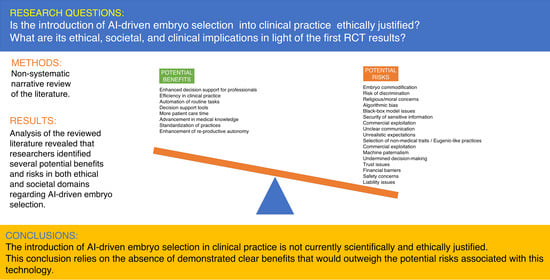
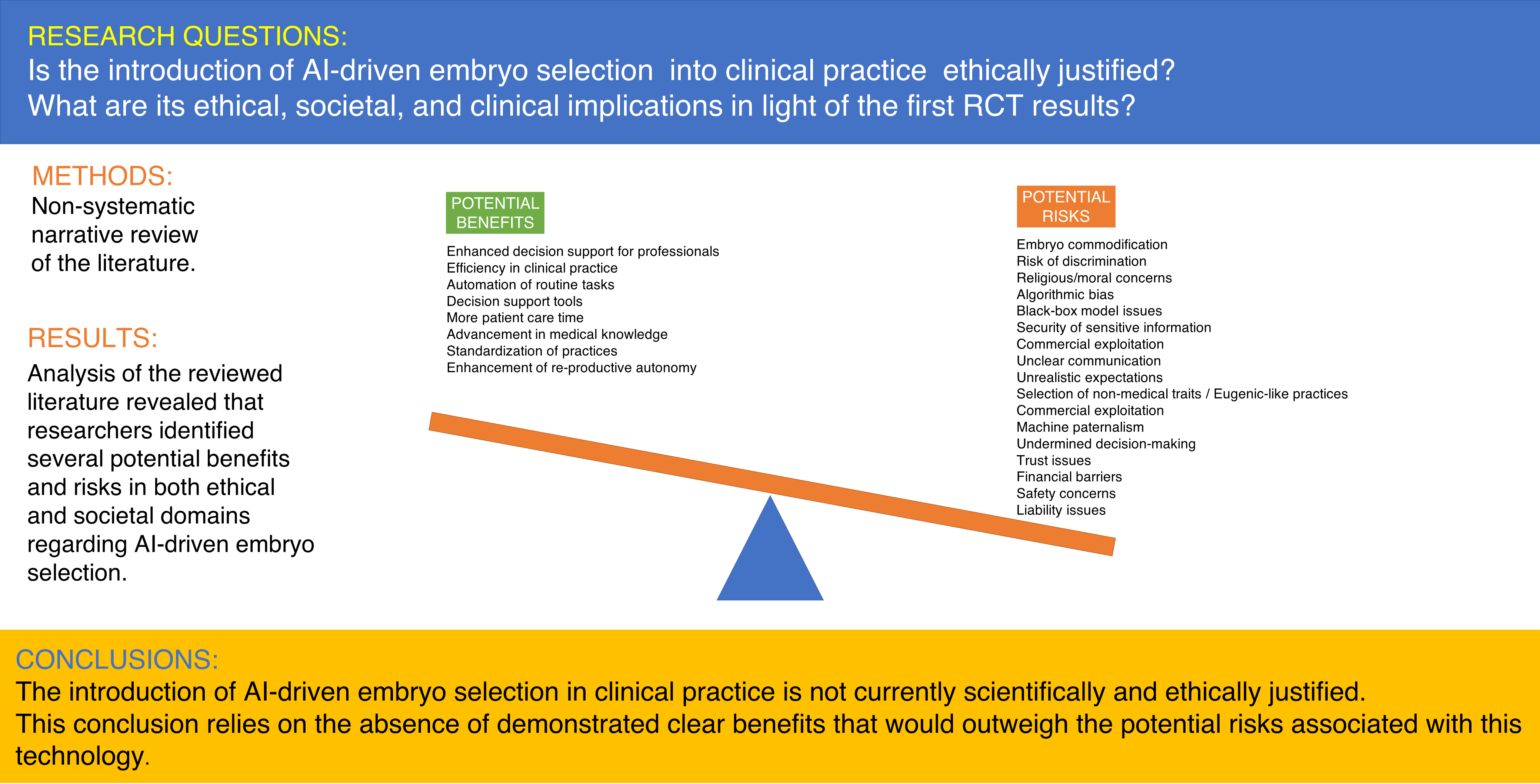
The introduction of artificial intelligence (AI) in embryo selection during in vitro fertilization presents distinct ethical and societal challenges compared to the general implementation of AI in healthcare. This narrative review examines ethical perspectives and potential societal implications of implementing AI-driven embryo selection. The literature reveals that some authors perceive AI as an extension of a technocratic paradigm that commodifies embryos, considering that any embryo selection methods undermine the dignity of human life. Others, instead, contend that prioritizing embryos with the highest viability is morally permissible while cautioning against discarding embryos based solely on unproven AI assessments. The reviewed literature identified further potential ethical concerns associated with this technique, including possible bias in the selection criteria, lack of transparency in black-box algorithms, risks of “machine paternalism” replacing human judgment, privacy issues with sensitive fertility data, equity of access, and challenges in maintaining human-centered care. These findings, along with the results of the only randomized controlled trial available, suggest that the introduction of AI-driven embryo selection in clinical practice is not currently scientifically and ethically justified. Implementing and deploying ethical and responsible AI in embryo selection would be feasible only if the ethical and societal concerns raised are adequately addressed.
Keywords: artificial intelligence; deep learning; decision-making; in vitro fertilization; embryo selection; ethics; personal autonomy; social responsibility; transparency; fairness artificial intelligence; deep learning; decision-making; in vitro fertilization; embryo selection; ethics; personal autonomy; social responsibility; transparency; fairness
Graphical Abstract