


Abstract
Research on sustainable consumption has largely emphasized secular motivations, leaving the psychological role of spirituality/religiosity underexplored within Muslim societies. Addressing this gap, this study investigates the relationship between spirituality and sustainable consumption behaviors (SCBs) among Muslim consumers in Türkiye, with environmental and health consciousness examined as parallel mediating mechanisms. Data were collected from 414 adult Muslim consumers through an online survey and analyzed using confirmatory factor analysis and structural path analysis via Hayes’ PROCESS macro (Model 4). The empirical findings indicate that spirituality is significantly and positively associated with sustainable consumption behaviors both directly and indirectly. Environmental consciousness emerged as a numerically stronger mediating pathway than health consciousness in the relationship between spirituality and sustainable consumption. Notably, when both mediators are included in the model, the direct path from spirituality to sustainable consumption behaviors becomes non-significant, consistent with a full-mediation pattern in the estimated model, in line with the value–attitude–behavior hierarchy. These results suggest that spirituality’s association with consumption decisions is, within the estimated model, transmitted through intervening attitudinal states. The study suggests that sustainable consumption initiatives in Muslim contexts can be meaningfully strengthened by integrating eco-friendly practices with consumers’ underlying spiritual and religious values.
1. Introduction
Almost six decades ago, White (1967) argued in Science that the ecological degradation of Western industrial civilization had its roots not in technology or economic policy alone, but in a religious imagination that had stripped nature of its sacred character and reduced it to a resource to be mastered. Whether or not one accepts White’s diagnosis, and many did not, his essay opened a question that has occupied scholars of religion and ecology ever since: how do the spiritual and moral frameworks people inherit shape the way they inhabit the earth?
The intervening decades have produced a substantial body of work in response. Berry’s (1999) vision of the great work of cultural-ecological transition, Taylor’s (2010) study of dark green religion, Gottlieb’s (2006) survey of faith-based environmentalism, and the editorial program of Tucker and Grim (2017) have together established eco-spirituality as a recognizable interdisciplinary field. What unites this literature, despite its internal diversity, is the premise that the ecological predicament cannot be resolved by data and policy alone. It requires what Berry called a reinvention of the human, a task as much spiritual as political.
Two limitations of this literature have grown increasingly visible. The first is that its center of gravity remains overwhelmingly Christian. Although studies of creation theology, indigenous spiritualities, and the religiously unaffiliated have multiplied, sustained empirical engagement with Muslim populations remains thin, even though Muslims constitute roughly a quarter of the world’s people and live disproportionately in regions that will bear the brunt of climate disruption (Khalid 2019). The second is methodological. The field is largely theological and philosophical in its tools, demonstrating what traditions might say about nature far more often than whether ordinary believers translate those teachings into action.
The present study addresses both gaps at once. It examines the relationship between spirituality and sustainable consumption behaviors (SCBs) among Muslim consumers in Türkiye, with environmental and health consciousness modeled as mediating mechanisms. Sustainable consumption is among the most concrete arenas in which eco-spiritual values become observable, since it encompasses recycling, energy and water conservation, the reuse of goods, preference for organic and locally sourced food, and the broader disposition toward voluntary simplicity (Jackson 2005). Spirituality, broadly understood, cultivates a sense of belonging to a larger whole and a moral responsibility extending beyond the self (Ellens 2008; Ulluwishewa 2014). In the Islamic tradition this orientation is articulated through a dense ethical vocabulary, including the concepts of khilāfa, amāna, mīzān, and fiṭra, that binds the believer to the natural order and to bodily well-being as forms of religious trust (Ayten et al. 2024; Nasr 1996; İ. Özdemir 2008). Whether these commitments translate into measurable consumption behaviors among contemporary Muslims has rarely been examined.
The contribution of this study is threefold. First, it brings empirical evidence from a Muslim-majority context to a field whose empirical base has remained largely Christian. Second, by modeling environmental and health consciousness as mediators, it moves beyond demonstrating an association between spirituality and sustainable behavior to offer a tested account of how that association operates. Third, by treating health consciousness alongside environmental consciousness, it brings into focus the Islamic ethical insight that body and earth share a common moral status as objects of human stewardship, a position implicit in several traditions but rarely integrated into sustainability research.
2. Theoretical Framework
2.1. Eco-Spirituality and Islamic Environmental Ethics
Eco-spirituality is best understood not as a single doctrine but as a family of orientations that locate environmental concern within a sacred or transcendent frame of reference. Taylor (2010) traces its contemporary forms to nineteenth and twentieth-century currents in American nature religion, whose common claim is that nature is a locus of meaning, value, and ethical obligation rather than a neutral backdrop to human projects. Berry (1999) articulated a parallel vision from within a broadly Catholic horizon, arguing that the modern severance of the human from the natural world lies behind the present crisis, while Tucker and Grim (2017) survey how the world’s religious traditions might be retrieved as resources for ecological imagination.
The place of Islam within this field has long been recognized in principle yet underdeveloped in practice. Nasr (1996) was among the earliest contemporary Muslim philosophers to draw sustained attention to the ecological dimensions of Islamic metaphysics, arguing that the environmental crisis is, at root, a crisis of the loss of the sacred. His work, together with that of Izzi Dien (2000), İ. Özdemir (2008), Quadir (2013), and Khalid (2019), has progressively articulated what may be called Islamic eco-spirituality, a synthesis of Qur’anic, prophetic, and juridical sources reread through the lens of contemporary ecological concern. The volume edited by Foltz et al. (2003) remains its most comprehensive scholarly treatment, while public statements such as the Islamic Declaration on Global Climate Change (International Islamic Climate Change Symposium 2015) and the more recent Al-Mizan: A Covenant for the Earth (United Nations Environment Programme 2024) translate classical Islamic categories into ecological language addressed to global audiences.
Four classical concepts carry the weight of this tradition. The first is khilāfa, often rendered as vicegerency or stewardship, derived from the Qur’anic statement that God placed the human being on earth as khalīfa (Qur’an 2:30). Muslim ecotheologians from Nasr (1996) to Khalid (2019) have argued that khilāfa is not a grant of dominion in the strong Baconian sense but a commission of responsibility in which authority is conditional on care for the trust received. The second concept, amāna, makes that conditionality explicit: the earth, the body, and ultimately existence itself are trusts placed in the believer’s hands, to be returned in a state no less worthy than that in which they were received (Izzi Dien 2000; Quadir 2013). The third, mīzān, names the principle of balance that, in the Qur’anic depiction, characterizes the natural order at its creation (Qur’an 55:7–9), so that human ecological wrongdoing is figured as a disturbance of this balance (Qur’an 30:41). The fourth, fiṭra, refers to the primordial nature with which all beings are created, and the believer’s task is to live in accordance with this nature rather than against it (İ. Özdemir 2008).
Read together, these concepts have important implications for the present study. In the Islamic tradition, ecological responsibility is not an additional theme appended to a generic spirituality but a structural feature of spiritual orientation as such, since to live as a Muslim in the demanding sense intended by classical sources is already to stand in a relationship of trust to the created order. The implication for empirical research is substantial. Where studies in Christian contexts have sometimes had to demonstrate the link between spirituality and ecological concern against the historical weight of White’s (1967) thesis, in Muslim contexts that link lies closer to the surface of the tradition itself. The framing is distinctive on a further point, the moral status of the body. Whereas most Western eco-spiritual writing treats environmental ethics and the ethics of personal health as separate domains, in Islamic reflection the body is itself amāna, a trust whose preservation is religiously obligatory (Rassool 2021). Caring for the body and caring for the earth thus become two expressions of a single ethic of stewardship, with direct implications for sustainable consumption, since consumption decisions simultaneously affect environmental systems and bodily health.
This conception of spirituality requires clarification, since the term carries a specific and potentially misleading connotation in the contemporary psychology of religion. In much of the Western, and especially North American, literature, spirituality and religiosity have been progressively differentiated, with spirituality denoting an individualized, subjective search for the sacred increasingly detached from institutional religion, and religiosity denoting adherence to organized tradition (Zinnbauer et al. 1997; Hill et al. 2000). The emblem of this differentiation is the now-familiar figure who is spiritual but not religious, for whom spiritual meaning is precisely what remains once institutional commitment is set aside (Pargament 1999). This polarization is historically and culturally specific to (post)secular Western modernity, and it does not transfer cleanly to societies in which religious tradition remains the dominant horizon of meaning. In classical Islamic thought, by contrast, spirituality is not a domain separable from religion but its interior dimension. The hadith of Gabriel presents islām, īmān, and iḥsān, the perfection of worship, as the three constitutive components of dīn, and iḥsān, cultivated through the disciplines later systematized as taṣawwuf, is the experiential core of religious life rather than an alternative to it (Nasr 1996; Knysh 2017). To deepen one’s spirituality, on this understanding, is to deepen one’s religion rather than to depart from it.
This theoretical point is matched by the empirical character of the present study’s setting. Türkiye is among the most religious societies in the world, since the overwhelming majority of its population identifies as Muslim and a large share regard religion as very important in their daily lives (Pew Research Center 2012). In such a context, spirituality is generally experienced as inseparable from religious belief and practice, and the deinstitutionalized spirituality characteristic of Western samples has not become culturally prevalent (Altınlı-Macić and Coleman 2015; Ayten 2021). When the present study treats spirituality as a psychological resource for sustainable consumption, it therefore refers not to a free-floating, post-religious sensibility but to an orientation substantively continuous with Islamic religiosity and the ethical architecture of khilāfa, amāna, mīzān, and fiṭra. It is this culturally embedded, religiously grounded spirituality whose behavioral consequences the paper sets out to test.
2.2. Spirituality and Sustainable Consumption Behavior
If the previous section sketched a tradition in which ecological responsibility is theologically intrinsic to spiritual orientation, the question now is whether that connection is observable at the level of consumer behavior. Sustainable consumption behaviors offer an apt site for such an inquiry because they occur at the intersection of daily routine, moral identity, and material throughput. They are not, in most cases, dramatic acts, but the small, repeated decisions that, aggregated across populations, determine ecological outcomes (Jackson 2005).
The literature on spirituality and sustainable consumption is younger than the broader literature on religion and environmental attitudes, but it has grown rapidly. Orellano et al. (2020) offer the most influential conceptual synthesis, arguing that religion and spirituality function as antecedents of sustainable consumption by providing a value framework, moral motivation, and communal reinforcement strong enough to translate concern into action. A recurring methodological observation is no less consequential, namely that most empirical studies have been conducted with Christian samples, so that conclusions presented as findings about religion and sustainability are, in practice, findings about Christian religion (Minton 2015; Muralidharan et al. 2024). Recent work has begun to broaden this base, integrating spirituality with cultural and behavioral models of consumption (Saxena and Sharma 2024), linking religiosity and spirituality to sustainable consumption through psychological well-being (Iqbal and Khan 2020), and extending the inquiry to mindfulness (Daniel et al. 2024) and to comparative national contexts (Yang and Lu 2024). Sustained work centered on Muslim populations nonetheless remains comparatively scarce and is concentrated in South and Southeast Asia, including studies of religiosity and ecologically conscious consumption (Islam and Chandrasekaran 2016), religious values and green purchasing (Ghazali et al. 2018), eco-conscious behavior in Pakistan (Hameed et al. 2019), and most recently transformational spirituality and pro-environmental behavior (Sohail et al. 2025).
The mechanisms through which spirituality is thought to shape consumption are several but share a common logic. Huneke (2005) emphasizes that spirituality cultivates voluntary simplicity, a disposition to reject consumerist excess in favor of a more deliberately frugal life, while Sharma and Sharma (2016) link spiritual orientation to lower self-centeredness and stronger altruistic motivation, and Ulluwishewa (2014) traces its influence through internal value structures that orient decisions across many domains. In each case spirituality functions not as a particular belief about consumption but as a deep value orientation whose effects propagate outward into behavior. In the Islamic context this logic gains further specificity, since the same vocabulary that grounds Islamic environmental ethics is mobilized in the literature on consumption. The Qur’anic injunction against isrāf (wasteful excess) and tabdhīr (squandering), and the corresponding ideal of iqtiṣād (measured economy), together constitute an ethic of moderation in consumption (Khalid 2019; Quadir 2013) whose behavioral correlates appear consistently in Muslim samples, where religious and spiritual values predict sustainable and health-conscious consumption alike (Hameed et al. 2019; Ishaq et al. 2021; Sohail et al. 2025).
The path from spirituality to behavior, however, is rarely direct. Homer and Kahle’s (1988) value–attitude–behavior hierarchy specifies that core values shape behavior primarily through their formative effect on intervening attitudes and forms of awareness. The implication is that spirituality should exhibit its strongest behavioral associations not by directly determining specific actions but through the cognitive and affective states through which value commitments are translated into concrete choices. In the present model these intervening states are environmental consciousness and health consciousness, the two attitudinal mediators most directly implicated in sustainable consumption. We accordingly hypothesize:
H3.
Spirituality is positively associated with sustainable consumption behaviors.
H4.
Spirituality is positively associated with environmental consciousness.
H5.
Spirituality is positively associated with health consciousness.
2.3. Environmental Consciousness as a Mediating Pathway
Environmental consciousness, in the sense established by Sanchez and Lafuente (2010), is a multidimensional construct encompassing information, beliefs, attitudes, and behavioral intentions oriented toward the natural environment. It is best understood not as a single attitude but as a configuration of cognitive and motivational orientations that predispose the individual to perceive ecological problems as morally salient and to act on that perception (Kim and Lee 2023). Behaviorally, it has been consistently linked to recycling, energy conservation, sustainable transportation, and green purchasing (Dönmez and Yardımcı 2024; Kaynak and Ekşi 2014).
The conceptual link between spirituality and environmental consciousness is grounded in both general spirituality research and the Islamic framework developed above. Spirituality cultivates a sense of universal connectedness, an awareness of being part of a whole that extends beyond the self and the human community (Ulluwishewa 2014), and this connectedness is a near-cognate of environmental consciousness, which can itself be characterized as the cognitive recognition of human embeddedness in ecological systems. In the Islamic frame the link is reinforced by the doctrine of mīzān, since the natural order is a balanced creation whose preservation is a religiously obligated act, and awareness of that order is part of what it means to live as khalīfa. Consistent with this, Kartopu et al. (2018) show that religiosity and a sense of responsibility are empirically intertwined in a Turkish sample. Empirical work corroborates the claim across contexts: religious belief predicts environmental orientation in Mexico (Felix and Braunsberger 2016), religious values shape pro-environmental behavior and intentions (Chung et al. 2019; Hwang 2018), religious values relate to green consumption among Muslim consumers (Ariswibowo and Ghazali 2017), and spirituality exerts mediated effects on green outcomes through ethical and behavioral pathways (Jalees et al. 2021). Most pertinent to the present argument, Preston and Shin (2022) show that once religion is decomposed, it is spirituality specifically, rather than religiosity in general, that predicts stronger climate belief and conservation intentions, while Billet and Baimel (2026) find across fifteen cultural samples that an ecospiritual orientation reliably predicts moral concern for nature. These results help explain the inconsistency of the earlier literature, since some studies report weak or null effects (Kanagy and Willits 1993; Sherkat and Ellison 2007), the relationship is sensitive to how religiosity is measured (Martin and Bateman 2014), and it proves positive and substantial where the construct is appropriately specified and the tradition emphasizes stewardship.
The behavioral consequence of environmental consciousness for sustainable consumption is among the most established findings in the field, since individuals who perceive the environment as an object of moral concern are more likely to recycle, choose green products, reduce ecologically costly consumption, and support sustainability-oriented policies (Dönmez and Yardımcı 2024). The mediating logic accordingly follows, in that spirituality cultivates environmental consciousness, which in turn motivates sustainable consumption. We hypothesize:
H1.
Environmental consciousness is positively associated with sustainable consumption behaviors.
H6.
Environmental consciousness mediates the association between spirituality and sustainable consumption behaviors.
2.4. Health Consciousness as a Mediating Pathway
The inclusion of health consciousness in a model of sustainable consumption may at first appear to require justification, since health and environment are often treated as separate ethical domains, the former pertaining to the self and the latter to the world. The framework developed in Section 2.1 dissolves this separation, because in the Islamic ethical tradition the body is itself amāna, a trust whose preservation is religiously obligatory (Rassool 2021). Caring for one’s health is therefore not only an individual interest but a form of fidelity to the divine commission, structurally analogous to caring for the earth, which makes health consciousness a theoretically coherent companion to environmental consciousness within an eco-spiritual model. Health consciousness, as defined by Gould (1988) and refined by Hong (2009, 2011), is a comprehensive mental attitude toward health that integrates self-awareness, personal responsibility for one’s well-being, and active motivation to maintain it. It manifests behaviorally in nutritional choices, exercise habits, attentiveness to preventive care, and resistance to known health risks, and it is empirically linked to attitudes toward organic food and the avoidance of additive-laden processed products within a broadly preventive and long-term orientation (Clark et al. 2019; Iqbal et al. 2021).
Health consciousness and sustainable consumption converge in practice because many of the behaviors that protect bodily health, such as choosing organic foods, avoiding chemically processed products, reducing consumption of intensively produced items, and preferring locally sourced goods, also reduce environmental burden (Li and Shan 2025; Parashar et al. 2023). This convergence is not coincidental but reflects the ecological fact that human bodies and ecosystems form a single interconnected system, which Islamic eco-spirituality theorizes through the doctrine of mīzān and which contemporary public health scholarship describes through the framework of planetary health (Whitmee et al. 2015), now extended to dietary patterns that simultaneously lower mortality risk and ecological impact (Bui et al. 2024).
The relationship between spirituality and health consciousness has been less extensively researched than the spirituality and environmental consciousness link, but the available evidence is consistent and growing. A recent systematic review concludes that greater religious and spiritual commitment is positively associated with health-promoting behaviors, including physical activity and broader preventive orientations (Kruk and Aboul-Enein 2024), and complementary work shows that spiritually oriented individuals display lower levels of health-risk behaviors (Espinosa and Kadić-Maglajlić 2018), while health consciousness itself has emerged as a central psychological determinant of healthy and sustainable food choices (Escobar-Farfán et al. 2025). The mechanism parallels that hypothesized for environmental consciousness, since spirituality cultivates a sense of responsibility for what has been entrusted to the believer, and the body, in the Islamic framing, is the first such trust. Where general spiritual orientation supplies the underlying value commitment, health consciousness provides the proximate motivational state that translates that commitment into specific consumption choices. We accordingly hypothesize:
H2.
Health consciousness is positively associated with sustainable consumption behaviors.
H7.
Health consciousness mediates the association between spirituality and sustainable consumption behaviors.
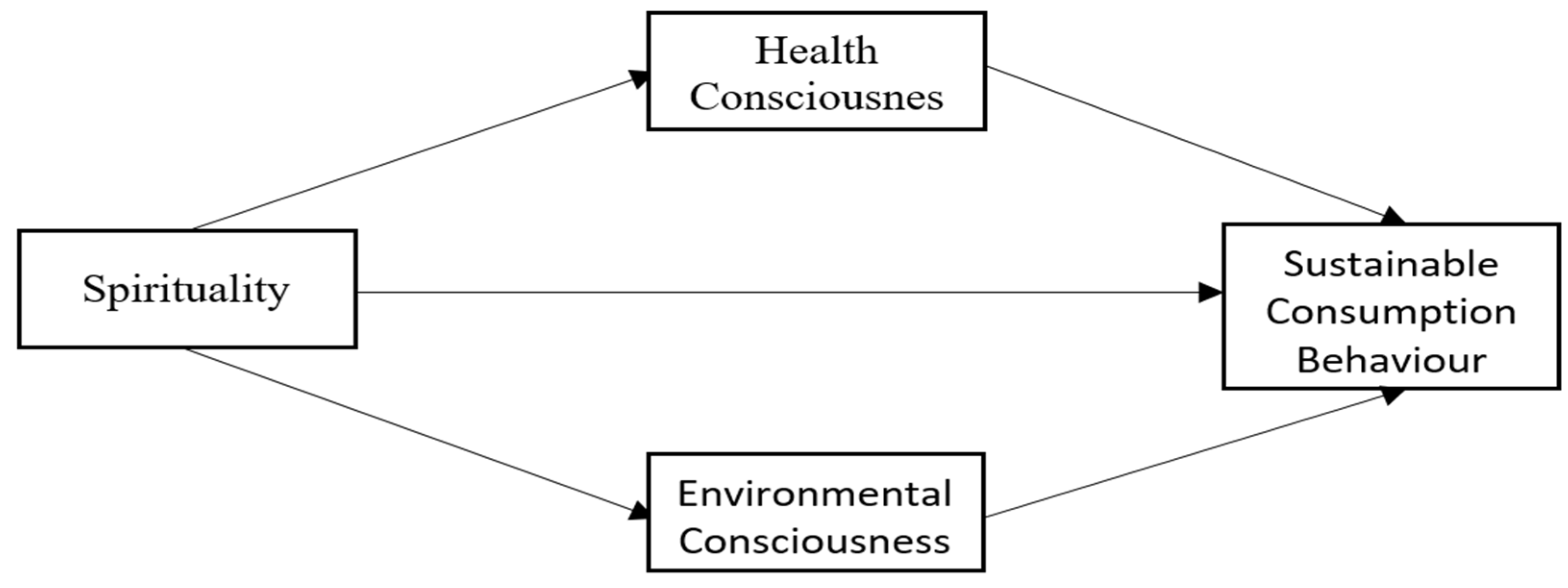
The proposed mediation model is summarized in Figure 1.
Figure 1.
Proposed research model.
3. Method
3.1. Participants and Procedure
This study employed a cross-sectional design, with data collected through a self-administered online survey of adult Muslim consumers in Türkiye. Because the target population, Muslim consumers engaged in everyday purchasing decisions, is large and geographically dispersed, a non-probability convenience sampling approach was adopted: the survey link, hosted on Google Forms, was distributed through social media channels and propagated further via participant referral (Fraenkel et al. 2012). This procedure was chosen for its efficiency in reaching a broad, dispersed adult consumer population at low cost; its non-probability nature is acknowledged as a limitation in the final section. Prior to data collection, the questionnaire was reviewed by three academics with subject-matter expertise to establish face validity and was then pilot-tested with twenty consumers. Only minor wording and spelling revisions were required, after which the finalized instrument was distributed.
All data collection procedures were conducted in strict accordance with the ethical standards of the institutional research committee and with the 1964 Helsinki Declaration and its later amendments or comparable ethical standards. Ethical approval for this study was formally granted by the Scientific Research and Publication Ethics Committee of Gümüşhane University (Meeting Date: 25 October 2024; Decision No: 2024/8). Participation was entirely voluntary and anonymous; respondents were presented with an information sheet explaining the study’s scope, data confidentiality, and anonymity assurances, and they provided explicit informed consent electronically before gaining access to the survey.
The minimum required sample size was estimated a priori using G*Power 3.1.9.7 (Faul et al. 2007) for the regression-based tests that are central to the proposed model. Assuming a medium effect size (f2 = 0.15), α = 0.05, statistical power (1 − β) = 0.95, and up to three predictors, the analysis indicated that 119 participants would suffice; since this represents the most demanding specification considered, the retained sample of 414 provides ample power for the bivariate tests reported below. Data were collected between 15 February and 15 March 2025. After data screening, 414 valid responses were retained for analysis—well above the calculated threshold and consistent with conventional sample-size guidance for confirmatory factor analysis and bootstrapped mediation. The demographic characteristics of the sample form the basis of Table 1.
Table 1.
Demographic characteristics.
The authors used Anthropic’s Claude as a writing aid to review the reporting of statistical procedures and to refine the English translation. All conceptual content, analytical decisions, and interpretation remained the authors’ own.
3.2. Measures
The questionnaire comprised two sections. The first collected demographic information (e.g., gender, marital status, age, education, and income), and the second contained the multi-item scales corresponding to the dependent, independent, and mediating variables in the research model. All scales had been previously validated and reported as reliable. Three of the instruments, those measuring sustainable consumption behavior, environmental consciousness, and health consciousness, were originally developed in English and were therefore translated into Turkish using a translation–back-translation procedure under expert supervision; the spirituality measure was developed in Turkish and was administered in its original form. All scale items used a five-point Likert response format (1 = “strongly disagree”, 5 = “strongly agree”).
Dependent variable. Sustainable consumption behavior was measured with the five-item scale used by Minton et al. (2022), adapted from Tambyah et al. (2009). A sample item is “I usually buy products that use recyclable packaging”. The Cronbach’s alpha reliability coefficient for this scale was 0.84.
Independent variable. Spirituality was operationalized using Kasapoğlu’s (2015) Spiritual Orientation Scale, an eleven-item instrument developed and validated with Turkish samples. Sample items include “I feel the presence of a higher power deep within my soul” and “Prayer/meditation provides me with emotional support”. The Cronbach’s alpha reliability coefficient was 0.96.
Mediating variables. Environmental consciousness was measured with the five-item scale developed by Haws et al. (2014); a sample item is “I can describe myself as an environmentally conscious person”. Health consciousness was assessed with five items adapted from Gould’s (1988) health consciousness scale; a sample item is “I am sensitive to changes in my health”. The Cronbach’s alpha reliability coefficients were 0.86 for environmental consciousness and 0.85 for health consciousness.
3.3. Data Analysis
The data were analyzed using SPSS (Version 24.0) and AMOS (Version 24). CB-SEM was preferred over PLS-SEM because the study aims to test an established theoretical model with previously validated reflective scales, and CB-SEM provides overall goodness-of-fit indices (CFI, NFI, TLI, RMSEA) that support model evaluation in confirmatory contexts (Hair et al. 2019). Descriptive and frequency analyses were first conducted to characterize the sample, and the distributional properties of the items were examined through their skewness and kurtosis values. The measurement model was assessed in AMOS through confirmatory factor analysis (CFA) with maximum likelihood estimation, yielding standardized factor loadings and model fit indices. Reliability was evaluated using Cronbach’s alpha, and convergent and discriminant validity were assessed through composite reliability (CR) and average variance extracted (AVE), both computed from the standardized factor loadings. For the hypothesis tests, composite scores were formed by averaging each construct’s items. Direct effects were tested in SPSS using a series of bivariate regression analyses, and the mediating roles of environmental and health consciousness were examined with Model 4 of the PROCESS macro (Hayes 2018), in which indirect effects were evaluated using 5000 bootstrap resamples and their 95% confidence intervals. To assess the robustness of these effects against potential confounding factors, the mediation model was re-estimated by including gender, marital status, age, income, and education level as covariates. Because all variables were measured through self-report within a single survey, the potential for common method bias was examined using Harman’s single-factor test (Podsakoff et al. 2003).
4. Results
4.1. Measurement Model Assessment
Prior to the reliability and validity analyses, the distributional properties of the data were examined using skewness and kurtosis. Skewness values within ±3 and kurtosis values within ±10 are generally regarded as acceptable for maximum likelihood estimation (Kline 2005). In the present data, skewness and kurtosis values ranged from −2.373 to +6.527, falling within these limits and indicating no severe departures from normality. Harman’s single-factor test indicated that a single unrotated factor accounted for 40.09% of the total variance, which is below the 50% threshold, suggesting that common method bias was not a serious concern in this study (Podsakoff et al. 2003). Harman’s single-factor test is widely acknowledged to have limited diagnostic value for detecting common method bias (Fuller et al. 2016; Podsakoff et al. 2003). Therefore, the results should not be interpreted as conclusive evidence that common method bias is absent, but rather as a preliminary indication that it is unlikely to pose a serious threat to the findings.
The measurement model was then assessed through confirmatory factor analysis (CFA) with maximum likelihood estimation. Model fit was evaluated against established thresholds (χ2/df < 5, RMSEA < 0.08, and NFI, CFI, TLI, and IFI > 0.90; Jöreskog and Sörbom 1984; Bagozzi and Yi 1988). The model showed a good fit to the data: χ2/df = 2.421, CFI = 0.945, NFI = 0.911, IFI = 0.946, TLI = 0.939, and RMSEA = 0.059.
Reliability and convergent validity were assessed using Cronbach’s alpha, standardized factor loadings, composite reliability (CR), and average variance extracted (AVE). Cronbach’s alpha values above 0.70 were considered acceptable, while convergent validity required loadings above 0.50, CR above 0.70, and AVE above 0.50 (Fornell and Larcker 1981; Hair et al. 2010). Table 2 reports the standardized factor loadings, α, CR, and AVE values for each construct.
Table 2.
Details about Confirmatory Factor Analysis.
As shown in Table 2, the standardized factor loadings for all items, together with the CR and AVE values for each construct, exceeded the recommended thresholds (loadings > 0.50, CR > 0.70, AVE > 0.50), supporting the convergent validity of the measurement model.
Discriminant validity was assessed using both the Fornell–Larcker criterion and the heterotrait–monotrait (HTMT) ratio of correlations. The Fornell–Larcker criterion requires the square root of each construct’s AVE to exceed its correlations with the other constructs (Fornell and Larcker 1981; Chin 1998); as shown in Table 3, this condition was met for all constructs, since each diagonal value exceeded the corresponding off-diagonal correlations. The HTMT results provided converging evidence: all HTMT ratios were below the conservative 0.85 threshold (Henseler et al. 2015), with the highest value (EC–SCB = 0.75) remaining well within acceptable limits. In addition, the significant positive correlations among the constructs, consistent with theoretical expectations, support the nomological validity of the measures.
Table 3.
Discriminant validity of constructs.
4.2. Hypothesis Testing
A series of bivariate regression analyses was conducted to test the hypothesized relationships among spirituality, environmental consciousness, health consciousness, and sustainable consumption behavior. The results are presented in Table 4.
Table 4.
Results of the regression analyses.
Environmental consciousness was a significant positive predictor of sustainable consumption behavior (β = 0.64, p < 0.001), accounting for 40% of its variance, which supports H1. Health consciousness likewise had a significant positive effect on sustainable consumption behavior (β = 0.56, p < 0.001, R2 = 0.32), supporting H2. Spirituality was also a significant positive predictor of sustainable consumption behavior (β = 0.26, p < 0.001), supporting H3, although it accounted for a smaller share of the variance (R2 = 0.07). In addition, spirituality significantly predicted both environmental consciousness (β = 0.39, p < 0.001, R2 = 0.15) and health consciousness (β = 0.38, p < 0.001, R2 = 0.15), supporting H4 and H5. Taken together, these findings provide support for the first five hypotheses.
4.3. Mediation Analysis
To test the mediating roles of environmental and health consciousness, a parallel multiple mediation analysis was conducted using Model 4 of the PROCESS macro (Hayes 2018), with 5000 bootstrap samples and 95% bias-corrected confidence intervals. An indirect effect is considered significant when its confidence interval does not include zero (Preacher and Hayes 2008). The results are reported in Table 5.
Table 5.
Standardized indirect effects of spirituality on sustainable consumption behavior.
As shown in Table 5, spirituality exerted a significant indirect effect on sustainable consumption behavior through environmental consciousness (β = 0.19, 95% CI [0.12, 0.26]), supporting H6, and through health consciousness (β = 0.12, 95% CI [0.07, 0.19]), supporting H7. In both cases the confidence intervals excluded zero. The indirect effect through environmental consciousness was numerically larger than the indirect effect through health consciousness. However, the contrast analysis indicated that this difference was not statistically significant, as the 95% confidence interval included zero (difference = 0.06, 95% CI [−0.01, 0.14]). Accordingly, both pathways should be regarded as comparably important mediating mechanisms in explaining the relationship between spirituality and sustainable consumption. While the total effect of spirituality on sustainable consumption behavior was significant (c = 0.26, p < 0.001), its direct effect became non-significant once the mediators were included (c′ = −0.05, p = 0.214), indicating that spirituality’s association with sustainable consumption behavior was, within the estimated model, transmitted through environmental and health consciousness.
To examine the sensitivity of the mediation results to demographic characteristics, the model was re-estimated by including gender, marital status, age, income, and education level as predictors of environmental consciousness, health consciousness, and sustainable consumption behavior. The re-estimated model produced virtually identical results. The indirect effects through environmental consciousness (b = 0.20, 95% CI [0.13, 0.30]) and health consciousness (b = 0.13, 95% CI [0.07, 0.21]) remained significant, whereas the direct effect of spirituality on sustainable consumption behavior remained non-significant (b = −0.07, p = 0.170). These findings indicate that the observed mediation effects are robust and cannot be attributed to demographic characteristics.
5. Discussion and Conclusions
This study set out to examine how spirituality relates to sustainable consumption behavior among Muslim consumers in Türkiye, with environmental and health consciousness modeled as parallel mediating mechanisms. All five direct hypotheses were supported, confirming that spirituality is positively associated with both mediators and that each mediator independently predicts sustainable consumption behavior. The mediation analysis, however, yields the study’s central theoretical contribution. Once environmental and health consciousness are entered as mediators, the direct path from spirituality to sustainable consumption behavior becomes non-significant, indicating that, within the estimated model, spirituality’s association with consumption is transmitted through these two attitudinal states. The finding of full mediation is specific to the model tested in this study and should not be interpreted as evidence that all possible pathways linking spirituality and behavior have been fully identified. Because the data were collected at a single point in time, the possibility of other unmeasured mediating variables, as well as alternative directions of the relationships, should also be taken into consideration.
The full-mediation pattern in the statistical model aligns with the logic of Homer and Kahle’s (1988) value–attitude–behavior hierarchy, which positions core values as distal antecedents that shape behavior indirectly by first cultivating specific attitudinal orientations. Spirituality occupies the uppermost tier of this hierarchy as a broad, abstract value orientation whose behavioral association is not manifested through a direct cognitive calculus of consumption choices; rather, it appears to work through the intermediate attitudinal states in which concrete decisions are grounded. Environmental consciousness and health consciousness are precisely such states. They represent the cognitive-affective recognition of moral obligations toward the natural world and the human body, respectively, and it is through these proximate orientations that spiritual commitment appears to be linked to the domain of marketplace behavior. The finding that the direct path becomes non-significant once the mediators are present is therefore not a disconfirmation of spirituality’s role but a precise specification of the pattern through which that role appears to be expressed. Spirituality does not bypass the cognitive and affective architecture of consumer decision-making; rather, its association with behavior appears to run through that architecture. In this sense, religion and spirituality may be understood as establishing a sense of trust rather than possession (Ayten 2021), an orientation associated with heightened awareness of autonomous responsibility toward both self and surroundings, which in turn appears linked to consumption decisions through environmental and health-oriented pathways.
The finding that environmental consciousness positively predicts sustainable consumption behavior is consistent with a well-established body of prior work (Kaynak and Ekşi 2014; Dönmez and Yardımcı 2024; Akın et al. 2010; Trinh et al. 2025), and the present results are consistent with the observation that higher environmental knowledge is associated with a stronger predisposition to prefer recyclable, resource-efficient, and ecologically oriented products and services. The indirect effect through environmental consciousness was numerically larger than the indirect effect through health consciousness, and this pathway is broadly consistent with the theoretical framework of Islamic eco-spirituality, in which the earth’s status as amāna is elaborated across Qur’anic and juristic sources with particular richness. The doctrine of mīzān articulates the natural order as a divinely calibrated balance whose disruption constitutes moral transgression (Qur’an 55:7–9; 30:41), and the concept of khilāfa charges the believer with active, responsible stewardship of the created world rather than passive enjoyment of its resources (Nasr 1996; Khalid 2019). Environmental consciousness, as the cognitive recognition of human embeddedness in ecological systems and the corresponding sense of moral salience, is thus a near-direct translation of these classical concepts into a contemporary psychological construct. Its emergence as the numerically stronger mediating pathway is consistent with the view that Islamic spirituality embodies an environmental ethic that is structurally embedded rather than optional or secondary. Consistent with this interpretation, prior research has shown that environmental consciousness mediates the impact of green product knowledge on consumer purchasing choices (Çelik and Durmaz 2025), and that it functions as a mediator between green advertising and purchasing behavior as well as between eco-labels and green purchasing behavior (Jalees et al. 2021).
The significant indirect path through health consciousness is interpretively consistent with a longstanding position in Islamic ethical reflection, namely that the body and the earth share a common moral status as objects of divinely entrusted stewardship. The present study did not, however, directly measure Islamic doctrinal constructs; the observed pattern is therefore offered as consistent with, rather than as empirical confirmation of, this theological framing. In the Islamic tradition, bodily integrity is not merely a personal preference but a religiously obligated form of care, since the human body is itself amāna, a trust to be preserved and returned in the condition in which it was received (Rassool 2021). Health consciousness, defined as a comprehensive motivational orientation toward maintaining and protecting one’s well-being (Gould 1988; Hong 2009), operationalizes this commitment at the level of individual psychology. Individuals with high health consciousness prefer products that are low in additives, organic, and environmentally oriented, and they display a sustained concern for long-term physical and ecological well-being (Iqbal et al. 2021; Parashar et al. 2023; Li and Shan 2025). This convergence of health-protective and environmentally protective consumption choices reflects the ecological insight that human bodies and ecosystems form a single interconnected system, a position theorized in Islamic tradition through mīzān and paralleled, at the level of general spiritual orientation rather than doctrinal content, by the mediating role of health consciousness documented here. Caring for the body and caring for the earth are not two separate ethical projects in this tradition; they are two expressions of a single underlying orientation of fidelity to the divine trust, and the parallel mediation structure of the empirical model is broadly congruent with that theological symmetry. Prior research has similarly documented health consciousness as a mediator between environmental concerns and organic food purchasing intention (Uyanık et al. 2025), and between green product knowledge and green purchase intention (Sriramaneni et al. 2025), lending further convergent support to the present findings.
These results also offer a valuable point of comparison with the broader Western literature on religion, spirituality, and environmental concern, particularly by providing evidence from a Muslim-majority sample that has been largely absent from this body of work. White’s (1967) influential argument held that the Judeo-Christian tradition, by positioning the human being as sovereign over a desacralized nature, supplied the ideological preconditions for ecological exploitation. Subsequent empirical work produced a complex and often contradictory picture. Kanagy and Willits (1993) found weak or null associations between religiosity and environmental orientation in Christian samples, and Sherkat and Ellison (2007) identified considerable structural variation depending on denominational affiliation and the content of specific beliefs. Eckberg and Blocker (1996) showed that the relationship between religion and environmental concern differs substantially by doctrinal emphasis, with traditions stressing creation theology yielding more consistently positive associations, while Martin and Bateman (2014) demonstrated that the direction and magnitude of the relationship are sensitive to how religiosity is measured, such that studies using generic affiliation measures often miss the effects that emerge when belief content is assessed directly. The body of work on intrinsic religiosity is particularly instructive here: intrinsically driven religious orientation has been found to promote reuse, recycling, and environmentally beneficial consumer behaviors (Granzin and Olsen 1991; Hameed et al. 2019; Islam and Chandrasekaran 2016), whereas extrinsic orientation does not consistently produce the same effects (Hameed et al. 2019). The present findings are coherent with this pattern. In an Islamic context, where the stewardship framework of khilāfa and the ethical architecture of amāna and mīzān are not peripheral emphases but central doctrinal commitments, spirituality and ecological concern converge rather than conflict. Preston and Shin (2022) similarly found that spirituality, when distinguished from doctrinal religiosity, predicted stronger climate beliefs and conservation intentions, and Billet and Baimel (2026) report across fifteen cultural samples that an ecospiritual orientation reliably predicts moral concern for nature. The present study extends this pattern into a Muslim-majority context and demonstrates that its behavioral consequences extend to everyday consumer choice.
The findings of this study suggest that in Muslim-majority countries such as Türkiye, the conceptual boundary between religion and spirituality is considerably less sharp than the Western literature typically assumes. Although the divergence between the two constructs has deepened steadily in that literature, in societies where religious tradition continues to exert a formative influence on social life, spirituality is generally not perceived as a separate domain from religious commitment or as an advanced stage that supersedes it. Indeed, in studies conducted with Muslim samples, the two concepts are often used interchangeably (Koenig 2012). Religion and spirituality may be distinguished or may overlap depending on whether one approaches them through an inclusive or an exclusive lens. Spirituality tends to appear as a concept denoting an inward search for meaning, while religion is understood as the outward behaviors through which individuals express the domains of meaning they have created or discovered in their inner lives (Ellens 2008). Along similar lines, spirituality has been increasingly associated with the private sphere of thought and experience, whereas religion is more closely linked to the public sphere, encompassing participation in religiously defined rituals, membership in religious communities, and adherence to formal denominations (Fuller 2001). Accordingly, whether the two concepts are viewed as inclusive or exclusive depends on the interpretive framework applied to them. In the Turkish case, it can be argued that both concepts are experienced and understood in their inclusive dimensions, such that spirituality and religious commitment are not opposed but mutually reinforcing orientations that together shape the individual’s engagement with the natural world and with consumption. This point of genuine cultural specificity limits direct comparison with findings from North American or Northern European samples where the spiritual-but-not-religious profile is more prevalent, and it underscores the value of extending sustainability research beyond its predominantly Western and Christian-centric empirical base.
6. Implications and Limitations
This study makes three theoretical contributions. The first is the demonstration that the relationship between spirituality and sustainable consumption behavior is, within the estimated model, fully mediated by environmental and health consciousness. By positioning spirituality as a distal value orientation whose behavioral influence is transmitted through proximate attitudinal states, the study provides empirical support consistent with the value–attitude–behavior hierarchy (Homer and Kahle 1988) in a domain and a cultural setting to which it has rarely been applied.
The second contribution lies in modeling environmental and health consciousness as parallel mediators within a single framework. Prior work has examined the mediating role of environmental consciousness (Jalees et al. 2021), the influence of health consciousness on consumption (Iqbal et al. 2021), and the link between spirituality and sustainable behavior (Orellano et al. 2020) in isolation, but their joint operation has not previously been tested. The present results show that the two forms of consciousness share a common spiritual root, supporting the theological proposition that environmental and bodily care derive from a single ethic of stewardship in which amāna and mīzān extend simultaneously to the earth and the body.
The third contribution is contextual. Research on religion, spirituality, and sustainable consumption has been conducted overwhelmingly in Christian or secular Western settings (Minton 2015; Muralidharan et al. 2024). By examining these relationships in a Muslim-majority sample and interpreting them through Islamic ethical concepts such as amāna and mīzān, the study extends the empirical and theoretical scope of the field to a population that bears a disproportionate share of environmental burden yet remains underrepresented in the literature (Khalid 2019).
The findings carry implications for marketing practice, public policy, and civil society. Because spirituality’s association with sustainable consumption in the present model was fully mediated by environmental and health consciousness, appeals directed at spiritual identity alone are unlikely to change behavior. In promoting organic or eco-friendly products, marketers would therefore do better to emphasize the environmental and health benefits that resonate with the values of spiritually oriented consumers than to rely on explicitly religious messaging, which risks appearing manipulative. Framing these benefits in terms of responsibility and care for what has been entrusted aligns with such consumers’ underlying commitments without invoking contested theological claims. The finding that environmentally and health-conscious consumers are more inclined toward sustainable products further suggests that segmentation based on these attitudes may be more effective than segmentation by religious affiliation alone.
For public institutions and civil society organizations in Muslim-majority contexts, environmental messages may gain traction when connected to shared moral commitments such as the avoidance of waste and the maintenance of balance. Rather than instrumentalizing religion, campaigns can draw on spiritually grounded values of responsibility to motivate behavioral change. Given that both environmental and health consciousness predict sustainable purchasing, educational programs and government incentives that raise these two forms of awareness together are likely to be especially effective.
Several limitations qualify these conclusions and indicate directions for future research. First, the value–attitude–behavior hierarchy implies a temporal sequence in which values shape attitudes that in turn shape behavior, but the cross-sectional design cannot establish that sequence; the relationships reported here are associational, and longitudinal or experimental designs are needed to test the causal ordering. Second, the data were collected through non-probability convenience sampling via social media, and the sample was predominantly highly educated, with the large majority holding an associate degree or higher. Both features limit generalizability, and replication with probability-based and more demographically diverse samples would strengthen external validity. Third, spirituality was assessed with a general measure of spiritual orientation rather than with an instrument capturing the specific Islamic theological constructs (khilāfa, amāna, mīzān, fiṭra) that frame the study; although general spiritual orientation is substantively continuous with religiosity in this highly religious context, the theological interpretation offered in the Discussion should therefore be read as an interpretive framing consistent with the observed pattern, not as empirical confirmation of these specific doctrinal constructs. Developing and validating measures that operationalize khilāfa, amāna, mīzān, and fiṭra directly is a valuable avenue for future work and is essential before any claim of empirical support for these constructs can be made.
The mediation model was also deliberately parsimonious. Future research could enrich it by incorporating additional mediators such as voluntary simplicity and moral identity, which prior work has linked to spirituality and sustainability (Sharma and Sharma 2016; N. Özdemir 2021), and by testing moderators such as income, gender, place of residence, and cultural orientation, including collectivism (Hofstede 1980).
Author Contributions
Conceptualization, İ.A., H.H. and M.E.V.; methodology, İ.A. and M.E.V.; software, İ.A.; validation, İ.A., H.H. and M.E.V.; formal analysis, İ.A. and M.E.V.; investigation, H.H. and İ.A.; resources, M.E.V.; data curation, İ.A. and M.E.V.; writing—original draft preparation, M.E.V., İ.A. and H.H.; writing—review and editing, M.E.V.; visualization, İ.A. and M.E.V.; supervision, M.E.V.; project administration, M.E.V.; funding acquisition, M.E.V. All authors have read and agreed to the published version of the manuscript.
Funding
The APC was funded by Recep Tayyip Erdoğan University Development Foundation, grant number 02026005020351.
Institutional Review Board Statement
The study was conducted in accordance with the Declaration of Helsinki and approved by the Scientific Research and Publication Ethics Committee of Gümüşhane University (protocol code: 2024/8 and date of approval: 25 October 2024).
Informed Consent Statement
Informed consent was obtained from all subjects involved in the study.
Data Availability Statement
Data for this study are available from the corresponding author upon reasonable request.
Acknowledgments
During the preparation of this manuscript, the authors used Anthropic Claude for the purposes of assisting in reporting statistical analysis workflows and refining the technical precision of the English translation. The authors have reviewed and edited the output and take full responsibility for the content of this publication.
Conflicts of Interest
The authors declare no conflicts of interest.
References
- Akın, Murat, Recep Çiçek, Mehmet Emin İnal, and Murat Toksarı. 2010. Niğde ilindeki tüketicilerin sosyo demografik özellikleri ile organik gıdalara ilişkin tutum ve bireysel değerleri arasındaki farklılığın incelenmesine yönelik bir araştırma. Dokuz Eylül Üniversitesi Sosyal Bilimler Enstitüsü Dergisi 12: 29–56. [Google Scholar]
- Altınlı-Macić, Merve, and Thomas J. Coleman, III. 2015. Spirituality and religion: An empirical study using a Turkish Muslim sample. In Psychology of Religion in Turkey. Edited by Zuhal Ağılkaya-Şahin, Heinz Streib, Ali Ayten and Ralph W. Hood Jr. Leiden: Brill, pp. 160–76. [Google Scholar] [CrossRef] [Scilit] [PubMed]
- Ariswibowo, Nanang, and Ezlika Ghazali. 2017. Green purchase behaviours of Muslim consumers: An examination of religious value and environmental knowledge. Journal of Organizational Studies and Innovation 4: 39–56. [Google Scholar]
- Ayten, Ali. 2021. Doğa Bize Emanet. İstanbul: İz Yayıncılık. [Google Scholar]
- Ayten, Ali, Muhammet Enes Vural, and Rahime Eymen Bakır. 2024. Sürdürülebilirlik ve Emanet Bilinci: Çevresel Tutum ve Davranışlarda Değerlerin Rolü Üzerine. In Proceedings of the 7th International Symposium on the Environment and Morals (ISEM2024). 7. Uluslararası Çevre ve Ahlak Sempozyumu. İstanbul: İstanbul Teknik Üniversitesi, pp. 235–42, e-ISBN 978-605-81053-4-8. [Google Scholar]
- Bagozzi, Richard P., and Youjae Yi. 1988. On the evaluation of structural equation models. Journal of the Academy of Marketing Science 16: 74–94. [Google Scholar] [CrossRef]
- Berry, Thomas. 1999. The Great Work: Our Way into the Future. New York: Bell Tower. [Google Scholar]
- Billet, Matthew I., and Adam Baimel. 2026. Ecospirituality predicts pro-environmental outcomes across cultures. Environment and Behavior 58: 418–47. [Google Scholar] [CrossRef] [Scilit] [PubMed]
- Bui, Linh P., Tung T. Pham, Fenglei Wang, Boyang Chai, Qi Sun, Frank B. Hu, Kyu Ha Lee, Marta Guasch-Ferré, and Walter C. Willett. 2024. Planetary Health Diet Index and risk of total and cause-specific mortality in three prospective cohorts. American Journal of Clinical Nutrition 120: 80–91. [Google Scholar] [CrossRef] [Scilit] [PubMed]
- Chin, Wynne W. 1998. The partial least squares approach to structural equation modeling. In Modern Methods for Business Research. Edited by George A. Marcoulides. Mahwah: Lawrence Erlbaum Associates, pp. 295–336. [Google Scholar]
- Chung, Min Gon, Hana Kang, Thomas Dietz, Patricia Jaimes, and Jianguo Liu. 2019. Activating values for encouraging pro-environmental behavior: The role of religious fundamentalism and willingness to sacrifice. Journal of Environmental Studies and Sciences 9: 371–85. [Google Scholar] [CrossRef] [Scilit]
- Clark, Michael A., Marco Springmann, Jason Hill, and David Tilman. 2019. Multiple health and environmental impacts of foods. Proceedings of the National Academy of Sciences 116: 23357–62. [Google Scholar] [CrossRef] [Scilit] [PubMed]
- Çelik, Çetin, and Yakup Durmaz. 2025. The mediating role of environmental consciousness in the effect of green product awareness on consumer purchase intention. Adıyaman Üniversitesi Sosyal Bilimler Enstitüsü Dergisi 49: 382–406. [Google Scholar] [CrossRef] [Scilit]
- Daniel, Carole, Rafi M. M. I. Chowdhury, and Elodie Gentina. 2024. Mindfulness, spiritual well-being, and sustainable consumer behavior. Journal of Cleaner Production 455: 142293. [Google Scholar] [CrossRef] [Scilit]
- Dönmez, Renginar Öztürk, and Eda Yardımcı. 2024. Environmental awareness and sustainable consumption behaviours of Turkish nursing students. PeerJ 12: e17366. [Google Scholar] [CrossRef] [Scilit] [PubMed]
- Eckberg, Douglas Lee, and T. Jean Blocker. 1996. Christianity, environmentalism, and the theoretical problem of fundamentalism. Journal for the Scientific Study of Religion 35: 343–55. [Google Scholar] [CrossRef] [Scilit] [PubMed]
- Ellens, J. Harold. 2008. Understanding Religious Experiences: What the Bible Says about Spirituality. Westport: Praeger Publishers. [Google Scholar]
- Escobar-Farfán, Manuel, Elizabeth Emperatriz García-Salirrosas, Mauricio Guerra-Velásquez, Iván Veas-González, Ledy Gómez-Bayona, and Rodrigo Gallardo-Canales. 2025. Psychological determinants of healthy food purchase intention: An integrative model based on health consciousness. Nutrients 17: 1140. [Google Scholar] [CrossRef] [Scilit] [PubMed]
- Espinosa, Adriana, and Selma Kadić-Maglajlić. 2018. The mediating role of health consciousness in the relation between emotional intelligence and health behaviors. Frontiers in Psychology 9: 2161. [Google Scholar] [CrossRef] [Scilit] [PubMed]
- Faul, Franz, Edgar Erdfelder, Albert-Georg Lang, and Axel Buchner. 2007. G*Power 3: A flexible statistical power analysis program for the social, behavioral, and biomedical sciences. Behavior Research Methods 39: 175–91. [Google Scholar] [CrossRef] [Scilit] [PubMed]
- Felix, Reto, and Karin Braunsberger. 2016. I believe therefore I care: The relationship between religiosity, environmental attitudes, and green product purchase in Mexico. International Marketing Review 33: 137–55. [Google Scholar] [CrossRef] [Scilit]
- Foltz, Richard C., Frederick M. Denny, and Azizan Baharuddin, eds. 2003. Islam and Ecology: A Bestowed Trust. Cambridge: Harvard University Press. [Google Scholar]
- Fornell, Claes, and David F. Larcker. 1981. Evaluating structural equation models with unobservable variables and measurement error. Journal of Marketing Research 18: 39–50. [Google Scholar] [CrossRef] [Scilit]
- Fraenkel, Jack R., Norman E. Wallen, and Helen H. Hyun. 2012. How to Design and Evaluate Research in Education, 8th ed. New York: McGraw-Hill. [Google Scholar]
- Fuller, Christie M., Marcia J. Simmering, Guclu Atinc, Yasemin Atinc, and Barry J. Babin. 2016. Common methods variance detection in business research. Journal of Business Research 69: 3192–98. [Google Scholar] [CrossRef] [Scilit]
- Fuller, Robert C. 2001. Spiritual, but Not Religious: Understanding Unchurched America. New York: Oxford University Press. [Google Scholar]
- Ghazali, Ezlika M., Dilip S. Mutum, and Nanang Ariswibowo. 2018. Impact of religious values and habit on an extended green purchase behaviour model. International Journal of Consumer Studies 42: 639–54. [Google Scholar] [CrossRef] [Scilit]
- Gottlieb, Roger S. 2006. A Greener Faith: Religious Environmentalism and Our Planet’s Future. New York: Oxford University Press. [Google Scholar]
- Gould, Stephen J. 1988. Consumer attitudes toward health and health care: A differential perspective. Journal of Consumer Affairs 22: 96–118. [Google Scholar] [CrossRef] [Scilit]
- Granzin, Kent L., and Janeen E. Olsen. 1991. Characterizing participants in activities protecting the environment: A focus on donating, recycling, and conservation behaviors. Journal of Public Policy & Marketing 10: 1–27. [Google Scholar] [CrossRef] [Scilit]
- Hair, Joseph F., Jeffrey J. Risher, Marko Sarstedt, and Christian M. Ringle. 2019. When to use and how to report the results of PLS-SEM. European Business Review 31: 2–24. [Google Scholar] [CrossRef] [Scilit]
- Hair, Joseph F., William C. Black, Barry J. Babin, and Rolph E. Anderson. 2010. Multivariate Data Analysis, 7th ed. New York: Pearson. [Google Scholar]
- Hameed, Irfan, Idrees Waris, and Mirza Amin ul Haq. 2019. Predicting eco-conscious consumer behavior using theory of planned behavior in Pakistan. Environmental Science and Pollution Research 26: 15535–47. [Google Scholar] [CrossRef] [Scilit] [PubMed]
- Haws, Kelly L., Karen Page Winterich, and Rebecca Walker Naylor. 2014. Seeing the world through GREEN-tinted glasses: Green consumption values and responses to environmentally friendly products. Journal of Consumer Psychology 24: 336–54. [Google Scholar] [CrossRef] [Scilit]
- Hayes, Andrew F. 2018. Introduction to Mediation, Moderation, and Conditional Process Analysis: A Regression-Based Approach, 2nd ed. New York: The Guilford Press. [Google Scholar]
- Henseler, Jörg, Christian M. Ringle, and Marko Sarstedt. 2015. A new criterion for assessing discriminant validity in variance-based structural equation modeling. Journal of the Academy of Marketing Science 43: 115–35. [Google Scholar] [CrossRef] [Scilit]
- Hill, Peter C., Kenneth I. Pargament, Ralph W. Hood, Michael E. McCullough, James P. Swyers, David B. Larson, and Brian J. Zinnbauer. 2000. Conceptualizing religion and spirituality: Points of commonality, points of departure. Journal for the Theory of Social Behaviour 30: 51–77. [Google Scholar] [CrossRef] [Scilit]
- Hofstede, Geert. 1980. Culture’s Consequences: International Differences in Work-Related Values. Beverly Hills: Sage. [Google Scholar]
- Homer, Pamela M., and Lynn R. Kahle. 1988. A structural equation test of the value-attitude-behavior hierarchy. Journal of Personality and Social Psychology 54: 638–46. [Google Scholar] [CrossRef]
- Hong, Hyehyun. 2009. Scale Development for Measuring Health Consciousness: Re-Conceptualization. Paper presented at the International Public Relations Research Conference, Miami, FL, USA, March 11–14. [Google Scholar]
- Hong, Hyehyun. 2011. An extension of the extended parallel process model (EPPM) in television health news: The influence of health consciousness on individual message processing and acceptance. Health Communication 26: 343–53. [Google Scholar] [CrossRef] [Scilit] [PubMed]
- Huneke, Mary E. 2005. The face of the un-consumer: An empirical examination of the practice of voluntary simplicity in the United States. Psychology and Marketing 22: 527–50. [Google Scholar] [CrossRef] [Scilit]
- Hwang, Hyesun. 2018. Do religion and religiosity affect consumers’ intentions to adopt pro-environmental behaviours? International Journal of Consumer Studies 42: 664–74. [Google Scholar] [CrossRef] [Scilit]
- International Islamic Climate Change Symposium. 2015. Islamic Declaration on Global Climate Change. Istanbul: Islamic Foundation for Ecology and Environmental Sciences. [Google Scholar]
- Iqbal, Jawad, Donglei Yu, Maria Zubair, Muhammad Imran Rasheed, Hafiz Muhammad Usman Khizar, and Muhammad Imran. 2021. Health consciousness, food safety concern, and consumer purchase intentions toward organic food: The role of consumer involvement and ecological motives. SAGE Open 11: 1–14. [Google Scholar] [CrossRef] [Scilit]
- Iqbal, Sana, and Muhammad Ishfaq Khan. 2020. Spirituality as a predictor of psychological well-being: An explanatory mechanism of religiosity and sustainable consumption. Religions 11: 634. [Google Scholar] [CrossRef] [Scilit]
- Ishaq, Muhammad Ishtiaq, Huma Sarwar, and Roheel Ahmed. 2021. “A healthy outside starts from the inside”: A matter of sustainable consumption behavior in Italy and Pakistan. Business Ethics, the Environment & Responsibility 30: 61–86. [Google Scholar] [CrossRef] [Scilit]
- Islam, Tajamul, and Uma Chandrasekaran. 2016. Effect of religiosity on ecologically conscious consumption behaviour. Journal of Islamic Marketing 7: 495–507. [Google Scholar] [CrossRef] [Scilit]
- Izzi Dien, Mawil. 2000. The Environmental Dimensions of Islam. Cambridge: The Lutterworth Press. [Google Scholar]
- Jackson, Tim. 2005. Motivating Sustainable Consumption: A Review of Evidence on Consumer Behaviour and Behavioural Change. Guildford: University of Surrey. [Google Scholar]
- Jalees, Tariq, Sahar Qabool, Syed Imran Zaman, and Syed Hasnain Alam Kazmi. 2021. Effect of spirituality and ethics on green advertising, and the multi-mediating roles of green buying and green satisfaction. Cogent Business and Management 8: 1920559. [Google Scholar] [CrossRef] [Scilit]
- Jöreskog, Karl G., and Dag Sörbom. 1984. LISREL-VI User’s Guide, 3rd ed. Mooresville: Scientific Software. [Google Scholar]
- Kanagy, Conrad L., and Fern K. Willits. 1993. A “greening” of religion? Some evidence from a Pennsylvania sample. Social Science Quarterly 74: 674–83. [Google Scholar]
- Kartopu, Saffet, Harun Geçer, and Hızır Hacıkeleşoğlu. 2018. Sorumluluk duygusu ve dindarlık: Üniversite öğrencileri üzerine ampirik bir araştırma. Uluslararası Sosyal Araştırmalar Dergisi 11: 465–88. [Google Scholar] [CrossRef] [Scilit]
- Kasapoğlu, Figen. 2015. Development of spiritual orientation scale: The study of validity and reliability. İnönü University Journal of the Faculty of Education 16: 51–68. [Google Scholar] [CrossRef] [Scilit]
- Kaynak, Ramazan, and Sevgi Ekşi. 2014. Effects of personality, environmental and health consciousness on understanding the anti-consumptional attitudes. Procedia Social and Behavioral Sciences 114: 771–76. [Google Scholar] [CrossRef] [Scilit]
- Khalid, Fazlun M. 2019. Signs on the Earth: Islam, Modernity and the Climate Crisis. Markfield: Kube Publishing. [Google Scholar]
- Kim, Nayeon, and Kyungtag Lee. 2023. Environmental consciousness, purchase intention, and actual purchase behavior of eco-friendly products: The moderating impact of situational context. International Journal of Environmental Research and Public Health 20: 5312. [Google Scholar] [CrossRef] [Scilit] [PubMed]
- Kline, Rex B. 2005. Principles and Practice of Structural Equation Modeling. New York: Guilford Press. [Google Scholar]
- Knysh, Alexander. 2017. Sufism: A New History of Islamic Mysticism. Princeton: Princeton University Press. [Google Scholar]
- Koenig, Harold G. 2012. Religion, spirituality, and health: The research and clinical implications. ISRN Psychiatry 2012: 278730. [Google Scholar] [CrossRef] [Scilit] [PubMed]
- Kruk, Joanna, and Basil H. Aboul-Enein. 2024. Religion- and spirituality-based effects on health-related components with special reference to physical activity: A systematic review. Religions 15: 835. [Google Scholar] [CrossRef] [Scilit]
- Li, Youyou, and Baoshun Shan. 2025. Exploring the role of health consciousness and environmental awareness in purchase intentions for green-packaged organic foods: An extended TPB model. Frontiers in Nutrition 12: 1528016. [Google Scholar] [CrossRef] [Scilit] [PubMed]
- Martin, William C., and Connie R. Bateman. 2014. Consumer religious commitment’s influence on ecocentric attitudes and behavior. Journal of Business Research 67: 5–11. [Google Scholar] [CrossRef] [Scilit]
- Minton, Elizabeth A. 2015. Religion and religiosity’s influence on sustainable consumption behaviours. In Communicating Sustainability for the Green Economy. Edited by Lynn R. Kahle and Eda Gurel-Atay. New York: Routledge, pp. 83–97. [Google Scholar]
- Minton, Elizabeth A., Soo Jiuan Tan, Siok Kuan Tambyah, and Richie L. Liu. 2022. Drivers of sustainability and consumer well-being: An ethically-based examination of religious and cultural values. Journal of Business Ethics 175: 167–90. [Google Scholar] [CrossRef] [Scilit]
- Muralidharan, Sidharth, Carrie La Ferle, and Osnat Roth-Cohen. 2024. How religiosity and spirituality influences the ecologically conscious consumer psychology of Christians, the non-religious, and atheists in the United States. Archive for the Psychology of Religion 46: 71–87. [Google Scholar] [CrossRef] [Scilit]
- Nasr, Seyyed Hossein. 1996. Religion and the Order of Nature. New York: Oxford University Press. [Google Scholar]
- Orellano, Anabel, Carmen Valor, and Emilio Chuvieco. 2020. The influence of religion on sustainable consumption: A systematic review and future research agenda. Sustainability 12: 7901. [Google Scholar] [CrossRef] [Scilit]
- Özdemir, İbrahim. 2008. The Ethical Dimension of Human Attitude towards Nature: A Muslim Perspective, 2nd ed. Istanbul: İnsan Publications. [Google Scholar]
- Özdemir, Neslişah. 2021. Dindarlık ve sürdürülebilir tüketim davranışı: Gönüllü sadeliğin aracı rolü. Turkish Journal of Marketing 6: 70–89. [Google Scholar] [CrossRef] [Scilit]
- Parashar, Sapna, Supriya Singh, and Gunjan Sood. 2023. Examining the role of health consciousness, environmental awareness and intention on purchase of organic food: A moderated model of attitude. Journal of Cleaner Production 386: 135553. [Google Scholar] [CrossRef] [Scilit]
- Pargament, Kenneth I. 1999. The psychology of religion and spirituality? Yes and no. The International Journal for the Psychology of Religion 9: 3–16. [Google Scholar] [CrossRef] [Scilit] [PubMed]
- Pew Research Center. 2012. The World’s Muslims: Unity and Diversity. Washington: Pew Research Center. [Google Scholar]
- Podsakoff, Philip M., Scott B. MacKenzie, Jeong-Yeon Lee, and Nathan P. Podsakoff. 2003. Common method biases in behavioral research: A critical review of the literature and recommended remedies. Journal of Applied Psychology 88: 879–903. [Google Scholar] [CrossRef] [Scilit] [PubMed]
- Preacher, Kristopher J., and Andrew F. Hayes. 2008. Asymptotic and resampling strategies for assessing and comparing indirect effects in multiple mediator models. Behavior Research Methods 40: 879–91. [Google Scholar] [CrossRef] [Scilit] [PubMed]
- Preston, Jesse L., and Faith Shin. 2022. Opposing effects of spirituality and religious fundamentalism on environmental attitudes. Journal of Environmental Psychology 80: 101772. [Google Scholar] [CrossRef] [Scilit]
- Quadir, Tarik M. 2013. Traditional Islamic Environmentalism: The Vision of Seyyed Hossein Nasr. Lanham: University Press of America. [Google Scholar]
- Rassool, G. Hussein. 2021. Islamic Psychology: Human Behaviour and Experience from an Islamic Perspective. London: Routledge. [Google Scholar]
- Sanchez, Manuel J., and Regina Lafuente. 2010. Defining and measuring environmental consciousness. Revista Internacional de Sociología 68: 731–55. [Google Scholar]
- Saxena, Noopur, and Ruchika Sharma. 2024. Impact of spirituality, culture, behaviour on sustainable consumption intentions. Sustainable Development 32: 2724–40. [Google Scholar] [CrossRef] [Scilit]
- Sharma, Chandra Shekhar, and Nitika Sharma. 2016. Relationship between consumers’ spirituality and green purchasing intentions: The mediation effect of perceived consumer effectiveness. IIM Kozhikode Society and Management Review 6: 204–14. [Google Scholar] [CrossRef] [Scilit]
- Sherkat, Darren E., and Christopher G. Ellison. 2007. Structuring the religion-environment connection: Identifying religious influences on environmental concern and activism. Journal for the Scientific Study of Religion 46: 71–85. [Google Scholar] [CrossRef] [Scilit]
- Sohail, Malik Muhammad, Akhlaq Ahmad, and Arndt Büssing. 2025. Transformational spirituality, transcendence, and awe/gratitude: Examining their influence on prosocial and pro-environmental behavior in Pakistan. Religions 16: 595. [Google Scholar] [CrossRef] [Scilit]
- Sriramaneni, Suman Datta, Venkata Varaha Devi Prasad Kotni, Babu Garikiparthi Naga Phani Veerabhadra, and Chudamani Sriramneni. 2025. Green purchase intention: Understanding the role of environmental beliefs, health consciousness and perceived behavioural control. Revista Galega de Economía 34: 1–23. [Google Scholar] [CrossRef] [Scilit]
- Tambyah, Siok Kuan, Soo Jiuan Tan, and Ah Keng Kau. 2009. The quality of life in Singapore. Social Indicators Research 92: 337–76. [Google Scholar] [CrossRef] [Scilit]
- Taylor, Bron. 2010. Dark Green Religion: Nature Spirituality and the Planetary Future. Berkeley: University of California Press. [Google Scholar]
- Trinh, An Khang, Mai Dong Tran, and Samuel Adomako. 2025. Environmental knowledge and sustainable consumption behavior: Evidence from Vietnam. Sustainable Development 33: 577–93. [Google Scholar] [CrossRef] [Scilit]
- Tucker, Mary Evelyn, and John Grim. 2017. The movement of religion and ecology: Emerging field and dynamic force. In Routledge Handbook of Religion and Ecology. Edited by Willis Jenkins, Mary Evelyn Tucker and John Grim. London: Routledge, pp. 3–12. [Google Scholar]
- Ulluwishewa, Rohana. 2014. Spirituality and Sustainable Development. Basingstoke: Palgrave Macmillan. [Google Scholar]
- United Nations Environment Programme. 2024. Al-Mizan: A Covenant for the Earth. Nairobi: UNEP Faith for Earth Coalition. [Google Scholar]
- Uyanık, Meziyet, Zeliha Ilgaz, and Vahap Önen. 2025. The role of health consciousness in the impact of environmental concerns on organic food purchase intention in Türkiye. İşletme Araştırmaları Dergisi 17: 153–71. [Google Scholar] [CrossRef] [Scilit]
- White, Lynn, Jr. 1967. The historical roots of our ecologic crisis. Science 155: 1203–7. [Google Scholar] [CrossRef] [Scilit] [PubMed]
- Whitmee, Sarah, Andy Haines, Chris Beyrer, Frederick Boltz, Anthony G. Capon, Braulio Ferreira de Souza Dias, Alex Ezeh, Howard Frumkin, Peng Gong, Peter Head, and et al. 2015. Safeguarding human health in the Anthropocene epoch: Report of The Rockefeller Foundation–Lancet Commission on planetary health. The Lancet 386: 1973–2028. [Google Scholar] [CrossRef] [Scilit] [PubMed]
- Yang, Junyan, and Chuntian Lu. 2024. The environmental impact of religious beliefs in the East and West: Evidence from China. Frontiers in Psychology 15: 1432142. [Google Scholar] [CrossRef] [Scilit] [PubMed]
- Zinnbauer, Brian J., Kenneth I. Pargament, Brenda Cole, Mark S. Rye, Eric M. Butter, Timothy G. Belavich, Kathleen M. Hipp, Allie B. Scott, and Jill L. Kadar. 1997. Religion and spirituality: Unfuzzying the fuzzy. Journal for the Scientific Study of Religion 36: 549–64. [Google Scholar] [CrossRef] [Scilit]

Disclaimer/Publisher’s Note: The statements, opinions and data contained in all publications are solely those of the individual author(s) and contributor(s) and not of MDPI and/or the editor(s). MDPI and/or the editor(s) disclaim responsibility for any injury to people or property resulting from any ideas, methods, instructions or products referred to in the content. |
© 2026 by the authors. Licensee MDPI, Basel, Switzerland. This article is an open access article distributed under the terms and conditions of the Creative Commons Attribution (CC BY) license.