Incorporating Radioactive Decay Chains Within Lagrangian Marine Radionuclide Transport Models for Assessing the Consequences of Nuclear Accidents
Abstract
1. Introduction
2. Lagrangian Model Description: Incorporating Decay Chains
3. Results
4. Discussion
5. Conclusions
- A new methodology has been developed to incorporate radioactive decay chains into a fully three-dimensional Lagrangian marine radionuclide transport model, allowing parent–daughter transformations to be simulated consistently together with advection, diffusion, and water–sediment interactions.
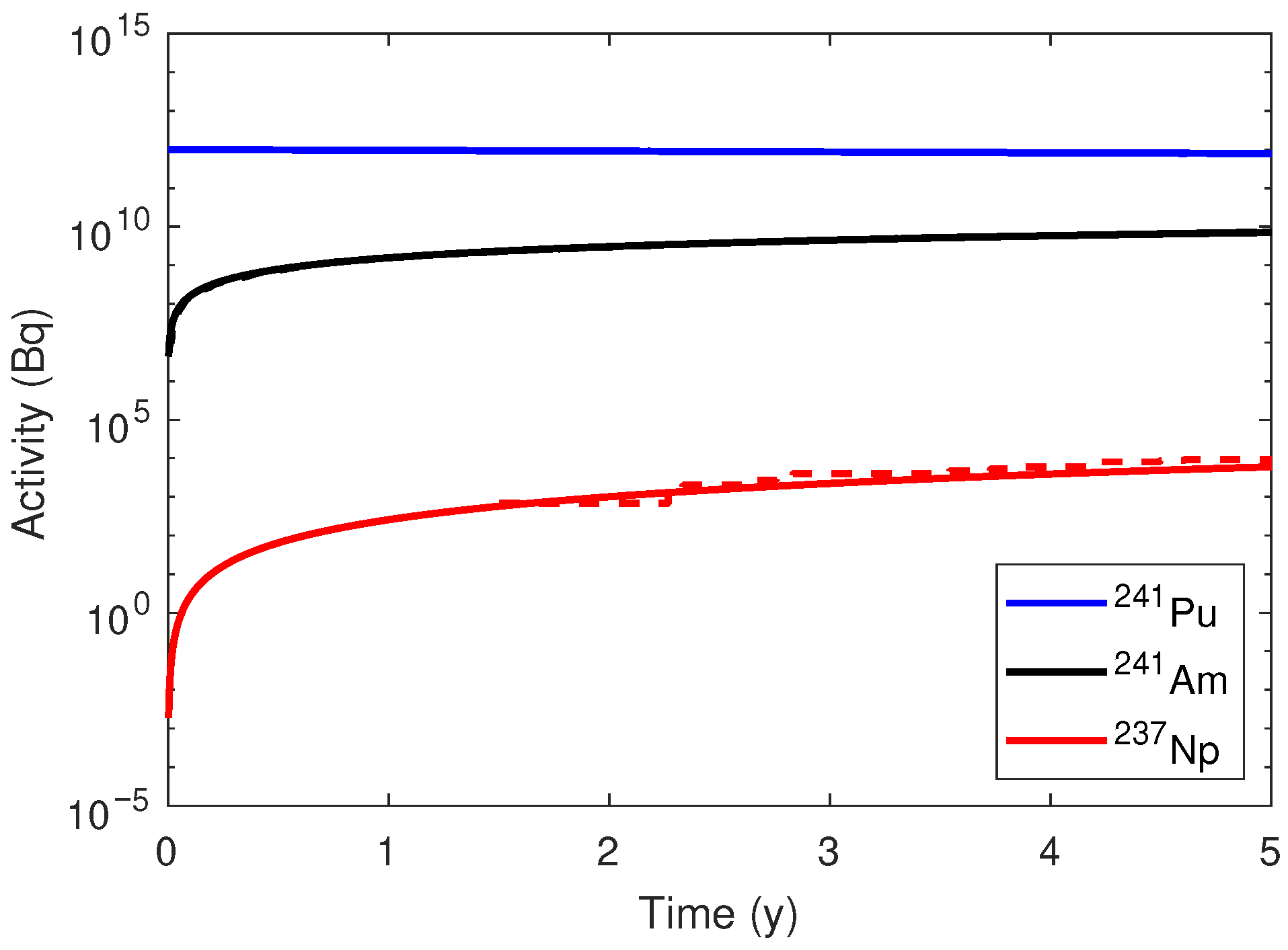
- The stochastic implementation of radioactive decay chains has been validated against analytical solutions, demonstrating that the method accurately reproduces the expected temporal evolution of activities in closed systems.
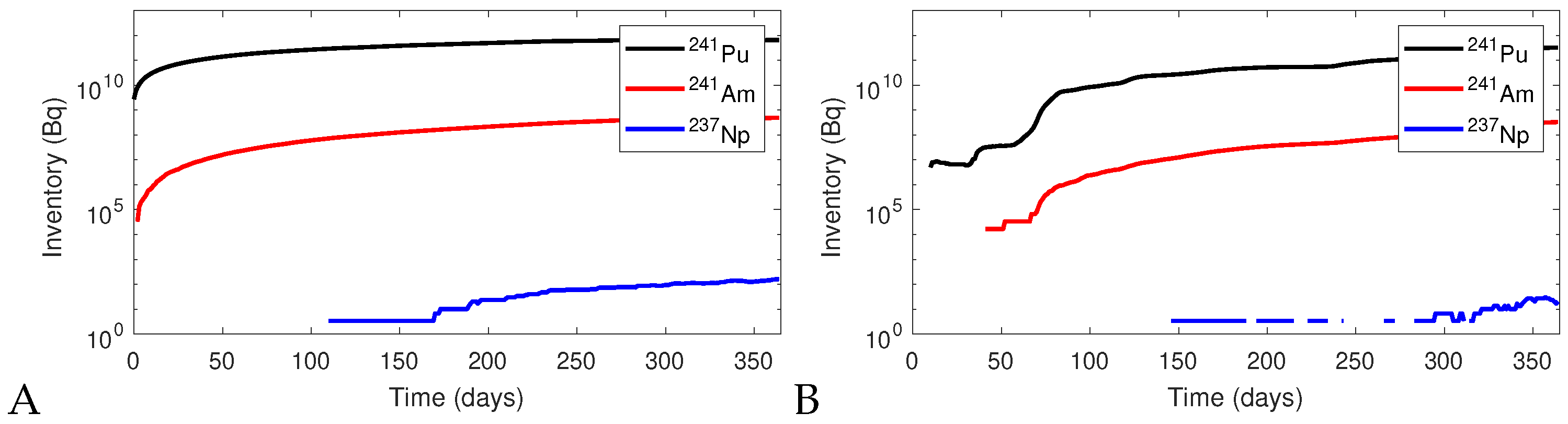
- The methodology has been applied to the 241Pu→241Am→237Np chain in the Western Mediterranean Sea, illustrating its capability to simulate realistic transport and partitioning patterns under different release scenarios.
- Further validation against observational data or independent datasets is still required and will be addressed in future work, together with applications to additional radionuclide chains and operational-scale emergency scenarios.
Supplementary Materials
Author Contributions
Funding
Data Availability Statement
Acknowledgments
Conflicts of Interest
References
- Schonfeld, W. Numerical simulation of the dispersion of artificial radionuclides in the English Channel and the North Sea. J. Mar. Syst. 1995, 6, 529–544. [Google Scholar] [CrossRef]
- Maderich, V.; Bezhenar, R.; Kovalets, I.; Khalchenkov, O.; Brovchenko, I. Long–Term Contamination of the Arabian Gulf as a Result of Hypothetical Nuclear Power Plant Accidents. J. Mar. Sci. Eng. 2023, 11, 331. [Google Scholar] [CrossRef]
- Min, B.I.; Periáñez, R.; Kim, I.G.; Suh, K.S. Marine dispersion assessment of 137Cs released from the Fukushima nuclear accident. Mar. Pollut. Bull. 2013, 72, 22–33. [Google Scholar] [CrossRef]
- Periáñez, R. APERTRACK: A particle-tracking model to simulate radionuclide transport in the Arabian/Persian Gulf. Prog. Nucl. Energ. 2021, 142, 103998. [Google Scholar] [CrossRef]
- Kawamura, H.; Kobayashi, T.; Furuno, A.; In, T.; Ishikawa, Y.; Nakayama, T.; Shima, S.; Awaji, T. Preliminary numerical experiments on oceanic dispersion of 131I and 137Cs discharged into the ocean because of the Fukushima Daiichi nuclear power plant disaster. J. Nucl. Sci. Technol. 2011, 48, 1349–1356. [Google Scholar] [CrossRef]
- Periáñez, R.; Cortés, C. A Numerical model to simulate the transport of radionuclides in the Western Mediterranean after a nuclear accident. J. Mar. Sci. Eng. 2023, 11, 169. [Google Scholar] [CrossRef]
- Brovchenko, I.; Kim, K.O.; Maderich, V.; Jung, K.T.; Bezhenar, R.; Ryu, J.H.; Min, J.E. Sediment and radioactivity transport in the Bohai, Yellow, and east China seas: A modeling study. J. Mar. Sci. Eng. 2022, 10, 596. [Google Scholar] [CrossRef]
- Periáñez, R.; Bezhenar, R.; Brovchenko, I.; Duffa, C.; Iosjpe, M.; Jung, K.T.; Kobayashi, T.; Liptak, L.; Little, A.; Maderich, V.; et al. Marine radionuclide transport modelling: Recent developments, problems and challenges. Environ. Modell. Softw. 2019, 122, 104523. [Google Scholar] [CrossRef]
- Maderich, V.; Bezhenar, R.; Tateda, Y.; Aoyama, M.; Tsumune, D.; Jung, K.T.; de With, G. The POSEIDON–R compartment model for the prediction of transport and fate of radionuclides in the marine environment. MethodsX 2018, 5, 1251–1266. [Google Scholar] [CrossRef]
- Thakur, P.; Ward, A.L. 241Pu in the environment: Insight into the understudied isotope of plutonium. J. Radioanal. Nucl. Chem. 2018, 317, 757–778. [Google Scholar] [CrossRef]
- IAEA. Sediment Distribution Coefficients and Concentration Factors for Biota in the Marine Environment; Technical Reports Series, No. 422; IAEA: Vienna, Austria, 2004. [Google Scholar]
- Molero, J.; Sánchez–Cabeza, J.A.; Merino, J.; Vives–Batlle, J.; Mitchell, P.I.; Vidal–Quadras, A. Particulate distribution of plutonium and americium in surface waters from the Spanish Mediterranean coast. J. Environ. Radioact. 1995, 28, 271–283. [Google Scholar] [CrossRef]
- UNSCEAR—United Nations Scientific Committee on the Effects of Atomic Radiation. Sources and Effects of Ionizing Radiation, Report to the General Assembly, with Scientific Annexes; United Nations: New York, NY, USA, 2000; Volume 1. [Google Scholar]
- Zheng, J.; Tagami, K.; Watanabe, Y.; Uchida, S.; Aono, T.; Ishii, N.; Yoshida, S.; Kubota, Y.; Fuma, S.; Ihara, S. Isotopic evidence of plutonium release into the environment from the Fukushima DNPP accident. Nat. Sci. Rep. 2012, 2, 304. [Google Scholar] [CrossRef]
- Gascó, C.; Antón, M.P.; Espinosa, A.; Aragón, A.; Alvarez, A.; Navarro, N.; García–Tenorio, R. Procedures to define Pu isotopic ratios characterizing a contaminated area in Palomares (Spain). J. Radioanal. Nucl. Chem. 1997, 222, 81–86. [Google Scholar] [CrossRef]
- Eriksson, M.; Lindahl, P.; Roos, P.; Dahlgaard, H.; Holm, E. U, Pu, and Am nuclear signatures of the Thule hydrogen bomb debris. Environ. Sci. Technol. 2008, 42, 4717–4722. [Google Scholar] [CrossRef] [PubMed]
- Bleck, R. An oceanic general circulation model framed in hybrid isopycnic–Cartesian coordinates. Ocean Model. 2001, 4, 55–88. [Google Scholar] [CrossRef]
- Xu, X.; Chassignet, E.P.; Price, J.F.; Özgökmen, T.M.; Peters, H. A regional modeling study of the entraining Mediterranean outflow. J. Geophys. Res. 2007, 112, C12005. [Google Scholar] [CrossRef]
- Kara, A.B.; Wallcraft, A.J.; Martin, P.J.; Pauley, R.L. Optimizing surface winds using QuikSCAT measurements in the Mediterranean Sea during 2000–2006. J. Mar. Syst. 2009, 78, S119–S131. [Google Scholar] [CrossRef]
- Pugh, D.T. Tides, Surges and Mean Sea Level; Wiley: Chichester, UK, 1987; p. 472. [Google Scholar]
- Periáñez, R.; Cortés, C. A Study on the Transport of 137Cs and 90Sr in Marine Biota in a Hypothetical Scenario of a Nuclear Accident in the Western Mediterranean Sea. J. Mar. Sci. Eng. 2023, 11, 1707. [Google Scholar] [CrossRef]
- Cortés, C.; Periáñez, R.; Block, B.A.; Castleton, M.R.; Cermeño, P.; Dedman, S. Numerical modelling of radionuclide uptake by bluefin tuna along its migration routes in the Mediterranean Sea after a nuclear accident. Mar. Environ. Res. 2024, 202, 106757. [Google Scholar] [CrossRef]
- IAEA. Modelling Of Marine Dispersion And Transfer Of Radionuclides Accidentally Released From Land Based Facilities; IAEA-TECDOC-1876; IAEA: Vienna, Austria, 2019. [Google Scholar]
- IAEA. Enhancement of Modelling Approaches for the Assessment of Radionuclide Transfer in the Marine Environment; IAEA-TECDOC-2060; IAEA: Vienna, Austria, 2024. [Google Scholar]
- Nyffeler, U.P.; Li, Y.H.; Santschi, P.H. A kinetic approach to describe trace element distribution between particles and solution in natural aquatic systems. Geochim. Cosmochim. Acta 1984, 48, 1513–1522. [Google Scholar] [CrossRef]
- Karcher, M.; Hosseini, A.; Schnur, R.; Kauker, F.; Brown, J.E.; Dowdall, M.; Strand, P. Modelling dispersal of radioactive contaminants in Arctic waters as a result of potential recovery operations on the dumped submarine K–27. Mar. Pollut. Bull. 2017, 116, 385–394. [Google Scholar] [CrossRef]
- Kobayashi, T.; Togawa, O.; Odano, N.; Ishida, T. Estimates of collective doses from a hypothetical accident of a nuclear submarine. J. Nucl. Sci. Technol. 2001, 38, 658–663. [Google Scholar] [CrossRef]
- Kobayashi, T.; Chino, M.; Togawa, O. Numerical simulations of short–term migration processes of dissolved cesium–137 due to a hypothetical accident of a nuclear submarine in the Japan sea. J. Nucl. Sci. Technol. 2006, 43, 569–575. [Google Scholar] [CrossRef]
- D’Ortenzio, F.; Iudicone, D.; de Boyer, M.C.; Testor, P.; Antoine, D.; Marullo, S.; Santoleri, R.; Madec, G. Seasonal variability of the mixed layer depth in the Mediterranean Sea as derived from in situ profiles. Geophys. Res. Lett. 2005, 32, L12605. [Google Scholar] [CrossRef]
- Periáñez, R. On the sensitivity of a marine dispersion model to parameters describing the transfers of radionuclides between the liquid and solid phases. J. Environ. Radioact. 2004, 73, 101–115. [Google Scholar] [CrossRef] [PubMed]
- Bezhenar, R.; Jung, K.T.; Maderich, V.; de With, G.; Willemsen, S.; Qiao, F. Transfer of radiocaesium from contaminated bottom sediments to marine organisms through benthic food chain in post-Fukushima and post-Chernobyl periods. Biogeosciences 2016, 13, 3021–3034. [Google Scholar] [CrossRef]
- Periáñez, R. A simple method for the evaluation of the uncertainty in the predictions of a Lagrangian marine radionuclide transport model. Nucl. Eng. Tech. 2026, 58, 103917. [Google Scholar] [CrossRef]


| 241Pu | 241Am | 237Np | |
|---|---|---|---|
| (s−1) | |||
| (m3/kg) | 100 | 2000 | 1 |
Disclaimer/Publisher’s Note: The statements, opinions and data contained in all publications are solely those of the individual author(s) and contributor(s) and not of MDPI and/or the editor(s). MDPI and/or the editor(s) disclaim responsibility for any injury to people or property resulting from any ideas, methods, instructions or products referred to in the content. |
© 2026 by the authors. Licensee MDPI, Basel, Switzerland. This article is an open access article distributed under the terms and conditions of the Creative Commons Attribution (CC BY) license.
Share and Cite
Cortés, C.; Periáñez, R. Incorporating Radioactive Decay Chains Within Lagrangian Marine Radionuclide Transport Models for Assessing the Consequences of Nuclear Accidents. J. Mar. Sci. Eng. 2026, 14, 328. https://doi.org/10.3390/jmse14040328
Cortés C, Periáñez R. Incorporating Radioactive Decay Chains Within Lagrangian Marine Radionuclide Transport Models for Assessing the Consequences of Nuclear Accidents. Journal of Marine Science and Engineering. 2026; 14(4):328. https://doi.org/10.3390/jmse14040328
Chicago/Turabian StyleCortés, Carmen, and Raúl Periáñez. 2026. "Incorporating Radioactive Decay Chains Within Lagrangian Marine Radionuclide Transport Models for Assessing the Consequences of Nuclear Accidents" Journal of Marine Science and Engineering 14, no. 4: 328. https://doi.org/10.3390/jmse14040328
APA StyleCortés, C., & Periáñez, R. (2026). Incorporating Radioactive Decay Chains Within Lagrangian Marine Radionuclide Transport Models for Assessing the Consequences of Nuclear Accidents. Journal of Marine Science and Engineering, 14(4), 328. https://doi.org/10.3390/jmse14040328