


Abstract
Reports of great white sharks (Carcharodon carcharias) in the Mediterranean Sea attract strong scientific and public attention but are frequently based on limited or unverified evidence. This study evaluates the reliability of citizen-science imagery for shark species identification using a comparative morphological framework. A recent Adriatic record was used as a representative case to demonstrate the application of diagnostic criteria for distinguishing lamnid sharks. Dentition and external morphological traits were compared with published reference material and field guides. The analysis indicates that the absence of lateral cusplets and overall dental morphology are inconsistent with C. carcharias, confirming the specimen as a porbeagle (Lamna nasus). Beyond this case, the findings emphasize the importance of expert validation, standardized morphological criteria, and proper reporting for protected species. Establishing clear validation protocols can ensure that citizen-science observations strengthen rather than distort the scientific understanding of Mediterranean shark populations.
1. Introduction
The great white shark, Carcharodon carcharias (Linnaeus, 1758), holds a unique position in both the public and scientific perspectives, particularly within the Mediterranean Sea, where the species is considered rare and critically endangered [1]. Every report of its presence, based on historical records, fishery bycatch, or citizen-science observations, attracts substantial attention. However, this trend has created pressure to publish alleged records rapidly, often without adequate evidence or independent verification. While such publications may raise awareness, they also risk propagating errors into the scientific record.
Misidentified or unsubstantiated observations can distort our knowledge of the current status of C. carcharias in the Mediterranean Sea, leading to inflated or misleading impressions of population size, distribution, and recruitment. Furthermore, reliance on unverified observations can propagate identification errors within the literature, emphasizing the need for robust validation before publication. When false identifications are published, they undermine conservation science but also erode confidence in the rigor of the peer-reviewed process.
Underlying these issues is the wider academic context of “publish or perish”. The pressure to produce a constant flow of publications encourages some researchers to prioritize novelty and visibility over caution and methodological rigor [2]. Rare species such as the great white shark provide particularly tempting subjects, as any report is likely to gain attention and citations. However, this dynamic risks lowering the threshold of evidence deemed acceptable for publication, especially in publications eager to attract readership through sensational findings. As a result, unverified sources such as anecdotal accounts, poor-quality pictures, or social media posts can be erroneously elevated to the status of scientific evidence, even though their reliability remains questionable.
However, field-based studies, such as monitoring surveys, tagging programs, or fishery-dependent sampling, require considerable effort, resources, and expertise. Even when they fail to confirm the presence of C. carcharias, publishing the information from such studies can provide valuable baseline data and could be useful for detecting ecological patterns, assessing population status, and guiding conservation strategies. Negative findings are likewise scientifically valuable, as they record the absence of the species across specific locations and times, thereby complementing presence records.
In recent years, on the other hand, a different trend has emerged in the form of “social media studies”, which rely heavily on opportunistic photographs, videos, or anecdotal posts shared online. These data are often detached from verifiable metadata such as precise location, gear used, or specimen preservation, and they rarely undergo expert validation. While social media can serve as a useful tool for raising awareness and generating leads for further investigation, treating such unverified reports as equivalent to rigorously obtained field data risks blurring the boundary between science and speculation. This problem has already been highlighted in the Mediterranean, where studies based primarily on social media records have led to questionable conclusions and subsequent criticisms [3,4]. This imbalance produces a distorted picture in the literature, where unverifiable presence records are overrepresented and systematic absences remain underreported. Correcting false records is essential if we are to achieve a realistic assessment of C. carcharias in the Mediterranean.
The present study aims to evaluate the reliability of citizen-science imagery in identifying lamnid sharks in the Mediterranean Sea. Using a recent Adriatic case as an example, diagnostic morphological criteria were applied and methodological, ecological, and conservation implications discussed. This approach provides a framework for validating citizen-sourced data before their incorporation into scientific or management records.
2. Materials and Methods
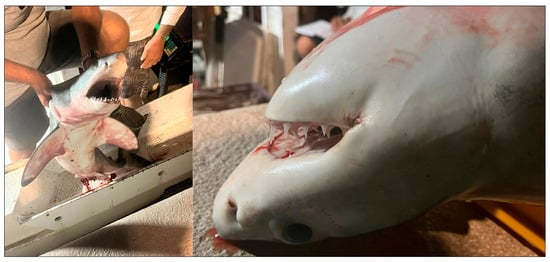
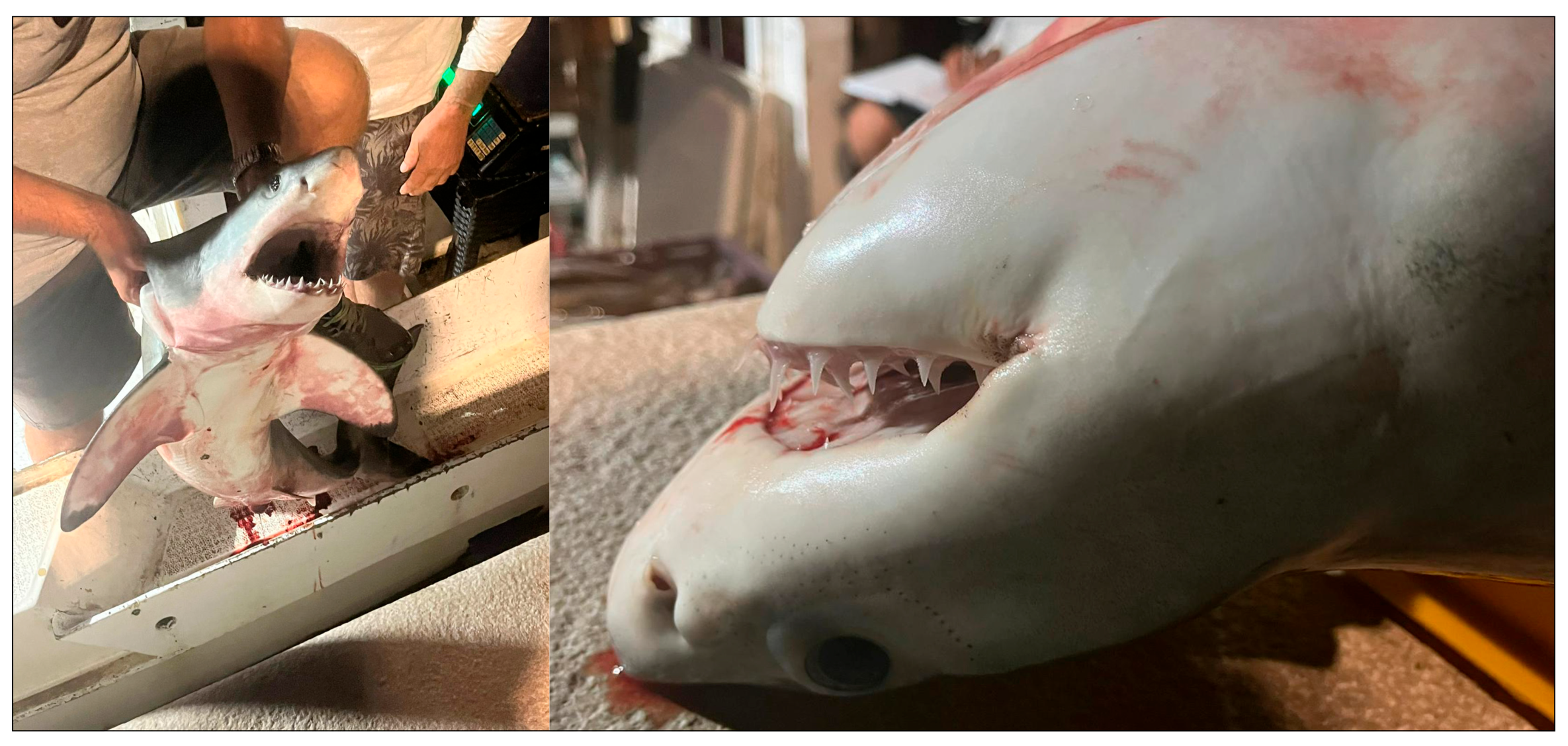
In September 2023, Croatian media, followed shortly by outlets in neighboring countries, reported the capture of a shark by a professional fisherman near Šibenik in the central eastern Adriatic. The news was accompanied by several photographs of the specimen (Figure 1), and the specimen was reported either as a porbeagle or as a juvenile great white shark. These photographs, initially circulated in media reports, were later reused in a published study describing the specimen as C. carcharias. Photographs of the specimen were examined and compared with published diagnostic traits for C. carcharias and Lamna nasus (Bonnaterre, 1788). Key features assessed included dentition, snout shape, caudal keel presence, fin coloration, and body proportions. Reference imagery from verified specimens and authoritative field guides was used to establish comparative benchmarks.
Figure 1.
Images of a lamnid shark specimen caught near Šibenik (central Adriatic Sea) in September 2023, originally circulated in regional media, later reproduced by Jambura et al. [5] and subsequently analyzed in this study.
3. Results and Discussion
Soldo and Bakiu [6], in a recent review of great white shark occurrences in the eastern Adriatic Sea, referenced this record but identified the specimen as a porbeagle shark, Lamna nasus. Hence, Soldo and Bakiu [6] emphasized that many reported occurrences of great white sharks in the Mediterranean are unreliable, as misidentifications remain common today, and numerous historical records cannot be verified due to insufficient supporting evidence. The most common mistake involves confusing the great white shark with its close relatives, such as the shortfin mako (Isurus oxyrinchus, Rafinesque, 1810) or L. nasus, leading to erroneous reports of juvenile C. carcharias [7]. Similarly, Soldo and Bakiu [6] referred to a specimen they identified as a L. nasus, but Jambura et al. [5] re-examined the case and argued that the specimen represented a young-of-the-year (YOY) C. carcharias and the first such record from the Adriatic Sea.
However, this case highlights the importance of specialized expertise in species identification, which citizen-science initiatives often lack, leading to frequent misidentifications. When identifying a species, all available data should be considered, particularly when the evidence is limited to photographs shared on social media. Firstly, the Central Eastern Adriatic has already been suggested as a nursery area for L. nasus, where specimens are frequently misidentified as juvenile C. carcharias [8]. While this does not prove that the specimen in question was L. nasus, it raises concerns about the reliability of reports claiming for the very first time the presence of juvenile great white sharks in the region. Moreover, Jambura et al. [5] estimated the length of the alleged juvenile great white shark at 1.20 to 1.30 m. However, the methodology for this estimate remains unclear, given that the size of the person holding the specimen in the available photos is unknown. In the available images, the shark’s head appears to reach only the fisher’s waist, suggesting its length may have been overestimated. Even if the 1.20 m estimate is correct, it would represent the smallest free-swimming juvenile great white shark ever recorded in the Mediterranean and among the smallest globally. For comparison, Saidi et al. [9] reported a 587 cm pregnant female from the Gulf of Gabes containing four embryos measuring 132–135 cm, which were not near term due to the presence of large yolk masses. Similarly, Kabasakal and Özgür Gedikoğlu [10] described a 125.5 cm male neonate caught off Altinoluk in the North Aegean Sea, the smallest confirmed specimen from the region. Moreover, applying length–weight equations for great white sharks [11] indicates that the 20 kg estimate by Jambura et al. [5] is lower than expected for a shark of this size. But, again, while these discrepancies raise concerns about the identification of the specimen as a YOY great white shark, they do not constitute definitive proof that it was a different species.
Although photographs can be valuable for documenting rare species, low image quality and lack of contextual information often make them insufficient for reliable identification, especially among closely related taxa such as C. carcharias and L. nasus. In their analysis, Jambura et al. [5] cited several diagnostic traits, including a conical snout, black markings on the ventral pectoral fins, absence of a white free rear tip on the first dorsal fin, and lack of a secondary caudal keel. However, many of these features are either shared with L. nasus [11,12,13,14,15] or cannot be verified from the available photographs. For instance, a conical snout is characteristic of all lamnid sharks, and the supposed white-free rear tip and missing caudal keel are not visible in the images. Moreover, the specimen’s overall dark bluish coloration, typical of L. nasus but not of great white sharks, which are usually lead grey to brownish-grey or blackish [11,13,14], further complicates the identification.
One of the primary characteristics Jambura et al. [5] rely on for their conclusion is a brief description of the specimen’s teeth. Given the low quality of the other available photos, the tooth description is actually the only characteristic that can be reliably used for species identification in this case. Interspecific and intraspecific variation in tooth row count and dental morphology occurs in many elasmobranchs, making these traits essential for species identification [16,17], a method that has also been applied to Mediterranean sharks as well [18,19,20]. In their paper, Jambura et al. [5] describe the specimen as having “serrated teeth and the lack of lateral cusplets”, which they associate with the great white shark. Indeed, teeth do not have lateral cusplets; however, these characteristics actually prove the opposite: that the specimen in question is not C. carcharias, but a L. nasus. Contrary to the opinion of Jambura et al. [5], the most distinguishing dental characteristic of young C. carcharias is exactly the presence of small but distinct lateral cusplets on either side of the central cusp [10,11,16,17,21,22,23,24]. Kabasakal and Özgür Gedikoğlu [10] presented a photograph of the jaws of a 125.5 cm long free-swimming Mediterranean C. carcharias, in which lateral cusplets are clearly evident. Similarly, Hubbell [16] and Uchida et al. [22] provided images of 140 cm and 142 cm total length (TL) specimens, both of which also display distinct lateral cusplets. Moreover, Shimada [17] suggested that in all free-swimming C. carcharias smaller than 214 cm, one or two pairs of lateral cusplets are present. Compagno [11] further noted that lateral cusplets are found in all C. carcharias under 3 m in length. By contrast, young L. nasus often lack lateral cusplets on their anterior teeth [11,21,25,26]. Consequently, the absence of lateral cusplets is therefore incompatible with the identification of this specimen as a young-of-the-year (YOY) C. carcharias.
Additional evidence derives from dental morphology. Although only part of the lower right anterior teeth is visible, the pattern supports the porbeagle identification. In free-swimming porbeagles, the first two lower anterior teeth are erect, and the third inclines slightly distally [25], a pattern evident in the available photo. In contrast, the third lower tooth in C. carcharias is slanted medially [16]. The alleged tooth serrations noted by Jambura et al. [5] appear smooth on most of the visible teeth, except for a small area likely showing wear or minor irregularities rather than true serrations, which can occur naturally in many shark species [27]. Considering all the aforementioned evidence, it is clear that the specimen in question was not a YOY C. carcharias but a L. nasus, as originally and correctly identified by Soldo and Bakiu [6].
Beyond the issue of species identification, this case also highlights important legal and conservation aspects. In Croatia, both the great white shark and the porbeagle, along with 21 other shark and ray species, are strictly protected under national legislation [28]. Regulations concerning strictly protected species require that such incidents be reported to the competent authorities, particularly when detailed information, such as that presented by Jambura et al. [5], is available and could assist in clarifying the circumstances of the event. However, when scientific publications describe occurrences of protected species without corresponding documentation in official databases, this creates a disconnect between conservation-oriented narratives and practical conservation procedures. Such inconsistencies can undermine the credibility of conservation-driven research and limit its contribution to effective species protection. Ensuring that scientific reporting is consistent with existing regulatory and reporting obligations is therefore essential if publications are to reflect genuine conservation concern rather than merely increasing the number of reported occurrences in the literature.
Aside from this individual case, the misidentification of shark species in scientific literature can have serious ecological and conservation consequences. Incorrect species records can distort distribution maps, misinform conservation strategies, and lead to misinterpretations of population trends for threatened species [29]. This situation highlights the critical need for rigorous expert validation in species identification and underscores the ethical responsibility of researchers to ensure that their scientific contributions support both conservation objectives and legal frameworks.
Another recent publication [30] relied on information from social media as well, and it was commented on by Soldo and Lipej [4], who cautioned that, in the absence of verified evidence, species identification and the subsequent publication of unsubstantiated observations should be avoided to prevent further confusion regarding the status of chondrichthyans, a persistent issue, particularly in the Mediterranean. Despite this, the same approach of publishing papers based on social media data was repeated, resulting in publishing wrong information once again. However, beyond the issue of misidentification, an even more concerning aspect of this case is the failure to comply with legal reporting requirements, which undermines conservation efforts for strictly protected species.
In conclusion, while citizen science has been shown to provide important contributions to shark research and conservation in the Mediterranean [31], this study demonstrates that the application of comparative morphological criteria can further strengthen the reliability of citizen-science records of rare shark species. The Adriatic case examined here illustrates the diagnostic value of dental and external traits in distinguishing C. carcharias from L. nasus. Based on these findings, I recommend that records of rare or protected elasmobranchs derived from citizen-science sources should be supported by high-quality photographic documentation of diagnostic features, evaluated by qualified taxonomic experts, and accompanied by verifiable metadata. In addition, occurrences involving strictly protected species should be formally reported through appropriate national frameworks prior to, or alongside, scientific publication. Adoption of these measures would reduce the risk of misidentification, improve data reliability, and ensure that citizen-science contributions meaningfully support biodiversity assessments and conservation of critically endangered elasmobranchs in the Mediterranean Sea.
Funding
This research received no external funding.
Data Availability Statement
The data presented in this study are available upon request from the corresponding author.
Acknowledgments
During the preparation of this study, the author used images initially circulated in media reports for the identification of the species. The author has reviewed and edited the output and takes full responsibility for the content of this publication.
Conflicts of Interest
The author declares no conflicts of interest.
References
- Soldo, A.; Bradai, M.N.; Walls, R.H.L. Carcharodon carcharias (Mediterranean Assessment). The IUCN Red List of Threatened Species. 2016; p. e.T3855A16527829. Available online: https://www.iucnredlist.org/species/3855/16527829 (accessed on 1 December 2025).
- Fanelli, D. Do pressures to publish increase scientists’ bias? An empirical support from US states data. PLoS ONE 2010, 5, e10271. [Google Scholar] [CrossRef] [Scilit] [PubMed]
- Pollerspöck, J.; Weigmann, S.; Seret, B.; Straube, N. Comment on “4.4 First record of the goblin shark Mitsukurina owstoni Jordan, 1898 (Lamniformes: Mitsukurinidae) in the Mediterranean Sea”. Mediterr. Mar. Sci. 2023, 24, 101–103. [Google Scholar] [CrossRef] [Scilit]
- Soldo, A.; Lipej, L. Comment on “Balàka et al. Updated checklist of chondrichthyan species in Croatia (Central Mediterranean Sea)”. Biology 2024, 13, 135. [Google Scholar] [CrossRef] [Scilit] [PubMed]
- Jambura, P.L.; Ugarković, P.; Pavičić, M.; Ćetković, I.; Niedermüller, S.; Kriwet, J.; Türtscher, J. New evidence for the contemporary presence of juvenile white sharks (Carcharodon carcharias) in the Adriatic Sea. Fishes 2025, 10, 25. [Google Scholar] [CrossRef] [Scilit] [PubMed]
- Soldo, A.; Bakiu, R. Additional historical records of the great white shark, Carcharodon carcharias (Lamniformes: Lamnidae), in the eastern Adriatic: Updating regional occurrence of a critically endangered shark. Ann. Ser. Hist. Nat. 2024, 34, 11–20. [Google Scholar]
- Casey, J.G.; Pratt, H.L., Jr. Distribution of the white shark, Carcharodon carcharias, in the western North Atlantic. Mem. South. Calif. Acad. Sci. 1985, 9, 2–14. [Google Scholar]
- Soldo, A. Status of the sharks in the Adriatic. In Proceedings of the Workshop on Mediterranean Cartilaginous Fish with Emphasis on Southern and Eastern Mediterranean, Istanbul, Turkey, 14–16 October 2006; Basusta, N., Keskin, C., Serena, F., Seret, B., Eds.; Turkish Marine Research Foundation: Istanbul, Turkey, 2006; pp. 128–134. [Google Scholar]
- Saidi, B.; Bradai, M.N.; Bouain, A.; Guelorget, O.; Capapé, C. Capture of a pregnant female white shark Carcharodon carcharias (Lamnidae) in the Gulf of Gabes (southern Tunisia, central Mediterranean) with comments on oophagy in sharks. Cybium 2005, 29, 303–307. [Google Scholar]
- Kabasakal, H.; Özgür Gedikoğlu, S. Two new-born great white sharks, Carcharodon carcharias (Linnaeus, 1758) (Lamniformes; Lamnidae) from Turkish waters of the northern Aegean Sea. Acta Adriat. 2008, 49, 125–135. [Google Scholar]
- Compagno, L.J.V. Sharks of the World: An Annotated and Illustrated Catalogue of Shark Species Known to Date. Volume 2. Bullhead, Mackerel and Carpet Sharks (Heterodontiformes, Lamniformes and Orectolobiformes); FAO Species Catalogue for Fishery Purposes No. 1; FAO: Rome, Italy, 2001; Volume 2, p. 269. [Google Scholar]
- Abercrombie, D.L.; Hernandez, S. Identifying Shark Fins: Implementing and Enforcing CITES; Abercrombie & Fish, Marine Biological Consulting: Suffolk County, NY, USA, 2017; p. 22. [Google Scholar]
- Ebert, D.A.; Dando, M. Field Guide to Sharks, Rays & Chimaeras of Europe and the Mediterranean; Princeton University Press: Woodstock, UK, 2021; p. 384. [Google Scholar]
- Ebert, D.A.; Fowler, S.; Dando, M. Sharks of the World: A Complete Guide; Princeton University Press: Princeton, NJ, USA, 2021; p. 608. [Google Scholar]
- Jung, A.; Ory, A.; Abaut, P.; Zaccagnini, L. First use of free-diving photo-identification of porbeagle shark (Lamna nasus) off the Brittany Coast, France. Diversity 2024, 16, 155. [Google Scholar] [CrossRef] [Scilit]
- Hubbell, G. Using tooth structure to determine the evolutionary history of the white shark. In Great White Sharks: The Biology of Carcharodon carcharias; Klimley, A.P., Ainley, D.G., Eds.; Academic Press: San Diego, CA, USA, 1996; pp. 9–18. [Google Scholar]
- Shimada, K. Teeth of embryos in lamniform sharks (Chondrichthyes: Elasmobranchii). Environ. Biol. Fishes 2002, 63, 309–319. [Google Scholar] [CrossRef] [Scilit]
- Soldo, A. Characteristics of the Teeth and Jaws of Elasmobranchii (Chondrichthyes). Bachelor’s Thesis, University of Split, Split, Croatia, 1996. [Google Scholar]
- Soldo, A.; Dulčić, J.; Cetinić, P. Contribution to the study of the morphology of the teeth of the nursehound Scyliorhinus stellaris (Chondrichthyes: Scyliorhinidae). Sci. Mar. 2000, 64, 355–356. [Google Scholar] [CrossRef] [Scilit]
- Morey, G.; Soldo, A.; Riera, F.; Serena, F. Records of Carcharhinus limbatus and Carcharhinus plumbeus (Chondrichthyes: Carcharhinidae) from off the Balearic Islands (NW Mediterranean). Cybium 2008, 32, 195–200. [Google Scholar]
- Cappetta, H. Chondrichthyes II: Mesozoic and Cenozoic Elasmobranchii; Gustav Fischer Verlag: New York, NY, USA, 1987. [Google Scholar]
- Uchida, S.; Toda, M.; Teshima, K.; Yano, K. Pregnant white sharks and full-term embryos from Japan. In Great White Sharks: The Biology of Carcharodon carcharias; Klimley, A.P., Ainley, D.G., Eds.; Academic Press: San Diego, CA, USA, 1996; pp. 139–155. [Google Scholar]
- Lipej, L.; De Maddalena, A.; Soldo, A. Sharks of the Adriatic Sea; Knjižnica Annales Majora: Koper, Slovenia, 2004; p. 253. [Google Scholar]
- Berkovitz, B.; Shellis, P. The Teeth of Non-Mammalian Vertebrates; Academic Press: Cambridge, MA, USA, 2017; p. 342. [Google Scholar]
- Bigelow, H.B.; Schroeder, W.C. Fishes of the western North Atlantic, Part I: Lancelets, Cyclostomes, Sharks. In Fishes of the Western North Atlantic; Tee-Van, J., Breder, C.M., Hildebrand, S.F., Parr, A.E., Schroeder, W.C., Eds.; Sears Foundation for Marine Research, Yale University: New Haven, CT, USA, 1948; pp. 59–576. [Google Scholar]
- Purdy, R.W.; Francis, M.P. Ontogenetic development of teeth in Lamna nasus (Bonnaterre, 1758) (Chondrichthyes: Lamnidae) and its implications for the study of fossil shark teeth. J. Vertebr. Paleontol. 2007, 27, 798–810. [Google Scholar] [CrossRef] [Scilit]
- Whitenack, L.B.; Simkins, D.C.; Motta, P.J. Biology meets engineering: The structural mechanics of fossil and extant shark teeth. J. Morphol. 2010, 272, 169–179. [Google Scholar] [CrossRef] [Scilit] [PubMed]
- Soldo, A.; Lipej, L. An annotated checklist and the conservation status of chondrichthyans in the Adriatic. Fishes 2022, 7, 245. [Google Scholar] [CrossRef] [Scilit]
- Dulvy, N.K.; Fowler, S.L.; Musick, J.A.; Cavanagh, R.D.; Kyne, P.M.; Harrison, L.R.; Carlson, J.K.; Davidson, L.N.K.; Fordham, S.V.; Francis, M.P.; et al. Extinction risk and conservation of the world’s sharks and rays. eLife 2014, 3, e00590. [Google Scholar] [CrossRef] [Scilit] [PubMed]
- Balàka, P.F.; Ugarković, P.; Türtscher, J.; Kriwet, J.; Niedermüller, S.; Krstinić, P.; Jambura, P.L. Updated checklist of chondrichthyan species in Croatia (Central Mediterranean Sea). Biology 2023, 12, 952. [Google Scholar] [CrossRef] [Scilit] [PubMed]
- Bargnesi, F.; Lucrezi, S.; Ferretti, F. Opportunities from citizen science for shark conservation, with a focus on the Mediterranean Sea. Eur. Zool. J. 2020, 87, 20–34. [Google Scholar] [CrossRef] [Scilit]
Disclaimer/Publisher’s Note: The statements, opinions and data contained in all publications are solely those of the individual author(s) and contributor(s) and not of MDPI and/or the editor(s). MDPI and/or the editor(s) disclaim responsibility for any injury to people or property resulting from any ideas, methods, instructions or products referred to in the content. |
© 2026 by the author. Licensee MDPI, Basel, Switzerland. This article is an open access article distributed under the terms and conditions of the Creative Commons Attribution (CC BY) license.