Comment

When Scientific Reassessment Fails Citizen Science. Comment on Soldo, A. When Citizen Science Becomes Speculation: Evaluating the Reliability of Lamnid Shark Identification from Photographic Records in the Mediterranean. J. Mar. Sci. Eng. 2026, 14, 173

by
Patrick L. Jambura
1,2,*,
Julia Türtscher
1,2,3,*,
Joshua K. Moyer
4,5,
Kenshu Shimada
6,7,8,9,
Ilija Ćetković
10,
Branko Dragičević
11,
Pero Ugarković
2,12,
Mišo Pavičić
11,
Phillip C. Sternes
13,14,15,
Simone Niedermüller
16,
Jacopo Bernardi
17,
Matteo Barbato
18,19,
Frederik H. Mollen
20,
Jürgen Kriwet
1,21,
Douglas J. Long
22,
Taketeru Tomita
23,24,
Charlie J. Underwood
25,
Clinton Duffy
26,
Craig P. O’Connell
27,28,
Alessandro De Maddalena
29,
John Chisholm
30 and
Gregory B. Skomal
31
add Show full author list remove Hide full author list
1
Department of Palaeontology, University of Vienna, 1090 Vienna, Austria
2
The MECO Project, 546 45 Thessaloniki, Greece
3
Johannes Kepler University Linz Library, Altenberger Straße 69, 4040 Linz, Austria
4
Department of Ecology and Evolutionary Biology, Yale University, New Haven, CT 06511, USA
5
Peabody Museum of Natural History, Yale University, New Haven, CT 06511, USA
6
Department of Environmental Science and Studies, DePaul University, Chicago, IL 60614, USA
7
Department of Biological Sciences, DePaul University, Chicago, IL 60614, USA
8
Sternberg Museum of Natural History, Fort Hays State University, Hays, KS 67601, USA
9
Field Museum of Natural History, Chicago, IL 60605, USA
10
Institute of Marine Biology, University of Montenegro, 85330 Kotor, Montenegro
11
Institute of Oceanography and Fisheries, Laboratory of Ichthyology and Coastal Fisheries, 21000 Split, Croatia
12
Independent Researcher, 21000 Split, Croatia
13
Education and Conservation Department, SeaWorld, San Diego, CA 92109, USA
14
Department of Biology, San Bernardino Valley College, San Bernardino, CA 92410, USA
15
Shark Measurements, London, UK
16
World Wide Fund for Nature Mediterranean Marine Initiative (WWF MMI), 00161 Rome, Italy
17
Experimental Center for Habitats Conservation (CESTHA), 48122 Marina di Ravenna, Italy
18
Department of Biology, University of Padova, 35131 Padova, Italy
19
Institute for Marine Biological Resources and Biotechnology (IRBIM), Italian National Research Council (CNR), 91026 Mazara del Vallo, Italy
20
Elasmobranch Research Belgium, Rehaegenstraat 4, 2820 Bonheiden, Belgium
21
Vienna Doctoral School of Ecology & Evolution (VDSEE), University of Vienna, 1030 Vienna, Austria
22
Department of Ichthyology, California Academy of Sciences, San Francisco, CA 94118, USA
23
Okinawa Churashima Research Center, Okinawa Churashima Foundation, Motobu-cho 905-0206, Okinawa, Japan
24
Okinawa Churaumi Aquarium, Okinawa Churashima Foundation, Motobu-cho 905-0206, Okinawa, Japan
25
School of Natural Sciences, Birkbeck College, London WC1E 7HX, UK
26
Auckland War Memorial Museum, The Domain, Parnell, Auckland 1010, New Zealand
27
Montauk Shark Lab, Montauk, New York, NY 11954, USA
28
School for Marine Science and Technology, University of Massachusetts Dartmouth, New Bedford, MA 02744, USA
29
Shark Museum, 26 Forest Hill Road, Simon’s Town, Cape Town 7975, South Africa
30
Fisheries Science and Emerging Technologies Program, Anderson Cabot Center for Ocean Life at the New England Aquarium, Boston, MA 02110, USA
31
Massachusetts Division of Marine Fisheries, New Bedford, MA 01950, USA
*
Authors to whom correspondence should be addressed.
J. Mar. Sci. Eng. 2026, 14(13), 1148; https://doi.org/10.3390/jmse14131148 (registering DOI)
Submission received: 27 March 2026 / Revised: 22 May 2026 / Accepted: 26 May 2026 / Published: 23 June 2026
(This article belongs to the Section Marine Biology)
Soldo [1] raises concerns about the reliability of citizen science-derived photographic records for identifying lamnid sharks in the Mediterranean Sea. Using a recently published juvenile white shark from Croatian waters [2] as a representative case, the author reinterprets the specimen as a porbeagle shark (Lamna nasus) rather than a white shark (Carcharodon carcharias), based primarily on selected dental characters. Given the critically endangered status of white sharks in the Mediterranean [3] and the limited number of confirmed observations [4,5], occurrences of the species in this region serve as valuable population data points [6,7] and merit careful examination. Species identifications and reinterpretations should therefore be well-supported, which includes verification of source materials and firsthand communication with citizen scientists, and make use of multiple diagnostic characters whenever possible. Here, we re-examined the specimen using all observable external and dental characters and show that it is consistent with the white shark. We further demonstrate that reliance on single, variably expressed traits—particularly dental characters affected by ontogeny and individual variation—can lead to erroneous identifications, and emphasize that rigorous taxonomic identifications should depend on a holistic, integrative assessment of all available morphological (and if available genetic) evidence.
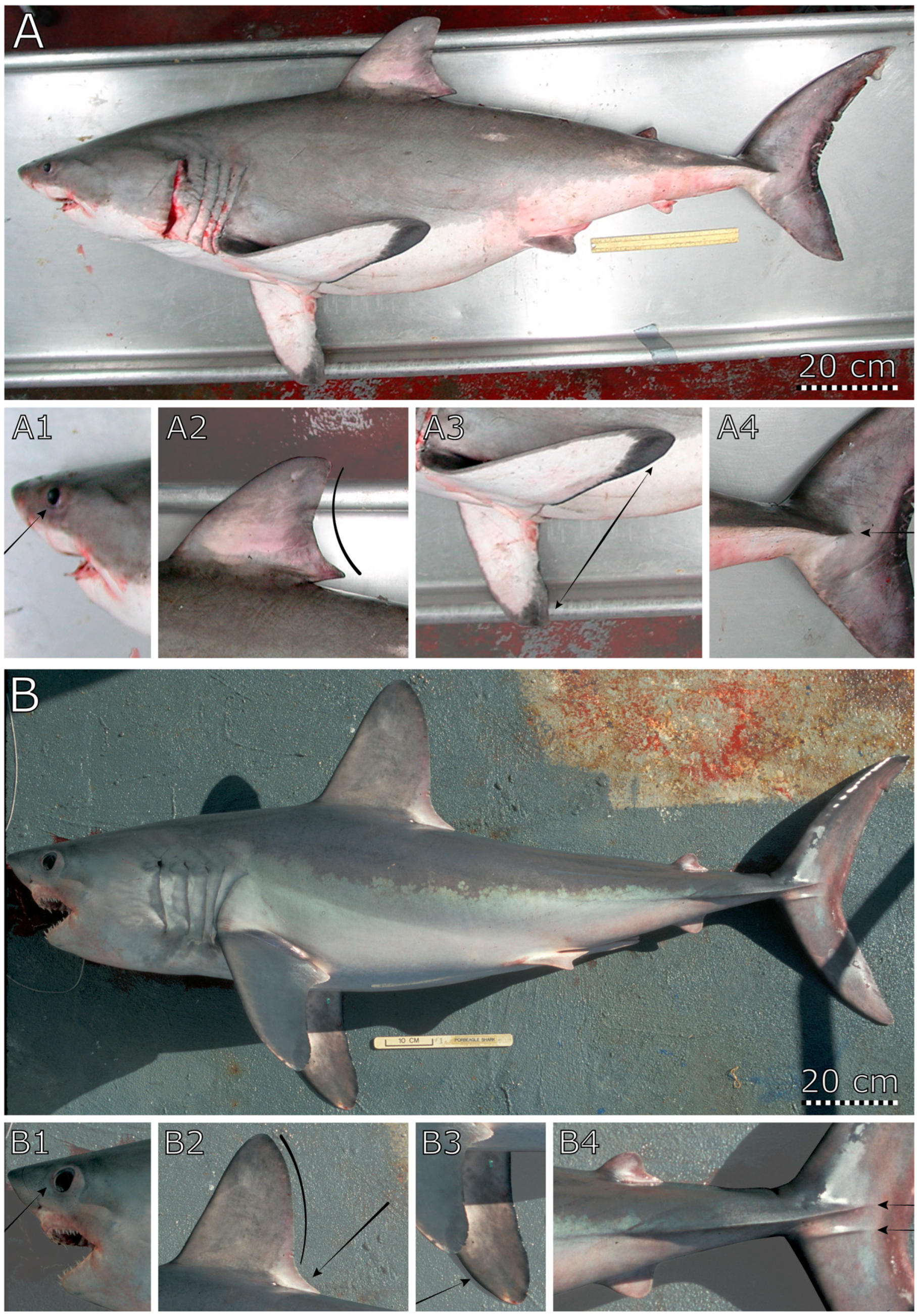
Carcharodon carcharias and Lamna nasus both belong to the family Lamnidae and can appear similar at first glance, particularly in general body shape. Nevertheless, multiple morphological traits enable taxonomic differentiation: (1) eyes small in C. carcharias vs. larger eyes (its diameter about 30% as long as snout in front of mouth) in L. nasus (2) posterior margin of the first dorsal fin concave in C. carcharias vs. straight or convex in L. nasus; (3) first dorsal fin without a white free rear tip in C. carcharias vs. conspicuous white free rear tip present in L. nasus; (4) distinct black markings on the ventral side of the pectoral fin tips present in C. carcharias vs. ventral surface of the pectoral fins exhibiting a broad dark area extending from the apex toward the base in L. nasus; (5) secondary caudal keel below the main keel on the caudal fin absent in C. carcharias vs. present in L. nasus; (6) upper teeth broadly triangular and labiolingually flattened in C. carcharias vs. upper teeth narrower and not labiolingually compressed in L. nasus; (7) cutting edges serrated in teeth of C. carcharias vs. unserrated in L. nasus; and (8) lateral cusplets absent in teeth of C. carcharias vs. present in L. nasus (occasionally absent in very young individuals) [8,9,10,11,12,13,14,15] (Figure 1). Ontogenetic change can affect the expression of individual characters in both species, particularly dental features [8,16,17,18,19,20]. However, the overall diagnostic framework remains robust, as species identification is supported by the combined concordant expression of multiple independent traits.
Soldo [1] first questions the reported total length of approximately 120–130 cm, arguing that this would represent the smallest free-swimming C. carcharias recorded in the Mediterranean. However, smaller free-swimming individuals (approximately 85–120 cm) have previously been documented in the Mediterranean Sea [21], and specimens of comparable size are also well documented outside this region [22,23]. In addition, documented late-term embryos reach sizes overlapping with or exceeding this range [24,25,26], indicating natural variation in size at birth. The reported total length therefore falls within the documented early ontogenetic range of C. carcharias and does not constitute evidence against this identification.
Although body size alone is acknowledged as insufficient to resolve the identification of the specimen, Soldo [1] further argues that several morphological traits are inconsistent with C. carcharias, focusing in particular on coloration, caudal keel development, and dental morphology. With respect to coloration, the specimen is described by Soldo [1] as having a dark bluish tone; however, the available photographs show a predominantly steel-grey overall appearance without a distinct blue hue. This coloration falls well within the documented intraspecific range of juvenile C. carcharias, which spans lead-grey to brownish grey or blackish tones [9,10,13,14]. Additionally, Castro ([27]: p. 284) reports that the color of L. nasus is “dark bluish grey to bluish brown” and notes postmortem color change. Collectively, this underscores the variability and subjectivity of coloration use as a diagnostic criterion in the absence of distinct pigmentation patterns or anatomical landmarks. In contrast, discrete pigmentation patterns can provide informative diagnostic cues. One such character concerns the ventral surface of the pectoral fins. In C. carcharias, the pectoral fins typically exhibit dark tips with a narrow black margin along the trailing edge, whereas in L. nasus the ventral surface shows a broader dark area extending from the apex toward the fin base [9,13]. The specimen illustrated by Jambura et al. [2] clearly displays dark pigmentation confined to the tip and margin of the pectoral fin, consistent with C. carcharias and not with L. nasus.
Another diagnostic pigmentation character is the white free rear tip of the first dorsal fin, which is consistently present in L. nasus and absent in C. carcharias. Although Soldo [1] argues that this feature cannot be assessed from the original images, the lateral view provided by Jambura et al. [2] in their figure 1B clearly shows the first dorsal fin, which lacks any indication of a white free rear tip, consistent with C. carcharias (Figure 1). In addition, the shape of the first dorsal fin exhibits a concave posterior margin, which is consistent with C. carcharias, but different from L. nasus (and other lamnids), whose posterior dorsal fin margin is either straight or convex [8,13]. A further external character discussed concerns the presence of a secondary caudal keel, which is consistently developed in L. nasus but absent in C. carcharias [9,10,13,14]. Like the first dorsal fin, Soldo [1] argued that this feature cannot be assessed from the available photographic material. However, in figure 1A of Jambura et al. [2] and figure 1 of Soldo [1], the caudal peduncle seemingly lacks a secondary keel below the main caudal keel, a condition consistent with C. carcharias. However, given the limited image resolution, viewing angle, and partial obscuration of the caudal region in the photographs, the presence or absence of a weakly developed secondary keel cannot be determined with complete confidence. This character is therefore treated conservatively and is not considered decisive here on its own. Importantly, even when this feature is excluded from consideration, the remaining external characters collectively support identification of the specimen as C. carcharias.
Despite the evidence of the external morphology strongly indicative of C. carcharias, Soldo [1] dismisses it and states that dental morphology represents the only character set that can be reliably used for species identification in this case. The paper places particular emphasis on the inclination of the intermediate tooth, serrations (or supposed lack thereof) on the cutting edge, and the absence of lateral cusplets. With regard to tooth inclination, it is argued that the polarity of the third anterior tooth (intermediate tooth) is inconsistent with C. carcharias, as it is inclined distally and not mesially and therefore resembles the state observed in L. nasus [1]. However, this interpretation is limited for two reasons. First, the mesially inclined third anterior tooth (=intermediate tooth) that characterizes C. carcharias refers to the upper jaw [9,28,29,30], whereas the available photographs show only the lower jaw dentition; the teeth in the upper jaw are not visible and therefore cannot be evaluated. Second, inclination of the third anterior (=intermediate) tooth of the lower jaw is variable in C. carcharias, and both mesial and distal orientations, as well as almost no inclination, have been reported [16,29], limiting its diagnostic utility. Moreover, variation in tooth inclination, including distally inclined upper intermediates, has been documented within C. carcharias, particularly among males [18], further limiting the taxonomic value of this character when considered in isolation.
The second dental character discussed concerns the development of a serrated cutting edge. It is argued that the cutting edges of the visible teeth appear largely smooth and unserrated, with only small irregular areas that are interpreted as the result of wear or minor surface irregularities rather than true serrations [1]. Based on this interpretation, Soldo [1] argues that the dentition is considered inconsistent with C. carcharias. However, the available images show that serrations are consistently present at the basal portion of all visible teeth, including teeth that are not fully erect and therefore unlikely to have experienced functional wear. This makes abrasion an unlikely explanation for the observed morphology. Instead, restriction of serrations to the basal part of the crown is consistent with incompletely developed serrational cutting edges, a condition known to occur in full-term embryos and juvenile C. carcharias [16,19,24,25,30,31] and reflects ontogenetic heterodonty rather than taxonomic distinction. Reduced or basally confined serrations, even the complete absence of such, are well known in small C. carcharias and typically become more fully expressed with increasing body size [9,16,30]. Consequently, the observed serration pattern falls within documented intraspecific and ontogenetic variations of C. carcharias and does not provide support for reassignment of the specimen to L. nasus.
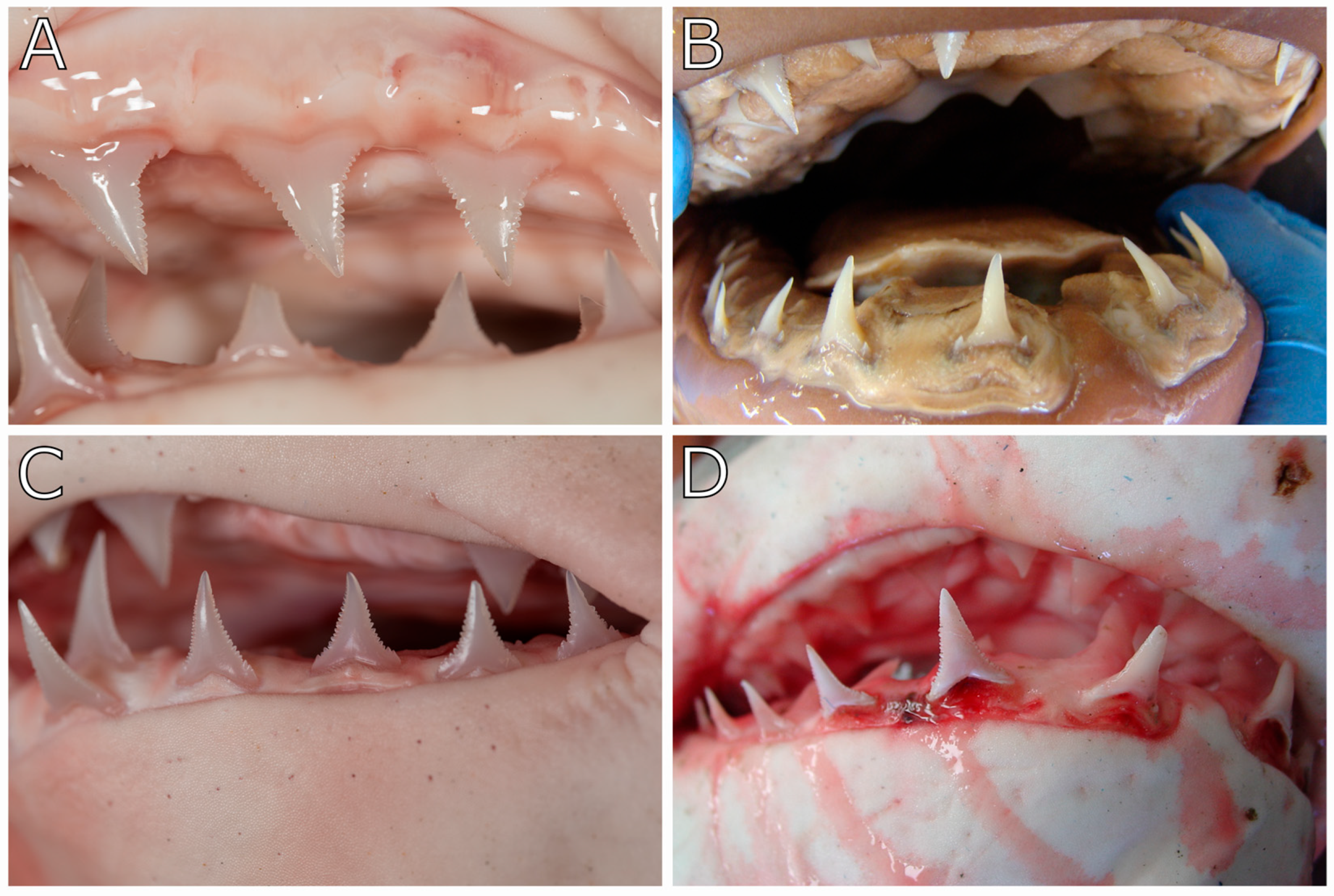
The central pillar of the reassessment of Soldo [1] is the alleged absence of lateral cusplets, which is treated as the most decisive diagnostic character. It is argued that small or juvenile C. carcharias consistently possess distinct lateral cusplets, whereas young L. nasus frequently lack them. Hence, it is concluded that the absence of such structures as reported by Jambura et al. [2] is incompatible with the identification of the specimen as a young-of-the-year C. carcharias. This argument, however, rests on an imprecise and historically inconsistent use of terminology that conflates non-homologous dental structures. As demonstrated by Bemis et al. [32], the lateral projections observed in juvenile C. carcharias are not true lateral cusplets sensu stricto, as found in lamnids such as L. nasus, but represent structures derived from the serrated cutting edge rather than independent cusps. Imprecise terminology applied to these fundamentally different morphologies has long obscured interpretations of character origin and homology in lamnid shark dentitions, with potential consequences for phylogenetic inferences [33,34]. Importantly, “serrational cusplets” (sensu Bemis et al. [32]) in C. carcharias show pronounced ontogenetic and intra-individual variability. For example, they may form distinct cusp-like projections [16,25,30], or partially to completely merge with adjacent serrations [16,20,32,35]. Their expression can also vary between tooth files and even between adjacent teeth within a single individual as can be seen in a recent case of a juvenile C. carcharias from Spain [35] (also see Figure 2). In the specimen illustrated by Jambura et al. [2], true lateral cusplets are indeed absent, consistent with the original description; however, weak basal projections consistent with serrational cusplets appear to be present in some teeth, whereas in others they likely are obscured by the overlying soft tissue, a condition consistent with known variation in juvenile C. carcharias, but not L. nasus.
Dental characters in sharks are well documented to exhibit substantial inter- and intraspecific morphological variation. Such variation is not restricted to ontogenetic change [17,36,37,38,39], but also includes monognathic and dignathic [40,41,42], geographic [43], and gynandric heterodonty [44,45,46], all of which are widespread across extant shark taxa, including C. carcharias [16,18,19,20]. In addition, pathologies [47,48] and pronounced individual variation [16,18] can further limit the diagnostic value of a single dental trait observed in a lone specimen. Lateral cusplets and cusplet-like structures are potentially among the most variable features, showing substantial variation in presence, number, size, symmetry, and degree of expression both within and among species [32]. A recent study by Ng et al. [49] reported a striking single-specimen case in which different teeth within one individual of the lamniform shark Odontaspis noronhai exhibited a mosaic of dental characters: some teeth displayed cusplet numbers previously regarded as diagnostic for the closely related species O. ferox, whereas others conformed to the typical condition of O. noronhai. Despite this pronounced intra-individual heterogeneity, the specimen was unambiguously identified as O. noronhai based on concordant overall morphology and molecular evidence. Similarly, Moyer et al. [50] recently documented variation in the number and development of lateral cusplets in a specimen of L. nasus. Nonetheless, lateral cusplets in lamniforms are still frequently treated as rigid, diagnostically decisive characters in recent taxonomic assessments, leading to misidentifications among lamniform sharks when other dental or external morphological characters are ignored or downweighed [51,52,53]. Awareness of these limitations is increasingly recognized in palaeontology, where taxonomic identification frequently relies on isolated teeth and consequently necessitates explicit consideration of heterodonty, ontogeny, and individual variation [54,55]. For extant sharks, however, dental characters rarely constitute the sole available evidence, and while teeth remain highly informative, robust taxonomic identification must integrate dental data with external morphology and, where available, molecular evidence. Treating a single, variably expressed trait as diagnostically decisive is ill-advised when multiple lines of evidence are available. We therefore maintain that best practices employ a holistic approach to taxonomic identification in which seemingly aberrant traits are contextualized or further studied rather than overemphasized to the exclusion of a larger body of evidence.
The original identification of the specimen by Jambura et al. [2] was based on the evaluation of both external and dental characters. Here, we have explicitly revisited these characters with particular emphasis on their documented ontogenetic, positional, and individual variability. We also acknowledge that such variability does not weaken taxonomic inference but is a prerequisite for its correct application. When all observable characters are considered collectively and interpreted within their known limits, the specimen consistently falls within the known morphological range of Carcharodon carcharias and does not match the diagnostic framework of Lamna nasus. Genetic analyses would have provided an additional independent line of evidence, but could not be conducted by the authors because the specimen was sold following capture [2]. Nevertheless, where feasible, molecular approaches should be incorporated into future assessments to further strengthen taxonomic identifications and the scientific value of citizen science-derived observations.
Citizen science has become an increasingly important tool in shark and ray research [56,57,58], particularly in regions such as the Mediterranean Sea where scientific survey data remain scarce and many species are rarely encountered. Opportunistic observations provided by fishers, divers, and the public have substantially improved knowledge on species occurrence, distribution, behaviour, and seasonality, especially for elusive or threatened taxa in this area [59,60,61,62,63,64]. At the same time, citizen science-derived records require careful verification, as photographic material may be incomplete, misleading, or incorrectly interpreted. A notable example is the purported first Mediterranean record of the goblin shark Mitsukurina owstoni [65], which was later challenged [66] and ultimately retracted [67] after concerns were raised that the photographed specimen represented a plastic toy rather than a natural specimen. Such cases highlight that citizen science observations should not be accepted at face value, but instead require critical expert evaluation, verification of source material, and integrative assessment using all available lines of evidence. When subjected to rigorous scrutiny, however, citizen science records remain a powerful and often indispensable source of conservation-relevant biodiversity data.
Reliable identification of white sharks is of particular relevance in the Mediterranean Sea, where the species is extremely rare and direct observations remain scarce despite repeated research efforts. While recent studies using eDNA [68,69] confirmed the presence of white sharks in the region, systematic field-based surveys have so far failed to collect observational or specimen-based data [70,71]. Consequently, current knowledge of occurrence and distribution relies mainly on meta-analyses of opportunistic records [4,5,6,7], including photographic observations contributed by fishers and members of the public [2,26,72,73,74,75]. Although such data cannot replace targeted field studies, they represent an essential source of information in systems where conventional survey approaches have proven ineffective. The current case of a juvenile white shark from the Adriatic Sea illustrates that the scientific value of such records depends on careful expert evaluation grounded in a clear understanding of character variability. When assessed within an appropriate taxonomic framework, citizen science observations can therefore be a powerful source of information to document rare species occurrences and inform conservation-relevant assessments.
In this context, dismissing well-documented records without rigorous, integrative scrutiny risks undermining conservation-relevant assessments. This is particularly critical for observations of juvenile or newborn individuals, as such records may provide rare indications of potential nursery or parturition areas in a region where scientific survey data remain limited. Given the low detection rates and the highly threatened population status of white sharks in the Mediterranean [6,7], careful and methodologically rigorous assessment of all available evidence is essential. Rather than weakening scientific standards, integrative evaluation strengthens the reliability of such records and ensures that conservation-relevant information is neither overstated nor prematurely disregarded.

Author Contributions

Conceptualization, P.L.J., J.K.M., I.Ć., P.U. and A.D.M.; methodology, P.L.J., J.K.M.; validation, P.L.J., J.T., J.K.M., K.S., I.Ć., B.D., P.U., M.P., P.C.S., S.N., J.B., M.B., F.H.M., J.K., D.J.L., T.T., C.J.U., C.D., C.P.O., A.D.M., J.C. and G.B.S.; investigation, P.L.J., J.T., J.K.M., K.S., I.Ć., B.D., P.U., M.P., P.C.S., S.N., J.B., M.B., F.H.M., J.K., D.J.L., T.T., C.J.U., C.D., C.P.O., A.D.M., J.C. and G.B.S.; writing—original draft preparation, P.L.J.; writing—review and editing, P.L.J., J.T., J.K.M., K.S., I.Ć., B.D., P.U., M.P., P.C.S., S.N., J.B., M.B., F.H.M., J.K., D.J.L., T.T., C.J.U., C.D., C.P.O., A.D.M., J.C. and G.B.S.; visualization, J.T.; supervision, P.L.J.; funding acquisition, J.K. All authors have read and agreed to the published version of the manuscript.

Funding

This research was funded in whole or in part by the Austrian Science Fund (FWF) [10.55776/P33820]. For the purpose of open access, the corresponding author has applied a CC BY public copyright license to any Author Accepted Manuscript version arising from this submission.

Data Availability Statement

No new data were created or analyzed in this study. Data sharing is not applicable to this article.

Acknowledgments

We thank Bob Hueter (OCEARCH) for insightful discussions and for sharing his expertise.

Conflicts of Interest

The authors declare no conflicts of interest.

References

  1. Soldo, A. When Citizen Science Becomes Speculation: Evaluating the Reliability of Lamnid Shark Identification from Photographic Records in the Mediterranean. J. Mar. Sci. Eng. 2026, 14, 173. [Google Scholar] [CrossRef]
  2. Jambura, P.L.; Ugarković, P.; Pavičić, M.; Ćetković, I.; Niedermüller, S.; Kriwet, J.; Türtscher, J. New Evidence for the Contemporary Presence of Juvenile White Sharks (Carcharodon carcharias) in the Adriatic Sea. Fishes 2025, 10, 25. [Google Scholar] [CrossRef] [PubMed]
  3. Dulvy, N.K.; Allen, D.J.; Ralph, G.M.; Walls, R.H.L. The Conservation Status of Sharks, Rays and Chimaeras in the Mediterranean Sea; IUCN Centre for Mediterranean Cooperation: Malaga, Spain, 2016; p. 14. [Google Scholar]
  4. Fergusson, I.K. Distribution and Autecology of the White Shark in the Eastern North Atlantic Ocean and the Mediterranean Sea. In The Biology of Carcharodon carcharias; Great White Sharks; Klimley, A.P., Ainley, D., Eds.; Academic Press: San Diego, CA, USA; London, UK, 1996; pp. 321–345. [Google Scholar]
  5. De Maddalena, A.; Heim, W. Mediterranean Great White Sharks: A Comprehensive Study Including All Recorded Sightings; Illustrated edition; McFarland & Company, Inc.: Jefferson, NC, USA, 2012. [Google Scholar]
  6. Boldrocchi, G.; Kiszka, J.; Purkis, S.; Storai, T.; Zinzula, L.; Burkholder, D. Distribution, Ecology, and Status of the White Shark, Carcharodon carcharias, in the Mediterranean Sea. Rev. Fish Biol. Fish. 2017, 27, 515–534. [Google Scholar] [CrossRef]
  7. Moro, S.; Jona-Lasinio, G.; Block, B.; Micheli, F.; De Leo, G.; Serena, F.; Bottaro, M.; Scacco, U.; Ferretti, F. Abundance and Distribution of the White Shark in the Mediterranean Sea. Fish Fish. 2020, 21, 338–349. [Google Scholar] [CrossRef]
  8. Bigelow, H.B.; Schroeder, W.C. Sharks. In Fishes of the Western North Atlantic; Part 1 Sears Foundation for Marine Research; Tee-Van, J., Breder, C.M., Hildebrand, S.F., Parr, A.E., Schroeder, W.C., Eds.; Yale University: New Haven, CT, USA, 1948; pp. 59–576. [Google Scholar]
  9. Compagno, L.J.V. Sharks of the World: Part 1: Hexachiformes to Lamniformes; FAO Species Catalogue; FAO: Rome, Italy, 1984; Volume 4. [Google Scholar]
  10. Compagno, L.J.V. Sharks of the World. An Annotated and Illustrated Catalogue of Shark Species Known to Date. Volume 2. Bullhead, Mackerel and Carpet Sharks (Heterodontiformes, Lamniformes and Orectolobiformes); FAO Species Catalogue for Fishery Purposes; FAO: Rome, Italy, 2001; 269p. [Google Scholar]
  11. De Maddalena, A. Il Disegno Della Superficie Ventrale Delle Pinne Pettorali Dei Selaci Come Carattere Diagnostico per Il Riconoscimento Delle Specie. Ann. Ser. Hist. Nat. 2000, 10, 187–198. [Google Scholar]
  12. De Maddalena, A.; Bänsch, H.; Heim, W. Sharks of the Mediterranean: An Illustrated Study of All Species; McFarland & Company, Inc., Publishers: Jefferson, NC, USA; London, UK, 2016. [Google Scholar]
  13. Ebert, D.A.; Dando, M. Field Guide to Sharks, Rays & Chimaeras of Europe and the Mediterranean; Princeton University Press: Princeton, NJ, USA, 2021. [Google Scholar]
  14. Ebert, D.A.; Fowler, S.; Dando, M. Sharks of the World: A Complete Guide; Princeton University Press: Princeton, NJ, USA, 2021. [Google Scholar]
  15. Bernardi, J.; De Maddalena, A. On a Porbeagle, Lamna nasus (Bonnaterre, 1788), Observed near Brač, Croatia. Boll. Mus. Civ. Stor. Nat. Venezia 2023, 74, 19–23. [Google Scholar]
  16. Hubbell, G. Using Tooth Structure to Determine the Evolution History of the White Sharks. In Great White Sharks. The Biology of Carcharodon carcharias; Klimley, A.P., Ainley, D., Eds.; Academic Press: San Diego, CA, USA; London, UK, 1996; pp. 9–18. [Google Scholar]
  17. Purdy, R.W.; Francis, M.P. Ontogenetic Development of Teeth in Lamna nasus (Bonnaterre, 1758) (Chondrichthyes: Lamnidae) and Its Implications for the Study of Fossil Shark Teeth. J. Vertebr. Paleontol. 2007, 27, 798–810. [Google Scholar] [CrossRef]
  18. French, G.C.A.; Stürup, M.; Rizzuto, S.; van Wyk, J.H.; Edwards, D.; Dolan, R.W.; Wintner, S.P.; Towner, A.V.; Hughes, W.O.H. The Tooth, the Whole Tooth and Nothing but the Tooth: Tooth Shape and Ontogenetic Shift Dynamics in the White Shark Carcharodon carcharias. J. Fish Biol. 2017, 91, 1032–1047. [Google Scholar] [CrossRef]
  19. Tomita, T.; Miyamoto, K.; Kawaguchi, A.; Toda, M.; Oka, S.-I.; Nozu, R.; Sato, K. Dental Ontogeny of a White Shark Embryo. J. Morphol. 2017, 278, 215–227. [Google Scholar] [CrossRef]
  20. Hunt, E.; Niella, Y.; Smoothey, A.F.; Marzinelli, E.M.; Raubenheimer, D.; Bradford, R.; Booth, D.J.; Peddemors, V.M. Form, Function and Feeding: Changes in Tooth Size and Shape Associated With Ontogenetic Changes in Prey Consumption by Australian White Sharks (Carcharodon carcharias). Ecol. Evol. 2026, 16, e72795. [Google Scholar] [CrossRef]
  21. Kabasakal, H. The Status of the Great White Shark (Carcharodon carcharias) in Turkey’s Waters. Mar. Biodivers. Rec. 2014, 7, e109. [Google Scholar] [CrossRef]
  22. Casey, J.G.; Pratt, H.L. Distribution of the White Shark Carcharodon carcharias in the Western North Atlantic. Mem. South. Calif. Acad. Sci. 1985, 9, 2–14. [Google Scholar]
  23. Santana-Morales, O.; Abad, A.; Hoyos-padilla, M.; Naylor, G.J.P.; Corrigan, S.; Malpica-cruz, L.; Aquino-baleyt, M.; Castillo-g, L. The Smallest Known Free-Living White Shark Carcharodon carcharias (Lamniformes: Lamnidae): Ecological and Management Implications. Copeia 2020, 108, 39–46. [Google Scholar] [CrossRef]
  24. Uchida, S.; Toda, M.; Teshima, K.; Yano, K. Pregnant White Sharks and Full-Term Embryos from Japan. In Great White Sharks. The Biology of Carcharodon carcharias; Klimley, A.P., Ainley, D., Eds.; Academic Press: San Diego, CA, USA; London, UK, 1996; pp. 139–155. [Google Scholar]
  25. Francis, M.P. Observations on a Pregnant White with a Review of Reproductive Biology. In Great White Sharks: The Biology of Carcharodon carcharias; Klimley, A.P., Ainley, D.G., Eds.; Academic Press: San Diego, CA, USA; London, UK, 1996; pp. 157–172. [Google Scholar]
  26. Saïdi, B.; Bradaï, M.N.; Bouaïn, A.; Guélorget, O.; Capapé, C. Capture of a Pregnant Female White Shark, Carcharodon carcharias (Lamnidae) in the Gulf of Gabès (Southern Tunisia, Central Mediterranean) with Comments on Oophagy in Sharks. Cybium 2005, 29, 303–307. [Google Scholar]
  27. Castro, J.; Peebles, D. The Sharks of North America; Oxford University Press: Oxford, NY, USA, 2011. [Google Scholar]
  28. Whitley, G.P. Studies in Ichthyology. No. 14. Rec. Aust. Mus. 1950, 22, 234–245. [Google Scholar] [CrossRef]
  29. Shimada, K. Dental Homologies in Lamniform Sharks (Chondrichthyes: Elasmobranchii). J. Morphol. 2002, 251, 38–72. [Google Scholar] [CrossRef] [PubMed]
  30. Pollerspöck, J.; Straube, N. An Identification Key to Elasmobranch Species Based on Dental Morphological Characters. Part B: Extant Lamniform Sharks (Superorder Galeomorphii: Order Lamniformes). Bull. Fish Biol. 2020, 19, 27–64. [Google Scholar]
  31. Shimada, K. Teeth of Embryos in Lamniform Sharks (Chondrichthyes: Elasmobranchii). Environ. Biol. Fishes 2002, 63, 309–319. [Google Scholar] [CrossRef]
  32. Bemis, W.E.; Moyer, J.K.; Riccio, M.L. Homology of Lateral Cusplets in the Teeth of Lamnid Sharks (Lamniformes: Lamnidae). Copeia 2015, 103, 961–972. [Google Scholar] [CrossRef]
  33. Long, D.J.; Waggoner, B.M. Evolutionary Relationships of the White Shark: A Phylogeny of Lamniform Sharks Based on Dental Morphology. In Great White Sharks; Klimley, A.P., Ainley, D., Eds.; Academic Press: San Diego, CA, USA; London, UK, 1996; pp. 37–47. [Google Scholar]
  34. Shimada, K. Phylogeny of Lamniform Sharks (Chondrichthyes: Elasmobranchii) and the Contribution of Dental Characters to Lamniform Systematics. Paleontol. Res. 2005, 9, 55–72. [Google Scholar] [CrossRef]
  35. Báez, J.C.; Puerto, M.A.; Torreblanca, D.; Varela, J.L.; Carmona, L.; Macías, D. New Record of White Shark, Carcharodon carcharias (Elasmobranchii, Lamniformes, Lamnidae), from the Mediterranean Spanish Coast. Acta Ichthyol. Piscat. 2026, 56, 27–31. [Google Scholar] [CrossRef]
  36. Cullen, J.A.; Marshall, C.D. Do Sharks Exhibit Heterodonty by Tooth Position and over Ontogeny? A Comparison Using Elliptic Fourier Analysis. J. Morphol. 2019, 280, 687–700. [Google Scholar] [CrossRef] [PubMed]
  37. Berio, F.; Evin, A.; Goudemand, N.; Debiais-Thibaud, M. The Intraspecific Diversity of Tooth Morphology in the Large-Spotted Catshark Scyliorhinus stellaris: Insights into the Ontogenetic Cues Driving Sexual Dimorphism. J. Anat. 2020, 237, 960–978. [Google Scholar] [CrossRef]
  38. Goodman, K.; Niella, Y.; Bliss-Henaghan, T.; Harcourt, R.; Smoothey, A.F.; Peddemors, V.M. Ontogenetic Changes in the Tooth Morphology of Bull Sharks (Carcharhinus leucas). J. Fish Biol. 2022, 101, 1033–1046. [Google Scholar] [CrossRef]
  39. Türtscher, J.; Jambura, P.L.; López-Romero, F.A.; Kindlimann, R.; Sato, K.; Tomita, T.; Kriwet, J. Heterodonty and Ontogenetic Shift Dynamics in the Dentition of the Tiger Shark Galeocerdo cuvier (Chondrichthyes, Galeocerdidae). J. Anat. 2022, 241, 372–392. [Google Scholar] [CrossRef] [PubMed]
  40. Compagno, L.J.V. Sharks of the Order Carcharhiniformes; Princeton University Press: Princeton, NJ, USA, 1988. [Google Scholar]
  41. Welton, B.J.; Farish, R.F. The Collector’s Guide to Fossil Sharks and Rays from the Cretaceous of Texas; Before Time: Lewisville, TX, USA, 1993. [Google Scholar]
  42. Cappetta, H. Handbook of Paleoichthyology, Volume 3E: Chondrichthyes—Mesozoic and Cenozoic Elasmobranchii: Teeth; Verlag Dr. Friedrich Pfeil: Munich, Germany, 2012; p. 512. [Google Scholar]
  43. Lucifora, L.O.; Cione, A.L.; Menni, R.C.; Escalante, A.H. Tooth Row Counts, Vicariance, and the Distribution of the Sand Tiger Shark Carcharias taurus. Ecography 2003, 26, 567–572. [Google Scholar] [CrossRef]
  44. Gruber, S.H.; Compagno, L.J.V. Taxonomic Status and Biology of the Bigeye Thresher, Alopias superciliosus. Fish. Bull. 1981, 79, 617–640. [Google Scholar]
  45. Straube, N.; Schliewen, U.; Kriwet, J. Dental Structure of the Giant Lantern Shark Etmopterus baxteri (Chondrichthyes: Squaliformes) and Its Taxonomic Implications. Environ. Biol. Fish. 2008, 82, 133–141. [Google Scholar] [CrossRef]
  46. Reichmann, K.A.R.; Mahoney, M.G.; Long, D.J.; Shimada, K. Dental Variations in the Crocodile Shark, Pseudocarcharias kamoharai (Lamniformes: Pseudocarchariidae): Implications for Fossil Pseudocarcharias. J. Ocean. Sci. Found. 2025, 45, 36–47. [Google Scholar] [CrossRef]
  47. Balbino, A.C.; Antunes, M.T. Pathologic Tooth Deformities in Fossil and Modern Sharks Related to Jaw Injuries. Comptes Rendus Palevol 2007, 6, 197–209. [Google Scholar] [CrossRef]
  48. Miller, H.S.; Avrahami, H.M.; Zanno, L.E. Dental Pathologies in Lamniform and Carcharhiniform Sharks with Comments on the Classification and Homology of Double Tooth Pathologies in Vertebrates. PeerJ 2022, 10, e12775. [Google Scholar] [CrossRef] [PubMed]
  49. Ng, S.-L.; Yu, C.-J.; Su, S.-H.; Joung, S.-J. A New Record of the Rare Bigeye Sand Tiger Shark Odontaspis noronhai Maul, 1955 (Lamniformes: Odontaspididae) from the Northwestern Pacific, with Notes on Dentition. Zootaxa 2022, 5094, 92–102. [Google Scholar] [CrossRef] [PubMed]
  50. Moyer, J.K.; Watkins-Colwell, G.J.; Shimada, K. Atypical Dentition of a Porbeagle Shark (Lamna nasus) Highlights Odontological Considerations in the Taxonomy and Phylogenetics of Sharks. Anat. Rec. 2026. [Google Scholar] [CrossRef]
  51. Lipej, L.; De Maddalena, A.; Soldo, A. Sharks of the Adriatic Sea; Knjiznica Annales Majora: Koper, Slovenia, 2004. [Google Scholar]
  52. Soldo, A.; Bakiu, R.; Hysolakoj, N. New Record of Smalltooth Sand Tiger Odontaspis ferox (Risso, 1810) in the Mediterranean. J. Mar. Biol. Assoc. U. K. 2022, 102, 502–504. [Google Scholar] [CrossRef]
  53. Soldo, A.; Lipej, L. Comment on Balàka et al. Updated Checklist of Chondrichthyan Species in Croatia (Central Mediterranean Sea). Biology 2023, 12, 952. Biology 2024, 13, 135. [Google Scholar] [CrossRef]
  54. Guinot, G.; Adnet, S.; Shimada, K.; Underwood, C.J.; Siversson, M.; Ward, D.J.; Kriwet, J.; Cappetta, H. On the Need of Providing Tooth Morphology in Descriptions of Extant Elasmobranch Species. Zootaxa 2018, 4461, 118–126. [Google Scholar] [CrossRef]
  55. Türtscher, J.; López-Romero, F.A.; Jambura, P.L.; Kindlimann, R.; Ward, D.J.; Kriwet, J. Evolution, Diversity, and Disparity of the Tiger Shark Lineage Galeocerdo in Deep Time. Paleobiology 2021, 47, 574–590. [Google Scholar] [CrossRef] [PubMed]
  56. Bargnesi, F.; Lucrezi, S.; Ferretti, F. Opportunities from Citizen Science for Shark Conservation, with a Focus on the Mediterranean Sea. Eur. Zool. J. 2020, 87, 20–34. [Google Scholar] [CrossRef]
  57. Bernardi, J.; Mazzoldi, C.; Bressan, G. Using Citizen Science to Understand the Recreational Fishing Impact on Elasmobranchs along the Italian Northern Adriatic Coast. Acta Adriat. 2025, 66, 95–101. [Google Scholar] [CrossRef]
  58. Mawer, R.; Dodd, J.; Thorburn, J.; Burns, N.M.; Bailey, D.M. Using Citizen Science Photographs to Identify Reproductive Events in an Oviparous Elasmobranch. J. Fish Biol. 2025, 107, 419–430. [Google Scholar] [CrossRef]
  59. Giovos, I.; Stoilas, V.; Al-Mabruk, S.A.; Doumpas, N.; Marakis, P.; Maximiadi, M.; Moutopoulos, D.; Kleitou, P.; Keramidas, I.; Tiralongo, F.; et al. Integrating Local Ecological Knowledge, Citizen Science and Long-term Historical Data for Endangered Species Conservation: Additional Records of Angel Sharks (Chondrichthyes: Squatinidae) in the Mediterranean Sea. Aquat. Conserv. 2019, 29, 881–890. [Google Scholar] [CrossRef]
  60. Giovos, I.; Serena, F.; Katsada, D.; Anastasiadis, A.; Barash, A.; Charilaou, C.; Hall-Spencer, J.M.; Crocetta, F.; Kaminas, A.; Kletou, D.; et al. Integrating Literature, Biodiversity Databases, and Citizen-Science to Reconstruct the Checklist of Chondrichthyans in Cyprus (Eastern Mediterranean Sea). Fishes 2021, 6, 24. [Google Scholar] [CrossRef]
  61. Jambura, P.L.; Ćetković, I.; Kriwet, J.; Türtscher, J. Using Historical and Citizen Science Data to Improve Knowledge about the Occurrence of the Elusive Sandbar Shark Carcharhinus plumbeus (Chondrichthyes–Carcharhinidae) in the Adriatic Sea. Mediterr. Mar. Sci. 2021, 22, 169–179. [Google Scholar] [CrossRef]
  62. Jambura, P.L.; Türtscher, J.; Kriwet, J.; Al Mabruk, S.A.A. Deadly Interaction between a Swordfish Xiphias gladius and a Bigeye Thresher Shark Alopias superciliosus. Ichthyol. Res. 2021, 68, 317–321. [Google Scholar] [CrossRef]
  63. Balàka, P.F.; Ugarković, P.; Türtscher, J.; Kriwet, J.; Niedermüller, S.; Krstinić, P.; Jambura, P.L. Updated Checklist of Chondrichthyan Species in Croatia (Central Mediterranean Sea). Biology 2023, 12, 952. [Google Scholar] [CrossRef]
  64. Ziani, N.; Soranzo, T.; Jambura, P.L.; Carbon, T.; Prunier, N.; Broutin-Renaud, J.; Bru, R.; De Maddalena, A.; Kabasakal, H. Record-Sized Female Smooth-Hound (Mustelus sp.) Captured in Corsican Waters and Preliminary Observations on Feeding on the Invasive Blue Crab Callinectes Sapidus. Acta Adriat. 2025, 66, 165–170. [Google Scholar] [CrossRef]
  65. Anastasiadis, A.; Papadimitriou, E.; Küpper, F.C. [Retracted 20 March 2023] First Record of the Goblin Shark Mitsukurina owstoni Jordan, 1898 (Lamniformes: Mitsukurinidae) in the Mediterranean Sea. Mediterr. Mar. Sci. 2023, 23, 417–446. [Google Scholar]
  66. Pollerspöck, J.; Weigmann, S.; Seret, B.; Straube, N. Comment on “4.4 First Record of the Goblin Shark Mitsukurina owstoni Jordan, 1898 (Lamniformes: Mitsukurinidae) in the Mediterranean Sea” by Athanasios Anastasiadis, Evangelos Papadimitriou and Frithjof C. Küpper in: Kousteni, V., Anastasiadis, A., Bariche, M., Battaglia, P., Bonifazi, A. et al. (2022). New Records of Rare Species in the Mediterranean Sea (May 2022). Mediterranean Marine Science, 23 (3), 417-446. Medit. Mar. Sci. 2023, 24, 101–103. [Google Scholar] [CrossRef]
  67. Anastasiadis, A.; Papadimitriou, E.; Küpper, F.C. Retraction Note: “4.4 First Record of the Goblin Shark Mitsukurina owstoni Jordan, 1898 (Lamniformes: Mitsukurinidae) in the Mediterranean Sea” by Athanasios Anastasiadis, Evangelos Papadimitriou and Frithjof C. Küpper in: Kousteni, V. et al. (2022). New Records of Rare Species in the Mediterranean Sea (May 2022). Mediterranean Marine Science, 23 (3), 417-446, doi:10.12681/Mms.28372 and Reply to Comment on “First Record of the Goblin Shark Mitsukurina owstoni Jordan, 1898 (Lamniformes: Mitsukurinidae) in the Mediterranean Sea” by Jürgen Pollerspöck, Simon Weigmann, Bernard Seret and Nicolas Straube. Mediterranean Marine Science, 24 (1), 101-103, Doi: Http://Doi.Org/10.12681/Mms.32478. Medit. Mar. Sci. 2023, 24, 173. [Google Scholar] [CrossRef]
  68. Jenrette, J.F.; Jenrette, J.L.; Truelove, N.K.; Moro, S.; Dunn, N.I.; Chapple, T.K.; Gallagher, A.J.; Gambardella, C.; Schallert, R.; Shea, B.D.; et al. Detecting Mediterranean White Sharks with Environmental DNA. Oceanography 2023, 36, 87–89. [Google Scholar] [CrossRef]
  69. Ferretti, F.; Shea, B.D.; Gambardella, C.; Jenrette, J.F.; Moro, S.; Echwikhi, K.; Schallert, R.J.; Gallagher, A.J.; Block, B.A.; Chapple, T.K. On the Tracks of White Sharks in the Mediterranean Sea. Front. Mar. Sci. 2024, 11, 1425511. [Google Scholar] [CrossRef]
  70. Soldo, A.; Peirce, R. Shark Chumming in the Eastern Adriatic. Ann. Ser. Hist. Nat. 2005, 15, 203–208. [Google Scholar]
  71. Micarelli, P.; Reinero, F.R.; Marsella, A.; Vernelli, E.; Vittorini, E.; Monteleone, L.; Vailati, M.; Marsili, L.; Tinti, F.; Sperone, E. Attempts to Locate and Sample the White Shark, Carcharodon carcharias (Lamniformes: Lamnidae), along the Italian Coasts in the Mediterranean Sea. Acta Adriat. 2023, 64, 181–186. [Google Scholar] [CrossRef]
  72. Galaz, T.; De Maddalena, A. On a Great White Shark, Carcharodon carcharias (Linnaeus, 1758), Trapped in a Tuna Cage off Libya, Mediterranean Sea. Ann. Ser. Hist. Nat. 2004, 14, 159–164. [Google Scholar]
  73. Jambura, P.L.; Türtscher, J.; De Maddalena, A.; Giovos, I.; Kriwet, J.; Rizgalla, J.; Al Mabruk, S.A.A. Using Citizen Science to Detect Rare and Endangered Species: New Records of the Great White Shark Carcharodon carcharias off the Libyan Coast. Ann. Ser. Hist. Nat. 2021, 31, 51–60. [Google Scholar] [CrossRef]
  74. Kabasakal, H.; Bayri, E.; Alkan, G. Distribution and Status of the Great White Shark Carcharodon carcharias in Turkish Waters: A Review and New Records. Ann. Ser. Hist. Nat. 2022, 32, 325–342. [Google Scholar] [CrossRef]
  75. Ziani, N.; Tondu, F.; Bru, R.; Mosnier, C.; Foxonet, S.; Gallien, R.B.; Pouly, M.; Tonietto, M.L.; Verdon, L.; Deysson, E.; et al. Bite Marks Observed on a Large Female White Shark Carcharodon carcharias off Camargue, France, Provide Potential Insights into the Reproduction of the Mediterranean Population. Ann. Ser. Hist. Nat. 2025, 35, 97–106. [Google Scholar] [CrossRef]
Figure 1. External diagnostic characters distinguishing a juvenile Carcharodon carcharias ((A); 183 cm TL) from a similarly sized Lamna nasus ((B); 188 cm TL). Diagnostic differences include relative eye size (A1,B1), posterior margin and pigmentation of the first dorsal fin (A2,B2), ventral pectoral fin markings (A3,B3), and caudal keel morphology (A4,B4).
Jmse 14 01148 g001
Figure 2. Variation in the development of serrational cusplets in juvenile white sharks (Carcharodon carcharias). (A). AIM MA122232 (159.4 cm TL); (B). OCF-P19920522-1 (TL: 135 cm); (C). Rehutai AIM MA125777 (105 cm TL); (D). NMFS uncatalogued (183 cm TL). Abbreviations: AIM—Auckland Museum; OCF—Okinawa Churashima Research Center; NMFS—National Marine Fisheries Service.
Jmse 14 01148 g002
Disclaimer/Publisher’s Note: The statements, opinions and data contained in all publications are solely those of the individual author(s) and contributor(s) and not of MDPI and/or the editor(s). MDPI and/or the editor(s) disclaim responsibility for any injury to people or property resulting from any ideas, methods, instructions or products referred to in the content.