


Abstract
Maritime Autonomous Surface Ships (MASSs) incorporate advanced digital technologies, thus rendering their systems more complex and diverse than those of conventional ships. Furthermore, the operation of MASSs, which introduces new risks not encountered in conventional ship operations, differs significantly from that of conventional manned vessels. These challenges highlight the necessity for a more systematic and structured approach to risk analysis and control. This study presents a qualitative risk assessment methodology to identify and manage hazardous scenarios associated with MASS operations systematically. The key feature of the proposed methodology is the integration of cognitive model-based functional analysis with the widely adopted hazard identification (HAZID) method, which enables a structured and comprehensive analysis process. Functional analysis is used to examine the functions required for MASS operations and to analyze interconnected systems to fulfill these functions. Subsequently, HAZID is performed to identify hazardous scenarios that may cause functional degradation or failure. To illustrate the proposed methodology, a case study is presented based on a qualitative risk assessment conducted in preparation for the field trial of an Autonomous Navigation System. Practical applications, including the presented case study, demonstrated the effectiveness of this methodology as a systematic tool for identifying and evaluating potentially hazards in MASS operations.
1. Introduction
In recent years, rapid advancement in information and communication technologies and related digital innovations has driven significant interest in autonomous maritime systems. These technologies, aimed at minimizing human intervention, have facilitated field trial operations of autonomous systems [1] and increased the feasibility of their commercial deployment. Recognizing the potential implications of such technological advancements, the International Maritime Organization (IMO) has acknowledged the necessity for robust regulatory measures to ensure the safety of human life at sea, on property, and in the marine environment. Since the 99th session of the Maritime Safety Committee (MSC 99), the IMO has initiated discussions on Maritime Autonomous Surface Ships (MASSs) and is currently developing the MASS Code to ensure the safe operation of MASSs and their coexistence with conventional vessels [2,3,4].
MASS technology is expected to enhance operational efficiency, environmental sustainability, and maritime safety [5,6,7,8,9,10,11,12]. However, adopting new technologies and the corresponding operational paradigms tends to introduce a range of novel risks distinct from those associated with conventional ship operations, thus underscoring the necessity for advanced risk assessment methodologies to systematically analyze and control emerging hazards [5,13,14].
Recent systematic review articles [13,15,16] have indicated a steady growth in research on risk assessment methodologies for MASSs since the initiation of IMO discussions. Tao et al. [13] analyzed 62 studies related to MASSs, classifying risk-influencing factors (RIFs) into human-related, vessel-related, environmental, and technological factors, and further examined 23 studies that focused specifically on risk assessment methodologies and data sources. Chaal et al. [15] conducted a bibliometric review of 417 papers published between 2011 and 2022 and performed a detailed analysis of the 30 most cited works concerning the methodologies and formats used for MASS risk assessment. Similarly, Yuzui and Kaneko [16] applied the PRISMA (Preferred Reporting Items for Systematic Reviews and Meta-Analyses) framework to select 47 relevant studies published between January 2018 and March 2023, categorizing them according to risk analysis types and tools, target indices (e.g., risk levels and failure rates), risk types (e.g., safety and cybersecurity), MASS type, and accident type. These reviews indicate that the System-Theoretic Process Analysis (STPA) [17,18,19,20,21,22] is the most commonly used approach for qualitative risk assessment, whereas Bayesian Networks (BNs) [23,24,25] are frequently applied for quantitative risk assessment. Other notable methodologies include Failure Modes and Effects Analysis (FMEA) [26,27], Human Factors Analysis and Classification System (HFACS) [28], Fault Tree Analysis (FTA) [29], and several others [30,31,32]. In many studies, these techniques are used in combination to meet the specific requirements of risk assessment objectives, for example, integrating STPA with BN [33,34,35,36,37] or combining FTA, BN, and Event Sequence Diagrams (ESDs) [38,39,40]. A key point emphasized across these systematic reviews is the increasing necessity for structured and effective risk assessment methodologies customized to MASSs, whether for developing novel approaches or adapting to existing ones. Thus, we developed a MASS-specific risk assessment framework as part of the “Development of Autonomous Ship Technology” R&D project under the Korea Autonomous Surface Ship (KASS) Project [41]. This study focuses on a qualitative risk assessment methodology within this framework.
While a range of qualitative risk assessment frameworks for MASSs has been proposed in previous studies, techniques such as STPA and FMEA have proven effective for detailed analyses involving control logic among components in autonomous systems. In addition, efforts to quantify risks by combining techniques like BNs, FTA, and ESDs have also been observed. However, this paper aims to propose a qualitative risk assessment methodology that is suitable for analyzing risks associated with MASS operations, particularly in light of the complexity of MASS operations and their unique human–system interaction challenges. The proposed methodology distinguishes itself by explicitly considering the functional requirements and interactions specific to MASS operations, while also being structured to facilitate future integration with quantitative risk modeling. The following considerations were taken into account in the development of this methodology.
A well-structured qualitative risk assessment methodology for MASSs should exhibit the following characteristics: (1) enable effective comparison with conventional ships to confirm that MASSs achieve at least an equivalent level of safety, (2) be sufficiently flexible and intuitive to be applicable across various system designs intended to meet MASS operational requirements, and (3) facilitate integration with quantitative risk assessment methodologies. To fulfill these requirements, this study proposes a methodology that combines cognitive model-based functional analysis with a hazardous scenario identification process, with emphasis on identifying functional degradation and failure scenarios from an operational perspective. Functional analysis is adopted to compare MASSs with conventional ships in terms of the required operational functions to satisfy the first requirement. Second, the methodology incorporates Functional Flow Diagrams to visualize the operational sequence of system functions intuitively and applies the widely used hazard identification (HAZID) method to identify risk factors that may cause functional degradation or failure. To support integration with quantitative approaches, the methodology also includes the development of logic-gate-based Functional Blocks, which enable the transformation of Functional Flow Diagrams into Fault Trees or Reliability Block Diagrams (RBDs).
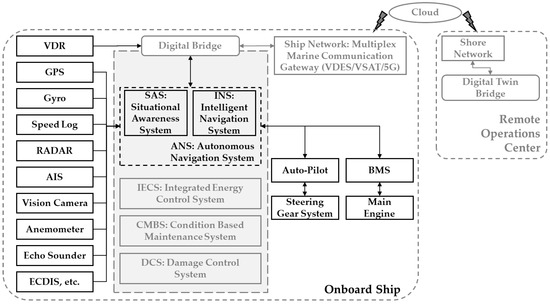
A detailed explanation of this methodology is provided in Section 2, beginning with a brief overview of the overall MASS risk assessment framework. Section 3 presents a case study of qualitative risk assessment applied to an Autonomous Navigation System (ANS) field trial conducted in accordance with the IMO’s Interim Guidelines for MASS Trials (MSC.1/Circ.1604). Section 4 discusses the key insights from applying the methodology, and Section 5 concludes the paper.
2. Methods
2.1. Scope and Concept
In ship and system design approval, traditional prescriptive regulations may limit the level of innovation that can be realized during the design process. Consequently, several IMO conventions include provisions accommodating alternatives and/or equivalent designs. To enable the widespread adoption of innovative and alternative/equivalent designs, it is essential to establish a predictable and reliable approval process that maximally leverages state-of-the-art risk assessment tools and techniques [42]. Risk assessment for innovative and alternative/equivalent designs is typically conducted during the system design phase, thus providing critical information for decision-making in both safe system design and the approval process. A thorough analysis of the risks associated with the operation of the target system can provide crucial information for sound decision-making and offer a clear justification for decisions made during the design and approval processes.
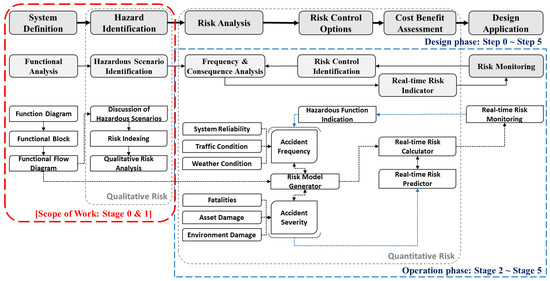
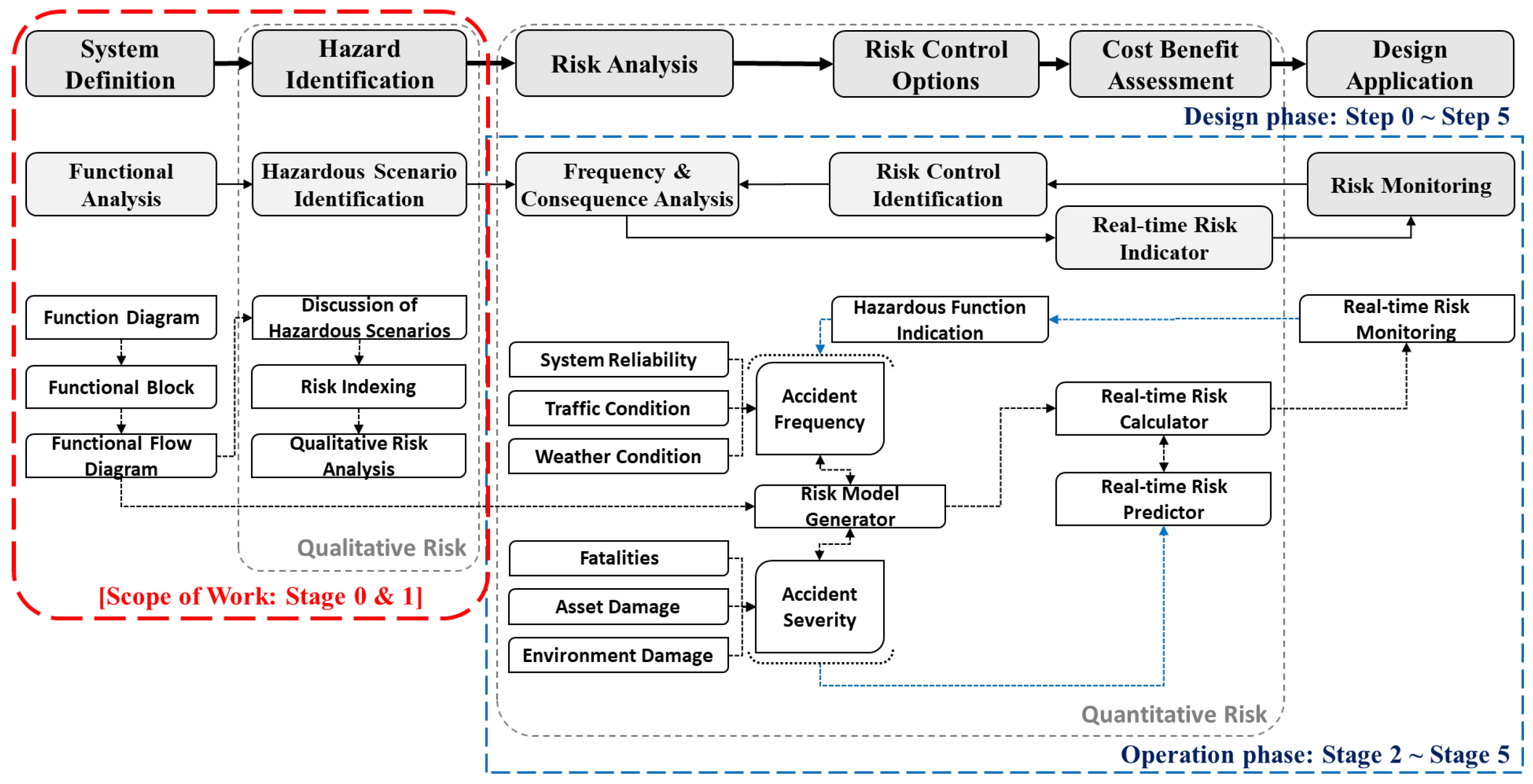
However, from a risk assessment perspective on the operation of MASSs incorporating innovative technologies, one must discuss whether design-phase risk assessments for approval alone can sufficiently guarantee the safety of MASSs. In particular, to operate advanced systems that drastically reduce human intervention, one may be required to implement real-time risk assessment methodologies to evaluate various dynamic operational variables and support decision-making (whether by humans or the system) to ensure safe system operation. Figure 1 presents the proposed overall risk assessment procedure applicable to both the design and operational phases of MASSs. This study focused exclusively on the qualitative risk assessment component of the overall process. For convenience, the methodology proposed in this paper will be referred to as the “Cognitive Model-based Functional Analysis and Hazard Identification” technique (hereinafter “COFA-HAZID”).
Figure 1.
Risk assessment procedure for MASSs.
Before providing a detailed explanation of the COFA-HAZID method, this section outlines the broader conceptual framework for MASS risk assessment, particularly the concept of real-time risk assessment during the operational phase. This overview is intended to help readers understand the rationale behind integrating functional analysis with HAZID into the COFA-HAZID procedure.
The risk assessment framework shown in Figure 1 encompasses both design- and operational-phase risk assessment processes, thus supporting the evaluation of risk levels across the entire lifecycle of the MASS and ensuring that risks are controlled to a level that allows for safe operation. Because the design-phase risk assessment process (Steps 0–5 in Figure 1) broadly aligns with the procedures already applied to innovative or alternative/equivalent designs, this study does not explain those steps. In the operational phase, the real-time risk assessment concept (Stages 0–5 in Figure 1) is applied based on the results of the design-phase risk assessment, thereby enabling continuous risk evaluation throughout MASS operations.
The first stage of the risk assessment process is the “Functional Analysis Stage (Stage 0)”, which involves analyzing the functions associated with MASS operation to define the system and the scope of risk assessment. Functional analysis begins with developing a functional diagram, followed by creating Functional Blocks combined to construct a Functional Flow Diagram. This process allows the analysis of the interrelationships between subsystems from a functional perspective. Upon completion of the functional analysis, the Hazardous Scenario Identification Stage (Stage 1) is conducted. At this stage, hazardous scenarios are identified based on the potential causes and consequences of functional degradation or failure associated with the functions identified in the Functional Analysis Stage. The HAZID study methodology, which is widely used in various industries, is proposed to identify hazardous scenarios related to the operation of the MASS. The major accident scenarios are grouped to define the initial events among the hazardous scenarios identified in the Hazardous Scenario Identification Stage. Subsequently, the causes of the initial events, possible event propagation scenarios, and potential consequences of accidents are analyzed in detail to quantify the risks in the Frequency and Consequence Analysis Stage (Stage 2). For the quantification of risk, a Risk Model Generator is proposed to support this process using FTA or RBDs for frequency estimation and Event Tree Analysis (ETA) for consequence estimation. Fault Trees or RBDs are automatically generated based on the Functional Flow Diagram developed in Stage 0, thus facilitating the estimation of the initial event occurrence frequencies and system failure probabilities. The feasibility of real-time risk assessment during the operational phase of MASSs depends on the availability of real-time operational data. In the operational phase, real-time risk is derived by inputting real-time data pertaining to system reliability, vessel traffic density, and meteorological conditions into the Risk Model Generator. In the Real-Time Risk Indicator Stage (Stage 4), real-time risk is computed based on the output of the Risk Model Generator and presented to decision-makers, whether they are human operators or autonomous systems. In the Risk Control Identification Stage (Stage 3), the results from the Real-Time Risk Indicator are used to assess the subsystems that may be responsible for functional degradation or failure. Potential risk control measures are identified, such as implementing alternative systems to replace failed ones. The Risk Model Generator calculates the predicted risk levels using these control measures. Decision-makers can select and apply the appropriate risk mitigation strategies by comparing real-time risk estimates from the Real-Time Risk Indicator with the predicted risks. Finally, in the Risk Monitoring Stage (Stage 5), real-time risk monitoring is performed to oversee and maintain the effectiveness of the risk assessment from Stages 2 to 4.
The COFA-HAZID methodology specifically addresses the qualitative risk assessment process described in Stages 0 and 1, shown in Figure 1, and is developed by considering its integration with the subsequent quantitative risk assessment process (Stages 2 to 4).
2.2. Functional Analysis: Stage 0
Generally, systems rely on human control, supervision, and operations to perform their intended functions. Unlike conventional systems, autonomous ships and systems offer extended functionalities encompassing areas that typically require human intervention to achieve operational objectives. Therefore, one must comprehensively examine these extended functions, the subsystems constituting the overall system, and the interactions with other connected systems to perform these functions. Functional analysis was conducted by adopting the following procedure to facilitate a clear understanding of the target system and systematically establishing the fundamental information necessary for identifying hazardous scenarios related to the operation of the system.
- Define Target System and Risk Assessment Scope.
- Define Function Diagram.
- Develop Functional Blocks.
- Analyze the Functional Flow Diagram.
All risk assessment processes begin with a clear definition of the target system and scope of risk assessment [43,44]. Once the scope of the risk assessment is established, the key functions and subfunctions of the system are defined based on the functional requirements for ship operations. Considering the operational characteristics of the system, the key functions and subfunctions are further refined to a level appropriate for the risk assessment scope. Once the functions and the Function Diagram are finalized properly, Functional Blocks are developed for the lowest-level functions of the Function Diagram. Subsequently, these Functional Blocks are used to construct a Functional Flow Diagram, which is analyzed to review the interrelationships among the constituent systems.
2.2.1. Function Diagram: Function Decomposition
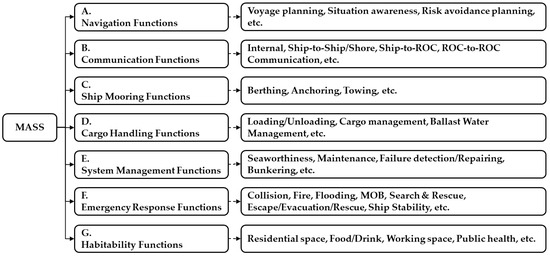
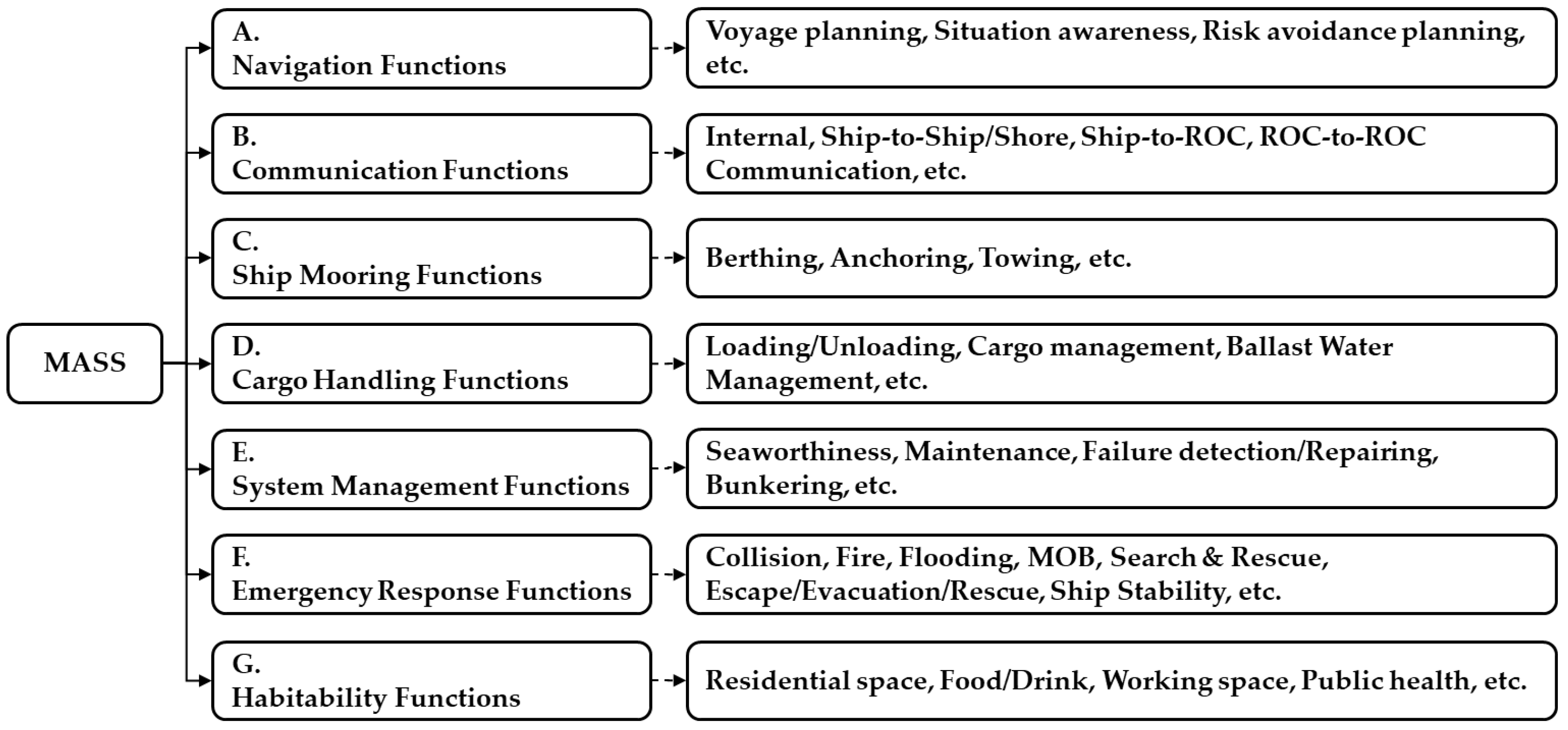
The COFA-HAZID methodology approaches risk assessment from the perspective of ship operations. Fundamentally, it is used to analyze potential function omissions, the necessity for additional functions, and the role of alternative functions by comparing the functional requirements of conventional ship operations with those of the target system under risk assessment (i.e., MASS). Based on the functions required for ship operations, the functions related to the operation of MASSs are identified and represented in a Function Diagram, as shown in Figure 2.
Figure 2.
Function diagram for MASSs.
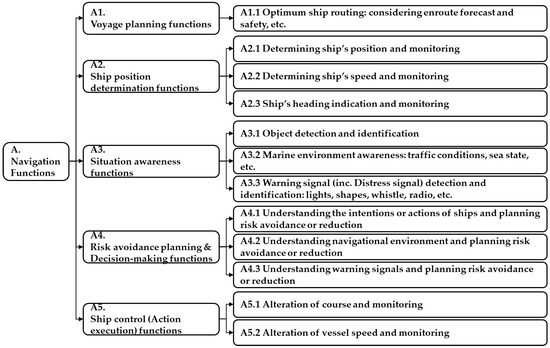
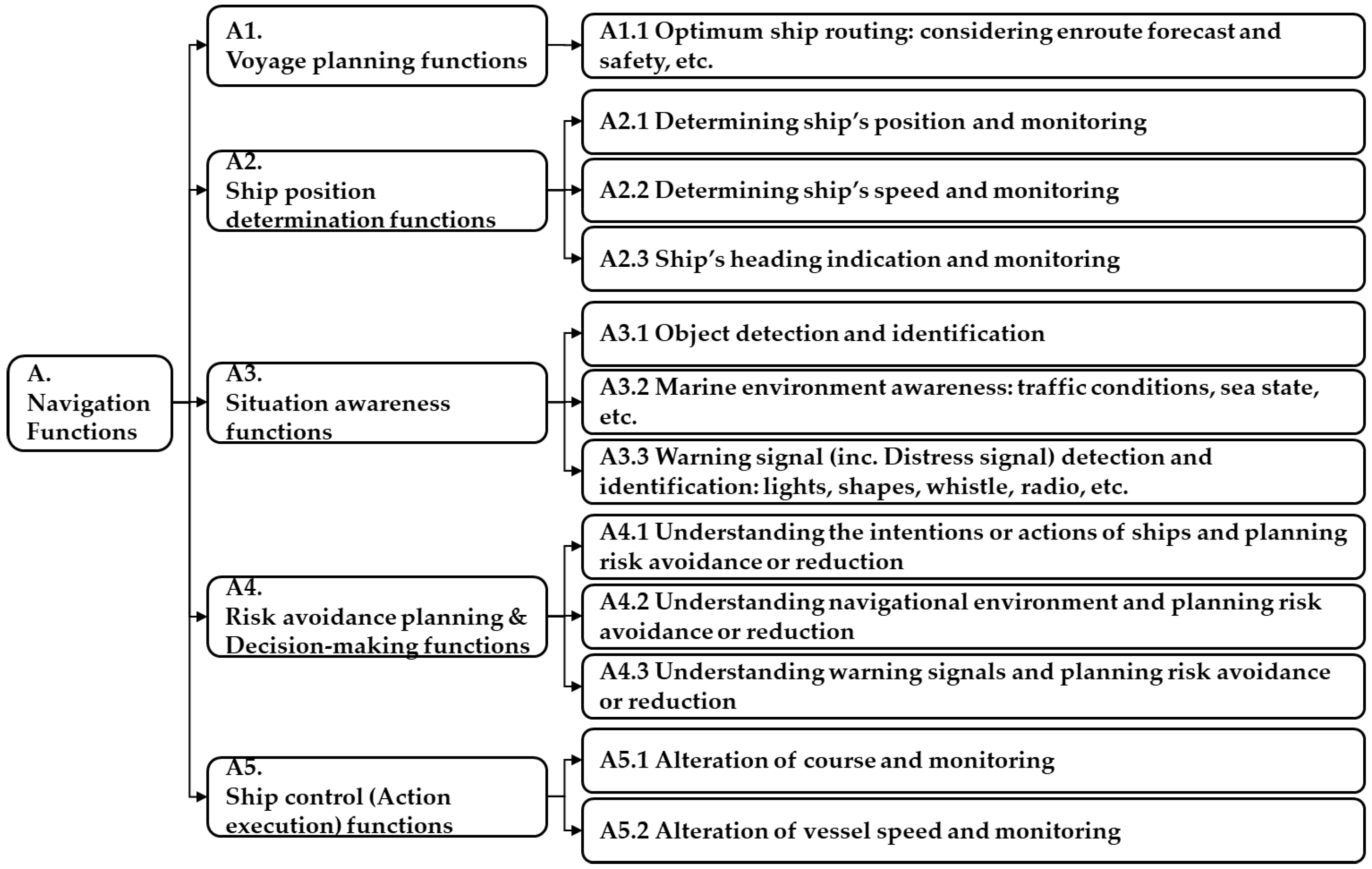
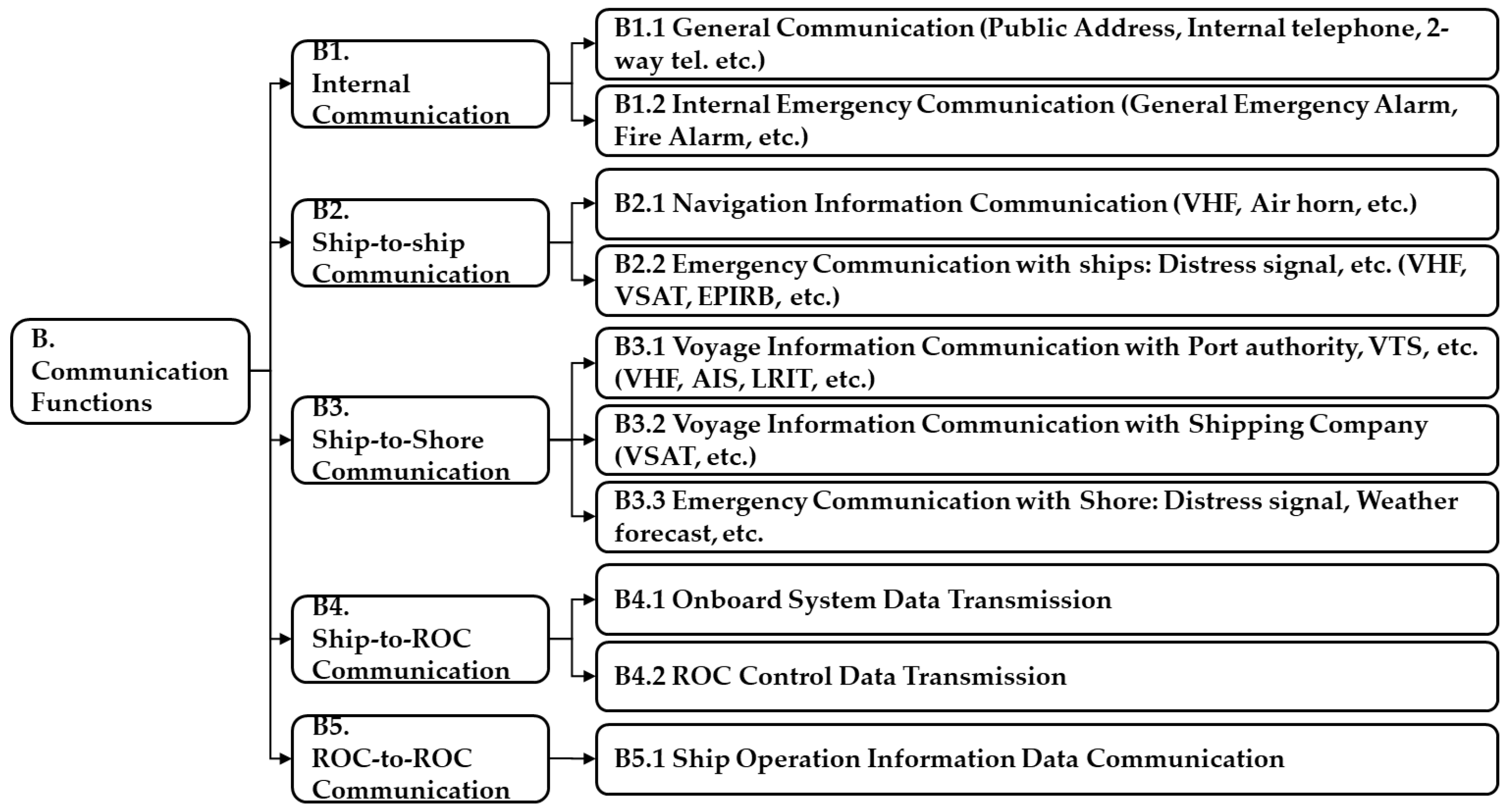
The key functions of MASSs can be further decomposed into subfunctions and sub-subfunctions. The function decompositions related to the navigation and communication functions in ship operations are illustrated in Figure 3 and Figure 4, respectively.
Figure 3.
Function diagram for navigation functions.
Figure 4.
Function diagram for communication functions.
The decomposition level in a functional diagram may vary depending on the purpose of risk assessment and its scope. It should allow the understanding of the system composition and the functions of its subsystems. Additionally, the functions must be decomposed to a level that enables the construction of Functional Blocks suitable for achieving the risk assessment objectives.
2.2.2. Functional Block
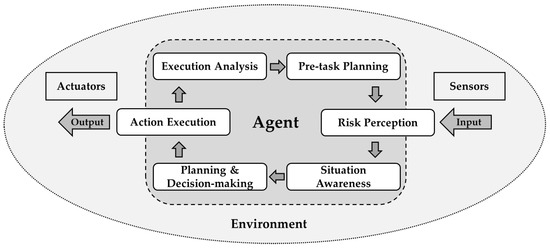
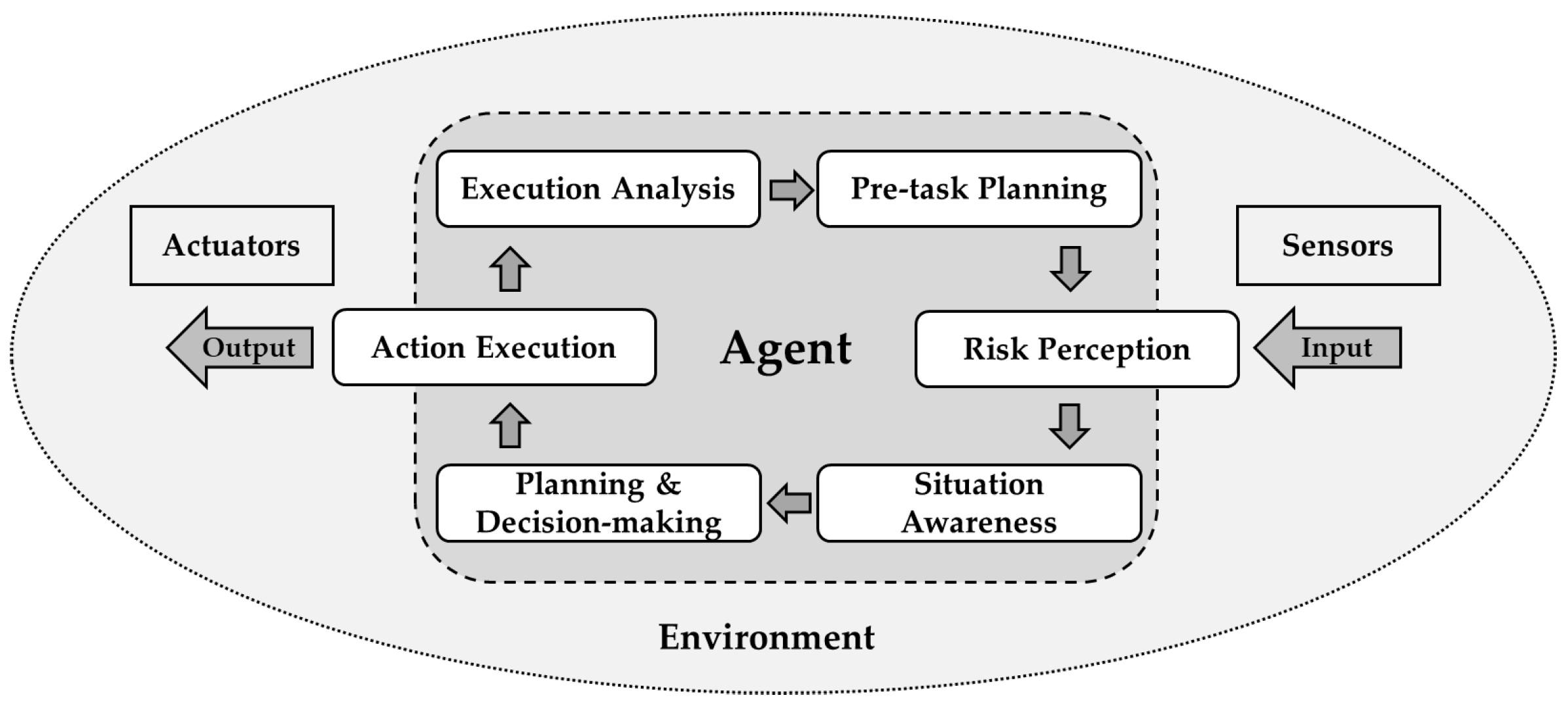
The Functional Block is designed based on the concepts of the Cognitive Model [45,46] and Intelligent Agents [47], as illustrated in Figure 5, and is used to provide structured information for systematically identifying potential hazardous scenarios that may arise during functional failure. The Cognitive Model and Intelligent Agents approach adopts a structured process for risk recognition and response, and comprises the following stages: “Pre-task planning”, “Risk perception (from Input sensors)”, “Situation awareness”, “Risk control planning and Decision-making”, “Execution of a risk control option (to Output actuators)”, and “Monitoring of risk control option execution”. The concepts of Cognitive Models and Intelligent Agents are applied in functional analysis to identify the (1) necessary information for function execution, (2) agents responsible for executing functions, (3) purpose of each function, and (4) outputs generated through function execution. In conventional ships, an agent is generally considered a human crew member, whereas in MASSs, it can be an autonomous system or an embedded Artificial Intelligence (AI) algorithm.
Figure 5.
Cognitive Models and Intelligent Agents.
Once a Function Diagram is developed, the corresponding Functional Blocks are constructed based on the concepts of Cognitive Models and Intelligent Agents. As shown in Figure 6a, a Functional Block comprises the following four main components:
- Input: Information or sensor data required to execute the lowest-level function.
- Agent: Someone or something that perceives its environment through sensors and acts according to that environment through actuators [47].
- Function Description: The description of the function represented by the Functional Block.
- Output: Output information or actuator actions resulting from executing the lowest-level function.
Figure 6.
Concept of Functional Block: (a) Functional Block for basic concept; (b) Functional Block for OR gate concept; (c) Functional Block for AND gate concept.
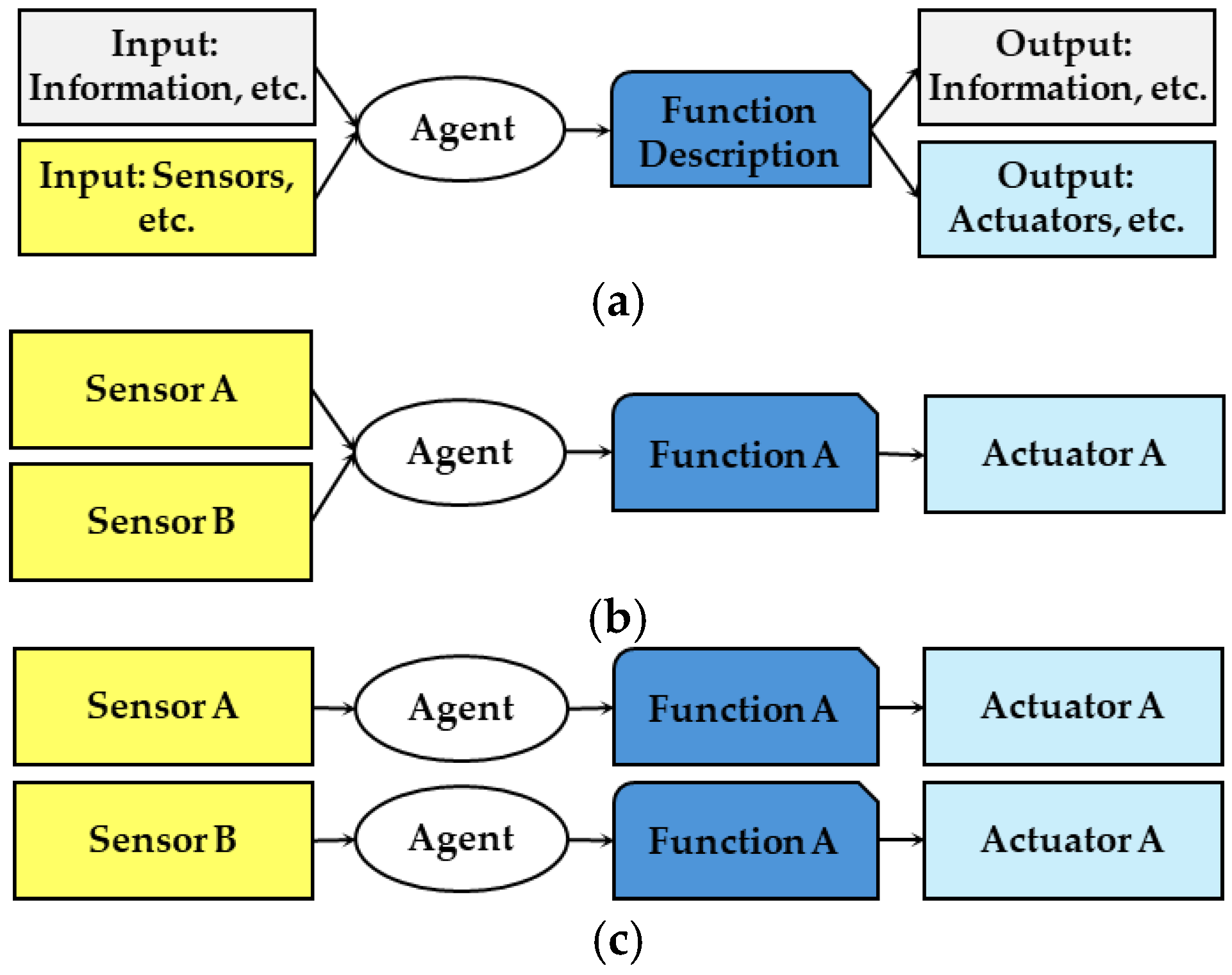
Each Functional Block represents the functional execution flow, where the “Agent” receives “Input” from information sources or sensors and generates an “Output” (information or actuator execution) to achieve the intended system function. For example, in Figure 3, functions “A1.1 Optimum Ship Routing Function” to “A5.2 Alteration of Vessel Speed and Monitoring Function” are selected as the lowest-level functions to develop Functional Blocks, which are then used to construct a Functional Flow Diagram representing the functional execution flow of a key function (e.g., A. Navigation Functions).
To illustrate the interconnections between the input and output systems required for function execution, the Functional Block utilizes logic gate concepts such as OR and AND gates, as depicted in Figure 6b,c. From the perspective of failure propagation, if both Sensors A and B are required to satisfy Function A, then an OR gate is used (i.e., if either Sensor A or B fails, then Function A fails as well). If Function A can be performed using either Sensor A or Sensor B, then an AND gate is used (i.e., Function A fails only if both Sensors A and B fail). By adopting Functional Blocks based on logic gate concepts, the relationships between the systems involved in function execution and the system configurations (e.g., redundancy arrangements) implemented to satisfy the function can be analyzed.
2.2.3. Functional Flow Diagram
The Functional Blocks are interconnected to construct a Functional Flow Diagram. A Functional Flow Diagram is used to examine the functional requirements of the target system and analyze the overall functional execution flow necessary to achieve the intended key functions.
For example, in the case of conventional ship operations, the Functional Flow Diagram for open-sea navigation is as shown in Figure A1 (Appendix A). In a conventional ship, the Officer of the Watch (OOW) formulates a voyage plan (initial route planning) based on navigational experience, weather forecast information, etc. The position, speed, and heading of the ship are continuously monitored to maintain its operational status. The Second Officer and the Captain generally develop voyage planning; however, for simplicity, all agents responsible for performing navigation functions are assumed to be the OOW in developing the Functional Blocks. Functions such as object detection, traffic environment recognition, and emergency signal recognition are maintained for situational awareness. When a hazardous situation arises, the ship determines an alternative route and/or speed to avoid danger and executes risk avoidance actions, if necessary. Communication functions, including ship-to-ship and ship-to-shore communications, are partially incorporated into the Functional Flow Diagram for risk control planning and decision-making.
2.3. Hazardous Scenario Identification: Stage 1
Hazard identification is a qualitative risk assessment methodology aimed at identifying all potential hazards in MASS operations and reducing the associated risks to acceptable levels by implementing appropriate control measures to protect human life, property, and the environment. Based on the functional analysis results, this study applies the HAZID methodology to identify hazardous scenarios associated with functional degradation or failure. The objectives of conducting the HAZID study on MASSs are as follows:
- To systematically identify potential hazards associated with the operation of MASSs.
- To identify the possible causes associated with the identified hazards.
- To identify the potential impact of hazards on human life, the environment, and assets.
- To review the adequacy of existing safeguards associated with the identified hazards.
- To propose additional safety actions and recommendations aimed at further enhancing the overall safety of the MASS.
2.3.1. Discussion of Hazardous Scenarios
In Stage 0 (Functional Analysis) of the risk assessment process for MASS, Function Diagrams, Functional Blocks, and Functional Flow Diagrams are developed to identify functions related to system operation and analyze the overall functional flow required for system operation. By contrast, Stage 1 (Hazardous Scenario Identification) involves identifying potentially hazardous scenarios. Expert brainstorming was conducted and supported by HAZID Worksheets to facilitate this step. Figure 7 shows two main components: a Function Description Column and a Hazard Identification Column. The functional analysis results from Stage 0 are recorded in the Function Description Column. Experts participating in the HAZID Workshop reviewed the functional analysis results, based on which hazardous scenarios were identified via expert brainstorming. All the outcomes of the brainstorming process were recorded in the Hazard Identification Column.
Figure 7.
Example of HAZID Worksheets: (a) Function Description Column; (b) Hazard Identification Column.
During the expert brainstorming process for hazardous scenario identification, the following potentially hazardous situations were systematically considered for each Functional Block:
- Errors in the Input information required to perform the lowest-level function, such as data integrity errors and sensor equipment failures.
- Failures of the “Agent” performing the lowest-level function, including human errors such as mis-operation or unfamiliarity with the system (if the agent is a human) and system errors such as system malfunction or failure (if the agent is an autonomous system), etc.
- “Function” degradation or loss: hazards affecting the function, effects of function loss on other systems, etc.
- Errors in the Output Information obtained by performing the lowest-level function: effects of data integrity error on other connected systems and actuator equipment failure.
During the expert brainstorming process, discussions may include errors related to the Input, Agent, Function, and Output of Functional Blocks; methods for detecting such errors; potential impacts of the errors; measures to reduce the likelihood of their occurrence; and strategies to mitigate their consequences. In addition to the above hazardous situations, conventional HAZID guidewords (refer to Table 1) were also used as secondary prompts during the expert brainstorming to identify the causes of hazardous scenarios while considering each hazardous situation.
Table 1.
Example of HAZID guidewords.
2.3.2. Risk Indexing
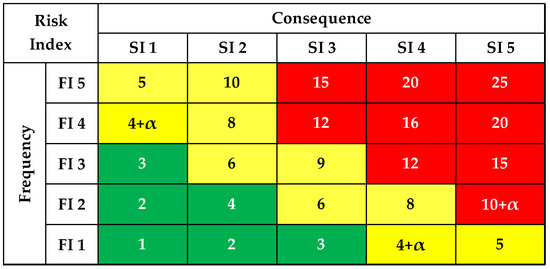
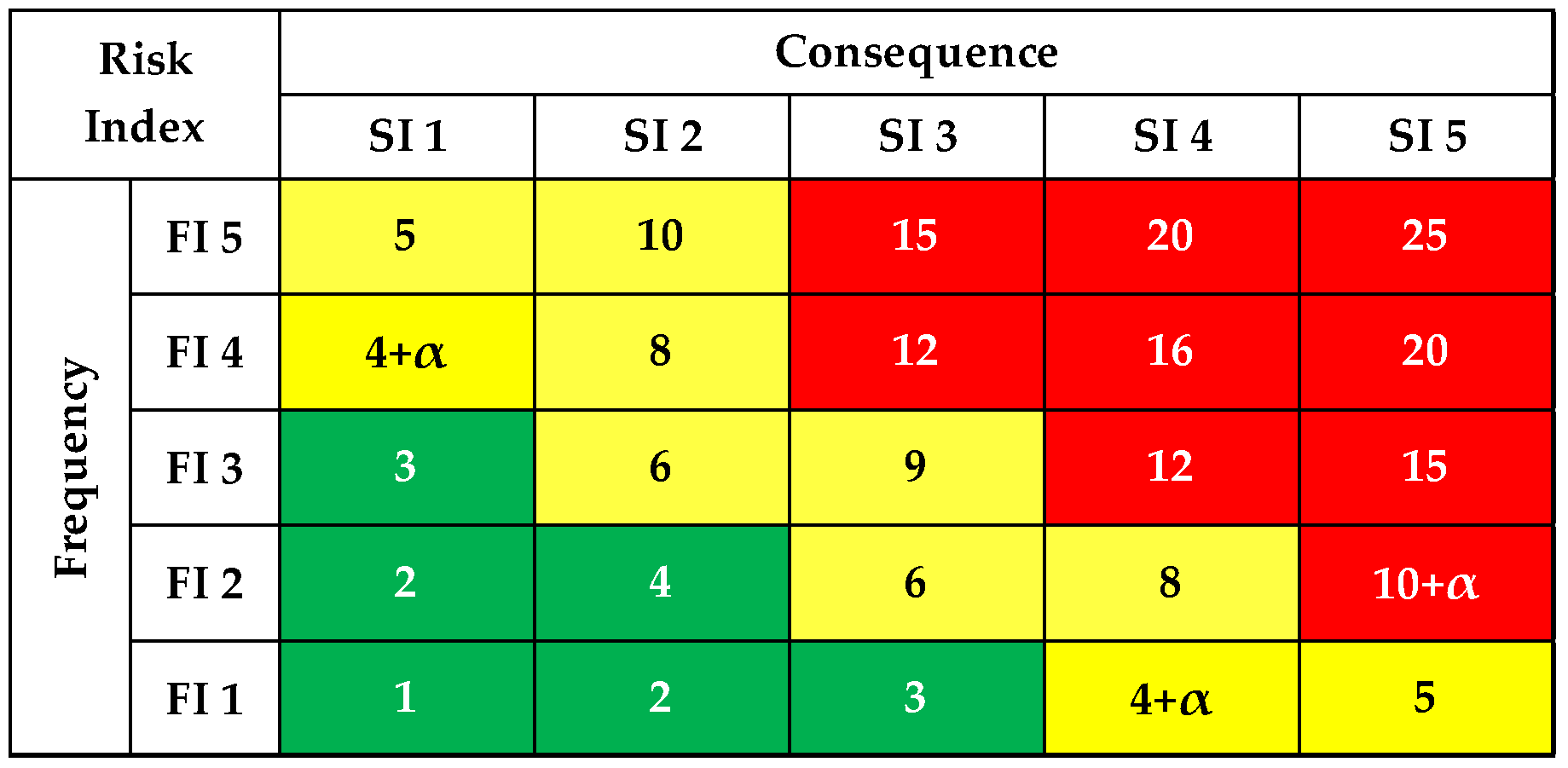
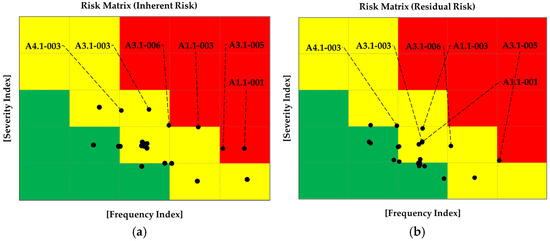
A qualitative risk acceptance criterion was applied to determine the importance or prioritization of the hazardous scenarios identified during the HAZID Workshop, similar to the conventional HAZID methodology. Each hazardous scenario was assigned a risk index using a Risk Matrix, as shown in Figure 8, which evaluates the combination of the Frequency Index (FI) and Severity Index (SI). The FI and SI values used for the risk ranking are listed in Table 2 and Table 3, respectively.
Figure 8.
Example of Risk Matrix: Red—Intolerable region; Yellow—ALARP region; Green—Tolerable region.
Table 2.
Example of Frequency Index.
Table 3.
Example of Severity Index.
The Risk Matrix was constructed by combining the Frequency Index (FI) and Severity Index (SI) values. For the qualitative risk acceptance criteria, the “As Low As Reasonably Practicable (ALARP)” principle, which is commonly accepted for maritime safety issues and recommended by the IMO FSA guidelines, was considered for risk evaluation [43,44].
2.3.3. Outcomes of Qualitative Risk Assessment
This chapter introduces the COFA-HAZID methodology, which is a qualitative risk assessment approach that integrates Functional Analysis with the HAZID methodology. The outcomes of applying the COFA-HAZID methodology are as follows:
- A list of key functions (and subfunctions) required for the MASS operation decomposed to a level suitable for the scope of risk assessment: Function Diagrams.
- The Input, Agent, and Output information for each lowest-level function, including information regarding the interacting systems: Functional Blocks.
- The Functional flow information for each key function necessary for MASS operation: Functional Flow Diagram.
- ✓
- Comparative analysis of functional differences between conventional ships and MASSs from an operational perspective.
- ✓
- Identification of unnecessary or additionally required functions in MASSs compared with conventional ship operations.
- A list of hazardous scenarios related to functional failure or degradation, each with an assigned risk index.
- ✓
- Root causes and consequences of each scenario.
- ✓
- Distribution of hazardous scenarios by function.
- A list of existing safety measures incorporated into the system design.
- A list of recommended additional risk control measures, including
- ✓
- Design or operational improvements to fulfill functional requirements.
- ✓
- Functional substitution strategies for maintaining the functions required for MASS operations, including system redundancy and alternative systems.
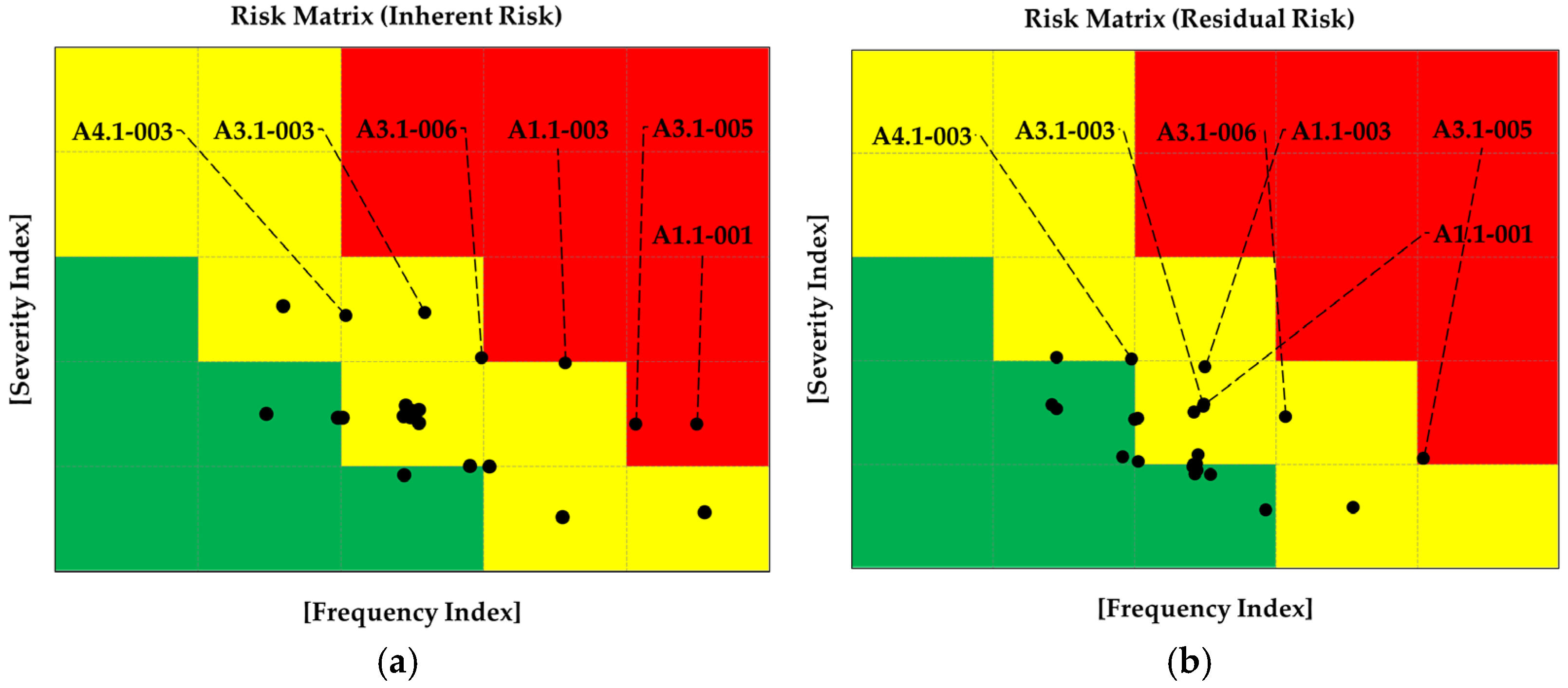
- Comparison of inherent and residual risks after applying additional risk control measures.
4. Discussion
This chapter discusses issues related to the field trial operation of ANSs installed onboard ships based on the experience obtained from multiple qualitative risk assessments of such trials. Additionally, the strengths and limitations of the proposed COFA-HAZID methodology are presented.
4.1. Discussion on Field Trial of Autonomous Navigation Systems
Field trials of ANSs installed onboard ships are typically conducted while maintaining a conventional safe navigational watch. In these trials, the OOW retains control, and control authority is transferred back from the ANS to the OOW when a system malfunction occurs. Hazardous scenarios directly related to the ANS operation are typically not associated with high-risk indices. Additionally, most of the identified hazardous scenarios and corresponding risk control measures focused on ensuring that the integration and operation of the ANS do not interfere with the existing navigational equipment or duties of the OOW. However, one critical aspect that must be considered meticulously in qualitative risk assessment is the potential risk associated with transitions between autonomous and manual control in systems requiring human–machine interaction. Even during ANS control, the OOW must monitor the system, and certain situations may necessitate a rapid transfer of control authority. In such cases, the OOW must act promptly and correctly to avoid danger. This may impose an additional burden on the OOW, who must monitor the intended functioning of the ANS while performing his/her conventional duties. Risks stemming from human–system interactions and those arising from the coexistence of manned and unmanned vessels should be thoroughly addressed to ensure safe field trial operations. From a more optimistic perspective, qualitative risk assessments have shown that ANSs can potentially serve as a valuable navigational decision support system capable of assisting the OOW by providing additional information for collision avoidance decision-making. Although the functions of current ANSs are limited compared with those that can be performed by human officers in charge of navigational watches, ongoing field trials and continued enhancement of system capabilities, such as collision avoidance algorithms, can address this discrepancy. If the interest in developing additional safety features continues, then autonomous navigation technologies may evolve into essential tools for improving navigational safety.
4.2. Discussion on COFA-HAZID Method
The application of the COFA-HAZID methodology offers several distinctive advantages, including its applicability across various systems, ease of functional comparison, a structured scenario identification process, suitability for complex systems, and expandability toward quantitative methods.
First, regarding applicability and comparative analysis from a functional perspective, technological advancements in ship design enable various systems to fulfill the required functions diversely. This broadens the selection of applicable systems and enables different designs to achieve the same operational goals. Because the COFA-HAZID approach focuses on a function-based system analysis, it can be applied to a wide range of systems designed to perform similar functions. This allows an easy comparison of the functional failure-related risks across different system architectures. Additionally, it allows the identification of missing or additional functions relative to conventional systems. However, systems using innovative technologies may include new or reconfigured functions that require a flexible development approach for the Function Diagram. Because Functional Blocks are created based on a Function Diagram, newly added or unconventional functions may be overlooked unless a complementary and iterative development process is applied between the creation of the Function Diagram and the Functional Block.
Second, concerning systematic scenario identification, incorporating a functional analysis stage enables COFA-HAZID to offer a more structured and consistent method than the conventional HAZID. As confirmed in the case study, COFA-HAZID is particularly effective in identifying high-level operational risk scenarios. However, for detailed analyses involving specific equipment behavior, the control logic between components, or systemic design flaws, other approaches such as STPA may be more suitable.
Third, regarding its suitability for complex systems, COFA-HAZID facilitates analysis by focusing on the Functional Blocks. Even in highly complex system environments, if Functional Blocks are appropriately constructed, then the overall functional flow of the system can be represented in a clear and manageable manner using a Functional Flow Diagram. This requires clearly defined risk assessment scopes and objectives as well as a sufficiently decomposed Function Diagram to support Functional Block generation. The degree of functional decomposition directly affects the level of detail achieved in the analyses.
Finally, regarding integration with quantitative risk assessment methods, the use of logic gate concepts by COFA-HAZID enables the modeling of redundancy and functional dependencies, which can be directly transformed into Fault Trees or RBDs. Once the logic-based Functional Blocks have been defined, they can be used to generate Functional Flow Diagrams, which can then be converted into Fault Trees or RBDs for system reliability analysis. In future studies, the authors plan to investigate the development of automatic transformation logic from Functional Flow Diagrams to Fault Trees or RBDs, followed by its application to real-world system reliability case studies. The feasibility of using these transformation models in the frequency estimation component of the Risk Model Generator (Stage 2 in Figure 1) can be investigated. Additionally, the possibility of incorporating real-time data to support real-time risk quantification can be examined.
5. Conclusions
In this study, the authors proposed a qualitative risk assessment methodology, termed COFA-HAZID, as one of the viable approaches for evaluating risks associated with MASSs. The COFA-HAZID methodology is designed to identify potentially hazardous scenarios that may arise during MASS operations. It integrates a functional analysis method based on the concepts of Cognitive Models and Intelligent Agents—with a HAZID-based approach for scenario identification, with emphasis on functional degradation or failure from an operational perspective. To support understanding of the methodology, a case study was presented that summarized the application of COFA-HAZID to the qualitative risk assessment of a field trial involving the K-ANS, which is an ANS installed on a 1800 TEU-class container ship. Based on this case study, along with additional experience from qualitative risk assessments conducted for various field trials of the ANS and Remote Operations Center (ROC) developed by different entities, the COFA-HAZID methodology was considered a sufficiently robust and structured approach for systematically identifying potential hazards in MASS operations. In particular, the COFA-HAZID methodology has been found to meet the core requirements for qualitative risk assessment methods related to MASS operations, as outlined in the Introduction Section.
- First, applying a functional analysis approach enables a structured comparison between conventional manned ship operations and those of MASSs.
- Second, integrating the widely used HAZID technique (a flexible and intuitive method for identifying hazardous scenarios) with a functional analysis approach makes the methodology well suited for analyzing functional degradation or failure from an operational perspective.
- Third, while COFA-HAZID is fundamentally a qualitative methodology, it was developed with potential future integration into quantitative risk assessment frameworks in mind. Specifically, the application of logic gate concepts in the construction of Functional Blocks facilitates seamless linkage with quantitative methods such as Fault Tree Analysis (FTA) and Reliability Block Diagrams (RBDs).
This work contributes to narrowing the gap between traditional qualitative risk assessments and the evolving safety requirements of autonomous maritime systems, providing a structured framework that can support both regulatory development and practical risk management.
Furthermore, as discussed in Section 2.1, highly autonomous ships with significantly reduced human involvement require the development of advanced risk assessment methodologies capable of continuously evaluating a wide range of dynamic variables that may affect operational safety. Hence, further studies should be conducted on risk assessments customized to various ship types and accident scenarios, as well as on the continued advancement of both qualitative and quantitative risk assessment techniques. The authors are currently developing a prototype software system, tentatively named “Real-time Risk Monitoring and Analysis System Tailored for Maritime Autonomous Surface Ships” (R2-MAS), based on the risk assessment framework presented in Figure 1. This system is intended to support the real-time monitoring and assessment of risks associated with MASS operations, thereby contributing to the safe and reliable integration of autonomous maritime technologies.
Author Contributions
Conceptualization, S.N.; methodology, S.N.; formal analysis, S.N., D.L. and J.B.; investigation, D.L. and J.B.; resources, D.L., J.B. and S.K.; writing—original draft preparation, S.N.; visualization, S.K.; supervision, C.C. All authors have read and agreed to the published version of the manuscript.
Funding
This research was funded by the Ministry of Oceans and Fisheries of Korea “Development of Autonomous Ship Technology” project (20200615). The APC is also funded by the same project.
Data Availability Statement
The original contributions presented in the study are included in the article. Further inquiries can be directed to the corresponding author.
Conflicts of Interest
The authors declare no conflicts of interest.
Appendix A. Example of Functional Flow Diagram
Figure A1.
Open-sea navigation function of conventional ships—simplified for illustration purposes (extracted from R2-MAS prototype software, version 0.2.3-alpha).
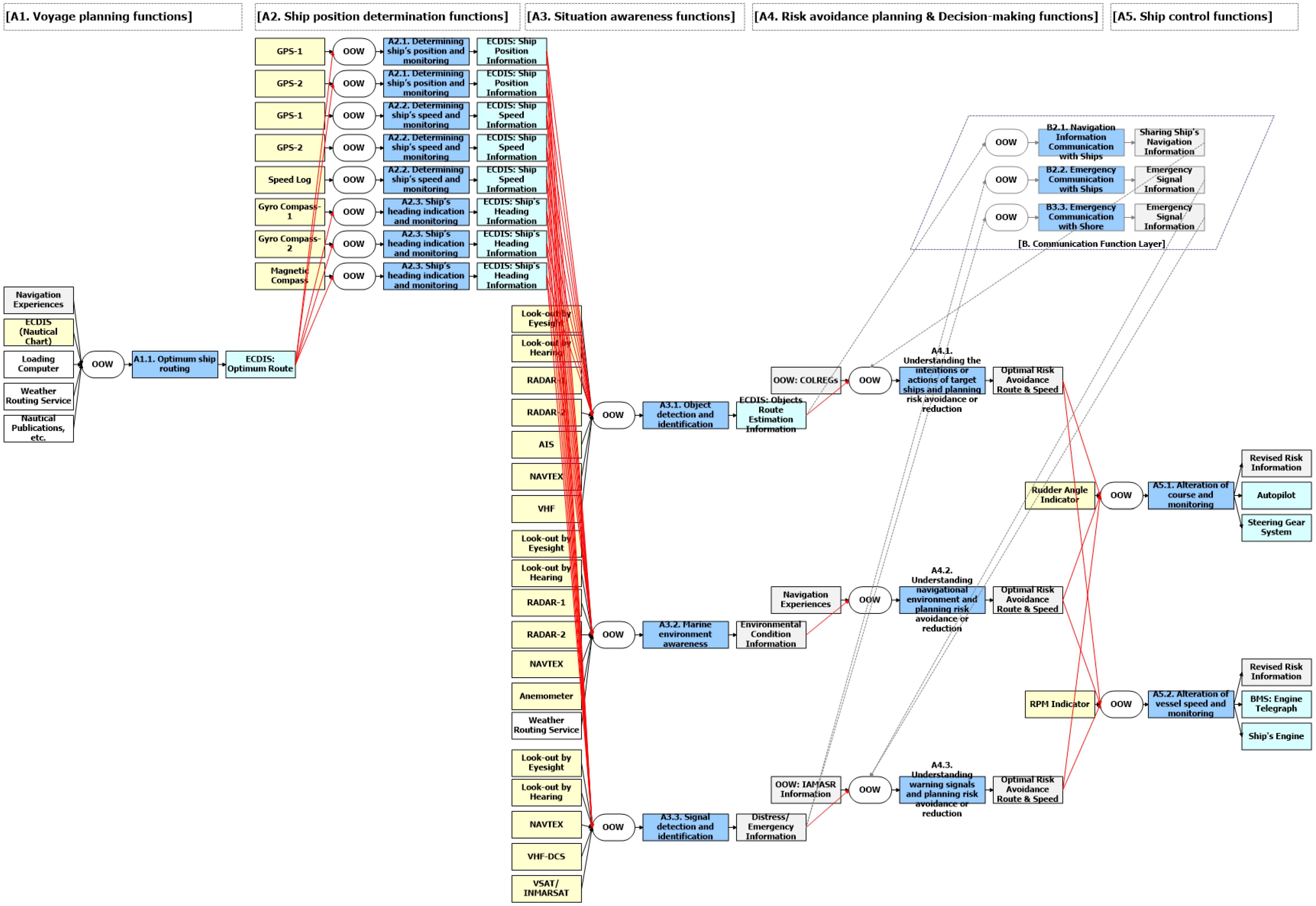
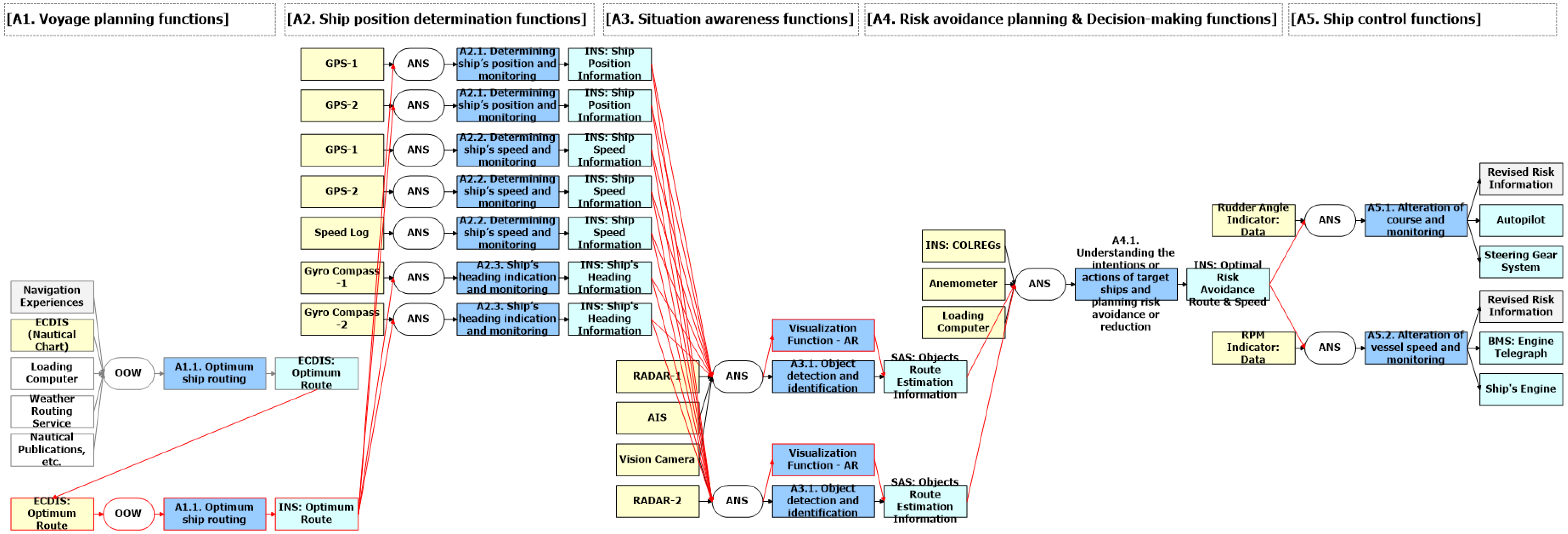
Figure A2.
Open-sea navigation function of Autonomous Navigation System—simplified for illustration purposes (extracted from R2-MAS prototype software, version 0.2.3-alpha).
Appendix B. Example of Hazardous Scenarios Identified
The hazards and corresponding recommendations for risk reduction discussed during the HAZID Workshop are briefly summarized. To ensure conciseness, when similar content is identified as an existing safeguard (ES) or recommendation (R) in a previous hazardous scenario, then the phrase “Refer to Hazard ID-XX” is used to avoid redundant descriptions. Certain hazardous scenarios are excluded from the summary.
Table A1.
Examples of identified hazards and associated risk control measures.
References
- IMO. MSC.1/Circ.1604. Interim Guidelines for MASS Trials; IMO: London, UK, 2019. [Google Scholar]
- IMO. IMO Takes First Steps to Address Autonomous Ships. 2018. Available online: https://www.imo.org/en/MediaCentre/PressBriefings/Pages/08-MSC-99-mass-scoping.aspx (accessed on 27 December 2024).
- IMO. IMO and Autonomous Shipping. Available online: https://www.imo.org/en/MediaCentre/HotTopics/Pages/Autonomous-shipping.aspx (accessed on 27 December 2024).
- IMO. Maritime Safety Committee—109th Session (MSC 109). 2024. Available online: https://www.imo.org/en/MediaCentre/MeetingSummaries/Pages/MSC-109th-session.aspx (accessed on 27 December 2024).
- Chang, C.; Kontovas, C.; Yu, Q.; Yang, Z. Risk Assessment of the operations of maritime autonomous surface ships. Reliab. Eng. Syst. Saf. 2021, 8, 206–222. [Google Scholar] [CrossRef] [Scilit]
- Vos, J.D.; Hekkenberg, R.G.; Banda, O.V. The Impact of Autonomous Ships on Safety at Sea—A Statistical Analysis. Reliab. Eng. Syst. Saf. 2021, 210, 107558. [Google Scholar] [CrossRef] [Scilit]
- Hogg, T.; Ghosh, S. Autonomous merchant vessels: Examination of factors that impact the effective implementation of unmanned ships. Aust. J. Marit. Ocean Aff. 2016, 8, 206–222. [Google Scholar] [CrossRef] [Scilit]
- Kretschmann, L.; Burmeister, H.C.; Jahn, C. Analyzing the economic benefit of unmanned autonomous ships: An exploratory cost-comparison between an autonomous and a conventional bulk carrier. Res. Transp. Bus. Manag. 2017, 25, 76–86. [Google Scholar] [CrossRef] [Scilit]
- Ziajka-Poznanska, E.; Montewka, J. Costs and Benefits of Autonomous Shipping—A Literature Review. Appl. Sci. 2021, 11, 4553. [Google Scholar] [CrossRef] [Scilit]
- Dantas, J.L.D.; Theotokatos, G. A framework for the economic-environmental feasibility assessment of short-sea shipping autonomous vessels. Ocean Eng. 2023, 279, 114420. [Google Scholar] [CrossRef] [Scilit]
- Burmeister, H.; Bruhn, W.; Rødseth, Ø.; Porathe, T. Autonomous Unmanned Merchant Vessel and its Contribution towards the e-Navigation Implementation: The MUNIN Perspective. Int. J. e-Navig. Marit. Econ. 2014, 1, 1–13. [Google Scholar] [CrossRef] [Scilit]
- Komianos, A. The Autonomous Shipping Era. Operational, Regulatory, and Quality Challenges. TransNav Int. J. Mar. Navig. Saf. Sea Transp. 2018, 12, 335–348. [Google Scholar] [CrossRef] [Scilit]
- Tao, J.; Liu, Z.; Wang, X.; Cao, Y.; Zhang, M.; Loughney, S.; Wang, J.; Yang, Z. Hazard identification and risk analysis of maritime autonomous surface ships: A systematic review and future directions. Ocean Eng. 2024, 307, 118174. [Google Scholar] [CrossRef] [Scilit]
- Li, W.; Chen, W.; Guo, Y.; Hu, S.; Xi, Y.; Wu, J. Risk Performance Analysis on Navigation of MASS via a Hybrid Framework of STPA and HMM: Evidence from the Human-Machine Co-Driving Mode. J. Mar. Sci. Eng. 2024, 12, 1129. [Google Scholar] [CrossRef] [Scilit]
- Chaal, M.; Ren, X.; BahooToroody, A.; Basnet, S.; Bolbot, V.; Banda, O.A.V.; Gelder, P.V. Research on risk, safety, and reliability of autonomous ships: A bibliometric review. Saf. Sci. 2023, 167, 106256. [Google Scholar] [CrossRef] [Scilit]
- Yuzui, T.; Kaneko, F. Toward a hybrid approach for the risk analysis of maritime autonomous surface ships: A systematic review. J. Mar. Sci. Technol. 2025, 30, 153–176. [Google Scholar] [CrossRef] [Scilit]
- Sumon, M.M.A.; Kim, H.; Na, S.; Choung, C.; Kjønsberg, E. Systems-Based Safety Analysis for Hydrogen-Driven Autonomous Ships. J. Mar. Sci. Eng. 2024, 12, 1007. [Google Scholar] [CrossRef] [Scilit]
- Chaal, M.; Banda, O.A.V.; Glomsrud, J.A.; Basnet, S.; Hirdaris, S.; Kujala, P. A framework to model the STPA hierarchical control structure of an autonomous ship. Saf. Sci. 2020, 132, 104939. [Google Scholar] [CrossRef] [Scilit]
- Banda, O.A.V.; Kannos, S.; Goerlandt, F.; Gelder, P.H.A.J.M.; Bergström, M.; Kujala, P. A systemic hazard analysis and management process for the concept design phase of an autonomous vessel. Reliab. Eng. Syst. Saf. 2019, 191, 106584. [Google Scholar] [CrossRef] [Scilit]
- Wróbel, K.; Montewka, J.; Kujala, P. System-theoretic approach to safety of remotely-controlled merchant vessel. Ocean Eng. 2018, 152, 334–345. [Google Scholar] [CrossRef] [Scilit]
- Wróbel, K.; Montewka, J.; Kujala, P. Towards the development of a system-theoretic model for safety assessment of autonomous merchant vessel. Reliab. Eng. Syst. Saf. 2018, 178, 209–224. [Google Scholar] [CrossRef] [Scilit]
- Ventikos, N.P.; Chmurski, A.; Louzis, K. A systems-based application for autonomous vessels safety: Hazard identification as a function of increasing autonomy levels. Saf. Sci. 2020, 131, 104919. [Google Scholar] [CrossRef] [Scilit]
- Guo, C.; Haugen, S.; Utne, I.B. Risk assessment of collisions of an autonomous passenger ferry. Proc. Inst. Mech. Eng. Part O 2023, 237, 425–435. [Google Scholar] [CrossRef] [Scilit]
- Guo, C.; Utne, I.B. Development of risk indicators for losing navigational control of autonomous ships. Ocean Eng. 2022, 266, 113204. [Google Scholar] [CrossRef] [Scilit]
- Gao, C.; Guo, Y.; Zhong, M.; Liang, X.; Wang, H.; Yi, H. Reliability analysis based on dynamic Bayesian networks: A case study of an unmanned surface vessel. Ocean Eng. 2021, 240, 109970. [Google Scholar] [CrossRef] [Scilit]
- Fan, C.; Montewka, J.; Zhang, D. Towards a Framework of Operational-Risk Assessment for a Maritime Autonomous Surface Ship. Energies 2021, 14, 3879. [Google Scholar] [CrossRef] [Scilit]
- Fan, C.; Montewka, J.; Zhang, D. A risk comparison framework for autonomous ships navigation. Reliab. Eng. Syst. Saf. 2022, 226, 108709. [Google Scholar] [CrossRef] [Scilit]
- Wróbel, K.; Montewka, J.; Kujala, P. Towards the assessment of potential impact of unmanned vessels on maritime transportation safety. Reliab. Eng. Syst. Saf. 2017, 165, 155–169. [Google Scholar] [CrossRef] [Scilit]
- Sahin, B.; Yazidi, A.; Roman, D.; Soylu, A. Ontology-Based Fault Tree Analysis Algorithms in a Fuzzy Environment for Autonomous Ships. IEEE Access 2021, 9, 40915–40932. [Google Scholar] [CrossRef] [Scilit]
- Shiokari, M.; Itoh, H.; Yuzui, T.; Ishimura, E.; Miyake, R.; Kudo, J.; Kawashima, S. Structure model-based hazard identification method for autonomous ships. Reliab. Eng. Syst. Saf. 2024, 247, 110046. [Google Scholar] [CrossRef] [Scilit]
- Lee, C.; Lee, S. A Risk Identification Method for Ensuring AI-Integrated System Safety for Remotely Controlled Ships with Onboard Seafarers. J. Mar. Sci. Eng. 2024, 12, 1778. [Google Scholar] [CrossRef] [Scilit]
- Abaei, M.M.; Hekkenberg, R.; BahooToroody, A. A multinomial process tree for reliability assessment of machinery in autonomous ships. Reliab. Eng. Syst. Saf. 2021, 210, 107484. [Google Scholar] [CrossRef] [Scilit]
- Chaal, M.; Bahootoroody, A.; Basnet, S.; Banda, O.A.V.; Goerlandt, F. Towards system-theoretic risk assessment for future ships: A framework for selecting Risk Control Options. Ocean Eng. 2022, 259, 111797. [Google Scholar] [CrossRef] [Scilit]
- Utne, I.B.; Rokseth, B.; Sørensen, A.J.; Vinnem, J.E. Towards supervisory risk control of autonomous ships. Reliab. Eng. Syst. Saf. 2020, 196, 106757. [Google Scholar] [CrossRef] [Scilit]
- Johansen, T.; Utne, I.B. Supervisory risk control of autonomous surface ships. Ocean Eng. 2022, 251, 111045. [Google Scholar] [CrossRef] [Scilit]
- Johansen, T.; Blindheim, S.; Torben, T.R.; Utne, I.B.; Johansen, T.A.; Sørensen, A.J. Development and testing of a risk-based control system for autonomous ships. Reliab. Eng. Syst. Saf. 2023, 234, 109195. [Google Scholar] [CrossRef] [Scilit]
- Basnet, S.; BahooToroody, A.; Chaal, M.; Lahtinen, J.; Bolbot, V.; Banda, O.A.V. Risk analysis methodology using STPA-based Bayesian network—Applied to remote pilotage operation. Ocean Eng. 2023, 270, 113569. [Google Scholar] [CrossRef] [Scilit]
- Li, P.; Wang, Y.; Yang, Z. Risk assessment of maritime autonomous surface ships collisions using an FTA-FBN model. Ocean Eng. 2024, 309, 118444. [Google Scholar] [CrossRef] [Scilit]
- Wu, Q.; Wang, T.; Diaconeasa, M.A.; Mosleh, A.; Wang, Y. A Comparative Assessment of Collision Risk of Manned and Unmanned Vessels. J. Mar. Sci. Eng. 2020, 8, 852. [Google Scholar] [CrossRef] [Scilit]
- Zhang, D.; Han, Z.; Zhang, K.; Zhang, J.; Zhang, M.; Zhang, F. Use of Hybrid Causal Logic Method for Preliminary Hazard Analysis of Maritime Autonomous Surface Ships. J. Mar. Sci. Eng. 2022, 10, 725. [Google Scholar] [CrossRef] [Scilit]
- KASS Project. Korea Autonomous Surface Ship Project. Available online: https://www.kassproject.org/en/main.php (accessed on 18 March 2025).
- MSC.1/Circ.1455; Guidelines for the Approval of Alternatives and Equivalents as Provided for in Various IMO Instruments. IMO: London, UK, 2013.
- MSC-MEPC.2/Circ.12/Rev.2; Revised Guidelines for Formal Safety Assessment (FSA) for Use in the IMO Rule-Making Process. IMO: London, UK, 2018.
- IEC/ISO 31010; Risk Management—Risk Assessment Techniques, Edition 2. IEC: Geneva, Switzerland, 2019.
- Endsley, M.R. Toward a Theory of Situation Awareness in Dynamic Systems. Hum. Factors 1995, 37, 32–64. [Google Scholar] [CrossRef] [Scilit]
- Kim, H.T.; Na, S. Development of a Human Factors Investigation and Analysis Model for Use in Maritime Accidents: A Case Study of Collision Accident Investigation. J. Navig. Port Res. 2017, 41, 303–318. [Google Scholar]
- Russell, S.J.; Norvig, P. Intelligent Agents. In Artificial Intelligence: A Modern Approach, 4th ed.; Pearson Education Limited: Upper Saddle River, NJ, USA, 2021. [Google Scholar]
- COLREGs, IMO Convention on the International Regulations for Preventing Collisions at Sea, 1972. Available online: https://www.imo.org/en/About/Conventions/Pages/COLREG.aspx (accessed on 27 December 2024).



Disclaimer/Publisher’s Note: The statements, opinions and data contained in all publications are solely those of the individual author(s) and contributor(s) and not of MDPI and/or the editor(s). MDPI and/or the editor(s) disclaim responsibility for any injury to people or property resulting from any ideas, methods, instructions or products referred to in the content. |
© 2025 by the authors. Licensee MDPI, Basel, Switzerland. This article is an open access article distributed under the terms and conditions of the Creative Commons Attribution (CC BY) license (https://creativecommons.org/licenses/by/4.0/).