


Abstract
Increasing total soil porosity and optimizing pore distribution improve soil water-holding capacity, thereby alleviating drought impacts on crop yields in semi-arid regions. A three year split-plot field experiment was conducted, with organic fertilizer (sheep manure) rates as main plots and water-retaining agent (WRA) rates as subplots. Four organic fertilizer (0, 45, 60, and 75 Mg hm−2) and four WRA rates (0, 0.3, 0.6, and 0.9 Mg hm−2) were set, resulting in 16 combined treatments. Undisturbed soil samples were collected to analyze pore distribution and water availability using the soil water retention curve. The results showed significant variations in ameliorative effects with soil depth. Individual applications of either organic fertilizer or WRA significantly improved topsoil pore distribution and water availability but exerted negative effects on the subsoil. Combined application enhanced both soil layers, with a stronger synergistic effect in the subsoil. The combination of 45 Mg ha−2 organic fertilizer + 0.9 Mg ha−2 WRA achieved optimal soil improvement in the 0–20 cm layer, increasing aeration porosity by 21.89% compared to organic fertilizer alone; this improvement led to 14.99% and 15.65% increases in plant available water (PAW) and readily available water (RAW), respectively. For the 20–40 cm layer, the combination of 60 Mg ha−2 organic fertilizer + 0.9 Mg ha−2 WRA was optimal, increasing total, aeration, and capillary porosity by 24.18%, 183.50%, and 56.73%, respectively, compared to organic fertilizer alone. Consequently, subsoil water availability was enhanced, resulting in 57.53% and 61.18% higher PAW and RAW than the control without WRA. These findings highlight the necessity of layer-specific regulation and differentiated management. The optimal combinations (OF45+W0.9 for 0–20 cm and OF60+W0.9 for 20–40 cm) effectively optimize pore distribution and increase water availability through the complementary synergistic effects of organic fertilizer and WRA. Consequently, this strategy alleviates drought stress on crop yields in semi-arid regions.
1. Introduction
Arid and semi-arid regions, which account for nearly 40% of the global cropland area, are critical yet vulnerable components of the world’s food production system [1,2,3]. In these regions, crop productivity is severely constrained by climatic conditions characterized by low and erratic precipitation and elevated evapotranspiration rates [4]. Drought is one of the most significant abiotic stresses and a leading natural hazard, threatening agricultural sustainability in arid and semi-arid environments.
Intensive agricultural practices are compounding the drought threat caused by climate change. Relying solely on mineral fertilizer often causes soil compaction and degrades soil physical quality, with the subsoil layer being especially affected [5]. A 36-year field experiment showed that sole mineral fertilizer significantly reduced the soil porosity in the 10–20 cm soil layer, while it did not produce significant change in 0–10 cm soil layer [6]. Such degradation typically diminishes the soil’s water-holding capacity by reducing soil porosity, as long-term application of chemical fertilizer hinders the soil particle cementation process [7,8,9]. While these changes do not directly increase the frequency or intensity of climatic droughts, they significantly amplify the agricultural impacts of drought by limiting root access to water and reducing soil resilience [10]. Consequently, given the escalating risks of drought, it is essential to develop effective strategies to enhance soil pore structure and water availability.
Organic fertilizer and WRA are two widely promoted strategies to mitigate these limitations. Organic fertilizers enhance soil pore structure through aggregate formation, biopore creation via soil biota, and direct contributions to porosity due to its low particle density [11,12,13,14,15]. A previous study showed that five years of continuous organic fertilizer application increased the proportion of soil aggregates (>2 mm) from 25% to 40% [16]. However, these effects are closely linked to organic fertilizer type and application rates. Fermented animal manure is reportedly superior to biochar in enhancing soil organic matter [17]. In terms of improving water-holding capacity, sheep manure is more effective than chicken manure because it forms a “sheep manure barrier” in the plow layer [18]. Additionally, a meta-analysis indicated positive impacts of manure application rate on soil properties, while low rates (<5 Mg/hm2) were significantly less effective [19,20]. This might be because soil organic matter content rises with the application amount.
WRAs are high molecular polymers that can absorb hundreds to thousands of times their own weight in water and slowly release it into the soil [21,22]. Slow release is a key advantage, as it prolongs water availability for crops following rainfall in dryland zones [23]. Water absorption rate is critical for WRA selection in arid and semi-arid regions to improve rainwater use efficiency, which depends on the hydrophilic functional groups attached to the polymer backbone [24]. Synthetic polymers, such as polyacrylamide, exhibit high water absorption due to their abundant hydrophilic functional groups [25]. They enhance soil pore structure and water availability through multiple mechanisms: promoting aggregate formation via increased microbial activity, stimulating root biopore formation, and leveraging their own expansion-contraction properties [26,27,28].
Numerous studies have investigated the effects of organic fertilizers and WRAs on soil physical quality. However, their effectiveness depends heavily on material type, application rate, and method. Sheep manure offers excellent water retention, and synthetic WRAs have high water absorption capacity. When combined, how will they synergistically affect soil pore structure and water-holding capacity in semi-arid areas? Are the response patterns the same across different soil depths? These questions remain unclear.
Therefore, we hypothesized that the responses of different soil layers to the ameliorative effects of sheep manure and synthetic WRA would be different. This was attributed to significant differences across soil profiles, including variations in soil physicochemical properties, disturbance intensity, and other related factors. To test the hypothesis, we conducted a three-year field experiment in a representative dryland farming system, integrating pore structure characterization and hydraulic properties in 0–20 cm and 20–40 cm soil layers. The aims of this study were to: (i) elucidate soil layer-specific responses of soil pore structure and water availability to the co-application of sheep manure and synthetic WRA; (ii) quantify the individual and interactive effects of sheep manure and synthetic WRA on soil pore structure and water-holding capacity; (iii) determine the optimal application rates of sheep manure and synthetic WRA that maximize soil hydraulic functionality while remaining practical for dryland agriculture.
2. Materials and Methods
2.1. Experimental Site Description
The field experiment was conducted at the Agricultural Experimental Station of Shanxi Agricultural University, Jinzhong, Shanxi, China (112°51′ E, 37°46′ N). The site has a semi-arid temperate monsoon climate, the multi-year average annual temperature is 8.3 °C, and the average precipitation is 440 mm. Details of soil texture and pretrial soil chemistry are shown in Table 1. Determination of soil particle size distribution was performed using the hydrometer method [29], soil texture was classified according to an international soil texture classification system [30], and soil organic carbon, total nitrogen, available phosphorus, and available potassium were determined using the Walkley-Black method, Kjeldahl analysis, Olsen-P method, and ammonium acetate extraction followed by flame photometry, respectively [29].
Table 1.
Soil texture and initial chemical properties at the experimental site.
2.2. Experimental Design and Crop Management
The field experiment took place between 2022 and 2024. The application rates of organic fertilizer were selected based on the results of a 36-year filed experiment [6], while WRA application was selected based on the study objectives and its intrinsic properties (i.e., water absorbent rate). A split-plot design was employed, with organic fertilizer applied at 0 (OF0), 45 (OF45), 60 (OF60), and 75 Mg hm–2 (OF75) as main plots, and WRA applied at 0 (WRA0), 0.3 (WRA0.3), 0.6 (WRA0.6), and 0.9 Mg hm–2 (WRA0.9) as subplots. A total of 16 experimental treatments were established, each with three replicates. Subplots measured 5 m × 10 m (50 m2), while main plots were 11 m × 21 m (231 m2). Subplots within each main plot were separated by 1 m wide alleys, and adjacent main plots were spaced 2 m apart. Within each of the three replications, main-plot treatments were randomly assigned, and subplot treatments were randomized independently within each main plot.
The tested organic fertilizer was produced from fermented sheep manure and was obtained from the Beijing Qigao Biotechnology Co., Ltd. (Beijing, China), China. Its organic matter content was 28.6%, total N content was 12.9 g kg–1, total P content was 9.9 g kg–1, and total K content was 19.0 g kg–1. The WRA (Zibo Jiadeli Polymer Technology Co., Ltd., Zibo, China) was a copolymer that contained polyacrylamide and potassium polyacrylate. It had a pH of 7.0 and a deionized water expansion ratio of 450 to 550 times. The particle size of the WRA ranged from 1.2 to 2.0 mm. All treatments were fertilized with a commercial compound fertilizer (Stanley Agricultural Group Co., Ltd., Linyi, China) that applied 150 kg·N hm–2, 150 kg·P hm–2, and 150 kg·K hm–2.
In accordance with local farming customs, each spring prior to sowing, organic fertilizer, WRA and compound fertilizer were uniformly dispersed onto the soil surface at predetermined application rates and subsequently incorporated into the soil through tillage. To mitigate the adverse effects of a thick plow pan on crop production in the region, a tillage system combining rotary tillage and deep plowing is commonly adopted locally. To be consistent with field production conditions, the study implemented a three-year sequence: rotary hoeing in 2022, deep plowing in 2023, and rotary hoeing in 2024. Rotary tillage was performed using a rotary tiller (1GKN-250A1, Hebei Shuangtian Machinery Manufacturing Co., Ltd., Baoding, China) at a working depth of approximately 20 cm, while deep plowing was conducted with a deep plow (1S-250A1, Xi’an Yaao Agricultural Machinery Co., Ltd., Xi’an, China) at a working depth of about 40 cm. No fertilizer topdressing or irrigation was applied during the crop growth periods.
Maize (Zea mays L., hybrid Chengxin 16) was planted during the latter half of May in 2022, 2023, and 2024 and had a growth cycle of about 140 days. The maize was planted at a density of 57,000 plants per hectare. During the experiment period, there were no plant residues on the soil surface.
2.3. Soil Sampling and Measurements
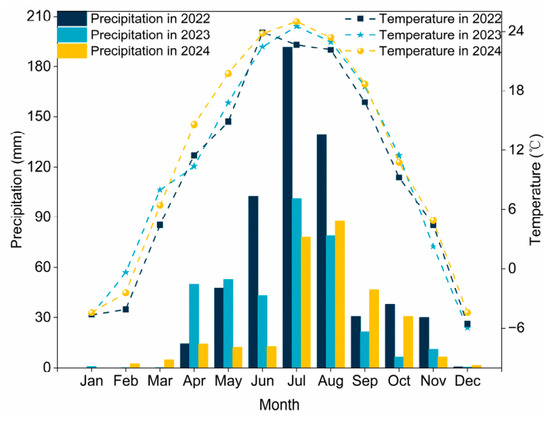
Undisturbed soil samples were taken from the center of each plot at depths of 0~20 cm (topsoil layer) and 20~40 cm (subsoil layer) on the crop harvest date in 2024. The year 2024 was characterized by a pronounced water deficit: annual precipitation amounted to 298.47 mm, which was 141.53 mm below the long-term mean (Figure 1). Consequently, the data presented herein were obtained under conditions of significant water stress. Three replicate soil samples were collected per treatment, yielding a total of 48 soil samples. All samples were transferred to the soil laboratory and analyzed.
Figure 1.
Monthly precipitation and temperatures at the test station between 2022 and 2024.
The soil pore characteristics measured were total porosity and soil pore distribution. Pores are typically categorized into aeration pores (>0.02 mm), capillary pores (0.002–0.02 mm), and ineffective pores (<0.002 mm), with the equivalent pore diameter serving as the key indicator. This study focused on capillary pores and aeration pores, and the soil pore characteristics were obtained from the measured soil water retention curves. A wide-range pF meter DIK-3404 (Daiki Rika Kogyo Co., Ltd., Akagidai, Kounosu, Saitama, Japan) was used to measure the soil water content under different water potentials, and then the Gardner model [31] was used to fit the water retention curves for the topsoil and subsoil layers. Assuming that pores in soil are circular tubes with various pore diameters, the relationship between soil suction and pore diameter (i.e., equivalent pore diameter) can be expressed as follows:
where d is the equivalent pore diameter and h is soil suction.
A pore volume greater than di in a soil can be described as representing a change in corresponding water content, and its ratio to the total pore volume can be expressed follows:
where θs is the saturated water content, θi is the residual water content, and yi is the ratio of the pore volume greater than di to the total pore volume [32].
The soil water-holding capacity was obtained from the soil water retention curves, and these were derived using the same method as used for the soil pore distribution curves. In this study, the soil was considered to be at field capacity when the matric potential was −33 kPa and the wilting point was e −1500 kPa [33]. The plant available water (PAW) and readily available water (RAW) were calculated as follows:
where θp (cm3·cm−3) is the plant available water content, θf (cm3·cm−3) is the field capacity, θw (cm3·cm−3) is the wilting point, θr (cm3·cm−3) is the readily available water content, and θ600 (cm3·cm−3) is the soil volumetric water content at 600 kPa [34].
2.4. Statistical Analysis
All data were statistically analyzed using SPSS Statistics version 20.0 (IBM, Armonk, NY, USA). The data were analyzed with a split-plot ANOVA, with the application of organic fertilizer (main plot, OF) and WRA (subplots, WRA) as fixed effects and block as a random effect; the OF × WRA interaction was tested. The main effect of OF was evaluated using the main-plot error term, while the effects of WRA and the OF × WRA interaction were tested against the subplot error term.
Prior to conducting ANOVA, assumptions (normality and homoscedasticity) were verified using residuals. Normality was assessed via the Shapiro–Wilk test, and homogeneity of variances across treatment groups was examined using Levene’s test. For all response variables, neither test indicated significant violations of these assumptions (Shapiro–Wilk: p > 0.05; Levene’s: p > 0.05), supporting the use of parametric ANOVA.
One-way ANOVA and Duncan’s test were used to test the significance differences between the sub-plot treatments within each main plot level at p < 0.05. Additionally, Pearson correlation analysis and principal component analysis (PCA) were carried out during the exploration phase.
Origin 2024 (OriginLab Corporation, Northampton, MA, USA) was used to draw the charts.
3. Results
3.1. Analysis of Precipitation During the Experimental Period
The detailed precipitation data during the experimental period are shown in Figure 1. During the experimental period, the average annual precipitation was 420.39 mm, which was 19.61 mm less than the long-term average annual precipitation of 440 mm. Specifically, the cumulative precipitation was 595.44 mm in 2022, 367.26 mm in 2023, and 298.47 mm in 2024. Both 2023 and 2024 experienced below-average annual rainfall, with 2024 being particularly dry, receiving less than 70% of the long-term average precipitation.
3.2. Effect of Different Fertilization Measures on the Soil Pore Characteristics
The ANOVA showed that the combined organic fertilizer and WRA applications had either significant (p < 0.05) or highly significant effects (p < 0.001) on total porosity, aeration porosity, and capillary porosity in both soil layers (Table 2).
Table 2.
Two-way analysis of variance (ANOVA) results showing the effects of the different organic fertilizer and water-retaining agent (WRA) application rates on soil pore distribution and water-holding capacity.
3.2.1. Effects of the Different Fertilization Measures on Total Porosity
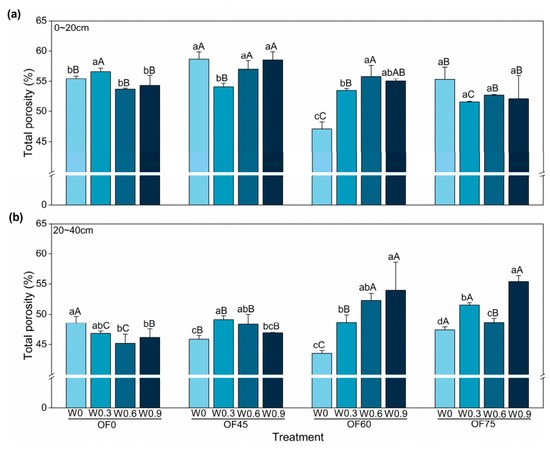
The individual applications of either organic fertilizer or WRA increased total porosity in the 0~20 cm soil layer compared to the blank control, but decreased it in the 20~40 cm layer (Figure 2). Specifically, the OF45+WRA0 treatment significantly enhanced total porosity by 5.68%, and OF0+WRA0.3 led to a significant increase of 2.11% (p < 0.05) in the 0~20 cm layer relative to the OF0+WRA0 treatment.
Figure 2.
Effect of different treatments on total porosity. (a) Total porosity in the 0~20 cm layer; (b) total porosity in the 20~40 cm layer. Abbreviations OF0, OF45, OF60, and OF75 represent organic fertilizer application rates of 0, 45, 60, and 75 Mg·hm–2, respectively. Abbreviations W0, W0.3, W0.6, and W0.9 represent water-retaining agent (WRA) application rates of 0, 0.3, 0.6, and 0.9 Mg·hm–2, respectively. Different lowercase letters represent significant differences (p < 0.05) in total porosity among the WRA treatments under the same organic fertilizer application. Different uppercase letters represent significant differences (p < 0.05) in total porosity among the organic fertilizer treatments under the same WRA application.
The combined application of organic fertilizer and WRA significantly increased total porosity (Figure 2). In the 0–20 cm soil layer, the combined effect was unstable. For the OF60 soils, the total porosity of WRA-containing soils significantly increased compared with WRA-free soils. Specifically, total porosity in OF60+WRA0.3, OF60+WRA0.6, and OF60+WRA0.9 significantly increased soil porosity by 13.72%, 18.72%, and 17.02% compared to OF60+WRA0, respectively (p < 0.05). However, a decreasing trend was found for the OF45 and OF75 soils when WRA was applied. In the 20–40 cm soil layer, the positive effect of the combined application of organic fertilizer and WRA was more pronounced. For all three organic fertilizer applications (OF45, OF60, and OF75), the total porosity of WRA-containing soils was significantly higher than non-WRA soil. The average increases in total porosity were 4.94%, 18.77% and 9.42% for OF45, OF60 and OF75, respectively. Among all treatments, the greatest enhancement was observed under the OF60 treatment; it significantly increased by 20.23% and 24.18% (p < 0.05) in the OF60+WRA0.6 and OF60+WRA0.9 soils, respectively, compared to OF60+WRA0.
3.2.2. Effect of Different Fertilization Measures on Aeration Porosity
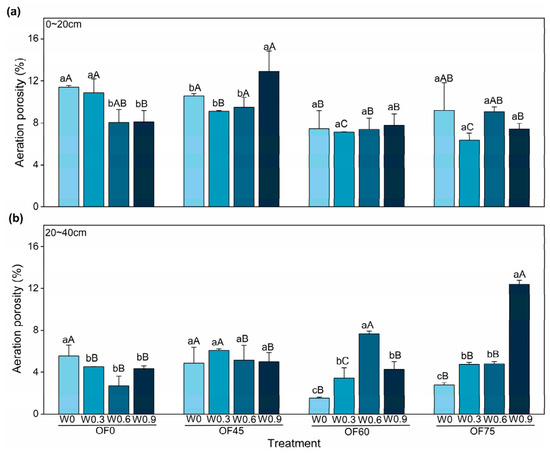
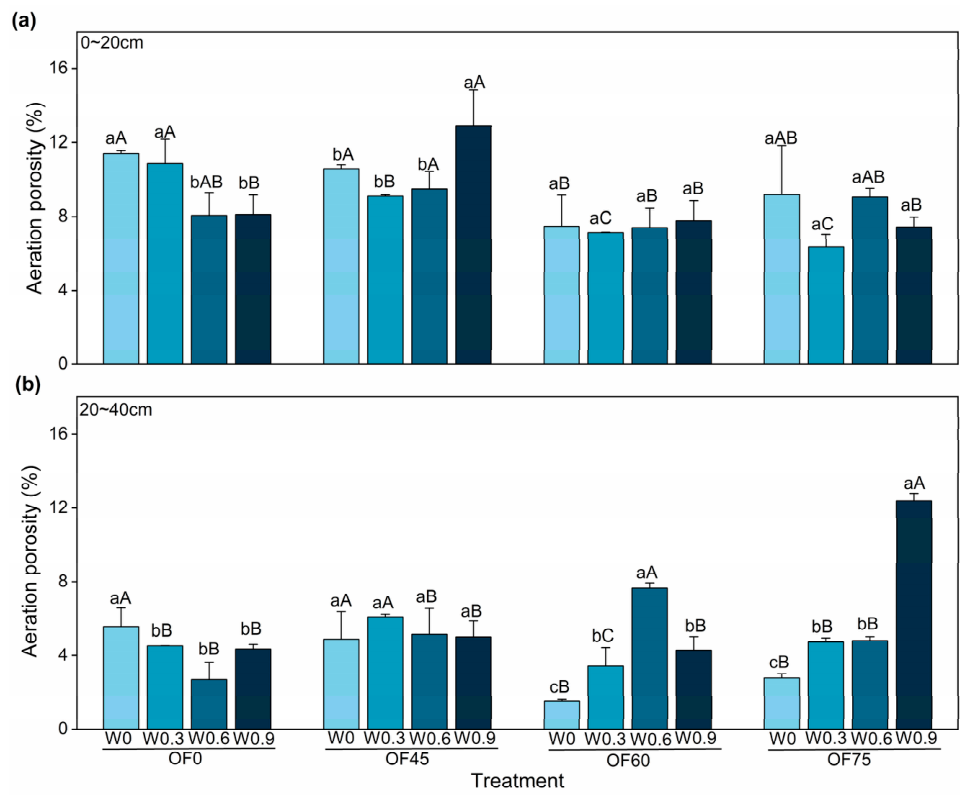
The interactions between the organic fertilizer and the WRA significantly increased aeration porosity in the 20–40 cm soil layer, whereas the increasing trend was unstable in the 0–20 cm soil layer (Figure 3). In the topsoil, the addition of WRA significantly increased soil aeration porosity across the OF45 treatments, but there were no significant differences between the WRA-containing and WRA-free treatments for OF60 and OF75 soils. Specifically, aeration porosity in OF45+WRA0.9 significantly increased by 21.89% (p < 0.05) compared to OF45+WRA0. In the deeper soil layer, the increasing trend aligned with combined OF and WRA application, and was observed for OF45, OF60, and OF75 soils. For the OF60 and OF75 soils, aeration porosity of WRA-containing treatments significantly increased compared with non-WRA soil, with growth rates ranging from 125.63% to 405.01% and from 71.91% to 348.98%, respectively. However, for the OF0 soils, aeration porosity of W0.3, W0.6 and W0.9 treatments significantly decreased compared with W0 in the 20–40 cm. The findings indicated that the application of WRA alone reduced soil aeration porosity in subsoil.
Figure 3.
Effect of different treatments on aeration porosity. (a) Aeration porosity in the 0~20 cm layer; (b) aeration porosity in the 20~40 cm layer. Abbreviations OF0, OF45, OF60, and OF75 represent organic fertilizer application rates of 0, 45, 60, and 75 Mg·hm–2, respectively. Abbreviations W0, W0.3, W0.6, and W0.9 represent water-retaining agent (WRA) application rates of 0, 0.3, 0.6, and 0.9 Mg·hm–2, respectively. Different lowercase letters represent significant differences (p < 0.05) in aeration porosity among the WRA treatments under the same organic fertilizer application. Different uppercase letters represent significant differences (p < 0.05) in aeration porosity among the organic fertilizer treatments under the same WRA application.
3.2.3. Effect of Different Fertilization Measures on Capillary Porosity
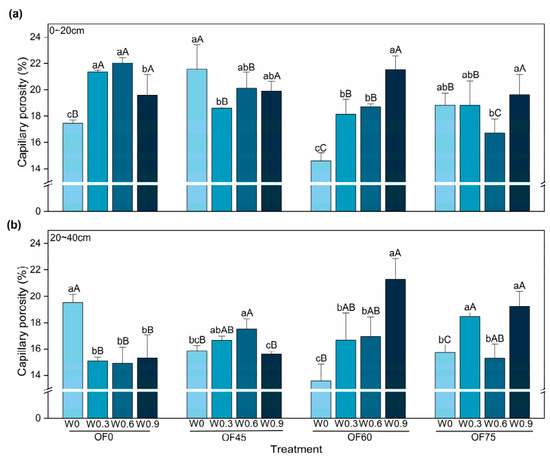
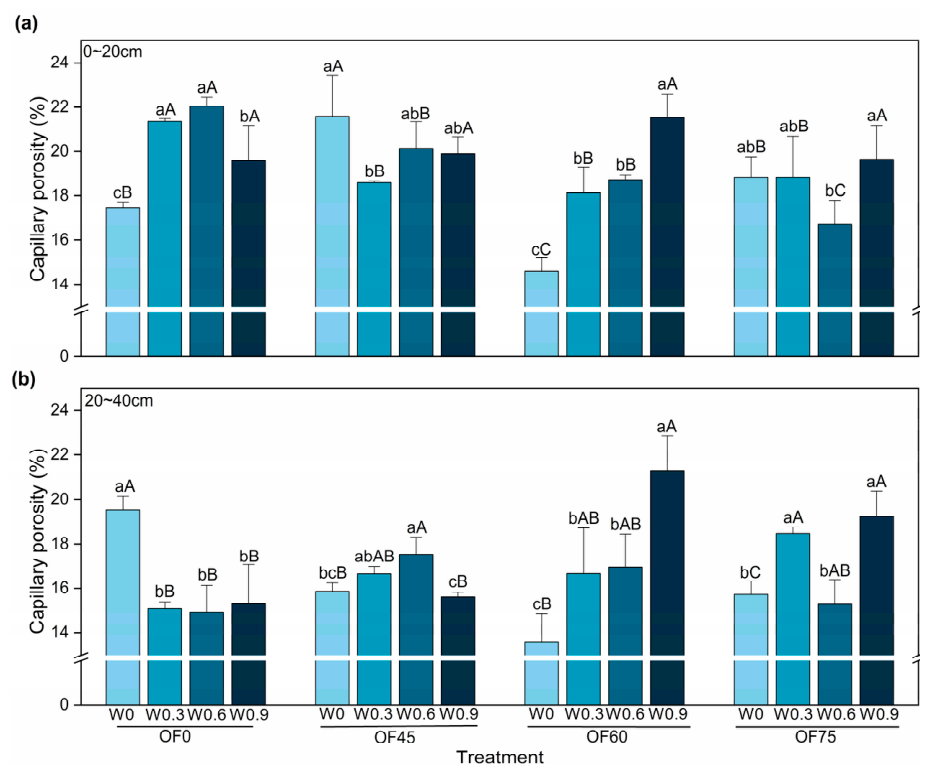
The effects of applying organic fertilizer or WRA alone on capillary porosity differed between the 0~20 cm and 20~40 cm soil layers (Figure 4). Compared to the blank control, the individual application of either organic fertilizer or WRA significantly increased capillary porosity in the 0~20 cm layer, but significantly reduced it in the 20~40 cm layer. Specifically, OF45+WRA0 significantly increased capillary porosity by 23.68% (p < 0.05) in the 0~20 cm layer relative to the blank control, but significantly decreased it in the 20~40 cm layer. A similar trend was observed for OF0+WRA0.3.
Figure 4.
Effect of different treatments on capillary porosity. (a) Capillary porosity in the 0~20 cm layer; (b) capillary porosity in the 20~40 cm layer. Abbreviations OF0, OF45, OF60, and OF75 represent organic fertilizer application rates of 0, 45, 60, and 75 Mg·hm–2, respectively. Abbreviations W0, W0.3, W0.6, and W0.9 represent water-retaining agent (WRA) application rates of 0, 0.3, 0.6, and 0.9 Mg·hm–2, respectively. Different lowercase letters represent significant differences (p < 0.05) in capillary porosity among the WRA treatments under the same organic fertilizer application. Different uppercase letters represent significant differences (p < 0.05) in capillary porosity among the organic fertilizer treatments under the same WRA application.
The combined application of organic fertilizer and WRA significantly increased capillary porosity in the 20–40 cm soil layer, whereas its influence in the 0–20 cm soil layer was variable (Figure 4). In the 0–20 cm soil layer, capillary porosity decreased with WRA addition in OF45 soils but increased with higher WRA rates in OF60 soils. In the 20–40 cm soil layer, there was an increasing trend after WRA application compared with non-WRA soil for OF45, OF60, and OF75. The most pronounced response occurred under OF60, where capillary porosity increased by 22.56% to 56.73% depending on WRA rate.
3.3. Effect of Different Fertilization Measures on Soil Water Availability
The results showed that the organic fertilizer × WRA interaction had either significant effects (p < 0.05) or highly significant effects (p < 0.001) on PAW and RAW in both soil layers (Table 2).
3.3.1. Effect of Different Fertilization Measures on PAW
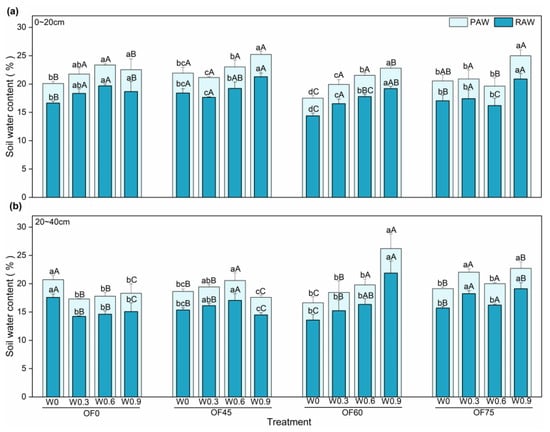
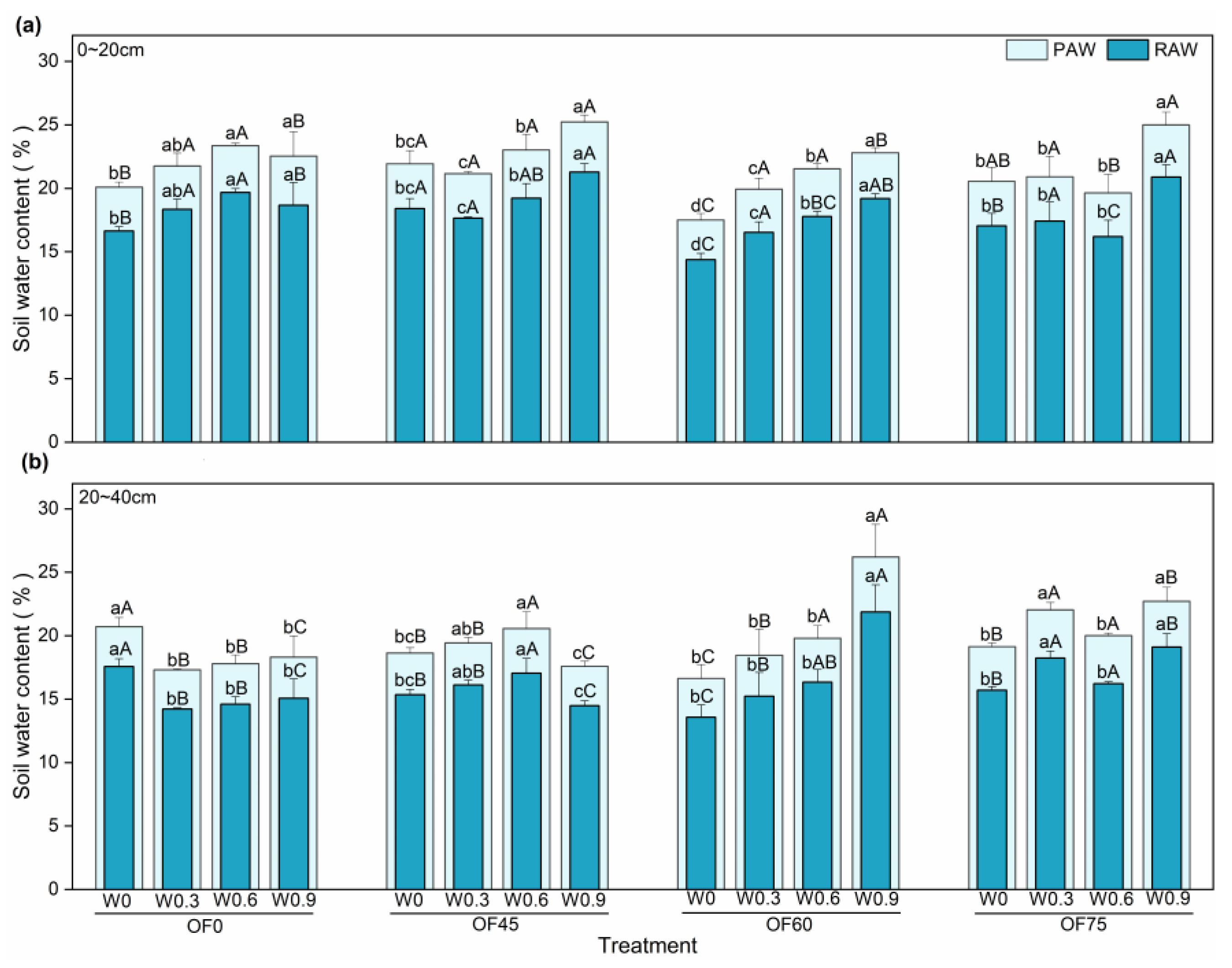
The effects of only applying organic fertilizer or WRA on PAW differed between the 0~20 cm and 20~40 cm soil layers (Figure 5). Compared to the blank control, applying either organic fertilizers or WRA alone significantly increased the PAW in the 0~20 cm soil layer but decreased it in the 20~40 cm soil layer. Specifically, OF45+WRA0 significantly increased PAW in the 0~20 cm soil layer by 9.19% (p < 0.05), but significantly decreased it in the 20~40 cm soil layer by 10.05% (p < 0.05). A similar trend was observed for OF0+WRA0.6 and OF0+WRA0.9.
Figure 5.
Effect of different treatments on soil water contents. (a) Soil water contents in the 0~20 cm layer; (b) soil water contents in the 20~40 cm layer. Abbreviations OF0, OF45, OF60, and OF75 represent organic fertilizer application rates of 0, 45, 60, and 75 Mg·hm–2, respectively. Abbreviations W0, W0.3, W0.6, and W0.9 represent water-retaining agent (WRA) application rates of 0, 0.3, 0.6, and 0.9 Mg·hm–2, respectively. Different lowercase letters represent significant differences (p < 0.05) in plant available water (PAW) and readily available water (RAW) among the WRA treatments under the same organic fertilizer application. Different uppercase letters represent significant differences (p < 0.05) in PAW and RAW among the organic fertilizer treatments under the same WRA application.
The combined application of organic fertilizer and WRA outperformed the application of organic fertilizer alone in both soil layers (Figure 5). In the 0~20 cm soil layer, a significant increase was observed in the combined application of W0.9 across OF45, OF60, and OF75 treatments. Compared with the WRA-free control, the increase rates were 14.99%, 30.29%, and 21.60% for OF45+WRA0.9, OF60+WRA0.9, and OF75+WRA0.9, respectively (p < 0.05). In contrast, in the 20–40 cm layer, the combined treatment consistently enhanced PAW across OF45, OF60, and OF75. The strongest response was again observed under OF60, which exhibited a maximum increase of 57.53% and an average increase of 29.16%.
3.3.2. Effect of Different Fertilization Measures on RAW
The application of either organic fertilizer or WRA alone significantly increased the RAW in the 0~20 cm layer compared to the blank control application, but reduced it in the 20~40 cm layer (Figure 5). Specifically, RAW significantly increased by 10.61% in OF45+WRA0 in the 0~20 cm layer (p < 0.05), but significantly decreased by 12.64% in the 20~40 cm layer (p < 0.05). Similarly, the OF0+WRA0.6 and OF0+WRA0.9 treatments increased RAW by 18.26% and 12.20% in the upper layer, respectively (p < 0.05), but decreased RAW by 16.91% and 14.25% in the lower layer (p < 0.05).
As with PAW, the combined effect on RAW also outperformed the application of organic fertilizer alone in both soil layers (Figure 5). Similarly, the combined application with W0.9 yielded the optimal effect across OF45, OF60, and OF75 treatments. Compared with the WRA-free control, the increase rates were 15.65%, 33.40%, and 22.52% for OF45+WRA0.9, OF60+WRA0.9, and OF75+WRA0.9, respectively (p < 0.05). In the 20–40 cm soil layer, the interaction exerted a robust and positive effect. RAW increases were 61.18% for OF60+WRA0.9 compared to W0.
3.4. Effect of Different Fertilization Measures on Maize Emergence Rates in 2024
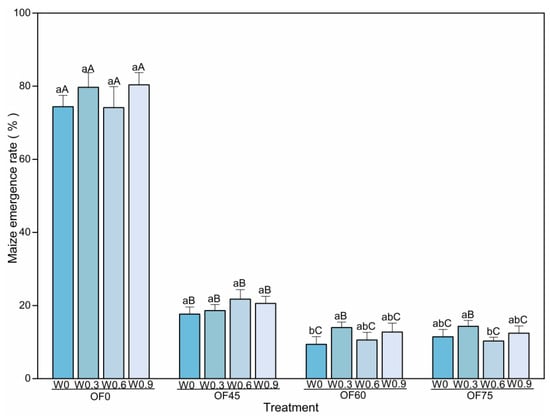
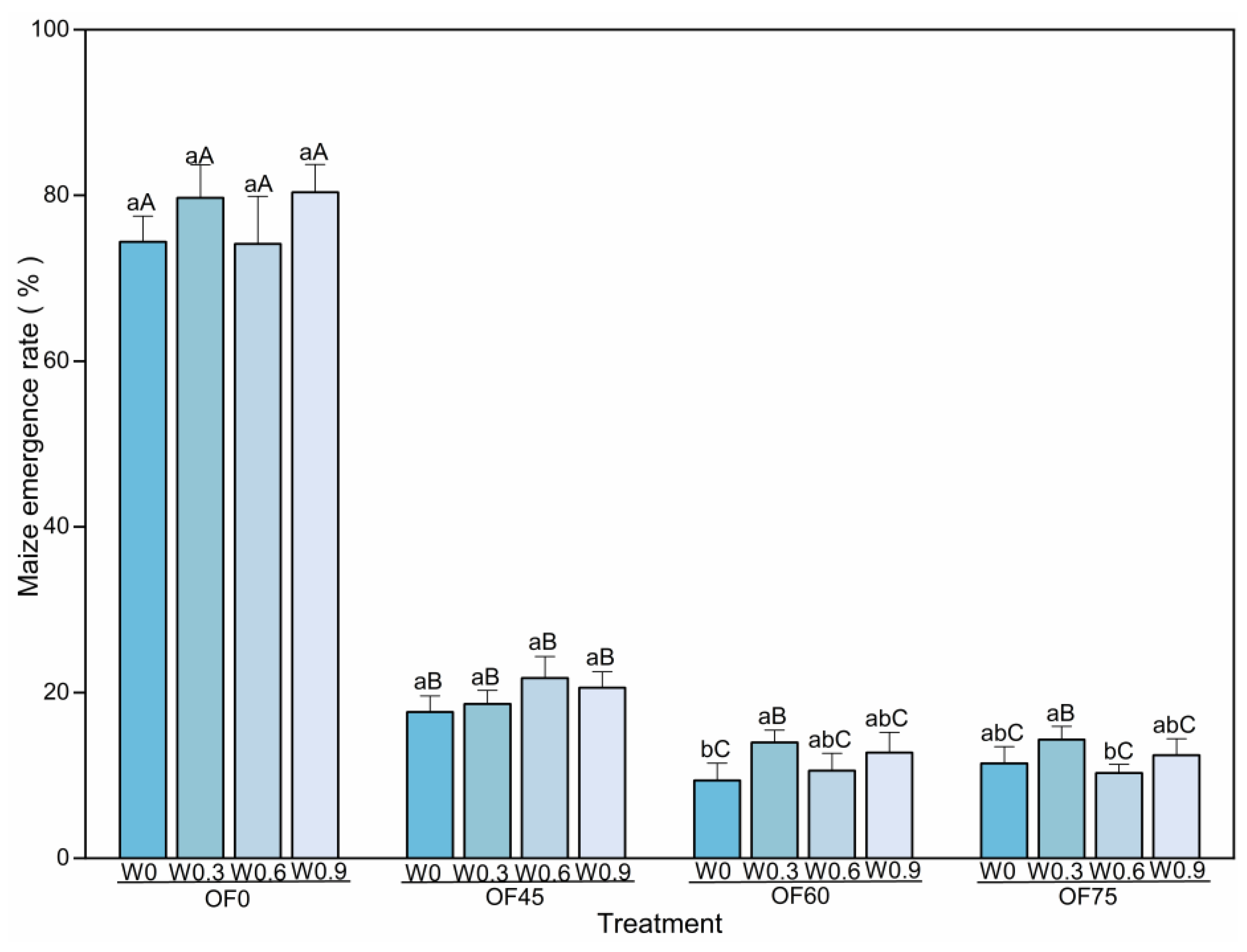
The application amount of organic fertilizer significantly influenced maize emergence rate in 2024 (Figure 6). The highest emergence rate was recorded for the treatment without organic fertilizer (OF0). Compared with OF0, the average emergence rates for the OF45, OF60, and OF75 treatments were significantly reduced by 74.53%, 84.87%, and 84.28%, respectively. Overall, the application of organic fertilizer markedly decreased seedling emergence in 2024. At the same organic fertilizer rate, WRA treatments exerted little effect on maize emergence.
Figure 6.
Maize emergence rates after the different treatments in 2024. Abbreviations OF0, OF45, OF60, and OF75 represent organic fertilizer application rates of 0, 45, 60, and 75 Mg·hm–2, respectively. Abbreviations W0, W0.3, W0.6, and W0.9 represent water-retaining agent (WRA) application rates of 0, 0.3, 0.6, and 0.9 Mg·hm–2, respectively. Different lowercase letters represent significant differences (p < 0.05) in maize emergence rates among the WRA treatments under the same organic fertilizer application. Different uppercase letters represent significant differences (p < 0.05) in maize emergence rates among organic fertilizer treatments under the same WRA application.
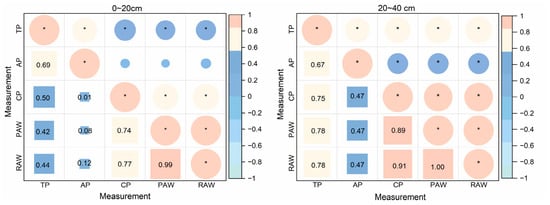
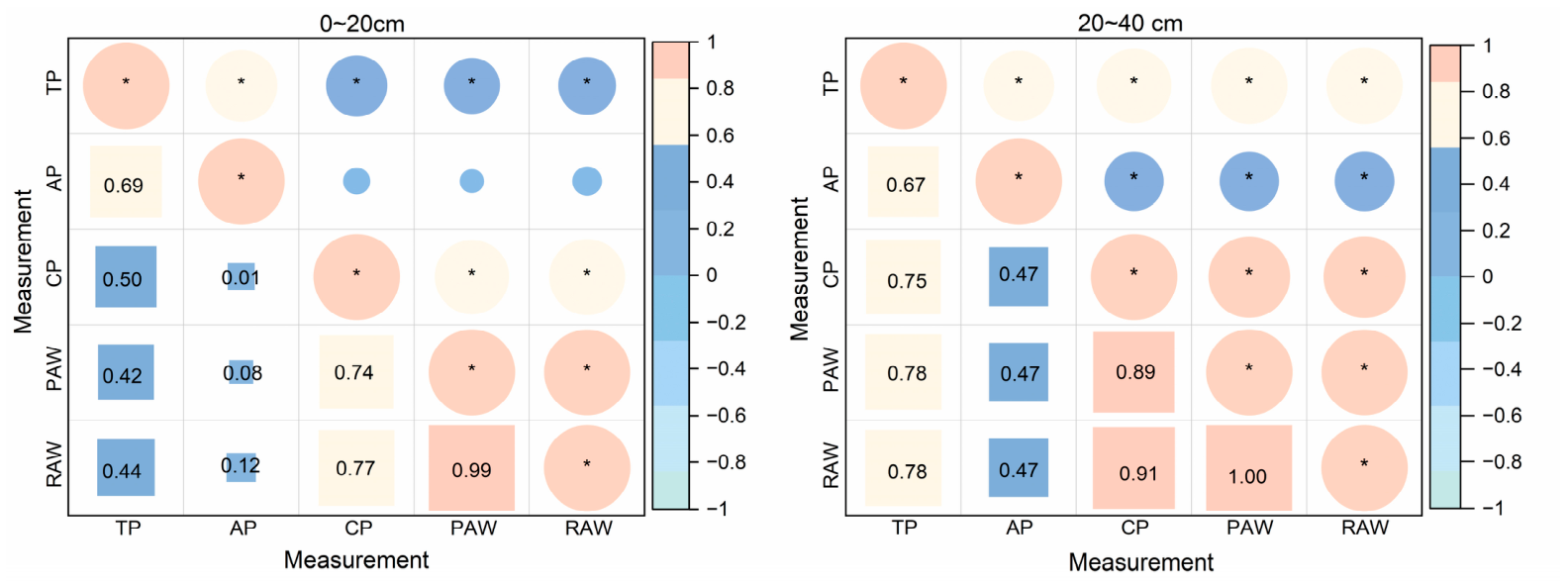
3.5. Correlations Among the Various Parameters
Total porosity, aeration porosity, capillary porosity, PAW, and RAW in the different soil layers were subjected to a correlation analysis (Figure 7), and the correlation patterns among the indicators varied with soil depth. In the 0~20 cm layer, PAW and RAW had significant positive correlations with total porosity and capillary porosity, with the correlation strength following the order capillary porosity > total porosity. This indicated that capillary porosity was the primary factor affecting soil water availability in the topsoil. In the 20~40 cm layer, PAW and RAW were significantly positively correlated with total porosity, aeration porosity, and capillary porosity, and these correlations were stronger than those observed in the 0~20 cm soil layer. This suggested that total porosity and pore distribution are among the key factors influencing soil water-holding capacity in the subsoil. Moreover, the correlation coefficients between PAW and RAW exceeded 99% in both soil layers, indicating that the amendment practices synchronously improved both the quantity and availability of soil water.
Figure 7.
Correlations between TP, AP, CP, PAW, and RAW in the different soil layers. Abbreviations TP, AP, CP, PAW, and RAW are total porosity, aeration porosity, capillary porosity, plant available water, and readily available water, respectively. Blue and apricot represent negative and positive correlations, respectively. Larger circles indicate stronger correlations. Correlation values marked with * are statistically significant at p < 0.05.
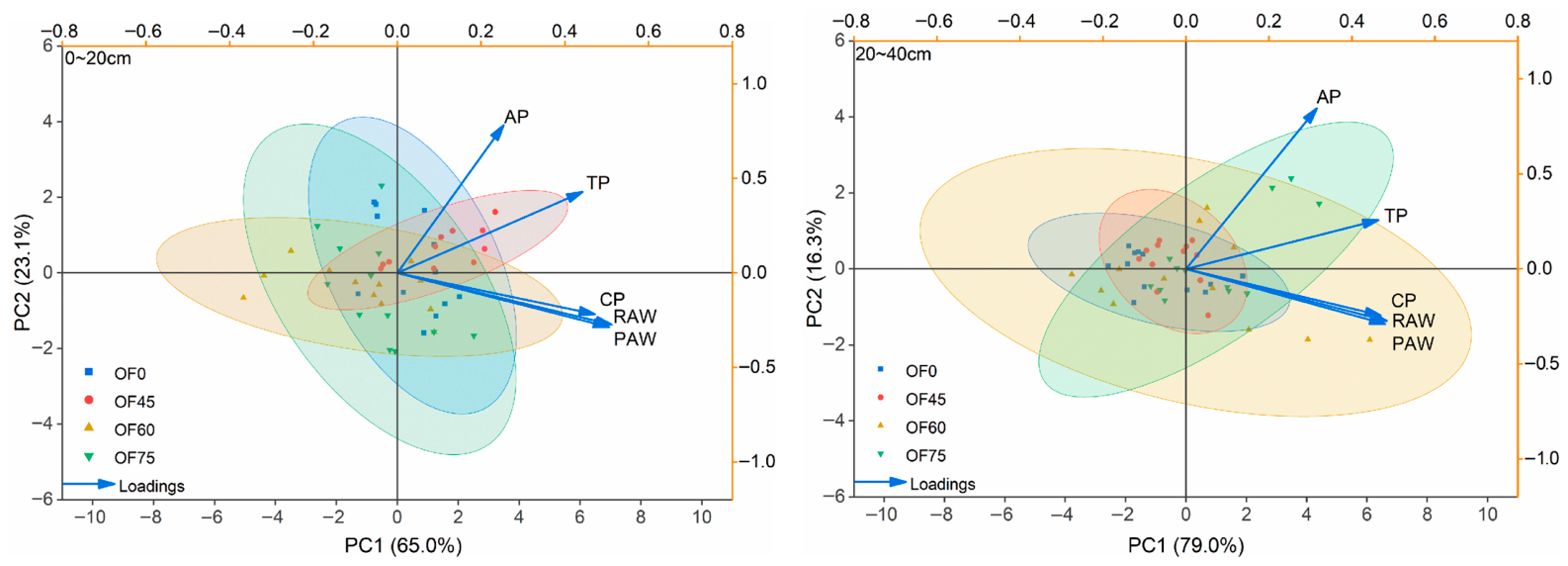
3.6. Comprehensive Evaluation of Soil Pore Structure and Water Availability
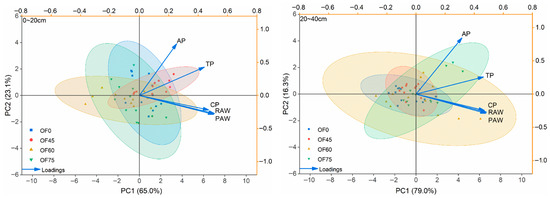
To comprehensively evaluate soil pore structure and water availability, PCA was employed in this study to perform dimensionality reduction on five key indicators (total porosity, aeration porosity, capillary porosity, PAW, and RAW). In the 0–20 cm soil layer, two principal components (PCs) with eigenvalues greater than 1 were extracted, accounting for a cumulative variance contribution rate of 88.1% (Figure 8). Regarding treatment distribution, the four groups exhibited distinct clustering patterns along the PCA axes. Notably, the OF45 treatments clustered predominantly in the positive quadrants of PC1 and PC2, showing marked segregation from the other groups. It indicated that OF45 had a significantly different effect on soil properties compared to the others. In terms of the correspondence between treatments and indicators, OF45 sample points aligned most closely with the loading vectors of all parameters. It indicated that OF45 treatments produced superior improvements in total porosity, aeration porosity, capillary porosity, PAW, and RAW. Furthermore, the comprehensive score evaluation revealed that the OF45+W0.9 treatment achieved the highest rank, demonstrating its status as the optimal amelioration strategy.
Figure 8.
Principal component analysis (PCA) of the relationship between soil pore structure and soil water availability. Abbreviations TP, AP, CP, PAW, and RAW are total porosity, aeration porosity, capillary porosity, plant available water, and readily available water, respectively.
In the 20–40 cm soil layer, only one principal component (eigenvalue > 1) was extracted, with a variance contribution rate of 79.0% (Figure 8). Specifically, capillary porosity, PAW, and RAW were the core drivers of PC1 differentiation due to their higher loading values. This suggested that soil water availability was the key factor distinguishing the ameliorative effects of different treatments. Additionally, strong positive correlations were observed between total porosity and aeration porosity, as well as between capillary porosity and PAW/RAW. This indicated a significant synergistic effect between pore structure optimization and water availability. Comprehensive ranking showed that the OF60+W0.9 treatment performed optimally, but significant variations in amelioration were observed among different WRA treatments under the OF60 treatment.
4. Discussion
4.1. Effects of Applying Organic Fertilizer and WRA Alone on Soil Pore Structure and Water Availability
The results show that the sole application of organic fertilizer or WRA optimized the pore distribution and improved the water availability of the topsoil. In contrast, the individual application of either organic fertilizer or WRA to the subsoil layer significantly decreased total porosity, aeration porosity, capillary porosity, PAW, and RAW. This suggested that the individual application of either organic fertilizer or WRA significantly improved soil pore structure and water availability in the topsoil but considerably reduced it in the subsoil. This result directly challenges the widely held assumption that organic amendments or polymeric conditioners universally benefit soil function. More importantly, it uncovers a previously underappreciated risk: single input management strategies, though advantageous at the surface, may be ineffective—or even deleterious—in deeper soil layers.
Compared to the majority of previous studies, our insight is critical and contrary to expectation. For example, the results of a long-term (13 years) positioning experiment conducted by Kaje et al. [35] showed that the application of organic amendments had a positive influence on soil physical properties in the 0–15 and 15–30 cm soil layers, which was different to the results from this study.
These differences may also be due to variations in root distribution among the soil layers. Roots function as a vital “biological plow,” and enhance deep soil structure through bioturbation and pore formation [36]. However, the site used in this study experienced a severe drought in 2024 with cumulative rainfall from January to May amounting to only 10 mm. The drought resulted in a severely reduced corn germination rate (Figure 6). This meant that the topsoil layer that had received organic fertilizer was more porous and fertile, making it more favorable for root growth. Under these conditions, crop roots tended to proliferate within the topsoil layer rather than penetrating the denser parts of the subsoil layer, such as the plow pan. A sparse root system in the subsoil would lead to the loss of key biological loosening agents [37], thereby weakening soil structure and hydraulic properties.
However, similar findings have also been reported. Consistent with this study, Xu et al. (2015) [38] also reported that WRAs primarily improved soil moisture content in the topsoil, but had a limited effect on the deeper layers. This may be due to reduced water infiltration. The WRA probably acted as a powerful “water pump” in the topsoil. Following rainfall or irrigation, it preferentially absorbed moisture that would otherwise percolate downward and retained it in the surface layer [39,40]. Similarly, the subsoil in this trial received insufficient water, leading to weakened wetting–drying cycles. Many studies have reported that the formation and stabilization of soil structure relies on moderate drying and wetting alternations. During wet periods, soil particles become rearranged under gravity, whereas water surface tension draws particles closer during dry spells, which promotes aggregation [41,42,43]. Thus, the application of WRA alone inhibited the self-reorganization and aggregate stability of the subsurface soil, thereby reducing soil pore structure and water availability.
4.2. Effects of the Combined Application of Organic Fertilizer and WRA on Soil Pore Structure and Water Availability
The combined application of organic fertilizer and WRA improved soil pore structure and water availability, compared to applying organic fertilizer alone. This finding agreed with Yan et al. [44] who reported that the combined application of WRA and organic fertilizers significantly increased water and fertilizer utilization and that the soil nutrient content was substantially greater in the combined application treatments than in the organic fertilizer or WRA alone treatments. In addition, similar results were also reported for biochar and WRA [45] and humic acid and WRA [38]. This may be due to synergistic effects when organic fertilizer and WRA are combined.
The organic fertilizer may have potentially enhanced soil pore structure and water availability by providing structural “skeletons” and “glues”. It may also have physically separated tightly packed soil particles and served as a “cementing agent” that facilitated the formation of water-stable aggregates [46,47]. Organic matter has also been shown to promote the aggregation of dispersed soil particles into stable aggregate structures via the action of fungal hyphae, root exudates, and microbial secretions [48,49]. In addition, organic fertilizer has been shown to continuously improve soil structure through biological pathways, such as activated microbial communities [50].
In contrast, the WRA may have “activated” and “stabilized” the soil structure through soil moisture management, thereby further reinforcing the soil pore structure and water availability. Zhang et al. reported that WRAs strongly optimized organic fertilizer turnover by regulating soil moisture [51]. After rainfall or irrigation, the WRA absorbs substantial amounts of water, which prolongs soil moisture availability and releases water gradually for crop uptake and microbial activities [52,53]. This slow and moderate drying process promotes the formation of stable aggregates. During wet conditions, soil particles approach each other under the influence of organic cementation, whereas during gradual drying, water surface tension and organic binding agents work together to firmly “weld” soil particles together [54]. Beyond water-related benefits, WRAs may also create bonds with soil particles through electrostatic attraction forces. These bonds could effectively reinforce the physical properties of soil [55].
However, the synergistic effect of organic fertilizer and WRA is not unconditional. It is significantly regulated by their application rates. Our results showed that the optimal combined application rate varied by soil layer. In the 0–20 cm soil layer, a low rate of organic fertilizer combined with WRA produced the best improvement. In the 20–40 cm layer, a medium rate was optimal. Different organic fertilizer to WRA ratios led to significant differences in the improvement of soil pore structure and water availability, which aligns with findings by Wang et al. [56]. This variation may be linked to the mechanisms of the two materials and the inherent properties of each soil layer. The organic matter in the fertilizer promotes the formation of macroaggregates. These macroaggregates are mainly in angular or edge contact. Such contact increases the number and diameter of pores between larger particles [57]. When a low rate of organic fertilizer is applied, the increase in total porosity and macropores is less. Consequently, the available pore space restricts the water absorption and swelling of the WRA, resulting in lower water absorption capacity. The topsoil (0–20 cm) is naturally looser and more porous [37]. Therefore, the pore space added by a low rate of organic fertilizer is sufficient for WRA’s water absorption needs. This explains why the combined application of a low rate of organic fertilizer and WRA was most effective in this layer. In contrast, the subsoil (20–40 cm) has a higher bulk density and fewer pores [37]. The pore space created by a low rate of organic fertilizer cannot meet the WRA’s requirements. Thus, a medium rate of organic fertilizer is needed to achieve the optimal effect. It is important to note that more organic fertilizer is not always better. A high application rate can increase microbial populations and the concentration of high charge ions in the soil [58]. These factors can damage the hydrophilic groups of the WRA, thereby accelerating its degradation and ultimately reducing the overall improvement effect [24].
4.3. Effects of Soil Depth on the Effectiveness of Combined Applications of Organic Fertilizer and WRA
The amelioration effects differed significantly between soil layers, and this vertical variation was consistent under both sole and combined applications of organic fertilizer and WRA. The results showed that the combined application of organic fertilizer and WRA led to a greater improvement in the soil pore structure and water availability of the subsoil compared to that of topsoil. Similar results were reported by Yang et al. [59] who reported that nitrogen addition had a greater influence on the priming effect in subsoil than in topsoil, regardless of incubation warming. This difference between the topsoil and subsoil layers may be attributed to differences in environmental conditions and the inherent structural property differences between the surface and subsurface soil layers.
First, these discrepancies are likely attributable to distinct tillage disturbance histories across soil depths. The topsoil, subjected to the intense ‘rotary–deep–rotary’ disturbance sequence, undergoes dynamic structural reconstruction, resulting in poor pore stability. Furthermore, direct exposure to external stressors, such as wet dry cycles, freeze thaw events, erosion, and machinery traffic, further disrupts soil aggregates [37]. In contrast, the subsoil environment remains relatively stable, characterized by minimal external disturbance and attenuated fluctuations in temperature and moisture [60]. Specifically, in the 20–40 cm subsurface layer, although deep plowing caused temporary disturbance in the second year, the cumulative impact of annual tillage was limited. Following settlement in the third year, the soil structure in this layer stabilized. Consequently, once improved, subsoil structure exhibits greater durability, rendering amendment effects more persistent in the subsoil than in the topsoil.
Second, the results may be due to the substantial differences in the initial conditions between the topsoil and subsoil. Generally, topsoil has a relatively stable aggregate structure and a higher SOM content, whereas the subsoil has a denser structure, lower porosity, and a significantly reduced SOM content [61,62]. This means that the subsoil reduces overall soil quality but is more sensitive to amelioration measures.
Third, the subsoil layer shows a more pronounced response to the combined application of organic fertilizer and WRA, which can be attributed to the dynamic coupling process among moisture regulation, microbial activation, and aggregate formation triggered by this integrated strategy. In the layer, the relatively low background water content typically severely inhibits microbial metabolism and root activity, thereby delaying the decomposition of organic materials as well as the formation of cementing substances such as polysaccharides, glomalin, and fungal hyphae [63,64,65]. The combined application of organic fertilizer and WRA can establish a synergistic positive feedback loop: the WRA absorbs water during wet periods and releases it slowly during dry phases, thus extending the time during which microbial communities remain under favorable moisture conditions [24]. The sustained suitable moisture promotes rapid decomposition and turnover of organic fertilizer, accelerates the synthesis of cementing agents such as extracellular polymeric substances (EPSs), and effectively binds soil particles into larger aggregates [66]. Furthermore, improved moisture conditions may also stimulate deeper root growth and soil fauna activity [67], fostering the formation of biopores, which significantly enhances soil porosity and water-holding capacity.
4.4. Study Limitations
In the dryland farming area where this study was conducted, the effectiveness of the combined organic fertilizer and WRA application on soil pore structure and water availability was most likely influenced by inter-annual precipitation variability. Furthermore, this study was conducted exclusively under drought year conditions, which means that it is unclear what the soil responses in normal and wet years will be. It is necessary to conduct long-term studies encompassing diverse climatic conditions to strengthen the related application recommendations. In addition, only the effects of the WRA on soil structure and hydraulic properties were observed in this study, leaving its impact on soil environmental safety unclear. Nevertheless, the soil ecological risks associated with WRA application cannot be ignored, and further research is needed.
5. Conclusions
Based on a three-year field experiment, this study systematically evaluated the effects of the combined application of organic fertilizer and WRA on soil pore structure and water availability. The main conclusions are as follows:
- (1)
- In semi-arid regions, especially under drought conditions, the sole application of either organic fertilizer or WRA exhibited clear limitations. The individual application of either organic fertilizer or WRA alone significantly enhanced soil pore structure and water-holding capacity in the topsoil but reduced it in the subsoil.
- (2)
- The incorporation of organic fertilizer and WRA together overcame the drawback, resulting in synergistic improvement in both soil layers. However, the synergistic enhancements differed between soil layers, with more pronounced effects in the subsoil than in the topsoil.
- (3)
- The remarkable vertical heterogeneity in soil physical improvement highlights the necessity of layer-specific regulation and differentiated management. The optimal combination for the 0–20 cm topsoil was OF45+W0.9, which was conducive to balancing soil water and air conditions. The optimal combination for the 20–40 cm subsoil was OF60+W0.9, which better promoted the synergistic improvement of soil water storage capacity and soil water-holding capacity.
Author Contributions
M.Z.: Writing—original draft, Methodology, Investigation, Formal analysis. Z.L.: Data curation, Investigation. M.Y.: Data curation, Investigation. X.H.: Conceptualization, Project administration, Funding acquisition. N.L.: Formal analysis, Visualization. K.H.: Writing—review and editing. G.L.: Visualization, Writing—review and editing, Formal analysis. All authors have read and agreed to the published version of the manuscript.
Funding
This work was supported by the National Key Research and Development Plan (grant number 2021YFD1901101); the Science and Technology Innovation Enhancement Project of Shanxi Agricultural University (grant number CXGC2025064); the Major Science and Technology Project “Unveiled” in Shanxi Province (grant number 202101140601026), and the Shanxi Scholarship Council of China (grant number 2022-110).
Data Availability Statement
The original contributions presented in this study are included in the article. Further inquiries can be directed to the corresponding author.
Conflicts of Interest
The authors declare that there are no commercial or associative interests that represent a conflict of interest in connection with the work submitted.
References
- Qi, W.Q.; Song, W.J.; Qi, R.; Li, R.; Li, Y.; Yang, H.K.; Li, Y.S.; Chang, Z.D. Land Use Types Drive the Distinct Patterns of Bacterial and Fungal Communities in Soils from the Semi-arid Area. Microb. Ecol. 2025, 88, 43. [Google Scholar] [CrossRef] [Scilit]
- He, J.; Qi, R.; Wang, S.; Duan, X.; Meng, L.; Ai, S.; Yu, L.; Gadd, G.; Song, W. Distinct composition patterns of bacterial and fungal communities and biogeochemical cycling genes depend on the vegetation type in arid soil. Appl. Soil. Ecol. 2023, 191, 105064. [Google Scholar] [CrossRef] [Scilit]
- FAO. The State of Agricultural Commodity Markets 2018—Agricultural Trade, Climate Change and Food Security; FAO: Rome, Italy, 2018. [Google Scholar]
- Yu, S.B.; Khan, S.; Mo, F.; Ren, A.X.; Lin, W.; Feng, Y.; Dong, S.F.; Ren, J.; Wang, W.X.; Noor, H.; et al. Determining optimal nitrogen input rate on the base of fallow season precipitation to achieve higher crop water productivity and yield. Agric. Water Manag. 2021, 246, 106689. [Google Scholar] [CrossRef] [Scilit]
- Oliver, M.A.; Gregory, P.J. Soil, food security and human health: A review. Eur. J. Soil Sci. 2015, 66, 257–276. [Google Scholar]
- Yang, Y.N.; Huang, M.B. Effects of Different Long-term Fertilization Treatments on Soil Hydraulic Properties and Their Changes with Depth. Bull. Soil Water Conserv. 2022, 42, 56–62. [Google Scholar]
- Zhu, X.; Peng, W.; Xie, Q.; Ran, E. Effects of Soil Compaction Stress Combined with Drought on Soil Pore Structure, Root System Development, and Maize Growth in Early Stage. Plants 2024, 13, 3185. [Google Scholar] [CrossRef] [Scilit]
- Wu, H.; Liu, Y.; Zhang, T.; Xu, M.; Rao, B. Impacts of Soil Properties on Species Diversity and Structure in Alternanthera philoxeroides-Invaded and Native Plant Communities. Plants 2024, 13, 1196. [Google Scholar] [CrossRef] [Scilit] [PubMed]
- Li, T.J.; Liu, H.F.; Zhang, S.X.; Yang, J.F.; Zhang, N.Y.; Zhang, X.Z.; Peng, C. Replacing part chemical fertilizer with maize straw enhances the aggregate stability and improves structure of black soil. J. Plant Nutr. Fertil. 2026, 32, 279–290. [Google Scholar]
- Lynch, J.P.; Mooney, S.J.; Strock, C.F.; Schneider, H.M. Future roots for future soils. Plant Cell Environ. 2022, 45, 620–636. [Google Scholar] [CrossRef] [Scilit]
- Lal, R. Soil organic matter and water retention. Agron. J. 2020, 112, 3265–3277. [Google Scholar] [CrossRef] [Scilit]
- Shirani, H.; Hajabbasi, M.A.; Afyuni, M.; Hemmat, A. Effects of farmyard manure and tillage systems on soil physical properties and corn yield in central Iran. Soil Tillage Res. 2002, 68, 101–108. [Google Scholar] [CrossRef] [Scilit]
- Schweizer, S.A.; Graf-Rosenfellner, M.; Bhat, N.A.; Kayser, G.; Sisodia, B.S.; Kirchhof, G.; Zikeli, S.; Cadisch, G.; Bhullar, G.S. Responses of soil organic carbon, aggregate diameters, and hydraulic properties to long-term organic and conventional farming on a Vertisol in India. Land Degrad. Dev. 2022, 33, 785–797. [Google Scholar] [CrossRef] [Scilit]
- Zhao, J.; Liu, M.; Xu, J.; Yang, Z.; Li, Q.; Cai, C. Soil meso- and micro-fauna community in response to bamboo-fungus agroforestry management. Sci. Rep. 2022, 12, 16392. [Google Scholar] [CrossRef] [Scilit]
- Wendel, A.S.; Bauke, S.L.; Amelung, W.; Knief, C. Root-rhizosphere-soil interactions in biopores. Plant Soil 2022, 475, 253–277. [Google Scholar] [CrossRef] [Scilit]
- Zhao, Z.; Zhang, C.; Zhang, J.; Liu, C.; Wu, Q. Fertilizer impacts on soil aggregation and aggregate-associated organic components. Plant Soil Environ. 2018, 64, 338–343. [Google Scholar] [CrossRef] [Scilit]
- Chen, J.; Yu, J.; Li, Z.; Zhou, J.; Zhan, L. Ameliorating Effects of Biochar, Sheep Manure and Chicken Manure on Acidified Purple Soil. Agronomy 2023, 13, 1142. [Google Scholar] [CrossRef] [Scilit]
- Xu, P.; Gao, Y.; Cui, Z.; Wu, B.; Yan, B.; Wang, Y.; Wen, M.; Wang, H.; Ma, X.; Wen, Z. Application of Organic Fertilizers Optimizes Water Consumption Characteristics and Improves Seed Yield of Oilseed Flax in Semi-Arid Areas of the Loess Plateau. Agronomy 2023, 13, 1755. [Google Scholar] [CrossRef] [Scilit]
- Du, Y.; Cui, B.; Zhang, Q.; Wang, Z.; Sun, J.; Niu, W. Effects of manure fertilizer on crop yield and soil properties in China: A meta-analysis. Catena 2020, 193, 104617. [Google Scholar] [CrossRef] [Scilit]
- Motsi, H.; Phiri, E.E.; Mothapo, P.N. Manure utilisation under smallholder farmers in Sub-Saharan Africa. A systematic review and meta-analysis. Nutr. Cycl. Agroecosyst. 2025, 131, 613–634. [Google Scholar] [CrossRef] [Scilit]
- Li, B.; Zhang, F.; Li, Y.; Meng, J.; Zhu, Y.; Shi, R.; Wang, Y. Retention effect of mineral superabsorbent composite on condensation water in arid areas in Xinjiang. Arid. Land. Geogr. 2021, 44, 1135–1140. [Google Scholar]
- Singh, N.; Agarwal, S.; Jain, A.; Khan, S. 3-Dimensional cross linked hydrophilic polymeric network “hydrogels”: An agriculture boom. Agric. Water Manag. 2021, 253, 106939. [Google Scholar] [CrossRef] [Scilit]
- Rizwan, M.; Gilani, S.R.; Durani, A.I.; Naseem, S. Materials diversity of hydrogel: Synthesis, polymerization process and soil conditioning properties in agricultural field. J. Adv. Res. 2021, 33, 15–40. [Google Scholar] [CrossRef] [Scilit]
- Yang, M.; Shi, Y. Categories and application fields and manufacturing process and action mechanism of water retaining agent. Adv. Polym. Technol. 2022, 2022, 2211441. [Google Scholar] [CrossRef] [Scilit]
- Wei, J.; Yang, H.; Cao, H.; Tan, T. Using polyaspartic acid hydro-gel as water retaining agent and its effect on plants under drought stress. Saudi J. Biol. Sci. 2026, 23, 654–659. [Google Scholar] [CrossRef] [Scilit]
- Li, X.; He, J.Z.; Hughes, J.M.; Liu, Y.R.; Zheng, Y.M. Effects of super-absorbent polymers on a soil-wheat (Triticum aestivum L.) system in the field. Appl. Soil Ecol. 2014, 73, 58–63. [Google Scholar] [CrossRef] [Scilit]
- Liu, W. Effect of Polyaspartic Acid Water-Retaining Agent on Soil Microecology and Isolation and Identification of Degrading Bacteria. Master’s Thesis, Tarim University, Alar, China, 2021. [Google Scholar]
- Wang, Y.; Jing, D.; Fu, X.; Liu, F.; Duan, X.; Liu, F.; Guo, Y.; Jiu, L.; Zhang, H.; Jia, H. Effects of application amount of super-absorbent polymer on soil physical characteristics and microbial activity under poplar seedlings. Bull. Soil Water Conserv. 2017, 37, 53–58. [Google Scholar]
- Lu, R.K. Soil Agricultural Chemical Analysis Methods; China Agricultural Science and Technology Press Co., Ltd.: Beijing, China, 2000; pp. 106–282. [Google Scholar]
- Wu, K.N.; Zhao, R. Soil Texture Classification and Its Application in China. Acta Pedol. Sin. 2019, 56, 227–241. [Google Scholar]
- Ng’eno, V.; Omuto, C.; Mbuge, D.; Too, V. Assessment of Super Absorbent Polymer (SAP) on Plant Available Water (PAW) in Dry Lands. Engineering 2023, 15, 90–105. [Google Scholar] [CrossRef]
- Chang, C.C.; Cheng, D.H.; Qiao, X.Y. Improving estimation of pore size distribution to predict the soil water retention curve from its particle size distribution. Geoderma 2019, 340, 206–212. [Google Scholar] [CrossRef] [Scilit]
- Rawls, W.J.; Pachepsky, Y.A.; Ritchie, J.C.; Sobecki, T.M.; Bloodworth, H. Effect of soil organic carbon on soil water retention. Geoderma 2003, 116, 61–76. [Google Scholar] [CrossRef] [Scilit]
- Zhang, L.; Han, J.C.; Luo, L.T.; Ma, Z.H.; Wang, H.Y. Water-holding characteristics of compounded soil with feldspathic sandstone and aeolian sandy soil. Chin. J. Northwest Sci.-Tech. Univ. Agric. For. (Nat. Sci. Ed.) 2014, 42, 207–214. [Google Scholar]
- Kaje, V.V.; Sharma, D.K.; Shivay, Y.S.; Jat, S.L.; Bhatia, A.; Purakayastha, T.J.; Bandyopadhyay, K.K.; Bhattacharyya, R. Long-term impact of organic and conventional farming on soil physical properties under rice (Oryza sativa)-wheat (Triticum aestivum) cropping system in north-western Indo-Gangetic plains. Indian J. Agric. Sci. 2023, 88, 107–113. [Google Scholar] [CrossRef] [Scilit]
- Zhang, Z.B.; Peng, X.H. Bio-tillage: A new perspective for sustainable agriculture. Soil Tillage Res. 2021, 206, 104844. [Google Scholar] [CrossRef] [Scilit]
- Ning, T.Y.; Liu, Z.; Hu, H.Y.; Li, G.; Kuzyakov, Y. Physical, chemical and biological subsoiling for sustainable agriculture. Soil Tillage Res. 2022, 223, 105490. [Google Scholar] [CrossRef] [Scilit]
- Xu, S.T.; Zhang, L.; McLaughlin, N.B.; Mi, J.Z.; Chen, Q.; Liu, J.H. Effect of synthetic and natural water absorbing soil amendment soil physical properties under potato production in a semi-arid region. Soil Tillage Res. 2015, 148, 31–39. [Google Scholar] [CrossRef] [Scilit]
- Bhardwaj, A.K.; Shainberg, I.; Goldstein, D.; Warrington, D.N.; Levy, G.J. Water retention and hydraulic conductivity of cross-linked polyacrylamides in sandy soils. Soil Sci. Soc. Am. J. 2007, 71, 406–412. [Google Scholar] [CrossRef] [Scilit]
- Hüttermann, A.; Orikiriza, L.J.B.; Agaba, H. Application of superabsorbent polymers for improving the ecological chemistry of degraded or polluted lands. Clean Soil Air Water 2009, 37, 517–526. [Google Scholar] [CrossRef] [Scilit]
- Pires, L.F.; Bacchi, O.O.S.; Reichardt, K. Assessment of soil structure repair due to wetting and drying cycles through 2D tomographic image analysis. Soil Tillage Res. 2007, 94, 537–545. [Google Scholar] [CrossRef] [Scilit]
- Zachariah, N.; Murthy, T.G.; Borges, R.M. Moisture alone is sufficientto impart strength but not weathering resistanceto termite mound soil. R. Soc. Open Sci. 2020, 7, 200485. [Google Scholar] [CrossRef] [Scilit]
- Aslam, M.M.; Karanja, J.K.; Dodd, I.C.; Waseem, M.; Xu, W.F. Rhizosheath: An adaptive root trait to improve plant tolerance to phosphorus and water deficits? Plant Cell Environ. 2022, 45, 2861–2874. [Google Scholar] [CrossRef] [Scilit]
- Yan, D.; Wei, F.; Chen, Z.; Han, Z.; Zhang, S.; Wang, H.; Yang, X.; Ma, J.; Ji, X. Effects of water retaining agent combined with organic carbon fertilizer on growth and development and water and fertilizer utilization of flue-cured tobacco. Water Sav. Irrig. China 2025, 11, 88–95. [Google Scholar]
- Abulaiti, A.; She, D.; Liu, Z.; Sun, X.; Wang, H. Application of biochar and polyacrylamide to revitalize coastal saline soil quality to improve rice growth. Environ. Sci. Pollut. Res. 2023, 30, 18731–18747. [Google Scholar] [CrossRef] [Scilit]
- Ma, B.; Ma, B.L.; McLaughlin, N.B.; Mi, J.Z.; Yang, Y.M.; Liu, J.H. Exploring soil amendment strategies with polyacrylamide to improve soil health and oat productivity in a dry land farming ecosystem: One-time versus repeated annual application. Land Degrad. Dev. 2020, 31, 1176–1192. [Google Scholar] [CrossRef] [Scilit]
- Liu, Z.; Zhang, Y.; Sun, Z.H.; Sun, Y.Y.; Wang, H.Y.; Zhang, R.Q. Effects of the application of different improved materials on reclaimed soil structure and maize yield of Hollow Village in Loess Area. Sci. Rep. 2022, 12, 7431. [Google Scholar] [CrossRef] [Scilit] [PubMed]
- Fan, X.; Pan, H.; Ping, Y.; Jin, G.; Song, F. The underlying mechanism of soil aggregate stability by fungi and related multiple factor: A Review. Eurasian Soil. Sci. 2022, 55, 242–250. [Google Scholar] [CrossRef] [Scilit]
- Goede, S.P.C.; Hannula, S.E.; Jansen, B.; Morriën, E. Fungal-mediated soil aggregation as a mechanism for carbon stabilization. ISME J. 2025, 19, 1. [Google Scholar] [CrossRef] [Scilit]
- Sarker, T.C.; Zotti, M.; Fang, Y.N.; Giannino, F.; Mazzoleni, S.; Bonanomi, G.; Cai, Y.J.; Chang, S.X. Soil Aggregation in Relation to Organic Amendment: A Synthesis. J. Soil Sci. Plant Nutr. 2022, 22, 2481–2502. [Google Scholar] [CrossRef] [Scilit]
- Zhang, B.; Jia, Y.; Fan, H.; Guo, C.; Fu, J.; Li, S.; Ma, R. Soil compaction due to agricultural machinery impact: A systematic review. Land Degrad. Dev. 2024, 35, 3256–3273. [Google Scholar] [CrossRef] [Scilit]
- Lado, M.; Ben-Hur, M. Treated domestic sewage irrigation effects on soil hydraulic properties in arid and semiarid zones: A review. Soil Tillage Res. 2009, 106, 152–163. [Google Scholar] [CrossRef] [Scilit]
- Huang, W.; Lai, H.Q.; Du, J.X.; Zhou, C.Y.; Liu, Z.; Ni, Q. Effect of polymer water retaining agent on physical properties of silty clay. Chem. Biol. Technol. Agric. 2022, 9, 47. [Google Scholar] [CrossRef] [Scilit]
- Yu, X.X.; Xiao, B.; Cao, Y.S.; Kidron, G.J. Microbial-induced extracellular polymers are fundamentally responsible for the mechanical stability of biocrusts in drylands. CATENA 2024, 245, 108349. [Google Scholar] [CrossRef] [Scilit]
- Cheng, Y.C.; Wang, C.P.; Liu, K.Y.; Pan, S.Y. Towards sustainable management of polyacrylamide in soil-water environment: Occurrence, degradation, and risk. Sci. Total Environ. 2024, 926, 171587. [Google Scholar] [CrossRef] [Scilit]
- Wang, G.; Gong, H.; Shang, K. Effects of combined application of water-retaining agents and organic fertilizer on soil water-holding capacity in waste dumps in open pit coal mines. J. East China Norm. Univ. (Nat. Sci. Ed.) 2023, 2023, 64–70. [Google Scholar]
- Zhang, H.; Pang, H.; Song, J. Effects of pore structure and water salt movement for saline soil under subsurface organic amendment. Trans. Chin. Soc. Agric. Mach. 2022, 53, 355–364. [Google Scholar]
- Xu, Q.; Li, L.; Guo, J.; Guo, H.; Liu, M.; Guo, S.; Kuzyakov, Y.; Ling, N.; Shen, Q. Active microbial population dynamics and life strategies drive the enhanced carbon use efficiency in high-organic matter soils. mBio 2024, 15, e00177-24. [Google Scholar] [CrossRef] [Scilit]
- Yang, S.B.; Zhao, X.C.; Wang, Q.K.; Tian, P. Greater influences of nitrogen addition on priming effect in forest subsoil than topsoil regardless of incubation warming. Sci. Total Environ. 2024, 946, 174308. [Google Scholar] [CrossRef] [Scilit]
- Ivan, D.; Pereira, P.; Kisic, I.; Matisic, M.; Bogunovic, I. Analyzing the influence of conservation tillage and manure on soil parameter modulations in croplands. Plants 2024, 13, 607. [Google Scholar] [CrossRef] [Scilit]
- Colombi, T.; Walder, F.; Büchi, L.; Sommer, M.; Liu, K.; Six, J.; van der Heijden, M.G.A.; Charles, R.; Keller, T. On-farm study reveals positive relationship between gas transport capacity and organic carbon content in arable soil. Soil 2019, 5, 91–105. [Google Scholar] [CrossRef] [Scilit]
- Zhang, Y.; Wang, R.; Wang, S.; Wang, H.; Xu, Z.; Jia, G.; Wang, X.; Li, J. Effects of different sub-soiling frequencies incorporated into no-tillage systems on soil properties and crop yield in dryland wheat-maize rotation system. Field Crop Res. 2017, 209, 151–158. [Google Scholar] [CrossRef] [Scilit]
- Lellei-Kovács, E.; Botta-Dukát, Z.; Ónodi, G.; Mojzes, A.; Kröel-Dulay, G. The Negative Legacy Effect of Extreme Drought on Soil Respiration Is Unaffected by Post-Drought Precipitation Regime in a Temperate Grassland. Glob. Change Biol. 2025, 31, e70083. [Google Scholar] [CrossRef] [Scilit]
- Banerjee, S.; van der Heijden, M.G.A. Soil microbiomes and one health. Nat. Rev. Microbiol. 2023, 21, 6–20. [Google Scholar] [CrossRef] [Scilit] [PubMed]
- Hartmann, M.; Six, J. Soil structure and Microbiome functions in agroecosystems. Nat. Rev. Earth Environ. 2022, 4, 4–18. [Google Scholar] [CrossRef] [Scilit]
- Iqbal, S.; Begum, F.; Nguchu, B.A.; Claver, U.P.; Shaw, P. The invisible architects: Microbial communities and their transformative role in soil health and global climate changes. Environ. Microbiome 2025, 20, 36. [Google Scholar] [CrossRef] [Scilit] [PubMed]
- Asamoah, E.; Heuvelink, G.B.M.; Chairi, I.; Bindraban, P.S.; Logah, V. Random forest machine learning for maize yield and agronomic efficiency prediction in Ghana. Heliyon 2024, 10, e37065. [Google Scholar] [CrossRef] [Scilit] [PubMed]

Disclaimer/Publisher’s Note: The statements, opinions and data contained in all publications are solely those of the individual author(s) and contributor(s) and not of MDPI and/or the editor(s). MDPI and/or the editor(s) disclaim responsibility for any injury to people or property resulting from any ideas, methods, instructions or products referred to in the content. |
© 2026 by the authors. Licensee MDPI, Basel, Switzerland. This article is an open access article distributed under the terms and conditions of the Creative Commons Attribution (CC BY) license.