


Abstract
Cool-season (C3) forage grasses are a cornerstone of temperate grassland systems, where improving productivity, nutritive value, and stress resilience is essential for sustainable forage production. In this context, plant growth-promoting microorganisms (PGPMs) have gained increasing attention as potential alternatives or complements to mineral and organic fertilization in grassland management. This review synthesizes current knowledge on the role of bacterial and fungal PGPM in enhancing the growth, nutrient use efficiency, and stress tolerance of C3 forage grasses, with particular emphasis on species of the genus Lolium. Available evidence indicates that PGPMs can substantially improve biomass production and plant performance under both optimal and stress conditions through a range of direct and indirect mechanisms. These include phytohormone production, nitrogen fixation, phosphate solubilization, as well as the activation of antioxidant defense systems and stabilization of plant water relations under stress. While Lolium perenne L. and Lolium multiflorum Lam. remain the most extensively studied model species, comparable growth-promoting responses have also been reported for Dactylis glomerata L., Festuca species, and Festulolium hybrids. Increasing attention is being directed toward bacterial and fungal endophytes, which may provide more persistent physiological benefits due to their close association with plant tissues. However, PGPM effects are often strongly species-, genotype-, and environment-dependent, particularly in complex grassland systems. Overall, PGPMs represent a promising tool for sustainable grassland management, although their effective application will require long-term field studies conducted under realistic meadow and pasture conditions.
1. Introduction
Grasslands are a fundamental component of temperate landscapes in Europe and play a central role in the economically important sector of animal production [1]. In addition to forage production, they provide a range of ecosystem benefits, including soil protection, carbon storage, water regulation, biodiversity support, and the maintenance of landscape aesthetics and ecosystem functions [2]. Grasslands are generally defined as land cultivated with herbaceous forage species, either naturally occurring or managed, that has not been included in crop rotation for at least five years [3].
In Europe, grasslands cover approximately 171.7 million hectares, accounting for nearly 37.6% of agricultural land [4]. Globally, they occupied 3236.4 million hectares in 2022, representing 67.3% of cultivated land [5]. In many regions, grasslands therefore dominate land-use patterns.
Compared with other agroecosystems, grasslands are particularly sensitive to climate change [6]. Their productivity and ecological value largely depend on the composition of species they host [7]. Among these species, C3 forage grasses are especially important in temperate climates. This group includes Lolium species, Festuca species, Dactylis glomerata L., Poa species., Phleum pratense L., Bromus species, and Agrostis species [8]. These species grow rapidly in cooler temperatures and perform particularly well in early spring and autumn. Widely used in pastures and meadows, they provide high nutritive value, persist under grazing, and form dense swards that support both forage production and soil protection. Together with legumes and forbs, they constitute the structural and functional backbone of temperate grasslands, shaping biomass yield, species diversity, and ecosystem resilience [9].
To support the growth, nutritive value, and resilience of these key forage species, increasing research attention is being directed toward the potential of Plant Growth-Promoting Microorganisms (PGPMs) as natural allies in grasslands management. PGPMs currently represent one of the most important and widely discussed alternatives to conventional mineral fertilization, as well as to organic fertilizers such as manure or slurry [10,11,12]. PGPMs comprise a broad group of microorganisms inhabiting both the rhizosphere and plant tissues as endophytes. This group includes bacteria (PGPB/PGPR), as well as fungi, particularly arbuscular mycorrhizal fungi (AMF) and other symbiotic fungi [13,14,15]. The substantial taxonomic diversity of PGPMs translates into a wide array of mechanisms through which they can stimulate plant growth and development [16,17,18]
Plant growth-promoting microorganisms include bacterial genera such as Bacillus, Pseudomonas, Paenibacillus, and Azospirillum [19,20,21,22], while important fungal representatives include endophytic fungi of the genus Serendipita and strains of the genus Trichoderma [14,15].
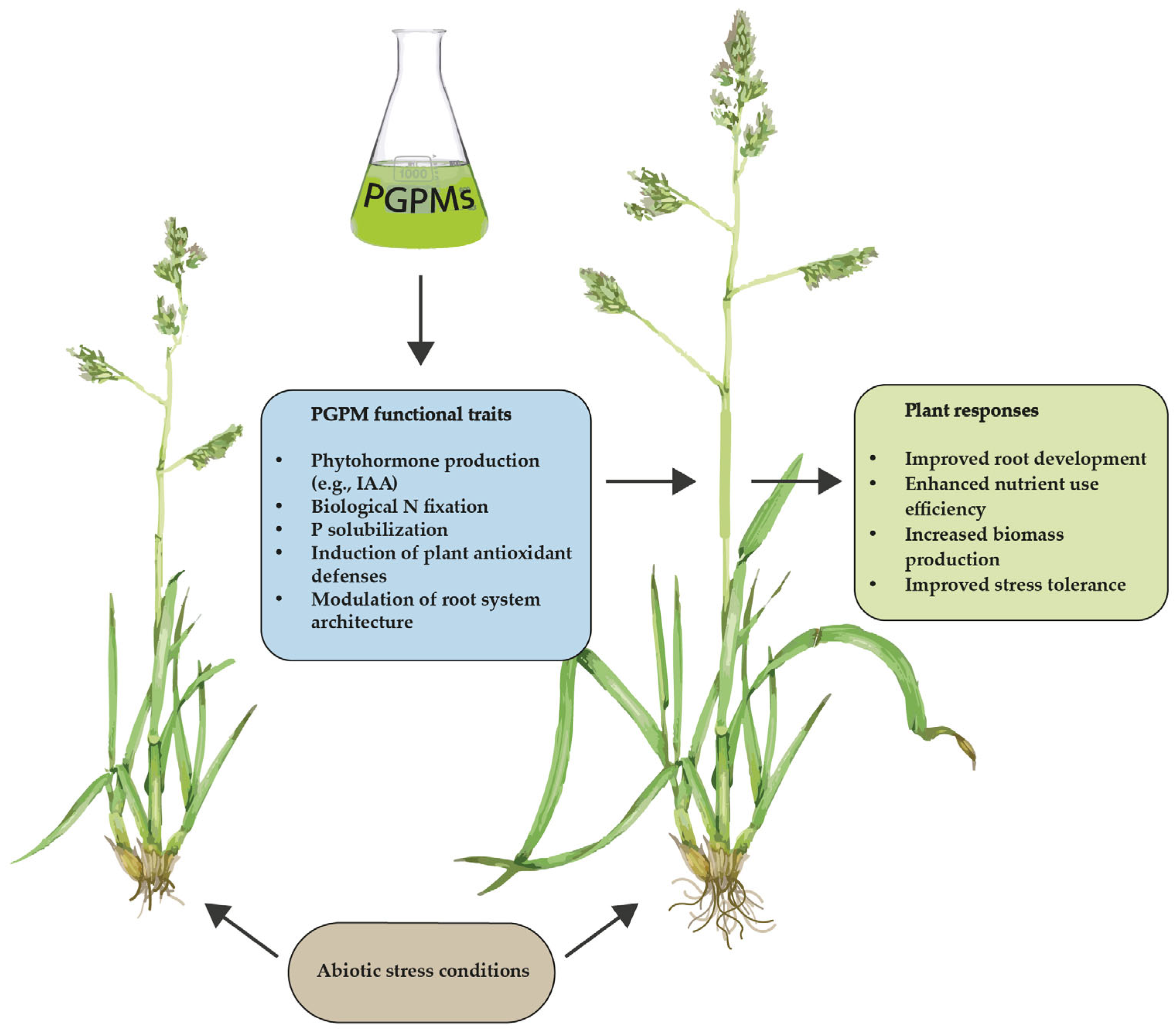
PGPMs influence plants through two main pathways: direct and indirect mechanisms. Direct mechanisms include atmospheric nitrogen fixation, solubilization of phosphorus and potassium, and the production of phytohormones such as indole-3-acetic acid (IAA), gibberellins, and cytokinin [12,13]. Indirect mechanisms involve the mitigation of abiotic stresses such as drought, salinity, heavy metals, or nutrient deficiency, as well as biotic stresses, including soil-borne pathogens. PGPMs can stimulate systemic plant resistance (ISR), modulate the production of phenolic compounds in plants, and reduce oxidative stress [17,23]. Moreover, they produce compounds with antagonistic activity against pathogens, such as lipopeptides, polyketides, and hydrolytic enzymes (e.g., chitinases or glucanases) [22,24,25]. In grasses used in forage systems, these effects translate into increased biomass production, improved feed quality, more efficient nutrient utilization, and, in many cases, enhanced efficiency of mineral fertilization (Figure 1).
Figure 1.
Schematic representation of the proposed mechanisms and associated effects of PGPMs in C3 forage grasses.
In light of recent studies on Lolium species, D. glomerata L., and Festuca species, the role of PGPMs is increasingly well-documented, and their practical application is becoming progressively more feasible [26,27]. Nevertheless, a comprehensive review synthesizing their mechanisms of action and practical applications in cool-season grasses is still lacking. Below, we present examples of relevant studies.
The review aims to provide an overview of how PGPMs can support the growth and productivity of C3 forage grasses, with a particular focus on potential applications in grassland management, and identifying current research gaps. This review highlights areas requiring further investigation and outlines new directions for the application of PGPMs in C3 forage grasses.
2. Materials and Methods
This article was prepared as a narrative review aimed at synthesizing current knowledge on plant growth-promoting microorganisms associated with C3 forage grasses. The literature search for this review was conducted via (i) Google Scholar (Google LLC, Mountain View, CA, USA; https://scholar.google.de accessed between 01 November 2025 and 20 February 2026). and (ii) Scopus (Elsevier B.V., Amsterdam, The Netherlands; https://www.scopus.com accessed between 1 November 2025 and 20 February 2026). The following keywords were used in combination: species-specific names (Lolium species, Festuca species, D. glomerata L., Poa species, Poa pratensis L., P. pratense L., Bromus species, Agrostis species) and terms related to plant growth-promoting microorganisms, plant growth-promoting rhizobacteria, plant growth-promoting bacteria, PGPR, PGPB, and endophytes. Peer-reviewed articles published up to January 2026 were considered. The selection of studies was based on their relevance to the thematic scope of the review, with particular emphasis on experimental research addressing mechanisms of action, plant stress responses, and field applicability in grassland systems. The reference lists of selected publications were screened to identify additional relevant studies.
3. Results and Discussion
3.1. Plant Growth-Promoting Rhizobacteria
3.1.1. Forage Grasses from Lolium Species
The genus Lolium comprises species that are widely used in grasslands within temperate climate zones. Their extensive use is conditioned by their high nutritive value and rapid growth. The most frequently studied species, Lolium perenne L. (perennial ryegrass) and Lolium multiflorum Lam. (annual ryegrass), owing to their considerable economic importance and well-documented response to PGPR inoculation, represent attractive model systems for research aimed at improving plant productivity and stress resilience.
Although L. perenne remains the dominant experimental model, comparable responses have been reported for L. multiflorum Lam. and related cool-season grasses. Most studies on Lolium species have been conducted under controlled greenhouse conditions, with comparatively fewer long-term field trials. Across experiments, inoculation with PGPR generally resulted in increased biomass production, improved nutrient uptake, and enhanced stress tolerance, although the magnitude of responses varied widely depending on strain identity, environmental context, and fertilization regime.
Under normal growth conditions, species of the genus Lolium (particularly L. perenne L. and L. multiflorum Lam.) generally exhibit positive responses to inoculation with various PGPR. For example, Shoebitz et al. [28] described the strain Enterobacter ludwigii BNM 0357, isolated from L. perenne L., which combines direct plant growth-promoting traits—such as IAA production, phosphate solubilization, and nitrogenase activity—with antagonistic activity against Fusarium solani. Inoculation with this strain enhanced root system development, confirming its potential as an effective PGPR.
Under optimal conditions, phosphate-solubilizing bacteria have also been shown to significantly stimulate the growth of L. perenne L. Barra et al. [26] demonstrated that a consortium of phosphobacteria increased shoot and root biomass as well as phosphorus content, irrespective of soil P availability. The effect was particularly pronounced when combined with superphosphate fertilization, indicating that phosphobacteria can “amplify” the efficiency of P fertilization [26].
Moreover, in grassland production systems where organic fertilization (e.g., poultry manure) is commonly applied, PGPR consortia may reduce the reliance on traditional fertilization. Recently, Satognon et al. [27] reported that a Bacillus-based consortium could partially replace poultry manure in L. multiflorum Lam. and F. arundinacea Schreb. (syn. L. arundinaceum Schreb. Darbysh). improving plant height, tiller number, and shoot and root biomass even with a 50–75% reduction in poultry litter fertilizer dose.
Collectively, these studies indicate that under non-stress conditions, PGPR primarily enhance biomass production through improved phosphorus mobilization and more efficient nutrient use, often allowing partial substitution of mineral or organic fertilizers. Under abiotic and biotic stress conditions, however, the mechanisms underlying growth promotion shift toward stress mitigation and physiological stabilization, including enhanced antioxidant activity, reduced toxic element accumulation, and hormonal regulation.
Under abiotic stress conditions, PGPR have been shown to mitigate the negative effects of heavy metals, drought, and high temperature. For instance, Ke et al. [29] demonstrated that three metal-tolerant PGPR strains maintained their ability to produce IAA and solubilize phosphorus under Cu and Cd exposure and increased the biomass of L. perenne L. by 11–44% in highly contaminated soils (800 mg Cu kg−1 and 30 mg Cd kg−1). Inoculated plants also accumulated lower concentrations of metals, thereby reducing their translocation to shoots and decreasing lipid peroxidation, which indicates a strong PGPR-induced antioxidant response [29].
Similar beneficial effects were documented for Cd stress in L. perenne L. and L. multiflorum Lam. In a study combining Pseudomonas fluorescens inoculation with organic amendments (rice straw, wheat straw, and cattle manure), co-application significantly reduced Cd toxicity, resulting in increases in plant height (by 96%), root length (158%), chlorophyll content (90–98%), and relative water content (168%) [30].
PGPR have also enhanced tolerance to drought. He et al. [31] reported that Bacillus sp. WM13-24 and Pseudomonas sp. M30-35 enhanced drought tolerance in L. perenne L. by increasing antioxidant enzyme activity (CAT, POD), reducing MDA levels, and modulating hormonal balance, particularly ABA. After seven days of drought stress, inoculated plants maintained higher chlorophyll content, improved water status, and exhibited fewer symptoms of oxidative damage compared with control plants.
Furthermore, a recent factorial experiment demonstrated that a consortium comprising three Bacillus strains (B. altitudinis AP18, B. subtilis AP278, B. safensis AP280) and Lysinibacillus macroides AP282 significantly enhanced seedling length and vigor of L. multiflorum Lam. and L. arundinaceum (Schreb.) Darbysh (syn. F. arundinaceum Schreb.) under both optimal (21 °C) and high-temperature (32 °C) conditions, despite a slight delay in germination [27]. These results indicate that PGPR can partially mitigate heat-induced growth limitations during early developmental stages. [27].
Under biotic stress conditions, PGPR can simultaneously promote plant growth and suppress pathogens. Shoebitz et al. [28] demonstrated that E. ludwigii BNM 0357 inhibits the growth and spore germination of Fusarium solani while enhancing root development. This antagonistic activity involves both competitive mechanisms and the induction of plant resistance mediated by IAA and siderophore production. Similarly, Li et al. [32] reported that rhizosphere Bacillus isolates associated with L. perenne suppress both plant and animal pathogens through the biosynthesis of antimicrobial compounds, including NRPS, NRPS-PKS, and bacteriocins. Seven isolates (B. subtilis, B. velezensis, B. pumilus, B. altitudinis, and B. laterosporus) exhibited simultaneous growth-promoting and antagonistic properties, suggesting a dual protective mechanism involving direct pathogen suppression and enhanced plant physiological performance.
Across stress conditions, reported biomass increases ranged from 11% to over 150%, depending on stress severity and co-application with organic amendments. Fertilizer inputs could be reduced by 50–75% when PGPR consortia were applied. Notably, stronger relative responses were frequently observed under severe abiotic stress compared with optimal growth conditions.
Overall, growth promotion in Lolium species appears to be mediated by multiple mechanisms: enhanced nutrient acquisition (phosphate solubilization, nitrogen fixation), modulation of phytohormonal balance (IAA and ABA regulation), improved antioxidant capacity, and biosynthesis of antimicrobial compounds. These processes collectively contribute to improved root architecture, greater nutrient use efficiency, and increased resilience to both abiotic and biotic stresses. However, the predominance of short-term, controlled experiments underscores the need for multi-season field studies to confirm the persistence and agronomic relevance of these effects. Moreover, most studies focus on single-strain inoculations, and interactions between introduced PGPR and native rhizosphere microbial communities remain insufficiently explored, highlighting an important knowledge gap for future research.
3.1.2. Forage Grasses of the Genus Dactylis
Under temperate climate conditions, D. glomerata L. (cock’s-foot) is the only species of the genus Dactylis with substantial economic importance. It is a widely cultivated C3 forage grass, characterized by high yield potential and tolerance to diverse environmental conditions. Despite its agronomic relevance, studies addressing bacterial growth promotion in D. glomerata L. remain relatively limited and have primarily been conducted under controlled greenhouse or in pots under outdoor conditions. For instance, greenhouse studies on D. glomerata L. forage yield demonstrated that inoculation with PGPB such as Ewingella americana, Pseudomonas chlororaphis, Bacillus toyonensis, and Microbacterium oxidans enhanced dry matter yield, protein content, and, in some cases, chlorophyll content (SPAD units), outperforming both unfertilized controls and conventional mineral fertilization [33]. Similarly, co-inoculation with rhizobacteria such as Azotobacter chroococcum, Bacillus megaterium, Pseudomonas spp., and Sinorhizobium meliloti, significantly enhanced shoot dry weight (up to 59%) and improved nutrient uptake (N, P, and K) compared with non-inoculated controls [34]. In another experiment, Aguilar-Benítez et al. [35] combined compost and digestate with PGPB (Brevibacterium frigoritolerans, Bacillus simplex, Pseudomonas putida), observing a 25–37% increase in dry matter yield relative to controls, with Pseudomonas putida and Bacillus simplex being the most effective strains. Recently, Dobrzynski et al. [36] demonstrated that under controlled growth chamber conditions, inoculation with Raoultella sp. KUP47 stimulated root growth and increased photosynthetic pigment content in D. glomerata L. In a two-year outdoor pot experiment, inoculation enhanced aboveground biomass and pigment content only in the first year, whereas after two years the effects on shoot growth were largely insignificant. Notably, the authors were the first to evaluate the impact of PGPR inoculation on native rhizobacterial community of Dactylis glomerata, reporting no significant changes in alpha-diversity but a higher relative abundance of Verrucomicrobiota, particularly Chthoniobacter, in soil inoculated twice per year.
Under abiotic stress conditions, D. glomerata has also served as a model for evaluating PGPR-mediated stress mitigation. Buntic et al. [37] reported that orchardgrass grown in Ni-contaminated soil and inoculated with Bacillus spp. (B. halotolerans and B. megaterium) exhibited increased shoot dry weight and slightly higher nitrogen content, accompanied by reduced microelement accumulation in plant biomass compared with non-inoculated plants.
Overall, available evidence indicates that bacterial inoculation can enhance biomass production and nutrient acquisition in D. glomerata, primarily through improved nutrient mobilization and possible stress mitigation mechanisms. However, the predominance of short-term greenhouse and pot experiments highlights the need for multi-season field studies to confirm the stability, persistence, and agronomic relevance of these effects under practical grassland management conditions.
3.1.3. Forage Grasses of the Genus Festuca and Festulolium Hybrids
In addition to forage grasses of the genus Lolium and D. glomerata L., PGPR have been applied to stimulate the growth of cool-season grass species of the genus Festuca under a wide range of experimental conditions. Under controlled conditions, Festuca pratensis Huds. (meadow fescue) inoculated with selected rhizobacterial strains, including Azotobacter chroococcum A2 and A5, Sinorhizobium meliloti, and Pseudomonas sp., exhibited significant increases in shoot dry weight and enhanced N, P, and K contents compared with non-inoculatedcontrols [34].
Comparable growth-promoting effects were observed in a three-year outdoor pot experiment in which the application of a microbiological fertilizer containing, among others, Azotobacter, Pseudomonas, members of Actinomycetota, and lactic acid bacteria—particularly in combination with mineral NPK fertilization—resulted in the highest biomass yield and chlorophyll content in D. glomerata L., F. pratensis Huds., and L. perenne L. [38].
Furthermore, PGPR have been applied in combination with Festuca species for phytoremediation purposes. Peng et al. [39] demonstrated that the application of Bacillus sp. AK-1 and Lysinibacillus sp. AK-5 together with F. arundinacea Schreb. (syn. L. arundinaceum Schreb. Darbysh) (tall fescue), significantly increased plant biomass and root and shoot length, reduced chromium bioavailability and toxicity in the soil, alleviated oxidative stress (decreased MDA and increased GSH levels), and enhanced chromium accumulation, thereby improving phytoremediation efficiency.
The effects of drought on the germination, growth, and nutrient uptake of Festuca ovina L. (sheep’s fescue) were investigated using plant growth-promoting rhizobacteria (PGPR) by Rigi et al. [40]. The application of Azotobacter vinelandii and Pantoea agglomerans + Pseudomonas putida, individually or in combination, enhanced drought tolerance in F. ovina L., as evidenced by improved germination indices, increased dry biomass, and greater stem and root lengths. In addition, inoculation of F. ovina L. with PGPR isolated from the roots of Agrostis capillaris L. (common bent), applied either during germination or after two weeks of growth, mitigated growth inhibition in heavy metal–contaminated soils, particularly when applied during early developmental stages [41].
Seed bio-priming, which combines seed treatment with plant growth-promoting rhizobacteria (PGPR) and osmotic priming, has also been shown to enhance germination, growth, and yield of forage species such as F. arundinacea Schreb. (syn. L. arundinaceum Schreb. Darbysh), under controlled conditions [42]. Treatments with Azotobacter and Azospirillum significantly improved root and shoot growth, fresh biomass, and overall plant performance relative to untreated controls, with Azotobacter generally exhibiting greater effectiveness. In particular, seed bio-priming with Azotobacter at 0.5 and 2 MPa for 2 days was identified as the most effective treatment, indicating a superior ability of this bacterium to associate with F. arundinacea Schreb. and to enhance drought tolerance.
Beneficial rhizobacteria have also been shown to suppress pathogens. Inoculation of F. arundinacea Schreb. (syn. L. arundinaceum Schreb. Darbysh), with a bacterial consortium consisting of Azotobacter chroococcum, Bacillus megaterium, and Pseudomonas fluorescens under soil microcosm conditions (21-day experiment) strongly inhibited the human pathogen Listeria monocytogenes in both soil and the rhizosphere, while simultaneously promoting plant growth and restructuring native soil bacterial communities in favor of PGPR and biocontrol taxa compared with non-inoculated controls [43].
Under field conditions, Festulolium hybrids (festucoid hybrid) grown in mixture with alfalfa were inoculated with a commercial PGPR consortium (Azotobacter, Sinorhizobium meliloti, and Bacillus megaterium). Holatko et al. [44] reported that inoculation enhanced soil enzyme activities (urease and phosphatase), specific soil respiration, and the relative abundance of copiotrophic and nitrifying microbes, while only slightly modulating nitrogen turnover. However, the treatment did not result in long-term enrichment of the introduced strains, did not substantially alter overall microbial diversity, and did not consistently increase plant biomass over the three-year study period.
Overall, evidence indicates that PGPR application in Festuca species can enhance plant growth, nutrient acquisition, stress tolerance, and phytoremediation potential under controlled and pot conditions. However, field studies suggest that the persistence and agronomic impact of introduced strains may be context-dependent, highlighting the need for long-term validation under practical management conditions.
3.1.4. Other Species of Cool-Season Grasses
P. pratense L. (timothy) is a major forage grass in cool regions of North America and Europe and is valued for its high yield, palatability, and winter hardiness. However, its relatively shallow and fibrous root system makes it susceptible to drought stress. Inoculation with the bacterial endophyte Bacillus subtilis B26 has been shown to improve the growth of P. pratense L. under drought conditions, resulting in higher shoot and root dry weights, increased photosynthetic rate, and greater stomatal conductance [45]. These improvements were associated with enhanced accumulation of soluble sugars and amino acids, indicating that strain B26 increases drought tolerance by modulating metabolic pathways involved in stress protection under field conditions, He et al. [46] investigated the effects of different combinations of chemical fertilizers and microbial inoculants on the growth of P. pratense L., chlorophyll content, soil properties, enzyme activities, and soil microbial communities. The application of 85% of the recommended chemical fertilizer rate combined with microbial inoculants significantly increased P. pratense L. yield and chlorophyll content. Moreover, reducing the chemical fertilizer rate to 55% while supplementing with microbial inoculants resulted in yields comparable to those obtained with 100% chemical fertilization without inoculation, highlighting the potential of microbial applications to reduce chemical fertilizer requirements. The authors also documented that microbial inoculants contributed to an increase in the relative abundance of beneficial microorganisms, for instance, Alphaproteobacteria, including the genus Sphingomonas, implying the successful effects of the inoculants on soil enhancement. Similarly, endemic Agrostis species—cool-season grasses naturally adapted to metal-contaminated soils—have attracted attention for the restoration of degraded mine sites and other contaminated environments. Inoculation with an endogenous microbial consortium significantly enhanced plant growth and promoted metal immobilization in roots. Additionally, this treatment increased soil organic matter content and microbial activity, thereby supporting phytostabilization processes in contaminated soils [47]. Summary of the application of plant growth-promoting rhizobacteria in C3 forage grasses shown in Table 1.
Table 1.
Summary of the application of plant growth-promoting rhizobacteria (PGPR) in C3 forage grasses.
3.2. Endophytes
Cool-season grasses, including D. glomerata, Festuca species, and Lolium species, host diverse communities of bacterial and fungal endophytes that can substantially influence plant growth and stress tolerance. To date, most research has focused on two model grass species, particularly F. pratensis Huds. and L. perenne L. with comparatively fewer studies on D. glomerata and hybrid species. Decunta et al. [48] highlighted that the effects of Epichloë fungal endophytes on drought tolerance are highly variable and cannot be generalized across species. Although endophyte-infected plants often accumulate greater above- and belowground biomass, these benefits appear more consistent in wild species than in domesticated cultivars, and uniform effects on tillering or reproductive fitness are rarely observed. The authors emphasize the need for field-based and manipulative experiments explicitly considering species’ evolutionary history and ecological context to fully understand the role of fungal endophytes in plant adaptation [48].
The isolation and characterization of endophytic bacteria and fungi have revealed numerous promising candidates for plant growth promotion. Zhang et al. [49] isolated 21 endophyte strains from four varieties of D. glomerata L., of which 14 exhibited plant growth-promoting (PGP) traits. Among these, Myroides odoratimimus TG2-B showed the highest indole-3-acetic acid (IAA) production, Bacillus cereus demonstrated the strongest inorganic phosphorus solubilization, and Trichoderma harzianum exhibited pronounced antagonistic activity against phytopathogens, highlighting the potential of these endophytes as microbial inoculants. Similarly, Knežević et al. [50] isolated nonrhizobial endophytic bacteria from the root nodules of Lotus corniculatus L. (common bird’s-foot trefoil) and D. glomerata L. and reported that strains of Bacillus, Pseudomonas, and Serratia exhibiting IAA production, siderophore synthesis, and antifungal activity positively affected plant growth in pot experiments conducted on acidic soils. Among these, Bacillus megaterium DZK1BH produced the most pronounced increases in shoot and root development in D. glomerata, underscoring the functional relevance of bacterial endophytes in supporting grass performance under suboptimal soil conditions.
Beneficial effects of endophytic fungi have also been documented in annual species such as L. multiflorum Lam. Liu et al. [51] reported high root colonization by Xerocomus badius and Serendipita indica (72.65% and 88.42%, respectively), which was associated with increased plant height and biomass, as well as improved physiological parameters, including chlorophyll content and relative water content. Comparable growth-promoting effects were observed following the application of filtrates and extracts of endophytic fungi (Sarocladium terricola, Xylariaceae sp.), which enhanced germination, shoot and root elongation, and dry matter accumulation in L. multiflorum Lam. [52]. Notably, filtrates from fungi typically considered pathogenic such as Fusarium avenaceum, were also found to stimulate plant growth, suggesting complex biochemical interactions and the involvement of secondary metabolites with phytohormone-like activity [52].
Earlier work by de los Santos et al. [53] resulted in the isolation of 342 bacterial strains from surface-sterilized roots, stems, and seeds of tall fescue (F. arundinacea cv. SFRO Don Tomás and cv. Tacuabé). These isolates were characterized for functional traits, including indole production, mineral solubilization, nitrogen fixation, and enzymatic activities. Ten isolates significantly promoted plant growth under gnotobiotic conditions, highlighting their potential as biotechnological inoculants for enhancing productivity in dry and cold environments [53].
Recent studies indicate substantial untapped potential for discovering new beneficial endophytes associated with cool-season grasses. Stakelienė et al. [54] examined the diversity and distribution of root-associated fungal and bacterial endophytes in Festuca and Lolium species across open grassland and forest habitats. In total, 21 fungal species (60 isolates) and 26 bacterial taxa (59 isolates) were recovered from root cuttings, with several fungi and bacteria identified as prospective plant growth-promoting and biocontrol agents.
European-derived F. arundinaceum Schreb. (syn. L. arundinaceum Schreb. Darbysh) cultivars are widely used in pasture-based systems, where Epichloë endophytes enhance host fitness but may compromise livestock health through the production of ergot alkaloids (e.g., ergovaline, ergonovine) to protect their hosts against herbivores and environmental stress [55]. These alkaloids, particularly in tall fescue, are the primary cause of “fescue toxicosis,” “sleepy grass,” or “drunken horse grass” symptoms in animals, often characterized by vasoconstriction and reduced serum prolactin [55,56,57,58]. Although endophyte removal improves animal performance, endophyte-free cultivars frequently exhibit reduced persistence and lower tolerance to abiotic stresses, particularly drought and heat [59,60,61]. This trade-off between plant resilience and livestock safety has driven the development of tall fescue cultivars infected with selected “novel” or “safe” endophytes. These strains are characterized by modified alkaloid profiles that retain beneficial metabolites associated with stress tolerance and insect resistance while minimizing or eliminating toxic ergot alkaloid production [62]. These findings underscore the strain-specific nature of endophyte-mediated effects and demonstrate that targeted endophyte selection can reconcile plant performance, stress resilience, and livestock safety in pasture systems. Overall, these findings demonstrate that cool-season grasses host a rich and functionally diverse array of bacterial and fungal endophytes with considerable potential to enhance plant growth, stress tolerance, and resilience. Compared with rhizosphere-associated bacteria, endophytes may provide more persistent physiological benefits due to their close integration within plant tissues and reduced exposure to environmental fluctuations. However, effective application of endophytes in grassland management will require a deeper, field-based understanding of species-specific and context-dependent interactions, as well as studies on persistence and performance across successive growth cycles.
3.3. Arbuscular Mycorrhizal Fungi (AMF)
AMF establish symbiotic associations with plant roots, extending the absorptive surface via extraradical hyphae and thereby enhancing phosphorus uptake and, to a lesser extent, nitrogen acquisition. Plant responses to AMF inoculation are substantially higher with single AMF species than with mixed AMF species, in laboratory experiments than in field experiments, and in legumes than in non-legumes [63]. Although positive AMF effects are well documented under controlled conditions, their agronomic relevance for C3 forage grasses under field-realistic settings remains less consistently demonstrated and strongly context dependent.
Evidence from greenhouse experiments shows that AMF inoculation can establish successfully even in soils already containing indigenous AMF communities. Köhl et al. [64] inoculated grass–clover (L. multiflorum L. and Trifolium pratense L.) microcosms with Rhizoglomus irregulare across eight unsterilized field soils differing in physicochemical properties and native AMF abundance. The introduced strain increased in abundance irrespective of soil P availability or initial AMF levels, indicating robust establishment capacity. However, plant responses were clearly species-specific: clover biomass increased significantly in most soils, whereas the grass component did not respond.
Soil fertility repeatedly emerges as a major moderator of plant responses to AMF inoculation. In a pot experiment with L. perenne L.—Trifolium repens L. mixtures, Ren et al. [65] observed no significant biomass response of perennial ryegrass to AMF inoculation under high soil fertility, suggesting that elevated nutrient availability may diminish the functional relevance of the symbiosis. Hartwig [66] similarly reported that although AMF colonization increased L. perenne L. biomass, high nitrogen fertilization slightly reduced colonization rates. Notably, AMF also altered plant responses to elevated atmospheric CO2 and nitrogen supply, highlighting that mycorrhizal effects are embedded within broader nutrient and environmental interactions rather than acting as isolated drivers of productivity.
Beyond individual plant growth, AMF influence nutrient dynamics at the system level. In grass–legume microcosms, AMF reduced nitrogen leaching losses, with the magnitude of the effect depending on host species and fungal identity. In L. multiflorum, greater root colonization was negatively correlated with phosphate leaching, and AMF enhanced plant P uptake. Importantly, experimental grassland microcosms have shown that AMF can substantially reduce phosphorus losses during rain-induced leaching events—by up to 60%—while also decreasing ammonium losses, thereby contributing to a more closed nutrient cycle at the ecosystem scale [67]. However, this effect may be weakened under fertilization, which can suppress AMF abundance and their capacity to retain phosphorus within the system. In mixed legume–grass seeding systems, AMF addition further reduced nitrogen losses and improved nitrogen use efficiency [68], pointing to functional relevance that extends beyond biomass responses. Similarly, AMF inoculation increased plant N and P uptake and enhanced productivity in degraded grasslands, with the strongest effects observed in severely degraded systems [69]. Taken together, these findings suggest that the contribution of AMF becomes more pronounced as nutrient limitation intensifies.
The evidence for AMF-mediated stress mitigation in cool-season grasses is comparatively consistent. In L. perenne L., AMF inoculation alleviated cadmium toxicity by improving photosynthetic performance, enhancing antioxidant enzyme activity, and promoting Cd sequestration in cell walls and vacuoles [70,71,72]. Comparable protective effects were documented under arsenic stress [73], where AMF improved P nutrition and reduced shoot As concentrations. Under temperature stress, inoculation with Rhizophagus irregularis regulated antioxidant defense systems and modulated hormonal balance (reduced ABA; increased JA, GA3, and IAA), thereby mitigating both low- and high-temperature growth inhibition [74]. In Dactylis glomerata, AMF inoculation enhanced shoot biomass and morphological traits under both full and restricted irrigation, although fungal performance varied among species [75]. Positive responses have also been observed under salt stress, where AMF inoculation improved perennial ryegrass growth, enhanced photosynthetic capacity, and strengthened salt tolerance mechanisms [76]. In summary, these results indicate that the presence of AMF fungi may confer particular benefits to cool-season grasses under abiotic stress conditions, primarily through the support of physiological adaptive mechanisms.
Overall, the available evidence indicates that AMF inoculation C3 forage grasses can enhance nutrient acquisition and stress tolerance, and in some contexts improve productivity. However, biomass responses remain inconsistent and are strongly shaped by soil fertility, especially phosphorus availability, as well as by fungal species identity and environmental conditions. Benefits are most apparent in nutrient-limited or degraded systems, whereas in fertile soils the symbiosis may exert neutral or marginal effects on grass growth. From an agronomic perspective, the value of AMF inoculation in temperate forage systems should therefore be viewed as conditional rather than universally beneficial.
Although large-scale, multi-season field trials specifically targeting C3 forage grasses remain scarce, broader evidence across plant systems supports the central role of soil nutrient availability in modulating AMF outcomes. Long-term field data from other crops indicate that moderate P fertilization can maintain AMF colonization while improving plant phosphorus use efficiency [77] and recent meta-analyses show that AMF inoculation generally increases plant biomass as well as N and P uptake across diverse species [63]. These broader patterns likely apply to temperate forage grasses, yet species-specific responses and interactions with fertilization regimes warrant further systematic investigation under field conditions.
3.4. Inoculant Deployment Logistics for Grasslands
PGPMs can be delivered through multiple inoculation strategies, including seed imbibition or biopriming, soil (rhizosphere) application, and foliar or surface spraying [78]. Despite the availability of these approaches, comparative studies addressing their effectiveness in grasses remain limited.
Available evidence suggests that soil-based inoculation may provide more consistent outcomes in grasses than seed or foliar delivery. For instance, Afzal et al. [79] demonstrated that soil inoculation in L. multiflorum Lam. was superior in enhancing biomass production and supporting phytoremediation processes, likely due to improved bacterial establishment in the rhizosphere. Similarly, Pawlik et al. [80] showed that inoculation efficiency in L. perenne L. depended strongly on the timing and mode of delivery, with combined seed pre-inoculation and soil application improving endophyte establishment compared with single-step approaches.
In grassland systems, inoculant deployment must consider the perennial, multi-species structure of swards and repeated defoliation through mowing or grazing, which differentiate these systems from annual cropping systems. In newly established or renovated swards, seed coating or biopriming appears to be the most feasible strategy, ensuring early root–microbe contact and facilitating rapid colonization [81,82]. However, in multi-species grass–legume mixtures, interspecific differences in seed traits, germination dynamics, and host responsiveness may lead to uneven symbiont establishment.
In permanent grasslands, where soil disturbance and reseeding events are infrequent, opportunities for effective inoculation are constrained. Under such conditions, maintaining inoculant persistence across regrowth cycles becomes a major challenge, and the success of surface or foliar applications may be limited by reduced root colonization and competition with established indigenous microbiota. Overall, optimization of delivery methods in grasslands requires system-specific approaches that integrate inoculation timing, plant community structure, and management intensity.
3.5. Economic and Practical Considerations of PGPM Application in Grasslands
While numerous studies have demonstrated the biological and physiological benefits of plant growth-promoting microorganisms (PGPMs) in C3 forage grasses, systematic analyses of their economic impacts remain scarce. Most research focuses on plant growth, nutrient uptake, and stress tolerance, whereas formal cost–benefit or adoption assessments under field conditions are very limited. Related studies in other cropping systems (e.g., bio-inoculants combined with chemical fertilization in rice [83] and beneficial microbial applications in potato cultivation [84]) indicate potential economic benefits and variability in cost–benefit outcomes.
One notable exception is a field study on P. pratense L. [46], which evaluated combinations of microbial inoculants and chemical fertilizers. In this experiment, partial chemical fertilization combined with inoculants (0.85 CF + CM) increased P. pratense L. yields to 46,979 kg·ha−1 and net returns to USD 24,161.5 per hectare, which was USD 2534 higher than chemical fertilization alone. Even reduced fertilizer treatments combined with inoculants produced comparable returns to full chemical fertilization, illustrating the potential economic benefits of PGPMs under real-world conditions.
Despite this promising example, the generalization of economic benefits is limited by the heterogeneity of experimental conditions, the scarcity of multi-site and multi-year studies, and the lack of data on neutral or negative responses. Factors such as soil microbiome compatibility, edaphic constraints, plant genotype, and inoculant formulation can all influence the effectiveness and persistence of PGPMs, emphasizing the context-dependent nature of their outcomes.
4. Conclusions and Future Perspectives
The body of evidence collected and critically analyzed in this review clearly demonstrates that plant growth-promoting microorganisms, encompassing both bacterial and fungal groups, can play a substantial role in enhancing the productivity and stress resilience of cool-season grasses, with particular emphasis on species of the genus Lolium. Under optimal growth conditions, classical plant growth-promoting mechanisms predominate, including phytohormone production (mainly indole-3-acetic acid), phosphorus solubilization, improved nitrogen and phosphorus uptake, and modifications of root system architecture. Collectively, these processes translate directly into increased biomass production and more efficient nutrient use. Under stress conditions, both chronic (e.g., heavy-metal contamination) and transient (e.g., drought or elevated temperature), indirect mechanisms become especially important, notably the activation of antioxidant defense systems, reduced accumulation of toxic elements in aboveground tissues, and stabilization of plant water relations and hormonal balance.
Among forage grasses, L. perenne L. and L. multiflorum Lam. remain the most extensively studied model species in PGPM research. Nevertheless, available evidence indicates that D. glomerata L., Festuca species, and Festulolium hybrids exhibit comparable growth-promoting and adaptive responses following microbial inoculation.
Endophytes and PGPR often employ similar mechanisms of action, including nutrient solubilization, hormone production, and pathogen suppression, through which they promote plant growth. Despite these similarities, the two groups differ fundamentally in their ecological niches and modes of plant association. Endophytes colonize internal plant tissues and are therefore less directly exposed to soil environmental fluctuations and competition with native microbiota. In contrast, PGPR primarily inhabit the rhizosphere, where their establishment and activity may be more strongly influenced by soil physicochemical properties and biotic interactions. These ecological differences may partly explain variations in the stability and consistency of plant responses observed across studies. However, direct head-to-head comparisons between endophytes and PGPR in C3 forage grasses are currently lacking, which prevents a quantitative assessment of their relative effectiveness under identical experimental conditions. However, the persistence of these effects is difficult to determine due to the very limited number of long-term studies. To date, only a single study on grasses has monitored effects over a two-year period [36]. The durability of these benefits is likely linked to the survival and establishment of beneficial microbes; yet, in grasses, little is known about endophyte persistence within plant tissues or PGPR survival in the rhizosphere, as these aspects are often overlooked in research. To address this in future studies, techniques such as qPCR or microscopic assessment of colonization should be employed to quantify microbial persistence. Furthermore, the effects of both endophytes and PGPR are highly dependent on plant species, genotype, and environmental context, which limits the generalization of results across systems.
Despite substantial progress, this review highlights several critical knowledge gaps. The majority of studies have been conducted under greenhouse or pot conditions, constraining the direct translation of findings to agricultural practice. It should be noted that results obtained under controlled growth chamber or greenhouse conditions do not always directly translate to field conditions, due to the multitude of factors that can influence microbial colonization and activity, including soil heterogeneity, environmental fluctuations, plant–microbe interactions, and competition with native microbial communities. Consequently, the effectiveness of inoculation observed in controlled experiments may differ under natural field conditions
Moreover, there is a notable lack of comprehensive studies evaluating how PGPM inoculation influences native rhizosphere microbial communities and the bulk soil microbiome associated with different grass species and grassland assemblages. These microbial communities are central to microbe–plant interactions and play a decisive role in shaping the direction, quality, and rate of key soil biochemical processes.
In addition, there is a pronounced shortage of studies conducted in multispecies plant communities where grasses coexist with dicotyledonous species, including legumes. The ways such multispecies swards respond to PGPM application may vastly differ from single-species grasslands, implying that results obtained in monocultures cannot always be extrapolated to complex meadow and pasture systems.
Furthermore, interactions between bacteria and fungi within complex, multispecies grassland systems remain insufficiently understood, as do the responses of different Lolium cultivars, particularly those widely cultivated in Europe. Another highly relevant yet still underexplored aspect is the impact of PGPMs on forage quality. Although existing evidence suggests a potential increase in crude protein content, robust field-based confirmation of such effects is still limited.
In conclusion, PGPMs represent a promising tool for the sustainable management of grasslands, offering opportunities to reduce mineral fertilizer inputs while enhancing grass tolerance to environmental stresses. However, their effective and reliable implementation will require further comprehensive, long-term field studies that integrate plant genetic diversity, soil microbial ecology, and realistic production conditions characteristic of European meadow and pasture systems.
Author Contributions
Conceptualization, Conceptualization, J.D. and B.W.; methodology, J.D.; validation, J.D., B.W. and A.P.-J.; formal analysis, J.D.; data curation, J.D. and W.S.; writing—original draft preparation, J.D.and B.W.; writing—review and editing, W.S. and A.P.-J.; visualization, W.S. and B.W.; supervision, J.D.; project administration, B.W. All authors have read and agreed to the published version of the manuscript.
Funding
This research received no external funding.
Institutional Review Board Statement
Not applicable.
Data Availability Statement
No new data were created or analysed in this study.
Acknowledgments
During the preparation of this manuscript/study, the authors did not used ChatGPT.
Conflicts of Interest
The authors declare no conflicts of interest.
References
- Huyghe, C.; de Vliegher, A.; Goliński, P. European Grasslands Overview: Temperate Region. Grassl. Sci. Eur. 2014, 19, 29–40. [Google Scholar]
- Pergola, M.; De Falco, E.; Cerrato, M. Grassland Ecosystem Services: Their Economic Evaluation through a Systematic Review. Land 2024, 13, 1143. [Google Scholar] [CrossRef] [Scilit]
- European Union. Regulation (EU) No 1307/2013 of the European Parliament and of the Council of 17 December 2013 Establishing Rules for Direct Payments to Farmers Under Support Schemes Within the Framework of the Common Agricultural Policy and Repealing Council Regulation (EC) No 637/2008 and Council Regulation (EC) No 73/2009. Off. J. Eur. Union 2013, 347, 608. Available online: https://eur-lex.europa.eu/LexUriServ/LexUriServ.do?uri=OJ:L:2013:347:0608:0670:EN:PDF (accessed on 2 December 2025).
- FAOSTAT. Land Use; FAO: Roma, Italy, 2019; Available online: http://www.fao.org/faostat/en/#data/EL (accessed on 19 January 2026).
- Statistics Poland. Statistical Yearbook of Agriculture 2025. Available online: https://stat.gov.pl/obszary-tematyczne/roczniki-statystyczne/roczniki-statystyczne/rocznik-statystyczny-rolnictwa-2025,6,19.html (accessed on 19 January 2026).
- Niedbała, G.; Wróbel, B.; Piekutowska, M.; Zielewicz, W.; Paszkiewicz-Jasińska, A.; Wojciechowski, T.; Niazian, M. Application of Artificial Neural Networks Sensitivity Analysis for the Pre-Identification of Highly Significant Factors Influencing the Yield and Digestibility of Grassland Sward in the Climatic Conditions of Central Poland. Agronomy 2022, 12, 1133. [Google Scholar] [CrossRef] [Scilit]
- Wróbel, B.; Zielewicz, W.; Paszkiewicz-Jasińska, A. Improving Forage Quality from Permanent Grasslands to Enhance Ruminant Productivity. Agriculture 2025, 15, 1438. [Google Scholar] [CrossRef] [Scilit]
- Rognli, O.A.; Pecetti, L.; Kovi, M.R.; Annicchiarico, P. Grass and Legume Breeding Matching the Future Needs of European Grassland Farming. Grass Forage Sci. 2021, 76, 175–185. [Google Scholar] [CrossRef] [Scilit]
- Baker, S.; Lynch, M.B.; Godwin, F.; Brennan, E.; Boland, T.M.; Evans, A.C.O.; Kelly, A.K.; Sheridan, H. Dry-Matter Production and Botanical Composition of Multispecies and Perennial Ryegrass Swards under Varying Defoliation Management. Grass Forage Sci. 2023, 78, 390–401. [Google Scholar] [CrossRef] [Scilit]
- Malgioglio, G.; Rizzo, G.F.; Nigro, S.; du Prey, V.L.; Herforth-Rahmé, J.; Catara, V.; Branca, F. Plant-Microbe Interaction in Sustainable Agriculture: The Factors That May Influence the Efficacy of PGPM Application. Sustainability 2022, 14, 2253. [Google Scholar] [CrossRef] [Scilit]
- He, S.; Li, L.; Lv, M.; Wang, R.; Wang, L.; Yu, S.; Gao, Z.; Li, X. PGPR: Key to Enhancing Crop Productivity and Achieving Sustainable Agriculture. Curr. Microbiol. 2024, 81, 377. [Google Scholar] [CrossRef] [Scilit]
- Hasan, A.; Tabassum, B.; Hashim, M.; Khan, N. Role of Plant Growth Promoting Rhizobacteria (PGPR) as a Plant Growth Enhancer for Sustainable Agriculture: A Review. Bacteria 2024, 3, 59–75. [Google Scholar] [CrossRef] [Scilit]
- Dobrzyński, J.; Kulkova, I.; Jakubowska, Z.; Naziębło, A.; Wróbel, B. Pseudomonas sp. G31 and Azotobacter sp. PBC2 Changed Structure of Bacterial Community and Modestly Promoted Growth of Oilseed Rape. Int. J. Mol. Sci. 2024, 25, 13168. [Google Scholar] [CrossRef] [Scilit]
- Chen, M.; Arato, M.; Borghi, L.; Nouri, E.; Reinhardt, D. Beneficial Services of Arbuscular Mycorrhizal Fungi—From Ecology to Application. Front. Plant Sci. 2018, 9, 1270. [Google Scholar] [CrossRef] [Scilit]
- Rahbari, A.; Esmaielpour, B.; Azarmi, R.; Fatemi, H.; Lajayer, H.M.; Panahirad, S.; Gohari, G.; Vita, F. Symbiotic Fungus Serendipita Indica as a Natural Bioenhancer Against Cadmium Toxicity in Chinese Cabbage. Plants 2025, 14, 2773. [Google Scholar] [CrossRef] [Scilit]
- El-Saadony, M.T.; Saad, A.M.; Soliman, S.M.; Salem, H.M.; Ahmed, A.I.; Mahmood, M.; El-Tahan, A.M.; Ebrahim, A.A.M.; Abd El-Mageed, T.A.; Negm, S.H.; et al. Plant Growth-Promoting Microorganisms as Biocontrol Agents of Plant Diseases: Mechanisms, Challenges and Future Perspectives. Front. Plant Sci. 2022, 13, 923880. [Google Scholar] [CrossRef] [Scilit] [PubMed]
- Naziębło, A.; Dobrzyński, J. Biotransformation of As, Cr, Hg, and Mn by Pseudomonadota: Chances and Risks. Biodegradation 2025, 36, 60. [Google Scholar] [CrossRef] [Scilit] [PubMed]
- Dobrzyński, J.; Gradowski, M.; Radkowski, A.; Bujak, H. Chloroflexota in Agricultural Soils: Current Knowledge and Future Research Directions. Front. Microbiol. 2026, 17, 1705889. [Google Scholar] [CrossRef] [Scilit] [PubMed]
- Cassán, F.; Coniglio, A.; López, G.; Molina, R.; Nievas, S.; de Carlan, C.L.N.; Donadio, F.; Torres, D.; Rosas, S.; Pedrosa, F.O.; et al. Everything You Must Know about Azospirillum and Its Impact on Agriculture and Beyond. Biol. Fertil. Soils 2020, 56, 461–479. [Google Scholar] [CrossRef] [Scilit]
- Świątczak, J.; Kalwasińska, A.; Felföldi, T.; Swiontek Brzezinska, M. Bacillus Paralicheniformis 2R5 and Its Impact on Canola Growth and N-Cycle Genes in the Rhizosphere. FEMS Microbiol. Ecol. 2023, 99, fiad093. [Google Scholar] [CrossRef] [Scilit]
- Dobrzyński, J.; Jakubowska, Z. Pseudomonas Protegens as a Biocontrol Agent against Phytopathogenic Fungi—Mini Review. World J. Microbiol. Biotechnol. 2025, 41, 428. [Google Scholar] [CrossRef] [Scilit]
- Dobrzyński, J.; Kulkova, I. Paenibacillus peoriae: Current Knowledge and Agricultural Biotechnology Potential of a Close Relative of P. polymyxa. Antonie Leeuwenhoek 2025, 118, 120. [Google Scholar] [CrossRef] [Scilit]
- Jakubowska, Z.; Gradowski, M.; Dobrzyński, J. Role of Plant Growth-Promoting Bacteria (PGPB) in Enhancing Phenolic Compounds Biosynthesis and Its Relevance to Abiotic Stress Tolerance in Plants: A Review. Antonie Leeuwenhoek 2025, 118, 123. [Google Scholar] [CrossRef] [Scilit]
- Zhao, H.; Shao, D.; Jiang, C.; Shi, J.; Li, Q.; Huang, Q.; Rajoka, M.S.R.; Yang, H.; Jin, M. Biological Activity of Lipopeptides from Bacillus. Appl. Microbiol. Biotechnol. 2017, 101, 5951–5960. [Google Scholar] [CrossRef] [Scilit]
- Singh, D.; Devappa, V.; Yadav, D.K. Suppression of Tomato Bacterial Wilt Incited by Ralstonia pseudosolanacearum Using Polyketide Antibiotic-Producing Bacillus spp. Isolated from Rhizospheric Soil. Agriculture 2022, 12, 2009. [Google Scholar] [CrossRef] [Scilit]
- Barra, P.J.; Pontigo, S.; Delgado, M.; Parra–Almuna, L.; Duran, P.; Valentine, A.J.; Jorquera, M.A.; Mora, M.D.L.L. Phosphobacteria Inoculation Enhances the Benefit of P–Fertilization on Lolium perenne in Soils Contrasting in P–Availability. Soil Biol. Biochem. 2019, 136, 107516. [Google Scholar] [CrossRef] [Scilit]
- Satognon, F.; Watts, D.B.; Adesemoye, A.O.; Torbert, H.A.; Prasad, R.; Mullenix, M.K. Impact of Bacillus PGPR Consortium on Germination and Seedling Vigor of Cool- and Warm-Season Forage Grasses under Different Temperature Regimes. Arid Land Res. Manag. 2025, 1–20. [Google Scholar] [CrossRef] [Scilit]
- Shoebitz, M.; Ribaudo, C.M.; Pardo, M.A.; Cantore, M.L.; Ciampi, L.; Curá, J.A. Plant Growth Promoting Properties of a Strain of Enterobacter Ludwigii Isolated from Lolium perenne Rhizosphere. Soil Biol. Biochem. 2009, 41, 1768–1774. [Google Scholar] [CrossRef] [Scilit]
- Ke, T.; Guo, G.; Liu, J.; Zhang, C.; Tao, Y.; Wang, P.; Xu, Y.; Chen, L. Improvement of the Cu and Cd Phytostabilization Efficiency of Perennial Ryegrass through the Inoculation of Three Metal-Resistant PGPR Strains. Environ. Pollut. 2021, 271, 116314. [Google Scholar] [CrossRef] [Scilit] [PubMed]
- Khan, M.B.; Sulaman, S.; Shabaan, M.; Fatima, A.; Hameed, A.; Zulfiqar, U.; Khaloud, M.A.; Aljeidi, R.A. Exploring the Phytostabilization Potential of Ryegrass (Lolium perenne L.) upon Synergistic Application of Cd-Tolerant Pseudomonas fluorescens and Organic Amendments. Int. J. Phytoremediation 2025, 27, 1314–1328. [Google Scholar] [CrossRef] [Scilit]
- He, A.; Niu, S.; Yang, D.; Ren, W.; Zhao, L.; Sun, Y.; Meng, L.; Zhao, Q.; Paré, P.W.; Zhang, J. Two PGPR Strains from the Rhizosphere of Haloxylon ammodendron Promoted Growth and Enhanced Drought Tolerance of Ryegrass. Plant Physiol. Biochem. 2021, 161, 74–85. [Google Scholar] [CrossRef] [Scilit]
- Li, Z.; Song, C.; Yi, Y.; Kuipers, O.P. Characterization of Plant Growth-Promoting Rhizobacteria from Perennial Ryegrass and Genome Mining of Novel Antimicrobial Gene Clusters. BMC Genom. 2020, 21, 157. [Google Scholar] [CrossRef] [Scilit]
- Solís-Oba, M.M.; Aguilar-Benítez, G.; Castro-Rivera, R.; Villegas-Aparicio, Y.; Castro-Ramos, J.J.; Solís-Oba, A. Cocksfood Forage Yield Inoculated with PGPB Bacteria. Rev. Mex. Cienc. Agric. 2020, 11, 129–139. [Google Scholar] [CrossRef] [Scilit]
- Stajković-Srbinović, O.; Delić, D.; Kuzmanović, D.; Sikirić, B.; Rasulić, N.; Nikolić, B.; Knežević-Vukčević, J. Growth and Nutrient Uptake of Orchardgrass (Dactylis glomerata L.) and Meadow Fescue (Festuca pratensis Huds.) as Affected by Rhizobacteria. Not. Bot. Horti Agrobot. Cluj Napoca 2016, 44, 296–301. [Google Scholar] [CrossRef] [Scilit]
- Aguilar-Benítez, G.; Solís-Oba, M.M.; Castro-Rivera, R.; López-Gayou, V.; Lara-Ávila, J.P.; Esteves-Luna, M.A. Effect of PGPB Bacteria, Compost and Digestate on the Dry Matter Yield of Cocksfood. Rev. Mex. Cienc. Agric. 2020, 11, 117–127. [Google Scholar] [CrossRef] [Scilit]
- Dobrzyński, J.; Kulkova, I.; Jakubowska, Z.; Naziębło, A.; Gryszkiewicz-Zalega, D.; Sosnowski, J.; Barszczewski, J.; Wróbel, B. Raoultella sp. KUP47 Promotes Dactylis glomerata L. Growth and Enriches Verrucomicrobiota in the Rhizosphere. J. Soil Sci. Plant Nutr. 2026, 1–13. [Google Scholar] [CrossRef] [Scilit]
- Buntić, A.; Stajković-Srbinović, O.; Pešić, M.; Dinić, Z.; Milinković, M.; Knežević, M. Improvement of Yield and Nutrient Composition of Orchardgrass in Soils with Increased Nickel Concentration by Inoculation with Bacillus Strains. Zemljište Biljka 2024, 73, 14–28. [Google Scholar] [CrossRef] [Scilit]
- Sosnowski, J. Reaction of Dactylis glomerata L., Festuca pratensis Huds. and Lolium perenne L. to Microbiological Fertilizer and Mineral Fertilization. Acta Sci. Pol. Agric. 2012, 11, 91–98. [Google Scholar]
- Peng, H.; Liang, K.; Luo, H.; Huang, H.; Luo, S.; Zhang, A.K.; Xu, H.; Xu, F. A Bacillus and Lysinibacillus sp. Bio-Augmented Festuca Arundinacea Phytoremediation System for the Rapid Decontamination of Chromium Influenced Soil. Chemosphere 2021, 283, 131186. [Google Scholar] [CrossRef] [Scilit]
- Rigi, F.; Saberi, M.; Ebrahimi, M. Improved Drought Tolerance in Festuca ovina L. Using Plant Growth Promoting Bacteria. J. Arid. Land 2023, 15, 740–755. [Google Scholar] [CrossRef] [Scilit]
- Grobelak, A.; Napora, A.; Kacprzak, M. Using Plant Growth-Promoting Rhizobacteria (PGPR) to Improve Plant Growth. Ecol. Eng. 2015, 84, 22–28. [Google Scholar] [CrossRef] [Scilit]
- Radnezhad, H.; Mortazaeinezhad, F.; Naghipour, A.; Behtari, B.; Abari, M. Evaluation of Drought Resistance and Yield in PGPR-Primed Seeds of Festuca Arundinacea Schreb under Different Levels of Osmotic Potential and Field Capacity. J. Pure Appl. Microbiol. 2015, 9, 2059–2068. [Google Scholar]
- Sharma, R.; Gal, L.; Garmyn, D.; Bru, D.; Sharma, S.; Piveteau, P. Plant Growth Promoting Bacterial Consortium Induces Shifts in Indigenous Soil Bacterial Communities and Controls Listeria Monocytogenes in Rhizospheres of Cajanus Cajan and Festuca Arundinacea. Microb. Ecol. 2022, 84, 106–121. [Google Scholar] [CrossRef] [Scilit]
- Holatko, J.; Brtnicky, M.; Kintl, A.; Baltazar, T.; Malicek, O.; Mustafa, A.; Skladanka, J.; Kucerik, J.; Alamri, S.; Lochman, J.; et al. Effect of Alfalfa-Grass Mixed Culture and Inoculation with Azotobacter and Rhizobium on Soil Biological Properties and Nutrient Transformation Activities. Eur. J. Soil Biol. 2024, 122, 103651. [Google Scholar] [CrossRef] [Scilit]
- Gagné-Bourque, F.; Bertrand, A.; Claessens, A.; Aliferis, K.A.; Jabaji, S. Alleviation of Drought Stress and Metabolic Changes in Timothy (Phleum pratense L.) Colonized with Bacillus Subtilis B26. Front. Plant Sci. 2016, 7, 584. [Google Scholar] [CrossRef] [Scilit] [PubMed]
- He, S.; Zhang, Y.; Yang, X.; Li, Q.; Li, C.; Yao, T. Effects of Microbial Inoculants Combined with Chemical Fertilizer on Growth and Soil Nutrient Dynamics of Timothy (Phleum pratense L.). Agronomy 2024, 14, 1016. [Google Scholar] [CrossRef] [Scilit]
- Lebrun, M.; Michel, C.; Joulian, C.; Morabito, D.; Bourgerie, S. Rehabilitation of Mine Soils by Phytostabilization: Does Soil Inoculation with Microbial Consortia Stimulate Agrostis Growth and Metal(Loid) Immobilization? Sci. Total Environ. 2021, 791, 148400. [Google Scholar] [CrossRef] [Scilit]
- Decunta, F.A.; Pérez, L.I.; Malinowski, D.P.; Molina-Montenegro, M.A.; Gundel, P.E. A Systematic Review on the Effects of Epichloë Fungal Endophytes on Drought Tolerance in Cool-Season Grasses. Front. Plant Sci. 2021, 12, 644731. [Google Scholar] [CrossRef] [Scilit]
- Zhang, C.; Cai, K.; Li, M.; Zheng, J.; Han, Y. Plant-Growth-Promoting Potential of PGPE Isolated from Dactylis glomerata L. Microorganisms 2022, 10, 731. [Google Scholar] [CrossRef] [Scilit]
- Knežević, M.; Berić, T.; Buntić, A.; Delić, D.; Nikolić, I.; Stanković, S.; Stajković-Srbinović, O. Potential of Root Nodule Nonrhizobial Endophytic Bacteria for Growth Promotion of Lotus corniculatus L. and Dactylis glomerata L. J. Appl. Microbiol. 2021, 131, 2929–2940. [Google Scholar] [CrossRef] [Scilit]
- Liu, B.; Liu, X.; Liu, F.; Ma, H.; Ma, B.; Zhang, W.; Peng, L. Growth Improvement of Lolium multiflorum Lam. Induced by Seed Inoculation with Fungus Suspension of Xerocomus badius and Serendipita indica. AMB Expr. 2019, 9, 145. [Google Scholar] [CrossRef] [Scilit]
- García-Latorre, C.; Rodrigo, S.; Marin-Felix, Y.; Stadler, M.; Santamaria, O. Plant-Growth Promoting Activity of Three Fungal Endophytes Isolated from Plants Living in Dehesas and Their Effect on Lolium multiflorum. Sci. Rep. 2023, 13, 7354. [Google Scholar] [CrossRef] [Scilit]
- De los Santos, M.C.; Taulé, C.; Mareque, C.; Beracochea, M.; Battistoni, F. Identification and Characterization of the Part of the Bacterial Community Associated with Field-Grown Tall Fescue (Festuca arundinacea) Cv. SFRO Don Tomás in Uruguay. Ann. Microbiol. 2016, 66, 329–342. [Google Scholar] [CrossRef] [Scilit]
- Stakelienė, V.; Pašakinskienė, I.; Matijošiūtė, S.; Martūnas, J.; Štukėnienė, G. Identifying Root-Associated Endophytic Fungi and Bacteria in Festuca and Lolium Grasses from a Site in Lithuania. Microorganisms 2025, 13, 799. [Google Scholar] [CrossRef] [Scilit] [PubMed]
- Guerre, P. Ergot alkaloids produced by endophytic fungi of the genus Epichloë. Toxins 2015, 7, 773–790. [Google Scholar] [CrossRef] [Scilit] [PubMed]
- Ferguson, T.D.; Vanzant, E.S.; McLeod, K.R. Endophyte infected tall fescue: Plant symbiosis to animal toxicosis. Front. Vet. Sci. 2021, 8, 774287. [Google Scholar] [CrossRef] [Scilit] [PubMed]
- Young, C.A.; Hume, D.; McCulley, R. Forages and pastures symposium: Fungal endophytes of tall fescue and perennial ryegrass: Pasture friend or foe? J. Anim. Sci. 2013, 91, 2379–2394. [Google Scholar] [CrossRef] [Scilit]
- Balbi, M.; Anchordoquy, J.M.; Fernandez, F.; Giuliodori, M.J.; Farnetano, N.A.; Boyezuk, D.A.; Flaherti, A.L.; Anchordoquy, J.P. Impact of grazing pastures containing a high percentage of Epichloë coenophiala-infected tall fescue on ovarian blood flow and activity in beef cows subjected to a Fixed-time artificial insemination protocol. Vet. Res. Commun. 2026, 50, 93. [Google Scholar] [CrossRef] [Scilit]
- Vanani, F.R.; Shabani, L.; Sabzalian, M.R.; Sharifi-Tehrani, M. Comparative physiological study of endophyte-infected and non-infected genotypes of Lolium perenne under drought stress. BMC Plant Biol. 2025, 25, 344. [Google Scholar] [CrossRef] [Scilit]
- Lee, K.; Missaoui, A.; Mahmud, K.; Presley, H.; Lonnee, M. Interaction between grasses and Epichloë endophytes and its significance to biotic and abiotic stress tolerance and the rhizosphere. Microorganisms 2021, 9, 2186. [Google Scholar] [CrossRef] [Scilit]
- Caradus, J.R.; Johnson, L.J. Epichloë Fungal Endophytes—From a Biological Curiosity in Wild Grasses to an Essential Component of Resilient High Performing Ryegrass and Fescue Pastures. J. Fungi 2020, 6, 322. [Google Scholar] [CrossRef] [Scilit]
- Caradus, J.; Chapman, D.; Cookson, T.; Cotching, B.; Deighton, M.; Donnelly, L.; Ferguson, J.; Finch, S.; Gard, S.; Hume, D. Epichloë endophytes: New perspectives on a key ingredient for resilient perennial grass pastures. NZGA Res. Pract. Series 2021, 17, 347–360. [Google Scholar] [CrossRef] [Scilit]
- Wu, Y.; Chen, C.; Wang, G. Inoculation with arbuscular mycorrhizal fungi improves plant biomass and nitrogen and phosphorus nutrients: A meta-analysis. BMC Plant Biol. 2024, 24, 960. [Google Scholar] [CrossRef] [Scilit]
- Köhl, L.; Lukasiewicz, C.E.; van der Heijden, M.G.A. Establishment and effectiveness of inoculated arbuscular mycorrhizal fungi in agricultural soils. Plant Cell Environ. 2016, 39, 136–146. [Google Scholar] [CrossRef] [Scilit]
- Ren, H.; Gao, T.; Hu, J.; Yang, G. The effects of arbuscular mycorrhizal fungi and root interaction on the competition between Trifolium repens and Lolium perenne. PeerJ 2017, 5, e4183. [Google Scholar] [CrossRef] [Scilit] [PubMed]
- Hartwig, U.A.; Wittmann, P.; Braun, R.; Hartwig-Räz, B.; Jansa, J.; Mozafar, A.; Lüscher, A.; Leuchtmann, A.; Frossard, E.; Nösberger, J. Arbuscular mycorrhiza infection enhances the growth response of Lolium perenne to elevated atmospheric pCO2. J. Exp. Bot. 2002, 53, 1207–1213. [Google Scholar] [CrossRef] [Scilit] [PubMed]
- Van Der Heijden, M.G. Mycorrhizal fungi reduce nutrient loss from model grassland ecosystems. Ecology 2010, 91, 1163–1171. [Google Scholar] [CrossRef] [Scilit] [PubMed]
- Verzeaux, J.; Hirel, B.; Dubois, F.; Lea, P.J.; Tétu, T. Agricultural practices to improve nitrogen use efficiency through the use of arbuscular mycorrhizae: Basic and agronomic aspects. Plant Sci. 2017, 264, 48–56. [Google Scholar] [CrossRef] [Scilit]
- Chang, J.; Li, K.; Xie, J.; Zhang, Y.; Wang, S.; Ren, H.; Liu, M. Integrating native plant mixtures and arbuscular mycorrhizal fungi inoculation increases the productivity of degraded grassland. Agronomy 2023, 13, 7. [Google Scholar] [CrossRef] [Scilit]
- Zhang, H.; Xu, N.; Li, X.; Long, J.; Sui, X.; Wu, Y.; Li, J.; Wang, J.; Zhong, H.; Sun, G.Y. Arbuscular mycorrhizal fungi (Glomus mosseae) improves growth, photosynthesis and protects photosystem II in leaves of Lolium perenne L. in cadmium contaminated soil. Front. Plant Sci. 2018, 9, 1156. [Google Scholar] [CrossRef] [Scilit]
- Han, Y.; Zveushe, O.K.; Dong, F.; Ling, Q.; Chen, Y.; Sajid, S.; de Dios, V.R. Unraveling the effects of arbuscular mycorrhizal fungi on cadmium uptake and detoxification mechanisms in perennial ryegrass (Lolium perenne). Sci. Total Environ. 2021, 798, 149222. [Google Scholar] [CrossRef] [Scilit]
- Hu, J.; Wu, S.; Wu, F.; Leung, H.M.; Lin, X.; Wong, M.H. Arbuscular mycorrhizal fungi enhance both absorption and stabilization of Cd by Sedum alfredii and Lolium perenne in a Cd-contaminated acidic soil. Chemosphere 2013, 93, 1359–1365. [Google Scholar] [CrossRef] [Scilit]
- Dong, Y.; Zhu, Y.G.; Smith, F.A.; Wang, Y.; Chen, B. Arbuscular mycorrhiza enhanced arsenic resistance of both white clover (Trifolium repens) and ryegrass (Lolium perenne) plants in an arsenic-contaminated soil. Environ. Pollut. 2008, 155, 174–181. [Google Scholar] [CrossRef] [Scilit]
- Wei, H.; Li, X.; He, W.; Kuang, Y.; Wang, Z.; Hu, W.; Chen, H. Arbuscular mycorrhizal symbiosis enhances perennial ryegrass growth during temperature stress through the modulation of antioxidant defense and hormone levels. Ind. Crops Prod. 2023, 195, 116412. [Google Scholar] [CrossRef] [Scilit]
- Kyriazopoulos, A.P.; Orfanoudakis, M.; Abraham, E.M.; Parissi, Z.M.; Serafidou, N. Effects of arbuscular mycorrhiza fungi on growth characteristics of Dactylis glomerata L. under drought stress conditions. Not. Bot. Horti Agrobot. Cluj Napoca 2014, 42, 132–137. [Google Scholar] [CrossRef] [Scilit]
- Li, W.; Zhai, Y.-L.; Hu, X.-Y.; Guo, S.-X. Effects of arbuscular mycorrhizal fungi on the growth and metabolism of perennial ryegrass (Lolium perenne) under salt stress. Not. Bot. Horti Agrobot. Cluj Napoca 2023, 51, 12649. [Google Scholar] [CrossRef] [Scilit]
- Fornara, D.A.; Flynn, D.; Caruso, T. Improving phosphorus sustainability in intensively managed grasslands: The potential role of arbuscular mycorrhizal fungi. Sci. Total Environ. 2020, 706, 135744. [Google Scholar] [CrossRef] [Scilit]
- Lopes, M.J.d.S.; Dias-Filho, M.B.; Gurgel, E.S.C. Successful Plant Growth-Promoting Microbes: Inoculation Methods and Abiotic Factors. Front. Sustain. Food Syst. 2021, 5, 606454. [Google Scholar] [CrossRef] [Scilit]
- Afzal, M.; Khan, S.; Iqbal, S.; Sajjad, M.; Qaiser, M.; Khan, M. Inoculation Method Affects Colonization and Activity of Burkholderia phytofirmans PsJN during Phytoremediation of Diesel-Contaminated Soil. Int. Biodeterior. Biodegrad. 2013, 85, 331–336. [Google Scholar] [CrossRef] [Scilit]
- Pawlik, M.; Płociniczak, T.; Thijs, S.; Pintelon, I.; Vangronsveld, J.; Piotrowska-Seget, Z. Comparison of Two Inoculation Methods of Endophytic Bacteria to Enhance Phytodegradation Efficacy of an Aged Petroleum Hydrocarbons Polluted Soil. Agronomy 2020, 10, 1196. [Google Scholar] [CrossRef] [Scilit]
- Mahmood, A.; Turgay, O.C.; Farooq, M.; Hayat, R. Seed Biopriming with Plant Growth-Promoting Rhizobacteria: A Review. FEMS Microbiol. Ecol. 2016, 92, fiw112. [Google Scholar] [CrossRef] [Scilit]
- Ma, Y. Seed Coating with Beneficial Microorganisms for Precision Agriculture. Biotechnol. Adv. 2019, 37, 107423. [Google Scholar] [CrossRef] [Scilit]
- Yadav, R.; Kumar, R.; Yadav, D.N.; Kumar, U. Economic analysis based on benefit cost ratio approach for rice crop in combination with the bio-inoculants and chemical fertilizers. Int. J. Plant Soil Sci. 2023, 35, 2186–2194. [Google Scholar] [CrossRef] [Scilit]
- Gołębiewska, B.; Maciejczak, M.; Filipiak, T.; Sobolewska, A.; Urbanowicz, J.; Osowski, J.; Treder, K. Economic and environmental effects of innovative potato cultivation with the use of beneficial microorganisms in Poland. Environ. Prot. Nat. Resour. 2023, 34, 11–18. [Google Scholar] [CrossRef] [Scilit]

Disclaimer/Publisher’s Note: The statements, opinions and data contained in all publications are solely those of the individual author(s) and contributor(s) and not of MDPI and/or the editor(s). MDPI and/or the editor(s) disclaim responsibility for any injury to people or property resulting from any ideas, methods, instructions or products referred to in the content. |
© 2026 by the authors. Licensee MDPI, Basel, Switzerland. This article is an open access article distributed under the terms and conditions of the Creative Commons Attribution (CC BY) license.