1. Introduction
Halyomorpha halys (Stål, 1855), commonly known as the brown marmorated stink bug (BMSB), is an invasive, highly polyphagous pentatomid species native to East Asia, including China, Japan, the Korean Peninsula, and Taiwan. Outside its native range, the species was first detected in North America in Pennsylvania in the mid-1990s, after which it rapidly expanded and became both a major agricultural pest and a household nuisance due to mass overwintering aggregations in buildings [
1,
2]. Following its introduction outside its native range,
H. halys has demonstrated a strong capacity for establishment and spread, particularly in regions with favourable climatic conditions. In Europe, the species was first detected in 2004 and has since expanded across multiple countries, including Croatia, where it was recorded in 2017 [
3,
4,
5].
Halyomorpha halys is currently regarded as one of the most economically important invasive insect pests worldwide, causing substantial losses across a wide range of agricultural crops [
6,
7,
8]. In the Mid-Atlantic USA, populations reached outbreak levels in 2010, resulting in severe feeding damage to tree fruit and substantial economic losses in commercial apple production [
2]. If populations of
H. halys are not effectively controlled, total production losses may occur; in some Mid-Atlantic states, yield losses of 60–100% have been reported in apples and peaches during outbreak conditions [
9,
10]. Climate-driven changes in temperature regimes play a central role in shaping its invasion success, influencing development rates, survival, reproductive potential, and voltinism. While populations in cooler regions are typically univoltine, partial or complete bivoltinism [
11,
12,
13] has been documented in warmer areas, with climate change expected to further extend seasonal activity and increase population pressure in temperate regions [
14,
15,
16].
Apple (
Malus domestica Borkh.) is the second most important fruit crop globally after banana and is important in international fruit trade [
17,
18]. Among more than 300 reported host plant species of
H. halys, apple is considered one of the most economically affected crops, particularly due to the pest’s affinity for Rosaceae [
19]. Because adults are highly mobile and can move between cultivated and non-cultivated hosts, population pressure in orchards is often reinforced by repeated immigration from the surrounding landscape [
2]. Feeding damage in apple orchards is frequently spatially aggregated, with higher damage levels occurring along orchard borders, especially in proximity to semi-natural or forested habitats that serve as source areas for pest populations [
20,
21].
The severity of
H. halys damage to apple fruit is closely linked to seasonal population dynamics and host phenology. Damage typically increases during late summer and early autumn, when adult abundance peaks and fruit are at sensitive developmental stages such as core hardening and fruit enlargement [
22,
23]. Feeding during these periods results in depressed and discoloured lesions on the fruit surface, often accompanied by internal necrosis that reduces marketability and increases susceptibility to secondary pathogens [
24]. Field studies in commercial orchards have shown that harvest damage can be substantial during outbreak years, underlining the need to align monitoring and intervention timing with periods of peak pest activity [
2,
25].
Beyond visible, damage feeding by
H. halys has been associated with physiological and biochemical changes in apple fruit. Localized alterations in primary and secondary metabolite profiles, including sugars, organic acids, and phenolic compounds, have been documented at feeding sites, indicating stress-related metabolic responses of the host plant [
26]. Within orchards, damage distribution is further shaped by canopy position, cultivar phenology, and landscape context. Higher damage levels have consistently been reported in edge rows, in upper canopy strata, and on late-ripening cultivars that remain exposed during periods of increased pest activity [
20,
27]. These patterns reflect the aggregation behaviour and mobility of
H. halys, as well as the influence of orchard management practices and surrounding landscape structure [
28].
Monitoring of
H. halys populations commonly relies on aggregation pheromone-baited traps, which are widely used within integrated pest management programmes to track seasonal population dynamics [
29]. However, several studies have reported increased fruit damage in the vicinity of traps, likely due to localized aggregation effects, particularly when traps are placed within or near orchard borders [
30,
31]. Recent evidence further indicates that border-deployed pheromone traps can shift and concentrate fruit damage spatially near treated edges, which is critical when designing monitoring layouts and interpreting trap-based risk [
32].
In Croatia,
H. halys is a relatively recent invader, and quantitative field data linking population monitoring with spatial damage patterns and economic damage in apple orchards remain limited [
5].
While individual aspects of
Halyomorpha halys biology and impact—such as seasonal phenology, spatial injury patterns, cultivar susceptibility, or fruit quality effects—have been addressed in previous studies [
33], these components are typically examined in isolation. The novelty of the present study lies in analysing seasonal population dynamics, within-orchard injury patterns, cultivar-specific yield effects, and post-harvest quality responses together within a single commercial orchard over two consecutive seasons. By linking population pressure with observed injury, yield, and quality outcomes, the study shows how monitoring data can be interpreted in relation to economically relevant impacts and used to guide IPM decisions in apple orchards.
2. Materials and Methods
2.1. Study Site
The study was conducted in 2024 and 2025 in a commercial apple orchard located in Velika Ludina, northwestern Croatia (45°36′ N, 16°36′ E). The orchard covers 45 ha and includes late-ripening apple cultivar ‘Fuji’ and very late-ripening apple cultivar ‘Cripps Pink’, managed under integrated production principles. The two cultivar blocks were located adjacent to each other; the orchard bordered a forest on one side and an adjacent apple orchard on the other. The orchard was established between 2004 and 2019, with both cultivars grafted onto the same rootstock (M9) and trained to a slender spindle system. The orchard is equipped with drip irrigation and overhead sprinkler systems and is fully covered with standard black anti-hail nets installed above the tree canopy throughout the production area. No insecticide applications were specifically targeted against H. halys. However, standard insecticide treatments were applied against other pests, including aphids and codling moth (Cydia pomonella), in accordance with integrated production guidelines. The study was conducted within a single commercial orchard, reflecting the early invasion stage of Halyomorpha halys in Croatia and the limited number of orchards currently experiencing economically relevant infestations. As a result, orchard-level replication was not possible, and the findings are intended to describe pest impacts under the specific conditions of the studied site.
2.2. Weather Conditions
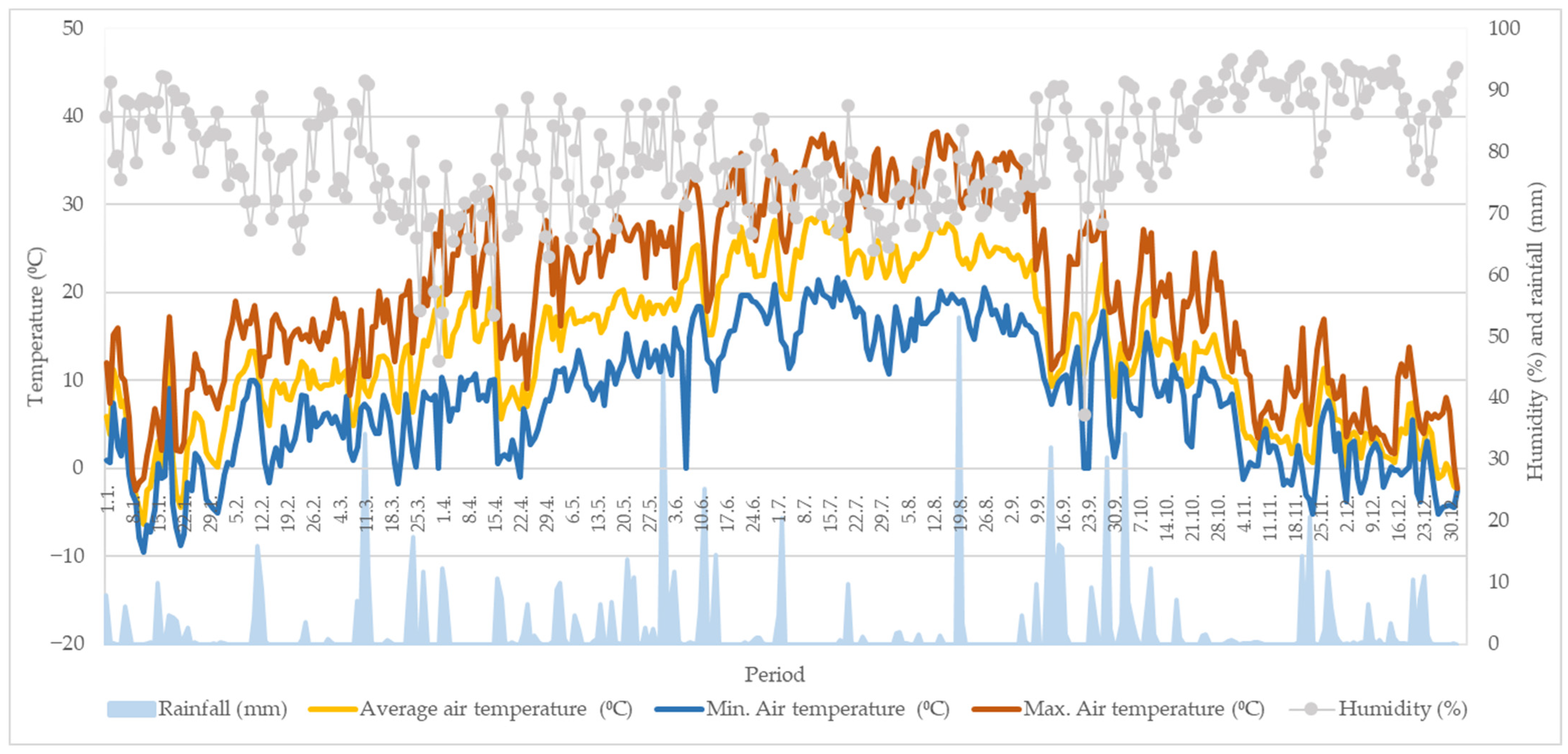
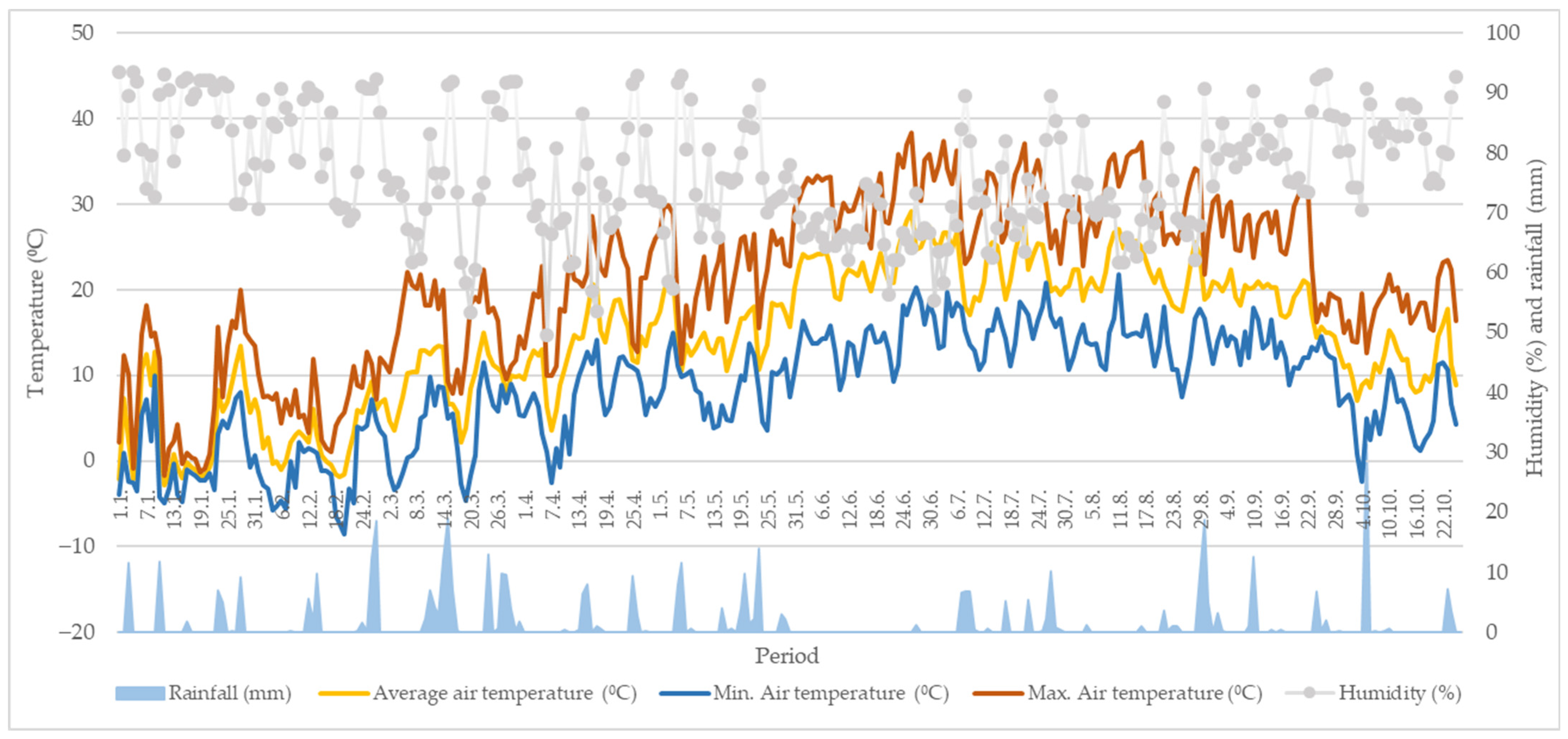
Daily climatic data, including minimum, mean, and maximum air temperature, relative humidity, and precipitation for 2024 and 2025, were obtained from the onsite meteorological station (Pinova Meteo—Agro-meteorological stations, Agra Ltd., Čakovec, Croatia) and visualised as time-series plots to illustrate seasonal patterns and interannual variability. Weather data were included to characterize interannual environmental conditions and provide contextual background for interpreting population dynamics and damage patterns.
2.3. Monitoring of Halyomorpha halys Seasonal Abundance
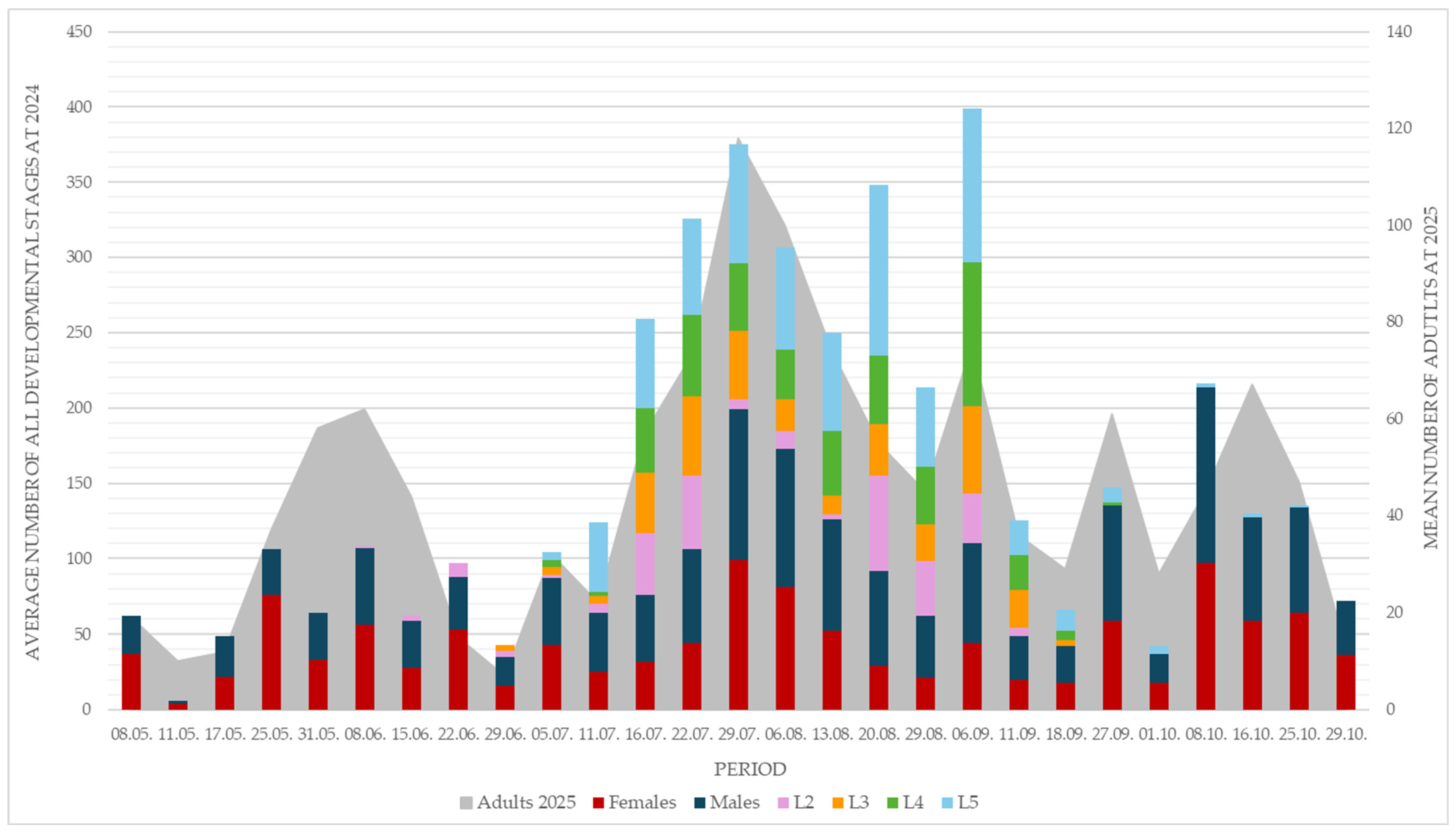
The seasonal abundance of H. halys was monitored using species-specific aggregation pheromones (Trécé Inc., Adair, OK, USA), comprising a dual controlled-release formulation of the aggregation pheromone (murgantiol) and a synergist (MDT), deployed in pyramid-shaped CYMA-TRAP PRO traps (CYMA-TRAP PRO; GEA s.r.l.). This controlled-release technology provides a sustained emission of both active components over approximately 12 weeks of field deployment, enabling continuous seasonal monitoring without frequent lure replacement. Traps were positioned at approximately 1.5 m above ground, corresponding roughly to the lower to middle canopy layer of the apple trees, and located at the forest edges of the experimental orchard prior to the expected emergence of overwintered adults in early May. A total of four pyramid traps were deployed, and pheromone lures were replaced at two-month intervals. Population dynamics were monitored weekly from early May to late October (27 consecutive weeks). At each sampling date in 2024, the number of adults (females and males) and nymphal instars (L2–L5) captured in each trap was recorded, and data were expressed as the average catch per pyramidal trap. Adult mean catch data from 2025 were included for comparison between years and plotted together with the 2024 data.
2.4. Population Size Estimation Using Capture–Mark–Recapture
The capture–mark–recapture assessment was conducted on the ‘Cripps Pink’ cultivar only. Adult population size of
H. halys were estimated during the 2025 growing season in a commercial orchard using a capture–mark–recapture (CMR) approach, following established protocols described by Onufrieva et al. and Onufrieva and Onufriev [
34,
35]. Adult insects were captured using pheromone-baited CYMA-TRAP PRO pyramid traps. Five traps were installed along the orchard perimeter at 50 m intervals. Traps were designated sequentially (Traps 1–5), with the central trap (Trap 3) located approximately midway along the orchard perimeter. Captured adult males and females were individually marked with a waterproof, non-toxic marker suitable for use on insects and released at the point of capture on 25 July 2025. In total, 251 adults were marked and released, including 129 males and 122 females. Recapture sampling was conducted seven days later, on 31 July 2025, when all traps were inspected, and both marked and unmarked adults were recorded.
Adult population size (
) was estimated using the Petersen (Lincoln–Petersen) capture–recapture estimator:
where
r is the number of individuals captured, marked, and released during the first sampling occasion,
n is the total number of individuals captured during the second sampling occasion, and
m is the number of marked individuals recaptured during the second sampling occasion. The Lincoln–Petersen estimator was applied under the assumption of a closed population and provides an order-of-magnitude estimate of adult population size, as commonly used in insect ecological studies [
34,
35,
36,
37].
2.5. Fruit Damage Assessment and Potential Yield Loss Estimation
Fruit damage caused by H. halys was assessed at harvest in apple cultivars, ‘Cripps Pink’ and ‘Fuji’, on 19 October 2024 and 7 October 2025. The experiment was conducted using three spatial positions per cultivar (forest edge, orchard interior, and road-adjacent orchard edge), with multiple trees sampled within each position. This design accounted for potential edge effects related to surrounding vegetation and orchard boundaries. At harvest, all fruits were completely removed from randomly selected trees within each spatial replicate, resulting in at least 1000 fruits examined per cultivar per year. Fruits were collected separately from three vertical canopy layers (lower, middle, and upper) and placed into separate boxes to allow assessment of damage distribution within the canopy. Each fruit was examined for symptoms characteristic of H. halys feeding damage, including puncture marks, surface indentations, internal necrosis, and corking. Fruit damage was expressed as the percentage of damaged fruits relative to the total number of examined fruits, based on feeding damage caused by nymphal and adult H. halys stages. Total yield per cultivar and production year was obtained from official orchard harvest records provided by the grower. Potential yield loss attributable to H. halys feeding was estimated by applying the cultivar- and year-specific damage rate to the corresponding total harvested yield. Yield loss attributable to H. halys feeding was estimated by applying the cultivar- and year-specific proportion of damaged fruit to the total harvested yield. This calculation assumes that fruits exhibiting visible or internal feeding damage are non-marketable under standard fresh-market grading criteria. Accordingly, the resulting values represent potential yield losses, providing an upper-bound estimate of the economic impact in the absence of detailed grading or price data.
2.6. Physicochemical Analysis
Following harvest and fruit damage assessment in 2025, apple fruits were transported to the laboratory of the Department of Pomology at the University of Zagreb Faculty of Agriculture, and stored in a cold room at 4 °C for 20 days prior to physicochemical analyses. For each cultivar (‘Cripps Pink’ and ‘Fuji’), 10 fruits without visible feeding damage and 10 fruits showing clearly visible and typical feeding injury attributable to
H. halys were selected for physicochemical analyses. Fruits with external symptoms not clearly attributable to
H. halys were excluded. Fruits from each group were photographed and further analyzed following the methodology described by [
38]. Fruit skin color was measured separately for background and additional color using a colorimeter (PCE-CSM 2, PCE Instruments, Alicante, Spain) and expressed in the CIE L*a*b* and CIE L*C*h° color space systems (Commission Internationale de l’Éclairage). The measured color parameters included relative lightness (L*) and color coordinates (a*, b*). Chroma (C*) and hue angle (h°) were calculated from a* and b* values following standard color analysis procedures [
39,
40].
Fruit mass was measured using a digital analytical balance (OHAUS Corporation, Parsippany, NJ, USA) and expressed in grams (g). Fruit height and width were determined with a digital caliper (Somet, Czech Republic) and expressed in millimetres (mm). Flesh firmness was measured at four equidistant points around the equatorial zone using a digital penetrometer (PCE-FM200, PCE Instruments, Southampton, UK) equipped with an 11 mm diameter probe, and expressed as kg cm
−2. Soluble solids content (SSC) was determined from juice extracted from the lower half of each transversely cut fruit using a digital refractometer (Atago PAL-1, Atago Co., Ltd., Tokyo, Japan) and expressed as °Brix. Titratable acidity (TA) was determined by titration with 0.1 M NaOH and expressed as g L
−1 of malic acid equivalents according to AOAC method 954.07 [
41]. The SSC/TA ratio was calculated for each fruit.
2.7. Data Analysis
Differences in climatic variables between 2024 and 2025 were assessed using one-way ANOVA for each parameter (average, minimum and maximum daily air temperature, relative humidity, and rainfall). Fruit damage (% damaged fruits) was analysed by ANOVA separately for each cultivar to test differences among orchard positions (forest edge, orchard interior, and opposite orchard edge) and canopy layers (lower, middle, and upper). For injury assessment, the sampling unit was an individual tree, with fruits assessed separately by canopy layer. Within each cultivar and year, four trees per orchard position were selected as spatial replicates, and fruit injury was evaluated across all sampling units. Mean injury values per tree were used for statistical analysis.
Prior to ANOVA, data were tested for normality using the Shapiro–Wilk test. When significant effects were detected (
p ≤ 0.05), treatment means were separated using Tukey’s HSD test. Post-harvest fruit quality traits were analysed separately for each cultivar by comparing healthy (undamaged) and
Halyomorpha halys-damaged fruits. For these analyses, 10 healthy and 10 damaged fruits per cultivar were used, with individual fruits treated as replicates. Evaluated traits included color parameters (L*, a*, b*, C*, h°; background and additional color) and physicochemical variables (fruit mass and dimensions, firmness, soluble solids content, titratable acidity, and SSC/TA ratio). Statistical analyses (ANOVA, Tukey’s HSD test) were performed using ARM 2025
® GDM software, Revision 2025.2 (Gylling Data Management Inc., Brookings, SD, USA) [
42].
3. Results
3.1. Weather Conditions
In 2024, the site experienced a typical temperate pattern, with cold winter conditions (minimum temperatures frequently below 0 °C), a gradual warming through spring, and a warm summer during which maximum daily temperatures often reached 30–35 °C. Rainfall was most frequent and intense during winter and spring, became sparse with occasional peaks during summer, and increased again in early autumn. Relative humidity remained generally high (60–90%) throughout the year, with slightly lower values during the warmest period (
Figure 1).
In contrast, 2025 showed a slightly cooler thermal profile overall, particularly in early spring, with minimum temperatures more frequently approaching or dropping below 0 °C and maximum temperatures rising more gradually compared with 2024. Summer temperatures were still warm but less extreme, with fewer days above 30 °C. Rainfall events were less frequent and of lower magnitude than in 2024, especially during spring and summer, contributing to drier overall conditions. Relative humidity remained high but exhibited slightly larger fluctuations, particularly during transitional periods, reflecting the reduced rainfall and more variable temperature regime (
Figure 2).
Average air temperature differed marginally between years (F1,594 = 3.86; p = 0.050), with slightly higher values in 2024. Minimum air temperature was significantly higher in 2024 (F1,594 = 4.42; p = 0.036). Maximum air temperature did not differ significantly between years (F1,594 = 3.75; p = 0.053). Relative humidity remained comparable across years (F1,594 = 0.35; p = 0.554). In contrast, rainfall was significantly higher in 2024 (F1,594 = 5.63; p = 0.018).
3.2. Seasonal Abundance
The seasonal dynamics (
Figure 3) of
Halyomorpha halys in 2024 showed clear temporal structuring across all developmental stages. Early in the monitoring period (May–June), captures were dominated by adults, with females consistently outnumbering males, while nymphs were largely absent or occurred only in very low numbers. The first nymphal instars (L2–L3) appeared in late June, followed shortly by the more advanced stages (L4–L5) in early July, indicating the onset of the first generation’s development. From mid-July to early September, all nymphal instars were present simultaneously, and total abundance increased sharply, reaching pronounced population peaks on 29 July, 6 August and 6 September (up to >350 individuals per sampling date when combining all stages). During this period, late-instar nymphs (L4 and L5) contributed substantially to overall population density, reflecting active development and progression toward the new adult cohort. After early September, the abundance of nymphal stages declined progressively, and by early October no nymphs were detected. Adults, however, remained present throughout the remainder of the season and exhibited several notable late-season peaks (e.g., 8 October and 16 October), consistent with emergence of the final generation before diapause entry. The adult abundance recorded in 2025 (grey curve) followed a similar seasonal trajectory but remained consistently lower than in 2024, indicating reduced population pressure in the subsequent year. Overall, the results demonstrate a well-defined univoltine to partially bivoltine pattern, with clear generational turnover, strong midsummer population expansion, and marked interannual variation in adult abundance.
3.3. Capture–Mark–Recapture
During the recapture event seven days after release, six previously marked H. halys individuals were captured, corresponding to a recapture rate of 2.39%. Of these, four were males and two were females. The majority of recaptures occurred in Trap 3, near the release point (two males and two females), while Traps 1 and 2 each yielded one marked male. No marked individuals were recovered in Traps 4 and 5. All recaptured individuals were detected near their original release site, indicating limited short-term dispersal and partially satisfying the closed-population assumption. The low recapture rate and small sample of marked individuals prevented formal statistical analysis of the CMR data. Across all traps, a total of 176 adults were captured during the recapture interval, including 96 females and 80 males. The highest total catches were observed in Trap 2 (66 individuals) and Trap 3 (35 individuals), demonstrating spatial heterogeneity in adult abundance. Based on the Lincoln–Petersen estimator (r = 251, n = 176, m = 6), the adult population () within the monitored area was estimated at approximately 7363 individuals. Given the low recapture rate (2.39%), this estimate should be interpreted as an or-der-of-magnitude indicator of adult abundance rather than a precise census of the population. Low recapture probability is common in field studies of mobile hemipterans and is known to inflate uncertainty around point estimates
3.4. Fruit Damage and Yield Losses
Sampling position significantly influenced the proportion of damaged ‘Cripps Pink’ fruits only in the lower canopy layer (F = 12.88,
p < 0.001;
Table 1). The forest edge position exhibited the highest level of damage, while significantly lower damage was observed in the orchard interior and at the opposite orchard edge. In contrast, orchard sampling position had no significant effect on fruit damage in the middle canopy layer or the upper canopy layer. Variability in fruit damage was highest in the upper canopy.
Sampling position did not significantly affect the proportion of damaged fruits in any canopy layer of the ‘Fuji’ cultivar (
Table 2). Although coefficients of variation were moderate to high, absolute damage levels remained consistently low across all sampling positions.
Canopy layer significantly influenced the proportion of damaged ‘Cripps Pink’ fruits at all sampling positions (
Table 3). At the forest edge, fruit damage differed significantly among canopy layers, with the highest damage recorded in the middle and upper canopy layers, while the lower layer exhibited significantly lower damage. In the orchard interior, canopy layer also had a significant effect on fruit damage, with the middle and upper canopy layers showing higher damage compared with the lower canopy. At the opposite orchard edge, canopy effects were highly significant, with damage highest in the middle canopy, followed by the upper and lower canopy layers. Assumption checks confirmed that the requirements for ANOVA were met, and a significant replicate effect was detected only at the opposite orchard edge.
Canopy layer did not significantly affect the proportion of damaged fruits in the ‘Fuji’ cultivar at any orchard sampling position (
Table 4). Damage levels remained consistently low across treatments, ranging from approximately 3% to 8%. Tukey’s HSD test did not detect significant differences among canopy layers within any sampling position. Assumption checks confirmed normality and homogeneity of variance, and replicate effects were not significant across orchard positions.
Based on harvest records, total yields per hectare in 2024 were 62,577 kg for ‘Cripps Pink’ and 61,910 kg for ‘Fuji’. Estimated potential yield losses due to
H. halys feeding amounted to 18,203 kg (29%) in ‘Cripps Pink’ and 8291 kg (13%) in ‘Fuji’. In 2025, total yield of ‘Cripps Pink’ decreased to 20,290 kg, while the estimated potential yield loss increased markedly to 14,033 kg, corresponding to a damage rate of 69%. In contrast, ‘Fuji’ produced 27,981 kg in 2025, with an estimated 1429 kg of damaged fruit, resulting in a damage rate of 5%. A summary of fruit damage and potential yield losses for both years is presented in
Table 5.
3.5. Physicochemical Properties of Fruit
For background color, no significant differences were observed between healthy and
H. halys-damaged ‘Cripps Pink’ fruits with respect to lightness (L*), yellowness (b*), or chroma (C*). Significant difference was detected for the a* coordinate and hue angle (h°) (
p < 0.001). Healthy fruits exhibited significantly lower a* values and higher h° values compared with
H. halys-damaged fruits (
Table 6). These changes indicate a shift in the red–green balance and overall color tone of the fruit skin, which is relevant for visual appearance and commercial grading.
For additional color, no significant differences were recorded between healthy and H. halys-damaged ‘Cripps Pink’ fruits for lightness (L*), b* coordinate, or hue angle (h°). In contrast, H. halys-damaged fruits exhibited significantly higher a* values and chroma (C*) values compared with healthy fruits (p < 0.001).
For background color, no significant differences were observed between healthy and H. halys-damaged ‘Fuji’ fruits for lightness (L*), yellowness (b*), or chroma (C*). Significant differences were detected for the a* coordinate (p = 0.03) and hue angle (h°) (p = 0.04). Healthy fruits exhibited significantly higher a* values and lower h° values compared with H. halys-damaged fruits, indicating differences in background color characteristics associated with fruit damage.
For additional color, no significant differences were recorded between healthy and
H. halys-damaged ‘Fuji’ fruits for lightness (
L*), the
a* coordinate, or hue angle (
h°) (
p > 0.05). In contrast, significant differences were observed for the
b* coordinate and chroma (C*) (
p < 0.05), with
H. halys-damaged fruits showing higher
b* and
C* values than healthy fruits (
Table 7).
Significant differences between healthy and
H. halys-damaged ‘Cripps Pink’ fruits were observed for fruit mass, fruit height, fruit width, titratable acidity (TA), and the SSC/TA ratio (
p < 0.001).
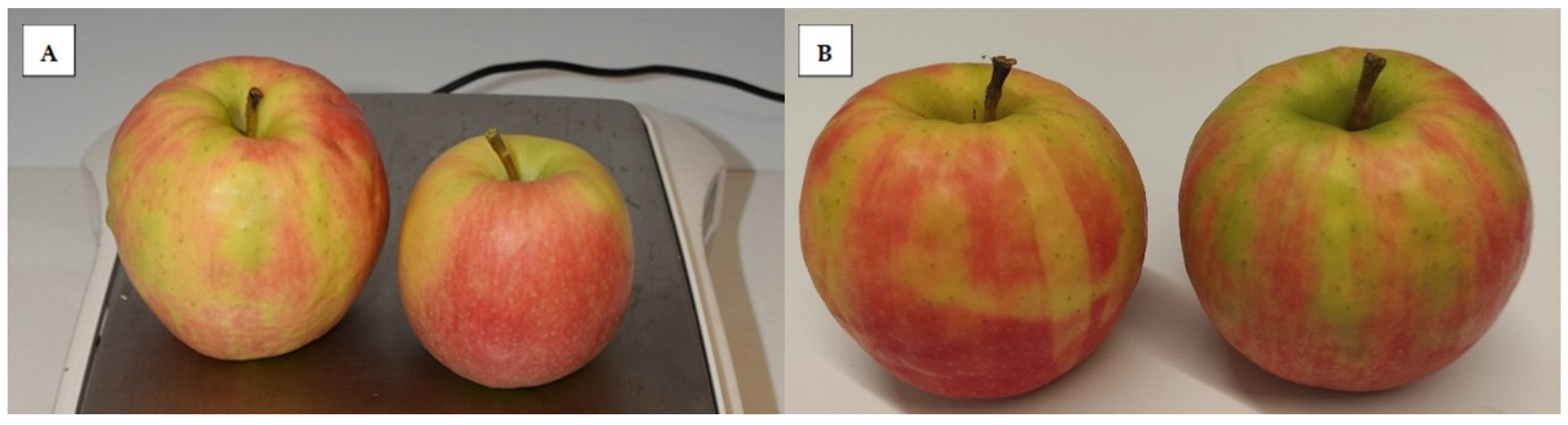
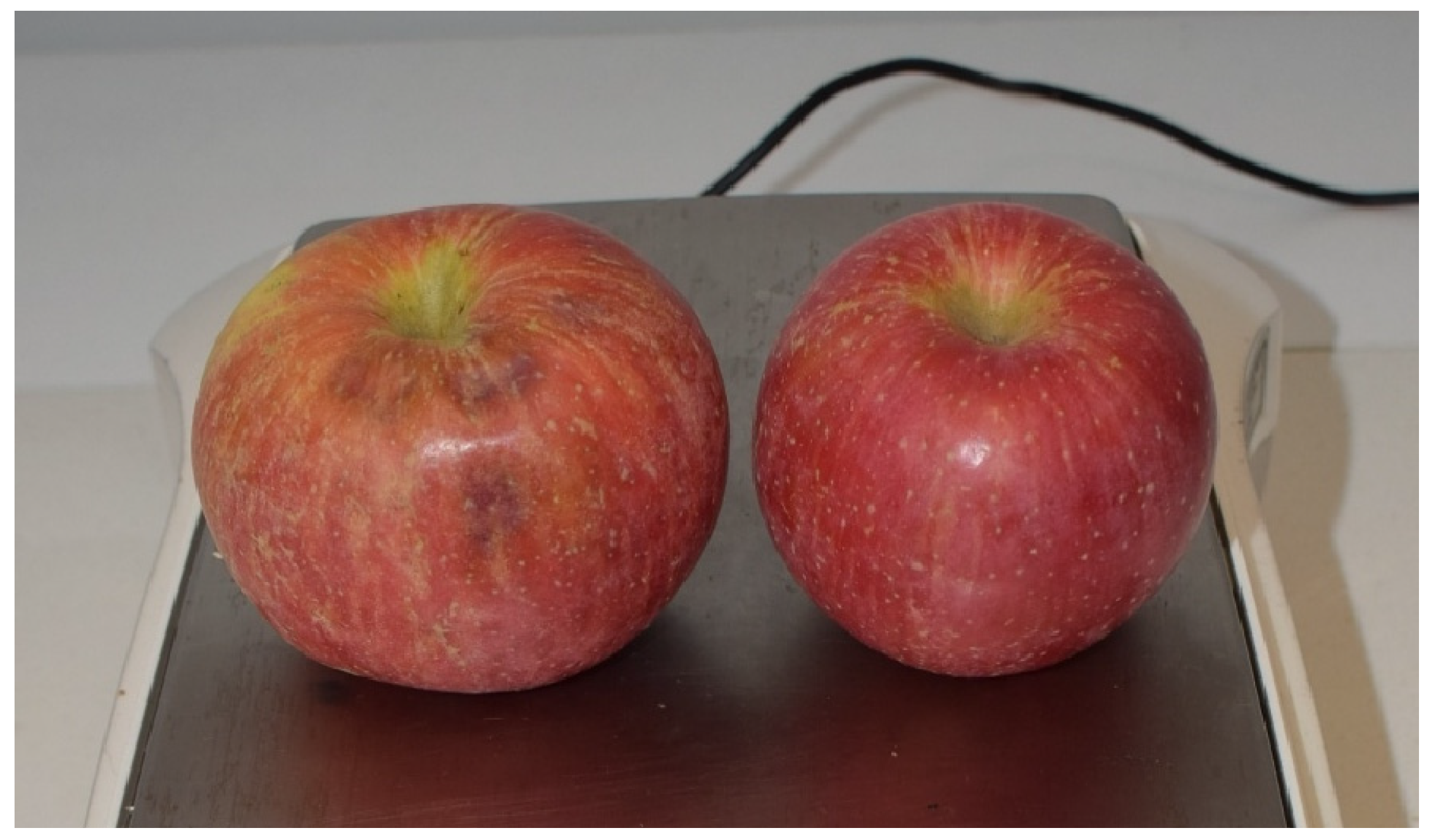
H. halys-damaged fruits exhibited significantly higher fruit mass, height, and width compared with healthy fruits (
Figure 4A,B). In addition, damaged fruits showed significantly higher TA values, while the SSC/TA ratio was significantly lower than in healthy fruits (
Table 8). No significant differences were detected between healthy and damaged fruits for flesh firmness or soluble solids content (SSC) (
p > 0.05).
For ‘Fuji’ apples, no significant differences were observed between healthy and
H. halys-damaged fruits with respect to fruit mass, fruit height, or fruit width (
p > 0.05). In contrast, significant treatment effects were detected for flesh firmness, soluble solids content (SSC), titratable acidity (TA), and the SSC/TA ratio (
p < 0.05).
Halyomorpha halys-damaged fruits exhibited significantly higher firmness, SSC, and TA values compared with healthy fruits (
Figure 5). Conversely, the SSC/TA ratio was significantly lower in damaged fruits than in healthy fruits (
Table 9).
4. Discussion
The present study was designed to quantify the seasonal dynamics and orchard-level impact of the H. halys in commercial production conditions, with particular emphasis on describing the relationship between observed pest activity and fruit damage patterns, as well as measurable post-harvest quality changes. Specifically, we combined adult monitoring with pheromone-baited pyramid traps, spatially structured assessments of fruit damage across orchard positions and vertical canopy strata, and comparative analyses of key fruit quality parameters in healthy versus injured fruit. Overall, our results confirm that H. halys represents a relevant risk for marketable yield and fruit quality in the studied system: trap catches documented clear seasonal activity, fruit damage was non-uniformly distributed within orchards and canopies, and damaged fruit exhibited significant shifts in several quality traits compared with undamaged fruit. Differences in weather conditions between the two years likely contributed to the observed variation in pest pressure and damage. The following sections discuss these findings in relation to current knowledge on H. halys phenology and dispersal, orchard edge effects and canopy use, and the mechanisms by which feeding damage translates into economic losses through external defects and altered physicochemical properties. Importantly, the combination of (i) trap-based phenology, (ii) within-canopy damage distribution, and (iii) cultivar-specific economic outcomes enables a more mechanistic interpretation of when and where damaging stages occurred and how this translated into harvest losses under commercial management. It should be noted that the study was conducted in a single commercial orchard during the early invasion phase of H. halys in Croatia. As a result, the observed patterns of population dynamics, damage distribution, and economic impact reflect orchard-specific conditions and should be interpreted as context-dependent rather than representative of broader regional situations. Taken together, these components form an integrated assessment that links population signals to spatially explicit damage and post-harvest consequences, thereby extending beyond descriptive monitoring toward a risk-oriented interpretation relevant for IPM decision-making under commercial conditions.
4.1. Weather Conditions
Interannual differences in weather conditions provide an important contextual framework for interpreting variation in
H. halys pressure and damage between 2024 and 2025. Overall, 2024 was slightly warmer and significantly wetter, with a marginally higher mean air temperature (
p = 0.050), significantly higher minimum temperatures (
p = 0.036), and higher rainfall (
p = 0.018), while maximum temperatures and relative humidity were broadly comparable between years. These contrasts are biologically relevant because temperature strongly regulates
H. halys development rate, seasonal phenology, and voltinism, with population growth typically favoured within an intermediate thermal window and constrained by cooler conditions that delay development and reproduction. The cooler early-season profile in 2025, combined with reduced precipitation, likely contributed to a slower seasonal build-up and/or lower realised population pressure relative to 2024, consistent with the lower adult trap captures observed in 2025 [
43]. In addition, although relative humidity did not differ statistically between years, humidity can interact with temperature to influence survival across life stages, meaning that modest shifts in the joint temperature–moisture regime may still translate into measurable changes in population performance [
44]. Beyond direct effects on the insect, interannual weather variation may also indirectly influence realised damage through effects on host phenology, fruit availability, and the temporal overlap between susceptible fruit stages and peak abundance of late nymphs and adults. Although climatic variables were not formally modelled against biological response variables, the observed interannual differences in temperature and rainfall provide a plausible explanatory framework for variation in population pressure and damage outcomes between years. Warmer minimum temperatures and higher rainfall in 2024 likely facilitated earlier seasonal activity and more sustained population development, consistent with the higher adult trap captures and greater damage levels observed. Conversely, the cooler early-season thermal profile and drier conditions in 2025 are compatible with delayed development and reduced realised population pressure. These associations are interpreted as supportive ecological context rather than causal inference, but they align well with established temperature-dependent development and survival patterns reported for
H. halys.
4.2. Seasonal Dynamics and Generational Turnover of H. halys
In 2024, the seasonal abundance pattern (
Figure 3) showed a clearly structured progression from an early-season adult phase to a mid-season nymphal build-up and late-season adult resurgence, which aligns well with published phenology for
H. halys in Europe. Early captures dominated by adults (May–June), with females outnumbering males, are consistent with post-overwintered adults dispersing into host crops and initiating reproduction after spring emergence [
45]. The first appearance of L
2–L
3 in late June, followed by rapid increases in L
4–L
5 and strong peaks in late July–early September, indicates successful reproduction and intensive within-orchard population growth, while the prolonged co-occurrence of all instars suggests overlapping cohorts rather than a single, tightly synchronised generation [
46]. The disappearance of nymphs by early October, coupled with several late-season adult peaks, is consistent with emergence of the final cohort and the transition toward diapause-related behaviour documented for this species in temperate climates. Collectively, these dynamics support a univoltine to partially bivoltine pattern, which is widely recognised as climate- and location-dependent across Europe (with warmer areas more likely to support two generations) [
15,
45]. Notably, adult captures in 2025 followed a broadly similar trajectory but remained consistently lower than in 2024, indicating substantial interannual variation in realised population pressure; such differences are commonly observed in field monitoring and may reflect weather-mediated effects on development and survival, as well as local population processes and landscape-level movement [
46]. From a management perspective, the timing of (i) first nymph detection (late June) and (ii) the strong midsummer increase driven by late instars and the emerging adult cohort (late July–early September) delineates the period of highest expected risk for economically relevant damage at harvest, particularly in late-ripening cultivars that remain exposed during this window.
4.3. Linking Adult Population Estimates to Fruit Damage and Economic Impact
The capture–mark–recapture (CMR) estimate obtained in this study should be interpreted with caution. The low recapture rate (2.39%) implies substantial uncertainty around the Lincoln–Petersen point estimate, which therefore represents an order-of-magnitude approximation of adult abundance rather than a precise population size. Low recapture probabilities are common in CMR studies of highly mobile insects such as
H. halys, where trap attraction, short residence time, heterogeneous movement, and mortality can strongly affect recapture likelihood. As a result, confidence intervals around the estimate would be wide, and the point estimate should not be viewed as a definitive census [
37].
Despite these limitations, the CMR result provides valuable ecological context by confirming the presence of a substantial adult population during the period of damage development and by supporting interpretation of trap phenology and spatial damage patterns. In this sense, the CMR estimate complements, rather than replaces, pheromone trap data and damage assessments.
4.4. Spatial and Vertical Structuring of Fruit Damage
Building on the population context provided by capture–mark–recapture, our damage assessments confirm that
H. halys damage in apple is not uniformly distributed within orchards, but is structured both horizontally (edge–interior) and vertically (canopy strata), consistent with previous reports of spatial aggregation in tree fruit systems [
20,
25,
27]. This edge effect was particularly evident in our study, where damage rates in ‘Cripps Pink’ reached up to 96% at orchard sections directly adjacent to the forest. Comparable observations from northern Italy report significantly elevated damage levels at orchard margins, a pattern commonly attributed to the pest’s reliance on forested habitats for overwintering and its seasonal movement between refuge sites and cultivated areas [
20,
47].
The spatial configuration of the orchard likely reinforced these patterns, as the ‘Cripps Pink’ block was located immediately adjacent to a forested area and pheromone-baited traps were positioned closer to this parcel than to the ‘Fuji’ block. Such proximity may have increased local adult activity through repeated immigration from surrounding habitats or localized aggregation near monitoring devices, contributing to the pronounced horizontal gradient in damage intensity. Given the documented potential for trap-associated aggregation and local increases in damage, trap placement should be considered when interpreting damage gradients, particularly if lures are deployed near susceptible cultivars or orchard borders.
Vertical canopy position further modulated damage expression. In ‘Cripps Pink’, damage was consistently higher in the middle and upper canopy layers, in agreement with previous studies showing that
H. halys adults preferentially exploit upper canopy strata due to favourable microclimatic conditions and easier access for flight-active individuals [
25,
27]. After adults entered the orchard, canopy height became a major determinant of damage distribution, in some cases exceeding the effect of distance from the orchard edge. The strong canopy signal observed here also implies that whole-orchard damage estimates may be biased if sampling under-represents upper and mid-canopy fruit, especially in slender-spindle systems where fruit distribution and accessibility differ across strata. Carnio et al. [
32] reported a spatially aggregated damage pattern, with higher fruit damage concentrated near the border where pheromone traps were deployed and lower damage further into the orchard. In contrast, in our study fruit damage was more uniformly distributed across orchard positions, even though pheromone-baited traps were placed along the forest edge.
In contrast, ‘Fuji’ exhibited neither pronounced spatial nor vertical structuring of damage, with damage remaining uniformly low across orchard positions and canopy layers. Such homogeneity is characteristic of conditions with relatively low pest pressure, under which spatial differentiation of damage becomes weak or undetectable [
23]. Alternatively, cultivar-associated differences in attractiveness, phenology, or fruit susceptibility may reduce the expression of spatial gradients even in the presence of adults, which is consistent with the generally lower damage and yield-loss signals observed for ‘Fuji’.
4.5. Cultivar-Dependent Damage Expression and Potential Yield Losses
Clear cultivar-related differences between ‘Cripps Pink’ and ‘Fuji’ highlight the importance of host-specific traits in mediating the impact of H. halys. The consistently higher damage levels and potential yield losses observed in ‘Cripps Pink’ indicate greater susceptibility under the studied conditions, whereas ‘Fuji’ experienced comparatively minor damage despite similar regional and climatic settings. At the same time, year-to-year differences in absolute yield suggest that pest-related effects acted on a crop base that was already shaped by cultivar physiology and abiotic conditions. Notably, damage rate increases when overall yield is low. Thus, the high damage rate observed in ‘Cripps Pink’ in 2025 likely reflects a combination of sustained pest pressure and reduced crop load, which increased the relative impact of repeated feeding on the remaining fruit. Importantly, ‘Cripps Pink’ did not exhibit classical external feeding injury; instead, fruits exposed to H. halys pressure showed atypical responses, expressed primarily as increased individual fruit mass and visible but non-classical symptoms, such as atypical skin color patterns, including pronounced striping and uneven pigmentation. The lack of typical “puncture wound” damage in ‘Cripps Pink’ fruits remains noteworthy. This may reflect a cultivar-specific tolerance or physiological response to H. halys feeding, resulting in atypical deformation and increases in fruit mass and size and altered skin color, rather than direct suppression of plant defenses by the insect.
In agreement with Acebes-Doria et al. [
23], our findings support the conclusion that late-season feeding by adult
H. halys results in the most severe and economically relevant damage to apples. Damage incidence was consistently higher on ‘Cripps Pink’ than on ‘Fuji’, which may reflect differences in cultivar susceptibility as well as local environmental context. In contrast, Zapponi et al. [
27] reported relatively low damage levels in ‘Pink Lady’—a cultivar genetically identical to ‘Cripps Pink’ —suggesting that regional variation in pest pressure, influenced by factors such as climate, orchard structure, and local population density, can substantially modify damage outcomes [
31]. Accordingly, cultivar-related differences in damage expression and associated yield losses observed in this study should be interpreted as context-dependent and specific to the studied orchard and seasons, rather than as broadly generalizable patterns. Interannual variation in total yield is therefore likely to reflect a combination of pest pressure and non-pest drivers. ‘Fuji’ is well known for its pronounced tendency toward biennial bearing, and reduced yields following a high crop load are consistent with this cultivar trait. Although ‘Cripps Pink’ is not considered a strongly biennial cultivar, partial yield fluctuations have been reported following seasons of heavy cropping, particularly under cumulative physiological or abiotic stress. Early-season temperature anomalies, including short periods of sub-zero temperatures during pre-bloom or early bloom stages, may have further limited fruit set and yield potential prior to the period of peak
H. halys activity.
In this orchard, the contrasting responses of ‘Cripps Pink’ and ‘Fuji’ likely reflect cultivar-specific traits, particularly phenology and the timing of fruit availability relative to seasonal pest activity. Very late-ripening cultivars such as ‘Cripps Pink’ remain exposed during periods dominated by older nymphal stages and adults, which are known to inflict more severe damage. Prolonged exposure under such conditions likely increases cumulative feeding pressure, thereby enhancing the likelihood that H. halys presence is translated into measurable damage and yield loss, especially when baseline yield potential is already reduced.
4.6. Consequences for Fruit Quality: Color and Physicochemical Traits
In addition to yield effects,
H. halys feeding was associated with cultivar-specific changes in post-harvest fruit quality, particularly skin color and selected physicochemical traits. Previous studies have shown that feeding-related damage may intensify during storage and contribute to further quality degradation over time [
48].
Alterations in CIE color variables suggest that piercing–sucking damage can interfere with normal color development, likely through localized damage to epidermal and subepidermal tissues where pigment synthesis and accumulation occur [
49]. Disruptions in chlorophyll degradation and pigment balance during ripening have previously been associated with pentatomid feeding and may explain the cultivar-specific color responses observed in this study [
23]. From a commercial perspective, these color shifts are directly relevant because grading standards for dessert apples penalize uneven pigmentation and atypical color patterns, meaning that “quality loss” may occur even when external necrosis/pitting is not the only symptom.
Physicochemical responses further illustrate the complexity of feeding effects. Although apples are a well-established host for
H. halys [
50], relatively few field studies have examined the consequences of feeding for internal fruit quality. Metabolic analyses indicate that
H. halys feeding induces pronounced but highly localized changes in sugars and organic acids near feeding sites [
26]. The results indicate that, when pest pressure is high and persists over time, these localized effects can extend beyond feeding sites and become detectable at the level of the entire fruit, particularly in susceptible cultivars. This integration is reflected in shifts in flavour-related attributes, underscoring that feeding damage can affect market quality even when metabolic responses are not uniformly distributed throughout the fruit. The cultivar-specific direction of change observed here (e.g., shifts in TA and SSC/TA ratio) further indicates that the same pest can translate into different sensory outcomes depending on cultivar physiology and ripening dynamics.
The principal contribution of this study is not the documentation of any single effect of H. halys, but the integration of multiple scales of evidence into a coherent impact framework. By combining seasonal phenology derived from pheromone trapping, within-orchard spatial and vertical damage distribution, cultivar-specific yield loss estimates, and post-harvest quality analyses, we demonstrate how population signals translate into economically relevant outcomes under commercial production conditions. This integrative perspective advances current understanding by moving beyond descriptive monitoring or isolated damage assessments toward a risk-based interpretation of pest pressure, which is essential for prioritizing monitoring intensity, spatial targeting, and intervention timing in IPM programmes.
5. Conclusions
This study demonstrates that the effects of Halyomorpha halys in apple orchards can differ markedly between cultivars exposed to the same environmental conditions and pest pressure. Under the commercial orchard conditions examined, ‘Fuji’ consistently exhibited low and spatially uniform damage, expressed primarily through typical feeding damage and limited potential yield loss. In contrast, the very late-ripening cultivar ‘Cripps Pink’ was associated with high damage rates and substantial estimated yield losses, particularly in a season with reduced crop load. Notably, this response was atypical, as increased fruit mass and size were observed even in the absence of classical external feeding symptoms, and atypical skin color patterns, including pronounced striping and uneven pigmentation, were also observed, indicating that pest impact may not always be adequately reflected by visible damage alone.
Damage in ‘Cripps Pink’ showed pronounced horizontal and vertical structuring within the orchard, highlighting the importance of canopy position and proximity to semi-natural habitats in shaping damage patterns. These results indicate that assessments based on uniform sampling schemes or orchard-wide averages may misrepresent actual risk, particularly for susceptible cultivars and specific orchard zones.
The findings further suggest that the realised impact of H. halys is strongly influenced by cultivar traits, crop load, and orchard-specific spatial dynamics. Accordingly, the results should be interpreted in the context of the studied orchard and seasons, rather than extrapolated uncritically to broader production regions. Nevertheless, they provide clear evidence that cultivar susceptibility and within-orchard heterogeneity are key determinants of economic risk under commercial production conditions.
From an applied perspective, the pronounced cultivar-dependent responses and spatial heterogeneity observed in this study indicate that uniform, orchard-wide control measures are unlikely to be optimal. Instead, the results support integrated pest management strategies that combine cultivar-specific risk assessment with spatially explicit monitoring and targeted control, particularly in orchards adjacent to forested areas that act as sources of H. halys populations. Such approaches may improve both the efficiency and sustainability of stink bug management, while accounting for pest effects that extend beyond visible fruit damage to include yield and subtler quality-related responses.





 ,
,