


Abstract
The geochemistry of karstic paddy soils significantly influences Cd bioavailability and its accumulation by rice. However, there is limited research on Cd translocation and accumulation in rice, grown in paddy soil with elevated CaO and Zn levels. Addressing this, a field-based study in Hanyuan County, Sichuan Province, China, examined the Cd distribution and translocation patterns across the soil–root–straw–grain continuum, aiming to elucidate how elevated CaO and Zn levels regulate Cd accumulation in grains. The geochemical characterization of the soil revealed elevated concentrations of cadmium (Cd), calcium oxide (CaO), and zinc (Zn), with mean values of 2.12 ± 2.93 mg/kg, 5.77 ± 5.80 wt.%, and 359 ± 472 mg/kg, respectively. The sequential extraction results (by Tessier) demonstrated that the distribution of Cd followed the general order: residual > Fe-Mn oxide-bound ≈ exchangeable ≈ carbonate-bound > organic matter-bound. The exchangeable Cd content ranged from 0.063 to 0.93 mg/kg, accounting for up to 21.4% of the total Cd on average. The correlation analysis, Bioconcentration Factor (BCF), and Transfer Factor (TF) of Cd in different rice tissues, and structural equation modeling (SEM) revealed that elevated CaO and Zn levels in soil exhibit synergistic effects in inhibiting Cd accumulation in grains. Specifically, the CaO in soil reduces the Cd bioavailability by the formation of carbonate-bound specie (CdF2), thereby inhibiting Cd uptake by roots. In rice tissues, Zn could limit Cd translocation, particularly from roots to straws. Consequently, the regional rice Cd exceedance rate (25.8%) was significantly lower than that reported for other similar karst soils in China (over 50%).
1. Introduction
Cadmium (Cd), a highly toxic metal with significant bioaccumulation potential, is a widespread contaminant in agricultural soils [1,2]. A recent nationwide survey conducted by the Ministry of Ecology and Environment of China revealed that approximately 16% of soils are contaminated based on China’s soil environmental quality limits, with Cd being the most severely contaminated metal [3]. The karst regions in southwestern China represent a critical region for Cd contamination, with over 235,000 km2 exhibiting average concentrations approximating 2 mg/kg, primarily attributable to the distinctive geochemical processes of carbonate weathering [4,5,6,7].
Rice is a recognized Cd-accumulating crop species. Chronic exposure to “Cd-contaminated rice” can cause Itai-Itai disease, pulmonary edema, skeletal lesions, and various cancers [8,9]. The recurrent “Cd-contaminated rice” incidents have sparked substantial food safety concerns in recent years. For instance, the rice cultivation regions in Chongzhou City, Sichuan Province, exhibited approximately 100% prevalence of rice Cd exceeding 0.2 mg/kg [10]. Similarly, Tongling District, Anhui Province [11] and Jiangxi Province [12] reported mean Cd concentrations substantially surpassing the 0.2 mg/kg threshold. Notably, mean rice Cd levels exceeding 1 mg/kg were observed in the Diaojiang River Basin, Guangxi Province [13], Shaoguan City, Guangdong Province [14], and Duyun City, Guizhou Province [15].
The soil’s physicochemical properties govern the Cd bioavailability, with the Cd2+ and CdCl+ species exhibiting the highest absorption efficiency by rice roots [16]. In alkaline soil, Cd predominantly exists as CdHCO3+ and CdCO3, demonstrating limited mobility and bioavailability [17,18]. Conversely, acidic soil promotes the formation of mobile Cd species, primarily Cd2+ and CdCl+, resulting in enhanced Cd bioavailability [16,19]. Consequently, soil amendment with cost-effective alkaline materials, such as CaCO3 and CaO, has been proven to effectively mitigate Cd uptake in rice through dual mechanisms involving increased soil pH, and facilitated the precipitation of CdCO3 [20,21,22]. Meanwhile, the primary transporters mediating Cd uptake in rice roots and straws share significant functional overlap with those involved in Zn uptake [23,24], establishing a competitive inhibition mechanism where Zn2+ effectively suppresses Cd2+ absorption at the soil–root interface and subsequent translocation of Cd from roots to aerial tissues [25]. Recent investigations have demonstrated a synergistic interaction between Ca and Zn in mitigating Cd accumulation in rice. When implemented in conjunction with lime-induced substrate stabilization, Zn fertilizer application significantly enhances the antagonistic interaction between Zn2+ and Cd2+, achieving a 73% reduction in Cd accumulation in grains [26]. This remediation strategy demonstrates 32% greater efficacy compared to a single lime application [27].
The pedogenesis in karstic regions exhibits distinctive geochemical properties due to variations in parent rock and weathering intensity [28,29,30]. Substantial evidence indicates Cd in karstic soils predominantly resides in residual fractions with low bioavailability [31,32,33]. Alternatively, some findings report 30~60% bioavailable Cd fraction in pristine, uncontaminated karstic soils [6,34]. Karstic soils consistently demonstrate elevated CaO concentrations and alkaline pH conditions, while exhibiting significant variability in Zn content [5,28,29,30,35]. These distinct geochemical conditions may substantially influence Cd accumulation in rice [34,36,37,38]. Nevertheless, there are few reports on Cd translocation and accumulation of rice plants in paddy soil with elevated CaO and Zn levels. Sichuan Province, a major rice-cultivating region in China, is characterized by many rice fields in the carbonate outcrops [39] and concurrently suffers from soil Cd contamination [10]. Despite this, systematic investigations into Cd bioavailability in karstic soils, especially in paddy soil with elevated CaO and Zn, and the natural regulation of soil–rice Cd accumulation remain scarce. To address this, paired soil–root–straw–grain samples were collected from karstic alluvial and eluvial paddy soils in Hanyuan County, Sichuan Province, focusing on high Cd, CaO, and Zn geological background. The research aimed to: (1) quantify soil Cd contamination levels and spatial distribution characteristics; and (2) determine rice Cd contamination levels and potential regulatory mechanisms of soil geochemical properties on grain Cd accumulation.
2. Materials and Methods
2.1. Study Area
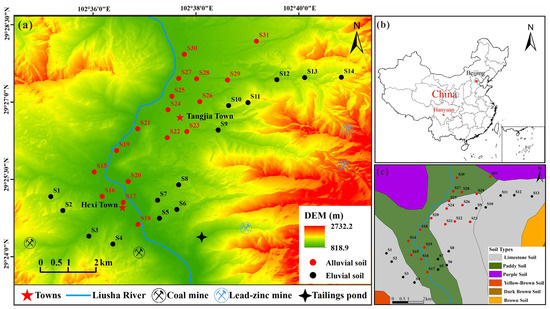
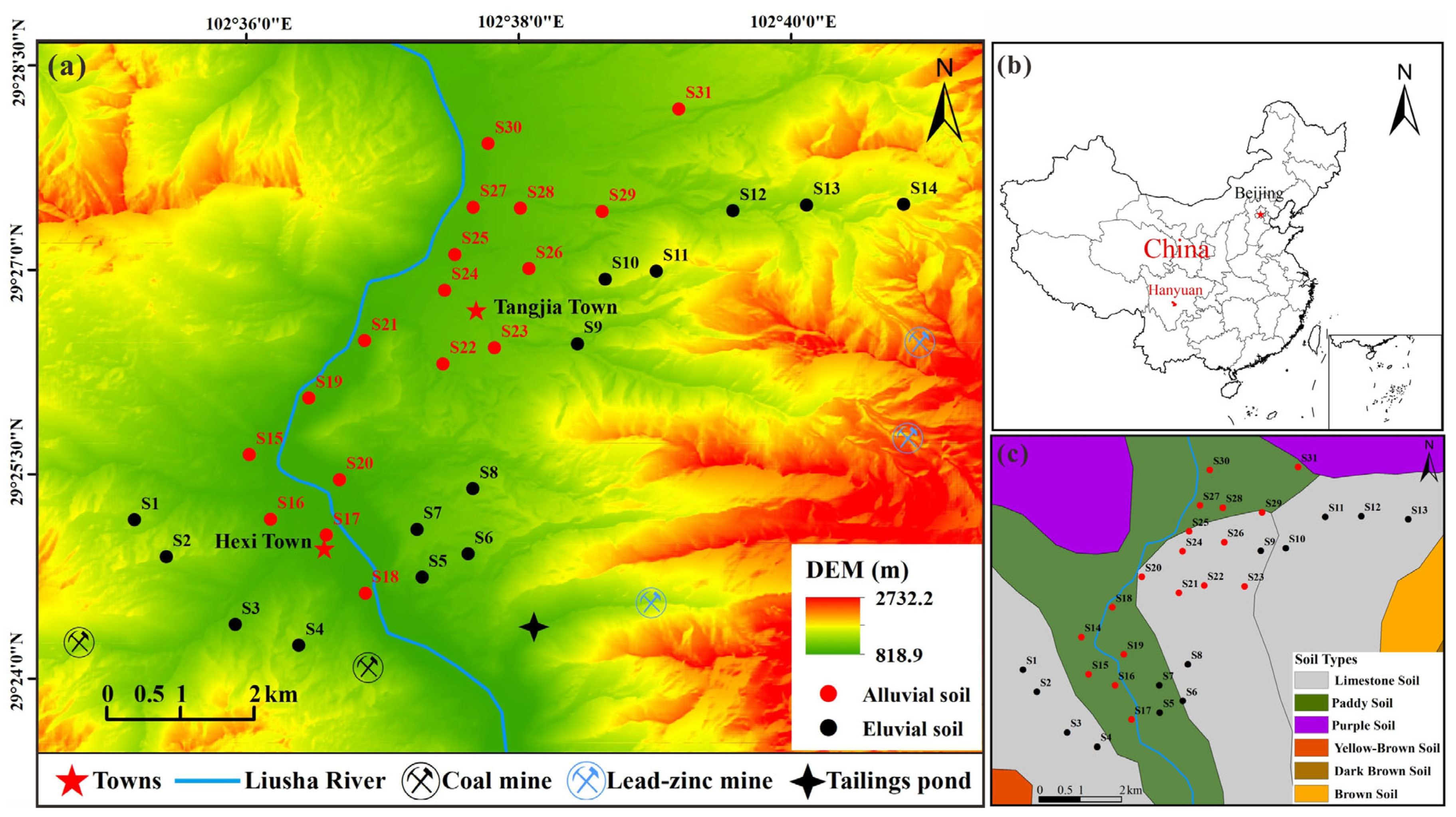
The study area is situated in the central region of Hanyuan County, Sichuan Province, southwestern China (102°35′12”–102°41′46” E, 29°24′34”–29°30′4” N), characterizing a subtropical monsoon climate with a mean temperature of 17.9 °C and around 741.8 mm precipitation. The study area features distinct topographic variations, transitioning from the Liusha River valley to an adjacent alluvial area and subsequently to upland eluvium, encompassing an elevational gradient of approximately 2000 m (Figure 1a). The lowland alluvium primarily consists of paddy soils derived from calcareous residue, while the adjacent eluvium is dominated by limestone soils [40] (Figure 1c). The alluvium on both sides of the Liusha River comprise agricultural and residential zones, accounting for more than 90% of regional paddy fields. The region primarily cultivates indica-type three-line hybrid rice. Characterized by a dry-hot valley climate with relative aridity, the area relies mainly on natural rainfall for irrigation. Consequently, paddy fields are typically lined with impermeable plastic film at a depth of 50 cm to prevent water loss. The eastern sector of the study area is located at the northern endpoint of the Sichuan–Yunnan–Guizhou Pb-Zn metallogenic belt [41], containing many small-scale Pb-Zn mines. Additionally, the southwestern region hosts several small-scale coal mines (Figure 1).
Figure 1.
Distribution of sampling sites. Soil type data were obtained from the National Earth System Science Data Center (https://www.geodata.cn, accessed on 12 April 2025). (a) Sample point distribution map; (b) Geographic distribution of the study area; (c) Soil type distribution map.
2.2. Sample Collection and Preparation
A systematic sampling scheme was implemented on paddy limestone soils, with equally spaced points collecting integrated soil–rice tissue (root, straw, grain) samples from the eluvial (S1–S14) and alluvial (S15–S31) layers, ensuring complete spatial coverage (Figure 1). Paddy soil samples were collected during the rice heading stage in June 2024, a critical period for rice Cd uptake from soil [42,43]. The samples were collected from the 5–15 cm layer by removing the surface layer (5 cm). Rice tissue samples were collected during the mature stage from corresponding sampling locations (September 2024). The soil and rice tissue samples collected by this institute were obtained while the soil was submerged, in order to minimize the impact of redox condition variations on Cd speciation. Whole plants were carefully uprooted and subsequently rinsed with irrigation water, followed by deionized water to eliminate surface soil and dust particles. All samples represented mixtures, incorporating at least four sub-samples collected within a 10 m radius of each sampling point. Using ceramic scissors, plant tissues were separated, naturally air-dried, and stored in sealed polyethene bags. Air-dried soil samples were meticulously cleared of organic debris and gravel, homogenized using an agate mortar to achieve a 100-mesh particle size, and preserved in sealed polyethylene bags. Grain samples were initially crushed using a mortar, followed by husk removal. The fine-grinding rice was then manually ground and stored in sealed polyethene bags. Roots and straw samples were initially shredded using ceramic scissors and then pulverized using a milling machine before being transferred to sealed polyethene bags. All processed samples were maintained at ambient temperature under light-protected conditions until they were subjected to subsequent analytical procedures.
2.3. Chemical Analysis
All analytical procedures for rice tissues and soil samples were conducted at the geochemistry laboratory of Chengdu University of Technology. Soil pH determination was performed according to the National Standard of China [44], using a calibrated pH electrode (LEI-CI, PHSJ-3F, Shanghai, China) to measure the pH in a 1:2.5 (w/v) soil–water suspension, following established protocols. The soil bioavailable Ca (Cabio) content was determined according to the Chinese Agricultural Industry Standard [45]. The cation exchange capacity (CEC) was determined using the hexaamminecobalt (III) chloride extraction-spectrophotometric method as specified in China’s National Environmental Standard [46].
Soil particle size and specific surface area (SSA) were determined using laser diffraction analysis (Mastersizer 3000, Malvern Panalytical, Malvern, UK), classifying sand (>20 μm), silt (2~20 μm), and clay (<2 μm). The main composition of soil was determined using X-ray fluorescence spectrometry (XRF, Axios max, Almelo, The Netherlands). Meanwhile, the soil samples were digested using a HNO3-HClO4-HF mixture (6:3:2, v/v/v), with Cd and Zn measured via inductively coupled plasma mass spectrometry (ICP-MS, Lab MS 3000, LabTech, Beijing, China), and Ti, Mn, and Ca were determined by inductively coupled plasma optical emission spectrometry (ICP-OES, Avio 500, PerkinElmer, Inc., Waltham, MA, USA). Rice tissues (roots, straw, and grains) were digested with a HNO3-HClO4 mixture (4:1, v/v), with Zn and Cd measured via ICP-MS, and Ca was determined by ICP-OES. All samples were analyzed in triplicate for Ca, Cd, and Zn concentrations, with the reported values representing the means. The corresponding method limits of detection (LOD) and quantification (LOQ) were: Ca (0.05 and 0.15 mg/L), Cd (0.005 and 0.02 μg/L), and Zn (0.01 and 0.03 μg/L). Quality assurance was maintained through reagent blanks, duplicate samples, and certified reference materials (CRMs: GBW07557 for soil and GBW(E) 100,357 for rice). The recovery for the certified reference soil materials were 98.3%, 92.5%, and 100% for Ca, Cd, and Zn, respectively, while the recovery for Cd in the certified rice material was 98.0%.
Sequential extraction, initially developed by Tessier, et al. [47] and modified by the Chinese standard [48], was implemented to determine the speciation of Zn and Cd into five geochemical fractions: exchangeable (F1), carbonate-bound (F2), Fe-Mn oxide-bound (F3), organic matter-bound (F4), and residual fraction (F5). Detailed extraction protocols for each fraction are presented in Table S1. Cd and Zn were determined via ICP-MS.
2.4. Chemical Index of Alteration (CIA)
The CIA serves as a quantitative indicator for assessing soil weathering intensity during pedogenesis from parent bedrock [49,50]. The CIA calculation formula is:
where oxide contents (Al2O3, K2O, Na2O, and CaO*) are expressed as molar percentages. CaO* is the smaller of the molar fractions of Na2O and CaO in the sample [51].
2.5. Bioconcentration Factor and Transfer Factor of Heavy Metals
The bioconcentration factor (BCF) is defined as the ratio of metal concentration in the crop’s edible tissues and paddy soil [52], measuring the heavy metals’ bioaccumulation capacity of the plants in the soil.
where Cn,root and Cn,soil represent the heavy metal “n” concentration (mg/kg) in roots and soil. BCFn,soil-root represents the bioconcentration factor of heavy metal “n” from soil to root.
The translocation factor (TF) infers the mobility of heavy metals from roots to aerial plant tissues [52]:
where Cn,root, Cn,straw, and Cn,grain represent the heavy metal “n” concentration (mg/kg) in roots, straws, and grains, respectively. TFn,root-straw represents the bioconcentration factor of heavy metal “n” from root to straw; TFn,straw-grain represents the bioconcentration factor of heavy metal “n” from straw to grain.
2.6. Statistical Analysis
The structural equation modeling (SEM) model was employed to investigate direct and indirect effects of soil geochemical characteristics on grain Cd accumulation. All data were standardized to achieve linearity and normality. Parameters were estimated using the maximum likelihood method. Model fit was evaluated by Chi-square to degrees of freedom ratio (χ2/df), p-value, comparative fit index (CFI), and root mean square error of approximation (RMSEA) [53]. Good model fits were reflected by χ2/df < 3, p > 0.05, CFI > 0.9, and RMSEA < 0.08 [54].
3. Results
3.1. Soil Properties
Table 1 shows the geochemical characteristics of the paddy soils. The soil pH, a critical factor influencing heavy metal distribution, averages 7.57 ± 0.41, slightly higher than the levels reported in Hanyuan County and Chengdu Plain, Sichuan Province [10,55], but comparable to karstic soil in Guizhou Province, China [28]. The soil clay was 17.87%, significantly lower than both the Sichuan background soils and the documented karstic soils [56,57]. The soils exhibited moderate CEC with a mean value of 17.50 ± 5.53 cmol+/kg, consistent with reported karstic soils in Guizhou Province [28].
Table 1.
Geochemical characteristics of the paddy soil.
The soil CaO weight percentage was 5.30 ± 5.56 wt. %, consistent with soil characteristics observed in karst regions [5,28,58]. Accordingly, the Cabio levels were notably high, averaging 13.31 ± 6.40 mg/kg. Notably, the MgO is 3.40 ± 2.60 wt. % in the soil exceeds the values reported for karstic soils in southwestern China [6,28,30], potentially attributable to the dolomitic bedrock in Hanyuan County.
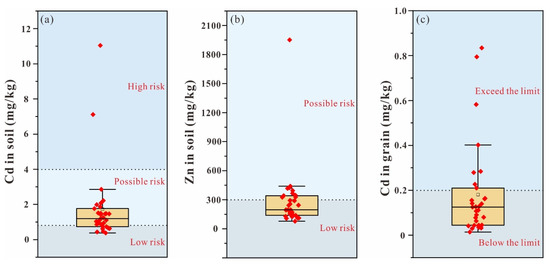
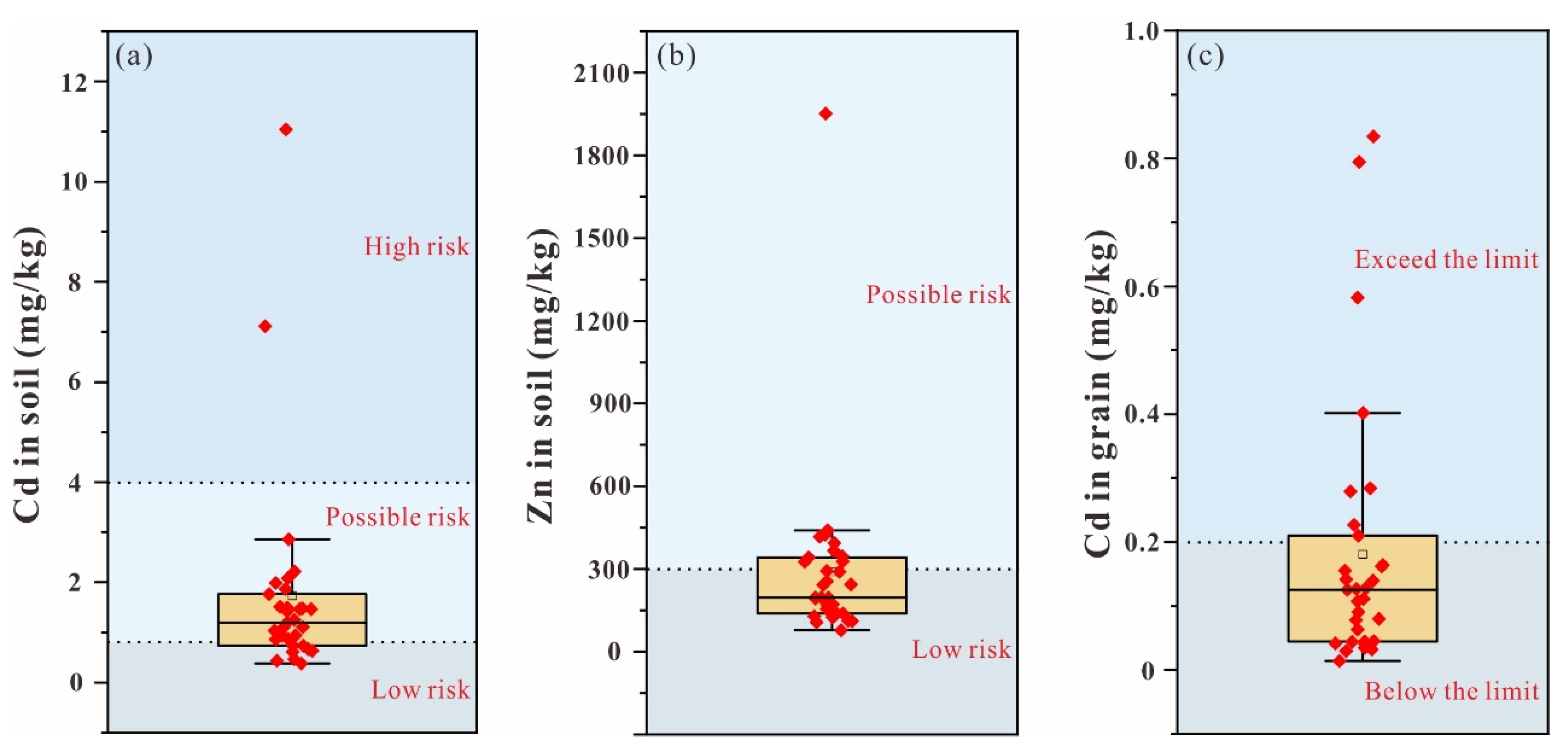
The paddy soils contained elevated Cd concentrations (1.73 ± 2.11 mg/kg), representing around 22-fold enrichment compared to the Sichuan background [57], yet comparable to karst soils from Guangxi and Guizhou Provinces [12]. The paddy soils exhibited Zn concentrations averaging 291 ± 326 mg/kg, representing about 3.4-fold enrichment relative to Sichuan background levels and exceeding typical karstic soils in Guizhou and Guangxi Provinces [28,29,37,57]. When evaluated against the soil environmental quality risk control standards of China [59], the mean Cd level surpasses the risk screening value. Overall, 77.4% of soil samples exceeded the Cd risk screening value (notably 6.5% reaching risk intervention value), while 32.3% exceeded the Zn risk screening value (Figure 2).
Figure 2.
Box plots of Cd and Zn contents in paddy soil and grain. (a) Box plot of Cd content in soil samples; (b) Box plot of Cd content in soil samples; (c) Box plot of Cd content in grain samples.
The soil particle distribution exhibited slight differentiation, with alluvial soils displaying relatively finer textures characterized by increased silt fraction proportions, while both soil layers maintained nearly identical clay content (Table S2). Notably, both Cd and Zn exhibited comparable spatial distribution patterns, with pronounced enrichment hotspots located in the eluvium (Figure S1). The average Cd content of the eluvium soil was 2.47 ± 2.95 mg/kg, ~2.2 times higher than that of the alluvial soil (1.13 ± 0.61 mg/kg). Similarly, the eluvium soil Zn content was 396 ± 462 mg/kg, which was twice as much as the alluvial soil (204 ± 93.0 mg/kg).
3.2. Fraction Distributions of Cd and Zn in Soils
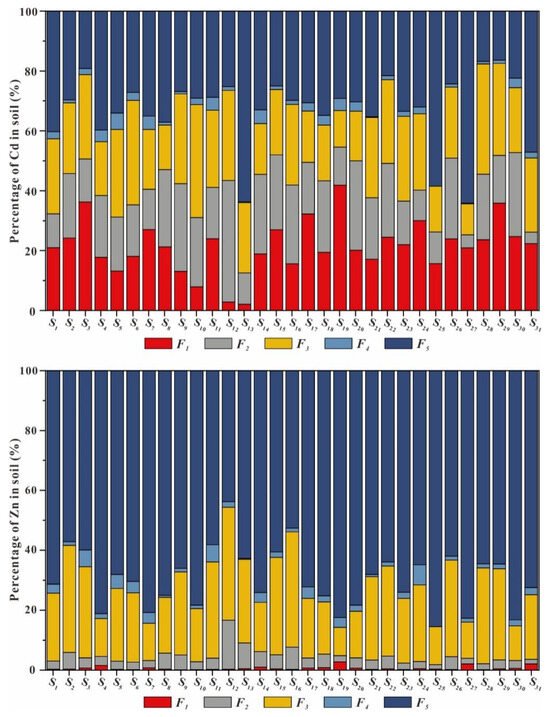
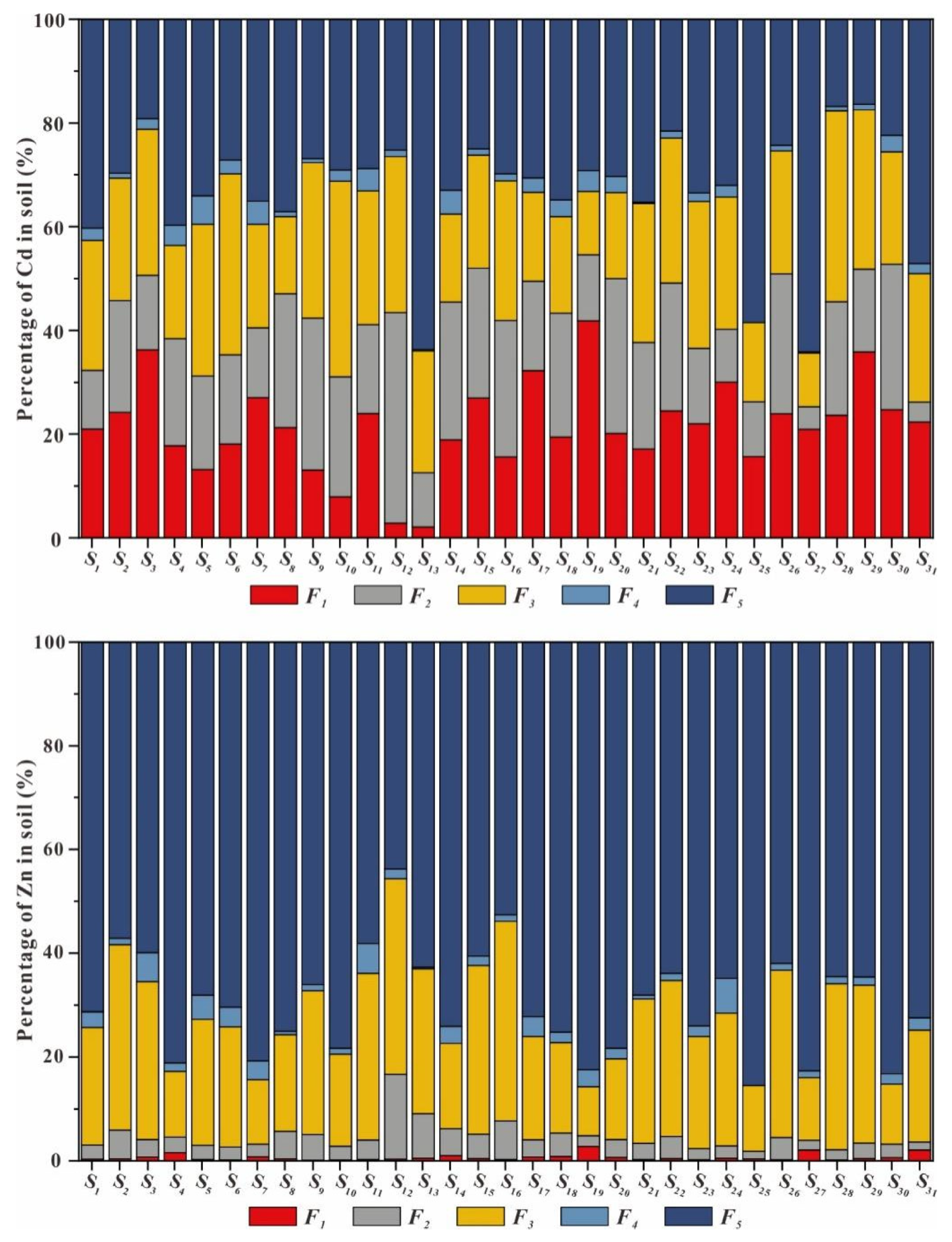
Generally, the order of biological effectiveness for metal fractions is exchangeable (F1) > Fe-Mn oxide-bound (F3) > organic matter-bound (F4) > carbonate-bound (F2) > residual fraction (F5) [60]. In Table 1, soil Cd is primarily present in the residual Cd (CdF5), with an average content of 0.76 ± 1.45 mg/kg. Other concentrations of exchangeable Cd (CdF1), carbonate-bound Cd (CdF2), Fe-Mn oxide-bound Cd (CdF3), and organic matter-bound Cd (CdF4) were 0.29 ± 0.21, 0.35 ± 0.41, 0.44 ± 0.54, and 0.027 ± 0.020 mg/kg, respectively. That is, the Cd fraction demonstrates relative uniformity, with the following order: CdF5 > CdF3 ≈ CdF2 ≈ CdF1 > CdF4 (Figure 3). Notably, the CdF3 (24.0 ± 6.9%), CdF1 (21.4 ± 8.8%) and CdF2 (19.6 ± 8.1%) fractions constitute substantial proportions of the bulk soil Cd, exhibiting similarity to the karstic soils in Guangxi Province, China [5]. The soils exhibit moderate chemical weathering intensity (CIA = 74.6 ± 5.1), coupled with elevated concentrations of CdF2 (0.35 ± 0.41 mg/kg). These characteristics indicate that ongoing carbonate weathering could potentially activate substantial quantities of CdF2. In contrast, Zn fractions demonstrated higher concentrations and greater variability than those of Cd fractions, with average concentrations of exchangeable Zn (ZnF1), carbonate-bound Zn (ZnF2), Fe-Mn oxide-bound Zn (ZnF3), and organic matter-bound Zn (ZnF4) and residual Zn (ZnF5) being 0.66 ± 0.63%, 4.0 ± 2.8%, 23.6 ± 8.4%, 2.3 ± 1.6%, 69.5 ± 9.9%, respectively. The minimal organic matter-bound (F4) fractions of Cd and Zn indicate limited influence of organic matter on metal mobility in the paddy soil system.
Figure 3.
Percentage of soil Cd and Zn fractions.
3.3. Cd and Zn Concentrations in Root, Straws, and Grains
Table 2 presents the distribution characteristics of Cd and Zn concentrations in rice tissues. The bulk Cd and Zn concentrations in roots reached 4.71 ± 4.20 mg/kg and 80.8 ± 35.6 mg/kg, respectively. In straws, concentrations declined to 1.42 ± 4.10 mg/kg for Cd and 48.0 ± 32.4 mg/kg for Zn. The grains demonstrate the lowest metal accumulation, with 0.18 ± 0.21 mg/kg for Cd and 18.8 ± 3.90 mg/kg for Zn. Based on maximum permissible concentration of Cd (0.2 mg/kg) in rice grains (GB 2762-2022) [61], 25.8% of the grain exceeded threshold (Figure 2), a lower exceedance rate than the average rice in China (33.5%) [12] and the cultivated on karstic paddy soils (50%) [6,36]. The Zn concentration in grains is relatively safe, collectively below the Chinese food safety maximum limitation [62].
Table 2.
Characteristics of Cd and Zn contents and transfer in rice tissues.
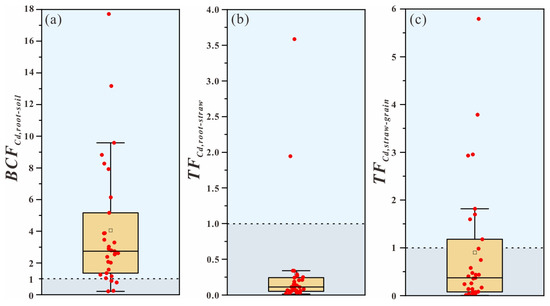
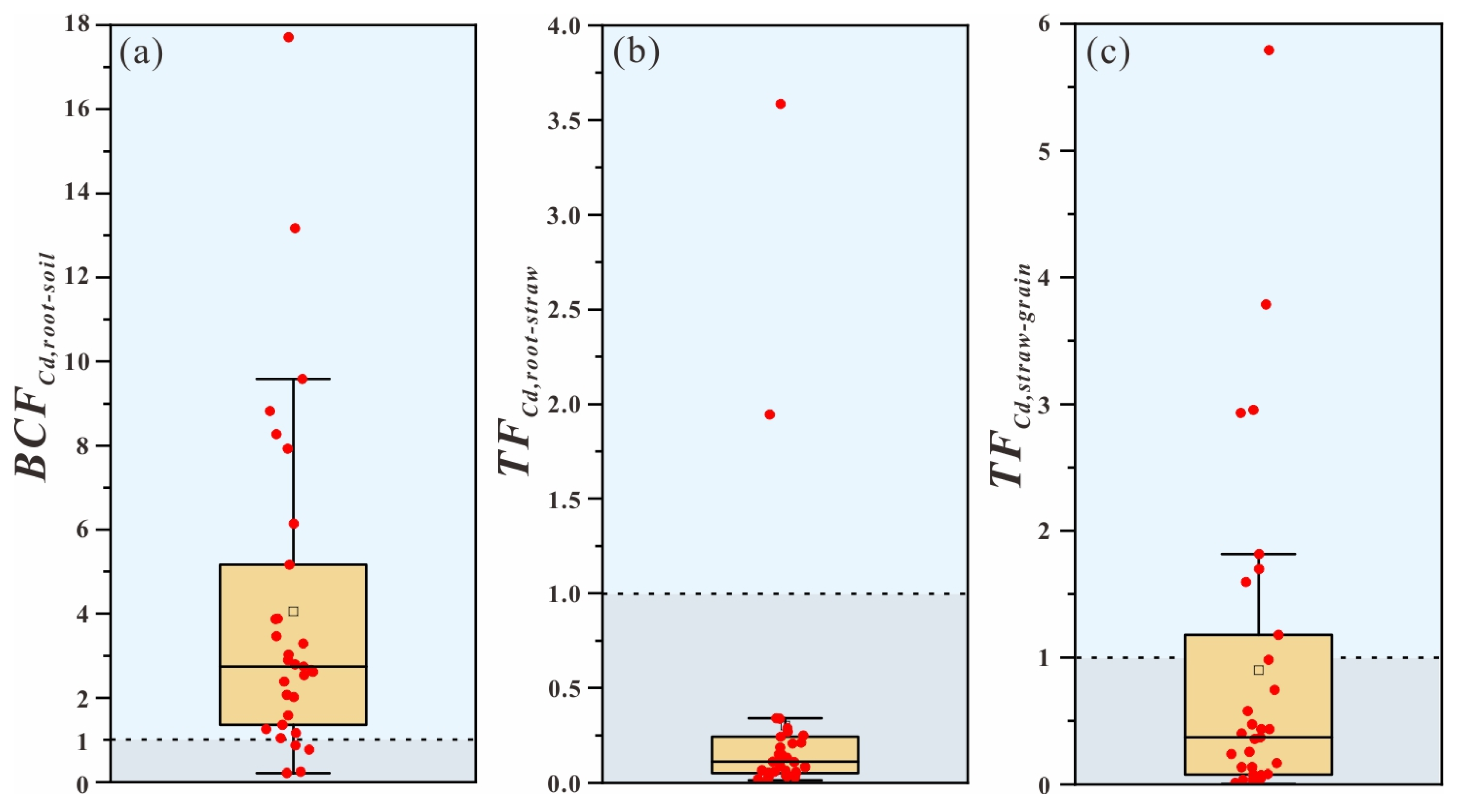
The translocation of heavy metals from soil to grains can be conceptualized through three primary stages: soil-to-root translocation, root-to-straw transport, and straw-to-grain redistribution [23,25]. The roots displayed the highest BCF levels, with 87.1% of samples showing BCFCd,root-soil > 1 (Figure 4). The TF reflects the capacity of rice for metal transport and enrichment from lower to aerial tissues [63]. The results reveal that TFCd,root-straw < TFCd,straw-grain, with 6.5% of samples exhibiting TFCd,root-straw > 1 and 25.8% showing TFCd,straw-grain > 1 (Figure 4). For the Cd, the BCFCd,root-soil is 4.05, with the TFCd,root-straw being 0.30, which then increases from straws to grains (TFCd,straw-grain = 0.90). In contrast, Zn demonstrates a distinct pattern, exhibiting a lower BCFZn,root-soil (0.38). Within rice tissues, TFZn,root-straw is 0.63, which subsequently decreases to 0.55 for TFZn,straw-grain. These reveal a clear tissue-specific partitioning of Cd and Zn in rice plants, predominant Cd sequestration in roots, and preferential Zn allocation to straws.
Figure 4.
Rice tissue bioconcentration factors and transfer factors. (a) Box plot of the BCFCd,root-soil; (b) Box plot of the TFCd,root-straw; (c) Box plot of the TFCd,straw-grain.
4. Discussion
4.1. Migration of Cd and Zn During Erosion
Given the inherently low mobility of titanium (Ti) and aluminum (Al), the ratio of Ti/Al2O3 is utilized as a resistant proxy to determine the material sources of soil [5,64]. In this study, a significant linear correlation was observed between Ti and Al2O3 in soils (Figure S2, r = 0.83, p < 0.01), indicating that the paddy soil originates from weathering of homogeneous parent bedrock [30].
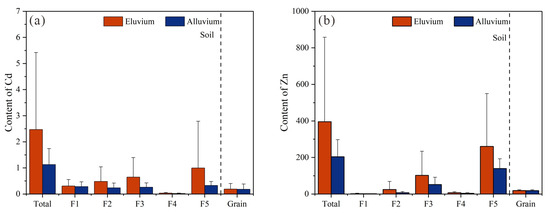
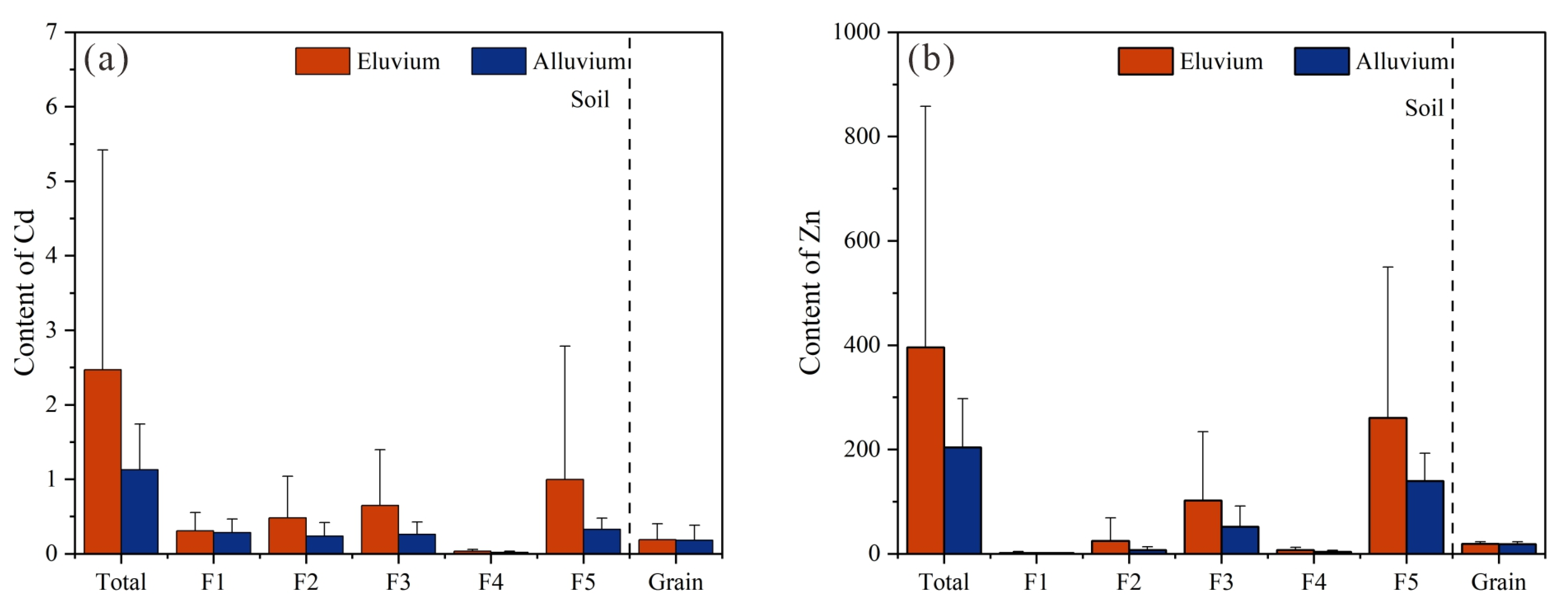
Karstic soils, characterized by thin soil layers, abundant gaps, and several bedrock fissures [56], experiencing significant erosion-induced alterations in both soil particle size and spatial patterns of metal concentrations [6,36,65]. Generally, alluvial soils should contain higher total Cd, CdF1, and clay content relative to eluvium, primarily due to erosion [6,36]. In this study, the alluvial and eluvial soils showed negligible differences in clay content (Table S2), but both were substantially lower than both the Sichuan background soils and well-preserved karstic soils [56,57]. However, this study revealed that eluvial soils contained roughly twice the total Cd and Zn concentrations compared to alluvial soils (Figure 5). Similarly, the Cd and Zn fractions (F2, F3, F4, and F5) in eluvial soils are roughly twice those found in alluvial soils. These suggest that soil erosion could have occurred in the study area, resulting in significant losses of Cd and Zn, particularly from the alluvial soil.
Figure 5.
The Cd (a) and Zn (b) content and percentage of soil and grain fractions.
In this study, the ratios of highly mobile to low-mobility elements (total Cd/Ti and total Zn/Ti) in soils exhibited significant variations (Figure S4), with the eluvial soils showing roughly 2.6-fold and 2.1-fold increases over those in alluvium, respectively. These indicate that significant chemical migration has occurred in the alluvial soil [64,66]. However, the content of CdF1 in alluvial soils was comparable to that in eluvial soils. In Table S3, an independent T-test revealed no significant difference in CIA values between eluvium and alluvial karst soils (p > 0.05), indicating the extra CdF1 and ZnF1 in alluvial soils cannot be attributed to differential weathering. Field investigation reveals that the study area predominantly adopts a rice–garlic rotation system, where the alternating flooded-drained cycles induce dynamic redox fluctuations that could mobilize Cd and Zn bound in fractions F2, F3, F4, and F5, promoting their transformation into the labile F1 fraction [67,68]. As reported by Tessier, Campbell and Bisson [47], the F1 fraction is strongly influenced by clays, Fe/Mn-hydrated oxides. In this study, the alluvial and eluvial soils exhibited similar characteristics in clays, Fe2O3, total Mn, CEC, and SSA (Table S3). The rotation system, therefore, could facilitate the transformation of other fractions into F1, facilitating their immobilization in soils and thereby compensating for the F1 fraction lost in the alluvial soil.
4.2. Effect of Soil Composition on Cd Enrichment in Rice
Studies demonstrated that over 50% of grain cultivated on karstic soils exceeds China’s food safety standard for Cd [6,36]. The predominant Cd bioavailable forms absorbed by rice roots are Cd2+ and CdCl+ (CdF1) [16]. In this study, despite the relatively high CdF1 levels (0.29 ± 0.21 mg/kg) consistent with values reported by Wei et al. [6] and Xia et al. [36], the grain Cd exceedance rate (25.8%) was significantly lower than both comparable karst soils (over 50%) [6,36] and the national average (33.5%) [12]. In addition, the independent T-test revealed no significant difference (p > 0.05) in grain Cd between the eluvial and alluvial soils. This discrepancy suggests the presence of natural Cd-regulation mechanisms in soil–rice systems.
4.2.1. Effects of Ca on Cd Uptake by Roots
Roots, the primary interface for soil-biosorption, are the initial defense against Cd toxicity in rice. After absorption by roots, Cd moves upwards through the plant tissues [69,70]. The BCFCd,root-soil in this study was 4.05, which was lower than the levels reported for heavily contaminated areas such as Hunan, Jiangsu, and Zhejiang Provinces [12,34,71], but higher than those observed in typical karstic regions, including Wanshan in Guizhou Province and Binyang in Guangxi Province (Table 3). This could potentially be attributed to the elevated Cd concentration in the soil. However, the BCFCd,root-soil remained at a relatively low level compared to karstic soils with similar CdF1 contents in Duyun, Guizhou Province [72] and the Xijiang River Basin, Guangxi Province [34], suggesting potential suppression of root Cd accumulation (Table 3).
Table 3.
Cd content of the soil, paddy roots, and BCF values in China.
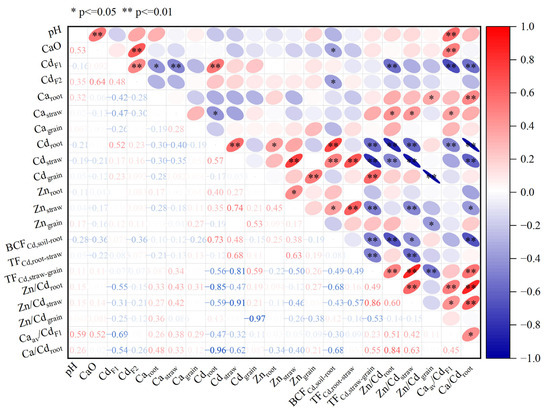
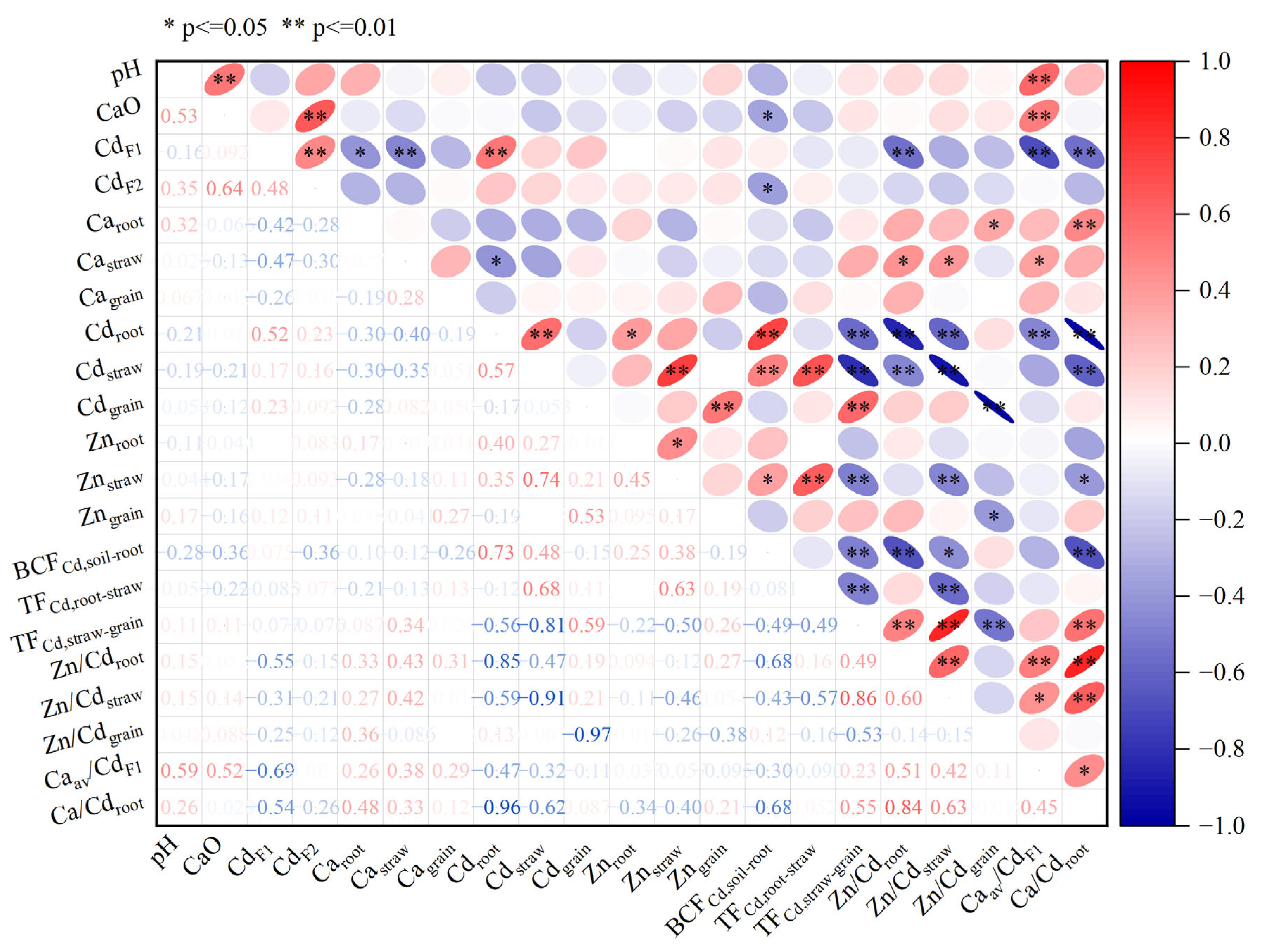
Researchers have demonstrated that soil CaO can effectively reduce root absorption of Cd, primarily through pH-mediated reduction in Cd mobility [21,22,37]. In this study, the limited effect of CaO on alkaline soils leads to a non-significant correlation between soil pH and BCFCd,soil-root (Figure 6). This suggests that Cd absorption reduction via CaO in rice roots operates through mechanisms other than elevated pH, particularly given the minor pH variation observed. Notably, a significant positive correlation occurred between CaO and CdF2 (r = 0.64, p < 0.01, Figure 6), indicating that elevated CaO levels could promote the formation of CdF2, thereby reducing Cd mobility [60]. Furthermore, the analogous ionic radii and shared transport pathways of Ca2+ and Cd2+ facilitate competitive inhibition, where Ca2+ uptake reduces Cd2+ absorption [21]. In this study, Cdroot showed no significant correlation with either CaO or Caroot, while a significant negative correlation between Cdroot and Cabio or CdF1 (r = −0.47, p < 0.01) or (Ca/Cd)root (r = −0.96, p < 0.01) supported this potential competitive inhibition [78]. The Ca concentrations in rice roots, straw, and grains were 7.43 ± 1.85, 2.94 ± 0.33, and 0.13 ± 0.09 g/kg, respectively; meanwhile, a significant negative correlation was observed between root Ca and Cd contents (Figure S3, r = −0.401, p < 0.05). In validation, bioavailable Ca levels were notably high in the soil, averaging 13.31 ± 6.40 mg/kg, about 46-fold higher than in CdF1 (0.29 ± 0.21 mg/kg). As a result, the bioavailable Ca content would inhibit the Cd root absorption from the soil.
Figure 6.
Correlation heatmap between soil physicochemical properties and Cd in rice tissues.
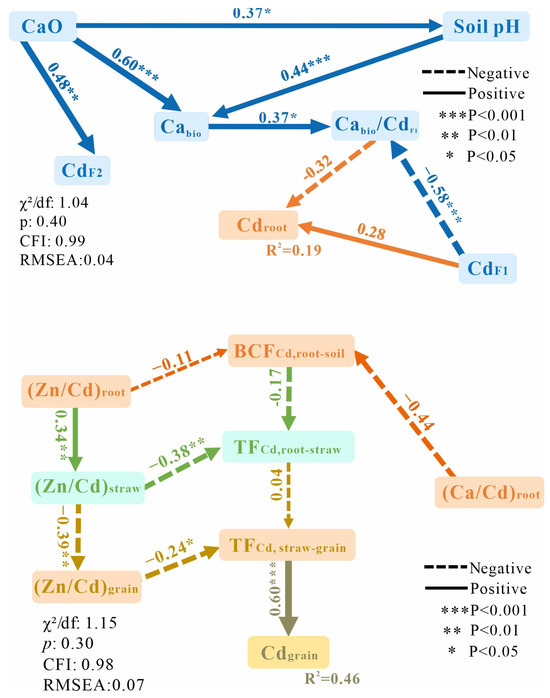
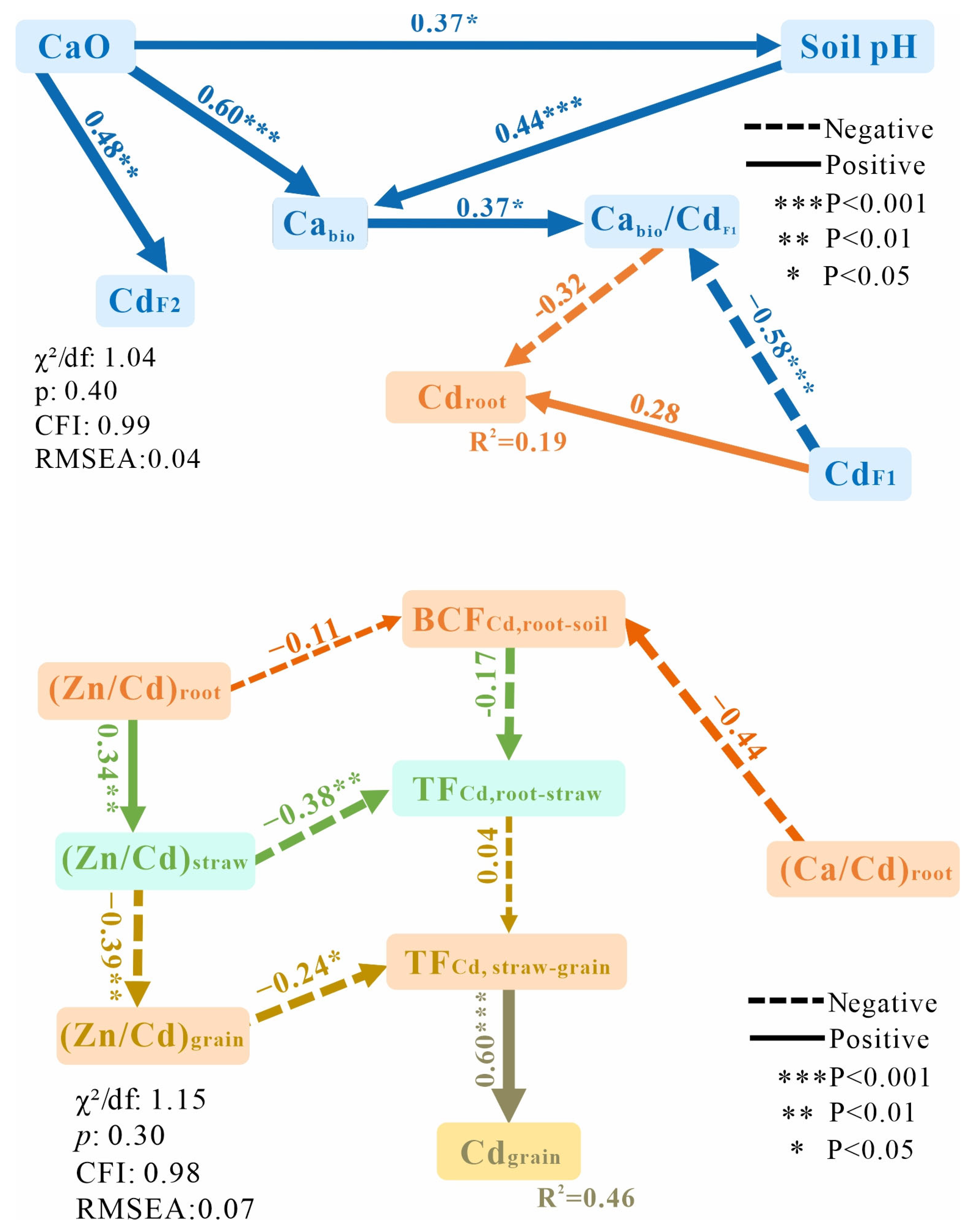
Meanwhile, the SEM model further revealed the influence of soil physicochemical characteristics on Cd accumulation in rice tissues. Elevated soil CaO content decreases Cd bioavailability through enhanced formation of CdF2, consequently reducing root Cd uptake (Figure 7). Simultaneously, increased CaO levels elevate available Ca2+, raising the Cabio/CdF1 ratio and further suppressing root Cd accumulation. Within rice tissues, Ca2+ competitively inhibits Cd uptake in rice root systems via ionic antagonism (Figure 6).
Figure 7.
SEM framework describing the effects of soil geochemical characteristics on Cd accumulation in rice tissues.
4.2.2. Effect of Zn on Cd Transfer in Rice Tissues
Rice is a Zn-accumulating species with an intrinsic mechanism that Zn can alleviate Cd translocation [79]. The shared chemical properties and transport pathways between Zn2+ and Cd2+ facilitate competitive interactions during root absorption and subsequent tissue partitioning [26,70,80]. In this study, significant negative correlations were observed between (Zn/Cd)root and BCFCd,root-soil (r = −0.68, p < 0.01), (Zn/Cd)straw and TFCd,root-straw (r = −0.57, p < 0.01), and (Zn/Cd)grain and TFCd,straw-grain (r = −0.53, p < 0.01), demonstrating Zn could share antagonistic mechanisms in Cd translocation within rice tissues (Figure 6). These findings are consistent with prior studies showing that higher Zn/Cd ratios decrease Cd accumulation in crops because of the antagonistic effects [81,82]. Notably, the Zn content in roots exceeds Cd by approximately 17-fold. During root-to-straw translocation, the Zn-Cd antagonism becomes more pronounced, reaching a maximum of 34-fold in straws, which ultimately reduces grain Cd accumulation (Table S4). A similar study found that a Zn/Cd molar ratio of 100 in soil could reduce Cd accumulation in grains [83]. In this study, the Zn/Cd molar ratio ranged from 78.8 to 508 (mean: 333), indicating that elevated Zn concentrations in soil may suppress Cd accumulation in grains. Moreover, foliar Zn application has been shown to more effectively inhibit Cd accumulation in grains [79,84,85], suggesting that Zn likely plays a significant role in the aboveground tissues (stems and leaves) of rice plants. Similarly, the contrasting transport patterns of Cd and Zn are particularly evident: Cd exhibits the highest BCFCd,root-soil but lowest TFroot-straw, while Zn demonstrates the highest TFZn,root-straw but lowest BCFZn,root-soil. This differential behavior suggests that straws may preferentially transport Zn, thereby enhancing antagonistic effects and inhibiting Cd translocation.
The SEM model further revealed that Zn inhibited Cd accumulation in rice tissues (Figure 7). Zn differentially suppressed Cd translocation across three critical processes: soil-to-root, root-to-straw, and straw-to-grain. Distinctively, Zn primarily inhibited Cd accumulation in straws and grains. While 87.1% of rice tissues exhibited BCFCd,soil-root > 1, only 6.1% showed TFCd,straw-root > 1, indicating root-to-straw translocation as the critical procedure for reduced Cd accumulation in grains [26]. This aligns with the primary action pathway of Zn (Figure 7).
5. Conclusions
This study provides insights into Cd contamination and factors inhibiting Cd accumulation in grain within the soil–rice system of Hanyuan’s karstic paddy soil in Sichuan Province, China. It revealed elevated soil Cd and Zn concentrations, with 75.8% and 36.4% of samples exceeding regulatory limits, respectively. Spatial distribution patterns showed that while eluvial soils contained approximately twice the total Cd and Zn concentrations of alluvium, both eluvial and alluvial soils exhibited comparable levels of exchangeable Cd, Zn, and clay, indicating that soil erosion played a significant role in Cd loss within alluvium. Furthermore, the analogous geochemical characteristics (clay, Fe2O3, total Mn, CEC, and SSA) governing the F1 fraction resulted in nearly identical CdF1 and ZnF1 concentrations across both soil types.
The paddy soils contained exchangeable Cd (CdF1) at 0.29 ± 0.21 mg/kg. Yet, the Cd exceedance rate (25.8%) in rice grains was lower than that of comparable national (33.5%) and karst soils (over 50%), owing to the synergistic effects of Ca and Zn in inhibiting Cd accumulation. Specifically, soil CaO could reduce the Cd bioavailability by the formation of CdF2 species, while the resulting exchangeable Ca from high CaO content competitively inhibits Cd uptake by rice roots. Within rice tissues, Zn could antagonistically inhibit Cd translocation, particularly inhibiting Cd transfer from roots to straws. Based on the finding that soil Zn and CaO inhibit Cd accumulation in rice, the moderate application of lime and Zn is recommended as a management strategy to produce safer rice in Cd-contaminated karst regions.
Supplementary Materials
The following supporting information can be downloaded at: https://www.mdpi.com/article/10.3390/agriculture16050501/s1, Figure S1: Spatial distribution of soil Cd and Zn; Figure S2: Correlation between soil Ti and Al2O3 contents; Figure S3: Correlation between Cd in soil and roots; Figure S4: The ratios of Cd and Zn to Ti for eluvial and alluvial soil; Table S1: Soil heavy metal phases extraction procedures; Table S2: Soil particle size characteristics; Table S3: Soil physico-chemical characterization; Table S4: Geochemical characterization of toxic metals in soil and rice tissues.
Author Contributions
Conceptualization, L.X. and L.T.; methodology, L.X., F.Y. and X.L. (Xudong Li); software, X.L. (Xudong Li) and F.Y.; formal analysis, L.X. and X.L. (Xudong Li); investigation, L.X. and B.C.; resources, L.T. and Z.S.; data curation, L.X. and X.L. (Xuemin Liu); writing—original draft preparation, L.X. and L.T.; writing—review and editing, L.T. and Z.S.; visualization, X.C. and X.L. (Xuemin Liu). All authors have read and agreed to the published version of the manuscript.
Funding
Open Foundation of the State Key Laboratory of Networking and Switching Technology (Beijing University of Posts and Telecommunications) (SKLNST-2022-1-05).
Institutional Review Board Statement
Not applicable.
Data Availability Statement
The data that support the findings of this study are available from the corresponding author upon reasonable request.
Acknowledgments
Acknowledgement for the data support from “National Earth System Science Data Center (https://www.geodata.cn accessed on 12 April 2025)”.
Conflicts of Interest
The authors declare no conflicts of interest.
References
- Mu, Y.; Cui, J.X.; Liu, A.D.; Wang, S.; Shi, Q.J.; Wang, J.; Wei, S.Q.; Zhang, J.Z. Interactions and quantification of multiple influencing factors on cadmium accumulation in soil-rice systems at a large region. Sci. Total Environ. 2023, 881, 163392. [Google Scholar] [CrossRef] [Scilit] [PubMed]
- Bui, A.T.K.; Duong, L.T.; Nguyen, M.N. Accumulation of copper and cadmium in soil–rice systems in terrace and lowland paddies of the Red River basin, Vietnam: The possible regulatory role of silicon. Environ. Geochem. Health 2020, 42, 3753–3764. [Google Scholar] [CrossRef] [Scilit] [PubMed]
- Zhao, F.J.; Ma, Y.B.; Zhu, Y.G.; Tang, Z.; McGrath, S.P. Soil Contamination in China: Current Status and Mitigation Strategies. Environ. Sci. Technol. 2015, 49, 750–759. [Google Scholar] [CrossRef] [Scilit] [PubMed]
- Li, B.; Lin, K.; Liu, X.; Ma, X.D.; Li, X.Z.; Wu, Z.L.; Li, C.; Yu, T.; Wu, T.S.; Yang, Z.F. Mechanism of cadmium (Cd) enrichment in the soil of karst areas with high geochemical background in Southwest China. Chem. Geol. 2025, 673, 122523. [Google Scholar] [CrossRef] [Scilit]
- Wen, Y.B.; Li, W.; Yang, Z.F.; Zhang, Q.Z.; Ji, J.F. Enrichment and source identification of Cd and other heavy metals in soils with high geochemical background in the karst region, Southwestern China. Chemosphere 2020, 245, 125620. [Google Scholar] [CrossRef] [Scilit]
- Wei, X.; Bai, X.Y.; Wen, X.F.; Liu, L.; Xiong, J.; Yang, C.L. A large and overlooked Cd source in karst areas: The migration and origin of Cd during soil formation and erosion. Sci. Total Environ. 2023, 895, 165126. [Google Scholar] [CrossRef] [Scilit]
- Jia, Z.Y.; Wang, J.X.; Zhou, X.D.; Zhou, Y.J.; Li, Y.; Li, B.J.; Zhou, S.L. Identification of the sources and influencing factors of potentially toxic elements accumulation in the soil from a typical karst region in Guangxi, Southwest China. Environ. Pollut. 2020, 256, 113505. [Google Scholar] [CrossRef] [Scilit]
- Zhao, H.H.; Huang, X.R.; Liu, F.H.; Hu, X.F.; Zhao, X.; Wang, L.; Gao, P.C.; Ji, P.H. A two-year field study of using a new material for remediation of cadmium contaminated paddy soil. Environ. Pollut. 2020, 263, 114614. [Google Scholar] [CrossRef] [Scilit]
- Qu, M.K.; Chen, J.; Huang, B.; Zhao, Y.C. Exploring the spatially varying relationships between cadmium accumulations and the main influential factors in the rice-wheat rotation system in a large-scale area. Sci. Total Environ. 2020, 736, 139565. [Google Scholar] [CrossRef] [Scilit]
- Deng, S.W.; Yu, J.; Wang, Y.T.; Xie, S.Q.; Ran, Z.X.; Wei, W. Distribution, transfer, and time-dependent variation of Cd in soil-rice system: A case study in the Chengdu plain, Southwest China. Soil Tillage Res. 2019, 195, 104367. [Google Scholar] [CrossRef] [Scilit]
- Li, Y.B.; Fang, F.M.; Wu, M.H.; Kuang, Y.; Wu, H.J. Heavy metal contamination and health risk assessment in soil-rice system near Xinqiao mine in Tongling city, Anhui province, China. Hum. Ecol. Risk Assess. Int. J. 2017, 24, 743–753. [Google Scholar] [CrossRef] [Scilit]
- Wang, C.C.; Zhang, Q.C.; Yan, C.A.; Tang, G.Y.; Zhang, M.Y.; Ma, L.Q.; Gu, R.H.; Xiang, P. Heavy metal(loid)s in agriculture soils, rice, and wheat across China: Status assessment and spatiotemporal analysis. Sci. Total Environ. 2023, 882, 163361. [Google Scholar] [CrossRef] [Scilit] [PubMed]
- Song, S.Q.; Wu, H.D.; Lan, W.Y. The Status of Heavy Metals Pollution in Soil along Diaojiang River Sides. J. Environ. Health 2008, 4, 317–319. (In Chinese) [Google Scholar] [CrossRef]
- Bai, J.; Li, W.Y.; Zhang, Y.L.; Xiao, L.; Lu, W.S.; Li, Y.T. Distributions and risks of Cu, Cd, Pb and Zn in soils and rice in the North River Basin, South China. Earth Environ. Sci. Trans. R. Soc. Edinb. 2018, 109, 483–493. [Google Scholar] [CrossRef] [Scilit]
- Shen, Q.J.; Liu, P.Z.; Du, Q.L.; Liu, X.Y.; Wu, D. Characteristics and Restoration Measures for Heavy-Metal Polluted Soil-Crop Systems After Recultivation in Abandoned Lead and Zinc Mining Areas. Bull. Soil Water Conserv. 2019, 39, 223–230+222. (In Chinese) [Google Scholar] [CrossRef]
- Li, H.H.; Li, Z.; Khaliq, M.A.; Xie, T.H.; Chen, Y.H.; Wang, G. Chlorine weaken the immobilization of Cd in soil-rice systems by biochar. Chemosphere 2019, 235, 1172–1179. [Google Scholar] [CrossRef] [Scilit]
- Sauvé, S.; Hendershot, W.; Allen, H.E. Solid-Solution Partitioning of Metals in Contaminated Soils: Dependence on pH, Total Metal Burden, and Organic Matter. Environ. Sci. Technol. 2000, 34, 1125–1131. [Google Scholar] [CrossRef] [Scilit]
- Khaokaew, S.; Chaney, R.L.; Landrot, G.; Ginder-Vogel, M.; Sparks, D.L. Speciation and Release Kinetics of Cadmium in an Alkaline Paddy Soil under Various Flooding Periods and Draining Conditions. Environ. Sci. Technol. 2011, 45, 4249–4255. [Google Scholar] [CrossRef] [Scilit]
- Shahid, M.; Dumat, C.; Khalid, S.; Niazi, N.K.; Antunes, P.M.C. Cadmium Bioavailability, Uptake, Toxicity and Detoxification in Soil-Plant System. In Reviews of Environmental Contamination and Toxicology; Springer International Publishing: Cham, Switzerland, 2017; Volume 241, pp. 73–137. [Google Scholar]
- Zhao, J.; Wang, W.L.; Cheng, Q.M. Investigation of spatially non-stationary influences of tectono-magmatic processes on Fe mineralization in eastern Tianshan, China with geographically weighted regression. J. Geochem. Explor. 2013, 134, 38–50. [Google Scholar] [CrossRef] [Scilit]
- Du, Y.Y.; Wang, X.; Ji, X.H.; Zhang, Z.X.; Saha, U.K.; Xie, W.C.; Xie, Y.H.; Wu, J.M.; Peng, B.; Tan, C.Y. Effectiveness and potential risk of CaO application in Cd-contaminated paddy soil. Chemosphere 2018, 204, 130–139. [Google Scholar] [CrossRef] [Scilit]
- Wang, C.; Li, W.; Yang, Z.F.; Chen, Y.; Shao, W.J.; Ji, J.F. An invisible soil acidification: Critical role of soil carbonate and its impact on heavy metal bioavailability. Sci. Rep. 2015, 5, 12735. [Google Scholar] [CrossRef] [Scilit]
- Li, Z.M.; Liang, Y.; Hu, H.W.; Shaheen, S.M.; Zhong, H.; Tack, F.M.G.; Wu, M.J.; Li, Y.F.; Gao, Y.X.; Rinklebe, J.; et al. Speciation, transportation, and pathways of cadmium in soil-rice systems: A review on the environmental implications and remediation approaches for food safety. Environ. Int. 2021, 156, 106749. [Google Scholar] [CrossRef] [Scilit] [PubMed]
- Zhang, Q.; Chen, H.F.; Xu, C.; Zhu, H.H.; Zhu, Q.H. Heavy metal uptake in rice is regulated by pH-dependent iron plaque formation and the expression of the metal transporter genes. Environ. Exp. Bot. 2019, 162, 392–398. [Google Scholar] [CrossRef] [Scilit]
- Jing, H.N.; Yang, W.T.; Chen, Y.L.; Yang, L.Y.; Zhou, H.; Yang, Y.; Zhao, Z.J.; Wu, P.; Zia-ur-Rehman, M. Exploring the mechanism of Cd uptake and translocation in rice: Future perspectives of rice safety. Sci. Total Environ. 2023, 897, 165369. [Google Scholar] [CrossRef] [Scilit] [PubMed]
- Huang, G.X.; Ding, C.F.; Zhou, Z.G.; Zhang, T.L.; Wang, X.X. A tillering application of zinc fertilizer based on basal stabilization reduces Cd accumulation in rice (Oryza sativa L.). Ecotoxicol. Environ. Saf. 2019, 167, 338–344. [Google Scholar] [CrossRef] [Scilit]
- Guo, F.; Ding, C.; Zhou, Z.; Huang, G.; Wang, X. Effects of combined amendments on crop yield and cadmium uptake in two cadmium contaminated soils under rice-wheat rotation. Ecotoxicol. Environ. Saf. 2018, 148, 303–310. [Google Scholar] [CrossRef] [Scilit]
- Wei, N.; Gu, X.Y.; Wen, Y.B.; Guo, C.; Ji, J.F. Geochemical speciation and activation risks of Cd, Ni, and Zn in soils with naturally high background in karst regions of southwestern China. J. Hazard. Mater. 2025, 486, 137100. [Google Scholar] [CrossRef] [Scilit]
- Chen, M.; Li, X.; Cao, X.; Yang, W.; Wu, P.; Hao, H.; Fei, Z.; Gao, Y. Soil-forming accumulation of heavy metals in geological high background areas: Constraints of structure, lithology, and overlying soil geochemistry. J. Geochem. Explor. 2024, 263, 107518. [Google Scholar] [CrossRef] [Scilit]
- Yang, Q.; Yang, Z.F.; Filippelli, G.M.; Ji, J.F.; Ji, W.B.; Liu, X.; Wang, L.; Yu, T.; Wu, T.S.; Zhuo, X.X.; et al. Distribution and secondary enrichment of heavy metal elements in karstic soils with high geochemical background in Guangxi, China. Chem. Geol. 2021, 567, 120081. [Google Scholar] [CrossRef] [Scilit]
- Zhu, L.J.; Qi, L. Chemical forms of heavy metals in carbonate-derived laterite and enrichment of its iron oxide minerals. Chin. J. Geochem. 1997, 16, 263–270. [Google Scholar] [CrossRef] [Scilit]
- Wen, Y.B.; Li, W.; Yang, Z.F.; Zhuo, X.X.; Guan, D.X.; Song, Y.X.; Guo, C.; Ji, J.F. Evaluation of various approaches to predict cadmium bioavailability to rice grown in soils with high geochemical background in the karst region, Southwestern China. Environ. Pollut. 2020, 258, 113645. [Google Scholar] [CrossRef] [Scilit] [PubMed]
- Quezada-Hinojosa, R.P.; Matera, V.; Adatte, T.; Rambeau, C.; Föllmi, K.B. Cadmium distribution in soils covering Jurassic oolitic limestone with high Cd contents in the Swiss Jura. Geoderma 2009, 150, 287–301. [Google Scholar] [CrossRef] [Scilit]
- Li, D.Q.; Li, W.Y.; Lu, Q.; Li, Y.T.; Li, N.; Xu, H.J.; Ren, Z.L.; Zhang, Y.L.; Wang, J.J. Cadmium bioavailability well assessed by DGT and factors influencing cadmium accumulation in rice grains from paddy soils of three parent materials. J. Soils Sediments 2018, 18, 2552–2561. [Google Scholar] [CrossRef] [Scilit]
- Feng, J.L. Trace elements in ferromanganese concretions, gibbsite spots, and the surrounding terra rossa overlying dolomite: Their mobilization, redistribution and fractionation. J. Geochem. Explor. 2011, 108, 99–111. [Google Scholar] [CrossRef] [Scilit]
- Xia, X.Q.; Ji, J.F.; Yang, Z.F.; Han, H.J.; Huang, C.L.; Li, Y.; Zhang, W. Cadmium risk in the soil-plant system caused by weathering of carbonate bedrock. Chemosphere 2020, 254, 126799. [Google Scholar] [CrossRef] [Scilit]
- Yang, Q.; Yang, Z.F.; Zhang, Q.Z.; Liu, X.; Zhuo, X.X.; Wu, T.S.; Wang, L.; Wei, X.J.; Ji, J.F. Ecological risk assessment of Cd and other heavy metals in soil-rice system in the karst areas with high geochemical background of Guangxi, China. Sci. China Earth Sci. 2021, 64, 1126–1139. [Google Scholar] [CrossRef] [Scilit]
- Zhu, H.; Chen, C.; Xu, C.; Zhu, Q.; Huang, D. Effects of soil acidification and liming on the phytoavailability of cadmium in paddy soils of central subtropical China. Environ. Pollut. 2016, 219, 99–106. [Google Scholar] [CrossRef] [Scilit]
- Li, H.W.; Wang, S.J.; Bai, X.Y.; Cao, Y.; Wu, L.H. Spatiotemporal evolution of carbon sequestration of limestone weathering in China. Sci. China Earth Sci. 2019, 62, 974–991. [Google Scholar] [CrossRef] [Scilit]
- Pan, X.Z.; Pan, K. National Soil Specimen Database, National Earth System Science Data Sharing Platform—Soil Science Data Center. Available online: https://www.geodata.cn (accessed on 12 April 2025).
- Meng, Y.M.; Zhang, X.; Huang, X.W.; Hu, R.Z.; Bi, X.W.; Meng, S.N.; Zhou, L.L.; Zheng, Y. A review of the Zn-Pb deposits in Sichuan-Yunnan-Guizhou metallogenic region with emphasis on the enrichment mechanism of Ge, Ga, and In. Ore Geol. Rev. 2024, 164, 105853. [Google Scholar] [CrossRef] [Scilit]
- Ge, Y.; Jia, P.; Tian, S.; Lu, L. Cadmium distribution in rice: Understanding the role of plant nodes and growth stages. Environ. Pollut. 2024, 362, 124919. [Google Scholar] [CrossRef] [Scilit]
- Rodda, M.S.; Li, G.; Reid, R.J. The timing of grain Cd accumulation in rice plants: The relative importance of remobilisation within the plant and root Cd uptake post-flowering. Plant Soil 2011, 347, 105–114. [Google Scholar] [CrossRef] [Scilit]
- HJ 962-2018; Soil—Determination of pH—Potentiometry. China Environmental Science Press: Beijing, China, 2018.
- NY/T 1121.5-2006; Method for Determination of Soil Cation Exchange Capacity in Calcareous Soils. Standards Press of China: Beijing, China, 2006.
- HJ 899-2017; Soil Quality—Determination of Cation Exchange Capacity (CEC)—Hexamminecobalt Trichloride Solution-Spectrophotometric Method. China Environmental Science Press: Beijing, China, 2017.
- Tessier, A.; Campbell, P.G.C.; Bisson, M. Sequential extraction procedure for the speciation of particulate trace metals. Anal. Chem. 1979, 51, 844–851. [Google Scholar] [CrossRef] [Scilit]
- HJ/T 166-2004; The Technical Specification for Soil Environmental Monitoring. China Environmental Science Press: Beijing, China, 2004.
- Nesbitt, H.W.; Young, G.M. Early Proterozoic climates and plate motions inferred from major element chemistry of lutites. Nature 1982, 299, 715–717. [Google Scholar] [CrossRef] [Scilit]
- Price, J.R.; Velbel, M.A. Chemical weathering indices applied to weathering profiles developed on heterogeneous felsic metamorphic parent rocks. Chem. Geol. 2003, 202, 397–416. [Google Scholar] [CrossRef] [Scilit]
- McLennan, S.M.; Hemming, S.; McDaniel, D.K.; Hanson, G.N. Geochemical approaches to sedimentation, provenance, and tectonics. In Processes Controlling the Composition of Clastic Sediments; Geological Society of America: Boulder, CO, USA, 1993; p. 10. [Google Scholar]
- Baker, A.J.M. Accumulators and excluders—Strategies in the response of plants to heavy metals. J. Plant Nutr. 1981, 3, 643–654. [Google Scholar] [CrossRef] [Scilit]
- Kuang, X.; Wang, Z.; Peng, L.; Wang, Y.; Song, H.; Li, C.; Song, K.; Hu, Y. Microcystis-dominated paddy crusts enhancing the cadmium accumulation in rice plant (Oryza sativa L.). Int. Biodeterior. Biodegrad. 2024, 190, 105774. [Google Scholar] [CrossRef] [Scilit]
- Rao, Z.-X.; Huang, D.-Y.; Wu, J.-S.; Zhu, Q.-H.; Zhu, H.-H.; Xu, C.; Xiong, J.; Wang, H.; Duan, M.-M. Distribution and availability of cadmium in profile and aggregates of a paddy soil with 30-year fertilization and its impact on Cd accumulation in rice plant. Environ. Pollut. 2018, 239, 198–204. [Google Scholar] [CrossRef] [Scilit]
- Yang, G.; Wu, J.; Sun, B.Y.; Zhou, Y.H. Health Risk Assessment of Heavy Metals in Arable Soils of Ya’an. J. Agro-Environ. Sci. 2010, 29, 74–79, (In Chinese with English abstract). [Google Scholar]
- Liao, Y.; Pan, T.; Deng, Y.; Yang, M.; Yang, G.; Yu, X.; Huang, Y. Comparing of soil matrix infiltration and preferential flow across different land use types in karst landscapes: Implications for soil and water conservation. Catena 2025, 256, 109127. [Google Scholar] [CrossRef] [Scilit]
- Wei, F.S.; Chen, J.S.; Wu, Y.Y.; Zheng, C.J.; Jiang, D.Z. Background Values of Soil Elements in China; China Environmental Science Press: Beijing, China, 1990. [Google Scholar]
- Li, C.; Zhang, C.S.; Yu, T.; Liu, X.; Yang, Y.Y.; Hou, Q.Y.; Yang, Z.Y.; Ma, X.D.; Wang, L. Use of artificial neural network to evaluate cadmium contamination in farmland soils in a karst area with naturally high background values. Environ. Pollut. 2022, 304, 119234. [Google Scholar] [CrossRef] [Scilit]
- GB15618-2018; Soil Environmental Quality-Risk Control Standard for Soil Contamination of Agricultural Land. China Environmental Science Press: Beijing, China, 2018.
- Cheng, S.W.; Liu, G.J.; Zhou, C.C.; Sun, R.Y. Chemical speciation and risk assessment of cadmium in soils around a typical coal mining area of China. Ecotoxicol. Environ. Saf. 2018, 160, 67–74. [Google Scholar] [CrossRef] [Scilit] [PubMed]
- GB2762-2022; National Food Safety Standard: Maximum Levels of Contaminants in Foods. Standards Press of China: Beijing China, 2022.
- GB 14880-2012; National Food Safety Standard: Standard for Uses of Food Nutrition Fortification Substances. Standards Press of China: Beijing, China, 2012.
- Lu, A.X.; Li, B.R.; Li, J.; Chen, W.; Xu, L. Heavy metals in paddy soil-rice systems of industrial and township areas from subtropical China: Levels, transfer and health risks. J. Geochem. Explor. 2018, 194, 210–217. [Google Scholar] [CrossRef] [Scilit]
- Ji, H.B.; Wang, S.J.; Ouyang, Z.Y.; Zhang, S.; Sun, C.X.; Liu, X.M.; Zhou, D.Q. Geochemistry of red residua underlying dolomites in karst terrains of Yunnan-Guizhou Plateau: I. The formation of the Pingba profile. Chem. Geol. 2004, 203, 1–27. [Google Scholar] [CrossRef] [Scilit]
- Lu, J.; Zheng, F.; Li, G.; Bian, F.; An, J. The effects of raindrop impact and runoff detachment on hillslope soil erosion and soil aggregate loss in the Mollisol region of Northeast China. Soil Tillage Res. 2016, 161, 79–85. [Google Scholar] [CrossRef] [Scilit]
- Wu, S.; Peng, B.; Wu, N.; Xie, S.; Yang, X.; Fang, X.; Song, Z. Mobility and environmental impact of cadmium (Cd) during weathering of carbonaceous black shales in western Hunan, China. J. Hazard. Mater. 2024, 470, 134267. [Google Scholar] [CrossRef] [Scilit]
- Zhang, J.; Mu, G.; Zhang, Z.; Huang, X.; Fang, H. Speciation Variation and Bio-Activation of Soil Heavy Metals (Cd and Cr) in Rice-Rape Rotation Lands in Karst Regions. Int. J. Environ. Res. Public Health 2021, 18, 1364. [Google Scholar] [CrossRef] [Scilit]
- Yan, Q.; Fang, H.; Wang, D.; Xiao, X.; Deng, T.; Li, X.; Wei, F.; Liu, J.; Lin, C. Transfer and transformation characteristics of Zn and Cd in soil-rotation plant (Brassica napus L and Oryza sativa L) system and its influencing factors. Sci. Rep. 2023, 13, 7393. [Google Scholar] [CrossRef] [Scilit]
- Wang, Y.L.; Shang, S.; Li, X.; Chen, S.N.; Li, R.; Jia, W.W.; Deng, H. Effect of Iron Plaque on Gaseous Elemental Mercury Uptake, Translocation, and Volatilization by Paddy Rice. Bull. Environ. Contam. Toxicol. 2022, 109, 1155–1161. [Google Scholar] [CrossRef] [Scilit]
- Zhang, J.L.; Zhu, Y.C.; Yu, L.J.; Yang, M.; Zou, X.; Yin, C.X.; Lin, Y.J. Research Advances in Cadmium Uptake, Transport and Resistance in Rice (Oryza sativa L.). Cells 2022, 11, 569. [Google Scholar] [CrossRef] [Scilit]
- Meng, L.; Huang, T.; Shi, J.; Chen, J.; Zhong, F.; Wu, L.; Xu, J. Decreasing cadmium uptake of rice (Oryza sativa L.) in the cadmium-contaminated paddy field through different cultivars coupling with appropriate soil amendments. J. Soils Sediments 2018, 19, 1788–1798. [Google Scholar] [CrossRef] [Scilit]
- Li, L.; Ma, L.; Tang, L.; Huang, F.; Xiao, N.; Zhang, L.; Song, B. Key Factors Controlling Cadmium and Lead Contents in Rice Grains of Plants Grown in Soil with Different Cadmium Levels from an Area with Typical Karst Geology. Agronomy 2024, 14, 2076. [Google Scholar] [CrossRef] [Scilit]
- Wei, N.; Wen, Y.B.; Guan, D.X.; Ji, J.F. A holistic investigation of potentially toxic element flow in the soil-root-straw-grain continuum of a typical rice–wheat rotation system. Appl. Geochem. 2024, 174, 106149. [Google Scholar] [CrossRef] [Scilit]
- Tang, L.; Deng, S.H.; Tan, D.; Long, J.M.; Lei, M. Heavy metal distribution, translocation, and human health risk assessment in the soil-rice system around Dongting Lake area, China. Environ. Sci. Pollut. Res. 2019, 26, 17655–17665. [Google Scholar] [CrossRef] [Scilit] [PubMed]
- Li, F.F.; Zhao, Y.; Gao, L.; Liang, J.; Pan, H.Y. Diagnosis and evaluation of the health status of sediment-water-farmland-rice system in Longtang. Environ. Sci. Pollut. Res. 2020, 28, 2269–2278. [Google Scholar] [CrossRef] [Scilit]
- Liu, X.; Yu, T.; Yang, Z.F.; Hou, Q.Y.; Yang, Q.; Li, C.; Ji, W.B.; Li, B.; Duan, Y.R.; Zhang, Q.Z.; et al. Transfer mechanism and bioaccumulation risk of potentially toxic elements in soil–rice systems comparing different soil parent materials. Ecotoxicol. Environ. Saf. 2021, 216, 112214. [Google Scholar] [CrossRef] [Scilit]
- Li, W.C.; Ouyang, Y.; Ye, Z.H. Accumulation of mercury and cadmium in rice from paddy soil near a mercury mine. Environ. Toxicol. Chem. 2014, 33, 2438–2447. [Google Scholar] [CrossRef] [Scilit]
- Lin, S.; Yan, Q.; Wei, F.; Liang, G.; Wang, D. Regulation of cadmium accumulation and transport in plants by exogenous calcium in acid yellow soils. Pedosphere 2025. [Google Scholar] [CrossRef] [Scilit]
- Yang, Y.; Li, Y.L.; Wang, M.E.; Chen, W.P.; Dai, Y.T. Limestone dosage response of cadmium phytoavailability minimization in rice: A trade-off relationship between soil pH and amorphous manganese content. J. Hazard. Mater. 2021, 403, 123664. [Google Scholar] [CrossRef] [Scilit]
- Yamaji, N.; Xia, J.X.; Mitani-Ueno, N.; Yokosho, K.; Ma, J.F. Preferential Delivery of Zinc to Developing Tissues in Rice Is Mediated by P-Type Heavy Metal ATPase OsHMA2. Plant Physiol. 2013, 162, 927–939. [Google Scholar] [CrossRef] [Scilit]
- Zhou, Z.Q.; Chen, Z.Z.; Pan, H.J.; Sun, B.B.; Zeng, D.M.; He, L.; Yang, R.; Zhou, G.H. Cadmium contamination in soils and crops in four mining areas, China. J. Geochem. Explor. 2018, 192, 72–84. [Google Scholar] [CrossRef] [Scilit]
- Zare, A.A.; Khoshgoftarmanesh, A.H.; Malakouti, M.J.; Bahrami, H.A.; Chaney, R.L. Root uptake and shoot accumulation of cadmium by lettuce at various Cd:Zn ratios in nutrient solution. Ecotoxicol. Environ. Saf. 2018, 148, 441–446. [Google Scholar] [CrossRef] [Scilit]
- Huang, H.; Tang, Z.X.; Qi, H.Y.; Ren, X.T.; Zhao, F.J.; Wang, P. Soil amendments with ZnSO4 or MnSO4 are effective at reducing Cd accumulation in rice grain: An application of the voltaic cell principle. Environ. Pollut. 2022, 294, 118650. [Google Scholar] [CrossRef] [Scilit]
- Wang, H.; Xu, C.; Luo, Z.C.; Zhu, H.H.; Wang, S.; Zhu, Q.H.; Huang, D.Y.; Zhang, Y.Z.; Xiong, J.; He, Y.B. Foliar application of Zn can reduce Cd concentrations in rice (Oryza sativa L.) under field conditions. Environ. Sci. Pollut. Res. Int. 2018, 25, 29287–29294. [Google Scholar] [CrossRef] [Scilit]
- Fahad, S.; Hussain, S.; Khan, F.; Wu, C.; Saud, S.; Hassan, S.; Ahmad, N.; Gang, D.; Ullah, A.; Huang, J. Effects of tire rubber ash and zinc sulfate on crop productivity and cadmium accumulation in five rice cultivars under field conditions. Environ. Sci. Pollut. Res. Int. 2015, 22, 12424–12434. [Google Scholar] [CrossRef] [Scilit]

Disclaimer/Publisher’s Note: The statements, opinions and data contained in all publications are solely those of the individual author(s) and contributor(s) and not of MDPI and/or the editor(s). MDPI and/or the editor(s) disclaim responsibility for any injury to people or property resulting from any ideas, methods, instructions or products referred to in the content. |
© 2026 by the authors. Licensee MDPI, Basel, Switzerland. This article is an open access article distributed under the terms and conditions of the Creative Commons Attribution (CC BY) license.