1. Introduction
The increasing implementation of precision livestock farming technologies has substantially transformed herd management in modern dairy production systems [
1]. Automatic milking systems and integrated herd management software enable continuous monitoring of milk yield, milk composition, electrical conductivity, and behavioral parameters at the individual cow level. These technologies are widely used in commercial dairy farms to support management decisions and improve production efficiency [
2]. However, although automated monitoring systems are highly sensitive to production and behavioral changes, interpretation of these deviations remains challenging without understanding the physiological mechanisms underlying them [
3,
4]. In addition, precision monitoring technologies are increasingly recognized as essential tools for improving animal welfare and production sustainability in modern dairy farming [
5].
Despite the availability of large volumes of automated monitoring data, linking these data to underlying physiological processes remains one of the main challenges in precision dairy management. Many monitoring parameters reflect indirect responses to physiological changes rather than the primary biological processes themselves [
6,
7]. Therefore, there is increasing interest in identifying systemic biomarkers that could help explain biological mechanisms behind changes observed in automated monitoring data [
8]. Blood biochemical indicators are particularly valuable in this context, as they provide direct information about tissue integrity, metabolic adaptation, and inflammatory responses, and may therefore improve interpretation of automated monitoring outputs under commercial farm conditions [
9].
Blood biochemical indicators remain essential for evaluating systemic physiological status because they reflect organ function, tissue integrity, inflammatory responses, and metabolic adaptation. In recent years, combining blood biochemical markers with automated monitoring parameters has been proposed as a promising strategy to improve early detection of subclinical physiological disturbances in dairy cows [
10,
11]. Such integrated monitoring approaches may improve interpretation of automated monitoring data and help distinguish between normal physiological variation and early pathological changes under commercial farm conditions. Metabolic monitoring based on blood indicators is widely used to evaluate herd health and detect early metabolic imbalances in dairy cattle [
12].
Despite increasing research on LDH, information linking blood LDH activity with routinely recorded automated monitoring parameters remains limited. Most available studies have focused on LDH activity in milk or specific disease conditions rather than evaluating systemic LDH activity together with automated milk parameters, behavioral monitoring data, and extended biochemical profiles under commercial farm conditions [
13,
14]. Systemic LDH activity measured in blood primarily reflects generalized tissue metabolism and cellular turnover, whereas milk LDH is considered a local biomarker associated with mammary epithelial damage and intramammary inflammatory processes [
10,
13]. Therefore, integrating systemic biochemical biomarkers with automated monitoring data is increasingly considered an important direction for improving herd health monitoring and diagnostic interpretation in precision dairy farming [
15]. In addition, multivariate monitoring approaches combining production, behavioral, and biochemical data are gaining increasing attention in dairy herd health management [
16].
There is increasing interest in merging various data sources to more accurately describe the physiological state of dairy cows as automated herd monitoring systems become more accessible and blood biochemical testing is frequently employed in dairy operations. A more comprehensive understanding of the physiological changes that take place during the early stages of lactation may be possible with such an integrated approach. Thus, the current study’s objective was to assess the connections among blood LDH activity, automated milk monitoring parameters, milk composition characteristics, and blood biochemical markers in early lactation dairy cows.
2. Materials and Methods
2.1. Study Animal Housing Conditions
In compliance with the Lithuanian Law on Animal Welfare and Protection, the study was carried out with the approval of the Lithuanian State Food and Veterinary Service Ethics Committee (Approval No. G2-298). The experiment was conducted from 1 September 2025 to 16 November 2025, on a commercial dairy farm in the Kaunas region of Lithuania. The Large Animal Clinic of the Veterinary Academy, Lithuanian University of Health Sciences, was the site of laboratory analyses and data processing.
The farm housed approximately 1400 lactating Holstein cows managed under uniform housing and feeding conditions. From this herd, 91 cows were selected for detailed monitoring. At the time of inclusion, cows were between 20 and 100 days in milk (DIM) and included both primiparous (n = 30) and multiparous (n = 61) animals. Cows showing clinical signs of systemic disease, including mastitis, lameness, displaced abomasum, metritis, or digestive disorders, as well as animals under medical treatment or with incomplete monitoring records, were excluded. Prior to enrollment, all cows underwent a standardized clinical examination performed by the same licensed veterinarian. Automated milking robots Lely Astronaut® A3 (Lely Industries N.V., Maassluis, The Netherlands) working in a free-traffic system milked the cows in loose free-stall barns with mechanical ventilation. The herd’s mean daily milk yield was roughly 35 kg per cow, and the average body weight was at 550 ± 50 kg. Throughout the study period, there was an unlimited supply of fresh drinking water.
Every cow was fed the identical total mixed ration (TMR), which was created in accordance with NRC guidelines to satisfy the nutritional needs of high-producing Holstein cows. The TMR was composed of roughly 50% grain concentration mash, 30% corn silage, 10% grass silage, 4% grass hay, and 6% mineral mix on a dry matter basis. A 47.8% dry matter content, 29% neutral detergent fiber, 17.5% acid detergent fiber, 38.6% non-fiber carbs, and 15.8% crude protein made up the ration’s chemical composition.
In order to guarantee constant feed availability, feeding was done twice a day, at roughly 7:00 and 16:00. An automatic feed pusher also dispersed the ration several times during the day. During milking, the robotic system gave the cows about 2 kg of concentrate daily in addition to the normal TMR. During the course of the trial, every animal was kept in the same housing, food, and milking settings.
2.2. Data Collection
Under a free-traffic barn management approach, cows were milked utilizing an automatic milking system Lely Astronaut® A3. In-line sensors included into the milking unit continuously recorded the characteristics of milk production and composition, such as milk yield, fat, protein, lactose, FPR, milk temperature, SCC, and electrical conductivity. The values for each cow were the daily averages derived from all milkings that took place during a 24 h period. Milk variables used for statistical analysis corresponded to the same day as blood sampling.
Rumination activity was monitored using neck-mounted sensors integrated into the same automated system. Rumination time was quantified as total minutes spent ruminating per day and extracted for the same day on which blood sampling was performed, thereby ensuring temporal consistency among milk, behavioral, and biochemical data.
Blood sampling was conducted once per cow, and LDH-based grouping was performed after serum biochemical analysis. Samples were obtained from the coccygeal vein into serum tubes without anticoagulant BD Vacutainer® serum tubes (Becton, Dickinson and Company, Eysins, Switzerland) during routine clinical examination. The Laboratory of Clinical Tests at the Large Animal Clinic, Veterinary Academy, Lithuanian University of Health Sciences, received the collected samples. Serum was isolated for analysis after centrifugation at 1500× g for 15 min. Blood samples were processed within routine laboratory timeframes to minimize pre-analytical variability. Serum samples were visually inspected for hemolysis prior to analysis, and samples showing visible hemolysis were excluded.
Using commercially available reagent kits and a fully automated wet-chemistry analyzer RX Daytona™ (Randox Laboratories Ltd., Crumlin, UK), serum biochemical assays were performed. In addition to the electrolytes sodium (Na), potassium (K), and chloride (Cl), the biochemical profile that was analyzed included the following: ALB, ALT, AST, Ca, CREA, C-reactive protein (CRP), Fe, GGT, glucose (GLUC), LDH, magnesium (Mg), non-esterified fatty acids (NEFA), PHOS, total protein (TP), triglycerides (TRIG), and urea (UREA). Quality control and analytical calibration were carried out in compliance with the manufacturer’s guidelines.
2.3. Grouping
Rather than choosing cows at random, a predetermined eligibility-based selection method was used. Based on these parameters, ninety-one early-lactation animals between 20 and 100 DIM were chosen for close observation out of a herd of roughly 1400 Holstein cows. Cows that showed clinical symptoms of disease, such as mastitis, lameness, displaced abomasum, metritis, or digestive abnormalities, or whose automated monitoring data were lacking, were not included. Each animal had a single blood sample taken. LDH activity in cattle is regarded as being within the reference range when it is less than 1364 U/L, which is the upper limit of the reference interval for bovine serum LDH activity, based on veterinary clinical chemistry reference values supplied by the diagnostic laboratory Laboklin GmbH & Co. KG (Bad Kissingen, Germany). Cows were divided into two groups according to LDH activity after serum biochemical analysis: Group 1 included 18 primiparous and 35 multiparous cows with low LDH activity (LDH < 1364 U/L; n = 53), and Group 2 included 12 primiparous and 26 multiparous cows with high LDH activity (LDH ≥ 1364 U/L; n = 38). DIM at the time of sampling were recorded for each cow and were comparable between LDH groups, with no statistically significant differences observed.
On the same day as blood sampling, data on milk yield, milk composition, rumination time, milk temperature, and electrical conductivity were retrieved from the automated milking and monitoring system for each cow. The LDH-based classification remained fixed throughout the study period and was applied in all subsequent analyses.
2.4. Statistical Analysis
IBM SPSS Statistics for Windows, Version 30.0 (IBM Corp., Armonk, NY, USA) was used for all statistical analyses. The threshold for statistical significance was p < 0.05. For every variable under study, descriptive statistics were computed and are shown as mean ± standard error of the mean (SEM). Before inferential analysis, data distributions were visually evaluated using Q–Q plots and histograms. SCC_LOG (log10-transformed somatic cell count) was calculated using somatic cell count values expressed in ×103 cells/mL to improve normality prior to statistical analysis. Additionally, before analysis, variables like SCC that are known to frequently display skewed distributions were log-transformed. Welch’s t-test was chosen because of its ability to withstand mild deviations from normalcy and unequal variances. Because the LDH groups differed in sample size (Group 1: n = 53; Group 2: n = 38) and several biochemical variables exhibited unequal variances, differences between groups were evaluated using Welch’s t-test, which does not assume homogeneity of variances and is appropriate for unequal group sizes. Associations between LDH activity and the investigated traits were assessed using Pearson correlation coefficients.
ROC curve analysis was performed to evaluate the ability of individual milk performance, milk composition, and blood biochemical traits to discriminate between cows with low LDH (Group 1) and high LDH (Group 2). In this study, ROC analysis was applied as an exploratory method to evaluate discrimination between biochemical LDH activity groups rather than to assess diagnostic performance for a specific clinical disease. For each analysis, the test variable was defined as the continuous trait of interest (e.g., milk electrical conductivity, SCC_LOG, milk yield, milk composition traits, and blood biochemical parameters), whereas the state variable was defined as LDH group, with Group 2 specified as the positive state.
The ROC procedure generated the area under the curve (AUC) with asymptotic significance (p-value) and 95% confidence intervals as measures of classification performance. AUC values were interpreted as follows: AUC ≥ 0.90, excellent discrimination; 0.80 ≤ AUC < 0.90, strong discrimination; 0.70 ≤ AUC < 0.80, acceptable discrimination; 0.60 ≤ AUC < 0.70, poor to moderate discrimination; and AUC < 0.60, no meaningful discrimination. In addition, Youden’s index and sensitivity–specificity coordinates were calculated to identify potential optimal cut-off values for each ROC curve. Given the exploratory design of the study and the evaluation of multiple variables, findings were interpreted cautiously, taking into account biological plausibility and consistency across related indicators rather than relying solely on statistical significance.
3. Results
3.1. Automated Parameter Monitoring (Mean ± SEM) Based on LDH Groups in Cows
Comparison of automated monitoring indicators between LDH Group 1 and Group 2 did not reveal statistically significant differences. However, several numerical tendencies were observed. Rumination time was numerically 7.74% lower in Group 2 cows compared to Group 1. SCC_LOG was numerically 8.53% higher in Group 2, accompanied by a 2.27% numerical increase in electrical conductivity.
Milk composition parameters showed small numerical differences in Group 2, with protein content being numerically 6.80% higher, fat 2.15% higher, and the FPR showing a modest 1.71% numerical increase relative to Group 1. Lactose content remained similar between groups, differing by only −0.44%. Milk yield tended to be numerically higher in Group 2, showing a 5.41% increase compared with Group 1, although variability was greater in this group. Milk temperature remained stable and differed by less than 0.5% between groups.
Overall, these findings represent non-significant numerical trends rather than confirmed biological differences and should be interpreted cautiously. These observations may reflect subtle physiological variation between LDH categories but require confirmation in larger and longitudinal datasets (
p > 0.05) (
Table 1).
3.2. Indicators of Blood Biochemistry (Mean ± SEM) Based on LDH Groups in Cows
Several blood biochemical parameters showed notable differences between LDH groups, as detailed in
Table 2. ALB concentration was 7.5% higher in LDH Group 2 compared with Group 1. Enzymatic activity patterns were more pronounced for AST, which was 57.2% higher in Group 2. ALT showed only a modest 11.2% increase in Group 2.
Mineral profiles also demonstrated group-dependent trends. Calcium concentration was 4.5% higher in Group 2 compared to Group 1. Similarly, serum iron increased by 17.0%, and GGT activity was 38.2% higher in Group 2 than in Group 1. Creatinine concentration demonstrated a noticeable 12.1% increase in Group 2.
Energy-related and metabolic indicators were largely comparable between groups. GLUC, magnesium, NEFA, triglycerides, and urea showed minimal percentage differences (<3%). Phosphorus concentration displayed a moderate 10.0% increase in Group 2.
Electrolyte concentrations remained relatively stable, although chloride was 2.3% higher and sodium was 1.3% higher in Group 2. Potassium varied by only 1.6% between LDH groups.
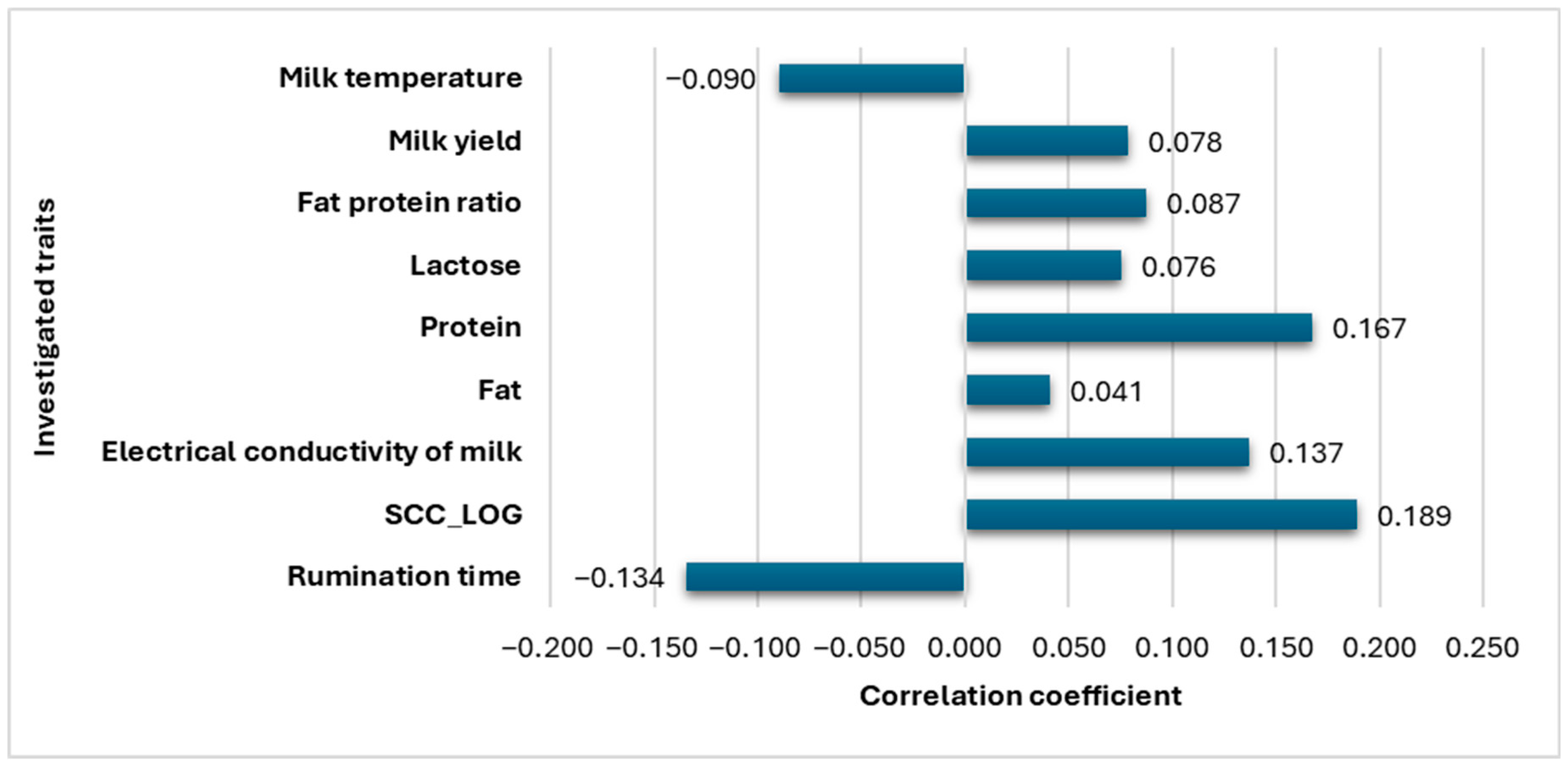
3.3. Correlations Between LDH and Milk Parameters
The analysis demonstrated no statistically significant linear relationships between LDH activity and any of the investigated traits (
Figure 1). While weak positive or negative correlations were observed in individual variables, these numerical deviations were small and inconsistent and therefore did not indicate a biologically meaningful association between LDH levels and the examined parameters.
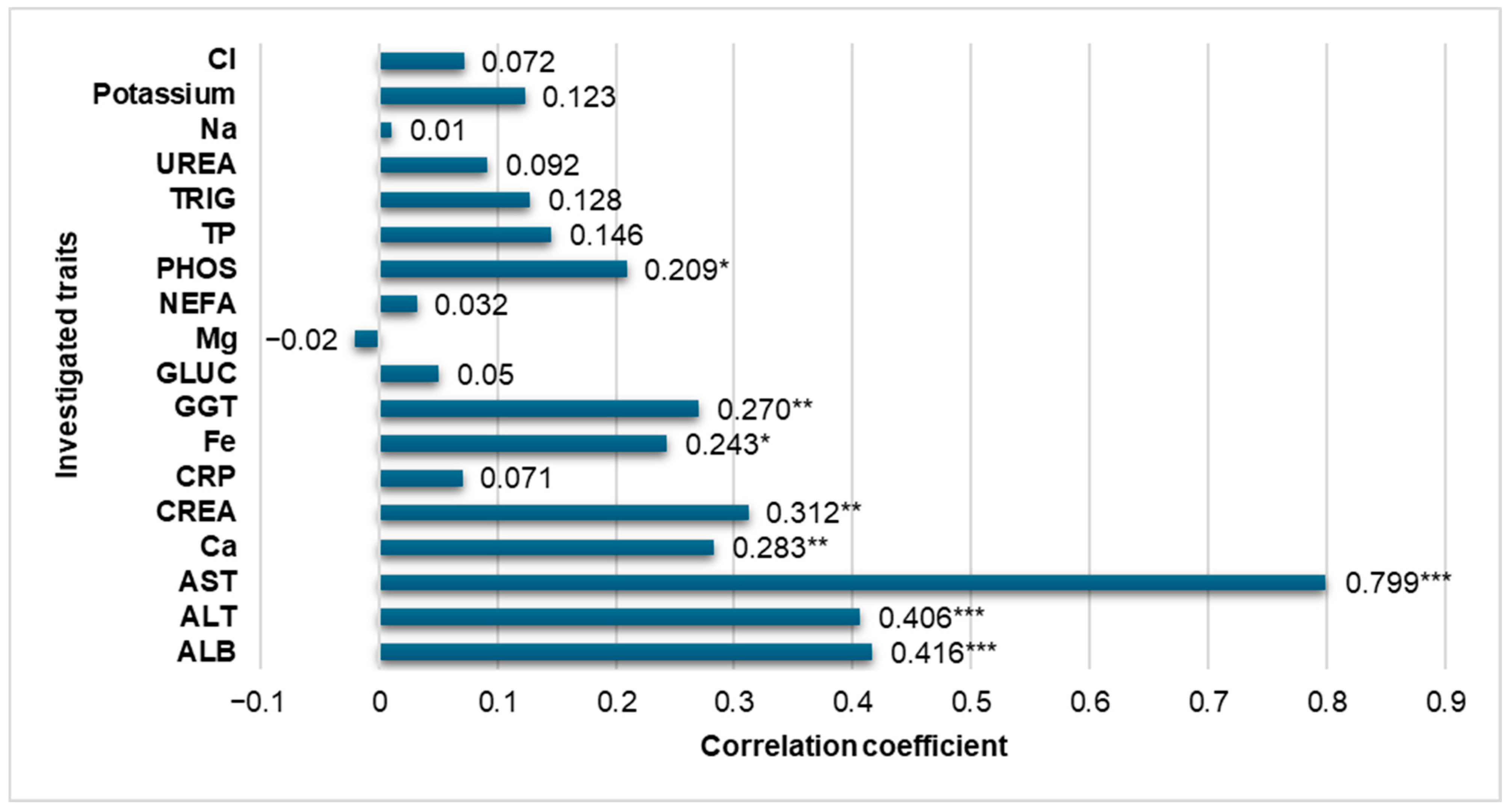
3.4. Correlations Between LDH and Blood Parameters
Numerous statistically significant correlations between LDH and the examined blood characteristics were found by correlation analysis (
Figure 2). LDH and AST showed the largest positive connection (r = 0.799,
p < 0.001). Additionally, there were notable moderately positive associations between LDH and ALT (r = 0.406,
p < 0.001) and ALB (r = 0.416,
p < 0.001).
Significant positive associations between LDH and Ca (r = 0.283, p < 0.05) and CREA (r = 0.312, p < 0.01) were observed. Additionally, there was a positive correlation between GGT and LDH (r = 0.270, p < 0.01) and Fe (r = 0.243, p < 0.05). LDH and PHOS also showed a lower but statistically significant positive connection (r = 0.209, p < 0.05).
Other biomarkers—K, UREA, TP, GLUC, and several low-magnitude coefficients—did not reach statistical significance, as indicated by small or near-zero correlation values.
3.5. Diagnostic Evaluation of Milk Biomarkers Using ROC Analysis
All things considered, the features under investigation showed little to no discriminatory power in predicting participation in the LDH group (
Table 3). Milk’s electrical conductivity had the highest AUC value (AUC = 0.616) of any variable, suggesting that it could only marginally differentiate between cows with high and low LDH. SCC_LOG had a marginally lower AUC (AUC = 0.583). Its low classification accuracy was shown by the fact that the null value of 0.5 was included in its confidence interval.
Milk composition traits, including fat (AUC = 0.549), protein (AUC = 0.571), lactose (AUC = 0.445), and the FPR (AUC = 0.523), also failed to demonstrate meaningful discriminatory capability, with AUC values close to 0.5 and nonsignificant p-values. Similarly, milk yield (AUC = 0.448) and milk temperature (AUC = 0.456) showed no ability to differentiate between LDH groups. The lowest discriminatory value was observed for rumination time (AUC = 0.394), indicating an inverse and clinically uninformative relationship with LDH level.
3.6. Assessing Blood Biomarkers Diagnostically Using ROC Analysis
Among the evaluated indicators, AST demonstrated the strongest discriminatory performance, with an AUC of 0.858 (
p < 0.001), indicating strong ability to differentiate cows with high LDH levels from those with low LDH (
Table 4). Several additional metabolites showed moderate predictive ability, including CREA (AUC = 0.665,
p = 0.004), ALB (AUC = 0.662,
p < 0.01), PHOS (AUC = 0.656,
p < 0.01), Fe (AUC = 0.646,
p < 0.05), Ca (AUC = 0.627,
p < 0.05), and GGT (AUC = 0.631,
p < 0.05). These metabolites exhibited statistically significant, though moderate, classification accuracy.
In contrast, several metabolic markers—including ALT, TRIG, Cl, NEFA, Mg, Na, and GLUC—displayed AUC values between 0.55 and 0.60, with nonsignificant p-values, indicating weak discriminatory ability. Markers such as TP (AUC = 0.534), UREA (AUC = 0.519), and CRP (AUC = 0.444) performed close to chance level, demonstrating no meaningful ability to distinguish between LDH groups.
4. Discussion
The present study demonstrated that increased blood LDH activity during early lactation was consistently associated with alterations in several biochemical indicators, supporting the concept that LDH appears to reflect systemic metabolic and tissue-related processes rather than isolated organ dysfunction [
17]. The most pronounced difference between groups was observed for AST activity. There was a very strong positive association between LDH and AST (r = 0.799,
p < 0.001), which confirmed the 57.2% higher AST activity in Group 2 cows compared to Group 1 cows. Furthermore, out of all the blood biomarkers that were tested, AST showed the best discriminatory ability (AUC = 0.858,
p < 0.001). The pattern in GGT activity was similar but less obvious. GGT activity was 38.2% higher in Group 2 compared with Group 1 and demonstrated a significant positive correlation with LDH (r = 0.270,
p < 0.01). ROC analysis showed moderate discriminatory ability for GGT (AUC = 0.631), indicating a weaker but still relevant association with LDH-associated metabolic variation compared with AST. These findings are biologically plausible, as AST is widely recognized as a marker of tissue metabolic activity and cellular turnover, particularly in metabolically demanding periods such as early lactation. Increased activity of transaminases and tissue enzymes during early lactation has been associated with metabolic adaptation and increased hepatic workload in high-producing dairy cows [
14,
18].
Elevated AST in conjunction with high LDH may reflect systemic inflammatory or metabolic responses, as cows with clinical or subclinical inflammatory conditions often show variations in these enzyme levels, which can serve as supportive biomarkers for monitoring overall health status [
19]. Additionally, management changes such as transitioning from stanchion housing to loose housing can also impact enzyme levels. A study found that dairy cows moving to loose housing conditions exhibited temporarily elevated LDH and other muscle damage markers, possibly reflecting stress due to changes in environment and management practices [
20]. Persistent elevation in LDH together with AST and GGT may provide a more comprehensive picture of an animal’s metabolic status. In some metabolic disorders, including conditions associated with rumen dysfunction, LDH activity has been reported to increase due to systemic metabolic stress [
21,
22]. This highlights the importance of monitoring LDH together with selected biochemical enzymes during periods of physiological or management-related transition.
Although LDH and AST showed a strong association in the present study, this finding should be interpreted cautiously, as several biological and technical factors may contribute to concurrent increases in these enzymes. Both LDH and AST are non-specific markers and may increase in response to hepatic metabolic load, skeletal muscle activity or damage, and systemic metabolic stress during early lactation. Previous studies have reported increased LDH and transaminase activity in cows experiencing metabolic imbalance, increased tissue turnover, or hepatic metabolic challenges during the transition period [
10,
22]. In addition, increases in LDH and muscle-associated enzymes have been described in response to management-related stressors, including housing or environmental changes, which may reflect muscle tissue adaptation rather than organ-specific pathology [
20]. LDH and AST activity may also be influenced by pre-analytical factors, including sample handling and hemolysis, which should be considered when interpreting enzyme activity results. LDH is widely recognized as a non-specific enzyme marker and may increase in response to generalized tissue damage or cellular turnover rather than organ-specific pathology [
10]. Taken together, the LDH–AST association observed in this study most likely reflects a shared response to systemic metabolic load rather than a marker of a single organ-specific process.
Along with alterations linked to enzymes, variations across groups were also noted in markers linked to systemic metabolic activity and protein metabolism. Group 2 had a 7.5% higher concentration of ALB than Group 1, and there was a moderately favorable connection between ALB and LDH (r = 0.416,
p < 0.001). Serum Fe concentration was 17.0% higher and exhibited a weaker but significant positive correlation (r = 0.243,
p < 0.05) with LDH, whereas creatinine concentration was 12.1% higher in Group 2 and positively linked with LDH (r = 0.312,
p < 0.01). These results were corroborated by ROC analysis, which revealed that CREA (AUC = 0.665), ALB (AUC = 0.662), and Fe (AUC = 0.646) had intermediate classification ability. Albumin is the most abundant protein in blood plasma and plays an essential role in maintaining oncotic pressure, transporting hormones and metabolites, and serving as an indicator of protein status and liver synthetic function. Variations in ALB concentration may reflect hydration status, protein metabolism, or systemic inflammatory processes [
23]. Higher dietary protein consumption or systemic physiological reactions to metabolic stress may also be linked to elevated ALB concentrations in dairy cows. Higher ALB concentrations in Group 2 and the positive correlation with LDH activity in this study imply that elevated LDH might not be associated with isolated hepatic disease but rather with broader systemic metabolic adaptability. The relationship between CREA, LDH, and ALB may reflect different aspects of metabolic status. While increased LDH activity may indicate increased tissue metabolic activity and systemic metabolic load, elevated CREA concentrations may be associated with changes in muscle metabolism or overall metabolic turnover rather than impaired renal function [
23,
24]. Iron is essential for energy metabolism, immunological response, and oxygen delivery. Variations in oxygen transport needs, metabolic demands, or systemic inflammatory reactions can all be reflected in changes in serum Fe concentration. Increased oxygen consumption and energy metabolism in early lactation dairy cows are linked to higher metabolic demand, which could be a factor in the concurrent alterations in LDH activity and Fe metabolism. Increased LDH activity together with higher serum Fe concentrations may therefore reflect increased metabolic demand and systemic physiological adaptation during early lactation, particularly during periods of increased energetic challenge after calving [
25].
LDH activity was also associated with selected indicators of mineral metabolism. Calcium concentration was 4.5% higher in Group 2 compared with Group 1 and showed a weak-to-moderate positive correlation with LDH (r = 0.283,
p < 0.05). Likewise, Group 2 had a 10.0% greater phosphorus concentration and a weakly significant positive connection with LDH (r = 0.209,
p < 0.05). According to ROC analysis, PHOS (AUC = 0.656) and Ca (AUC = 0.627) had moderate discrimination ability, indicating a moderate relationship between the two minerals and physiological variation linked to LDH. During early lactation, Ca and PHOS metabolism is closely linked to endocrine regulation and the metabolic demands of milk synthesis. Even relatively small shifts in these minerals may reflect the normal physiological adjustments required to support increased nutrient use and tissue activity during this period. Previous work has shown that calcium metabolism is strongly influenced by the rapid increase in mineral demand after calving, together with endocrine mechanisms involved in maintaining systemic mineral balance [
26]. In addition, changes in PHOS availability during early lactation have been associated with mobilization of body reserves and adaptation to increased metabolic requirements [
27]. Increased LDH activity has also been described in cows experiencing systemic metabolic or inflammatory stress, reflecting increased cellular turnover and overall tissue metabolic activity [
28]. Taken together, the parallel increase in LDH activity together with moderate increases in Ca and PHOS concentrations observed in the present study may reflect coordinated metabolic and endocrine adaptation during early lactation, rather than isolated mineral imbalance.
In contrast to the biochemical findings, most automated monitoring parameters did not differ significantly between Group 1 and Group 2. Still, some consistent tendencies were observed. Cows in Group 2 generally showed lower rumination time together with higher milk electrical conductivity, higher milk yield, FPR, and higher SCC compared with cows in Group 1. These differences were small and not statistically significant, but they may reflect subtle biological variation associated with LDH differences rather than clear metabolic disturbance. Similar observations have been reported in early-lactation cows, where production and behavioral traits do not always change noticeably despite underlying metabolic adaptation [
29,
30]. Changes in behavior are often more evident only when metabolic or inflammatory stress becomes more pronounced, whereas mild systemic variation can remain difficult to detect using monitoring data alone [
31]. This suggests that automated monitoring data should be interpreted together with biochemical indicators, as markers such as LDH may be associated with systemic metabolic changes that are not yet visible in production or behavioral parameters [
32].
When evaluating the results of this study, a number of limitations should be taken into account. The statistical power to identify weaker correlations between LDH activity and specific milk production or behavioral factors may have been constrained by the moderate sample size. While a number of automated monitoring indicators showed consistent numerical tendencies, certain non-significant results might be due to sample size constraints rather than a real lack of biological linkages. In addition, the study methodology was observational, and consequently causal correlations between LDH activity, systemic metabolic state, and automated monitoring measures cannot be established. Only a single time point of LDH activity and related biochemical state during early lactation—a time of rapid metabolic and physiological adaptation—was obtained by blood collection. This limits the ability to evaluate temporal dynamics of LDH activity and prevents assessment of causal relationships between LDH variation and systemic metabolic changes during early lactation.
Although no significant DIM differences were observed between LDH groups, inclusion of cows across a relatively wide early-lactation window (20–100 DIM) may have introduced additional biological variability related to stage of lactation. Although both LDH groups included primiparous and multiparous cows, parity was not included as a covariate and may represent an additional source of biological variability influencing metabolic, biochemical, and production-related parameters. A more thorough assessment of temporal variations in LDH activity and its connection to systemic metabolic adaptation might be possible with repeated sampling. The capacity to identify short-term physiological fluctuation may have been hampered by the fact that, despite the continuous recording of automated monitoring data, their interpretation was dependent on the LDH status ascertained at a single sampling point. Despite these limitations, the combined evaluation of LDH activity together with selected biochemical indicators and automated monitoring data provides valuable insight into systemic metabolic adaptation during early lactation and supports the potential of integrated monitoring approaches in modern dairy herd management. The observational design together with single time-point biochemical sampling further supports cautious interpretation of automated monitoring numerical trends, as temporal relationships between systemic metabolic status and sensor-derived parameters could not be fully characterized.



 ,
,