Article

A Large Exonic Insertion in the Rice DEP2 Gene Creates a Novel Allelic Mutant srt with Increased Grain Number per Panicle and Short, Round Grains

1
Key Laboratory of Crop Germplasm Innovation and Green Production, College of Agriculture, Anhui Science and Technology University, Chuzhou 239000, China
2
College of Life Sciences, Shihezi University, Shihezi 832003, China
*
Authors to whom correspondence should be addressed.
These authors contributed equally to this work.
Agriculture 2026, 16(5), 500; https://doi.org/10.3390/agriculture16050500
Submission received: 13 January 2026 / Revised: 16 February 2026 / Accepted: 24 February 2026 / Published: 25 February 2026
(This article belongs to the Section Crop Genetics, Genomics and Breeding)

Abstract

DENSE AND ERECT PANICLE 2 (DEP2) is a key pleiotropic gene regulating panicle architecture and grain shape in rice. To explore its favorable allelic variations, a stably inherited mutant with short, round and thick grains (srt) was identified in this study using the Japonica rice variety ‘Zhonghua 11’ (ZH11) as the genetic background. Compared with ZH11, srt exhibited reduced plant height and a shorter panicle length but significantly increased numbers of primary branches, secondary branches, and grains per panicle. The mutant grains showed decreased length, increased width, and thickness, ultimately leading to reductions in both thousand-grain weight and grain yield per plant. Cytological analysis revealed that both the longitudinal and transverse dimensions of hull cells in srt were significantly enlarged, while the number of longitudinal cells per unit length decreased. This suggests that srt remodels grain shape by altering the balance between cell division and expansion. Genetic analysis indicated that the phenotype is controlled by a single recessive gene. Map-based cloning and whole-genome resequencing localized the target gene to chromosome 7 and confirmed that srt is the DEP2 gene. Sequence analysis revealed the presence of a large fragment insertion of approximately 87 kb entirely within the seventh exon region of the DEP2 gene in srt. However, unlike most reported DEP2 mutants, in which the numbers of primary branches, secondary branches, and grains per panicle showed no significant difference from the wild type, the srt mutant exhibited a significant increase in all these traits. This unique phenotypic combination expands the understanding of the functional diversity of this gene. This study provides new genetic material for further elucidating the molecular mechanisms by which DEP2 regulates panicle development and for molecular design breeding of rice grain shape.

1. Introduction:

Rice (Oryza sativa L.) is one of the major staple crops in China, and its yield is directly related to national food security. Improving rice yield has become a core objective in rice breeding [1,2]. Rice yield is primarily determined by three components: tiller number, number of grains per panicle, and thousand-grain weight. Among these, thousand-grain weight is mainly influenced by grain size and filling degree [2]. Consequently, grain shape is a crucial factor affecting rice yield [3]. Rice grain shape is a typical quantitative trait, governed by multiple genes that coordinately regulate the morphogenesis of grain length, width, and thickness [4]. Notably, grain length and width exhibit relatively high heritability, meaning their phenotypes are largely determined by genotype [5].
In recent years, with the advancement of functional genomics and molecular biology techniques, an increasing number of grain shape-related genes have been mapped and cloned. Grain morphology development is primarily regulated by the division and expansion of hull cells [6]. Most quantitative trait locus (QTL) analyses indicate that rice grain shape inheritance is controlled by multiple genes and exhibits pleiotropy, leading to varying degrees of correlation among different grain shape traits [3]. To date, several key genes regulating grain shape have been successfully cloned and functionally characterized.
The first gene controlling grain shape to be cloned in rice was Grain size 3 (GS3), located on chromosome 3, which encodes a heterotrimeric G-protein γ subunit [7]. Deletion or loss-of-function of the Organ Size Regulation (OSR) domain of GS3 leads to significantly elongated grains and increased thousand-grain weight, while deletion of the C-terminal inhibitory TNFR/VWFC domain results in significantly smaller grains [8].
The DENSE AND ERECT PANICLE 1 (DEP1) gene also encodes a G-protein γ sub-unit, but it is considered atypical because it contains a unique N-terminal transmembrane domain and a large C-terminal extension that are not present in canonical Gγ proteins [8,9]. It encodes a protein containing a PLEKHG2 domain involved in the G protein signaling pathway. Overexpression of DEP1 increases grain size, whereas its downregulation or knockdown results in slightly shorter, rounder grains with improved grain thickness and filling [10]. Like GS3, Grain Width 2 (GW2) regulates rice grain size, but through a distinct molecular mechanism. GW2 encoding a RING-type E3 ubiquitin ligase that specifically recognizes and ubiquitinates the cell wall-loosening protein Expansin-Like 1 (EXPLA1) for degradation, thereby negatively regulating seed size. Loss-of-function of GW2 leads to increased hull cell number, wider grains, and higher thousand-grain weight [11]. Its allele gw2.1 affects rice hull shape by regulating cell proliferation; compared to the wild type, the near-isogenic line NIL-gw2.1 exhibits increased grain length and width [12]. Additionally, GW7 encodes a protein containing a TONNEAU1 recruitment motif (TRM). Upregulating GW7 expression promotes longitudinal division and suppresses transverse division of hull cells, thereby increasing grain length [13]. The MYB transcription factor Abnormal Hull 2 (AH2) can bind to the GW7 promoter and inhibit its expression. Using gene editing to knockout the ACII element or nearby promoter fragments reduces AH2’s binding ability to the GW7 promoter, increases GW7 expression, and enhances the grain length-to-width ratio [14].
As a key upstream regulator of GW7, Squamosa promoter binding protein-like 16 (OsSPL16) encodes an SBP-box family transcription factor. OsSPL16 exhibits tissue specificity and can bind to the GW7 promoter, inhibiting its activity. This inhibition promotes cell transverse division and improves filling efficiency, thereby significantly increasing grain width and weight [14]. Another important grain width gene, Grain width and weight on chromosome 5 (GW5), encodes a plasma membrane-localized calmodulin-binding protein [15]. GW5 directly binds to and inhibits the activity of the brassinosteroid (BR) signaling pathway kinase Glycogen Synthase Kinase 2 (GSK2), promoting the nuclear accumulation of dephosphorylated BRI1-EMS-SUPPRESSOR 1 (OsBZR1) and DWARF AND LOW-TILLERING (DLT) proteins. This leads to the upregulation of BR-responsive gene expression, ultimately affecting grain width and weight [16]. Further research found that another SBP-family transcription factor, OsSPL12, can directly bind to the GW5 promoter region and enhance its transcriptional activity [17]. In Japonica rice, OsSPL12 activity is relatively low, and a 1212 bp deletion exists in the GW5 promoter, resulting in weak GW5 expression and the formation of a broad, round grain phenotype [17].
OsSPL13 was the first grain shape quantitative trait locus (QTL) successfully cloned in a Japonica rice population through genome-wide association study (GWAS). This gene also encodes an SBP-box transcription factor. OsSPL13 directly transcriptionally activates the α-tubulin encoding gene Small and Round Seed 5 (SRS5), positively regulating the cytoskeleton and cell elongation to increase grain length and thickness [18]. SRS1/DEP2/SUG1 (SUPPRESSOR OF GS2) encodes a plant-specific protein of unknown function. This gene is hereafter referred to as DEP2. Its loss-of-function mutants exhibit not only dense and erect panicle phenotypes but also often display significantly shorter, rounder, and thicker grains, along with decreased thousand-grain weight [19,20,21,22]. Further studies have shown that SUG1 interacts with OsSPL13 and enhances its transcriptional activation activity, Knockout of the SUG1 gene suppresses the long-grain phenotype resulting from OsSPL13 overexpression [22].
In summary, significant progress has been made in recent years in understanding rice grain shape regulation. The identification and cloning of multiple key genes have laid an important foundation for deciphering yield components and implementing molecular design breeding. However, the genetic regulatory networks of many genes and the molecular mechanisms through which they influence grain shape have not been fully elucidated. How to utilize different allelic variations to improve panicle and grain shape while overcoming the negative impacts of grain size reduction and yield decline remains a subject requiring in-depth exploration and practice. To further investigate the molecular mechanisms regulating rice grain size, this study initially obtained a mutant with short, round and thick grains (srt) by irradiating Zhonghua 11 (ZH11) with 60Co-γ rays. Using this mutant as research material, we conducted investigations on its agronomic traits, analyzed the genetic characteristics of the srt mutant phenotype, and identified the grain shape-regulating gene srt through fine mapping. This study provides novel genetic material for further elucidating the molecular developmental mechanisms by which srt regulates rice grain morphogenesis.

2. Materials and Methods

2.1. Rice Materials

The rice material used in this experiment was a mutant with a short, round, and thick grain phenotype srt, obtained by irradiating the Japonica medium-maturing variety ZH11 with 60Co-γ rays [23]. The phenotype was stably inherited through multiple generations of cultivation.

2.2. Plant Cultivation and Agronomic Trait Investigation

In May 2024, seeds of ZH11 and srt were germinated in the dark at 37 °C. After seed radicle emergence, they were sown on a seedling bed. At the four-leaf one-heart stage, seedlings were transplanted to the rice field at the planting garden of Anhui Science and Technology University in Fengyang County, Anhui Province (32°52′30″ N, 117°33′15″ E). At the mature stage, 15 plants each of ZH11 and srt with uniform growth were selected to measure plant height, tiller number, panicle length, number of primary branches, number of secondary branches, and number of grains per panicle. Furthermore, 15 plump seeds each of ZH11 and srt were selected. Grain length (from the apex of the outer glume to the base of the grain), grain width (the widest part of the inner and outer glumes), and grain thickness (the thickest part at the junction of the inner and outer glumes) were measured using a vernier caliper. Simultaneously, a seed analyzer (Top Cloud-Agri, Hangzhou, China) was used to automatically measure the grain area (projected area). An electronic balance (Shanghai Yueping, YP3002, Shanghai, China) was used to measure thousand-grain weight and single-plant yield. Statistical analysis was performed using Student’s t-test with SPSS software (IBM SPSS Version 21.0), and graphs were generated using GraphPad Prism (FreeImage Public License—Version 9.5).

2.3. Glume Cell Morphology Analysis

Mature seeds of rice ZH11 and the mutant srt were separately collected, fixed on gold-plated stubs, and sputter-coated with gold. Subsequently, observations were conducted using a scanning electron microscope (Zeiss Gemini SEM 300 ultra-high resolution field emission scanning electron microscope, Carl Zeiss AG, Oberkochen, Germany). Images of the outer epidermal cells of the grain glumes were captured at 500× magnification. Cell size and number were statistically analyzed using ImageJ 1.54g software.

2.4. Construction of F2 Segregation Populations and Genetic Analysis

The mutant srt was crossed with indica conventional rice varieties Wushansimiao (WSSM), Nanjing 11 (NJ11), and Huajingxian 74 (HJX74) to obtain F1 seeds, respectively. The F1 plants were self-pollinated to generate F2 segregation populations. At the mature stage, the numbers of plants exhibiting the wild-type and the short, round, and thick grain phenotypes were counted in the segregation populations. The chi-square test was performed using SPSS software (IBM SPSS Version 21.0) to analyze the genetic characteristics of the srt mutant phenotype.

2.5. Mapping of the srt Gene

Individual plants exhibiting the short, round, and thick grain phenotype from the F2 segregation population and the F2:3 families were used as mapping individuals. DNA was extracted from their young leaves using a modified cetyltrimethylammonium bromide (CTAB) method [24]. Initially, SSR primers distributed across the 12 rice chromosomes were selected. PCR amplification and 4% agarose gel electrophoresis analysis were first performed between the parents to screen for primers showing polymorphism. Subsequently, the DNA from 30 F2 individuals with the short, round, and thick grain phenotype was used for the preliminary mapping of the gene.
Furthermore, utilizing the genomic information of the Japonica cultivar Nipponbare and the indica cultivar 93-11, differences within the preliminary mapping interval between the two subspecies were compared via the National Center for Biotechnology Information (NCBI) website (https://www.ncbi.nlm.nih.gov/, accessed on 10 May 2025). InDel (Insertion and Deletion) primers were designed using the online tool Primer 3 (https://primer3.ut.ee/, accessed on 1 August 2025), and all primers were synthesized by Anhui General Biology Co., Ltd (Chuzhou, China). These InDel primers were first screened for polymorphism between the parents of the three populations. Subsequently, the polymorphic primers (Table S1) were used to amplify 695 individuals with the short, round, and thick grain phenotype from the segregation population via PCR for fine mapping of the srt gene. The PCR amplification system was 20 μL, containing 50 ng of DNA, 10 μL of 2× Santaq PCR mix (Vazyme Biotech Co., Ltd., Nanjing, China), and 5 pmol each of the forward and reverse primers. The PCR program consisted of an initial denaturation at 95 °C for 3 min; followed by 35 cycles of denaturation at 95 °C for 15 s, annealing at 55 °C for 15 s, and extension at 72 °C for 5 s; with a final extension at 72 °C for 10 min. PCR amplification products were electrophoresed on 4% agarose gels.

2.6. Sequencing Analysis of the srt Candidate Gene

Based on the fine mapping results, the Rice Genome Annotation Project database (https://rice.uga.edu/, accessed on 25 December 2025) was used to annotate genes within the defined interval, allowing for a preliminary assessment of their potential functions. Primers for amplifying candidate genes (Table S1) were designed according to the gene reference sequences published on this website, PCR amplification was performed using genomic DNA from ZH11 and the srt mutant as templates, the PCR products were sent to GENERAL BIOL (Chuzhou, China) for sequencing analysis. The sequencing results were aligned against the reference genome sequence of Nipponbare version 7.0 using Snap Gene software (v6.0.2.0). Based on the alignment results, candidate genes were further screened and prioritized [25].

2.7. Whole-Genome Resequencing

To identify the mutation site, whole-genome resequencing was performed on both ZH11 and srt. Genomic DNA extracted from leaves was entrusted to GENERAL BIOL (Chuzhou, China) for sequencing using the Illumina NovaSeq X Plus platform. Paired-end sequencing with a read length of 150 bp was performed, and an average insert fragment size of approximately 400 bp was obtained. DNA samples were initially fragmented by sonication. Subsequently, the fragments underwent end repair, 3’-end adenylation, and adapter ligation. Fragments approximately 400 bp in length were then enriched via bead adsorption, followed by PCR amplification for library construction.
The sequencing data were analyzed using a bioinformatics pipeline. Fastqc (v0.12.1) was used to assess the quality of the raw sequencing data [26]. Quality control was performed using Trimmomatic (v0.39) to remove adapters and filter out low-quality bases, with parameters set as “LEADING:3 TRAILING:3 SLIDINGWINDOW:4:15 MINLEN:36” [27]. The clean data after quality control were aligned to the rice reference genome of the Japonica cultivar Nipponbare (RGAP 7.0) using the “mem-M” parameters in BWA software (v0.7.18-r1243) [28,29]. Nipponbare was selected as the reference genome because it is the most completely assembled and best-annotated rice genome, and the srt mutant was generated in the Japonica cultivar ZH11, which shares high genomic synteny and sequence identity with Nipponbare. This ensures optimal read alignment accuracy and variant detection sensitivity. Using Samtools (v1.21), uniquely mapped reads with a mapping quality MAPQ > 20 were selected, and PCR duplicate reads were marked and removed using the MarkDuplicates (v4.0.0.1) tool from the Picard (v3.3.0) toolkit [30]. Finally, SNP and InDel variant detection was performed using the HaplotypeCaller module of GATK (v4.6.1.0) [31]. Candidate variants were visualized and comparatively analyzed using Integrative Genomics Viewer 2.19.7 (IGV) for differential locus comparison [32].

3. Results

3.1. Analysis of Plant Height and Panicle Type in the srt Mutant

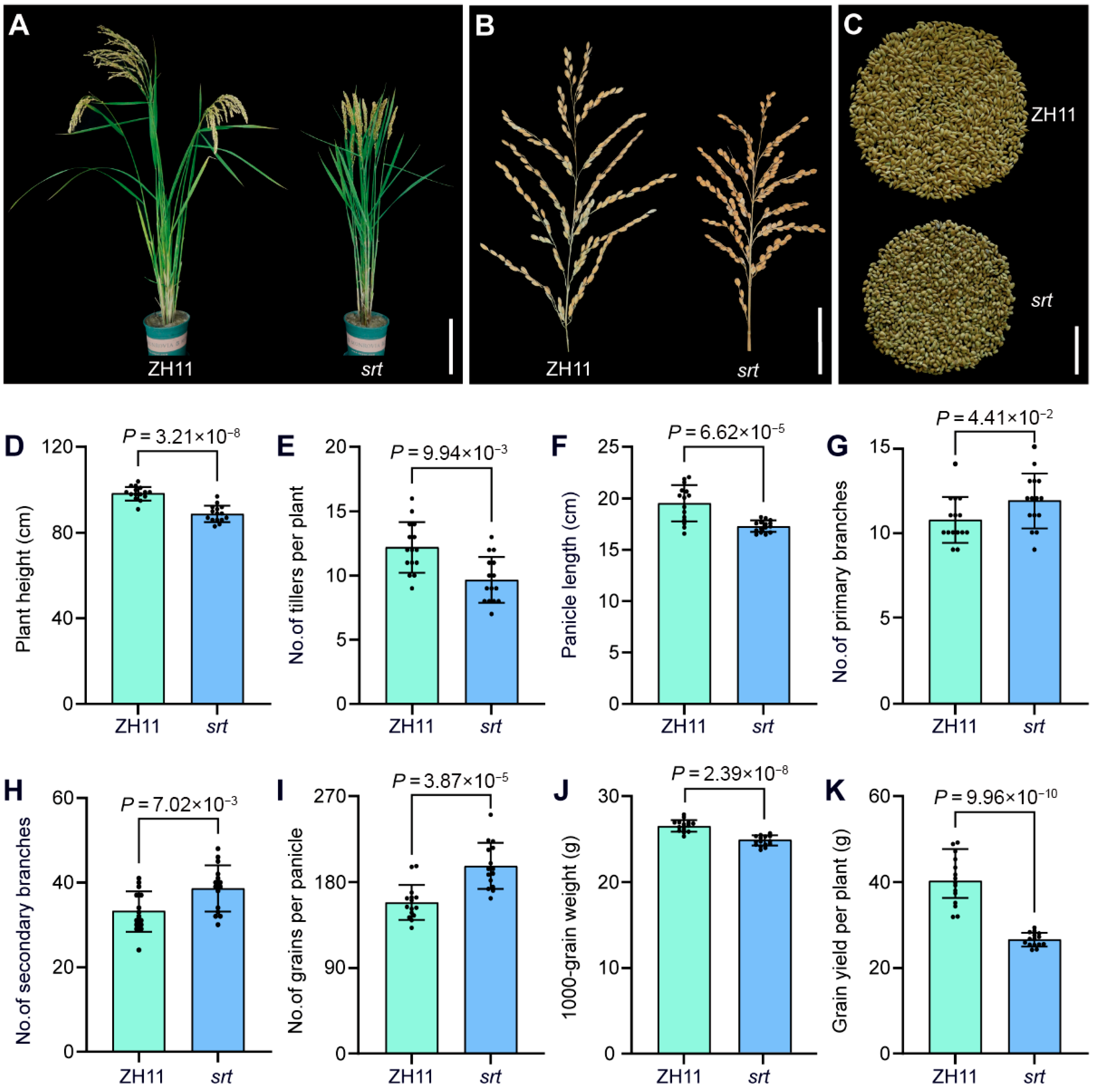
Under field cultivation conditions, statistical analyses were conducted on the plant architecture (Figure 1A), panicle morphology (Figure 1B), and grain yield (Figure 1C) of rice ZH11 and the mutant srt at the mature stage. The results showed that, compared to ZH11, the plant height of srt was significantly shorter (Figure 1D; p = 3.21 × 10⁻⁸), and the tiller number was significantly reduced (Figure 1E; p = 9.94 × 10⁻³). Investigation of the panicle morphology of ZH11 and srt (Figure 1B) indicated that the panicle length of srt was significantly shorter compared to ZH11 (Figure 1F; p = 6.62 × 10⁻⁵), measuring 90.62% of ZH11. However, the number of primary branches per panicle and number of secondary branches per panicle in srt were both significantly increased (Figure 1H), reaching 110.56% and 116.5% of ZH11, respectively. Furthermore, the number of grains per panicle in srt was also significantly higher (Figure 1I; p = 3.87 × 10⁻⁵), at 121% of ZH11. The results for thousand-grain weight and single-plant yield of ZH11 and srt showed that both the thousand-grain weight and yield per plant of srt were significantly lower than those of ZH11 (Figure 1J; p = 2.39 × 10⁻⁸; Figure 1K; p = 9.96 × 10⁻¹⁰), at 94.15% and 66.14% of ZH11, respectively.

3.2. The srt Mutant Exhibits Shorter, Thicker, Wider, and Rounder Grains

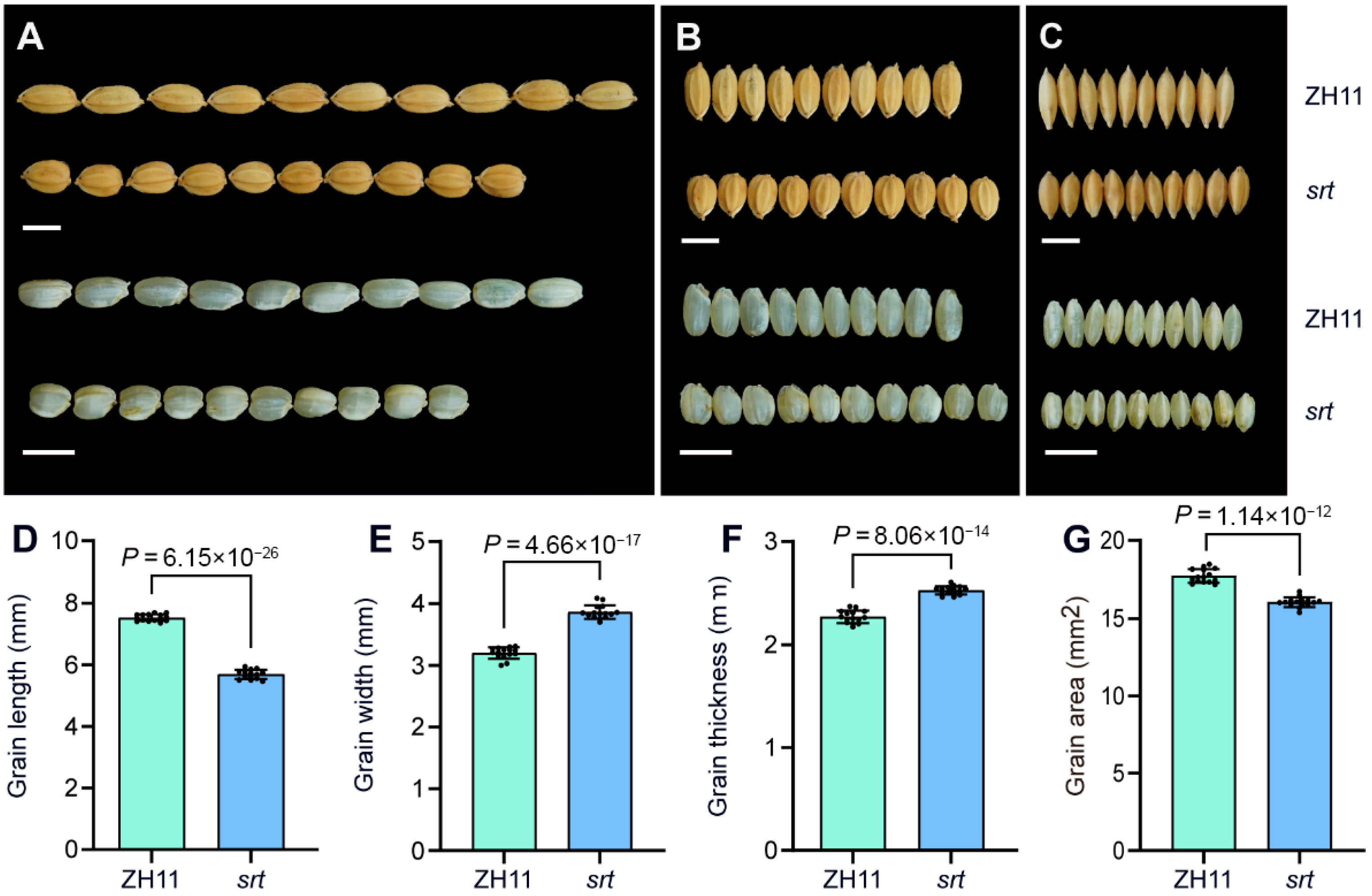
We further analyzed grain phenotypes of ZH11 and the srt mutant, including grain length (Figure 2A), grain width (Figure 2B), and grain thickness (Figure 2C). The results showed that, compared to ZH11, the grain length of srt was significantly reduced (Figure 2D; p = 6.15 × 10⁻²⁶), approximately 74.86% of ZH11 grain length. Concurrently, the grain width of srt was significantly increased (Figure 2E; p = 4.66 × 10⁻¹⁷), about 121.05% of ZH11 grain width. The grain thickness of srt was also significantly greater (Figure 2F; p = 8.06 × 10⁻¹⁴), approximately 111.29% of ZH11 grain thickness. Additionally, the grain area of srt was significantly lower, about 90.50% of ZH11 grain area (Figure 2G; p = 1.14 × 10⁻¹²).

3.3. Glume Cell Width Is Significantly Increased in the srt Mutant

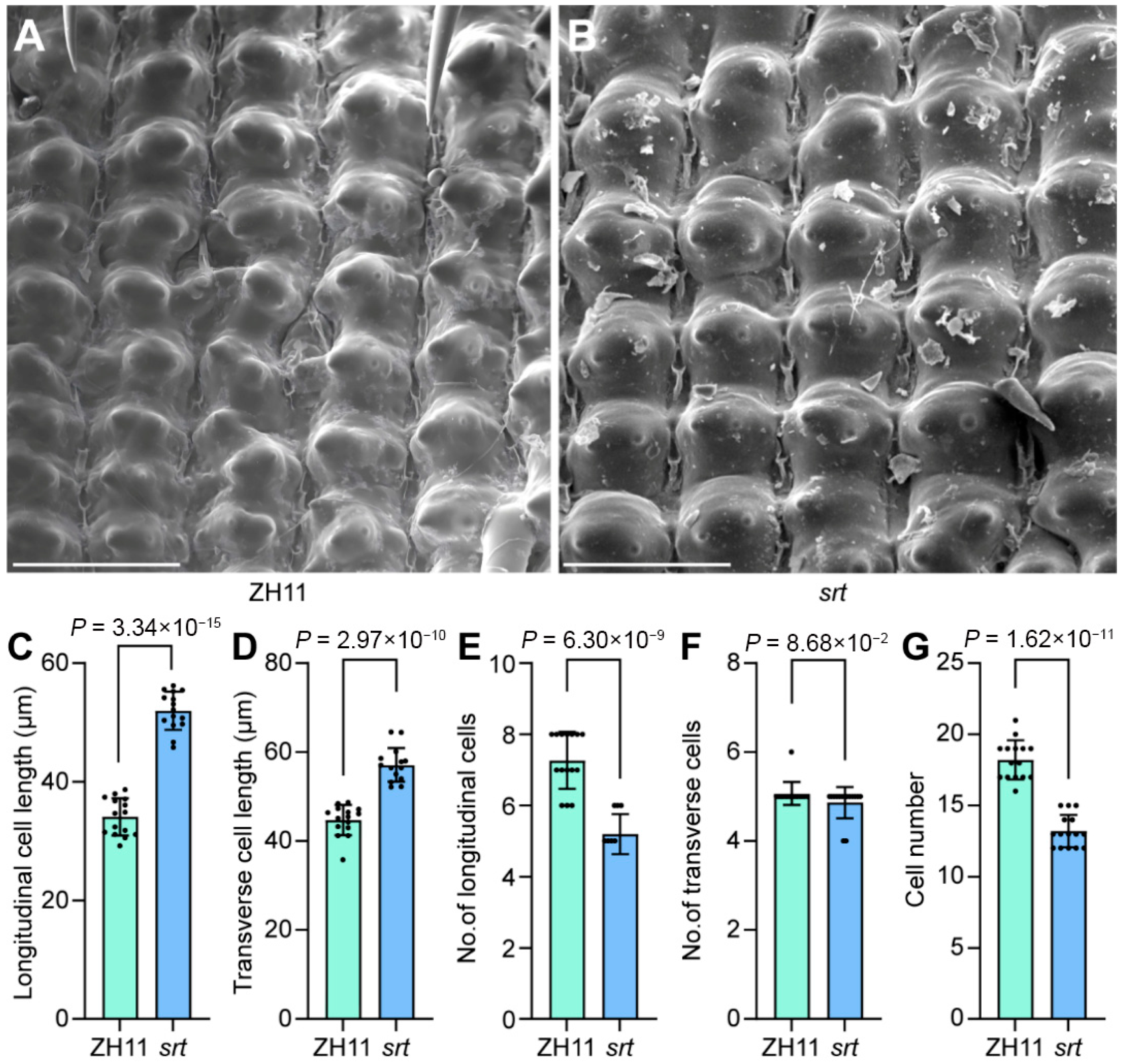
The upper epidermis of glumes from ZH11 and the srt mutant was observed using scanning electron microscopy. The results showed that under the same field of view, the epidermal cells of ZH11 glumes were arranged more densely than those of srt (Figure 3A,B). Further measurement and analysis of glume cell morphology revealed that, compared to ZH11, both the longitudinal and transverse lengths of glume cells in srt were significantly increased (Figure 3C, D). However, the number of longitudinal cells per unit length was significantly lower in srt than in ZH11 (Figure 3E; p = 6.3 × 10⁻⁹), whereas the number of transverse cells per unit length showed no significant change compared to ZH11 (Figure 3F; p = 8.68 × 10⁻²). Additionally, the number of cells per unit area was significantly lower in srt than in ZH11 (Figure 3G; p = 1.62 × 10⁻¹¹).

3.4. Genetic Analysis of the srt Mutant Phenotype

To elucidate the inheritance pattern of the short, round, and thick grain traits, genetic analysis of the srt mutant phenotype was conducted. At the mature stage, three hybrid combinations were analyzed using ZH11 (srt) as the female parent and WSSM, NJ11, and HJX74 as male parents, respectively. Observations revealed that all F1 generation plants exhibited the grain phenotype of the male parent. Further investigation and statistical analysis of traits in the three F2 segregation populations, along with chi-square calculation, showed that the segregation ratio of wild-type to mutant plants fit a 3:1 pattern (χ2 < χ20.05,1 = 3.84) (Table 1). This indicates that the mutant phenotype of srt is controlled by a single recessive gene.

3.5. Map-Based Cloning of the srt Gene

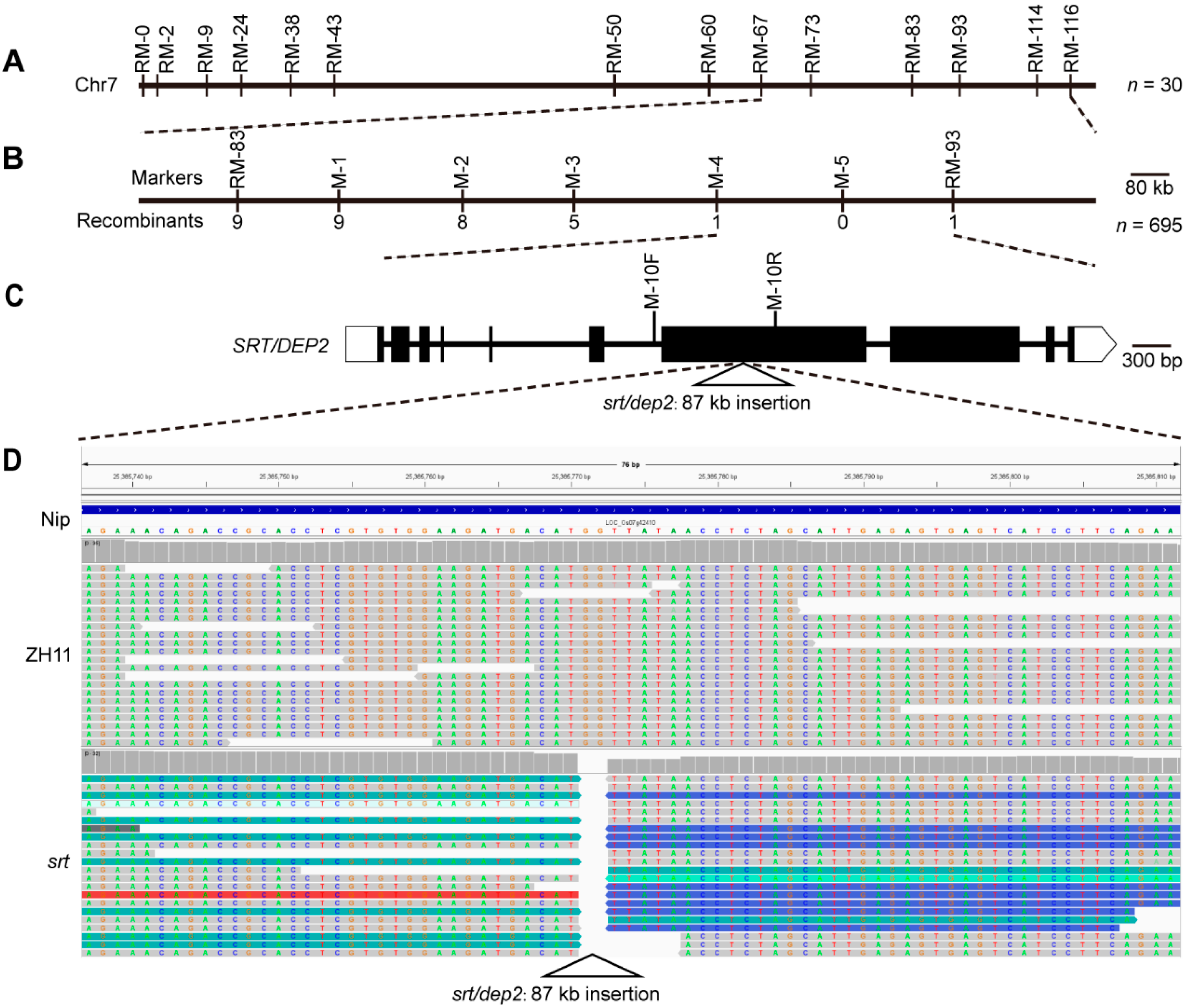
Three F2 segregation populations were utilized as mapping populations, with individuals exhibiting the short, round, and thick grain phenotype serving as mapping plants. First, 226 pairs of SSR primers that were already available in the laboratory, uniformly distributed across all 12 chromosomes and showing polymorphism between the parents were selected. Individuals displaying the extreme srt phenotype within the populations were used for preliminary mapping. The results indicated that the srt gene was preliminarily mapped to a 9.7 Mb interval between markers RM-67 and RM-116 on the long arm of chromosome 7 (Figure 4A). InDel primers were designed within this marker interval (Table S1). Using 695 srt phenotype individuals, the candidate gene was further fine-mapped to a 492 kb region between primer M4 and marker RM-93 (Figure 4B). Analysis of candidate genes within this interval revealed a total of 76 annotated genes. Subsequently, candidate genes were amplified by PCR and the products were directly sequenced (Table S1), but no sequence differences were detected between ZH11 and srt. Further sequencing of ZH11 and srt using Illumina technology revealed, upon resequencing analysis, that except for the LOC_Os07g42410 gene, no significant deletions or insertions were found in the nucleotide sequences of the other genes within the mapping interval between ZH11 and srt. The LOC_Os07g42410 gene consists of 10 exons and 9 introns. Resequencing analysis showed an insertion of approximately 87 kb of unknown sequence in its seventh exon (Figure 4D and Figure S1). Furthermore, based on the exon positions, nine pairs of primers were designed to amplify this gene (Table S1). PCR amplification of the exons of LOC_Os07g42410 from ZH11 and srt was performed. The results showed that the primer pair M-10F and M-10R, targeting the seventh exon, failed to produce normal amplification (Figure S2), while the other exons amplified normally and their nucleotide sequences were identical to those of ZH11. LOC_Os07g42410 corresponds to the previously reported DEP2 gene [20].

4. Discussion

4.1. The srt Mutant Defines a Novel DEP2 Allele with Distinctive Panicle Phenotypes

In this study, a stably inherited short, round and thick grain mutant, srt, was identified in the background of the Japonica rice cultivar ‘Zhonghua 11’. Compared with the wild type, srt exhibited typical phenotypes associated with DEP2 alleles, such as reduced plant height, shortened panicle length, rounded grains, and decreased thousand-grain weight [19,20,21]. However, a crucial and distinctive finding is that the numbers of primary branches, secondary branches, and grains per panicle were all significantly increased in srt (Figure 1). This phenotype stands in contrast to that of most previously reported dep mutants, which typically show no significant difference in branch and grain number per panicle compared with the wild type [20,21]. These results indicate that srt is not a simple loss-of-function mutant; rather, the allelic variation it carries may exert a more complex influence on DEP2 function. Importantly, while this increase in grain number per panicle is a unique feature of srt, it is accompanied by a significant yield penalty (≈34% reduction), which limits its direct breeding application. Nevertheless, this trade-off between grain number and grain weight provides a valuable genetic tool to study the pleiotropic functions of DEP2.

4.2. Large-Fragment Insertion in Exon: Genomic Evidence for a Disruptive Mutation

Through map-based cloning and whole-genome resequencing, we confirmed that srt is indeed the previously reported DEP2 gene. Sequence analysis revealed that a large fragment insertion of approximately 87 kb is present entirely within the seventh exon region of the DEP2 gene in the srt mutant (Figure 4D). We acknowledge that RT-qPCR and Western blot analyses to validate transcript and protein levels are currently lacking, primarily due to time constraints. Nevertheless, we provide the following genomic evidence: multiple primer pairs specifically targeting the seventh exon failed to yield amplification products in srt (Figure S2), whereas adjacent exons could be amplified normally with sequences identical to the wild type. These results, corroborated by the whole-genome resequencing data, confirm a large-scale structural rearrangement in the seventh exon region. According to previous reports, large fragment insertions within exons typically lead to aberrant splicing, premature termination, or transcriptional disruption [19,21,33]. The failure to amplify the seventh exon region suggests that the normal transcript is likely absent or severely truncated in srt.

4.3. Cytological Remodeling Provides a Foundation for Mechanistic Hypotheses

Cytological observations provide a direct explanation for the grain phenotype. Both the longitudinal and transverse dimensions of hull cells in srt were significantly enlarged, yet the number of longitudinal cells per unit length decreased, while the number of transverse cells remained unchanged (Figure 3). This suggests that srt/DEP2 may influence grain morphology by disrupting the balance between cell division and cell expansion. Based on previous reports, DEP2 is known to be involved in multiple signaling pathways, including BR and gibberellin (GA) signaling, which are master regulators of cell division and expansion [22,33]. The phenotype observed in srt—enlarged cells with reduced longitudinal cell number—suggests a shift from cell division toward cell expansion, consistent with a possible disruption of DEP2’s role in integrating hormonal signals. We present these cytological data as a critical foundation for formulating future mechanistic hypotheses, rather than as definitive proof of a specific molecular pathway.

4.4. Limitations and Future Perspectives

This study has several limitations that should be addressed in future work. First, direct genetic complementation of the srt mutant with a wild-type DEP2 allele is needed to definitively establish causality. Second, transcript-level analysis (e.g., RT-PCR, RNA-seq) is required to determine whether the 87 kb insertion leads to aberrant splicing, truncated transcripts, or nonsense-mediated mRNA decay. Third, protein-level validation using a specific DEP2 antibody would confirm the absence or alteration of the DEP2 protein in srt. Whether the srt allele represents a complete loss-of-function or exerts a more complex effect remains to be determined through these future investigations. Additionally, introgressing the srt allele into different genetic backgrounds would help assess the stability and penetrance of the high-branch-number phenotype. Despite these limitations, the srt mutant provides a novel allelic series for dissecting the pleiotropic functions of DEP2.

5. Conclusions

In summary, this study identified and finely mapped a novel rice mutant, srt, which exhibits a unique phenotypic combination of significantly increased grain number per panicle (121% of ZH11, representing a 21% increase) and short, round, thick grains (grain length reduced to 74.86% of ZH11, grain width increased to 121.05%, and grain thickness increased to 111.29%). It was confirmed to be a new allelic variant of the DEP2 gene resulting from a large-fragment insertion of approximately 87 kb located entirely within its seventh exon. Cytological analysis revealed that these grain shape changes are associated with significantly enlarged hull cells and a reduced number of longitudinal cells per unit length. While the accompanying reduction in thousand-grain weight (94.15% of ZH11) and yield per plant (66.14% of ZH11) currently limits its direct breeding value, the unique phenotypic combination offers a valuable genetic entry point for investigating the mechanistic basis of DEP2 pleiotropy. This finding broadens our understanding of the functional diversity of DEP2 and provides important genetic resources for future studies aimed at precisely modifying panicle and grain morphology through gene editing or hybridization approaches.

Supplementary Materials

The following supporting information can be downloaded at: https://www.mdpi.com/article/10.3390/agriculture16050500/s1, Table S1: Primers used in gene mapping; Figure S1: Comparison of differential sites among srt, srs1-1, ep2-1, and rela in the DEP2 gene; Figure S2: PCR amplification validation of the seventh intron region of the srt gene.

Author Contributions

Conceptualization, X.H. and M.Z.; Investigation, H.F., Z.S. and M.L.; Methodology, H.F., Z.S. and M.Z.; Software, M.L. and D.X.; validation, Z.S.; formal analysis, H.F., L.L. and X.H.; resources, X.H. and M.Z.; data curation, Z.S. and M.Z.; writing—original draft preparation, H.F. and Z.S.; writing—review and editing, M.Z. and X.H.; visualization, M.L., L.L. and D.X.; supervision, X.H. and M.Z.; project administration, X.H. and M.Z.; funding acquisition, X.H. and M.Z. All authors have read and agreed to the published version of the manuscript.

Funding

This work was funded by the Peak Discipline Construction Funds for Crop Science of Anhui Science and Technology University (XK-XJGF001), the Excellent Scientific Research and Innovation Team of the Education Department of Anhui Province (2022AH010087), the Science and technology innovation team of Anhui Sciences and Technology University (2023KJCXTD001), the Talent Introduction Start-up Fund Project of Anhui Science and Technology University (NXYJ202001).

Institutional Review Board Statement

Not applicable.

Data Availability Statement

The original contributions presented in the study are included in the article and Supplementary Material, further inquiries can be directed to the corresponding authors.

Conflicts of Interest

The authors declare no conflicts of interest.

References

  1. Zuo, J.R.; Li, J.Y. Molecular genetic dissection of quantitative trait loci regulating rice grain size. Annu. Rev. Genet. 2014, 48, 99–118. [Google Scholar] [CrossRef]
  2. Ren, D.Y.; Ding, C.Q.; Qian, Q. Molecular bases of rice grain size and quality for optimized productivity. Sci. Bull. 2023, 68, 314–350. [Google Scholar] [CrossRef] [PubMed]
  3. Xing, Y.Z.; Zhang, Q.F. Genetic and molecular bases of rice yield. Annu. Rev. Plant Biol. 2010, 61, 421–442. [Google Scholar] [CrossRef] [PubMed]
  4. Huang, R.Y.; Jiang, L.R.; Zheng, J.S.; Wang, T.S.; Wang, H.C.; Huang, Y.M.; Hong, Z.L. Genetic bases of rice grain shape: So many genes, so little known. Trends Plant Sci. 2013, 18, 218–226. [Google Scholar] [CrossRef] [PubMed]
  5. Harberd, N.P. Shaping Taste: The Molecular Discovery of Rice Genes Improving Grain Size, Shape and Quality. J. Genet. Genom. 2015, 42, 597–599. [Google Scholar] [CrossRef]
  6. Li, N.; Xu, R.; Li, Y.H. Molecular Networks of Seed Size Control in Plants. Annu. Rev. Plant Biol. 2019, 70, 435–463. [Google Scholar] [CrossRef]
  7. Fan, C.C.; Xing, Y.Z.; Mao, H.L.; Lu, T.T.; Han, B.; Xu, C.G.; Li, X.H.; Zhang, Q.F. GS3, a major QTL for grain length and weight and minor QTL for grain width and thickness in rice, encodes a putative transmembrane protein. Theor. Appl. Genet. 2006, 112, 1164–1171. [Google Scholar] [CrossRef]
  8. Mao, H.L.; Sun, S.Y.; Yao, J.L.; Wang, C.R.; Yu, S.B.; Xu, C.G.; Li, X.H.; Zhang, Q.F. Linking differential domain functions of the GS3 protein to natural variation of grain size in rice. Proc. Natl. Acad. Sci. USA 2010, 107, 19579–19584. [Google Scholar] [CrossRef]
  9. Huang, X.Z.; Qian, Q.; Liu, Z.B.; Sun, H.Y.; He, S.Y.; Luo, D.; Xia, G.M.; Chu, C.C.; Li, J.Y.; Fu, X.D. Natural variation at the DEP1 locus enhances grain yield in rice. Nat. Genet. 2009, 41, 494–497. [Google Scholar] [CrossRef]
  10. Sun, S.Y.; Wang, L.; Mao, H.L.; Shao, L.; Li, X.H.; Xiao, J.H.; Ouyang, Y.; Zhang, Q.F. A G-protein pathway determines grain size in rice. Nat. Commu. 2018, 9, 851. [Google Scholar] [CrossRef]
  11. Choi, B.S.; Kim, Y.J.; Markkandan, K.; Koo, Y.J.; Song, J.T.; Seo, H.S. GW2 Functions as an E3 Ubiquitin Ligase for Rice Expansin-Like 1. Int. J. Mol. Sci. 2018, 19, 1904. [Google Scholar] [CrossRef] [PubMed]
  12. Huang, J.P.; Chen, Z.M.; Lin, J.J.; Guan, B.B.; Chen, J.W.; Zhang, Z.S.; Chen, F.Y.; Jiang, L.R.; Zheng, J.S.; Wang, T.S.; et al. gw2.1, a new allele of GW2, improves grain weight and grain yield in rice. Front. Plant Sci. 2022, 325, 111495. [Google Scholar] [CrossRef] [PubMed]
  13. Wang, S.K.; Li, S.; Liu, Q.; Wu, K.; Zhang, J.Q.; Wang, S.S.; Wang, Y.; Chen, X.B.; Zhang, Y.; Gao, C.X.; et al. The OsSPL16-GW7 regulatory module determines grain shape and simultaneously improves rice yield and grain quality. Nat. Genet. 2015, 47, 949–954. [Google Scholar] [CrossRef]
  14. Tan, W.C.; Miao, J.; Xu, B.; Zhou, C.T.; Wang, Y.R.; Gu, X.Q.; Liang, S.N.; Wang, B.X.; Chen, C.; Zhu, J.Y.; et al. Rapid production of novel beneficial alleles for improving rice appearance quality by targeting a regulatory element of SLG7. Plant Biotechnol. J. 2023, 21, 1305–1307. [Google Scholar] [CrossRef] [PubMed]
  15. Duan, P.G.; Xu, J.S.; Zeng, D.L.; Zhang, B.L.; Geng, M.F.; Zhang, G.Z.; Huang, K.; Huang, L.J.; Xu, R.; Ge, S.; et al. Natural Variation in the Promoter of GSE5 Contributes to Grain Size Diversity in Rice. Mol. Plant 2017, 10, 685–694. [Google Scholar] [CrossRef]
  16. Liu, J.F.; Chen, J.; Zheng, X.M.; Wu, F.Q.; Lin, Q.B.; Heng, Y.Q.; Tian, P.; Cheng, Z.J.; Yu, X.W.; Zhou, K.N.; et al. GW5 acts in the brassinosteroid signalling pathway to regulate grain width and weight in rice. Nat. Plants 2017, 3, 17043. [Google Scholar] [CrossRef]
  17. Zhang, X.F.; Yang, C.Y.; Lin, H.X.; Wang, J.W.; Xue, H.W. Rice SPL12 coevolved with GW5 to determine grain shape. Sci. Bull. 2021, 66, 2353–2357. [Google Scholar] [CrossRef]
  18. Si, L.Z.; Chen, J.Y.; Huang, X.H.; Gong, H.; Luo, J.H.; Hou, Q.Q.; Zhou, T.Y.; Lu, T.T.; Zhu, J.J.; Shangguan, Y.Y.; et al. OsSPL13 controls grain size in cultivated rice. Nat. Genet. 2016, 48, 447–456. [Google Scholar] [CrossRef]
  19. Abe, Y.; Mieda, K.; Ando, T.; Kono, I.; Yano, M.; Kitano, H.; Iwasaki, Y. The SMALL AND ROUND SEED1 (SRS1/DEP2) gene is involved in the regulation of seed size in rice. Genes Genet. Syst. 2010, 85, 327–339. [Google Scholar] [CrossRef]
  20. Li, F.; Liu, W.D.; Tang, J.Y.; Chen, J.F.; Tong, H.N.; Hu, B.; Li, C.L.; Fang, J.; Chen, M.S.; Chu, C.C. Rice DENSE AND ERECT PANICLE 2 is essential for determining panicle outgrowth and elongation. Cell Res. 2010, 20, 838–849. [Google Scholar] [CrossRef]
  21. Zhu, K.M.; Tang, D.; Yan, C.J.; Chi, Z.C.; Yu, H.X.; Chen, J.M.; Liang, J.S.; Gu, M.H.; Cheng, Z.K. Erect panicle2 encodes a novel protein that regulates panicle erectness in indica rice. Genetics 2010, 184, 343–350. [Google Scholar] [CrossRef] [PubMed]
  22. Li, Y.J.; Huang, K.; Zhang, L.M.; Zhang, B.L.; Duan, P.G.; Zhang, G.Z.; Huang, X.H.; Zhou, C.; Han, N.N.; Zheng, L.Y.; et al. A molecular framework for the GS2-SUG1 module-mediated control of grain size and weight in rice. Nat. Commu. 2025, 16, 3944. [Google Scholar] [CrossRef] [PubMed]
  23. Xu, X.; Liu, B.M.; Zhang, L.L.; Wu, Y.J. Mutagenic effects of heavy ion irradiation on rice seeds. Nucl. Instrum. Methods Phys. Res. 2012, 290, 19–25. [Google Scholar] [CrossRef]
  24. Edwards, K.; Johnstone, C.; Thompson, C. A simple and rapid method for the preparation of plant genomic DNA for PCR analysis. Nucleic Acids Res. 1991, 19, 1349. [Google Scholar] [CrossRef]
  25. Weber, S.; Ramirez, C.; Doerfler, W. Signal hotspot mutations in SARS-CoV-2 genomes evolve as the virus spreads and actively replicates in different parts of the world. Virus Res. 2020, 289, 198170. [Google Scholar] [CrossRef]
  26. de Sena Brandine, G.; Smith, A.D. Falco: High-speed FastQC emulation for quality control of sequencing data. F1000Research 2019, 8, 1874. [Google Scholar] [CrossRef]
  27. Bolger, A.M.; Lohse, M.; Usadel, B. Trimmomatic: A flexible trimmer for Illumina sequence data. Bioinformatics 2014, 30, 2114–2120. [Google Scholar] [CrossRef]
  28. Li, H.; Durbin, R. Fast and accurate long-read alignment with Burrows-Wheeler transform. Bioinformatics 2010, 26, 589–595. [Google Scholar] [CrossRef]
  29. Kawahara, Y.; de la Bastide, M.; Hamilton, J.P.; Kanamori, H.; McCombie, W.R.; Ouyang, S.; Schwartz, D.C.; Tanaka, T.; Wu, J.; Zhou, S.; et al. Improvement of the Oryza sativa Nipponbare reference genome using next generation sequence and optical map data. Rice 2013, 6, 4. [Google Scholar] [CrossRef]
  30. Li, H.; Handsaker, B.; Wysoker, A.; Fennell, T.; Ruan, J.; Homer, N.; Marth, G.; Abecasis, G.; Durbin, R. The Sequence Alignment/Map format and SAMtools. Bioinformatics 2009, 25, 2078–2079. [Google Scholar] [CrossRef]
  31. McKenna, A.; Hanna, M.; Banks, E.; Sivachenko, A.; Cibulskis, K.; Kernytsky, A.; Garimella, K.; Altshuler, D.; Gabriel, S.; Daly, M.; et al. The Genome Analysis Toolkit: A Map Reduce framework for analyzing next-generation DNA sequencing data. Genome Res. 2010, 20, 1297–1303. [Google Scholar] [CrossRef]
  32. Robinson, J.T.; Thorvaldsdóttir, H.; Winckler, W.; Guttman, M.; Lander, E.S.; Getz, G.; Mesirov, J.P. igv.js: An embeddable JavaScript implementation of the Integrative Genomics Viewer (IGV). Nat. Biotechnol. 2011, 29, 24–26. [Google Scholar] [CrossRef]
  33. Zhu, C.L.; Xing, B.; Teng, S.Z.; Deng, C.; Shen, Z.Y.; Ai, P.F.; Lu, T.G.; Zhang, S.W.; Zhang, Z.G. OsRELA Regulates Leaf Inclination by Repressing the Transcriptional Activity of OsLIC in Rice. Front. Plant Sci. 2021, 12, 760041. [Google Scholar] [CrossRef]
Figure 1. Comparison of plant height and panicle type between rice ZH11 and the srt mutant. (A) Plant growth status under field conditions, scale bar: 20 cm; (B) Panicle type, scale bar: 5 cm; (C) Single plant yield, scale bar: 5 cm; (D) Plant height; (E) Tiller number; (F) Panicle length; (G) Number of primary branches per panicle; (H) Number of secondary branches per panicle; (I) Number of grains per panicle; (J) Thousand-grain weight; and (K) Statistical analysis of yield per plant. Student’s t-test was used for significance analysis of differences. Data are presented as mean ± SD; n = 15 plants for agronomic traits, n = 15 seeds for grain traits.
Agriculture 16 00500 g001
Figure 2. Comparison of grain type between rice ZH11 and the srt mutant. (A) Grain length (top) and hull-removed grain length (bottom) at mature stage; (B) Grain width (top) and hull-removed grain width (bottom) at the mature stage; (C) Grain thickness (top) and hull-removed grain thickness (bottom) at the mature stage; (D) Comparison of grain length at mature stage; (E) Comparison of grain width at the mature stage; (F) Comparison of grain thickness at the mature stage; (G) Comparison of grain area. Scale bar: 0.5 cm. Student’s t-test was used for significance analysis of differences. Data are presented as mean ± SD; n = 15 seeds for grain traits.
Agriculture 16 00500 g002
Figure 3. Scanning electron microscopy observation and analysis of grain glume cells in ZH11 and the srt mutant. (A) SEM image of glumes from mature ZH11 grains; (B) SEM image of glumes from mature srt grains; (C) Longitudinal cell length in ZH11 and srt; (D) Transverse cell length in ZH11 and srt; (E) Number of longitudinal cells per unit length in ZH11 and srt; (F) Number of transverse cells per unit length in ZH11 and srt; and (G) Number of cells per unit area in ZH11 and srt. Scale bar: 100 μm. Student’s t-test was used for significance analysis of differences. Data are presented as mean ± SD; n = 15, the number of sample size in (CG).
Agriculture 16 00500 g003
Figure 4. Mapping of the srt gene. (A) The srt gene was initially mapped between RM-63 and RM-116, n = 30; (B) The srt gene was fine-mapped between M4 and RM-93, n = 695; (C) Gene structure of the candidate gene LOC_Os07g42410. Black rectangles represent exons, lines represent introns, the white rectangle indicates the 5′UTR, and the triangle indicates the 3′UTR; and (D) IGV visualization of whole-genome resequencing data for ZH11 and srt. The triangle represents the 87 kb insertion.
Agriculture 16 00500 g004
Table 1. Genetic analysis of inheritance of the mutant srt gene in rice hybrids.
Hybrid CombinationF1 PhenotypeF2 Generationχ23∶1
No. of Paternal PhenotypesNo. of Mutant PhenotypesTotal Numbers
ZH11 (srt) × WSSMWSSM76723310001.452
ZH11 (srt) × NJ11NJ117222189401.545
ZH11 (srt) × HJX74HJX7481624410602.11
Disclaimer/Publisher’s Note: The statements, opinions and data contained in all publications are solely those of the individual author(s) and contributor(s) and not of MDPI and/or the editor(s). MDPI and/or the editor(s) disclaim responsibility for any injury to people or property resulting from any ideas, methods, instructions or products referred to in the content.