


Abstract
This survey of rapeseed oils purchased on the Central European retail market in 2025 included 31 products: 19 refined oils (including three declared as gently refined and one high-oleic oil) and 12 cold-pressed oils; seven products (six cold-pressed and one refined) came from certified organic farming. The oils demonstrated high quality of technological processing with low values of trans-unsaturated fatty acids, acid value, and peroxide value and also met the limits set by legislation in the content of erucic acid, process contaminants 3-monochloropropane-1,2-diol (3-MCPD) esters and glycidyl esters, and residue of pesticides. Oxidative stability, expressed as the induction period ranging from 2.4 to 5.6 h, predisposes them to cold cooking or short-term frying, while the 6.1 h of the high oleic rapeseed oil (HORO) indicates the possibility of medium-term heat stress. The nutritional benefit is a low content of saturated fatty acids (5.69–8.15%) and a high content of mono- and polyunsaturated fatty acids, with a favorable n-3 α-linolenic acid proportion ranging from 7.04 to 10.33%, and an average vitamin E content of 305 mg/kg oil. Sensory quality ranged from excellent to fair; cold-pressed oils were characterized by a more pronounced color, aroma, and typical nutty flavor, whereas refined oils were sensorially almost neutral. Within the analyzed set of products and the parameters determined, the results indicate that rapeseed oil available on the Central European market is a nutritionally valuable and technologically high-quality commodity. Principal component analysis showed that the processing technology (refined vs. cold-pressed) was the main factor structuring the data, followed by tocopherol content and oxidative status, whereas organic and conventional cold-pressed oils were not differentiated.
1. Introduction
Vegetable oils are an important part of a healthy diet. One of the most widely used in European households and gastronomy is rapeseed oil, owing to its affordability, versatility, and favorable nutritional profile. In the food industry, it is a component of margarines, mayonnaises, tartar sauces, dressings or various bakery products. Furthermore, a huge proportion is channeled into the industrial sector for the production of biodiesel [1,2,3]. The oil is extracted from the seeds of varieties derived from Brassica napus L., Brassica campestris L. and Brassica juncea L., species, a crop of the temperate zone. Total European Union (EU) oilseed production in the 2025/2026 marketing year included rapeseed at 20,245 thousand metric tons (TMT), the largest share among domestic oilseeds, ahead of sunflower seed (8575 TMT) and soybean (2785 TMT) [4]. Globally, with an annual production of 35.68 million tonnes (2025/2026 marketing year), rapeseed oil ranks third among edible oils, behind only palm and soybean oil [5].
Historically, the use of rapeseed oil in human nutrition was limited by its content of erucic acid, a monounsaturated fatty acid (C22:1) associated with cardiotoxic effects in animal studies, and by glucosinolates in the seed meal, which impair its nutritional value as animal feed. Early cultivars contained up to 45% erucic acid in the oil and were used mainly for industrial (lubricant) purposes. Systematic breeding from the 1960s onward led to the development of so-called single-zero and, from 1974 onward, double-zero (00) cultivars combining low erucic acid content with reduced glucosinolate levels, which enabled the widespread food use of rapeseed/canola oil that continues today [6]. The Codex Alimentarius standard defines low-erucic-acid rapeseed oil as containing not more than 2% erucic acid [7], a level that modern double-zero cultivars meet with a substantial margin. Nevertheless, the misconception that rapeseed oil still contains high concentrations of erucic acid remains a persistent myth affecting its popularity among consumers, particularly the older generation who recall the earlier high-erucic-acid oil.
In industrial processing, rapeseed oil is typically subjected to refining, during which the majority of undesirable but also many sensorially active compounds are deliberately removed—pigments (chlorophyll and its degradation products, carotenoids), as well as compounds responsible for taste and odor [8]. However, in the vegetable oil processing industry, it was necessary to develop specialized strategies to mitigate the negative impacts of the formation of process contaminants esters: 3-monochloropropane-1,2-diol (3-MCPD), 2-monochloropropane-1,3-diol (2-MCPD) and glycidyl fatty acid esters, mainly formed during high-temperature deodorization [9,10]. Owing to the long tradition of using refined oils, consumers expect an oil of light color and almost neutral taste. Cold-pressed oil (CPO), with a more pronounced taste of the raw material and a nutty character, is more of a specialty suited to cold cuisine. Both oil types can also be found on the market as products of certified organic farming.
From a nutritional standpoint, rapeseed oil is regarded as one of the vegetable oils with the most favorable fatty acid composition, combining a low content of saturated fatty acids (SFAs) with a high proportion of monounsaturated oleic acid and one of the most favorable n-6/n-3 ratios among common vegetable oils, owing to its comparatively high content of α-linolenic acid (n-3) [7,11,12]. As observed in other oilseed crops [7], cultivars with modified fatty acid compositions and elevated oleic acid concentrations have been developed through plant breeding. High-oleic rapeseed cultivars are widely grown outside Europe, particularly in Canada, the United States, and Australia. In the European Union, however, commercially cultivated high-oleic rapeseed varieties have been obtained through conventional breeding, as the commercial cultivation of genetically modified rapeseed is currently not authorized in the EU. Oils produced from these cultivars are commonly known as high-oleic rapeseed oil (HORO) or high-oleic, low-linolenic (HOLL) rapeseed oil. Their elevated monounsaturated fatty acids (MUFAs) content and reduced proportion of polyunsaturated fatty acids (PUFAs) confer enhanced oxidative stability, making them particularly suitable for high-temperature applications such as deep-fat frying [13].
Among the minor constituents of rapeseed oil, α-tocopherol is considered the most nutritionally significant due to its high concentration and biological activity. According to published studies, the total tocopherol content in rapeseed oil ranges from 390 to 2680 mg/kg oil, depending strongly on cultivar and growing conditions [7,11,14]. Adequate dietary intake of vitamin E (authoritative bodies consider vitamin E as being α-tocopherol equivalents or α-tocopherol only) is essential for preventing neurological disorders associated with vitamin E deficiency and may also contribute to the reduction in oxidative-stress-related diseases [15]. Recommended daily intakes for adults vary internationally, generally stated as 7.5 to 15 mg per day. The lowest recommendations have been established by the World Health Organization (WHO), which suggests a daily intake of 10 mg α-tocopherol equivalents (α-TE) for men and 7.5 mg α-TE for women [16]. In contrast, the highest recommended intake is reported in the United States, where the daily requirement of vitamin E, defined as the biologically active stereoisomers of α-tocopherol, is set at 15 mg for both sexes [17]. The European Food Safety Authority (EFSA) has established adequate intake levels of 13 mg/day for men and 11 mg/day for women of α-tocopherol [15].
The composition and quality of rapeseed oil have already been studied in various contexts [13,14,18,19,20,21,22]. Retail and market surveys of cold-pressed rapeseed oils in Germany [23], Poland [24,25] and the United Kingdom, Ireland and France [26] documented substantial between-brand variability in acid and peroxide values, tocopherol contents and oxidative stability, whereas laboratory and plant-scale processing studies described the effects of pressing, refining and deodorization conditions on the composition and stability of the oil [27,28,29]. The occurrence of 3-MCPD and glycidyl esters in edible oils, including rapeseed oil, has been monitored since the mid-2000s [9,30,31], and pesticide residues in cold-pressed rapeseed oils from conventional and ecological cultivation have been compared [24]. However, few studies have combined these endpoints—fatty acid profile, tocochromanols, hydrolytic and oxidative status, oxidative stability, process contaminants, pesticide residues and sensory quality—in one set of retail products sampled after the EU maximum levels for 3-MCPD and glycidyl esters in vegetable oils became applicable [32]. The aim of this work was therefore to provide such an integrated snapshot of rapeseed oils on the Central European retail market, to examine whether persisting consumer concerns (e.g., about erucic acid) are supported by current data, and to explore relationships among the measured parameters using multivariate statistics. The study follows the analytical framework previously applied to sunflower oil from the same market [33]. However, it differs in the oil matrix and has a broader scope, including pesticide residue analysis (also covering organic products), a high-oleic variety, and multivariate statistical evaluation. A brief comparison of the two oil matrices is provided in Section 4.
2. Materials and Methods
Samples of rapeseed oil were purchased from retail stores in Austria, the Czech Republic, Germany, Poland, and Slovakia between February and July 2025 for laboratory analysis (Table 1). The products were selected as a convenience sample intended to cover the main types of rapeseed oil available on the shelves at the time of purchase, i.e., products of major national and private-label brands, cold-pressed specialty oils, certified organic products and the only high-oleic rapeseed oil found. Each product was represented by one lot. The sample set contained 31 products, of which 19 were refined, and 12 were CPOs; seven products were certified organic (six cold-pressed and one refined, sample 26). Three refined products (samples 6, 12 and 13) were declared by the manufacturers as “gently refined”. This term is not legally defined; it usually denotes refining under milder deodorization conditions (lower temperature and/or shorter time) intended to retain more minor constituents and part of the characteristic flavor of the oil. Because no process data were available, these samples were classified according to the label declaration and were included in the refined group in all statistical comparisons. The origin of the seeds given in Table 1 corresponds to the label declaration. Because the sample set is not a probability sample of the market, the results describe the analyzed products and cannot be extrapolated to the whole Central European market without caution. All samples were at least 6 months prior to the best-before date at the time of analysis.
Table 1.
List of rapeseed oil samples from the market and their characteristics.
The fatty acid content was determined after esterification to methyl esters (FAMEs) according to EN ISO 12966-2:2017 [34]. FAMEs extracted into hexane were analyzed under the conditions described by Pohořelá et al. [35]. The fatty acid quantification was carried out by the internal normalization method, and the results were expressed as relative percentages of all identified fatty acids.
Tocochromanols, i.e., α-tocopherol (α-T), β-tocopherol (β-T), γ-tocopherol (γ-T), δ-tocopherol (δ-T), α-tocotrienol (α-T3), β-tocotrienol (β-T3), γ-tocotrienol (γ-T3), and δ-tocotrienol (δ-T3), were determined by high-performance liquid chromatography (HPLC) with an amperometric detector according to Fišnar [36]. The quantification was carried out by external calibration using the respective tocopherol standards. The content of vitamin E in α-tocopherol equivalents (α-TE) was calculated according to the formula [37]: α-TE = α-T + 0.5 β-T + 0.1 γ-T + 0.03 δ-T + 0.3 α-T3 + 0.05 γ-T3. Use of the α-TE unit has been the accepted way of reporting vitamin E concentration in foods. The limits of detection (LOD) and quantification (LOQ) of the method were 0.5 mg/kg and 2.0 mg/kg, respectively; analytes below the LOD are reported as not detected.
The oxidative stability of the oil samples was determined by the Rancimat test (Official Method AOCS Cd 12b-92 1993) [38] on a Rancimat apparatus (Metrohm, Herisau, Switzerland). An oil sample (2.5 g) was subjected to a constant temperature of 120 °C and an air flow rate of 20 L/h. The result was expressed as the induction period (IP) in hours, with a longer IP indicating greater oxidative stability. Because IP values depend strongly on the test temperature, air flow and sample mass, the results were compared only with the literature data obtained at 120 °C.
The acid value (AV) and peroxide value (PV) were both determined by titration according to EN ISO 660 [39] and EN ISO 3960 [40], respectively.
The content of MCPD esters and glycidyl esters was determined by gas–liquid chromatography according to AOCS Official Method Cd 29a-13 [41] under the conditions described by Nakonechna et al. [33]. The concentration was expressed as the amount of 3-MCPD, 2-MCPD, and glycidol, respectively, of the respective esters. The analytes are thus ester-bound; the results are expressed as the equivalent amounts of the free compounds. The LOD and LOQ were 50 and 150 µg/kg, respectively, for all three analytes.
For all of the above measurements, each sample was analyzed in duplicate. To verify method reliability, six replicate determinations were performed on a selected sample, with the repeatability—expressed as relative standard deviation (RSD)—remaining below 5% for all methods. The reported standard deviations were estimated from the repeatability RSD of the respective method obtained from these six replicate determinations, not from the duplicate measurements, which are too few for a reliable estimate of variability. The individual product was considered the experimental unit, and the means of the duplicates were used for the statistical evaluation. Differences between refined (n = 18; the high-oleic sample 31 excluded) and cold-pressed oils (n = 12), and between organic (n = 6) and conventional (n = 6) cold-pressed oils, were evaluated by Welch’s two-sample t-test, with the Mann–Whitney U test as a non-parametric check. Because 15 variables were compared, p-values were adjusted for multiplicity using the Holm method, and effect sizes were reported as Hedges’ g together with the 95% confidence interval (CI) of the difference between group means. As the high-oleic oil was represented by a single product, no inferential statistics were applied to it. Comparisons between organic and conventional oils and correlations between variables (Pearson’s correlation coefficient, r) are considered exploratory. Principal component analysis (PCA) and hierarchical cluster analysis (HCA; Ward’s method, Euclidean distance) were performed on autoscaled data of 17 variables (palmitic, stearic, oleic, linoleic, α-linolenic and erucic acids, total TFAs, α-tocopherol, total tocopherols, AV, PV, IP, 3-MCPD esters, glycidyl esters, odor intensity, taste intensity and overall sensory rating); for this purpose only, concentrations below the LOD and LOQ were replaced by LOD/2 and (LOD + LOQ)/2, respectively (i.e., 25 and 100 µg/kg for MCPD and glycidyl esters). Sensory data were evaluated by one-way analysis of variance with Scheffé’s post hoc test using Statistica (StatSoft, Inc., Tulsa, OK, USA); the other statistical analyses were performed in Python 3 (NumPy and SciPy libraries). Differences were considered significant at p < 0.05.
For the determination of pesticide residues, a QuOil-based extraction method was used [42]. Two grams of sample were weighed into a 50 mL centrifuge tube. Subsequently, 10 mL of 1% formic acid in acetonitrile was added, and the tube was shaken on a vertical laboratory shaker for 2 min at 1000 min−1. Next, 100 μL of an internal standard solution (triphenyl phosphate and nicarbazin) at a concentration of 5 μg/ml was added; the cuvette was shaken thoroughly and centrifuged for 5 min at 10,000 min−1. Subsequently, 3 mL of the extract was taken and purified using 75 mg of Bondesil PSA sorbent and 75 mg of Bondesil C18 sorbent. In a 15 mL centrifuge cuvette, the extract was mixed vigorously for 1 min using a vortex mixer and then centrifuged at 6000 min−1 for 2 min. Finally, the purified extract was transferred to a vial and subjected to analysis. The analysis was conducted using ultra-high-performance liquid chromatography coupled with tandem mass spectrometry (UHPLC-MS/MS) under the conditions described by Han et al. [43].
To validate the above-mentioned method, blank samples were spiked with the target analytes at two concentration levels (0.01 and 0.1 mg/kg), each in six replicates. After weighing 2 g of the sample and adding a mixed pesticide standard, the samples were left to stand for 30 min. Subsequently, the analytical procedure was performed in the same manner as for the tested samples. Validation was carried out for a targeted set of 100 analytes, including pesticides, pesticide metabolites, and a pesticide synergist. The selection of analytes was based on published data regarding pesticide residues in rapeseed and rapeseed oil [24,44,45,46,47,48], their relevance to rapeseed production practices, and the preliminary screening results obtained in the present study. The performance characteristics of the method were assessed in accordance with the requirements and acceptance criteria specified in the SANTE/11312/2021v2 guidance document [49]. The analytical method showed satisfactory performance for the determination of the target analytes (pesticide residues, their metabolites, and a pesticide synergist, n = 100) in rapeseed oil. The obtained recoveries (REC), relative standard deviations under repeatability conditions (RSDr), limits of quantitation (LOQs), along with the LC-MS/MS acquisition parameters, are summarized in Table S1. At the spiking level of 0.010 mg/kg, recoveries ranged from 74 to 120%, with RSDr values between 2 and 20%. At the spiking level of 0.100 mg/kg, recoveries ranged from 71 to 113%, while RSDr values varied between 1 and 12%. The LOQs achieved for the target analytes covered the interval from 0.005 to 0.100 mg/kg.
The organoleptic properties of the samples were assessed in the Sensory Laboratory of the University of Chemistry and Technology Prague, equipped in accordance with ISO 8589 [50], by a 12-member panel of trained assessors. The assessors were selected, trained, and monitored according to the international standard ISO 8586 [51], ISO 5496 [52], and ISO 3972 [53]. The assessors were also trained and experienced in evaluating edible oils and fats. Samples were coded and presented in randomized order. A 100-point unstructured scale with 5 descriptors was used for the evaluation: odor intensity, overall pleasantness of odor, taste intensity, overall pleasantness of taste, and overall off-flavor intensity, followed by a free qualitative description of the organoleptic characteristics. A seven-point ordinal category scale was used for the overall evaluation (1—very poor, 2—poor, 3—fair, 4—good, 5—very good, 6—excellent, 7—exceptional). RedJade software (RedJade Sensory Solutions, LLC, Martinez, CA, USA) was used for the collection of sensory analysis data and their statistical processing.
3. Results
3.1. Fatty Acid Composition
The basic characteristics of the oil composition were illustrated by the fatty acid profile summarized in Table 2 and Table 3. All samples exhibited a low content of SFAs (7.01–8.15%), a high content of MUFAs (61.4–66.5%), dominated by oleic acid (57.5–61.5%), and a substantial content of PUFAs (25.8–29.7%). The content of n-3 fatty acids, represented in rapeseed oil only by α-linolenic acid (C18:3, ∆9,12,15 cis, cis, cis), ranged from 7.04 to 10.3%, and the content of n-6 linoleic acid (C18:2, ∆9,12 cis, cis) ranged from 17.5 to 21.3%. Compared to conventional oil types, HORO (sample no. 31) exhibits an altered fatty acid profile, characterized by an increased proportion of oleic acid (72.2%) at the expense of linoleic acid (8.13%) and, to a lesser extent, saturated fatty acids (5.69%). Among the remaining fatty acids, not presented in Table 2, at levels exceeding 1%, only palmitoleic acid (C16:1, ∆9 cis) and eicosenoic acid (C20:1, ∆11 cis), commonly known as gondoic acid, were detected. The content of nutritionally undesirable erucic acid (C22:1, ∆13 cis) was low in all samples, ranging from 0.04 to 0.49%. Of the other fatty acids occurring at concentrations between 0.1% and 1%, only arachidic acid (C20:0), behenic acid (C22:0), lignoceric acid (C24:0), and nervonic acid (C24:1, ∆15 cis) were quantified. The content of trans-unsaturated fatty acids (TFAs) in refined oils ranged from 0.23 to 1.35%, whereas significantly lower levels were detected in CPOs (0.09–0.16%; mean difference 0.57 percentage points, 95% CI 0.40–0.75; Hedges’ g = 2.05; Holm-adjusted p < 0.001). Within the refined group, the three gently refined oils (samples 6, 12 and 13) had the lowest TFA contents (0.23–0.28%), whereas the other refined low-erucic oils contained 0.36–1.35% TFAs (mean 0.79%), which is consistent with milder deodorization conditions (see Section 4). The average concentrations of trans isomers in refined oils were 0.05%, 0.10%, and 0.54% for trans-octadecenoic acids, trans-octadecadienoic acids, and trans-octadecatrienoic acids, respectively, demonstrating the higher susceptibility of fatty acids to isomerization reactions with an increasing number of double bonds [1,27].
Table 2.
Composition of fatty acids in rapeseed oils (as % of total fatty acids).
Table 3.
Composition of fatty acid groups in rapeseed oils (as % of total fatty acids).
3.2. Tocopherols as Naturally Present Antioxidants
Tocochromanols (vitamin E compounds, including tocopherols and tocotrienols, particularly α-tocopherol) represent a major group of lipophilic antioxidants that play a crucial role in protecting polyunsaturated fatty acids incorporated into tissue lipids against free radical-mediated oxidation. Their antioxidant function is especially important for maintaining the integrity of biological membranes and lipoproteins [16].
The total tocochromanol content averaged 586 mg/kg in refined oil samples, whereas slightly higher concentrations were detected in CPOs, reaching an average of 645 mg/kg (Table 4). The tocochromanol pattern was characterized by the predominance of γ-tocopherol (328 mg/kg), accompanied by a substantial concentration of α-tocopherol (272 mg/kg). In contrast, only trace amounts of δ-tocopherol (8.7 mg/kg) were found, while β-tocopherol and tocotrienols were below the LOD (0.5 mg/kg) in all analyzed samples. The vitamin E activity, expressed as α-tocopherol equivalents (α-TE), reached 299 mg/kg in refined oils, while a moderately higher value of 313 mg/kg was observed in cold-pressed samples. The total tocopherol content of CPOs was higher than that of refined oils by 52 mg/kg on average (95% CI −5 to 109 mg/kg; Hedges’ g = 0.65), but this difference was not significant after Holm adjustment (p = 0.64); no significant differences were found for α-tocopherol or α-TE either. Statistical analysis using Student’s t-test revealed a significant difference only for γ-tocopherol content between cold-pressed and refined oils (p < 0.05).
Table 4.
Content of tocopherols and vitamin E in α-tocopherol equivalents and values characterizing quality of rapeseed oils—acid value, peroxide value, and induction period.
3.3. Free Fatty Acid Content
Small amounts of free fatty acids are naturally present in vegetable oils, and their concentration is reflected by the AV. Refined oils exhibited significantly lower AV (0.06–0.23 mg KOH/g) than CPOs (0.57–3.35 mg KOH/g). The difference was significant (mean difference 1.29 mg KOH/g, 95% CI 0.73–1.84; Hedges’ g = 2.28; Holm-adjusted p = 0.004) (Table 4). The decrease in AV after refining indicates a substantial reduction in the concentration of free fatty acids in the oil samples. All analyzed samples complied with the limits established by the Codex Alimentarius, which specify a maximum AV of 0.6 mg KOH/g for refined vegetable oils and 4.0 mg KOH/g for cold-pressed and virgin oils (with the exception of crude palm kernel oil and virgin palm oil) [7].
3.4. Peroxide Value
The PV, which reflects the concentration of hydroperoxides formed during the initial stages of lipid oxidation, was determined to assess the oxidative status of the analyzed oils. The results are presented in Table 4. Freshly refined oils are generally characterized by PV values below 1 meq O2/kg oil [33,54]. In the present study, eight refined oils (samples 1, 2, 6, 11, 14, 17, 26 and 31; note that organic sample 26 is a refined oil) and one cold-pressed oil (sample 18) exhibited PV values below 2 meq O2/kg oil, representing 29% of all analyzed samples. Oils within this range are generally considered to be in good oxidative condition. The mean PV of CPOs was higher than that of refined oils (4.16 vs. 2.56 meq O2/kg; Hedges’ g = 0.94), but the difference was not significant after Holm adjustment (p = 0.21). None of the analyzed samples exceeded the limits established by the Codex Alimentarius [7], namely 15 meq O2/kg oil for virgin and CPOs and 10 meq O2/kg oil for other edible oils and fats, the threshold commonly associated with the onset of rancidity [55].
3.5. Oxidative Stability
The Rancimat test is widely employed to determine the induction period (IP), also referred to as the oxidative stability index (OSI), of edible oils. In contrast to PV, which provides a static assessment of primary oxidation products, IP represents a dynamic measure of oxidative stability based on the detection of volatile acidic compounds generated during lipid oxidation. Consequently, the Rancimat method offers valuable information on the oxidative resistance of oils under thermal processing conditions such as heating and frying. A longer induction period indicates greater oxidative stability of the oil (Table 4). The average induction period of oils obtained from conventional low-erucic rapeseed cultivars was 4.5 h, whereas HORO exhibited a markedly longer IP of 6.1 h. These values correspond well with previously reported ranges for rapeseed oils (3–5 h; determined at 120 °C) [28,56,57]. Refined low-erucic oils had a longer mean IP than CPOs (4.68 vs. 4.13 h; Hedges’ g = 0.92), but this difference was not significant after Holm adjustment (p = 0.08). In an exploratory correlation analysis of the low-erucic oils (n = 30), IP was not significantly correlated with total tocopherol content (r = 0.32; p = 0.08) or PUFA content (r = −0.02; p = 0.93), but it correlated positively with α-tocopherol content (r = 0.53; p = 0.003) and negatively with PV (r = −0.67; p < 0.001). These correlations should be interpreted with caution, as they are partly confounded by the processing category.
3.6. Pesticide Residues and Related Compounds
Of the 31 rapeseed oil samples analyzed, 19 contained no pesticide residues at concentrations exceeding the reporting limits (RLs) (equal to the LOQs of the respective analytes, Table S1), whereas quantifiable residues were detected in 12 samples (Table 5). Based on the applicable residue definitions, six pesticide residues were identified: azoxystrobin (n = 1), boscalid (n = 7), fludioxonil (n = 1), fluopyram (n = 1), fluvalinate (sum of isomers) resulting from the use of tau-fluvalinate (n = 1), and pirimiphos-methyl (n = 3). In addition, the pesticide synergist piperonyl butoxide (PBO) was detected in three samples (samples 19, 22 and 28). Pirimiphos-methyl, an organophosphate insecticide used mainly for the protection of stored grain and seeds, was found in three cold-pressed oils (samples 19, 20 and 23), with the highest concentration of 0.219 mg/kg in sample 23.
Table 5.
Results of the pesticide residues and PBO analysis (in mg/kg).
3.7. Process Contaminants: 3-MCPD, 2-MCPD, and Glycidyl Esters
Process contaminants associated with oil refining, namely 3-monochloropropane-1,2-diol (3-MCPD) esters, 2-monochloropropane-1,3-diol (2-MCPD) esters, and glycidyl esters, were not detected in any CPO samples. In refined oils, the concentration of 3-MCPD esters ranged from <50 to 366 μg/kg, while glycidyl esters ranged from <50 to 423 μg/kg (Table 6). Concentrations of 2-MCPD esters were below the LOQ or LOD in all analyzed samples; only one sample contained a quantifiable level of 162 µg/kg.
All determined concentrations of 3-MCPD esters and glycidyl esters were substantially below the maximum limits established by Commission Regulation (EU) No. 2023/915, which specifies limits of 1250 µg/kg for 3-MCPD esters (expressed as 3-MCPD) and 1000 µg/kg for glycidyl esters (expressed as glycidol) in oils from coconut, maize, rapeseed, sunflower, soybean, palm kernel and olive oil placed on the market for the final consumer or for use as an ingredient in food [32]. The highest 3-MCPD ester concentration (366 µg/kg, i.e., 29% of the maximum level) was found in the conventionally refined sample 4, and the highest glycidyl ester concentration (423 µg/kg, i.e., 42% of the maximum level) in the refined high-oleic oil (sample 31). Quantifiable glycidyl esters occurred in only five refined oils (samples 5, 8, 9, 11 and 31). Of the three gently refined oils, two had 3-MCPD esters below the LOQ or LOD, and one contained 219 µg/kg; none contained quantifiable glycidyl esters.
Table 6.
Content of 3-MCPD, 2-MCPD, and glycidyl esters with fatty acids in rapeseed oils.
3.8. Sensory Evaluation
The sensory profile, together with the descriptive and overall evaluations of the tested oils, indicated the absence of major organoleptic defects (Table 7). Consistent with previous studies [59,60], panelists positively evaluated the characteristic sensory properties of both oil categories. Refined oils were favored for their nearly neutral taste and odor, whereas CPOs received positive ratings for sensory attributes associated with seed-like, nutty, and grain-like notes. In contrast, descriptors indicative of quality deterioration, including rancidity, burnt flavor, and excessive bitterness, were consistently assessed negatively.
Table 7.
Sensory evaluation of rapeseed oils.
3.9. Multivariate Analysis
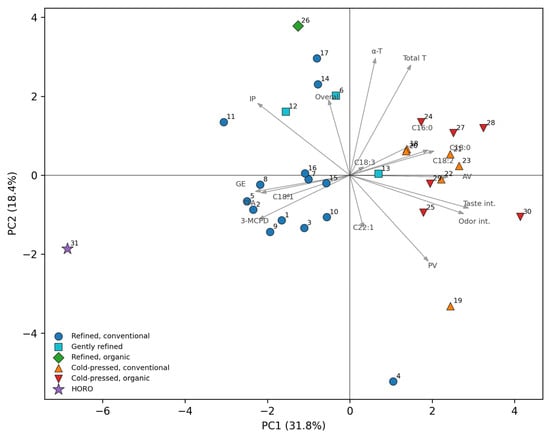
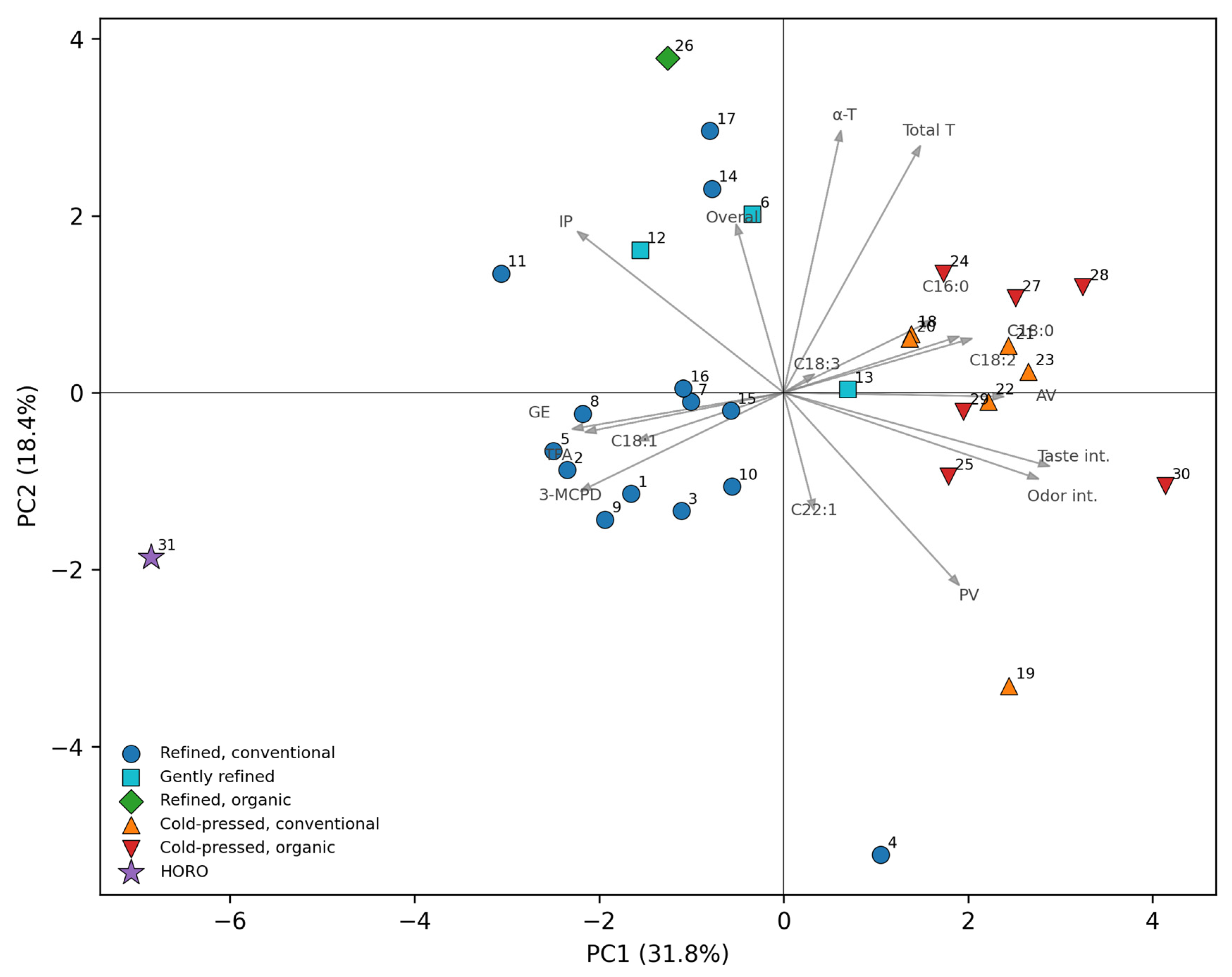
To obtain an integrated view of the data, PCA was applied to 17 compositional, quality, contaminant and sensory variables of all 31 samples (Figure 1). The first three principal components explained 31.8%, 18.4% and 14.2% of the total variance (64.3% cumulatively). PC1 separated the products according to the processing technology: CPOs had positive PC1 scores associated with higher AV (loading 0.71), PV (0.57), odor intensity (0.83) and taste intensity (0.87), whereas refined oils had negative scores associated with TFAs (−0.64), 3-MCPD esters (−0.66), GE (−0.68) and longer IP (−0.67). PC2 was defined mainly by α-tocopherol (0.89) and total tocopherols (0.84), together with IP (0.55) and the overall sensory rating (0.56), in opposition to PV (−0.65); it differentiated the samples within both processing groups according to their tocopherol content and oxidative status. The refined oils 26, 17 and 14, with the highest tocopherol contents, were located at the top of the plot, whereas the refined oil 4 (PV 6.78 meq O2/kg, IP 2.43 h, overall rating 2) and the cold-pressed oil 19 (PV 7.28 meq O2/kg, the lowest tocopherol content among the CPOs) were located at the bottom. PC3 () was dominated by oleic (0.82) and linoleic acid (−0.73) and separated the HORO sample 31, which, owing to its long IP and relatively high GE content, also occupied an extreme position on PC1. Organic and conventional CPOs were not separated in the score plot, in agreement with the absence of significant differences between these groups after correction for multiple testing (all Holm-adjusted p > 0.4). HCA confirmed these patterns: at the two-cluster level, the products were divided into refined and cold-pressed oils, with the single exception of the refined sample 4, which clustered with the CPOs owing to its high PV, short IP and pronounced, partly rancid flavor; at the three-cluster level, HORO formed a separate cluster.
Figure 1.
Principal component analysis biplot (PC1 vs. PC2) of 31 rapeseed oils based on 17 autoscaled variables. Numbers denote samples (Table 1); arrows represent scaled variable loadings. TFA = trans-unsaturated fatty acids; α-T = α-tocopherol; Total T = total tocopherols; AV = acid value; PV = peroxide value; IP = induction period; GE = glycidyl esters; HORO = high-oleic rapeseed oil.
4. Discussion
The fatty acid composition analysis (Table 2 and Table 3) revealed a profile consistent with previously published data for low-erucic acid rapeseed oils, with all measured values falling within the expected range of natural variation reported in the scientific literature and reference databases [1,7,8,11,13,14]. Notably, among commonly consumed vegetable oils, only rapeseed and soybean oils contain appreciable amounts of α-linolenic acid (ALA), an essential n-3 PUFA [7]. Dietary fat should be composed primarily of unsaturated fatty acids, with no more than 10% of total energy intake (E%) from SFAs and no more than 1 E% from TFAs, as recommended by the WHO [12]. In its 2010 opinion on PUFAs, the EFSA recommended an adequate intake of n-6 linoleic acid of 4 E% and n-3 α-linolenic acid of 0.5 E% [11]. Rapeseed oil, with its above-mentioned proportion of fatty acids, is therefore generally regarded as nutritionally superior to oils dominated almost exclusively by n-6 PUFAs. Compared with sunflower oils from the same market analyzed by the same methods [33], the rapeseed oils had a markedly higher α-linolenic acid and lower linoleic acid content, a lower α-tocopherol but higher γ-tocopherol content, and comparable AV and process contaminant levels.
Despite the development of rapeseed cultivars with altered fatty acid compositions, including HORO and HOLL types characterized by elevated oleic acid contents and enhanced oxidative stability, their market presence remains relatively limited [13]. Consequently, they have not yet achieved sufficient market penetration to support widespread cultivation, industrial-scale processing, and commercialization as a separate market category of rapeseed oil, particularly within the Central European market. This situation is reflected in the present sample set, which included only a single sample (no. 31) representing this category of rapeseed oils.
In terms of nutrition, erucic acid and TFAs are considered undesirable [7]. Erucic acid is a monounsaturated fatty acid naturally present in Brassicaceae seed oils (rapeseed, mustard, camelina), jojoba wax esters, and, to a lesser extent, in fatty marine fish. Animal studies have consistently demonstrated cardiotoxic and hepatotoxic effects of high dietary erucic acid intake, including reversible myocardial lipidosis, focal myocardial fibrosis, hepatic steatosis, and impaired growth and fertility, attributed to inhibition of mitochondrial β-oxidation of fatty acids in the heart and liver [61,62,63]. Based on the absence of adverse effects at 0.7 g/kg body weight/day in young rats and piglets, EFSA established a tolerable daily intake (TDI) of 7 mg/kg body weight/day in 2016 [64], and Commission Regulation (EU) 2019/1870 subsequently set maximum erucic acid limits for edible oils and fats (20 g/kg; 50 g/kg for camelina, mustard, and borage oil) and mustard (35 g/kg) [65]. All samples met this limit, as well as the standard for low-erucic rapeseed oil set by the Codex Alimentarius [7], with a safety margin.
TFAs are also receiving negative assessments. Only very low levels (<0.2%) of atherogenic TFAs were observed in CPOs, which are due to the lipoxygenase activity in seeds before processing. During deodorization as part of the refining process, TFAs are formed to some extent. PUFAs are particularly sensitive to trans isomerisation, especially the α-linolenic acid [8]. Deodorization at temperatures not exceeding about 220 °C is reported to form only negligible amounts of TFAs, whereas at higher temperatures (above 240 °C) their formation increases nearly exponentially [8,27]. The lowest TFA contents among the refined oils, found in the three gently refined products (0.23–0.28%; samples 6, 12 and 13), together with their low or non-quantifiable contents of process contaminants, are consistent with milder deodorization conditions; however, as process data were not available, the actual refining temperatures cannot be inferred from these results. As anticipated, the isomerization of unsaturated fatty acids occurred in relation to the number of double bonds present in their molecular structure (see Section 3.1).
Rapeseed oil is recognized as one of the major dietary sources of vitamin E among commonly consumed vegetable oils, although its α-tocopherol content is generally lower than that of sunflower oil [33]. Despite the considerable variability in tocopherol concentration and vitamer composition associated with cultivar, agronomic practices, seed processing, and environmental growing conditions [8,9], the total tocochromanol content determined in the present study (476–760 mg/kg) and the α-tocopherol content (189–345 mg/kg) were within the ranges reported for rapeseed oils in published databases and the scientific literature [1,7,11]. Refining processes may affect the final tocopherol concentration, with the greatest losses typically occurring during the neutralization and deodorization stages, owing to thermal degradation and removal of minor lipid constituents, which may explain the slightly, but not significantly, lower total tocopherol content of the refined oils (see Section 3.2). The tocopherol contents are also comparable with those reported for cold-pressed and refined rapeseed oils in earlier market and processing studies [25,26]; plastochromanol-8, another characteristic tocochromanol of rapeseed oil, was not determined in the present study.
One of the primary objectives of oil refining is the removal of free fatty acids, which substantially contribute to the AV. The significantly lower AV of refined oils (mean: 0.12 mg KOH/g) compared to cold-pressed oils (mean: 1.41 mg KOH/g) demonstrates the efficiency of the refining process in reducing free fatty acid levels. This finding is consistent with the expected outcome of neutralization and other refining steps designed to improve oil quality and stability. Moreover, the fact that all samples met the Codex Alimentarius requirements [7] indicates that both the refined and cold-pressed oils were of acceptable quality with respect to acidity. The measured AVs are also in close agreement with previously reported values for refined sunflower oils and CPOs, ranging from 0.12 to 0.31 mg KOH/g and from 0.68 to 1.15 mg KOH/g, respectively [33].
The PV is widely used for monitoring the early stages of lipid oxidation because it quantifies hydroperoxides, the primary oxidation products formed during the autoxidation of unsaturated fatty acids. However, the interpretation of PV requires caution, as hydroperoxides are relatively unstable intermediates that can subsequently decompose into secondary oxidation products such as aldehydes, ketones, and alcohols. Consequently, PV alone does not always provide a reliable measure of the overall extent of oil deterioration, particularly in thermally stressed oils, where hydroperoxide decomposition may result in a decrease in PV despite ongoing oxidative degradation [66]. In contrast, for unused oils stored under normal conditions, PV is considered a useful indicator of oxidative quality and storage stability. The PV values observed in the present study indicate a generally satisfactory oxidative status of the analyzed samples. Although only a limited proportion of samples (29%) exhibited PV values below the recommended level of 2 meq O2/kg oil, all oils remained well within the regulatory limits specified by the Codex Alimentarius [7]. The absence of samples exceeding the rancidity threshold further confirms that none of the investigated oils showed advanced oxidative deterioration. These findings suggest that the oils were of acceptable quality at the time of analysis and had not undergone substantial primary oxidation.
Although tocopherols are recognized as effective natural antioxidants, their antioxidant performance is strongly influenced by factors such as temperature, oxygen availability, and the composition of the lipid matrix [67]. Moreover, tocopheroxyl radicals, particularly α-tocopheroxyl radicals, may participate in secondary pro-oxidative reactions in model and in vitro systems. As a result, high tocopherol concentrations do not necessarily translate into prolonged induction periods, which may explain the weak relationship between total tocopherol content and IP observed in the present study. In general, a significant negative linear relationship exists between polyunsaturated fatty acid (PUFA) content and IP in vegetable oils, indicating that oils with higher PUFA levels are more susceptible to oxidative degradation [33,67]. From a practical perspective, the average IP of 4.5 h observed in conventional low-erucic rapeseed oils indicates suitability primarily for cold culinary applications and short-term frying operations. For comparison, typical IP values are given for some globally important oils, soybean oil (1–7 h), sunflower oil (1–4 h), and cottonseed oil (2–3 h), performed at 120 °C [56]. In contrast, the longer IP of HORO (6.1 h) suggests improved resistance to medium-term thermal stress, making this oil more appropriate for applications involving prolonged heating. Nevertheless, the oxidative stability of HORO remained lower than that reported for some highly stable oils, such as high-oleic sunflower oil (10–15 h) and palm oil (7–12 h), while being comparable to olive oil (6–11 h), performed at 120 °C [33,56]. The longest IP of HORO (6.10 h) was observed despite its relatively low total tocopherol content (461 mg/kg, the second lowest in the set). This is consistent with its modified fatty acid composition: the high proportion of oleic acid (72.2%) at the expense of linoleic acid (8.1%) reduces the number of bis-allylic methylene groups, which are the preferential sites of hydrogen abstraction, so that oleic acid oxidizes considerably more slowly than linoleic and α-linolenic acids [8,67]. However, as HORO was represented by a single product, this interpretation cannot be generalized. Among the conventional low-erucic oils, whose fatty acid composition varied only within a narrow range, IP was not related to PUFA content but rather to the oxidative status of the oil (PV) and to its α-tocopherol content (Section 3.5).
The occurrence of pesticide residues in the analyzed rapeseed oils was relatively limited (see Table 5). Quantifiable residues were detected in only 12 (39%) of the 31 analyzed samples (7 of 19 refined oils and 5 of 12 CPOs). These residues comprised four fungicides (azoxystrobin, boscalid, fludioxonil and fluopyram), two insecticides (pirimiphos-methyl and fluvalinate (sum of isomers) resulting from the use of tau-fluvalinate), and the synergist piperonyl butoxide (PBO). Refining processes can substantially reduce pesticide residue levels present in crude vegetable oils, particularly during the bleaching and deodorization stages [68]. However, the extent of residue removal depends on the individual pesticide and the processing conditions. As the residue levels of the corresponding seeds or crude oils were not known, the effect of refining on the occurrence of pesticide residues could not be directly assessed.
Furthermore, the presence of a pesticide residue does not necessarily indicate that the pesticide was applied directly to the crop. Cross-contamination during storage and handling is another possible source of pesticide residues in oilseeds. For example, Dauguet (2007) reported the contamination of sunflower seeds with pirimiphos-methyl through contact with storage bins and grain-handling equipment previously exposed to insecticide treatments used for stored cereals [69]. As the present study was based on retail rapeseed oil samples, the origin of the detected residues cannot be established, nor can the effect of refining on individual pesticides be directly assessed.
All detected pesticide active substances were approved for use in the EU at the time of sample analysis (April–July 2025). For the assessment of compliance with the maximum residue levels (MRLs) in rapeseed oil, the MRLs established for rapeseeds/canola seeds (code number: 0401060) were used. All detected pesticide residues (see Table 5) were below the established limits. However, the assessment of pesticide residues in processed foods should account for changes in residue concentrations during processing, in accordance with Article 20 of Regulation (EC) No 396/2005 [58]. Processing factors (PF) depend on the pesticide–commodity combination and the processing conditions. In the absence of substance-specific data, a default PF of 2.5, corresponding to the oil content of rapeseed (approximately 40%) and complete transfer of lipophilic residues into the oil, was applied to the MRLs for rapeseeds (code number 0401060), as proposed by FEDIOL [70]. This factor is appropriate only for lipophilic compounds; for more polar substances, the experimentally determined PFs are lower [47], and the default factor then overestimates the permissible concentration in oil. Importantly, all detected concentrations were below the MRLs for rapeseed even without application of any PF (i.e., PF = 1); the highest ratio to the respective MRL was observed for fluvalinate in sample 14 (0.017 mg/kg) and pirimiphos-methyl in sample 23 (0.219 mg/kg). In the organic products, no residues of pesticide active substances were detected; only PBO was found in one organic CPO (sample 28; 0.018 mg/kg), and it was also present in two conventional CPOs (samples 19 and 22). PBO is not an insecticide in its own right but a synergist that inhibits the detoxifying enzymes of insects; it is used in combination with pyrethrins and pyrethroids in plant protection and biocidal products, including products for the treatment of storage premises, and it is therefore discussed separately from the pesticide active substances. No MRL has been set for PBO under Regulation (EC) No 396/2005 [58]. In organic production, the use of plant protection products is restricted to the substances authorized in Implementing Regulation (EU) 2021/1165 [71] pursuant to Regulation (EU) 2018/848 [72]. The BNN orientation value [73], frequently used by the organic sector to trigger investigations, is not a legal limit and explicitly excludes PBO; it therefore cannot serve as a compliance threshold for PBO. Because PBO occurred without any co-occurring pyrethroid, its source cannot be determined from the present data: possible explanations include the use of PBO-containing products in storage or processing facilities, cross-contamination during transport or pressing, or environmental contamination, but the data do not allow these possibilities to be distinguished from intentional application. The finding should therefore be regarded as a signal warranting investigation by the operator and the control body rather than as evidence of deliberate use or of non-compliance with organic production rules.
The formation of 3-MCPD esters, 2-MCPD esters, and glycidyl esters during the refining of edible oils is well documented and is primarily associated with high-temperature processing, particularly the deodorization step conducted at temperatures exceeding 200 °C [10]. These contaminants are of toxicological concern because chloropropanols are classified by the International Agency for Research on Cancer (IARC) as possibly carcinogenic to humans (Group 2B), while glycidol is classified as probably carcinogenic to humans (Group 2A) [74]. Consequently, maximum limits have been established for 3-MCPD esters and glycidyl esters in selected edible oils, including rapeseed oil [32].
The absence of these contaminants in all CPO samples is consistent with the lack of severe thermal treatment during cold-pressing [33]. In refined oils, the formation of these contaminants is known to depend on the deodorization conditions and on the availability of precursors such as chlorine donors and partial acylglycerols [10]; however, as no process data were available for the analyzed products, the differences among individual refined oils cannot be attributed to specific refining temperatures. Nevertheless, all detected levels remained substantially below current regulatory limits [32]. Furthermore, 2-MCPD esters were found at concentrations below the analytical detection or quantification limits in all samples except one (see Section 3.7). Previous studies have reported a 2-MCPD-to-3-MCPD ester ratio of approximately 0.4–0.5 in rapeseed oils [75], which is consistent with the low levels observed in the present study.
For context, Zelinková et al. [9] first reported 3-MCPD ester contents of 381–484 µg/kg in refined rapeseed oils in the mid-2000s. Furthermore, EFSA occurrence data from 2012 to 2015 indicated mean and 95th-percentile concentrations of 232 and 630 µg/kg for 3-MCPD esters and 166 and 560 µg/kg for glycidyl esters, respectively, in rapeseed oil [30,31]. The lower levels found in the present study (maximum 366 and 423 µg/kg, respectively) are in line with the implementation of mitigation measures by the industry [10] and with the introduction of maximum levels [32]. However, because the earlier and present data differ in analytical methods, sample sets and sampling strategy, this comparison does not prove a temporal trend.
Oil refining is specifically designed to remove undesirable constituents, many of which are responsible for sensory characteristics such as color, taste, and odor. Pigments including chlorophylls, their degradation products, and carotenoids are substantially reduced during refining, resulting in the light-colored appearance preferred by consumers. Owing to the long-standing market dominance of refined oils, consumer expectations are generally associated with products exhibiting a neutral flavor and aroma. Consequently, the presence of volatile compounds is often perceived as an indication of quality deterioration or rancidity. Several sensory defects have been reported in edible oils, including musty, moldy, yeasty, straw-like, roasted, and burnt notes, which are typically associated with inadequate raw material quality, improper processing conditions, or unsuitable storage practices. More specifically, rancid, oily, bitter, leafy, bean-like, and fishy sensations are recognized indicators of oxidative deterioration. Among the compounds associated with rancidity, (2E)-hept-2-enal, a secondary oxidation product of linoleic acid, has been identified as one of the most potent contributors because of its extremely low odor threshold [60]. In contrast, cold-pressed oils produced from high-quality seeds are generally characterized by desirable seed-like and nutty flavors [59]. Additional sensory attributes such as woody, astringent, bitter, or pungent notes may also be present and are not considered defects provided that they remain balanced within the overall flavor profile. Previous findings reported that the volatile fraction of commercial cold-pressed oils contains several potent aroma-active compounds with high odor activity values, particularly 2-isopropyl-3-methoxypyrazine, associated with earthy and pea-like notes, (E,E)-2,4-nonadienal, characterized by deep-fried and oily, fatty aromas, and (E,Z)-2,6-nonadienal, imparting cucumber-like sensory impressions [76]. S-containing aroma-active compounds in rapeseed oils (dimethyl sulfides, dimethyl sulfone, dimethyl sulfoxide) are very crucial and responsible for the characteristic pungent, sulfury or cabbage-like attributes [60]. The positive sensory ratings obtained in the present study suggest that the analyzed oils retained these desirable characteristics while remaining free of significant oxidative or processing-related defects. The presence of aroma-active volatile compounds, which are largely removed during conventional refining, contributes to the distinctive sensory identity of cold-pressed oils and may enhance their acceptance in applications involving cold consumption. However, when CPOs are subjected to heat treatment, these volatile compounds can be transferred to fried foods, where consumers may perceive their characteristic aromas as undesirable or intrusive. Therefore, the sensory advantages of cold-pressed oils are most effectively preserved in culinary applications that avoid intensive heating.
Several limitations of this study should be acknowledged. First, the sample set was a convenience sample of 31 retail products purchased in 2025 and does not represent the market in a statistically defined way; the subgroups were unbalanced (19 refined vs. 12 cold-pressed oils, 7 organic products, a single HORO), and comparisons involving small subgroups are exploratory. Second, each product was represented by a single lot, so lot-to-lot variability could not be assessed. Third, the safety-related analyses covered erucic acid, process contaminants (3-MCPD, 2-MCPD and glycidyl esters) and a targeted set of 100 pesticide residues only; other relevant contaminants, such as polycyclic aromatic hydrocarbons (PAHs), mineral oil hydrocarbons (MOSH/MOAH), plasticizers or toxic elements, were not determined, and the results therefore do not represent a comprehensive safety evaluation. Fourth, analytical uncertainty, particularly for residues close to the LOQ, has to be taken into account when interpreting individual values. Finally, the cross-sectional design does not allow inferences about temporal changes or causal effects of processing and storage conditions; such hypotheses would require studies of products with known process histories.
5. Conclusions
Within the limits of the analyzed set of 31 retail products and of the parameters determined, this study indicates that rapeseed oil marketed in Central Europe is an edible vegetable oil of excellent nutritional, technological, and sensory characteristics. All 31 samples analyzed exhibited a favorable fatty acid profile, characterized by low levels of SFAs, high concentrations of MUFAs, and a beneficial n-6/n-3 fatty acid ratio. The concentration of erucic acid, an undesirable fatty acid, did not exceed 0.49% in any sample and was therefore substantially below the EU regulatory limit of 2%, which does not support the persistent misconception that contemporary rapeseed oil contains elevated levels of erucic acid. Similarly, the content of trans-unsaturated fatty acids was low across all samples, with CPOs exhibiting lower concentrations than refined counterparts. None of the analyzed oils exceeded the limits established by the Codex Alimentarius for acid value and peroxide value, nor did they surpass the legislative thresholds for process contaminants, 3-MCPD esters and glycidyl esters, and the detected pesticide residues were below the MRLs applicable to rapeseed. Sensorially, the oils were rated from excellent to still-acceptable quality; pronounced off-flavors or rancidity occurred only exceptionally. CPOs were characterized by higher color, odor, taste intensity and a pronounced nutty flavor, whereas refined rapeseed oils were sensorially almost neutral, allowing them not to influence the resulting taste of the dish. Owing to its composition and sensory properties, rapeseed oil is universally usable in both cold and hot cuisine; CPO is particularly suited to cold cuisine, while refined oil is also suitable for single-use frying and baking. Multivariate analysis showed that the processing technology was the main factor structuring the data, followed by tocopherol content and oxidative status, whereas organic and conventional products did not differ significantly.
Supplementary Materials
The following supporting information can be downloaded at: https://www.mdpi.com/article/10.3390/agriculture16212449/s1, Table S1: LC-MS/MS acquisition parameters and method validation data for target analytes.
Author Contributions
Conceptualization, V.I., L.Z. and M.D.; methodology, K.N., M.B., L.U. and V.V.; validation, K.N., L.U., V.V. and M.D.; formal analysis, V.I. and V.V.; investigation, V.I., K.N., A.K., M.B., L.U. and M.D.; data curation, V.I., K.N., A.K. and M.D.; writing—original draft preparation, V.I., K.N., L.U., L.Z. and M.D.; writing—review and editing, K.N., L.Z. and M.D.; supervision, V.I. and M.D. All authors have read and agreed to the published version of the manuscript.
Funding
This research was funded by specific university research project no. A1_FPBT_2026_001 and by the METROFOOD-CZ Research Infrastructure, supported by the Ministry of Education, Youth and Sports of the Czech Republic (Project No. LM2023064).
Institutional Review Board Statement
Not applicable.
Data Availability Statement
The original contributions presented in this study are included in the article/Supplementary Materials. Further inquiries can be directed to the corresponding author.
Conflicts of Interest
The authors declare no conflicts of interest.
References
- McDonald, B.E. Food uses and nutritional properties. In Rapeseed and Canola Oil. Production, Processing, Properties and Uses, 1st ed.; Gunstone, F.D., Ed.; CRC Press: Boca Raton, FL, USA, 2004; pp. 131–153. [Google Scholar]
- Walker, K. Non-food uses. In Rapeseed and Canola Oil. Production, Processing, Properties and Uses, 1st ed.; Gunstone, F.D., Ed.; CRC Press: Boca Raton, FL, USA, 2004; pp. 154–185. [Google Scholar]
- European Biodiesel Board: Statistical Report 2024–2025. Available online: https://ebb-eu.org/wp-content/uploads/2025/07/EBB-Statistical-Report-2024.pdf (accessed on 21 August 2026).
- USDA. European Union: Oilseeds and Products Annual. Available online: https://www.fas.usda.gov/data/gain-report/2026/04/Oilseeds%20and%20Products%20Annual_Vienna_European%20Union_E42026-0029.pdf (accessed on 21 August 2026).
- USDA. Oilseeds: World Markets and Trade. Available online: https://www.fas.usda.gov/sites/default/files/2026-03/oilseeds.pdf (accessed on 21 August 2026).
- Azhar, M.; Cahill, D.M.; Khan, G.A. A Brief History of Canola Genetic Gains: From Classical Breeding to Genome Editing. Physiol. Plant. 2025, 177, e70644. [Google Scholar] [CrossRef] [Scilit] [PubMed]
- Codex Alimentarius Commission. Codex Standard for Named Vegetable Oils, CXS 210-1999; FAO/WHO: Rome, Italy, 2026; Available online: https://www.fao.org/fao-who-codexalimentarius/sh-proxy/tr/?lnk=1&url=https%253A%252F%252Fworkspace.fao.org%252Fsites%252Fcodex%252FStandards%252FCXS%2B210-1999%252FCXS_210e.pdf (accessed on 22 August 2026).
- Booth, E.J. Extraction and refining. In Rapeseed and Canola Oil. Production, Processing, Properties and Uses, 1st ed.; Gunstone, F.D., Ed.; CRC Press: Boca Raton, FL, USA, 2004; pp. 17–36. [Google Scholar]
- Zelinková, Z.; Svejkovská, B.; Velíšek, J.; Doležal, M. Fatty acids esters of 3-chloropropane-1,2-diol in edible oils. Food Addit. Contam. 2006, 23, 1290–1298. [Google Scholar] [CrossRef] [Scilit] [PubMed]
- Yung, Y.L.; Lakshmanan, S.; Kumaresan, S.; Chu, C.M.; Tham, H.J. Mitigation of 3-monochloropropane 1,2 diol ester and glycidyl ester in refined oil—A review. Food Chem. 2023, 429, 136913. [Google Scholar] [CrossRef] [Scilit] [PubMed]
- Souci, S.W.; Fachmann, W.; Kraut, H. Food Composition and Nutrition Tables; MedPharm & Taylor & Francis CRC Press Book: Stuttgart, Germany, 2008; p. 186. [Google Scholar]
- EFSA Panel on Dietetic Products, Nutrition, and Allergies (NDA). Scientific Opinion on Dietary Reference Values for fats, including saturated fatty acids, polyunsaturated fatty acids, monounsaturated fatty acids, trans fatty acids, and cholesterol. EFSA J. 2010, 8, 1461. [Google Scholar] [CrossRef] [Scilit]
- Han, Y.; Gao, P.; Yang, Y.; Zou, M.; Zhong, W.; Yin, J.; Hu, C.; He, D. Frying characteristics of high-oleic rapeseed blended oil: A comparative study. J. Am. Oil Chem. Soc. 2024, 101, 1173–1182. [Google Scholar] [CrossRef] [Scilit]
- Matthäus, B.; Özcan, M.M.; Al Juhaimi, F. Some rape/canola seed oils: Fatty acid composition and tocopherols. Z. Naturforsch. C 2016, 71, 73–77. [Google Scholar] [CrossRef] [Scilit] [PubMed]
- EFSA. Dietary Reference Values for nutrients Summary report. EFSA J. 2017, 14, e15121E. [Google Scholar] [CrossRef] [Scilit]
- WHO/FAO. Vitamin and Mineral Requirements in Human Nutrition, 2nd ed.; World Health Organization: Geneva, Switzerland; Food and Agriculture Organization of the United Nations: Rome, Italy, 2004. [Google Scholar]
- Institute of Medicine. Dietary Reference Intakes for Vitamin C, Vitamin E, Selenium, and Carotenoids; The National Academies Press: Washington, DC, USA, 2000. [Google Scholar] [CrossRef] [Scilit] [PubMed]
- Bochniak, M.; Wereńska, M.; Wójcik, W. The Effect of Two-Stage Pressing and Low-Temperature Bleaching on the Lipid Profile and Nutritional Quality Indices of Rapeseed Oil: An Applied Food Processing Approach. Appl. Sci. 2026, 16, 7182. [Google Scholar] [CrossRef] [Scilit]
- Markie, E.; Khoddami, A.; Liu, S.Y.; Chen, S.; Tan, D.K.Y. The Impact of Heat Stress on Canola (Brassica napus L.) Yield, Oil, and Fatty Acid Profile. Agronomy 2025, 15, 1511. [Google Scholar] [CrossRef] [Scilit]
- Abrante-Pascual, S.; Nieva-Echevarría, B.; Goicoechea-Oses, E. Vegetable Oils and Their Use for Frying: A Review of Their Compositional Differences and Degradation. Foods 2024, 13, 4186. [Google Scholar] [CrossRef] [Scilit] [PubMed]
- Tileuberdi, N.; Turgumbayeva, A.; Yeskaliyeva, B.; Sarsenova, L.; Issayeva, R. Extraction, Isolation of Bioactive Compounds and Therapeutic Potential of Rapeseed (Brassica napus L.). Molecules 2022, 27, 8824. [Google Scholar] [CrossRef] [Scilit] [PubMed]
- Russo, M.; Yan, F.; Stier, A.; Klasen, L.; Honermeier, B. Erucic Acid Concentration of Rapeseed (Brassica napus L.) Oils on the German Food Retail Market. Food Sci. Nutr. 2021, 9, 3664–3672. [Google Scholar] [CrossRef] [Scilit] [PubMed]
- Matthäus, B.; Brühl, L. Quality of cold-pressed edible rapeseed oil in Germany. Nahrung 2003, 47, 413–419. [Google Scholar] [CrossRef] [Scilit] [PubMed]
- Wroniak, M.; Rękas, A. A preliminary study of PCBs, PAHs, pesticides and trace metals contamination in cold-pressed rapeseed oils from conventional and ecological cultivations. J. Food Sci. Technol. 2017, 54, 1350–1356. [Google Scholar] [CrossRef] [Scilit] [PubMed]
- Wroniak, M.; Krygier, K.; Kaczmarczyk, M. Comparison of the quality of cold pressed and virgin rapeseed oils with industrially obtained oils. Pol. J. Food Nutr. Sci. 2008, 58, 85–89. [Google Scholar]
- McDowell, D.; Elliott, C.T.; Koidis, A. Characterization and Comparison of UK, Irish, and French Cold Pressed Rapeseed Oils with Refined Rapeseed Oils and Extra Virgin Olive Oils. Eur. J. Lipid Sci. Technol. 2017, 119, 1600327. [Google Scholar] [CrossRef] [Scilit]
- Čmolík, J.; Pokorný, J.; Doležal, M.; Svoboda, Z. Geometrical isomerization of polyunsaturated fatty acids in physically refined rapeseed oil during plant-scale deodorization. Eur. J. Lipid Sci. Technol. 2007, 109, 656–662. [Google Scholar] [CrossRef] [Scilit]
- Symoniuk, E.; Ratusz, K.; Krygier, K. Kinetics parameters determination of refined and cold-pressed rapeseed oils after oxidation by Rancimat. Ital. J. Food Sci. 2017, 29, 276–287. [Google Scholar] [CrossRef] [Scilit]
- Symoniuk, E.; Ratusz, K.; Krygier, K. Evaluation of the Oxidative Stability of Cold-Pressed Rapeseed Oil by Rancimat and Pressure Differential Scanning Calorimetry Measurements. Eur. J. Lipid Sci. Technol. 2019, 121, 1800017. [Google Scholar] [CrossRef] [Scilit]
- EFSA CONTAM Panel. Risks for human health related to the presence of 3- and 2-monochloropropanediol (MCPD), and their fatty acid esters, and glycidyl fatty acid esters in food. EFSA J. 2016, 14, 4426. [Google Scholar] [CrossRef] [Scilit]
- EFSA CONTAM Panel. Update of the risk assessment on 3-monochloropropane diol and its fatty acid esters. EFSA J. 2018, 16, e05083. [Google Scholar] [CrossRef] [Scilit] [PubMed]
- European Parliament. Commission Regulation (EU) 2023/915 on maximum levels for certain contaminants in food and repealing Regulation (EC) No 1881/2006. Off. J. Eur. Union 2023, L119, 103–157. [Google Scholar]
- Nakonechna, K.; Ilko, V.; Berčíková, M.; Vietoris, V.; Panovská, Z.; Doležal, M. Nutritional, Utility, and Sensory Quality and Safety of Sunflower Oil on the Central European Market. Agriculture 2024, 14, 536. [Google Scholar] [CrossRef] [Scilit]
- EN ISO 12966-2:2017; Animal and Vegetable Fats and Oils—Gas Chromatography of Fatty Acid Methyl Esters—Part 2: Preparation of Methyl Esters of Fatty Acids. International Organization for Standardization (ISO): Geneva, Switzerland, 2017.
- Pohořelá, B.; Gramblička, T.; Doležal, M.; Dvořáková, D.; Pulkrabová, J.; Kouřimská, L.; Ilko, V.; Pánek, J. Nutritional Quality and Assessment of Contaminants in Farmed Atlantic Salmon (Salmo salar L.) of Different Origins. J. Food Qual. 2022, 2022, 9318889. [Google Scholar] [CrossRef] [Scilit]
- Fišnar, J.; Doležal, M.; Réblová, Z. Tocopherol losses during pan-frying. Eur. J. Lipid Sci. Technol. 2014, 116, 1694–1700. [Google Scholar] [CrossRef] [Scilit]
- Eitenmiller, R.; Lee, J. (Eds.) Nutrition and health implication of vitamin E. In Vitamin E, Food Chemistry, Composition, and Analysis; CRC Press: Boca Raton, FL, USA, 2004; pp. 39–88. [Google Scholar]
- AOCS. Method Cd 12b-92. In Official Methods and Recommended Practices of the American oil Chemists’ Society; AOCS: Champaign, IL, USA, 2022. [Google Scholar]
- EN ISO 660:2020; Animal and Vegetable Fats and Oils. Determination of Acid Value and Acidity. ISO: Geneva, Switzerland, 2020.
- EN ISO 3960:2017; Animal and Vegetable Fats and Oils. Determination of Peroxide Value. Iodometric (Visual) Endpoint Determination. ISO: Geneva, Switzerland, 2017.
- AOCS. Method Cd 29a-13. In Official Methods and Recommended Practices of the American oil Chemists’ Society; AOCS: Champaign, IL, USA, 2017. [Google Scholar]
- EURL-SRM (EU Reference Laboratory for Pesticides Requiring Single Residue Methods). Analysis of Ethylene Oxide and Its Metabolite 2-Chloroethanol by the QuOil or the QuEChERS Method and GC-MS/MS. Analytical Observations Report; Version 1.1; CVUA Stuttgart: Fellbach, Germany, 2020; Available online: https://eurl-pesticides.eu/library/docs/srm/EurlSrm_Observation_EO_V1.pdf (accessed on 3 September 2026).
- Han, J.; Schusterova, D.; Binova, Z.; Kocourek, V.; Hajslova, J.; Uttl, L. Challenges in quality and safety analysis of fresh chili and powder thereof. J. Chromatogr. A 2025, 1763, 466423. [Google Scholar] [CrossRef] [Scilit] [PubMed]
- Jiang, Y.; Li, Y.; Jiang, Y.; Li, J.; Pan, C. Determination of Multiresidues in Rapeseed, Rapeseed Oil, and Rapeseed Meal by Acetonitrile Extraction, Low-Temperature Cleanup, and Detection by Liquid Chromatography with Tandem Mass Spectrometry. J. Agric. Food Chem. 2012, 60, 5089–5098. [Google Scholar] [CrossRef] [Scilit] [PubMed]
- Madej, K.; Janiga, K.; Piekoszewski, W. The Potential of Graphene as an Adsorbent for Five Pesticides from Different Classes in Rape Oil Samples Using Dispersive Solid-Phase Extraction. J. Anal. Methods Chem. 2018, 2018, 3587860. [Google Scholar] [CrossRef] [Scilit] [PubMed]
- Guo, Q.; Yue, X.; Qi, X.; Feng, X.; Wang, X.; Hu, X.; Ma, F.; Zhang, L.; Li, P.; Yu, L. A study of the pesticide residues in rapeseeds in China: Levels, distribution and health risk assessment. Environ. Res. 2024, 246, 118110. [Google Scholar] [CrossRef] [Scilit] [PubMed]
- Lacoste, F.; Carré, P.; Dauguet, S.; Petisca, C.; Campos, F.; Ribera, D.; Roϊz, J. Experimental determination of pesticide processing factors during extraction of seed oils. Food Addit. Contam. Part A 2020, 37, 1491–1502. [Google Scholar] [CrossRef] [Scilit] [PubMed]
- Zayats, M.F.; Leschev, S.M.; Zayats, M.A. An improved extraction method of rapeseed oil sample preparation for the subsequent determination in it of azole class fungicides by gas chromatography. Anal. Chem. Res. 2015, 3, 37–45. [Google Scholar] [CrossRef] [Scilit][Green Version]
- European Commission. Guidance Document on Analytical Quality Control and Method Validation Procedures for Pesticide Residues Analysis in Food and Feed; SANTE/11312/2021 v2; European Commission: Brussels, Belgium, 2024; Available online: https://www.eurl-pesticides.eu/userfiles/file/EurlALL/SANTE-11312_2021-V2.pdf (accessed on 3 September 2026).
- ISO 8589; Sensory Analysis—General Guidance for the Design of Test Rooms. ISO: Geneva, Switzerland, 2007.
- ISO 8586:2023; Sensory Analysis—Selection and Training of Sensory Assessors. ISO: Geneva, Switzerland, 2023.
- ISO 5496:2006; Sensory Analysis—Methodology-Initiation and Training of Assessors in the Detection and Recognition of Odours. ISO: Geneva, Switzerland, 2006.
- ISO 3972:2011; Sensory Analysis—Methodology-Method of Investigating Sensitivity of Taste. ISO: Geneva, Switzerland, 2011.
- Hammond, E.W. Quality control. In Edible Oil Processing, 1st ed.; Hamm, W., Hamilton, R.J., Eds.; CRC Press: Boca Raton, FL, USA, 2000; pp. 174–189. [Google Scholar]
- Gunstone, F.D. Oils and Fats in the Food Industry; Wiley-Blackwell: Oxford, UK, 2008. [Google Scholar]
- News Medical and Life Sciences. Rancimat Method for the Oxidation Stability of Fats and Oils. Available online: https://www.news-medical.net/whitepaper/20190821/Rancimat-Method-for-the-Oxidation-Stability-of-Fats-and-Oils.aspx (accessed on 11 September 2026).
- Mathäus, B. Determination of the oxidative stability of vegetable oils by rancimat and conductivity and chemiluminescence measurements. J. Am. Oil Chem. Soc. 1996, 73, 1039–1043. [Google Scholar] [CrossRef] [Scilit]
- European Union. Regulation (EC) No 396/2005 of the European Parliament and of the Council of 23 February 2005 on maximum residue levels of pesticides in or on food and feed of plant and animal origin. Off. J. Eur. Union 2005, L70, 1–16. [Google Scholar]
- Brühl, L.; Matthäus, B. Sensory Assessment of Virgin Rapeseed Oils. Eur. J. Lipid Sci. Technol. 2008, 110, 608–610. [Google Scholar] [CrossRef] [Scilit]
- Zhang, Y.; Wu, Y.; Chen, S.; Yang, B.; Zhang, H.; Wang, X.; Granvogl, M.; Jin, Q. Flavor of Rapeseed Oil: An Overview of Odorants, Analytical Techniques, and Impact of Treatment. Compr. Rev. Food Sci. Food Saf. 2021, 20, 3983–4018. [Google Scholar] [CrossRef] [Scilit] [PubMed]
- Christophersen, B.O.; Bremer, J. Erucic acid—An inhibitor of fatty acid oxidation in the heart. Biochim. Biophys. Acta Lipids Lipid Metab. 1972, 280, 506–514. [Google Scholar] [CrossRef] [Scilit] [PubMed]
- Chien, K.R.; Bellary, A.; Nicar, M.; Mukherjee, A.; Buja, L.M. Induction of a reversible cardiac lipidosis by a dietary long-chain fatty acid (erucic acid). Relationship to lipid accumulation in border zones of myocardial infarcts. Am. J. Pathol. 1983, 112, 68–77. [Google Scholar] [PubMed]
- Chen, X.; Shang, L.; Deng, S.; Li, P.; Chen, K.; Gao, T.; Zhang, X.; Chen, Z.; Zeng, J. Peroxisomal oxidation of erucic acid suppresses mitochondrial fatty acid oxidation by stimulating malonyl-CoA formation in the rat liver. J. Biol. Chem. 2020, 295, 10168–10179. [Google Scholar] [CrossRef] [Scilit] [PubMed]
- EFSA Panel on Contaminants in the Food Chain (CONTAM). Scientific Opinion on erucic acid in feed and food. EFSA J. 2016, 14, e04593.
- European Commission. Commission Regulation (EU) 2019/1870 of 7 November 2019 amending and correcting Regulation (EC) No 1881/2006 as regards maximum levels of erucic acid and hydrocyanic acid in certain foodstuffs. Off. J. Eur. Union 2019, L289, 37–40. [Google Scholar]
- Farhoosh, R.; Moosavi, S. Evaluating the performance of peroxide and conjugated diene values in monitoring the quality of used frying oils. J. Agric. Sci. Technol. 2010, 11, 173–179. [Google Scholar]
- Sabolová, M.; Johanidesová, A.; Hasalíková, E.; Fišnar, J.; Doležal, M.; Réblová, Z. Relationship between the Composition of Fats and Oils and Their Oxidative Stability at Different Temperatures, Determined Using the Oxipres Apparatus. Eur. J. Lipid Sci. Technol. 2017, 119, 1600454. [Google Scholar] [CrossRef] [Scilit]
- van Duijn, G.; Den Dekker, G. Unilever Food Safety Assurance System for Refined Vegetable Oils and Fats. OCL 2010, 17, 100–103. [Google Scholar] [CrossRef] [Scilit]
- Dauguet, S. Insecticide residues cross-contamination of oilseeds during storage. OCL 2007, 14, 313–316. [Google Scholar] [CrossRef] [Scilit][Green Version]
- FEDIOL. Establishing Processing Factors for Fat Soluble Pesticides in Crude Vegetable Oils and Fats; Position Paper Ref. 11SAF181_rev4; EU Vegetable Oil and Proteinmeal Industry Association: Brussels, Belgium, 2022. [Google Scholar]
- European Union. Commission Implementing Regulation (EU) 2021/1165 of 15 July 2021 authorising certain products and substances for use in organic production and establishing their lists. Off. J. Eur. Union 2021, L253, 13–48. [Google Scholar]
- European Union. Regulation (EU) 2018/848 of the European Parliament and of the Council of 30 May 2018 on organic production and labelling of organic products. Off. J. Eur. Union 2018, L150, 1–92. [Google Scholar]
- BNN. Orientation Value for Pesticides in Organic Food; Bundesverband Naturkost Naturwaren e.V.: Berlin, Germany, 2021; Available online: https://n-bnn.de/fileadmin/user_upload/Leistungen_Services/Richtlinien_und_Empfehlungen/BNN-Orientierungswert/OW-Allg._Dokumente/230712_BNN-Orientation-Value_EN.pdf (accessed on 22 August 2026).
- IARC. IARC Monographs on the Evaluation of Carcinogenic Risk of Chemicals to Humans; International Agency for Research on Cancer: Lyon, France, 2000; Volume 77, pp. 469–486. [Google Scholar]
- Kuhlmann, J. Determination of bound 2,3-epoxy-1-propanol (glycidol) and bound monochloropropanediol (MCPD) in refined oils. Eur. J. Lipid Sci. Technol. 2011, 113, 335–344. [Google Scholar] [CrossRef] [Scilit]
- Pollner, G.; Schieberle, P. Characterization of the Key Odorants in Commercial Cold-Pressed Oils from Unpeeled and Peeled Rapeseeds by the Sensomics Approach. J. Agric. Food Chem. 2016, 64, 627–636. [Google Scholar] [CrossRef] [Scilit] [PubMed]

Disclaimer/Publisher’s Note: The statements, opinions and data contained in all publications are solely those of the individual author(s) and contributor(s) and not of MDPI and/or the editor(s). MDPI and/or the editor(s) disclaim responsibility for any injury to people or property resulting from any ideas, methods, instructions or products referred to in the content. |
© 2026 by the authors. Licensee MDPI, Basel, Switzerland. This article is an open access article distributed under the terms and conditions of the Creative Commons Attribution (CC BY) license.