


Abstract
The fate of urea-derived carbon (urea-C) in paddy soils is poorly understood. Although urea-C is generally considered to be rapidly mineralized and released as CO2, a fraction may be retained in soil through physicochemical and microbial processes. Here, we used 13C-labeled urea combined with 13C-phospholipid fatty acid stable isotope probing (13C-PLFA-SIP) to determine the fate of urea-C under contrasting long-term irrigation and straw management practices and to identify the microbial groups involved in its assimilation. Soil CO2 efflux peaked on day 5, whereas the proportion of urea-derived CO2 in total soil CO2 efflux generally peaked on day 3. Both subsequently declined during the observation period. Cumulative urea-C loss as CO2 accounted for 36–60% of the applied C, with straw return stimulating early CO2 release and the greatest loss occurring under controlled irrigation combined with straw return. Nevertheless, a measurable fraction of urea-C remained in the soil, declining to approximately 10% of the applied C by day 21, with greater retention under flooded irrigation. Controlled irrigation combined with straw return increased microbial biomass and the fungal-to-bacterial (F/B) and Gram-positive-to-Gram-negative (GP/GN) ratios. 13C-PLFA-SIP further revealed distinct microbial partitioning of urea-C: flooded irrigation promoted incorporation into general and Gram-positive bacteria, whereas controlled irrigation favored Actinomycetes and fungi. Straw return increased urea-C incorporation into Actinomycetes and decreased its incorporation into Gram-positive bacteria under both irrigation regimes, while enhancing incorporation into Gram-negative bacteria only under controlled irrigation.
1. Introduction
Urea [CO(NH2)2] is one of the most widely used N fertilizers in agriculture [1]. Its high N content makes it essential for sustaining soil nutrient supply and supporting crop productivity and soil fertility [2]. While the fate of urea-derived N in agroecosystems has been well studied, the carbon contained in urea, which accounts for about 20% of urea mass, has received much less attention. Under high nitrogen application rates, the carbon input introduced by urea may represent a non-negligible external source of inorganic carbon in agroecosystems. Urea is rapidly hydrolyzed by soil urease after application. Zhao et al. [3] observed rapid urea hydrolysis in paddy soil, with NH4+-N production peaking within 48 h, while Govindasamy et al. [4] reported that urease is sufficiently abundant in most soils to rapidly hydrolyze urea. Consequently, urea-derived C has generally been considered a transient C source with limited persistence in soil and is expected to be readily released as CO2 after hydrolysis. However, recent studies have highlighted the importance of soil inorganic carbon cycling, and the inorganic carbon produced during urea hydrolysis can directly enter this cycle [5]. This suggests that urea-derived C may not only be lost as CO2 but may also be transformed and retained through soil and microbial processes. The fate of urea-derived C may therefore extend beyond direct CO2 loss. In flooded paddy soils, restricted gas diffusion can favor the accumulation of inorganic C in the water phase, while 13C-urea tracing has shown that fertilizer-derived C can also be recovered in rice tissues [6,7]. Prolonged flooding further creates strongly reducing conditions that support methanogenesis, providing an additional pathway for C transformation [8]. A clearer understanding of urea-derived C fate in agroecosystems, particularly under different management practices, is therefore needed.
Rice paddies in China cover a vast area and not only serve as major food production systems but also function as highly active components of the carbon cycle, acting as important carbon sinks in terrestrial ecosystems [9,10]. In paddy soils, carbon transformation processes are primarily driven by redox conditions and microbial activity, while soil moisture influences these processes by regulating these two factors [11,12]. Flooded conditions maintain soils in a persistently saturated, anaerobic state, limiting oxygen diffusion and suppressing the metabolic activity of aerobic microorganisms while favoring the growth of anaerobic microbial communities [13]. Under such conditions, the decomposition rate of soil organic carbon is reduced. In contrast, controlled irrigation (CI), a water-saving irrigation regime that adjusts the timing and amount of irrigation to maintain suitable soil moisture for crop growth, promotes alternating wetting and drying, creating intermittent aerobic conditions that enhance soil oxygen availability, alter redox potential, and stimulate aerobic microbial activity [14,15]. These changes in soil aeration and redox conditions can influence organic matter decomposition and microbial processes, thereby modifying soil C cycling [16]. These two contrasting water management regimes may influence the fate of urea-derived C. However, under different long-term water management practices, the patterns of urea-derived C transformation and the extent of microbial assimilation remain unclear.
Straw return has been widely adopted in paddy systems to increase organic carbon inputs and improve soil quality [17]. Straw contains both readily decomposable and recalcitrant organic components, and the organic matter released during its decomposition can markedly alter the quantity and composition of available carbon substrates in soil, thereby regulating microbial metabolic activity and their strategies for utilizing different carbon sources [18,19]. Meanwhile, straw return generally increases the soil C/N ratio; under conditions of relatively abundant carbon but limited nitrogen, microorganisms may enhance the immobilization and assimilation of external nitrogen to sustain growth, a process that may in turn influence the fate of urea-derived carbon in soil [20]. At the same time, water management strongly affects the decomposition rate of straw. Compared with flooded irrigation, controlled irrigation enhances soil aeration through alternating wetting and drying conditions, which accelerates straw decomposition and promotes the release of organic substances [21]. Differences in straw decomposition under various paddy water management regimes may alter microbial community composition and activity, thereby affecting the fate of urea-derived C in the soil. However, how water management and straw return jointly regulate the short-term retention and microbial assimilation of urea-derived carbon in soil remains insufficiently understood.
To address these knowledge gaps, a study was conducted based on a long-term field experiment initiated in 2012, with the application of 13C-labeled urea to quantify the fate of urea-derived C under two irrigation regimes (flooded and controlled irrigation) and two straw practices (straw return and removal). The objectives of this study were to: (i) quantify the partitioning of urea-derived C into CO2 loss and soil C pools under different irrigation and straw treatments and (ii) use 13C-labeled urea in combination with phospholipid fatty acid stable isotope probing (13C-PLFA-SIP) to determine microbial assimilation of urea-derived C and identify the key microbial groups involved under contrasting long-term management regimes.
2. Materials and Methods
2.1. Study Area
The field experiment was conducted at the State Key Station for Irrigation Experimentation in the Heping Irrigation District, Heilongjiang Province, Northeast China (127°40′45″ E, 46°57′28″ N). The site represents one of the major rice-producing regions in China. According to the U.S. Department of Agriculture (USDA) soil taxonomy, the soil is classified as a Mollisol. The soil pH was 5.81, with a field capacity of 31.5% and a total porosity of 55.6%. The contents of soil organic matter and total N were 32.7 and 1.4 g kg−1, respectively, while available P and K were 36.2 and 112.1 mg kg−1, respectively. The cation exchange capacity was 31.4 cmol kg−1. The region has a cold temperate continental monsoon climate, with a mean annual air temperature of 3.6 °C and a mean annual precipitation of approximately 550 mm, most of which occurs between June and August. Mean annual evaporation is about 750 mm, and the effective accumulated temperature reaches 2530 °C. Annual total solar radiation ranges from 4000 to 4300 MJ m−2, and the frost-free period averages 128 days.
Rice (Oryza sativa L.) has been continuously cultivated in this region for more than 30 years. Rice is usually transplanted in late May and harvested from late September to early October, and the fields remain fallow from November to the following April. For a long time, flooded irrigation has been the main irrigation method, and a water layer is kept on the field surface during the whole growing season to ensure yield and suppress weeds. Since the early 2000s, water-saving irrigation practices have been gradually promoted in this region. Among these, controlled irrigation (CI), which regulates field water depth and soil moisture according to rice growth stages to achieve alternating wetting and drying conditions, has become an important water management practice in paddy fields.
2.2. Experimental Design
A long-term field experiment was established in 2012 to study the effects of water and straw management practices in paddy fields. Four treatment combinations were established: controlled irrigation without straw return (C), flooded irrigation without straw return (F), controlled irrigation with straw return (CS), and flooded irrigation with straw return (FS). Each treatment was replicated four times in a randomized block design, resulting in a total of 16 field plots (10 m × 10 m each).
Irrigation water was supplied to each field plot through irrigation inlets. During the regreening stage, a shallow water layer was maintained under both irrigation regimes. Following the regreening stage, the two irrigation regimes were managed differently. Under controlled irrigation, irrigation timing and water supply were adjusted according to soil moisture conditions, allowing alternating wetting and drying. Soil moisture was monitored regularly, and irrigation was initiated when soil moisture reached the prescribed lower threshold and stopped when the upper threshold was reached. Under flooded irrigation, a water layer of 30–50 mm was maintained in the field, and water depth was monitored regularly. Detailed information on the controlled irrigation regime is provided in Xu et al. [22].
After each annual rice harvest, 6 Mg ha−1 of air-dried straw, chopped to 30–50 mm, was incorporated into the surface soil in the straw-return plots. Rice was transplanted in late May and harvested in late September or early October every year. All treatments received the same fertilization management, with nitrogen (110 kg N ha−1 as urea), phosphorus (45 kg P ha−1 as superphosphate), and potassium (80 kg K ha−1 as potassium chloride). Weed, pest, and disease control were also managed uniformly across treatments.
Based on this long-term field experiment, a 13C tracer study was conducted in 2023 to examine the fate of urea-derived carbon under different irrigation and straw management practices. All treatments received basal fertilization with unlabeled urea at a rate of 65 mg N kg−1 soil prior to transplanting. Two 40 cm × 40 cm microplots were installed in each field plot at the tillering stage, 35 days after transplanting. Each microplot was bounded by a 30-cm-high PVC frame inserted 20 cm into the soil, with the remaining 10 cm extending above the surface to restrict lateral water and fertilizer movement. Within each field plot, two paired micro-plots were established under the same management conditions. One micro-plot received 13C-labeled urea (99 atom%) at 35 mg N kg−1 soil, while the other received the same amount of unlabeled urea and served as the control (for background 13C correction). The tillering stage was selected for 13C-urea application because it provides more stable soil conditions and better represents urea transformation and carbon allocation processes in different treatment paddy soils.
2.3. Sample Collection and Analysis
Gas and soil samples were collected on days 1, 3, 5, 7, 14, and 21 after 13C-labeled urea application. Soil CO2 efflux was measured using a modified closed static chamber method [23]. The chamber (15 cm × 15 cm × 30 cm) was placed between adjacent rice plants within each microplot. A 12-V fan was installed to ensure uniform air mixing, and chamber air temperature was recorded during sampling. Gas samples were collected between 10:00 and 12:00 using a 50-mL syringe, with 30 mL of gas withdrawn at 0, 10, 20, and 30 min after chamber closure. CO2 concentrations were measured using a gas chromatograph (Agilent 7890B, Agilent Technologies, Santa Clara, CA, USA), and δ13C values were determined using a high-precision trace gas analyzer (TGA200A, Campbell Scientific, Logan, UT, USA).
Soil CO2 efflux (RTotal, mg·m−2·h−1) was calculated using Equation (1) [23]:
where ρ is the density of CO2 under standard conditions (kg·m−3), h is the effective chamber height (m), T is the mean air temperature inside the chamber (°C), and dC/dt is the slope of the linear regression of CO2 concentration against time.
At each sampling time, five subsamples were taken from the 0–20 cm soil layer of each plot and combined into one composite sample. The samples were then dried at 40 °C to constant weight and passed through a 100-mesh sieve. Prior to analysis, soil samples were acid-treated to remove inorganic carbonates. The C content and δ13C values of soil samples were determined using a Flash 2000 HT elemental analyzer (Thermo Fisher Scientific, Waltham, MA, USA) interfaced to an isotope ratio mass spectrometer (Delta V Advantage, Thermo Fisher Scientific, Bremen, Germany).
On day 21 after urea application, an additional portion of each soil sample was stored at −80 °C for subsequent phospholipid fatty acids (PLFAs) and 13C-PLFA analyses. Meanwhile, soil samples from the control plots (receiving unlabeled urea) were also collected and analyzed for PLFAs to provide a background reference.
2.4. 13C in CO2
The 13C atom percentage of emitted CO2 ((13Cat%)CO2, %) was calculated using Equation (2) [24]:
CO2 efflux from urea (Rurea, mg·m−2·h−1) was calculated using Equation (3):
where RTotal is the CO2 efflux rate during the sampling interval (mg·m−2·h−1), (13Cat%)CO2 is the 13C atom percentage (%) of CO2 from the labeled plots, (13Cat%)Soil is the 13C atom percentage (%) of CO2 from the unlabeled control microplot, and (13Cat%)Urea is the 13C atom percentage (%) of the added 13C-labeled urea.
Cumulative CO2 emission from urea (M, mg·m−2) was calculated using Equation (4) [25]:
where Fi and Fi+1 are the CO2 effluxes from urea (mg·m−2·h−1) at two consecutive sampling times, ti and ti+1 are the corresponding sampling times (h), and n is the number of sampling dates.
2.5. 13C in Soil
Retention of urea-C in soil (Cretention, %) was calculated using Equation (5):
where CTotal is the total carbon content in the soil sample (mg·kg−1), (13Cat%)Labeled and (13Cat%)Control represent the 13C atom percentage (%) in the labeled and control samples, respectively, and CAddition is the carbon content of the 13C-labeled urea (mg·kg−1).
2.6. PLFAs and 13C in PLFAs
Soil phospholipid fatty acids (PLFAs) were extracted, fractionated, and purified following the method of Hannam et al. [26]. Briefly, freeze-dried soil samples were extracted twice with 22.8 mL of a single-phase mixture of chloroform:methanol:citrate buffer (1:2:0.8, 0.15 M, pH 4.0). Phospholipids were separated from glycolipids and neutral lipids on silicic acid columns (Supelco, Bellefonte, PA, USA). The phospholipid fraction was subjected to mild alkaline methanolysis to convert phospholipids into fatty acid methyl esters (FAMEs), and methyl nonadecanoate (19:0) was added as an internal standard. PLFA identifiers are listed in Table 1. The FAMEs were separated and identified using a gas chromatograph (GC 7890A; Agilent Technologies, Santa Clara, CA, USA) equipped with the MIDI Sherlock Microbial Identification System (MIDI Inc., Newark, DE, USA). The 13C/12C ratios of individual PLFAs were determined using a Trace GC Ultra gas chromatograph interfaced to a Delta V Advantage isotope ratio mass spectrometer via a GC Combustion III interface (Thermo Fisher Scientific, USA).
Table 1.
Identified Phospholipid Fatty Acid (PLFA) Biomarkers in Soil Samples.
The ratios of Gram-positive to Gram-negative bacteria (GP/GN) and fungi to bacteria (F/B) were calculated as indicators of microbial community structure [33,34].
The amount of urea-derived C incorporated into each PLFA was calculated using Equation (6):
where Mi is the molecular C content of the individual PLFAs, (13Cat%)PLabeled is the 13C atom percentage (%) of individual PLFAs from the 13C-labeled treatment, (13Cat%)PControl is the 13C atom percentage (%) of individual PLFAs from the control treatment, and (13Cat%)Urea is the 13C atom percentage (%) of the added 13C-labeled urea.
The relative abundance (Pr) of individual 13C-labeled PLFA in soil was calculated according to Equation (7):
2.7. Statistical Analysis
Statistical analysis was performed using SPSS 21.0 software (IBM Corporation, Armonk, NY, USA). Data were processed using Excel 2021 to calculate means and standard errors. Normality and homogeneity of variance were evaluated using the Shapiro–Wilk and Levene tests, respectively. When these assumptions were not met, the data were log-transformed before ANOVA. One-way analysis of variance (ANOVA) followed by Duncan’s test was employed to examine the effects of different treatments on soil CO2 efflux, urea-derived CO2 efflux, retention of urea-derived C in soil, PLFA biomarkers, and the F/B and GP/GN ratios. Statistical significance was set at p < 0.05. Two-way ANOVA was performed to test the main effects and interactions of irrigation regimes and straw management practices on soil CO2 efflux, urea-derived CO2 efflux, soil retention of urea-derived C, PLFA profiles, and urea-derived C allocation. Principal component analysis (PCA) was applied to the mole percentages of individual PLFAs to visualize the overall differences in microbial community structure among treatments. All figures were prepared using Origin 24 (OriginLab Corporation, Northampton, MA, USA).
3. Results
3.1. Soil CO2 Efflux and the Proportion of Urea-Derived CO2
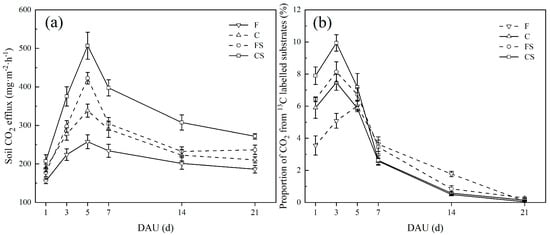
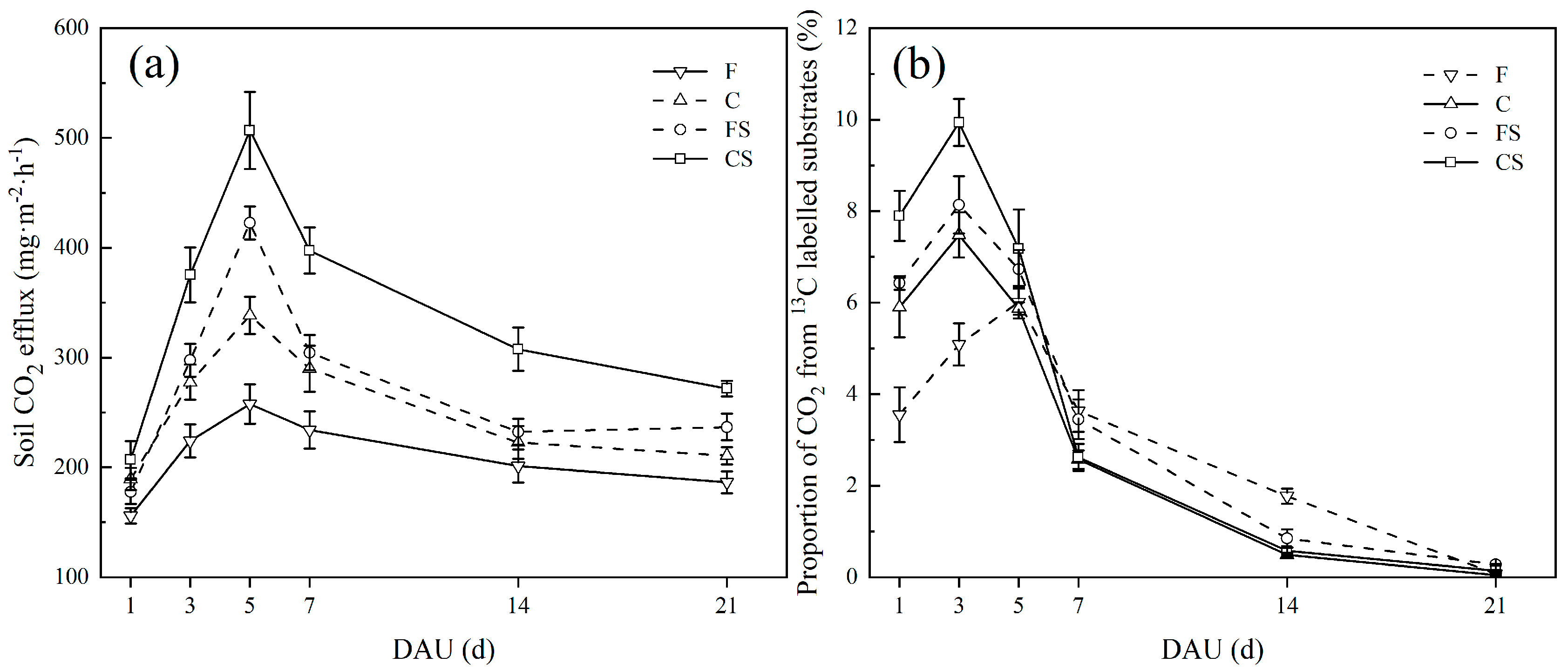
Soil CO2 efflux exhibited a clear temporal pattern across treatments during the 21 days after urea application, with a rapid increase followed by a gradual decline (Figure 1a). CO2 efflux peaked on day 5 and then decreased, approaching a steady level after day 7. Straw return increased CO2 efflux under both irrigation regimes, with the highest fluxes consistently observed in the CS treatment (Table S1). In contrast, the flooded treatment maintained lower CO2 efflux throughout the observation period.
Figure 1.
Soil CO2 efflux (a) and the proportion of urea-derived CO2 in total soil CO2 efflux (b) under different irrigation and straw management. C, F, CS, and FS represent controlled irrigation, flooded irrigation, controlled irrigation with straw return, and flooded irrigation with straw return, respectively. DAU indicates days after urea application. Error bars represent standard errors (n = 4).
Specifically, 36–60% of the applied urea-C was lost as CO2. The proportion of urea-derived CO2 in total soil CO2 efflux increased rapidly after urea application, generally peaked on day 3, and subsequently declined to nearly zero by day 21 (Figure 1b). Straw return increased the proportion of urea-derived CO2 during the first 5 days under both irrigation regimes, whereas after day 7, the proportion of urea-derived CO2 was lower in straw-return treatments than in straw-removal treatments (Table S2). Among all treatments, CS showed the highest proportion of urea-derived CO2 during the first 5 days. However, after day 7, this proportion in the CS treatment became the lowest among all treatments.
3.2. Retention of Urea-Derived C in Soil
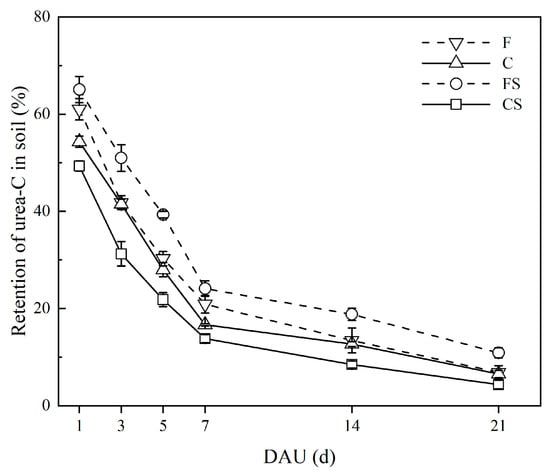
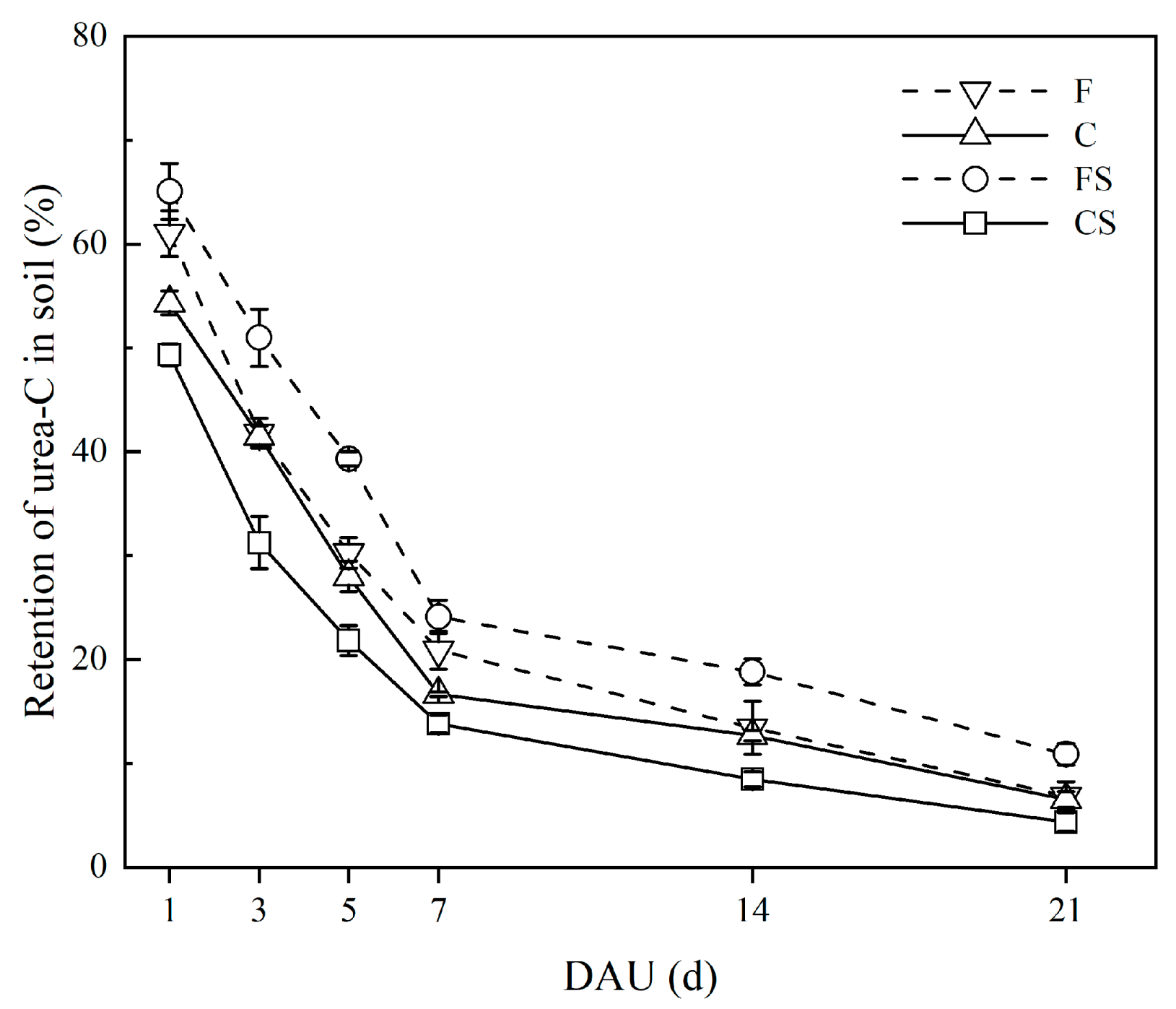
In contrast to the CO2 efflux dynamics, soil retention of urea-derived carbon showed contrasting temporal patterns between straw-return and straw-removal treatments (Figure 2). One day after urea application, urea-derived C retained in soil was highest across all sampling times, ranging from 45% to 65% among treatments. Retention then declined rapidly during the first 7 days, decreasing to 14–24% by day 7, and subsequently decreased more slowly to around 10% by day 21. Flooded irrigation increased the retention of urea-derived C in soil, particularly during the early stage (Table S3). Retention of urea-derived C in soil under flooded irrigation was higher than under controlled irrigation during the first 3 days and on day 7, and the difference between irrigation regimes gradually narrowed over time. Straw return also influenced urea-derived C retention, particularly under flooded irrigation, where straw return increased the residual urea-derived C in soil and slowed its decline (Figure 2). Throughout the observation period, the retention of urea-derived C in soil was generally higher under flooded irrigation (F and FS) than under controlled irrigation (C and CS). These results demonstrate that flooded irrigation combined with straw incorporation is more conducive to the soil retention of urea-derived C than controlled irrigation.
Figure 2.
Retention of urea-derived C in soil. C, F, CS and FS represent controlled irrigation, flooded irrigation, controlled irrigation with straw return and flooded irrigation with straw return, respectively. DAU indicates days after urea application. Error bars represent standard errors (n = 4).
3.3. Soil Microbial Community Structure
Analysis of variance showed that both total PLFA and the PLFA contents of individual microbial groups were significantly affected by irrigation regime and straw management (Table 2). Across treatments, G− were the dominant group, whereas Actinomycetes showed relatively low content. Straw return significantly increased total PLFA under both irrigation regimes, and total PLFA under controlled irrigation was generally higher than that under flooded irrigation. The highest PLFA contents of General, G−, G+, Actinomycetes, and fungi were observed in the CS treatment.
Table 2.
PLFA Contents of Different Microbial Groups under Various Treatments (nmol/g).
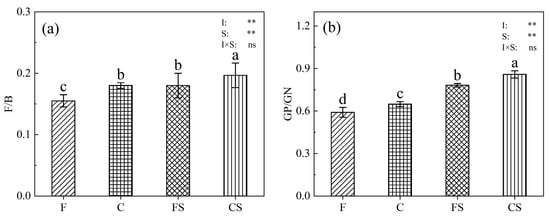
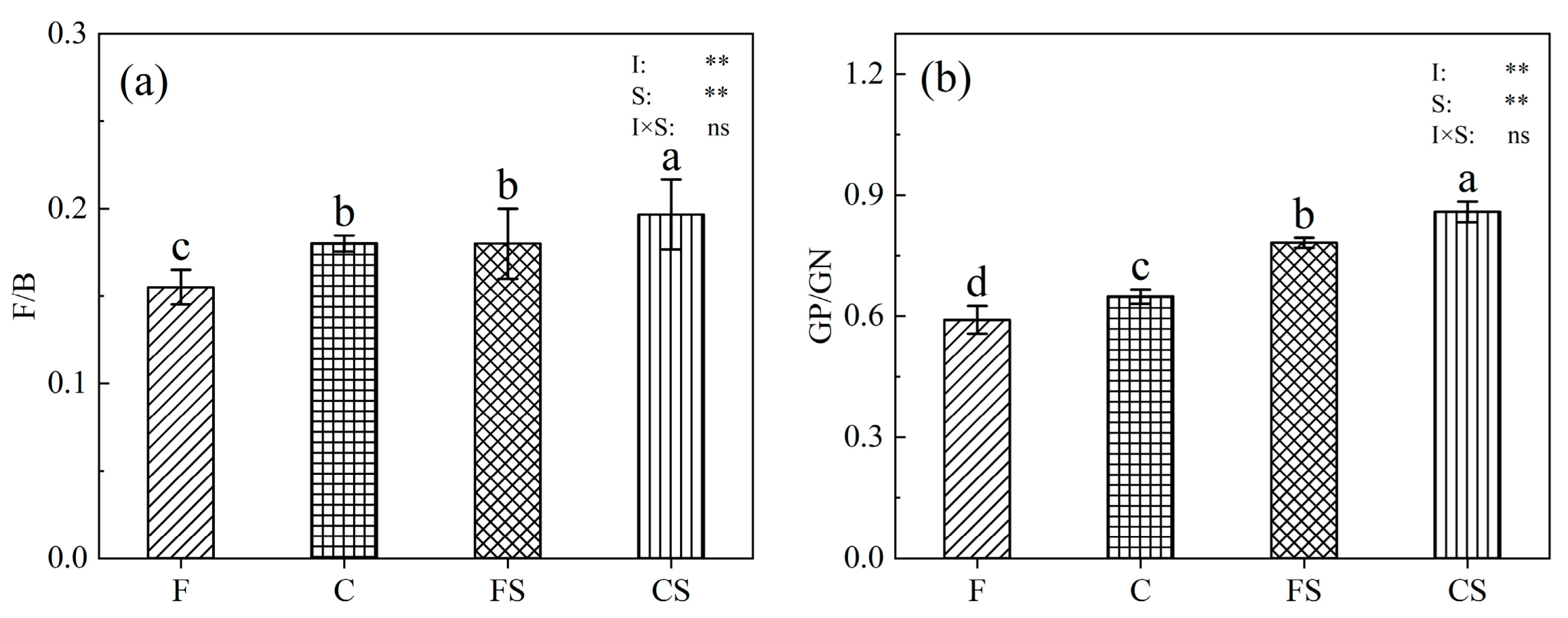
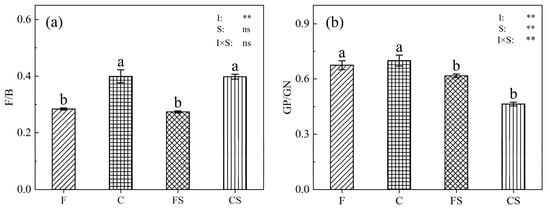
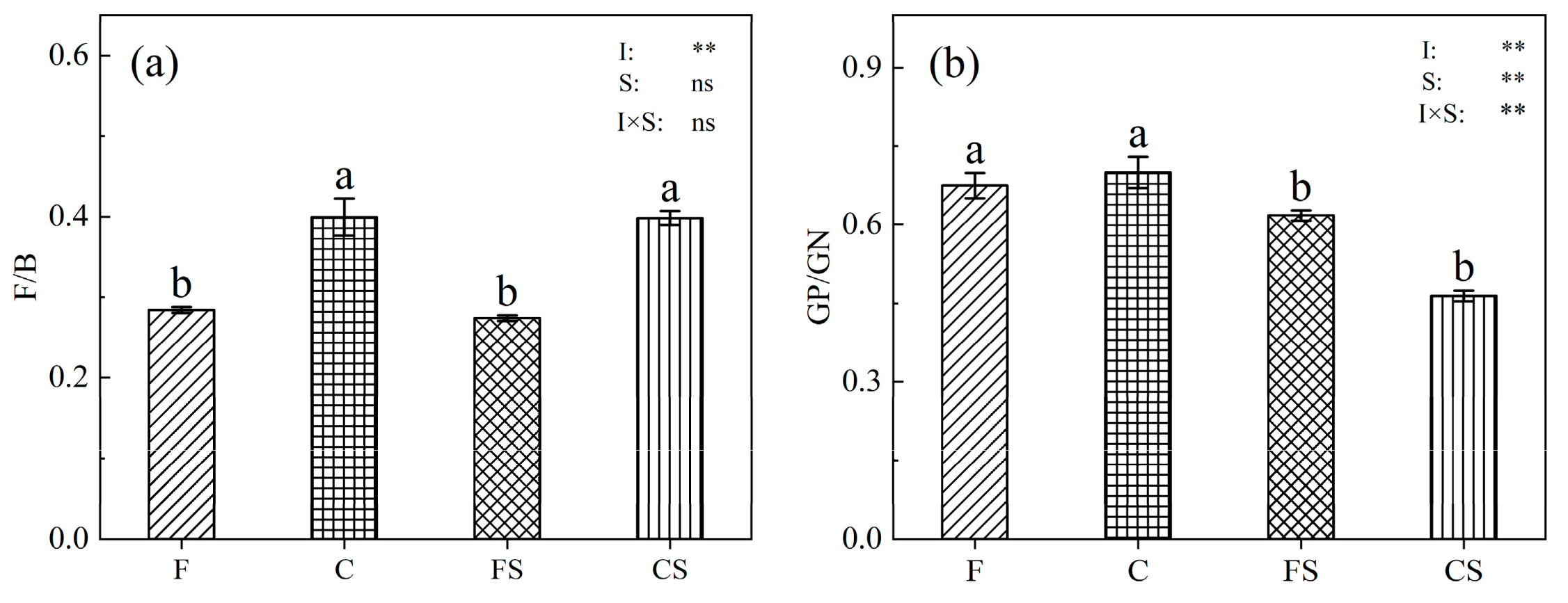
The irrigation regime significantly affected microbial community structure, with the F/B and GP/GN ratios being significantly higher under controlled irrigation than under flooded irrigation (Figure 3). Under the same irrigation regime, straw return increased F/B and GP/GN. Among all treatments, CS exhibited the highest F/B and GP/GN values, whereas the F treatment showed the lowest values.
Figure 3.
F/B ratio (a) and GP/GN ratio (b). C, F, CS and FS represent controlled irrigation, flooded irrigation, controlled irrigation with straw return and flooded irrigation with straw return, respectively. I, S, and I × S represent the effects of irrigation, straw, and their interaction, respectively. **, p < 0.01. ns, not significant. Different lowercase letters indicate significant differences among treatments (p < 0.05). Error bars represent standard errors (n = 4).
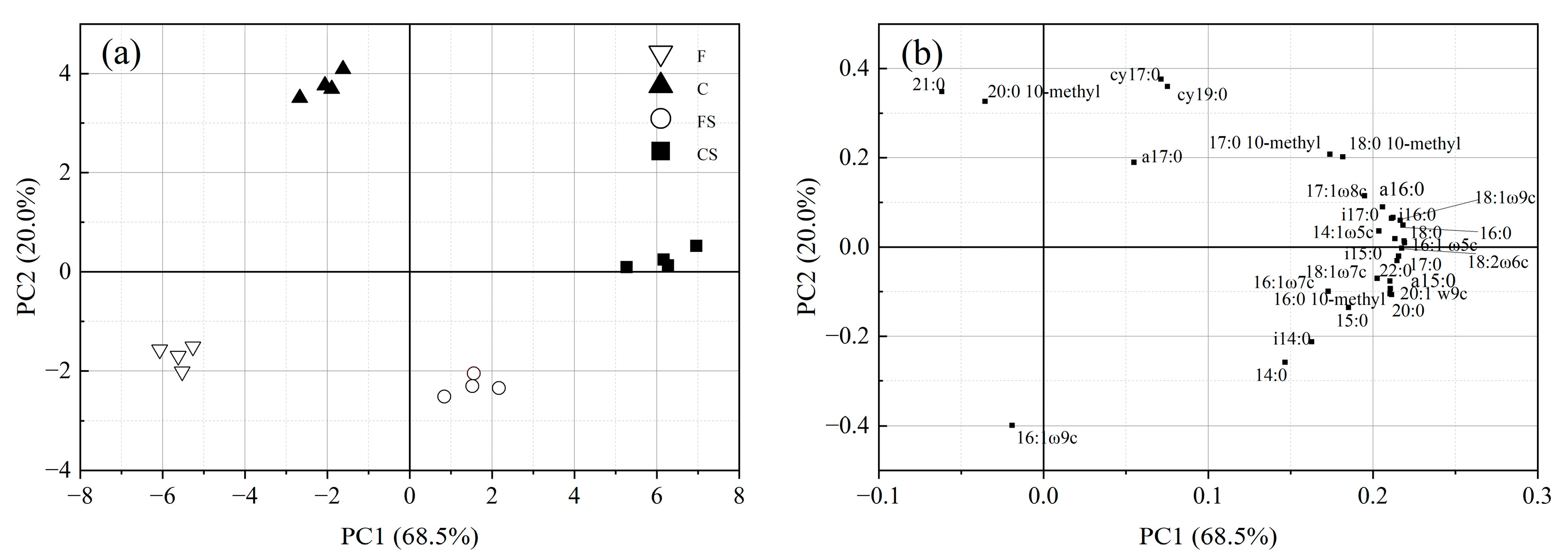
PCA based on PLFA profiles showed clear separation among treatments along PC1 (68.5%) and PC2 (20.0%) (Figure 4a). The C, F, CS, and FS treatments were clearly separated along PC1 and PC2, indicating differences in microbial community composition among treatments. According to the loading plot (Figure 4b), PLFAs such as 16:1ω5c, 14:1ω5c, and 18:1ω9c were strongly enriched in the CS treatment. In contrast, 14:0, i14:0, and 21:0 were mainly associated with the FS treatment, while cy19:0 was more closely linked to the C treatment. No specific PLFA biomarkers were distinctly enriched in the F treatment.
Figure 4.
Principal component analysis (PCA) based on the relative abundance of individual soil PLFAs. (a) Score plot of the four experimental treatments; (b) Loading plot of PLFAs for the first two principal components. The values in parentheses on the axis labels represent the percentage of variation explained by each axis.
3.4. 13C-PLFA-SIP
The 13C-PLFA-SIP results showed that microbial assimilation of urea-derived C differed among treatments and was affected by both irrigation regime and straw return (Table 3). Under controlled irrigation, incorporation of urea-derived C into Actinomycetes and Fungi was higher than under flooded irrigation. In contrast, flooded irrigation enhanced incorporation into General and G+ under both straw management practices, as well as into G− in the absence of straw return. Straw return increased incorporation into Actinomycetes and decreased incorporation into G+ under both irrigation regimes, while increasing incorporation into G− under controlled irrigation.
Table 3.
13C-PLFA Content in Microbial Groups across Treatments (ng/g).
Controlled irrigation and straw return affected the 13C-F/B and 13C-GP/GN ratios differently (Figure 5). Controlled irrigation increased 13C-F/B compared with flooded irrigation, whereas straw return did not change 13C-F/B under either irrigation regime. Irrigation and straw management interactively influenced the 13C-GP/GN ratio. Straw return decreased the 13C-GP/GN ratio under both irrigation regimes.
Figure 5.
F/B ratio (a) and GP/GN ratio (b) in 13C-PLFA profiles. C, F, CS and FS represent controlled irrigation, flooded irrigation, controlled irrigation with straw return and flooded irrigation with straw return, respectively. I, S, and I × S represent the effects of irrigation, straw, and their interaction, respectively. **, p < 0.01. ns, not significant. Different lowercase letters indicate significant differences among treatments (p < 0.05). Error bars represent standard errors (n = 4).
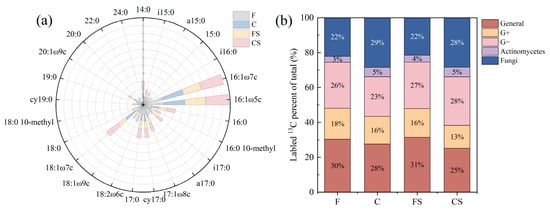
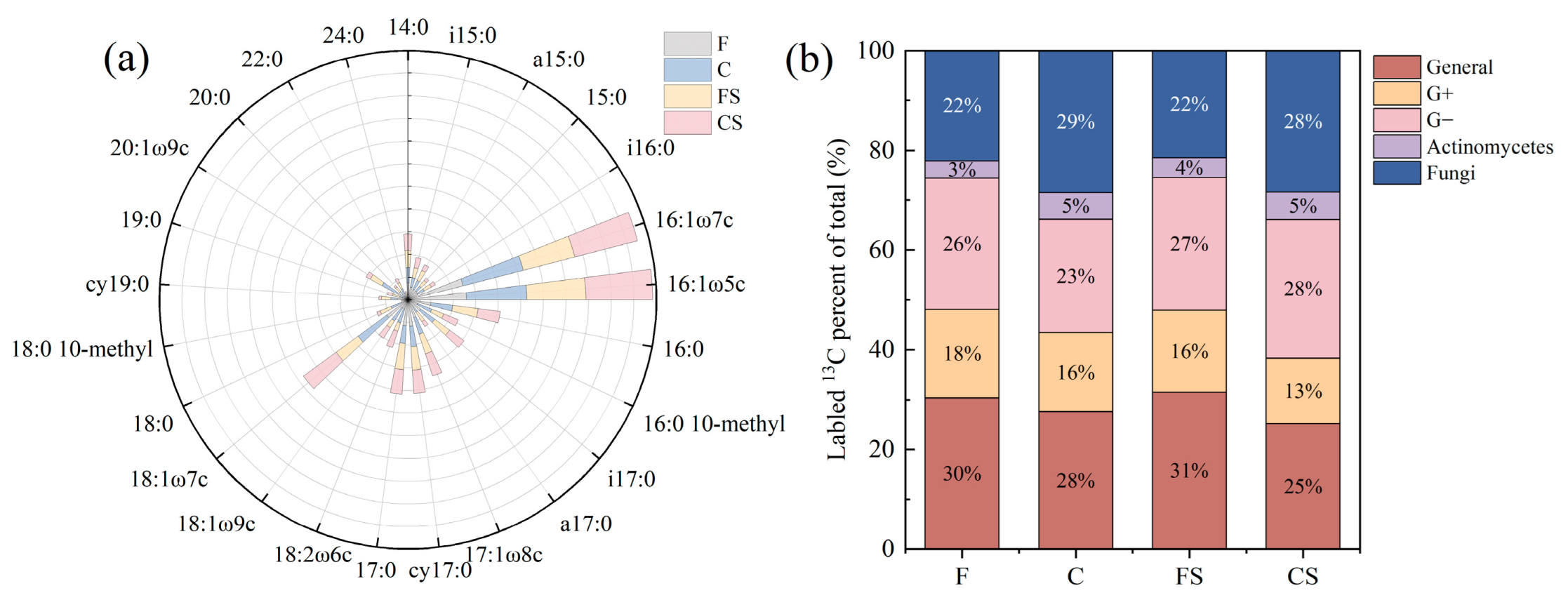
A total of 25 PLFA biomarkers showed detectable 13C enrichment (Figure 6a), with 16:1ω7c, 16:1ω5c, and 18:1ω7c accounting for the largest shares of urea-derived 13C. The relative distribution of 13C among microbial groups also varied with irrigation regime and straw return (Figure 6b). Controlled irrigation (either with or without straw return) increased the relative contribution of Fungi, whereas flooded irrigation (either with or without straw return) increased the relative contribution of General. Straw return did not markedly change the relative distribution of assimilated urea-C under flooded irrigation. Under controlled irrigation, straw return increased the relative contribution of G− and decreased those of General and G+.
Figure 6.
Relative abundance of individual 13C-PLFA biomarkers (a) and relative distribution of 13C among microbial groups (b) in soil under different treatments. C, F, CS, and FS represent controlled irrigation, flooded irrigation, controlled irrigation with straw return, and flooded irrigation with straw return, respectively.
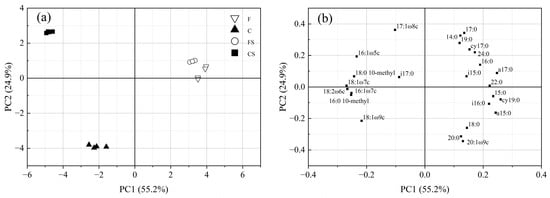
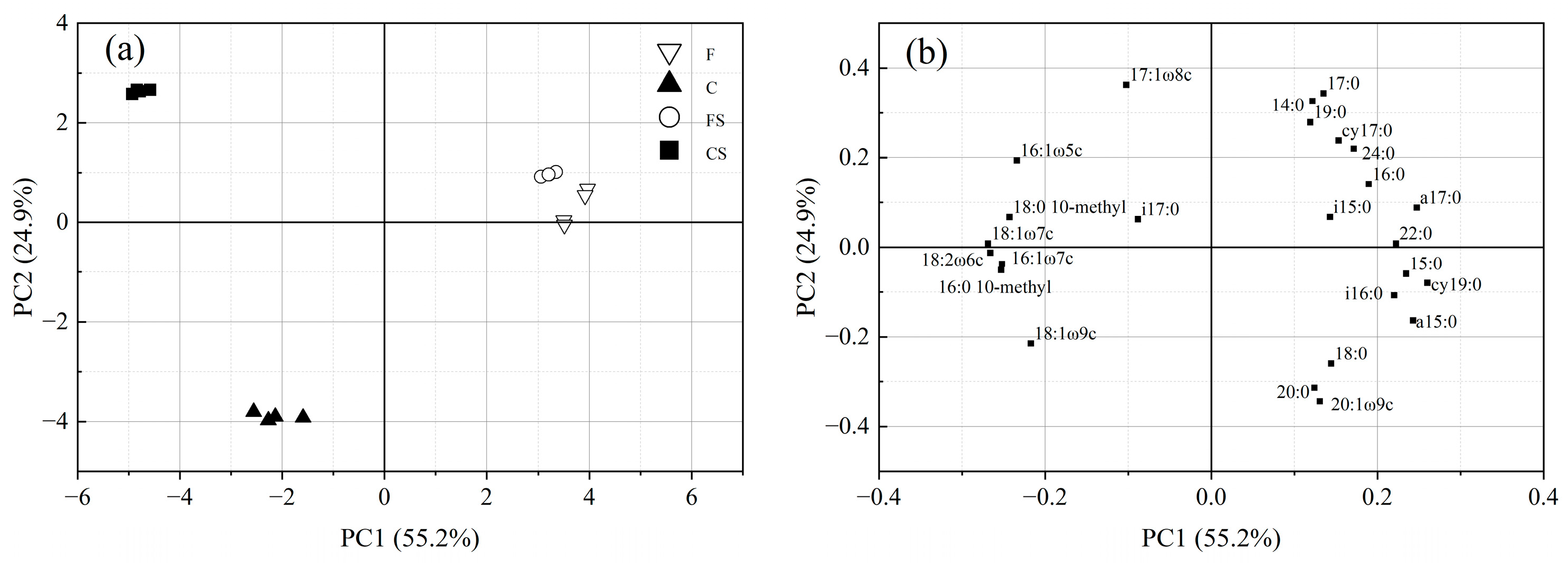
PCA based on 13C-labeled PLFA profiles showed clear separation among treatments along PC1 (55.2%) and PC2 (24.9%) (Figure 7a), indicating differences in urea-derived C assimilation patterns among treatments. According to the loading plot (Figure 7b), PLFAs such as 18:1ω9c were strongly associated with the C treatment, while 17:1ω8c was strongly associated with the CS treatment. Under flooded conditions, 14:0 showed higher loadings in the FS treatment, whereas cy19:0 was more distinctly enriched in the F treatment.
Figure 7.
Principal component analysis (PCA) based on the relative abundance of individual 13C-PLFAs in soil. (a) Score plot of the four experimental treatments; (b) loading plot of PLFA biomarkers for the first two principal components. Values in parentheses on the axis labels indicate the percentage of variance explained by each principal component.
4. Discussion
4.1. Partitioning of Urea-Derived Carbon Between CO2 and Soil Retention as Affected by Water and Straw Management
During the 21-day observation period after urea application, 36–60% of the urea-derived carbon added to the soil was lost as CO2. After being applied to the soil, urea is rapidly hydrolyzed by urease to produce NH3 and CO2 [35]. The proportion of urea-derived CO2 in total soil CO2 efflux generally peaked on day 3 after fertilization (Figure 1b), and then declined rapidly, indicating that the relative contribution of urea-derived CO2 was greatest during the early stage after fertilization. The early increase in the proportion of urea-derived CO2 may be associated with the rapid hydrolysis of urea.
Irrigation regimes significantly dictate the metabolic fate of urea-derived carbon by modulating both urea hydrolysis and microbial activity [36]. Under CI treatments, the absence of a standing water layer enhances gas diffusion and soil oxygen content; concurrently, the wet–dry cycles inherent to CI increase the contact frequency between urea molecules and soil enzymes. These conditions may favor urea hydrolysis and aerobic microbial activity, thereby contributing to the higher proportion of urea-derived CO2 in total soil CO2 efflux observed under controlled irrigation during the early stage [37]. Consequently, a higher proportion of urea-derived CO2 was observed under CI treatments during the early stage. In contrast, long-term flooded management creates a persistently anaerobic environment and restricts gas exchange, which may contribute to the greater short-term retention of urea-derived carbon in soil [38].
Notably, straw incorporation further altered the fate of urea-derived carbon in soil. Under the aerobic conditions created by controlled irrigation, straw decomposition stimulated pronounced microbial activity [21]. Under controlled irrigation, the straw-return treatment showed a higher proportion of urea-derived CO2 in total soil CO2 efflux during the early period after urea application, with the highest proportion observed in the CS treatment (Figure 1b). This response may be related to changes in soil C availability and microbial activity resulting from repeated straw incorporation [39,40]. Previous studies have shown that products of straw decomposition can alter soil mineral and aggregate properties [41,42,43], which may in turn influence the accessibility of urea to soil enzymes and thereby affect urea hydrolysis. Under flooded irrigation, straw return was associated with greater residual urea-derived C in soil (Figure 2). Previous studies suggest that reducing conditions may affect soil C turnover and thereby contribute to greater C retention [44], which interacts with urea-derived carbon to form more stable organo-mineral complexes, thereby enhancing the retention of urea-derived carbon in the soil. Collectively, these findings indicate that straw return and irrigation regime jointly regulate the fate of urea-derived carbon and soil CO2 effluxes.
The substantial release of urea-derived CO2 during the early stage after fertilization indicates the rapid transformation of urea-C in paddy soils. However, the cumulative CO2 emissions and soil C retention did not fully account for the applied urea-derived 13C. This incomplete recovery may be related to the transformation and movement of inorganic C following urea hydrolysis. In paddy soils, dissolved CO2 and HCO3- may remain in soil porewater and floodwater or be transported with water rather than being immediately released into the atmosphere [45]. In addition, Chen et al. [7] detected urea-derived 13C in rice roots, stems, and leaves, indicating that plant uptake may also contribute to the redistribution of urea-C. These carbon pools were not included in the present measurements, which limits our understanding of the overall fate of urea-derived C. Further studies involving 13C measurements in soil water and rice plants would help clarify these carbon transfer pathways.
4.2. Soil Microbial Community Composition Under Long-Term Water and Straw Management
The impact of irrigation practices and straw return on soil microbial community structure has been widely studied, but most research focuses on short-term experiments, which often reflect the immediate responses of microbial communities to environmental changes within a short period [21,46]. However, the effects of long-term water and carbon management on the structure and function of microbial communities may go beyond what short-term studies can reveal, and the underlying mechanisms may be more complex.
Long-term controlled irrigation significantly increased soil microbial biomass compared to the flooded treatment (Table 2). This finding aligns with most short-term studies, which suggest that moderate moisture and optimal aeration conditions are conducive to microbial growth [47]. However, such consistency is primarily reflected at the level of microbial biomass. Long-term water management, through persistent drying-wetting cycles, alters soil substrate availability and redox environments, thereby exerting a cumulative ecological filtering effect on the microbial community [48]. Previous studies have shown that microbial community composition and functional characteristics can still exhibit significant differences under similar biomass levels [34]. Consequently, shifts in microbial biomass alone may fail to capture the profound differences in community structure and functional capacity.
In the initial stage of short-term exogenous carbon input or environmental fluctuations, the microbial community is typically dominated by G− [49]. In contrast, in this study, long-term controlled irrigation significantly increased the F/B and GP/GN ratios. The alternate wetting and drying cycles under controlled irrigation create intermittent aerobic conditions that continuously consume labile substrates, thereby selecting for resource-efficient and stress-tolerant fungi and G+ bacteria, which gain a competitive advantage over G− bacteria [50]. Similarly, long-term straw return introduces large amounts of recalcitrant polymers such as cellulose and lignin into the soil, the decomposition of which is highly dependent on fungi and G+ bacteria [51,52,53], thus increasing the F/B and GP/GN ratios under both irrigation regimes. Notably, the CS treatment exhibited the highest microbial biomass, as well as the highest F/B and GP/GN ratios. Under the CS treatment, the improved soil aeration from controlled irrigation accelerated straw decomposition and the release of organic substrates [54,55]. Meanwhile, the sufficient and continuous supply of such structural carbon sources precisely met the energy demands of fungi and G+ bacteria that thrive in the fluctuating aerobic environment. These findings reveal that long-term water and straw management regulate microbial community structure, driving a shift toward greater relative abundances of fungi and G+ bacteria.
4.3. Water and Straw Management Drive the Assimilation of Urea Carbon by the Microbial Community in Paddy Soils
Investigating microbial community utilization of urea-derived carbon under different water and carbon management regimes helps elucidate their carbon source utilization strategies, especially in the context where long-term irrigation and straw return have significantly altered the microbial community structure in paddy fields (Table 2). 13C-PLFA analysis reveals distinct differences in microbial assimilation of urea-derived carbon under different water and carbon management regimes. We found that under controlled irrigation, PLFA content was higher than under long-term flooded treatments. However, 13C-PLFA analysis showed that the urea-derived carbon content in PLFAs was higher under long-term flooded treatments. This suggests that although microbial abundance is higher under controlled irrigation, long-term flooded management conditions are more favorable for microbial assimilation of urea-derived carbon. Under long-term flooded conditions, the higher 13C incorporation despite lower overall microbial abundance may reflect differences in microbial C-source utilization under low-oxygen conditions [7]. Additionally, the low-oxygen conditions under long-term flooding slow down competition among fast-growing microbes, providing a favorable environment for those that can efficiently utilize urea-derived carbon, thus enhancing microbial assimilation of urea carbon under flooded conditions [56,57]. A similar pattern was reported by Chen et al. [58], who found higher total PLFA under controlled irrigation but greater incorporation of urea-derived 13C into PLFAs under flooded conditions. Water regime affects the distribution of newly added 13C among microbial PLFAs, and only certain microbial groups preferentially utilize this carbon [59,60]. These studies suggest that a larger microbial biomass does not necessarily correspond to greater use of a specific newly supplied C source. Thus, the substantial 13C incorporation observed under flooded conditions in our study may reflect differences in microbial C-source utilization rather than microbial biomass alone.
Further analysis of PLFA compositions involved in urea-derived carbon assimilation revealed that 16:1ω7c, 16:1ω5c, and 18:1ω7c exhibited robust assimilation capabilities. These results showed greater 13C incorporation into PLFAs associated with G− bacteria and fungi (Figure 6). Water management significantly modulated these microbial assimilation patterns. Compared with long-term flooding, controlled irrigation enhanced the incorporation of urea-derived C into Actinomycetes and fungi while simultaneously increasing the 13C-F/B ratio. In contrast, straw incorporation exerted no significant impact on this ratio. These findings suggest that fungal assimilation of urea-derived C is primarily governed by soil redox potential and the metabolic environment, rather than the input of exogenous organic substrates [61]. Meanwhile, the 13C-GP/GN ratio decreased significantly, exhibiting a trend contrary to that of the overall community GP/GN ratio (Figure 5). This divergence indicates that while long-term management favors the accumulation of G+ bacteria, G− bacteria showed greater incorporation of urea-derived C than G+ bacteria. This phenomenon is likely attributable to the preference of G− bacteria for labile carbon substrates and their elevated metabolic rates, which facilitate the rapid incorporation of urea hydrolysis products into microbial biomass. In contrast, G+ bacteria appear more involved in the long-term decomposition of recalcitrant carbon sources, such as straw.
Straw return added substantial labile carbon to the soil and shifted microbial community composition. It increased the abundance of G− bacteria, actinomycetes, and fungi, key groups that assimilate urea-derived carbon. The labile carbon released during straw decomposition also boosted overall microbial activity, enhancing the assimilation and retention of urea hydrolysis products [62]. These findings suggest that straw return influences the microbial assimilation and short-term retention of urea-derived C in paddy soils.
The results of this study challenge the traditional understanding that urea-derived carbon is only briefly retained in the soil and rapidly lost after hydrolysis. We found that a detectable fraction of urea-derived carbon can be assimilated by soil microorganisms, leading to temporary storage and retention. This suggests that the application of fertilizers such as urea is not only a nutrient input for crops but also, through microbial mediation, serves as an important driving force influencing soil material transformation and functional maintenance, rather than merely a nutrient supply process.
5. Conclusions
Under all treatments, approximately 36–60% of the urea-derived carbon was released as CO2 within 21 days, while about 10% remained in the soil after 21 days. The effect of straw return was strongly regulated by the irrigation regime: controlled irrigation promoted the turnover of urea-derived carbon, while flooded irrigation increased its short-term retention in soil. Controlled irrigation generally increased soil PLFA content, whereas 13C-PLFA-SIP revealed group-specific patterns of urea-derived C incorporation. Incorporation was higher in Actinomycetes and fungi under controlled irrigation, whereas flooded irrigation promoted incorporation into general and Gram-positive bacteria, as well as Gram-negative bacteria in the absence of straw return. In conclusion, both irrigation regime and straw return regulated urea-derived carbon transformation and microbial community structure, with irrigation regime playing a dominant role. Flooded irrigation favored the short-term retention of urea-derived carbon under anaerobic conditions, while controlled irrigation accelerated its turnover. This underscores the importance of water management in shaping carbon fate in paddy soils.
Supplementary Materials
The following supporting information can be downloaded at: https://www.mdpi.com/article/10.3390/agriculture16212447/s1. Table S1. Two-way ANOVA for soil CO2 efflux; Table S2. Two-way ANOVA for the proportion of urea-derived CO2; Table S3. Two-way ANOVA for retention of urea-derived C in soil.
Author Contributions
R.T.: Investigation, Methodology, Data Curation, Writing—Original Draft. Z.Z. (Zhaoqiang Zhou): Conceptualization, Supervision, Writing—Review & Editing, Writing—Original Draft. T.N. and P.C.: Resources, Supervision, Writing—Review & Editing. S.D.: Writing—Review & Editing. Y.H., H.L. and H.G.: Methodology, Investigation. Z.Z. (Zhongxue Zhang): Writing—Review & Editing. All authors have read and agreed to the published version of the manuscript.
Funding
This research was funded by the Natural Science Foundation of Jiangsu Province (BK20241531), the Natural Science Foundation Project of Heilongjiang Province (LH2023E109), the Science and Technology Plan Project of Nyingchi City (XDHZ-2025-06), the 2025 Annual Ecological Environment Protection Scientific Research Project of Heilongjiang Province (HST2025ST014), the National Natural Science Foundation of China (52409056), and the Open Research Fund of Yinshanbeilu Grassland Eco-hydrology National Observation and Research Station, China Institute of Water Resources and Hydropower Research (YSS202517). The APC was funded by the authors.
Data Availability Statement
The raw data supporting the conclusions of this article will be made available by the corresponding author upon reasonable request.
Conflicts of Interest
The authors declare no conflicts of interest.
Abbreviations
The following abbreviations are used in this manuscript:
| 13C-PLFA-SIP | 13C-labeled phospholipid fatty acid stable isotope probing |
| PLFA | Phospholipid fatty acid |
| C | Controlled irrigation with straw removal |
| CS | Controlled irrigation with straw return |
| F | Flooded irrigation with straw removal |
| FS | Flooded irrigation with straw return |
| G+ | Gram-positive bacteria |
| G- | Gram-negative bacteria |
| F/B | Fungi-to-bacteria ratio |
| GP/GN | Gram-positive-to-Gram-negative bacterial ratio |
References
- Motasim, A.M.; Samsuri, A.W.; Abdul Sukor, A.S.; Adibah, A.M. Gaseous Nitrogen Losses from Tropical Soils with Liquid or Granular Urea Fertilizer Application. Sustainability 2021, 13, 3128. [Google Scholar] [CrossRef] [Scilit]
- You, Y.; Li, S.; Wang, H.; Wang, L.; Jiang, L.; Li, X.; Peng, Y.; Pang, Z.; Zhao, X. Contrasting mechanisms of poplar and rhizosphere soil influenced by urea and compound fertilizer. Ind. Crops Prod. 2025, 229, 120995. [Google Scholar] [CrossRef] [Scilit]
- Zhao, R.; Liu, J.; Xu, N.; He, T.; Meng, J.; Liu, Z. Urea hydrolysis in different farmland soils as affected by long-term biochar application. Front. Environ. Sci. 2022, 10, 950482. [Google Scholar] [CrossRef] [Scilit]
- Govindasamy, P.; Muthusamy, S.K.; Bagavathiannan, M.; Mowrer, J.; Jagannadham, P.T.K.; Maity, A.; Halli, H.M.; Vadivel, R.; Raj, R.; Pooniya, V.; et al. Nitrogen use efficiency—A key to enhance crop productivity under a changing climate. Front. Plant Sci. 2023, 14, 1121073. [Google Scholar] [CrossRef] [Scilit] [PubMed]
- Jia, C.; Fan, Y.; Wei, Q.; Wang, L.; Zhang, W. Soil organic matter enhances urease-mediated microbially induced carbonate precipitation: Dual benefits for inorganic carbon sequestration and cadmium immobilization. J. Hazard. Mater. 2025, 496, 139342. [Google Scholar] [CrossRef] [Scilit] [PubMed]
- Greenway, H.; Armstrong, W.; Colmer, T.D. Conditions Leading to High CO2 (>5 kPa) in Waterlogged–Flooded Soils and Possible Effects on Root Growth and Metabolism. Ann. Bot. 2006, 98, 9–32. [Google Scholar] [CrossRef] [Scilit] [PubMed]
- Chen, P.; Li, Y.; Lv, Y.; Xu, J.; Zhang, Z.; Liu, X.; Luan, Y.; Wei, Q.; Zheng, E.; Wang, K. Water Management-Mediated Changes in the Rhizosphere and Bulk Soil Microbial Communities Alter Their Utilization of Urea-Derived Carbon. Microorganisms 2024, 12, 1829. [Google Scholar] [CrossRef] [Scilit] [PubMed]
- Ma, C.; Wu, J.; Li, F. Impacts of combined water-saving irrigation and controlled-release urea on CH4 emission and its associated microbial communities and function. Sci. Total Environ. 2022, 830, 154724. [Google Scholar] [CrossRef] [Scilit] [PubMed]
- Frolking, S.; Qiu, J.; Boles, S.; Xiao, X.; Liu, J.; Zhuang, Y.; Li, C.; Qin, X. Combining remote sensing and ground census data to develop new maps of the distribution of rice agriculture in China. Glob. Biogeochem. Cycles 2002, 16, 38-1–38-10. [Google Scholar] [CrossRef] [Scilit]
- Qian, H.; Zhu, X.; Huang, S.; Linquist, B.; Kuzyakov, Y.; Wassmann, R.; Minamikawa, K.; Martinez-Eixarch, M.; Yan, X.; Zhou, F.; et al. Greenhouse gas emissions and mitigation in rice agriculture. Nat. Rev. Earth Environ. 2023, 4, 716–732. [Google Scholar] [CrossRef] [Scilit]
- Hanke, A.; Cerli, C.; Muhr, J.; Borken, W.; Kalbitz, K. Redox control on carbon mineralization and dissolved organic matter along a chronosequence of paddy soils. Eur. J. Soil Sci. 2013, 64, 476–487. [Google Scholar] [CrossRef] [Scilit]
- Kögel-Knabner, I.; Amelung, W.; Cao, Z.; Fiedler, S.; Frenzel, P.; Jahn, R.; Kalbitz, K.; Kölbl, A.; Schloter, M. Biogeochemistry of paddy soils. Geoderma 2010, 157, 1–14. [Google Scholar] [CrossRef] [Scilit]
- Anderson, C.G.; Tfaily, M.M.; Chu, R.K.; Tolic, N.; Fox, P.M.; Nico, P.S.; Fendorf, S.; Keiluweit, M. Seasonal Controls on Microbial Depolymerization and Oxidation of Organic Matter in Floodplain Soils. Environ. Sci. Technol. 2024, 58, 16815–16823. [Google Scholar] [CrossRef] [Scilit] [PubMed]
- Majumdar, A.; Dubey, P.K.; Giri, B.; Moulick, D.; Srivastava, A.K.; Roychowdhury, T.; Bose, S.; Jaiswal, M.K. Combined effects of dry-wet irrigation, redox changes and microbial diversity on soil nutrient bioavailability in the rice field. Soil Tillage Res. 2023, 232, 105752. [Google Scholar] [CrossRef] [Scilit]
- Du, S.; Chen, P.; Lin, G.; Zhang, Z.; Song, J.; Guan, S.; Han, Y.; Deng, M.; Liu, M.; Qi, Z.; et al. Controlled irrigation and straw-decomposing microbial inoculant mitigate CH4 emissions and increase rice yield in straw return mollisols of paddy fields. Agric. Water Manag. 2026, 327, 110269. [Google Scholar] [CrossRef] [Scilit]
- Wang, L.; Guo, S.; Hijri, M.; Farooq, M.; Rehman, A.; Ge, T.; Feng, S.; Wei, Z.; Zhang, J.; Zhao, C.; et al. Enhancing carbon restoration and ecosystem resilience in global drylands via water-to-carbon biotransformation strategies. Commun. Earth Environ. 2025, 6, 916. [Google Scholar] [CrossRef] [Scilit]
- Li, H.; Xie, M.; Hu, B.; Zhou, Y.; Chen, S.; He, R.; Li, Y.; Teng, H.; Zhao, W.; Jia, X.; et al. Effects of straw return on soil carbon sequestration, soil nutrients and rice yield of in acidic farmland soil of Southern China. Environ. Dev. Sustain. 2024, 27, 29775–29795. [Google Scholar] [CrossRef] [Scilit]
- Li, J.; Ren, Q.; Yu, H.; Wu, X.; Yin, Y.; Yue, Z.; Bai, X. Impact of corn straw and straw-derived biochar returning to the field on soil carbon fractions, carbon-converting enzyme activities, and cbbL bacterial community structure. Front. Microbiol. 2025, 16, 1611691. [Google Scholar] [CrossRef] [Scilit] [PubMed]
- Chen, P.; Xu, J.; Wang, K.; Zhang, Z.; Zhou, Z.; Li, Y.; Li, T.; Nie, T.; Wei, Q.; Liao, L. Straw return combined with water-saving irrigation increases microbial necromass accumulation by accelerating microbial growth-turnover in Mollisols of paddy fields. Geoderma 2025, 454, 117211. [Google Scholar] [CrossRef] [Scilit]
- Wang, S.; Zhai, L.; Guo, S.; Zhang, F.; Hua, L.; Liu, H. Returned straw reduces nitrogen runoff loss by influencing nitrification process through modulating soil C:N of different paddy systems. Agric. Ecosyst. Environ. 2023, 354, 108438. [Google Scholar] [CrossRef] [Scilit]
- Bagheri Novair, S.; Mirseyed Hosseini, H.; Etesami, H.; Razavipour, T. Rice straw and composted azolla alter carbon and nitrogen mineralization and microbial activity of a paddy soil under drying–rewetting cycles. Appl. Soil Ecol. 2020, 154, 103638. [Google Scholar] [CrossRef] [Scilit]
- Xu, J.; Peng, S.; Yang, S.; Wang, W. Ammonia volatilization losses from a rice paddy with different irrigation and nitrogen managements. Agric. Water Manag. 2012, 104, 184–192. [Google Scholar] [CrossRef] [Scilit]
- Nie, T.; Chen, P.; Zhang, Z.; Qi, Z.; Lin, Y.; Xu, D. Effects of Different Types of Water and Nitrogen Fertilizer Management on Greenhouse Gas Emissions, Yield, and Water Consumption of Paddy Fields in Cold Region of China. Int. J. Environ. Res. Public Health 2019, 16, 1639. [Google Scholar] [CrossRef] [Scilit] [PubMed]
- Leyrer, V.; Blum, J.; Marhan, S.; Kandeler, E.; Zimmermann, T.; Berauer, B.J.; Schweiger, A.H.; Canarini, A.; Richter, A.; Poll, C. Drought Impacts on Plant-Soil Carbon Allocation-Integrating Future Mean Climatic Conditions. Glob. Change Biol. 2025, 31, e70070. [Google Scholar] [CrossRef] [Scilit] [PubMed]
- Dossou-Yovo, E.R.; Brüggemann, N.; Jesse, N.; Huat, J.; Ago, E.E.; Agbossou, E.K. Reducing soil CO2 emission and improving upland rice yield with no-tillage, straw mulch and nitrogen fertilization in northern Benin. Soil Tillage Res. 2016, 156, 44–53. [Google Scholar] [CrossRef] [Scilit]
- Hannam, K.; Swallow, M.J.B.; Lloret, E.; Norris, C.E.; McIntosh, A.C.S.; Quideau, S.A. Extraction and Analysis of Microbial Phospholipid Fatty Acids in Soils. J. Vis. Exp. 2016, 114, 54360. [Google Scholar] [CrossRef] [Scilit] [PubMed]
- Wang, Q.-q.; Liu, L.-l.; Li, Y.; Qin, S.; Wang, C.-j.; Cai, A.-d.; Wu, L.; Xu, M.; Zhang, W.-j. Long-term fertilization leads to specific PLFA finger-prints in Chinese Hapludults soil. J. Integr. Agric. 2020, 19, 1354–1362. [Google Scholar] [CrossRef] [Scilit]
- Aciego Pietri, J.C.; Brookes, P.C. Substrate inputs and pH as factors controlling microbial biomass, activity and community structure in an arable soil. Soil Biol. Biochem. 2009, 41, 1396–1405. [Google Scholar] [CrossRef] [Scilit]
- Li, N.; Yao, S.-H.; You, M.-Y.; Zhang, Y.-L.; Qiao, Y.-F.; Zou, W.-X.; Han, X.-Z.; Zhang, B. Contrasting development of soil microbial community structure under no-tilled perennial and tilled cropping during early pedogenesis of a Mollisol. Soil Biol. Biochem. 2014, 77, 221–232. [Google Scholar] [CrossRef] [Scilit]
- McKinley, V.L.; Peacock, A.D.; White, D.C. Microbial community PLFA and PHB responses to ecosystem restoration in tallgrass prairie soils. Soil Biol. Biochem. 2005, 37, 1946–1958. [Google Scholar] [CrossRef] [Scilit]
- Lu, Z.; Lu, T.; Shi, J.; Chen, K.; Guo, H.; Li, N.; Han, X. Short-term microbial community dynamics induced by 13C-labeled maize root, its derived biochar and NPK in long-term amended soil. Biochar 2024, 6, 72. [Google Scholar] [CrossRef] [Scilit]
- Bååth, E.; Anderson, T.H. Comparison of soil fungal/bacterial ratios in a pH gradient using physiological and PLFA-based techniques. Soil Biol. Biochem. 2003, 35, 955–963. [Google Scholar] [CrossRef] [Scilit]
- Fanin, N.; Kardol, P.; Farrell, M.; Nilsson, M.-C.; Gundale, M.J.; Wardle, D.A. The ratio of Gram-positive to Gram-negative bacterial PLFA markers as an indicator of carbon availability in organic soils. Soil Biol. Biochem. 2019, 128, 111–114. [Google Scholar] [CrossRef] [Scilit]
- Malik, A.A.; Chowdhury, S.; Schlager, V.; Oliver, A.; Puissant, J.; Vazquez, P.G.; Jehmlich, N.; von Bergen, M.; Griffiths, R.I.; Gleixner, G. Soil Fungal:Bacterial Ratios Are Linked to Altered Carbon Cycling. Front. Microbiol. 2016, 7, 1247. [Google Scholar] [CrossRef] [Scilit] [PubMed]
- Sigurdarson, J.J.; Svane, S.; Karring, H. The molecular processes of urea hydrolysis in relation to ammonia emissions from agriculture. Rev. Environ. Sci. Bio/Technol. 2018, 17, 241–258. [Google Scholar] [CrossRef] [Scilit]
- Islam, S.M.M.; Gaihre, Y.K.; Biswas, J.C.; Singh, U.; Ahmed, M.N.; Sanabria, J.; Saleque, M.A. Nitrous oxide and nitric oxide emissions from lowland rice cultivation with urea deep placement and alternate wetting and drying irrigation. Sci. Rep. 2018, 8, 17623. [Google Scholar] [CrossRef] [Scilit] [PubMed]
- Huang, J.; Nie, T.; Li, T.; Chen, P.; Zhang, Z.; Zhu, S.; Sun, Z.; E, L. Effects of Straw Incorporation Years and Water-Saving Irrigation on Greenhouse Gas Emissions from Paddy Fields in Cold Region of Northeast China. Agriculture 2022, 12, 1878. [Google Scholar] [CrossRef] [Scilit]
- Zhang, Y.; Chen, X.; Geng, S.; Zhang, X. A review of soil waterlogging impacts, mechanisms, and adaptive strategies. Front. Plant Sci. 2025, 16, 1545912. [Google Scholar] [CrossRef] [Scilit] [PubMed]
- Yuan, L.; Gao, Y.; Mei, Y.; Liu, J.; Kalkhajeh, Y.K.; Hu, H.; Huang, J. Effects of continuous straw returning on bacterial community structure and enzyme activities in rape-rice soil aggregates. Sci. Rep. 2023, 13, 2357. [Google Scholar] [CrossRef] [Scilit] [PubMed]
- Zhang, L.; Wang, J.; Zhu, C.; Li, J.; Yang, Q.; Fu, M.; Wang, Y. Regulatory Effects of Nitrogen Fertilization on Soil Extracellular Enzyme Activity and Greenhouse Gas Emissions in Paddy Fields with Straw Return. Agriculture 2026, 16, 964. [Google Scholar] [CrossRef] [Scilit]
- Bolscher, T.; Cardon, Z.G.; Garcia Arredondo, M.; Grand, S.; Griffen, G.; Hestrin, R.; Imboden, J.; Jamoteau, F.; Lacroix, E.M.; Perez Castro, S.; et al. Vulnerability of mineral-organic associations in the rhizosphere. Nat. Commun. 2025, 16, 5527. [Google Scholar] [CrossRef] [Scilit] [PubMed]
- Chen, C.; Hall, S.J.; Coward, E.; Thompson, A. Iron-mediated organic matter decomposition in humid soils can counteract protection. Nat. Commun. 2020, 11, 2255. [Google Scholar] [CrossRef] [Scilit] [PubMed]
- Chen, P.; Xu, J.; Zhang, Z.; Wang, K.; Li, T.; Wei, Q.; Li, Y. Carbon pathways in aggregates and density fractions in Mollisols under water and straw management: Evidence from 13C natural abundance. Soil Biol. Biochem. 2022, 169, 108684. [Google Scholar] [CrossRef] [Scilit]
- Jeewani, P.H.; Van Zwieten, L.; Zhu, Z.; Ge, T.; Guggenberger, G.; Luo, Y.; Xu, J. Abiotic and biotic regulation on carbon mineralization and stabilization in paddy soils along iron oxide gradients. Soil Biol. Biochem. 2021, 160, 108312. [Google Scholar] [CrossRef] [Scilit]
- Dong, Y.; Liu, S.; Hu, Y.; Mulder, J.; Adingo, S.; Nie, Y.; Yin, L.; Ma, Y.; Peng, X. Effects of long-term straw application and groundwater management on acidification of paddy soils in subtropical China: Insight from a 35-year field experiment. Agric. Water Manag. 2025, 309, 109337. [Google Scholar] [CrossRef] [Scilit]
- Han, Y.; Chen, P.; Zhang, Z.; Yan, X.; Zhang, G.; Zhang, Z.; Li, T.; Nie, T.; Du, S. Continuous biochar amendment to achieve long-term CH4 mitigation in paddy fields under water-saving irrigation: A 5-year experiment. Biochar 2026, 8, 70. [Google Scholar] [CrossRef] [Scilit]
- Liao, H.; Chapman, S.J.; Li, Y.; Yao, H. Dynamics of microbial biomass and community composition after short-term water status change in Chinese paddy soils. Environ. Sci. Pollut. Res. Int. 2018, 25, 2932–2941. [Google Scholar] [CrossRef] [Scilit] [PubMed]
- Schimel, J.P.; Schaeffer, S.M. Microbial control over carbon cycling in soil. Front. Microbiol. 2012, 3, 348. [Google Scholar] [CrossRef] [Scilit] [PubMed]
- Cao, X.; Zhang, J.; Yu, Y.; Ma, Q.; Kong, Y.; Pan, W.; Wu, L.; Jin, Q. Alternate wetting–drying enhances soil nitrogen availability by altering organic nitrogen partitioning in rice-microbe system. Geoderma 2022, 424, 115993. [Google Scholar] [CrossRef] [Scilit]
- Zhang, M.; Dong, L.-G.; Fei, S.-X.; Zhang, J.-W.; Jiang, X.-M.; Wang, Y.; Yu, X. Responses of Soil Organic Carbon Mineralization and Microbial Communities to Leaf Litter Addition under Different Soil Layers. Forests 2021, 12, 170. [Google Scholar] [CrossRef] [Scilit]
- Wang, X.; He, P.; Xu, X.; Qiu, S.; Zhao, S. Characteristics of rice straw decomposition and bacterial community succession for 2 consecutive years in a paddy field in southeastern China. Sci. Rep. 2022, 12, 20893. [Google Scholar] [CrossRef] [Scilit] [PubMed]
- Liu, X.; Chen, Q.; Zhang, H.; Zhang, J.; Chen, Y.; Yao, F.; Chen, Y. Effects of exogenous organic matter addition on agricultural soil microbial communities and relevant enzyme activities in southern China. Sci. Rep. 2023, 13, 8045. [Google Scholar] [CrossRef] [Scilit] [PubMed]
- Ye, J.; Chen, Z.; Ma, J.; Ma, J.; Zou, P.; Sun, W.; Wang, F.; Yu, Q.; Wang, Q. The Effect of Long-Term Organic Amendments on Soil Organic Carbon Accumulation via Regulating Microbial Traits in a Paddy Soil. Agriculture 2025, 15, 2308. [Google Scholar] [CrossRef] [Scilit]
- Zhang, W.; Zhao, Y.; Frouz, J.; Xue, P.; Li, J.; Suo, L.; Song, B.; Wang, H. The impact of precipitation on N2O emissions during the freeze-thaw cycle in a typical grassland in Inner Mongolia. Soil Tillage Res. 2026, 255, 106774. [Google Scholar] [CrossRef] [Scilit]
- Jiang, D.; Chen, J.; Gao, J.; Na, L. Machine learning and environmental sustainability of agricultural residues: A review of wheat straw, rice straw, sugarcane bagasse, and cotton stalk valorization pathways. Ind. Crops Prod. 2026, 251, 124217. [Google Scholar] [CrossRef] [Scilit]
- Chen, J.; Cordero, I.; Moorhead, D.L.; Rowntree, J.K.; Simpson, L.T.; Bardgett, R.D.; Craig, H. Trade-off between microbial carbon use efficiency and specific nutrient-acquiring extracellular enzyme activities under reduced oxygen. Soil Ecol. Lett. 2023, 5, 220157. [Google Scholar] [CrossRef] [Scilit]
- Randle-Boggis, R.J.; Ashton, P.D.; Helgason, T. Increasing flooding frequency alters soil microbial communities and functions under laboratory conditions. Microbiologyopen 2018, 7, e00548. [Google Scholar] [CrossRef] [Scilit] [PubMed]
- Chen, P.; Xu, J.; Wang, K.; Zhang, Z.; Liu, X.; Wei, Q.; Nie, T.; Zhou, Z.; Meng, Q.; Lei, C. Biochar- or straw-mediated alteration in rice paddy microbial community structure and its urea-C utilization are depended on irrigation regimes. Appl. Soil Ecol. 2024, 203, 105608. [Google Scholar] [CrossRef] [Scilit]
- Yao, H.; Thornton, B.; Paterson, E. Incorporation of 13C-labelled rice rhizodeposition carbon into soil microbial communities under different water status. Soil Biol. Biochem. 2012, 53, 72–77. [Google Scholar] [CrossRef] [Scilit]
- Murase, J.; Matsui, Y.; Katoh, M.; Sugimoto, A.; Kimura, M. Incorporation of 13C-labeled rice-straw-derived carbon into microbial communities in submerged rice field soil and percolating water. Soil Biol. Biochem. 2006, 38, 3483–3491. [Google Scholar] [CrossRef] [Scilit]
- Tian, J.; Liu, L.; Chen, H.; Zhong, L.; Zhou, X.; Jiang, L.; Zhan, W.; Wang, Y. Aerobic environments in combination with substrate additions to soil significantly reshape depth-dependent microbial distribution patterns in Zoige peatlands, China. Appl. Soil Ecol. 2022, 170, 104252. [Google Scholar] [CrossRef] [Scilit]
- Yang, C.; Zhang, Q.; Diao, M.; Yang, G.; Liu, H.; Guo, Y.; Cong, L.; Chen, Y.; Li, J.; Tang, W.; et al. Global and regional soil salinization drives bacterial diversity loss and biogeochemical imbalance. Commun. Earth Environ. 2026, 7, 486. [Google Scholar] [CrossRef] [Scilit]

Disclaimer/Publisher’s Note: The statements, opinions and data contained in all publications are solely those of the individual author(s) and contributor(s) and not of MDPI and/or the editor(s). MDPI and/or the editor(s) disclaim responsibility for any injury to people or property resulting from any ideas, methods, instructions or products referred to in the content. |
© 2026 by the authors. Licensee MDPI, Basel, Switzerland. This article is an open access article distributed under the terms and conditions of the Creative Commons Attribution (CC BY) license.