


Abstract
Seed germination in cold deserts is constrained by winter conditions, yet the combined effects of snow cover and freeze–thaw cycles on seed metabolism remain unclear. We investigated their interactive influence on Seriphidium transiliense germination using four snow cover levels (P1: 0%, P2: 50%, P3: natural, P4: 200% natural) and five freeze–thaw cycles (C1: none; C2 to C5: daily fluctuations from −2/8 °C to 8/−2 °C) in a factorial design. Germination traits, physiology, and metabolomics were analyzed. Snow cover and freeze–thaw cycles significantly interacted. P4C5 treatment (200% snow cover, 8/−2 °C freeze–thaw regime) most strongly promoted germination, increasing the germination percentage, potential, index, and vigor index by 67.6–172.5% compared with P1C1. P4C5 treatment increased soluble sugars and proteins but reduced proline and malondialdehyde levels, indicating improved osmotic balance and membrane stability. Antioxidant enzyme activities rose alongside increased indole-3-acetic acid and gibberellin and decreased abscisic acid. Metabolomic profiling revealed reprogramming, with HexCer (17:2;02/16:1;0) as a key metabolite and enrichment in cofactor biosynthesis, ABC transporters, and flavonoid pathways. Greater snow cover combined with mild freeze–thaw regime primes S. transiliense seeds for germination by optimizing the microenvironment, strengthening physiological resilience, and activating coordinated metabolic networks.
1. Introduction
Desert ecosystems are highly sensitive to climatic variability. Changes in precipitation, snowfall, and temperature fluctuations can have a huge impact on the soil thermal and moisture conditions. Especially in temperate desert regions, these factors strongly influence the survival and reproduction of desert plants [1,2].
Seriphidium transiliense Poljakov (syn. Artemisia transiliensis) is a perennial plant belonging to the Asteraceae family. It is a characteristic species of desert grasslands in Northwest China, particularly in the Northern Xinjiang region [2,3,4,5]. The species contributes to forage resources, wind protection, soil stabilization, water conservation, and the reduction in desertification processes [1,6]. It is also used in traditional medicine for the treatment of inflammation-related disorders and contains several bioactive secondary metabolites [7]. Ecologically, its persistence in cold, arid grasslands reflects the capacity to withstand marked seasonal variation in temperature and water availability.
Despite its ecological importance, the population of S. transiliense is increasingly exposed to habitat degradation associated with climate change, overgrazing, and other human disturbances, leading to a decline in suitable habitat within desert ecosystems [3,8]. Because of its sensitivity to environmental change, S. transiliense is widely used as an indicator species, and changes in its abundance reflect vegetation degradation and restoration dynamics in deserts [9]. Therefore, its conservation, scientific management, reseeding, and long-term monitoring are important for maintaining and restoring desert grassland ecosystems.
Successful regeneration of S. transiliense depends strongly on seed survival during winter and germination during early spring. In temperate desert ecosystems, snow cover and seasonal freeze–thaw cycles are fundamental climatic processes and determine the thermal and moisture environment experienced by overwintering seeds [10,11,12]. Snow cover primarily acts as a thermal insulator and as a temporary reservoir of water [13]. A stable snow layer reduces extreme temperature fluctuations and can protect seeds from freezing injury. Increased snow cover has been associated with improved overwinter survival in several woody species [14,15]. Reduced winter snow cover can weaken thermal insulation and expose vegetation to severe cold stress [16].
Snow cover also influences germination by providing soil moisture during early spring. By delaying water release and reducing evaporative losses, snow accumulation may modify the conditions under which seeds imbibe and resume metabolic activity [17,18]. However, plant responses to snow cover are highly species-specific [14,18]. For example, increased snow accumulation has promoted seed development in some Krascheninnikovia species, whereas snow removal has stimulated germination in Ewersmanniana and Schismus arabicus but reduced it in other desert species [10]. Anniwaer et al. [18], for example, found that altered snow conditions produced either no significant change or a negative effect on germination across many of the 35 Central Asian desert species examined. Such contrasting responses indicate that snow effects cannot be generalized across desert plant communities and are likely mediated by species-specific physiological strategies.
Freeze–thaw cycles constitute a second major component of the overwintering environment. During late winter and early spring, repeated freezing and thawing events alter soil structure, temperature regimes, moisture distribution, and seed–soil contact [19]. Freeze–thaw processes can influence seed imbibition, metabolic activation, and germination performance by changing the soil porosity and aeration, and seed hydration status [20,21].
Their biological effects vary according to temperature amplitude, duration, soil moisture, and species sensitivity. Moderate freeze–thaw conditions have been reported to promote germination and early seedling growth in Hordeum jubatum and Festuca elata [22]. Similarly, Zhang YL et al. [23] reported that the interaction of soil moisture and temperature during freeze–thaw events influenced seed germination in the Gurbantunggut Desert; longer freeze–thaw periods under low soil moisture improved seed germination of Lappula patula, Erodium oxyrrhynchum, and Alyssum linifollum, whereas high soil moisture reduced the germination of Eremopyrum orientale. These findings indicate that freeze–thaw effects on early plant establishment depend on interactions among temperature amplitude, soil moisture status, and species-specific physiological tolerance [18,23,24,25].
The ecological importance of snow cover and freeze–thaw cycles therefore lies not simply in whether they increase or decrease germination, but in how their interaction shapes the physiological state of seeds during overwintering [18,23,24,25]. Snow depth determines the degree of thermal buffering and the timing of snowmelt, whereas freeze–thaw regimes impose repeated temperature transitions that can influence membrane stability, osmotic adjustment, antioxidant metabolism, hormonal regulation, and broader metabolic reorganization [25,26,27,28,29]. Together, these processes may determine whether overwintered seeds retain sufficient physiological integrity and metabolic readiness to germinate once spring conditions become favorable. Such responses are particularly relevant to the reproductive adaptation of S. transiliense, because successful recruitment under variable winter conditions may contribute to its persistence and population distribution across temperate desert grasslands.
Based on this framework, we hypothesized that snow-cover thickness and freeze–thaw regime interact to regulate post-winter germination of S. transiliense through coordinated changes in pre-germinative physiological and metabolic processes. Specifically, we expected that treatment combinations associated with greater membrane stability, balanced osmotic adjustment, stronger antioxidant regulation, a higher relative abundance of growth-promoting hormones, and favorable metabolic reorganization would be accompanied by higher subsequent germination and seed vigor.
This study aimed to clarify the interactive effects of snow cover and freeze–thaw cycles on seed germination and physiological metabolism of S. transiliense. The objectives of this study were to: (i) quantify the individual and interactive effects of snow cover thickness and freeze–thaw regime on seed germination and vigor; (ii) determine whether differences in germination performance are associated with changes in osmotic adjustment, membrane stability, antioxidant capacity, and endogenous hormone balance; and (iii) characterize metabolic responses associated with contrasting snow cover and freeze–thaw conditions. By linking overwintering conditions with subsequent germination and physiological regulation, this study provides a mechanistic basis for understanding reproductive adaptation and recruitment of S. transiliense under variable winter environments, with implications for reseeding and restoration of desert grasslands in Northwest China.
2. Materials and Methods
2.1. Seed Collection and Experimental Site
Mature seeds of Seriphidium transiliense Poljakov were collected from natural populations in the low mountain belt of the middle section of the northern slope of Tianshan Mountain (84°58′–86°24′ E, 43°26′–45°20′ N). Seeds were harvested at full maturity from multiple randomly selected mother plants to minimize maternal effects, air-dried at room temperature in a well-ventilated laboratory, and stored at room temperature until experimentation. The experimental site was located at the pasture experimental site of Shihezi University (44°31′ N, 85°05′ E), which belongs to the temperate continental climate zone. The region has a mean annual temperature of 8.85 °C, with the highest monthly mean temperature occurring in July (26.3 °C) and the lowest in December (−16 °C). Mean annual rainfall is 189.2 mm, and the annual evaporation is approximately 1300 mm. These climatic conditions are representative of temperate desert ecosystems in Northwest China.
2.2. Snow Cover and Freeze–Thaw Treatments
2.2.1. Snow-Cover Treatments
Uniform, plump, and undamaged seeds of S. transiliense were packed into nylon mesh bags (5 cm × 7 cm; pore size 40–50 µm), with each bag containing 5 g of seeds. The bags were buried horizontally at a depth of 1.5 cm in plastic pots (35 cm × 10 cm × 15 cm) filled with soil. Each pot contained 1 seed bag, and each snow-cover treatment consisted of 3 pots.
The snow-cover treatments were maintained under field conditions for 125 days, from 7 November 2024 to 12 March 2025. During the entire winter period, after each natural snowfall event, four snow cover levels were maintained: (i) P1 (no snow cover), (ii) P2 (half snow cover, 50% of natural snowfall), (iii) P3 (natural snow cover, 100% snowfall), and (iv) P4 (double snow cover, 200% of natural snowfall) achieved by manually adding snow collected from adjacent areas. Snow thickness was adjusted after each snowfall to maintain consistent treatment levels. This approach enabled realistic simulation of field snow-cover gradients while preserving natural temperature fluctuations.
2.2.2. Freeze–Thaw Treatments
After the snowmelt was completed on 12 March 2025, seeds were treated with freeze–thaw temperatures for 15 days. A refrigerator manufactured by Aike Holdings Group Co., Ltd. (Model C75, Foshan, Guangdong, China) was used to simulate the natural freeze–thaw cycle. Five freeze–thaw regimes selected based on long-term winter-spring temperature records for the Shihezi region were: (i) C1 (no freeze–thaw, temperature of 25 °C/20 °C under dry conditions), (ii) C2 (most severe freeze–thaw regime, 2 °C/−8 °C), (iii) C3 (intermediate freeze–thaw regime, 4 °C/−6 °C), (iv) C4 (milder freeze–thaw regime, 6 °C/−4 °C), and (v) C5 (mildest freeze–thaw regime, 8 °C/−2 °C). After snowmelt, the seeds from each of these 12 independently treated seed bags were divided into five portions, with one portion assigned to each freeze–thaw treatment (C1–C5). Each 24 h freeze–thaw cycle consisted of 12 h at the higher temperature followed by 12 h at the lower temperature [23].
Following treatment, seeds from each replicate within each treatment combination were divided into two subsamples. One subsample was used for germination assessment, while the second was frozen in liquid nitrogen and stored at −80 °C for physiological and metabolomics analysis.
2.2.3. Seed Germination Assay
Seeds originating from the three independent biological replicates of each snow-cover treatment were maintained separately throughout the freeze–thaw and germination experiments; seeds from different replicate bags were not pooled. Following the freeze–thaw treatments, ten seeds from each replicate were placed in a 9 cm-diameter Petri dish lined with two layers of filter paper. Thus, each Petri dish represented one experimental unit, and each of the 20 snow-cover × freeze–thaw treatment combinations consisted of three independent biological replicates (three Petri dishes).
P1C1, representing 0% natural snow cover followed by the no-freeze–thaw treatment, was used as the reference treatment for overall comparisons. Petri dishes were incubated in an artificial climate chamber (RXZ-1608, Ningbo, China) under a 12 h light period at 25 °C and a 12 h dark period at 20 °C, with relative humidity maintained at 50%. Filter papers were moistened with distilled water as required to maintain adequate moisture throughout the experiment.
Germination was monitored every 24 h for 14 days. Seeds were considered germinated when the radicle length reached at least 2 mm. The following germination parameters were calculated [30]:
where Gt is the number of seeds newly germinated on day t, and Dt is the number of days from the start of the germination test.
where SL is the mean seedling length, and GI is the germination index.
2.3. Determination of Seed Physiology Parameters
Physiological measurements were performed independently for all three replicates of each snow-cover × freeze–thaw treatment combination. Seeds originating from different biological replicates were kept separate throughout sample preparation and analysis. Frozen seed material was ground to a fine powder in liquid nitrogen before biochemical assays.
For determination of soluble sugar (WSC), approximately 0.2 g of frozen seed tissue from each biological replicate was used for extraction, and WSC content was quantified using the anthrone colorimetric method of Yemm and Willis [31]. Soluble protein (SP) content was extracted from approximately 0.2 g of frozen seed tissue and quantified using the Coomassie Brilliant Blue G-250 method of Bradford [32], with bovine serum albumin used for preparation of the standard curve.
Free proline (Pro) content was determined using approximately 0.5 g of frozen seed tissue according to the acid-ninhydrin method of Bates et al. [33]. Tissue was extracted in 3% sulfosalicylic acid, and proline concentration was quantified spectrophotometrically following reaction with acid ninhydrin. Lipid peroxidation was assessed by measuring malondialdehyde (MDA) content using approximately 0.5 g of frozen seed tissue. MDA was determined using the thiobarbituric acid reaction following Heath and Packer [34].
For antioxidant enzyme extraction, approximately 0.5 g of frozen seed tissue from each biological replicate was ground to a fine powder in liquid nitrogen and homogenized on ice with 4 mL of ice-cold 50 mM potassium phosphate buffer (pH 7.0) containing 1 mM EDTA and 1% (w/v) polyvinylpyrrolidone (PVP). The homogenate was centrifuged at 12,000× g for 15 min at 4 °C, and the supernatant was collected and kept on ice for enzyme assays. For ascorbate peroxidase extraction, 1 mM ascorbate was additionally included in the extraction buffer to stabilize APX activity.
Superoxide dismutase (SOD; EC 1.15.1.1) activity was determined using the nitroblue tetrazolium (NBT) photoreduction method of Beauchamp and Fridovich [35]. The 3 mL reaction mixture contained 50 mM potassium phosphate buffer (pH 7.8), 13 mM methionine, 75 µM NBT, 0.1 mM EDTA, 2 µM riboflavin, and 0.1 mL enzyme extract. Riboflavin was added last, and the reaction mixtures were illuminated under fluorescent light for 15 min, while an identical non-illuminated mixture served as the blank. Absorbance was measured at 560 nm. One unit of SOD activity was defined as the amount of enzyme required to inhibit NBT photoreduction by 50%.
Guaiacol peroxidase (POD; EC 1.11.1.7) activity was determined by monitoring H2O2-dependent oxidation of guaiacol. The 3 mL reaction mixture contained 50 mM potassium phosphate buffer (pH 7.0), 20 mM guaiacol, 10 mM H2O2, and 0.1 mL enzyme extract. The reaction was initiated by the addition of H2O2, and the increase in absorbance at 470 nm was recorded for 1 min. Activity was calculated using the extinction coefficient of tetraguaiacol (ε470 = 26.6 mM−1 cm−1) [36].
Catalase (CAT; EC 1.11.1.6) activity was determined according to Aebi [37] by monitoring H2O2 decomposition. The 3 mL reaction mixture contained 50 mM potassium phosphate buffer (pH 7.0), 10 mM H2O2, and 0.1 mL enzyme extract. The reaction was initiated by the addition of H2O2, and the decrease in absorbance at 240 nm was recorded for 1 min. CAT activity was calculated using an extinction coefficient for H2O2 of 39.4 M−1 cm−1.
Ascorbate peroxidase (APX; EC 1.11.1.11) activity was measured according to Nakano and Asada [38]. The 3 mL reaction mixture contained 50 mM potassium phosphate buffer (pH 7.0), 0.5 mM ascorbate, 0.1 mM EDTA, 0.1 mM H2O2, and 0.1 mL enzyme extract. The reaction was initiated by addition of H2O2, and the decrease in absorbance at 290 nm was monitored for 1 min. APX activity was calculated using an extinction coefficient for ascorbate of 2.8 mM−1 cm−1. Enzyme activities were calculated from the linear change in absorbance and expressed relative to seed fresh weight.
For phytohormone determination, approximately 0.5 g of frozen seed tissue from each biological replicate was ground in liquid nitrogen and extracted with 4 mL of ice-cold 80% (v/v) methanol containing 1 mM butylated hydroxytoluene (BHT) as an antioxidant. Extracts were incubated at 4 °C for 4 h and centrifuged at 10,000× g for 20 min at 4 °C. The supernatants were passed through C18 Sep-Pak cartridges preconditioned with methanol, dried under a stream of N2, and the residues were dissolved in phosphate-buffered saline (PBS; pH 7.4–7.5) containing 0.1% (v/v) Tween-20 and 0.1% (w/v) gelatin. Indole-3-acetic acid (IAA), cytokinin (CTK), abscisic acid (ABA), and gibberellic acid (GA) were quantified by indirect competitive enzyme-linked immunosorbent assay (ELISA) following Yang et al. [39].
For ELISA, microtiter plates were coated with the corresponding hormone–protein conjugate and blocked to prevent nonspecific binding. Hormone standards or seed extracts were incubated with hormone-specific monoclonal antibodies, followed by horseradish peroxidase-conjugated secondary antibody. After addition of o-phenylenediamine substrate, color development was carried out in the dark and terminated with H2SO4. Absorbance was recorded at 490 nm. Hormone concentrations were calculated from standard curves generated for each hormone and expressed on a seed fresh-weight basis. Three independent biological replicates were analyzed for each treatment, and repeated measurements from the same extract were averaged as technical measurements.
2.4. Metabolomic Profiling
Following the snow-cover and freeze–thaw treatments, six treatment combinations (P1C1, P4C1, P1C2, P4C2, P1C5, and P4C5) were selected for untargeted metabolomic profiling to represent contrasts between the lowest (P1) and highest (P4) snow-cover levels under the no-freeze–thaw treatment (C1) and two contrasting freeze–thaw regimes (C2 and C5).
Metabolomic profiling was performed by Meiji Biotechnology Co., Ltd. (Shanghai, China). Approximately 100 mg of frozen S. transiliense seed tissue was accurately weighed from each replicate of the six selected combinations and mixed with 800 μL of pre-cooled extraction solvent (methanol:water, 4:1, v/v) containing 0.02 mg mL−1 L-2-chlorophenylalanine as an internal standard. Samples were homogenized using a tissue grinder at −10 °C and 50 Hz for 6 min, followed by ultrasonic extraction at 5 °C and 40 kHz for 30 min. Extracts were incubated at 20 °C for 30 min, and centrifuged at 13,000× g and 4 °C for 15 min.
The supernatant was analyzed using ultra-high-performance liquid chromatography coupled with a quadrupole-Orbitrap high-resolution mass spectrometer (UHPLC-Q Exactive HF-X, Thermo Fisher Scientific, Waltham, MA, USA). A pooled quality-control (QC) sample was prepared by combining equal aliquots of the extracts from all analyzed biological samples and was used to monitor the stability and reproducibility of the LC–MS analytical system.
2.5. Statistical Analysis
All germination and physiological data were analyzed under a two-factor factorial design, with snow cover thickness and freeze–thaw temperature regime as fixed factors. For each response variable, a two-way ANOVA was performed to test the main effects of snow cover, freeze–thaw, and their interaction. When the interaction term was significant, simple-effects analyses were conducted to compare: (i) freeze–thaw regimes within each snow cover level, and (ii) snow cover levels within each freeze–thaw regime.
Mean comparisons were performed using Tukey’s HSD test at p < 0.05. Data distributions are presented as box plots, in which the boxes represent the interquartile range (25th–75th percentiles), the horizontal line within each box indicates the median, whiskers extend to values within 1.5 × the interquartile range, and individual points represent the biological replicates. Prior to ANOVA, residuals were checked for normality using the Shapiro–Wilk test and for homogeneity of variances using Levene’s test. When these assumptions were not met, data were log- or square-root transformed before analysis. Data organization and preliminary calculations were performed using Microsoft Excel 2023. Statistical analyses were conducted using IBM SPSS Statistics 22.0, and figures were prepared using Origin 2022.
3. Results
3.1. Effects of Snow Cover and Freeze–Thaw Treatments on Seed Germination
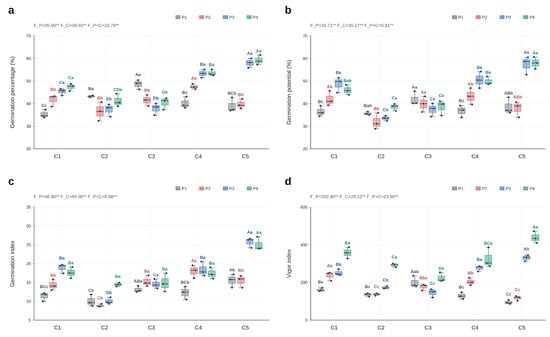
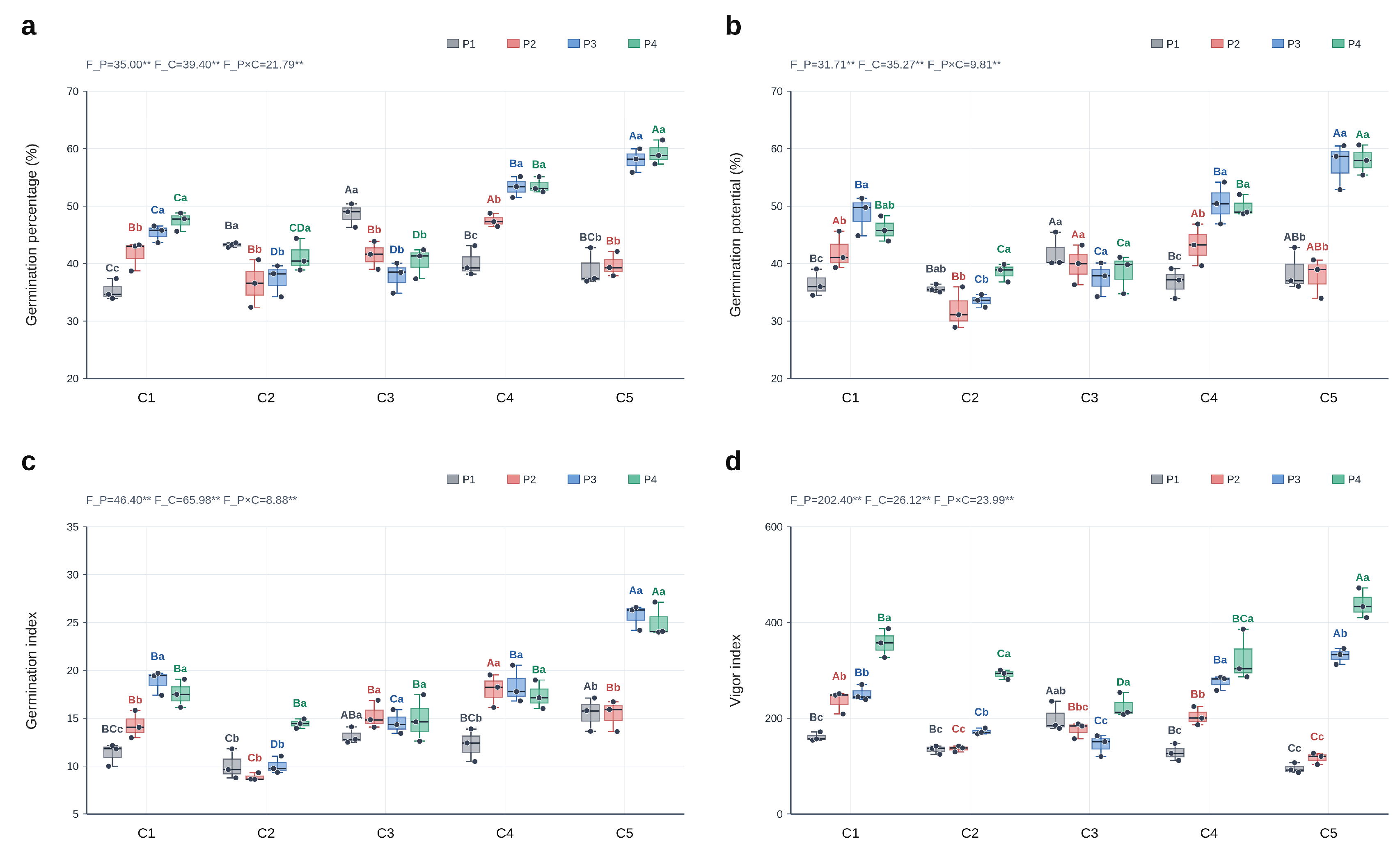
Snow cover thickness, freeze–thaw regime, and their interaction significantly affected all germination traits of S. transiliense seeds, including germination percentage, germination potential, germination index, and vigor index. Under control conditions (P1C1; no snow cover, no freeze–thaw), germination performance was lower than under combinations of greater snow cover and milder freeze–thaw regimes, particularly at P3C5 and P4C5. This pattern was observed for germination percentage (Figure 1a), germination potential (Figure 1b), germination index (Figure 1c), and vigor index (Figure 1d). With increasing snow cover thickness and progression toward milder freeze–thaw regimes, particularly C4 (6/−4 °C) and C5 (8/−2 °C), germination performance generally increased. Treatments combining high snow cover with the mildest freeze–thaw regime (P4C5, 200% snow cover and 8 °C/−2 °C freeze–thaw) produced the highest values for all germination parameters. Compared with P1C1, P4C5 increased germination percentage, germination potential, germination index, and vigor index by 67.6%, 58.9%, 121.7%, and 172.5%, respectively.
Figure 1.
Seed germination traits of S. transiliense under different snow cover and freeze–thaw treatments. (a) Germination percentage, (b) germination potential, (c) germination index, and (d) vigor index. P1 (0% natural snow cover), P2 (50% natural snow cover), P3 (100% natural snow cover), and P4 (200% natural snow cover); C1 (no freeze–thaw), C2 (2/−8 °C), C3 (4/−6 °C), C4 (6/−4 °C), and C5 (8/−2 °C). Boxes show the interquartile range (25th–75th percentiles); horizontal lines indicate the median. FP, FC, and FP×C represent the F values from a two-way ANOVA for the main effects of snow cover and freeze–thaw regime, and their interaction, respectively. Asterisks indicate significance levels (** p < 0.01). Different uppercase letters indicate significant differences among snow cover treatments within the same freeze–thaw regime, whereas different lowercase letters indicate significant differences among freeze–thaw treatments within the same snow cover level (Tukey’s HSD, p < 0.05).
Within each snow cover level, germination traits generally increased as the freeze–thaw regime shifted from C2 (2 °C/−8 °C) toward C5 (8 °C/−2 °C), although the magnitude and statistical significance of this response depended on snow-cover levels. Similarly, within a given freeze–thaw regime, greater snow cover generally enhanced germination performance. Notably, for germination percentage, some snow-freeze treatments subjected to freeze–thaw cycles, particularly P1C3, were statistically comparable to some snow-covered treatments under milder freeze–thaw regimes. This pattern was less evident for germination index and vigor index, indicating that similar final germination percentages did not necessarily correspond to equivalent germination performance or seed vigor.
3.2. Effects of Different Snow Cover and Freeze–Thaw Treatments on Seed Osmotic Adjustment and Membrane Stability
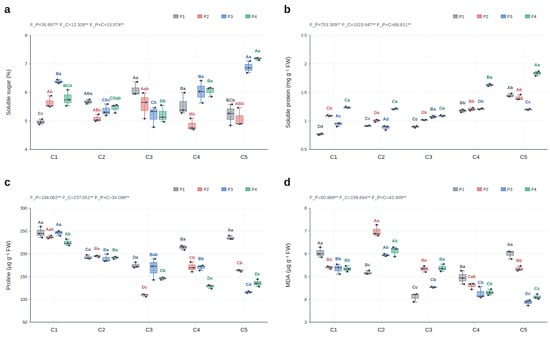
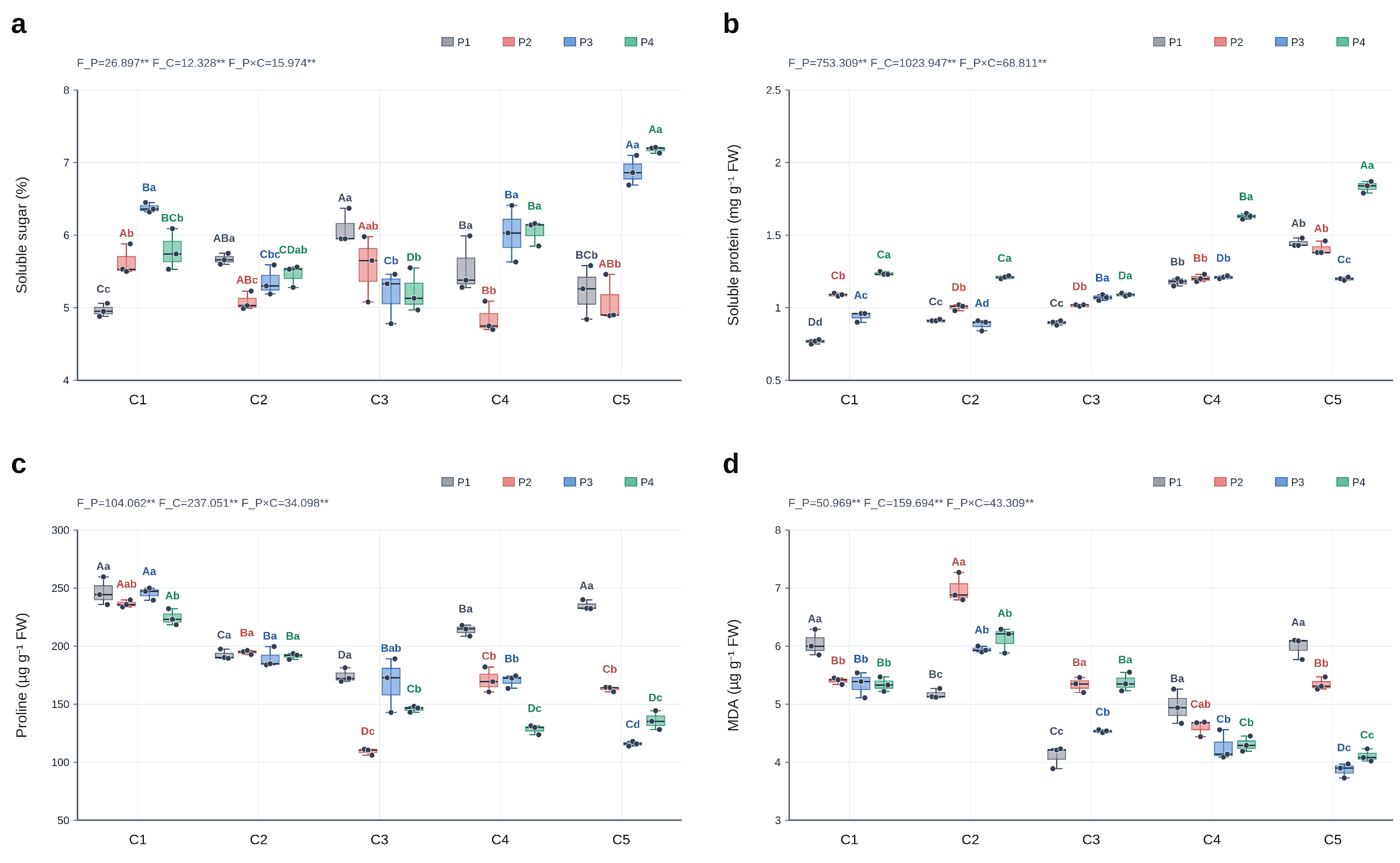
The soluble sugars (WSC), soluble proteins (SP), proline (Pro), and malondialdehyde (MDA) contents in S. transiliense seeds were significantly affected by the snow cover, freeze–thaw treatments, and their interaction (Figure 2a–d). Across treatments, WSC and SP contents increased with increasing snow cover thickness, particularly under mild freeze–thaw conditions. In contrast, Pro and MDA contents were higher under no snow cover (P1), low snow cover (P2), and harsh freeze–thaw treatment (C2).
Figure 2.
Seed osmotic-regulation and membrane-stability parameters of S. transiliense under different snow cover and freeze–thaw treatments. (a) Soluble sugar (WSC), (b) soluble protein (SP), (c) proline (Pro), and (d) malondialdehyde (MDA). P1 (0% natural snow cover), P2 (50% natural snow cover), P3 (100% natural snow cover), and P4 (200% natural snow cover); C1 (no freeze–thaw), C2 (2/−8 °C), C3 (4/−6 °C), C4 (6/−4 °C), and C5 (8/−2 °C). Boxes show the interquartile range (25th–75th percentiles); horizontal lines indicate the median. FP, FC, and FP×C represent the F values from a two-way ANOVA for the main effects of snow cover and freeze–thaw regime, and their interaction, respectively. Asterisks indicate significance levels (** p < 0.01). Different uppercase letters indicate significant differences among snow cover treatments within the same freeze–thaw regime, whereas different lowercase letters indicate significant differences among freeze–thaw treatments within the same snow cover level (Tukey’s HSD, p < 0.05).
Under the optimal treatment combination for germination traits (P4C5), seeds accumulated significantly higher levels of WSC and SP, while Pro and MDA contents were comparatively low. Compared to P1C1, P4C5 increased WSC and SP contents by 44.7% and 137.7%, respectively, whereas Pro and MDA contents decreased by 44.9% and 32.1%, respectively. Several intermediate treatments indicated no significant difference. These results indicate that greater snow cover combined with the mildest freeze–thaw regime (P4C5) promotes carbohydrate and protein accumulation while inhibiting the excessive accumulation of proline and the formation of MDA, a product of membrane lipid peroxidation.
3.3. Effects of Different Snow Cover and Freeze–Thaw Treatments on the Antioxidant Capacity of S. transiliense Seeds
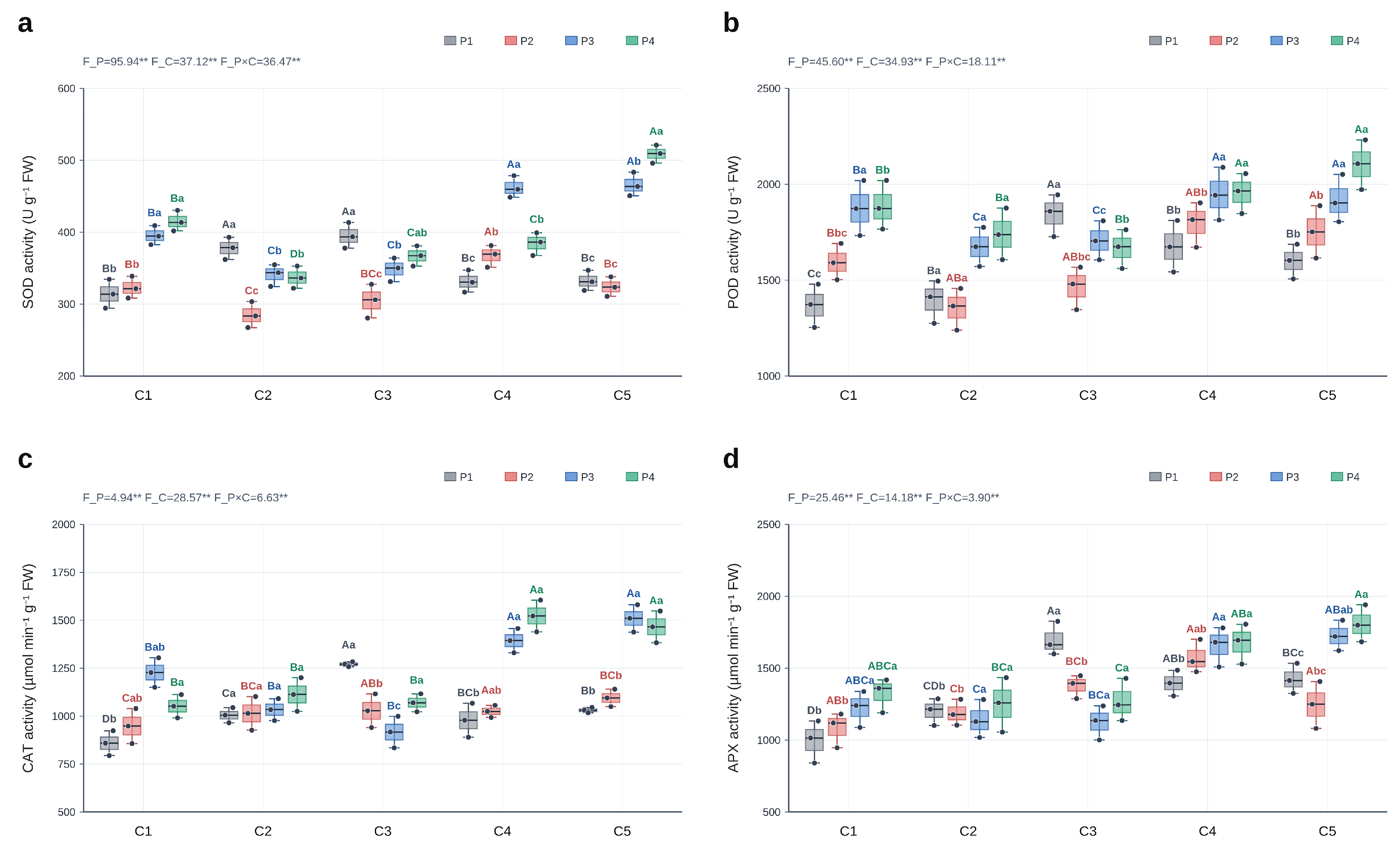
Snow cover, freeze–thaw treatments, and their interaction significantly affected the activities of the antioxidant enzymes in S. transiliense seeds (Figure 3a–d). Across snow cover gradients, superoxide dismutase (SOD), catalase (CAT), peroxidase (POD), and ascorbate peroxidase (APX) activities generally increased with increasing snow cover thickness, particularly under milder freeze–thaw regimes (C4-C5).
Figure 3.
Antioxidant enzyme activities of S. transiliense seeds under different snow cover and freeze–thaw treatments. (a) Superoxide dismutase (SOD) activity, (b) peroxidase (POD) activity, (c) catalase (CAT) activity, and (d) ascorbate peroxidase (APX) activity. P1 (0% natural snow cover), P2 (50% natural snow cover), P3 (100% natural snow cover), and P4 (200% natural snow cover); C1 (no freeze–thaw), C2 (2/−8 °C), C3 (4/−6 °C), C4 (6/−4 °C), and C5 (8/−2 °C). Boxes show the interquartile range (25th–75th percentiles); horizontal lines indicate the median. FP, FC, and FP×C represent the F values from a two-way ANOVA for the main effects of snow cover and freeze–thaw regime, and their interaction, respectively. Asterisks indicate significance levels (** p < 0.01). Different uppercase letters indicate significant differences among snow cover treatments within the same freeze–thaw regime, whereas different lowercase letters indicate significant differences among freeze–thaw treatments within the same snow cover level (Tukey’s HSD, p < 0.05).
Under the optimal germination treatment combination P4C5 (200% snow cover combined with 8 °C/−2 °C freeze–thaw), antioxidant enzyme activities reached their highest or near-highest levels. Compared with the P1C1 treatment, the P4C5 treatment increased SOD, POD, CAT, and APX by 62.3%, 47.3%, 142%, and 1.8%, respectively. Increasing temperature in freeze–thaw treatments from C2 to C5 increased the activities of all antioxidant enzymes, particularly at high snow levels (P3 and P4). Overall, higher enzyme activities were observed under greater snow cover (P3–P4) combined with milder freeze–thaw temperature cycles (C4–C5), indicating a coordinated physiological response that helps regulate oxidative stress during germination under cold-season conditions.
3.4. Effects of Different Snow Cover and Freeze–Thaw Treatments on Endogenous Hormone Levels in S. transiliense Seeds
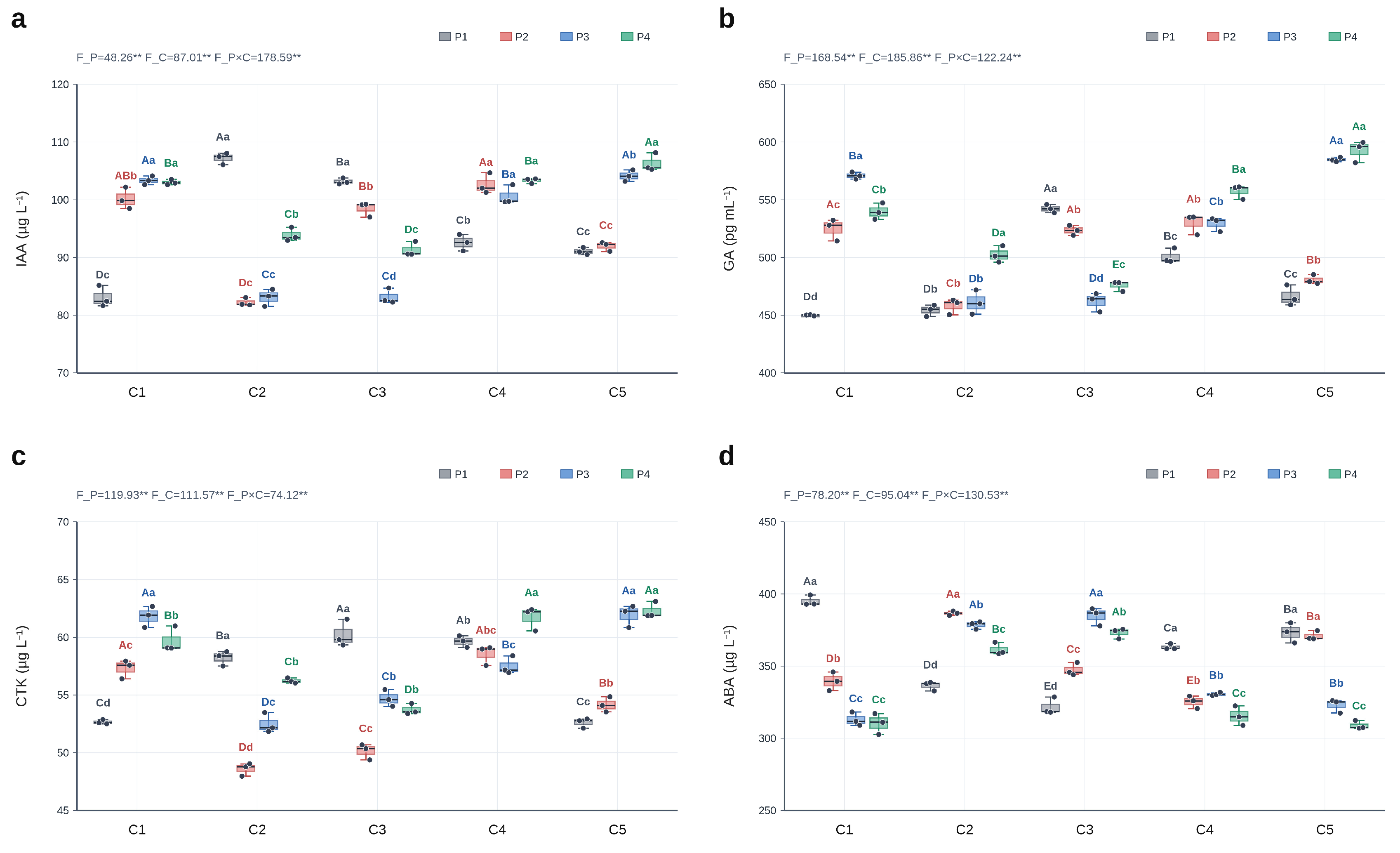
Snow cover thickness, freeze–thaw temperature, and their interaction significantly affected the contents of auxin (IAA), gibberellin (GA), cytokinin (CTK), and abscisic acid (ABA) (Figure 4). In the optimal germination treatment combination P4C5, the levels of growth-promoting hormones in the seeds reached their peak, with IAA, GA, and CTK contents significantly higher than most other treatments. Simultaneously, the ABA content, which inhibits germination, decreased to its lowest level in this treatment. Compared to the P1C1 treatment, the P4C5 treatment increased IAA, GA, and CTK contents by 28%, 31.7%, and 18.3%, respectively, while the ABA content decreased by 21.8%. Greater snow cover combined with the mildest freeze–thaw regime (P4C5) can effectively optimize the endogenous hormone balance of S. transiliense seeds, significantly increasing the levels of promoting hormones such as IAA, GA and CTK, while inhibiting the accumulation of ABA.
Figure 4.
Endogenous hormone contents of S. transiliense seeds under different snow cover and freeze–thaw treatments. (a) Auxin, (b) gibberellin, (c) cytokinin, and (d) abscisic acid content. P1 (0% natural snow cover), P2 (50% natural snow cover), P3 (100% natural snow cover), and P4 (200% natural snow cover); C1 (no freeze–thaw), C2 (2/−8 °C), C3 (4/−6 °C), C4 (6/−4 °C), and C5 (8/−2 °C). Boxes show the interquartile range (25th–75th percentiles); horizontal lines indicate the median. FP, FC, and FP×C represent the F values from a two-way ANOVA for the main effects of snow cover and freeze–thaw regime, and their interaction, respectively. Asterisks indicate significance levels (** p < 0.01). Different uppercase letters indicate significant differences among snow cover treatments within the same freeze–thaw regime, whereas different lowercase letters indicate significant differences among freeze–thaw treatments within the same snow cover level (Tukey’s HSD, p < 0.05).
3.5. Effects of Snow Cover and Freeze–Thaw Treatments on Seed Metabolite Profiles of S. transiliense
3.5.1. Metabolic Profiling and Sample Quality Assessment
Untargeted metabolomic profiling was performed on the six treatment combinations selected a priori for contrasting comparisons: P1C1, P4C1, P1C2, P4C2, P1C5, and P4C5. These combinations represented the lowest (P1) and highest (P4) snow-cover levels under no freeze–thaw (C1) and two contrasting freeze–thaw regimes (C2 and C5). All subsequent PCA, PLS-DA, differential-metabolite, Venn, biomarker, and pathway analyses reported below were based exclusively on these six metabolomically profiled treatment combinations or pairwise comparisons among them.
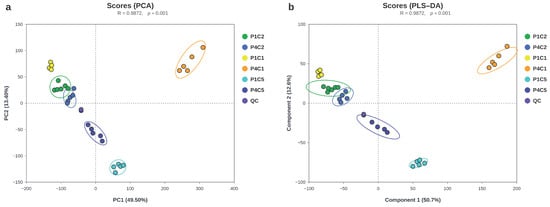
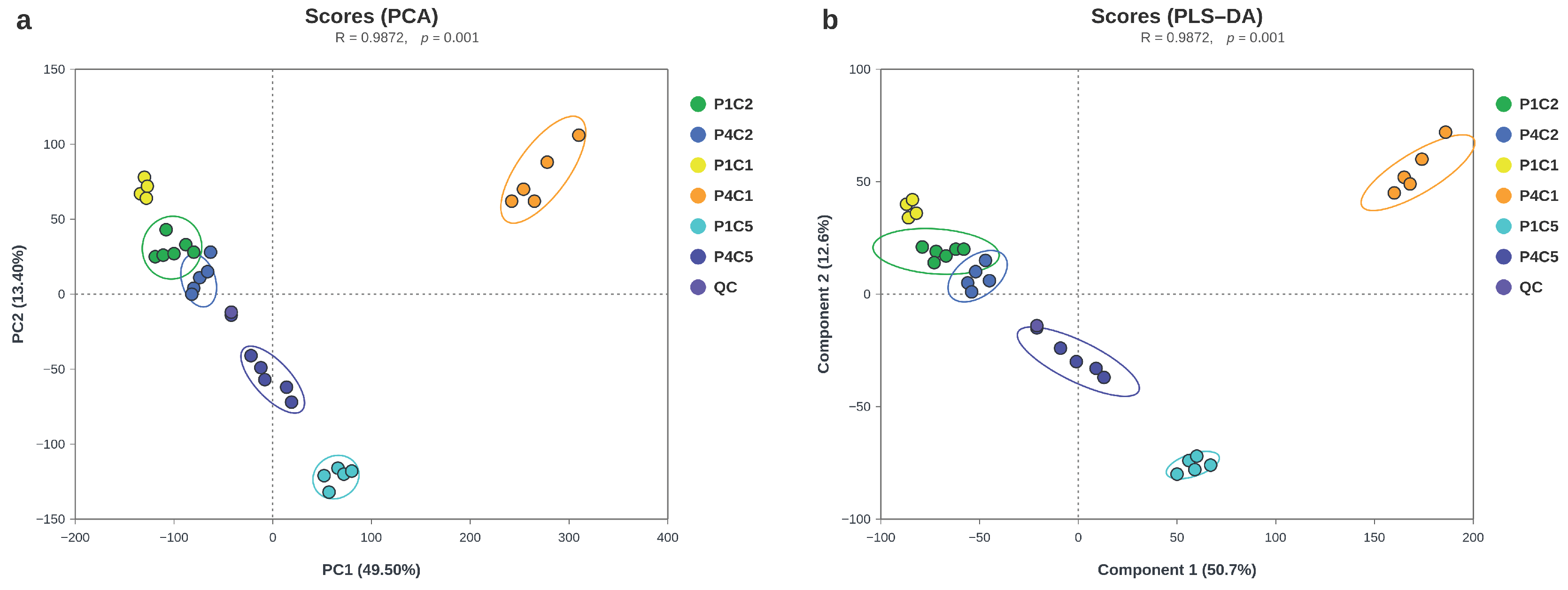
Quality control (QC) samples clustered tightly within the 95% confidence interval, indicating high analytical stability and reproducibility of the LC–MS platform (Figure 5a). Principal component analysis (PCA) revealed clear separation among the selected treatments, with PC1 and PC2 explaining 49.50% and 13.40% of the total variance, respectively (Figure 5a). The distinct grouping of samples reflects pronounced metabolic divergence driven by both snow cover and freeze–thaw conditions, confirming the robustness and biological relevance of the dataset.
Figure 5.
Multivariate analysis of seed metabolite profiles under snow cover and freeze–thaw treatments: (a) Principal component analysis (PCA) score plot showing the overall metabolic variation among S. transiliense seed samples under different snow cover and freeze–thaw treatments. Quality control (QC) samples cluster tightly within the 95% confidence interval, indicating high analytical stability. (b) Partial least squares discriminant analysis (PLS-DA) score plot demonstrating clear separation among treatment groups, reflecting distinct metabolic responses to snow cover depth and freeze–thaw intensity. The percentage of variance explained by each component is indicated on the axes.
3.5.2. Multivariate Discrimination and Pairwise Differential Metabolite Analysis
To further evaluate metabolic differentiation among the six selected treatment combinations (P1C1, P4C1, P1C2, P4C2, P1C5, and P4C5), partial least squares discriminant analysis (PLS-DA) was performed (Figure 5b). The PLS-DA plot showed clear separation among the selected treatment groups, consistent with the PCA pattern, indicating distinct metabolomic profiles among these treatment combinations.
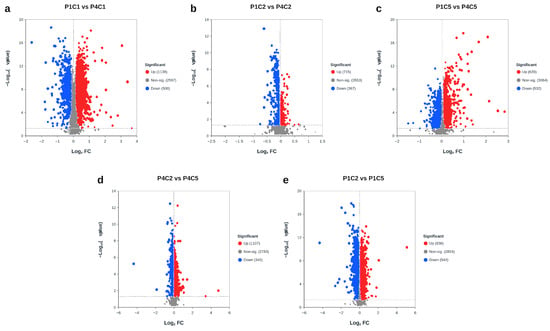
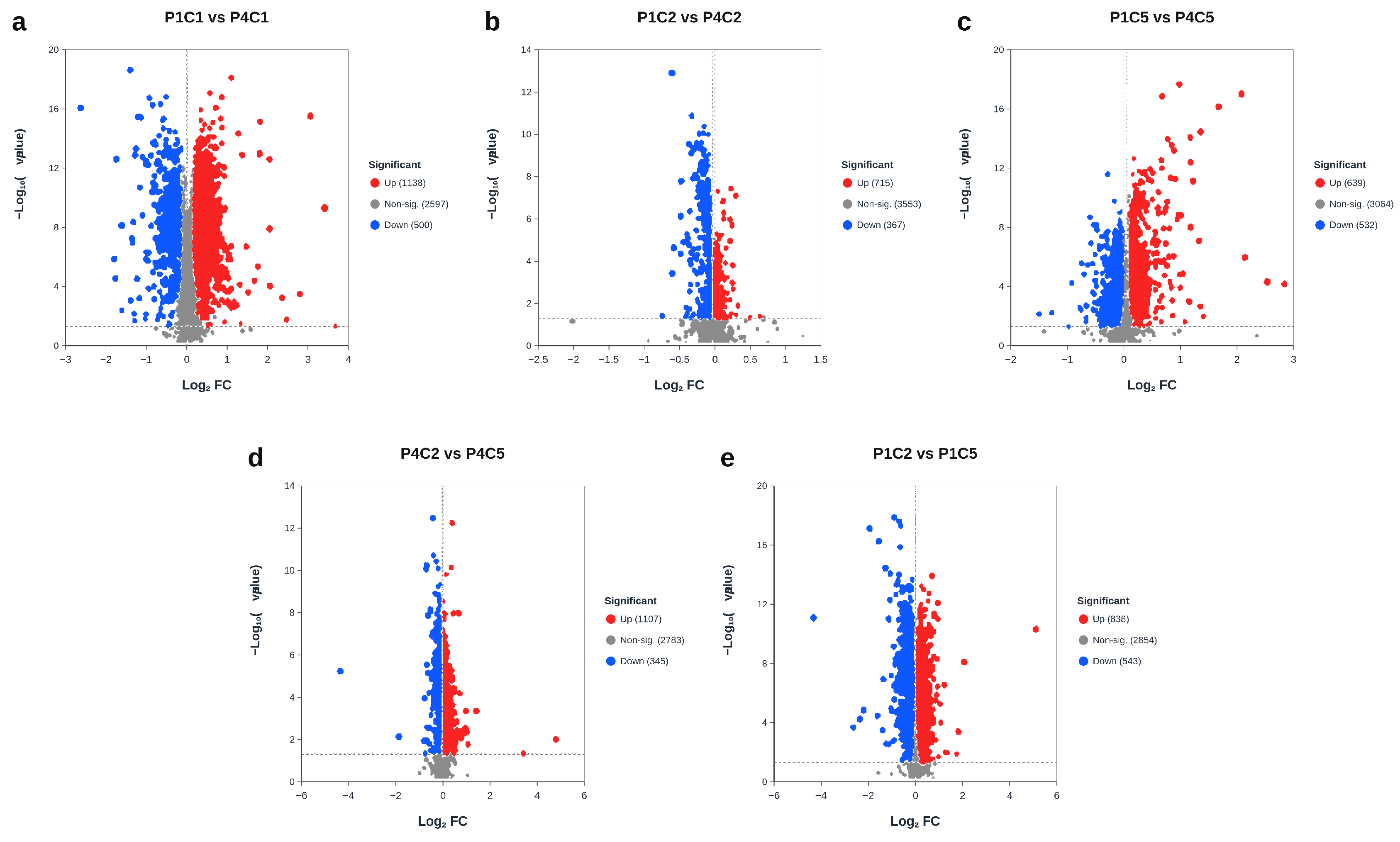
Differential-metabolite analysis was subsequently performed using five predefined pairwise comparisons among the six treatments. To evaluate contrasts in snow-cover level while maintaining the same freeze–thaw regime, P1C1 was compared with P4C1, P1C2 with P4C2, and P1C5 with P4C5. To evaluate contrasts between selected freeze–thaw regimes while maintaining the same snow-cover level, P1C2 was compared with P1C5 and P4C2 with P4C5 (Figure 6a–e).
Figure 6.
Volcano plots of differential metabolites between snow cover and freeze–thaw treatments. Differentially expressed metabolites between paired treatments: (a) P1C1 vs. P4C1; (b) P1C2 vs. P4C2; (c) P1C5 vs. P4C5; (d) P4C2 vs. P4C5; (e) P1C2 vs. P1C5. Red dots represent significantly upregulated metabolites, blue dots represent significantly downregulated metabolites, and gray dots represent metabolites with no significant difference. The x-axis shows log2 fold change, and the y-axis represents −log10 (p-value). The size of each point corresponds to the VIP value derived from the PLS-DA model.
The P1C1 versus P4C1 comparison identified 1138 upregulated and 500 downregulated differential metabolites. The P1C2 versus P4C2 comparison identified 315 upregulated and 367 downregulated metabolites, whereas P1C5 versus P4C5 identified 639 upregulated and 532 downregulated metabolites. For the freeze–thaw contrasts, P4C2 versus P4C5 and P1C2 versus P1C5 showed substantial metabolic differences, with 1107 and 838 upregulated metabolites, respectively.
Volcano plots illustrate the magnitude and direction of these pairwise metabolic differences, with red and blue points representing significantly upregulated and downregulated metabolites, respectively, and gray points representing metabolites without significant differences. VIP values derived from the PLS-DA model were used to indicate the relative contribution of individual metabolites to group discrimination.
3.5.3. Shared and Treatment-Specific Metabolite Responses
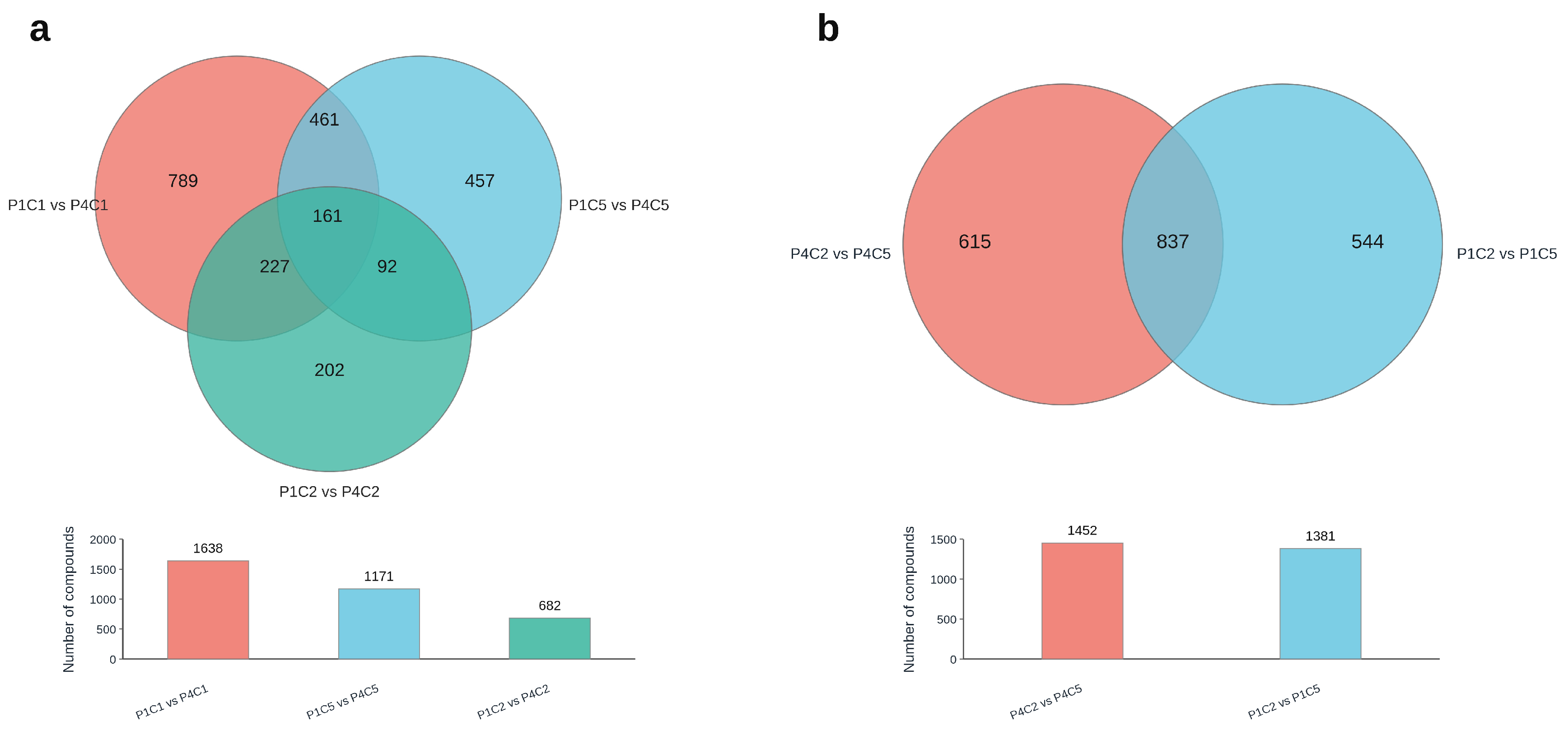
Venn diagrams were used to quantify the overlap of differential metabolites among predefined pairwise contrasts (Figure 7a,b). For the three contrasts comparing P1 and P4 while holding the freeze–thaw regime constant (P1C1 vs. P4C1, P1C2 vs. P4C2, and P1C5 vs. P4C5), 161 differential metabolites were shared among all three comparisons (Figure 7a). For the two contrasts comparing C2 and C5 within a constant snow-cover level (P1C2 vs. P1C5 and P4C2 vs. P4C5), 837 differential metabolites were shared (Figure 7b). These shared metabolite sets were used for subsequent biomarker and pathway analyses. Because the metabolomic dataset comprised selected combined treatments rather than the complete factorial design, these groups are interpreted as metabolites consistently associated with the corresponding pairwise contrasts rather than as independent main effects of snow cover or freeze–thaw.
Figure 7.
Shared and treatment-specific differential metabolites under snow cover and freeze–thaw conditions. (a) Venn diagram showing the overlap of differential metabolites among snow cover treatments (P1C1 vs. P4C1, P1C2 vs. P4C2, and P1C5 vs. P4C5). (b) Venn diagram illustrating shared and unique differential metabolites under freeze–thaw comparisons (P4C2 vs. P4C5 and P1C2 vs. P1C5). Bar plots below each Venn diagram indicate the total number of differential metabolites identified in each comparison.
3.5.4. Identification of Key Metabolic Biomarkers
Differential metabolites were ranked according to VIP values derived from the PLS-DA model. Under snow cover treatments, HexCer (17:2_2O/16:1_O) exhibited the highest VIP value, followed by several lipid-related, amino acid-derived, and flavonoid-associated metabolites (Table 1). These compounds likely contribute to membrane stabilization, antioxidant defense, and metabolic adjustment during prolonged snow insulation.
Table 1.
Top differential metabolites shared among P1-versus-P4 contrasts at fixed freeze–thaw regimes.
Under freeze–thaw conditions, Paromomycin showed the highest VIP value, along with sphingolipids, glucuronides, and flavonoid derivatives (Table 2). The recurrence of certain metabolites (e.g., HexCer species and Dgdg derivatives) across both treatment types suggests overlapping protective mechanisms, while the appearance of unique metabolites under freeze–thaw stress reflects distinct biochemical responses to repeated temperature oscillations.
Table 2.
Top differential metabolites associated with C2-versus-C5 contrast at fixed snow-cover levels.
3.5.5. Pathway Enrichment Analysis of Differential Metabolites from Selected Pairwise Contrasts
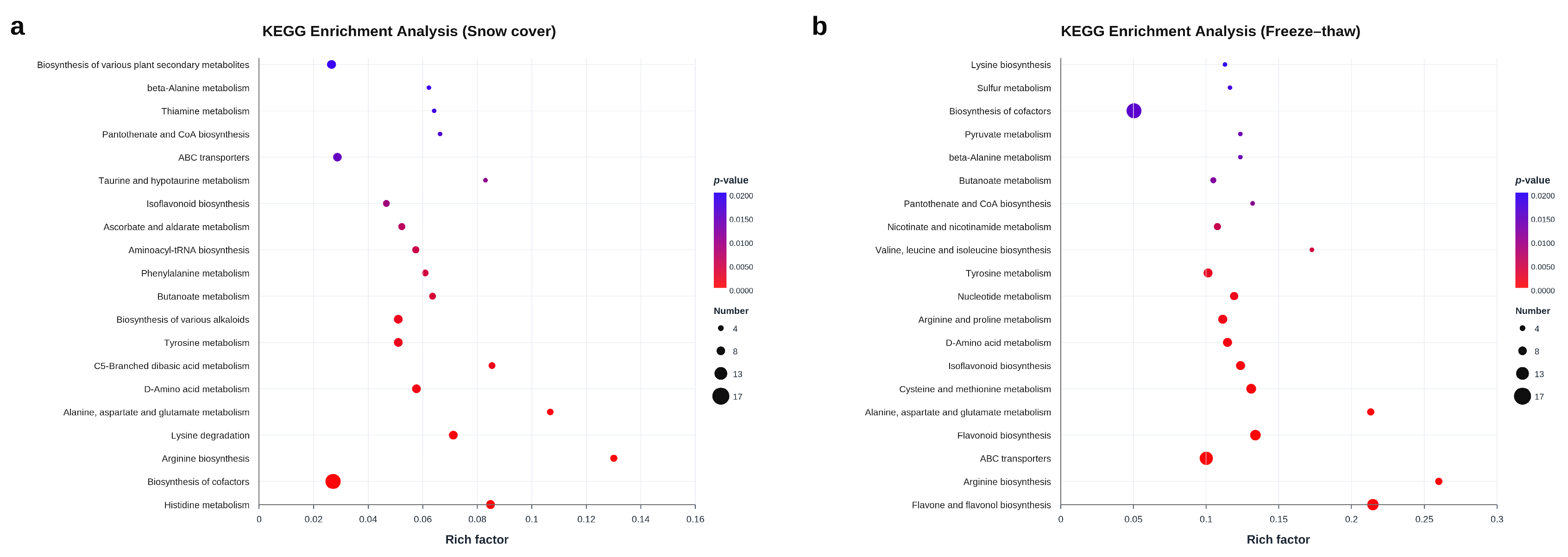
To elucidate the functional significance of the differential metabolites identified from the selected treatment comparisons, KEGG pathway enrichment analysis was performed. For the three contrasts comparing the lowest and highest snow-cover levels while maintaining the same freeze–thaw regime (P1C1 vs. P4C1, P1C2 vs. P4C2, and P1C5 vs. P4C5), the shared differential metabolites were enriched in pathways including cofactor biosynthesis, lysine degradation, and tyrosine metabolism (Figure 8a). These pathways are associated with metabolic processes related to redox regulation, nitrogen metabolism, and secondary metabolite synthesis.
Figure 8.
KEGG pathway enrichment analysis of differential metabolites in S. transiliense seeds. (a) Bubble plot of KEGG pathway enrichment for differential metabolites identified under snow cover treatments. (b) Bubble plot of KEGG pathway enrichment for differential metabolites shared among the C2-versus-C5 contrasts at fixed snow-cover levels. Bubble size represents the number of metabolites enriched in each pathway, while color indicates the significance level (p-value). The x-axis shows the rich factor, reflecting the proportion of differential metabolites within each pathway.
For the two contrasts comparing C2 and C5 while maintaining the same snow-cover level (P1C2 vs. P1C5 and P4C2 vs. P4C5), the shared differential metabolites were enriched in pathways including ABC transporters, flavonoid and flavonol biosynthesis, and amino acid metabolism (Figure 8b). These pathways are associated with metabolite transport, secondary metabolism, and antioxidant-related processes. Cofactor biosynthesis was represented in both contrast-based pathway analyses, indicating that this pathway was consistently associated with metabolic differentiation across the selected snow-cover and freeze–thaw comparisons.
4. Discussion
4.1. Interactive Effects of Snow Cover and Freeze–Thaw Regimes on Seed Germination
Seed germination represents a sensitive transition in the plant life cycle, during which seeds integrate temperature and moisture cues to shift from dormancy towards active growth [4]. Our results showed that germination of S. transiliense was jointly influenced by snow cover and freeze–thaw conditions. In general, greater snow cover combined with milder freeze–thaw regimes was associated with improved germination performance, although the response was not uniform across all treatment combinations. In particular, some snow-free treatments exposed to intermediate freeze–thaw regimes produced final germination percentages statistically comparable with those of some treatments receiving greater snow cover under milder freeze–thaw conditions, indicating a more complex interaction between the two factors.
Across the four germination parameters, the deep snow cover treatment (P4, 200% natural snow cover) generally showed higher values, particularly when combined with the mild freeze–thaw regimes C4 (6/−4 °C) and C5 (8/−2 °C). Greater snow cover can moderate soil temperature fluctuations and influence the moisture environment experienced by overwintering seeds [14,15]. Snow also represents an important seasonal water reservoir in desert ecosystems, where snowmelt contributes to early-spring soil moisture and can influence the conditions required for seed imbibition and metabolic reactivation [18,40,41]. However, the response of S. transiliense cannot be explained by snow cover alone, because the magnitude of the germination response differed among freeze–thaw regimes.
The highest overall germination performance was observed under P4C5, indicating that the greatest snow cover combined with the mildest freeze–thaw regime provided conditions associated with high final germination, germination index, and vigor index. Freeze–thaw temperature can influence membrane properties, enzyme activity, and seed hydration status, and its effects depend on temperature amplitude and species sensitivity [23,26,42]. Compared with the more severe freeze–thaw treatments, the milder C4 and C5 regimes may have imposed less thermal injury while still providing temperature fluctuations characteristic of late-winter and early-spring conditions [24]. In particular, C5, and to a lesser extent C4, may have provided a functional balance between sufficient cold exposure to alleviate physiological dormancy and intermittent warming that supports membrane repair, enzyme activation, and reserve mobilization [43].
In contrast, the relatively mild C5 (and to a lesser extent C4) cycles appear to strike a functional balance: they provide sufficient cold exposure to alleviate physiological dormancy while allowing intermittent warming phases that enable membrane repair, enzyme activation, and reserve mobilization [43].
The superiority of the P4C5 combination suggests that deep snow buffered seeds from abrupt thermal shocks, reducing freezing injury, while the mildest freeze–thaw regime (C5) delivered a biologically meaningful signal resembling early spring soil conditions [24]. This controlled fluctuation likely facilitated testa softening and improved water uptake without inducing irreversible cellular stress, thereby enhancing both germination speed and seedling vigor [4,18].
Furthermore, germination percentage should be distinguished from germination index and vigor index because these traits capture different aspects of seed performance. Germination percentage reflects the proportion of seeds that ultimately germinate, whereas germination index and vigor index incorporate germination timing and subsequent seedling performance. This distinction was evident under snow-free conditions, where P1C3 produced a final germination percentage statistically comparable with some snow-covered treatments, suggesting that an intermediate freeze–thaw regime may partially compensate for the absence of snow in determining final germination. Such temperature-mediated variation is consistent with evidence that germination responses can shift with low-temperature exposure, snowmelt timing, and associated microclimatic conditions [44,45,46]. However, this compensatory pattern was less evident for germination index and vigor index, indicating that similar final germination percentages did not necessarily correspond to equivalent germination dynamics or seed vigor.
Thus, the interaction between snow cover and freeze–thaw regime is better interpreted as a continuum of responses rather than as a simple separation between favorable and unfavorable treatment combinations. Greater snow cover generally improved germination performance, but particular freeze–thaw regimes could partially offset the absence of snow for final germination percentage. The weaker compensation observed for germination index and vigor index further indicates that snow cover remained important for the speed and vigor of germination.
4.2. Pre-Germination Physiological Responses Associated with Snow Cover and Freeze–Thaw Treatments
The physiological data further showed that different snow cover x freeze–thaw combinations were associated with distinct pre-germinative states in S. transiliense seeds. Treatments with higher subsequent germination performance generally showed higher soluble sugar and soluble protein contents and lower proline and MDA levels. These differences are consistent with the substantial metabolic reorganization that occurs before visible germination, when carbohydrate mobilization, protein metabolism, osmotic regulation, and membrane integrity become important determinants of seed performance [27,47].
In particular, the deep snow cover–mild freeze–thaw treatment (P4C5) showed higher WSC and soluble protein contents together with relatively low proline MDA contents. Soluble sugars can contribute to osmotic adjustment and provide readily available substrates for respiratory metabolism, while soluble proteins reflect both stored reserves and metabolically active proteins during germination [27,47]. By contrast, elevated proline commonly accompanies osmotic and temperature stress, whereas MDA accumulation reflects increased membrane lipid peroxidation [25,26,48]. The lower MDA content observed under treatments with better germination performance therefore indicates greater preservation of membrane stability before germination.
However, P1C3 provides an important qualification to this general pattern. Despite the absence of snow cover, this treatment maintained a comparatively high final germination percentage, suggesting that an intermediate freeze–thaw regime can support germination capacity through a physiological state that is not identical to that observed under P4C5. This supports the interpretation that different combinations of snow cover and temperature can lead to similar final germination percentages, while their effects on germination timing and vigor remain distinct.
Antioxidant enzyme activities also varied with treatment combination. SOD, POD, CAT, and APX activities were generally greater in treatments associated with higher germination performance, particularly under P3–P4 combined with C4–C5. Antioxidant enzymes are important components of cellular redox regulation during seed germination and environmental stress [25,49]. SOD contributes to the conversion of superoxide radicals, whereas CAT, POD, and APX participate in peroxide metabolism. Because ROS concentrations were not measured directly in the present study, these enzyme activities act as indicators of antioxidant regulation rather than direct evidence of ROS accumulation or scavenging.
The hormonal responses were also consistent with differences in germination performance. Treatments showing greater germination generally had higher IAA, GA, and CTK contents and lower ABA levels, with the clearest pattern observed under P4C5. ABA is strongly associated with maintenance of seed dormancy, whereas GA promotes germination and reserve mobilization [28,50]. Increases in IAA and CTK may additionally support cell expansion and division during early germination. The observed hormonal shift therefore indicates that snow cover and freeze–thaw conditions influenced the balance between dormancy maintenance and germination readiness [50].
These physiological results indicate that higher germination performance was generally associated with improved membrane stability, altered osmotic regulation, greater antioxidant enzyme activity, and a hormone profile favoring germination. Nevertheless, the P1C3 response demonstrates that these relationships are not exclusive to high snow cover and mild freeze–thaw combinations and that different treatment combinations may achieve comparable final germination through partially different physiological routes.
4.3. Metabolic Responses Among Selected Snow-Cover × Freeze–Thaw Contrasts
Untargeted metabolomic profiling was conducted on six selected treatment combinations: P1C1, P4C1, P1C2, P4C2, P1C5, and P4C5. These treatments were selected to compare the lowest and highest snow-cover levels under the no-freeze–thaw condition and two contrasting freeze–thaw regimes. Accordingly, the metabolomic results are interpreted in relation to these predefined comparisons and not as independent main effects across all 20 treatment combinations.
Multivariate analysis showed distinct metabolic profiles among the selected treatments. The P1-versus-P4 comparisons conducted at fixed freeze–thaw regimes identified metabolic differences associated with contrasting snow-cover conditions, whereas the C2-versus-C5 comparisons conducted at fixed snow-cover levels identified differences associated with contrasting freeze–thaw regimes. The larger number of shared differential metabolites observed in the C2-versus-C5 comparisons suggests substantial metabolic sensitivity to the selected freeze–thaw contrast, although this should not be interpreted as demonstrating a universally greater effect of freeze–thaw than snow cover across the complete factorial experiment.
Among the differential metabolites, HexCer-related compounds showed high VIP values in several selected comparisons. Changes in sphingolipid and ceramide-related compounds have been associated with membrane remodeling and environmental stress signaling in plants [29,51,52]. Such changes may therefore reflect adjustments in membrane composition under contrasting overwintering conditions.
Several additional metabolites differed among the selected freeze–thaw contrasts, including compounds associated with lipid, flavonoid, and amino acid metabolism. These differences are consistent with the broader metabolic reorganization that accompanies temperature stress and germination-related metabolic activation [27,53].
Pathway enrichment analysis further supported metabolic differentiation. Differential metabolites shared among the P1-versus-P4 contrasts were enriched in pathways including cofactor biosynthesis, lysine degradation, and tyrosine metabolism, whereas metabolites shared among the C2-versus-C5 contrasts were associated with ABC transporters, flavonoid and flavonol biosynthesis, and amino acid metabolism. Cofactor biosynthesis was represented in both contrast-based analyses, consistent with the importance of enzymatic cofactors in redox reactions and primary metabolic activation during seed germination [27,53].
Freeze–thaw treatments additionally enriched the “ABC transporter” and “flavonoid and flavonol biosynthesis” pathways. The enrichment of ABC transporters implies enhanced capacity for substance redistribution, including hormone transport, secondary metabolite movement, and detoxification processes, consistent with temperature-driven metabolic reprogramming [54,55]. Meanwhile, increased flavonoid and flavonol biosynthesis points to anticipatory antioxidant deployment, preparing seeds to counter oxidative stress and photodamage commonly associated with freeze–thaw transitions and post-winter light exposure [56,57]. Enrichment of these pathways among the selected treatment contrasts therefore supports the physiological evidence for changes in transport, secondary metabolism, and antioxidant regulation under contrasting winter conditions.
Overall, the metabolomic results complement the germination and physiological findings by showing that selected snow cover × freeze–thaw combinations were associated with distinct metabolic profiles. However, because metabolomics was performed on only six selected treatment combinations, these results should be considered mechanistic support for the specific contrasts examined rather than a complete representation of metabolic responses across the full factorial experiment.
5. Conclusions
This study showed that snow cover and freeze–thaw regimes jointly and interactively influenced post-winter germination and physiological responses of S. transiliense. The highest overall germination performance occurred under P4C5, combining the greatest snow cover (200% of natural snow cover) with the mildest freeze–thaw regime (8/−2 °C). However, the response was not uniform across all germination traits. P1C3 (no snow cover combined with the intermediate freeze–thaw regime, 4/−6 °C) produced a final germination percentage comparable to some snow-covered treatments, suggesting a partial compensatory interaction between snow cover and freeze–thaw regime, whereas this pattern was less evident for germination index and vigor index. Higher germination performance was generally associated with greater soluble sugar and protein contents, lower proline and MDA levels, increased antioxidant enzyme activities, higher IAA, GA, and CTK, and reduced ABA. Metabolomic profiling of the six selected treatment combinations further revealed distinct metabolic differences involving lipid-related metabolites and pathways such as cofactor biosynthesis, ABC transporters, and flavonoid metabolism. Overall, these findings show that S. transiliense germination depends on the combined winter thermal environment, with different snow cover × freeze–thaw combinations producing distinct effects on final germination, germination dynamics, and seed vigor.
Author Contributions
Y.Y. and X.Z. contributed equally to this work, regarding the following areas: conceptualization, methodology, investigation, formal analysis, writing—original draft. M.Z.: Investigation, data curation, formal analysis. Y.D.: Resources, investigation. S.A.: Validation, writing—review and editing. H.H.: Supervision, project administration, funding acquisition, writing—review and editing. All authors have read and agreed to the published version of the manuscript.
Funding
This research was funded by the Xinjiang Agriculture Research System (13-14), the 2025 Talent Development Special Program (Second) through its Postdoctoral Funding Project (grant number CZ002415/0215), the Tianchi Talent Project (grant number CZ004311), and the University International Science and Technology Cooperation Promotion Plan Project (grant number GJHZ202402).
Data Availability Statement
The materials used in this research and protocols are available upon request.
Acknowledgments
The authors acknowledge the support staff at Shihezi University for their assistance with experimental activities and thank colleagues who provided valuable feedback during manuscript preparation.
Conflicts of Interest
The authors declare no conflicts of interest.
References
- Li, L.; Chen, J.; Han, X.; Zhang, W.; Shao, C. Desert rangeland ecosystem. In Grassland Ecosystems of China: A Synthesis and Resume; Springer: Singapore, 2020; pp. 401–454. [Google Scholar] [CrossRef] [Scilit]
- Wang, X.; Geng, X.; Liu, B.; Cai, D.; Li, D.; Xiao, F.; Zhu, B.; Hua, T.; Lu, R.; Liu, F. Desert ecosystems in China: Past, present, and future. Earth Sci. Rev. 2022, 234, 104206. [Google Scholar] [CrossRef] [Scilit]
- Zhao, W.Y.; Li, Z.; Yin, H.; Wang, Y. Responses of subshrub sagebrush rangeland in North-Western China to changes in livestock numbers and rainfall over 10 years (2004–2013). Arid Land Res. Manag. 2019, 33, 212–233. [Google Scholar] [CrossRef] [Scilit]
- Chen, A.; Wang, Y.; Sui, X.; Jin, G.; Wang, K.; An, S. Effects of drought and temperature on the germination of seeds of Seriphidium transiliense, a desert xerophytic subshrub of Xinjiang, China. Seed Sci. Technol. 2020, 48, 355–365. [Google Scholar] [CrossRef] [Scilit]
- Yang, H.; Dong, Y.; An, S.; Sun, Z.; Li, P.; Liu, H. Effects of temporal variation and grazing intensity on leaf C:N:P stoichiometry in Northwest desert, China. Plant Soil Environ. 2024, 70, 154–163. [Google Scholar] [CrossRef] [Scilit]
- Zheng, W. Research progress on utilization and conservation of Seriphidium transiliense. Grassl. Turf 2013, 33, 68–83. [Google Scholar]
- Wang, F.; Wen, H.; Liu, L.; He, F.; Xin, X. Chemical constituents of Seriphidium transiliense and their anti-inflammatory activity. Chem. Nat. Compd. 2024, 60, 1005–1007. [Google Scholar] [CrossRef] [Scilit]
- Li, W.; Jin, G.; Pan, Y.; Zhao, W.; Chen, M.; Li, C.; Du, W. MaxEnt prediction of Seriphidium transiliense habitats in China: Integrating climate change and human activity effects. Ecol. Evol. 2025, 15, e72641. [Google Scholar] [CrossRef] [Scilit]
- Liu, W.; Han, W.; Jin, G.; Li, Y.; Gong, K.; Ma, J.; Liu, Z.; Li, J.; Chen, M. Identification of Hyperspectral Characteristics of the Main Plants in Seriphidium transiliense Desert Grassland. In Proceedings of the XXV International Grassland Congress, Covington, KY, USA, 14–19 May 2023. [Google Scholar] [CrossRef]
- Bie, B.W.; Zhou, X.B.; Zhang, Y.M. Effects of snow cover on seed germination of ten desert plant species. Chin. J. Ecol. 2016, 35, 2348–2354. [Google Scholar] [CrossRef]
- Zhang, W.; Du, C.; Zhang, L.; Tan, Y.; Huang, Y.; Jiang, M. Contribution of spring snowmelt water to soil water in Northeast China and its dynamic changes. Water 2022, 14, 1368. [Google Scholar] [CrossRef] [Scilit]
- He, S.; Zhang, C.; Meng, F.R.; Bourque, C.P.A.; Huang, Z.; Li, X.; Jia, R. Scrub-vegetation cover impact on soil water migration and temperature change during freeze–thaw events in sandy desert soils of northwest China. Catena 2024, 237, 107828. [Google Scholar] [CrossRef] [Scilit]
- Tan, X.; Yang, Y. Research progress on effects of snow cover change on belowground ecosystem. J. Glaciol. Geocryol. 2023, 45, 724–737. [Google Scholar]
- Drescher, M.; Thomas, S.C. Snow cover manipulations alter survival of early life stages of cold-temperate tree species. Oikos 2013, 122, 541–554. [Google Scholar] [CrossRef] [Scilit]
- Fu, Q.; Hou, R.; Wang, Z.; Li, T. Soil moisture thermal interaction effects under snow cover during freezing and thawing period. Trans. Chin. Soc. Agric. Eng. 2015, 31, 101–107. [Google Scholar]
- Kreyling, J. The ecological importance of winter in temperate, boreal, and arctic ecosystems in times of climate change. In Progress in Botany; Springer International Publishing: Cham, Switzerland, 2019; Volume 81, pp. 377–399. [Google Scholar] [CrossRef] [Scilit]
- Löffler, J. The influence of micro-climate, snow cover, and soil moisture on ecosystem functioning in high mountains. J. Geogr. Sci. 2007, 17, 3–19. [Google Scholar] [CrossRef] [Scilit]
- Anniwaer, A.; Su, Y.; Zhou, X.; Zhang, Y. Impacts of snow on seed germination are independent of seed traits and plant ecological characteristics in a temperate desert of Central Asia. J. Arid Land 2020, 12, 775–790. [Google Scholar] [CrossRef] [Scilit]
- Leuther, F.; Schlüter, S. Impact of freeze–thaw cycles on soil structure and soil hydraulic properties. Soil 2021, 7, 179–191. [Google Scholar] [CrossRef] [Scilit]
- Zhao, Y.D.; Hu, X. How do freeze–thaw cycles affect the soil pore structure in alpine meadows considering soil aggregate and soil column scales? J. Soil Sci. Plant Nutr. 2022, 22, 4207–4216. [Google Scholar] [CrossRef] [Scilit]
- Ding, T.; Guo, Z.; Qian, Y.; Wang, Y.; Huang, X.; Zhang, Z.; Peng, X. Effects of straw return methods on the soil organic carbon fractions and pore structure characteristics of Shajiang black soil (Vertisol). Trans. Chin. Soc. Agric. Eng. 2023, 39, 71–78. [Google Scholar] [CrossRef]
- Di, X.L.; Muhammad, S.; Wang, Z.S.; Tian, J.Y.; Lin, J.; Wang, J.H. Effects of freeze–thaw cycles on seed germination and seedling growth of Hordeum jubatum and Festuca elata in northeast China. Fresenius Environ. Bull. 2020, 29, 4634–4641. [Google Scholar]
- Zhang, Y.L.; Yin, B.F.; Tao, Y.; Zhou, X.B.; Zhang, Y.M. Effects of freezing and thawing cycle on seed germination of desert ephemeral plants. Chin. J. Ecol. 2021, 40, 301. [Google Scholar] [CrossRef]
- Jaganathan, G.K.; Dalrymple, S.E.; Pritchard, H.W. Seed survival at low temperatures: A potential selecting factor influencing community level changes in high altitudes under climate change. Crit. Rev. Plant Sci. 2020, 39, 479–492. [Google Scholar] [CrossRef] [Scilit]
- Yin, B.; Li, J.; Zhang, Q.; Wu, N.; Zhang, J.; Rong, X.; Tao, Y.; Zang, Y.; Li, Y.; Zhou, X.; et al. Freeze–thaw cycles change the physiological sensitivity of Syntrichia caninervis to snow cover. J. Plant Physiol. 2021, 266, 153528. [Google Scholar] [CrossRef] [Scilit]
- Bao, G.; He, F.; Chen, W.; Sun, J.; Ding, X. Physiological effects of different concentrations of chloride deicing salt and freeze–thaw stress on Secale cereale L. seedlings. J. Plant Growth Regul. 2020, 39, 15–25. [Google Scholar] [CrossRef] [Scilit]
- Rosental, L.; Nonogaki, H.; Fait, A. Activation and regulation of primary metabolism during seed germination. Seed Sci. Res. 2014, 24, 1–15. [Google Scholar] [CrossRef] [Scilit]
- Sano, N.; Marion-Poll, A. ABA metabolism and homeostasis in seed dormancy and germination. Int. J. Mol. Sci. 2021, 22, 5069. [Google Scholar] [CrossRef] [Scilit]
- Zheng, G.; Tian, B.O.; Zhang, F.; Tao, F.; Li, W. Plant adaptation to frequent alterations between high and low temperatures: Remodelling of membrane lipids and maintenance of unsaturation levels. Plant Cell Environ. 2011, 34, 1431–1442. [Google Scholar] [CrossRef] [Scilit]
- Koger, C.H.; Reddy, K.N.; Poston, D.H. Factors affecting seed germination, seedling emergence, and survival of texasweed (Caperonia palustris). Weed Sci. 2004, 52, 989–995. [Google Scholar] [CrossRef] [Scilit]
- Yemm, E.W.; Willis, A.J. The estimation of carbohydrates in plant extracts by anthrone. Biochem. J. 1954, 57, 508–514. [Google Scholar] [CrossRef] [Scilit]
- Bradford, M.M. A rapid and sensitive method for the quantitation of microgram quantities of protein utilizing the principle of protein–dye binding. Anal. Biochem. 1976, 72, 248–254. [Google Scholar] [CrossRef]
- Bates, L.S.; Waldren, R.P.; Teare, I.D. Rapid determination of free proline for water-stress studies. Plant Soil 1973, 39, 205–207. [Google Scholar] [CrossRef] [Scilit]
- Heath, R.L.; Packer, L. Photoperoxidation in isolated chloroplasts: I. Kinetics and stoichiometry of fatty acid peroxidation. Arch. Biochem. Biophys. 1968, 125, 189–198. [Google Scholar] [CrossRef] [Scilit]
- Beauchamp, C.; Fridovich, I. Superoxide dismutase: Improved assays and an assay applicable to acrylamide gels. Anal. Biochem. 1971, 44, 276–287. [Google Scholar] [CrossRef] [Scilit]
- Chance, B.; Maehly, A.C. Assay of catalases and peroxidases. Methods Enzymol. 1955, 2, 764–775. [Google Scholar] [CrossRef] [Scilit]
- Aebi, H. Catalase in vitro. Methods Enzymol. 1984, 105, 121–126. [Google Scholar] [CrossRef] [Scilit]
- Nakano, Y.; Asada, K. Hydrogen peroxide is scavenged by ascorbate-specific peroxidase in spinach chloroplasts. Plant Cell Physiol. 1981, 22, 867–880. [Google Scholar] [CrossRef] [Scilit]
- Yang, J.; Zhang, J.; Wang, Z.; Zhu, Q.; Liu, L. Water deficit-induced senescence and its relationship to the remobilization of pre-stored carbon in wheat during grain filling. Agron. J. 2001, 93, 196–206. [Google Scholar] [CrossRef] [Scilit]
- Hui, R.; Zhao, R.; Liu, L.; Li, X. Effect of snow cover on water content, carbon and nutrient availability, and microbial biomass in complexes of biological soil crusts and subcrust soil in the desert. Geoderma 2022, 406, 115505. [Google Scholar] [CrossRef] [Scilit]
- Cai, S.; Li, Q. Snow cover dynamics: Impacts on soil moisture and plant growth in temperate ecosystems. Mol. Soil Biol. 2024, 15, 109–117. [Google Scholar] [CrossRef] [Scilit]
- Yang, R.; Hui, Q.; Feng, X.; Feng, L.; Gu, Z.; Wang, P. The mechanism of freeze-thawing induced accumulation of γ-aminobutyric acid in germinated soybean. J. Sci. Food Agric. 2020, 100, 1099–1105. [Google Scholar] [CrossRef] [Scilit]
- Tiryaki, I.; Topu, M. A novel method to overcome coat-imposed seed dormancy in Lupinus albus L. and Trifolium pratense L. J. Bot. 2014, 2014, 647469. [Google Scholar] [CrossRef] [Scilit]
- Kumar, R.; Singh, P.C.; Singh, S. A review report: Low temperature stress for crop production. Int. J. Pure Appl. Biosci. 2018, 6, 575–598. [Google Scholar] [CrossRef] [Scilit]
- Rosbakh, S.; Fernández-Pascual, E.; Mondoni, A.; Onipchenko, V. Alpine plant communities differ in their seed germination requirements along a snowmelt gradient in the Caucasus. Alp. Bot. 2022, 132, 223–232. [Google Scholar] [CrossRef] [Scilit]
- Espinosa del Alba, C.; Fernández-Pascual, E.; Jiménez-Alfaro, B. Microclimatic variation regulates seed germination phenology in alpine plant communities. J. Ecol. 2024, 113, 249–262. [Google Scholar] [CrossRef] [Scilit]
- Qu, C.; Zuo, Z.; Cao, L.; Huang, J.; Sun, X.; Zhang, P.; Yang, C.; Li, L.; Xu, Z.; Liu, G. Comprehensive dissection of transcript and metabolite shifts during seed germination and post-germination stages in poplar. BMC Plant Biol. 2019, 19, 279. [Google Scholar] [CrossRef] [Scilit]
- Chang, Y.; Zhang, J.; Bao, G.; Yan, B.; Qu, Y.; Zhang, M.; Tang, W. Physiological responses of highland barley seedlings to NaCl, drought, and freeze–thaw stress. J. Plant Growth Regul. 2021, 40, 154–161. [Google Scholar] [CrossRef] [Scilit]
- Chen, K.; Arora, R. Dynamics of the antioxidant system during seed osmopriming, post-priming germination, and seedling establishment in spinach (Spinacia oleracea). Plant Sci. 2011, 180, 212–220. [Google Scholar] [CrossRef] [Scilit]
- Zeng, F.; Zheng, C.; Ge, W.; Gao, Y.; Pan, X.; Ye, X.; Wu, X.; Sun, Y. Regulatory function of the endogenous hormone in the germination process of quinoa seeds. Front. Plant Sci. 2024, 14, 1322986. [Google Scholar] [CrossRef] [Scilit]
- Huby, E.; Napier, J.A.; Baillieul, F.; Michaelson, L.V.; Dhondt-Cordelier, S. Sphingolipids: Towards an integrated view of metabolism during the plant stress response. New Phytol. 2020, 225, 659–670. [Google Scholar] [CrossRef] [Scilit]
- Gao, Y.; Liu, F.; Zhang, J.; Qiao, Z.; Tan, P.; Liu, N.; Hu, M.; Zhang, J.; Yan, X.; Yi, Z.; et al. Saturated ceramide is required for seed germination in soybean. Seed Biol. 2025, 4, e006. [Google Scholar] [CrossRef] [Scilit]
- Rajjou, L.; Duval, M.; Gallardo, K.; Catusse, J.; Bally, J.; Job, C.; Job, D. Seed germination and vigor. Annu. Rev. Plant Biol. 2012, 63, 507–533. [Google Scholar] [CrossRef] [Scilit]
- Kang, J.; Park, J.; Choi, H.; Burla, B.; Kretzschmar, T.; Lee, Y.; Martinoia, E. Plant ABC transporters. Arab. Book 2011, 9, e0153. [Google Scholar] [CrossRef] [Scilit]
- Kuromori, T.; Seo, M.; Shinozaki, K. ABA transport and plant water stress responses. Trends Plant Sci. 2018, 23, 513–522. [Google Scholar] [CrossRef] [Scilit]
- Agati, G.; Azzarello, E.; Pollastri, S.; Tattini, M. Flavonoids as antioxidants in plants: Location and functional significance. Plant Sci. 2012, 196, 67–76. [Google Scholar] [CrossRef] [Scilit]
- Brunetti, C.; Di Ferdinando, M.; Fini, A.; Pollastri, S.; Tattini, M. Flavonoids as antioxidants and developmental regulators: Relative significance in plants and humans. Int. J. Mol. Sci. 2013, 14, 3540–3555. [Google Scholar] [CrossRef] [Scilit]

Disclaimer/Publisher’s Note: The statements, opinions and data contained in all publications are solely those of the individual author(s) and contributor(s) and not of MDPI and/or the editor(s). MDPI and/or the editor(s) disclaim responsibility for any injury to people or property resulting from any ideas, methods, instructions or products referred to in the content. |
© 2026 by the authors. Licensee MDPI, Basel, Switzerland. This article is an open access article distributed under the terms and conditions of the Creative Commons Attribution (CC BY) license.