


Abstract
To reveal how land use type regulates soil bacterial community structure, co-occurrence networks, and carbon–nitrogen functions across 0–100 cm profiles in the alpine semi-arid Huangshui River Basin, soils from five land use types (cropland, grassland, forestland, wetland, and abandoned land) were analyzed by 16S rRNA sequencing. Pseudomonadota, Actinomycetota, Chloroflexota, Acidobacteriota, and Bacillota dominated all communities (77.25–87.04%). Vertical stratification occurred within each land use: copiotrophic taxa dominated surface layers (49.77–70.46%), while stress-tolerant anaerobes increased with depth. Land use was the primary driver of community divergence (56.46% of variation), with grassland clearly separated. Soil organic carbon, total nitrogen, total phosphorus, available phosphorus, and potassium were key drivers. Network analysis showed grassland had the highest positive correlation proportion (53.3%), wetland the highest modularity (0.878), and cropland the highest negative correlation proportion (55.3%) and lowest modularity (0.774). Functional prediction indicated that grassland was enriched in methanotrophy, nitrite respiration, and nitrogen fixation; cropland was characterized by methanol oxidation and ureolysis; and forestland and wetland exhibited strong potential for aromatic compound degradation. These findings clarify land-use regulation of vertical bacterial differentiation and functions, supporting land optimization and soil conservation in alpine semi-arid basins.
1. Introduction
Soil microorganisms are core drivers of biogeochemical cycles in terrestrial ecosystems, playing a key role in maintaining soil fertility, regulating nutrient cycling, and sustaining ecosystem multifunctionality [1,2]. Specifically, soil microorganisms mediate the decomposition of soil organic matter and the sequestration of soil organic carbon [3], drive nitrogen transformation (nitrogen fixation, nitrification, and denitrification) and phosphorus solubilization that govern nutrient availability [4,5], and secrete extracellular polymeric substances that bind soil particles into aggregates, thereby improving soil structure and water retention [6,7]. Land use change directly alters soil physicochemical properties, thereby reshaping microbial community composition, diversity, and interspecific interaction patterns, and ultimately influencing the expression of ecological functions [8,9]. Previous studies have confirmed that land use change significantly modifies the abundance patterns of dominant phyla such as Pseudomonadota and Actinomycetota, and reduces microbial network complexity and multifunctionality of microbial co-occurrence networks [10,11]. The alpine semi-arid region has a fragile ecological environment, and its soil ecosystems are highly sensitive to anthropogenic disturbances [12]. Previous studies have examined individual facets of this response: land-use change modifies the abundance patterns of dominant phyla and community composition [6,10]; erosion and management reduce microbial network complexity and multifunctionality [11]; and soil-depth studies resolve vertical community turnover and its link to nutrient cycling, but mainly in reforested forest ecosystems [13]. However, these studies were conducted largely in humid lowland, agricultural, or forest ecosystems and targeted either surface soils or a single land-use transition, without resolving how land-use type and soil depth jointly govern community composition, interaction networks, and carbon–nitrogen functional potential in an alpine semi-arid basin. Systematic and in-depth research on this integrated response in the alpine semi-arid region therefore remains limited.
The Huangshui River Basin is a major tributary basin in the upper Yellow River and a key region where population concentration, economic activities, and ecological governance overlap [14]. Driven by human activities and ecological protection policies, the land use pattern in the basin has been continuously adjusted, directly affecting soil ecological processes and ecosystem stability [10]. Current studies on the Huangshui River Basin focus mainly on aquatic environmental issues, including water pollution assessment, sediment heavy metal risk, and aquatic nitrogen transformation [14,15,16]. The response characteristics and variation patterns of soil microbial communities under different land use types have not been systematically investigated.
Soil microbial communities are jointly regulated by land use type and soil depth. Previous evidence indicates that land use type significantly alters soil bacterial α-diversity and community composition, leading to clear differentiation of dominant phyla [6,10]. For instance, the relative abundances of Acidobacteriota, Gemmatimonadota, and Planctomycetota are higher in upland soils, whereas Bacteroidota, Chloroflexota, and Nitrospirota are significantly more abundant in paddy soils [6]. Vertical gradients in soil organic matter, aeration, and nutrients drive distinct vertical stratification of microbial communities: in most regions, soil bacterial α-diversity declines with increasing depth, with copiotrophic taxa dominating surface soils and oligotrophic, stress-tolerant taxa prevailing in deep layers [13,17]. However, most studies in the alpine semi-arid region have focused only on surface soils and have not systematically revealed the vertical differentiation of microbial communities across multiple land use types using full soil profiles. This limitation restricts a complete understanding of microbial spatial distribution. Therefore, a full-profile investigation of soil bacterial communities considering both land use and soil depth is urgently needed in the Huangshui River Basin.
Microbial community composition, interspecific co-occurrence networks, and functional potential are closely linked and collectively govern soil ecological processes [4,11]. Microbial co-occurrence networks reflect community complexity, topological structure, and interaction modes, and serve as a key approach for disentangling community assembly mechanisms [18]. Functional prediction tools based on 16S rRNA sequencing can effectively characterize core ecological functions related to soil carbon and nitrogen cycling and variations in land use and soil layer conditions directly reshape microbial functional profiles [19]. However, functional predictions inferred from taxonomic annotation represent potential rather than expressed functions, and co-occurrence networks reconstructed from abundance data reflect statistical associations rather than causal ecological interactions. Recent studies have begun to link some of these dimensions, but only partially. For example, a study combining land-use type and soil depth was restricted to bacterial community composition in the black-soil region of Northeast China and did not examine co-occurrence networks or functional potential [20]; grazing studies in alpine meadows resolved microbial networks but ignored depth and functional prediction [12]; and land-use studies in coastal regions described taxonomic and functional structure without vertical profiles or network topology [9]. In the Huangshui River Basin specifically, existing research has focused exclusively on aquatic systems, including water pollution, sediment heavy metals, and aquatic nitrogen transformation [14,15,16], so soil bacterial community structure, networks, and functions have not been investigated. The present study therefore addresses a scientific, rather than purely methodological, gap: it is, to our knowledge, the first to characterize, across full 0–100 cm profiles and five land-use types in the alpine semi-arid Huangshui River Basin, (i) the relative strength of land-use versus depth in driving community divergence, (ii) land-use-specific co-occurrence network structure and interaction modes, and (iii) land-use-specific carbon and nitrogen functional potential. We hypothesized that land use type and soil depth jointly regulate soil bacterial community composition and diversity, with land use type acting as the primary driver of community divergence. We further hypothesized that different land use types develop distinct co-occurrence network structures and interaction modes, and that the carbon and nitrogen cycling functional potential differs significantly among land use types and changes along the soil profile. Accordingly, this study selected the Xining section of the Huangshui River Basin as the study area and five typical land use types (cropland, grassland, forestland, wetland, and abandoned land) as research objects. Using 16S rRNA high-throughput sequencing, we systematically analyzed the vertical differentiation of soil bacterial communities, network structure and interaction patterns, key environmental drivers, and functional potential related to carbon and nitrogen cycling. This study aims to clarify the regulatory mechanisms of land use type and soil depth on soil bacterial communities, and to provide a scientific basis for land use optimization and soil ecological function conservation in the alpine semi-arid region of the upper Yellow River.
2. Materials and Methods
2.1. Study Area and Soil Sample Collection
The study area is located in the Xining section of the Huangshui River Basin (101°41′–101°55′ E, 36°37′–36°48′ N), which is situated on the eastern margin of the Qinghai–Tibet Plateau and characterized by a typical alpine and semi-arid climate [21]. This region has an annual average temperature of 2.8–6.9 °C and annual precipitation of 350–550 mm, with rainfall concentrated from June to September. The dominant soil types are alkaline chestnut soil and sierozem, making the study area a typical region where ecological fragility and intensive human activities overlap in the upper reaches of the Yellow River [21].
Five typical land use types were selected in this study, including cropland (CL), grassland (GL), artificial forestland (FL), riverine wetland (WL), and abandoned land (AL). Three independent replicate plots were set for each land use type, with a distance of no less than 500 m between plots to eliminate interference from terrain and parent material. The experiment was conducted in 2023. All soil samples were collected in September 2023. In each plot, a five-point mixed sampling method was adopted, and a soil profile of 1 m × 0.5 m × 1 m was excavated. Soil samples were collected from bottom to top at five vertical layers: 0–20 cm, 20–40 cm, 40–60 cm, 60–80 cm, and 80–100 cm. Due to the shallow soil development of abandoned land, only the 0–20 cm layer was collected for this land use type. Five soil samples from the same layer were evenly mixed on site and divided into two subsamples: one was immediately placed in an incubator with dry ice for soil total DNA extraction, and the other was sealed in a sterile plastic bag, air-dried indoors, and sieved through a 2 mm sieve for the determination of soil physicochemical properties [22,23]. In total, 63 soil samples were collected and analyzed.
2.2. Soil Physicochemical Property Analysis
Soil physicochemical properties were determined following standard soil analytical methods [22,23]. Soil pH was measured using a potentiometric method in a 1:2.5 soil-to-water suspension. Soil organic carbon (SOC) content was determined by the potassium dichromate external heating method. Total nitrogen (TN) content was measured using a multi N/C 3100 carbon and nitrogen analyzer (Elementar Analysensysteme GmbH, Langenselbold, Germany). Dissolved organic carbon (DOC) was extracted with 0.05 mol/L K2SO4 and determined by a total organic carbon analyzer (Elementar Analysensysteme GmbH, Langenselbold, Germany) [24]. Total phosphorus (TP) content was analyzed using the NaOH fusion-molybdenum antimony colorimetric method, and available phosphorus (AP) was extracted with 0.5 mol/L NaHCO3 and determined by the molybdenum antimony colorimetric method. Potassium ion (K+) content was measured by flame photometry, and magnesium ion (Mg2+) content was determined by EDTA titration [22].
2.3. Soil Microbial DNA Extraction and 16S rRNA High-Throughput Sequencing
Total soil microbial DNA was extracted using the FastDNA Spin Kit for Soil (MPbio, Santa Ana, CA, USA) following the manufacturer’s instructions. The integrity of extracted DNA was detected by 1% agarose gel electrophoresis, and the concentration and purity (A260/A280 = 1.8–2.0) were verified using a NanoDrop 2000 spectrophotometer (Thermo Fisher Scientific, Wilmington, DE, USA). The V3–V4 hypervariable region of the bacterial 16S rRNA gene was amplified with the universal primers 338F (5′-ACTCCTACGGGAGGCAGCAG-3′) and 806R (5′-GGACTACHVGGGTWTCTAAT-3′) [8,25,26]. The PCR amplification was performed in a 25 μL reaction system containing 12.5 μL 2 × Taq PCR MasterMix (Tiangen Biotech Co., Ltd., Beijing, China), 3 μL DNA template, 1 μL forward and reverse primers (10 μmol/L), and 8.5 μL sterile distilled water. The amplification procedure included an initial denaturation at 95 °C for 3 min, followed by 25 cycles of denaturation at 95 °C for 30 s, annealing at 55 °C for 30 s, and extension at 72 °C for 30 s, with a final extension at 72 °C for 5 min. PCR products were purified using AMPure XP magnetic beads (Beckman Coulter, Brea, CA, USA), and the Illumina sequencing library was constructed subsequently [27]. High-throughput sequencing was performed on the Illumina MiSeq PE300 platform (Illumina, San Diego, CA, USA), and the sequencing service was provided by Shanghai Majorbio Biological Technology Co., Ltd., Shanghai, China [28,29].
2.4. Bioinformatics and Statistical Analysis
Raw sequencing reads were processed with Fastp (v0.23.2) for quality control to remove low-quality sequences (Q < 20), adapter sequences, and chimeras. The DADA2 (v1.26) plugin was used for denoising to generate amplicon sequence variants (ASVs) [26]. To normalize sequencing depth across samples, the ASV table was rarefied to the minimum sequencing depth among samples prior to the calculation of alpha diversity indices, and rarefaction curves confirmed that the sequencing depth was sufficient to capture the bacterial diversity of each sample. Alpha diversity indices including Sobs, Shannon, ACE, and Chao1 were calculated based on the ASV matrix to reflect bacterial community richness and diversity. Principal coordinate analysis (PCoA) based on Bray–Curtis distance was performed to reveal the beta diversity differentiation of bacterial communities under different land use types.
Taxonomic assignment of the ASVs was performed using the QIIME2 (2023.2) feature-classifier classify-sklearn, a naive Bayes classifier trained on the SILVA v138 16S rRNA reference database, and the annotation was reported at the phylum and genus levels. Taxon abundances were expressed as relative abundance, calculated as the proportion of sequences assigned to each taxon relative to the total sequences in each sample, and these relative abundance values were used for all community composition displays. Hierarchical clustering and heatmap analysis were used to visualize the distribution of bacterial communities. LEfSe analysis with a linear discriminant analysis (LDA) threshold of 3 was applied to identify indicator taxa with significant differences among land use types [29]. Before correlation analysis, the relative abundance data were log10(x + 1)-transformed to approximate normality, and normality and homogeneity of variance were verified using the Shapiro–Wilk test and Levene’s test, respectively. For bacterial co-occurrence network analysis, amplicon sequence variants (ASVs) with relative abundance greater than 0.1% were selected, and Pearson correlation analysis was performed with a correlation coefficient |r| > 0.6 and significance level p < 0.001 to construct the co-occurrence network, which was visualized using Gephi software (v0.10.1) [18]. Topological parameters including node number, edge number, average degree, clustering coefficient, and modularity index were calculated to evaluate the structure and interaction patterns of the microbial network [18]. Because these parameters are derived from a single co-occurrence network constructed per land use type, they characterize static community organization and are reported as descriptive values without between-group significance testing; the modularity index was therefore interpreted as a proxy for structural robustness rather than a direct measure of temporal stability (resistance or resilience).
The FAPROTAX tool (v1.2.6) was used to predict the ecological functions of soil bacteria based on ASV taxonomic annotations, with a focus on functional processes related to carbon and nitrogen cycles [19]. ASV abundances were normalized to relative abundance within each sample, and the percentage of each predicted function was calculated as the sum of the relative abundances of the ASVs assigned to that function relative to the total sequences, with ASVs that could not be mapped to any functional group retained in the denominator but contributing to no specific function. One-way analysis of variance (ANOVA) was used to compare significant differences among groups, and Pearson correlation analysis, following the same log-transformation and normality verification, was performed to explore the relationships between bacterial communities and environmental factors. All statistical analyses were conducted with a significance level of p < 0.05, and statistical analyses and visualizations were completed using R software (v4.3.1) with the vegan, ggplot2, pheatmap, igraph, and ggpubr packages [30].
3. Results
3.1. Vertical Distribution of Soil Physicochemical Properties Under Different Land Use Types
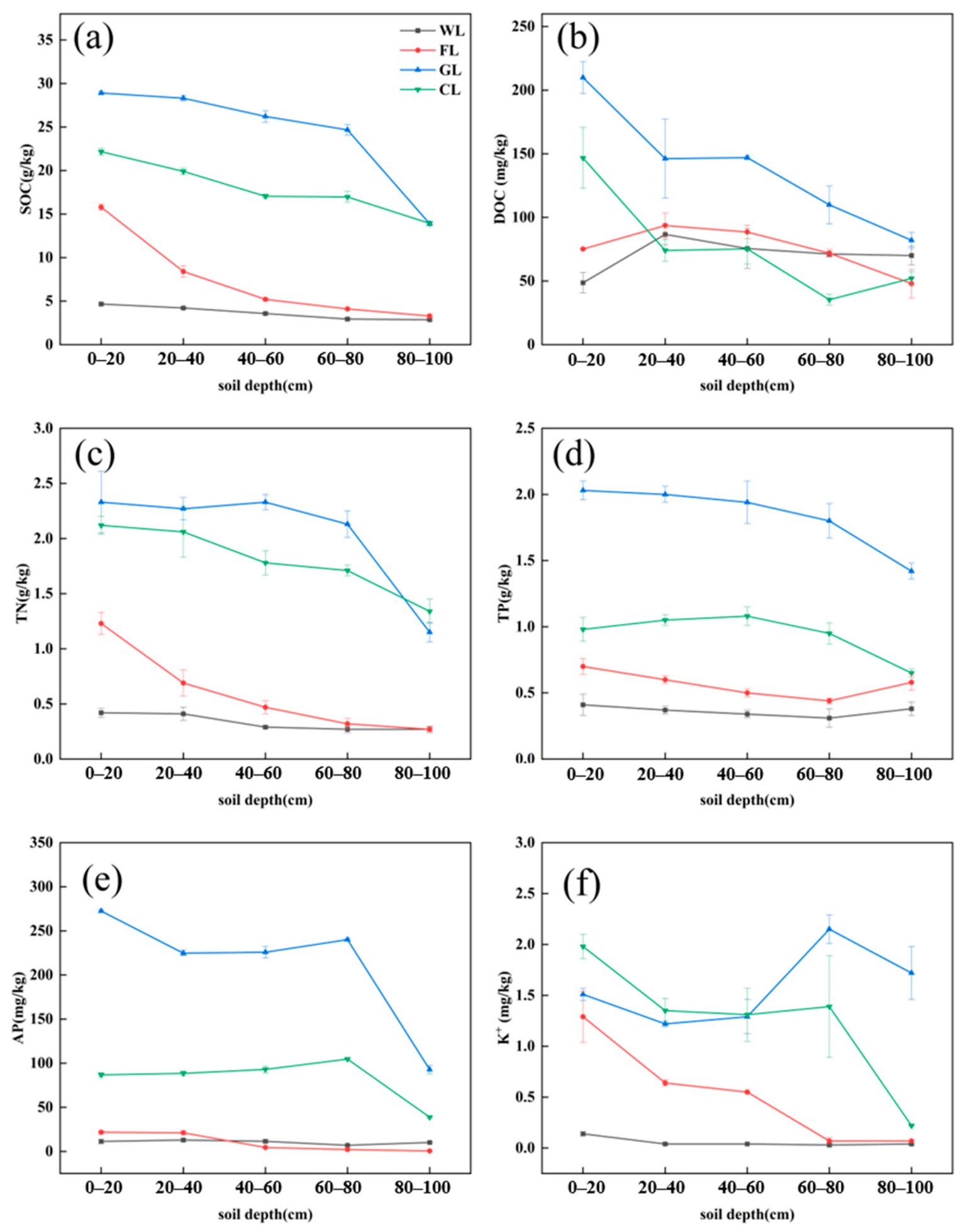
Land use type significantly altered the contents and vertical distribution patterns of soil carbon, nitrogen and phosphorus nutrients (Figure 1; Table A1). Grassland had the highest soil organic carbon (SOC) in the 0–80 cm layer (28.91–24.67 g/kg), significantly higher than other land use types (p < 0.05), followed by farmland, while forest and wetland showed lower SOC values. SOC declined with increasing depth across all land uses, with the steepest decreases in grassland and farmland. Total nitrogen (TN) followed an identical vertical pattern: surface-layer (0–20 cm) TN in grassland and farmland (2.33 and 2.12 g/kg, respectively) was 3.5–5.55 times higher than in wetland and abandoned land, and decreased sharply with depth. Unlike C and N, total phosphorus (TP) and available phosphorus (AP) were significantly higher in grassland throughout the profile, indicating extremely high phosphorus availability, though this difference diminished with soil depth. Surface-layer potassium ion (K+) was highest in farmland (413.33 mg/kg), followed by grassland, and lowest in forest. All soils were alkaline (pH > 8), with a slight pH increase with depth but no significant differences among land uses. Abandoned land, sampled only in the surface layer (<20 cm) due to shallow soil development, had lower SOC, TN and TP than grassland and farmland but similar values to wetland surfaces. Overall, grassland and farmland maintained higher soil fertility, while forest and wetland had lower nutrient levels; all land uses showed consistent nutrient depletion with depth, but the rate of decline varied by land use type.
Figure 1.
Vertical distribution characteristics of soil physicochemical properties under different land use types. CL, cropland; GL, grassland; FL, forestland; WL, wetland. Line charts show vertical variations of (a) soil organic carbon, (b) dissolved organic carbon, (c) total nitrogen, (d) total phosphorus, (e) available phosphorus, and (f) potassium ion in 0–100 cm soil profiles. Significant differences among land use types within each soil layer (p < 0.05) are described in the text.
3.2. Variations in Bacterial Community Composition and Diversity Across Land Use Types
Soil bacterial α-diversity was jointly regulated by land use type and soil depth, with consistent trends for ACE, Chao1, Shannon and Simpson indices. Bacterial richness, diversity and evenness were generally higher in the 0–20 cm surface layer, and fluctuated with increasing soil depth without a uniform monotonic decreasing trend. Cropland and fallow land had relatively higher surface diversity, while grassland showed significantly higher bacterial richness in deep layers than other land use types. Woodland and wetland exhibited overall low alpha diversity across all soil layers (Figure A1).
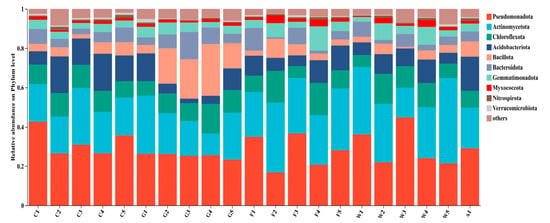
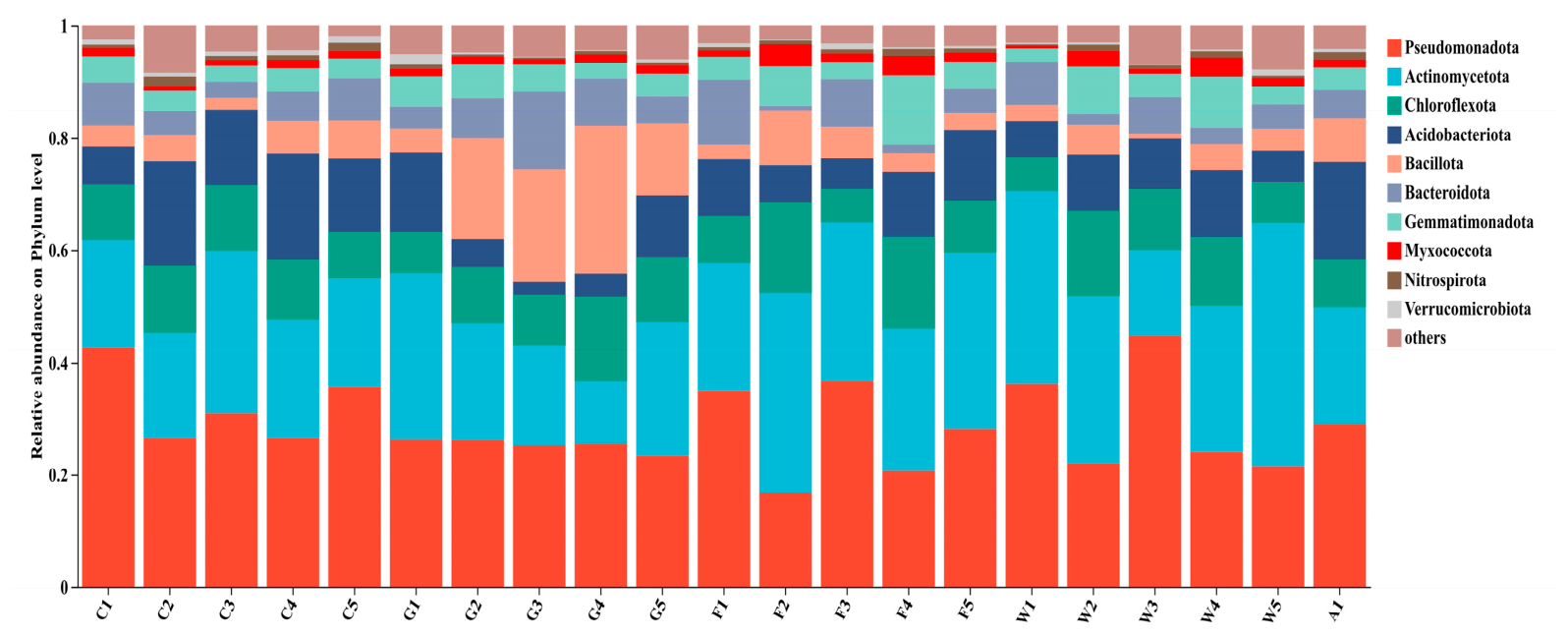
Soil bacterial community composition at the phylum level was co-regulated by land use type and soil depth, showing significant horizontal differentiation and vertical stratification (Figure 2). Bacterial communities across all soil profiles were dominated by five core phyla: Pseudomonadota, Actinomycetota, Chloroflexota, Acidobacteriota and Bacillota, with their total relative abundance accounting for 77.25–87.04% of all sequences. In the surface soil (0–20 cm), Pseudomonadota and Actinomycetota were the predominant phyla, collectively accounting for 49.77–70.46% of the total sequences. The relative abundance of Pseudomonadota in the surface layer followed the order: cropland (42.62%) > wetland (36.17%) > forestland (34.97%) > abandoned land (28.98%) > grassland (26.35%), while the relative abundance of Actinomycetota followed the order: wetland (34.28%) > grassland (29.58%) > forestland (22.72%) > abandoned land (20.79%) > cropland (19.13%). With increasing soil depth, the relative abundance of Pseudomonadota fluctuated and reached a secondary peak in the 40–60 cm soil layer of cropland, forestland, and wetland. Actinomycetota was predominantly concentrated in the middle soil layers; in the 40–60 cm layer, the combined relative abundance of Pseudomonadota and Actinomycetota exceeded 55% in cropland (59.82%), forestland (64.95%), and wetland (59.94%). Chloroflexota was mostly enriched in the subsurface soil layers. Acidobacteriota was enriched in the subsurface layers of cropland and the surface layer of grassland. Bacillota was significantly enriched in the 40–80 cm layer of grassland, surpassing Actinomycetota to become the second most dominant phylum, and also formed distinct enrichment peaks in the subsurface layers of forestland and wetland.
Figure 2.
Relative abundance of soil bacterial community composition at phylum level under different land use types. The bar chart shows the community composition of soil bacteria at phylum level in 0–100 cm profiles. The core dominant phyla include Pseudomonadota, Actinomycetota, Chloroflexota, Acidobacteriota and Bacillota. CL, cropland; GL, grassland; FL, forestland; WL, wetland.
At the class level, the internal structure of each dominant phylum differed among land use types. Pseudomonadota was composed mainly of Alphaproteobacteria and Gammaproteobacteria, Actinomycetota was dominated by the class Actinobacteria together with Thermoleophilia, Bacillota mainly comprised Clostridia and Bacilli, and Bacteroidota was represented chiefly by Bacteroidia. In cropland, Alphaproteobacteria, Actinobacteria, and Gammaproteobacteria together accounted for more than half of the community, with Alphaproteobacteria most abundant in the surface layer and Actinobacteria peaking in the 40–60 cm layer. Grassland exhibited a more balanced class composition, with Alphaproteobacteria, Actinobacteria, Gammaproteobacteria, and Bacteroidia each contributing approximately 15%. Clostridia were markedly more abundant in grassland than in the other land use types, and Bacteroidia and Bacilli were enriched in the 20–80 cm layers. In forestland, Alphaproteobacteria and Actinobacteria were the dominant classes (approximately 20–25%). Wetland was dominated by Actinobacteria, followed by Gammaproteobacteria and Alphaproteobacteria (approximately 35–40% combined). In the surface layer of abandoned land, Alphaproteobacteria, Actinobacteria, and Gammaproteobacteria together dominated the community.
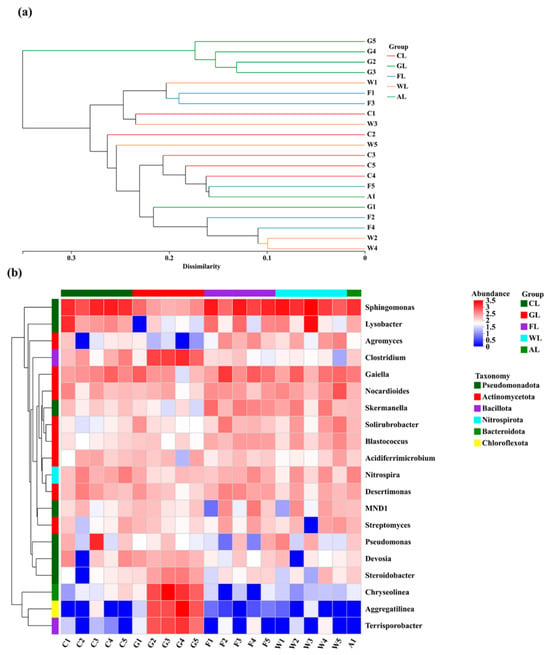
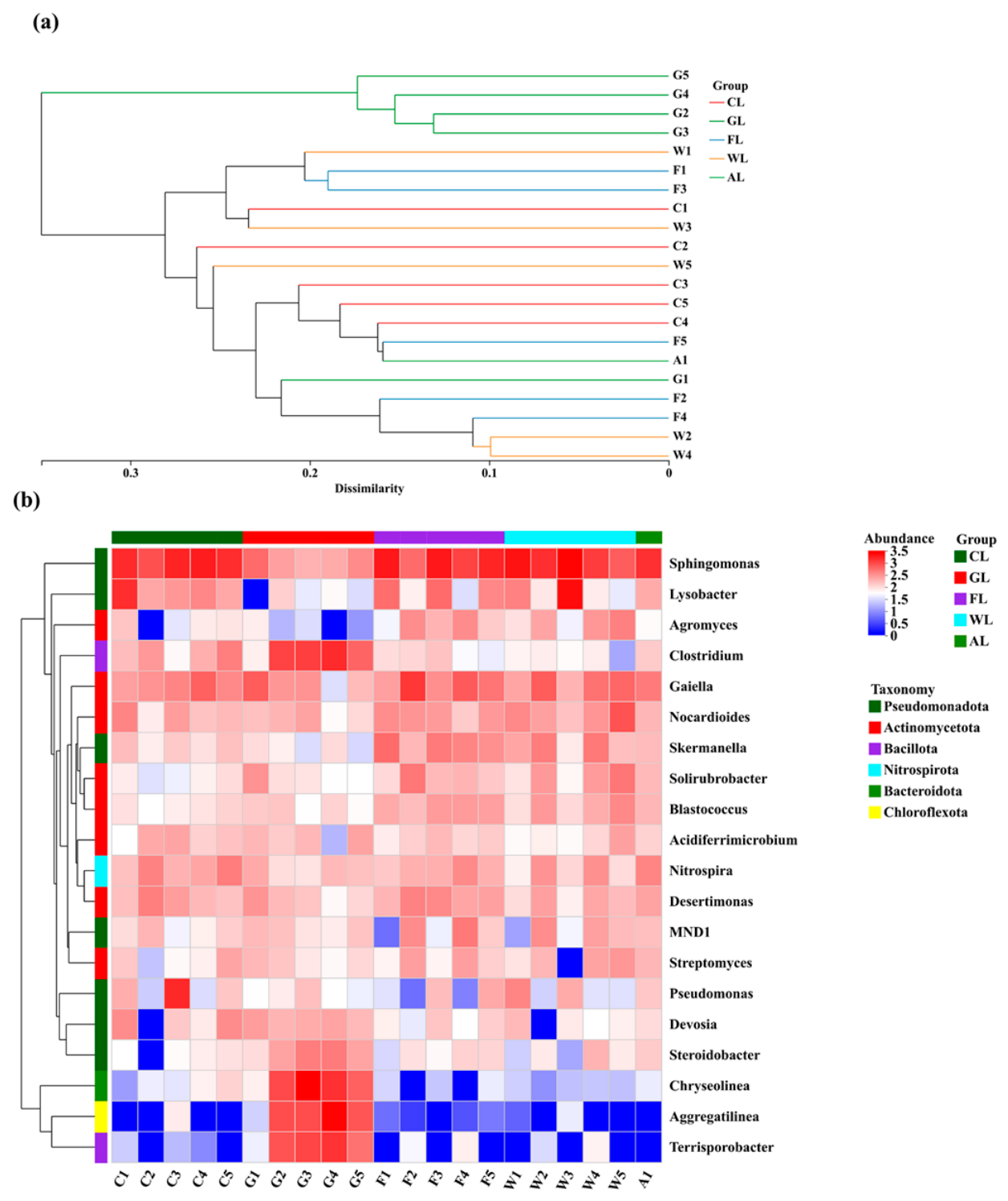
Hierarchical clustering analysis and genus-level abundance heatmaps clarified the compositional differences and clustering characteristics of soil bacterial communities under different land use types. Hierarchical clustering analysis showed that bacterial communities across the five land use types were classified into two major clusters: samples from the 20–100 cm soil layer of grassland formed an independent cluster, while samples of the other land use types clustered together, highlighting the uniqueness of the grassland community structure (Figure 3a). The genus-level abundance heatmap further revealed the community differentiation pattern: Sphingomonas was the core dominant genus in cropland, forestland, wetland and abandoned land (Figure 3b). The dominant genera in grassland presented significant vertical differentiation, with Gaiella dominating in the 0–20 cm soil layer, and Chryseolinea, Aggregatilinea, Clostridium and Terrisporobacter acting as the main dominant taxa in the 20–80 cm soil layer.
Figure 3.
Hierarchical clustering and abundance heatmap of soil bacterial community at genus level under different land use types. (a) Hierarchical clustering analysis of samples based on genus-level community composition, revealing the similarity of bacterial communities among land use types and soil layers; (b) Heatmap of relative abundance of dominant soil bacterial genera, with color depth representing abundance level. CL, cropland; GL, grassland; FL, forestland; WL, wetland; AL, abandoned land.
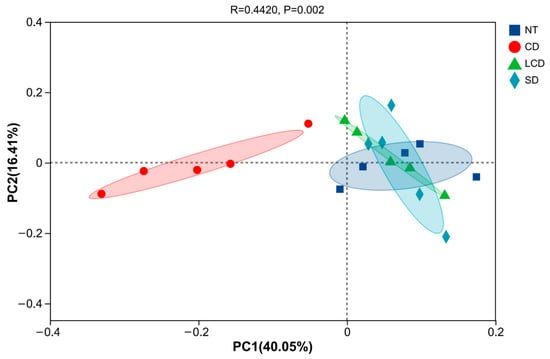
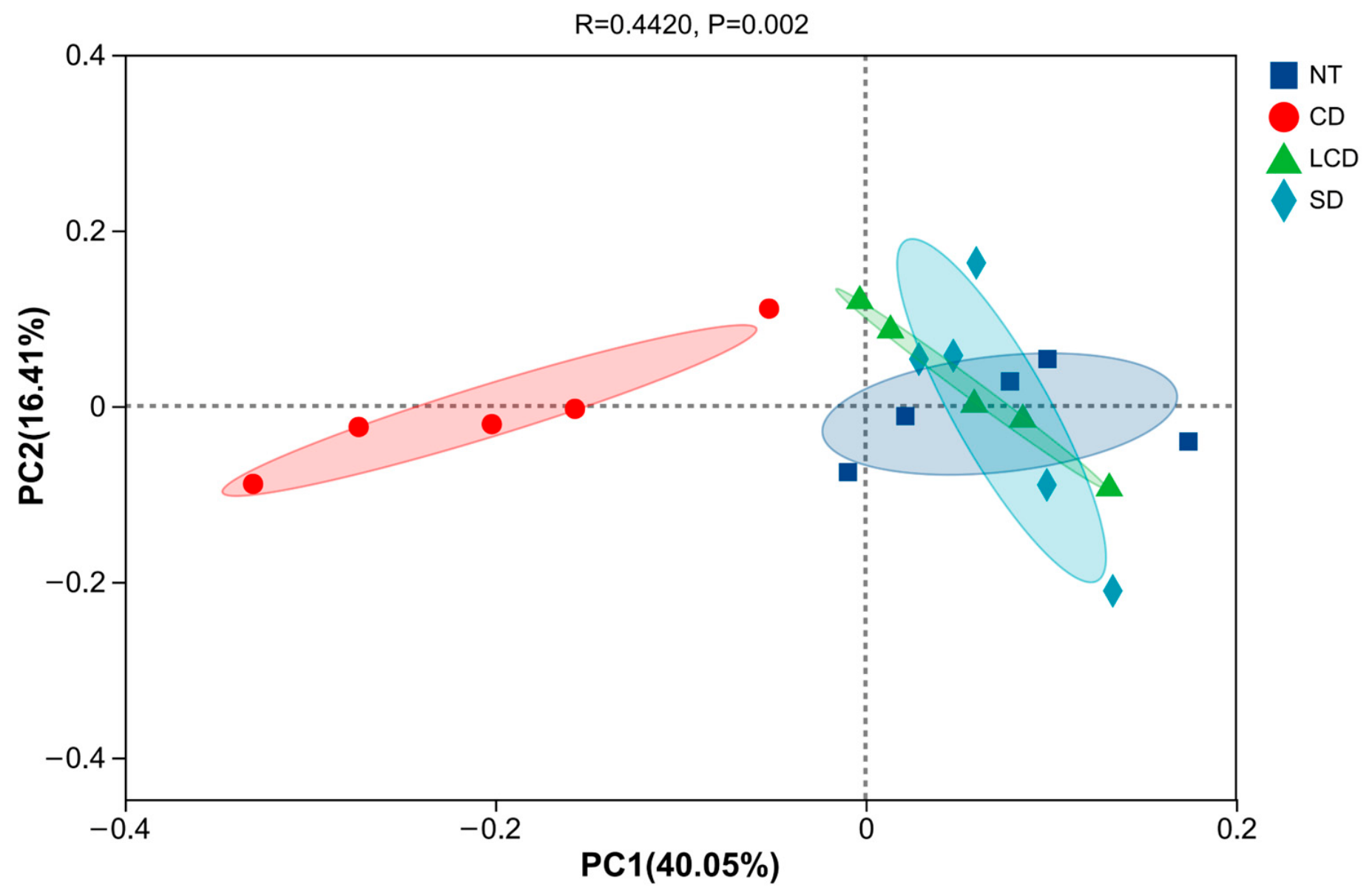
Principal coordinate analysis (PCoA) revealed the beta-diversity differences of soil bacterial communities under various land use types (Figure 4). The two axes collectively explained 56.46% of the total community variation, with the first and second principal components accounting for 40.05% and 16.41% of the total variance, respectively. Grassland samples were clearly separated from those of other land use types, indicating a significant divergence in bacterial community structure. In contrast, samples from cropland, forestland and wetland showed partial overlapping, suggesting high similarity in their bacterial community composition.
Figure 4.
PCoA analysis of soil bacterial communities based on Bray–Curtis distance at genus level. PCoA was performed to reveal β-diversity differences of soil bacterial communities under different land use types. PC1 and PC2 explain 40.05% and 16.41% of the total community variation, respectively, with a cumulative explanation of 56.46%. R = 0.4420, p = 0.002, indicating a significant effect of land use type on community differentiation. CL, cropland; GL, grassland; FL, forestland; WL, wetland.
The number of bacterial ASVs differed significantly among land use types, with a low number of shared ASVs. The Venn diagram showed that 978, 916, 961, 893 and 944 ASVs were detected in cropland, grassland, forestland, wetland and abandoned land at the 0–20 cm soil layer, respectively, with only 22 shared bacterial taxa. For the entire soil profile, 3556, 4282, 3293 and 3544 ASVs were identified in cropland, grassland, forestland and wetland, with 245 shared ASVs in total (Figure A2).
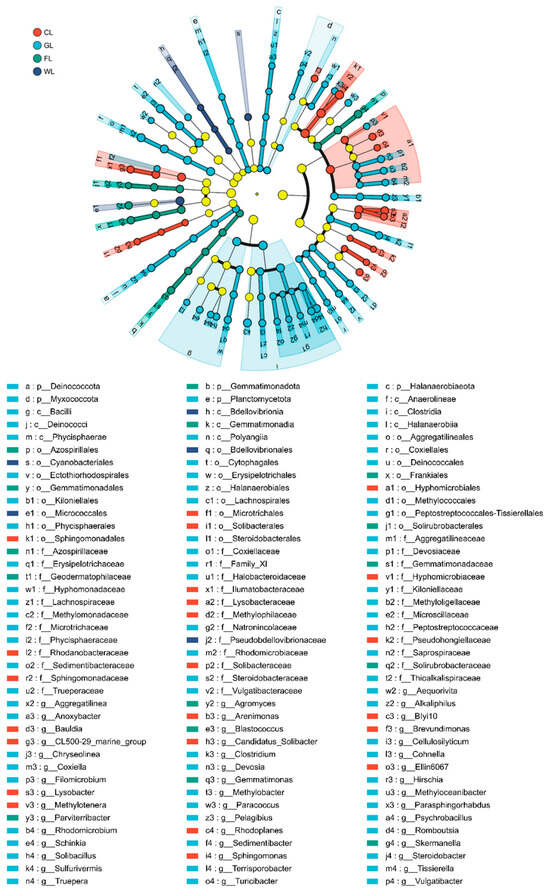
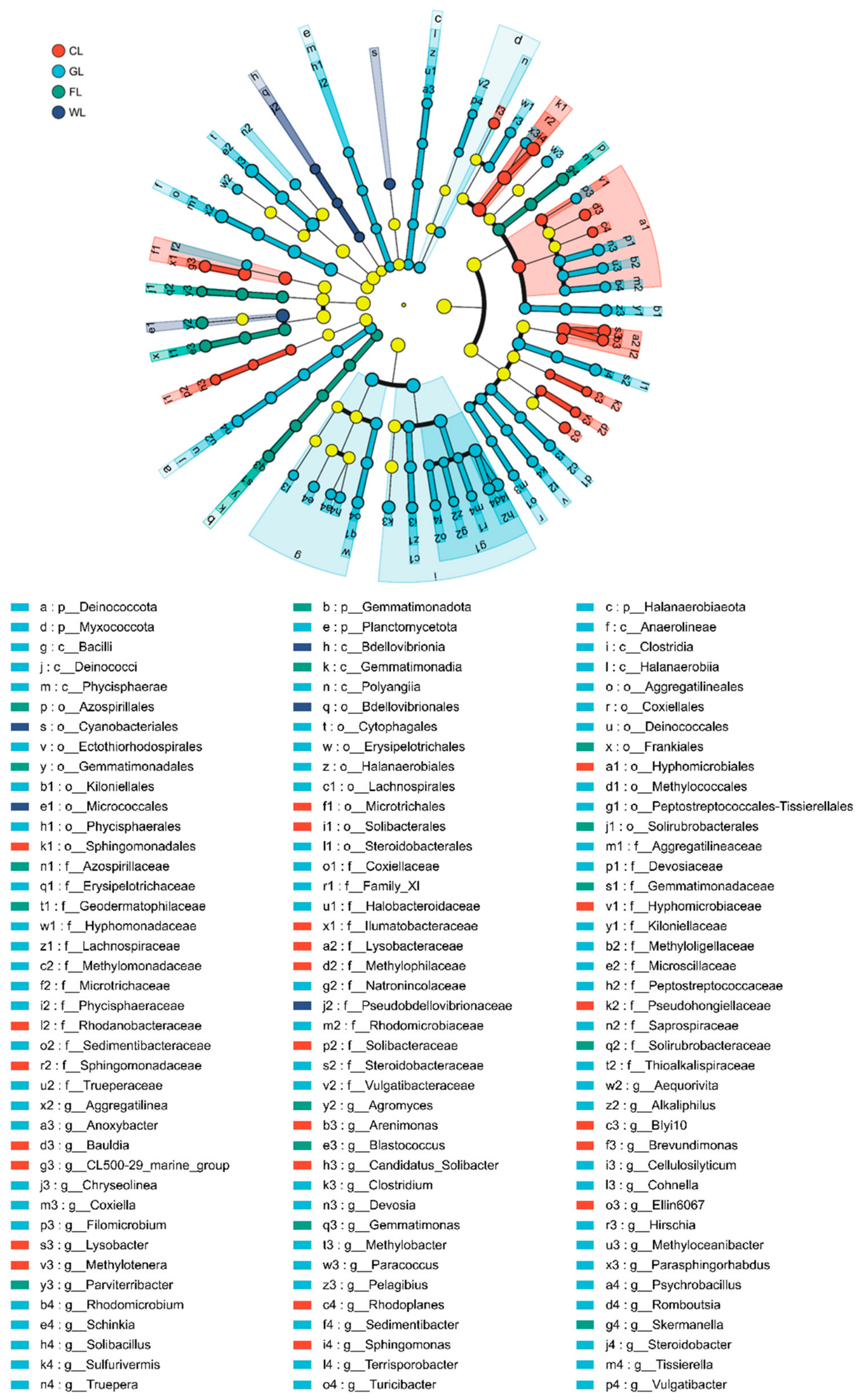
To elucidate the compositional differences in bacterial communities among land use types, LEfSe (Linear discriminant analysis Effect Size) was performed to identify significant differential taxa (Figure 5). A total of 35 significantly different bacterial taxa were identified at an LDA threshold of 3, and each land use type harbored a unique set of biomarker taxa. Cropland was significantly enriched in Sphingomonas, Lysobacter, Hyphomicrobiales and Illumatobacteraceae. The key differential taxa in grassland included Clostridia, Cytophagales, Chryseolinea, Aggregatilinea and Peptostreptococcales, among which Clostridia had an LDA score exceeding 4.5 and served as the core indicator for distinguishing natural grassland communities. Azospirillaceae, Skermanella, Solirubrobacteraceae, Agromyces and Blastococcus were identified as indicator taxa with LDA scores higher than 3 in forestland. Micrococcales and Cyanobacteriales were the main differential taxa in wetland.
Figure 5.
Evolutionary cladogram of soil bacteria by LEfSe analysis under different land use types. LDA threshold = 3 to identify indicator taxa with significant differences among land use types. The cladogram represents taxonomic units from kingdom to genus from inside to outside. Each circle (node) represents a taxonomic unit; the color of each node indicates the land use type in which that taxon is significantly enriched ([red] = cropland, [blue] = grassland, [green] = forestland, [dark blue] = wetland), and yellow nodes represent taxa that are not significantly enriched in any group.
3.3. Co-Occurrence Network Structure and Interaction Patterns
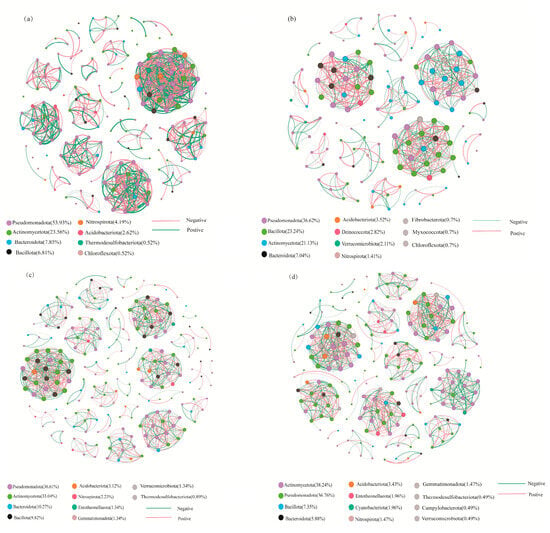
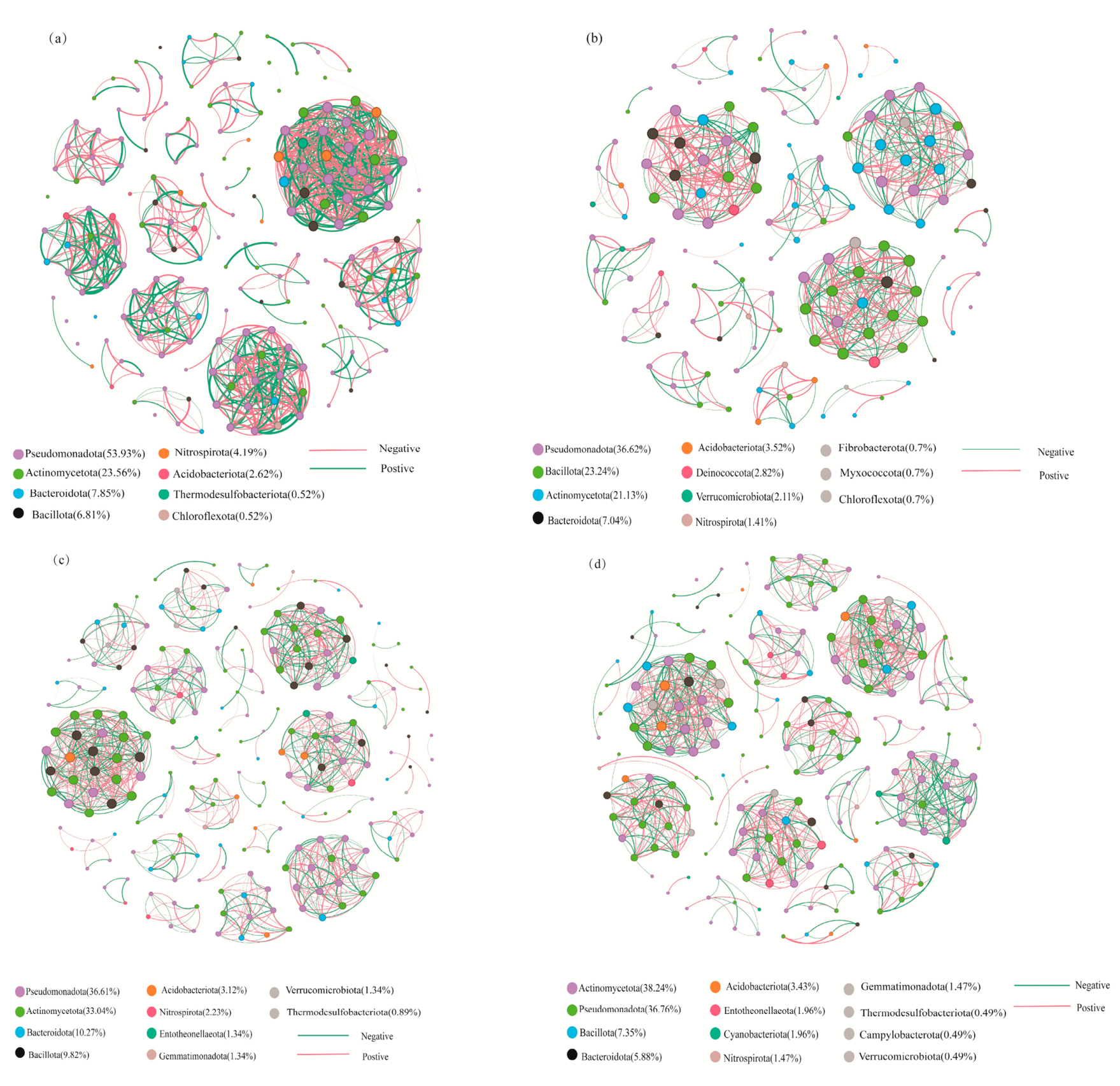
The structure and topological parameters of bacterial co-occurrence networks showed systematic differences among land use types (Figure 6, Table 1). In the cropland network, Pseudomonadota (53.93%) and Actinomycetota (23.56%) dominated, whereas the grassland network additionally contained Bacillota, Myxococcota, Deinococcota, and Verrucomicrobiota. The network structures of forestland and wetland were similar to that of cropland, with Pseudomonadota and Actinomycetota as the dominant phyla. Topological parameters showed that forestland had the highest number of nodes (224), while grassland had the lowest (142), representing a 36.6% reduction compared to forestland. Wetland had the highest number of edges (1006) and grassland the lowest (614). Wetland also exhibited the highest average degree (9.863), whereas forestland had the lowest average degree (8.527) and the longest average path length (0.380). Clustering coefficients varied little among land use types (0.951–0.958). Except for grassland, the proportion of negative edges was higher than that of positive edges in cropland, forestland, and wetland (55.3%, 52.8%, and 53.3%, respectively). Cropland had the smallest modularity index (0.774) and wetland the largest (0.878); grassland had the shortest average path length (0.323).
Figure 6.
Co-occurrence network analysis of soil bacteria under different land use types. (a) Cropland, (b) Grassland, (c) Forestland, (d) Wetland. Node size represents relative abundance; red edges indicate positive correlations, blue edges indicate negative correlations. Networks were constructed with |r| > 0.6 and p < 0.001. Nodes represent amplicon sequence variants (ASVs) and are colored according to their phylum, as shown in the color legend in the figure.
Table 1.
Topological parameters of soil bacterial co-occurrence networks under different land use types.
3.4. Environmental Drivers of Soil Bacterial Community Structure
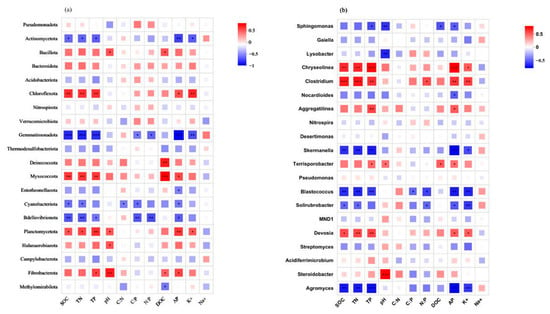
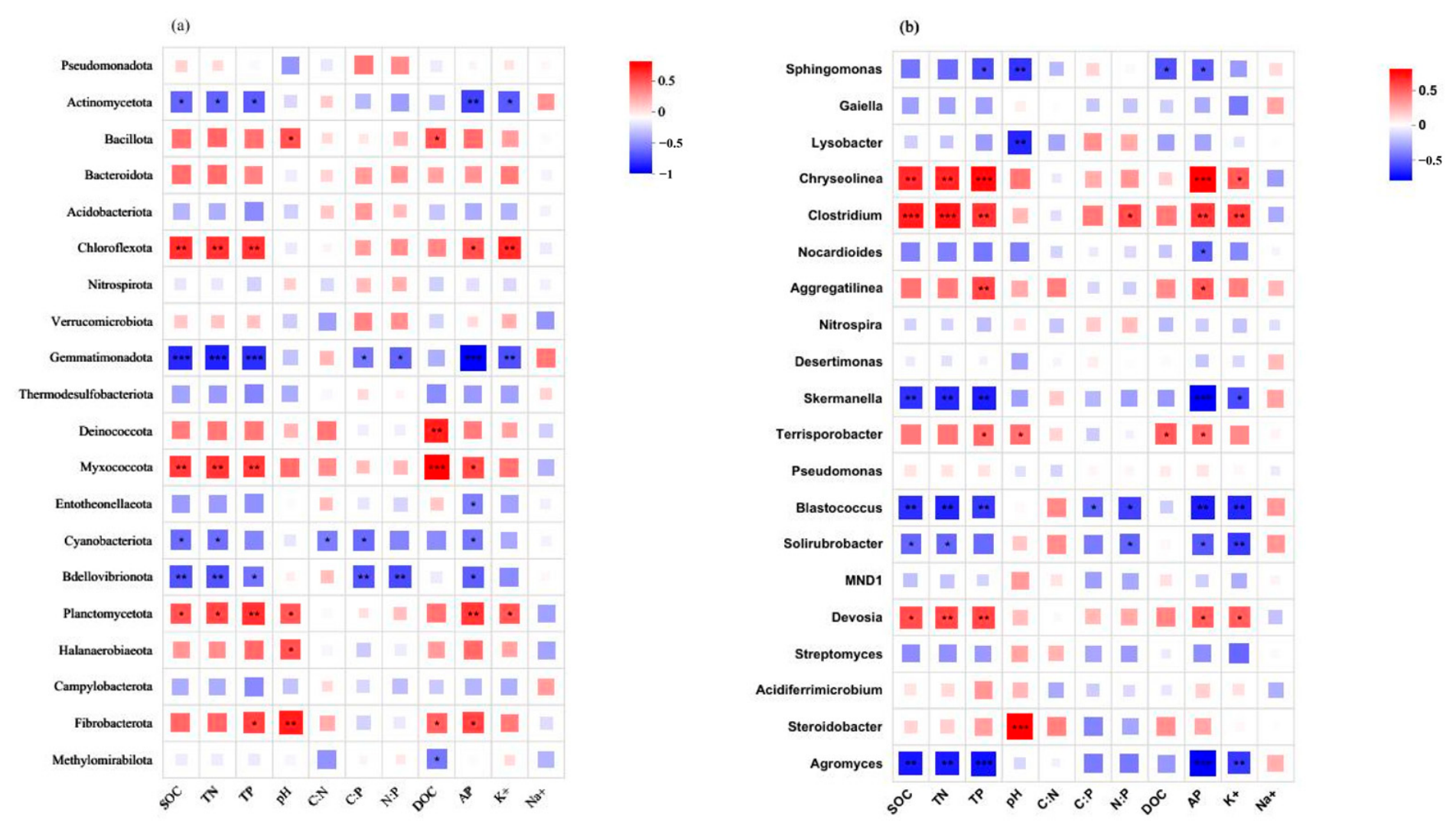
Soil nutrients are critical environmental drivers of variations in bacterial community structure, and different bacterial groups exhibited distinct divergent responses to soil nutrients (Figure 7). At the phylum level, Chloroflexota and Actinomycetota showed completely opposite response patterns to soil nutrients. Chloroflexota was significantly positively correlated with SOC, TN, TP, AP and K+ (r = 0.50 to 0.61), while Actinomycetota and Gemmatimonadota had significant negative correlations with these nutrient indicators (r = −0.51 to −0.62). Bacillota was only positively correlated with pH and DOC, and Myxococcota displayed significant positive correlations with most nutrient indicators, suggesting an obvious copiotrophic preference.
Figure 7.
Correlation heatmap between soil bacterial communities and environmental factors. (a) Correlations between microbial taxa at phylum level and soil physicochemical factors; (b) Correlations between microbial taxa at genus level and soil physicochemical factors. * p < 0.05, ** p < 0.01, *** p < 0.001. Color depth and positive/negative values indicate the degree and direction of correlation, and the size of each square is proportional to the magnitude of the correlation coefficient (|r|). SOC, soil organic carbon; TN, total nitrogen; TP, total phosphorus; AP, available phosphorus; K+, potassium ion.
At the genus level, the dominant genera were divided into two groups based on their correlations with soil nutrients. The first group was nutrient-preferential taxa: Clostridium, Aggregatilinea, Chryseolinea, Terrisporobacter and Devosia were significantly positively correlated with SOC, TN, TP, AP or K+, and Clostridium also had a significant positive correlation with N:P ratio (r = 0.54). The second group was nutrient-tolerant taxa adapted to infertile conditions: Skermanella, Blastococcus, Solirubrobacter and Agromyces were significantly negatively correlated with SOC, TN, AP and K+. Sphingomonas was negatively correlated with TP, pH, DOC and AP, and Lysobacter showed an extremely significant negative correlation with pH.
Overall, nutrient-enriched soils such as the topsoil of cropland and grassland were more conducive to the growth of Chloroflexota and Clostridium. By contrast, Actinomycetota and Sphingomonas tended to dominate in nutrient-poor or strongly alkaline soil environments.
3.5. Land Use-Driven Shifts in Bacterial Carbon and Nitrogen Cycling Functions
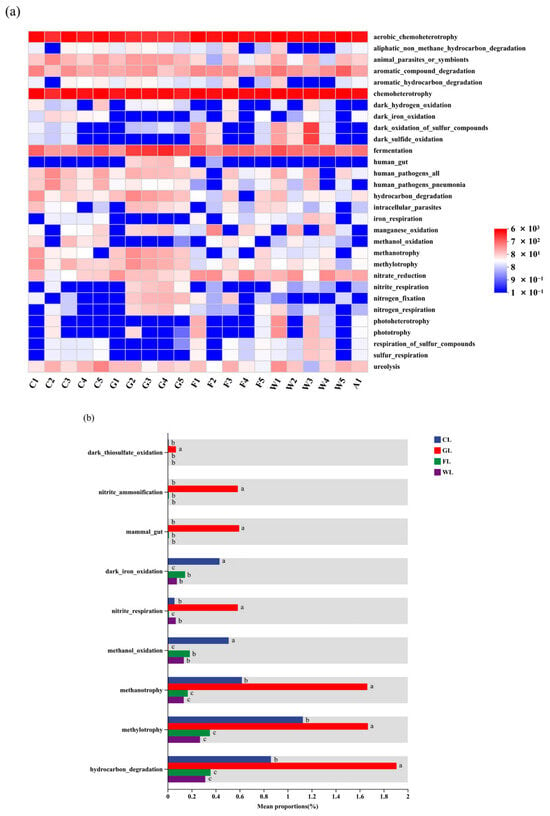
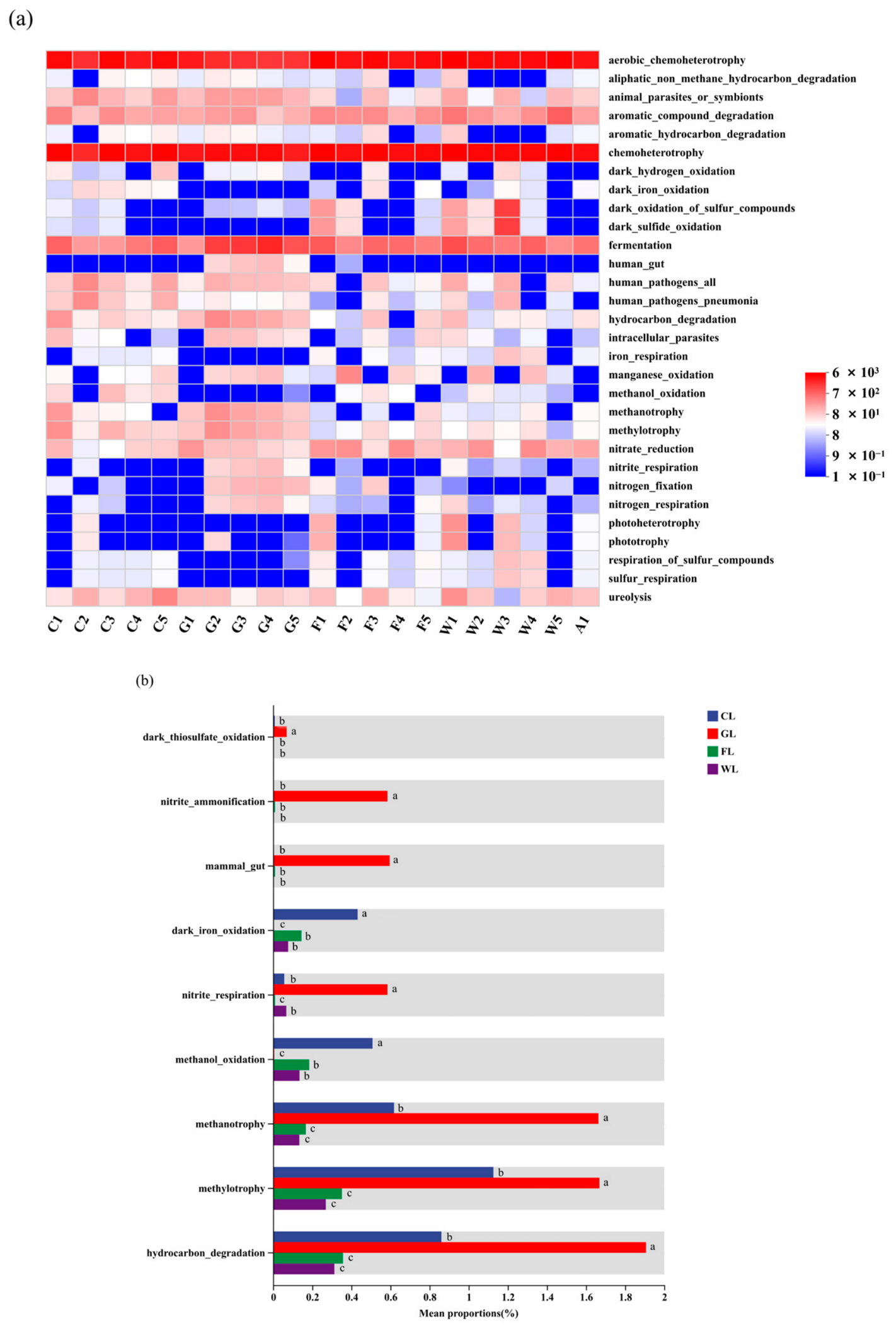
Functional prediction based on FAPROTAX indicated that soil bacterial functional profiles differed significantly among the four land use types (Figure 8), dominated by carbon and nitrogen cycling-related functions. Across all land use types and soil layers, aerobic chemoheterotrophy and chemoheterotrophy were the most prevalent core functions.
Figure 8.
(a) Relative abundance of soil bacterial functional groups related to carbon and nitrogen cycling based on FAPROTAX; (b) significance difference analysis of functional abundance among land use types. The relative abundance of each functional group was calculated as the summed relative abundance of all ASVs assigned to that function by FAPROTAX, and ASVs that could not be assigned to any function were excluded from this calculation. Significant differences in functional abundance among land use types were tested by one-way ANOVA followed by Tukey’s HSD test, and bars not sharing a common lowercase letter differ significantly at p < 0.05. CL, cropland; GL, grassland; FL, forestland; WL, wetland.
Carbon cycling functions exhibited distinct habitat preferences. Grassland was significantly enriched in fermentation, hydrocarbon degradation, methanotrophy and methylotrophy. The relative abundances of methanotrophy and methylotrophy followed a consistent order of grassland > cropland > forestland > wetland. Cropland had significantly higher methanol oxidation capacity than forestland and wetland. Aromatic compound degradation was prominent in forestland and wetland throughout soil profiles, while aliphatic non-methane hydrocarbon degradation was mainly concentrated in topsoil. Nitrogen cycling functions also showed clear differentiation across land uses. Grassland harbored significantly higher abundances of nitrite respiration, nitrogen fixation and nitrogen respiration than other land use types. Nitrate reduction was widely distributed in all habitats, with higher levels in grassland and forestland. Ureolysis was primarily enriched in all soil layers of cropland and the topsoil of wetland. Overall, bacterial functional traits displayed obvious land use specificity: grassland was characterized by active carbon metabolism and nitrogen cycling, cropland was dominated by methanol oxidation and ureolysis, forestland and wetland presented strong potential for aromatic compound degradation.
For carbon cycling functions, methanotrophy and methylotrophy were significantly enriched in the 0–40 cm soil of grassland (GL) and cropland (CL), respectively, with their abundance decreasing with increasing soil depth. Meanwhile, hydrocarbon degradation maintained relatively high abundance across the soil profile in cropland (CL), indicating strong vertical functional connectivity for carbon decomposition in agricultural soils. In terms of nitrogen-cycling functions, nitrite reduction exhibited significantly higher relative abundance in the topsoil of grassland (GL), with its abundance decreasing markedly with increasing soil depth. In contrast, anaerobic nitrogen-related processes such as nitrate reduction showed sustained and moderate activity in wetland (WL) soils, displaying a “decrease-then-increase” pattern in abundance along the vertical profile.
4. Discussion
4.1. Land Use and Soil Depth Co-Regulate Vertical Differentiation of Soil Bacterial Communities
Soil bacterial community composition and diversity are jointly regulated by land-use type and soil depth, which shape distinct community structures by altering vertical nutrient distribution and microenvironmental conditions. In this study, only 22 ASVs were shared among the five land-use types in the surface 0–20 cm layer (Figure A1), indicating strong land-use specificity of surface bacterial communities. Grassland had the highest total ASV count (4282) across the entire profile, and bacterial richness in the deep grassland layers (80–100 cm) was significantly higher than that of other land-use types. This phenomenon may be related to the deep root systems of grassland plants, where root turnover and exudates transport organic carbon to deeper layers, providing additional carbon sources and ecological niches for subsurface microorganisms [31]. In contrast, α-diversity in forestland and wetland was relatively low across all soil layers. The dominance of recalcitrant litter (e.g., lignin) in forestland may slow microbial turnover and restrict niche differentiation [32], whereas prolonged waterlogging and reducing conditions in wetland exert physiological stress on aerobic bacteria, thereby suppressing diversity [33]. Principal coordinate analysis (PCoA) further revealed that grassland bacterial communities were clearly separated from those of cropland, forestland, and wetland (Figure 4), confirming that land-use type is the primary factor driving the differentiation of community structure.
At the phylum level, Pseudomonadota and Actinomycetota exhibited distinctly different vertical distribution patterns (Figure 2). Pseudomonadota reached its highest surface abundance in cropland (42.62%), first decreased and then increased with depth, and reached a secondary peak at 40–60 cm. Pseudomonadota comprises diverse copiotrophic functional groups capable of rapid growth using root exudates and fresh litter [34,35], thus dominating the nutrient-rich cropland surface; its re-enrichment at 40–60 cm may be associated with anaerobic metabolism or nitrogen fixation capabilities of certain lineages, enabling them to maintain moderate abundance in middle layers with medium organic matter content and limited oxygen [36]. Actinomycetota dominated the surface layers of wetland and grassland (34.28% and 29.58%, respectively) and was mainly enriched in the 20–60 cm middle layers. Most members of Actinomycetota are capable of decomposing recalcitrant organic matter such as cellulose and lignin [17]; in the surface layer they may be outcompeted by fast-growing taxa in Pseudomonadota, while in deep layers they are limited by severe carbon depletion, thus forming a relative advantage in middle layers [37]. Chloroflexota increased in abundance in subsurface layers (40–80 cm, Figure 2), consistent with observations by Geng et al. [20] in the black soil region of Northeast China. Although Chloroflexota are often classified as oligotrophic anaerobes, their enrichment in deep soils may be attributed to the ability to utilize mineral-associated organic matter rather than dependence on labile organic carbon [38]. Bacillota was significantly enriched in grassland at 40–80 cm, surpassing Actinomycetota to become the second most dominant phylum, and also formed distinct enrichment peaks in the subsurface layers of forestland and wetland. This is mainly because Bacillota comprises numerous spore-forming anaerobes (e.g., Clostridium), and spore formation confers strong stress tolerance to this group [21], allowing them to survive and proliferate in deep anoxic, oligotrophic environments; their enrichment in subsurface layers of forestland and wetland may be related to the presence of localized anaerobic microsites in these ecosystems [39,40].
At the genus level, vertical turnover (Figure 3) further revealed niche differentiation of bacterial communities. Sphingomonas showed higher relative abundance in the surface layer than in the subsurface across cropland, forestland, wetland, and abandoned land (Figure 3b). This pattern seems contradictory to the oligotrophic lifestyle of Sphingomonas, but its facultative metabolic capacity allows it to survive on low-concentration organic matter and also to rapidly proliferate in organic-rich surface layers through chemotaxis [41]. Genus-level differentiation in grassland was more typical: the surface layer was dominated by Gaiella (Figure 3b), a genus closely linked to organic matter decomposition, and the abundant litter in the grassland surface layer provided a favorable niche [12,37]; in the deep 20–80 cm layers, the dominant taxa shifted to Chryseolinea, Aggregatilinea, Clostridium, and Terrisporobacter. Among these, the latter three are strictly anaerobic, and most are capable of spore formation [21,42], adapted to deep anoxic environments; Chryseolinea exhibits oligotrophic adaptation and metabolic flexibility [40]. This vertical turnover of genera clearly reflects a continuous transition from surface oxic, high-substrate conditions to deep anoxic, low-substrate environments. The metabolic basis of this turnover is supported by experimentally validated functions at the species level. Sphingomonas isolates are confirmed degraders of aromatic hydrocarbons, Clostridium and Terrisporobacter cultures are obligate anaerobes that form endospores, and Chryseolinea strains isolated from soil grow on a broad range of simple substrates [12,40,41].
In summary, land-use type determines the initial community composition and diversity patterns by altering the quantity and quality of surface litter input, whereas soil depth shapes a continuous community turnover from copiotrophic (Pseudomonadota, Sphingomonas) to deep-layer tolerant (Chloroflexota, Clostridium and other anaerobes) taxa via gradients in oxygen, nutrient availability, and substrate degradability (Figure 1, Figure 2 and Figure 3). This vertical differentiation is particularly pronounced in the alpine semi-arid region, where soil layers are shallow and the vertical nutrient gradient is steep, rendering microbial communities more sensitive to depth variation. Our results fully demonstrate that when evaluating the effects of land use on soil microbial communities, the vertical depth gradient must be incorporated; otherwise, the uniqueness of deep-layer microbial communities and their potential contribution to nutrient cycling will be underestimated.
4.2. Land Use-Driven Co-Occurrence Network Patterns and Structure Differentiation of Soil Bacteria
Land use types markedly altered the co-occurrence network structure, interspecific interaction patterns of soil bacteria. In this study, the network topological parameters of cropland, forestland, wetland and grassland showed systematic differences (Table 1, Figure 6). Grassland was the only land use type dominated by synergistic symbiosis, with a higher proportion of positive correlations (53.3%) than negative ones in the network. Such interaction patterns facilitated bacterial adaptation to the alpine and semi-arid environment [43]. Grassland had the lowest number of nodes (142) and edges (614), with a relatively simple network structure. It also contained unique taxa such as Bacillota, leading to distinct network composition and interaction patterns. Bacterial communities in cropland, forestland and wetland were dominated by interspecific competition, and the proportion of negative correlations in these three ecosystems all exceeded 52%. Affected by long-term tillage and fertilization, microbes in cropland exhibited stronger competition for available nutrients, as reflected by the highest proportion of negative edges (55.3%) and the network was characterized by high connectivity but the lowest modularity (0.774) [4,9]. Wetland had the highest number of nodes (204), edges (1006) and modularity index (0.878), indicating a more modular and structurally robust network [44], which was directly related to the diverse microhabitats formed in the wetland environment [45]. Forestland had the largest number of nodes (224) and close connections among species (edges = 955), with a more abundant species composition. Microbes in forestland mostly utilized refractory litter independently and also showed obvious competitive characteristics. In conclusion, land use types regulated the interspecific associations and network structure of soil bacteria by changing soil resources and environmental conditions, ultimately forming differentiated network structures and interaction modes of soil bacterial communities in the Huangshui River Basin.
4.3. Environmental Factors Drive the Differentiation of Soil Bacterial Community Structure
Soil organic carbon, total nitrogen, total phosphorus, available phosphorus, and potassium ions are the core environmental factors driving the differentiation of soil bacterial community structure in the Huangshui River Basin, and different bacterial groups exhibit distinct response patterns to soil nutrients (Figure 7). At the phylum level, Chloroflexota shows significantly positive correlations with most soil nutrients, while Actinomycetota shows significantly negative correlations, presenting an opposite distribution pattern. This contrasting pattern is determined not by the copiotrophic/oligotrophic strategy alone, but primarily by substrate quality (labile versus mineral-associated organic carbon) [31], depth-related oxygen availability [46], and competitive exclusion by copiotrophic taxa [-bound organic matter in deep soil, rather than dependence on labile organic carbon in the surface layer [38]. Actinomycetota has the ability to decompose refractory organic matter such as lignin and cellulose [37], but it is easily outcompeted by fast-growing copiotrophic groups like Pseudomonadota in nutrient-rich surface soil, thus showing an overall negative correlation with nutrients. Myxococcota is significantly positively correlated with labile organic carbon and most soil nutrients, representing a typical copiotrophic phylum [47,48]; Bacillota is only significantly correlated with pH and dissolved organic carbon, with a relatively concentrated niche distribution. The above differentiation indicates that soil nutrients do not simply promote the growth of all microorganisms, and the actual distribution of bacteria is co-regulated by competitive exclusion and metabolic specificity among taxa.
At the genus level, the dominant genera can be divided into two groups according to their nutrient response strategies. The first group is positively correlated with nutrients, including Clostridium, Aggregatilinea, Chryseolinea, Terrisporobacter, and Devosia, among which Clostridium is also significantly positively correlated with soil nitrogen-to-phosphorus ratio. Most of these genera are anaerobic or facultative anaerobic fermentative bacteria [39,40], which are mainly distributed in fertile soils such as cropland and grassland surface layers, and participate in organic matter decomposition and nutrient cycling. The second group is negatively correlated with nutrients, including Skermanella, Blastococcus, Solirubrobacter, and Agromyces; in addition, Sphingomonas is negatively correlated with total phosphorus, pH, dissolved organic carbon, and available phosphorus, and Lysobacter is negatively correlated with pH. Most of these genera are oligotrophic or stress-tolerant taxa, which can occupy dominant niches in nutrient-poor or alkaline soils by utilizing refractory organic matter and resisting environmental stress [20,41]. Soil nutrients shape a typical resource-dependent community distribution pattern in the Huangshui River Basin by screening bacterial taxa with different nutrient adaptation strategies. Copiotrophic and fermentative bacteria preferentially colonize fertile soils, while oligotrophic and stress-tolerant bacteria dominate in barren or alkaline habitats. This pattern also serves as the core internal mechanism underlying the differentiation of soil microbial communities driven by land use in the basin. These contrasting strategies are supported by experimentally characterized traits. Lysobacter species produce lytic enzymes and antimicrobial metabolites that confer a competitive advantage in nutrient-limited soils, whereas the copiotrophic fermenters such as Clostridium depend on readily available organic substrates [42,49].
4.4. Regulation of Soil Bacterial Carbon and Nitrogen Cycling Functions by Land Use and Soil Depth
Land use types and soil depth jointly regulate the composition and abundance of soil bacterial carbon and nitrogen cycling functions by synergistically altering substrate supply, redox conditions, and vertical nutrient distribution, thereby forming a dual functional pattern of horizontal differentiation and vertical stratification (Figure 8). Aerobic chemoheterotrophy and chemoheterotrophy are dominant across all land use types, and their functional abundance decreases significantly with increasing soil depth. Continuous input of litter and labile organic matter in the surface soil provides sufficient substrates for functional microorganisms, whereas the oligotrophic and anaerobic environment in deep soil substantially weakens the expression of most carbon and nitrogen cycling functions [3].
For carbon cycling, methylotrophy was significantly enriched in the 0–40 cm surface soil of both grassland (GL) and cropland (CL), with a pronounced decline in relative abundance as soil depth increased. This vertical stratification aligns with the general trend of aerobic microbial functions being concentrated in oxic, carbon-rich topsoil [46]. Notably, hydrocarbon degradation maintained persistently high relative abundance across the entire soil profile in cropland, indicating enhanced vertical functional connectivity for carbon decomposition under agricultural management, likely driven by continuous organic inputs and tillage-induced soil homogenization [7]. For nitrogen cycling, nitrite respiration exhibited significantly higher relative abundance in the topsoil of grassland (GL) and decreased markedly with depth, consistent with the oxic niche preference of this process in well-aerated grassland soils [46]. In contrast, anaerobic nitrogen-related processes such as nitrate reduction showed sustained, moderate activity in wetland (WL) soils, displaying a characteristic “decrease-then-increase” abundance pattern along the vertical profile. This bimodal distribution, with abundance peaks in the upper subsoil (20–40 cm) and the deep layer (60–80 cm), reflects the strong redox stratification in wetland soils: the upper-subsoil peak corresponds to microaerophilic niches near the root zone, whereas the deep-layer peak reflects strongly reducing conditions that favor anaerobic nitrate-reducing communities [50].
The differentiation of carbon cycling functions is jointly driven by substrate types, methane oxidation niches, and soil layer environments. The abundances of methanotrophy and methylotrophy in grassland are significantly higher than those in wetland. Grassland is dominated by aerobic oxidation of atmospheric low-concentration methane, and this function remains relatively stable in deep soil. Wetland is dominated by anaerobic methane oxidation, while FAPROTAX only predicts aerobic pathways, resulting in relatively low predicted surface functional values [51]. Methanol oxidation in cropland is most prominent in the surface layer, which is closely related to volatile substrates released by long-term organic fertilizer input and straw returning. Aromatic compound degradation is dominant in forestland and wetland, especially in the surface litter input layer, where microorganisms efficiently utilize lignin-based refractory carbon sources by secreting aromatic ring-cleaving enzyme systems. The differentiation of nitrogen cycling functions is synergistically regulated by redox gradients, C/N ratios, and nitrogen supply patterns across soil layers. Nitrite respiration and nitrogen fixation in grassland are enriched in the upper and middle soil layers. The moderate C/N ratio and microaerobic-aerobic alternating environment strongly drive denitrification and biological nitrogen fixation [5]. High nitrogen input in cropland leads to dominant ureolysis across all soil layers and significantly inhibits nitrogen fixation. The long-term anaerobic environment in wetland, as well as the acidic conditions and refractory substrates in forestland, restrict the expression of key nitrogen cycling functions in all soil layers [52].
The interaction between land use and soil depth reshapes carbon availability, nitrogen supply, and redox conditions along the soil profile, forming a unique pattern of vertical and horizontal differentiation of microbial functions in the alpine and semi-arid basin. Different ecosystems thus develop differentiated ecological service capabilities: grassland supports methane oxidation and biological nitrogen fixation (a potential atmospheric methane sink and nitrogen input), cropland supports methanol oxidation and ureolysis (nitrogen turnover), wetland supports nitrate reduction (potential anaerobic nitrogen removal), and forestland and wetland support aromatic compound degradation (potential recalcitrant carbon processing). The predicted functional differentiation was broadly consistent with the soil nutrient and redox gradients described above, reinforcing the interpretation that soil carbon and nitrogen availability drive the functional differentiation among land use types. These differentiated capabilities provide a microbiological basis for land use optimization and soil function conservation in the basin.
5. Conclusions
This study systematically elucidated the vertical differentiation characteristics, co-occurrence network topology, and carbon and nitrogen cycling functional potentials of soil bacterial communities under five land use types in the Huangshui River Basin, an alpine semi-arid region. The results demonstrated that soil bacterial community structure was co-regulated by land use type and soil depth. Pseudomonadota and Actinomycetota exhibited significantly divergent vertical distribution patterns, while deep soils of grassland were enriched with anaerobic taxa such as Bacillota and Clostridium, clearly presenting a continuous vertical succession from copiotrophic taxa in surface soils to stress-tolerant taxa in deep layers. Soil organic carbon, total nitrogen, total phosphorus, available phosphorus, and potassium ions were the core environmental factors driving bacterial community differentiation, which shaped a resource-dependent community distribution pattern by screening microbial taxa with distinct nutrient adaptation strategies. Co-occurrence network analysis showed systematic differences in network structure among land use types. Grassland was the only type dominated by microbial synergy, wetland exhibited the highest network modularity (structural robustness), and cropland was characterized by the most intense interspecific competition (the highest proportion of negative edges). Functional prediction confirmed significantly differentiated functional profiles among land use types: grassland was significantly enriched in methanotrophy, nitrite respiration, and biological nitrogen fixation; cropland was dominated by methanol oxidation and ureolysis; and forestland and wetland showed strong potentials for aromatic compound degradation.
6. Limitations
This study has two objective limitations. First, restricted by geological conditions (bedrock or gravel layer below 20 cm), only surface soil samples (0–20 cm) could be collected for abandoned land. Accordingly, abandoned land was included in the surface-layer (0–20 cm) analyses of soil physicochemical properties, bacterial community composition, and α-diversity, but was excluded from the vertical (full-profile) analyses—co-occurrence networks, functional prediction, and profile-level community comparisons—which were restricted to the four land use types with complete 0–100 cm profiles (cropland, grassland, forestland, and wetland). The surface data nevertheless provide important support for revealing microbial responses along the anthropogenic disturbance gradient. Second, FAPROTAX functional prediction based on 16S rRNA gene sequences only reflects potential microbial functions rather than actual metabolic expression. Further studies combining metagenomic sequencing and functional gene quantification are required to verify the real activities of key carbon and nitrogen cycling pathways identified in this study—methane oxidation (methanotrophy, e.g., pmoA), nitrogen fixation (e.g., nifH), denitrification and nitrate reduction (e.g., nirK/nirS, narG), ureolysis (e.g., ureC), and aromatic compound degradation.
Author Contributions
Conceptualization, Y.T., C.Z. and Q.X.; investigation, C.W., J.W., B.T. and C.Z.; writing—original draft preparation, Y.T. and C.Z.; writing—review and editing, Q.X.; visualization, B.T. and J.W.; methodology, Y.T., C.W. and Q.X.; formal analysis, C.W.; data curation, J.W.; project administration, Y.T. All authors have read and agreed to the published version of the manuscript.
Funding
This research was supported by Jing-Jin-Ji RegionalIntegrated EnvironmentalImprovement-National Scienceand Technology Major Project (2026ZD1212203) and the Basic Scientific Research Project of the Chinese Research Academy of Environmental Sciences (Grant No. 2023YSKY-32).
Institutional Review Board Statement
Not applicable.
Informed Consent Statement
Not applicable.
Data Availability Statement
The original contributions presented in this study are included in the article. Further inquiries can be directed to the corresponding author.
Conflicts of Interest
The authors declare no conflicts of interest.
Appendix A
Figure A1.
Variation characteristics of community diversity under different land use types in the Huangshui River Basin. (a) Sobs index, (b) ACE index, (c) Chao1 index, (d) Shannon index.
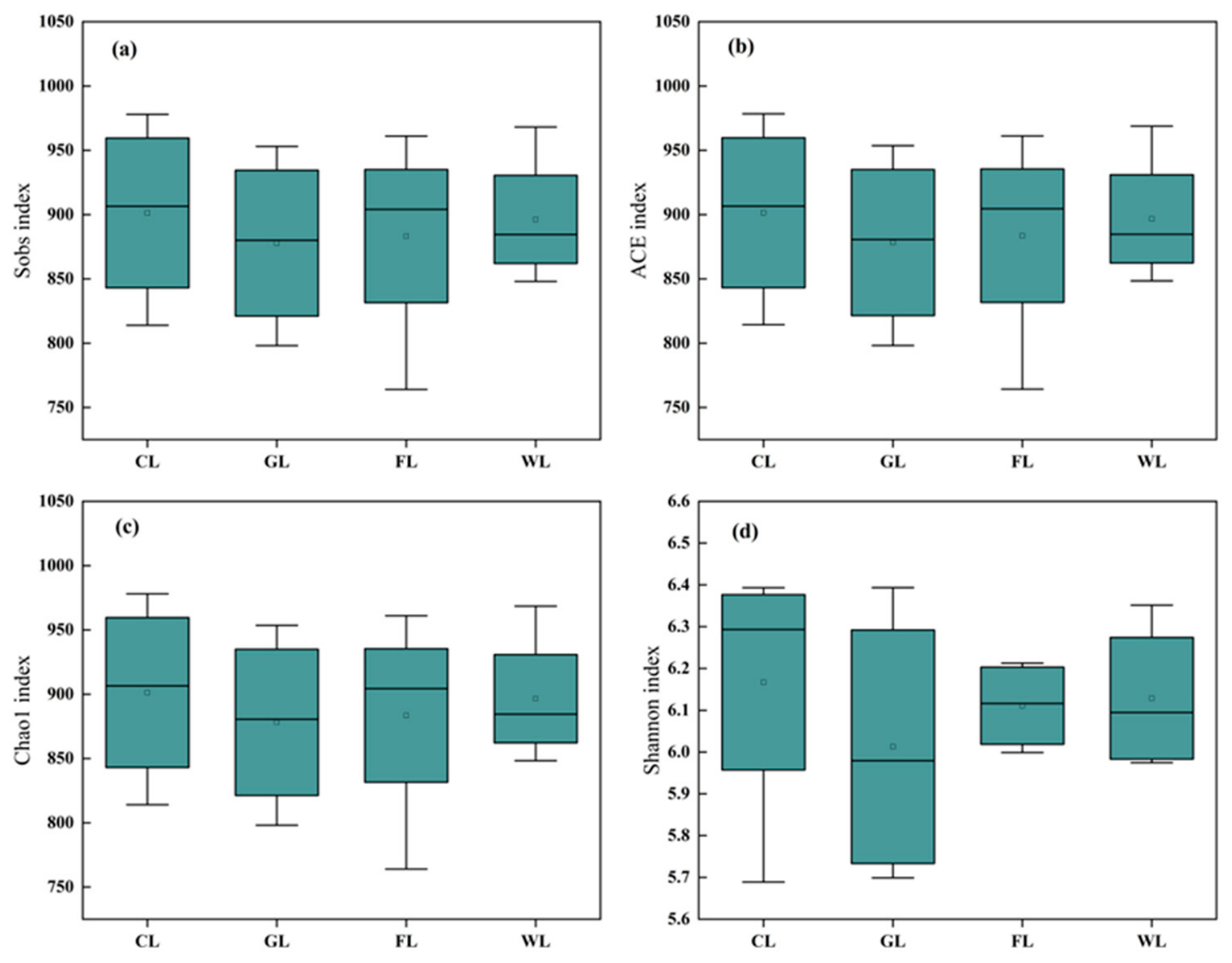
Figure A2.
(a) Venn diagram at the ASV level for the 0–20 cm soil layer under different land use types; (b) Venn diagram at the ASV level for the entire soil profile under different land use types. CL, cropland; GL, grassland; FL, forestland; WL, wetland; AL, abandoned land.
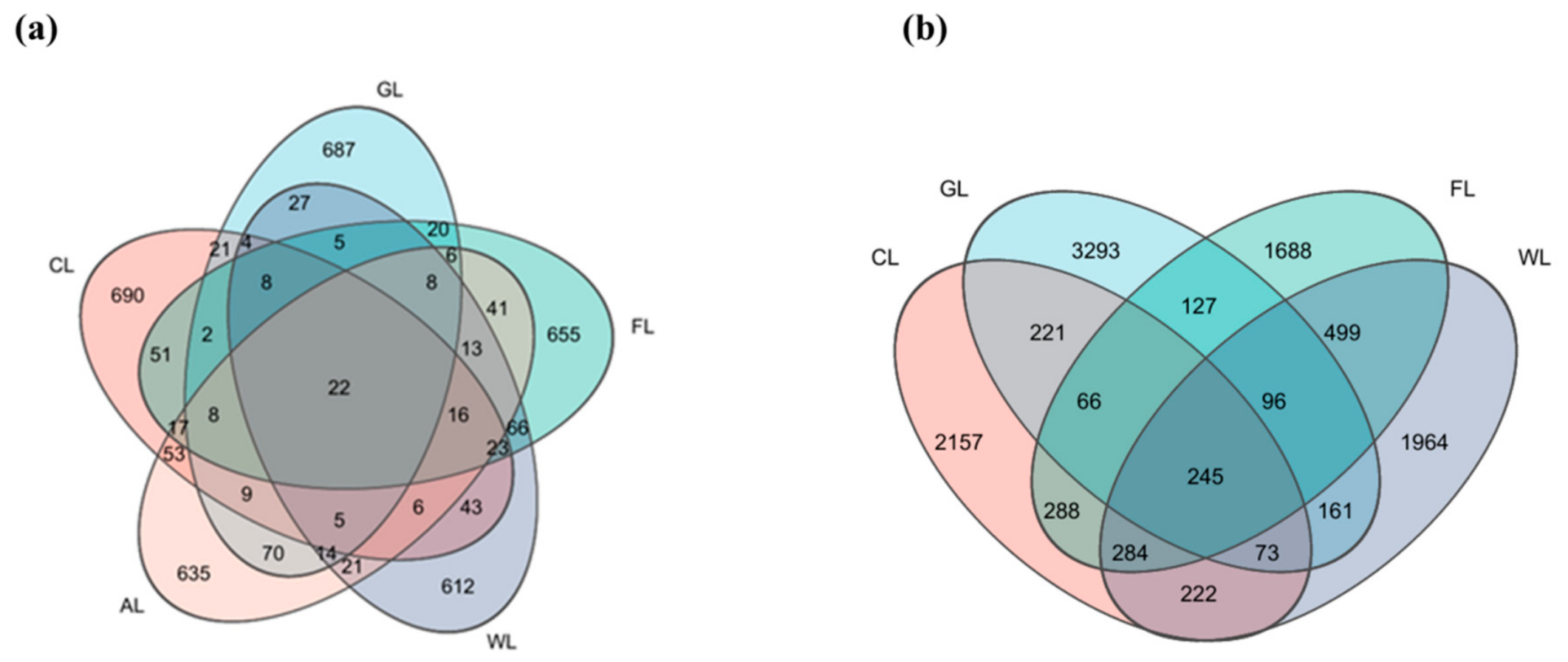
Table A1.
Soil physicochemical properties of different land use types at different soil depths.
References
- Mishra, A.K.; Yadav, P.; Sharma, S.; Maurya, P. Comparison of microbial diversity and community structure in soils managed with organic and chemical fertilization strategies using amplicon sequencing of 16 s and ITS regions. Front. Microbiol. 2025, 15, 1444903. [Google Scholar] [CrossRef] [Scilit] [PubMed]
- Chen, X.; Feng, J.G.; Ding, Z.J.; Tang, M.; Zhu, B. Changes in soil total, microbial and enzymatic C-N-P contents and stoichiometry with depth and latitude in forest ecosystems. Sci. Total Environ. 2022, 816, 151583. [Google Scholar] [CrossRef] [Scilit] [PubMed]
- Lv, C.; Wang, C.; Cai, A.; Zhou, Z. Global magnitude of rhizosphere effects on soil microbial communities and carbon cycling in natural terrestrial ecosystems. Sci. Total Environ. 2023, 856, 158961. [Google Scholar] [CrossRef] [Scilit] [PubMed]
- Liu, S.; Li, H.; Xie, X.; Chen, Y.; Lang, M.; Chen, X. Long-term moderate fertilization increases the complexity of soil microbial community and promotes regulation of phosphorus cycling genes to improve the availability of phosphorus in acid soil. Appl. Soil Ecol. 2024, 194, 105178. [Google Scholar] [CrossRef] [Scilit]
- Du, J.; Du, M.Y.; Yao, Y.; Li, W.T.; Xu, G.R.; Ma, W.W.; Yuan, J.Y.; Li, G. Different Land Use Patterns in Semi-Arid Regions Affect N2O Emissions by Regulating Soil Nitrification Functional Genes. Agronomy 2025, 15, 2810. [Google Scholar] [CrossRef] [Scilit]
- Li, X.; Zhang, H.; Sun, M.; Xu, N.; Sun, G.; Zhao, M. Land use change from upland to paddy field in Mollisols drives soil aggregation and associated microbial communities. Appl. Soil Ecol. 2020, 146, 103351. [Google Scholar] [CrossRef] [Scilit]
- Panek, J.; Gryta, A.; Maj, W.; Mącik, M.; Oszust, K.; Pertile, G.; Pylak, M.; Siegieda, D.; Hallama, M.; Hatano, R.; et al. Plant–soil–microbiome interactions: Mechanisms, advances, and challenges in sustainable agriculture and healthy agroecosystems. Front. Microbiol. 2026, 17, 1762743. [Google Scholar] [CrossRef] [Scilit] [PubMed]
- Mishra, A.; Singh, D.; Hathi, Z.; Purohit, H.J.; Jessy, M.D.; Philip, A.; Uthup, T.K.; Singh, L. Soil microbiome dynamics associated with conversion of tropical forests to different rubber based land use management systems. Appl. Soil Ecol. 2023, 188, 104933. [Google Scholar] [CrossRef] [Scilit]
- Yang, M.; Cui, W.; Tao, Y.; Chen, Y.; Liu, Z.; Zeng, T.; Wang, A.-J. Unravel the impact of land use type on taxonomic and functional structure of microbial communities in coastal urban and rural areas, China. Sci. Total Environ. 2025, 1003, 180731. [Google Scholar] [CrossRef] [Scilit] [PubMed]
- Pan, Y.; Kang, P.; Qu, X.; Zhang, H.; Li, X. Response of the soil bacterial community to seasonal variations and land reclamation in a desert grassland. Ecol. Indic. 2024, 165, 112227. [Google Scholar] [CrossRef] [Scilit]
- Qiu, L.P.; Zhang, Q.; Zhu, H.S.; Reich, P.B.; Banerjee, S.; van der Heijden, M.G.A.; Sadowsky, M.J.; Ishii, S.; Jia, X.X.; Shao, M.G.; et al. Erosion reduces soil microbial diversity, network complexity and multifunctionality. ISME J. 2021, 15, 2474–2489. [Google Scholar] [CrossRef] [Scilit]
- Zhang, X.F.; Feng, Q.; Cao, J.J.; Liu, W.; Qin, Y.Y.; Zhu, M.; Han, T. Grazing practices affect soil microbial networks but not diversity and composition in alpine meadows of northeastern Qinghai-Tibetan plateau. Environ. Res. 2023, 235, 116656. [Google Scholar] [CrossRef] [Scilit] [PubMed]
- Jiao, S.; Chen, W.M.; Wang, J.L.; Du, N.N.; Li, Q.P.; Wei, G.H. Soil microbiomes with distinct assemblies through vertical soil profiles drive the cycling of multiple nutrients in reforested ecosystems. Microbiome 2018, 6, 146. [Google Scholar] [CrossRef] [Scilit]
- Li, X.Q. Migration, Transformation and Water Quality Assessment of Pollutants in the Huangshui River Basin. Master’s Thesis, Qinghai Normal University, Xining, China, 2013. [Google Scholar]
- Xu, S.G.; Yang, S.; Qin, X.W.; Ren, E.F.; Yang, Q.P. Spatial Distribution and Ecological Risk Assessment of Heavy Metals in Surface Sediments from Xining Section of the Huangshui River Basin. Earth Environ. 2021, 49, 561–569. [Google Scholar] [CrossRef]
- Shang, Y.Y.; Li, Z.L.; Sun, L.Y.; Chen, Q. Microbial Nitrogen Transformation Key Processes and Its Influencing Factors in Water and Sediment of Xining Section of the Huangshui River. Acta Sci. Nat. Univ. Pekin. 2023, 59, 92–104. [Google Scholar] [CrossRef]
- Liu, Z.X.; Liu, J.J.; Hu, X.J.; Jin, J.; Wang, G.H. Research progress on the distribution of microbial community in soil profile. Soils Crops 2022, 11, 129–138. [Google Scholar] [CrossRef]
- Chen, X.; Lin, S.Y.; Tian, J.; Wang, Y.J.; Ye, Y.X.; Dong, S.N.; Gong, X.L.; Lin, Q.L.; Zhu, L.Y. Simulation study on water yield service flow based on the InVEST-Geoda-Gephi network: A case study on Wuyi Mountains, China. Ecol. Indic. 2024, 159, 111694. [Google Scholar] [CrossRef] [Scilit]
- Louca, S.; Parfrey, L.W.; Doebeli, M. Decoupling function and taxonomy in the global ocean microbiome. Science 2016, 353, 1272–1277. [Google Scholar] [CrossRef] [Scilit] [PubMed]
- Geng, T.T.; Wang, Z.H.; Wang, Q.K.; Yang, Q.S.; Wang, J.G. Effects of land-use type and soil depth on soil physicochemical properties, enzyme activities and bacterial community composition in black soil region of Northeast China. Catena 2025, 258, 109276. [Google Scholar] [CrossRef] [Scilit]
- Zhang, F.; Sun, Y.; Liu, J.; Ding, C.; Luo, Y.; Min, X.; Wang, J.; Sun, Y.; Duo, Z. Multi-scenario land use simulation and habitat quality changes in the Huangshui River Basin based on the PLUS–InVEST model. Front. Ecol. Evol. 2026, 14, 1782847. [Google Scholar] [CrossRef] [Scilit]
- Lu, R.K. Analytical Methods for Soil and Agro-Chemistry; China Agricultural Science and Technology Press: Beijing, China, 2000. [Google Scholar]
- Azene, B.; Zhu, R.; Pan, K.; Sun, X.; Nigussie, Y.; Gruba, P.; Raza, A.; Guadie, A.; Wu, X.; Zhang, L. Land use change alters phosphatase enzyme activity and phosphatase-harboring microbial abundance in the subalpine ecosystem of southeastern Qinghai-Tibet Plateau, China. Ecol. Indic. 2023, 153, 110416. [Google Scholar] [CrossRef] [Scilit]
- Yang, L.; Luo, J.; Gu, C.; Huang, W.; Dai, J.; Liao, P.; Chang, H.; Yao, X.; Gao, Y.; Hu, W.; et al. Preceding intercropped leguminous green manure shifts microbial life strategies to regulate soil organic carbon in low-nitrogen input maize-rapeseed rotations. Soil Tillage Res. 2026, 256, 106841. [Google Scholar] [CrossRef] [Scilit]
- Wang, Y.X.; Gao, Q.H.; Wang, T.; Sun, G.; Nie, S.A. Shifts in Fertilization Regime Alter Carbon Cycling in Paddy Soils: Linking the Roles of Microbial Community, Functional Genes, and Physicochemical Properties. Agronomy 2025, 16, 104. [Google Scholar] [CrossRef] [Scilit]
- Callahan, B.J.; McMurdie, P.J.; Rosen, M.J.; Han, A.W.; Johnson, A.J.A.; Holmes, S.P. DADA2: High-resolution sample inference from Illumina amplicon data. Nat. Methods 2016, 13, 581–583. [Google Scholar] [CrossRef] [Scilit] [PubMed]
- Klindworth, A.; Pruesse, E.; Schweer, T.; Peplies, J.; Quast, C.; Horn, M.; Glöckner, F.O. Evaluation of general 16S ribosomal RNA gene PCR primers for classical and next-generation sequencing-based diversity studies. Nucleic Acids Res. 2013, 41, e1. [Google Scholar] [CrossRef] [Scilit] [PubMed]
- Buetas, E.; Jordán-López, M.; López-Roldán, A.; D’Auria, G.; Martínez-Priego, L.; De Marco, G.; Carda-Diéguez, M.; Mira, A. Full-length 16S rRNA gene sequencing by PacBio improves taxonomic resolution in human microbiome samples. Bmc Genom. 2024, 25, 310. [Google Scholar] [CrossRef] [Scilit]
- Bahram, M.; Lehtovirta-Morley, L.; Mikryukov, V.; Sveen, T.R.; Grant, A.; Pent, M.; Hildebrand, F.; Labouyrie, M.; Köninger, J.; Tedersoo, L.; et al. Intensive land use enhances soil ammonia-oxidising archaea at a continental scale. Soil Biol. Biochem. 2026, 213, 110024. [Google Scholar] [CrossRef] [Scilit]
- Sarkar, S.; Kazarina, A.; Hansen, P.M.; Ward, K.; Hargreaves, C.; Reese, N.; Ran, Q.; Kessler, W.; de Souza, L.F.T.; Loecke, T.D.; et al. Metabolism diversification of ammonia-oxidizing archaea and bacteria under different precipitation gradients and land legacies. Appl. Soil Ecol. 2025, 206, 105831. [Google Scholar] [CrossRef] [Scilit]
- Huang, W.G.; Kuzyakov, Y.; Niu, S.L.; Luo, Y.; Sun, B.; Zhang, J.B.; Liang, Y.T. Drivers of microbially and plant-derived carbon in topsoil and subsoil. Glob. Change Biol. 2023, 29, 6188–6200. [Google Scholar] [CrossRef] [Scilit] [PubMed]
- Zheng, H.; Chen, Y.; Liu, Y.; Zhang, J.; Yang, W.; Yang, L.; Li, H.; Wang, L.; Wu, F.; Guo, L. Litter quality drives the differentiation of microbial communities in the litter horizon across an alpine treeline ecotone in the eastern Tibetan Plateau. Sci. Rep. 2018, 8, 10029. [Google Scholar] [CrossRef] [Scilit]
- Li, J.; Chen, Q.; Li, Q.; Zhao, C.; Feng, Y. Influence of plants and environmental variables on the diversity of soil microbial communities in the Yellow River Delta Wetland, China. Chemosphere 2021, 274, 129967. [Google Scholar] [CrossRef] [Scilit] [PubMed]
- Zhao, X.; Sun, J.; Liu, C.; Zhang, E.; Zhao, G.; Chen, Q. Mechanisms of plant-derived and microbial residue carbon in coastal wetland soils in response to salinity gradients. CATENA 2025, 256, 109108. [Google Scholar] [CrossRef] [Scilit]
- Tou, C.; Liu, X.; Gan, J.; Wanek, W.; Jones, D.L.; Wu, L.; Ma, Q. Plant residue quality regulates its incorporation into soil aggregates and organic carbon stabilisation. Geoderma 2025, 460, 117407. [Google Scholar] [CrossRef] [Scilit]
- Ji, H.J.; Zhang, J.; Zhao, Y.L.; Huang, H.; Ma, Y.Q.; Liang, D.J.; Chen, F.N.; Huo, H.X.; Wang, S.F.; Xie, T. Heavy metal pollution migration and its ecological impact on microbial communities in the karst region of Guangxi. Sci. Rep. 2025, 15, 14750. [Google Scholar] [CrossRef] [Scilit]
- Wei, L.; Wang, Y.L.; Li, N.; Zhao, N.; Xu, S.X. Bacteria-Like Gaiella Accelerate Soil Carbon Loss by Decomposing Organic Matter of Grazing Soils in Alpine Meadows on the Qinghai-Tibet Plateau. Microb. Ecol. 2024, 87, 104. [Google Scholar] [CrossRef] [Scilit]
- Nakahara, N.; Nobu, M.K.; Takaki, Y.; Miyazaki, M.; Tasumi, E.; Sakai, S.; Ogawara, M.; Yoshida, N.; Tamaki, H.; Yamanaka, Y.; et al. Aggregatilinea lenta gen. nov., sp. nov., a slow-growing, facultatively anaerobic bacterium isolated from subseafloor sediment, and proposal of the new order Aggregatilineales ord. nov. within the class Anaerolineae of the phylum Chloroflexi. Int. J. Syst. Evol. Microbiol. 2019, 69, 1185–1194. [Google Scholar] [CrossRef] [Scilit] [PubMed]
- Sekiguchi, Y.; Yamada, T.; Hanada, S.; Ohashi, A.; Harada, H.; Kamagata, Y. Anaerolinea thermophila gen. nov., sp. nov. and Caldilinea aerophila gen. nov., sp. nov., novel filamentous thermophiles that represent a previously uncultured lineage of the domain Bacteria at the subphylum level. Int. J. Syst. Evol. Microbiol. 2003, 53, 1843–1851. [Google Scholar] [CrossRef] [Scilit]
- Wang, J.J.; Chen, Q.; Li, Y.Z. Chryseolinea flava sp nov., a new species of Chryseolinea isolated from soil. Int. J. Syst. Evol. Microbiol. 2018, 68, 3518–3522. [Google Scholar] [CrossRef] [Scilit] [PubMed]
- Zhou, M.; Liu, Z.; Wang, J.; Zhao, Y.; Hu, B. Sphingomonas Relies on Chemotaxis to Degrade Polycyclic Aromatic Hydrocarbons and Maintain Dominance in Coking Sites. Microorganisms 2022, 10, 1109. [Google Scholar] [CrossRef] [Scilit] [PubMed]
- Dürre, P. Physiology and Sporulation in Clostridium. Microbiol. Spectr. 2014, 2, 315–329. [Google Scholar] [CrossRef] [Scilit] [PubMed]
- Xiong, W.; Li, R.; Ren, Y.; Liu, C.; Zhao, Q.; Wu, H.; Jousset, A.; Shen, Q. Distinct roles for soil fungal and bacterial communities associated with the suppression of vanilla Fusarium wilt disease. Soil Biol. Biochem. 2017, 107, 198–207. [Google Scholar] [CrossRef] [Scilit]
- Zhou, Z.; Xie, P.; Huang, K.; Mo, P.; Deng, A.; Fan, S.; Long, B.; Wang, Y. Symbiotrophs dominate rhizosphere soil fungal community stability of the Cathaya argyrophylla. Appl. Soil Ecol. 2024, 204, 105719. [Google Scholar] [CrossRef] [Scilit]
- Wang, Z.; Zhang, Z.; Guo, L.; Miao, N.; Shao, Y.; Chen, Y.; Yuan, Z. Responses of soil fungal communities to changes in different land use types in the Yellow River wetland. J. Environ. Manag. 2025, 393, 127025. [Google Scholar] [CrossRef] [Scilit] [PubMed]
- Naylor, D.; McClure, R.; Jansson, J. Trends in Microbial Community Composition and Function by Soil Depth. Microorganisms 2022, 10, 540. [Google Scholar] [CrossRef] [Scilit] [PubMed]
- Yang, F.; Wu, J.; Zhang, D.; Chen, Q.; Zhang, Q.; Cheng, X. Soil bacterial community composition and diversity in relation to edaphic properties and plant traits in grasslands of southern China. Appl. Soil Ecol. 2018, 128, 43–53. [Google Scholar] [CrossRef] [Scilit]
- Wang, J.; Wang, J.; Wu, S.; Zhang, Z.; Li, Y. Global Geographic Diversity and Distribution of the Myxobacteria. Microbiol. Spectr. 2021, 9, e0001221. [Google Scholar] [CrossRef] [Scilit]
- Xie, Y.; Wright, S.; Shen, Y.; Du, L. Bioactive natural products from Lysobacter. Nat. Prod. Rep. 2012, 29, 1277–1287. [Google Scholar] [CrossRef] [Scilit] [PubMed]
- Zheng, Y.; Hou, L.; Liu, M.; Liu, Z.; Li, X.; Lin, X.; Yin, G.; Gao, J.; Yu, C.; Wang, R.; et al. Tidal pumping facilitates dissimilatory nitrate reduction in intertidal marshes. Sci. Rep. 2016, 6, 21338. [Google Scholar] [CrossRef] [Scilit] [PubMed]
- Täumer, J.; Kolb, S.; Boeddinghaus, R.S.; Wang, H.T.; Schöning, I.; Schrumpf, M.; Urich, T.; Marhan, S. Divergent drivers of the microbial methane sink in temperate forest and grassland soils. Glob. Change Biol. 2021, 27, 929–940. [Google Scholar] [CrossRef] [Scilit] [PubMed]
- Yang, Q.N.; Li, H.; Gong, L.X.; Zhang, X.L.; Wang, L.L. Dissimilatory Nitrate Reduction to Ammonium (DNRA) and nrfA Gene in Crop Soils: A Meta-Analysis of Cropland Management Effects. Glob. Change Biol. Bioenergy 2025, 17, e70039. [Google Scholar] [CrossRef] [Scilit]

Disclaimer/Publisher’s Note: The statements, opinions and data contained in all publications are solely those of the individual author(s) and contributor(s) and not of MDPI and/or the editor(s). MDPI and/or the editor(s) disclaim responsibility for any injury to people or property resulting from any ideas, methods, instructions or products referred to in the content. |
© 2026 by the authors. Licensee MDPI, Basel, Switzerland. This article is an open access article distributed under the terms and conditions of the Creative Commons Attribution (CC BY) license.