


Abstract
Pomegranate by-product silage has potential as a sustainable feed ingredient for ruminants. This study evaluated the effects of including ensiled pomegranate by-product (Punica granatum L., cv. Wonderful) in the diet of Murciano-Granadina dairy goats during a full lactation period. Forty goats were allocated to four groups to test 2 diets (2 treatments × 2 batches): a control diet (conventional diet without pomegranate by-products) and an isoenergetic, isoproteic diet containing pomegranate silage (PS). After a pre-experimental sampling at five weeks post-partum (to collect baseline data), an 8-month experimental phase was carried out. Feed and water intake—every 2 weeks— live weight, milk yield and composition, urea content, and somatic cell count were measured every 6 weeks. Blood samples were obtained at the beginning, midpoint, and end of lactation to assess physiological, metabolic, inflammatory, and oxidative status. Data were analyzed using a mixed linear model. The treatment effects were limited to live weight, which was lower in the PS treatment (p < 0.05), without affecting milk production. In conclusion, ensiled pomegranate by-product can be included without compromising productivity or animal health, representing a sustainable nutritional alternative for dairy goats.
1. Introduction
Livestock feeding is largely based on crops and resources that could also be consumed by humans, such as maize, barley, wheat, and soy. This creates ongoing competition not only for food but also for scarce land and water resources. Transitioning toward a circular economy, where these crops are partially replaced by surplus agro-processing residues, would not only save land and water but also reduce dependence on feed imports and exposure to volatile international grain markets. These markets are increasingly affected by global disruptions, including pandemics, wars, and regional conflicts. A study done by Cambridge University [1] showed that sending food waste to animal feed scores better on 12 out of 14 environmental and health indicators than anaerobic digestion (biogas) or composting. Besides, these calculations in this study were based on the current UK energy mix for the energy needed to render the food waste safe, so if renewable energy was used, feed could potentially beat biogas and compost on all indicators [1]. The European Commission estimates that more than 1.3 billion tons of food, or 1/3 of global production, are wasted every year. Of this, 89 million tons of food in good condition are squandered each year in the European Union and 8 million tons in Spain [2].
Pomegranate is a fruit predominantly cultivated in semi-arid and Mediterranean regions, with a global production estimated at 5.6 million tons in 2023 [3]. India is the leading producer (1.4 million tons), followed by China (0.8 million tons) and Iran (0.7 million tons), reflecting the crop’s strong expansion driven by fresh-fruit and processing markets [3]. Spain is the largest producer of pomegranates in Europe, with an annual production of approximately 50,000 tons, mainly from the Mollar de Elche and Wonderful varieties [4], most of which is concentrated in the Alicante region. These fruits are primarily processed for juice, generating large quantities of by-products, mainly peels and seeds [5]. The peel, which represents approximately 30–40% of the whole fruit, is particularly rich in polyphenolic compounds, including phenolic acids, tannins, flavonoids, and anthocyanins [4], and exhibits considerable antioxidant capacity [6,7]. Previous research [8] demonstrated that silages produced from Mollar de Elche and Wonderful pomegranate by-products are suitable for ensiling and can be preserved for up to six months while maintaining their nutritional characteristics, total phenolic content, and antioxidant capacity. Moreover, short-term inclusion of up to 15% dry matter (DM) of ensiled pomegranate by-products in dairy goat diets has been shown to reduce dry matter and water intake without negatively affecting feed efficiency or milk yield [9]. However, no studies have yet evaluated the incorporation of this by-product in its ensiled form as part of a complete diet formulation, nor its effects over an entire lactation period. Therefore, the present study aimed to evaluate the effect of including Wonderful pomegranate by-products ensiled in the diets of Murciano-Granadina dairy goats throughout the entire lactation period.
2. Materials and Methods
2.1. Animals and Facilities
The study was conducted on a dairy goat herd at the teaching and experimental farm of the Universidad Miguel Hernández de Elche (EPSO, Alicante, Spain; 38.0677, −0.9823) from February to mid-September. The farm houses Murciano-Granadina goats managed under free-stall conditions in straw-bedded pens, providing ~1.0–1.5 m2 per animal, 35 cm of feeder space, and ad libitum access to water, with access to outdoor exercise areas during daytime. Animals were fed a standard lactation diet consisting of pelleted concentrate formulated for dairy goats (Nanta S.A., Fuente Álamo de Murcia, Spain) supplemented with alfalfa hay and cereal straw, offered twice daily. Goats were milked once daily prior to morning feeding as usual in the region, using a parallel milking parlor (2 × 12; GEA, Düsseldorf, Germany) equipped with a mid-line system and rapid front exit. The experimental protocol was approved by the Office of Responsible Research of the Universidad Miguel Hernández de Elche (code UMH.DTA.JDS.04.22).
2.2. Experimental Design
Five weeks postpartum, a pre-experimental sampling was conducted on 100 goats receiving a conventional diet to record milk yield, milk composition, somatic cell count (SCC), body weight, and blood biochemical, inflammatory, and antioxidant status. From this initial population, 40 animals were selected and allocated into four homogeneous groups (n = 10) based on body weight (35.7 ± 5.8 kg), milk yield (2.3 ± 0.8 kg/day), SCC (2.4 ± 0.5 log10 103 cells/mL), and parity (same n of primaparous/batches). These groups were assigned to four experimental units corresponding to two treatments with two replicates each. Pens were randomly distributed within the facility to minimize environmental effects. After 2 weeks of adaptation to the treatments, during which they were managed identically to allow acclimation and the establishment of social hierarchy, the first experimental sampling was performed and subsequently repeated at 6-week intervals, including a total of 6 samplings and an experimental period of 8 months. Measurements included body weight (kg), daily milk yield (kg/day; Lactocorder®, WMB AG, Balgach, Switzerland), and milk composition (fat, protein, lactose, solids-not-fat, fat and protein, and urea concentration) as well as somatic cell count (103 cells/mL), determined using a CombiFoss™ 7 DC analyzer (Foss, Hillerød, Denmark). Three blood samplings were done at the beginning, mid, and late lactation, coinciding with the milk samplings. Feed and water intake of each group was recorded every two weeks (over two consecutive days).
2.3. Diets
The pomegranate by-product (Punica granatum L. var. Wonderful), obtained from the agri-food industry dedicated to juice production in the province of Alicante, consisted of peels, rinds, and remnants of pulp and seeds from this fruit. It was included in the animals’ diets in the form of silage. For this purpose, commercial bale-format microsilos were produced using a mixture of 80% pomegranate by-product and 20% cereal straw. These bales were manufactured at the pilot plant located in the outdoor facilities of the goat farm of the Escuela Politécnica Superior de Orihuela (EPSO), part of the Miguel Hernández University of Elche (UMH). The manufacturing method followed is described in the patent by Díaz et al. [10], and the composition is published by Galvez-Lopez et al. [8]. Briefly, the raw materials were homogenized using a Faster Mix 1 V mixing wagon (Compar, Sant Pere de Torelló, Spain). Subsequently, an MR 820 rotary baler (Agronic Oy, Haapavesi, Finland) was used, producing silage bales of approximately 300 kg, which were used throughout the experimental phase. The diets offered to the dairy goats consisted of a control diet composed of pelleted grain mix, alfalfa hay, barley straw, and soybean meal (Table 1). The experimental diet (PS) consisted of pelleted grain mix, alfalfa hay, barley straw, and 17.5% pomegranate silage mixed with cereal straw (80:20). The silage used in the current study was made with pomegranate byproduct (variety Wonderfull), ensiled in commercial plastic bales (weight: 300 kg, pH: 4.3, DM: 36.3%). Briefly, the silage contained approximately 36% DM, 0.1% EE, 4.5% CP, 54% NDF, and 35% ADF, characterizing it as a fibrous ingredient with a moderate energy contribution in ruminant diets [8].
Table 1.
Ingredients and chemical composition of experimental diets.
2.4. Variables Analyzed
Feeding was conducted at the group level to prevent the stress associated with prolonged individual confinement during an 8-month trial, following the approach of Nudda et al. [12] and considering the gregarious nature of goats [13]. Feed intake (offered and refused) and water consumption were measured every two weeks over two consecutive days. Water intake was recorded using SV-RTK (E4)® water meters (Flow Systems, Gilmonde, Portugal) installed at drinking bowls (Suevia®, Kirchheim am Neckar, Germany), and calculated as the difference between consecutive readings. A total of 15 measurements/batches were recorded for intake calculation. Feed intake was determined as the difference between feed offered and refusals. This design enables the estimation of average feed intake per animal, although it does not allow precise quantification of individual consumption or nutrient ingestion. Nonetheless, the farm’s infrastructure and equipment permitted the collection of individual milk samples.
2.5. Animals
Body weight was recorded every six weeks using a floor scale (BGI®, Baxtran, Girona, Spain). We calculated average per-goat water intake (WI) and dry matter feed intake (DMI). Individual milk yield was recorded using an ICAR-approved system (Lactocorder®, WMB AG, Switzerland), which also collected representative milk samples (100 mL per animal). Milk samples were refrigerated with the addition of a bacteriostatic preservative (Azidiol®, Panreac Química SLU, Barcelona, Spain) and analyzed within 24 h at the Interprofessional Dairy Laboratory of the Valencian Community (LICOVAL, Polytechnic University of Valencia, Spain). Milk composition (fat, protein, lactose, solids-not-fat, cheese extract, and urea) and SCC were determined using infrared spectroscopy and fluoro-opto-electronic methods, respectively (CombiFoss™ 7 DC, Foss, Denmark). Fat-Corrected Milk (FCM 3.5%) was calculated following Gravert [14] (1987): FCM (3.5%) = 0.433 × milk yield (kg/day) + 16.218 × fat yield (kg/day); and, Fat and Protein-Corrected Milk (FPCM) was estimated using CVB [15]: FPCM = milk yield (kg/day) × (0.337 + 0.116 × Fat (%) + 0.06 × Protein (%)). A total of 6 milk measurements/goat were recorded.
Blood samples were collected at the beginning of lactation (2 months ± 7 days postpartum), at 4 months postpartum (±7 days), and at the end of lactation (8 months ± 7 days postpartum). All goats were sampled on the same dates across dietary groups. A total of 3 blood samples/goat were collected. Hematological parameters (WBC, RBC, lymphocyte/neutrophil ratio, lymphocyte/monocyte ratio, and hematocrit) were analyzed using an Element HT5 analyzer (SCIL VET, Navarra, Spain). Plasma metabolites (cholesterol, albumin, alkaline phosphatase, amylase, blood urea nitrogen, creatinine, and glucose) were determined using an Element RC3X analyzer (SCIL VET, Spain). Oxidative status was monitored by total antioxidant capacity assay—ABTS (2.2′-azino-bis(3-ethylbenzothiazoline-6-sulfonate) reduction power) [16] and FRAP (Ferric Reducing Antioxidant Power) [17]. Specific antioxidant capacity was determined by measuring superoxide dismutase (SOD) activity (DetectX® Superoxide Dismutase Activity Kit, Arbor Assays, Ann Arbor, MI, USA). Serum amyloid-A (SAA), an acute-phase protein, was quantified as an inflammatory biomarker using a species-specific commercial ELISA kit (GOAT-SAA, FineTest™).
2.6. Statistical Analysis
The SCC values were transformed into base-ten logarithms for statistical analysis. The statistical evaluation of variables measured at the individual level was conducted using a mixed linear model (PROC GLIMMIX, SAS v9.4, 2024), considering the effect of the covariate (pre-experimental sampling), diet, sampling—refer to the predefined experimental sampling time points—, the interaction (diet × sampling), and batch nested within diet, according to the following equation:
where Y is the dependent variable, µ is the intercept, Di represents the fixed effect of diet (i = Control and PS), Sj is the fixed effect of sampling (j = 1, 2, 3, 4, 5), Di × Sj represents the interaction between diet and sampling (10 levels), covY0 accounts for the effect of Y in the pre-experimental sampling, and Bk(Di) is the batch nested within diet.
Y = µ + Di + Sj + Di × Sj + covY0 + Bk(Di) + Ak + e
For variables analyzed on blood/plasma/serum samples, the model included the fixed effects of diet (i = 2 levels), sampling (3 levels, j = 1, 3, 5), their interaction (6 levels), covY0 accounts for the effect of Y in the pre-experimental sampling, and batch(diet).
For both scenarios, the animal was considered a random effect (Ak), and e represents the residual error. A compound symmetry covariance structure was employed to account for the correlation of repeated measures, based on the lowest AIC and BIC values.
Least squares means were calculated to interpret differences between levels of the fixed effects. Statistical significance was assessed at α = 0.05. The null hypothesis was rejected at p < 0.05, indicating statistically significant differences between levels.
For batch-level data (WI, DMI), observed means and standard deviations were calculated for every treatment and sampling.
3. Results
3.1. Feed and Water Intake, Body Weight, and Milk Yield
Dry matter intake (DMI, observed mean ± standard deviation) was moderately lower in the Control diet (2.01 ± 0.19 kg/day) than in the PS diet (2.30 ± 0.19 kg/day). In contrast, batches receiving the PS diet exhibited lower water intake (WI) than those fed the Control diet (5.32 ± 0.54 kg/day vs. 6.16 ± 0.72 kg/day).
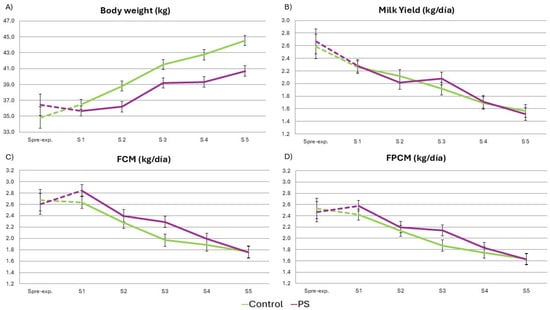
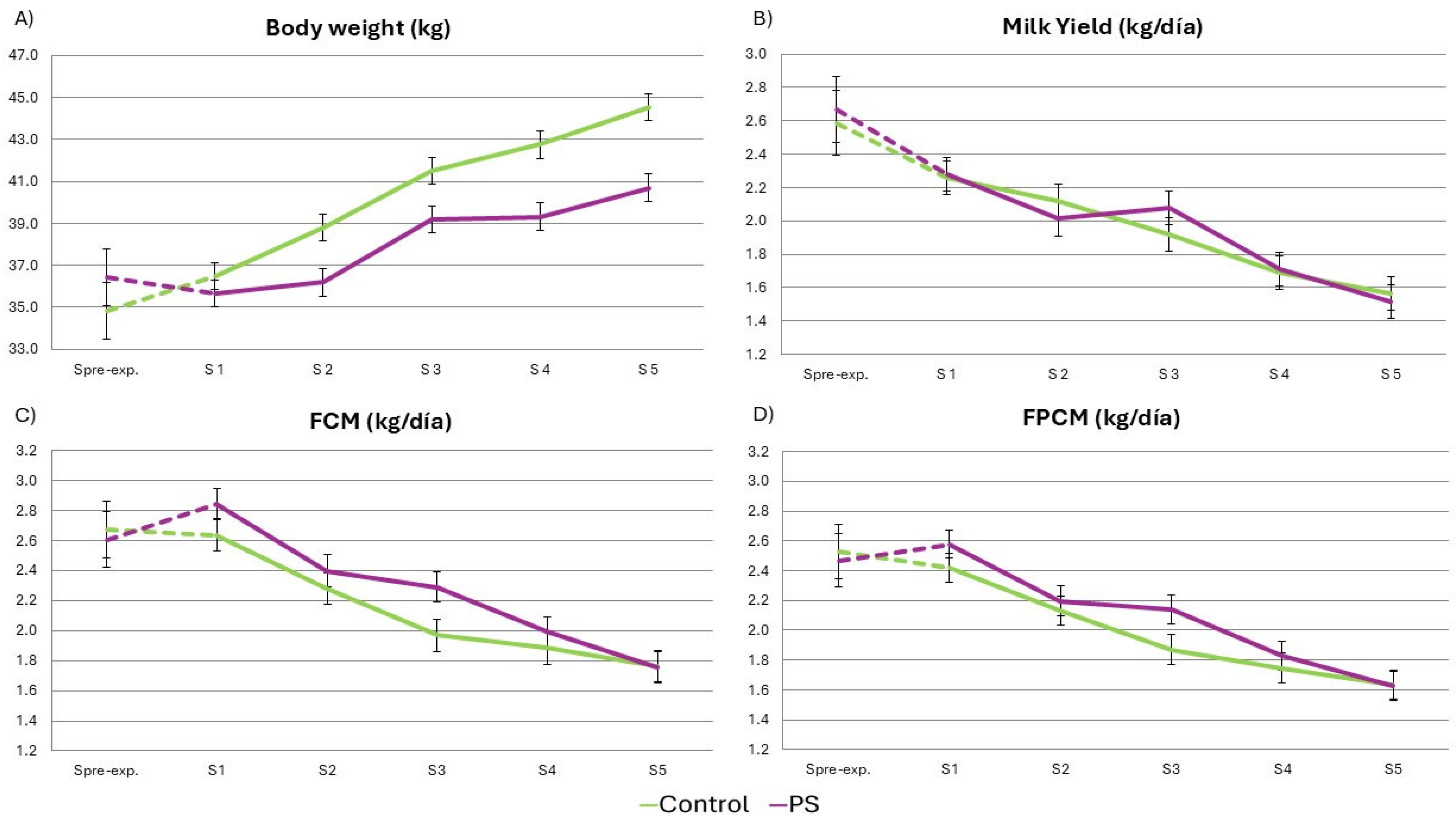
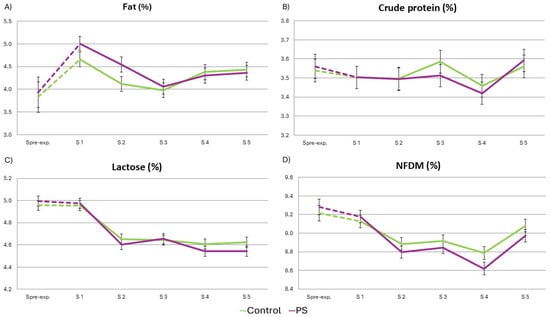
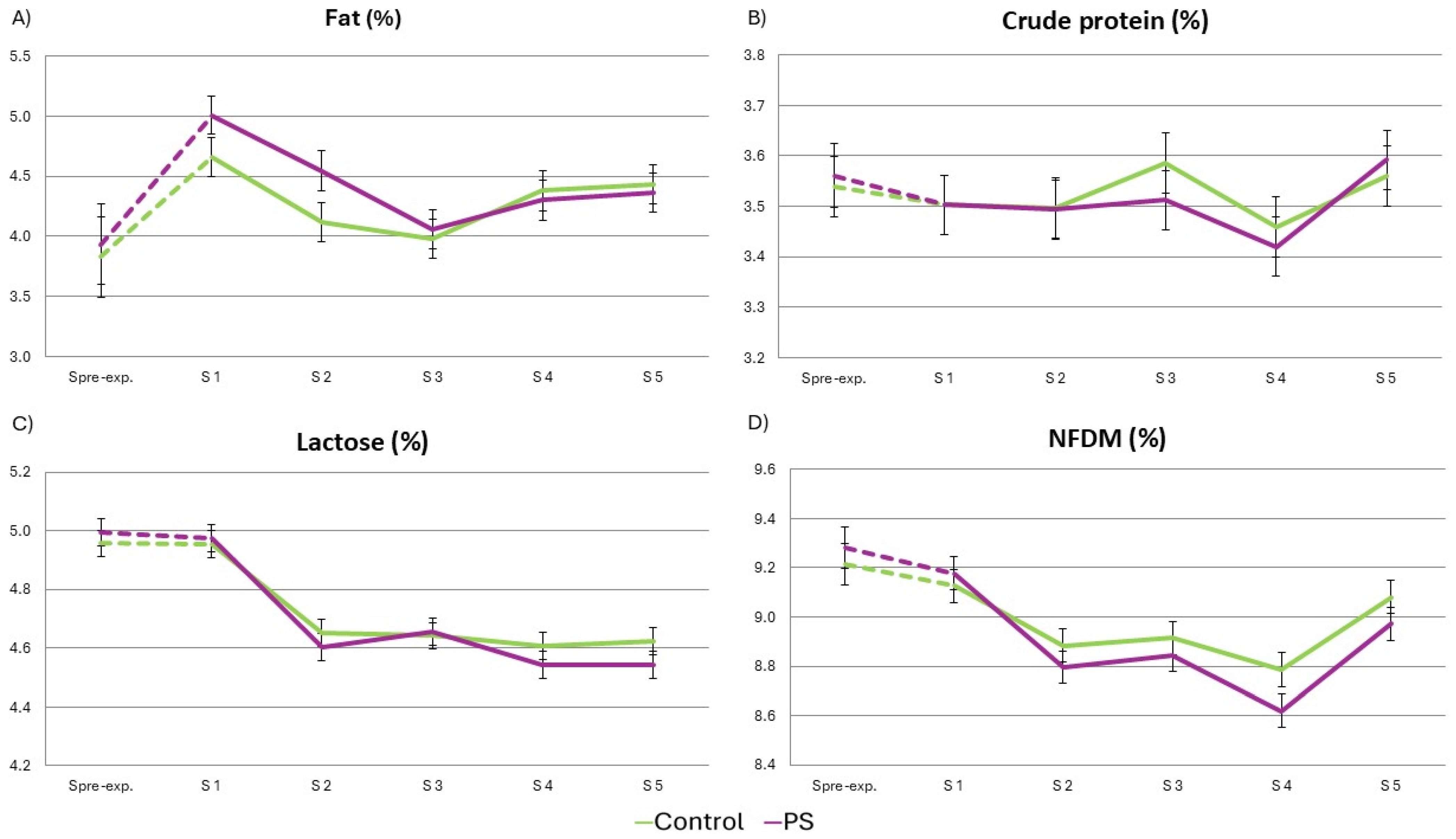
The statistical effects of diets containing pomegranate silage on body weight and milk yield parameters are presented in Table 2, while Figure 1 illustrates the temporal evolution of milk yield, FCM, FPCM, and body weight. Finally, Figure 2 shows the changes in milk composition over full lactation.
Table 2.
Statistical analysis results (Least Square Means ± SEM and p-values) for main productive performance traits by tested diets.
Figure 1.
Body weight (A), milk yield (B), fat-corrected milk (FCM) (C), and fat and protein-corrected milk (FPCM) (D) recorded throughout the experiment (Least Square Means ± SE); dotted lines indicate the adaptation period. PS: treatment including pomegranate silage.
Figure 2.
Milk composition, fat (A); crude protein (B); lactose (C); non-fat dry matter (NFDM) (D); recorded throughout the experiment (Least Square Means ± SE); dotted lines indicate the adaptation period. PS: treatment including pomegranate silage.
The inclusion of pomegranate silage (PS) did not significantly affect milk yield, FCM, FPCM, milk urea concentration, or LSCC compared with the control diet (p > 0.05), indicating that productive performance was maintained under the dietary treatment. However, goats fed the PS diet showed significantly lower body weight (37.9 vs. 39.8 kg; p = 0.0023).
As shown in Figure 2D, goats assigned to the PS group started the trial with slightly higher body weight at the pre-experimental stage; however, from the initial stage of lactation onward, body weight increased more markedly in the control group, which progressively surpassed the PS group and maintained higher values until the end of lactation. Overall, sampling time significantly affected most productive variables (p < 0.0001), whereas covariate effects were significant for most milk-related traits (p < 0.05), indicating that baseline differences contributed to the observed variability.
3.2. Hemogram, Serum Biochemical Profile, and Oxidative Stress
The hematological profile across treatments and samplings is presented in Table 3. Dietary inclusion of PS did not significantly affect most hematological variables, including white blood cells, lymphocytes, monocytes, neutrophils, neutrophil-to-lymphocyte ratio, monocyte-to-lymphocyte ratio, red blood cells, mean corpuscular volume, mean corpuscular hemoglobin, mean corpuscular hemoglobin concentration, or red cell distribution width (p > 0.05). However, goats fed PS showed lower hemoglobin concentrations (p = 0.0404), while hematocrit was also affected by diet (p = 0.0216).
Table 3.
Hemogram evolution throughout the experiment: comparison of mean values across diets and sampling (Least Square Means ± SEM), and statistical effects of diet, sampling time, and their interaction (p-value).
The sampling significantly influenced leukocyte-related variables and erythrocyte indices. White blood cells and lymphocytes changed across the pre-experimental stage, initial stage of lactation, mid-lactation, and end of lactation (p < 0.05). Hematocrit, mean corpuscular volume, mean corpuscular hemoglobin concentration, and red cell distribution width were also significantly affected by sampling time (p < 0.05), showing progressive physiological adaptations across lactation.
A significant diet × sampling interaction was observed for hematocrit (p = 0.0193) and mean corpuscular hemoglobin concentration (p = 0.027), indicating that dietary effects varied across lactation stages. Covariate effects were significant for most hematological traits (p < 0.05), highlighting the influence of baseline values on observed responses.
The effects of dietary treatment on serum biochemical parameters are presented in Table 4. The inclusion of PS did not significantly affect albumin, blood urea nitrogen, creatinine, total protein, globulins, glucose, cholesterol, calcium, phosphorus, corrected calcium, albumin/globulin ratio, or B/C ratio (p > 0.05), indicating that metabolic and renal profiles remained stable across diets.
Table 4.
Serum biochemical profile evolution throughout the experiment: comparison of mean values (Least Square Means ± SEM) across diets and samplings, and statistical effects of diet, sampling time, and their interaction (p-value).
Sampling time significantly affected several biochemical variables across the pre-experimental stage, initial stage of lactation, mid-lactation, and end of lactation (p < 0.05). Albumin, blood urea nitrogen, creatinine, total protein, globulins, phosphorus, and B/C ratio showed significant temporal variations (p < 0.05), reflecting physiological adaptations during lactation. In particular, blood urea nitrogen and phosphorus decreased toward the end of lactation, while creatinine increased at the end of lactation. In contrast, glucose, cholesterol, calcium, corrected calcium, and albumin/globulin ratio remained stable throughout the experimental period (p > 0.05).
A significant diet × sampling interaction was detected only for phosphorus (p = 0.018), indicating that the response to PS varied across lactation stages, with a more pronounced reduction at the end of lactation in the PS group. Covariate effects were significant for several biochemical variables (p < 0.05), indicating baseline influence on serum metabolite variability.
The evolution of oxidative stress biomarkers throughout the experimental period is presented in Table 5. Dietary inclusion of pomegranate silage (PS) significantly influenced ABTS values (p < 0.0001), with higher antioxidant capacity observed in goats fed PS at the pre-experimental stage, the initial stage of lactation, and mid-lactation compared with the control group, whereas differences were reduced at the end of lactation. FRAP was also affected by diet (p = 0.0008), showing higher or comparable values in the PS group at the pre-experimental stage and the initial stage of lactation, followed by a decline at mid-lactation and the end of lactation. In contrast, SOD activity and SAA concentrations were not significantly affected by diet (p > 0.05), indicating that the dietary treatment did not modify enzymatic antioxidant defense or acute-phase protein response.
Table 5.
Evaluation of oxidative stress throughout the feeding trial: comparison of mean values across diets (Least Square Means ± SEM), and statistical effects of diet, sampling time, and their interaction (p-value).
Sampling time significantly affected all oxidative stress markers (p < 0.0001 for ABTS, FRAP, and SOD), reflecting physiological changes across lactation. ABTS and FRAP showed higher values at the initial stage of lactation, followed by a progressive decrease at mid-lactation and the end of lactation. SOD activity decreased steadily from the pre-experimental stage to the end of lactation, indicating a reduction in enzymatic antioxidant capacity over time. Inflammatory status (monitored by SAA concentrations) was not significantly affected by treatment or sampling (p > 0.05).
A significant diet × sampling interaction was detected only for ABTS (p < 0.0001), indicating that the effect of PS on non-enzymatic antioxidant capacity varied across physiological stages, with stronger dietary differences observed at the pre-experimental stage and the initial stage of lactation, which diminished toward mid-lactation and the end of lactation. No interaction effects were observed for FRAP, SOD, or SAA (p > 0.05). A significant covariate effect was observed for FRAP (p = 0.0006), suggesting that baseline antioxidant status influenced reducing power, whereas no covariate effects were detected for the remaining variables (p > 0.05).
4. Discussion
A previous study evaluated different inclusion levels of PS, ranging from 5% to 15% of dietary DM, in Murciano-Granadina goat dairy goats in the Alicante region over 8 weeks [9]. The results showed that PS inclusion levels of up to 15% did not significantly affect productive performance and physiological parameters [9]. In the current study, the effects of PS inclusion were evaluated over the entire lactation period of 8 months. Incorporation of PS had no detrimental effect on milk yield performance. Milk yield, FCM, FPCM, milk urea concentration, or LSCC were not significantly affected, indicating that PS inclusion was acceptable and productive parameters were maintained. Notably, goats on PS weighed slightly less. It is well recognized that high amounts of tannins rich plants in the diet of small ruminants may reduce voluntary feed intake [18], however, it is not the case in our study with PS inclusion. Our findings are in agreement with previous studies in small ruminants showing that moderate levels of pomegranate by-products do not impair intake [19] or milk yield [20].
The significantly lower body weight in the PS group suggests a shift in nutrient partitioning. Although both groups began lactation at similar weights, control goats gained weight while PS goats did so at a lower magnitude (Figure 1A). This pattern maintained milk yield, but lower weight gain implies that nutrients in the PS diet were preferentially used for milk at the expense of body tissue deposition. Such mobilization of reserves is common in early lactation when energy is limiting [21]. It may be that the relatively higher fiber and tannins (not analyzed) in the PS diet slightly reduced digestible energy and therefore BW. Consistent with this, Battelli et al. [22] reported that adding condensed tannins to goat diets did not affect DMI but linearly reduced nutrient digestibility and net energy retention, resulting in decreased fat, protein, and urea concentrations in milk and reduced feed efficiency. In our study, goats on PS likely had a modest drop in nutrient availability, forcing reliance on body stores; however, no effect was observed on Milk yield, milk protein, FCM, FPCM, and Milk urea level. The physiological prioritization of lactation (homeorhesis) in ruminants may have constrained energy allocation to body tissue maintenance [23]. The moderate energy deficit suggested by the decline in body weight could thus reflect nutrient partitioning favoring milk production, supported by rumen efficiency and mobilization of body reserves [24], showcasing the high adaptability of the Murciano-Granadina breed to intensive milk production systems.
The PS diet batches drank less water on average. This is most readily explained by the higher moisture content of the silage-based diet. In effect, the pomegranate silage supplied more water internally, so goats needed to drink less. In ruminants, feeding wet forages or silages is well known to reduce voluntary drinking water. Similar results were reported by Galvez-Lopez et al. [25,26] and Díaz et al. [9] when feeding white grape pomace and when feeding PS for 8 8-week period to dairy goats. Other studies showed that water restriction for 8 h while dairy goats were grazing during early summer temperatures did not affect daily milk production, milk composition, body weight, or daily grazing time, suggesting that the moisture content in grass kept goats hydrated [27].
The inclusion of pomegranate silage (PS) in the diet of lactating Murciana-Granadina dairy goats produced only minor effects on most of the hematological and serum biochemical variables, while sampling time due to the physiological stage of lactation explained most of the observed variation. Moreover, the baseline (covariate) values significantly influenced many hematological parameters, indicating that pre-experimental individual variability contributed importantly to the subsequent response (Table 3). As described by Klinkon and Ježek [28], these variables are widely used as medical decision-making tools and are very useful to get an insight into the metabolic and health status of animals. Besides, there is no doubt that feeding and rearing systems have an important influence on the hematological variables [29,30]. In our findings, the dietary treatment had no significant effect (p > 0.05) on most leukocyte variables, including WBC, LYM, MON, NEU, NLR, MLR, RBC, MCV, MCHC, and RDWC. This suggests that replacing part of the ration with PS did not impair immune cell production or erythropoiesis, confirming that the silage was hematological safe. The slight reductions in hemoglobin (HGB; p = 0.0404) and hematocrit (HCT; p = 0.0216) observed in goats receiving pomegranate peel silage (PS), compared with the control group, remained within the broad ranges reported for Murciano-Granadina goats. Macri et al. [31] reported HGB and HCT ranges of 6.40–14.70 g/dL and 20.50–44.80%, respectively, in a large population of Murciano-Granadina goats, most of which were in their first lactation. Therefore, despite the statistical significance of the dietary effect, the observed differences do not appear to indicate a clinically relevant alteration of erythrocyte status. This interpretation is further supported by the absence of a significant dietary effect on red blood cell count (RBC; p = 0.18). The absence of major dietary effects on the hematological profile is consistent with previous findings in Murciano-Granadina dairy goats, in which pomegranate peel silage was included during a short term (8 weeks) without significantly affecting the main hematological parameters [9]. Similarly, Gálvez-López et al. [26] reported no significant alterations in hematological traits when red grape pomace silage was included at levels of up to 18% of dietary dry matter in Murciano-Granadina dairy goats during the same stage of lactation. Collectively, these findings suggest that moderate inclusion levels of ensiled fruit-processing by-products, including pomegranate peel and grape pomace, can be incorporated into diets of lactating Murciano-Granadina goats without causing major disturbances in hematological homeostasis.
The inclusion of PS produced a limited effect on serum biochemical homeostasis. Most biochemical variables were unaffected by diet, whereas sampling stage was a major source of variation for albumin, BUN, creatinine, total protein, globulin, phosphorus, and B_C. The only dietary response was observed for serum glucose concentration (p = 0.0086), which decreased over the experimental period in both groups, consistent with the physiological adaptations of early lactation. However, glucose concentrations remained lower in goats receiving the PS diet, suggesting an effect associated with nutrient partitioning towards milk synthesis [32,33], which reflect a greater utilization of glucose to support lactational requirements rather than an impairment of energy status. This response is consistent with previous evidence in dairy cattle showing that dietary pomegranate by-products, particularly pomegranate seed pulp containing peel, reduced postpartum plasma glucose and were associated with improved glucose utilization. Safari et al. [34] reported a greater reduction in plasma glucose in cows receiving pomegranate seed pulp than in control animals, together with lower β-hydroxybutyrate and non-esterified fatty acids, suggesting a more favorable metabolic response to the dietary pomegranate by-product.
Overall, supplementation with pomegranate silage (PS) produced a selective effect on oxidative status, as evidenced by the significant dietary effect on FRAP, while ABTS and SOD were not affected by diet. The increase in serum reducing antioxidant capacity may be associated with the high concentration of phenolic compounds and tannins in pomegranate peel and is consistent with previous findings in dairy cattle supplemented with pomegranate by-products [34,35]. The pronounced sampling effects observed for ABTS and SOD indicate that the physiological progression of lactation was a major determinant of antioxidant status, whereas the significant ABTS × sampling interaction suggests that the temporal response differed between diets. The absence of a dietary effect on SAA further indicates that PS did not induce a detectable systemic acute-phase response. Notably, the greater reducing antioxidant capacity in the PS group occurred together with lower serum glucose and numerically greater FCM yield, suggesting a potential association between the antioxidant properties of pomegranate peel, glucose utilization, and milk energy output, as previously suggested in dairy cows receiving pomegranate by-products [34]. Nevertheless, because FCM yield did not differ significantly between diets and glucose utilization was not directly measured, this relationship should be considered associative rather than causal. Taken together, the findings suggest that PS was well tolerated and selectively improved serum reducing antioxidant capacity during lactation, without evidence of an adverse inflammatory response.
5. Conclusions
In conclusion, the inclusion of pomegranate silage in the diet of lactating Murciano-Granadina goats was well tolerated throughout the 8-month lactation period. PS treatment did not adversely affect milk yield, milk composition, or major hematological and biochemical indicators of health. Although goats receiving PS showed lower body weight, these effects were not accompanied by reductions in lactation performance, suggesting a modest shift in nutrient partitioning rather than impaired productivity. Importantly, PS increased serum reducing antioxidant capacity (FRAP) without inducing an inflammatory response, while the reduction in serum glucose may indicate altered glucose utilization. Overall, these findings support the use of pomegranate silage as a safe and sustainable feed ingredient for dairy goats, although its effects on nutrient utilization and long-term feed efficiency warrant further investigation.
Author Contributions
Conceptualization, G.R., C.P. and J.R.D.; methodology, J.R.D., C.A.S.-C. and G.R.; investigation, M.G.-L. and A.N.; resources, J.R.D. and G.R.; data curation, M.G.-L. and G.R.; formal analysis, M.G.-L. and G.R.; writing—original draft preparation, J.Z.; writing—review and editing, M.G.-L. and G.R.; supervision: G.R. and J.R.D.; funding acquisition, J.R.D. and G.R.; project administration, J.R.D. and G.R. All authors have read and agreed to the published version of the manuscript.
Funding
This research was funded by Consellería d’Innovació, universitats, ciència i innovació digital of Valencian Government (Spain), grant number CIAICO/2021/301.
Institutional Review Board Statement
The study was conducted according to the guidelines of EU Directive 2010/63 and the ARRIVE guidelines and approved by the Ethics Committee of Universidad Miguel Hernández de Elche (UMH.DTA.JDS.02.21, approval date: 18 October 2022).
Informed Consent Statement
Not applicable.
Data Availability Statement
The data presented in this study are available on request from the corresponding author because they are part of an ongoing study.
Acknowledgments
The Authors acknowledge technical personnel from Granja Caprina at Miguel Hernández University (Amparo Roca and Elena Pérez) for their implication in the welfare and management of animals and Mihaela Iasmina Madalina Ilea for her collaboration in the laboratory analyses.
Conflicts of Interest
The authors declare no conflict of interest. The funders had no role in the design of the study; in the collection, analyses, or interpretation of data; in the writing of the manuscript, or in the decision to publish the results.
Abbreviations
| ABTS | 2,2′-Azino-bis(3-ethylbenzothiazoline-6-sulfonate) |
| ADF | Acid detergent fiber |
| ADL | Acid detergent lignin |
| A/G | Albumin-to-globulin ratio |
| ALB | Albumin |
| ALT | Alanine aminotransferase |
| B/C | Blood urea nitrogen-to-creatinine ratio |
| BUN | Blood urea nitrogen |
| BW | Body weight |
| CHOL | Cholesterol |
| CP | Crude protein |
| CREA | Creatinine |
| DM | Dry matter |
| DMI | Dry matter intake |
| EE | Ether extract |
| EPSO | Escuela Politécnica Superior de Orihuela |
| FCM | Fat-corrected milk |
| FMI | Fresh matter intake |
| FPCM | Fat- and protein-corrected milk |
| FRAP | Ferric reducing antioxidant power |
| GAE | Gallic acid equivalent |
| GLIMMIX | Generalized linear mixed model |
| GLM | General linear model |
| GLOB | Globulins |
| GLU | Glucose |
| HCT | Hematocrit |
| HGB | Hemoglobin |
| ICAR | International Committee for Animal Recording |
| LICOVAL | Interprofessional Dairy Laboratory of the Valencian Community |
| LSCC | Log10 somatic cell count |
| LYM | Lymphocytes |
| MCH | Mean corpuscular hemoglobin |
| MCHC | Mean corpuscular hemoglobin concentration |
| MCV | Mean corpuscular volume |
| MLR | Monocyte-to-lymphocyte ratio |
| MON | Monocytes |
| NDF | Neutral detergent fiber |
| NEU | Neutrophils |
| NFDM | Non-fat dry matter |
| NLR | Neutrophil-to-lymphocyte ratio |
| OM | Organic matter |
| PS | Pomegranate silage |
| RBC | Red blood cells |
| RDWC | Red blood cell distribution width |
| SAA | Serum amyloid A |
| SAS | Statistical Analysis System |
| SCC | Somatic cell count |
| SE | Standard error |
| SEM | Standard error of the mean |
| SOD | Superoxide dismutase |
| TP | Total protein |
| UDM | Useful dry matter |
| UMH | Universidad Miguel Hernández de Elche |
| WBC | White blood cells |
| WI | Water intake |
References
- Salemdeeb, R.; Zu Ermgassen, E.K.H.J.; Kim, M.H.; Balmford, A.; Al-Tabbaa, A. Environmental and health impacts of using food waste as animal feed: A comparative analysis of food waste management options. J. Clean. Prod. 2017, 140, 871–880. [Google Scholar] [CrossRef] [Scilit] [PubMed]
- European Commission; Directorate-General for Environment; BIO Intelligence Service. Preparatory Study on Food Waste Across EU-27; Publications Office of the European Union: Luxembourg, 2010; Available online: https://op.europa.eu/en/publication-detail/-/publication/c53d0adf-7c3c-4cd4-a457-0df434575263 (accessed on 8 August 2026).
- Market Growth Reports. Pomegranate Market Size, Share, Industry Trend & Analysis Research Report Information by Types, Applications and Region—Forecast Till 2035; Report ID: MGR107606; Market Growth Reports: Pune, India, 2026. [Google Scholar]
- Centre for the Promotion of Imports (CBI). Exporting Fresh Pomegranates to Europe; CBI: The Hague, The Netherlands, 2019; Available online: https://www.cbi.eu/market-information/fresh-fruit-vegetables/pomegranates/europe (accessed on 8 August 2026).
- Ain, H.; Ali, A.; Ahmed, S.; Khan, M. Variation in polyphenol content and antioxidant capacity of pomegranate peels from different cultivars. Antioxidants 2023, 12, 756. [Google Scholar]
- Gil, M.I.; Tomás-Barberán, F.A.; Hess-Pierce, B.; Holcroft, D.M.; Kader, A.A. Antioxidant activity of pomegranate juice and its relationship with phenolic composition and processing. J. Agric. Food Chem. 2000, 48, 4581–4589. [Google Scholar] [CrossRef] [Scilit] [PubMed]
- Huxley, R.R.; Neil, H.A.W. The relation between dietary flavonol intake and coronary heart disease mortality: A meta-analysis. Eur. J. Clin. Nutr. 2003, 57, 904–908. [Google Scholar] [CrossRef] [Scilit] [PubMed]
- Galvez-Lopez, M.; Zemzmi, J.; Ilea, M.I.M.; Hernández, F.; Rodríguez, M.; Díaz, J.R.; Romero, G. Silage of the by-products of Mollar de Elche and Wonderful pomegranate varieties preserves nutritional value and antioxidant activity of ruminant feed. Fermentation 2025, 11, 392. [Google Scholar] [CrossRef] [Scilit]
- Díaz, J.R.; Galvez-Lopez, M.; Kiatti, D.D.; Roca, A.; Ilea, M.I.M.; Atzori, A.S.; Romero, G. Dairy goats’ responses to different levels of pomegranate by-product silage in the diet: Productive performance and metabolic indicators. Animals 2026, 16, 2456. [Google Scholar] [CrossRef] [Scilit] [PubMed]
- Díaz, J.R.; Fenoll, J.; Fenoll, A.; Romero, G.; Sendra, E. Procedimiento de Fabricación de Microsilos a Partir de Alcachofas (Cynara scolymus L.) Para la Alimentación Animal. Patent ES2607220B1, 17 January 2018. [Google Scholar]
- Jarrige, R.; De Blas, J.C.; Fraga, M.J. (Eds.) Alimentación en Rumiantes; INRA: Paris, France; Mundi-Prensa: Madrid, Spain, 1981. [Google Scholar]
- Nudda, A.; Correddu, F.; Marzano, A.; Battacone, G.; Nicolussi, P.; Bonelli, P.; Pulina, G. Effects of diets containing grape seed, linseed, or both on milk production traits, liver and kidney activities, and immunity of lactating dairy ewes. J. Dairy. Sci. 2015, 98, 1157–1166. [Google Scholar] [CrossRef] [Scilit] [PubMed]
- Spigarelli, C.; Zuliani, A.; Battini, M.; Mattiello, S.; Bovolenta, S. Welfare assessment on pasture: A review on animal-based measures for ruminants. Animals 2020, 10, 609. [Google Scholar] [CrossRef] [Scilit] [PubMed]
- Gravert, H.O. Dairy Cattle Production; Elsevier Science: Amsterdam, The Netherlands, 1987. [Google Scholar]
- Centraal Veevoederbureau. CVB Table Booklet Feeding of Ruminants; CVB Series No. 43; CVB: Lelystad, The Netherlands, 2008. [Google Scholar]
- Leite, A.V.; Malta, L.G.; Riccio, M.F.; Eberlin, M.N.; Pastore, G.M.; Maróstica Júnior, M.R. Antioxidant potential of rat plasma by administration of freeze-dried jaboticaba peel (Myrciaria jaboticaba Vell Berg). J. Agric. Food Chem. 2011, 59, 2277–2283. [Google Scholar] [CrossRef] [Scilit] [PubMed]
- Oyaizu, M. Studies on products of browning reaction: Antioxidative activities of products of browning reaction prepared from glucosamine. Jpn. J. Nutr. Diet. 1986, 44, 307–315. [Google Scholar] [CrossRef] [Scilit]
- Correddu, F.; Lunesu, M.F.; Buffa, G.; Atzori, A.S.; Nudda, A.; Battacone, G.; Pulina, G. Can agro-industrial by-products rich in polyphenols be advantageously used in the feeding and nutrition of dairy small ruminants? Animals 2020, 10, 131. [Google Scholar] [CrossRef] [Scilit] [PubMed]
- Kotsampasi, B.; Christodoulou, V.; Zotos, A.; Liakopoulou-Kyriakides, M.; Goulas, P.; Petrotos, K.; Natas, P.; Bampidis, V.A. Effects of dietary pomegranate by-product silage supplementation on performance, carcass characteristics and meat quality of growing lambs. Anim. Feed. Sci. Technol. 2014, 197, 92–102. [Google Scholar] [CrossRef] [Scilit]
- Modaresi, J.; Fathi Nasri, M.H.; Rashidi, L.; Dayani, O.; Kebreab, E. Effects of supplementation with pomegranate seed pulp on concentrations of conjugated linoleic acid and punicic acid in goat milk. J. Dairy. Sci. 2011, 94, 4075–4080. [Google Scholar] [CrossRef] [Scilit] [PubMed]
- El-Morsy, A.M.; Shoukry, M.M.; Soliman, S.M.; Soliman, M.M. Influence of using pomegranate peel silage in rations of dairy cows on their productive performance. Int. J. Plant Anim. Environ. Sci. 2022, 12, 74–95. [Google Scholar] [CrossRef] [Scilit]
- Battelli, M.; Colombini, S.; Crovetto, G.; Galassi, G.; Abeni, F.; Petrera, F.; Manfredi, M.; Rapetti, L. Condensed tannins fed to dairy goats: Effects on digestibility, milk production, blood parameters, methane emission, and energy and nitrogen balances. J. Dairy. Sci. 2024, 107, 3614–3630. [Google Scholar] [CrossRef] [Scilit] [PubMed]
- Chilliard, Y.; Ferlay, A.; Faulconnier, Y.; Bonnet, M.; Rouel, J.; Bocquier, F. Adipose tissue metabolism and its role in adaptations to undernutrition in ruminants. Proc. Nutr. Soc. 2000, 59, 127–134. [Google Scholar] [CrossRef] [Scilit] [PubMed]
- Aguerre, M.J.; Wattiaux, M.A.; Powell, J.M.; Broderick, G.A.; Arndt, C. Effect of forage-to-concentrate ratio in dairy cow diets on emission of greenhouse gases, total tract digestibility, and energy partitioning. J. Dairy. Sci. 2011, 94, 3081–3093. [Google Scholar] [PubMed]
- Galvez-Lopez, M.; Romero, G.; Sandoval-Castro, C.A.; Perez, E.; Rodriguez, M.; Peris, C.; Díaz, J.R. Short-term feeding of different levels of white grape pomace silage in dairy goats: Impacts on milk yield, nutritional efficiency, and metabolic responses. Front. Anim. Sci. 2025, 6, 1675085. [Google Scholar] [CrossRef] [Scilit]
- Gálvez-López, M.; Kiatti, D.D.; Atzori, A.S.; Roca, A.; Fernández, N.; Romero, G.; Díaz, J.R. Short-term effect of different inclusion levels of dietary red grape pomace silage on productive performance, milk composition, and health indices in dairy goats. Anim. Feed. Sci. Technol. 2026, 342, 116860. [Google Scholar] [CrossRef] [Scilit]
- Lemoine, M.; Delagarde, R. Drinking water intake, milk production, and grazing behaviour of alpine dairy goats in response to daytime water restriction on temperate pastures. J. Therm. Biol. 2023, 117, 103720. [Google Scholar] [CrossRef] [Scilit] [PubMed]
- Klinkon, M.; Ježek, J. Values of blood variables in calves. In A Bird’s-Eye View of Veterinary Medicine; Perez-Marin, C.C., Ed.; InTech: Rijeka, Croatia, 2012; Available online: http://www.intechopen.com/books/a-bird-s-eye-view-of-veterinary-medicine/values-of-blood-variables-in-calves (accessed on 8 August 2026).
- Reece, W.O.; Hotchkiss, D.K. Blood studies and performance among calves reared by different methods. J. Dairy. Sci. 1987, 70, 1601–1611. [Google Scholar] [CrossRef] [Scilit] [PubMed]
- Scheidegger, H.R. Veränderungen des roten Blutbildes und der Serumeisenkonzentration bei Simmentaler Kälbern. Schweiz. Arch. Tierheilkd. 1973, 115, 483–497. [Google Scholar] [PubMed]
- Macri, M.; Luigi-Sierra, M.G.; Guan, D.; Delgado, J.V.; Alvarez, J.F.; Amills, M.; Martínez, A.M. Univariate and multivariate genome-wide association studies for hematological traits in Murciano-Granadina goats. Anim. Genet. 2023, 54, 491–499. [Google Scholar] [CrossRef] [Scilit] [PubMed]
- Andersen, J.B.; Friggens, N.C.; Larsen, T.; Vestergaard, M.; Ingvartsen, K.L. Effect of energy density in the diet and milking frequency on plasma metabolites and hormones in early lactation dairy cows. J. Vet. Med. A Physiol. Pathol. Clin. Med. 2004, 51, 52–57. [Google Scholar] [CrossRef] [Scilit] [PubMed]
- De Koster, J.D.; Opsomer, G. Insulin resistance in dairy cows. Vet. Clin. N. Am. Food Anim. Pract. 2013, 29, 299–322. [Google Scholar] [CrossRef] [Scilit] [PubMed]
- Safari, M.; Ghasemi, E.; Alikhani, M.; Ansari-Mahyari, S. Supplementation effects of pomegranate by-products on oxidative status, metabolic profile, and performance in transition dairy cows. J. Dairy. Sci. 2018, 101, 11297–11309. [Google Scholar] [CrossRef] [Scilit] [PubMed]
- Choupani, M.; Riasi, A.; Kowsar, R.; Khorsandi, S. Effect of pomegranate by-product silage on feed intake, blood metabolites, inflammatory responses, and prostaglandin F2α metabolites in Holstein dairy cows. Anim. Sci. J. 2020, 91, e13473. [Google Scholar] [CrossRef] [Scilit] [PubMed]

Disclaimer/Publisher’s Note: The statements, opinions and data contained in all publications are solely those of the individual author(s) and contributor(s) and not of MDPI and/or the editor(s). MDPI and/or the editor(s) disclaim responsibility for any injury to people or property resulting from any ideas, methods, instructions or products referred to in the content. |
© 2026 by the authors. Licensee MDPI, Basel, Switzerland. This article is an open access article distributed under the terms and conditions of the Creative Commons Attribution (CC BY) license.