


Abstract
Mountain sheep farming contributes to rural livelihoods and the management of mountain grazing landscapes; however, its economic performance may be constrained by low animal productivity, remoteness, labor requirements, and limited market integration. This study investigated farm-level characteristics associated with self-reported annual income per ewe in 37 mountain sheep farms. Using a structured questionnaire, we examined farm structure, flock management, grazing practices, infrastructure, technology, production, marketing, and future development intentions. Annual income per ewe was categorized into four ordered brackets. Because two responses combined income categories and could not be unambiguously assigned, 35 observations were used; therefore, they were used for the principal inferential analyses. Associations were examined using Spearman’s rank correlation and Mann–Whitney U tests with effect sizes. The two primary associations were further evaluated using bootstrap confidence intervals, permutation testing and leave-one-out sensitivity analyses, while a parsimonious ordinal logistic regression was used as a multivariable sensitivity analysis. Annual milk yield per ewe was positively associated with income per ewe (Spearman’s ρ = 0.570; 95% bootstrap CI: 0.282–0.789; permutation p = 0.0006). Off-road access to grazing areas showed a similarly robust positive association (Spearman’s ρ = 0.521; 95% bootstrap CI: 0.270–0.737; permutation p = 0.001). Both variables remained associated with higher income categories in parsimonious ordinal models, whereas herd size and pasture area showed no evidence of association with income per ewe. These findings suggest that economic differentiation in the surveyed mountain sheep farms may be more closely related to animal-level productivity and operational accessibility than to physical farm scale alone. Given the small, cross-sectional sample and the self-reported ordinal outcome, the results should be interpreted as associative and hypothesis-generating rather than causal.
1. Introduction
Mountain livestock farming occupies a distinctive position within European agriculture because it combines food production with landscape management, rural employment, and ecosystem services in areas where climatic and topographic conditions constrain alternative agricultural activities [1]. Extensive sheep farming is particularly relevant in these environments; the role and capacity of farmers to raise sheep have evolved considerably in recent times as a result of agricultural policies, research, and the more efficient utilization of environmental conditions [2]. However, mountain sheep systems operate under severe structural constraints, including remoteness, difficult access to grazing areas, high labor requirements, infrastructure limitations, and fluctuating market conditions. These constraints collectively threaten the economic performance and long-term viability of pastoral systems [3,4,5,6].
Economic performance in sheep farming is commonly assessed using production, income, profitability, and efficiency indicators, yet their determinants vary substantially across production systems. In dairy sheep farming, milk yield represents a critical component of farm revenue and exerts a direct economic impact at both the animal and farm levels [4,5]. Recent farm-level evidence from Greece evaluated milk yield per ewe alongside gross income, gross profit, and net profit per ewe, further reinforcing the relevance of animal-level productivity in economic performance assessments [6]. However, the relationship between physical farm scale and economic performance remains less straightforward. While larger flocks may benefit from economies of scale and higher aggregate output, they often incur greater labor, transport, feeding, and infrastructure costs. Consequently, total farm income and income standardized per ewe reflect distinct dimensions of economic performance and may be driven by different determinants [5,6,7,8].
This distinction is particularly relevant in mountain sheep systems, where physical expansion is often constrained by pasture availability, topography, and the logistical costs associated with dispersed grazing resources. Consequently, a larger flock or a greater pasture area does not necessarily translate to higher economic efficiency at the animal level. Evidence from Romania similarly suggests that while flock size can influence economic efficiency in certain sheep production systems, these effects remain highly context-dependent [9,10,11,12]. Conversely, comparative evidence from Mediterranean pastoral sheep systems highlights substantial performance disparities across production types, underscoring the importance of diversification, local resource utilization, and value-chain integration over physical scale alone [13].
Accessibility represents another critical dimension of the operational environment in mountain farming systems. Grazing areas are frequently spatially segregated from permanent farm infrastructure, and impaired accessibility increases the time and labor required for flock monitoring, input and equipment transport, veterinary interventions, and product delivery. Indeed, recent evidence from the Pyrenees and Alps highlights degraded access roads, restricted vehicle access, elevated transport costs, and infrastructure bottlenecks as major challenges confronting mountain sheep pastoralism [3,14,15,16]. Such operational constraints can interact with farm organization and labor availability, ultimately exerting a direct influence on economic performance.
Beyond primary production, a farm’s capacity for value capture within the local supply chain plays a pivotal role in driving economic performance. Mountain sheep operations can generate substantially higher returns when milk is processed into differentiated, high-value products rather than disposed of through bulk raw milk sales. For instance, evidence from the Basque Country demonstrates that farms producing artisanal, high-value cheese achieve superior economic returns and reduced reliance on public subsidies while successfully maintaining extensive grazing regimes [15]. This reinforces the premise that economic optimization does not strictly require physical scale expansion or productive intensification, but can equally stem from maximizing value addition from existing outputs.
Finally, technological adoption serves as a vital mechanism to alleviate labor shortages and operational bottlenecks. Evidence from dairy sheep farming indicates that technological innovation is multidimensional—encompassing herd management, nutrition, animal health, land use, milking infrastructure, and reproductive management—and remains strongly correlated with structural, productive, and economic performance [17]. Furthermore, studies in mountain and extensive sheep production demonstrate that targeted precision livestock farming (PLF) applications can effectively lower labor requirements and potentially enhance economic viability under specific management contexts [18,19]. At the same time, technology adoption may reflect differences in location, infrastructure and management intensity and should therefore be interpreted within the wider farm-development context [20].
Methodological approaches to assessing farm economic performance differ according to the indicators examined and the characteristics of the available data. Cost-based and profitability analyses provide detailed information on production expenses and returns but require reliable data on both revenues and costs. Productivity indicators, such as milk yield per ewe, capture physical performance, whereas income standardized per animal allows comparisons between farms of different sizes, although it does not represent net profitability when production costs are unavailable. Statistical approaches also differ in their assumptions: parametric methods are appropriate when their underlying assumptions are adequately met, while non-parametric methods can be useful for examining associations in small samples with ordinal variables or distributions that do not satisfy those assumptions. The choice of method should therefore reflect the research question, the scale of measurement, and the completeness of the available data. Despite growing interest in the sustainability of mountain livestock systems, empirical farm-level evidence that integrates productivity, accessibility, technology, value-added processing, and physical scale within a unified analytical framework remains limited. In particular, it remains uncertain whether economic differentiation among mountain sheep farms is primarily driven by physical scale or if animal-level productivity and the capacity to overcome operational constraints in remote grazing areas play a more decisive role [21,22,23,24,25]. Clarifying this distinction is critical for both farm management and agricultural policy, as support strategies centered predominantly on flock expansion may fail to address the core factors constraining unit-level income generation. Furthermore, many existing studies evaluate these factors separately, often using parametric methods that may be less suitable for small, heterogeneous samples of mountain farms when their underlying assumptions are not met. Consequently, further research is needed to better understand how these multidimensional factors are jointly associated with farm-level economic outcomes under challenging environmental and structural conditions.
Accordingly, the present study evaluated farm-level characteristics associated with self-reported annual income per ewe across mountain sheep production systems. Focusing on mountain sheep operations in the Romanian Southern Carpathians—a representative region characterized by rich pastoral traditions yet constrained by structural and logistical bottlenecks—this study applies a robust, non-parametric evaluation to capture these dynamics without imposing restrictive distributional assumptions. Specifically, we examined annual milk yield per ewe, grazing area accessibility, selected technological practices, value-added dairy processing, herd size, and pasture area. Additionally, we explored whether current income levels correlate with farmers’ intentions to maintain or expand flock size. We hypothesized that higher annual milk yield per ewe and enhanced accessibility would be positively associated with income per ewe, whereas herd size and pasture area would exhibit weaker or non-significant associations. Furthermore, we hypothesized that value-added processing and targeted technological practices would positively influence economic performance, though their independent contributions would remain contingent upon the broader farm context.
2. Materials and Methods
2.1. Study Area and Eligible Respondents
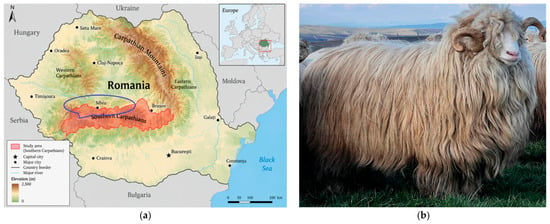
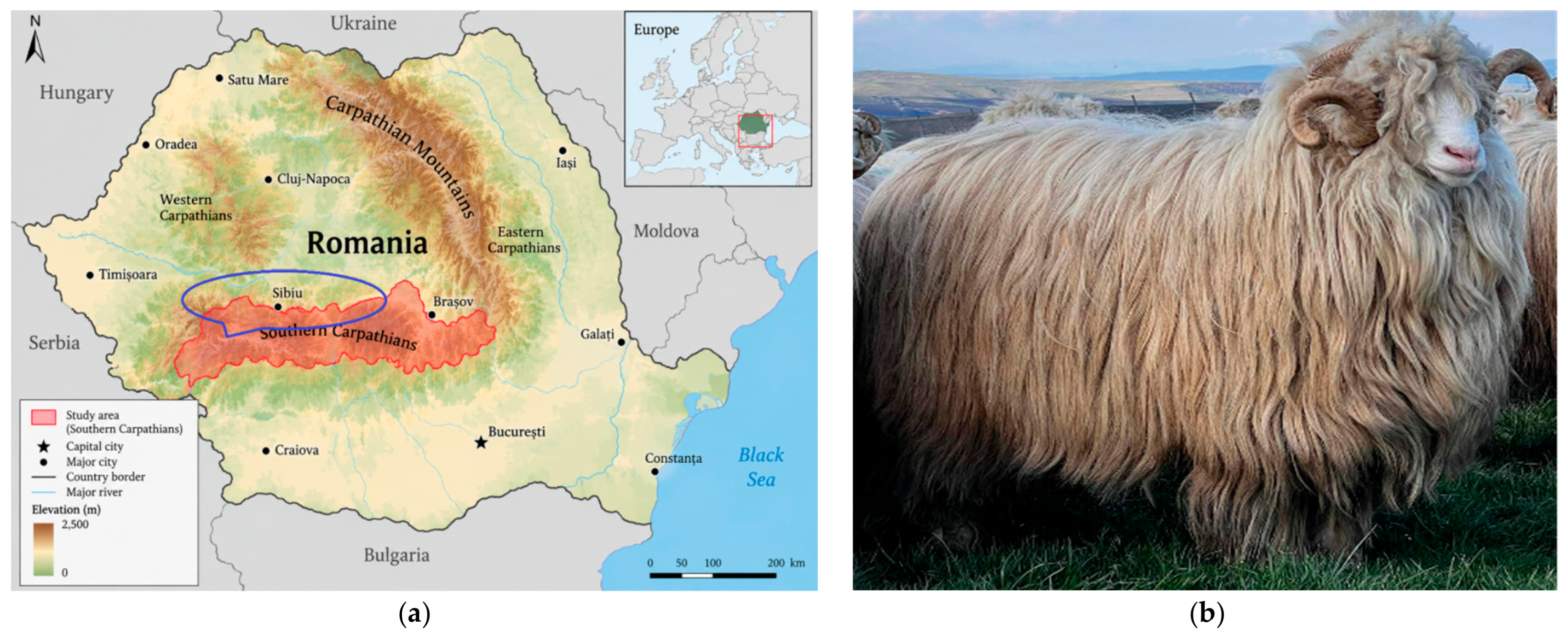
The study was conducted in the Southern Carpathians area of Romania (Figure 1a), a region with a long-standing tradition of raising Țurcana sheep (Figure 1b). The study area is characterized by steep altitudinal gradients and mountainous climatic conditions.
Figure 1.
Location of the study area in the Southern Carpathians, Romania (a) and a Țurcana breed ram (b). Source: (a) authors’ elaboration based on Natural Earth geographic data; (b) authors’ photograph.
Potential respondents were identified with the assistance of the “Păstorul Crișana” Sheep Breeders’ Association, and participation was voluntary. This breeders’ association manages the breeding program for the Țurcana sheep breed, which is raised in several mountainous areas of Romania. The study included 37 sheep breeders. The available study documentation does not provide a complete sampling frame or a denominator for calculating the response rate; therefore, the sample should not be interpreted as a probability sample representative of all mountain sheep farms in the region.
2.2. Study Design and Survey Instrument
The study was based on a cross-sectional farm-level questionnaire survey conducted between 1 March and 30 June 2026. Prior to data collection, prospective participants were informed about the study’s purpose, the voluntary nature of participation, and the confidential and anonymous handling of all responses. The questionnaire was structured and administered digitally via Google Forms, comprising 60 variables that encompassed farmer demographics, flock structure, seasonal grazing patterns, pasture management, infrastructure, labor, animal protection, milking practices, production output, marketing channels, financial subsidies, and future development intentions. The individual farm/respondent served as the unit of analysis.
The questionnaire was self-administered. This format was selected to standardize data collection and minimize interviewer-induced recording bias. Completion of the questionnaire implicitly constituted informed consent to participate in the study.
2.3. Ethics and Informed Consent
The study protocol was conducted in accordance with the Declaration of Helsinki. Ethical approval was obtained from the Ethics Committee of the Faculty of Food and Animal Sciences at the “Ion Ionescu de la Brad” University of Life Sciences in Iași (protocol code No. 37, approved on 20 January 2026). Before completing the questionnaire, participants were informed about the purpose of the study, the voluntary nature of participation, and the anonymous handling of questionnaire responses. Completion of the anonymous online questionnaire constituted consent to participate in the study.
2.4. Questionnaire Structure and Data Preparation
Questionnaire responses comprised single-choice, multiple-choice, and open-text fields. Multiple-response variables were decomposed into binary indicators whenever the presence of a clearly identifiable practice or facility could be definitively established. Ordinal variables were coded according to their natural hierarchical order. Open-text responses were excluded from quantitative transformation when the questionnaire lacked sufficient context to support reliable reconstruction. Finally, a data cleaning log and analytical codebook were maintained to document all recoding decisions.
2.5. Economic Outcome
The primary outcome was derived from questionnaire item Q48: “Care este venitul obținut pe fiecare oaie într-un an?” (“What is the income obtained per sheep in one year?”). The item measures self-reported annual income per ewe; it does not define accounting costs or distinguish gross receipts from net profit. Accordingly, the outcome is referred to throughout the manuscript as self-reported annual income per ewe rather than profitability. Responses were recorded in four ordered categories: <500 lei, 500–750 lei, 750–1000 lei and >1000 lei per ewe/year. For graphical presentation only, these categories were converted using 500 lei = EUR 100, giving <EUR 100, EUR 100–150, EUR 150–200 and >EUR 200 per ewe/year. Two questionnaires contained combined income responses (“<500 lei, 750–1000 lei” and “750–1000 lei, >1000 lei”) [curs-valutar-bnr.ro].
These observations were retained in the source dataset but excluded from ordinal inferential analyses because their exact position on the ordinal scale could not be determined without an arbitrary rule.
2.6. Explanatory Variables
Annual milk yield per ewe was recorded in three ordered categories: <50 L, 51–75 L and >76 L. Herd size was categorized as <300, 300–500 and >500 sheep, and pasture area was categorized according to the questionnaire response groups. Off-road access was coded as a binary indicator reflecting explicit access to off-road transport for grazing areas. Additional binary indicators represented mechanical or mixed milking, surveillance cameras and the processing of milk into matured dairy products. For binary predictors, the presence “yes” category was treated as the positive category and the absence “no” category as the reference category. Future development intention was coded according to the reported direction of flock development, with higher scores representing stronger expansion orientation.
2.7. Statistical Analysis
Descriptive statistics were used to characterize the sample. Because the outcome was ordinal and the inferential sample was small, rank-based methods were used for the main analyses. Spearman’s rank correlation coefficient (ρ) was used to quantify monotonic associations between ordered variables and annual income per ewe. For binary predictors, Mann–Whitney U tests were used to compare income-category distributions between groups, and rank-biserial correlation was reported as an effect-size measure. These two effect-size measures reflect the same underlying rank comparison when applied to a binary predictor, but use different normalisations and should not be interpreted as independent evidence.
The two focal associations—annual milk yield per ewe with income per ewe and off-road access with income per ewe—were evaluated using non-parametric robustness checks. Bootstrap confidence intervals were obtained from 10,000 resamples of the farm-level observations. Permutation testing used 20,000 random permutations of the outcome values to obtain distribution-free p-values under the null hypothesis of no association. Leave-one-out sensitivity analysis recalculated Spearman’s ρ after sequentially removing each observation to assess whether individual farms materially influenced the estimates.
These procedures were used to assess the uncertainty and stability of the focal associations; they do not correct for multiple testing or potential selection effects arising from the examination of multiple candidate associations. Nominal and Benjamini–Hochberg-adjusted p-values for the documented association tests are reported in Supplementary Table S1. Adjustments were performed separately for the documented Spearman correlation tests and Mann–Whitney U tests. Because the available records do not establish a complete inventory of all exploratory tests conducted, these adjustments are restricted to the documented tests and should not be interpreted as comprehensive control of the false discovery rate across all questionnaire variables examined.
2.8. Multivariable Sensitivity Analysis
Given that annual income per ewe was recorded on an ordered four-category scale, a parsimonious cumulative ordinal logistic regression model was fitted. To assess the robustness of the primary associations while controlling for additional farm-level attributes displaying bivariate associations with income, two complementary sensitivity models were specified. Model A incorporated annual milk yield per ewe, off-road grazing accessibility, and on-farm processing of matured dairy products, whereas Model B replaced matured dairy processing with the presence of surveillance cameras. Model complexity was intentionally constrained due to the limited sample size available for inferential analysis. Candidate predictors were selected based on substantive domain knowledge and the strongest bivariate relationships, rather than through automated stepwise selection procedures. Mechanical or mixed milking was excluded from the primary multivariable models because only five farms reported this practice, leading to numerical instability in parameter estimation. In light of the small sample size and sparse cell counts across certain outcome–predictor combinations, the ordinal regression models were interpreted cautiously as sensitivity analyses within the proportional-odds framework. Adjusted odds ratios (ORs) and corresponding 95% confidence intervals (CIs) are reported, representing adjusted statistical associations rather than causal effects.
The proportional-odds assumption was not formally tested. Given the small sample size and sparse outcome–predictor combinations, the validity of this assumption remains uncertain. Accordingly, the reported ORs should be interpreted cautiously as common odds-ratio estimates across the cumulative income thresholds, as specified by the model, rather than as evidence that the proportional-odds assumption was satisfied.
Annual milk yield per ewe was categorized into three ordered groups (<50 L, 50–75 L, and ≥75 L) and entered into the ordinal logistic regression models as an ordinal numeric score coded from 1 to 3.
2.9. Statistical Software and Reporting Conventions
Data cleaning and statistical analysis were conducted using Python 3.13.5 with pandas 2.2.3, NumPy 2.3.5, SciPy 1.17.0 and stats models 0.14.6 [26]; figures were produced using Matplotlib 3.10.8 [27]. The nominal statistical significance threshold was set at p < 0.05. Because of the exploratory nature and small sample size, effect sizes and confidence intervals were emphasized and p-values were not interpreted in isolation. No causal inference was attempted.
3. Results
The survey included 37 mountain sheep farms. Of the 37 income responses, 35 were unambiguous and were used in the principal inferential analyses. The main characteristics of the surveyed farms are summarized in Table 1.
Table 1.
Characteristics of the surveyed mountain sheep farms.
Nine farms reported <EUR 100/ewe/year, eight EUR 100–150, eleven EUR 150–200 and seven >EUR 200. The surveyed farms were predominantly characterized by medium-sized or large flocks, with 14 farms (37.8%) keeping 300–500 sheep and 12 farms (32.4%) keeping more than 500 sheep.
Annual milk yield was >51 L/ewe in 32 farms (86.4%), whereas four farms (10.8%) reported <50 L/ewe and one response was missing. Off-road access to grazing areas was reported by 26 farms (70.3%), while matured dairy products were produced by 23 farms (62.2%). Mechanical or mixed milking was reported by five farms (13.5%), and surveillance cameras were present on 11 farms (29.7%). Regarding future development, 18 respondents (48.6%) intended to increase their flock, 17 (45.9%) to maintain their current size, and only two (5.4%) to reduce or liquidate the flock.
3.1. Annual Milk Yield and Economic Performance
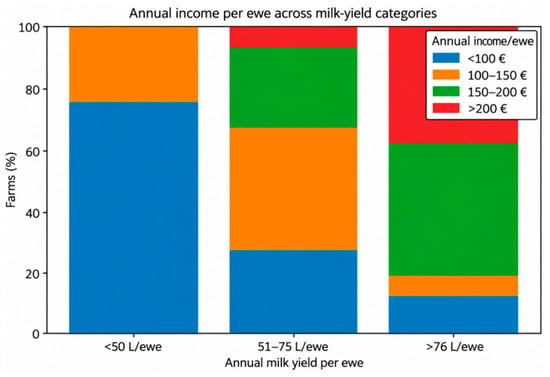
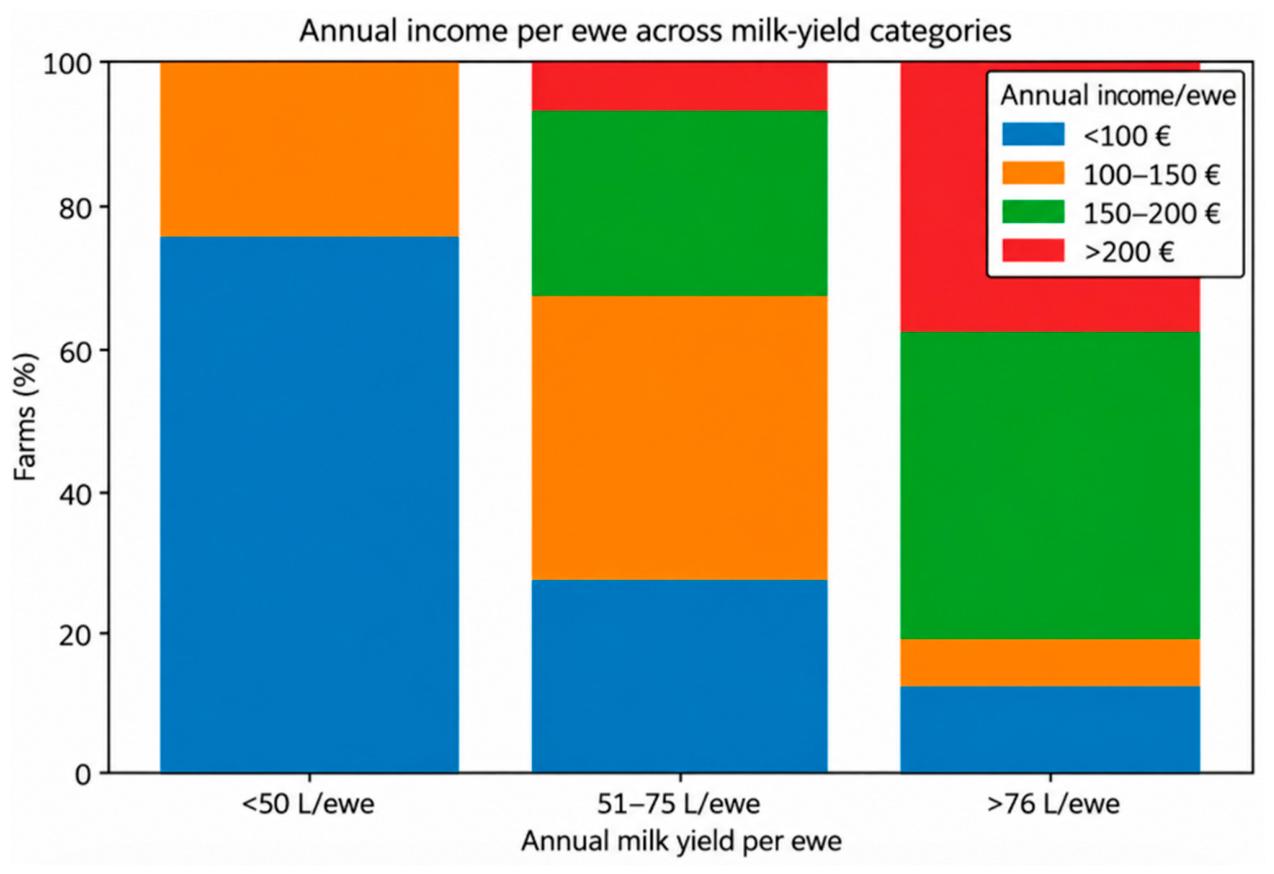
The relationship between milk yield and income is illustrated in Figure 2, and the corresponding bivariate association is summarized in Table 2. Annual milk yield per ewe showed a strong positive association with annual income per ewe (Spearman’s ρ = 0.570, n = 35, p < 0.001; permutation p = 0.0006). The 95% bootstrap confidence interval was 0.282–0.789, while leave-one-out correlations ranged from 0.542 to 0.639, indicating that the association was not driven by a single observation.
Figure 2.
Distribution of self-reported annual income per ewe across annual milk-yield categories. Note: Income categories were converted using an approximate exchange rate of 500 Romanian lei (RON) = EUR 100, based on the exchange-rate source reported at www.curs-valutar-bnr.ro (accessed on 25 June 2026). The euro equivalents are provided for presentation purposes only [28].
Table 2.
Main associations with self-reported annual income per ewe.
3.2. Accessibility to Grazing Areas
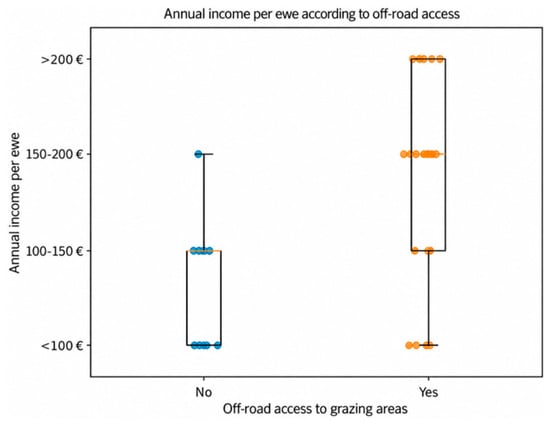
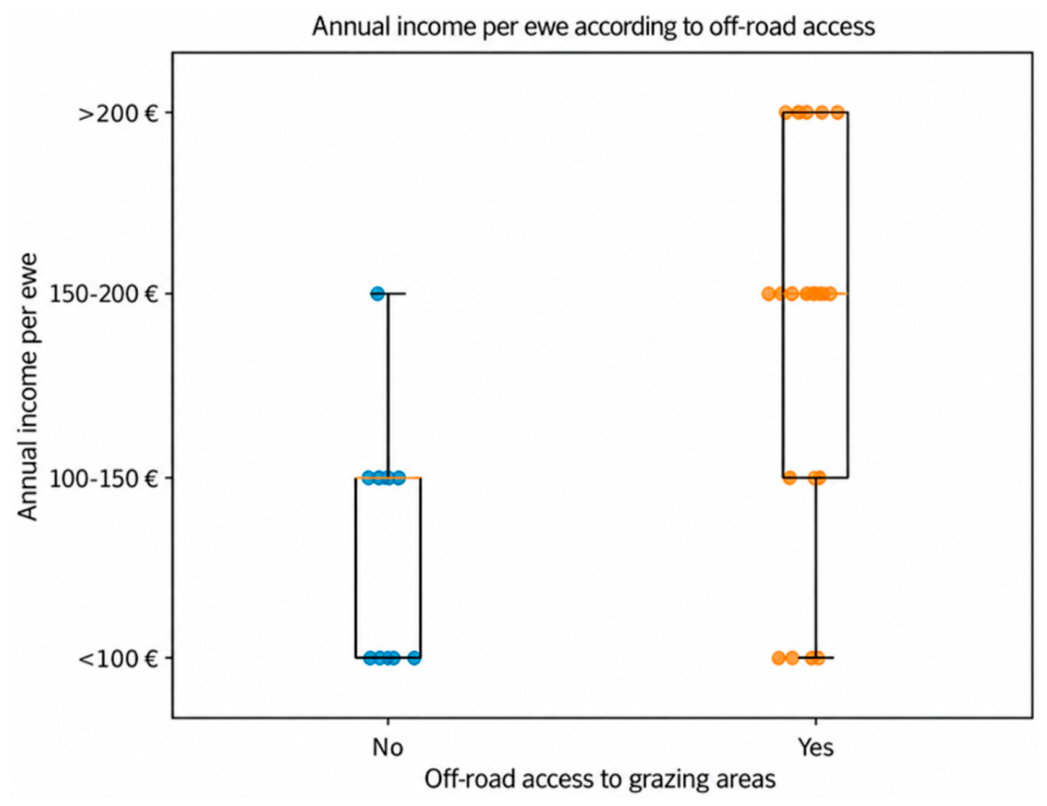
Off-road access to grazing areas was positively associated with annual income per ewe (Spearman’s ρ = 0.521, n = 35, p = 0.001; permutation p = 0.001). The 95% bootstrap confidence interval was 0.270–0.737, while leave-one-out correlations ranged from 0.494 to 0.568. A Mann–Whitney U test similarly indicated a difference in the distribution of income categories between farms with and without off-road access (U = 49.5, p = 0.003), with a rank-biserial correlation of 0.625.
As shown in Figure 3, farms with off-road access were more frequently represented in the higher annual income categories than farms without such access. The corresponding bivariate association is also summarized in Table 2.
Figure 3.
Self-reported annual income per ewe according to off-road access to grazing areas. Note: Income categories were converted using 500 lei = EUR 100 [curs-valutar-bnr.ro].
3.3. Technology and Value-Added Processing
Mechanical or mixed milking showed a strong unadjusted association with income per ewe (Spearman’s ρ = 0.586, p < 0.001; U = 5.0, p < 0.001; rank-biserial correlation = 0.933). However, only five farms reported mechanical or mixed milking, and the corresponding multivariable model produced unstable estimates; therefore, this variable was treated as exploratory rather than as a primary independent predictor.
Processing milk into matured dairy products was moderately associated with income per ewe (Spearman’s ρ = 0.373, p = 0.027; U = 81.5, p = 0.031; rank-biserial correlation = 0.430). Surveillance cameras showed a similar unadjusted association (Spearman’s ρ = 0.376, p = 0.026; U = 67.0, p = 0.030; rank-biserial correlation = 0.464). These associations were attenuated in the parsimonious ordinal models after accounting for milk yield and off-road access.
3.4. Farm Scale
Neither herd size nor pasture area showed evidence of an association with annual income per ewe. Spearman’s ρ was 0.135 (p = 0.440) for herd-size category and 0.094 (p = 0.593) for pasture-area category. Thus, physical farm scale was not associated with higher income per ewe in this sample.
3.5. Future Development Intention
Future development intention was positively associated with current income per ewe (Spearman’s rho = 0.555, p < 0.001). Eighteen of the 37 respondents intended to increase their flock and 17 intended to maintain its current size; only two indicated an intention to reduce or liquidate the flock. This pattern suggests that farms with stronger current economic performance were also more oriented toward continuation or expansion.
3.6. Parsimonious Ordinal Regression
The parsimonious ordinal logistic regression analyses were consistent with the main bivariate findings presented in Table 2. In Model A, which included annual milk yield per ewe, off-road access and matured-dairy-product processing, milk yield remained positively associated with higher income categories (OR = 6.57, 95% CI: 1.93–22.32, and p = 0.003), as did off-road access (OR = 8.08, 95% CI: 1.66–39.37, and p = 0.010). In contrast, the association with matured-dairy-product processing was attenuated after adjustment and did not reach statistical significance (OR = 3.12, 95% CI: 0.71–13.76, and p = 0.133).
In the sensitivity Model B, which included surveillance cameras instead of matured-dairy-product processing, milk yield (OR = 6.04, 95% CI: 1.73–21.11, and p = 0.005) and off-road access (OR = 8.59, 95% CI: 1.76–42.03, and p = 0.008) remained positively associated with higher income categories, whereas surveillance cameras were not statistically significant (OR = 2.38, 95% CI: 0.51–11.15, and p = 0.273). The complete regression estimates are presented in Table 3.
Table 3.
Parsimonious ordinal logistic regression models.
Given the modest sample size and correspondingly wide confidence intervals, these regression estimates should be interpreted as exploratory sensitivity evidence rather than precise, population-level effect estimates.
4. Discussion
4.1. Productivity and Economic Performance
The positive association between annual milk yield per ewe and self-reported income per ewe was the strongest and most consistent finding of the present study. This result is supported by previous farm-level economic analyses of dairy sheep systems. In 20 Assaf dairy sheep farms in Spain, Milán et al. reported a strong positive relationship between total annual income per ewe and milk yield, with milk yield explaining a substantial proportion of the variation in income per ewe (R2 = 0.88) [6]. Similarly, economic evaluations of sheep milk production—in systems specific to Mediterranean and mountainous regions as well as organic farming—have demonstrated that milk yield and other productive traits are closely correlated with the farm’s economic performance [5,29,30].
The positive association between annual milk yield per ewe and self-reported income per ewe should be interpreted in light of the role of milk sales in farm revenue. Because higher milk production can directly contribute to higher income, this relationship may partly reflect the underlying revenue structure rather than an independent economic mechanism. More recent farm-level evidence from Greece and Romania has also evaluated milk yield per ewe alongside gross income, gross profit and net profit per ewe, reinforcing the relevance of animal-level productivity as an economic performance indicator [31,32]. Our findings are therefore consistent with a broader pattern across dairy sheep systems. However, the present study extends this evidence to a mountain pastoral context using non-parametric evaluations on self-reported, ordinal economic outcomes, where neither herd size nor pasture area was associated with income per ewe.
The observed relationship should not be interpreted as strictly causal. Milk yield may reflect differences in breed, nutrition, reproductive management, animal health, milking practices, and overall farm management. Furthermore, potential reverse causality or unobserved confounding cannot be ruled out, as farms generating higher revenues may simultaneously possess greater financial capacity to invest in high-quality feed, veterinary care, and superior genetic stock.
4.2. Accessibility and the Operating Environment
The positive association between off-road access to grazing areas and annual income per ewe was one of the most consistent findings of the present study. In mountain sheep systems, access to remote grazing areas may facilitate flock supervision, transport of equipment and inputs, veterinary interventions and the movement of agricultural products. Recent evidence identifies poorly maintained transhumance routes and deteriorated access roads as important constraints that reduce flock mobility and increase the labor intensity of seasonal movements [22,32,33,34,35].
However, reverse causality cannot be excluded, as farms with higher incomes may also be better able to afford off-road vehicles. However, these findings must be interpreted with caution. Given the cross-sectional design of the study, the observed association does not establish a direct causal linkage. Farms with enhanced off-road accessibility may systematically differ in structural capital, geographical location, investment capacity, market integration, or overall management intensity. Furthermore, potential reverse causality cannot be ruled out, as higher-income operations may possess greater financial means to invest in suitable off-road transport equipment or private track maintenance.
4.3. Why Physical Scale Was Not Associated with Income per Ewe
The absence of an association between herd size and annual income per ewe is noteworthy because previous studies have reported positive relationships between flock size and economic performance [36,37]. Papanikolopoulou et al. [5] found that larger dairy sheep farms in less-favoured areas of Greece had higher incomes and gross margins, while Milán et al. [6] identified flock size, milk production and feeding costs among factors related to farm profitability in Assaf sheep.
The difference between these findings and the present results may partly reflect the way economic performance was defined. Studies based on total farm income or farm-level gross margins may capture economies associated with greater production scale, whereas the present study assessed income on a per-ewe basis. In our sample, neither herd size nor pasture area was associated with income per ewe, suggesting that physical expansion alone did not distinguish farms with higher animal-level economic returns.
These findings should not be construed as evidence that physical scale is economically irrelevant. Larger operations may well benefit from structural economies of scale through labor efficiency, bulk purchasing of inputs, or fixed infrastructure optimization; however, in mountain pastoral environments, such scale advantages do not automatically translate into higher unit-level margins per animal, where logistical constraints and feed availability often impose upper limits. Finally, given the small sample size and cross-sectional design, these results should be interpreted cautiously, as potential non-linear dynamics or threshold effects between farm scale, productivity, and unit economic performance warrant further investigation in larger longitudinal samples.
4.4. Value-Added Processing and Economic Performance
Processing milk into matured dairy products was positively associated with annual income per ewe [36,37,38,39,40] in the bivariate analysis, although the association was attenuated and no longer statistically significant after adjustment for milk yield and off-road access. This pattern is consistent with evidence from mountain dairy sheep systems in the Basque Country, where farms producing high-value products such as cheese achieved higher net margins than farms selling milk to cheese factories [15].
The attenuation observed upon multivariable adjustment suggests that the apparent economic advantage of value-added processing partially overlaps with other structural features of high-performing farms—specifically higher animal-level productivity and superior logistical accessibility. In mountain pastoral contexts, on-farm processing may thus serve as a marker of broader managerial capacity and capital investment rather than an isolated financial driver.
Because the present study did not directly quantify unit product prices, processing overheads, distribution channels, or exact output volumes, the precise economic mechanisms underlying this relationship remain to be fully elucidated. Nevertheless, on-farm value addition represents a highly promising strategy for mountain sheep operations to enhance farm-gate returns, particularly when paired with direct marketing and regional product differentiation.
4.5. Technology as a Marker of Farm Modernization
Mechanical or mixed milking displayed the strongest unadjusted association among the technology-related variables; however, this practice was reported by only five farms within our sample. Consequently, this unadjusted relationship must not be interpreted as evidence of a direct causal effect of milking mechanization on unit income. Rather, technology adoption in this context likely reflects broader structural differences in farm organization, available infrastructure, management intensity, and an overall strategic orientation toward modernization. This interpretation aligns with findings by Rivas et al. [17], who demonstrated across 157 dairy sheep operations in Spain that technological innovation is inherently multidimensional and strongly linked to structural, productive, and economic performance.
Studies on mountain and extensive livestock systems have similarly noted that targeted precision livestock farming (PLF) applications can effectively alleviate labor constraints and streamline operational management under specific production contexts [17,18,36,37,38,39,40,41,42]. In the present study, the presence of surveillance cameras showed a positive association with income in the unadjusted analysis, but this relationship diminished upon accounting for animal-level milk yield and off-road accessibility. Overall, these findings reinforce the view that individual technological implementations operate as components of a comprehensive farm modernization pathway rather than standalone drivers of economic performance.
4.6. Future Development Orientation
The positive association between annual income per ewe and farmers’ intention to maintain or increase flock size provides an additional perspective on the future orientation of the surveyed farms. Most respondents intended either to maintain or expand their flocks, while only two reported an intention to reduce or liquidate sheep production. This pattern suggests that better current economic performance was associated with a stronger orientation toward continuation or expansion, although the cross-sectional design does not allow the direction of this relationship to be established. However, future development intention should not be interpreted as a direct measure of long-term farm viability or actual farm continuity. Farmers’ decisions concerning future flock size may also depend on labor availability, access to land and infrastructure, market expectations and household circumstances. Indeed, the recent European literature on farm succession underscores that economic performance interacts dynamically with broader socio-structural drivers—such as farmer age and the presence of a designated successor—in determining long-term farm survival.
Nonetheless, these findings suggest that unit-level economic returns play a central role in shaping producers’ optimism and strategic planning. Longitudinal and panel studies will be essential to track whether these expressed expansionary intentions ultimately translate into tangible capital investment, flock growth, and sustained operational continuity in mountain pastoral systems.
4.7. Implications for Sustainable Mountain Sheep Farming
The findings support targeted modernization rather than indiscriminate intensification. In the surveyed farms, economic performance was more consistently associated with milk yield per ewe and accessibility than with physical farm scale. Accordingly, farm-development and support strategies could consider productivity improvement, improved access to remote grazing areas, appropriate labor-saving technologies and value-added processing [3,4,15]. Crucially, such interventions must remain sensitive to the multifunctional role of extensive mountain pastoralism—balancing agricultural production with biodiversity conservation, landscape stewardship, and rural cohesion. Given the cross-sectional design, observational nature, and modest sample size of this study, these policy implications should be interpreted as hypothesis-generating frameworks rather than direct impact assessments of specific policy instruments.
4.8. Strengths and Limitations
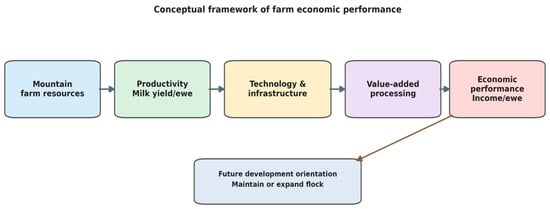
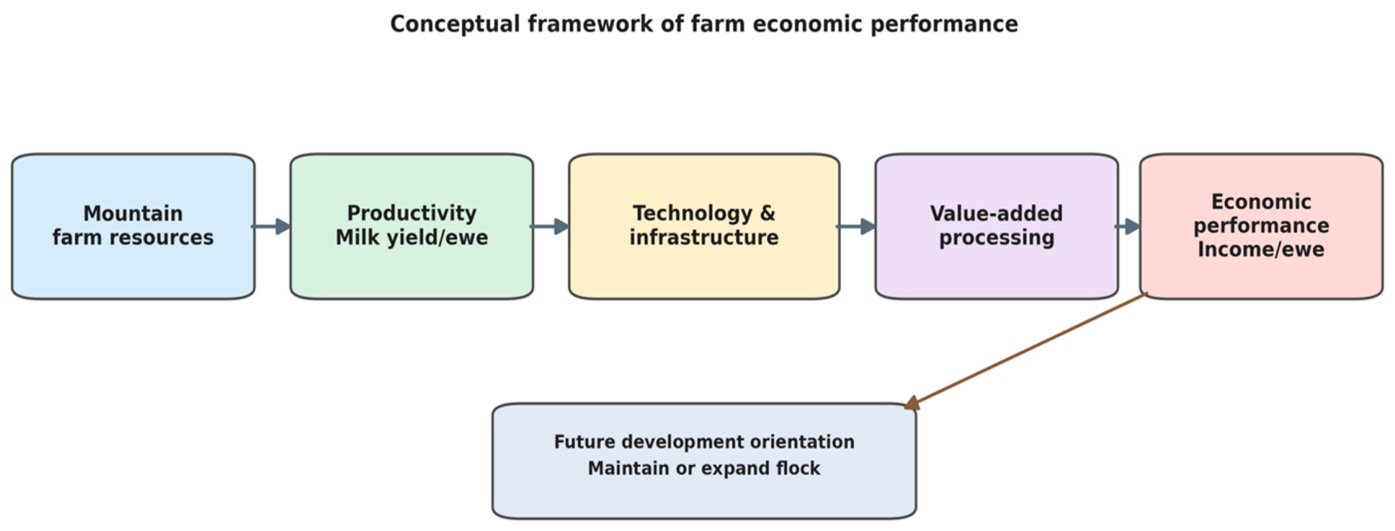
A primary strength of this study lies in its integrated framework, which simultaneously evaluates animal productivity, physical infrastructure, technological practices, value-added processing, and farmers’ future intentions within a unified farm-level dataset, supported by multiple sensitivity procedures (Figure 4). Conversely, several limitations must be acknowledged. First, the sample size is relatively small (N = 35/37) and relies on a geographically defined cohort rather than a probability-based sample, which precludes broad extrapolation to all Romanian or European mountain sheep systems. Second, the cross-sectional design prevents drawing causal inferences or establishing temporal sequences.
Figure 4.
Conceptual framework linking farm resources, productivity, technology and infrastructure, value addition, economic performance and future farm orientation.
Third, economic outcomes were assessed using a self-reported ordinal income measure rather than standardized farm accountancy data. Detailed quantitative metrics regarding unit production costs, explicit labor valuation, market prices, and subsidy contributions were unavailable. Additionally, two income responses were ambiguous and required exclusion, while several multiple-response items were recoded. These limitations notwithstanding, the consistency of the primary associations across complementary non-parametric evaluations and robustness checks reinforces their internal validity. Consequently, these findings offer valuable hypothesis-generating insights that warrant further confirmation through larger, longitudinal panel studies.
5. Conclusions
The present study demonstrates that annual milk yield per ewe and off-road grazing access represent factors associated with higher self-reported income per ewe among the surveyed mountain sheep operations. Conversely, herd size and pasture area exhibited no significant association with unit-level income, indicating that physical scale expansion alone does not guarantee superior economic performance per animal. While value-added processing and selected technological applications showed positive unadjusted associations, their independent contributions were less consistent in multivariable frameworks.
Overall, these findings suggest that enhancing animal-level productivity and improving operational accessibility may play a more decisive role in unit economic differentiation than simply increasing farm scale. These recommendations are grounded in the observed associations between farm-level characteristics and self-reported income per ewe and should be interpreted in the context of the study’s exploratory design, small sample size, and inability to establish causal relationships.
From a forward-looking perspective, strategic interventions targeting productivity and infrastructure upgrades are expected to yield higher long-term stability for mountain pastoral systems than passive land or flock accumulation. However, quantitative forecasting of specific economic returns remains constrained by the observational cross-sectional design and the ordinal nature of available income data. Future predictive modeling and financial forecasting will require longitudinal panel tracking coupled with standardized farm accountancy metrics to accurately project benefit–cost dynamics under fluctuating market conditions.
Nevertheless, translating these productivity- and infrastructure-focused recommendations into practice carries inherent operational and financial risks that farm managers and policy designers must navigate. First, capital investments aimed at boosting milk yield (e.g., genetic improvement, specialized nutritional supplementation, or mechanical milking infrastructure) involve substantial up-front costs and extended payback periods. In volatile market environments characterized by surging feed prices and energy costs, heavily leveraged farms risk severe liquidity shortages. Furthermore, implementing on-farm dairy processing exposes producers to regulatory compliance risks, heightened food safety liabilities, and the commercial risk of failing to secure stable niche market outlets for differentiated products.
Second, infrastructure and accessibility interventions carry broader socio-environmental and institutional risks. Upgrading off-road access routes to remote high-altitude pastures can inadvertently increase ecological footprint, cause soil erosion, and disrupt vulnerable mountain ecosystems if not executed under strict environmental guidelines. From a managerial standpoint, over-reliance on labor-saving technologies and mechanization may create technical dependencies in remote areas where immediate maintenance and technical support are lacking. Finally, there is a strategic risk that support policies incentivizing technological modernization without accompanying training and advisory services may disproportionately benefit well-capitalized operations, thereby exacerbating structural inequities among traditional pastoral communities.
Given the modest sample size of this study, these conclusions should be interpreted cautiously as hypothesis-generating frameworks rather than definitive policy assessments, warranting further confirmation through larger longitudinal studies incorporating comprehensive farm accountancy data.
Supplementary Materials
The following supporting information can be downloaded at: https://www.mdpi.com/article/10.3390/agriculture16212334/s1, Table S1: Documented associations between farm characteristics and self-reported annual income per ewe, with nominal and Benjamini–Hochberg-adjusted p-values.
Author Contributions
Conceptualization, C.P. (Constantin Pascal); methodology, C.P. (Constantin Pascal) and C.G.R.R.; software, C.G.R.R. and C.P. (Constantin Pascal); validation, C.P. (Claudia Pânzaru) and A.C.; formal analysis, A.C.; investigation, C.P. (Constantin Pascal) and C.P. (Claudia Pânzaru); data curation, C.P. (Constantin Pascal); writing—original draft preparation, C.P. (Constantin Pascal), C.P. (Claudia Pânzaru), and A.C.; writing—review and editing, C.P. (Constantin Pascal) and C.P. (Claudia Pânzaru); visualization, C.P. (Constantin Pascal), C.P. (Claudia Pânzaru), A.C., and C.G.R.R.; supervision, C.P. (Constantin Pascal), and C.G.R.R. All authors have read and agreed to the published version of the manuscript.
Funding
This research received no external funding.
Institutional Review Board Statement
The study was conducted in accordance with the Declaration of Helsinki and approved by the Ethics Committee of the Faculty of Food and Animal Sciences at the “Ion Ionescu de la Brad” University of Life Sciences in Iași (No. 37, 20 January 2026).
Informed Consent Statement
Informed consent for participation was obtained through the voluntary completion of the anonymous online questionnaire. Before completing the questionnaire, participants were informed about the purpose of the study, the voluntary nature of participation, and the anonymous handling of their responses. Completion of the questionnaire constituted consent to participate in the study.
Data Availability Statement
The de-identified data supporting the findings of this study are available from the corresponding author upon reasonable request, subject to applicable ethical and privacy restrictions.
Acknowledgments
The authors would like to thank the leadership team of the Păstorul Crișana professional organization for their support in identifying and facilitating contact with sheep farmers who participated in the survey.
Conflicts of Interest
The authors declare no conflicts of interest.
References
- Renta, M.; Crișan, I.; Pleșa, A.; Ihuț, A. Influence of summer transhumance practice in the Carpathians, Apuseni Mountains, Romania, on cattle milk production and quality. Front. Anim. Sci. 2025, 6, 1720225. [Google Scholar] [CrossRef] [Scilit]
- Morgan-Davies, C.; Zanon, T.; Schneider, M.K.; Pauler, C.M.; Holand, Ø.; Bernués, A.; Dovc P, P.; Gauly, M.; Cozzi, G. Trends in mountain sheep farming in Europe over the past 40 years—Challenges and opportunities. In Book of Abstracts of the 73rd Annual Meeting of the European Federation of Animal Science; Wageningen Academic Publishers: Wageningen, The Netherlands, 2022; Volume 28, p. 476. [Google Scholar] [CrossRef] [Scilit]
- Zieliński, M.; Łopatka, A.; Koza, P.; Sobierajewska, J.; Juszczyk, S.; Józwiak, W. Development of Agriculture in Mountain Areas in Europe: Organisational and Economic Versus Environmental Aspects. Agriculture 2026, 16, 127. [Google Scholar] [CrossRef] [Scilit]
- Larraz, V.; Reiné, R.; Barrantes, O. Challenges and Adoption of New Technologies for Sustainable Sheep Mountain Pastoralism: A Case Study from the Jacetania Region, Spanish Western Pyrenees. Sustainability 2026, 18, 1791. [Google Scholar] [CrossRef] [Scilit]
- Papanikolopoulou, V.; Vouraki, S.; Priskas, S.; Theodoridis, A.; Dimitriou, S.; Arsenos, G. Economic Performance of Dairy Sheep Farms in Less-Favoured Areas of Greece: A Comparative Analysis Based on Flock Size and Farming System. Sustainability 2023, 15, 1681. [Google Scholar] [CrossRef] [Scilit]
- Milán, M.J.; Frendi, F.; González-González, R.; Caja, G. Cost Structure and Profitability of Assaf Dairy Sheep Farms in Spain. J. Dairy Sci. 2014, 97, 5239–5249. [Google Scholar] [CrossRef] [Scilit] [PubMed]
- Tolone, M.; Riggio, V.; Maizon, D.O.; Portolano, B. Economic Values for Production and Functional Traits in Valle del Belice Dairy Sheep Using Profit Functions. Small Rumin. Res. 2011, 97, 41–47. [Google Scholar] [CrossRef] [Scilit]
- Liagka, D.V.; Politis, A.P.; Spilioti, M.; Nellas, E.; Simitzis, P.; Tsiboukas, K. A Comparative Economic Analysis of Different Reproductive Management Strategies in Two Dairy Sheep Farms in Greece. Agriculture 2025, 15, 719. [Google Scholar] [CrossRef] [Scilit]
- Popescu, A. Research Concerning the Economic Efficiency in Carabasa Sheep Breed Raising in Various Sized Farms. Sci. Pap. Anim. Sci. Biotechnol. 2012, 45, 466–471. [Google Scholar]
- Chiurciu, I.A.; Cofas, E. Technical-economic analysis of sheep and goat herds in Romania. In Proceedings of the the 11th International Symposium “Agrarian Economy and Rural Development—Realities and Perspectives for Romania”; The Research Institute for Agricultural Economy and Rural Development (ICEADR): Bucharest, Romania, 2020; pp. 110–111. [Google Scholar]
- Chetroiu, R.; Rodino, S.; Dragomir, V.; Ilie, D.M. Assessing Economic Viability of Resilient Sheep Foraging Alternatives in Lowland Regions of Romania. Agriculture 2024, 14, 1656. [Google Scholar] [CrossRef] [Scilit]
- Brumă, I.S.; Toader, M.; Popescu, G.; Petcu, V.; Georgescu, E. The Evolution of Alfalfa, as Important Crop in Organic Farming System in Romania. Rom. Agric. Res. 2023, 40, 297–306. [Google Scholar] [CrossRef] [Scilit]
- Skordos, D.; Koutouzidou, G.; Arca, P.; Altana, G.; Francioni, M.; Bianchini, M.; Dar Ali, M.; Sintori, A.; Sokratous, S.; Ivankovic, A.; et al. The Economic Performance of Sheep Pastoral Systems in the Mediterranean: An Analysis Based on Typologies. Livest. Sci. 2025, 298, 105738. [Google Scholar] [CrossRef] [Scilit]
- Riedel, J.L.; Casasús, I.; Bernués, A. Sheep farming intensification and utilization of natural resources in a Mediterranean pastoral agro-ecosystem. Livest. Sci. 2007, 111, 153–163. [Google Scholar] [CrossRef] [Scilit]
- Garmendia, E.; Aldezabal, A.; Galan, E.; Andonegi, A.; del Prado, A.; Gamboa, G.; Garcia, O.; Pardo, G.; Aldai, N.; Barron, L.J.R. Mountain Sheep Grazing Systems Provide Multiple Ecological, Socio-Economic, and Food Quality Benefits. Agron. Sustain. Dev. 2022, 42, 47. [Google Scholar] [CrossRef] [Scilit]
- Teston, M.; Orsi, M.; Bittane, G.; Cecchinato, L.G.; Gatto, L.; Mota, L.F.M.; Ramazin, M.; Raniolo, S.; Tormen, A.; Sturaro, E. Added Value of Local Sheep Breeds in Alpine Agroecosystems. Sustainability 2022, 14, 4698. [Google Scholar] [CrossRef] [Scilit]
- Rivas, J.; Perea, J.M.; De-Pablos-Heredero, C.; Angon, E.; Barba, C.; García, A. Canonical Correlation of Technological Innovation and Performance in Sheep’s Dairy Farms: Selection of a Set of Indicators. Agric. Syst. 2019, 176, 102665. [Google Scholar] [CrossRef] [Scilit]
- Morgan-Davies, C.; Lambe, N.; Wishart, H.; Waterhouse, A.; Kenyon, F.; McBean, D.; McCracken, D. Impacts of Using a Precision Livestock System Targeted Approach in Mountain Sheep Flocks. Livest. Sci. 2018, 208, 67–76. [Google Scholar] [CrossRef] [Scilit]
- Morgan-Davies, C.; Kyle, J.; Boman, I.A.; Wishart, H.; McLaren, A.; Fair, S.; Creighton, P. A Comparison of Farm Labor, Profitability, and Carbon Footprint of Different Management Strategies in Northern European Grassland Sheep Systems. Agric. Syst. 2021, 191, 103155. [Google Scholar] [CrossRef] [Scilit]
- Fonseca, F.; Castro, M.; Alves, L.; Castro, J. Impacts of Extensive Sheep Grazing on Soil Physical and Chemical Quality in Open Mountain Forests, NE Portugal. Span. J. Soil Sci. 2023, 13, 11632. [Google Scholar] [CrossRef] [Scilit]
- Shackleton, D.M. Social maturation and productivity in bighorn sheep: Are young males incompetent? Appl. Anim. Behav. Sci. 1991, 29, 173–184. [Google Scholar] [CrossRef] [Scilit]
- Larranz, V.; Barrantes, O.; Reine, R. Habitat Selection by Free-Grazing Sheep in a Mountain Pasture. Animals 2024, 14, 1871. [Google Scholar] [CrossRef] [Scilit] [PubMed]
- Seibert, B.; Cauli, M.; Erhartd, G. Productivity of different sheep breeds in extensive pasture management. Arch. Tierz. Dummerstorf 2004, 47, 142–152. [Google Scholar]
- Guisuraga, F.M.J.; Garcia, F.V.; Tarrega, R.; Marcos, E.; Valbuena, L.; Pinto, R.; Monte, P.; Baltran, D.; Huerta, S.; Calvo, L. Transhumant Sheep Grazing Enhances Ecosystem Multifunctionality in Productive Mountain Grasslands: A Case Study in the Cantabrian Mountains. Front. Ecol. Evol. 2022, 10, 861611. [Google Scholar] [CrossRef] [Scilit]
- Popa, D.; Rusu, M.; Padeanu, I.; Cotirlea, D.; Flueraru, I. Exploitation of Mountain Pastures by Grazing with Ovine Youth. Sci. Pap. Anim. Sci. Biotechnol. 2012, 45, 78–81. [Google Scholar]
- Virtanen, P.; Gommers, R.; Oliphant, T.E.; Haberland, M.; Reddy, T.; Cournapeau, D.; Burovski, E.; Peterson, P.; Weckesser, W.; Bright, J.; et al. SciPy 1.0: Fundamental Algorithms for Scientific Computing in Python. Nat. Methods 2020, 17, 261–272. [Google Scholar] [CrossRef] [Scilit] [PubMed]
- Hunter, J.D. Matplotlib: A 2D Graphics Environment. Comput. Sci. Eng. 2007, 9, 90–95. [Google Scholar] [CrossRef] [Scilit]
- The Monthly Average Exchange Rate of the National Bank of Romania. Available online: https://www.curs-valutar-bnr.ro/curs-valutar-mediu-lunar (accessed on 25 June 2026).
- Oravcova, M. Costs, income and economic efficiency of dairy sheep flocks. Acta Fytotech. Zootech. 2021, 24, 98–101. [Google Scholar] [CrossRef] [Scilit]
- Tzouramani, I.; Sintori, A.; Liontakis, A.; Karanikolas, P.; Alexopulus, G. An assessment of the economic performance of organic dairy sheep farming in Greece. Livest. Sci. 2011, 141, 136–142. [Google Scholar] [CrossRef] [Scilit]
- Iurchevici, L. Profitability and standard gross margin at sheep. In Proceedings of the 4th Edition of the International Symposium “Agrarian Economy and Rural Development—Realities and Perspectives for Romania”; The Research Institute for Agricultural Economy and Rural Development (ICEADR): Bucharest, Romania, 2013; pp. 96–99. [Google Scholar]
- García-Ruiza, J.M.; Facib, G.T.; Blascoc, P.D.; Montesd, L.; Domingod, R.; Sebastiáne, R.; Lasantaa, T.; Sampériza, P.G.; López-Morenoa, J.; Arnáezf, J.; et al. Transhumance and long-term deforestation in the subalpine belt of the central Spanish Pyrenees: An interdisciplinary approach. Catena 2020, 195, 104744. [Google Scholar] [CrossRef] [Scilit]
- Demšar, U.; Buchin, K.; Cagnacci, F.; Safi, K.; Speckmann, B.; Van De Weghe, N.; Weiskopf, D.; Weibel, R. Analysis and Visualisation of Movement: An Interdisciplinary Review. Mov. Ecol. 2015, 3, 5. [Google Scholar] [CrossRef] [Scilit] [PubMed]
- Nadal-Romero, E.; Petrlic, K.; Verachtert, E.; Bochet, E.; Poesen, J. Effects of Slope Angle and Aspect on Plant Cover and Species Richness in a Humid Mediterranean Badland. Earth Surf. Processes Landf. 2014, 39, 1705–1716. [Google Scholar] [CrossRef] [Scilit]
- Mayer, A.; Egger, C.; EggerAdeline, C.; Adeline, L.; Plutzar, C.; Schmeller, D.S. Mountain pastures increase the resilience of livestock farming to extreme events in the Ariège department, France. Agron. Sustain. Dev. 2022, 42, 49. [Google Scholar] [CrossRef] [Scilit]
- Bohan, A.; Shalloo, L.; Creighton, P.; Boland, T.M.; Mchugh, N. A survey of management practices and flock performance and their association with flock size and ewe breed type on Irish sheep farms. J. Agric. Sci. 2017, 155, 1332–1341. [Google Scholar] [CrossRef] [Scilit]
- Arnold, J.C.; Onono, J.; Ballesteros, C.; Aboge, G.; Alarcon, P. Modeling the economic performance of small ruminant pastoralist flocks and financial impact of changes in reproductive performance and mortalities in Kajiado county, Kenya. Front. Sustain. Food Syst. 2024, 8, 1406864. [Google Scholar] [CrossRef] [Scilit]
- Fiorillo, V.; Amico, M.B. Milk Quality and Economic Sustainability in Dairy Farming: A Systematic Review of Performance Indicators. Dairy 2024, 5, 384–402. [Google Scholar] [CrossRef] [Scilit]
- Milić, D.; Novaković, T.; Tekić, D.; Matkovski, B.; Đokić, D.; Zekić, S. Economic Sustainability of the Milk and Dairy Supply Chain: Evidence from Serbia. Sustainability 2023, 15, 15234. [Google Scholar] [CrossRef] [Scilit]
- Kövesdi, M.G.; Lakner, Z.; Mezőszentgyörgyi, D. The Economics of Dairy Production. Acta Carolus Robertus 2025, 15, 158–170. [Google Scholar] [CrossRef] [Scilit]
- Mura, C.M.; Trimasse, O.; Carcangiu, V.; Luridiana, S. Precision Livestock Farming for Dairy Sheep: A Literature Review of IoT and Decision-Support Systems for Enhanced Management and Welfare. AgriEngineering 2026, 8, 58. [Google Scholar] [CrossRef] [Scilit]
- Paolino, R.; Di Tirana, A.; Coppola, A.; Sabia, E.; Riviezzi, A.M.; Vignozzi, L.; Claps, S.; Cappara, P.; Pacelli, C.; Brangheri, A. May the Extensive Farming System of Small Ruminants Be Smart? Agriculture 2025, 15, 929. [Google Scholar] [CrossRef] [Scilit]

Disclaimer/Publisher’s Note: The statements, opinions and data contained in all publications are solely those of the individual author(s) and contributor(s) and not of MDPI and/or the editor(s). MDPI and/or the editor(s) disclaim responsibility for any injury to people or property resulting from any ideas, methods, instructions or products referred to in the content. |
© 2026 by the authors. Licensee MDPI, Basel, Switzerland. This article is an open access article distributed under the terms and conditions of the Creative Commons Attribution (CC BY) license.