


Abstract
Emerging or poorly studied pests may require control before detailed information is available on their biology or management. We used Stephanitis chinensis Drake (Hemiptera: Tingidae), a poorly studied tea pest that feeds mainly on abaxial leaf surfaces, to determine how insecticide mobility, application method, and spray volume affect control efficacy. Twelve insecticides assigned to literature-based plant-mobile or contact-dominant categories were tested in leaf-dip bioassays at recommended field-rate concentrations and in field trials comparing misting with conventional spraying at 450 and 900 L/ha. Water-sensitive paper measured abaxial deposition across three canopy levels. At 48 h, 11 insecticides caused 90.0–100.0% mortality, whereas rotenone caused 66.0%. Field efficacy was significantly affected by mobility, application method, and assessment day, but spray volume had no significant main effect. Misting significantly improved efficacy in 34 of 36 comparisons for contact-dominant insecticides and 11 of 36 for plant-mobile insecticides; increasing spray volume improved only 1 of 72 comparisons. Under misting, droplet density and coverage exceeded measurement limits throughout the canopy (>300 droplets/cm2); conventional spraying produced lower deposition that declined toward the lower canopy. Improving abaxial and within-canopy deposition was more effective than increasing spray volume. Misting improved efficacy more frequently for contact-dominant insecticides such as bifenthrin and pyrethrins, whereas plant mobility of thiamethoxam, imidacloprid, sulfoxaflor, cyantraniliprole, and matrine may partly compensate for inadequate deposition.
1. Introduction
Emerging or poorly studied pests may require management before pest-specific information is available on their feeding sites, within-crop distribution, insecticide susceptibility, or effective application practices [1]. Growers may therefore rely on experience with better-known pests or on general pesticide recommendations. When control is poor, they may increase pesticide use without first identifying the cause of failure. Farmer surveys have linked limited pest-management knowledge to pesticide misuse and low confidence in pesticide efficacy to greater reliance on chemical control [2,3]. This concern is particularly relevant in tea production because, when inadequate spray delivery remains uncorrected, repeated applications may increase residue and environmental risks without providing proportional control benefits [4]. Determining whether poor control results from low insecticidal activity or inadequate spray delivery may therefore help avoid unnecessary retreatment. This issue also applies to the tea lace bug, Stephanitis chinensis Drake (Hemiptera: Tingidae).
S. chinensis is a piercing–sucking pest of tea plants. The species has been reported from tea-growing regions of China, including Sichuan, Hubei, and Shaanxi, but no occurrence records have been reported outside China [5,6,7,8]. Adults and nymphs feed mainly on leaf undersides, producing whitish stippling on the upper surface; severe infestations may cause premature leaf loss, reduced plant vigor, and delayed or stunted bud growth [5,9,10].
Laboratory bioassays are widely used to compare insecticide activity against target pests. Controlled conditions reduce environmental variation and provide more uniform exposure than field applications, allowing more precise estimates of activity [11]. However, high laboratory mortality does not always translate into effective field control. Field performance also depends on whether spray reaches the pest or the surface on which it occurs. In tests of contact-dominant miticides, complete leaf treatment provided effective control, whereas incomplete coverage reduced mortality; the extent of the reduction depended partly on pest behavior [12]. Thus, when an insecticide is active in the laboratory but performs poorly in the field, spray delivery should be examined before failure is attributed to the active ingredient.
Spray deposition depends on canopy structure, leaf orientation, application method, and spray volume. In tea bushes, deposition in the middle and lower canopy may be only about 20% and 1–2%, respectively, of that on the upper plucking surface because foliage restricts spray penetration [13]. Methods that alter droplet movement, spray direction, or airflow can improve deposition on lower leaf surfaces and within dense canopies [14,15]. Increasing spray volume may improve overall wetting but does not necessarily improve deposition at concealed sites or pest mortality [16]. The effect of deposition may also vary with insecticide mobility. Plant-mobile insecticides, including systemic and translaminar compounds, can enter leaf tissues and remain available beyond the treated surface, partly compensating for uneven coverage [17,18]. By contrast, contact-dominant insecticides depend more strongly on direct deposition on the pest or occupied leaf surface [12,19]. Application method, spray volume, and insecticide mobility may therefore affect field efficacy differently, but their relative importance for concealed piercing–sucking pests remains unclear.
The abaxial feeding habit of S. chinensis makes spray delivery a particular concern: application to the upper plucking surface results in much lower deposition within the middle and lower tea canopy [13], potentially leaving pest-occupied leaf undersides inadequately treated. A previous field study found that a knapsack mist sprayer controlled S. chinensis more effectively than a knapsack electric sprayer and that increasing water volume improved efficacy [20]. However, that study did not determine whether the effect of application method depended on insecticide mobility or whether increasing spray volume could compensate for poor deposition on abaxial leaf surfaces. The present study extends that work by combining a crossed comparison of application method and spray volume, with each insecticide’s active ingredient dose per hectare held constant across spray volumes, with comparisons based on insecticide mobility and assessments of abaxial droplet deposition at upper, middle, and lower canopy positions.
This study examined how insecticide mobility, application method, and spray volume affected the control of S. chinensis using 12 insecticides: thiamethoxam, imidacloprid, sulfoxaflor, afidopyropen, cyantraniliprole, matrine, lambda-cyhalothrin, bifenthrin, azadirachtin, rotenone, veratrine, and pyrethrins. We first tested these insecticides in laboratory leaf-dip assays at concentrations based on recommended field rates. We then compared field efficacy between misting and conventional spraying at 450 and 900 L/ha. Insecticides were classified as plant-mobile or contact-dominant to test whether their responses to application method differed. Finally, we measured droplet deposition on the abaxial leaf surface in the upper, middle, and lower canopy using water-sensitive paper. We hypothesized that misting would increase field efficacy, that its benefit would be greater for contact-dominant than for plant-mobile insecticides, and that increasing carrier volume at a fixed active ingredient dose would not fully compensate for inadequate abaxial spray delivery.
2. Materials and Methods
2.1. Study Sites and Experimental Period
The study was conducted from April to August 2025. Laboratory assays were carried out at the Bio-Agriculture Institute of Shaanxi, Dali County, Shaanxi Province, China. Field experiments were conducted in a 60-ha tea plantation in Dashichuan Village, Guanyin Town, Zhenba County, Hanzhong City, Shaanxi Province, China (32.35° N, 108.05° E). The plantation was at an average elevation of 1085.2 m on a gentle slope with loam soil. The dominant tea cultivar was Camellia sinensis (L.) Kuntze ‘Shancha No.1’, and the plants were 15 years old. Mean canopy height was 1.3 m, and row spacing was 1 m. No pesticides had been applied during the previous two years.
2.2. Insect Collection and Rearing
Fifth-instar nymphs of S. chinensis were collected from the tea plantation described in Section 2.1 in April 2025. Infested tea plants were dug up with their roots intact and transplanted into plastic pots 27 cm in diameter and 30 cm high. Ten plants, each carrying approximately 600 nymphs, were transplanted. Each plant was enclosed in a 120-mesh gauze cage to prevent insect escape. The potted plants were maintained in a controlled-environment chamber and watered regularly, allowing S. chinensis to develop and reproduce on the plants [21]. Rearing conditions were 25 ± 1 °C, 45 ± 5% relative humidity, and a 12:12 h (L:D) photoperiod. The population was monitored, and bioassays were performed on fifth-instar nymphs of the second laboratory generation.
2.3. Insecticides, Field Rates, and Mobility Classification
Twelve insecticides used or considered suitable for controlling small piercing–sucking pests were selected (Table 1). Six insecticides were provisionally classified as plant-mobile based on evidence from other crops. Foliar translaminar activity has been reported for thiamethoxam in eggplant [22], imidacloprid in hop [18], afidopyropen in eggplant [23], cyantraniliprole in several crops [17], and sulfoxaflor following foliar application [24]. Matrine was included based on foliar uptake and transport between organs in wheat and pepper [25]. The remaining six insecticides were classified as contact-dominant [12,26,27,28]. Azadirachtin can be absorbed and translocated after soil or root application [29,30]. By contrast, foliar-applied azadirachtin shows limited movement to untreated plant parts, making its efficacy more dependent on direct deposition and coverage [31]. We accordingly classified azadirachtin as contact-dominant for the foliar applications used here. Each insecticide was tested at the manufacturer-recommended field rate for small piercing–sucking pests, rather than across a concentration gradient. The aim was not to estimate LC50 or LC90 values, but to determine whether field-relevant rates controlled S. chinensis under laboratory and field conditions. This design also reflected how growers select insecticides and rates from product recommendations for similar pests.
Table 1.
Insecticide treatments used in the laboratory and field experiments.
2.4. Laboratory Leaf-Dip Bioassay
The toxicity of the selected insecticides to S. chinensis was assessed using a leaf-dip bioassay adapted from methods for small piercing–sucking insects [32,33,34]. Fresh, undamaged tea leaves were collected from untreated plants and used as the exposure substrate. Each commercial formulation was diluted in water to the concentration corresponding to its recommended field rate at a reference spray volume of 450 L/ha (Table 1). Water served as the control.
Leaves were immersed in the appropriate insecticide solution for approximately 10 s with gentle agitation to wet the surface uniformly. Control leaves were immersed in water in the same manner. Treated leaves were placed on paper towels and air-dried at room temperature with the abaxial surface facing upward. Each leaf was then placed in a Petri dish containing (9 cm in diameter) moistened filter paper to maintain freshness.
Each treatment had five independent replicates of 20 S. chinensis individuals. Insects were randomly assigned to treated leaves after the leaf surface had dried. Petri dishes were maintained at 25 ± 1 °C, 45 ± 5% relative humidity, and a 12:12 h light:dark photoperiod. Mortality was recorded at 12, 24, and 48 h after exposure. An individual was considered dead if it showed no coordinated movement after gentle stimulation with a fine brush. The assay determined whether the insecticides were directly toxic to S. chinensis at field-relevant rates.
2.5. Field Efficacy Experiment
The field experiment was conducted in a tea plantation naturally infested with S. chinensis [20,34]. Plots were selected from areas with relatively uniform plant growth, canopy structure, and pest abundance. Areas with obvious plant damage, abnormal growth, or highly uneven initial pest density were excluded. Each plot measured 8 m × 2 m (16 m2). Adjacent plots were separated by untreated buffer areas approximately two tea-canopy widths wide to reduce spray drift and cross-contamination.
The experiment included 52 field treatments: 13 treatments (12 insecticides and a water control) × two application methods × two spray volumes. Each insecticide had four application combinations: misting at 450 or 900 L/ha and conventional spraying at 450 or 900 L/ha. A corresponding water control was included for each method–volume combination. Each treatment was replicated five times, and treatments were arranged in a completely randomized design.
Insecticides were applied once at the recommended field rates listed in Table 1. The dose of active ingredient per hectare was held constant across spray volumes; therefore, the insecticide concentration in the 900 L/ha spray solution was half that in the 450 L/ha solution. Applications were made with a backpack sprayer (3JWB-16A, Taicang Jingang Plant Protection Machinery Technology Co., Ltd., China). The sprayer pump supplied liquid at an operating pressure of 0.4 MPa. Conventional spraying used the standard nozzle, with a specified flow rate of 14 L/h, a nominal spray width of 2 m, and a specified droplet diameter of ≤120 µm. For misting, the standard nozzle was replaced with the supplied atomizer and circular misting nozzle, specified to produce droplets <10 µm. The atomizer was supplied with liquid under pressure from the same sprayer pump; no fan or compressed-air assistance was used. The nozzle was held approximately 40 cm from the canopy. Each plot was treated in two lengthwise passes: the operator sprayed along one side of the plot, turned at the end, and returned along the opposite side, directing the spray toward both sides and the top of the tea canopy. No rainfall occurred during application. At the experimental site, the air temperature was 27 °C, relative humidity was 67%, and wind speed was below 2 m/s. Before spraying, no visible dew or pooled water was present on the leaf surfaces.
For sampling before treatment and at 1, 3, and 7 days after treatment (DAT), each 8 m × 2 m plot was divided into two adjacent 4 m × 2 m sections by splitting its 8 m length in half. At each assessment, one tea plant was randomly selected from each section, excluding plants sampled at previous assessments. One fully expanded leaf was collected from each of the upper, middle, and lower canopy layers of each plant, yielding six leaves per plot. Sampling did not depend on the presence or abundance of S. chinensis, and leaves with no insects were retained. Live nymphs and adults on the abaxial surface of each leaf were counted, and the six leaf counts were summed to obtain one plot-level count per assessment.
2.6. Abaxial Droplet-Deposition Assay
A separate water-sensitive paper assay with clean water was used to assess the effect of application method on droplet delivery to the abaxial surface of tea leaves [35,36].
The assay included four treatments: misting and conventional spraying, each at 450 and 900 L/ha. Methods, volumes, and the backpack sprayer were the same as those used in the field efficacy experiment. Each treatment had three independent application replicates. In each replicate, water-sensitive papers were attached to the abaxial surface of leaves in the upper, middle, and lower canopy [37]. The sensitive side faced outward to represent the leaf surface on which S. chinensis mainly occurred.
Water-sensitive papers were supplied by Henan Hesangyuan Instrument Equipment Co., Ltd. (Zhengzhou, China) and measured 3.0 cm × 7.4 cm. Before application, cards were protected from moisture and direct contact. After application, the water-sensitive papers were air-dried in the field, collected, labeled, and stored under dry conditions. Before analysis, each water-sensitive paper was scanned using a Brother DCP-B7530DN scanner (Brother Industries, Ltd., Nagoya, Japan) at a resolution of 300 dpi under identical scanning conditions. The resulting images were analyzed using Droplet Testing Software V1.1 (Henan Hesangyuan Instrument Equipment Co., Ltd., China), a proprietary program supplied by the water-sensitive paper manufacturer. All images were processed using the software’s default procedure without manual adjustment. Values exceeding the software’s upper reporting limits were recorded as >300 droplets/cm2.
2.7. Statistical Analysis
Mortality proportions from the laboratory bioassay were arcsine square-root transformed before analysis. A two-way repeated-measures analysis of variance (ANOVA) was used to test the effects of treatment (12 insecticides and a water control), exposure time (12, 24, and 48 h), and their interaction. To compare treatments at each exposure time, separate one-way ANOVAs were performed using the five independent Petri dishes per treatment at that time point, followed by Tukey’s honestly significant difference test [38,39]. The Tukey adjustment was applied separately within each time point. Mortality values are presented as untransformed percentages (mean ± SE).
Corrected field efficacy was calculated from pre- and post-treatment counts using the corresponding water control and the Henderson–Tilton method [40].
where Et is corrected field efficacy at t days after treatment, expressed as a percentage; T0 and Tt are the plot-level totals of live insects in the treated plot before treatment and at t days after treatment, respectively; and C0 and Ct are the corresponding totals in the water-control plot at the same assessment times. Water controls were used only for this correction and were excluded from the efficacy models. Corrected efficacy was converted to proportions, with values of 0 and 1 replaced by 0.001 and 0.999, respectively, before logit transformation. Results are presented on the original percentage scale.
A linear mixed-effects model was fitted to logit-transformed corrected efficacy using the MIXED procedure with restricted maximum likelihood estimation. Insecticide mobility type, application method, spray volume, assessment day, and all their interactions were included as fixed effects. Active ingredient and plot identity were included as random effects, with plot identity accounting for repeated assessments [41]. Fixed effects were evaluated using Wald chi-square tests.
Planned Welch’s t-tests compared application methods within each active ingredient × spray volume × assessment day combination and spray volumes within each active ingredient × application method × assessment day combination [42]. Within each active ingredient, p values were adjusted using Holm’s sequentially rejective procedure, separately across application-method comparisons and spray-volume comparisons [43].
Droplet density and coverage were summarized for each application method, spray volume, and canopy position. Because all misting observations exceeded the software’s reporting limits, analyses were restricted to conventional spraying. Each independent application replicate provided measurements from the upper, middle, and lower canopy positions. A mixed-design repeated-measures ANOVA tested spray volume as a between-replicate factor, canopy position as a within-replicate factor, and their interaction, with application replicate nested within spray volume [44]. The six spray-volume × canopy-position combinations were then compared in 15 pairwise contrasts for each outcome. Contrasts within a spray volume used the within-replicate error term; contrasts between spray volumes combined the between- and within-replicate variance components, with degrees of freedom approximated using the Satterthwaite method [45]. The 15 p values were adjusted using Holm’s procedure [43], separately for droplet density and coverage. Coverage was analyzed as a proportion, and model assumptions were assessed using residual diagnostics.
All analyses were performed using SAS version 9.4 (SAS Institute Inc., Cary, NC, USA). Differences were considered significant at p < 0.05, and values are reported as means ± standard errors. The raw data for all experiments are provided in Data S1.
3. Results
3.1. Laboratory Mortality at Field-Use Concentrations
The results showed significant effects of treatment (F12,52 = 244.10, p < 0.001), exposure time (F2,104 = 348.86, p < 0.001), and their interaction (F24,104 = 6.00, p < 0.001). The interaction indicated that the temporal pattern of mortality varied among treatments. Averaged across the 12 insecticides, mortality increased from 72.9% at 12 h to 85.8% at 24 h and 94.7% at 48 h. Treatments differed significantly at each assessment time (12 h: F12,52 = 91.31; 24 h: F12,52 = 91.46; 48 h: F12,52 = 209.53; all p < 0.001; Table 2). Mortality in the water control remained 0 and was significantly lower than that in every insecticide treatment at each time point. At 12 h, mortality ranged from 33.0 ± 3.7% for rotenone to 97.0 ± 2.0% for thiamethoxam; thiamethoxam and lambda-cyhalothrin formed the highest statistical group. At 48 h, 11 of the 12 insecticides caused 90.0–100.0% mortality. Thiamethoxam, imidacloprid, lambda-cyhalothrin, cyantraniliprole, matrine, and pyrethrins caused 100.0% mortality, whereas rotenone caused 66.0 ± 1.9% and remained significantly less effective than the other insecticides. Thus, all tested insecticides were directly toxic to S. chinensis at field-relevant rates, but their speed and final level of activity differed.
Table 2.
Laboratory mortality of Stephanitis chinensis after exposure to insecticides at field-use concentrations.
3.2. Overall Effects of Insecticide Mobility, Application Method, Spray Volume, and Assessment Day
Corrected field efficacy was significantly affected by insecticide mobility type (Wald χ2 = 13.32, df = 1, p < 0.001), application method (Wald χ2 = 40.57, df = 1, p < 0.001), and assessment day (Wald χ2 = 80.93, df = 2, p < 0.001). Spray volume had no significant main effect (Wald χ2 = 0.00, df = 1, p = 0.978; Table 3). The interactions of mobility type × assessment day (Wald χ2 = 16.21, df = 2, p < 0.001) and application method × assessment day (Wald χ2 = 7.66, df = 2, p = 0.022) were also significant, showing that the effects of insecticide mobility and application method changed over time.
Table 3.
Effects of insecticide mobility, application method, spray volume, and assessment day on corrected field efficacy against Stephanitis chinensis.
The mobility type × application method interaction was not significant (Wald χ2 = 0.01, df = 1, p = 0.940), but the mobility type × application method × assessment day interaction was significant (Wald χ2 = 34.13, df = 2, p < 0.001). Thus, the effect of application method varied with both insecticide mobility and assessment day. No interaction involving spray volume was significant (all p ≥ 0.05).
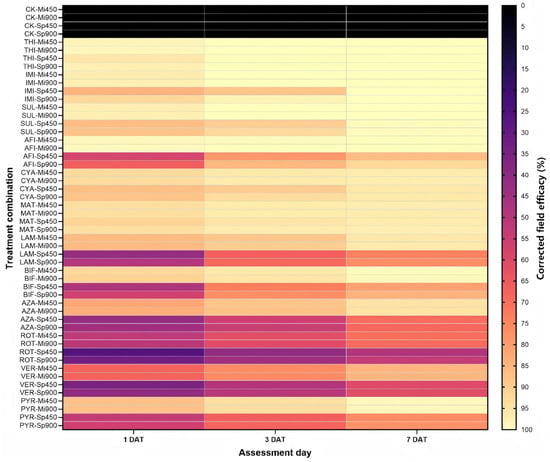
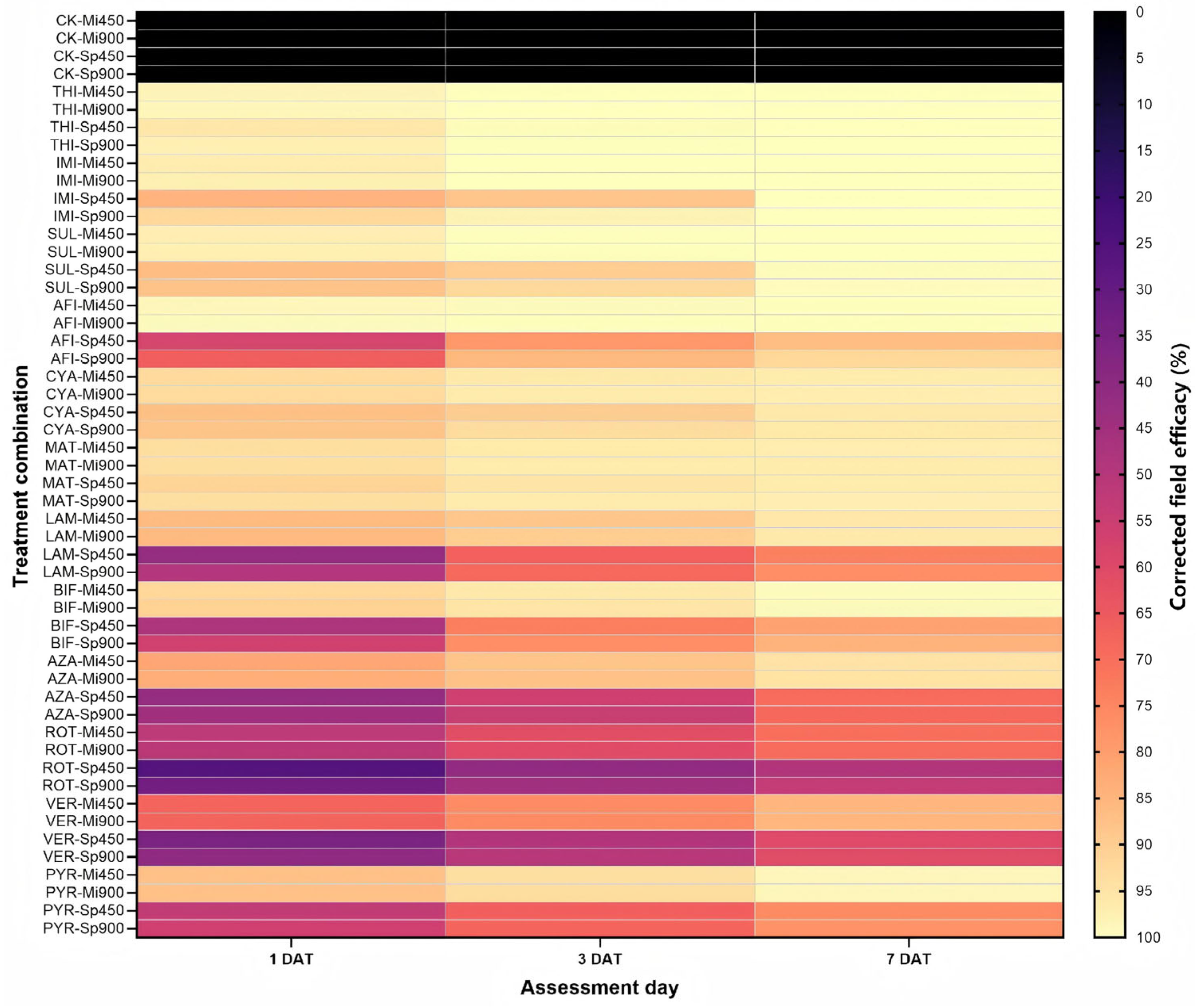
Each cell in the heatmap represents the mean corrected field efficacy from five plots for one insecticide–application method–spray volume combination at a given assessment day (Figure 1). Efficacy was corrected using the corresponding water control with the same application method and spray volume; lighter colors indicate higher efficacy. Within each assessment day, the Mi and Sp rows for the same insecticide and spray volume can be compared to visualize differences between application methods, whereas the 450 and 900 L/ha rows for the same insecticide and application method show differences associated with spray volume. Across active treatments, efficacy ranged from 25.8% to 99.1% at 1 DAT, 41.0% to 100.0% at 3 DAT, and 48.9% to 100.0% at 7 DAT. Variation was greatest at 1 DAT, when several treatments exceeded 90% efficacy while others remained below 50%. The minimum efficacy increased over time, but marked differences among treatments remained at 7 DAT. These patterns were consistent with the mixed-model results and showed no consistent visual effect of spray volume.
Figure 1.
Heatmap of corrected field efficacy for all treatment combinations against Stephanitis chinensis. Each row represents one combination of insecticide, application method, and spray volume; columns represent 1, 3, and 7 days after treatment (DAT). Values are mean corrected efficacy (%) from five field replicates. The water control is shown as 0 only for visual reference because corrected efficacy was calculated relative to this control. Row labels are formatted as treatment abbreviation–application method–spray volume. Abbreviations: CK, water control; THI, thiamethoxam; IMI, imidacloprid; SUL, sulfoxaflor; AFI, afidopyropen; CYA, cyantraniliprole; MAT, matrine; LAM, lambda-cyhalothrin; BIF, bifenthrin; AZA, azadirachtin; ROT, rotenone; VER, veratrine; PYR, pyrethrins; Mi, misting; Sp, conventional spraying; 450 and 900, spray volumes of 450 and 900 L/ha, respectively.
3.3. Misting More Frequently Improved Contact-Dominant Insecticide Efficacy
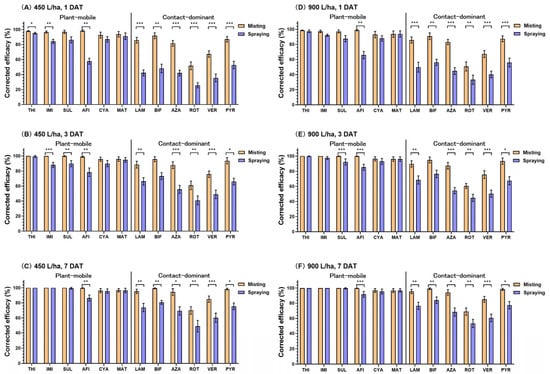
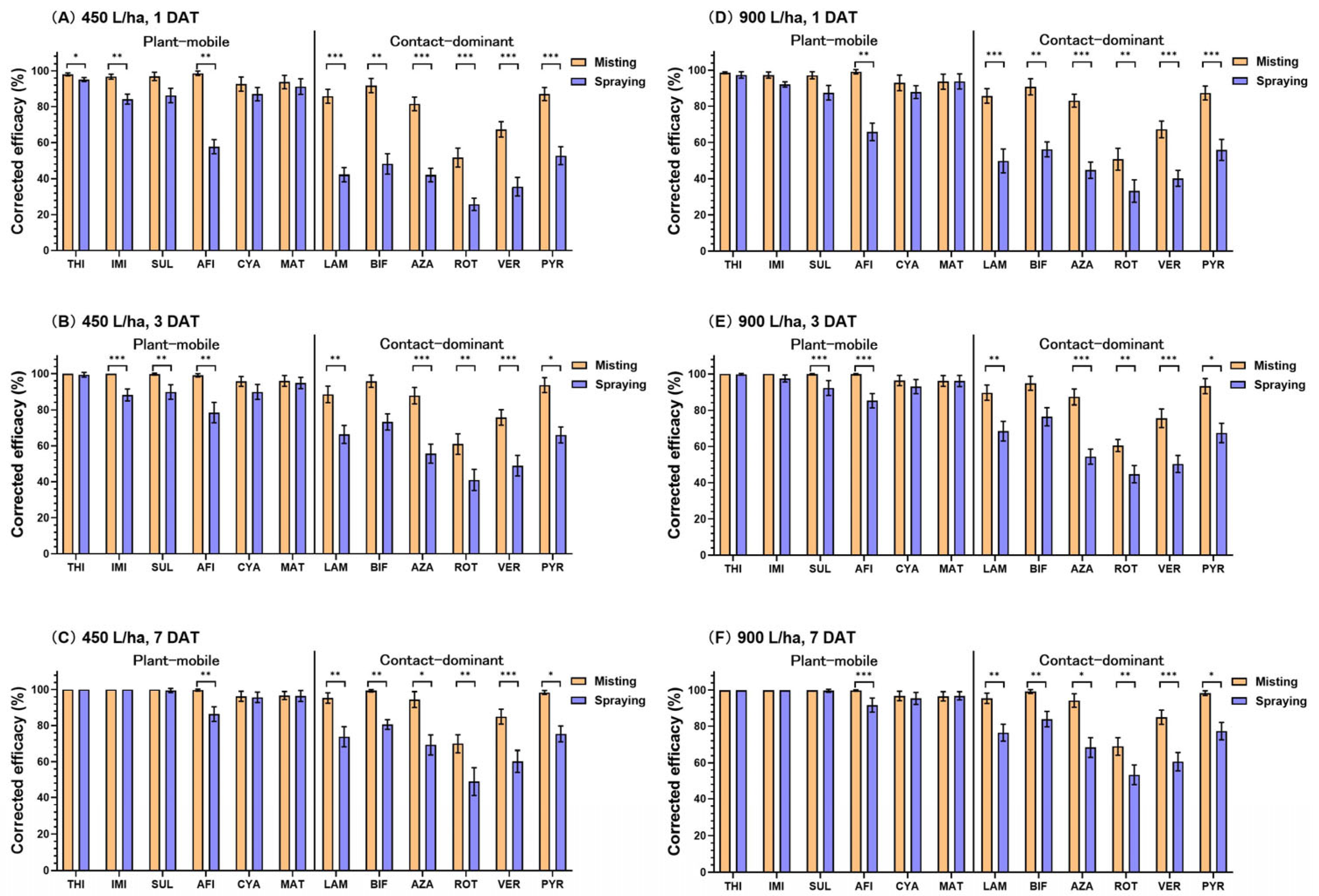
Under the primary analysis, the effect of application method differed markedly between insecticide mobility categories (Figure 2). Among plant-mobile insecticides, misting and conventional spraying differed significantly in 11 of 36 predefined comparisons. For contact-dominant insecticides, misting produced higher corrected efficacy in all 36 comparisons, and 34 differences remained significant after Holm adjustment.
Figure 2.
Effect of application method on corrected field efficacy of insecticides against Stephanitis chinensis. Corrected field efficacy was compared between misting and conventional spraying for each active ingredient at the same spray volume and assessment day. Panels show 450 L/ha at 1 DAT (A), 3 DAT (B), and 7 DAT (C), and 900 L/ha at 1 DAT (D), 3 DAT (E), and 7 DAT (F). Bars are means ± SE from five field replicates. Plant-mobile insecticides are shown on the left of each panel and contact-dominant insecticides on the right. Asterisks indicate significant method effects within an active ingredient, spray volume, and assessment day based on Welch’s t-test of logit-transformed corrected efficacy with Holm-adjusted p values. *, p < 0.05; **, p < 0.01; ***, p < 0.001. Unlabeled comparisons were not significant. Abbreviations: THI, thiamethoxam; IMI, imidacloprid; SUL, sulfoxaflor; AFI, afidopyropen; CYA, cyantraniliprole; MAT, matrine; LAM, lambda-cyhalothrin; BIF, bifenthrin; AZA, azadirachtin; ROT, rotenone; VER, veratrine; PYR, pyrethrins.
For several plant-mobile insecticides, the effect of application method was absent or limited to specific conditions. Cyantraniliprole and matrine showed no significant difference between misting and conventional spraying in any of the six comparisons. Thiamethoxam differed only at 1 DAT under 450 L/ha, when efficacy was 98.1 ± 0.4% with misting and 95.2 ± 0.5% with conventional spraying (t = 4.45, df = 6.05, adjusted p = 0.026). Imidacloprid showed a stronger early response at 450 L/ha. At 1 DAT, misting increased efficacy from 84.2 ± 1.2% to 96.8 ± 0.6% (t = 7.01, df = 5.08, adjusted p = 0.004). At 3 DAT, it increased efficacy from 88.2 ± 1.5% to 100.0 ± 0.0% (t = 33.66, df = 4.00, adjusted p < 0.001). Afidopyropen was the clearest exception in this category, with significantly higher efficacy under misting in all six comparisons.
The effect of application method was much more consistent for contact-dominant insecticides. For lambda-cyhalothrin at 1 DAT and 450 L/ha, efficacy was 85.8 ± 1.7% under misting and 42.2 ± 1.7% under conventional spraying (t = 13.19, df = 5.77, adjusted p < 0.001). At 900 L/ha, the corresponding values were 85.7 ± 1.8% and 49.7 ± 3.0% (t = 9.56, df = 7.61, adjusted p < 0.001). Azadirachtin showed a similar response: misting was significantly more effective than conventional spraying in all six comparisons. At 1 DAT, misting increased efficacy from 42.0 ± 1.6% to 81.5 ± 1.7% at 450 L/ha and from 44.7 ± 2.0% to 83.1 ± 1.6% at 900 L/ha (both adjusted p < 0.001).
3.4. Limited Effect of Spray Volume on Field Efficacy
Increasing spray volume from 450 to 900 L/ha did not consistently improve corrected field efficacy. Only one of 72 predefined comparisons remained significant after Holm adjustment. This difference occurred for imidacloprid applied by conventional spraying at 1 DAT: efficacy increased from 84.2 ± 1.2% at 450 L/ha to 92.1 ± 0.7% at 900 L/ha (t = −6.00, df = 7.99, adjusted p = 0.002). At 3 DAT, the volume comparison did not reach statistical significance after Holm adjustment; at 7 DAT, both spray volumes gave 100% corrected efficacy. Several treatments showed numerical increases at 900 L/ha, particularly under conventional spraying, but none was significant after adjustment. No statistically significant spray-volume differences were detected under misting or for any contact-dominant insecticide. Together with the nonsignificant main effect of spray volume in the mixed-effects model (Wald χ2 = 0.00, df = 1, p = 0.978), these results show that increasing spray volume alone did not consistently improve field efficacy.
3.5. Effects of Application Method, Spray Volume, and Canopy Position on Abaxial Droplet Deposition
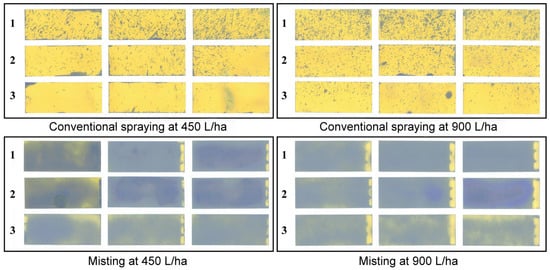
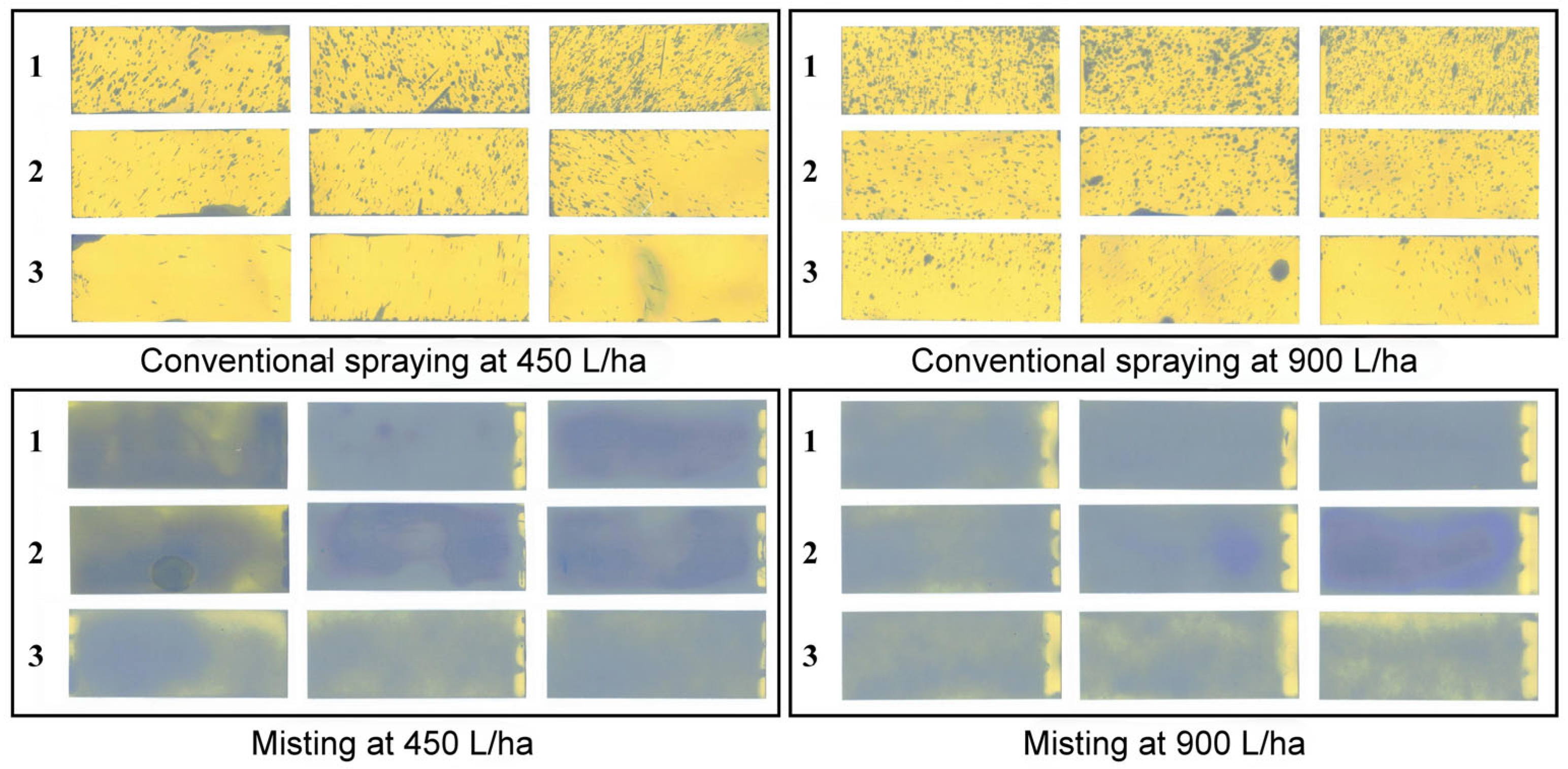
The water-sensitive paper assay showed a clear difference between application methods in droplet delivery to the abaxial leaf surface (Table 4; Figure 3). Under misting, all cards exceeded the measurement range of the image-analysis system, regardless of spray volume or canopy position: droplet density was >300 droplets/cm2 and coverage was >90.0%. Exact means and standard errors therefore could not be calculated for misting.
Table 4.
Droplet deposition on the abaxial surface of tea leaves under different application methods and spray volumes.
Figure 3.
Representative water-sensitive paper images showing droplet deposition on the abaxial surface of tea leaves under different application treatments. Rows 1, 2, and 3 in each treatment group represent upper-, middle-, and lower-canopy leaves, respectively. The three cards in each row represent the three independent application replicates. Treatment names and spray volumes are shown below each group. Water-sensitive paper is yellow before exposure; blue areas show droplet deposition.
Under conventional spraying, spray volume significantly affected droplet density (F1,4 = 9.26, p = 0.038) and coverage (F1,4 = 16.36, p = 0.016). Canopy position also affected density (F2,8 = 22.79, p < 0.001) and coverage (F2,8 = 114.04, p < 0.001). The spray volume × canopy position interaction was not significant for density (F2,8 = 0.33, p = 0.729) or coverage (F2,8 = 1.50, p = 0.279). Averaged across canopy positions, increasing spray volume from 450 to 900 L/ha increased mean droplet density from 10.8 to 18.7 droplets/cm2 and mean coverage from 7.0% to 11.8%.
The Holm-adjusted pairwise comparisons identified differences among specific conventional-spraying combinations (Table 4). Droplet density in the upper canopy exceeded that in the lower canopy at both 450 L/ha (adjusted p = 0.030) and 900 L/ha (adjusted p = 0.012). Droplet coverage in the upper canopy exceeded that in the middle and lower canopy at both spray volumes (all adjusted p ≤ 0.002). At the upper-canopy position, coverage was also greater at 900 than at 450 L/ha (adjusted p = 0.015).
4. Discussion
The field results suggest that access to the occupied leaf surface, rather than carrier volume alone, was important for control. This interpretation has a mechanistic basis: incomplete coverage can reduce the performance of contact pesticides [12], whereas cyantraniliprole has demonstrated translaminar activity against insects on untreated abaxial surfaces in other crops [17]. The more frequent benefit of misting for contact-dominant insecticides is compatible with these different exposure pathways. The mobility type × application method interaction was not significant. However, the three-way interaction among mobility type, application method, and assessment day was significant. The response to application method therefore changed with mobility category and assessment day.
Tea canopy structure can further restrict delivery to the feeding site. After chemicals were sprayed onto the plucking surface, Kawai et al. [13] measured deposits within the middle and bottom of tea foliage at approximately 20% and 1–2%, respectively, of those on the plucking surface. Another tea-field study reported greater droplet density and better control with a management sprayer than with a conventional knapsack sprayer, even at a reduced pesticide dose [46]. Our upper-to-lower canopy gradient under conventional spraying and greater abaxial deposition under misting are consistent with these findings. Similar effects of spray placement have been reported in other crop–pest systems. Air-assisted spraying, with or without electrostatic charging, improved deposition and control of Tetranychus urticae Koch (Acari: Tetranychidae) on chrysanthemum [47]. In glasshouse tomatoes, permethrin deposited on abaxial leaf surfaces controlled first-instar whiteflies [19]. Spray angle, airflow, charging conditions, and leaf orientation can affect deposition on concealed surfaces [15,37]. The separate water test gives some support for our explanation. But it does not show a link between insecticide deposits and field efficacy at the plot level, and also does not test how the formulation affects wetting.
The response to application method also depended on insecticide mobility and assessment day. Several plant-mobile insecticides showed little or no difference between misting and conventional spraying. Cyantraniliprole and matrine did not differ between methods in any of the predefined comparisons. The effect on thiamethoxam was restricted to one early comparison, while the differences for imidacloprid occurred at 1 and 3 DAT under 450 L/ha but were not maintained at 7 DAT. These temporal patterns may reflect continued uptake, movement within leaf tissues, or delayed insecticidal activity. Foliar-applied cyantraniliprole can move within leaves and control insects feeding on untreated abaxial surfaces, while matrine can be absorbed by leaves and transported to other plant tissues [17,25]. Movement within leaves may reduce the effect of uneven spray coverage. This could help explain our results. Afidopyropen was the clearest exception: misting significantly improved its efficacy in all six comparisons despite its classification as plant-mobile. Its limited foliar uptake and downward translocation in mustard (Brassica juncea) may explain why direct deposition remained important in the present study [48]. Insecticide mobility should therefore be regarded as a continuous and context-dependent property rather than a strict binary characteristic. Speed of action may also affect these results. Formulation and persistence may affect field performance [49,50]. High efficacy under conventional spraying leaves less room for further improvement. Because the mobility classifications used here were based largely on studies conducted in other crop species and with specific formulations, they represent mechanistic groupings rather than direct measurements of insecticide movement in tea plants.
Increasing spray volume from 450 to 900 L/ha increased droplet density and coverage under conventional spraying, but only one of the 72 predefined volume comparisons showed a statistically significant increase in field efficacy. Because the active ingredient dose per hectare was held constant, the higher spray volume produced a more dilute spray rather than a higher insecticide dose. Previous studies have shown that increasing spray volume can improve canopy coverage, although the response depends on the application system. For example, increasing spray volume from 30 to 90 L/ha improved droplet coverage in the surface and inner layers of tea canopies during unmanned aerial vehicle application, but the equipment and volume range differed substantially from those used in the present study [51]. Greater coverage also does not necessarily produce a proportional increase in control. Mortality of the potato psyllid, Bactericera cockerelli (Šulc) (Hemiptera: Triozidae), approached a plateau above moderate spray coverage [52], and higher spray volumes did not consistently increase lambda-cyhalothrin deposition or heliothine larval mortality in cotton [16]. By contrast, changing spray direction or improving canopy penetration can increase deposition on lower or concealed leaf surfaces without increasing water volume [14]. Thus, within the tested range of 450–900 L/ha, additional carrier volume improved recorded deposition under conventional spraying but did not overcome poor delivery to the abaxial surface and lower canopy. These findings do not indicate that spray volume is unimportant under all conditions; rather, they show that increasing volume alone was insufficient when spatial spray distribution remained poor.
The laboratory and field results further illustrate why insecticide activity should not be evaluated solely under conditions of uniform exposure. Leaf dipping treated the entire leaf surface, and 11 insecticides caused 90–100% mortality by 48 h. In the field, however, several contact-dominant insecticides were much less effective under conventional spraying. This difference indicates that high toxicity at a field-relevant concentration does not ensure control when exposure at the feeding site is limited. Luo et al. [20] similarly reported better control of S. chinensis with a knapsack mist sprayer than with a knapsack electric sprayer. However, air assistance or electrostatic charging does not always improve control because performance also depends on operating conditions, pesticide properties, canopy structure, and environmental factors [53,54]. Application equipment should therefore be selected according to pest location and canopy characteristics rather than on the assumption that a particular technology will perform consistently in all crops.
The main integrated pest management (IPM) implication of this study is that pest location, spray delivery, and insecticide mobility should be considered jointly. For S. chinensis and other pests that occupy abaxial or lower-canopy sites, control decisions should begin by determining whether spray reaches the occupied surface. When abaxial deposition is poor, increasing carrier volume or repeating the same conventional application may not correct the main constraint. Spray delivery to the leaf underside needs particular attention when using the tested contact-dominant insecticides. In our trial, misting improved efficacy more often for these insecticides than for plant-mobile insecticides. The benefit varied among insecticides and assessment days. Mobility, however, should not be treated as a safety advantage. Product selection within an IPM program should also consider field efficacy, local registration, residue dissipation and transfer to the infusion, preharvest interval, effects on natural enemies, and resistance-management needs [4,28,55,56,57,58]. Botanical insecticides may contribute to this strategy when they meet these criteria, but botanical origin alone does not ensure low residue risk, low non-target toxicity, or reliable field efficacy. Matching insecticide properties to pest location and spray delivery may reduce initial control failure and unnecessary retreatment, although its effects on cumulative pesticide use and tea residues require direct evaluation.
5. Conclusions
Application method was more important than spray volume in determining the field control of Stephanitis chinensis. Although 11 of the 12 insecticides caused 90.0–100.0% mortality after 48 h in the leaf-dip bioassays, their field performance varied across the literature-based mobility categories and with spray delivery. Misting increased abaxial deposition throughout the tea canopy and significantly improved efficacy in 34 of 36 comparisons involving contact-dominant insecticides, compared with 11 of 36 comparisons involving plant-mobile insecticides. Increasing spray volume from 450 to 900 L/ha significantly improved efficacy in only one of 72 comparisons. Thus, improving spray delivery to abaxial leaf surfaces and the middle and lower canopy was more effective than increasing spray volume alone. These results support improving target coverage when applying the tested contact-dominant insecticides. Whether movement of the other insecticides within tea plants compensated for incomplete deposition remains unverified. These findings provide a practical basis for matching insecticide properties with application methods while avoiding unnecessary increases in spray volume. Because the field experiment was conducted at one location during a single season, further validation across locations and seasons is needed before broader recommendations are made.
Supplementary Materials
The following supporting information can be downloaded at: https://www.mdpi.com/article/10.3390/agriculture16212333/s1, Data S1: Raw data from the laboratory bioassay, field efficacy experiment, and water-sensitive paper experiment.
Author Contributions
Conceptualization, T.T., F.Z. and B.H.; methodology, T.T., F.Z.; software, T.T. and B.H.; validation, T.T., Y.Z. and T.Z.; formal analysis, T.T., Y.Z., Z.C., and T.Z.; investigation, T.T., F.Z., Y.Z. and Y.L.; resources, Y.L., F.Z. and B.H.; data curation, T.T., Y.Z. and T.Z.; writing—original draft preparation, T.T.; writing—review and editing, F.Z., Y.Z., T.Z., Y.L., Z.C. and B.H.; visualization, T.T.; supervision, F.Z. and B.H.; project administration, T.T.; funding acquisition, T.T. and F.Z. All authors have read and agreed to the published version of the manuscript.
Funding
This research was funded by “Science and Technology Program of Shaanxi Academy of Sciences, grant number 2024K-26” “the Key Research and Development Program of Shaanxi Province, grant number 2025NC-YBXM-069” and “the Science and Technology Program of the Bio-Agriculture Institute of Shaanxi, grant number 2024SY01”.
Data Availability Statement
The original contributions presented in this study are included in the Supplementary Material. Further inquiries can be directed to the corresponding author.
Conflicts of Interest
The authors declare no conflicts of interest. The funders had no role in the design of the study; in the collection, analyses, or interpretation of data; in the writing of the manuscript; or in the decision to publish the results.
References
- Shea, K.; Possingham, H.P.; Murdoch, W.W.; Roush, R. Active adaptive management in insect pest and weed control: Intervention with a plan for learning. Ecol. Appl. 2002, 12, 927–936. [Google Scholar] [CrossRef]
- Hashemi, S.M.; Damalas, C.A. Farmers’ perceptions of pesticide efficacy: Reflections on the importance of pest management practices adoption. J. Sustain. Agric. 2011, 35, 69–85. [Google Scholar] [CrossRef] [Scilit]
- Sun, S.; Hu, R.; Zhang, C.; Shi, G. Do farmers misuse pesticides in crop production in China? Evidence from a farm household survey. Pest Manag. Sci. 2019, 75, 2133–2141. [Google Scholar] [CrossRef] [Scilit] [PubMed]
- Chen, Z.; Luo, Z. Management of insect pests on tea plantations: Safety, sustainability, and efficiency. Annu. Rev. Entomol. 2025, 70, 359–377. [Google Scholar] [CrossRef] [Scilit] [PubMed]
- Jiang, H.; Wang, Y.; Chen, S.; Liao, S.; Chen, T.; Wang, X. Potential for distribution expansion of Stephanitis chinensis in China based on MaxEnt model. Insects 2026, 17, 279. [Google Scholar] [CrossRef] [Scilit] [PubMed]
- Liu, H.-L.; Chen, Z.-T.; Wu, X.-L.; Pu, D.-Q. Genetic diversity and population structure of the tea lace bug Stephanitis chinensis Drake, 1948 (Hemiptera: Tingidae) in central China. J. Entomol. Res. Soc. 2024, 26, 225–238. [Google Scholar] [CrossRef] [Scilit]
- Li, Z.Y.; Chen, H.; Tu, Z.J.; Chen, H.; Zhu, L.X.; Zhang, Y.L.; Zhang, S.Z. Occurrence dynamics and integrated prevention and control technology of the tea ridge crown lace bug (Stephanitis chinensis) in Ankang city. China Plant Prot. 2018, 38, 58–61. [Google Scholar]
- Luo, H.; Cui, Q.C.; Chen, Q.H.; Ma, H.J.; Zhang, Q. Occurrence regularity and integrated prevention and control technology of the tea lace bug (Stephanitis chinensis) in the Enshi tea area. China Plant Prot. 2023, 43, 62–64. [Google Scholar]
- Wang, C.Y. Biology and control of the tea lace bug. Chin. Bull. Entomol. 1988, 25, 339–341. (In Chinese) [Google Scholar]
- Zhou, X.; Lang, K.; Zhang, S.; Yu, Y.; Li, S.; Wang, Z.; Bi, S.; Zou, Y.; Wang, J.; Liu, F. Relationships between Pentatomoidea insects and natural enemies spiders in ‘Baihaozao’ tea garden. J. South China Agric. Univ. 2018, 39, 46–54. [Google Scholar] [CrossRef]
- Cremonez, P.S.G.; Perier, J.D.; Nagaoka, M.M.; Simmons, A.M.; Riley, D.G. Precision and accuracy of field versus laboratory bioassay insecticide efficacy for the control of immature Bemisia tabaci. Insects 2023, 14, 645. [Google Scholar] [CrossRef] [Scilit] [PubMed]
- Martini, X.; Kincy, N.; Nansen, C. Quantitative impact assessment of spray coverage and pest behavior on contact pesticide performance. Pest Manag. Sci. 2012, 68, 1471–1477. [Google Scholar] [CrossRef] [Scilit] [PubMed]
- Kawai, A.; Kohata, K.; Yamaguchi, Y. Deposition of chemicals on various parts of tea bushes sprayed on the plucking surface. Appl. Entomol. Zool. 1999, 34, 387–389. [Google Scholar] [CrossRef] [Scilit]
- Foqué, D.; Pieters, J.G.; Nuyttens, D. Effect of spray angle and spray volume on deposition of a medium droplet spray with air support in ivy pot plants. Pest Manag. Sci. 2014, 70, 427–439. [Google Scholar] [CrossRef] [Scilit] [PubMed]
- Maski, D.; Durairaj, D. Effects of charging voltage, application speed, target height, and orientation upon charged spray deposition on leaf abaxial and adaxial surfaces. Crop Prot. 2010, 29, 134–141. [Google Scholar] [CrossRef] [Scilit]
- Reed, J.T.; Smith, D.B. Droplet size and spray volume effects on insecticide deposit and mortality of heliothine (Lepidoptera: Noctuidae) larvae in cotton. J. Econ. Entomol. 2001, 94, 640–647. [Google Scholar] [CrossRef] [Scilit] [PubMed]
- Barry, J.D.; Portillo, H.E.; Annan, I.B.; Cameron, R.A.; Clagg, D.G.; Dietrich, R.F.; Watson, L.J.; Leighty, R.M.; Ryan, D.L.; McMillan, J.A.; et al. Movement of cyantraniliprole in plants after foliar applications and its impact on the control of sucking and chewing insects. Pest Manag. Sci. 2015, 71, 395–403. [Google Scholar] [CrossRef] [Scilit] [PubMed]
- Weichel, L.; Nauen, R. Uptake, translocation and bioavailability of imidacloprid in several hop varieties. Pest Manag. Sci. 2004, 60, 440–446. [Google Scholar] [CrossRef] [Scilit] [PubMed]
- Adams, A.J.; Palmer, A. Air-assisted electrostatic application of permethrin to glasshouse tomatoes: Droplet distribution and its effect upon whiteflies (Trialeurodes vaporariorum) in the presence of Encarsia formosa. Crop Prot. 1989, 8, 40–48. [Google Scholar] [CrossRef] [Scilit]
- Luo, H.; Cui, Q.; Cai, X.; Luo, F.; Zhang, Q.; Chen, Z. Study on the safe pesticides and efficient application method against tea lace bug (Stephanitis chinensis Drake). J. Tea Sci. 2021, 41, 361–370. [Google Scholar] [CrossRef]
- Jiang, H.Y.; Wang, X.Q.; Chen, S.C.; Hu, X. An artificial rearing method for Stephanitis chinensis. Chinese Patent CN113519467B, 6 December 2022. (In Chinese) [Google Scholar] [CrossRef] [Scilit]
- Dumra, N.; Rolania, K.; Yadav, S.S.; Kumari, S. Translaminar activity of different insecticides against Bemisia tabaci. Indian J. Agric. Sci. 2023, 93, 534–538. [Google Scholar] [CrossRef] [Scilit]
- Horikoshi, R.; Goto, K.; Mitomi, M.; Oyama, K.; Hirose, T.; Sunazuka, T.; Ōmura, S. Afidopyropen, a novel insecticide originating from microbial secondary extracts. Sci. Rep. 2022, 12, 2827. [Google Scholar] [CrossRef] [Scilit] [PubMed]
- Australian Pesticides and Veterinary Medicines Authority. Public Release Summary on the Evaluation of the New Active Constituent Sulfoxaflor in the Product Transform Insecticide; Australian Pesticides and Veterinary Medicines Authority: Kingston, ACT, Australia, 2013. Available online: https://www.apvma.gov.au/sites/default/files/publication/14041-prs-sulfoxaflor.pdf (accessed on 30 September 2026).
- Sun, Z.; Zhang, B.; Li, W.; Zhou, Y.; Zhang, J.; Wang, J.; Ma, Z. Matrine can be absorbed and transmitted bidirectionally to defend against aphids (Hemiptera: Aphididae) on wheat and pepper. Pest Manag. Sci. 2023, 79, 2098–2106. [Google Scholar] [CrossRef] [Scilit] [PubMed]
- Copping, L.G.; Duke, S.O. Natural products that have been used commercially as crop protection agents. Pest Manag. Sci. 2007, 63, 524–554. [Google Scholar] [CrossRef] [Scilit] [PubMed]
- Grdiša, M.; Gršić, K. Botanical insecticides in plant protection. Agric. Conspec. Sci. 2013, 78, 85–93. Available online: https://hrcak.srce.hr/104637 (accessed on 24 August 2026).
- Sparks, T.C.; Nauen, R. IRAC: Mode of action classification and insecticide resistance management. Pestic. Biochem. Physiol. 2015, 121, 122–128. [Google Scholar] [CrossRef] [Scilit] [PubMed]
- Sundaram, K.M.S.; Campbell, R.; Sloane, L.; Studens, J. Uptake, translocation, persistence and fate of azadirachtin in aspen plants (Populus tremuloides Michx.) and its effect on pestiferous two-spotted spider mite (Tetranychus urticae Koch). Crop Prot. 1995, 14, 415–421. [Google Scholar] [CrossRef] [Scilit]
- Thoeming, G.; Draeger, G.; Poehling, H.-M. Soil application of azadirachtin and 3-tigloyl-azadirachtol to control western flower thrips, Frankliniella occidentalis (Thysanoptera: Thripidae): Translocation and persistence in bean plants. Pest Manag. Sci. 2006, 62, 759–767. [Google Scholar] [CrossRef] [Scilit] [PubMed]
- Larew, H.G. Limited occurrence of foliar-, root-, and seed-applied neem seed extract toxin in untreated plant parts. J. Econ. Entomol. 1988, 81, 593–598. [Google Scholar] [CrossRef] [Scilit]
- Insecticide Resistance Action Committee. IRAC Susceptibility Test Method 019: Aphids, Adult/Nymphs, Version 3.4. Available online: https://irac-online.org/methods/aphids-adultnymphs/ (accessed on 24 August 2026).
- Sabra, S.G.; Abbas, N.; Hafez, A.M. Evaluation of insecticide toxicity and field performance against Myzus persicae (Hemiptera: Aphididae) in laboratory and greenhouse conditions. Agronomy 2025, 15, 280. [Google Scholar] [CrossRef] [Scilit]
- Tian, Y.; Chen, Z.; Huang, X.; Zhang, L.; Zhang, Z. Evaluation of botanicals for management of piercing–sucking pests and the effect on beneficial arthropod populations in tea trees Camellia sinensis (L.) O. Kuntze (Theaceae). J. Insect Sci. 2020, 20, 27. [Google Scholar] [CrossRef] [Scilit] [PubMed]
- Kakoki, S.; Kamimuro, T.; Tsuda, K.; Sakamaki, Y. Use of a lower-volume, surface pesticide spray conserves spider assemblages in a tea field. J. Econ. Entomol. 2018, 111, 1595–1604. [Google Scholar] [CrossRef] [Scilit] [PubMed]
- Xu, D.-J.; Gu, Z.-Y.; Xu, G.-C.; Xu, X.-L. Influence of sprayer and application rate on pesticide deposit character on rice canopy. Sci. Agric. Sin. 2013, 46, 4284–4292. [Google Scholar] [CrossRef]
- Xu, S.; Wang, X.; Li, C.; Ran, X.; Zhong, Y.; Jin, Y.; Song, J. Effect of airflow angle on abaxial surface deposition in air-assisted spraying. Front. Plant Sci. 2023, 14, 1211104. [Google Scholar] [CrossRef] [Scilit] [PubMed]
- Zhao, J.; Wang, C.; Totton, S.C.; Cullen, J.N.; O’Connor, A.M. Reporting and analysis of repeated measurements in preclinical animals experiments. PLoS ONE 2019, 14, e0220879. [Google Scholar] [CrossRef] [Scilit] [PubMed]
- Tukey, J.W. Comparing individual means in the analysis of variance. Biometrics 1949, 5, 99–114. [Google Scholar] [CrossRef] [Scilit]
- Henderson, C.F.; Tilton, E.W. Tests with acaricides against the brown wheat mite. J. Econ. Entomol. 1955, 48, 157–161. [Google Scholar] [CrossRef] [Scilit]
- Laird, N.M.; Ware, J.H. Random-effects models for longitudinal data. Biometrics 1982, 38, 963–974. [Google Scholar] [CrossRef] [Scilit]
- Welch, B.L. The generalization of ‘Student’s’ problem when several different population variances are involved. Biometrika 1947, 34, 28–35. [Google Scholar] [CrossRef] [Scilit] [PubMed]
- Holm, S. A simple sequentially rejective multiple test procedure. Scand. J. Stat. 1979, 6, 65–70. [Google Scholar]
- Robinson, T.J.; Brenneman, W.A.; Myers, W.R. An intuitive graphical approach to understanding the split-plot experiment. J. Stat. Educ. 2009, 17. [Google Scholar] [CrossRef] [Scilit][Green Version]
- Satterthwaite, F.E. An approximate distribution of estimates of variance components. Biom. Bull. 1946, 2, 110–114. [Google Scholar] [CrossRef] [Scilit]
- Luo, Z.; Bian, L.; Cai, X.; Chen, Z. Pesticide deposit characteristics and its field efficacy evaluation of a new type of tea management machine. J. Tea Sci. 2016, 36, 52–58. [Google Scholar] [CrossRef]
- Cerqueira, D.T.R.; Raetano, C.G.; Dal Pogetto, M.H.F.A.; Carvalho, M.M.; Prado, E.P.; Costa, S.I.A.; Moreira, C.A.F. Optimization of spray deposition and Tetranychus urticae control with air-assisted and electrostatic sprayer. Sci. Agric. 2017, 74, 32–40. [Google Scholar] [CrossRef] [Scilit]
- Fang, N.; Zhao, X.; Li, Y.; Luo, Y.; Wang, X.; He, H.; Zhang, C.; Jiang, J. Uptake, translocation and subcellular distribution of broflanilide, afidopyropen, and flupyradifurone in mustard (Brassica juncea). J. Hazard. Mater. 2023, 452, 131381. [Google Scholar] [CrossRef] [Scilit] [PubMed]
- Kumar, P.; Poehling, H.-M. Persistence of soil and foliar azadirachtin treatments to control sweetpotato whitefly Bemisia tabaci Gennadius (Homoptera: Aleyrodidae) on tomatoes under controlled (laboratory) and field (netted greenhouse) conditions in the humid tropics. J. Pest Sci. 2006, 79, 189–199. [Google Scholar] [CrossRef] [Scilit]
- Sarais, G.; Angioni, A.; Lai, F.; Cabras, P.; Caboni, P. Persistence of two neem formulations on peach leaves and fruit: Effect of the distribution. J. Agric. Food Chem. 2009, 57, 2457–2461. [Google Scholar] [CrossRef] [Scilit] [PubMed]
- Wu, M.; Li, Z.; Yang, Y.; Meng, X.; Luo, Z.; Bian, L.; Xiu, C.; Fu, N.; Chen, Z.; Wang, G.; et al. The effect of operational parameters of plant protection unmanned aerial vehicle on the droplet deposition distribution in tea canopy. J. Tea Sci. 2025, 45, 535–544. [Google Scholar] [CrossRef]
- Nansen, C.; Vaughn, K.; Xue, Y.; Rush, C.; Workneh, F.; Goolsby, J.; Troxclair, N.; Anciso, J.; Gregory, A.; Holman, D.; et al. A decision-support tool to predict spray deposition of insecticides in commercial potato fields and its implications for their performance. J. Econ. Entomol. 2011, 104, 1138–1145. [Google Scholar] [CrossRef] [Scilit] [PubMed]
- Latheef, M.A.; Carlton, J.B.; Kirk, I.W.; Hoffmann, W.C. Aerial electrostatic-charged sprays for deposition and efficacy against sweet potato whitefly (Bemisia tabaci) on cotton. Pest Manag. Sci. 2009, 65, 744–752. [Google Scholar] [CrossRef] [Scilit] [PubMed]
- Pelegrini, G.; Souza, A.M.; Ferreira, P.H.U.; Monteiro, G.G.; Ferreira, M.C. Air-assisted spraying and electrically charged droplets for Bemisia tabaci control in soybeans. Pest Manag. Sci. 2022, 78, 4618–4627. [Google Scholar] [CrossRef] [Scilit] [PubMed]
- Seenivasan, S.; Muraleedharan, N.N. Residues of lambda-cyhalothrin in tea. Food Chem. Toxicol. 2009, 47, 502–505. [Google Scholar] [CrossRef] [Scilit] [PubMed]
- Ward, L.T.; Hladik, M.L.; Guzman, A.; Winsemius, S.; Bautista, A.; Kremen, C.; Mills, N.J. Pesticide exposure of wild bees and honey bees foraging from field border flowers in intensively managed agriculture areas. Sci. Total Environ. 2022, 831, 154697. [Google Scholar] [CrossRef] [Scilit] [PubMed]
- Food and Agriculture Organization of the United Nations; World Health Organization. Guidelines for the Registration of Pesticides: International Code of Conduct on the Distribution and Use of Pesticides; WHO/HTM/NTD/WHOPES/2010.7; World Health Organization: Geneva, Switzerland, 2010; Available online: https://iris.who.int/handle/10665/70293 (accessed on 24 August 2026).
- Wang, X.; Zhou, L.; Zhang, X.; Luo, F.; Chen, Z. Transfer of pesticide residue during tea brewing: Understanding the effects of pesticide’s physico-chemical parameters on its transfer behavior. Food Res. Int. 2019, 121, 776–784. [Google Scholar] [CrossRef] [Scilit] [PubMed]

Disclaimer/Publisher’s Note: The statements, opinions and data contained in all publications are solely those of the individual author(s) and contributor(s) and not of MDPI and/or the editor(s). MDPI and/or the editor(s) disclaim responsibility for any injury to people or property resulting from any ideas, methods, instructions or products referred to in the content. |
© 2026 by the authors. Licensee MDPI, Basel, Switzerland. This article is an open access article distributed under the terms and conditions of the Creative Commons Attribution (CC BY) license.