


Abstract
Coconut coir, a key substrate in soilless cultivation, presents challenges for accurate moisture detection because of its complex internal structure, which limits the understanding of water infiltration and redistribution. This study employed RGB image recognition techniques combined with machine learning algorithms to systematically investigate the effects of initial moisture content (10%, 20%, and 30%), coarse-to-fine coir volume ratio (1:0, 1:1, and 0:1), and emitter discharge rate (1.0, 1.5, and 2.0 L h−1) on wetting front morphology, water transport dynamics, and moisture variation within coir substrates. Morphological features of the wetting front were extracted from images and incorporated into three machine learning models—Support Vector Regression (SVR), Random Forest (RF), and Polynomial Regression—to construct a predictive framework for coir moisture estimation. The results showed that the SVR model achieved the best predictive performance in coarse coir substrates (R2 = 0.89, RMSE = 3.37%), whereas Polynomial Regression performed best in mixed substrates (R2 = 0.861, RMSE = 4.34%). All models exhibited lower accuracy in fine coir, particularly at high moisture levels. Under the same irrigation volume, increasing the initial moisture content enhanced both the water transport rate and the wetting front extent, with the aspect ratio (AR) decreasing from approximately 2.0 to 1.3, indicating a morphological transition of the wetting front from a “thumb-shaped” to a “hemispherical” pattern. Coarse particles facilitated vertical infiltration, while fine particles exhibited stronger water retention. By integrating RGB image recognition with machine learning approaches, this study achieved reliable prediction of coir moisture content and proposed an optimal management strategy using mixed substrates with an initial moisture content of 20–30% to balance infiltration efficiency and water-holding capacity while minimizing percolation risk. These findings provide a robust technical pathway for precise water management in coir-based cultivation systems.
1. Introduction
Drip irrigation, as an efficient and precise irrigation method, plays a vital role in addressing global water scarcity and improving agricultural productivity [1]. Unlike conventional irrigation techniques, drip irrigation directly delivers water and nutrients to the crop root zone, significantly improving water and fertilizer use efficiency [2] while reducing deep percolation and surface evaporation [3]. Moreover, drip irrigation optimizes the root zone’s water and nutrient environment, increasing crop yield and reducing management costs [4]. However, improper drip irrigation management can lead to water and nutrient waste, negatively impacting crop yield and quality. Therefore, achieving highly efficient regulation and real-time monitoring of drip irrigation systems has become a key research focus in precision agriculture and irrigation management.
To realize precise control of drip irrigation, many studies have investigated the morphology of wetting fronts and characteristics of soil water movement [5]. Previous research has shown that parameters such as emitter discharge rate, initial moisture content, particle size of the medium, and emitter spacing strongly affect infiltration and distribution patterns [6,7]. Nogueira et al. (2021) [8] found that combinations of soil texture and buried depth of drip lines can markedly alter the wetting front shape and diffusion range. Zhao et al. (2024) [9] reported that adjusting the emitter flow rate and wetted proportion improves soil aeration and water use efficiency, while Wang et al. (2024) [10] observed that under unconventional water sources, the wetting front tends to exhibit a “pear-shaped” rather than “hemispherical” pattern, reflecting the strong sensitivity of infiltration morphology to medium properties. Furthermore, numerous studies have used the HYDRUS model to simulate infiltration processes under different irrigation parameters and validated the simulations experimentally, providing a theoretical basis for system optimization [11,12].
Although substantial progress has been made in understanding soil infiltration processes, research on soilless cultivation media, particularly coconut coir substrates, remains limited [13]. Coconut coir, as an eco-friendly and highly efficient growing medium, has distinctive physical properties—low bulk density, high water-holding capacity, good aeration, and high porosity—that make it suitable for root development [14]. However, its physical structure differs greatly from that of natural soil, leading to fundamental differences in water transport behavior and wetting front morphology. A systematic understanding of water infiltration and redistribution in coir is crucial for optimizing high-frequency drip irrigation scheduling and improving water use efficiency in controlled-environment agriculture.
Meanwhile, moisture sensors developed for coir substrates remain immature, and their installation may disturb the pore structure, altering local flow and hydraulic conditions [15,16]. This limitation highlights the need for non-contact, low-cost, and visual methods for substrate moisture monitoring. With rapid advances in computational technologies in agriculture [17,18], image recognition combined with machine learning algorithms has shown great potential in estimating soil and substrate moisture content [19]. Recent studies have demonstrated that machine learning models such as Random Forest (RF) and Support Vector Regression (SVR) can accurately predict moisture content across various soil and substrate types [20,21,22]. Collectively, these findings suggest that machine learning methods integrating multiple data sources are feasible and widely applicable for developing intelligent, non-destructive moisture estimation approaches.
However, most existing image-based moisture studies have concentrated on mineral soils, while investigations on coconut coir—a fibrous, highly porous soilless medium—remain extremely limited. The distinct pore geometry and hydraulic behavior of coir substrates present unique challenges for moisture characterization. Therefore, this study focuses on coconut coir substrates and integrates image recognition with multiple machine learning algorithms to develop predictive models for moisture content estimation. Specifically, the objectives of this study are to: (1) develop and evaluate the reliability of image feature–based moisture prediction models; (2) elucidate the effects of different drip irrigation parameters (particle-size ratio, initial moisture content, and emitter flow rate) on wetting front morphology and water movement dynamics; (3) propose an optimized combination of key parameters for efficient water utilization in coir-based systems. Through the combination of image-based analysis and machine learning modeling, this study aims to provide a novel methodological and theoretical framework for precision irrigation and water management in soilless cultivation systems.
2. Materials and Methods
2.1. Experimental Materials and Setup
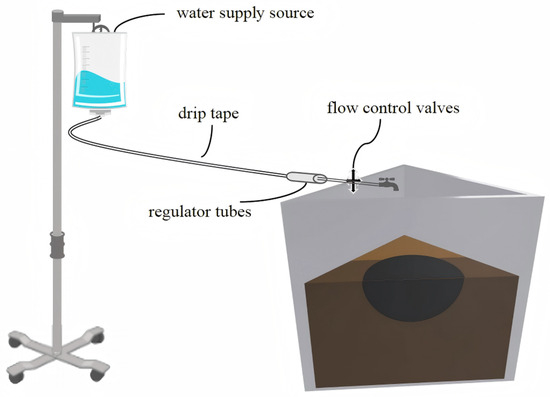
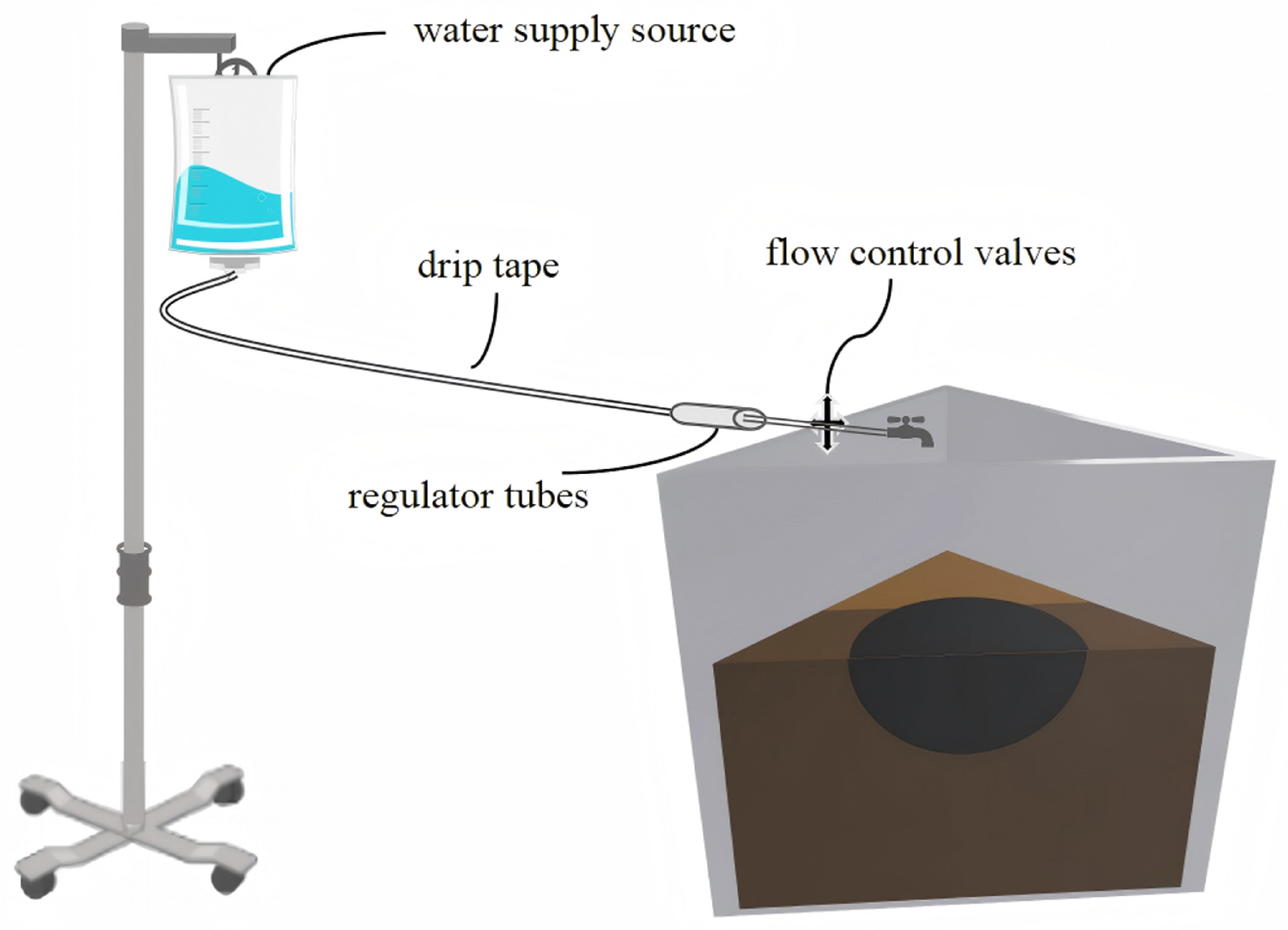
The experimental coconut coir substrates consisted of fine coir (0–1 mm) and coarse coir (4–15 mm), supplied by Shandong Xindema Biotechnology Co., Ltd. (Dezhou, China). The coir was pretreated by soaking, washing, filtering, and air-drying before being uniformly packed into the experimental apparatus, as illustrated in Figure 1. The experimental system comprised a 5 L water reservoir, a flow control valve, a water delivery pipe, a pressure-stabilizing pipe, an emitter, an isosceles right triangular prism-shaped substrate column (30 cm × 30 cm × 40 cm), and an image acquisition device (iPhone 11, Apple, Zhengzhou, China). Tap water was used as the water source, with the water bag placed 0.5 m above the substrate column. The water pressure was stabilized using a pressure-stabilizing rod, and the emitter was fixed at the center of the front wall of the substrate column. The image acquisition device was mounted on a tripod placed 1.5 m in front of the substrate column to capture dynamic images of the wetting front. All images were captured under constant illumination within a controlled photo booth to minimize lighting variation and ensure uniform color conditions. Specific photography parameters are listed in Table 1.
Figure 1.
Schematic diagram of the infiltration test device for coconut coir substrate.
Table 1.
Parameters of the image acquisition device.
2.2. Experimental Design
Different substrate particle size ratios, initial water contents (volumetric water content), and emitter discharge rates are critical factors influencing water transport in coir. Based on the volumetric ratio of coarse to fine coir, three substrate types were prepared: pure coarse coir (1:0, denoted as C), coarse–fine coir mixture (1:1, denoted as H), and pure fine coir (0:1, denoted as X). Among them, the equal-volume mixture represents the most commonly used substrate form in protected agriculture, while pure coarse and pure fine substrates correspond to the two extremes of particle-size distribution. The comparison among these three treatments enabled a systematic analysis of the mechanisms by which particle-size differences affect infiltration and water-retention characteristics of the substrate. The physical properties of the three substrates are presented in Table 2. Three initial moisture content levels (10%, 20%, and 30%) were designated as M10, M20, and M30, respectively. Similarly, three emitter flow rates (1 L/h, 1.5 L/h, and 2 L/h) were denoted as D1, D1.5, and D2. The physical properties of the three substrate types are listed in Table 2. All treatments ensured the same irrigation volume of 250 mL. The detailed irrigation duration for each treatment is listed in Table 3.
Table 2.
Physical properties of coconut coir substrate with different particle size mixing ratios.
Table 3.
Experimental design.
2.3. Experimental Methods
The experiments were conducted in the laboratory of the Zibo Digital Agriculture and Rural Research Institute. First, coarse and fine coir were mixed according to the experimental design to prepare the three types of coconut coir substrate.
2.3.1. Moisture Content Prediction Model Based on Image Parameters
To develop image-based models for predicting water content, the three coir substrates were mixed with distilled water at predetermined volumetric ratios to achieve different initial moisture gradients. A total of 150 samples were prepared and used as the modeling database. These samples consisted of 50 for each substrate type (coarse, mixed, and fine coir). Each sample was independently prepared in a fixed acrylic container by gradually adding and thoroughly mixing distilled water until the target volumetric moisture content was reached. The preparation process was repeated under identical temperature, illumination, and humidity conditions to ensure consistency and reproducibility. Images of all samples were acquired using the same imaging equipment as described in Table 1, under constant illumination within a controlled photo booth. The camera was mounted on a tripod to maintain a consistent angle and distance throughout all image captures. Images were preprocessed using Adobe Photoshop 2015 by cropping the central square region of each sample, following the methods of Baek et al. (2024) [20] and Naeimi et al. (2024) [23], to eliminate background and container-edge interference. To minimize the effect of uneven illumination on image analysis and to enhance feature stability under variable lighting conditions [24,25,26], six color-related parameters—red (R), green (G), blue (B), hue (H), saturation (S), and value (V)—were extracted using the “EBImage” package in RStudio (v4.5.0). Pearson correlation analysis was then performed within the training dataset to assess the relationships between these image parameters and water content, ensuring that the validation data remained unseen during feature selection to avoid information leakage. Three regression algorithms were employed for model construction: quadratic polynomial regression (Polynomial), random forest regression (RF), and support vector regression (SVR). The dataset was divided into a training set (80%) and a validation set (20%) using stratified random sampling, ensuring that each subset contained representative samples from all substrate types and moisture levels. The training set was used for model fitting and parameter tuning, while the validation set served for independent testing. 10-fold cross-validation procedure was applied within the training dataset to evaluate and optimize model performance. Grid search for the RF and SVR models was nested inside the cross-validation loop to ensure that validation data were not exposed during model optimization. The SVR model was implemented using the e1071 package with a radial basis function (RBF) kernel, and the optimal combination of cost, gamma, and epsilon was selected through grid search over the ranges of cost (0.1–100), gamma (0.001–1), and epsilon (0.01–0.5). The RF model was implemented with the random Forest package, with mtry (2–6) and ntree (200–1000) optimized. The polynomial regression model was fitted as a quadratic function without parameter tuning. Finally, all models were retrained on the full training set using the optimized parameters and evaluated on the independent validation set.
2.3.2. Substrate Column Water Transport Experiment
To investigate water movement in coir, substrate columns were prepared with three initial water contents and three emitter discharge rates, as specified in the experimental design. Before filling, the inner walls of the acrylic columns were coated with a thin layer of petroleum jelly to minimize wall effects and prevent preferential flow [27]. The substrates were packed into the columns in 5 cm layers, with each layer gently roughened before adding the next to ensure tight contact and reduce the risk of stratified wetting fronts. A single drip emitter was positioned at the center along the column wall to capture the symmetrical wetting front typical of point-source infiltration. The wetting front development was recorded through time-lapse photography at the onset of drip irrigation. In addition, since coir-based cultivation systems typically adopt high-frequency, low-volume irrigation, the redistribution of the wetting front was documented at 30 min and 60 min after irrigation ceased.
2.4. Measurement Indicators
2.4.1. Model Performance Assessment
Model performance was assessed using the coefficient of determination (R2) and root mean square error (RMSE). During the hyperparameter tuning stage, 10-fold cross-validation within the training set was employed to calculate R2 and RMSE, and the optimal parameters were selected accordingly. For the final evaluation, the same metrics were calculated on the independent 20% validation set to assess the generalization ability of the models.
where Oi and Pi are the measured and predicted values, respectively; is the mean of the observed values; nnn is the total number of samples; and n is the number of observations. R2 represents the proportion of variance in the observed data explained by the model, with values closer to 1 indicating higher predictive accuracy. RMSE reflects the deviation between predicted and actual values, with values closer to 0 indicating better model performance [28].
2.4.2. Wetting Front Morphology
Based on the images of wetting fronts captured during the experiment, the contours of wetting fronts at different time intervals were redrawn using Procreate software (v5.3.10). From these contours, the horizontal and vertical advancement distances of the wetting front were determined, denoted as HD (cm) and VD (cm), respectively. To quantitatively characterize the wetting front morphology, the aspect ratio (AR) was defined as the ratio of the maximum vertical depth to the maximum horizontal width of the wetting front:
where VD represents the infiltration depth of the wetting front (cm), and HD represents the lateral expansion radius of the wetting front (cm).
2.4.3. Water Migration Rate
The water migration rate under different treatments was calculated based on the horizontal and vertical movement distances of the wetting front at various time points. Subsequently, a regression fitting approach was employed to establish the functional relationship between the migration rate and infiltration time.
2.4.4. Substrate Water Content Distribution
After irrigation, images of the substrate columns were captured under consistent lighting and background conditions. Among three image-based water content prediction models, the model most compatible with the characteristics of the experimental substrate was selected. This model was then used to invert the image data and obtain the spatial distribution of water content at different positions within the substrate columns.
2.5. Data Processing and Analysis
All data were collected, organized, and processed using Excel 2021. Data analysis, modeling, and cross-validation were conducted in RStudio (v4.5.0). The morphology of the wetting front was depicted using Procreate software, while water migration rates and substrate water content distributions were analyzed and visualized in Origin 2024.
3. Results
3.1. Development and Evaluation of Cocopeat Substrate Moisture Content Prediction Models Using Image Recognition and Machine Learning
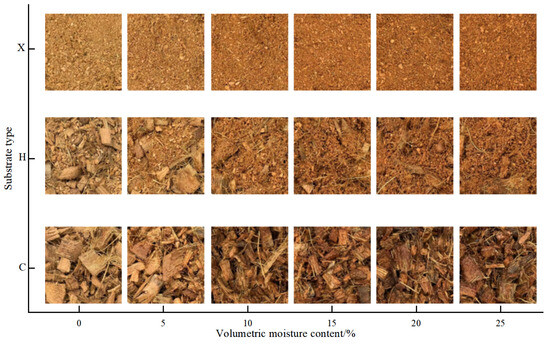
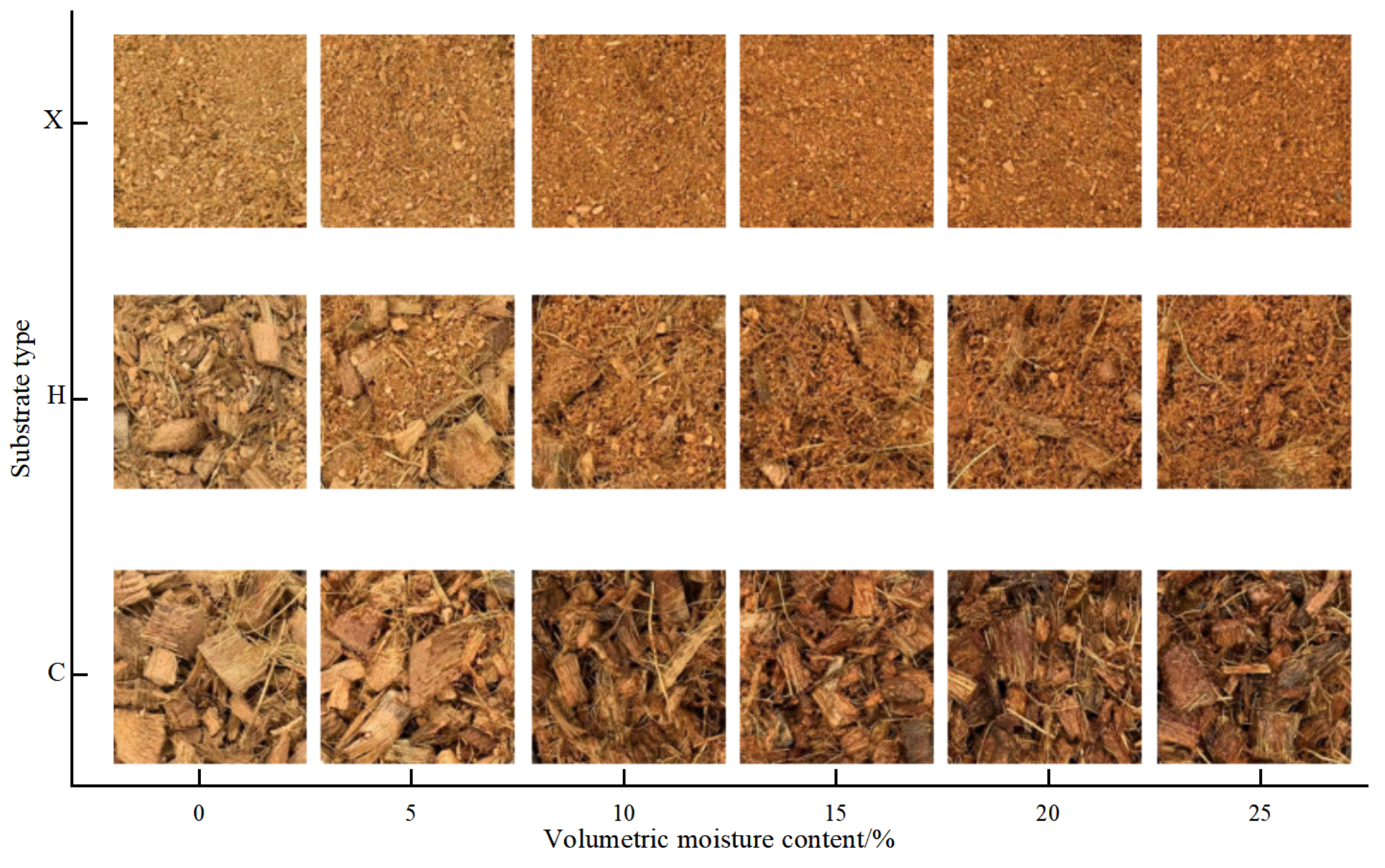
Figure 2 presents representative images of the three substrate types within the 0–25% volumetric water content range, which were used for feature extraction and model development. Table 4 summarizes the Pearson correlation coefficients between six image feature parameters and the water content of coir substrates. r, g, b, h, and v were significantly negatively correlated with water content (|r| > 0.70, p < 0.001), while S exhibited a significant positive correlation (r = 0.51–0.64, p < 0.001). The strength of the correlations followed the order: h > g > r = v > b > s. Among these, h showed the strongest correlation (|r| = −0.89 to −0.90, p < 0.001), indicating the highest sensitivity to changes in water content. r, g, and v also exhibited strong correlations (r ≥ 0.80). Therefore, four key image features—r, g, h, and v—were selected as inputs for the water content prediction models.
Figure 2.
Representative images of coconut coir substrates at various moisture content levels.
Table 4.
Correlation analysis between image features and moisture content.
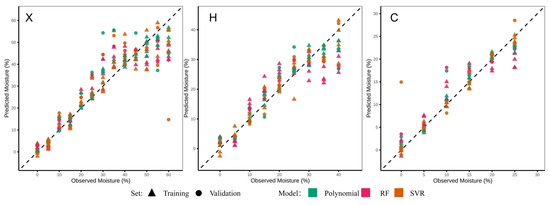
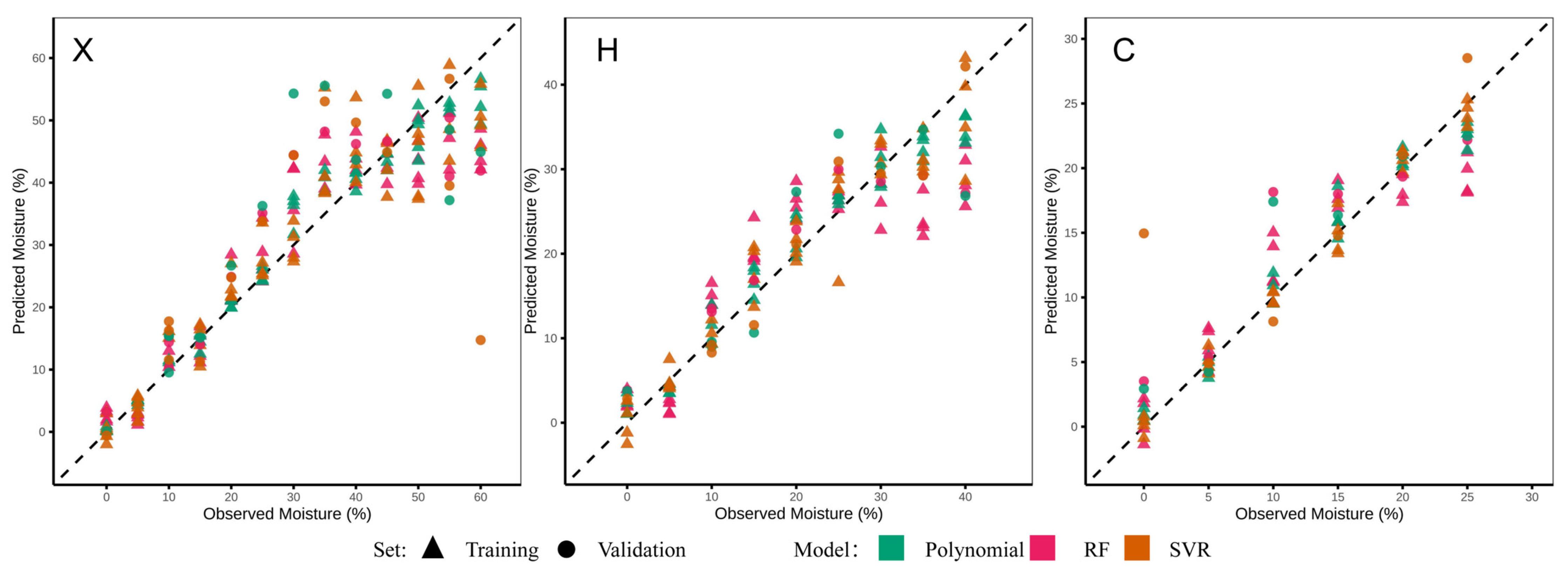
Table 5 summarizes the model performance on both training and validation sets across different substrate types. During the training phase, all three models achieved high accuracy, with R2 ranging from 0.875 to 0.986 and RMSE ranging from 0.983% to 6.791%. The best results were obtained in coarse coir, where training R2 ranged from 0.902 to 0.986 and RMSE ranged from 0.983% to 0.887%. However, substantial differences in model performance emerged during validation. For coarse coir, SVR (R2 = 0.893, RMSE = 3.37%) and RF (R2 = 0.867, RMSE = 3.49%) maintained high predictive stability, while polynomial regression showed a sharp decline in accuracy, with validation R2 dropping by 32.2% to 0.587. In mixed coir, polynomial regression achieved the highest validation accuracy (R2 = 0.861, RMSE = 4.34%). In contrast, fine coir exhibited substantially larger prediction errors across all models, with polynomial regression performing the worst (R2 = 0.443, RMSE = 14.95%). Figure 3 compares the predictive performance of the three models across substrate types. Overall, when substrate water content was below 30%, all models achieved high accuracy, with prediction points closely aligned along the 1:1 reference line. However, as water content increased, model accuracy declined. In fine coir, predictions were consistently lower than observed values when actual water content exceeded 40%. A similar decline in accuracy was also observed in mixed coir when water content reached 35–40%.
Table 5.
Comparative performance of the three predictive models under different coir mixing ratios.
Figure 3.
Comparison of multi-model predictions of volumetric water content across substrate types. Note: X, H and C denote fine, blended and coarse coir substrates, respectively.
3.2. Wetting Front Morphology Characteristics
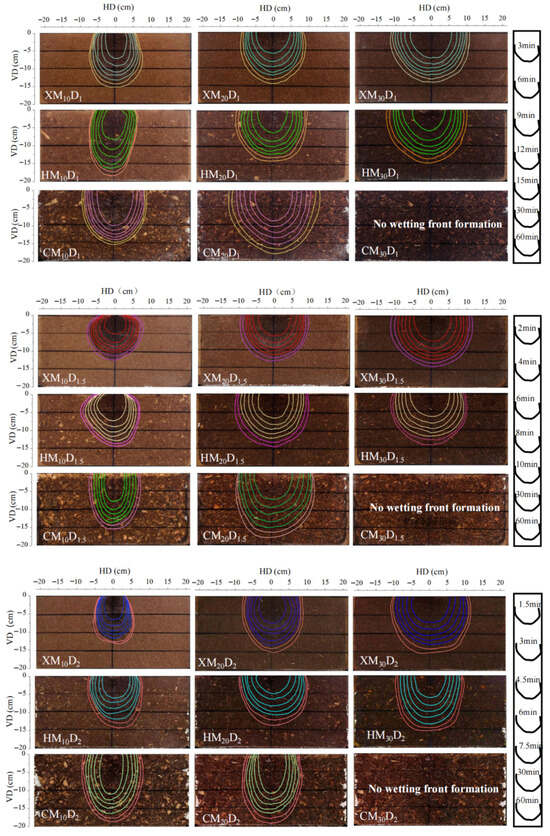
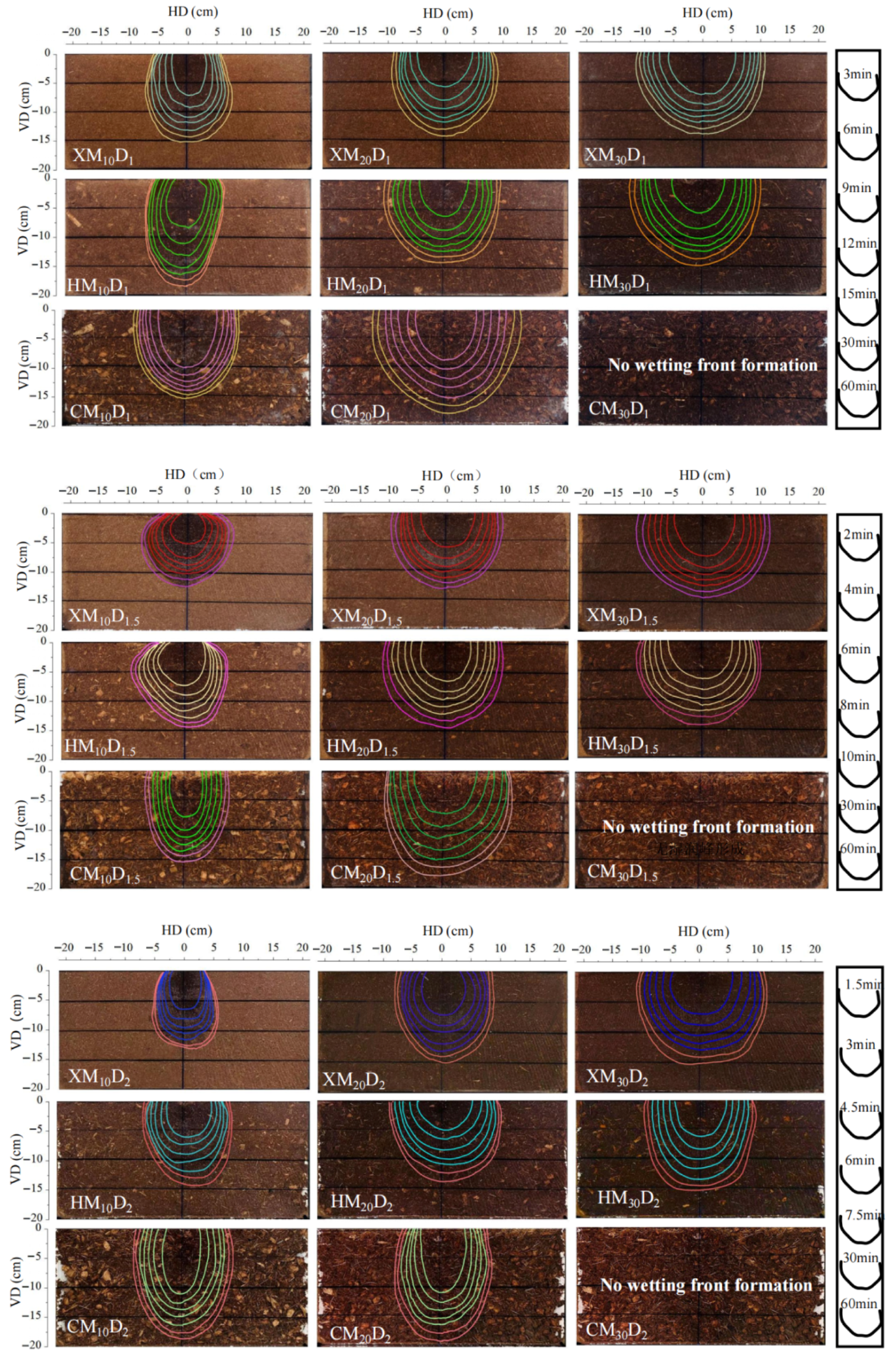
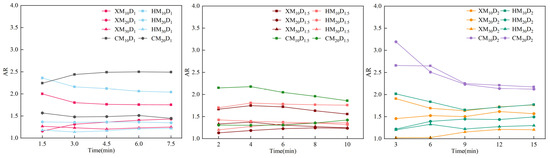
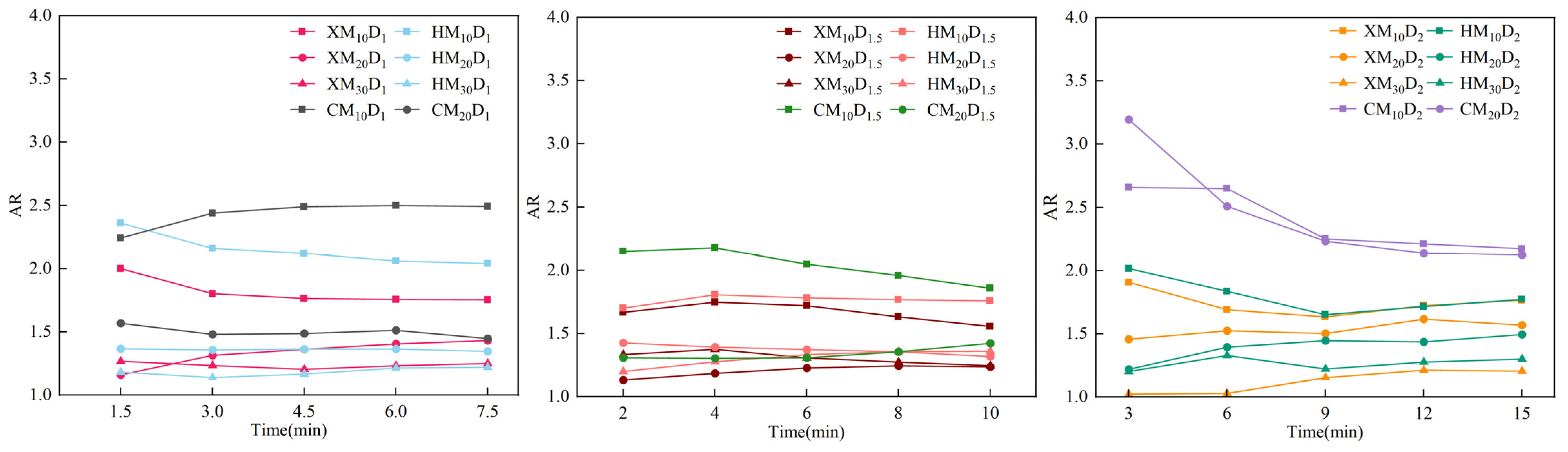
Figure 4 illustrates the morphological differences in wetting fronts under various initial water contents, coir particle-size ratios, and emitter flow rates. The results clearly show that wetting front morphology was jointly governed by particle size and initial water content. When the substrate consists of coarse particles with low initial water content, the wetting front exhibits an elongated “thumb-like” shape, as observed in CM10D1.5. With increasing initial water content and the inclusion of fine coir, the wetting front gradually transitions toward a “hemispherical” form, exemplified by XM30D1.5. Wetting fronts in mixed coir substrates display intermediate characteristics, maintaining considerable vertical penetration while exhibiting pronounced lateral spread. Notably, in the CM30 treatment, the substrate’s water-holding porosity is only ~30%, approaching saturation; as a result, a distinct wetting front does not form, and this treatment was therefore excluded from both Figure 4 and subsequent analyses. The temporal dynamics of the aspect ratio (AR) are presented in Figure 5. The AR values are initially high during the early infiltration stage, then gradually decrease and stabilize. Under C treatments, AR values are consistently higher than in other treatments. At high flow rates (2 L/h), AR initially exceeds 3.0 but rapidly decreases to approximately 2.0, where it stabilizes. In contrast, under low flow rates (1 L/h), AR reaches a stable value early, with minimal overall fluctuation. The final AR values 60 min after irrigation are summarized in Table 6. Coarse coir consistently exhibited the highest AR values (1.55–2.05), indicating dominance of vertical infiltration. Fine coir had the lowest AR (1.25–1.86), favoring lateral expansion, while mixed coir fell in between (1.30–2), balancing depth and spread. Increasing the initial water content significantly reduced AR; for example, in mixed coir, AR decreased from 2.22 under HM10D1 to 1.35 under HM30D1, a reduction of ~39%, indicating a transition from vertically dominated to laterally expanded wetting fronts.
Figure 4.
Variation characteristics of wetting front with time under different drip irrigation parameters. Note: HD denotes horizontal distance, and VD denotes vertical distance; Contour colors represent equal irrigation volumes under different emitter discharge rates.
Figure 5.
Variation temporal dynamics of wetting front aspect ratio under different drip irrigation treatments.
Table 6.
Wetting front aspect ratio redistribution 60 min after drip irrigation under different treatments.
3.3. Water Transport Rate Patterns
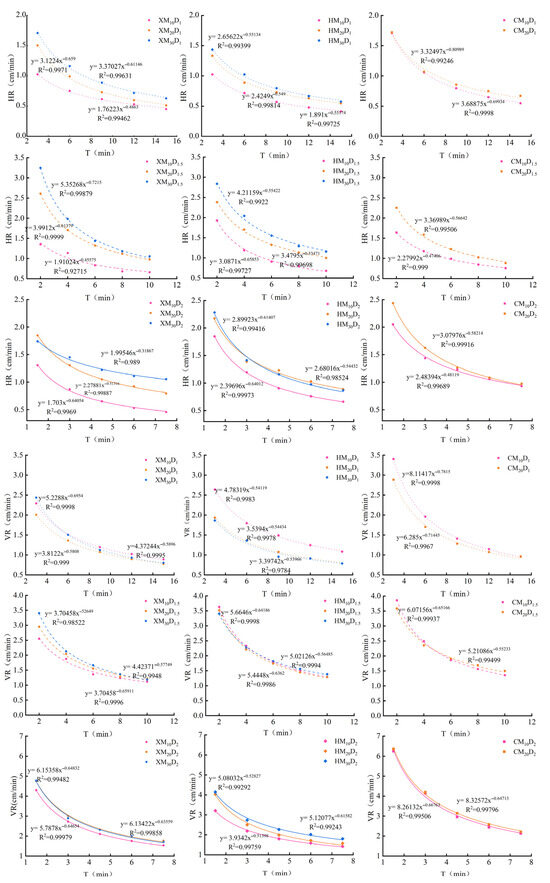
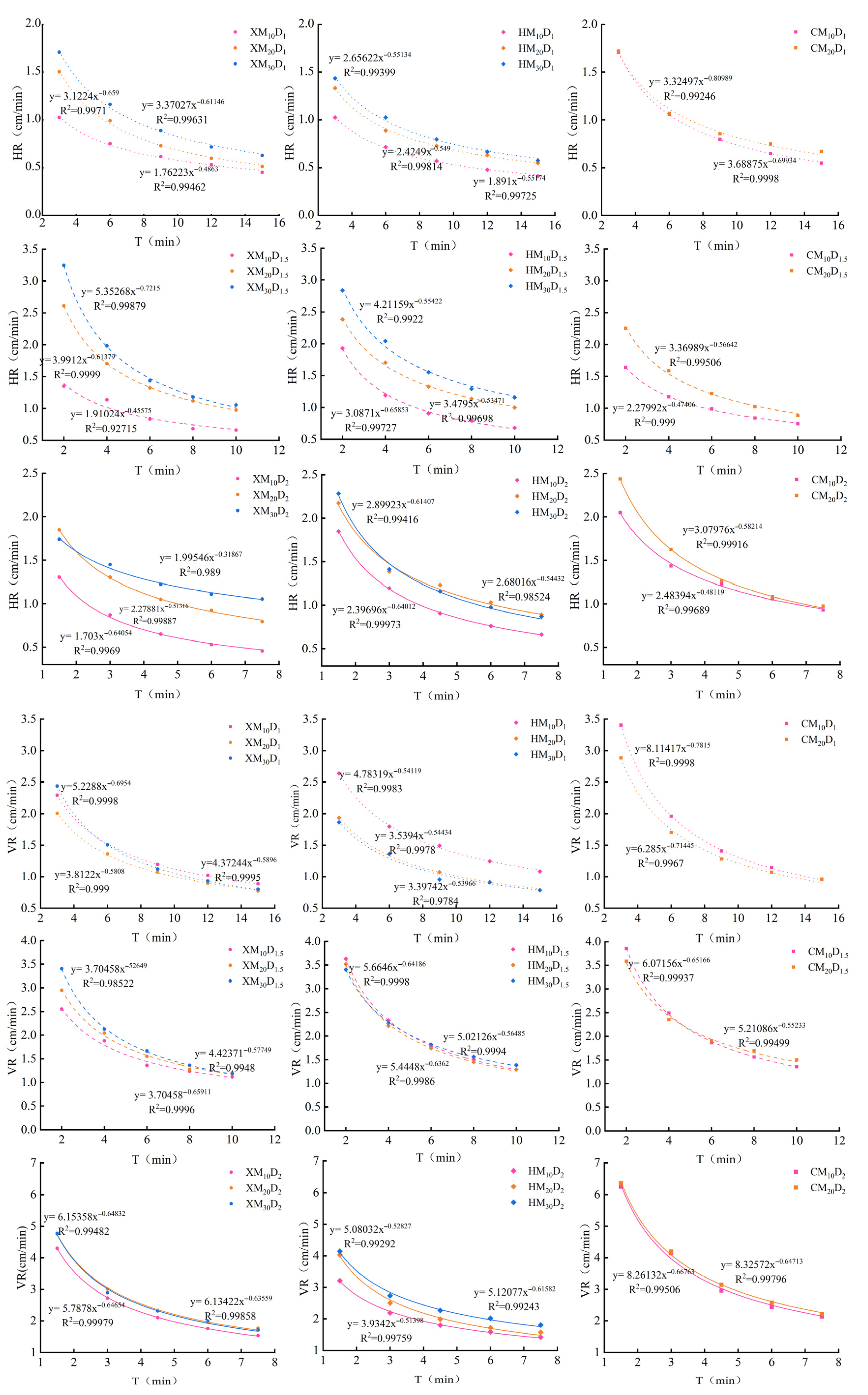
Figure 6 illustrates the temporal variations in horizontal (HR) and vertical (VR) water transport rates within coir substrates. The results demonstrated that the water transport rate followed a power-law decay with time (Rate = a · t−b, R2 > 0.95), and the vertical rate was consistently higher than the horizontal rate. Specifically, vertical transport rates ranged from 2 to 6.5 cm/min, whereas horizontal transport rates ranged from 1 to 3.3 cm/min. Substrate composition exerted a significant influence on transport dynamics. The C treatment exhibited the highest vertical transport rates (3.6–3.85 cm/min) but the lowest horizontal rates. In contrast, the X treatment showed the highest horizontal transport rates (2.8–3.3 cm/min), with vertical rates of 2.5–3.4 cm/min. The H treatment presented intermediate values in both directions. Initial water content also played a directional role in water transport. In the vertical direction, both coarse and mixed substrates generally showed higher vertical transport rates under lower initial water content, while the X treatment displayed the opposite trend, where higher initial water content led to greater vertical transport. In the horizontal direction, lower initial water content consistently resulted in slower transport. For instance, the HR of HM10D1.5 ranged between 0.48 and 1.04 cm/min, compared with 1.28–2.74 cm/min for HM30D1.5. A similar trend was observed vertically, although the D1 treatment exhibited the reverse pattern: the VR of HM10D1 was 1.08–2.61 cm/min, whereas that of HM30D1 was 0.85–1.87 cm/min, indicating that higher initial water content reduced vertical transport rates. Emitter discharge also had a pronounced effect on infiltration. At the same observation time, higher discharge rates accelerated water transport. However, in the horizontal direction, the transport rates in mixed and coarse substrates did not strictly conform to this trend.
Figure 6.
Relationship between wetting front transport rate and time under different irrigation flow rates, initial moisture contents, and coarse-fine ratios. Tip: HR denotes horizontal rate, and VR denotes vertical rate.
3.4. Moisture Content Distribution
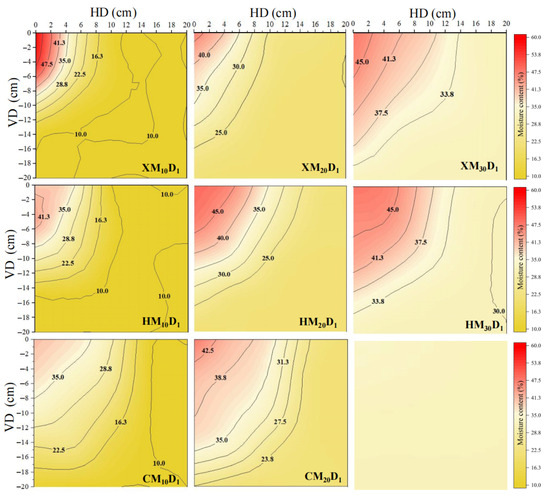
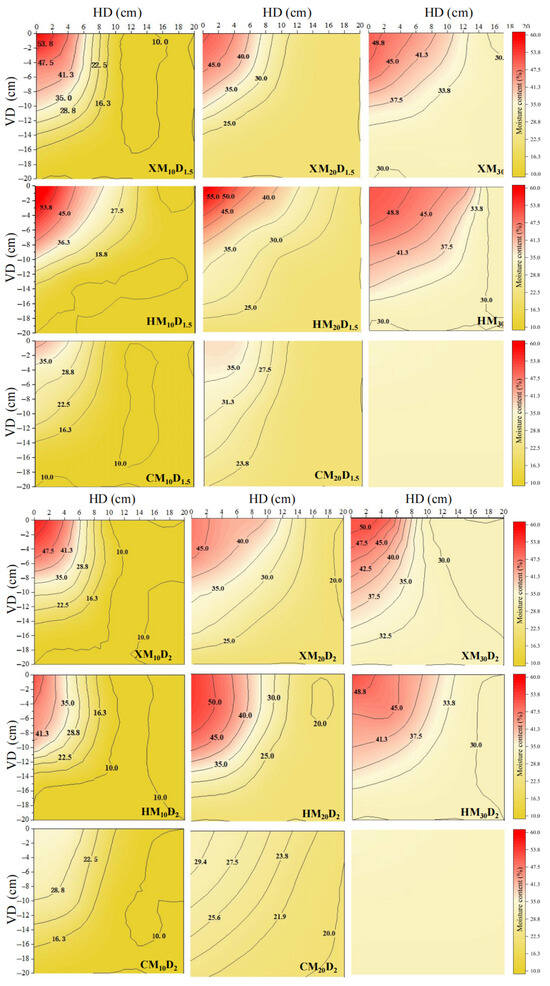
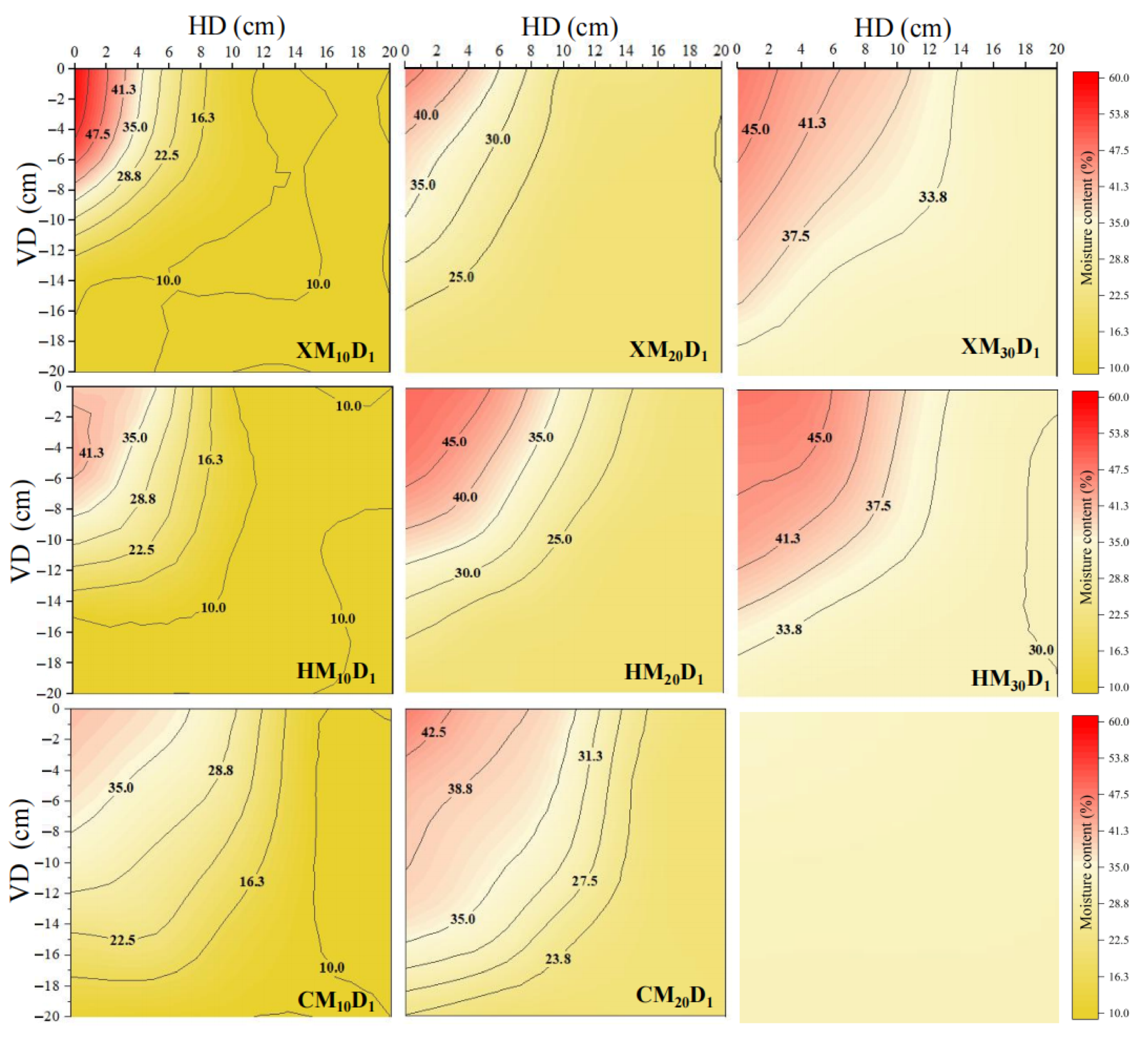
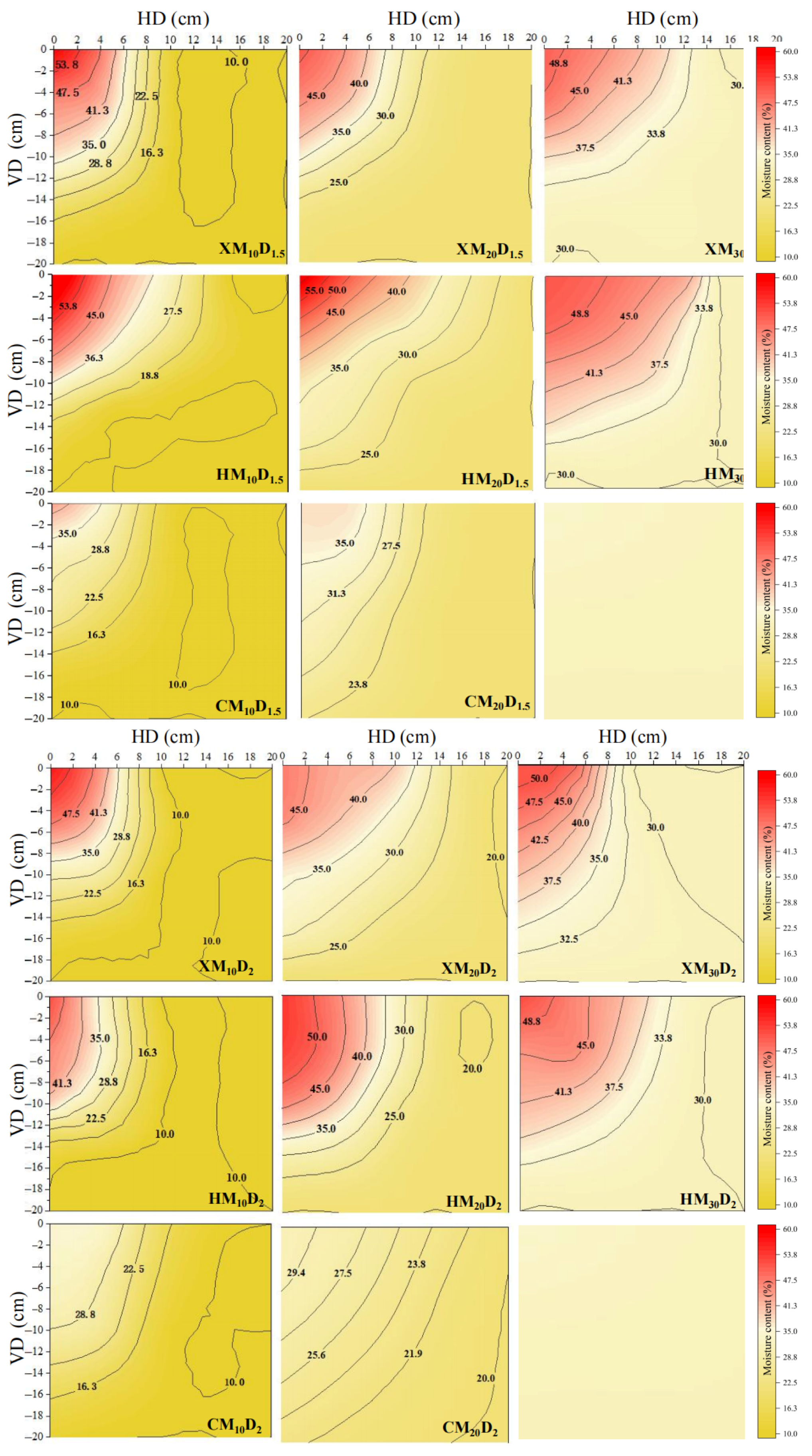
Figure 7 presents the substrate water content profiles of coir substrates at 60 min after irrigation under different treatments. The values at each depth were obtained through model inversion, with the SVR model applied to X and C substrates and the Polynomial model applied to H substrates. The results indicate that the particle-size composition of the substrate is a critical factor influencing the redistribution of water. In the X treatment, the redistribution range of substrate water content was relatively limited, with a pronounced difference between the upper layer (0–5 cm) and the deeper layer (15–20 cm). The wetting front appeared steep, and the overall substrate water content averaged around 45%, reflecting strong water-retention capacity. By contrast, the H treatment exhibited a more uniform redistribution of water, with both horizontal and vertical infiltration distances increasing; however, the overall substrate water content decreased to approximately 40%. Initial water content strongly influenced the uniformity of redistribution. A higher initial water content expanded the wetting front area and reduced the differences between layers. For instance, under the same substrate type and irrigation flow rate, the M30 treatment yielded an upper-layer substrate water content of about 45%, with only ~10% difference compared with deeper layers. In contrast, under M10, the upper-layer substrate water content reached nearly 50%, while the difference with the deeper layer increased to ~35%. The effect of irrigation flow rate on redistribution was relatively minor and was mainly reflected in the vertical direction. Increasing the flow rate from 1 L/h to 2 L/h accelerated deep percolation, extending vertical redistribution by approximately 2–4 cm. In the C treatment, the substrate water content at a depth of 16 cm under the high-flow condition was about 5% greater than under the low-flow condition, whereas lateral redistribution showed little variation.
Figure 7.
Soil moisture distribution profile in coconut coir substrate under different treatments after irrigation.
4. Discussion
4.1. Performance Analysis of Moisture Content Prediction Models Based on Image Recognition and Machine Learning
Traditional moisture sensors can rapidly monitor substrate water content; however, when deeply embedded, they may disturb substrate structure and alter the dynamics of wetting front propagation. In recent years, image analysis techniques have gained increasing attention in soil and substrate water monitoring due to their non-destructive and visual advantages. For example, Lai et al. (2012) [29] monitored moisture dynamics by extracting color features from images, while Wang et al. (2022) [30] and Zhuang et al. (2017) [31] further integrated machine learning with image features to improve prediction accuracy. In this study, four key image features (r, g, h, and v) were extracted from coconut coir-based substrates to establish three predictive models, namely polynomial regression (Polynomial), random forest (RF), and support vector regression (SVR). The feasibility of using image recognition for substrate moisture prediction was evaluated. The results (Table 5) indicated that all three models achieved relatively high accuracy during the training phase (R2 = 0.875–0.986, RMSE = 0.983–6.791%), with the best performance observed in coarse coir (R2 = 0.986). However, substantial differences were observed during validation. Polynomial regression showed high accuracy in mixed substrates (R2 = 0.861) but declined sharply in coarse and fine coir (minimum R2 = 0.443). In contrast, both RF and SVR maintained stable performance across substrate types. Variations in model accuracy were mainly attributed to the reduced sensitivity of image features at higher moisture levels. When substrate water content was below 30%, clear color contrasts at the wetting front resulted in large variations in feature values, and predicted data points were closely aligned with the 1:1 diagonal line (Figure 3). However, as moisture content exceeded approximately 35–40%, surface colors approached saturation, indicating a detection saturation threshold beyond which RGB-based models failed to effectively distinguish incremental changes in water content. Similar findings were reported by Zhang et al. (2024) [19] for loess soils, where high water content weakened the correlation between color features and moisture. This phenomenon can be attributed to surface darkening with cumulative infiltration, which reduces visible differences and increases errors. The decline in polynomial regression performance may be attributed to its limited adaptability to nonlinearity and heterogeneity [32], whereas RF and SVR demonstrated stronger robustness in handling nonlinear features and multivariable interactions [33]. Overall, RF and SVR exhibited superior applicability across different substrates and moisture ranges, suggesting their potential to replace traditional moisture sensors for non-destructive, real-time monitoring in practical production. It should be noted that all images were acquired under controlled illumination, and the model has not yet been validated under variable lighting conditions, which may limit its direct transferability to field environments.
4.2. Infiltration Characteristics and Regulatory Mechanisms of Water in Cocopeat Substrate
Analyzing wetting front morphology provides critical insights into infiltration dynamics in coir substrates and offers a scientific basis for designing irrigation volume and frequency [34]. The present study demonstrated that wetting front morphology is primarily governed by two interacting factors: the initial substrate moisture content and particle size distribution. The aspect ratio (AR) values presented in Table 5 quantitatively confirm these relationships. As the initial water content increased, lateral water movement was markedly enhanced, with AR decreasing from approximately 2.0 to about 1.3. This transition reflects a morphological shift from a narrow, “finger-shaped” wetting front to a more hemispherical pattern. Such behavior contrasts with the predominantly hemispherical wetting fronts commonly reported in soils under point-source drip irrigation [35,36,37], highlighting the distinct hydraulic responses of coir-based media. Mechanistically, higher initial water content reduces matric suction, allowing gravity-driven flow to dominate, thereby facilitating both deeper and wider infiltration. Meanwhile, particle size distribution also exerted a marked influence on AR and wetting front shape. Fine coir substrates, characterized by small pores and strong capillary forces, produced relatively low AR values (1.33–1.8) and favored lateral expansion, while coarse coir substrates, with larger pores and weaker suction, maintained higher AR values (1.55–2.05), reflecting gravity-driven vertical infiltration. Mixed coir substrates produced intermediate AR values (1.33–2), achieving a balance between vertical depth and lateral spread. These findings are consistent with Nogueira et al. (2021) [8], who also demonstrated that particle-size distribution strongly regulates wetting front expansion across different soil types, suggesting that coir substrates and soils share common hydrological mechanisms despite their structural differences.
Water transport rates in coconut coir substrates followed a power function over time, showing a decreasing trend consistent with previous observations in coir-based cultivation media [38] and in soil irrigated with unconventional water sources such as biogas slurry [10]. This indicates a common power-law behavior of water movement under point-source drip irrigation. During the initial stages of drip irrigation, the substrate’s water potential gradient is high, leading to faster water transport rates. Over time, the substrate’s water-holding capacity reaches equilibrium, and transport rates slow. Additionally, the study found that vertical transport rates (2–6.5 cm/min) in coconut coir substrates were significantly higher than horizontal transport rates (1–3.3 cm/min), consistent with most soil media, where water transport in unsaturated media is dominated by gravity, leading to faster vertical infiltration than horizontal infiltration. Furthermore, the study’s findings on the influence of emitter flow rate on water transport rates align with the review by Zhang et al. (2022) [39] on soil moisture distribution in drip irrigation systems, where higher flow rates led to faster transport rates. However, in pure coarse and mixed coir substrates, vertical and horizontal transport rates showed different trends, with vertical rates increasing as the proportion of coarse coir increased, while horizontal rates showed the opposite trend. This may be due to the pore structure of coconut coir substrates influencing water infiltration paths.
The post-irrigation water distribution characteristics reveal the diffusion dynamics and equilibrium state of water within coir-based substrates. Results showed that the redistribution range in coir was relatively limited, which differs markedly from conventional soils where redistribution tends to be broader and more prolonged [40]. This difference may be attributed to the higher water-holding porosity of coir and the absence of surface runoff or ponding, which allows water to quickly reach its maximum extent after irrigation and suppresses further lateral advancement. The effect of initial water content on redistribution was also evident. Under high initial water content (M30), redistribution was greater and more uniform, with interlayer water content differences of only about 10%. In contrast, under low initial water content (M10), redistribution was restricted, and vertical differences between upper and lower layers were pronounced, reaching approximately 35%. These findings are consistent with Ketsela et al. (2023) [41], and Chen et al. (2023) [42], who reported that higher initial water content enhances post-irrigation redistribution. However, excessively high initial water content may also increase the risk of deep percolation and evaporative losses [43]. Substrate composition further influenced water content dynamics. Fine coir exhibited the strongest water-holding capacity due to its smaller pore structure, which enhanced capillary forces, reduced percolation losses, and maintained the highest water content. In contrast, coarse coir exhibited the lowest water-holding capacity, as its larger pore structure promoted vertical infiltration, leading to relatively low water content. On average, the water content of fine coir was about 15% higher than that of coarse coir, though its lateral redistribution was limited, resulting in a greater wetting front aspect ratio (AR) characterized by a narrow and deep profile. Conversely, mixed coir substrates provided a more balanced hydraulic behavior, maintaining relatively high water content while ensuring adequate permeability. Their wetting front exhibited a smaller AR and a more uniform hemispherical pattern. These results are in agreement with Hu et al. (2025) [44], who reported that increased bulk density significantly reduces both the infiltration rate and the extent of redistribution. Therefore, in practical drip irrigation design, optimizing substrate composition and controlling initial water content can effectively enhance the water-holding capacity of the substrate and improve overall water use efficiency.
5. Conclusions
This study applied image recognition and machine learning techniques for monitoring moisture content in cocopeat substrates. By integrating analyses of wetting front morphology, aspect ratio, water migration rates, and model-predicted moisture distributions, a systematic framework spanning morphology–dynamics–state was established, providing a novel methodological reference for reliable characterization of substrate water processes under controlled conditions. The main conclusions are as follows: Prediction model performance: Moisture content prediction models based on image recognition and machine learning effectively estimated water content in cocopeat substrates. Among them, the Support Vector Regression (SVR) model performed best for coarse cocopeat (R2 = 0.89, RMSE = 3.49%), while polynomial regression achieved the highest accuracy in mixed substrates (R2 = 0.861, RMSE = 4.34%). In contrast, fine-textured cocopeat exhibited relatively lower predictive performance (R2 < 0.78, RMSE > 9.07%), and the model errors tended to increase notably under high-moisture conditions (>35%), indicating a reduced sensitivity of image features at elevated water contents. Wetting front morphology: The morphology of the wetting front was jointly influenced by initial substrate moisture and particle size. Higher initial moisture enhanced horizontal water spread, reducing the wetting front aspect ratio (AR) from ~2 to 1.3 and shifting the shape from “thumb-shaped” to hemispherical. Coarse substrates favored vertical infiltration, whereas fine substrates exhibited higher water retention. Water migration dynamics: Water migration rates decreased over infiltration time following a power-law function (Rate = a · t−b, R2 > 0.95), with vertical rates (2.0–6.5 cm/min) consistently exceeding horizontal rates (1.0–3.3 cm/min). Increased irrigation flow enhanced vertical migration but had limited effect on horizontal rates. Initial moisture content exerted substrate-specific regulatory effects, promoting vertical migration in fine cocopeat, but producing the opposite trend in coarse and mixed substrates. Moisture redistribution: The redistribution process was jointly controlled by initial moisture content and substrate composition. High initial moisture (30%) led to more uniform moisture distribution (inter-layer differences ≤ 10%). Fine-textured cocopeat exhibited strong water retention but limited redistribution range. Mixed substrates (coarse: fine = 1:1) at 20–30% initial moisture balanced infiltration efficiency and water-holding capacity, reducing the risk of deep percolation.
However, some limitations should be noted. Image acquisition was performed under controlled illumination and fixed camera settings; thus, the robustness of RGB/HSV features under variable lighting conditions and real-field environments was not assessed. Moreover, RGB-based models exhibited limited sensitivity beyond a saturation threshold, implying that color-based approaches may underestimate moisture variation at high water contents. Future research will address these limitations through illumination calibration, exploration of illumination-invariant features, and integration of multi-spectral or infrared imaging, alongside a quantitative analysis of model complexity to enhance interpretability and robustness.
Author Contributions
X.F.: Investigation, Formal analysis, Data Curation, Writing—Original Draft, P.Z.: Writing—Review and Editing, Q.W.: Writing—Review and Editing, H.W.: Writing—Review and Editing, Funding acquisition. X.L.: Investigation, J.W.: Writing—Review and Editing. All authors have read and agreed to the published version of the manuscript.
Funding
This research was funded by the Research and Demonstration of Key Technologies for Green Development of Ecological Agriculture in Gobi, Xinjiang (2023B02024-2); the National Natural Science Foundation of China (52509081), the Natural Science Foundation of Beijing (8254048), and Central Public-interest Scientific Institution Basal Research Fund (No. BSRF202607).
Data Availability Statement
The raw data supporting the conclusions of this article will be made available by the authors on request.
Conflicts of Interest
The authors declare that there are no conflicts of interest.
References
- Yang, X.; Zhang, L.; Liu, X. Optimizing Water-Fertilizer Integration with Drip Irrigation Management to Improve Crop Yield, Water, and Nitrogen Use Efficiency: A Meta-Analysis Study. Sci. Hortic. 2024, 338, 113653. [Google Scholar] [CrossRef] [Scilit]
- García-Mollá, M.; Medina, R.P.; Vega-Carrero, V.; Sanchis-Ibor, C. Economic Efficiency of Drip and Flood Irrigation. Comparative Analysis at Farm Scale Using DEA. Agric. Water Manag. 2025, 309, 109314. [Google Scholar] [CrossRef] [Scilit]
- Han, F.; Zheng, Y.; Zhang, L.; Xiong, R.; Hu, Z.; Tian, Y.; Li, X. Simulating Drip Irrigation in Large-Scale and High-Resolution Ecohydrological Models: From Emitters to the Basin. Agric. Water Manag. 2023, 289, 108500. [Google Scholar] [CrossRef] [Scilit]
- Domínguez-Niño, J.M.; Arbat, G.; Raij-Hoffman, I.; Kisekka, I.; Girona, J.; Casadesús, J. Parameterization of Soil Hydraulic Parameters for HYDRUS-3D Simulation of Soil Water Dynamics in a Drip-Irrigated Orchard. Water 2020, 12, 1858. [Google Scholar] [CrossRef] [Scilit]
- Bajpai, A.; Kaushal, A. Soil Moisture Distribution under Trickle Irrigation: A Review. Water Supply 2020, 20, 761–772. [Google Scholar] [CrossRef] [Scilit]
- Eltarabily, M.G.; Mohamed, A.Z.; Begna, S.; Wang, D.; Putnam, D.H.; Scudiero, E.; Bali, K.M. Simulated Soil Water Distribution Patterns and Water Use of Alfalfa under Different Subsurface Drip Irrigation Depths. Agric. Water Manag. 2024, 293, 108693. [Google Scholar] [CrossRef] [Scilit]
- Zhou, L.; Feng, H.; Zhao, Y.; Qi, Z.; Zhang, T.; He, J.; Dyck, M. Drip Irrigation Lateral Spacing and Mulching Affects the Wetting Pattern, Shoot-Root Regulation, and Yield of Maize in a Sand-Layered Soil. Agric. Water Manag. 2017, 184, 114–123. [Google Scholar] [CrossRef] [Scilit]
- Nogueira, V.H.; Diotto, A.V.; Thebaldi, M.S.; Colombo, A.; Silva, Y.F.; de Castro Lima, E.M.; Resende, G.F.L. Variation in the Flow Rate of Drip Emitters in a Subsurface Irrigation System for Different Soil Types. Agric. Water Manag. 2021, 243, 106485. [Google Scholar] [CrossRef] [Scilit]
- Zhao, J.; Yang, K.; Shock, C.C.; Yang, B.; Dai, J.; Wang, F. Small Soil Wetted Proportion and Emitter Flow Rate of Drip Irrigation Enhance Potato Yield by Improving Soil Water and Aeration in the Sandy Loam in Arid Northwest China. Field Crops Res. 2024, 316, 109498. [Google Scholar] [CrossRef] [Scilit]
- Wang, H.; Qiu, X.; Liang, X.; Wang, H.; Wang, J. Biogas Slurry Change the Transport and Distribution of Soil Water under Drip Irrigation. Agric. Water Manag. 2024, 294, 108719. [Google Scholar] [CrossRef] [Scilit]
- Chen, R.; Filipović, V.; Zhang, J.; Li, W.; Ye, H.; Zhang, J.; Wang, Z. Uncovering Soil Preferential Flow Induced by Different Drip Irrigation Emitter Settings: Insights Integrating Wetting-Fronts Image Variability, HYDRUS-2D, and Active Region Model. CATENA 2025, 249, 108669. [Google Scholar] [CrossRef] [Scilit]
- Wang, H.; Wang, H.; Liang, X.; Wang, J.; Qiu, X.; Wang, C.; Li, G. Infiltration Simulation and System Design of Biogas Slurry Drip Irrigation Using HYDRUS Model. Comput. Electron. Agric. 2024, 218, 108682. [Google Scholar] [CrossRef] [Scilit]
- Jarrar, E.; Hasan, A.R.; Alimari, A.; Saleh, M. Water and Fertilizer Use Efficiency of Lettuce Plants Cultivated in Soilless Conditions under Different Irrigation Systems. Desalination Water Treat. 2022, 275, 184–195. [Google Scholar] [CrossRef] [Scilit]
- Papadimitriou, D.M.; Daliakopoulos, I.N.; Louloudakis, I.; Savvidis, T.I.; Sabathianakis, I.; Savvas, D.; Manios, T. Impact of Container Geometry and Hydraulic Properties of Coir Dust, Perlite, and Their Blends Used as Growing Media, on Growth, Photosynthesis, and Yield of Golden Thistle (S. hispanicus L.). Sci. Hortic. 2024, 323, 112425. [Google Scholar] [CrossRef] [Scilit]
- Woo, D.K.; Do, W.; Hong, J.; Choi, H. A Novel and Non-Invasive Approach to Evaluating Soil Moisture without Soil Disturbances: Contactless Ultrasonic System. Sensors 2022, 22, 7450. [Google Scholar] [CrossRef] [Scilit]
- Yu, L.; Gao, W.; Shamshiri, R.R.; Tao, S.; Ren, Y.; Zhang, Y.; Su, G. Review of Research Progress on Soil Moisture Sensor Technology. Int. J. Agric. Biol. Eng. 2021, 14, 32–42. [Google Scholar] [CrossRef] [Scilit]
- Kisi, O.; Khosravinia, P.; Heddam, S.; Karimi, B.; Karimi, N. Modeling Wetting Front Redistribution of Drip Irrigation Systems Using a New Machine Learning Method: Adaptive Neuro-Fuzzy System Improved by Hybrid Particle Swarm Optimization—Gravity Search Algorithm. Agric. Water Manag. 2021, 256, 107067. [Google Scholar] [CrossRef] [Scilit]
- Li, Y.; Nie, W.-B.; Feng, Z.-J. Development of a Soil Wetting Pattern Estimation Model for Drip Irrigation. Water Supply 2022, 23, 144–161. [Google Scholar] [CrossRef] [Scilit]
- Zhang, Y.; Zhang, H.; Lan, H.; Li, Y.; Sun, D.; Wang, E.; Dong, Z. Recognition of Cross-Regional Loess Water Content Based on Machine Vision: Case Study of Three Regions. CATENA 2024, 244, 108263. [Google Scholar] [CrossRef] [Scilit]
- Baek, S.-H.; Jeon, J.-S.; Kwak, T.-Y. Prediction of Soil Composition Using Digital Images Taken under Variable Lighting Environments. KSCE J. Civ. Eng. 2024, 29, 100093. [Google Scholar] [CrossRef] [Scilit]
- Lamichhane, M.; Mehan, S.; Mankin, K.R. Soil Moisture Prediction Using Remote Sensing and Machine Learning Algorithms: A Review on Progress, Challenges, and Opportunities. Remote Sens. 2025, 17, 2397. [Google Scholar] [CrossRef] [Scilit]
- Zhang, Y.; Zhang, H.; Lan, H.; Li, Y.; Liu, H.; Sun, D.; Wang, E.; Dong, Z. Water Content Intelligent Measurement Method of Detection Robot for Deep Soils within Loess Slopes. Measurement 2025, 253, 117374. [Google Scholar] [CrossRef] [Scilit]
- Naeimi, M.; Daggupati, P.; Biswas, A. Image-Based Soil Characterization: A Review on Smartphone Applications. Comput. Electron. Agric. 2024, 227, 109502. [Google Scholar] [CrossRef] [Scilit]
- Kang, H.-C.; Han, H.-N.; Bae, H.-C.; Kim, M.-G.; Son, J.-Y.; Kim, Y.-K.; Kang, H.-C.; Han, H.-N.; Bae, H.-C.; Kim, M.-G.; et al. HSV Color-Space-Based Automated Object Localization for Robot Grasping without Prior Knowledge. Appl. Sci. 2021, 11, 7593. [Google Scholar] [CrossRef] [Scilit]
- Jung, E.; Kim, D.; Song, J.; Park, J. Image-Based Interpolation of Soil Surface Imagery for Estimating Soil Water Content. Agriculture 2025, 15, 1812. [Google Scholar] [CrossRef] [Scilit]
- Zeng, Z.; He, J.; Zhan, Y.; Liu, H.; Tan, X. RGB-Guided Depth Feature Enhancement for RGB–Depth Salient Object Detection. Electronics 2024, 13, 4915. [Google Scholar] [CrossRef] [Scilit]
- Wang, J.; Tian, Z.; Yang, T.; Li, X.; He, Q.; Wang, D.; Chen, R. Characteristics of Limited Flow and Soil Water Infiltration Boundary of a Subsurface Drip Irrigation Emitter in Silty Loam Soil. Agric. Water Manag. 2024, 291, 108636. [Google Scholar] [CrossRef] [Scilit]
- Willmott, C.J. On the validation of models. Phys. Geogr. 1981, 2, 184–194. [Google Scholar] [CrossRef] [Scilit]
- Lai, W.L. Unsaturated Zone Characterization in Soil through Transient Wetting and Drying Using GPR Joint Time–Frequency Analysis and Grayscale Images. J. Hydrol. 2012, 452–453, 1–13. [Google Scholar] [CrossRef] [Scilit]
- Wang, J.; Li, X.; Zhang, Z.; Li, X.; Han, Y.; Feng, L.; Yang, B.; Wang, G.; Lei, Y.; Xiong, S.; et al. Application of Image Technology to Simulate Optimal Frequency of Automatic Collection of Volumetric Soil Water Content Data. Agric. Water Manag. 2022, 269, 107674. [Google Scholar] [CrossRef] [Scilit]
- Zhuang, S.; Wang, P.; Jiang, B.; Li, M.; Gong, Z. Early Detection of Water Stress in Maize Based on Digital Images. Comput. Electron. Agric. 2017, 140, 461–468. [Google Scholar] [CrossRef] [Scilit]
- Breiman, L. Random Forests. Mach. Learn. 2001, 45, 5–32. [Google Scholar] [CrossRef] [Scilit]
- Chen, M.; Cui, Y.; Wang, X.; Xie, H.; Liu, F.; Luo, T.; Zheng, S.; Luo, Y. A Reinforcement Learning Approach to Irrigation Decision-Making for Rice Using Weather Forecasts. Agric. Water Manag. 2021, 250, 106838. [Google Scholar] [CrossRef] [Scilit]
- de Rooij, G.H. Modeling Fingered Flow of Water in Soils Owing to Wetting Front Instability: A Review. J. Hydrol. 2000, 231–232, 277–294. [Google Scholar] [CrossRef] [Scilit]
- Singh, D.K.; Rajput, T.B.S.; Singh, D.K.; Sikarwar, H.S.; Sahoo, R.N.; Ahmad, T. Simulation of Soil Wetting Pattern with Subsurface Drip Irrigation from Line Source. Agric. Water Manag. 2006, 83, 130–134. [Google Scholar] [CrossRef] [Scilit]
- Sepaskhah, A.R.; Chitsaz, H. Validating the Green-Ampt Analysis of Wetted Radius and Depth in Trickle Irrigation. Biosyst. Eng. 2004, 89, 231–236. [Google Scholar] [CrossRef] [Scilit]
- Shiri, J.; Karimi, B.; Karimi, N.; Kazemi, M.H.; Karimi, S. Simulating Wetting Front Dimensions of Drip Irrigation Systems: Multi Criteria Assessment of Soft Computing Models. J. Hydrol. 2020, 585, 124792. [Google Scholar] [CrossRef] [Scilit]
- Liu, Z.; Li, P.; Hu, Y.; Wang, J. Wetting Patterns and Water Distributions in Cultivation Media under Drip Irrigation. Comput. Electron. Agric. 2015, 112, 200–208. [Google Scholar] [CrossRef] [Scilit]
- Zhang, Q.; Wu, H.; Ba, L.; Lian, M.; Feng, Z. Characteristics of drip irrigation soil wetting body and calculation method of its volume. J. Shanxi Agric. Univ. Nat. Sci. Ed. 2022, 42, 114–122. (In Chinese) [Google Scholar] [CrossRef]
- Lima do Nascimento, F.A.; Pereira da Silva, A.J.; Oliveira de Freitas, F.T.; dos Anjos Veimrober, L.A., Jr. Sensor Placement in 2D/3D Wetting Patterns from Drip Irrigation for Quantification of Evapotranspiration. Comput. Electron. Agric. 2021, 188, 106356. [Google Scholar] [CrossRef] [Scilit]
- Ketsela, Y.S.; Hatiye, S.D.; Muche, A.T. Evaluating the Effect of Initial Soil Moisture Content on Infiltration Characteristics Using Empirical and Hydrus 1D Models. Water Conserv. Sci. Eng. 2023, 8, 47. [Google Scholar] [CrossRef] [Scilit]
- Chen, Y.; Zhang, J.; Wang, Z.; Li, H.; Chen, R.; Zhao, Y.; Huang, T.; Luo, P. Influence of Long-Term Mulched Drip Irrigation on Upward Capillary Water Movement Characteristics in the Saline–Sodic Region of Northwest China. Agronomy 2024, 14, 1300. [Google Scholar] [CrossRef] [Scilit]
- Beyene, A.; Cornelis, W.; Verhoest, N.E.C.; Tilahun, S.; Alamirew, T.; Adgo, E.; De Pue, J.; Nyssen, J. Estimating the Actual Evapotranspiration and Deep Percolation in Irrigated Soils of a Tropical Floodplain, Northwest Ethiopia. Agric. Water Manag. 2018, 202, 42–56. [Google Scholar] [CrossRef] [Scilit]
- Hu, X.; Huang, L.; Chen, H.; Chen, L.; Fallgren, P.H. Effects of Soil Bulk Density and Corresponding Soil Infiltration Rate on the Migration and Transformation of Gibberellic Acid. J. Contam. Hydrol. 2025, 269, 104488. [Google Scholar] [CrossRef] [Scilit]

Disclaimer/Publisher’s Note: The statements, opinions and data contained in all publications are solely those of the individual author(s) and contributor(s) and not of MDPI and/or the editor(s). MDPI and/or the editor(s) disclaim responsibility for any injury to people or property resulting from any ideas, methods, instructions or products referred to in the content. |
© 2026 by the authors. Licensee MDPI, Basel, Switzerland. This article is an open access article distributed under the terms and conditions of the Creative Commons Attribution (CC BY) license.