


Abstract
Behavior recognition and multi-object tracking of dairy cows in free-style cow barn environments play a crucial role in monitoring their health status and serve as an essential means for intelligent scientific farming. This study proposes an efficient embedded algorithm, MTW-BYTE, for dairy cow behavior recognition and multi-object tracking. It addresses challenges in free-style cow barn environments, including the impact of lighting variations and common occlusions on behavior recognition, as well as trajectory interruptions and identity ID switching during multi-object tracking. First, the MTW-YOLO cow behavior recognition model is constructed based on the YOLOv11n object detection algorithm. Replacing parts of the backbone network and neck network with MANet and introducing the Task Dynamic Align Detection Head (TDADH). The CIoU loss function of YOLOv11n is replaced with the WIoU loss. The improved model not only effectively handles variations in lighting conditions but also addresses common occlusion issues in cows, enhancing multi-scale behavior recognition capabilities and improving overall detection performance. The improved MTW-YOLO algorithm improves Precision, Recall, mAP50 and F1 score by 4.5%, 0.1%, 1.6% and 2.2%, respectively, compared to the original YOLOv11n model. Second, the ByteTrack multi-object tracking algorithm is enhanced by designing a dynamic buffer and re-detection mechanism to address cow trajectory interruptions and identity ID switching. The MTW-YOLO algorithm is cascaded with the improved ByteTrack to form the multi-target tracking algorithm MTW-BYTE. Compared with the original multi-target tracking algorithm YOLOv11n-ByteTrack (a combination of YOLOv11n and the original ByteTrack), this algorithm improves HOTA by 1.1%, MOTA by 3.6%, MOTP by 0.2%, and IDF1 by 1.9%, reduces the number of ID changes by 11, and achieves a frame rate of 43.11 FPS, which can meet the requirements of multi-target tracking of dairy cows in free-style cow barn environments. Finally, to verify the model’s applicability in real-world scenarios, the MTW-BYTE algorithm is deployed on an NVIDIA Jetson AGX Orin edge device. Based on real-time monitoring of cow behavior on the edge device, the pure inference time for a single frame is 16.62 ms, achieving an FPS of 29.95, demonstrating efficient and stable real-time behavior detection and tracking. The ability of MTW-BYTE to be deployed on edge devices to identify and continuously track cow behavior in various scenarios provides hardware feasibility verification and algorithmic support for the subsequent deployment of intelligent monitoring systems in free-style cow barn environments.
1. Introduction
In recent years, with the rapid development of the livestock industry, dairy farms have also placed higher demands on monitoring and managing cow behavior. Cow behavior serves as a key indicator for assessing their health status, welfare levels, and production efficiency [1]. Real-time detection and tracking of cow behavior, thereby providing data support for dairy farms, holds significant importance for the management of modern dairy operations.
Traditional methods of monitoring dairy cow behavior primarily rely on manual observation, which is time-consuming, labor-intensive, and suffers from low accuracy and efficiency [2]. With technological advancements, sensors have gradually been applied to dairy cow monitoring [3,4,5]. By equipping cows with wearable sensors, comprehensive activity data can be obtained; however, this approach is costly and can easily cause stress reactions in cows. Advancements in computer technology and artificial intelligence have increasingly focused attention on automated cow behavior detection. Breakthroughs in deep learning have significantly expanded the application of object detection and multi-object tracking (MOT) algorithms in agricultural and livestock settings, providing the technological foundation for real-time monitoring and quantitative analysis of cow behavior [6].
To further analyze the current research status in this field, this paper selects representative research works published in mainstream international journals in recent years to systematically review the development path and research trends of related technologies. Zong et al. [7] addressed the challenges posed by complex backgrounds and variations in cow scale by integrating the Shuffle Attention (SA) module, Deformable Convolutional Networks (DCNv3), and Dynamic Detection Head (DyHead) into YOLOv5, thereby enhancing the accuracy and efficiency of detecting cows’ standing, drinking, eating, and lying behaviors. However, this approach could not handle the effects of occlusion variations. To reduce the mortality rates of cows and calves during calving, Wang et al. [8] integrated Global Navigation Satellite System (GNSS), triaxial accelerometers, and remote IoT sensor networks. They employed a fully connected autoencoder with temporal encoding for unsupervised detection of abnormal cow behaviors, followed by a random forest to distinguish calving events from other anomalies. This framework effectively detected and classified calving times, enhancing detection efficiency on farms. However, it only identified relatively single behaviors and was unable to recognize multiple behaviors simultaneously. Ahmed et al. [9] proposed a novel cow behavior recognition method, YOLOv8-BS, by integrating YOLOv8 with a CV model, the OpenCV background subtraction module, and a behavior counting component. It identified four behaviors—standing, eating, lying down, and walking—in a self-built dataset. This approach enhances recognition accuracy and better distinguishes stationary from walking cows. However, this algorithm was susceptible to changes in lighting conditions. Zheng et al. [10] addressed the lack of real-time, identity-linked methods for analyzing and monitoring cow behavior. First, they compressed the YOLO v5l model using a channel pruning algorithm to reduce its parameter count. Then, they employed a multi-object tracking method with Cascaded Buffer IoU (C-BIoU) to integrate behavior recognition results with tracking trajectory information, enabling behavior recognition and tracking for multiple cows. This approach achieves high accuracy in cow behavior recognition, robust tracking performance, and strong real-time capabilities. However, this algorithm was prone to trajectory interruptions. Wang et al. [11] developed an automated cow recognition and feeding model using YOLOv8n to monitor feeding conditions, specifically tracking time and frequency. This model advances and validates the application of computer vision in herd monitoring. Nevertheless, the device’s capacity for recognition remains constrained to a single range of behaviors, impeding the comprehensive monitoring of cow conditions. To address false negatives and false positives in real-world cow detection and tracking, Zheng et al. [12] enhanced YOLOv7 with self-attention and a convolutional mixing module (Acmix), implemented a lightweight spatial pyramid pooling cross-level partial connection (SPPCSPC-L) module, and optimized parameters of the ByteTrack-enhanced Kalman filter. Results demonstrate high detection accuracy for dairy cow behaviors, reduced model parameters, and effective multi-object tracking capabilities. However, the frequency of identity ID changes was excessively high. Tong et al. [13] addressed missed and false detections caused by occlusions and infrastructure obstacles in real dairy farm environments. They introduced dynamic convolutions and C2f-iRMB to YOLOv8, replaced Adown subsampling with DyHead dynamic detection heads, and incorporated DIoU distance calculation, confidence-based bounding box reclassification, and virtual trajectory update mechanisms into BOTSORT. Experiments demonstrate that this algorithm enhances the accuracy of dairy cow behavior detection while reducing cow identity switching rates. However, specific research on the embedded deployment of the algorithm was lacking.
In vision-based livestock monitoring, multi-target tracking not only requires accurate detection of individual targets but also maintains identity consistency across consecutive frames to enable long-term analysis of individual behavior. In free-style cow barn environments, monitoring dairy cows faces challenges such as highly similar individual appearances, frequent occlusion, and changes in behavioral states, which can easily lead to identity association errors, trajectory interruptions, and ID switching issues. Furthermore, in dairy cow behavior monitoring tasks, tracking results often need to be combined with behavior categories, i.e., achieving behavior-aware multi-target tracking, which places higher demands on detection accuracy and trajectory stability.
This study focuses on the problem of cow behavior recognition and multi-target tracking in free-style cow barn environments, aiming to improve cow behavior detection, identity association stability, and long-term tracking capabilities under complex lighting and occlusion conditions while ensuring real-time performance. In practical farming scenarios, long-term monitoring of cow behavior is essential, making the deployment of multi-target tracking algorithms to edge devices a crucial research direction. Therefore, this study constructs an embedded multi-target tracking algorithm, MTW-BYTE, by improving the YOLOv11n and ByteTrack algorithms, and deploys it on an NVIDIA Jetson AGX Orin edge device. This enables real-time operation of the model on the edge device, improving its stability and engineering practicality for cow behavior recognition and multi-target tracking in free-style cow barn environments.
2. Materials and Methods
2.1. Data Source
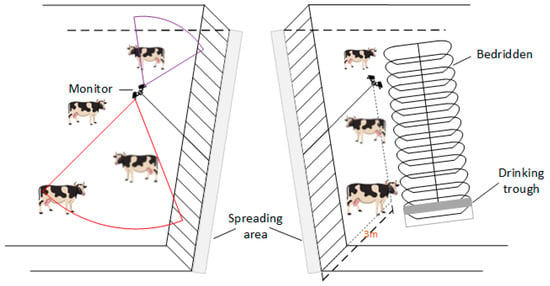
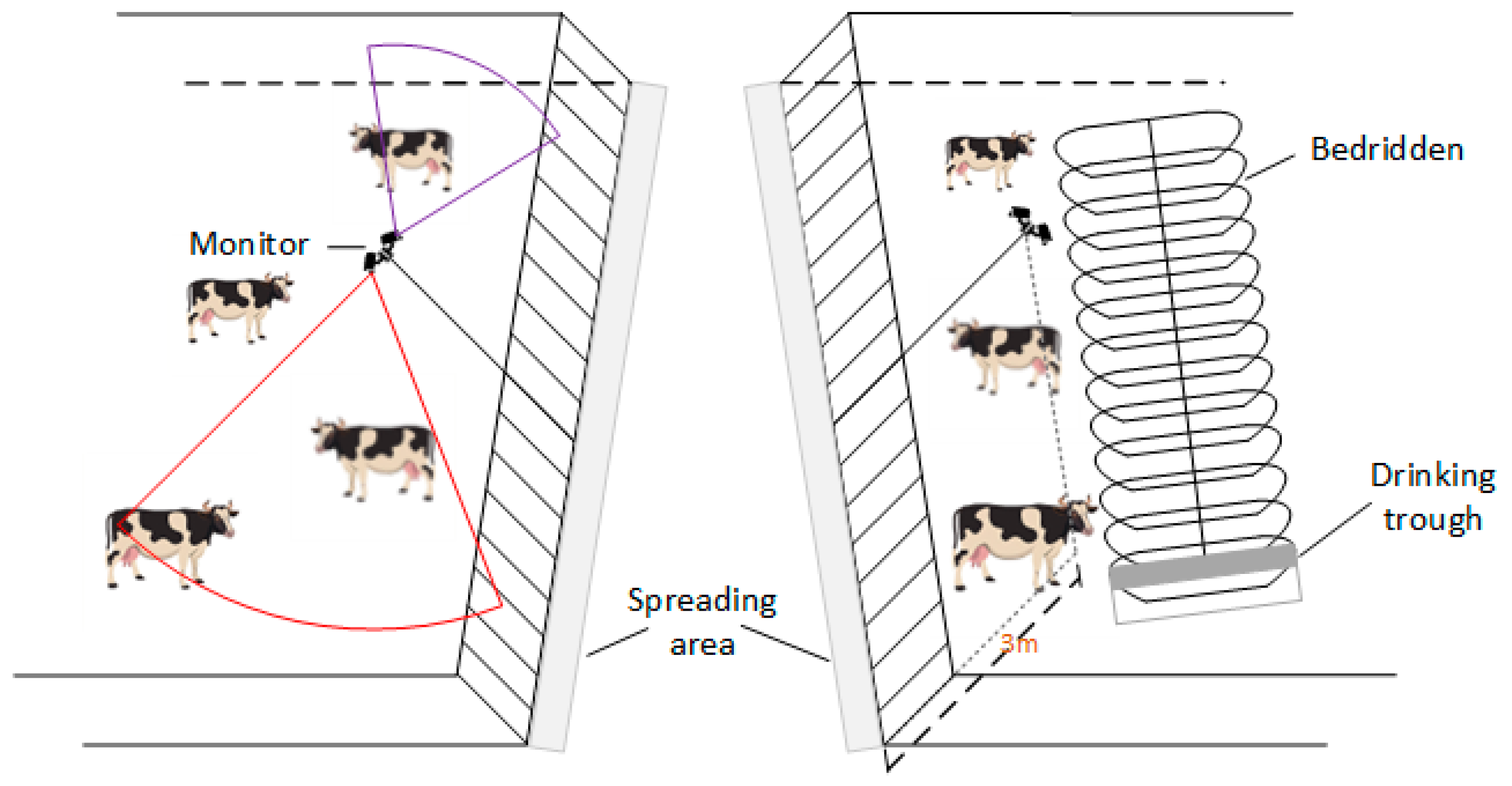
To ensure the authenticity and usability of experimental data, all data required for this study were collected in the field. The collection sites are the Mengdelong Ranch and Shengqingyuan Ranch in Hohhot City, Inner Mongolia Autonomous Region, both large-scale dairy farms housing approximately 500 cows each. The free-style cow barn adopts a standardized design, with eating areas, drinking areas, lying areas, and activity areas. The original data for the dataset constructed in this study includes both images and videos. The video data was acquired through surveillance cameras in March 2021 and collected by our laboratory as part of a long-term research project. Two surveillance cameras (Figure 1 shows four surveillance cameras, but only two on the same side were used for data collection) were installed on the crossbeam support frame of the dairy farm cowshed, with the equipment positioned at a height of 3 m. The video resolution is specified as 1920 × 1080 pixels, the frame rate is indicated as 25 frames per second, and the video is saved in MP4 format. The images were supplemented by capturing partial behavioral data of dairy cows using a camera on 20 September 2024. The camera captures images at a resolution of 4032 × 3024 pixels. All data are processed and verified in a consistent and reliable manner prior to the commencement of the experiment, thereby ensuring the validity and dependability of the dataset.
Figure 1.
Schematic diagram of the cow barn and camera.
2.2. Dataset
2.2.1. Cow Behavior Dataset
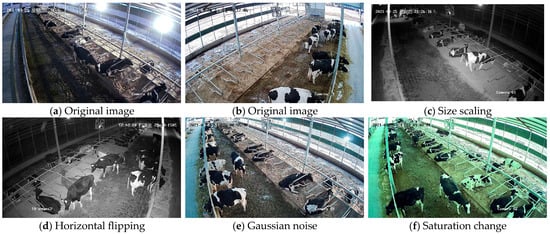
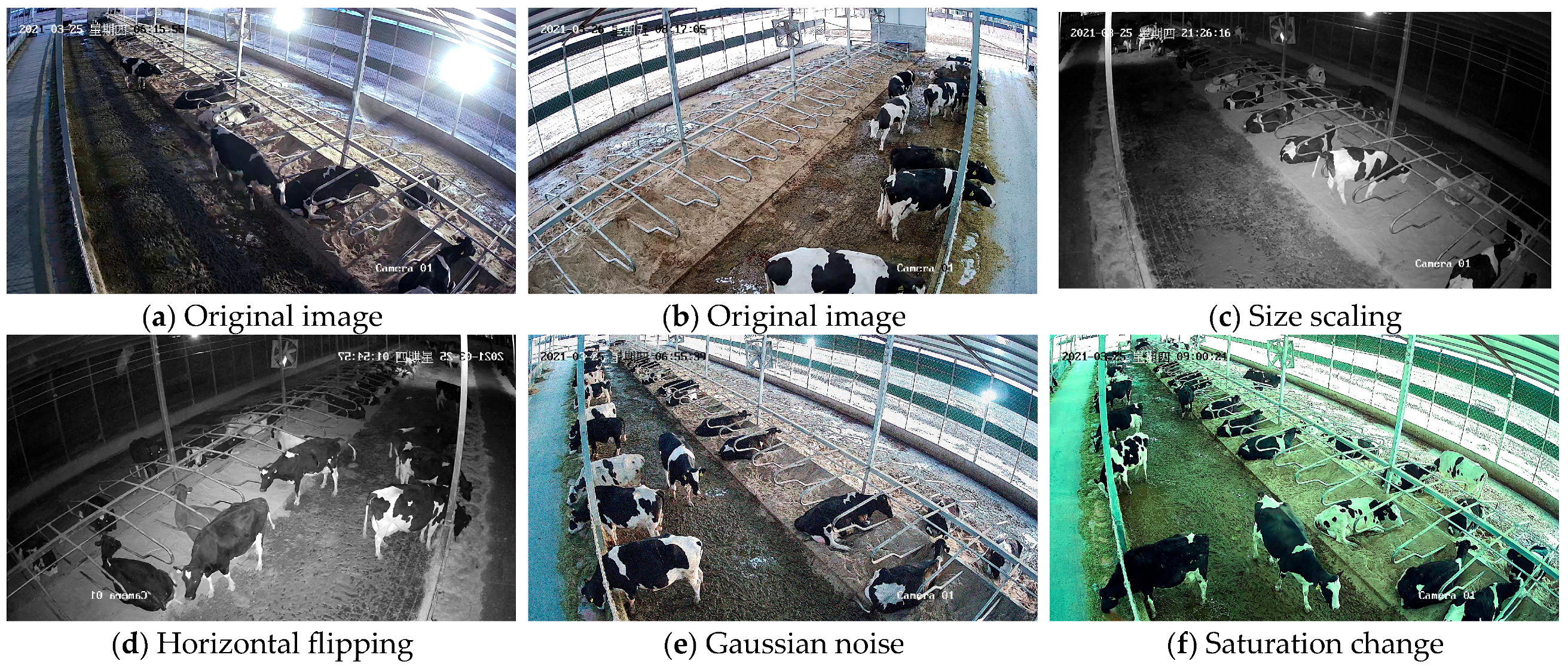
This study selects six dairy cow behaviors—eating, drinking, standing, lying, walking, and mounting—as the behavioral baselines for our behavioral detection and multi-target tracking. The selection of these six dairy cow behaviors in this study comprehensively considers their importance in animal husbandry and animal welfare assessment, their visual observability and distinguishability in surveillance videos, and the feasibility of data annotation and experimental implementation. These behaviors occur frequently in actual pasture environments and have stable characteristics, effectively reflecting the health and welfare status of dairy cows. They also help to construct a relatively balanced dataset, thereby ensuring the stability of model training and the reliability of recognition results. Due to the slow movements and prolonged static postures of dairy cows, images showing highly similar behaviors need to be excluded. First, in the video frame extraction stage, a fixed time interval (4 s/100 frames) frame extraction strategy is adopted to avoid directly using adjacent consecutive frames, thereby effectively reducing temporal frame redundancy. Second, for behavioral samples of the same target in the extracted frames, the spatial location and behavioral characteristics of the cows are observed manually to determine similarity, and cow behavior images with high similarity are removed. To enable multi-object tracking algorithms to track cows across diverse scenarios, the dataset incorporates images captured throughout a 24 h cycle. This includes both daytime and nighttime lighting conditions, as well as scenarios with sparse and dense cow populations, comprehensively covering different scenarios in free-style cowshed environments. The data augmentation diagram is shown in Figure 2. The non-English terms in the image are the time watermarks from the surveillance cameras we used to acquire the data.
Figure 2.
Data augmentation diagram.
The selected images were labeled using Labelimg based on the behavioral characteristics of different behavior categories, resulting in 1792 images. To avoid data leakage, a “split first, augment later” processing strategy was adopted. First, the dataset was divided into three portions (training, validation, and testing) at a ratio of 7:2:1 based on different scenarios. Subsequently, data augmentation was applied to portions of the divided dataset (specifically, the training and validation sets containing fewer cow behavior samples) to improve the balance of samples across behavioral categories. The specific augmentation techniques employed were: size scaling, horizontal flipping, Gaussian noise, and saturation change. The final dataset contains 6264 images, including 4364 images in the training set, 1235 images in the validation set, and 665 images in the test set.
The number of labels (bounding boxes) for the six manually labeled behavior categories in the dataset was statistically analyzed. The training set has 40,331 labels, the validation set has 11,518 labels, and the test set has 6157 labels, for a total of 58,006 labels. Statistical analysis shows that the label distribution ratio is consistent with the distribution of dairy cow activity in a real dairy farm environment. Further statistical analysis of the six behavior labels in each subset reveals that the label distribution ratio for each behavior is roughly the same in each subset, and also largely consistent with the overall distribution ratio of the dataset. Therefore, the dataset constructed in this study avoids the impact of uneven label distribution and further verifies the reliability and rationality of the dataset. The dataset label statistics are shown in Table 1.
Table 1.
Dataset label statistics.
2.2.2. Multi-Object Tracking Dataset
The multi-object tracking dataset comprises eight video segments spanning diverse scenes and time periods, each approximately 60 s in length. Using DarkLabel 2.4, we annotate the tracking trajectories of cows, recording detection object IDs, bounding box dimensions, and coordinates to create the MOT17 dataset. This dataset contains a total of 11,627 frames depicting cow behavior. The specific time periods, sparsity, and influencing factors of the eight video segments in the multi-target tracking dataset are shown in Table 2.
Table 2.
Multi-object tracking dataset.
To evaluate the tracking performance of the multi-object tracking algorithm, we use real-world dairy cow surveillance videos as experimental data when constructing the multi-object tracking dataset to compare the model’s tracking capabilities under different scenarios. During the process of video analysis, a manual observation approach is employed to categorize videos into two distinct classes: those containing a substantial number of cows and significant occlusion, and those with a minimal or non-existent occlusion. These categories are referred to as dense and sparse videos, respectively. As shown in Table 2, although the dataset contains eight video segments, it covers complex scenarios in multi-target tracking, including variations in lighting and occlusion. Furthermore, it includes six typical behaviors of dairy cows, meeting the data requirements for multi-target tracking of dairy cows in free-style cow barn environments.
2.3. Cow Behavior Recognition Model
As the lightest network architecture among YOLOv11 models, YOLOv11n achieves a balance between accuracy and efficiency by maintaining good detection precision while reducing computational overhead and model size [14]. It is evident that the present study adopts YOLOv11n as the foundational model for the recognition of bovine behavior.
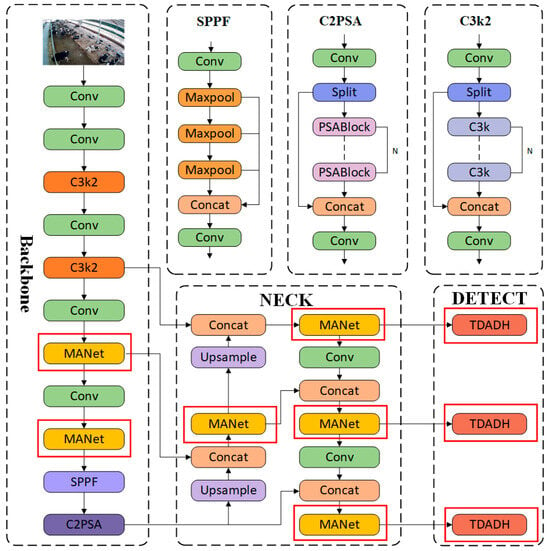
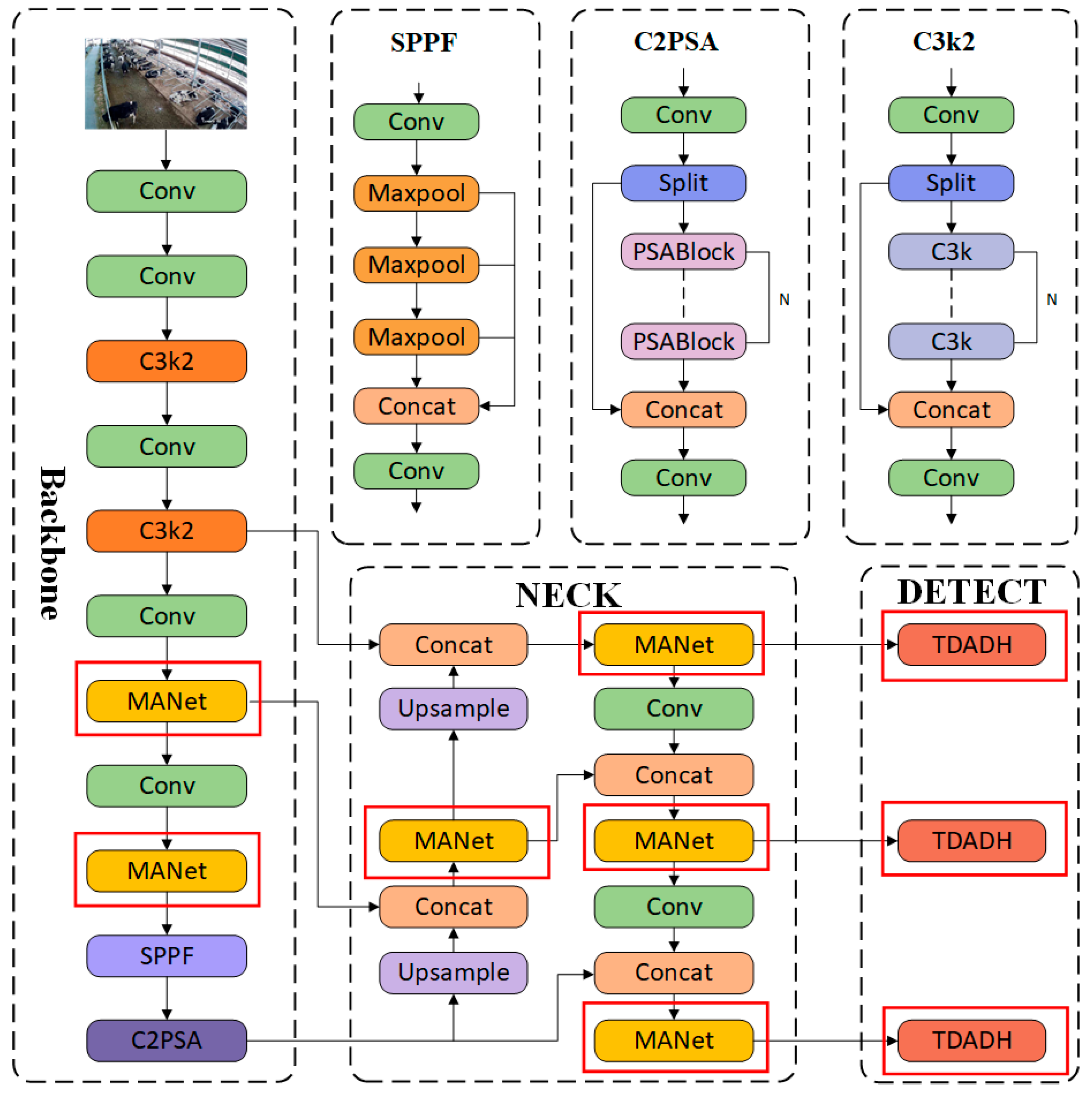
The MTW-YOLO model for cow behavior recognition is constructed based on YOLOv11n. MTW is taken from the first letters of MANet, TDADH and WIoU, and the model is named MTW-YOLO. It replaces the backbone network with MANet and substitutes part of the C3k2 in the neck network. The Task-Dynamic Aligned Detection Head (TDADH) is introduced, and the CIoU loss function is replaced with the WIoU loss function. The network architecture diagram of the improved MTW-YOLO model is shown in Figure 3, with the modified modules highlighted by red rectangular boxes.
Figure 3.
MTW-YOLO network structure diagram.
2.3.1. Mixed Aggregation Network (MANet)
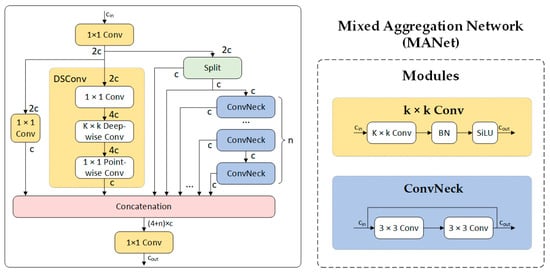
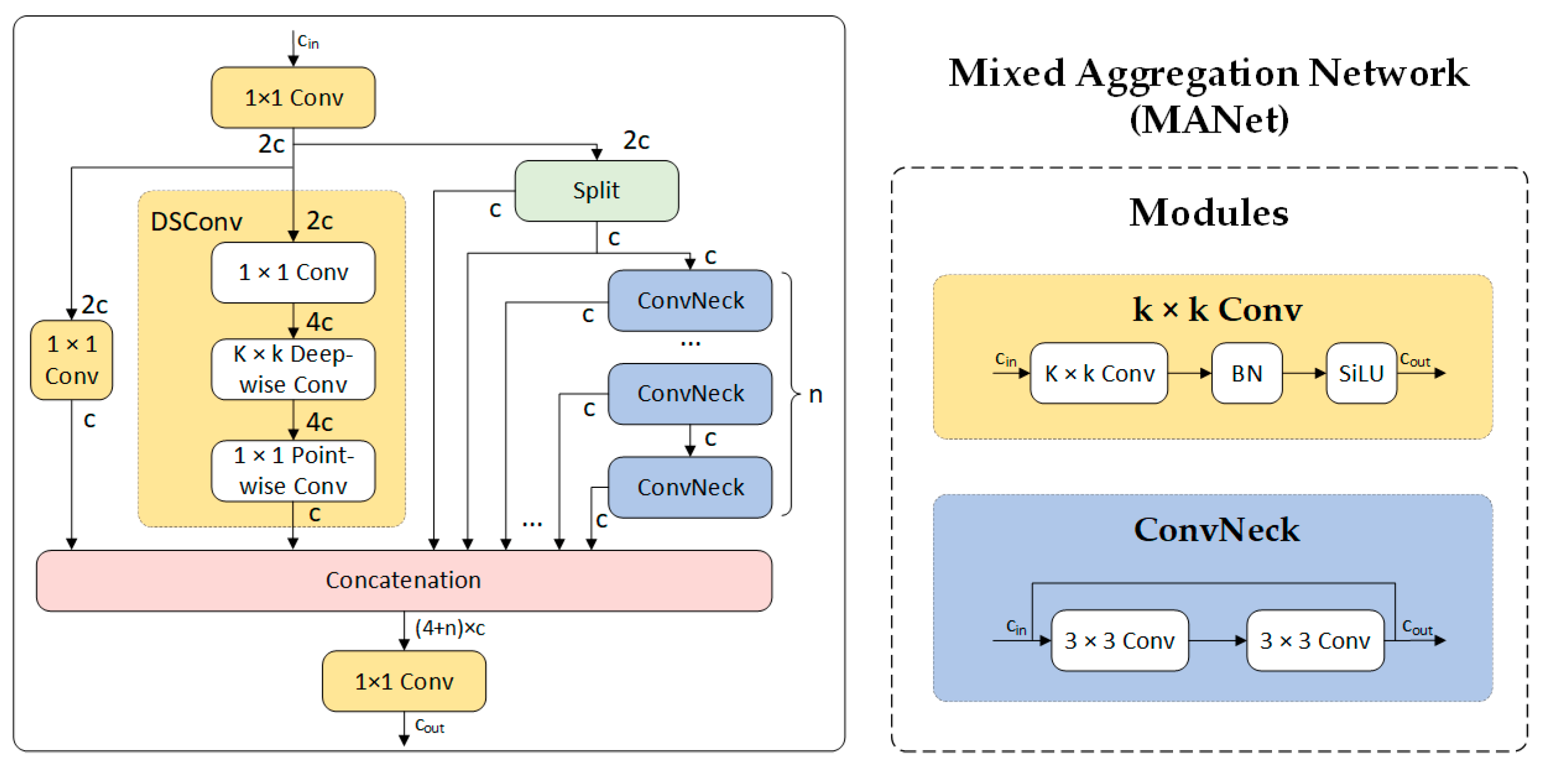
Traditional C3K2 modules are primarily based on lightweight residual stacking structures, which have limited feature expression capabilities, especially in recognizing illumination variations and multi-scale cow behaviors. To address these, the MANet module is introduced. It utilizes a multi-path hybrid aggregation mechanism, fusing channel adjustment, spatial augmentation, channel segmentation, DWConv, and multiple Bottleneck residual structures to effectively enhance the model’s ability to represent fine-grained behavioral features [15]. The MANet network structure is shown in Figure 4, and its core formula is as follows:
where has 2c channels, while each feature in , , …, has c channels.
Figure 4.
MANet network structure diagram.
First, MANet expands the input features through 1 × 1 convolutions, then extracts global and local spatial features using two branches: a 1 × 1 convolution and DSConv. Depthwise separable convolution (DWConv) enhances the spatial modeling capability of each channel, expands the effective receptive field, and thus improves the perception of local differences in the behavior of different cows, while reducing dependence on ambient light intensity. Simultaneously, channel-level feature decomposition introduces multiple residual Bottleneck modules, enabling adaptation to targets of different scales and giving the model stronger contextual modeling capabilities. Deep semantic enhancement reduces the impact of illumination intensity. Finally, a 1 × 1 convolutional layer aggregates the multi-scale features for output, achieving a unified expression of multi-dimensional behavioral information.
In summary, MANet significantly enhances the accuracy and robustness of recognizing dairy cow behavior under different lighting conditions through multi-path parallel feature extraction and multi-scale behavioral feature perception.
2.3.2. Task Dynamic Align Detection Head (TDADH)
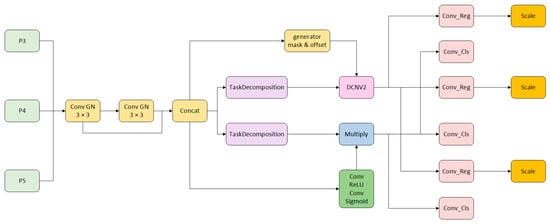
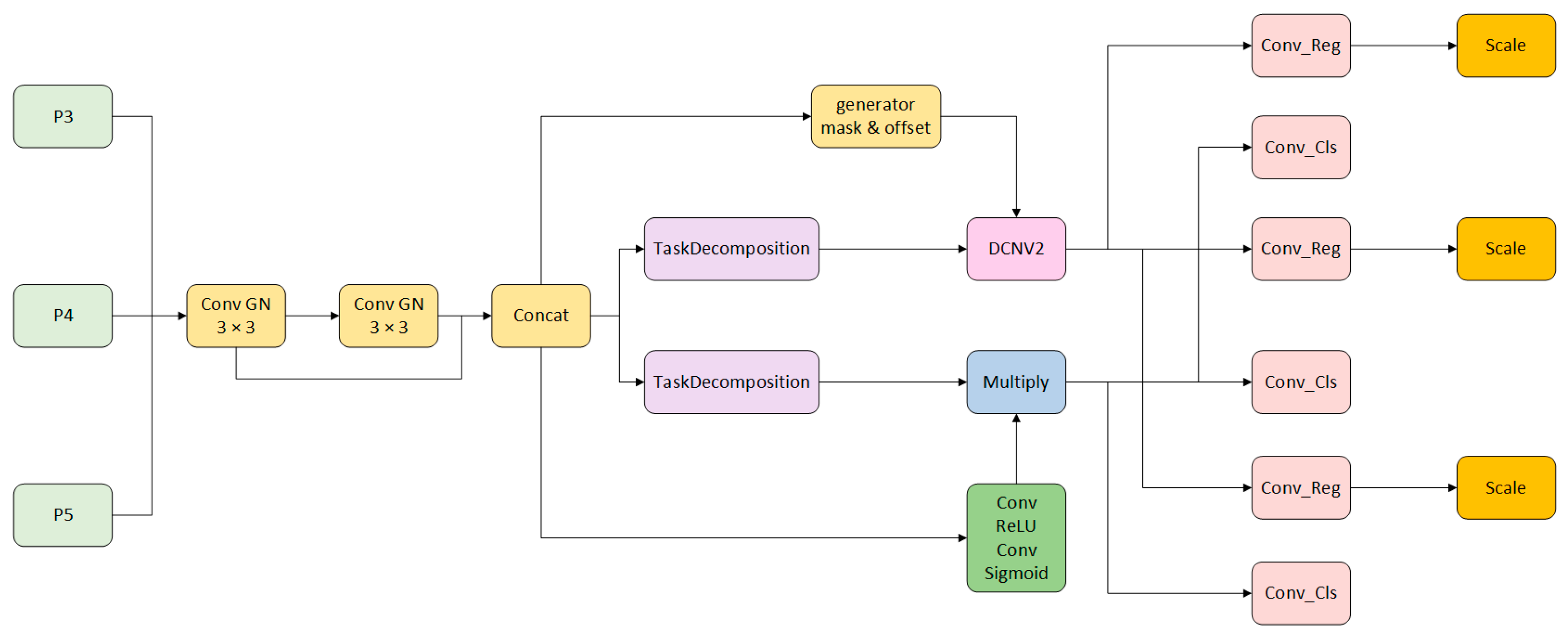
In real dairy farm environments, cows are not stationary but move dynamically, exhibiting significant changes in posture. In areas of high cow density and constant movement, occlusion frequently occurs, introducing interference to cow behavior recognition. To address the problem, the Task Dynamic Align Detection Head (TDADH) is designed. This detection head integrates multiple advanced detection strategies, including task decoupling mechanisms, dynamic spatial alignment, attention guidance, and distributed bounding box modeling. It significantly enhances the performance of cow behavior recognition in dense scenarios. The network structure diagram of TDADH is shown in Figure 5.
where represents the -th element of the attention of the learning layer, and is calculated through cross-layer task interaction features and can capture the relationship between layers [16].
where and represent two fully connected layers. is a sigmoid function, and is obtained by applying average pooling to . Finally, the classification or localization result is predicted from each .
where is a conv layer used for dimensionality reduction.
Figure 5.
TDADH network structure diagram.
TDADH employs shared convolutions, significantly reducing the number of parameters. To address the issue of inconsistent target scales detected by each detection head while using shared convolutions, a Scale layer is applied to scale features, enhancing the model’s ability to represent behavioral features across different scales. The task decoupling module processes the classification branch and regression branch independently, effectively preventing feature interference between different behavioral recognition tasks. This enables the effective differentiation of distinct behaviors in cows within dense scenes. Dynamic Convolutional Neural Network with Variable Convolution (DCNV2) integrates offset and mask mechanisms to achieve spatial dynamic perception. It adaptively adjusts receptive fields based on target morphology changes, enhancing the model’s adaptability to pose variations and scale shifts. The classification output layer incorporates an attention-guided fusion mechanism. By focusing on key regions (such as the head and legs), it improves behavioral discrimination capabilities in adverse conditions such as low light and dense environments.
2.3.3. Wise-IoU (WIoU)
Replacing the bounding box regression loss function with WioU (Wise IoU) offers significant advantages. WIoU introduces a dynamic weighting mechanism that adaptively adjusts the focus on different samples during training based on the matching degree between predicted and ground-truth boxes. It assigns greater optimization weight to low-quality, challenging samples (e.g., small-scale, high-pose-variation, occluded targets), thereby accelerating model convergence for complex objects. In cow behavior recognition, bounding box shapes vary significantly across different behaviors. WioU employs a more balanced optimization strategy for bounding box regression, avoiding the conflicting objectives of distance metric and overlap area optimization present in CIoU. This effectively enhances both bounding box localization accuracy and behavior classification precision [17]. WioU has three versions; this study adopts the WioUv3 version.
The loss function formula for WIoUv1 is shown below:
where and are the sizes of the minimum closed bounding box; and are the coordinates of the anchor box center point; and are the coordinates of the target bounding box center point. will significantly reduce the of high-quality anchor boxes and their focusing on the distance between center points when the anchor box and the target box are well coincident.
The loss function for WIoUv3 is shown below:
where represents the outlier degree, denotes the gradient gain, and is typically greater than 1. When , causes .
2.4. Cow Multi-Object Tracking
This study proposes the Multi-object Tracking (MOT) algorithm MTW-BYTE for free-style cow barn environments, enabling stable, real-time tracking of dairy cows in scenarios involving changing lighting conditions and occlusions.
2.4.1. MTW-BYTE Multi-Object Tracking Algorithm
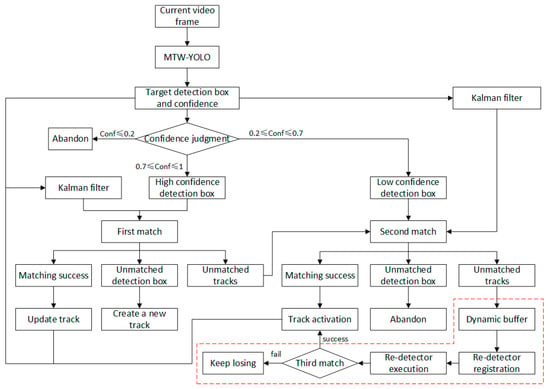
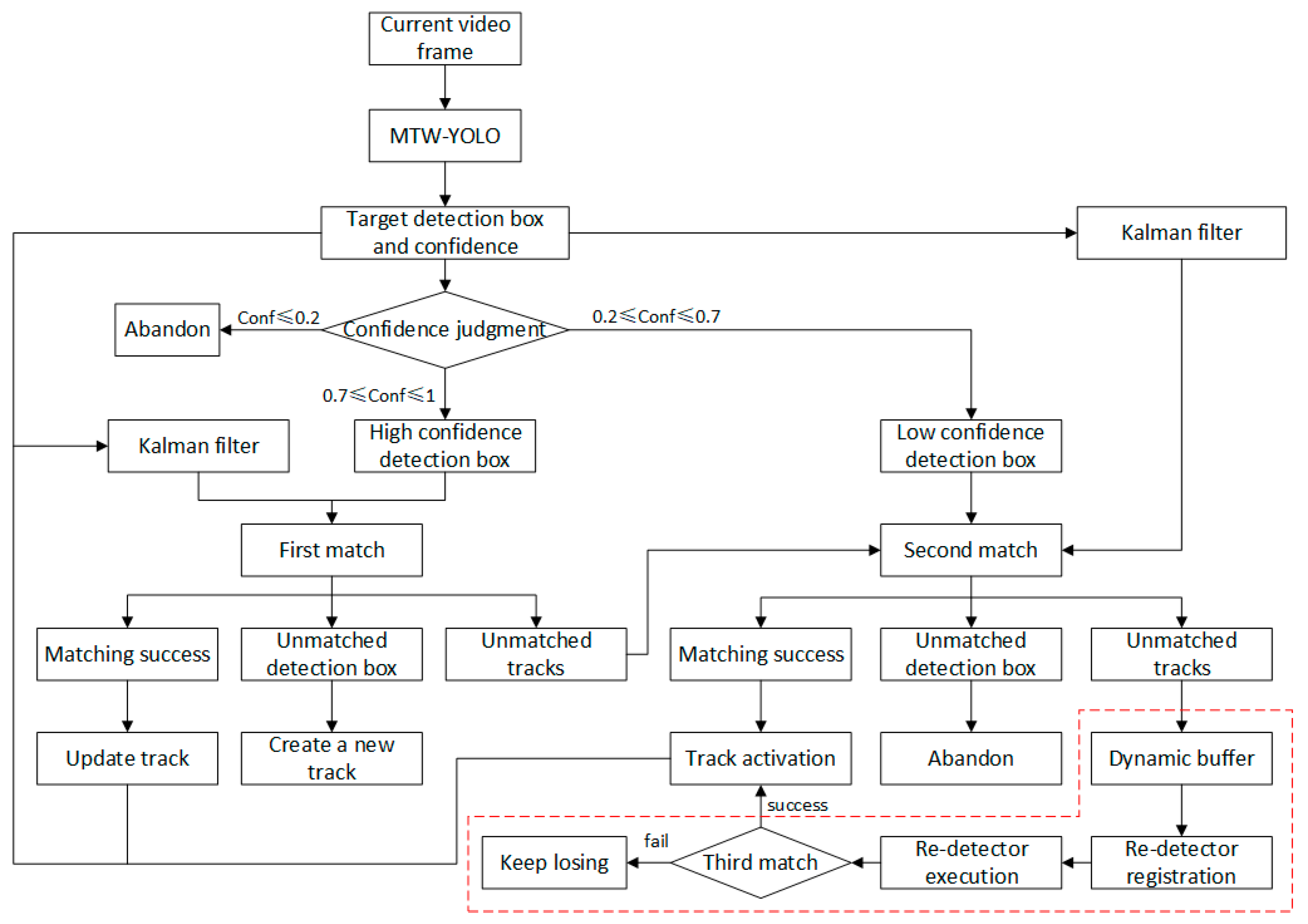
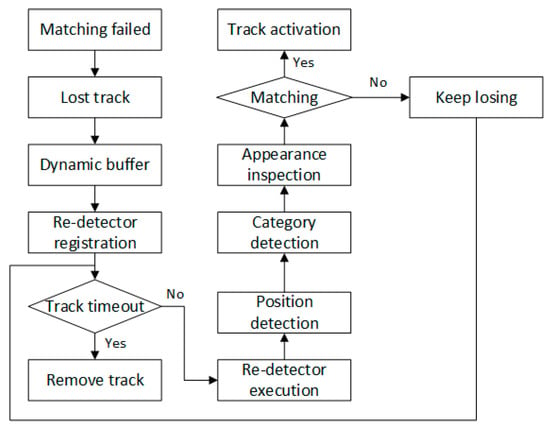
ByteTrack is a multi-object tracking algorithm based on object detection, utilizing detection boxes obtained from object detection for tracking [18,19]. When an object passes through the object detection tracker, it is classified into low-scoring detection boxes and high-scoring detection boxes based on a confidence threshold range. If the confidence falls below a certain threshold, it is deemed not to be the detected object and is subsequently discarded. First, an initial association is performed, matching high-confidence detections with trajectories. A Kalman filter predicts bounding box positions, which are then compared with high-confidence boxes in the current frame using IoU to generate a pairwise IoU relationship loss matrix. This matrix is used with the Hungarian algorithm to match trajectories and detections. ByteTrack enables effective utilization of low-confidence detection boxes, mitigating tracking loss of occluded targets. Secondly, a second association is performed, which involves associating the low-confidence detection boxes with the unmatched trajectories from the first association, calculating the IoU matrix between each pair, and then using the Hungarian algorithm for matching. Track activation means that during the second association process, when a low-confidence detection box is successfully associated with an unmatched trajectory, the trajectory is reactivated and restored to the tracking state; if there are low-confidence detection boxes that fail to match, they are discarded directly.
In this study, MTW-YOLO is employed as the detector. Subsequently, a dynamic buffer and re-detection mechanism are designed for the second unmatched trajectory. The trajectory survival time is adaptively adjusted, and the target is actively searched according to the matching conditions to realize the reconnection and removal of the trajectory. The multi-target tracking algorithm MTW-BYTE is constructed. The improved strategy is shown in the red box in Figure 6. The red dashed box in the Figure 6 represents the improved part of the algorithm.
Figure 6.
MTW-BYTE algorithm flowchart.
2.4.2. Dynamic Buffer and Re-Detection Mechanism
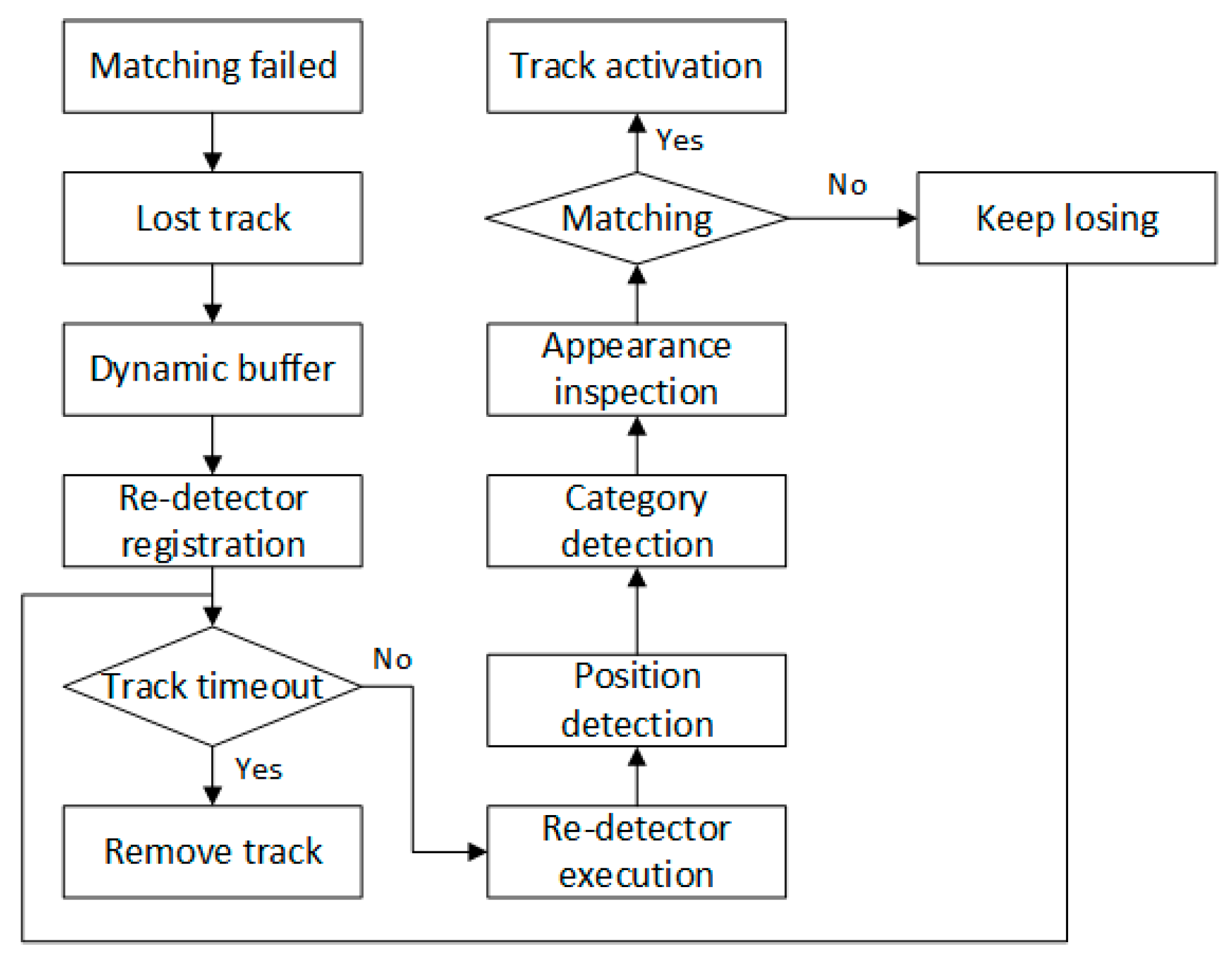
When cows temporarily disappear due to factors such as obstructions and then reappear, it can cause trajectory interruptions and identity ID switching issues. This study designs a dynamic buffer and re-detection mechanism to address this problem, with its algorithm flowchart shown in Figure 7.
Figure 7.
Flowchart of the dynamic buffer and re-detection mechanism algorithm.
First, in the processing loop of each video frame, when a target fails to match during the data association phase, it is marked as “Lost,” but it is not immediately deleted. Subsequently, the system calculates a dynamic buffer length for the target based on the area of the detection box (longer buffer for large targets, shorter for small targets), replacing the fixed value shared by all tracks. The target enters a “buffer countdown” calculated based on its dynamic buffer length, registers it with the redetector, and records key status information of the track (such as ID, last position, category, etc.) for matching and recovery in subsequent redetection phases.
The Track timeout module determines whether the lost track has exceeded the maximum allowed buffer time. Tracks that fail to rematch within the set maximum number of search frames are eventually removed, thus preventing the long-term existence of false tracks. For lost tracks that have not timed out, the redetection process is initiated. In the detection results of each frame, for each lost track in the “buffer,” new detection boxes of the same category with an appearance similarity (IoU) exceeding a threshold of 0.7 are actively searched within the search radius around its last known position. Once a highly matching detection box is found, the redetector will immediately notify the main process, and the lost track will be reactivated—its state will be restored to “Tracked” and it will inherit the original ID, thus achieving seamless connection; if a match is still not found at this time, the track will enter the lost state, return to the dynamic buffer to wait for redetection in subsequent frames, until timeout or successful activation.
2.5. Experimental Platform and Parameter Settings
The experimental platform and parameters significantly influence the experimental results. Therefore, all experiments in this study are conducted under identical experimental conditions to ensure the reliability of the results. The experimental environment parameters are shown in Table 3. All hardware parameters are derived from the experimental equipment identifier, and the experimental virtual environment is selected with parameter settings compatible with the experimental equipment.
Table 3.
Experimental environment parameters.
In this study, the experiments are divided into two parts: (1) training and validation of the dairy cow behavior recognition model; (2) experimental analysis of the multi-object tracking algorithm for dairy cows. To ensure experimental reliability, all experiments are conducted under identical hyperparameter settings. The hyperparameters for dairy cow behavior recognition are shown in Table 4. The multi-object tracking experiments employ the same environmental configuration as Table 3. Additionally, the confidence threshold is set to 0.2, the IOU is set to 0.7, with all other settings maintained at their default values.
Table 4.
Hyperparameters in cow behavior experiments.
In the hyperparameter settings for the cow behavior experiment, imgsz, lr, and momentum are the default settings in Ultralytics. batch = 16 is a reasonable setting based on the GPU resources of the experimental hardware. The SGD optimizer, a fixed combination, is used based on the lr value of 0.01. Finally, based on the dataset’s performance during training, the epoch is set to 200 to ensure the model is fully trained.
2.6. Evaluation Indicators
2.6.1. Cow Behavior Recognition Evaluation Indicators
To objectively reflect the comparative effects before and after model refinement, this study selects seven evaluation metrics—Precision (P), Recall (R), mAP50, F1, FPS, Parameters, and GFLOPs—to validate the model’s performance.
The formulas for Precision (P), Recall (R), mAP50, and F1 are as follows:
where , , and represent the number of actual positive classes predicted as positive, the number of actual negative classes predicted as positive, and the number of actual positive classes predicted as negative, respectively. C denotes the number of classes, denotes average precision, and denotes the value for class .
The number of parameters refers to the total number of trainable parameters in the model. GFLOPs represents the total floating-point computation during model forward inference. FPS indicates the number of images processed per second by the model.
2.6.2. Multi-Object Tracking Evaluation Indicators
For evaluating cattle tracking, this study selects six evaluation metrics to measure the tracking model performance: Higher-order tracking accuracy (HOTA), Multiple object tracking accuracy (MOTA), Multiple object tracking precision (MOTP), Identification F1 (IDF1), IDSW, and FPS. The relevant formulas are shown below:
where represents the detection accuracy score, represents the association accuracy score, is the number of positive samples, is the number of positive samples predicted as negative by the model, represents the number of negative samples predicted as positive by the model, is the point belonging to , and represents the association accuracy [10].
where denotes the total number of false positives detected in frame ; denotes the total number of false negatives detected in frame ; IDS denotes the number of target label switches during tracking in frame ; denotes the number of targets observed at time [12].
where represents the distance between the given real position and its paired detection position in frame ; represents the number of matches between the target and the hypothetical position in frame ; and represents the current detected target.
where represents the total number of targets correctly tracked when remains unchanged; represents the total number of targets incorrectly tracked when remains unchanged; and represents the total number of targets lost during tracking when remains unchanged.
3. Results
3.1. Analysis of Cow Behavior Recognition Experiment
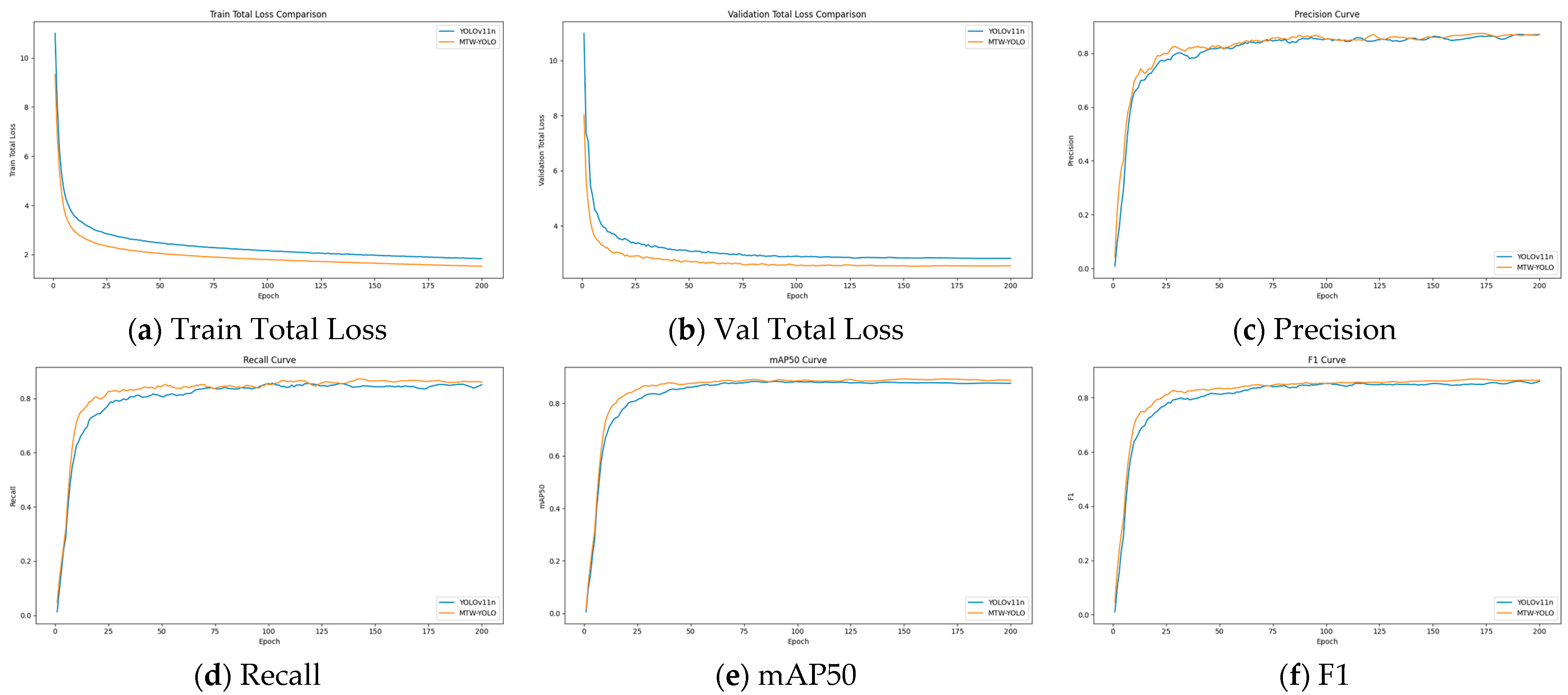
To validate the overall performance of the model before and after improvement, we conduct a visual analysis of the precision (P), recall (R), mAP50, F1 score metrics, and the model’s loss values on the training and validation sets. By comparing the curve changes before and after model enhancement, we assess the effectiveness of the model improvement strategy. The performance index curves are shown in Figure 8.
Figure 8.
Performance index curves.
From the loss curves during training, the improved MTW-YOLO model consistently exhibits lower overall loss values on both the training and validation sets compared to the original model, and converges faster, indicating a more stable optimization process and effectively mitigating overfitting and underfitting issues. In terms of performance metrics, the MTW-YOLO model shows a faster rate of increase in precision (P), recall (R), mAP50, and F1 score compared to the original model, reaching a plateau earlier with smoother curves, and outperforming the original model in all metrics.
In conclusion, the improved MTW-YOLO model enhances detection accuracy while effectively reducing losses during training and validation, validating the effectiveness and superiority of the proposed method in practical tasks and demonstrating better overall model performance.
3.1.1. Ablation Experiment
To evaluate the effectiveness of MANet, TDADH, and WIoU in the improved cow behavior recognition model MTW-YOLO, this study conducts ablation experiments on the test set using a self-built cow behavior dataset under identical experimental environments and model parameters. The ablation experiment results are shown in Table 5.
Table 5.
Ablation experiment.
To address variations in lighting conditions and enhance multi-scale feature recognition capabilities for cows, the MANet architecture is introduced to replace C3k2. The improved Model B achieves accuracy (P), mAP50, and F1 scores that are 0.5%, 0.3%, and 0.1% higher than YOLOv11n, respectively. To address variations in lighting conditions and common occlusion issues in dense cow scenes, TDADH is introduced to replace the original detection head. Compared to YOLOv11n, the improved Model C achieves 2.4%, 0.6%, and 1.1% increases in accuracy (P), mAP50, and F1 score, respectively. To more effectively enhance the accuracy of behavioral classification, replacing the CIoU loss function with WIoU results in improved model D, achieving 3.3%, 0.4%, and 0.1% increases in precision (P), mAP50, and F1 score, respectively, compared to YOLOv11n. After integrating MANet and TDADH, Model E achieves overall improvements of 2.4% in precision (P), 1% in recall (R), 1.3% in mAP50, and 1.7% in F1 score. Although precision (P) decreases compared to Model D, recall (R), mAP50, and F1 score all show varying degrees of enhancement relative to single-module improvements. The MTW-YOLO model consumes fewer Parameters than Model B but more than other models. It achieves higher GFLOPs than other models while maintaining a lower FPS value. Nevertheless, its frame rate reaches 55.2 FPS, satisfying real-time requirements.
The improved MTW-YOLO model achieves 89.9% precision, 85.9% recall, 90% mAP50, and 87.8% F1 score. Compared to the original model, all metrics show improvement: precision (P) increases by 4.5%, recall (R) by 0.1%, mAP50 by 1.6%, and F1 score by 2.2%. Compared to other improved models, MTW-YOLO only falls short of Model E in recall, outperforming all other models in all other metrics.
3.1.2. Comparative Experiment
This study conducted a comparative analysis of the model with mainstream models widely used in the field of object detection under the same experimental environment. In addition, models with the same number of parameters were used in the experiments to objectively reflect the improvement effect of MTW-YOLO on cow behavior recognition. The comparative experimental results are shown in Table 6.
Table 6.
Comparative experiment.
The improved MTW-YOLO achieves a Precision (P) of 89.9%, significantly higher than other models. Its recall reaches 85.9%, lower than SSD and Faster-RCNN, but higher than other models. In terms of mAP50, MTW-YOLO reached 90%, higher than all other detection models. Regarding the F1 score, MTW-YOLO achieves 87.8%, only lower than YOLOv9t, and higher than other models. In terms of FPS, MTW-YOLO’s frame rate is 55.2, higher than SSD, Faster-RCNN, RT-DETR-1, YOLOv9t, and YOLOv12n, but lower than other models, meeting real-time requirements. While its parameters and GFLOPs are higher than some models, they are significantly lower than SSD, Faster-RCNN, and RT-DETR-1.
Overall, the improved MTW-YOLO model shows varying degrees of improvement in Precision, Recall, mAP50, and F1 scores, outperforming the original model.
3.1.3. Visualization and Analysis of Test Results
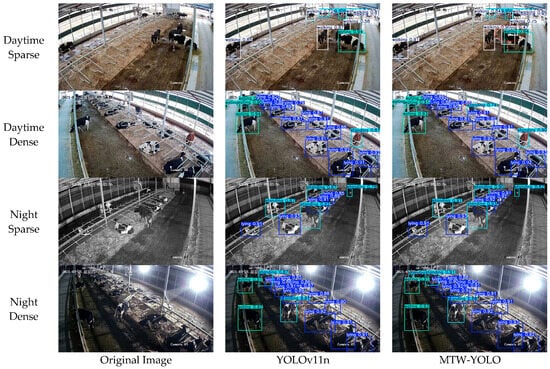
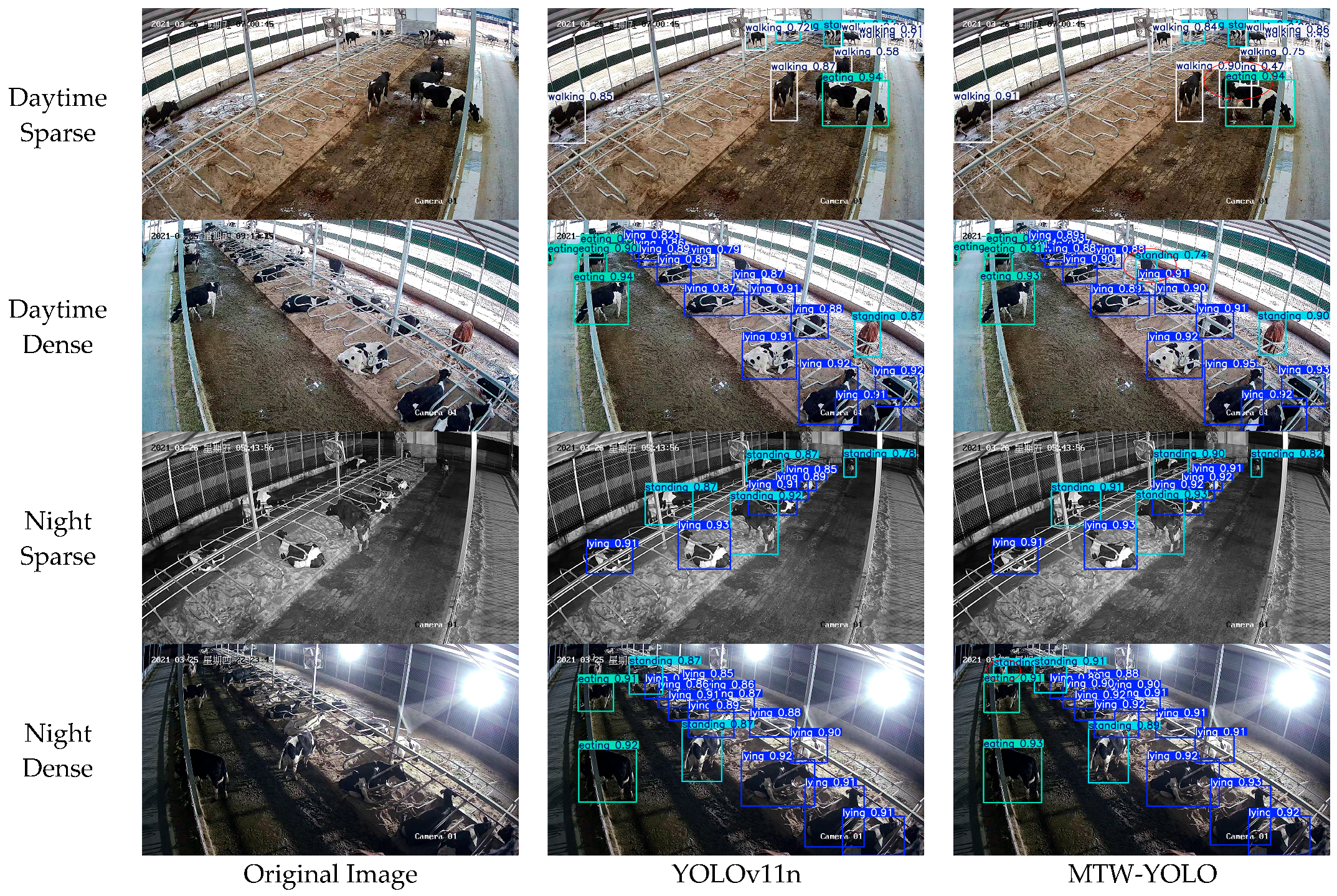
To further demonstrate the effectiveness of the improved dairy cow behavior recognition model, this study selects images of cow behavior across four distinct scenarios from the test dataset. These scenarios encompass daytime sparse cattle, daytime dense cattle, nighttime sparse cattle, and nighttime dense cattle—scenarios commonly encountered in real dairy farms. By comparing model performance before and after the improvements, the enhanced capabilities of the modified MTW-YOLO model are validated. The test results are shown in Figure 9. The red circles in Figure 9 represent a comparison of the detection results of the model before and after the improvement.
Figure 9.
Test results comparison chart.
Based on test results across four scenarios, MTW-YOLO consistently achieves higher confidence scores than the original model. In daytime sparse scenes, the improved model successfully detects cows under occlusion conditions where the original model fails to identify obscured cows, demonstrating MTW-YOLO’s effective handling of common cow occlusion challenges. In both daytime dense and nighttime dense scenarios, MTW-YOLO successfully detects larger cows as well as smaller cows at greater distances. This demonstrates the model’s ability to not only effectively handle variations in lighting conditions but also adapt to changes in the behavioral scale of cows across different scenarios.
In summary, the improved MTW-YOLO model not only significantly enhances cow behavior recognition under common occlusion conditions but also effectively handles multi-scale variations in cow behavior across different lighting conditions. This results in increased model accuracy, reduced false negative rates, and an overall improvement in detection performance.
3.2. Analysis of Multi-Object Tracking Experiment in Dairy Cows
3.2.1. Tracker Selection Experiment
To ensure the proposed multi-object tracking algorithm meets the requirements of effectiveness and real-time performance in free-style cow barn environments, this section designs a comparative experiment, combining YOLOv11n with current mainstream multi-object tracking algorithms to compare various parameter indicators and thus determine the optimal multi-object tracking algorithm. The experimental results are shown in Table 7.
Table 7.
Tracker selection experiment.
By integrating the original YOLOv11n model with ByteTrack, BotSort, DeepOcsort, Ocsort, and BoostTrack, BotSort demonstrates the best overall performance across all metrics, followed by ByteTrack. However, BotSort’s frame rate (FPS) is significantly lower than ByteTrack’s, especially when deployed on edge devices, resulting in poor real-time performance and higher demands on edge computing equipment. Therefore, this study selects ByteTrack as the multi-object tracker due to its superior tracking accuracy and robust real-time performance.
3.2.2. Experiment on the Improved Multi-Object Tracking Algorithm
To validate the effectiveness of the improved multi-object tracking algorithm, experimental analysis is conducted on the tracking model MTW-BYTE after enhancing its dynamic buffer and re-detection mechanism. The experimental results are shown in Table 8.
Table 8.
Tracking algorithm improvement experiment.
In Table 8, the original YOLO11n model combined with the original ByteTrack multi-target tracking algorithm is named YOLO11-ByteTrack; the improved cow behavior recognition algorithm MTW-YOLO combined with the original ByteTrack multi-target tracking algorithm is named MTW-ByteTrack; and the improved cow behavior recognition algorithm MTW-YOLO combined with the improved ByteTrack multi-target tracking algorithm is named MTW-BYTE.
As shown in Table 8, after incorporating the dynamic buffer and re-detection mechanism, the improved cow behavior recognition model MTW-YOLO, combined with the enhanced tracking algorithm, outperforms the original multi-object tracking algorithm YOLO11-ByteTrack. Specifically, it achieves a 1.1% improvement in HOTA, a 3.6% improvement in MOTA, a 0.2% improvement in MOTP, and a 1.9% improvement in IDF1. The number of ID changes decreases by 11. Although the FPS is lower than YOLO11-ByteTrack, it still achieves 43.11 frames per second.
3.2.3. Multi-Scenario Tracking Experiment
To validate the tracking performance of the multi-object tracking algorithm MTW-BYTE across different scenarios, this study employs eight segments of cow behavior videos (labeled 1–8 for different scenarios) for testing. By comparing various metrics before and after algorithmic improvements, the effectiveness of the enhanced algorithm is demonstrated.
Table 9 demonstrates that when testing the multi-object tracking algorithms YOLO11-ByteTrack and MTW-BYTE on cow behavior videos across various scenarios, comparing metrics across eight scenarios reveals that MTW-BYTE achieves significant improvements in performance under different lighting conditions and varying degrees of occlusion. Additionally, the number of ID changes is effectively reduced, indicating that MTW-BYTE performs well in diverse scenarios.
Table 9.
Multi-Scenario tracking experiment.
3.2.4. Visualization and Analysis of Tracking Results
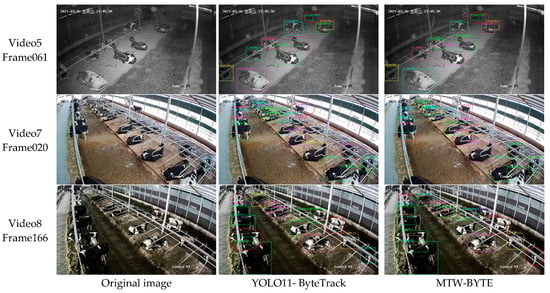
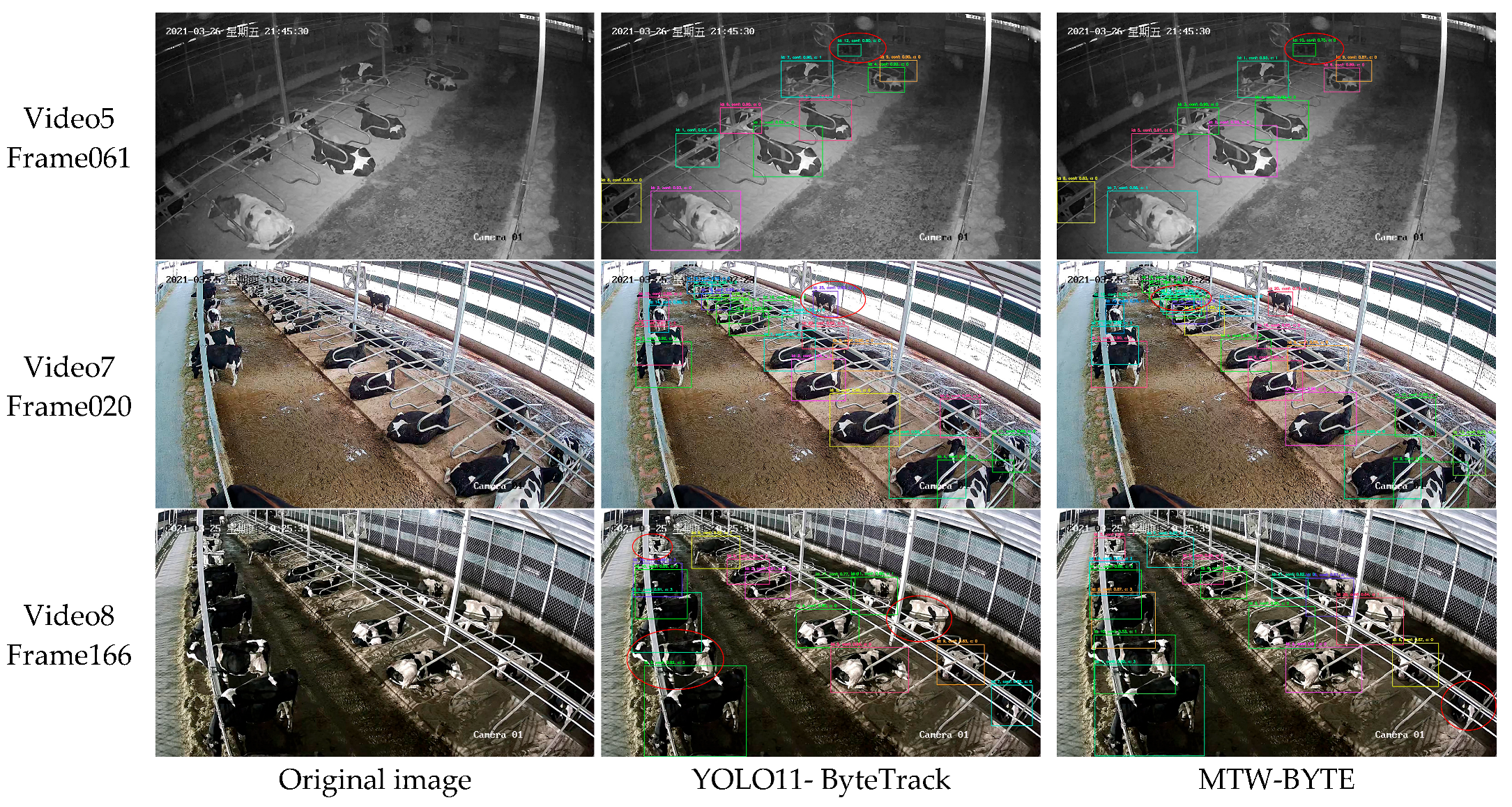
To further validate the effectiveness of the improved MTW-BYTE multi-object tracking algorithm for dairy cows, visual analysis is conducted using videos from different scenarios. The results are shown in Figure 10. In Figure 10, id represents the cow’s ID, conf represents the confidence level, and c, ranging from 0 to 5, represents lying, standing, walking, eating, drinking, and mounting, respectively. The red circles in Figure 10 represent a comparison of the tracking results before and after the improvement of the tracking algorithm.
Figure 10.
Tracking Results Comparison Chart.
Three sets of cow behavior videos under different scenarios are selected for testing and analysis using both the YOLO11-ByteTrack and MTW-BYTE multi-object tracking algorithms, comparing their tracking performance on identical frames. The first scenario is nighttime with no lighting and slight occlusion. The tracking results show that both pre- and post-improvement algorithms detect 10 bounding boxes in the same scene. MTW-BYTE tracks 10 IDs, while YOLO11-ByteTrack generates 12 IDs during tracking. Scenario 2: Daytime with occlusion. Both pre- and post-improvement algorithms detect 22 bounding boxes. MTW-BYTE tracks 22 IDs, while YOLO11-ByteTrack tracks 25 IDs. This demonstrates that the model improvement effectively reduces ID transformation frequency. Scenario 3 involves nighttime conditions with strong light and occlusion. Tracking results show that YOLO11-ByteTrack frequently misses detections, leading to trajectory interruptions, while MTW-BYTE maintains continuous tracking.
In summary, the improved MTW-BYTE multi-object tracking algorithm effectively mitigates the impact of lighting and occlusion on cow behavior recognition. It significantly reduces ID changes, prevents trajectory interruptions, and enhances overall tracking performance.
3.3. NVIDIA Embedded Deployment
3.3.1. NVIDIA Jetson AGX Orin
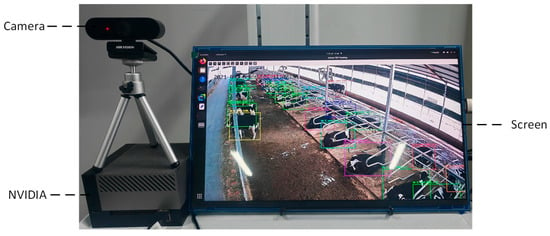
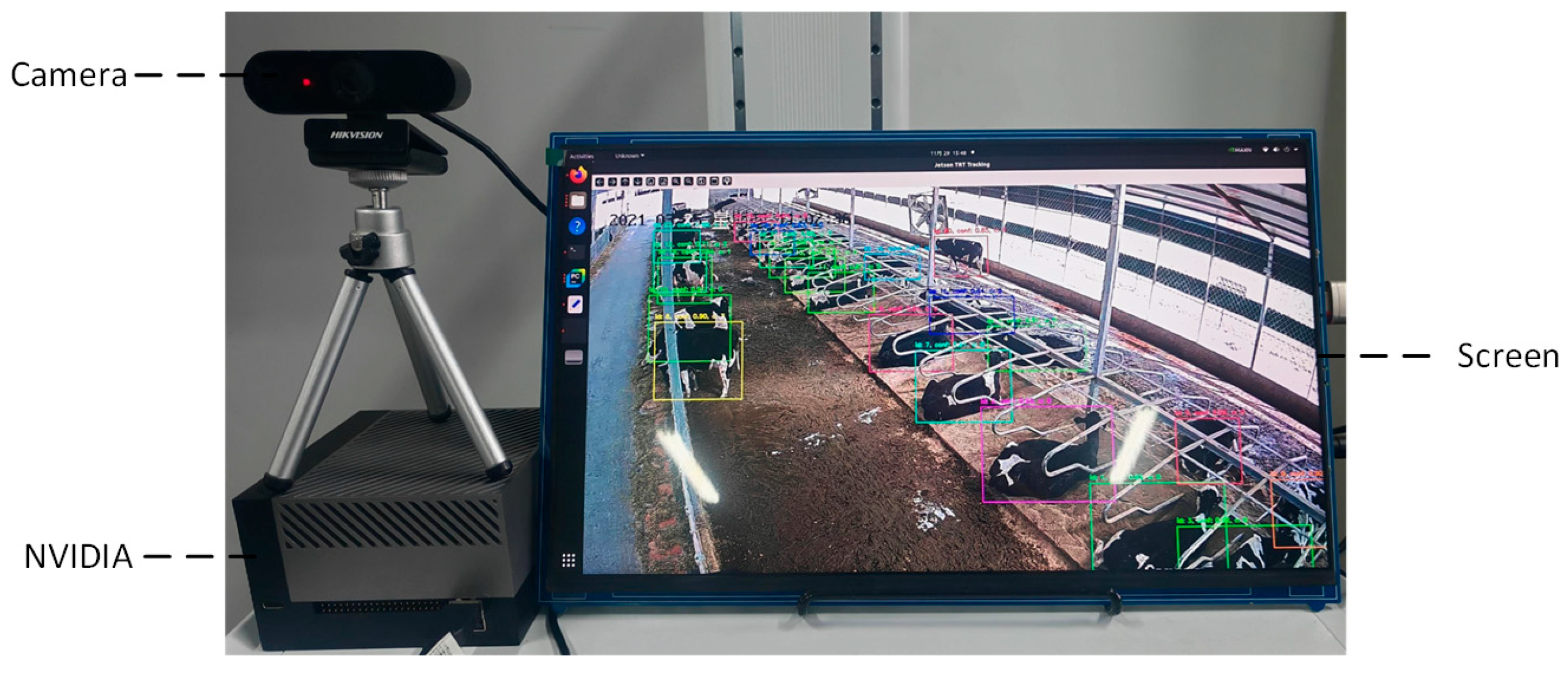
NVIDIA Jetson AGX Orin (NVIDIA CORP, 2788 San Tomas Expressway, Santa Clara, CA 95051, USA) is an embedded edge computing platform released by NVIDIA. It comes pre-installed with Ubuntu and features a processor with a 12-core Arm Cortex-A78AE v8.2 64-bit CPU, an NVIDIA Ampere architecture GPU with 2048 NVIDIA CUDA cores and 64 Tensor cores, and 64 GB of both graphics memory and system memory. NVIDIA Jetson AGX Orin delivers powerful computational capabilities to meet the demands of model deployment in embedded edge computing environments. Figure 11 shows our embedded device diagram, including NVIDIA, camera, and screen.
Figure 11.
Embedded device diagram.
3.3.2. Embedded Model Transformation
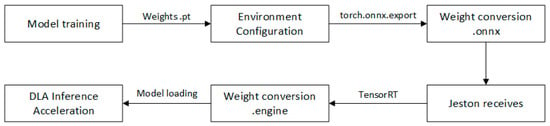
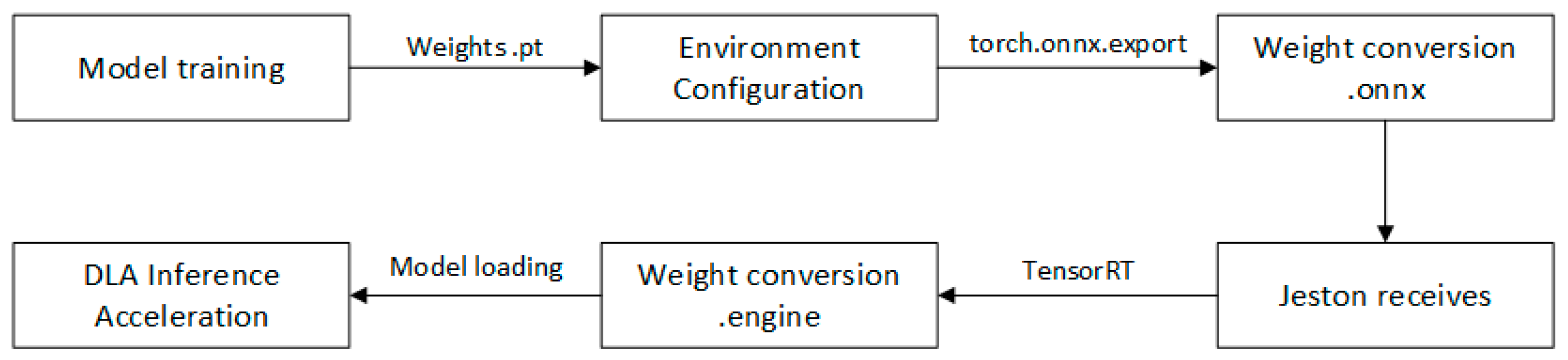
First, establish a virtual environment with the same environment variables configured during model training. After setting up the virtual environment, convert the model’s weight files. The weight files obtained from YOLO training are in PT format. These must first be converted to ONNX format. Subsequently, on the edge computing platform, the ONNX files are converted to ENGINE format files. Inference acceleration is achieved using the deep learning accelerator on the NVIDIA Jetson AGX Orin platform. The model conversion flowchart is shown in Figure 12.
Figure 12.
Model conversion flowchart.
3.3.3. Tracking Algorithm Deployment Experiment
To validate the real-time performance and feasibility of the improved MTW-BYTE multi-object tracking algorithm in an embedded environment, both the original and modified algorithms are deployed on an NVIDIA Jetson AGX Orin edge device. The results are shown in Table 10.
Table 10.
Deploy the experiment.
The detection algorithm and multi-object tracking algorithm are integrated separately, then tested on a training machine equipped with an RTX-4070 and an NVIDIA Jetson AGX Orin edge device. The algorithms’ actual performance is validated by comparing their pure inference time per frame and FPS. As shown in Table 10, MTW-BYTE achieves a pure inference time of 9.34 ms per frame and an FPS of 43.11 on the training machine. After deploying MTW-BYTE to the NVIDIA Jetson AGX Orin edge device, the pure inference time per frame remains at 16.62 ms with an FPS of 29.95. Analysis of the improved algorithm’s metrics confirms that MTW-BYTE still meets real-time requirements in free-style cow barn environments, further validating the algorithm’s feasibility.
4. Discussion
Continuous monitoring of dairy cow behavior is of significant practical importance for assessing their health and welfare levels and is also a crucial component of intelligent dairy farm management. Existing research on dairy cow behavior monitoring primarily focuses on behavior detection or multi-object tracking. In detection, the focus is mainly on multi-scale changes, single behavior category classification, and small targets, lacking further research on illumination changes and occlusion. Regarding multi-object tracking, although some researchers have conducted studies, instability persists in environments with illumination changes and occlusion, easily leading to trajectory interruptions and identity ID switching. Furthermore, related studies have not considered the feasibility of practical deployment.
To address the problems in existing research, this study proposes a multi-object tracking algorithm, MTW-BYTE, by improving YOLO11 and ByteTrack. This algorithm aims to solve the impact of illumination changes and common occlusion on dairy cow behavior recognition in free-style cow barn environments, as well as the problems of trajectory interruptions and identity ID switching during multi-object tracking.
From an algorithmic perspective, the improved detection and tracking algorithm exhibits relatively stable performance under common illumination changes and common occlusion conditions in free-style cow barns. This improvement is primarily due to the network structure improvements of YOLOv11. The backbone and neck network C3k2 are replaced with MANet, a Task Dynamic Alignment Detector Head (TDADH) is introduced, and the CIoU loss function of YOLOv11n is replaced with the WIoU loss function. The improved MTW-YOLO model not only effectively addresses the impact of varying lighting conditions and identifies multi-scale behaviors of cows under different lighting conditions, but also handles common occlusion issues, improving the overall detection performance of the model. Furthermore, the ByteTrack algorithm is improved by designing a dynamic buffer and a re-detection mechanism. The dynamic buffer length is calculated based on the detection box area, replacing the original fixed value. Then, the dynamic buffer of the lost trajectory is used to determine if a timeout has occurred, resulting in the removal of the trajectory. Finally, a re-detector actively searches for the target to reconnect the trajectory. This addresses the issues of trajectory interruption and identity ID switching during tracking, improving the overall performance of multi-target tracking. Finally, to verify the engineering practicality of the algorithm, MTW-BYTE is deployed on the edge device NVIDIA Jetson AGX Orin, and inference acceleration is achieved using the deep learning accelerator of the NVIDIA Jetson AGX Orin platform, thus verifying the feasibility of deploying the algorithm on the edge device.
In this study, the six behavioral categories labeled in the dataset are all high-frequency daily behaviors with clear animal husbandry significance, but low-frequency, small-sample behaviors are not considered. The dataset distribution is relatively reasonable, but further collection and expansion of data for relatively low-frequency behaviors can make the dataset more balanced. Furthermore, this study focuses on ordinary occlusion conditions; the algorithm performs only moderately under severe occlusion. For our further research, we will consider factors such as low-frequency behaviors, severe occlusion, and complex backgrounds, making these our future research directions. Existing research has attempted to improve the reliability of behavior recognition and individual identification by introducing multimodal information. For example, some scholars have used sensor systems [20,21] and pose estimation [22,23] to identify dairy cow behavior and barcodes and cameras to track and identify [24] dairy cows. Inspired by this, future research can further explore strategies for fusing visual information and sensor data to improve the ability to recognize small-sample behaviors and the stability of long-term tracking without significantly increasing system computational overhead, thereby better serving the practical application needs in free-range cattle shed environments. Compared with the research results of current researchers [7,8,9,10,12,13,25] in the field of cow behavior recognition and tracking, our research has been able to solve the problems of lighting and ordinary occlusion while detecting multiple cow behaviors, but the algorithms they have studied are also worth learning from. Our research data is limited to free-style cow barn environments, but future experiments can also be conducted in open natural pasture environments, providing intelligent solutions for detecting dairy cow behavior in both free-style cow barn environments and open natural pasture environments.
5. Conclusions
This study proposes an efficient cow behavior recognition and multi-object tracking algorithm, MTW-BYTE, to address the impact of lighting variations and common occlusion on cow behavior recognition in free-style cow barn environments, as well as the issues of trajectory interruption and ID switching during multi-object tracking.
In the cow behavior recognition part, the MTW-YOLO cow behavior recognition algorithm, on a self-built cow behavior dataset, achieves improvements of 4.5% in Precision, 0.1% in Recall, 1.6% in mAP50, and 2.2% in F1 score compared to the original model, with a frame rate of 55.2 FPS. In the multi-object tracking task, the MTW-BYTE algorithm outperforms the original YOLO11-ByteTrack algorithm in all multi-object tracking evaluation metrics. Compared to the original tracking algorithms, HOTA, MOTA, MOTP, and IDF1 achieve improvements of 1.1%, 3.6%, 0.2%, and 1.9%, respectively, reduce the number of ID switching by 11, and achieve a frame rate of 43.11 FPS. Deploying the improved multi-target tracking algorithm MTW-BYTE on an NVIDIA Jetson AGX Orin edge device, its pure inference time per frame is 16.62 ms, and its frame rate reaches 29.9 FPS.
Experimental results show that the proposed MTW-BYTE multi-target tracking algorithm maintains high detection and tracking accuracy while possessing good real-time performance and stability, effectively handling common lighting variations and ordinary occlusion conditions in free-style cow barn environments. Furthermore, deployment and verification on an NVIDIA Jetson AGX Orin edge device further demonstrate the engineering practicality of this method in real-world ranch intelligent monitoring scenarios. The real-time and stable MTW-BYTE multi-target tracking algorithm helps to realize the statistics of dairy cow behavior, provides a technical foundation for refined feeding management, health monitoring, and welfare assessment, and improves the intelligence level of dairy cow behavior monitoring systems.
Author Contributions
Conceptualization, J.F., X.W., Y.Z. and C.W.; methodology, C.W.; software, C.W.; validation, J.F., X.W., Y.Z. and C.W.; formal analysis, C.W.; investigation, C.W.; writing—original draft preparation, C.W., X.W. and J.F.; writing—review and editing, C.W., X.W. and J.F.; visualization, C.W.; supervision, J.F., X.W. and C.W.; project administration, J.F., X.W. and Y.Z.; funding acquisition, X.W. and J.F. All authors have read and agreed to the published version of the manuscript.
Funding
This work was supported by the Inner Mongolia Scientific and Technological Project under Grant (Grant No. 2023YFJM0002, 2025KYPT0088, 2025YFHH0063).
Data Availability Statement
The data presented in this study are available on request from the corresponding author due to the fact that our funding project is still ongoing and the related data are confidential.
Conflicts of Interest
The authors declare no conflicts of interest.
References
- Yao, L.; Liu, J.; Hong, W.; Kong, F.; Fan, Z.; Lei, L.; Li, X. SideCow-VSS: A Video Semantic Segmentation Dataset and Benchmark for Intelligent Monitoring of Dairy Cows Health in Smart Ranch Environments. Vet. Sci. 2025, 12, 1104. [Google Scholar] [CrossRef] [Scilit] [PubMed]
- Li, J.; Kang, F.; Zhang, Y.; Liu, Y.; Yu, X. Research on tracking and identification of typical protective behavior of cows based on deeplabcut. Appl. Sci. 2023, 13, 1141. [Google Scholar] [CrossRef] [Scilit]
- Kim, S.-J.; Jin, X.-C.; Bharanidharan, R.; Kim, N.-Y. Distinguishing True from False Estrus in Hanwoo Cows Using Neck-Mounted IMU Sensors: Quantifying Behavioral Differences to Reduce False Positives. Agriculture 2025, 15, 2307. [Google Scholar] [CrossRef] [Scilit]
- Antanaitis, R.; Džermeikaitė, K.; Krištolaitytė, J.; Arlauskaitė, S.; Girdauskaitė, A.; Tolkačiovaitė, K.; Juodžentytė, R.; Palubinskas, G.; Labakojytė, A.; Šertvytytė, G.; et al. Utilizing Noseband Sensor Technology to Evaluate Rumination Time as a Predictor of Feeding and Locomotion Behaviors in Dairy Cows. Agriculture 2025, 15, 296. [Google Scholar] [CrossRef] [Scilit]
- Zhang, Y.; Zhang, Y.; Gao, M.; Dai, B.; Kou, S.; Wang, X.; Fu, X.; Shen, W. Digital twin perception and modeling method for feeding behavior of dairy cows. Comput. Electron. Agric. 2023, 214, 108181. [Google Scholar] [CrossRef] [Scilit]
- Gosch, M.; Oczak, M.; Iwersen, M.-S. 136. Pose classification for detection of calving related behavior in dairy cows. Adv. Anim. Biosci. 2025, 16, 745–747. [Google Scholar] [CrossRef] [Scilit]
- Zong, Z.; Ban, Z.; Wang, C.; Wang, S.; Yuan, W.; Zhang, C.; Su, L.; Yuan, Z. A Study on Multi-Scale Behavior Recognition of Dairy Cows in Complex Background Based on Improved YOLOv5. Agriculture 2025, 15, 213. [Google Scholar] [CrossRef] [Scilit]
- Wang, Y.; Perea, A.; Cao, H.; Bakir, M.; Utsumi, S. A Two-Stage Machine Learning Approach for Calving Detection in Rangeland Cattle. Agriculture 2025, 15, 1434. [Google Scholar] [CrossRef] [Scilit]
- Ahmed, M.; Cao, H.; Perea, A.; Bakir, M.; Chen, H.; Utsumi, S. YOLOv8-BS: An integrated method for identifying stationary and moving behaviors of cattle with a newly developed dataset. Smart Agric. Technol. 2025, 12, 101153. [Google Scholar] [CrossRef] [Scilit]
- Zheng, Z.; Qin, L. PrunedYOLO-Tracker: An efficient multi-cows basic behavior recognition and tracking technique. Comput. Electron. Agric. 2023, 213, 108172. [Google Scholar] [CrossRef] [Scilit]
- Giannone, C.; Sahraeibelverdy, M.; Lamanna, M.; Cavallini, D.; Formigoni, A.; Tassinari, P.; Torreggiani, D.; Bovo, M. Automated dairy cow identification and feeding behaviour analysis using a computer vision model based on YOLOv8. Smart Agric. Technol. 2025, 12, 101304. [Google Scholar] [CrossRef] [Scilit]
- Zheng, Z.; Li, J.; Qin, L. YOLO-BYTE: An efficient multi-object tracking algorithm for automatic monitoring of dairy cows. Comput. Electron. Agric. 2023, 209, 107857. [Google Scholar] [CrossRef] [Scilit]
- Tong, L.; Fang, J.; Wang, X.; Zhao, Y. Research on cattle behavior recognition and multi-object tracking algorithm based on yolo-bot. Animals 2024, 14, 2993. [Google Scholar] [CrossRef] [Scilit] [PubMed]
- Khanam, R.; Hussain, M. Yolov11: An overview of the key architectural enhancements. arXiv 2024, arXiv:2410.17725. [Google Scholar] [CrossRef] [Scilit]
- Feng, Y.; Huang, J.; Du, S.; Ying, S.; Yong, J.-H.; Li, Y.; Ding, G.; Ji, R.; Gao, Y. Hyper-yolo: When visual object detection meets hypergraph computation. IEEE Trans. Pattern Anal. Mach. Intell. 2024, 47, 2388–2401. [Google Scholar] [CrossRef] [Scilit] [PubMed]
- Feng, C.; Zhong, Y.; Gao, Y.; Scott, M.R.; Huang, W. Tood: Task-aligned one-stage object detection. In Proceedings of the 2021 IEEE/CVF International Conference on Computer Vision (ICCV), Montreal, QC, Canada, 10–17 October 2021; pp. 3490–3499. [Google Scholar]
- Tong, Z.; Chen, Y.; Xu, Z.; Yu, R. Wise-IoU: Bounding box regression loss with dynamic focusing mechanism. arXiv 2023, arXiv:2301.10051. [Google Scholar]
- Zhang, Y.; Sun, P.; Jiang, Y.; Yu, D.; Weng, F.; Yuan, Z.; Luo, P.; Liu, W.; Wang, X. Bytetrack: Multi-object tracking by associating every detection box. In Proceedings of the European Conference on Computer Vision, Tel Aviv, Israel, 23–27 October 2022; pp. 1–21. [Google Scholar]
- Xue, Y.; Shen, Y.; Ma, D.; Ning, K.; Guo, Z.; Cai, Z.; Wang, J.; Wang, W.; Liu, S.; Wang, K. High-precision counting method of moving sheep flock based on YOLOV8n-MEB+ ByteTrack-CD and diversion channel. Comput. Electron. Agric. 2025, 237, 110677. [Google Scholar] [CrossRef] [Scilit]
- Gómez, Y.; Blasco-Andreo, N.; Llabrés-Brustenga, A.; Chow, K.; Serra-Sagrista, J.; Berteselli, G.; Canali, E.; Manteca, X.; Llonch, P. Continuous welfare assessment of dairy cows at individual level: A farmer-oriented tool based on normal daily ranges of sensor-recorded traits. Biosyst. Eng. 2026, 262, 104365. [Google Scholar] [CrossRef] [Scilit]
- Leerdam, M.; Hut, P.; Liseune, A.; Slavco, E.; Hulsen, J.; Hostens, M. A predictive model for hypocalcaemia in dairy cows utilizing behavioural sensor data combined with deep learning. Comput. Electron. Agric. 2024, 220, 108877. [Google Scholar] [CrossRef] [Scilit]
- Kroese, A.; Högberg, N.; Vicuna, E.; Berthet, D.; Fall, N.; Alam, M.; Tamminen, L.-M. Evaluating the automated measurement of abnormal rising and lying down behaviours in dairy cows using 3D pose estimation. Smart Agric. Technol. 2025, 12, 101205. [Google Scholar] [CrossRef] [Scilit]
- Zhao, K.; Daadouch, S.; Roth, P.; Gelautz, M.-S. Evaluation of YOLO-Pose for cattle pose estimation from videos. Adv. Anim. Biosci. 2025, 16, 658–660. [Google Scholar] [CrossRef] [Scilit]
- Ramesh, M.; Reibman, A. AutoCattlogger: Track assisted, automatic, instant cattle identity cataloger for recognition and beyond. Smart Agric. Technol. 2025, 12, 101561. [Google Scholar] [CrossRef] [Scilit]
- Wang, N.; Li, X.; Shang, S.; Yun, Y.; Liu, Z.; Lyu, D. Monitoring Dairy Cow Rumination Behavior Based on Upper and Lower Jaw Tracking. Agriculture 2024, 14, 2006. [Google Scholar] [CrossRef] [Scilit]

Disclaimer/Publisher’s Note: The statements, opinions and data contained in all publications are solely those of the individual author(s) and contributor(s) and not of MDPI and/or the editor(s). MDPI and/or the editor(s) disclaim responsibility for any injury to people or property resulting from any ideas, methods, instructions or products referred to in the content. |
© 2026 by the authors. Licensee MDPI, Basel, Switzerland. This article is an open access article distributed under the terms and conditions of the Creative Commons Attribution (CC BY) license.