


Abstract
Soil-applied herbicides can pose a risk to sensitive rotational crops when biologically active residues remain in soil. This study evaluated tomato susceptibility to simulated clomazone residues in two soil types (loam and sand) under three soil moisture levels (20%, 50%, and 70% of field water capacity—FWC) using a laboratory bioassay. Clomazone was applied at concentrations of 17.3–277 μg a.i./kg dry soil. After 28 days of growth, visual injury, shoot dry weight, chlorophyll content index (CCI), and carotenoid content were assessed. Clomazone induced leaf bleaching and reduced pigment content in tomato plants across all soil types and moisture levels, with effects increasing with application rate. Tomato grown in sandy soil exhibited greater visual injury and larger reductions in shoot dry weight, CCI, and carotenoid content than plants grown in loam soil. Pairwise comparisons of the estimated EC50 values for shoot dry weight, CCI, and carotenoid content between loam and sandy soil at the same moisture levels revealed statistically significant differences, indicating that soil type influenced the phytotoxic response to clomazone. Soil moisture did not significantly affect the estimated EC50 values for the evaluated parameters in sandy soil, whereas in loam soil, significant differences were predominantly observed between 20% and 70% FWC and between 50% and 70% FWC. Overall, the results demonstrate that tomato is sensitive to simulated clomazone residues and that the magnitude of phytotoxic responses varies with soil type and, in loam soil, with moisture conditions, supporting the use of the proposed bioassay as a screening tool for assessing clomazone-related phytotoxic risk under controlled conditions.
Keywords:
clomazone; tomato; phytotoxicity; CCI values; carotenoids; bioassay; soil moisture; loamy and sandy soil 1. Introduction
Herbicide application has become one of the most important agricultural technologies worldwide. However, intensive and repeated herbicide use has increased selection pressure on weed populations, contributing to the evolution and spread of herbicide resistance [1,2]. At the same time, herbicide residues may persist in agricultural soils after harvest and, depending on their physicochemical properties and environmental conditions, affect subsequent crops, soil organisms, and other components of the soil ecosystem. Therefore, understanding herbicide persistence and carryover is important for both effective weed management and the sustainability of crop production [3].
These issues are particularly relevant with the increasing adoption of conservation tillage. Compared with conventional plowing, reduced soil disturbance can modify soil structure, moisture dynamics, organic matter distribution, and microbial activity, thereby affecting herbicide sorption, degradation, and persistence [4,5]. In Serbia, conventional plowing remains the predominant tillage practice, accounting for approximately 75% of arable land, whereas conservation tillage is used on approximately 24% and no-tillage on about 1% of the cultivated area [6,7]. As conservation tillage becomes more widely adopted, the accumulation of organic matter and crop residues near the soil surface may alter herbicide retention and potentially increase the persistence of some compounds in the upper soil layer [4,8]. Consequently, herbicide residues remaining after treatment of one crop may pose a risk to sensitive crops subsequently grown in rotation.
The short production cycle of vegetable crops allows their use in crop rotation systems with other vegetables or grains. Crop rotation is commonly practiced in production areas and offers numerous advantages. However, numerous incidents have been reported regarding the negative impacts of herbicides and their residues on vegetables [9,10,11,12]. Herbicides with long residual effects on previous crops can impair the growth and development of sensitive vegetable crops in subsequent crops, given plants’ sensitivity to these products and their residues in the soil. Symptoms of carryover in crops are related to herbicide dose, plant developmental stage, and cultivar [13]. Because many vegetable crops are high-value crops, even relatively low levels of residual herbicides may result in substantial economic losses.
Among herbicides used in agricultural production, clomazone is of particular interest because of its residual activity and potential to affect sensitive crops grown in rotation.
Clomazone (2-(2-chlorobenzyl)-4,4-dimethyl-1,2-oxazolidin-3-one) is an isoxazolidinone herbicide widely used for the control of a broad spectrum of weeds, including both broadleaf and grass species, with possible applications pre- and post-emergence. In Serbia, clomazone is used in soybean, oilseed rape, and tobacco, as well as for weed management in potato, carrot, bean, and pea. It is taken up by plant roots, emerging shoots, and leaves and is translocated to developing foliage and plastids [14]. Clomazone disrupts plastid isoprenoid biosynthesis; its herbicidal activity is associated with inhibition of deoxy-D-xylulose 5-phosphate synthase (DXS), resulting in impaired carotenoid and chlorophyll biosynthesis and characteristic bleaching symptoms in susceptible plants [14]. Clomazone’s physicochemical properties, including high water solubility (approximately 1100 mg/dm3), moderate soil mobility (KOC: 150–562 dm3/kg), relatively slow degradation under environmental conditions, and soil persistence (DT50: 30–135 days), together with its potential phytotoxicity to subsequent rotational crops, make it an herbicide of environmental and agronomic relevance [15,16,17]. Accordingly, clomazone was included in the targeted pesticide residue list of the large-scale European monitoring study SPRINT, conducted within the Horizon 2020 programme [18,19,20].
Once clomazone enters the soil, its environmental fate is influenced by soil properties as well as precipitation, irrigation, and temperature. Sorption–desorption processes are particularly important because they determine the fraction of clomazone present in the soil solution and, therefore, its potential bioavailability. Clomazone has a greater affinity for soil organic matter than for the mineral fraction, and increasing soil organic matter content has been associated with lower amounts of desorbed clomazone [21]. Moreover, desorption may remain incomplete after adsorption to soil organic matter. Repeated wetting–drying cycles can promote sequestration at high-energy sorption sites, thereby reducing the immediately available fraction while potentially prolonging the presence of biologically active residues in soil [22]. These processes indicate that the phytotoxicity of residual clomazone may vary not only with its concentration but also with soil characteristics and moisture conditions.
Previous studies [23,24,25] have demonstrated that tomato is highly sensitive to clomazone. Nurse et al. [23] reported severe visual injury in transplanted tomato grown in loam soil containing 2.6% organic matter, compared with soils containing 3.8–4.7% organic matter. Weston and Barrett [24] reported 50% visible injury in tomato at a dose of 0.1 kg a.i. ha−1, whereas 9.4 kg a.i. ha−1 was required to produce a similar level of injury in bell pepper. Tomato growth was also considerably more inhibited, with bell pepper exhibiting approximately 40-fold greater tolerance. These findings confirm the pronounced sensitivity of tomato to clomazone and indicate that relatively low levels of residual clomazone may adversely affect subsequent tomato crops.
This high sensitivity makes tomato a potentially suitable indicator species for assessing the phytotoxicity of residual clomazone in soil. From a practical perspective, reliable detection of biologically active clomazone residues before planting sensitive crops is important for crop rotation planning and for reducing the risk of crop injury, yield losses, and associated economic consequences. Although chemical analytical methods provide quantitative information on herbicide residues, bioassays provide a biologically relevant measure of their phytotoxic activity and are therefore widely used to assess the potential effects of residual herbicides in soil.
Although the sensitivity of tomato to clomazone has been established, the influence of soil type and moisture conditions on the phytotoxic response of tomato to different levels of residual clomazone remains insufficiently understood. In particular, limited information is available on how contrasting soil textures and moisture regimes affect the biological activity of simulated clomazone residues and, consequently, the response of a highly sensitive rotational crop such as tomato. Addressing this gap is important because the concentration of herbicide remaining in soil does not necessarily correspond directly to its bioavailable or phytotoxic fraction, which may vary with soil and environmental conditions.
Therefore, this study aimed to assess the sensitivity of tomato as a potential bioindicator of biologically active clomazone residues by evaluating its response to simulated clomazone residues across a range of concentrations in loamy and sandy soils under varying moisture conditions using laboratory bioassays. The study was designed to determine whether tomato growth responses can provide a sensitive and reliable indication of biologically active clomazone residues under contrasting soil environments (loam and sand) and moisture regimes.
2. Materials and Methods
2.1. Soil Properties
Loamy and sandy soils were collected in April 2025 from sites near Belgrade (44.85569° N, 20.37791° E) and Tavankut (46.05788° N, 19.43196° E), respectively. Soil samples were collected from the upper 10 cm of the soil profile at locations where herbicides had not been applied for at least 10 years. After collection, the samples were cleared of above- and below-ground plant residues, air-dried at room temperature, and sieved through 5-mm and 3-mm mesh sieves, respectively.
Selected physicochemical properties of the soils are presented in Table 1. Soil samples were subsequently characterized by standard methods: soil texture by combining the sieving and pipette methods, using 0.1 M sodium pyrophosphate as a dispersing agent; organic carbon (OC) by the dichromate method; soil pH by the potentiometric method (soil/water 1/2.5) [26]. The loamy soil was moderately calcareous, slightly alkaline, and rich in humus, with high levels of total nitrogen, available phosphorus, and available potassium. In contrast, the sandy soil was moderately calcareous, moderately alkaline, and low in humus, with a moderate total nitrogen content and high levels of available phosphorus and potassium. According to the World Reference Base (WRB) classification system [27], the loamy soil was classified as a Chernozem, whereas the sandy soil was classified as an Arenosol.
Table 1.
Physical and chemical properties of soil samples.
The field water capacity (FWC) of the soils was determined in the laboratory as the soil water content at a matric pressure of 33 kPa (pF 2.5), using a pressure plate extractor, according to SRPS EN ISO 11274:2020—Soil quality—Determination of the water-retention characteristic—Laboratory methods [28]. The soil water content measured at 33 kPa was used as a laboratory estimate of FWC. The FWC was 29.7% (v/v) for the loam soil and 13.3% (v/v) for the sand soil [28,29]. Throughout the experiment, soil moisture was maintained at defined levels of 20%, 50%, and 70% FWC.
2.2. Plant Growth and Treatment
Tomato seeds (Berberana F1, Enza Zaden, Enkhuizen, The Netherlands) and a commercial clomazone formulation (Gamit 480 EC; 480 g active ingredient (a.i.)/L; FMC Agrosolutions A/S, Harboøre, Denmark) were used in this study. Herbicide rates, simulating clomazone residues expected to persist in the soil over time, were calculated assuming that the applied herbicide remained uniformly distributed within the upper 10 cm of soil with a bulk density of 1.3 g/cm3 following an application rate of 360 g a.i./ha. The resulting clomazone concentrations were 0, 17.3, 34.6, 69.3, 138.5, and 277 μg a.i./kg dry soil, where 277 μg a.i./kg is the recommended application rate (360 g a.i./ha). The rates 17.3–138.5 μg a.i./kg simulated the expected clomazone residues in the soil over time, considering the half-life under field conditions.
Each herbicide concentrate was diluted with distilled water to the required concentration. For each clomazone rate, 1 kg of soil was evenly distributed among four plastic trays (250 g per tray) and treated in a single pass using a single-nozzle laboratory track sprayer (LAB Sprayer LS-24, Indjija, Serbia). Applications were performed using a TT11004 flat-fan nozzle (TeeJet Technologies, Glendale Heights, IL, USA) at a pressure of 2 bar, with a spray volume of 70 mL of working solution per 1 kg of soil. The untreated control received an equivalent volume of distilled water. Following application, the soil in each tray was thoroughly mixed with a scoop to ensure uniform herbicide distribution. The treated soil from each tray was then transferred to an individual plastic pot (9 cm in diameter), with 250 g of treated soil placed in each pot. Ten tomato seeds were sown in each pot, and the pots were subsequently transferred to a controlled-environment growth chamber. The experimental plant-back interval was 0 days, as tomato seeds were sown immediately after clomazone application to the soil. This immediate-planting scenario was selected as a conservative exposure condition to assess the sensitivity of tomato to biologically active simulated clomazone residues in freshly treated soil and to provide a basis for evaluating the potential relevance of the observed responses to rotational-crop injury. Five clomazone rates and an untreated control (0 μg a.i./kg) were evaluated, with four replicates per treatment. The pots were arranged randomly in the growth chamber, and the experiment was conducted using a completely randomized design. Each pot contained 10 plants, and measurements were obtained individually from all 10 plants within each pot. For statistical analysis, the measurements from the 10 plants within each pot were averaged to obtain a single replicate-level value. Thus, the individual pot, rather than individual plants within a pot, was considered the experimental unit, and each pot represented one replicate of the respective treatment.
Plants were grown for 28 days under controlled conditions with a 14 h light/10 h dark photoperiod, day/night temperatures of 26/21 °C, and relative humidity of 60–70%. Throughout the experiment, soil moisture was maintained at the predetermined field water capacity (FWC) levels.
2.3. Evaluation of Tomato Sensitivity
Visible injury, expressed as the intensity of leaf bleaching, was visually assessed at 14 and 28 days after treatment (DAT) using a 0–100% rating scale, where 0% indicated no visible injury and 100% indicated complete plant necrosis and death. At 28 DAT, plants were cut at the soil surface and dried under controlled room conditions (21–22 °C and 35% relative humidity) until a constant weight was reached. Shoot dry weight (g) was then recorded.
Photosynthetic pigment content was evaluated using two complementary methods: non-destructive measurement of leaf greenness and spectrophotometric determination following extraction with N,N-dimethylformamide (DMF, BASF SE, Ludwigshafen, Germany).
Leaf greenness was measured on fresh leaves using a handheld chlorophyll content meter (CCM-200, ADC BioScientific Ltd., Hoddesdon, UK), which estimates chlorophyll content by measuring leaf transmittance at 653 nm (red light, absorbed by chlorophyll pigments) and 931 nm (near-infrared light, not absorbed by chlorophyll), and expresses the result as a chlorophyll content index (CCI). At 28 DAT, one fully expanded leaf per plant was selected, and three measurements were taken from the central portion of each leaf blade, avoiding major veins. The abaxial leaf surface was consistently positioned toward the instrument’s emitting window. Ten plants were evaluated per treatment replicate, and the mean of the three measurements was used as the CCI value for each leaf.
For spectrophotometric analysis, 0.1 g of fresh leaf tissue was cut into small pieces and extracted with 3 mL of DMF. Samples were incubated in darkness at 4 °C for 24 h. Absorbance of the extracts was subsequently measured using a UV–Vis spectrophotometer (PerkinElmer Lambda Bio, Waltham, MA, USA) at 664, 647, and 480 nm for chlorophyll a, chlorophyll b, and total carotenoids, respectively. Pigment concentrations (µg/mL) were calculated according to the equations of Wellburn [30] and expressed as mg/g fresh weight.
2.4. Statistical Analysis
The effects of clomazone concentration and soil water content, expressed as FWC, on visual injuries, shoot dry weight, CCI values, and carotenoid content were evaluated separately for each soil type using a two-way analysis of variance (ANOVA). For each soil type, clomazone concentration and FWC were included as fixed factors, together with their interaction (clomazone concentration × FWC). When significant differences were detected, means were separated using Tukey’s Honestly Significant Difference (HSD) test at the 5% level of significance. Statistical analysis was performed in software package STATISTICA 8.0. Data on shoot dry weight, CCI values, and carotenoid content were analyzed using the R program (version 4.4.0) with the “drc” statistical add-on package, applying a three-parameter log-logistic nonlinear regression model in which parameter C, the lower limit, is fixed at C = 0 [31]:
where Y is the response, D is the upper limit, E is the dose that produces a 50% response between the upper and lower limits (also known as the inflection point I50 or EC50), B denotes the relative slope around E, and X is the concentration of clomazone. Differences in EC50 values were assessed using pairwise comparisons and expressed as EC50 ratios with 95% confidence intervals. Statistical significance was defined as p < 0.05.
Y = D/1 + exp (B (logX − logE))
For treatments in which complete plant death occurred, resulting in the absence of viable leaf tissue, dry weight, CCI, and carotenoid content were set to zero. These zero values were treated as 100% inhibition relative to the control and were included in the dose–response analysis to account for the complete loss of plant biomass and leaf tissue at these treatment levels.
3. Results
3.1. Effect of Clomazone on Visual Injuries of Tomato Plants
Clomazone phytotoxicity was monitored from tomato emergence through 28 DAT across all concentrations and both soil types at varying moisture levels. Clomazone did not affect seedling emergence, as 10 seeds emerged in each pot. However, clomazone caused damage to young seedlings regardless of application rate, and initial phytotoxicity symptoms appeared two weeks after treatment (Table 2). Symptoms were characterized by plant stunting and leaf bleaching, initially appearing as bright white chlorosis and subsequently progressing to complete leaf necrosis in some trial variants.
Table 2.
Visual injuries of tomato plants at 14 and 28 days after treatment (DAT).
At 14 DAT, tomato plants grown in loam soil showed only minor visual injury (5%) at the two lowest clomazone concentrations (17.3 and 34.6 µg a.i./kg) under 20% FWC. In contrast, plants grown in sandy soil were more susceptible across all tested moisture levels (Table 2). The highest clomazone concentrations (138.5 and 277 µg a.i./kg) caused severe bleaching in sandy soil, with visual injury ranging from 71.3% to 85%.
At 28 DAT, visual injury symptoms markedly worsened, and statistically significant phytotoxicity was detected across all treatment variants. Complete (100%) injury of tomato plants occurred in the sandy soil at clomazone rates of 138.5 and 277 µg a.i./kg, regardless of soil moisture level. In the loam soil, complete injury was observed only at the higher application rate (277 µg a.i./kg) under 50% and 70% FWC. The sandy soil exhibited considerably greater phytotoxicity than the loam soil. Even at the minimum clomazone concentration (17.3 µg a.i./kg), visual injury ranged from 45% to 51.3% in the sandy soil, whereas injury in the loam soil remained between 20% and 32.5%.
3.2. Effect of Clomazone on Dry Weight of Tomato Plants
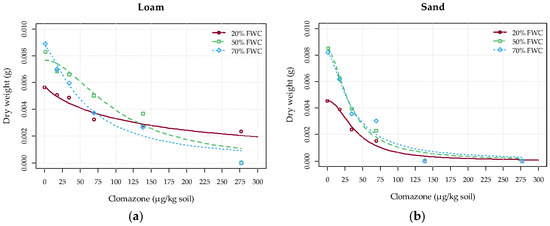
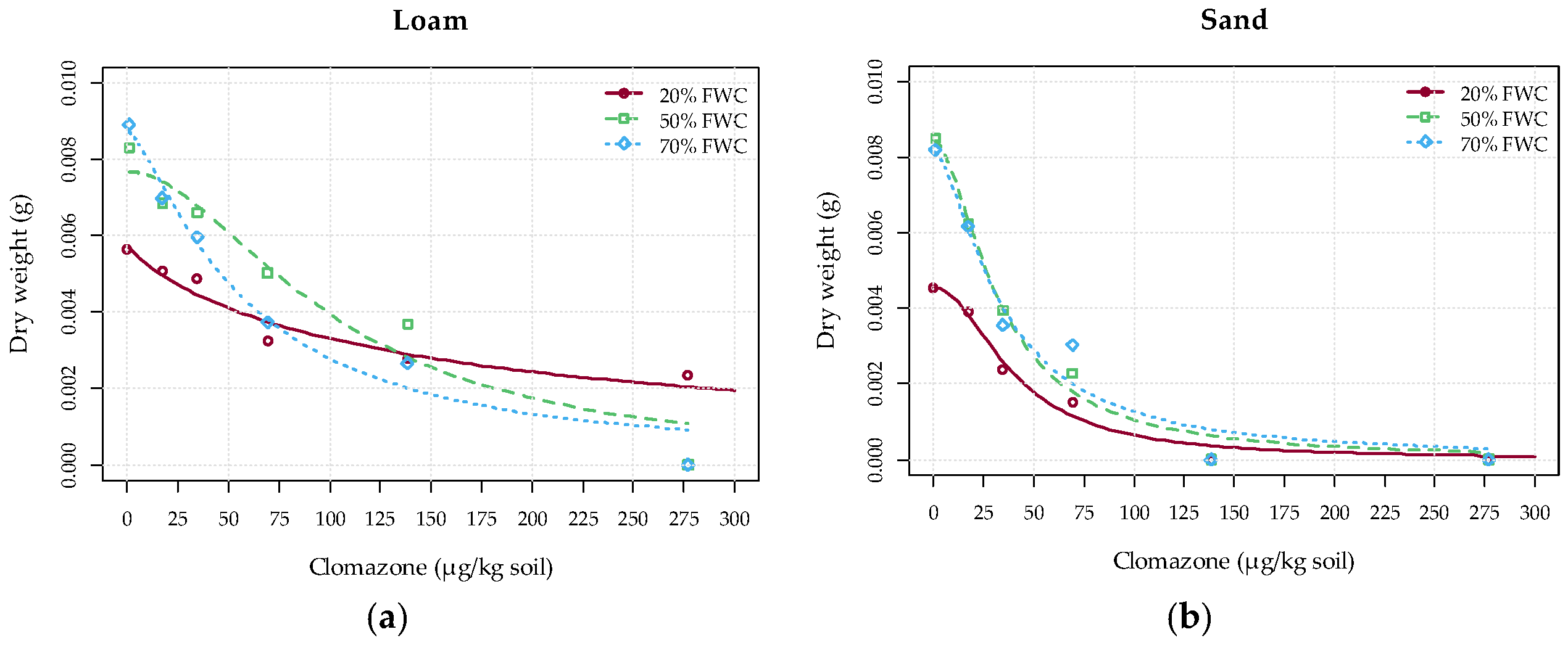
The reduction in tomato plant dry weight varied considerably with soil type, soil moisture level, and clomazone concentration. In loam soil at 20% FWC, all tested clomazone concentrations reduced plant dry weight by up to 58.7% (Figure 1a). Under higher soil moisture conditions (50% and 70% FWC), the highest clomazone concentration (277 µg a.i./kg) completely inhibited dry biomass (100% reduction). In these treatments, clomazone concentrations of 17.3 to 138.5 µg a.i./kg reduced plant dry weight by up to 55.7% and 70.3%, respectively. The two-way ANOVA (Table 3) demonstrated that clomazone concentration, FWC, and their interaction had statistically significant effects on plant dry weight (p < 0.05).
Figure 1.
Dose–response curves for the dry weight of tomato plants grown in (a) loam and (b) sandy soil at different clomazone concentrations and soil moisture levels (FWC—field water capacity).
Table 3.
Effects of clomazone concentration, field water capacity (FWC), and their interaction on measured parameters: F- and p-values from two-way ANOVA.
Tomato plants grown in sandy soil were more susceptible to simulated clomazone residues across all three soil moisture levels (Figure 1b). Dry weight decreased by more than 50% at clomazone concentrations of 34.6 and 69.3 µg a.i./kg, and biomass accumulation was completely inhibited (100%) at the two highest concentrations (138.5 and 277 µg a.i./kg). Statistical analysis (Table 3) revealed that clomazone concentration, FWC, and their interaction had statistically significant effects on dry weight (p < 0.05).
Dose–response analysis showed that the clomazone concentration required to reduce tomato plant dry weight by 50% (EC50) was influenced by both soil type and soil moisture (Table 4). In sandy soil, EC50 values were 32.50 ± 1.54 and 34.07 ± 2.63 µg a.i./kg at 50% and 70% FWC, respectively. In contrast, substantially higher EC50 values were observed in loam soil under the same moisture conditions, reaching 103.03 ± 10.80 and 57.02 ± 4.24 µg a.i./kg, respectively. Similarly, at 20% FWC, the EC50 value was approximately 3.5-fold higher in loam soil (140.50 ± 15.37 µg a.i./kg) than in sandy soil (40.04 ± 2.18 µg a.i./kg), indicating greater tolerance of tomato plants to clomazone in loam soil. Statistical analysis revealed that soil moisture significantly affected the calculated EC50 values in loam soil. Significant differences were observed between 20% and 70% FWC and between 50% and 70% FWC, while no significant difference was detected between 20% and 50% FWC. In contrast, EC50 values did not differ significantly among soil moisture levels in sandy soil (Table S1).
Table 4.
Regression parameters and clomazone concentrations (µg a.i./kg) that caused 50% inhibition (EC50 + SE) of dry weight, CCI value, and carotenoid content.
3.3. Effect of Clomazone on Pigment Content of Tomato Plants
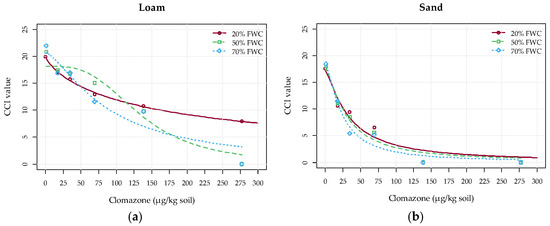
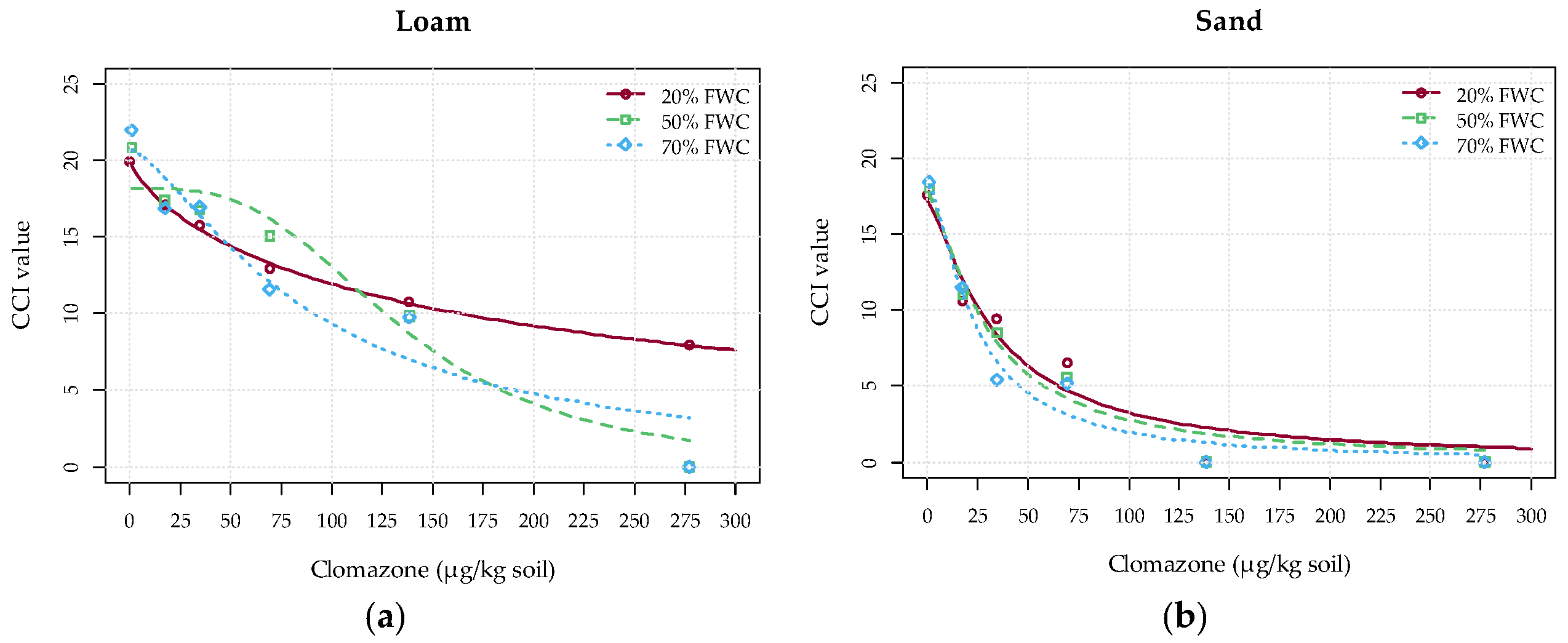
In situ measurements of leaf chlorophyll content showed that the inhibitory effect of simulated clomazone residues varied across the soils tested. In plants grown in loam soil, clomazone concentrations ranging from 17.3 to 138.5 µg a.i./kg produced similar reductions in the chlorophyll content index (CCI) across all soil moisture levels, with decreases ranging from 14.1% to 55.6% (Figure 2a). However, at the highest clomazone concentration, the reduction in CCI reached 60.1% under 20% FWC, whereas complete inhibition (100% reduction) was observed under the higher soil moisture levels of 50% and 70% FWC.
Figure 2.
Dose–response curves for the CCI value of tomato plants grown in (a) loam and (b) sandy soil at different clomazone concentrations and soil moisture levels (FWC—field water capacity).
Tomato plants grown in sandy soil exhibited greater susceptibility to clomazone at all three soil moisture levels, as indicated by greater reductions in the CCI value (Figure 2b). Clomazone concentrations ranging from 17.3 to 69.3 µg a.i./kg reduced CCI by 37.6–72.0%, whereas the two highest concentrations caused complete inhibition (100% reduction). Statistical analysis (Table 3) revealed that clomazone concentration, FWC, and their interaction had statistically significant effects on CCI (p < 0.05).
The calculated EC50 values were consistent with the observed reductions in CCI (Table 4). Across all soil moisture levels, EC50 values were considerably lower in sandy soil than in loam soil, indicating greater tomato sensitivity to clomazone in sandy soil. At 20% FWC, the EC50 in loam soil (164.61 ± 5.19 µg a.i./kg) was approximately fivefold higher than in sandy soil (33.06 ± 3.49 µg a.i./kg). At higher soil moisture levels (50% and 70% FWC), the EC50 values in loam soil were 134.80 ± 8.05 and 87.27 ± 10.36 µg a.i./kg, respectively. In contrast, substantially lower values were recorded in sandy soil (29.34 ± 2.14 and 23.12 ± 1.51 µg a.i./kg, respectively) (Table 4). Statistical analysis revealed that soil moisture significantly affected CCI values in loam soil. Significant differences were observed between 20% and 70% FWC and between 50% and 70% FWC, while no significant difference was detected between 20% and 50% FWC. In contrast, in sandy soil, a significant difference was observed only between 20% and 70% FWC (Table S1).
As expected, spectrophotometric analysis showed that pigment content was affected by simulated clomazone residues, with the degree of inhibition varying across soil types and moisture levels. The inhibition patterns observed for chlorophyll a, chlorophyll b, and carotenoid contents were similar, with slightly greater reductions observed for carotenoid content. Given the mode of action of clomazone, which primarily affects carotenoid biosynthesis, only the results for carotenoid content are presented here. The corresponding results for chlorophyll a and b are provided in the Supplementary Materials (Figure S1).
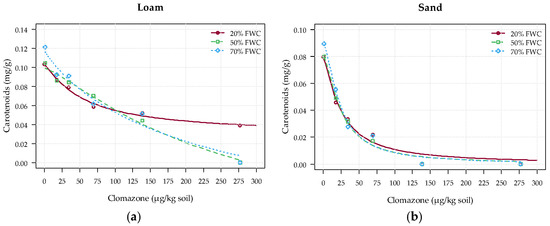
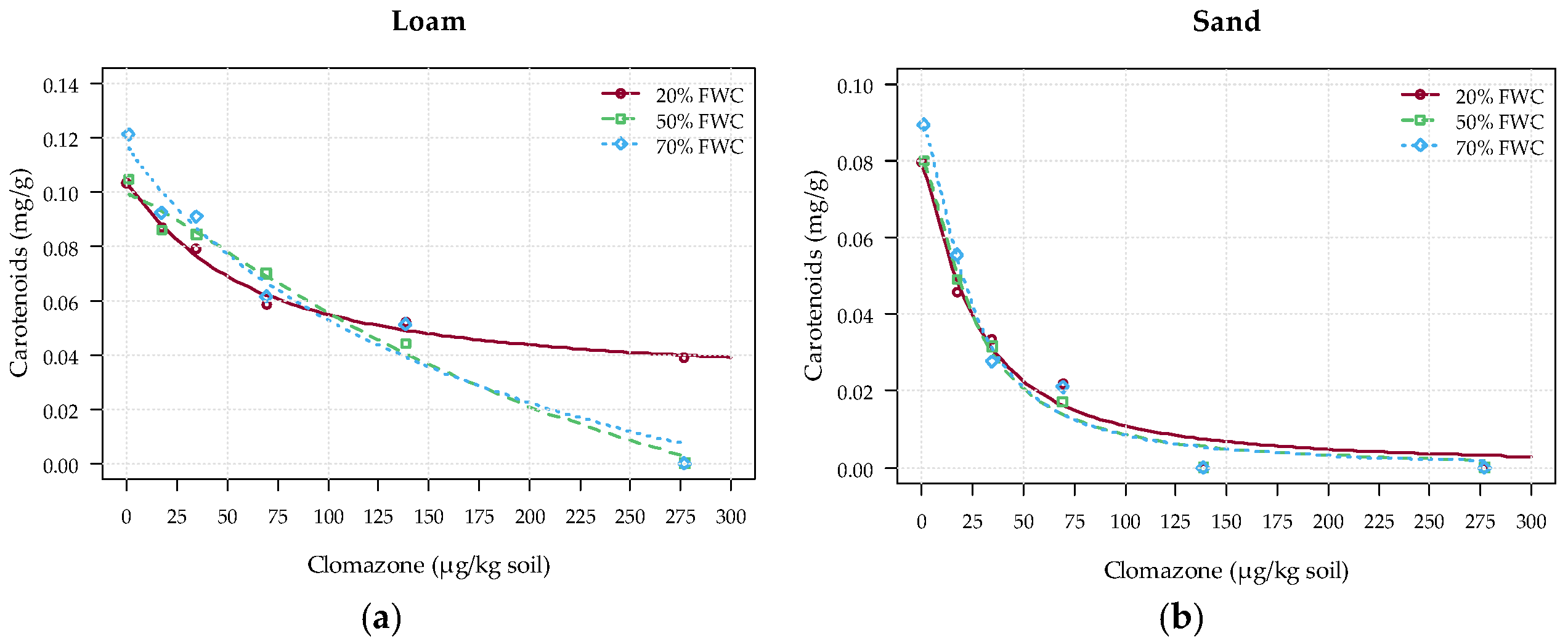
Among all measured parameters, carotenoid content showed the greatest inhibition. In loam soil at 20% FWC, all tested clomazone concentrations reduced carotenoid content by 15.8–62.3% (Figure 3a). Greater reductions were observed at higher soil moisture levels, ranging from 17.8% to 100% at 50% FWC and from 23.9% to 100% at 70% FWC. The inhibitory effect was even more pronounced in sandy soil. Clomazone concentrations of 17.3, 34.6, and 69.3 µg a.i./kg reduced carotenoid content by 42.5–72.6%, 38.9–78.6%, and 38.0–76.4% at 20%, 50%, and 70% FWC, respectively. As noted above, the two highest clomazone concentrations caused complete plant death, resulting in 100% inhibition at all soil moisture levels (Figure 3b).
Figure 3.
Dose–response curves for the carotenoid content of tomato plants grown in (a) loam and (b) sandy soil at different clomazone concentrations and soil moisture levels (FWC—field water capacity).
Accordingly, based on carotenoid content, the EC50 values were considerably lower in sandy soil than in loam soil (Table 4). In sandy soil, the calculated EC50 values were 24.94 ± 1.98, 24.96 ± 1.26, and 23.14 ± 1.24 µg a.i./kg at 20%, 50%, and 70% FWC, respectively. In contrast, tomato plants grown in loam soil at 20% FWC were the least sensitive to simulated clomazone residues, with an EC50 of 130.41 ± 11.35 µg a.i./kg. At higher soil moisture levels, the EC50 values decreased to 115.09 ± 8.78 and 79.58 ± 10.55 µg a.i./kg at 50% and 70% FWC, respectively. Statistical analysis revealed that soil moisture significantly affected the calculated EC50 values in loam soil. Significant differences were observed between 20% and 70% FWC and between 50% and 70% FWC, while no significant difference was detected between 20% and 50% FWC. In contrast, EC50 values did not differ significantly among soil moisture levels in sandy soil (Table S1).
4. Discussion
Herbicide recommendations are inherently crop-specific because many herbicides persist in the soil for weeks, months, or even years after application, potentially injuring susceptible rotational crops. Consequently, a simple, reliable bioassay for identifying herbicide-sensitive species could facilitate crop rotation planning by detecting biologically active herbicide residues before planting [11]. In the present study, the proposed bioassay successfully detected biologically active simulated clomazone residues, as demonstrated by the pronounced inhibition of tomato growth.
Although simulated clomazone residues did not significantly affect seedling emergence, they resulted in substantial injury to tomato seedlings. The visual symptoms were characteristic of carotenoid biosynthesis inhibition, with bleaching severity increasing from 14 to 28 DAT across all clomazone concentrations, soil types, and soil moisture levels. In loam soil, severe visual injury (≥50%) occurred at clomazone concentrations of ≥69.3 µg a.i./kg. In contrast, tomato plants grown in sandy soil exhibited 45–51.3% bleaching even at the lowest simulated concentration (17.3 µg a.i./kg), indicating greater bioavailability and phytotoxicity of clomazone under these conditions. Complete plant death was observed at the two highest clomazone concentrations (138.5 and 277 µg a.i./kg) in sandy soil, regardless of soil moisture level. In loam soil, however, complete inhibition occurred only at the highest concentration under 50% and 70% FWC.
The phytotoxicity of clomazone is primarily determined by its bioavailability, which is strongly influenced by adsorption to soil organic matter, thereby reducing the fraction of herbicide available for plant uptake. Soils with higher organic matter content generally exhibit greater herbicide adsorption than those with lower organic matter content [32,33]. Consequently, clomazone typically displays greater bioactivity in sandy soils characterized by low organic carbon content and low cation exchange capacity, whereas its persistence is enhanced in soils with higher organic matter content [34,35]. The effect of soil type on clomazone bioactivity observed in the present study is consistent with previous findings reported by Loux et al. [36]. In the present study, pairwise comparisons of the estimated EC50 values between loam and sandy soil at the same FWC levels revealed statistically significant differences, indicating that soil type influenced the phytotoxic response to clomazone. Similarly, using a wheat bioassay, Loux et al. [36] demonstrated greater clomazone availability in a silt loam soil containing 1.3% organic matter than in a silty clay loam soil containing 5.8% organic matter. Similarly, Nurse et al. [23] reported less severe visual injury in transplanted tomato grown in loam soil containing 3.8–4.7% organic matter than in sandy loam soil containing 2.6% organic matter. The authors attributed this difference to the higher clay and organic matter contents of the loam soil, which increased clomazone adsorption, thereby reducing its concentration in the soil solution and consequently limiting crop injury.
Changes in precipitation and irrigation regimes influence water use efficiency and alter soil physicochemical properties and redox conditions that regulate herbicide persistence. Soil moisture has been identified as a major factor affecting clomazone bioavailability and phytotoxicity [37,38]. In the present study, most of the observed responses were consistent with greater herbicide availability under higher moisture conditions. This interpretation is supported by greater visual injury and significant reductions in measured growth and physiological parameters. These results are consistent with our previous study [39], where, in a laboratory bioassay, simulated clomazone residues induced leaf bleaching and reduced pigment content in cucumber grown in both loam and sandy soils at 20%, 50%, and 70% FWC. Phytotoxic effects were more pronounced in sandy soil, whereas cucumber plants grown at 20% FWC in both soil types exhibited the lowest sensitivity. Similar observations have been reported by other authors [40,41], who demonstrated that clomazone bioavailability and persistence are strongly influenced by soil moisture and climatic conditions. Dry conditions reduce microbial degradation, thereby increasing herbicide persistence, whereas subsequent increases in soil moisture may enhance the bioavailability and phytotoxicity of residual clomazone.
These findings are consistent with the observed decrease in tomato shoot dry weight and pigment content with increasing simulated clomazone concentration, indicating a generally dose-dependent response. In sandy soil under elevated soil moisture, higher simulated clomazone application rates resulted in more pronounced reductions in shoot dry weight, CCI values, and carotenoid content than those observed in loam soil.
Pigment content is a key indicator of plant growth status and photosynthetic capacity [42]. Leaf chlorophyll concentration is most accurately quantified by extracting pigments with an appropriate organic solvent, followed by spectrophotometric analysis using established calculation methods [30]. Although this approach yields reliable measurements of absolute chlorophyll content, it is destructive, labor-intensive, and unsuitable for repeated measurements of the same plants over time. Therefore, nondestructive optical techniques based on leaf transmittance or reflectance at chlorophyll absorption wavelengths are widely used for rapid, in situ estimation of relative chlorophyll content. Portable chlorophyll meters are now widely used in plant physiological and agronomic research [43]. However, the relationship between optical indices and absolute chlorophyll concentration is inherently nonlinear and depends on species-specific leaf traits, including leaf thickness, internal leaf structure, chloroplast distribution, and pigment composition. Consequently, calibration models established for a particular species or experimental condition may not be directly applicable to other plant systems. Considerable variability in the relationship between optical measurements and extracted chlorophyll concentrations has been reported, even among plants of the same species [43].
In this context, the results of the present study indicate that in vitro pigment quantification provides a more sensitive assessment of clomazone-induced phytotoxicity than in situ optical measurements. Across all soil moisture levels and both soil types, the calculated EC50 values were consistently lower for carotenoid content than for CCI, except under 70% FWC in sandy soil, where the EC50 values were 23.14 and 23.12 µg a.i./kg for carotenoid content and CCI, respectively. These findings indicate that carotenoid content was generally a more sensitive indicator of clomazone effects than CCI, although CCI showed a slightly lower EC50 under 70% FWC in sandy soil.
The inhibition patterns for chlorophyll a, chlorophyll b, and carotenoid contents were broadly similar, with slightly greater inhibition observed for carotenoid content, as also demonstrated by the corresponding inhibition calculations presented in the Supplementary Materials. Thus, the greater sensitivity of carotenoid content observed in most experimental conditions, together with the primary mode of action of clomazone on carotenoid biosynthesis, supports the use of carotenoid content as a particularly relevant and mechanistically informative indicator of clomazone-induced phytotoxicity. This interpretation is consistent with previous studies [39,41,44,45].
The present findings are also consistent with previous reports showing that clomazone disrupts chlorophyll and carotenoid biosynthesis in susceptible vegetable crops. Scott et al. [25] observed concentration-dependent decreases in total chlorophyll and carotenoids in tomato and pepper seedlings after clomazone exposure, confirming the high sensitivity of photosynthetic pigments to this herbicide. Similar effects were reported under field conditions by Nurse et al. [23], who documented bleaching symptoms characterized by severe leaf chlorosis in transplanted tomato plants across all evaluated application rates. Comparable phytotoxic responses have been observed in cucurbit crops. Barth et al. [46] demonstrated that clomazone application reduced leaf pigment concentrations and negatively affected fruit quality in pumpkin, despite its registration for use in this crop in the United States, indicating that crop tolerance may be limited under specific environmental conditions. Similarly, Keinath and DuBose [47] and Harrison Jr. and Keinath [48] reported substantial variation in clomazone injury severity among pumpkin and squash cultivars, emphasizing the role of genetic variability in determining crop sensitivity. Collectively, these studies, together with the findings of the present investigation, demonstrate that disruption of pigment biosynthesis is a consistent and sensitive indicator of clomazone-induced phytotoxicity across susceptible plant species.
5. Conclusions
In this study, the proposed tomato bioassay provided a practical and sensitive approach for assessing the phytotoxic effects of simulated clomazone residues. Tomato responses varied with clomazone concentration, soil type, and soil moisture, with phytotoxic effects generally more pronounced at higher soil moisture levels and in the sandy soil evaluated. Because the two soils differed simultaneously in several physicochemical properties, including texture, organic matter content, and pH, the observed differences cannot be attributed to any single soil property. These findings highlight the importance of considering soil characteristics and moisture conditions when assessing the phytotoxic effects of clomazone residues. The results obtained under controlled laboratory conditions provide evidence of phytotoxic responses to freshly applied residues, while field persistence and environmental fate remain to be determined. Studies using naturally aged residues under field conditions are warranted to evaluate the relevance of these findings to crop-rotation scenarios. Overall, the proposed bioassay may serve as a useful screening tool for evaluating the phytotoxic risk of biologically active clomazone residues across contrasting soil and moisture conditions.
Supplementary Materials
The following supporting information can be downloaded at: https://www.mdpi.com/article/10.3390/agriculture16181979/s1, Figure S1: Inhibition of chlorophyll a, chlorophyll b, and carotenoid contents in tomato plants grown in loam and sandy soils at 20%, 50%, and 70% field water capacity (FWC) under different simulated clomazone concentrations; Table S1: Pairwise comparisons of estimated EC50 values between treatments.
Author Contributions
Conceptualization, J.G.U. and L.R.; methodology, J.G.U., L.Š., M.S.-K. and L.R.; software, J.G.U., M.S.-K. and T.J.; formal analysis, J.G.U., M.S.-K., T.Đ. and T.J.; investigation, J.G.U., M.S.-K., R.Đ.-P., L.Š. and T.Đ.; data curation, J.G.U. and M.S.-K.; writing—original draft preparation, J.G.U.; writing—review and editing, J.G.U., M.S.-K., R.Đ.-P. and L.R.; visualization, J.G.U.; supervision, J.G.U. All authors have read and agreed to the published version of the manuscript.
Funding
This research was funded by the Ministry of Education, Science, and Technological Development of the Republic of Serbia, grant numbers [451-03-33/2026-03/200214] to J.G.U., M.S.-K., R.Ð-P., T.Ð., L.Š. and L.R., and [451-03-34/2026-03/200116] to T.J.
Institutional Review Board Statement
Not applicable.
Data Availability Statement
The raw data supporting the conclusions of this article will be made available by the authors on request.
Conflicts of Interest
The authors declare no conflicts of interest.
Abbreviations
The following abbreviations are used in this manuscript:
| FWC | Field Water Capacity |
| DMF | N, N-dimethylformamide |
| DAT | Days After Treatment |
| CCI | Chlorophyll Content Index |
References
- Ofosu, R.; Agyemang, E.D.; Márton, A.; Pásztor, G.; Taller, J.; Kazinczi, G. Herbicide resistance: Managing weeds in a changing world. Agronomy 2023, 13, 1595. [Google Scholar] [CrossRef] [Scilit]
- Matzrafi, M.; Peleg, Z.; Lati, R. Herbicide Resistance in Weed Management. Agronomy 2021, 11, 280. [Google Scholar] [CrossRef] [Scilit]
- Parven, A.; Meftaul, I.M.; Venkateswarlu, K.; Megharaj, M. Herbicides in modern sustainable agriculture: Environmental fate, ecological implications, and human health concerns. Int. J. Environ. Sci. Technol. 2025, 22, 1181–1202. [Google Scholar] [CrossRef] [Scilit]
- Alletto, L.; Coquet, Y.; Benoit, P.; Heddadj, D.; Barriuso, E. Tillage management effects on pesticide fate in soils. Agron. Sustain. Dev. 2010, 30, 367–400. [Google Scholar] [CrossRef] [Scilit]
- Nichols, V.; Verhulst, N.; Cox, R.; Govaerts, B. Weed dynamics and conservation agriculture principles: A review. Field Crops Res. 2015, 183, 56–68. [Google Scholar] [CrossRef] [Scilit]
- Dolijanović, Ž.; Šeremešić, S.; Simić, M.; Kovačević, D. Conservation tillage in Serbia: State and perspectives. In Proceedings of the Importance and Place of Biotechnology in the Economic Development of Serbia, Belgrade, Serbia, 7 November 2024. (In Serbian) [Google Scholar]
- Jug, D.; Jug, I.; Brozović, B.; Šeremešić, S.; Dolijanović, Ž.; Zsembeli, J.; Ujj, A.; Marjanović, J.; Smutný, V.; Dušková, S.; et al. Conservation Soil Tillage: Bridging Science and Farmer Expectations—An Overview from Southern to Northern Europe. Agriculture 2025, 15, 260. [Google Scholar] [CrossRef] [Scilit]
- Yu, L.; Van Eerd, L.L.; O’Halloran, I.; Sikkema, P.H.; Robinson, D.E. Response of four spring-seeded cover crops to residues of selected herbicides. Can. J. Plant Sci. 2015, 95, 303–313. [Google Scholar] [CrossRef] [Scilit]
- Robinson, D.; McNaughton, K. Saflufenacil carryover injury varies among rotational crops. Weed Technol. 2012, 26, 177–182. [Google Scholar] [CrossRef] [Scilit]
- Riddle, R.N.; O’Sullivan, J.; Swanton, C.J.; Acker, R.C.V. Crop response to carryover of mesotrione residues in the field. Weed Technol. 2013, 27, 92–100. [Google Scholar] [CrossRef] [Scilit]
- Melo, C.A.D.; Dias, R.D.C.; Mendes, K.F.; Assis, A.C.L.P.; Reis, M.R.D. Herbicides carry over in systems cultivated with vegetable crops. Rev. Bras. Herbic. 2016, 15, 67–78. [Google Scholar]
- Pintar, A.; Svečnjak, Z.; Lakić, J.; Magdić, I.; Brzoja, D.; Barić, K. The Susceptibility of Pea (Pisum sativum L.) to Simulated Mesotrione Residues as Affected by Soil pH Manipulation. Agriculture 2021, 11, 688. [Google Scholar] [CrossRef] [Scilit]
- García Carriquiry, I.; Silva, V.; Raevel, F.; Harkes, P.; Osman, R.; Bentancur, O.; Fernández, G.; Geissen, V. Effects of mixtures of herbicides on nutrient cycling and plant support considering current agriculture practices. Chemosphere 2024, 349, 140925. [Google Scholar] [CrossRef] [Scilit] [PubMed]
- Ferhatoglu, Y.; Barrett, M. Studies of clomazone mode of action. Pestic. Biochem. Physiol. 2006, 85, 7–14. [Google Scholar] [CrossRef] [Scilit]
- Tomlin, C.D.S. The Pesticide Manual, A World Compendium, 14th ed.; British Crop Protection Council: Hampshire, UK, 2006. [Google Scholar]
- Andres, A.; Concenço, G.; Theisen, G.; Vidotto, F.; Ferrero, A. Selectivity and weed control efficacy of pre- and post-emergence applications of clomazone in Southern Brazil. Crop Prot. 2013, 53, 103–108. [Google Scholar] [CrossRef] [Scilit]
- Wayment, D.G.; Wright, A.A.; Bergeron, D.R.; McCollam, G.A.; White, P.M., Jr. Soil dissipation and efficacy on itchgrass of soil-applied residual herbicides pendimethalin and clomazone in Louisiana sugarcane. Pest Manag. Sci. 2025, 81, 288–297. [Google Scholar] [CrossRef] [Scilit] [PubMed]
- Silva, V.; Gai, L.; Harkes, P.; Tan, G.; Ritsema, C.J.; Alcon, F.; Contreras, J.; Abrantes, N.; Campos, I.; Baldi, I.; et al. Pesticide residues with hazard classifications relevant to non-target species, including humans, are omnipresent in the environment and farmer residences. Environ. Int. 2023, 181, 108280. [Google Scholar] [CrossRef] [Scilit] [PubMed]
- Knuth, D.; Gai, L.; Silva, V.; Harkes, P.; Hofman, J.; Šudoma, M.; Bílková, Z.; Alaoui, A.; Mandrioli, D.; Pasković, I.; et al. Pesticide residues in organic and conventional agricultural soils across Europe: Measured and predicted concentrations. Environ. Sci. Technol. 2024, 58, 6744–6752. [Google Scholar] [CrossRef] [Scilit] [PubMed]
- Khurshid, C.; Silva, V.; Gai, L.; Osman, R.; Mol, H.; Alaoui, A.; Christ, F.; Schlünssen, V.; Vested, A.; Abrantes, N.; et al. Pesticide residues in European sediments: A significant concern for the aquatic systems? Environ. Res. 2024, 261, 119754. [Google Scholar] [CrossRef] [Scilit] [PubMed]
- Ðurović-Pejčev, R.; Radmanović, S.; Tomić, Z.; Kaluđerović, L.; Bursić, V.; Šantrić, L. Adsorption-desorption behavior of clomazone in Regosol and Chernozem agricultural soils. J. Serb. Chem. Soc. 2020, 85, 809–819. [Google Scholar] [CrossRef] [Scilit]
- Ðurović-Pejčev, R.; Radmanović, S.; Tomić, Z.; Kaluđerović, L.; Đorđević, T. Characterization of the clomazone sorption process in four agricultural soils using different kinetic models. Environ. Sci. Process. Impacts 2023, 25, 542–553. [Google Scholar] [CrossRef] [Scilit] [PubMed]
- Nurse, R.E.; Robinson, D.E.; Hamill, A.S.; Sikkema, P.H. Annual broad-leaved weed control in transplanted tomato with clomazone in Canada. Crop Prot. 2006, 25, 795–799. [Google Scholar] [CrossRef] [Scilit]
- Weston, L.A.; Barrett, M. Tolerance of tomato (Lycopersicon esculentum) and bell pepper (Capsicum annuum) to clomazone. Weed Sci. 1989, 37, 285–289. [Google Scholar] [CrossRef] [Scilit]
- Scott, J.E.; Weston, L.A.; Chappell, J.; Hanley, K. Effects of clomazone on IPP isomerase and prenyl transferase activities in cell suspension cultures and cotyledons of Solanaceous species. Weed Sci. 1994, 42, 509–516. [Google Scholar] [CrossRef] [Scilit]
- Carter, M.R.; Gregorich, E.G. Soil Sampling and Methods of Analysis, 2nd ed.; CRC Press: Boca Raton, FL, USA; Taylor & Francis Group: New York, NY, USA, 2008. [Google Scholar]
- IUSS Working Group WRB. World Reference Base for Soil Resources. International Soil Classification System for Naming Soils and Creating Legends for Soil Maps, 4th ed.; International Union of Soil Sciences (IUSS): Vienna, Austria, 2022. [Google Scholar]
- SRPS EN ISO 11274:2020 ISO 11274:2019; Soil Quality—Determination of the Water-Retention Characteristic—Laboratory Methods. Institute for Standardization of Serbia: Belgrade, Serbia, 2020.
- Eliason, R.; Schoenau, J.J.; Szmigielski, A.M.; Laverty, W.M. Phytotoxicity and persistence of flucarbazone-sodium in soil. Weed Sci. 2004, 52, 857–862. [Google Scholar] [CrossRef] [Scilit]
- Wellburn, A.R. The spectral determination of chlorophylls a and b, as well as total carotenoids, using various solvents with spectrophotometers of different resolutions. J. Plant Physiol. 1994, 144, 307–313. [Google Scholar] [CrossRef] [Scilit]
- Ritz, C.; Baty, F.; Streibig, J.C.; Gerhard, D. Dose-Response Analysis Using R. PLoS ONE 2015, 10, e0146021. [Google Scholar] [CrossRef] [Scilit] [PubMed]
- Weber, J.B. Behavior of dinitroaniline herbicides in soils. Weed Technol. 1990, 4, 394–406. [Google Scholar] [CrossRef] [Scilit]
- Knezevic, S.Z.; Datta, A.; Scott, J.; Porpiglia, P.J. Dose–response curves of KIH-485 for preemergence weed control in corn. Weed Technol. 2009, 23, 34–39. [Google Scholar] [CrossRef] [Scilit]
- Antonious, G.F. Clomazone residues in soil and runoff: Measurement and mitigation. Bull. Environ. Contam. Toxicol. 2000, 64, 168–175. [Google Scholar] [CrossRef] [Scilit] [PubMed]
- Gunasekara, A.S.; de la Cruz, I.D.P.; Curtis, M.J.; Claassen, V.P.; Tjeerdema, R.S. The behavior of clomazone in the soil environment. Pest Manag. Sci. 2009, 65, 711–716. [Google Scholar] [CrossRef] [Scilit] [PubMed]
- Loux, M.M.; Liebl, R.A.; Slife, F.W. Availability and persistence of imazaquin, imazethapyr and clomazone in soil. Weed Sci. 1989, 37, 259–267. [Google Scholar] [CrossRef] [Scilit]
- Bwire, D.; Saito, H.; Sidle, R.C.; Nishiwaki, J. Water management and hydrological characteristics of paddy-rice fields under alternate wetting and drying irrigation practice as climate-smart practice: A review. Agronomy 2024, 14, 1421. [Google Scholar] [CrossRef] [Scilit]
- Vicente, L.A.; Peña, D.; Fernández-Rodríguez, D.; Albarrán, Á.; Rato Nunes, J.M.; López-Piñeiro, A. Sorption, persistence and leaching of clomazone in rice environments under varying severity of alternate wetting and drying irrigation management with and without biochar amendment. J. Environ. Manag. 2025, 386, 125761. [Google Scholar] [CrossRef] [Scilit] [PubMed]
- Gajić Umiljendić, J.; Đorđević, T.; Šantrić, L.; Sarić-Krsmanović, M.; Radivojević, L. Cucumber susceptibility to simulated soil residues of clomazone. Pestic. Phytomed. 2016, 31, 107–114. [Google Scholar] [CrossRef] [Scilit]
- Ahrens, W.H.; Fuerst, E.P. Carryover injury of clomazone applied in soybeans (Glycine max) and fallow. Weed Technol. 1990, 4, 855–861. [Google Scholar] [CrossRef] [Scilit]
- Jovanović-Radovanov, K. Susceptibility of different crops to simulated clomazone carry-over and its degradation dynamics in sandy loam soil. Agronomy 2025, 15, 1538. [Google Scholar] [CrossRef] [Scilit]
- Liu, A.; Zhang, Y.; Chen, D. Effects of salt stress on the growth and the antioxidant enzyme activity of Thellungiella halophila. Bull. Bot. Res. 2006, 26, 216–221. [Google Scholar]
- Parry, C.; Blonquist, J.M., Jr.; Bugbee, B. In situ measurement of leaf chlorophyll concentration: Analysis of the optical/absolute relationship. Plant Cell Environ. 2014, 37, 2508–2520. [Google Scholar] [CrossRef] [Scilit] [PubMed]
- Gajić Umiljendić, J.; Jovanović-Radovanov, K.; Radivojević, L.; Šantrić, L.; Đurović, R.; Đorđević, T. Maize, sunflower and barley sensitivity to the residual activity of clomazone in soil. Pestic. Phytomed. 2012, 27, 157–165. [Google Scholar] [CrossRef] [Scilit]
- Gajić Umiljendić, J.; Radivojević, L.; Đorđević, T.; Jovanović-Radovanov, K.; Šantrić, L.; Đurović-Pejčev, R.; Elezović, I. A bioassay technique to study clomazone residues in sandy loam soil. Pestic. Phytomed. 2013, 28, 203–211. [Google Scholar] [CrossRef] [Scilit]
- Barth, M.M.; Weston, L.A.; Zhuang, H. Influence of clomazone herbicide on postharvest quality of processing squash and pumpkin. J. Agric. Food Chem. 1995, 43, 2389–2393. [Google Scholar] [CrossRef] [Scilit]
- Keinath, A.P.; DuBose, V.B. Evaluation of pumpkin cultivars for powdery and downy mildew resistance, virus tolerance and yield. HortScience 2000, 35, 281–285. [Google Scholar] [CrossRef] [Scilit]
- Harrison, H.F., Jr.; Keinath, A.P. Glasshouse assessment of clomazone response of US pumpkin cultivars. Crop Prot. 2003, 22, 795–798. [Google Scholar] [CrossRef] [Scilit]

Disclaimer/Publisher’s Note: The statements, opinions and data contained in all publications are solely those of the individual author(s) and contributor(s) and not of MDPI and/or the editor(s). MDPI and/or the editor(s) disclaim responsibility for any injury to people or property resulting from any ideas, methods, instructions or products referred to in the content. |
© 2026 by the authors. Licensee MDPI, Basel, Switzerland. This article is an open access article distributed under the terms and conditions of the Creative Commons Attribution (CC BY) license.