


Abstract
Garlic (Allium sativum L.) is a major horticultural crop valued for its distinctive flavor, nutritional quality, and health-promoting properties, including antioxidant and antimicrobial activities. The characteristic aroma and health benefits of garlic are primarily attributed to its organosulfur compounds. This study evaluated the effects of conventional zinc sulfate (ZnSO4) and zinc oxide nanoparticles (ZnO NPs) on selected organosulfur metabolites in garlic bulbs using targeted liquid chromatography–tandem mass spectrometry (LC–MS/MS) and gas chromatography–mass spectrometry (GC–MS). Treatments comprised an untreated control, ZnSO4, 25 mg ZnO NPs kg−1 soil (ZnO NP-25), and 55 mg ZnO NPs kg−1 soil (ZnO NP-50), with ten independent experimental units per treatment. Relative to the control, ZnO NP-50 increased alliin by 225.3%, allicin by 309.6%, diallyl sulfide (DAS) by 219.5%, diallyl disulfide (DADS) by 231.7%, and diallyl trisulfide (DATS) by 149.7%, whereas ajoene decreased by 67.3%. ZnO NP-50 produced the highest mean concentrations of alliin, allicin, DAS, DADS, and DATS, indicating a dose-related compositional pattern across the two nanoparticle rates. These findings demonstrate that soil-applied ZnO NPs altered the targeted organosulfur profile of garlic under greenhouse conditions. The physiological and molecular mechanisms underlying these responses were not measured and require further investigation.
1. Introduction
Garlic (Allium sativum L.) is one of the oldest cultivated horticultural crops and has been extensively utilized worldwide as both a culinary ingredient and a medicinal plant. It is highly valued for its distinctive flavor, nutritional quality, and diverse pharmacological properties, including antimicrobial, antioxidant, anti-inflammatory, anticancer, cardioprotective, antidiabetic, and antiviral activities [1,2,3,4,5,6]. These chemical and biological properties are largely associated with organosulfur compounds (OSCs), including alliin (S-allyl-L-cysteine sulfoxide), allicin (diallyl thiosulfinate), ajoenes, diallyl sulfides, vinyldithiins, and related sulfur metabolites [7,8,9,10]. Intact garlic cloves accumulate nonvolatile S-alk(en)yl-L-cysteine sulfoxides, principally alliin. Tissue disruption brings alliin into contact with alliinase, producing allicin, a reactive thiosulfinate that can subsequently undergo chemical transformation into compounds such as ajoene, diallyl sulfide (DAS), diallyl disulfide (DADS), and diallyl trisulfide (DATS) [1,2,3,11,12,13]. In addition, these metabolites contribute to the sensory and biochemical characteristics of garlic and have demonstrated biological activities in experimental systems; however, variation in their concentrations should not be interpreted directly as evidence of specific human-health benefits [2,3,14,15,16,17]. However, the stability of allicin is strongly influenced by temperature, pH, storage conditions, and processing methods, resulting in substantial losses during postharvest handling and food processing [18,19].
Garlic OSCs composition is influenced by genotype, developmental stage, sulfur nutrition, environmental conditions, and postharvest handling [3,4,5,6,20,21,22,23,24,25,26,27,28,29,30]. Sulfur supply is particularly relevant because sulfur-containing amino acids and γ-glutamyl peptides provide precursors for the formation of S-alk(en)yl-L-cysteine sulfoxides; experimentally, sulfur nutrition can alter garlic bulb yield and allicin concentration [4,31,32]. Recent molecular studies have also identified transcriptional and post-transcriptional components associated with alliin or allicin biosynthesis in Allium species [5,6]. These studies advance understanding of garlic sulfur biology and provided new opportunities for metabolic engineering and cultivar improvement [10,33,34,35] but they do not demonstrate that zinc fertilizers or ZnO NPs regulate those components. Moreover, because allicin is produced rapidly after tissue disruption and is chemically labile, measured concentrations can reflect both plant composition at harvest and transformations occurring during sample preparation or analysis [2,3].
Zinc (Zn) is an essential plant micronutrient involved in enzyme function, protein synthesis, membrane integrity, and cellular redox homeostasis [36,37]. Conventional ZnSO4 and ZnO NPs represent chemically distinct Zn sources, and their comparative performance depends on particle properties, dose, application method, plant species, soil conditions, and growth stage. Recent primary studies have reported treatment-dependent increases in tissue or grain Zn concentration following ZnO NPs application in groundnut, corn, wheat, and rice [38,39,40,41,42]. Other studies have observed changes in antioxidant-enzyme activities or oxidative-stress indicators following ZnO NPs treatment, including direct comparisons with ZnSO4 [38,43,44]. These findings establish that ZnO NPs can affect Zn accumulation and redox-related responses in some crop systems, but the direction and magnitude of the response are dependent on context. For example, a study in rice found that ZnO NPs increased grain Zn accumulation at relatively low application rates, whereas ZnSO4 produced the larger yield response, illustrating why nanoparticle formulations should not be assumed to be universally superior [12].
Evidence specific to Allium crops remains limited. A recent field study in Allium hirtifolium reported changes in bulb Zn concentration, antioxidant-related measurements, and agronomic traits following ZnO NPs treatment, but it did not quantify the garlic organosulfur metabolites examined here [45]. Likewise, studies in amaranth, groundnut, cotton, cereals, and other species provide useful evidence that ZnO NPs exposure can alter Zn accumulation or antioxidant responses [38,43,44,46], but they cannot establish equivalent responses in garlic bulbs.
Despite increasing research on zinc or ZnO NPs in crop nutrition, it remains unclear whether conventional and nanoparticle Zn sources produce different organosulfur profiles in garlic. The objective of this study was therefore to evaluate the effects of conventional ZnSO4, and two soil-applied ZnO NPs treatments by quantifying selected OSCs profiles in garlic bulbs. Alliin and allicin were determined by targeted LC–MS/MS, whereas ajoene, DAS, DADS, and DATS were determined by targeted GC–MS. The study was designed to test whether the Zn treatments were associated with differences in the concentrations and overall profiles of these predefined metabolites under greenhouse conditions. Understanding these compositional responses may help guide future studies of nanofertilizer effects on garlic quality and agronomic performance. Accordingly, this study investigated the effects of zinc oxide nanofertilizers on allicin and other organosulfur metabolites in garlic using a targeted metabolite quantification approach.
2. Materials and Methods
2.1. Plant Material and Greenhouse Conditions
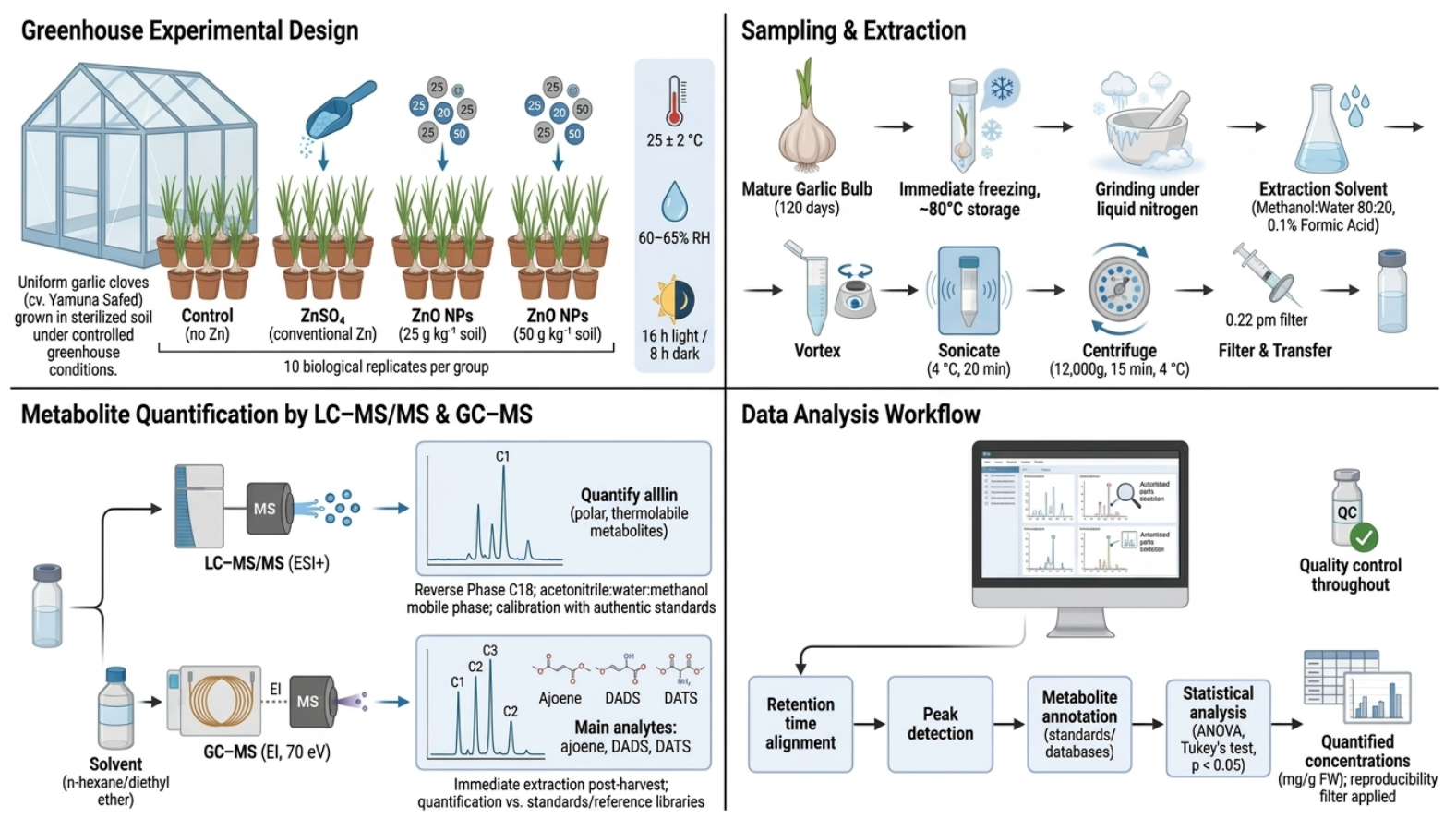
Uniform cloves of garlic cultivar Yamuna Safed (average clove weight of 4.5 g) that can be fully matured and harvested within 120 days [47] were selected from healthy seed stock. Cloves were surface sterilized with 0.5% sodium hypochlorite followed by repeated rinsing in sterile distilled water. Individual cloves were planted in 2 L pots containing 1 kg of homogenized soil. The experiment was conducted during summer 2025 in the greenhouse at Bill and Vera Daniel Ranch and Farm, Prairie View A&M University, Prairie View, TX, USA (GPS: latitude 30.0901/longitude −95.9824). Greenhouse conditions were maintained at 25 ± 2 °C, 60–65% relative humidity, 16 h light/8 h dark photoperiod. Photosynthetic photon flux density at canopy height was 1000 μmol m−2 s−1.
Prior to sowing, the composite soil samples were analyzed for total organic carbon (TOC) using a TOC analyzer, macro- and micronutrient concentrations using inductively coupled plasma–optical emission spectroscopy (ICP-OES; Agilent 5100, Agilent Technologies, Santa Clara, CA, USA) and pH and EC were assessed using a portable pH meter and a PCTSTestr™ 50 Waterproof Pocket Tester (Oakton Instruments, Vernon Hills, IL, USA). Additionally, cation exchange capacity (CEC) was measured by the ammonium acetate extraction method (1 M NH4OAc, pH 7.0). The soil was characterized as fine sandy loam, with a pH of 6.89, electrical conductivity of 0.11 mS cm−1, organic matter of approximately 0.86%, CEC of approximately 5–7 cmolc kg−1, total N of 0.09%, available P of 0.09%, exchangeable K of 0.07%, extractable Zn of 2.00 mg kg−1, and available S of 2800 mg kg−1. No pots received basal fertilizer. Soil moisture was maintained at 70% field capacity using deionized water. Moisture was determined by gravimetric method twice a week. Pots were arranged in a completely randomized design and repositioned weekly to minimize positional effects. Bulbs were harvested at physiological maturity, 120 days after planting.
2.2. Experimental Design and Zinc Treatments
The experiment comprised four treatments with ten independent biological replicates per treatment. The experimental unit was one pot containing one garlic plant. Treatments were: (i) untreated control; (ii) conventional ZnSO4; (iii) 25 mg ZnO NPs kg−1 soil (ZnO NP-25); and (iv) 55 mg ZnO NPs kg−1 soil (ZnO NP-50).
ZnO contains approximately 80.3% elemental Zn. Accordingly, ZnO NP-25 and ZnO NP-50 supplied approximately 20.1 and 40.2 mg elemental Zn kg−1 soil, respectively. The conventional treatment consisted of ZnSO4 anhydrous applied at 55 mg ZnSO4 kg−1 soil, equivalent to 20.1 mg Zn kg−1 soil (Supporting Table S1). Zinc sources were incorporated uniformly into the soil before planting by manual mixing.
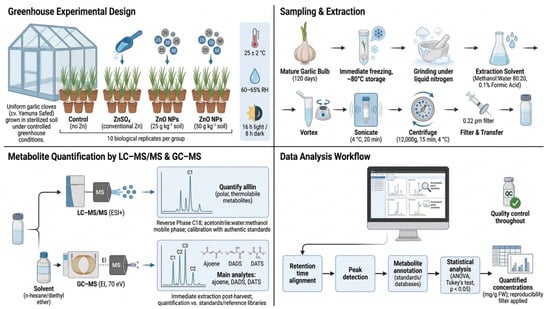
The ZnO NPs (Stock # US 3599; Cas# 1314-13-2 and purity 99.95%) were purchased from Skyspring Nanomaterials, Inc. (Houston, TX, USA) and were not synthesized in-house. The product had primary particle size of 10 nm and uniform spherical morphology, well-defined crystalline structure, zeta potential of −16.8 ± 3.2 mV (characterized in our previous study [46], Figure S1). The experimental design and analytical workflow are summarized in Figure 1 generated using AI (FigureLabs available at https://chat.figurelabs.ai) by providing the details of the experimental procedures stated in the materials and methods.
Figure 1.
Experimental design and analytical workflow used to evaluate the effects of conventional ZnSO4 and ZnO NPs treatments on sulfur metabolism in garlic.
2.3. Sample Collection, Metabolite Extraction and LC–MS/MS Quantification
To minimize variability associated with alliinase-mediated conversion, bulbs were processed within 5 min of harvest and flash-frozen in liquid nitrogen before storage at −80 °C [48,49,50,51]. Frozen tissue was pulverized under liquid nitrogen using a prechilled mortar and pestle. Extraction solvent was added within 30–60 s of pulverization. Tissue mass, extraction volume, processing order, and timing were held constant across samples to standardize post-disruption alliinase exposure. Frozen tissue (0.50 ± 0.01 g) was extracted with 5.0 mL of ice-cold 80% methanol containing 0.1% formic acid and 10 μg mL−1 S-propyl-L-cysteine as internal standard. Samples were vortexed for 2 min, sonicated in an ice-water bath for 15 min, centrifuged at 15,000× g for 15 min at 4 °C, and filtered through 0.22-μm PTFE membranes. Extracts were transferred to amber vials, held at 4 °C, and analyzed within 4 h.
Alliin and allicin were quantified by targeted liquid chromatography–tandem mass spectrometry (LC–MS/MS) using a Shimadzu Nexera X2 UHPLC system coupled to an LCMS-8060 triple-quadrupole mass spectrometer equipped with an electrospray ionization source [52]. Chromatographic separation was performed on a Shim-pack Velox C18 column (150 × 4.6 mm, 5 μm) maintained at 30 °C, using water (A) and acetonitrile (B), each containing 0.1% formic acid. The gradient was programmed as follows: 5% B for 0–2 min, 5–40% B for 2–10 min, 40–90% B for 10–13 min, and 90% B for 13–15 min, followed by re-equilibration at 5% B for 5 min. The flow rate was 0.30 mL min−1, the injection volume was 5 μL, and the total run time was 20 min. Detection was conducted in positive-ion multiple-reaction-monitoring mode using source conditions optimized by direct infusion of authentic standards: capillary voltage, 4.0 kV; interface temperature, 300 °C; desolvation-line temperature, 250 °C; heat-block temperature, 400 °C; nebulizing-gas flow, 3.0 L min−1; drying-gas flow, 10.0 L min−1; heating-gas flow, 10.0 L min−1; and argon collision-gas pressure, 230 kPa. Chromatographic peaks were integrated automatically using LabSolutions LCMS software version 5.97 (Shimadzu Corporation, Kyoto, Japan) and manually verified for peak identity and baseline assignment.
Quantification was based on analyte-to-internal-standard peak-area ratios using S-propyl-L-cysteine (10 μg mL−1) as the internal standard and eight-point (0.05, 0.1, 0.5, 1.0, 5.0, 10, 50, and 100 μg mL−1) external calibration curves prepared from certified alliin and allicin standards (≥98% purity; Sigma-Aldrich, St. Louis, MO, USA). Extracts were diluted 100-fold before analysis, and calculated concentrations were corrected for the dilution factor and expressed as mg g−1 fresh weight using the following equation:
where C is the concentration determined by LC–MS/MS (μg mL−1), DF is the dilution factor (100), V is the extraction volume (5.0 mL), and W is the fresh tissue weight extracted (0.50 g). Under these conditions, the conversion simplifies to mg g−1 FW = C.
Solvent blanks, extraction blanks, pooled quality-control samples, and calibration-verification standards were analyzed after every five injections. The limits of detection (LOD) and quantification (LOQ) were determined based on signal-to-noise ratios of 3 and 10, respectively. Method accuracy was assessed by recovery experiments in which garlic extracts were fortified with alliin and allicin at three concentration levels (0.5, 5, and 50 μg mL−1). Recovery was calculated by comparing the measured concentrations of the spiked samples with their corresponding theoretical concentrations. Compound-specific MRM transitions, collision energies, quantifier and qualifier ions, retention times, calibration equations and linearity, limits of detection and quantification, matrix effects, recovery, intra- and interday precision, and QC acceptance criteria and performance are summarized in Supplementary Tables S2 and S3.
2.4. GC–MS Analysis of Volatile Organosulfur Compounds
Before extraction fresh tissues were subjected to the same rapid harvest-to-freezing and standardized post-disruption timing described for LC–MS/MS analysis. Fresh tissue (2.0 g) was extracted with 10.0 mL n-hexane containing 10 μg mL−1 dibutyl sulfide as internal standard [50,51]. Extracts were vortexed for 2 min, sonicated for 15 min, centrifuged at 10,000× g for 10 min at 4 °C, dried over anhydrous sodium sulfate, filtered through 0.22-μm PTFE membranes, and transferred to amber vials.
DAS, DADS, DATS, and ajoene were analyzed using a Shimadzu GCMS-QP2020 (Shimadzu Corporation, Kyoto, Japan) fitted with an HP-5MS column (30 m × 0.25 mm, 0.25 μm). Helium flow was 1.0 mL min−1. A 1-μL aliquot was injected at 250 °C using a 10:1 split. The oven was held at 40 °C for 2 min, increased to 180 °C at 5 °C min−1, then to 280 °C at 10 °C min−1, and held for 10 min. Electron ionization was conducted at 70 eV over m/z 35–500. Because the concentrations of volatile organosulfur compounds exceeded the upper calibration range, extracts were diluted 100-fold with n-hexane before analysis.
Compound identification was based on retention time, diagnostic mass spectral ions, authenticated standards (≥98% purity), and NIST library matching with a similarity index ≥90%. Chromatographic and quantitative parameters, including retention time, quantifier and qualifier ions, peak area, signal-to-noise ratio, and calculated concentration, were recorded for each analyte (Supporting Table S2). Quantification was performed using external calibration curves prepared over 0.05–100 μg mL−1, with dibutyl sulfide used as the internal standard for normalization. Concentrations obtained from the calibration curves were corrected for the dilution factor and expressed on a fresh weight as shown in Section 2.3. Specifically, ajoene was quantified as the combined abundance of the E- and Z-ajoene isomers using an authenticated ajoene analytical standard (≥98% purity; Sigma-Aldrich, St. Louis, MO, USA). The combined ajoene response was determined from the corresponding E- and Z-ajoene chromatographic peaks, with identification confirmed by retention characteristics, characteristic mass spectral fragmentation, and NIST library matching. Quantification was reported as total ajoene.
2.5. Data Processing and Statistical Analysis
The experimental unit was an individual pot containing one garlic plant. The experiment comprised four zinc treatments with 10 independent biological replicates per treatment with each biological replicate representing a plant grown in a separate pot. Repeated chromatographic measurements were treated as technical replicates for analytical quality assurance and were not considered independent observations in the statistical analysis.
Statistical analyses were performed in R version 4.4.1 (R Foundation for Statistical Computing, Vienna, Austria) using the stats, car, emmeans, effect size, and ggplot2 packages. Metabolite concentrations were analyzed separately by one-way analysis of variance (ANOVA), with zinc treatment as the fixed effect. Model assumptions were assessed using residual-versus-fitted plots, the Shapiro–Wilk test for residual normality, and Levene’s test for homogeneity of variance. Since all ANOVA assumptions were met, treatment means were separated using Tukey’s honestly significant difference (HSD) test at α = 0.05. ANOVA results are reported as F statistics with numerator and denominator degrees of freedom, exact p values and effect sizes, where applicable.
3. Results and Discussion
3.1. Overall Effects of Zinc Treatments on Garlic Sulfur Metabolism
ANOVA revealed significant treatment effects for all measured metabolites (Table 1), with large effect sizes and predominantly positive responses to increasing ZnO NPs application rates. Among the metabolites, the greatest increases were observed for alliin and allicin, while downstream OSCs showed treatment-specific variations in accumulation patterns. Overall, ZnO NP-50 produced the highest concentrations of most targeted OSCs relative to the untreated control and the conventional Zn source.
Table 1.
Effects of ZnSO4 and ZnO NPs on the concentrations of sulfur-containing metabolites in garlic, with one-way ANOVA results. SS: sum of square; MS: mean square; η2: effect size; and df: degree of freedom.
3.2. Alliin and Allicin Accumulation
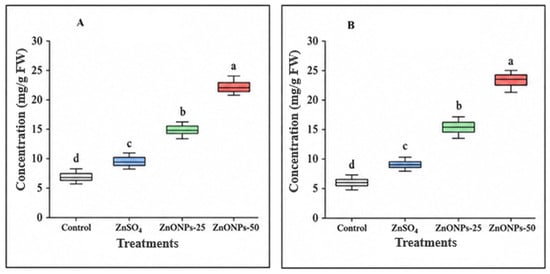
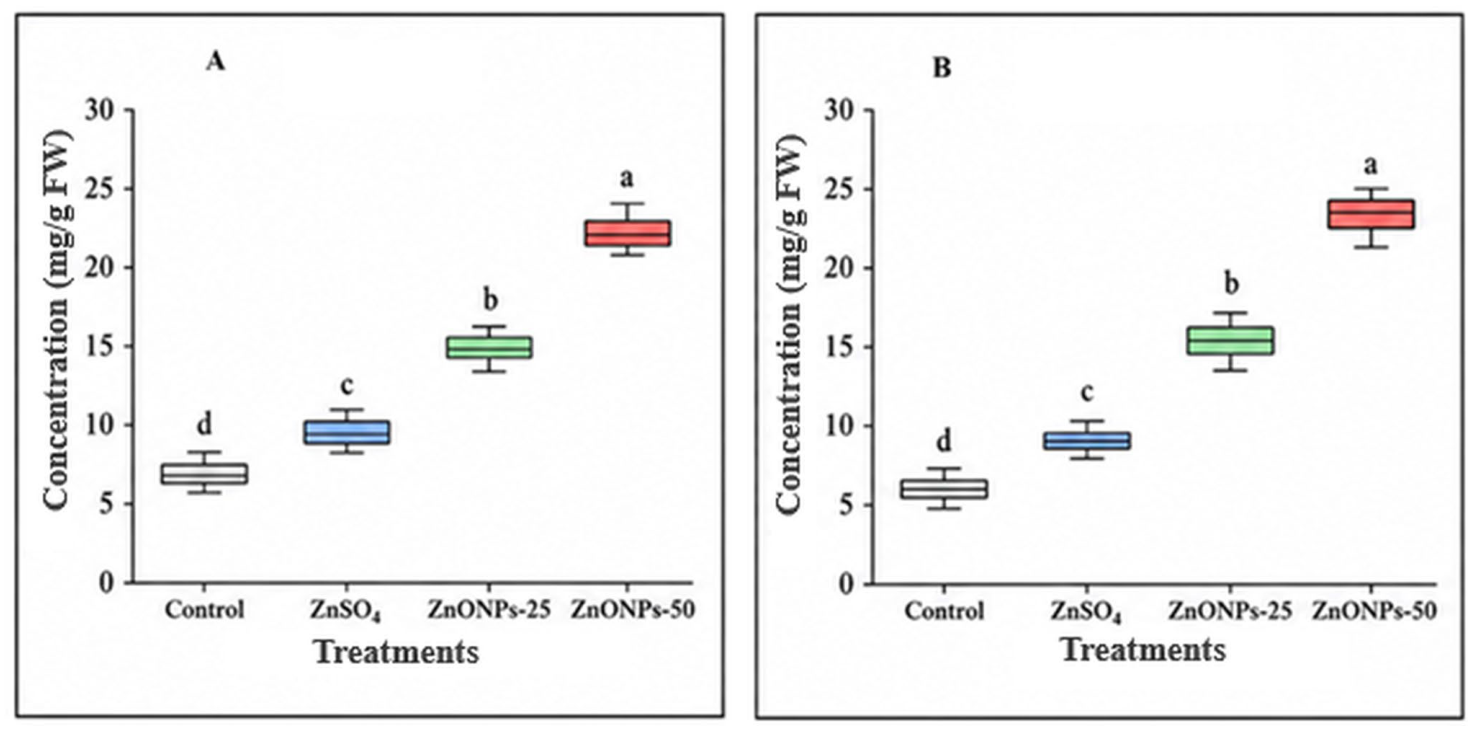
Alliin increased from an average of 6.95 mg g−1 FW in the negative control to 9.39 mg g−1 FW with ZnSO4 (+35.1%), 14.60 mg g−1 FW with ZnO NP-25 (+110.1%), and 22.60 mg g−1 FW with ZnO NP-50 (+225.3%) (Figure 2A). Allicin showed a parallel response, increasing from 5.92 mg g−1 FW in the control to 8.78 mg g−1 FW with ZnSO4 (+48.3%), 15.53 mg g−1 FW with ZnO NP-25 (+162.3%), and 24.25 mg g−1 FW with ZnO NP-50 (+309.6%) (Figure 2B). All treatments differed significantly (p < 0.05), confirming a pronounced stimulatory effect of ZnO NPs on organosulfur metabolite accumulation.
Figure 2.
Accumulation of alliin (A) and allicin (B) in garlic bulbs under control, ZnSO4, ZnO NP-25, and ZnO NP-50 treatments. Boxplots display the median (center line), interquartile range (box), and whiskers extending to 1.5 × the interquartile range. Individual points represent independent biological replicates (n = 10 plants per treatment). Values are expressed as mg g−1 fresh weight (FW). Different letters indicate significant differences among treatments according to Tukey’s test at p < 0.05.
The concurrent increase of alliin and allicin indicates coordinated regulation of sulfur metabolism at both precursor and product levels. Alliin, the primary non-protein sulfur amino acid, serves as the direct precursor of allicin through alliinase-mediated hydrolysis [8,35]. The substantial increase in alliin concentrations observed under ZnO NP treatments could be associated with enhanced sulfur assimilation and upstream sulfur metabolic activity, although these mechanisms were not directly evaluated in this study. Such a possibility is consistent with the documented responsiveness of garlic sulfur metabolism to nutrient availability and oxidative signaling [2]. This response may be associated with enhanced sulfur assimilation and regulation of sulfur-metabolic pathways. Previous studies have shown that genes involved in cysteine metabolism, γ-glutamyl transpeptidase activity, flavin-containing monooxygenases, and transcriptional regulators of alliin biosynthesis can influence organosulfur compound accumulation in garlic [32,35]; however, these mechanisms were not directly evaluated in the present study.
Allicin concentration increased under ZnO NPs treatments. Greater alliinase-mediated conversion is one possible explanation, but alliinase activity was not measured. Zinc plays a critical role as a cofactor in protein synthesis and redox regulation, supporting enzymes involved in sulfur metabolism [3,36]. The superior efficacy of ZnO NPs compared with ZnSO4 could potentially be attributed to higher bioavailability and cellular uptake, which may promote zinc-dependent metabolic processes and stabilize cellular redox homeostasis, thereby could optimize enzyme functionality [51]. Generally, the observed increases in alliin and allicin following ZnO NPs treatment could indicate enhanced precursor availability and downstream conversion, suggesting a coordinated modulation of sulfur metabolism and secondary metabolic pathways. This response may contribute to greater OSC accumulation and associated biochemical functionality [8,53,54].
3.3. Ajoene Reduction
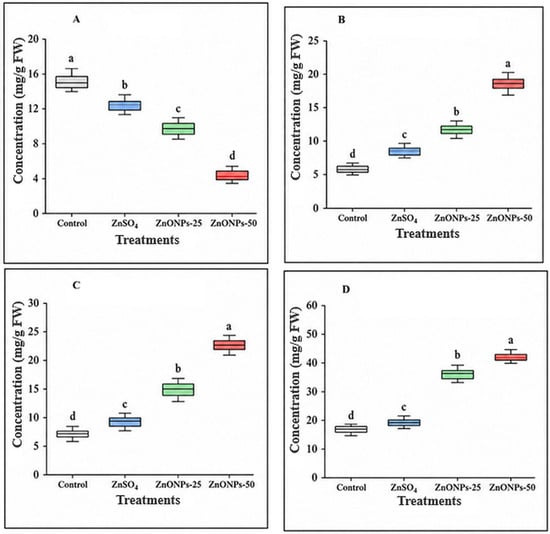
In contrast to allicin and alliin, ajoene concentration decreased significantly with increasing Zn treatments (Figure 3A). Garlic plants grown on untreated soil exhibited the highest ajoene concentration (15.24 mg g−1 FW), while ZnSO4 treatment reduced the concentration to approximately 12.85 mg g−1 FW, corresponding to a 15.7% decrease relative to the negative control. ZnO NP-25 further reduced ajoene concentration to approximately 10.87 mg g−1 FW, representing a 28.7% reduction relative to the control and a 15.4% reduction relative to ZnSO4 treatment. The lowest concentration was recorded under ZnO NP-50 treatment (4.99 mg g−1 FW), which corresponded to a 67.3% decrease relative to the control and a 61.2% decrease relative to ZnSO4 treatment. ANOVA confirmed significant treatment effects on ajoene concentration (p < 0.05).
Figure 3.
Changes in ajoene (A), diallyl sulfide (B), diallyl disulfide (C), and diallyl trisulfide (D) concentrations in garlic bulbs under different zinc treatments. Boxplots display the median (center line), interquartile range (box), and whiskers extending to 1.5 × the interquartile range. Individual points represent independent biological replicates (n = 10 plants per treatment). Values are expressed as mg g−1 fresh weight (FW). Different lowercase letters indicate significant differences among treatments according to Tukey’s test at p < 0.05.
Ajoene, a downstream transformation product of allicin, exhibited a contrasting response to ZnO NPs treatments compared with alliin and allicin. The inverse relationship between allicin and ajoene concentrations indicates that ZnO NPs treatments were associated with higher allicin abundance and lower ajoene abundance. However, because ajoene can arise through chemical transformations of allicin during tissue disruption, extraction, and subsequent handling [55], the present data do not distinguish between changes occurring in planta and those occurring during postharvest processes. Reduced ajoene abundance may reflect differences in allicin availability, stability, or conversion kinetics. However, the present study did not directly assess allicin stability, reaction rates, or metabolic flux, and therefore the underlying mechanism cannot be determined from the metabolite profile alone. The conversion of sulfur intermediates into ajoene and related compounds is strongly influenced by environmental and biochemical factors, including pH, redox status, and the cellular metabolic environment [48,49,50]. Consequently, ZnO NPs treatments were associated with a distinct sulfur-metabolite profile characterized by increased alliin, allicin, DAS, DADS, and DATS and decreased ajoene. Whether this pattern reflects altered in planta metabolism, differences in post-disruption chemical transformations, or a combination of both requires further investigation.
The lower ajoene concentration, together with higher allicin, is consistent with altered postharvest stability or conversion patterns; however, the responsible process cannot be determined from endpoint concentrations. Nanoparticles can influence membrane integrity, intracellular redox balance, and metabolite interactions, thereby affecting the equilibrium between sulfur compounds and their degradation products [2]. Zhou et al. [49] also demonstrated that allicin degradation products, including ajoene, are highly dependent on matrix composition and endogenous biochemical conditions. Therefore, the reduced ajoene levels observed in ZnO NPs-treated plants likely reflect shifts in the intracellular chemical environment rather than reduced sulfur metabolism. From a biological perspective, ajoene contributes to the pharmacological properties of garlic; however, its formation could also reflect ongoing allicin decomposition [52]. Thus, the combination of increased allicin and decreased ajoene under ZnO NPs treatments could suggest enhanced preservation of bioactive sulfur compounds and a shift in sulfur-metabolite equilibrium toward retention of the primary active metabolite. Overall, the results demonstrate a robust treatment-associated shift in the relative abundance of allicin and ajoene; however, the mechanistic basis of this relationship remains unresolved because both biological metabolism and post-disruption chemical reactions may contribute to the observed metabolite profile.
3.4. Diallyl Sulfide, Diallyl Disulfide, and Diallyl Trisulfide Accumulation
Diallyl sulfide (DAS), diallyl disulfide (DADS), and diallyl trisulfide (DATS) accumulation increased progressively with zinc supplementation, with markedly stronger effects under ZnO NP treatments than ZnSO4 (Figure 3B–D). DAS rose from 5.78 mg g−1 FW in the negative control to 8.53 mg g−1 FW with ZnSO4 (+47.6%) and further to 11.88 and 18.47 mg g−1 FW under ZnO NP-25 and NP-50 (+105.5% and +219.5%, respectively), indicating higher concentrations of volatile OSCs. Similarly, DADS increased from 7.00 mg g−1 FW (control) to 9.14 mg g−1 FW with ZnSO4 (+30.6%) and to 15.22 and 23.22 mg g−1 FW under ZnO NPs (+117.4% and +231.7%; p < 0.05). DATS exhibited the strongest concentration response, rising from 16.94 mg g−1 FW in the control to 18.94 mg g−1 FW with ZnSO4 (+11.8%) and sharply to 35.84 and 42.29 mg g−1 FW under ZnO NPs (+111.6% and +149.7%).
DAS, DADS, and DATS under zinc treatments showed coordinated concentration changes. However, endpoint concentrations alone do not establish pathway flux [5]. The greater effectiveness of ZnO NPs compared with ZnSO4 could reflect differences in the interaction of nanoparticulate and ionic Zn sources with plant physiological processes. While Zn bioavailability, cellular uptake, sulfur assimilation, and metabolic activation were not directly assessed in this study, the observed metabolite profiles are consistent with literature reports indicating that ZnO nanoparticles may enhance Zn delivery and influence Zn-dependent metabolic pathways in plants [38,44,56,57]. In addition, previous studies have suggested that ZnO nanoparticles can influence ROS-mediated signaling pathways associated with secondary metabolism and plant defense responses [58]. Although such mechanisms could potentially contribute to the observed increases in sulfur metabolites, ROS production and redox-related parameters were not measured in the present study.
GC–MS analysis supported these findings by revealing higher abundances of DAS, DADS, and DATS in Zn-treated garlic plants. Since these volatile OSCs originate from allicin decomposition during tissue disruption and postharvest transformations, their accumulation reflects increased precursor availability and enhanced conversion into stable sulfur derivatives [48]. Notably, DATS would exhibit the strongest response to ZnO NP treatments, potentially indicating enhanced sulfur transfer and coupling reactions involved in polysulfide biosynthesis. The increased accumulation of DADS and DATS over DAS agrees with their greater stability as end products of allicin breakdown [48,49]. Previous studies have shown that amino acid interactions and cellular redox environments can direct allicin degradation toward disulfide and trisulfide production, supporting the observed increases in DADS and DATS [49].
3.5. Integrated Interpretation and Hypothesized Mechanistic Basis
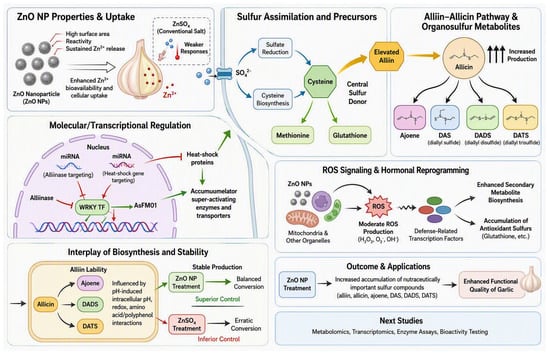
Proposed mechanistic model of ZnO nanoparticle–mediated enhancement of garlic sulfur metabolism is provided in Figure 4. Taken together, the metabolite profile suggests that ZnO NPs fertilization influences garlic sulfur metabolism at multiple levels. The mechanistic interpretations presented below are proposed as literature-supported hypotheses based on the observed metabolite responses and should be validated through future studies incorporating tissue Zn analysis, enzyme assays, transcriptomics, and redox measurements. First, nanoscale Zn delivery likely sustained Zn2+ availability and improved Zn uptake because ZnO NPs have high surface area, strong reactivity, and favorable release characteristics [36,59]. Second, the observed metabolite profile is consistent with the hypothesis that increased Zn availability may enhance sulfur assimilation and precursor formation [36]. However, sulfur-assimilation enzymes and tissue Zn concentrations were not measured, and therefore this interpretation remains speculative. Third, the observed responses are consistent with mechanisms previously reported for nanoparticle-mediated regulation of sulfur metabolism, including transcriptional and signaling pathways. Nevertheless, gene expression analyses were not performed in the present study [34,35]. It has been proposed that nanoparticle-induced ROS may function as signaling molecules regulating secondary metabolism [58,59]. Because ROS levels, lipid peroxidation, antioxidant enzymes, and redox-related indicators were not assessed in this study, their involvement can only be inferred from previous reports.
Figure 4.
Proposed mechanistic model of ZnO nanoparticle–mediated enhancement of garlic sulfur metabolism. Improved Zn availability and cellular uptake are hypothesized to stimulate sulfur assimilation, alliin biosynthesis, alliinase-mediated allicin formation, ROS signaling, and downstream conversion to stable sulfur metabolites, thereby enhancing bulb functional quality. Mechanisms shown were not directly evaluated in the present study.
The accumulation of allicin and polysulfides, which possess strong antioxidant activity, is therefore consistent with an adaptive response that reinforces redox homeostasis and bulb defense. Finally, because allicin is highly labile, the observed metabolite patterns are consistent with differences in the formation, stability, or transformation of sulfur compounds. However, because metabolite fluxes and reaction kinetics were not measured directly, these interpretations should be considered hypotheses rather than demonstrated mechanisms [49].
3.6. Implications for Garlic Quality and Functional Value
The increase in alliin, allicin, DAS, DADS, and DATS under ZnO NP treatments demonstrates that nano-enabled Zn fertilization alters the organosulfur composition of garlic bulbs. Because these compounds have been associated with flavor characteristics and biological activities in previous studies, the observed compositional changes may have implications for garlic quality and utilization; however, these functional attributes were not directly evaluated in the present study. Alliin and allicin are major contributors to garlic pungency and nutraceutical properties, whereas DAS, DADS, and DATS contribute to flavor development and diverse biological activities [35,48]. The concurrent accumulation of these metabolites following ZnO NP treatment may indicate coordinated modulation of sulfur metabolism and enhanced accumulation of key organosulfur compounds. However, whether these compositional changes translate into improved sensory, nutritional, or biological properties remains to be established.
ZnO NPs consistently outperformed ZnSO4, with the highest OSC-containing metabolite concentrations observed at 50 mg kg−1 of soil. Although Zn bioavailability, cellular uptake, and sulfur assimilation were not directly measured in the present study, the observed response is consistent with previous reports suggesting that nanoparticle-based Zn fertilizers may differ from conventional Zn sources in their interactions with plant physiological and metabolic processes. Studies have proposed that the high surface area and reactivity of ZnO nanoparticles may enhance Zn availability to plants and influence Zn-dependent biochemical pathways, including antioxidant regulation and nutrient metabolism [44,56,57]. Therefore, the higher OSC metabolite concentrations observed in the present study could reflect such processes; however, these mechanisms remain hypothetical and were not directly evaluated. In contrast, the reduction in ajoene accumulation could indicate selective regulation of downstream sulfur-conversion pathways, potentially favoring the retention of biologically active precursor compounds. Because the conversion of alliin and allicin is highly sensitive to postharvest handling and storage conditions, agronomic strategies that increase precursor pools should be integrated with optimized processing practices to maximize bioactive sulfur compounds [48,49].
From an agricultural and phytochemical perspective, the enhanced accumulation of key organosulfur metabolites is noteworthy because these compounds have been associated with antioxidant, antimicrobial, cardioprotective, and anticancer activities in previous studies [3,53]. However, no biological activity, bioavailability, or health-related endpoints were measured in the present work. These findings demonstrate that ZnO NP application can modify the targeted organosulfur composition of garlic bulbs under greenhouse conditions, while the consequences for nutritional, sensory, biological, and commercial quality remain to be established.
4. Conclusions
This study demonstrated that ZnO NP fertilization significantly altered the concentrations of the targeted organosulfur metabolites in garlic under greenhouse conditions. ZnO NPs treatments increased the concentrations of alliin, allicin, DAS, DADS, and DATS, while reducing ajoene abundance, resulting in a distinct sulfur-metabolite profile compared with both the untreated control and conventional ZnSO4 fertilization. These responses indicate that nano-enabled Zn delivery can modify the accumulation patterns of key sulfur-containing metabolites associated with garlic phytochemistry. The observed metabolite profiles are consistent with enhanced sulfur-metabolic activity, although the underlying physiological and molecular mechanisms remain to be validated. Overall, this work advances understanding of how ZnO NPs influence garlic sulfur metabolism and provides a foundation for future studies linking nutrient management with phytochemical composition. However, the present study evaluated only metabolite responses under greenhouse conditions and did not assess plant growth, yield, tissue Zn accumulation, phytotoxicity, residual soil Zn, nanoparticle fate, or food and environmental safety. Therefore, the findings should be interpreted as evidence of compositional changes rather than agronomic or safety benefits. Future research should integrate metabolite profiling with agronomic, physiological, environmental, and safety assessments under field conditions to determine the practical relevance of ZnO NP fertilization in garlic production.
Supplementary Materials
The following supporting information can be downloaded at: https://www.mdpi.com/article/10.3390/agriculture16181981/s1, Table S1. The equivalent elemental zinc calculated from ZnO and anhydrous ZnSO4 for in soil application; Table S2. LC–MS/MS and GC–MS characterization and quantitative profiling of organosulfur compounds, including quantifier and qualifier ions, retention times, peak responses, limit of detection (LOD) and limit of quantification (LOQ), linearity and statistical significance; Table S3. LC–MS/MS analytical parameters for quantification of alliin and allicin in garlic; Text S1. R Script used to run ANOVA, mean comparison, effect size determination and generating the box plots; Figure S1: Particle size distribution (A), zeta potential (B), XRD patterns, scanning electron microscope (SEM) image (D), elemental composition from EDS analysis (E) and transmission electron microscope (TEM) image of ZnO nanoparticles.
Author Contributions
A.G.: writing—review and editing, data curation, writing—original draft, validation, methodology, formal analysis. E.P.: investigation, methodology, writing—review and editing. A.S.: investigation, writing—review and editing, methodology, validation. X.M.: funding acquisition, methodology, data curation, writing—review and editing. L.C.: funding acquisition, supervision, resources, writing—review and editing, data curation, project administration, conceptualization, validation. All authors have read and agreed to the published version of the manuscript.
Funding
The authors declare that financial support was received for the research and/or publication of this article. This research was funded by the United States Department of Agriculture, National Institute of Food and Agriculture (USDA-NIFA) Capacity Building Grant, Project #2023-38821-39982.
Institutional Review Board Statement
Not applicable.
Data Availability Statement
The original contributions presented in this study are included in the article/Supplementary Material. Further inquiries can be directed to the corresponding author.
Acknowledgments
The authors appreciate CAFNR Research, College of Agriculture, Food, and Natural Resources, Prairie View A&M University, Texas, for providing space and facility support. During the preparation of this manuscript, the authors used FigureLabs, version Nano Banana Pro (https://chat.figurelabs.ai), for the purpose of summarizing the materials and methods and creating a framework to integrate the findings. The authors have reviewed and edited the output and take full responsibility for the content of this publication.
Conflicts of Interest
The authors declare no conflicts of interest.
References
- Amagase, H. Clarifying the real bioactive constituents of garlic. J. Nutr. 2006, 136, 716S–725S. [Google Scholar] [CrossRef] [Scilit] [PubMed]
- Martins, N.; Petropoulos, S.; Ferreira, I.C.F.R. Chemical composition and bioactive compounds of garlic (Allium sativum L.) as affected by pre- and post-harvest conditions: A review. Food Chem. 2016, 211, 41–50. [Google Scholar] [CrossRef] [Scilit] [PubMed]
- Batiha, G.E.-S.; Beshbishy, A.M.; Wasef, L.G.; Elewa, Y.H.A.; Al-Sagan, A.A.; Abd El-Hack, M.E.; Taha, A.E.; Abd-Elhakim, Y.M.; Devkota, H.P. Chemical constituents and pharmacological activities of garlic (Allium sativum L.): A review. Nutrients 2020, 12, 872. [Google Scholar] [CrossRef] [Scilit] [PubMed]
- Sudhakar, K.; Mishra, V.; Hemani, V.; Verma, A.; Jain, A.; Jain, S.; Charyulu, R.N. Reverse pharmacology of phytoconstituents of food and plant in the management of diabetes: Current status and perspectives. Trends Food Sci. Technol. 2021, 110, 594–610. [Google Scholar] [CrossRef] [Scilit]
- El-Saadony, M.T.; Saad, A.M.; Korma, S.A.; Salem, H.M.; Abd El-Mageed, T.A.; Alkafaas, S.S.; Elsalahaty, M.I.; Elkafas, S.S.; Mosa, W.F.A.; Ahmed, A.E.; et al. Garlic bioactive substances and their therapeutic applications for improving human health: A comprehensive review. Front. Immunol. 2024, 15, 1277074. [Google Scholar] [CrossRef] [Scilit] [PubMed]
- Ren, L.; Pan, X.; Deng, Y.; Ge, Z.; Li, S.; Su, D.; Zhao, G.; Tang, H.; Wang, X. Combined transcriptomic and metabolomic analyses of sulfur and nitrogen interaction in garlic. Horticulturae 2024, 10, 1203. [Google Scholar] [CrossRef] [Scilit]
- Amagase, H.; Petesch, B.L.; Matsuura, H.; Kasuga, S.; Itakura, Y. Intake of garlic and its bioactive components. J. Nutr. 2001, 131, 955S–962S. [Google Scholar] [CrossRef] [Scilit] [PubMed]
- Borlinghaus, J.; Albrecht, F.; Gruhlke, M.C.H.; Nwachukwu, I.D.; Slusarenko, A.J. Allicin: Chemistry and biological properties. Molecules 2014, 19, 12591–12618. [Google Scholar] [CrossRef] [Scilit] [PubMed]
- Deng, Y.; Ho, C.-T.; Lan, Y.; Xiao, J.; Lu, M. Bioavailability, health benefits, and delivery systems of allicin: A review. J. Agric. Food Chem. 2023, 71, 19207–19220. [Google Scholar] [CrossRef] [Scilit] [PubMed]
- Xu, C.; Wan, W.; Wang, W.; Zhang, Z.; Tian, C.; Su, Y.; Wu, J.; Li, J.; Li, M.; Zeng, L.; et al. A basic leucine zipper transcription factor, AsbZIP26, positively regulates the synthesis of alliin in garlic (Allium sativum L.). Sci. Hortic. 2025, 339, 113840. [Google Scholar] [CrossRef] [Scilit]
- Block, E. Garlic and Other Alliums: The Lore and the Science; Royal Society of Chemistry: Cambridge, UK, 2010; pp. 1–454. [Google Scholar]
- Yamaguchi, Y.; Kumagai, H. Characteristics, biosynthesis, decomposition, metabolism and functions of the garlic odour precursor, S-allyl-L-cysteine sulfoxide. Exp. Ther. Med. 2020, 19, 1528–1535. [Google Scholar] [CrossRef] [Scilit] [PubMed]
- Mengers, H.G.; Schier, C.; Zimmermann, M.; Gruhlke, M.C.H.; Block, E.; Blank, L.M.; Slusarenko, A.J. Seeing the smell of garlic: Detection of gas phase volatiles from crushed garlic (Allium sativum), onion (Allium cepa), ramsons (Allium ursinum) and human garlic breath using SESI-Orbitrap MS. Food Chem. 2022, 397, 133804. [Google Scholar] [CrossRef] [Scilit] [PubMed]
- Gruhlke, M.C.H.; Nicco, C.; Batteux, F.; Slusarenko, A.J. The effects of allicin, a reactive sulfur species from garlic, on a selection of mammalian cell lines. Antioxidants 2017, 6, 1. [Google Scholar] [CrossRef] [Scilit] [PubMed]
- Bhattacharya, S.; Sen, D.; Bhattacharjee, C. Strategic development to stabilize bioactive diallyl thiosulfinate by pH responsive non ionic micelle carrier system. Process Biochem. 2022, 120, 64–73. [Google Scholar] [CrossRef] [Scilit]
- Xu, Y.; Tao, M.; Xu, W.; Xu, L.; Yue, L.; Cao, X.; Chen, F.; Wang, Z. Nano-CeO2 activates physical and chemical defenses of garlic (Allium sativum L.) for reducing antibiotic resistance genes in plant endosphere. Ecotoxicol. Environ. Saf. 2024, 276, 116289. [Google Scholar] [CrossRef] [Scilit] [PubMed]
- Hirata, Y.; Nagase, H.; Satoh, K.; Takemori, H.; Furuta, K.; Kamatari, Y.O. Antiferroptotic properties of allicin and related organosulfur compounds—Diallyl disulfide and diallyl trisulfide—From garlic. Food Chem. Toxicol. 2025, 195, 115124. [Google Scholar] [CrossRef] [Scilit] [PubMed]
- Huang, Z.; Zhou, Q.; Wu, W.-L.; Wan, J.; Jiang, A.-M. Thermal kinetics of enzyme inactivation, color changes, and allicin degradation of garlic under blanching treatments. J. Food Process Eng. 2019, 42, e12991. [Google Scholar] [CrossRef] [Scilit]
- Nguyen, B.T.; Harper, S.M.; O’Hare, T.J.; Menzies, N.W.; Wehr, B. Sulfur Nutrition Affects Garlic Bulb Yield and Allicin Concentration. Plants 2022, 11, 2571. [Google Scholar] [CrossRef] [Scilit] [PubMed]
- Kamenetsky, R.; Rabinowitch, H.D.; Kik, C. Diversity in garlic. Acta Hortic. 2005, 688, 123–130. [Google Scholar]
- Baghalian, K.; Naghavi, M.R.; Ziai, S.A.; Naghdi Badi, H. Post-planting evaluation of morphological characters and allicin content in Iranian garlic (Allium sativum L.) ecotypes. Sci. Hortic. 2006, 107, 405–410. [Google Scholar] [CrossRef] [Scilit]
- Hayat, S.; Cheng, Z.; Ahmad, H.; Ali, M.; Chen, X.; Wang, M. Garlic, from remedy to stimulant: Evaluation of antifungal potential reveals diversity in phytoalexin allicin content among garlic cultivars; allicin containing aqueous garlic extracts trigger antioxidants in cucumber. Front. Plant Sci. 2016, 7, 1235. [Google Scholar] [CrossRef] [Scilit] [PubMed]
- Marsic, N.K.; Necemer, M.; Veberic, R.; Ulrih, N.P.; Skrt, M. Effect of cultivar and fertilization on garlic yield and allicin content in bulbs at harvest and during storage. Turk. J. Agric. For. 2019, 43, 414–429. [Google Scholar] [CrossRef] [Scilit]
- Abdelrahman, M.; Hirata, S.; Mukae, T.; Yamada, T.; Sawada, Y.; El-Syaed, M.; Yamada, Y.; Sato, M.; Yokota Hirai, M.; Shigyo, M. Comprehensive metabolite profiling in genetic resources of garlic (Allium sativum L.) collected from different geographical regions. Molecules 2021, 26, 1415. [Google Scholar] [CrossRef] [Scilit] [PubMed]
- Leite, V.d.S.A.; Ikehara, B.R.M.; Almeida, N.R.; Silva, G.H.; Macedo, W.R.; Pinto, F.G. Metabolomics based on GC–MS combined with chemometrics for geographical discrimination of garlic (Allium sativum L.). Food Control 2025, 169, 110976. [Google Scholar] [CrossRef] [Scilit]
- Ruíz-Torres, C.; Feriche-Linares, R.; Rodríguez-Ruíz, M.; Palma, J.M.; Corpas, F.J. Arsenic-induced stress activates sulfur metabolism in different organs of garlic (Allium sativum L.) plants accompanied by a general decline of the NADPH-generating systems in roots. J. Plant Physiol. 2017, 211, 27–35. [Google Scholar] [CrossRef] [Scilit] [PubMed]
- Atif, M.J.; Amin, B.; Ghani, M.I.; Ali, M.; Liu, X.; Zhang, Y.; Cheng, Z. Allium sativum L. (garlic) bulb enlargement as influenced by differential combinations of photoperiod and temperature. Food Chem. 2021, 338, 127991. [Google Scholar] [CrossRef] [Scilit] [PubMed]
- Atif, M.J.; Amin, B.; Ghani, M.I.; Ali, M.; Zhang, S.; Cheng, Z. Effect of photoperiod and temperature on garlic (Allium sativum L.) bulbing and selected endogenous chemical factors. Environ. Exp. Bot. 2020, 180, 104250. [Google Scholar] [CrossRef] [Scilit]
- Woo, U.J.; Moon, Y.H.; Sim, H.S.; Lee, T.Y.; Shin, H.R.; Jo, J.S.; Ku, K.-M.; Kim, S.K. Changes in biochemical metabolites and growth of garlic by evapotranspiration-based irrigation regime. Ann. Agric. Sci. 2024, 69, 100378. [Google Scholar] [CrossRef] [Scilit]
- Kopriva, S.; Rennenberg, H. Control of sulphate assimilation and glutathione synthesis: Interaction with N and C metabolism. J. Exp. Bot. 2004, 55, 1831–1842. [Google Scholar] [CrossRef] [Scilit] [PubMed]
- Lancaster, J.E.; Shaw, M.L. Gamma-glutamyl peptides in the biosynthesis of S-alk(en)yl-L-cysteine sulfoxides (flavour precursors) in Allium. Phytochemistry 1989, 28, 455–460. [Google Scholar] [CrossRef] [Scilit]
- Yang, X.; Su, Y.; Wu, J.; Wan, W.; Chen, H.; Cao, X.; Wang, J.; Zhang, Z.; Wang, Y.; Ma, D.; et al. Parallel analysis of global garlic gene expression and alliin content following leaf wounding. BMC Plant Biol. 2021, 21, 174. [Google Scholar] [CrossRef] [Scilit] [PubMed]
- Ai, P.; Xue, J.; Zhu, Y.; Tan, W.; Wu, Y.; Wang, Y.; Li, Z.; Shi, Z.; Kang, D.; Zhang, H.; et al. Comparative analysis of two kinds of garlic seedings: Qualities and transcriptional landscape. BMC Genom. 2023, 24, 87. [Google Scholar] [CrossRef] [Scilit] [PubMed]
- Asadi, M.; Nazarian-Firouzabadi, F.; Naghavi, M.R.; Ismaili, A. Identifying miRNAs and target genes associated with allicin synthesis in Allium species. J. Plant Biochem. Biotechnol. 2024, 33, 168–177. [Google Scholar] [CrossRef] [Scilit]
- Wu, J.; Li, M.; Wang, W.; Su, Y.; Li, J.; Gong, J.; Meng, X.; Lin, C.; Zhang, Q.; Yang, Y.; et al. Identification and functional characterization of AsWRKY9, a WRKY transcription factor modulating alliin biosynthesis in garlic (Allium sativum L.). BMC Biol. 2025, 23, 14. [Google Scholar] [CrossRef] [Scilit] [PubMed]
- Broadley, M.R.; White, P.J.; Hammond, J.P.; Zelko, I.; Lux, A. Zinc in plants. New Phytol. 2007, 173, 677–702. [Google Scholar] [CrossRef] [Scilit] [PubMed]
- Cakmak, I. Possible roles of zinc in protecting plant cells from oxidative damage. New Phytol. 2000, 146, 185–205. [Google Scholar] [CrossRef] [Scilit] [PubMed]
- Raliya, R.; Nair, R.; Chavalmane, S.; Wang, W.N.; Biswas, P. Mechanistic Evaluation of Translocation and Physiological Impact of Zinc Oxide Nanoparticles on Tomato Plants. Metallomics 2015, 7, 1584–1594. [Google Scholar] [CrossRef] [Scilit] [PubMed]
- Srivastav, A.; Ganjewala, D.; Singhal, R.K.; Rajput, V.D.; Minkina, T.; Voloshina, M.; Srivastava, S.; Shrivastava, M. Effect of ZnO Nanoparticles on Growth and Biochemical Responses of Wheat and Maize. Plants 2021, 10, 2556. [Google Scholar] [CrossRef] [Scilit] [PubMed]
- Mazhar, Z.; Akhtar, J.; Alhodaib, A.; Naz, T.; Zafar, M.I.; Iqbal, M.M.; Fatima, H.; Naz, I. Efficacy of ZnO Nanoparticles in Zn Fortification and Partitioning of Wheat and Rice Grains under Salt Stress. Sci. Rep. 2023, 13, 2022. [Google Scholar] [CrossRef] [Scilit] [PubMed]
- Yadav, A.; Krishnan, P.; Kundu, M.; Bana, R.S.; Shaloo; Choudhary, A.K.; Shivay, Y.S.; Meena, S.L.; Begam, S.; Godara, S.; et al. Zinc Nano-Fertilization Enhances Wheat Productivity and Biofortification. bioRxiv 2023. [Google Scholar] [CrossRef] [Scilit]
- Jayasree, B.; Prasad, T.; Krishna, T.G.; Sunitha, N. Effect of Nanoscale Zinc Oxide Particles on Macronutrient Concentration of Groundnut (Arachis hypogaea L.). Int. J. Plant Soil Sci. 2023, 35, 118–122. [Google Scholar] [CrossRef] [Scilit]
- Geremew, A.; Carson, L.; Woldesenbet, S.; Wang, H.; Reeves, S.; Brooks, N., Jr.; Saganti, P.; Weerasooriya, A.; Peace, E. Effect of zinc oxide nanoparticles synthesized from Carya illinoinensis leaf extract on growth and antioxidant properties of mustard (Brassica juncea). Front. Plant Sci. 2023, 14, 1108186. [Google Scholar] [CrossRef] [Scilit] [PubMed]
- Faizan, M.; Faraz, A.; Yusuf, M.; Khan, S.T.; Hayat, S. Zinc Oxide Nanoparticle-Mediated Changes in Photosynthetic Efficiency and Antioxidant System in Plants. Photosynthetica 2018, 56, 678–686. [Google Scholar] [CrossRef] [Scilit]
- Moguee, S.; Fallah, S.; Pokhrel, L.R.; Adavi, Z.; Berkuta, J. Multi-Site Field Validation of Improved Morpho-Physiological Responses and Yield in Allium hirtifolium with Zinc Oxide Nanoparticle Treatments in Semi-Arid Soils. Biosci. Nanotechnol. 2026, 2, 26. [Google Scholar] [CrossRef] [Scilit]
- Geremew, A.; Stovall, L.; Woldesenbet, S.; Ma, X.; Carson, L. Nanopriming with zinc oxide: A novel approach to enhance germination and antioxidant systems in amaranth. Front. Plant Sci. 2025, 16, 1599192. [Google Scholar] [CrossRef] [Scilit] [PubMed]
- Priyanshu, A.B.; Singh, M.K.; Malik, S.; Kumar, M.; Kumar, V.; Tripathi, S.K.; Shahi, U.P. Effect of Integrated Nutrient Management on Growth Characters of Garlic (Allium sativum L.) cv. Yamuna Safed-3. Prog. Agric. 2019, 19, 242–246. [Google Scholar] [CrossRef] [Scilit]
- Borlinghaus, J.; Foerster, J.; Kappler, U.; Antelmann, H.; Noll, U.; Gruhlke, M.C.H.; Slusarenko, A.J. Allicin, the odor of freshly crushed garlic: A review of recent progress in understanding allicin’s effects on cells. Molecules 2021, 26, 1505. [Google Scholar] [CrossRef] [Scilit] [PubMed]
- Zhou, S.; Yan, X.; Qiao, X.; Qiu, Z.; Zhu, W.; Lu, X.; Zheng, Z.; Zhang, B. Evaluate the stability of synthesized allicin and its reactivity with endogenous compounds in garlic. NPJ Sci. Food 2025, 9, 18. [Google Scholar] [CrossRef] [Scilit] [PubMed]
- Martín-Lagos, A.R.; Olea Serrano, M.F.; Ruiz López, M.D. Determination of organic sulphur compounds in garlic extracts by gas chromatography and mass spectrometry. Food Chem. 1995, 53, 91–93. [Google Scholar] [CrossRef] [Scilit]
- Janská, P.; Knejzlík, Z.; Perumal, A.S.; Jurok, R.; Tokárová, V.; Nicolau, D.V.; Štěpanek, F.; Kaspar, O. Effect of physicochemical parameters on the stability and activity of garlic alliinase and its use for in-situ allicin synthesis. PLoS ONE 2021, 16, e0248878. [Google Scholar] [CrossRef] [Scilit] [PubMed]
- Verma, T.; Aggarwal, A.; Dey, P.; Chauhan, A.K.; Rashid, S.; Chen, K.-T.; Sharma, R. Medicinal and therapeutic properties of garlic, garlic essential oil, and garlic-based snack food: An updated review. Front. Nutr. 2023, 10, 1120377. [Google Scholar] [CrossRef] [Scilit] [PubMed]
- Lawson, L.D.; Wang, Z.J. Allicin and allicin-derived garlic compounds increase breath acetone through allyl methyl sulfide: Use in measuring allicin bioavailability. J. Agric. Food Chem. 2005, 53, 1974–1983. [Google Scholar] [CrossRef] [Scilit] [PubMed]
- Shang, A.; Cao, S.Y.; Xu, X.Y.; Gan, R.Y.; Tang, G.Y.; Corke, H.; Mavumengwana, V.; Li, H.B. Bioactive compounds and biological functions of garlic (Allium sativum L.). Foods 2019, 8, 246. [Google Scholar] [CrossRef] [Scilit] [PubMed]
- Subramanian, M.S.; Nandagopal, G.; Nordin, S.A.; Thilakavathy, K.; Joseph, N. Prevailing knowledge on the bioavailability and biological activities of sulphur compounds from Alliums: A potential drug candidate. Molecules 2020, 25, 4111. [Google Scholar] [CrossRef] [Scilit] [PubMed]
- Dimkpa, C.O.; Bindraban, P.S. Nanofertilizers: New Products for the Industry? J. Agric. Food Chem. 2018, 66, 6462–6473, Correction in J. Agric. Food Chem. 2018, 66, 9158. https://doi.org/10.1021/acs.jafc.8b04127. [Google Scholar] [CrossRef] [Scilit] [PubMed]
- Ochoa-Chaparro, E.H.; Castruita-Esparza, L.U.; Sánchez, E. Eco-Physiological and Molecular Roles of Zinc Oxide Nanoparticles (ZnO-NPs) in Mitigating Abiotic Stress: A Comprehensive Review. Plants 2026, 15, 147. [Google Scholar] [CrossRef] [Scilit] [PubMed]
- Mirakhorli, T.; Ardebili, Z.O.; Ladan-Moghadam, A. Bulk and nanoparticles of zinc oxide exert beneficial effects in soybean. PLoS ONE 2021, 16, e0256905. [Google Scholar] [CrossRef] [Scilit] [PubMed]
- Rastogi, A.; Zivcak, M.; Sytar, O.; Kalaji, H.M.; He, X.; Mbarki, S.; Brestic, M. Impact of metal and metal oxide nanoparticles on plant physiology. Front. Chem. 2017, 5, 78. [Google Scholar] [CrossRef] [Scilit] [PubMed]

Disclaimer/Publisher’s Note: The statements, opinions and data contained in all publications are solely those of the individual author(s) and contributor(s) and not of MDPI and/or the editor(s). MDPI and/or the editor(s) disclaim responsibility for any injury to people or property resulting from any ideas, methods, instructions or products referred to in the content. |
© 2026 by the authors. Licensee MDPI, Basel, Switzerland. This article is an open access article distributed under the terms and conditions of the Creative Commons Attribution (CC BY) license.