1. Introduction
The global citrus cultivation area has shown a steady upward trend over the past few decades. Citrus is one of the world’s major fruit crops and is grown in more than 140 countries [
1]. However, with increasing consumer expectations for appearance, flavor, nutritional value, and consistency, the citrus industry faces growing pressure to improve fruit quality and market competitiveness [
2]. Fruit quality is a critical factor affecting market competitiveness and consumer acceptance. It includes internal attributes, such as soluble solids content (SSC) and titratable acidity (TA), as well as external characteristics, including color, shape, and size [
3,
4]. Therefore, efficient and accurate fruit quality evaluation is essential for ensuring the production and distribution of high-quality fruits. However, conventional quality assessment methods still face significant limitations. Destructive laboratory analyses for SSC and TA are time-consuming and unsuitable for large-scale industrial applications. At the same time, manual visual inspection is highly subjective and often leads to inconsistent grading results and limited accuracy [
5,
6]. These challenges have hindered the modernization and intelligent development of the citrus industry.
As an advanced nondestructive sensing technology, hyperspectral imaging (HSI) has attracted considerable attention because of its unique capability to integrate spectral and spatial information. This enables the simultaneous acquisition of spatial texture and spectral fingerprints associated with biochemical constituents [
7]. Compared with conventional RGB imaging or single-point spectroscopy, HSI can not only capture subtle variations in fruit surface color and texture related to external quality, but also nondestructively evaluate internal chemical attributes, such as soluble solids content (SSC) and titratable acidity (TA). In addition, physiological and structural changes, including disease infection and mechanical damage, can be identified through spectral responses at specific wavelength ranges [
8,
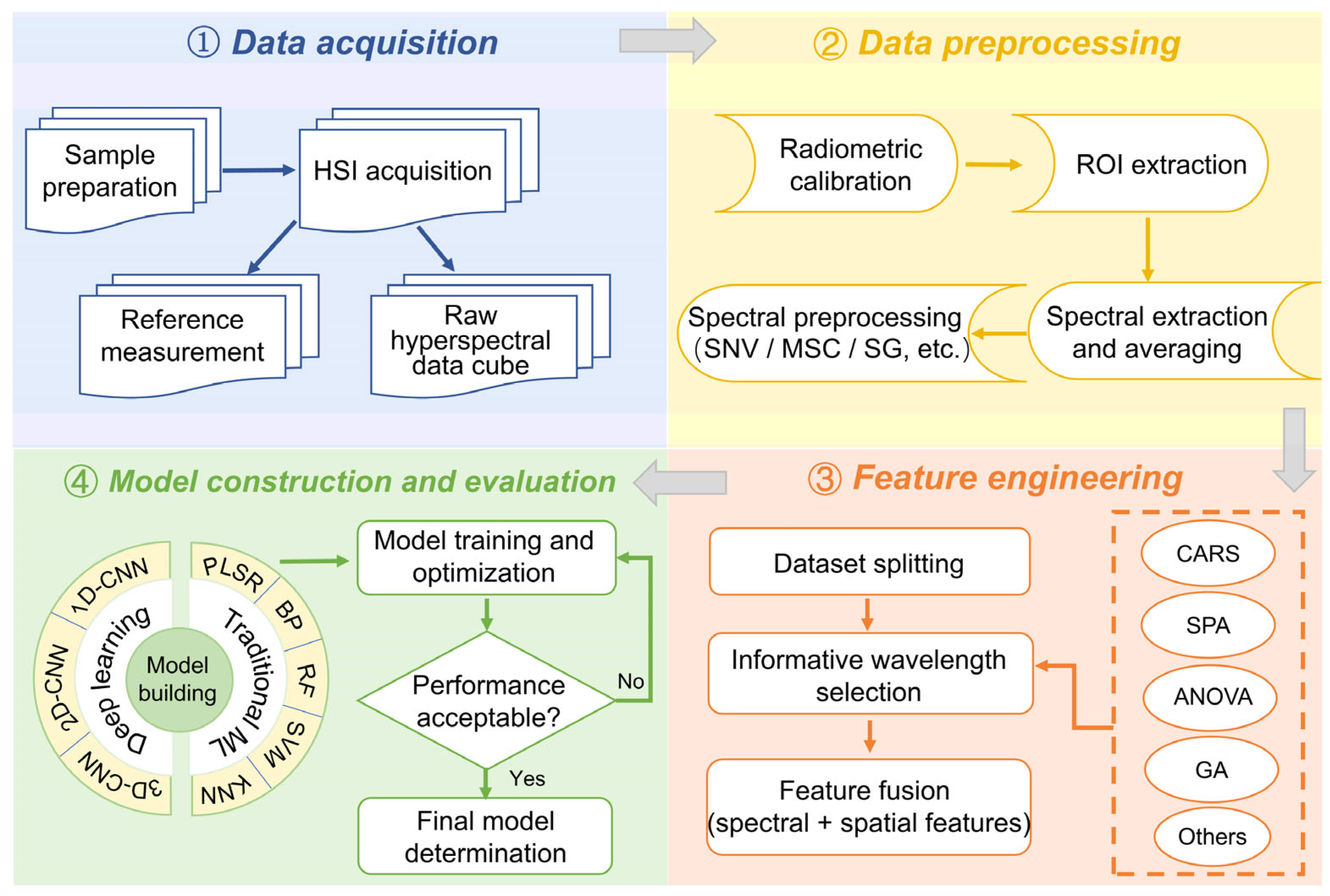
9]. These characteristics give HSI substantial potential for comprehensive, rapid, and nondestructive evaluation of both external and internal fruit quality. The overall technical framework is illustrated in
Figure 1.
In recent years, with the rapid development of hyperspectral imaging technology and data analysis methods, the application of hyperspectral imaging technology in the nondestructive quality evaluation of fruits has received increasing attention and made significant progress [
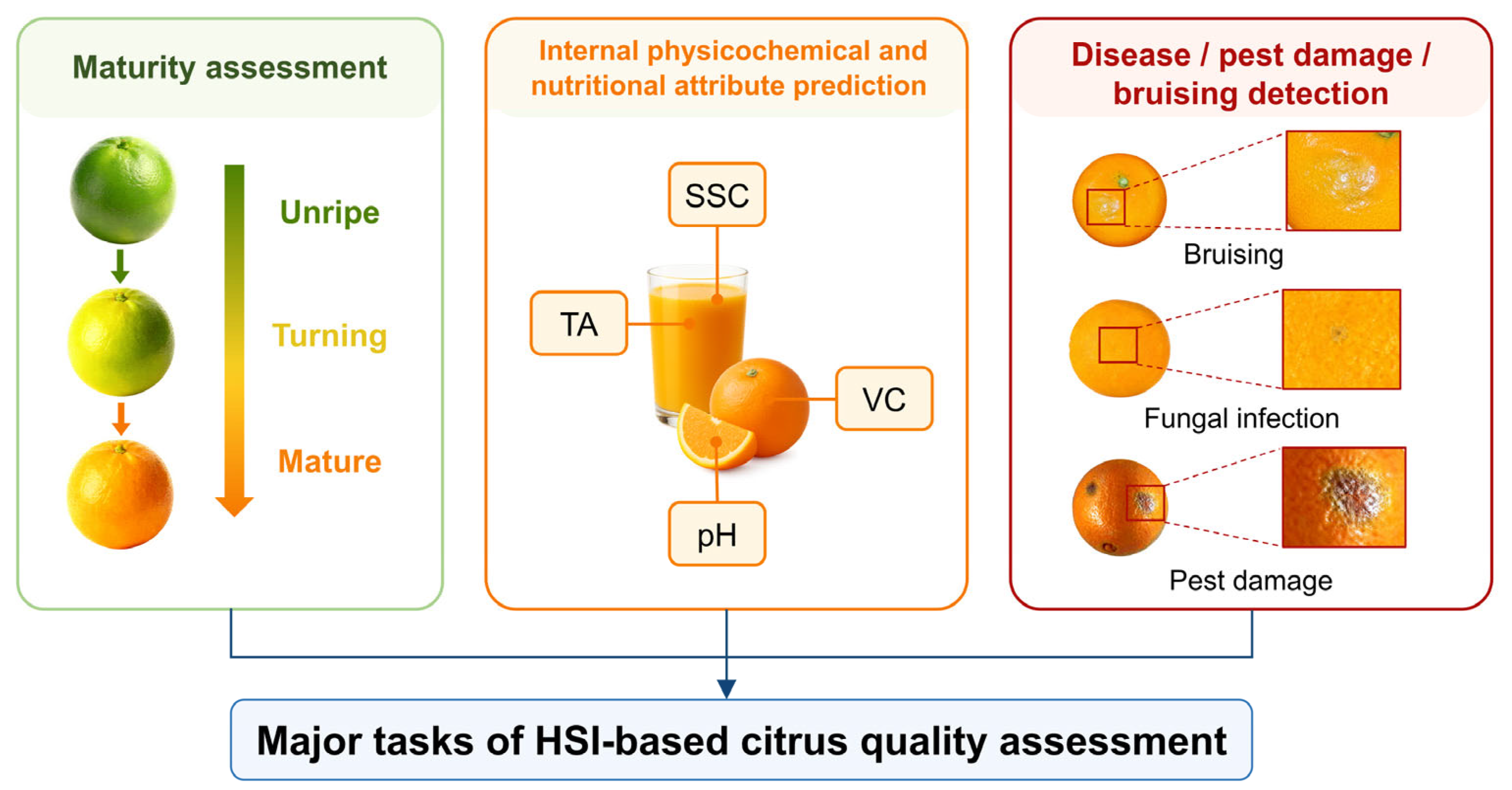
10]. Extensive studies have been carried out in several important application areas, including maturity assessment; disease, pest damage, and bruising detection; and internal physicochemical and nutritional attribute prediction, such as SSC, TA, and VC prediction (
Figure 2) [
11]. Meanwhile, various predictive approaches based on chemometrics, machine learning, and deep learning have been developed [
12].
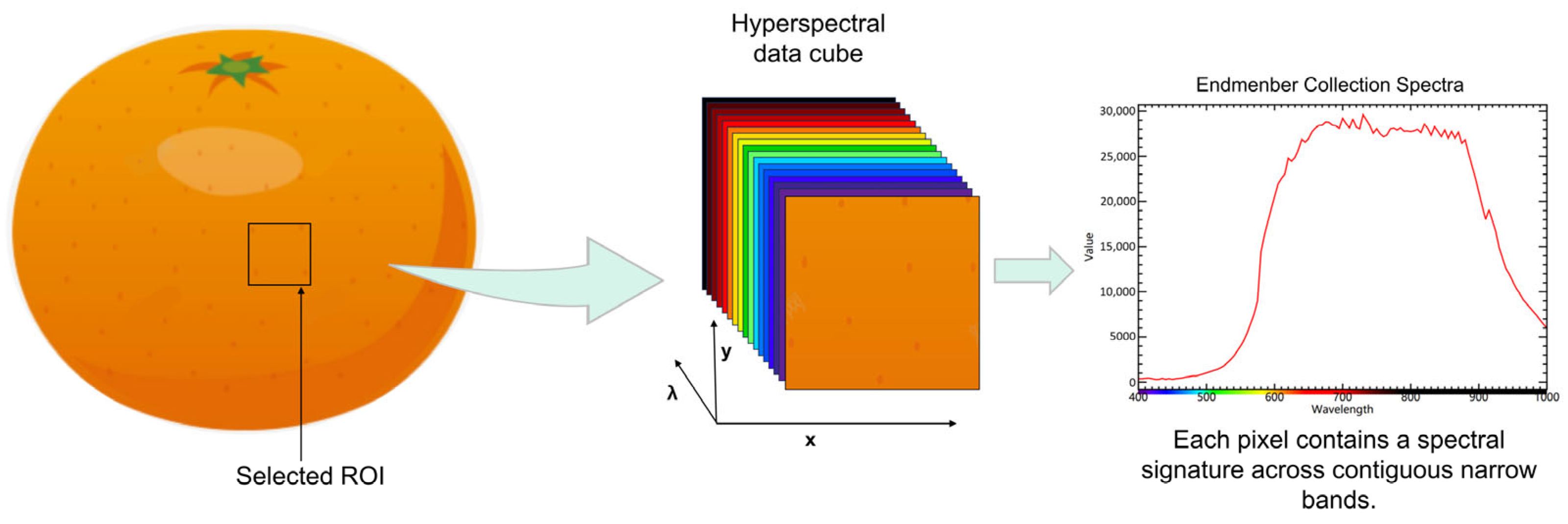
HSI can generate high-dimensional data cubes containing rich spatial and spectral information (
Figure 3). However, the efficient transformation of these large-scale, highly redundant data into accurate quality evaluation results still relies heavily on advanced algorithms. Algorithmic development has played a central role in improving the performance of HSI-based nondestructive citrus quality assessment. This evolution ranges from early chemometric methods and shallow machine learning models to more recent strategies involving deep learning, transfer learning, lightweight modeling, and multimodal fusion. It has consistently served as a key driving force for enhancing detection accuracy, computational efficiency, and cross-scenario adaptability [
13,
14,
15].
Existing reviews have largely summarized the research progress of HSI in fruit and vegetable quality assessment from the perspectives of application scenarios, sensor systems, and general methodologies [
16,
17,
18]. However, limited attention has been paid to how algorithms address specific task-related challenges in nondestructive citrus quality assessment and why distinct evolutionary pathways have emerged across different tasks. In fact, maturity assessment, disease, pest damage and bruising detection, and internal physicochemical and nutritional attribute prediction all fall within the scope of citrus quality evaluation. However, they differ substantially in terms of task objectives, spectral response mechanisms, evaluation metrics, and algorithmic requirements. Maturity assessment places greater emphasis on representing continuous biochemical changes. In contrast, disease, pest damage, and bruising detection focus more on subtle abnormal signals and the suppression of complex interference, whereas internal physicochemical and nutritional attribute prediction relies more heavily on robust quantitative modeling, error control, and cross-batch generalization capability. Therefore, it is necessary to re-examine the research landscape in this field from an algorithmic perspective.
On this basis, this review systematically examines recent advances in data analysis algorithms for nondestructive citrus quality assessment based on HSI, with a particular focus on the following aspects:
- (1)
systematically reviewing representative algorithmic pathways and their applicable scenarios in three core tasks, namely maturity assessment, disease/pest damage/bruising detection, and internal physicochemical and nutritional attribute prediction;
- (2)
synthesizing the key challenges revealed by existing studies and identifying future research directions that warrant particular attention, including domain adaptation, high-dimensional redundancy reduction, model interpretability, few-shot learning, and multi-attribute collaborative modeling.
This review focuses on how hyperspectral imaging data analysis algorithms address different citrus quality evaluation tasks. Such a focused scope enables a more in-depth discussion of key methodological issues, including spectral response characteristics, wavelength selection, feature extraction, model development, and task-specific algorithm requirements. By concentrating on these algorithmic aspects, this review aims to provide a systematic theoretical reference for algorithm design and system optimization in nondestructive citrus quality assessment, while also offering methodological insights for intelligent sorting and quality evaluation of other fruit and vegetable products.
2. Review Methodology
This review was conducted as a structured narrative review with an algorithm-oriented focus. The purpose was not to perform a quantitative meta-analysis, but to synthesize representative studies on hyperspectral imaging (HSI)-based citrus quality assessment and to examine how different data analysis algorithms address task-specific challenges.
The literature search was conducted using major scientific databases, publisher platforms, and academic search engines, including ScienceDirect, MDPI, SpringerLink, IEEE Xplore, and Google Scholar. Scopus and Web of Science were also consulted to verify bibliographic information and identify additional relevant indexed studies. Google Scholar was further used for supplementary searching, including citation tracking and screening of reference lists in relevant review and research articles.
The search terms were selected according to three main aspects: citrus commodities, spectral imaging techniques, and quality assessment tasks. The main keywords included “citrus”, “orange”, “mandarin”, “lemon”, “grapefruit”, “hyperspectral imaging”, “HSI”, “visible and near-infrared”, “Vis-NIR”, “near-infrared spectroscopy”, “NIR”, “nondestructive detection”, “quality assessment”, “maturity”, “ripeness”, “disease detection”, “pest damage”, “bruising”, “defect detection”, “soluble solids content”, “SSC”, “titratable acidity”, “TA”, “pH”, “vitamin C”, “nutritional quality”, “flavor”, “taste”, “machine learning”, “deep learning”, “chemometrics”, “wavelength selection”, “feature extraction”, “transfer learning”, and “multimodal fusion”. These keywords were used individually and in different combinations to identify studies related to both application targets and algorithmic methods.
The literature screening was carried out in three steps. First, titles and abstracts were screened to remove studies that were clearly unrelated to citrus quality assessment, fruit spectral analysis, or nondestructive sensing. Second, full texts were examined to determine whether the studies provided sufficient methodological and performance information. Third, eligible studies were grouped according to their main research tasks, including maturity assessment, disease, pest damage, and bruising detection, and internal physicochemical and nutritional attribute prediction.
To ensure the relevance and quality of the selected literature for this structured narrative review, the following inclusion and exclusion criteria were applied:
Inclusion Criteria:
Studies focusing on citrus fruits or citrus-related samples.
Studies using hyperspectral imaging (HSI) or closely related spectral imaging/spectroscopy techniques, such as visible and near-infrared (Vis-NIR), near-infrared (NIR), or fluorescence HSI, for fruit quality assessment.
Studies reporting data analysis methods, including spectral preprocessing, wavelength selection, feature extraction, chemometric modeling, machine learning, deep learning, transfer learning, or multimodal fusion.
Studies providing clear quality assessment targets and evaluation results.
Studies on non-citrus fruits were considered only when they provided methodological insights directly relevant to HSI data analysis, spectral interpretation, model transferability, or quality attribute prediction.
Exclusion Criteria:
Studies unrelated to fruit quality assessment.
Studies that did not involve spectral, hyperspectral, or closely related optical sensing data.
Studies lacking sufficient methodological details or evaluation results.
Studies focusing only on hardware design without discussing data analysis or quality evaluation.
Duplicate publications or studies with insufficient information for comparison and synthesis.
The selected studies were then analyzed qualitatively. Rather than comparing model performance solely based on numerical accuracy, this review emphasized the relationships among measured quality attributes, imaging modes, spectral characteristics, algorithmic strategies, and practical limitations. This approach was adopted because direct comparison of reported results across studies is often limited by differences in citrus cultivar, sample size, imaging mode, spectral range, preprocessing strategy, modeling method, and validation design.
3. Quality Attributes of Citrus Fruits
Citrus fruit quality is a multidimensional concept that involves appearance, internal physicochemical properties, nutritional composition, and sensory experience. These attributes jointly determine the commercial grading, consumer acceptance, and postharvest value of citrus fruits. Recent studies on citrus quality assessment have also emphasized that quality evaluation should not be limited to a single indicator. Instead, it should comprehensively consider external defects, internal physicochemical properties, maturity-related parameters, nutritional constituents, and eating quality [
17].
3.1. External Quality Attributes
External quality attributes are the most direct factors affecting citrus grading, marketability, and consumer purchasing decisions. They mainly include peel color, fruit size, shape, surface texture, peel defects, disease symptoms, scratches, and other visible injuries [
17]. Among these attributes, peel color is one of the important indicators related to maturity and marketability. Changes in citrus peel color are closely associated with chlorophyll degradation and carotenoid accumulation during fruit maturation. Therefore, external color is widely used in postharvest handling and commercial sorting [
2,
19,
20]. However, in some cultivars, internal maturity may have already been reached before the peel color is fully developed. This means that external color alone cannot fully reflect eating quality or internal maturity [
21]. Therefore, color should be regarded as an important indicator in citrus quality evaluation, but not as a sole indicator [
22].
Peel defects and surface injuries are another important category of external quality attributes. Common external defects in citrus fruits include peel diseases, insect damage, mechanical injuries, scratches, scars, and other surface blemishes or abnormalities. These defects can directly reduce the visual quality and commercial grade of citrus fruits, and may also be associated with postharvest decay or storage losses [
23,
24].
Fruit size and shape are also important external quality attributes. They are commonly used for commercial grading and are closely related to consumer preference, packaging requirements, and market standards [
25,
26]. In addition, peel surface texture and roughness are important visual features in citrus external quality evaluation. Previous studies have shown that image features based on peel texture can be used to distinguish citrus fruits at different maturity stages, and that peel image roughness is also related to structural characteristics such as peel thickness. Therefore, surface texture and peel roughness can, to some extent, reflect fruit maturity status and certain physiological characteristics [
27,
28]. Compared with internal quality attributes, external quality attributes can be more easily evaluated using RGB imaging, multispectral imaging, hyperspectral imaging, or computer vision techniques. However, external attributes cannot fully describe the eating quality of citrus fruits, because fruits with good appearance may still differ significantly in soluble solids content, acidity, water content, internal decay, and flavor characteristics [
17,
21]. Therefore, external quality evaluation should be combined with internal quality evaluation to obtain a more comprehensive assessment of citrus fruit quality.
3.2. Internal Physicochemical Properties
Internal physicochemical properties are key indicators of citrus maturity, eating quality, and processing value. They mainly include soluble solids content (SSC), often expressed as total soluble solids (TSS), titratable acidity (TA), pH, the SSC/TA ratio, firmness, water content, juice content, and internal decay [
29].
SSC is one of the most commonly used internal quality indicators in citrus fruits. It reflects the total concentration of soluble substances in fruit juice, including sugars, organic acids, soluble pectin, amino acids, and minerals. In citrus maturity assessment, SSC is usually evaluated together with TA, juice content, and maturity index [
30]. The SSC/TA ratio is particularly important because it reflects the balance between sweetness and acidity. It is therefore commonly used as a maturity- and flavor-related indicator in citrus production and postharvest evaluation [
2,
30].
TA and pH are acidity-related indicators. During fruit maturation and postharvest storage, changes in acidity can significantly affect taste balance and consumer acceptance. pH reflects the acidic environment of citrus juice, whereas TA provides a more direct estimation of the total acid content in the fruit. In studies on maturity evaluation, acidity-related parameters are usually analyzed together with SSC and VC to evaluate the overall juice quality of citrus cultivars [
30].
Fruit firmness, water content, and juice quality are also important internal quality attributes. Fruit firmness is related to texture, mechanical strength, and postharvest storage performance. Water and juice content affect the juiciness and consumer acceptance of citrus fruits, especially for fresh consumption. Lado et al. [
2] pointed out that commercial maturity indicators of citrus fruits are usually based on peel color, juice percentage, and the SSC/TA ratio, but the importance of each indicator may vary depending on cultivar and market requirements. Internal decay is another important quality issue. Unlike surface defects, internal decay cannot always be identified by visual inspection, but it directly affects fruit safety, acceptability, and market value. For this reason, nondestructive detection techniques, such as visible/near-infrared spectroscopy, hyperspectral imaging, and multispectral imaging, have been increasingly explored for evaluating the internal quality of citrus fruits [
17].
3.3. Nutritional and Sensory-Related Attributes
Nutritional and sensory-related attributes further extend the scope of citrus quality evaluation from basic physicochemical measurements to health value and consumer perception. Typical nutritional or functional compounds in citrus fruits include VC, phenolic compounds, flavonoids, carotenoids, limonoids, terpenes, and other bioactive compounds. Citrus fruits are widely recognized as important sources of health-related compounds, and their nutritional value is closely associated with antioxidants and bioactive metabolites [
2]. Saini et al. [
31] reviewed the composition and health benefits of citrus carotenoids, flavonoids, limonoids, and terpenes, showing that citrus fruits contain various bioactive compounds with nutritional and functional significance. Other studies have also investigated VC, total phenolics, flavonoids, organic acids, sugars, and antioxidant activity in citrus fruits, further confirming the importance of these compounds in the evaluation of citrus nutritional quality [
32].
Sensory attributes include sweetness, acidity, freshness, aroma, bitterness, and overall flavor preference. Although sweetness and acidity are sensory attributes perceived by consumers, they are chemically related to sugars and organic acids. For example, recent studies on citrus fruits have shown that sweetness and acidity during fruit maturation and storage are mainly determined by sugars and organic acids, especially sucrose and citric acid [
33]. Similarly, some studies have reported that the taste of citrus fruits is mainly affected by the contents of sugars and acids and their relative ratio [
34,
35]. Therefore, sugars and organic acids can serve as important links between internal physicochemical attributes and sensory quality. However, these indicators are indirect proxies and cannot fully represent sensory perception or consumer preference.
Aroma is another important sensory attribute of citrus fruits. Citrus aroma is mainly determined by volatile compounds, and changes in volatile components can affect fruit flavor during maturation and storage. Studies on citrus flavor have shown that soluble solids, acidity, and aroma volatiles jointly influence sensory quality and consumer preference [
36,
37]. Therefore, sensory quality should be understood as the result of the combined effects of sugars, organic acids, volatile compounds, cultivar characteristics, maturity stage, and postharvest storage conditions.
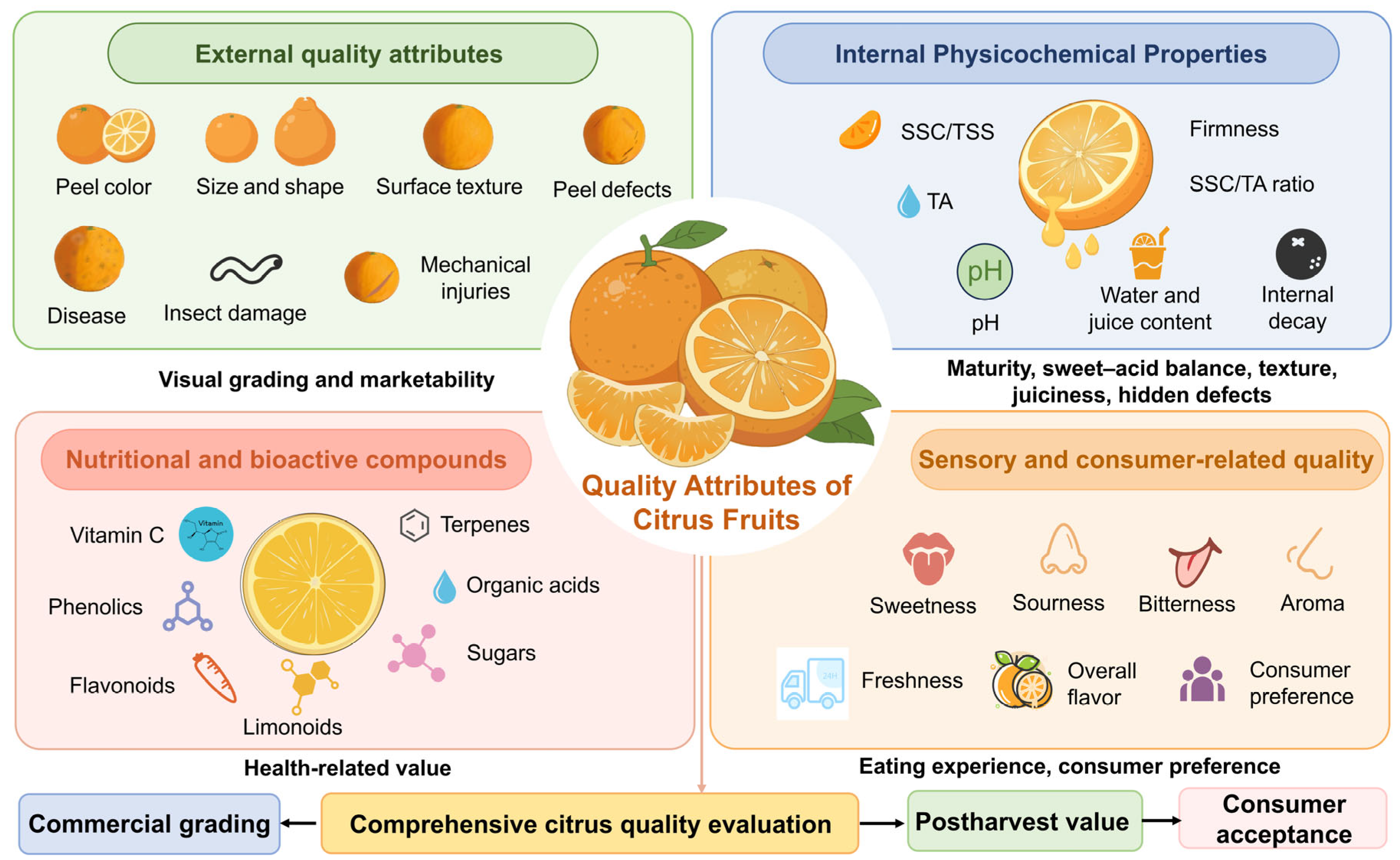
In summary, the quality attributes of citrus fruits should be regarded as an integrated system. External attributes determine visual quality and grading potential. Internal physicochemical attributes reflect maturity, sweet–acid balance, texture, juiciness, and hidden defects. Nutritional and sensory-related attributes represent health value and the consumer eating experience.
Although citrus quality includes a broad range of external, internal, nutritional, and sensory-related attributes, current HSI-based citrus studies are still mainly concentrated on maturity, disease/damage detection, and several measurable internal or nutritional indicators such as SSC, pH, TA, and VC. Therefore, this review discusses broader quality attributes as the conceptual background, while focusing the algorithmic review on the quality attributes for which HSI-related studies are currently available.
Figure 4 summarizes the major external, internal, nutritional, and sensory quality attributes that collectively determine overall citrus fruit quality.
4. Overview of HSI
4.1. Principles and Imaging Modes
The basis of nondestructive detection using hyperspectral imaging lies in the interaction between matter and electromagnetic radiation. When light irradiates a fruit sample, phenomena such as reflection, absorption, transmission, and scattering occur, and the energy variations across different wavelengths jointly determine the spectral response characteristics of the sample [
38,
39]. In fruits such as citrus, internal chemical constituents, including water, sugars, organic acids, pigments, and vitamins, as well as physical characteristics such as peel thickness and tissue microstructure, can influence the propagation and absorption of light within the tissue, thereby generating distinctive spectral features at specific wavelengths. Unlike conventional RGB imaging, which mainly reflects surface color and texture, hyperspectral imaging can simultaneously acquire the spatial and spectral information of a sample over a continuous range of narrow wavebands and record the target’s response characteristics at different wavelengths in the form of a data cube [
18,
40].
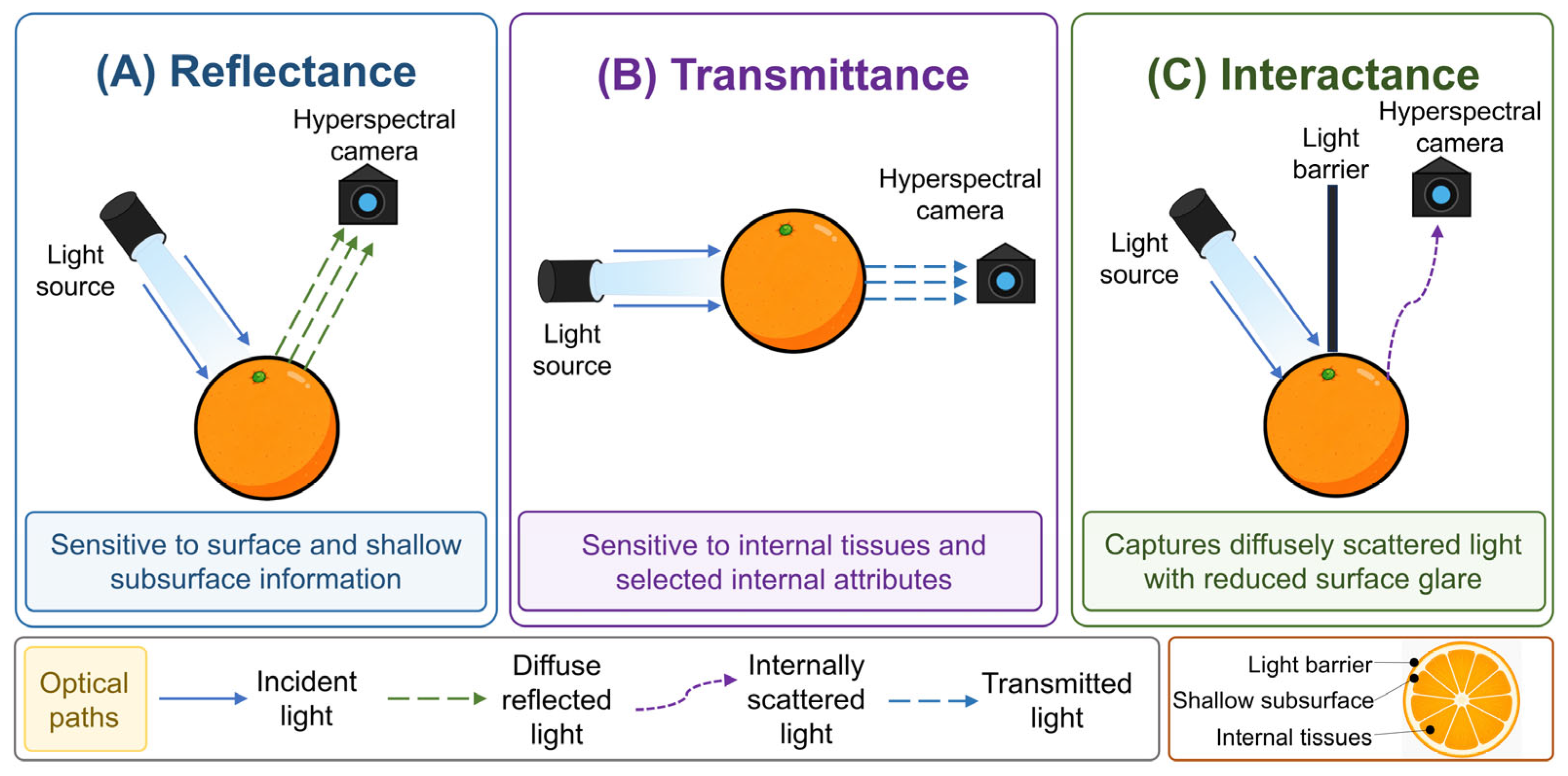
From the perspective of image acquisition geometry, the commonly used hyperspectral imaging modes for fruit quality assessment include reflectance, transmittance, and interactance modes [
41] (as shown in
Figure 5). The reflectance mode mainly records the response of the sample surface and subsurface tissues to incident light, making it more suitable for acquiring information on surface color, peel defects, and certain shallow lesions. In contrast, the transmittance mode focuses more on the attenuation characteristics of light after passing through the sample, and is therefore often more sensitive to internal tissue conditions, decay, and selected internal quality attributes. The interactance mode lies between these two approaches, retaining relatively rich surface information while also providing limited penetration capability. Different imaging modes vary in their sensitive regions and signal sources for target information; therefore, they often exhibit different levels of suitability for tasks such as fruit maturity assessment, disease, pest damage, and bruising detection; and internal physicochemical and nutritional attribute prediction [
7,
42,
43,
44].
4.2. Data Characteristics
In terms of data structure, hyperspectral imaging simultaneously integrates spatial and spectral information. A typical imaging spectrometer outputs a three-dimensional data cube, which can be regarded either as a sequence of numerous narrow-band images stacked by wavelength or as a collection of continuous reflectance or radiance spectra corresponding to individual pixels. As a result, the same dataset contains spatial texture, geometric structure, and material-specific spectral response information at the same time. Compared with multispectral imaging, hyperspectral imaging offers higher spectral resolution and denser continuous waveband sampling, enabling it to capture subtle spectral differences arising from mechanisms such as pigment absorption, moisture variation, and chemical bond vibrations. This provides a richer information basis for tasks such as classification and constituent quantification [
45,
46,
47].
However, the richness of information does not imply a simpler modeling process. On the contrary, the structural characteristics of hyperspectral data pose several complex algorithmic challenges in practical analysis:
The large number of continuous wavebands and the high correlation among them can easily cause redundancy and collinearity, which can disperse informative features and consequently lead to an ill-conditioned feature space, model instability, and increased sensitivity to noise during training [
45,
46,
47].
Hyperspectral studies in agricultural settings often face the classic high-dimensional small-sample-size problem. Sample collection is constrained by season, cultivar, production region, and experimental cost, while label acquisition frequently depends on destructive physicochemical measurements or expert-based manual assessment. Consequently, the sample size is often limited, whereas the feature dimensionality is extremely high, which can readily lead to the curse of dimensionality, overfitting, and reduced generalization ability under varying cultivars, regions, seasons, and acquisition conditions [
45,
46,
47].
Noise and interference in hyperspectral data arise from multiple sources. In addition to sensor noise, dark current, and stripe noise, hyperspectral measurements are often affected by variations in illumination, scattering effects, surface specular reflection, geometric pose changes, and background contamination. These factors can cause baseline drift, distortion of local absorption peaks, and spurious spatial textures, thereby weakening the subtle signals associated with lesions, bruising, or internal quality attributes [
45,
46,
47].
The acquisition, calibration, feature extraction, and model inference of full hyperspectral data cubes all involve substantial computational and storage costs, which impose significant constraints on real-time detection and edge deployment.
These characteristics indicate that hyperspectral modeling is not merely a matter of directly feeding full-spectrum data into a model; rather, it requires preprocessing and compression steps to improve robustness, interpretability, and deployability before the data are used in classification or regression models. Therefore, preprocessing, dimensionality reduction, and feature selection have become critical steps in determining the performance of subsequent models. In existing studies, preprocessing commonly includes reflectance or radiometric calibration, dark-current and white-reference correction, removal of noisy bands, smoothing and denoising, scatter correction, baseline correction, normalization or standardization, derivative transformation, and detrending [
48,
49]. The purpose of these operations is to reduce non-target interference caused by factors such as surface roughness, texture heterogeneity, moisture gradients, and uneven illumination [
50].
In addition, a specific and important source of non-target interference in citrus HSI is curvature-induced reflectance variation from the fruit surface. Citrus fruits generally have a nearly spherical or ellipsoidal geometry, which causes spatial differences in illumination-viewing geometry, effective optical path, and reflected intensity across the fruit surface [
41,
51]. As a result, different surface regions may show shadowing, specular highlights, or reduced signal intensity even when their chemical composition is similar. These effects can introduce artificial spectral variations that are unrelated to fruit quality attributes and may further influence wavelength selection, model stability, and spectroscopic interpretability. Because HSI data consist of wavelength-wise images, curvature-related effects should be corrected or mitigated at the level of individual band images or pixel spectra, rather than only at the RGB image level. Possible strategies include fruit region segmentation, contour or surface-geometry estimation, exclusion or down-weighting of severely distorted edge pixels, wavelength-wise reflectance normalization, central region-of-interest (ROI) extraction, ratio-image construction, and auxiliary scatter correction [
41,
51,
52]. When depth information or multi-view imaging is available, local surface normals can also be estimated to compensate for angle-dependent reflectance more explicitly [
53]. Such correction is especially important for reflectance-mode HSI, where the measured signal is jointly affected by surface geometry, illumination conditions, tissue scattering, and chemical composition.
At the feature level, the primary objective is to reduce redundancy, alleviate collinearity, and decrease model complexity and training difficulty through methods such as dimensionality reduction and informative wavelength selection. At the same time, these strategies help concentrate discriminative information into a limited number of wavebands or low-dimensional representations, thereby improving cross-scenario generalization capability and overall model robustness [
54]. Representative methods are shown in
Table 1.
5. Advances in Algorithms for Maturity Assessment
Maturity is a key factor determining the postharvest quality, shelf life, and market value of citrus fruit. Its progression is accompanied by biochemical processes such as chlorophyll degradation, sugar accumulation, and changes in acidity, which in turn give rise to quantifiable differences in optical responses across the visible and near-infrared spectral regions [
17,
68,
69,
70]. Hyperspectral imaging can capture these subtle and continuous spectral variations. By identifying feature wavelengths or spectral indices closely associated with maturity and extracting informative spectral–spatial features, algorithms can establish predictive relationships between spectral information and maturity-related indicators, thereby enabling the nondestructive assessment of citrus fruit maturity.
5.1. Classic Machine Learning
In studies on citrus maturity assessment, classical chemometric approaches and shallow machine learning methods continue to serve as important baseline modeling frameworks. Their basic workflow generally includes spectral preprocessing, informative wavelength selection or dimensionality reduction, followed by maturity discrimination based on classification or regression models [
17,
50,
71]. Compared with deep learning-based approaches, these methods generally require relatively smaller sample sizes and offer better interpretability and computational efficiency under controlled experimental conditions [
72,
73]. Therefore, these methods should not be simply regarded as early approaches that have already been superseded; rather, they remain representative and foundational strategies in current maturity assessment research.
In terms of task types, classical methods for maturity assessment primarily address two categories of problems: classification or grading based on maturity-stage labels, and regression modeling based on continuous physicochemical indicators. The former focuses more on the separability of different maturity stages, typically relying on characteristics such as color, texture, and spectral indices for classification; the latter places greater emphasis on the continuous mapping relationship between maturity-related variables and spectral responses, with common metrics including SSC, TA, and the SSC/TA ratio.
In classification tasks, transmittance or diffuse transmittance hyperspectral imaging is often used to construct maturity-related spectral indices, which are then combined with classifiers such as linear discriminant analysis (LDA), k-nearest neighbors (kNN), or support vector machine (SVM) to identify maturity stages. Related studies have shown that kNN models based on multispectral indices can achieve relatively high accuracy in maturity grading; however, their performance is strongly dependent on imaging conditions and transmittance configurations. When the research scope is extended to samples from multiple cultivars and maturity stages, class boundaries often exhibit highly nonlinear characteristics, and nonlinear discriminative models such as SVM generally demonstrate greater robustness than kNN [
74]. Existing studies based on multi-cultivar navel orange datasets have also shown that SVM achieves markedly better classification performance than kNN; however, errors in stage labeling and inter-cultivar variability may still introduce a risk of overfitting [
75]. These findings indicate that classical classification methods still retain considerable practical value in maturity grading; nevertheless, the stability of their performance depends largely on the consistency of sample distribution and the controllability of imaging conditions.
In regression tasks, the modeling paradigm that combines spectral preprocessing, informative wavelength selection, and partial least squares regression (PLSR)/support vector regression (SVR) remains one of the most commonly adopted and interpretable approaches. In an early study, Teerachaichayut et al. [
76] employed PLSR to nondestructively predict the maturity index SSC/TA ratio of limes and further generated spatial distribution maps of maturity, demonstrating that classical regression models can not only estimate continuous variables but also be effectively integrated with the visualization capability of hyperspectral imaging. Aredo et al. [
77] likewise used PLSR to model multiple quality attributes. Their results showed that the model was more sensitive to external color-related indices, whereas its predictive performance for internal attributes such as SSC and TA was relatively limited. This suggests that shorter wavelengths are more suitable for characterizing surface maturity features, whereas internal ripening processes, such as changes in sugars and organic acids, generally require stronger support from near-infrared information. Therefore, the performance of classical regression methods depends not only on the model itself, but also on the imaging mode and the range of physically observable information.
However, as research scenarios have gradually expanded from single-cultivar and controlled environments to multi-cultivar, unstructured, and cross-domain conditions, the limitations of classical methods have become increasingly evident. Related studies have indicated that although PLSR can achieve high accuracy in cross-validation within a single cultivar, its generalization performance declines markedly across different cultivars. This suggests that models built on manual feature engineering and shallow mapping relationships, while offering advantages in interpretability and computational efficiency under constrained conditions, exhibit clear limitations in feature representation when faced with complex biochemical variability and highly nonlinear relationships [
78]. Overall, classical machine learning methods are better suited to serving as strong baselines and lightweight solutions for maturity assessment under controlled conditions. Their principal limitation lies not in insufficient within-domain accuracy but in their restricted robustness and generalization capability across cultivars, orchards, and complex environments.
5.2. Deep Learning
To overcome the limitations of classical machine learning in complex nonlinear modeling and high-dimensional feature representation, deep learning methods have gradually been introduced into citrus maturity assessment. Compared with conventional methods that rely on handcrafted feature engineering, deep learning models possess stronger capabilities for automatic feature extraction and nonlinear modeling. As a result, they can more effectively uncover the complex spectral patterns associated with pigment variation, sugar–acid transformation, and tissue structural changes during ripening, while avoiding the subjective bias introduced by manual informative wavelength selection and feature construction [
79].
Existing studies have shown that deep learning exhibits clear advantages in both maturity classification and regression tasks. Sandra et al. [
80] developed an artificial neural network (ANN) model based on optimized activation functions and output layer design, and achieved high performance in maturity classification on a specific dataset, indicating that neural networks have considerable potential for addressing nonlinear discrimination problems in citrus maturity assessment. Compared with classical methods such as PLSR and SVM, deep learning-based models rely less on manual wavelength selection and empirical feature construction. This is an important advantage because maturity-related spectral responses are often distributed across multiple wavelengths and may have nonlinear relationships with pigment degradation, sugar accumulation, acidity changes, and tissue structural variation. In traditional modeling frameworks, predefined spectral indices or manually selected informative wavelengths may overlook weak but useful spectral information embedded in the original HSI data cube. Therefore, the introduction of deep learning can help overcome, to some extent, the limitations of manually extracted features in representing complex spectral patterns.
However, the principal challenge of applying deep learning in agricultural hyperspectral scenarios lies not solely in network architecture design itself, but also in the mismatch between sample size and labeling cost. Maturity labels often rely on physicochemical measurements or long-term monitoring, while agricultural samples are constrained by cultivar, season, orchard conditions, and postharvest handling, resulting in a limited number of high-quality samples available for training deep models. Under such circumstances, although deep models possess stronger fitting capability, they are also more prone to training instability, overfitting, and fluctuations in test performance. The deep convolutional neural network (DCNN) regression model proposed by Al Riza et al. [
81] clearly illustrates this contradiction. With only 120 samples available, although the study improved model performance through multichannel stacking and optimizer refinement, a substantial discrepancy remained between the training and testing results. This discrepancy may be related to the limited sample size and the validity of the train/test split. A small sample size can result in insufficiently broad feature distributions and make the dataset more susceptible to the influence of outliers, thereby making complex deep learning models more prone to overfitting. This suggests that, while deep learning can enhance nonlinear modeling capacity in maturity assessment, such advantages cannot always be realized reliably under small-sample conditions without robust validation strategies.
In recent years, related studies have begun to shift from simply increasing model complexity toward strategies that integrate physical priors with input optimization and lightweight modeling. When Wang et al. [
70] conducted in-orchard, in situ maturity assessment of ‘Shiranui’ citrus with a distinctive hollow internal structure, they did not directly rely on a highly complex convolutional neural network (CNN) for end-to-end learning. Instead, they first identified an x-axis-based region of interest (ROI) extraction strategy through comparative experiments to reduce spectral noise induced by the internal cavity structure. On this basis, they further compared deep models with lightweight neural networks combined with informative wavelength selection. The results showed that a backpropagation (BP) neural network constructed using a small number of key wavelengths selected by SPA not only achieved excellent predictive accuracy but also outperformed CNNs in computational efficiency. This finding indicates that, in maturity assessment, deep learning does not necessarily achieve superior performance by simply increasing network depth or architectural complexity. Rather, approaches that integrate physical prior constraints, input optimization, and lightweight modeling are often better aligned with the practical demands for stability and deployment efficiency in agricultural scenarios. It should also be noted that end-to-end CNN models may improve predictive accuracy by automatically learning latent spectral–spatial features, but they also increase the black-box nature of the model. This can obscure wavelength assignment and band-level interpretation, which are essential for HSI data analysis, especially in Vis–NIR and NIR-HSI applications where spectral responses are closely related to biochemical changes in fruit tissues. In contrast, wavelength selection combined with lightweight models can provide clearer links between selected bands and physicochemical attributes, although it may sacrifice part of the representation capability of deep networks. Therefore, CNN-based maturity assessment should not be evaluated only by predictive accuracy; spectroscopic interpretability, wavelength attribution, and the physical meaning of learned spectral–spatial features should also be considered [
82].
Overall, deep learning has not replaced classical methods; rather, it has further exposed the core challenges in maturity assessment. When samples are limited, fruit structures are complex, and environmental variability is substantial, improvements in model performance cannot rely solely on increasing network complexity. Instead, they should shift toward modeling strategies that place greater emphasis on data efficiency, cross-scenario robustness, and physical observability.
5.3. Domain Adaptation
In citrus maturity assessment, declines in model performance often do not stem from model underfitting on the training set, but rather from data distribution shifts encountered across cultivars, orchards, production batches, and deployment environments. The spectral response of fruit is influenced not only by maturity itself but also by the combined effects of cultivar-specific genetic traits, rootstock type, microclimatic conditions, cultivation management, and postharvest handling practices. Therefore, even a high-accuracy model developed under laboratory conditions may rapidly lose effectiveness once transferred to a new orchard or a different production batch because of domain shift. Against this background, transfer learning and cross-domain adaptation methods have been introduced into maturity assessment, with the aim not merely of improving predictive accuracy on a local dataset, but of enhancing model transferability and robustness in real-world application environments.
Existing studies suggest that small-sample recalibration has become one of the representative technical pathways for cross-domain adaptation in maturity assessment. The “orchard-adaptive recalibration” strategy proposed by Pires et al. [
78] demonstrated that prediction errors can be significantly reduced by correcting the bias of the original model using only a limited number of target-domain samples, without requiring complete model retraining. In agricultural hyperspectral applications, this strategy is of considerable practical value, as it reduces reliance on large-scale annotated datasets from multiple domains and provides a realistic and feasible technical transition for moving models from laboratory settings to field deployment.
However, the difficulty of cross-domain adaptation lies not only in distribution shift in a statistical sense, but also in deeper constraints related to the physical observability of information. In a cross-orchard study, Serna-Escolano et al. [
83] found that the same PLSR model exhibited clear performance degradation after transfer. When only about 10% of samples from the target orchard were incorporated for recalibration, the predictive performance for SSC returned to an acceptable level, indicating that recalibration strategies can be effective for certain maturity-related indicators. However, for TA, the model remained almost entirely ineffective under cross-orchard conditions. The authors further pointed out that the root cause was not merely the algorithm’s insufficient ability to learn inter-domain differences, but rather the limited physical observability imposed by the relatively thick lemon peel structure, including the flavedo and albedo layers. This structure restricts the effective penetration of near-infrared light into the pulp, causing the acquired spectra to mainly reflect information from the outer tissues and thereby substantially increasing the difficulty of achieving stable prediction of internal attributes such as acidity.
It is worth noting that, in the two studies discussed above, spectral data from different orchards were acquired using the same spectroscopic system, but external validation across orchards showed lower predictive performance than internal validation. These findings indicate that, even when the same instrument is used, cross-orchard model transfer can still be affected by differences in orchard conditions, sample population distribution, ripening stage, and physicochemical attribute distribution. When different spectrometers or acquisition systems are used, instrument-to-instrument differences may introduce additional spectral bias, especially in the near-infrared region, where overtone and combination bands are sensitive to instrumental response, wavelength calibration, and measurement conditions [
84]. Therefore, cross-domain maturity assessment studies should clearly report whether the same spectrometer, illumination geometry, calibration procedure, and acquisition protocol were used across different orchards, batches, or years. When different instruments are involved, inter-instrument calibration, measurement standardization, and calibration transfer should be considered together with algorithm-level domain adaptation [
85].
This result indicates that transfer learning can, to some extent, alleviate performance degradation induced by distribution shifts, but it cannot overcome the inherent physical observability limits of single-modality spectral data. When the input data themselves do not carry sufficient information, relying solely on algorithm-level domain adaptation is unlikely to further improve predictive performance. Therefore, cross-domain adaptation in maturity assessment should not be understood merely as a problem of model fine-tuning, but rather as a comprehensive modeling challenge arising from the combined effects of data distribution shift and limited physical observability.
5.4. Multimodal Data Fusion
As single-modality hyperspectral sensing in maturity assessment gradually approaches its information acquisition limits, multimodal data fusion has emerged as an important direction for enhancing the characterization of fruit maturity. Compared with single-modality reflectance spectroscopy, multimodal approaches place greater emphasis on the complementarity among different physical measurements, thereby offering the potential to alleviate the information limitations of a single modality in representing complex ripening processes.
Existing studies have shown that the fusion of reflectance and fluorescence spectra offers clear advantages for maturity assessment. Al Riza et al. [
86] found that, after data-level fusion of near-infrared reflectance spectra and fluorescence spectra, the fused model achieved significantly higher predictive accuracy than either single-modality model alone. Mechanistically, reflectance spectra mainly characterize fruit water content, surface pigments, and tissue optical properties, whereas fluorescence spectra are more sensitive to chlorophyll fluorescence attenuation and related metabolic activity. Because these two types of signals do not completely overlap in their response mechanisms during ripening, their fusion can enhance the model’s overall ability to capture complex biochemical changes. This finding indicates that, in maturity assessment, the simultaneous incorporation of multi-channel information from multiple physical mechanisms, together with an appropriate fusion strategy for model construction, can help overcome the limitations of a single modality in detecting subtle changes and characterizing complex states. In addition, Kalprajsinh et al. [
87] found that image-sensor fusion can improve model performance compared with single-modal inputs. However, such multimodal paradigms also entail higher data acquisition costs, more complex synchronization and calibration requirements, and stricter constraints on real-time online deployment.
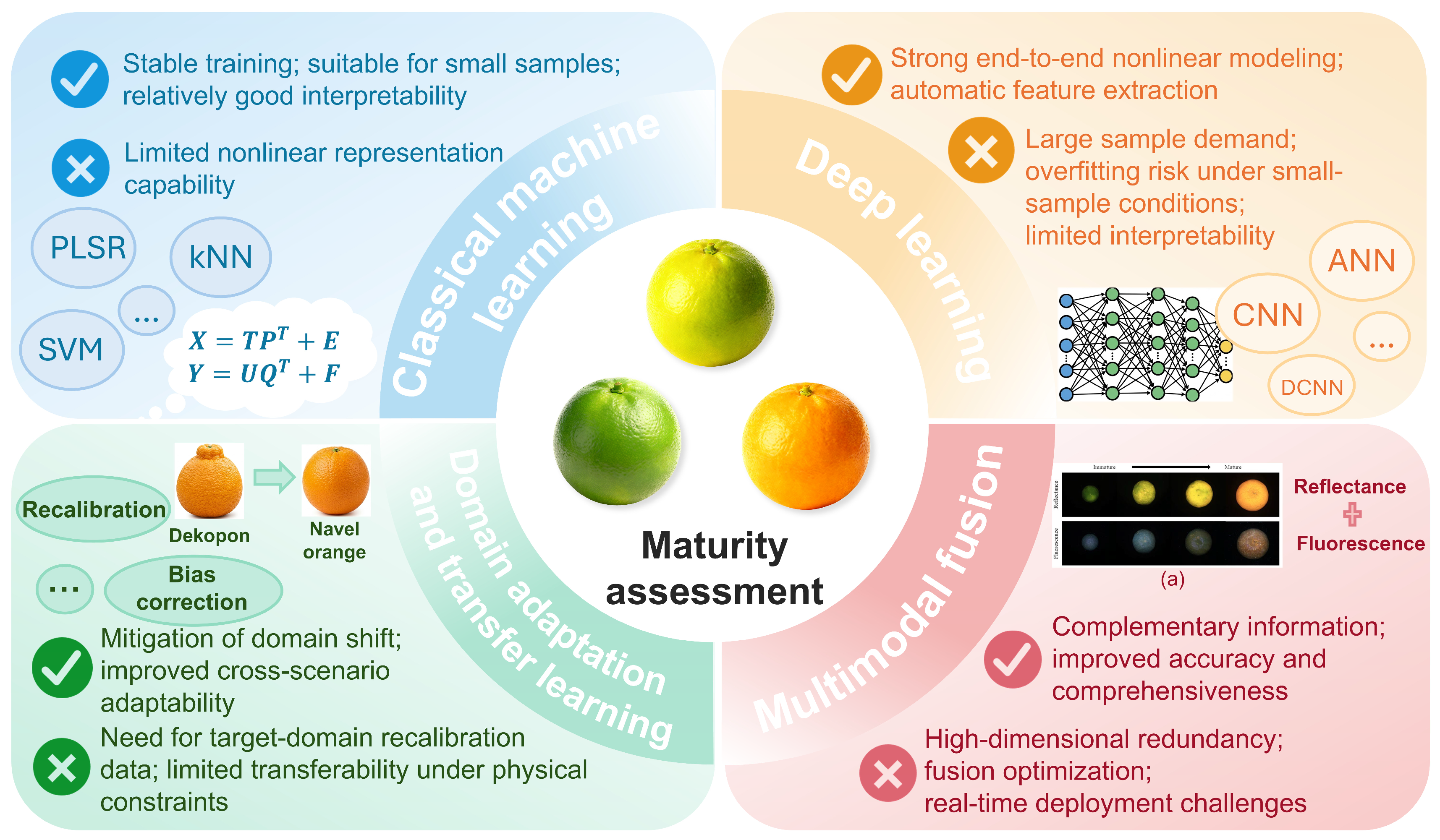
Overall, citrus maturity assessment has followed a clear methodological evolution from classical classification and regression models to deep learning, physically guided input optimization, and multimodal fusion. Classical models remain valuable as interpretable and lightweight baselines, whereas deep learning and multimodal approaches provide stronger nonlinear representation and information fusion capabilities. However, limited sample size, peel and tissue interference, cross-orchard variability, and deployment cost remain major constraints. These evolutionary pathways and their associated challenges are summarized in
Figure 6.
6. Recent Algorithmic Advances in Disease, Pest Damage, and Bruising Detection
Diseases, pest damage, and mechanical injury are important factors affecting the postharvest quality, storage and transport stability, and commercial value of citrus fruit. Their occurrence is usually accompanied by a cascade of complex alterations, including pigment variation, tissue structural disruption, moisture migration, and localized physiological and metabolic abnormalities. Plant disease development is a dynamic process that triggers a range of physiological and biochemical responses, which in turn alter the spectral characteristics of the plant and provide the theoretical basis for nondestructive detection [
88].
6.1. Visible Disease and Surface Defect Detection
During postharvest grading and disease screening, citrus fruits often exhibit various visually observable surface abnormalities, such as canker lesions, black spot symptoms, wind damage, insect scars, and peel necrosis. Compared with latent defects, these abnormalities already show discernible differences in color, texture, or local morphology. Therefore, the primary challenge for hyperspectral detection is to achieve stable and interpretable identification and grading under conditions such as specular reflection, stem-end artifacts, inter-class symptom similarity, and class imbalance.
In early studies, the detection of visible diseases and surface defects generally followed a conventional pipeline comprising informative wavelength selection, image enhancement/segmentation, and shallow machine learning classification. Li et al. [
89] utilized PCA in conjunction with band ratios to establish a thresholding model, achieving the preliminary extraction of visible defect regions. This indicates that for diseases or defects with relatively pronounced surface symptoms, PCA-driven spatial segmentation still retains strong practical value.
As visible disease recognition has evolved from binary classification to fine-grained classification, increasing attention has been paid to informative wavelength selection and machine learning-based modeling. Xie et al. [
90] selected informative wavelengths using PLS regression coefficients and subsequently combined them with a kNN model, achieving high accuracy in distinguishing diseased fruit from healthy fruit; however, the recognition performance for samples at the early stages of symptom development still declined markedly. This finding indicates that even in tasks involving visually observable lesions, when symptoms are still at an early stage of formation or inter-class differences are subtle, relying solely on a limited number of handcrafted spectral features and shallow classifiers remains insufficient for robust differentiation.
To address this issue, subsequent studies have gradually shifted toward hybrid frameworks that combine spectral dimensionality reduction, deep feature extraction, and lightweight decision-making. Frederick et al. [
91] proposed a strategy that uses a small number of highly informative wavebands for shallow CNN-based feature extraction, followed by final discrimination using a conventional classifier. Compared with VGG-16 trained on the same selected bands, this hybrid framework achieved better performance, suggesting that under conditions of small sample sizes and highly correlated hyperspectral data, lightweight feature learning is often more advantageous than directly introducing highly complex deep networks. Furthermore, Yadav et al. [
92] employed a customized VGG-16 network to extract deep features from five PCA-derived bands and combined it with a softmax classifier to achieve high-accuracy recognition, thereby confirming the feasibility of deep feature learning under extremely limited-band conditions.
6.2. Invisible Damage and Bruising Detection
6.2.1. Early-Stage Rot Detection
In the detection of early decay, Li et al. [
58] extracted informative wavelengths and principal component images using PCA, and achieved region segmentation by combining these features with an improved watershed algorithm, thereby enabling stable identification of early decay using only a very limited number of wavebands. However, this method showed limited capability in systematically distinguishing complex interferences, such as the navel, stem-end, and peel scars. This study indicates that, for tasks involving visually asymptomatic latent decay, principal component transformation can not only compress high-dimensional redundancy but also enhance the contrast between healthy and diseased tissues at the image level, thereby providing a clearer input basis for subsequent segmentation and classification.
Tian et al. [
93] addressed rot detection in navel oranges under stem-end interference by adopting a visible–near-infrared (Vis–NIR) transmittance mode in combination with PCA, and achieved a recognition rate of 94% using an improved watershed segmentation algorithm (IWSA). However, this approach suffered from a complex transmittance optical configuration, the risk of thermal damage induced by high-intensity illumination, and the substantial computational overhead associated with performing full-spectrum PCA on high-dimensional data cubes.
In a subsequent study [
63], to better capture abnormalities related to moisture status and carbohydrate metabolism, the authors introduced long-wave near-infrared (LW–NIR) reflectance imaging and replaced global PCA with a dual-band ratio method, thereby increasing the final recognition accuracy to over 97%. This advancement not only compressed massive high-dimensional spectral data into just two informative wavebands but also mitigated edge-shadowing artifacts and illumination inconsistencies caused by the spherical curvature of citrus fruit through a physically grounded band-ratio strategy. This also suggests that full-spectrum HSI may not always be necessary for final deployment once stable diagnostic wavelengths have been identified.
Information related to early decay is usually concentrated in a small number of wavebands that are sensitive to moisture status, tissue disruption, and metabolic changes. Without effective compression, these weak signals can easily be overwhelmed by highly redundant background information. Therefore, variable selection in early decay detection is intended not only to reduce model complexity but also to enhance the separability between abnormal signals and healthy background tissues. To address the problem of false detection caused by structural interference in transmittance imaging, Cai et al. [
94] further proposed the NFINDR-JMSAM algorithm to separate and segment pixels from different tissue types, thereby distinguishing healthy tissue, early decay tissue, and easily confounding structures such as the navel, stem-end, and scars. This approach enabled clear pixel-level visualization and improved the stability of early decay detection.
In recent years, with the introduction of deep learning into the detection of invisible diseases, related studies have begun to explore data augmentation and feature representation reconstruction to further improve recognition performance under small-sample constraints. In the task of early citrus decay detection, Cai et al. [
95] introduced the synthetic minority oversampling technique (SMOTE) for sample augmentation, encoded spectral sequences into images using Gramian angular summation fields (GASF), and then performed feature extraction and classification with an AlexNet-SVM framework. Their approach maintained an accuracy of over 95% even when the number of wavebands was reduced to 11–15, while also significantly decreasing image generation time. This finding indicates that, for tasks such as early decay detection that involve small sample sizes and weak abnormal signals, the effective application of deep learning often depends more on upstream data reconstruction and sample augmentation than on heavy end-to-end training directly on the original hyperspectral data cube. In other words, the key to algorithmic advancement lies in improving data efficiency rather than indiscriminately introducing deeper networks. From a practical application perspective, HSI can be regarded as an exploratory tool for identifying wavelength bands sensitive to decay-related indicators in this context. Once these key wavelengths are determined, they can be applied to dedicated imaging sensors or multispectral imaging systems. Compared with full HSI systems, such dedicated sensors may offer lower hardware costs, faster image acquisition, simpler data processing, and greater suitability for online sorting or field deployment. Therefore, the value of HSI in early decay detection should not be limited to the direct use of full-spectrum imaging systems. Instead, HSI can also be used for wavelength discovery and mechanism analysis, followed by the development of task-specific sensors for practical applications.
More recently, research has begun to shift from single-model or single-branch paradigms toward lightweight collaborative frameworks with multiple feature branches. In the dual-branch network designed by Yu et al. [
65], the spatial branch employed ResNet-12 combined with a squeeze-and-excitation (SE) attention module to extract spatial features, while the spectral branch used bidirectional long short-term memory (BiLSTM) to learn sequential dependencies in spectral data. The fusion of these two branches enabled high-accuracy classification of citrus fungal diseases. This lightweight architecture reduced the number of parameters and computational complexity while effectively exploiting the complementarity between spatial and spectral features, thereby demonstrating clear advantages in both model efficiency and spatial–spectral feature fusion.
6.2.2. Bruise Detection
For early invisible defects dominated by subsurface damage, such as bruising, the importance of three-dimensional spatial–spectral feature learning was first directly demonstrated through model comparison. Pourdarbani et al. [
96] systematically compared two-dimensional convolutional neural network (2D-CNN) and three-dimensional convolutional neural network (3D-CNN) models based on hyperspectral data and found that the 3D model could explicitly exploit spatial–spectral coupling information, thereby achieving superior performance in bruise detection. This study provided a direct basis for subsequent model selection, although such networks also involve relatively high computational and storage costs. To further improve the separability of weak bruising signals, recent studies have attempted to enhance the contrast between damaged regions and healthy tissues at the imaging model level. Lee et al. [
97] used ultraviolet-induced fluorescence hyperspectral imaging excited at 365 nm to capture non-discolored bruises on citrus peel, and directly input PCA-derived principal component images into networks such as ResNet-50, EfficientNet-B0, and MobileNet for comparison. The results showed that when nine principal component images were used as input, ResNet-50 achieved 100% accuracy on both the validation and test sets, significantly outperforming traditional methods. This finding confirms that fluorescence-based imaging has the potential to further amplify the spectral contrast of slight damage, thereby improving the early detection of bruising. It should be noted that 365 nm belongs to the ultraviolet-A (UVA) region. Slight structural and biochemical changes caused by early fruit damage may be amplified in the fluorescence response, thereby enhancing the contrast between damaged and healthy tissues and improving the detection of early non-discolored bruises. However, this approach also raises practical safety concerns. Direct or repeated exposure to UV radiation may pose risks to operators, particularly to the eyes and skin. Therefore, UV-induced fluorescence systems should be designed with appropriate shielding, enclosed illumination chambers, controlled exposure time, interlock protection, and personal protective equipment when necessary. For fruit inspection, exposure conditions should also be strictly controlled to avoid unnecessary irradiation of the product. These considerations indicate that UV-induced fluorescence HSI has potential for enhancing weak damage signals, but its practical application requires safety-compliant optical design and operating procedures.
6.2.3. Field Detection of Diseases and Pest Damage
In addition to postharvest grading and damage screening, preharvest field detection of diseases and pest damage is also a key component of citrus quality monitoring and precision management. Compared with postharvest laboratory or sorting-line scenarios, field detection is subject to much more complex background interference, including variations in natural illumination, differences in leaf posture, occlusion by branches and foliage, confounding effects of nutrient stress and phytotoxicity, as well as differences in cultivar and growth stage.
Among field diseases and insect-related disorders, Huanglongbing (HLB) is one of the most representative research targets. HLB in citrus fruits can lead to small, deformed fruit (e.g., fruit that is noticeably skewed or asymmetrical). During ripening, the fruit often fails to change color properly; for example, the stem end turns yellow while the tip (near the stigma) remains green. The major challenge lies in the fact that, during the asymptomatic stage, the appearance of infected leaves is highly similar to that of healthy leaves, even though significant physiological and biochemical abnormalities have already developed within the plant. Early studies have shown that identification based solely on spectral features can achieve moderate effectiveness; however, when the differences between asymptomatic and healthy samples are extremely subtle, model performance remains inherently limited. Weng et al. [
98] improved HLB detection accuracy by combining PCA with gray-level co-occurrence matrix (GLCM) texture features, achieving better performance than models based solely on spectral information. This finding suggests that, under the complex background conditions of field environments, spatial structural information can effectively compensate for the limited ability of single spectral features to characterize lesion morphology and localized abnormal regions. Therefore, field disease detection should not be treated simply as one-dimensional spectral classification, but should instead be addressed within a joint spatial–spectral modeling framework. Furthermore, Wang et al. [
99] acquired hyperspectral data from both the adaxial and abaxial surfaces of leaves and established a least-squares support vector machine (LS-SVM) model using polymerase chain reaction (PCR) test results as ground-truth labels, demonstrating that both leaf surfaces contain effective information for asymptomatic detection. Compared with studies that classify samples solely according to visible symptoms, this modeling strategy substantially improves the reliability of conclusions regarding early detection, while also indicating that the challenge of field disease monitoring lies not only in algorithm development, but also in the acquisition and definition of high-quality sample labels. However, because the sample size remains relatively limited and broader cross-domain validation is still lacking, the generalization capability of such studies in real field environments requires further verification.
In addition to Huanglongbing, studies on field detection of early-stage diseases such as anthracnose have also shown that fused features combined with efficient classifiers hold strong potential for application in complex environments. Tang et al. [
59] found that, after integrating global and local features, the model maintained high predictive accuracy even under severe dimensionality reduction. This suggests that early field disease detection does not necessarily depend on full-spectrum, heavyweight models; rather, a well-designed feature compression strategy can achieve a balance between accuracy and efficiency. Similarly, Dong et al. [
100] optimized wavelength combinations through incremental feature selection and achieved high recognition accuracy under complex field conditions. However, this study was conducted primarily on samples that had already developed visible symptoms, and the model’s capability for detecting latent infections that are completely invisible to the naked eye still requires further empirical validation. This indicates that, although current field studies on diseases and insect-related disorders have achieved strong performance after symptoms become visible, advancing from the recognition of visibly symptomatic cases to the true early detection of asymptomatic infections remains a major challenge in this area.
In studies aimed at rapid field screening, wavelength compression and lightweight modeling have gradually become important directions. Using this strategy, Yan et al. [
101] achieved an accuracy of 97.46% in the three-class classification of healthy leaves, mildly HLB-infected leaves, and blotchy mottled leaves. This result indicates that, in field scenarios, the value of algorithmic optimization lies not only in improving final accuracy but also in reducing input redundancy and enhancing inference efficiency through wavelength compression, thereby increasing the practical feasibility of hyperspectral technology for rapid screening. Similarly, Li et al. [
102] developed a lightweight hybrid 3D–2D LcNet architecture for the detection of yellow vein clearing disease (YVCD) in lemon, enabling effective discrimination of diseased leaves from those exhibiting complex confounding symptoms such as nitrogen deficiency or phytotoxicity. Nevertheless, even with a lightweight hybrid architecture, field disease detection remains constrained by the dual challenges of limited symptom visibility and phenotypic confusion among classes.
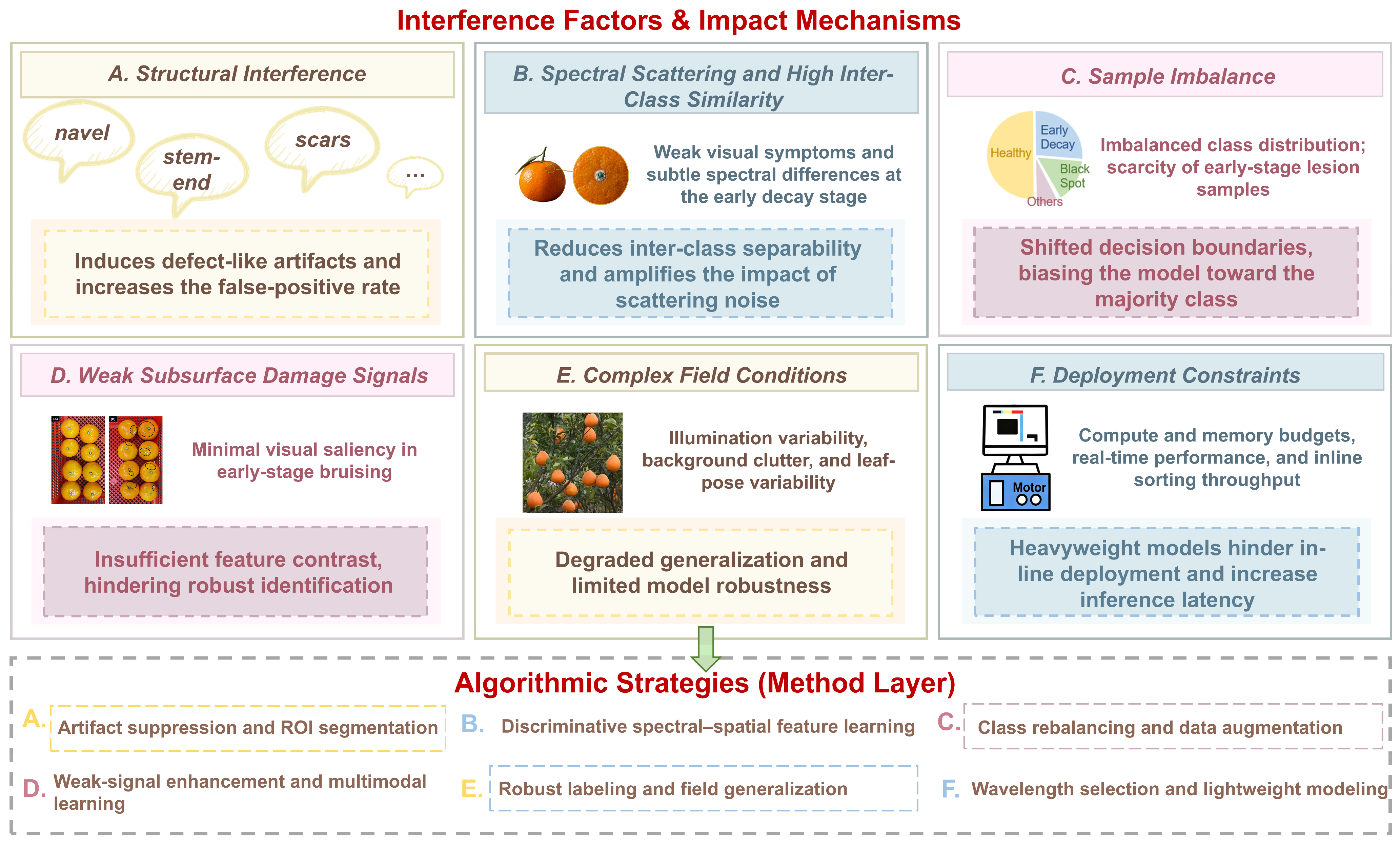
This section reviews the algorithmic advances in HSI-based detection of citrus diseases, insect-related damage, and bruising, with particular emphasis on the transition from the recognition of visible defects to the diagnosis of latent early-stage lesions. Based on the studies reviewed above,
Table 2 summarizes and compares representative studies, while
Figure 7 further outlines the major sources of interference in disease and damage detection, their underlying mechanisms, and the corresponding algorithmic strategies.
7. Recent Algorithmic Advances in Internal Physicochemical and Nutritional Attribute Prediction
Internal physicochemical and nutritional attributes are important physicochemical indicators during fruit production, processing, and storage. Fruits contain a wide variety of nutritional constituents, mainly including sugars, vitamins, minerals, and organic acids [
17,
104]. These constituents are closely associated with fruit maturity, flavor balance, nutritional value, and consumer acceptance. From the perspective of HSI, however, not all internal or nutritional attributes can be predicted with the same level of reliability. Previous studies have shown that the prediction performance of spectral techniques varies among different quality attributes. This variability is mainly related to the concentration level and dynamic range of the target constituent, the optical penetration depth of the fruit tissue, the strength of the spectral response, and whether the target attribute is directly or indirectly associated with measurable spectral features [
39,
77]. For instance, SSC is one of the most widely studied and relatively stable internal quality indicators in citrus spectral detection, whereas TA and VC are generally more challenging to predict because of their lower concentration levels, weaker or more indirect spectral responses, and stronger dependence on fruit tissue structure and optical measurement mode [
56,
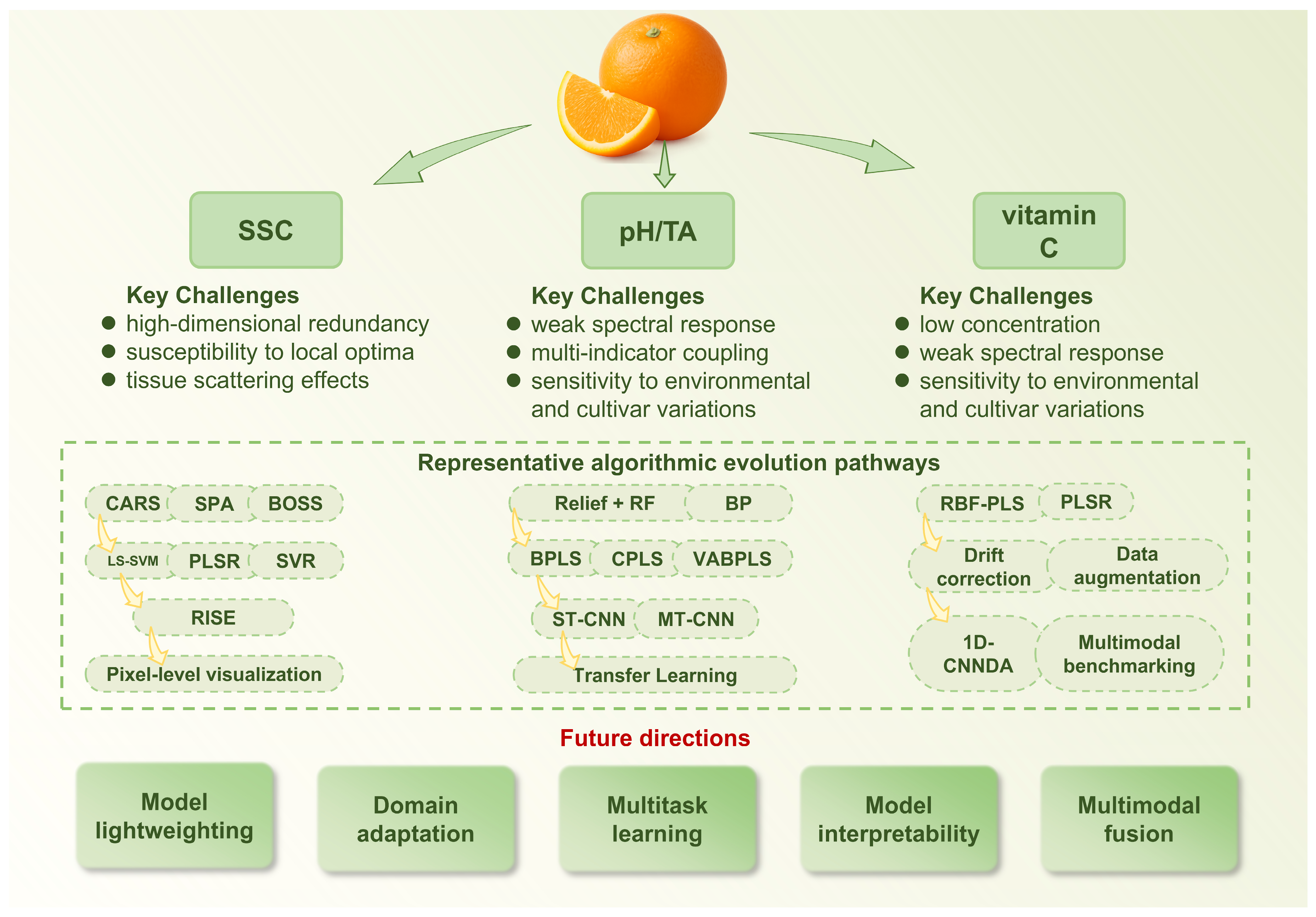
57]. Therefore,
Figure 8 summarizes the differences in research focus, core challenges, and algorithmic evolution among the prediction of SSC, pH, TA, and VC.
7.1. SSC Prediction
SSC is one of the most widely investigated internal quality indicators in citrus fruit and has been extensively studied using Vis–NIR/NIR spectroscopy and hyperspectral imaging. In the studies reviewed in this section, the measured samples mainly included intact citrus fruits, such as mandarins [
67,
105], ponkan [
106], oranges [
56,
107], and Tribute citrus [
108]. Most measurements were conducted under laboratory or controlled optical conditions using HSI or Vis–NIR/NIR spectroscopy systems in reflectance or transmittance modes. These controlled settings helped reduce illumination variation and background interference, but this also suggests that model performance may be affected when the methods are transferred to field environments or online sorting systems.
In SSC-related studies, the high dimensionality of hyperspectral data and substantial spectral redundancy make efficient informative wavelength selection a key step for model simplification and acceleration. Traditional feature selection algorithms, such as CARS, SPA, and BOSS, have therefore been widely applied in SSC modeling. They can retain spectral variables that are more closely associated with sugar- and water-related absorption, as well as tissue-scattering characteristics, while removing redundant or noisy bands. For example, Kim et al. [
109] improved the stability of SSC prediction through effective wavelength selection and outlier sample handling, indicating that limited-band modeling combined with conventional regression remains an important route for balancing accuracy and deployability in SSC assessment. Zhang et al. [
56] jointly selected informative wavelengths using the CARS-SPA strategy and established an LS-SVM model. They further introduced fruit size as a physical compensation variable to correct differences in optical path length and scattering intensity among individual fruits, thereby effectively suppressing interference caused by fruit size variation. By reducing 192 wavebands to nine key wavelengths, the proposed method also significantly im-proved detection efficiency.
These studies indicate that, within classical modeling frameworks, well-designed feature engineering and physically informed compensation can often substantially improve model robustness, and may in some cases be more critical than simply replacing the regression algorithm. However, such methods are prone to becoming trapped in local optima, and the selected wavelengths do not always have clearly interpretable physicochemical significance. Luo et al. [
105] achieved high-accuracy SSC prediction and generated spatial distribution maps of SSC by combining secondary dimensionality reduction using BOSS-CARS with PLSR, thereby demonstrating the value of dimensionality reduction for visual analysis. Qiu et al. [
67] innovatively proposed the reinforced intelligent spectra enhancement (RISE) algorithm. This method creatively formulates wavelength selection as a Markov decision process (MDP) and employs a deep Q-network (DQN) to learn the optimal policy, thereby enabling global optimization of feature selection. RISE exhibited excellent versatility and robustness across multiple models, including SVR, RF, and XGBoost. Its core innovation effectively avoids the local optimum trap commonly encountered in traditional methods; however, the computational cost of RISE is much higher than that of conventional approaches, and its performance depends heavily on the representativeness and quality of the training data, which remains a major bottleneck for its practical application.
In addition to selecting key wavelengths through algorithmic approaches, researchers have also focused on the data themselves and developed a variety of feature representation and data enhancement strategies to address interferences such as fruit size variation and internal tissue scattering. Li et al. [
108] found that, in citrus SSC prediction, the sampling surface (stem-end versus blossom-end side) had no significant effect on model performance, suggesting that spectral information from a single side can, in some cases, represent the whole fruit and thereby further simplify data acquisition requirements. By contrast, Xiao et al. [
106] investigated multi-point spectra and demonstrated that a multi-point spectral averaging strategy could effectively improve model robustness, reducing the prediction error by approximately 20%. This is because multi-point averaging reduces the influence of local heterogeneity in soluble solids distribution and internal tissue scattering. More recent work by Liu et al. [
107] further demonstrated that, when combined with SNV preprocessing and full-spectrum PLSR modeling, hyperspectral transmittance imaging outperforms reflectance imaging in SSC prediction because transmittance measurements can capture more information from internal juice sacs and pulp tissues, whereas reflectance measurements are more strongly affected by peel and surface scattering.
Overall, SSC prediction is influenced by the combined effects of sugars, water, tissue structure, peel thickness, fruit size, surface curvature, internal scattering, and optical path length. Therefore, prediction errors may arise from both chemical and physical sources, including differences in sugar accumulation, maturity stage, soluble compound distribution, peel thickness, measurement position, and heterogeneous light scattering within citrus tissues. These factors may weaken or distort the relationship between spectral signals and SSC, especially in reflectance measurements that mainly capture surface or subsurface information. Future SSC studies should therefore place greater emphasis on reporting sample characteristics, measurement conditions, and optical configurations, as well as providing spectroscopic explanations for selected wavelengths and model improvements.
7.2. pH and Titratable Acidity (TA) Prediction
Compared with SSC, the relationships between pH or TA and spectral responses may be weaker or more complex, making their nondestructive detection more challenging and placing higher demands on the feature mining and modeling capabilities of algorithms. In the exploration of simultaneous multi-attribute prediction, early studies mainly focused on achieving the joint prediction of multiple quality parameters through traditional machine learning methods. Rasekh et al. [
66] used the Relief algorithm to identify key wavelength intervals and established a random forest (RF) model, achieving high-accuracy dual-parameter prediction of SSC and pH. Wang et al. [
110] employed a backpropagation (BP) neural network in combination with specific preprocessing strategies, including MSC-VN for acidity, and obtained reasonably promising results under conditions of limited sample size and a restricted number of wavelengths.
As methodologies have advanced, research has gradually shifted toward ensemble learning and deep learning models to address the challenges of simultaneous multi-attribute prediction, particularly the prediction of acidity-related indicators. Tan et al. [
111] compared conventional PLS with three ensemble strategies, namely boosting PLS (BPLS), consensus PLS (CPLS), and variable adaptive boosting PLS (VABPLS), and found that, when simultaneously predicting SSC, pH, and TA, the predictive performance for pH and TA remained unsatisfactory, reflecting the inherent difficulty of multi-attribute detection, especially for acidity-related parameters. A more recent advance was reported by Li et al. [
112], who developed both single-task and multi-task convolutional neural network models (ST-CNN and MT-CNN). By sharing lower convolutional layers to learn common spectral feature representations and using task-specific upper layers for SSC and pH prediction, the MT-CNN achieved high-accuracy simultaneous prediction of both parameters. In addition, the study introduced transfer learning by transferring a model trained on hyperspectral images to near-infrared spectral data, enabling the model adapted to a new device to achieve performance comparable to, or even better than, that of a directly trained model. This substantially reduced the cost and time required for model redevelopment and provided important algorithmic support for cross-platform and cross-device model deployment.
Compared with SSC, pH and TA are generally more difficult to predict using HSI or NIR spectroscopy. This difference should not be attributed solely to algorithmic limitations, but should first be examined from spectroscopic and physicochemical perspectives. SSC is a concentration-related indicator associated with sugar accumulation and maturity development, and it usually exhibits a wider effective variation range in fruit datasets. According to the data reported by Aredo et al. [
77], the coefficient of variation (CV) of pH in Valencia oranges was very narrow, at approximately 4.5%, whereas that of SSC was more than double, reaching approximately 10.0%. In addition, pH is a logarithmic indicator of hydrogen ion activity rather than a direct linear measure of the concentration of a specific chemical constituent [
113]. Therefore, its relationship with spectral responses is usually more indirect than that of SSC.
These findings suggest that prediction difficulty should be interpreted together with the intrinsic variability of each quality attribute. From a spectroscopic perspective, a narrow effective variation range may result in only subtle acidity-related spectral changes, which can be easily masked by stronger absorption and scattering effects associated with water, sugars, peel structure, and tissue heterogeneity. Therefore, the difficulty of predicting pH and TA observed in many studies should be understood as a combined consequence of limited variation range, weak direct spectral response, sample heterogeneity, and model constraints. In this context, the challenge for advanced machine learning algorithms is not only to handle nonlinear modeling, but also to extract low-variance acidity-related spectral information from strong background interference.
7.3. Vitamin C Prediction
VC is an important functional constituent of citrus fruit and contributes to nutritional value and health-related quality; however, its relatively low concentration and potentially weak spectral response make nondestructive prediction particularly challenging. In NIR/HSI-based prediction, the detection of low-concentration constituents such as VC should be interpreted cautiously. Fruit spectra are strongly affected by water absorption, tissue scattering, and highly convoluted overtone and combination bands [
114,
115]. Therefore, improved prediction accuracy for VC may not necessarily indicate direct detection of VC-specific absorption. Instead, the model may partly exploit indirect correlations with dominant constituents or maturity-related variables, such as SSC, organic acids, moisture, or tissue structure. This issue highlights the need for wavelength attribution, independent validation, and careful spectroscopic interpretation when evaluating VC prediction models.
Chen et al. [
116] employed partial least squares regression based on a Gaussian radial basis function kernel (RBF-PLS) for VC prediction in pomelo. By optimizing the kernel parameter (σ) and the number of latent variables (s), their study showed that the RBF-PLS model could improve nonlinear regression modeling of NIR hyperspectral data for VC estimation. Santos et al. [
117] further showed that portable near-infrared spectroscopy (NIRS) combined with a PLSR model can effectively predict VC content in various citrus fruits, including oranges and lemons, while also distinguishing between ascorbic acid (AA) and dehydroascorbic acid (DHA). These studies suggest that nonlinear modeling and portable spectral systems may provide useful tools for rapid, on-site, and low-cost VC prediction. Nevertheless, such results should be interpreted together with the spectral detectability of VC and the possibility of indirect correlations with other fruit quality attributes.
The denoising strategies proposed by Xu et al. [
118] to address temporal drift, sensor response shifts, and batch-to-batch variation—such as reference and dark correction, artificial horizontal shifting, and data supplementation—provide valuable guidance for improving the stability and accuracy of detecting low-abundance constituents such as VC. Huang et al. [
57] employed a one-dimensional convolutional neural network based on data augmentation (1D-CNN
DA) to process Vis–NIR spectral data and achieved improved performance in predicting VC content in citrus, significantly outperforming the conventional PLSR model. This result highlights the potential of deep learning in capturing the weak spectral features associated with low-concentration constituents. However, higher prediction accuracy obtained by complex models does not necessarily mean that the model has directly identified VC-specific absorption features. For low-concentration constituents such as VC, model performance should be further supported by independent datasets, wavelength attribution, feature-importance analysis, and evaluation of possible indirect correlations with SSC, organic acids, moisture, or maturity-related changes.
Future research on VC prediction should move beyond reporting prediction accuracy alone. It should combine robust modeling with spectroscopic interpretation, measurement standardization, external validation, and analysis of direct versus indirect spectral relationships. In particular, it is important to verify whether prediction models capture VC-specific spectral information or rely mainly on correlations with other constituents. These efforts will help improve the reliability and practical value of HSI-based VC prediction in citrus fruits.
Overall, algorithmic research on internal physicochemical and nutritional attribute prediction in citrus exhibits a clear hierarchical pattern: SSC prediction started earlier, has attracted the greatest research attention, and has already formed a relatively mature technical pathway; pH and TA prediction, owing to weaker spectral responses, stronger environmental sensitivity, and the frequent involvement of multi-attribute coupling, has gradually evolved from traditional variable selection and shallow modeling toward multi-task learning and cross-device transfer; VC prediction, by contrast, remains largely at the stage of methodological exploration and stability enhancement because of its low concentration, weak signal intensity, and the absence of a unified evaluation framework.
8. Limitations and Challenges
Although hyperspectral imaging combined with machine learning and deep learning algorithms has shown considerable potential in citrus maturity assessment, disease/bruising detection, and internal physicochemical and nutritional attribute prediction, most existing studies remain confined to controlled experimental conditions. A substantial gap still exists before stable application in complex real-world scenarios can be achieved. At present, the key factors limiting the further advancement of nondestructive citrus HSI toward engineering implementation and large-scale application lie not only in the imaging hardware itself, but also in the persistent methodological limitations of current algorithms in terms of generalization capability, feature compression, interpretability, data efficiency, and multi-task collaborative modeling.
Limited cross-domain generalization capability. Insufficient generalization capability across cultivars, production regions, growing environments, and samples collected in different years or batches remains one of the central challenges for current algorithmic models. As a biological system, citrus exhibits spectral characteristics that are strongly influenced by cultivar-specific genetic traits, such as peel thickness and tissue structure, as well as by orchard microclimate, cultivation practices, and postharvest handling processes. These factors can lead to pronounced differences in data distributions across domains, commonly referred to as domain shift. However, domain shift in citrus HSI should not be regarded solely as an algorithmic problem. Spectral differences may also arise from physical and instrumental factors, including differences in spectrometers, illumination conditions, spectral resolution, sensor response, fruit orientation, and measurement distance. In the near-infrared region, instrument-to-instrument variation can affect overtone and combination bands, making it difficult to distinguish spectral differences caused by cultivar or orchard conditions from those introduced by instrument variation. Therefore, algorithm-level approaches have inherent limitations when measurement conditions are not well controlled. To improve cross-domain robustness, future studies should combine algorithmic adaptation with standardized acquisition protocols and inter-instrument calibration. Consistent illumination, reference correction, imaging geometry, and calibration procedures are essential for reducing non-biological spectral variation. Calibration transfer methods should also be considered when models are applied across different devices or platforms. These strategies can provide a more reliable basis for the practical application of HSI-based citrus quality assessment systems.
High-dimensional redundancy, spectroscopic interpretability, and real-time deployment constraints. The dense and continuous sampling of HSI results in hyperspectral data with numerous continuous wavebands, strong inter-band correlations, and high redundancy. This redundancy is an inherent structural characteristic arising from the measurement principle of HSI itself. Although such data provide rich information, they also increase the computational burden associated with feature extraction, model training, and real-time inference. Although complex deep learning models can process high-dimensional data, they mainly rely on computational power to handle redundant inputs and do not achieve truly scientific dimensionality reduction. In citrus quality assessment, scientifically effective redundancy reduction should be linked to informative wavelength selection, absorption-related spectral regions, and physically interpretable feature combinations. Such interpretation is essential for associating model predictions with water absorption, pigment variation, sugar- and organic acid-related responses, tissue scattering, peel structure, and disease- or damage-induced physiological changes. In addition, the black-box nature of deep learning may weaken spectroscopic interpretability. Even when a model achieves high prediction accuracy, it may remain difficult to determine whether the learned features are physically meaningful or merely data-driven correlations. Therefore, future research should clearly distinguish between merely using computational power to process redundancy and scientifically reducing redundancy through wavelength selection, spectral attribution, and interpretable modeling. For practical applications, wavelength compression, lightweight modeling, and edge-computing requirements should also be integrated to develop online detection systems that balance accuracy, efficiency, and spectroscopic interpretability.
Insufficient model interpretability and weak mechanistic linkage. Current research on citrus HSI has gradually evolved from traditional chemometric approaches to deep learning. However, as model complexity increases, the decision-making process has shifted from traceable relationships between key wavelengths and physicochemical indicators to latent representations that are difficult to interpret directly. For example, although the ANN model reported by Sandra et al. [
80] achieved 100% classification accuracy, the internal learning and decision-making mechanisms of the model remain unclear, which limits both its scientific interpretability and the persuasiveness of its broader application. For the citrus quality assessment tasks covered in this review, interpretability is not merely an algorithmic issue; it also determines whether the model can be reasonably linked to fruit biochemical mechanisms, tissue structural changes, and pathological processes. Therefore, future research should aim not only to improve predictive performance but also to strengthen analyses of key wavelength attribution, salient-region visualization, and mechanistic associations between spectral bands and physiological indicators, thereby advancing HSI algorithms from being merely usable to becoming reliable and trustworthy.
Limited high-quality datasets and insufficient data efficiency. In agricultural scenarios, the acquisition of high-quality data is typically constrained by seasonality, cultivar availability, sampling cost, and the need for destructive physicochemical measurements. For maturity assessment and internal physicochemical and nutritional attribute prediction, ground-truth labels often need to be obtained through laboratory testing; for early disease detection and latent damage assessment, labels frequently require long-term tracking or expert-based annotation, making it difficult to construct large-scale and highly consistent datasets. Under such conditions, although deep learning offers stronger nonlinear representation capability, its performance is often strongly constrained by the scale of the training data and the quality of annotations, leading to problems such as overfitting, cross-batch instability, and difficulties in model reproducibility. Future research should strengthen the development of standardized public datasets and combine strategies such as data augmentation, few-shot transfer learning, and weakly supervised, semi-supervised, or self-supervised learning to improve modeling efficiency and stability under limited-sample conditions.
Insufficient multi-task collaborative modeling and unified evaluation frameworks. From an industrial application perspective, citrus quality evaluation is not a matter of judging a single indicator, but instead generally requires the simultaneous consideration of maturity, disease status, and multiple internal quality attributes, such as SSC, TA, and VC. However, most existing studies have focused on a single task or individual indicators, and substantial differences in evaluation systems, data sources, and experimental conditions across models make direct cross-study comparison difficult and also constrain the development of integrated quality decision-making models. Future research should place greater emphasis on multi-task learning, joint modeling, and the establishment of unified evaluation frameworks to support comprehensive quality grading and intelligent sorting applications. In addition, future studies could gradually incorporate sensory-oriented reference indicators, such as perceived sweetness, acidity, freshness, aroma intensity, overall flavor, and consumer liking. Although SSC, TA, and the SSC/TA ratio are closely related to citrus flavor, they remain indirect indicators and cannot fully represent sensory perception or consumer preference. Establishing reliable sensory indicators and integrating physicochemical attributes with sensory and consumer-preference indicators may provide a more comprehensive basis for multi-task quality assessment and intelligent grading.
9. Conclusions
By virtue of its ability to integrate spectral and spatial information, hyperspectral imaging provides an important technological foundation for the nondestructive assessment of citrus quality, while algorithms constitute the core component that determines whether this technology can achieve high-accuracy analysis, robust generalization, and practical engineering deployment. Overall, the associated algorithmic approaches have evolved from early feature engineering and chemometric methods into an integrated technological framework that incorporates deep learning, transfer learning, and lightweight design.
For maturity assessment, existing methods have achieved relatively high accuracy in modeling sugar–acid variation and identifying maturity grades. However, differences among cultivars, orchards, production batches, and postharvest conditions still substantially constrain the cross-domain transferability and practical applicability of these models. In contrast, disease and damage detection rely more heavily on the effective discrimination of weak abnormal signals from complex background interference. Accordingly, the evolution of algorithms in this area has placed greater emphasis on feature enhancement, spatial–spectral fusion, and lightweight recognition architectures, with the synergistic design of physical imaging modes and algorithmic strategies being especially important for the detection of latent diseases and subsurface bruising. Internal physicochemical and nutritional attribute prediction exhibits a more pronounced task hierarchy, in which SSC prediction is the most mature, whereas pH and TA prediction and VC prediction remain more challenging in terms of stability and modeling difficulty.
Overall, the research focus of HSI in nondestructive citrus quality assessment is gradually shifting from demonstrating feasibility to achieving reliable practical application. This transition implies that future work with lasting impact will no longer be confined to performance improvements on a single task or dataset, but will instead require a comprehensive balance among accuracy, efficiency, generalization, and interpretability under complex conditions. Only when algorithmic research can effectively address these core demands will hyperspectral technology be able to evolve from a laboratory research tool into a practical technological system for intelligent grading, quality monitoring, and precision management in the citrus industry.
Author Contributions
Conceptualization, J.L. and T.L.; methodology, S.Y.; investigation, S.Y., Q.W., and R.Q.; resources, J.L. and T.L.; data curation, S.Y., Q.W., and R.Q.; writing—original draft preparation, S.Y.; writing—review and editing, J.L., T.L., Q.W. and R.Q.; visualization, S.Y., Q.W. and R.Q.; supervision, J.L. and T.L.; project administration, J.L. and T.L.; funding acquisition, J.L. and T.L. All authors have read and agreed to the published version of the manuscript.
Funding
This research was funded by the Natural Science Foundation of Sichuan Province, grant number 2025ZNSFSC1105; the Sichuan Modern Agricultural Equipment Engineering and Technology Research Center, grant number XDNY2022-003; and the project “Research on Field Airborne Image Deblurring Methods Based on Deep Learning”, grant number 2023RC043. The APC was funded by the above-mentioned funding sources.
Institutional Review Board Statement
Not applicable.
Data Availability Statement
No new data were created or analyzed in this study. Data sharing is not applicable to this article.
Acknowledgments
During the preparation of this manuscript, the authors used ChatGPT (OpenAI, GPT-4) for language polishing. AI-assisted tools were also used in the preparation and graphical refinement of some citrus-fruit illustrations in the schematic figures. The authors carefully reviewed, edited, and verified all AI-assisted outputs, figure labels, conceptual relationships, and graphical elements, and take full responsibility for the content, accuracy, and integrity of this publication.
Conflicts of Interest
The authors declare no conflicts of interest.
Abbreviations
The following abbreviations are used in this manuscript:
| AA | Ascorbic acid |
| ANOVA | Analysis of variance |
| ANN | Artificial neural network |
| BOSS | Bootstrapping soft shrinkage |
| BP | Backpropagation |
| BP-ANN | Backpropagation artificial neural network |
| CARS | Competitive adaptive reweighted sampling |
| CBS | Citrus black spot |
| CLAHE | Contrast-limited adaptive histogram equalization |
| CNN | Convolutional neural network |
| CPLS | Consensus partial least squares |
| DCNN | Deep convolutional neural network |
| DHA | Dehydroascorbic acid |
| DL | Deep learning |
| DQN | Deep Q-network |
| DT | Decision tree |
| GAF | Gramian angular field |
| GASF | Gramian angular summation field |
| GB | Gradient boosting |
| GLCM | Gray-level co-occurrence matrix |
| HLB | Huanglongbing |
| HOG | Histogram of oriented gradients |
| HSI | Hyperspectral imaging |
| IWSA | Improved watershed segmentation algorithm |
| kNN | k-nearest neighbors |
| LASSO | Least absolute shrinkage and selection operator |
| LDA | Linear discriminant analysis |
| LR | Logistic regression |
| LS-SVM | Least-squares support vector machine |
| LW–NIR | Long-wavelength near-infrared |
| MDP | Markov decision process |
| ML | Machine learning |
| MLR | Multiple linear regression |
| MSC | Multiplicative scatter correction |
| MT-CNN | Multi-task convolutional neural network |
| NFINDR-JMSAM | NFINDR combined with Jeffries–Matusita spectral angle mapper |
| NIR | Near-infrared |
| NIRS | Near-infrared spectroscopy |
| OA | Overall accuracy |
| PC | Principal component |
| PCA | Principal component analysis |
| PCR | Polymerase chain reaction |
| PLS | Partial least squares |
| PLS-DA | Partial least squares discriminant analysis |
| PLSR | Partial least squares regression |
| RBF | Radial basis function |
| RBF-PLS | Radial basis function-based partial least squares |
| RF | Random forest |
| RISE | Reinforced intelligent spectra enhancement |
| RMSE | Root mean square error |
| RMSEP | Root mean square error of prediction |
| ROI | Region of interest |
| SE | Squeeze-and-excitation |
| SBS | Sequential backward selection |
| SG | Savitzky–Golay filter |
| SMOTE | Synthetic minority oversampling technique |
| SNV | Standard normal variate |
| SPA | Successive projections algorithm |
| SSC | Soluble solids content |
| STD | Standard deviation |
| SVM | Support vector machine |
| SVR | Support vector regression |
| TA | Titratable acidity |
| TSS | Total soluble solids |
| UV | Ultraviolet |
| UVA | Ultraviolet-A |
| VC | Vitamin C |
| Vis–NIR | Visible and near-infrared |
| XGBoost | Extreme gradient boosting |
| YVCD | Yellow vein clearing disease |
| 1D-CNN | One-dimensional convolutional neural network |
| 1D-CNNDA | One-dimensional convolutional neural network based on data augmentation |
| 2D-CNN | Two-dimensional convolutional neural network |
| 3D-CNN | Three-dimensional convolutional neural network |
References
- Ladaniya, M. Chapter 1—Introduction. In Citrus Fruit, 2nd ed.; Academic Press: Cambridge, MA, USA, 2023; pp. 1–21. [Google Scholar]
- Lado, J.; Gambetta, G.; Zacarias, L. Key determinants of citrus fruit quality: Metabolites and main changes during maturation. Sci. Hortic. 2018, 233, 238–248. [Google Scholar] [CrossRef]
- Goldenberg, L.; Yaniv, Y.; Porat, R.; Carmi, N. Mandarin fruit quality: A review. J. Sci. Food Agric. 2018, 98, 18–26. [Google Scholar] [CrossRef] [PubMed]
- He, K.; Su, Y.; He, L.; Hu, C.; Xing, J.; Alisher, N. Modeling of table grape soluble solids content, titratable acidity and pH prediction during storage based on Vis-NIR spectroscopy. Front. Plant Sci. 2025, 16, 1723949. [Google Scholar] [CrossRef] [PubMed]
- Liu, J.; Sun, J.; Wang, Y.; Liu, X.; Zhang, Y.; Fu, H. Non-Destructive Detection of Fruit Quality: Technologies, Applications and Prospects. Foods 2025, 14, 2137. [Google Scholar] [CrossRef] [PubMed]
- Rizzo, M.; Marcuzzo, M.; Zangari, A.; Gasparetto, A.; Albarelli, A. Fruit ripeness classification: A survey. Artif. Intell. Agric. 2023, 7, 44–57. [Google Scholar] [CrossRef]
- Lu, Y.; Saeys, W.; Kim, M.; Peng, Y.; Lu, R. Hyperspectral imaging technology for quality and safety evaluation of horticultural products: A review and celebration of the past 20-year progress. Postharvest Biol. Technol. 2020, 170, 111318. [Google Scholar] [CrossRef]
- Mei, M.; Li, J. An overview on optical non-destructive detection of bruises in fruit: Technology, method, application, challenge and trend. Comput. Electron. Agric. 2023, 213, 108195. [Google Scholar] [CrossRef]
- Wan, G.; He, J.; Meng, X.; Liu, G.; Zhang, J.; Ma, F.; Zhang, Q.; Wu, D. Hyperspectral imaging technology for nondestructive identification of quality deterioration in fruits and vegetables: A review. Crit. Rev. Food Sci. Nutr. 2025, 65, 7923–7952. [Google Scholar] [CrossRef] [PubMed]
- Wang, H.; Hu, R.; Zhang, M.; Zhai, Z.; Zhang, R. Identification of tomatoes with early decay using visible and near infrared hyperspectral imaging and image-spectrum merging technique. J. Food Process Eng. 2021, 44, e13654. [Google Scholar] [CrossRef]
- Wang, C.; Li, X.; Zhang, Z.; Luo, X.; Cai, J.; Wang, A. Nondestructive Quality Detection of Characteristic Fruits Based on Vis/NIR Spectroscopy: Principles, Systems, and Applications. Agriculture 2025, 15, 2167. [Google Scholar] [CrossRef]
- Ahmed, M.T.; Monjur, O.; Khaliduzzaman, A.; Kamruzzaman, M. A comprehensive review of deep learning-based hyperspectral image reconstruction for agri-food quality appraisal. Artif. Intell. Rev. 2025, 58, 96. [Google Scholar] [CrossRef]
- Nikzadfar, M.; Rashvand, M.; Zhang, H.; Shenfield, A.; Genovese, F.; Altieri, G.; Matera, A.; Tornese, I.; Laveglia, S.; Paterna, G.; et al. Hyperspectral Imaging Aiding Artificial Intelligence: A Reliable Approach for Food Qualification and Safety. Appl. Sci. 2024, 14, 9821. [Google Scholar] [CrossRef]
- Guerri, M.F.; Distante, C.; Spagnolo, P.; Bougourzi, F.; Taleb-Ahmed, A. Deep learning techniques for hyperspectral image analysis in agriculture: A review. ISPRS Open J. Photogramm. Remote Sens. 2024, 12, 100062. [Google Scholar] [CrossRef]
- Walsh, J.; Neupane, A.; Koirala, A.; Li, M.; Anderson, N. Review: The evolution of chemometrics coupled with near infrared spectroscopy for fruit quality evaluation. II. The rise of convolutional neural networks. J. Near Infrared Spectrosc. 2023, 31, 109–125. [Google Scholar] [CrossRef]
- Chen, L.; Wu, Y.; Yang, N.; Sun, Z. Advances in Hyperspectral and Diffraction Imaging for Agricultural Applications. Agriculture 2025, 15, 1775. [Google Scholar] [CrossRef]
- Yu, K.; Zhong, M.; Zhu, W.; Rashid, A.; Han, R.; Virk, M.S.; Duan, K.; Zhao, Y.; Ren, X. Advances in Computer Vision and Spectroscopy Techniques for Non-Destructive Quality Assessment of Citrus Fruits: A Comprehensive Review. Foods 2025, 14, 386. [Google Scholar] [CrossRef] [PubMed]
- Yang, C.; Guo, Z.; Fernandes Barbin, D.; Dai, Z.; Watson, N.; Povey, M.; Zou, X. Hyperspectral Imaging and Deep Learning for Quality and Safety Inspection of Fruits and Vegetables: A Review. J. Agric. Food Chem. 2025, 73, 10019–10035. [Google Scholar] [CrossRef] [PubMed]
- Habibi, F.; Sarkhosh, A.; Kim, J.; Shahid, M.; Gmitter, F.; Brecht, J. Citrus Fruit Pigments. EDIS 2023, 2023, 1–6. [Google Scholar] [CrossRef]
- Keawmanee, N.; Ma, G.; Zhang, L.; Kato, M. Regulation of Chlorophyll and Carotenoid Metabolism in Citrus Fruit During Maturation and Regreening. Rev. Agric. Sci. 2023, 11, 203–216. [Google Scholar] [CrossRef] [PubMed]
- Morales, J.; Cervera Chiner, L.; Navarro, P.; Salvador, A. Quality of Postharvest Degreened Citrus Fruit. In Citrus Research-Horticultural and Human Health Aspects; IntechOpen: London, UK, 2022. [Google Scholar]
- Nawaz, R.; Akhtar Abbasi, N.; Ahmad Hafiz, I.; Khalid, A. Color-break effect on Kinnow (Citrus nobilis Lour × Citrus deliciosa Tenora) fruit‘s internal quality at early ripening stages under varying environmental conditions. Sci. Hortic. 2019, 256, 108514. [Google Scholar] [CrossRef]
- Strano, M.C.; Altieri, G.; Allegra, M.; Di Renzo, G.C.; Paterna, G.; Matera, A.; Genovese, F. Postharvest Technologies of Fresh Citrus Fruit: Advances and Recent Developments for the Loss Reduction during Handling and Storage. Horticulturae 2022, 8, 612. [Google Scholar] [CrossRef]
- Huang, Y.-W.; Wang, W. PVMNet: A navel orange defect detection algorithm based on Mamba structure. Expert Syst. Appl. 2026, 300, 130412. [Google Scholar] [CrossRef]
- Chuquimarca, L.E.; Vintimilla, B.X.; Velastin, S.A. A review of external quality inspection for fruit grading using CNN models. Artif. Intell. Agric. 2024, 14, 1–20. [Google Scholar] [CrossRef]
- Xu, M.; Zhang, X.; Zhan, C.; Ge, J.; Yang, H. Research on citrus grading system based on machine vision. Syst. Sci. Control Eng. 2025, 13, 2460443. [Google Scholar] [CrossRef]
- Jafari, A.; Fazayeli, A.; Zarezadeh, M.R. Estimation of orange skin thickness based on visual texture coarseness. Biosyst. Eng. 2014, 117, 73–82. [Google Scholar] [CrossRef]
- Wang, C.; Han, Q.; Li, C.; Zou, T.; Zou, X. Fusion of fruit image processing and deep learning: A study on identification of citrus ripeness based on R-LBP algorithm and YOLO-CIT model. Front. Plant Sci. 2024, 15, 1397816. [Google Scholar] [CrossRef] [PubMed]
- Cavaco, A.M.; Guerra, R.; Pires, R.; Passos, D.; Carlos Antunes, M.D. Nondestructive Assessment of Citrus Fruit Quality and Ripening by Visible–Near Infrared Reflectance Spectroscopy. In Citrus-Research, Development and Biotechnology; Khan, M.S., Khan, I.A., Eds.; IntechOpen: London, UK, 2021. [Google Scholar]
- Singh, N.; Sharma, R.M.; Dubey, A.K.; Awasthi, O.P.; Porat, R.; Saha, S.; Bharadwaj, C.; Sevanthi, A.M.; Kumar, A.; Sharma, N.; et al. Harvesting Maturity Assessment of Newly Developed Citrus Hybrids (Citrus maxima Merr. × Citrus sinensis (L.) Osbeck) for Optimum Juice Quality. Plants 2023, 12, 3978. [Google Scholar] [CrossRef] [PubMed]
- Saini, R.K.; Ranjit, A.; Sharma, K.; Prasad, P.; Shang, X.; Gowda, K.G.; Keum, Y.-S. Bioactive Compounds of Citrus Fruits: A Review of Composition and Health Benefits of Carotenoids, Flavonoids, Limonoids, and Terpenes. Antioxidants 2022, 11, 239. [Google Scholar] [CrossRef] [PubMed]
- Sdiri, S.; Bermejo, A.; Aleza, P.; Navarro, P.; Salvador, A. Phenolic composition, organic acids, sugars, vitamin C and antioxidant activity in the juice of two new triploid late-season mandarins. Food Res. Int. 2012, 49, 462–468. [Google Scholar] [CrossRef]
- Liu, X.-C.; Tang, Y.-Q.; Li, Y.-C.; Li, S.-J.; Yang, H.-D.; Wan, S.-L.; Wang, Y.-T.; Hu, Z.-D. Identification of key sensory and chemical factors determining flavor quality of Xinyu mandarin during ripening and storage. Food Chem. X 2024, 22, 101395. [Google Scholar] [CrossRef] [PubMed]
- Tietel, Z.; Plotto, A.; Fallik, E.; Lewinsohn, E.; Porat, R. Taste and aroma of fresh and stored mandarins. J. Sci. Food Agric. 2011, 91, 14–23. [Google Scholar] [CrossRef] [PubMed]
- Obenland, D.; Collin, S.; Mackey, B.; Sievert, J.; Fjeld, K.; Arpaia, M.L. Determinants of flavor acceptability during the maturation of navel oranges. Postharvest Biol. Technol. 2009, 52, 156–163. [Google Scholar] [CrossRef]
- Simons, T.; McNeil, C.; Pham, V.D.; Wang, S.; Wang, Y.; Slupsky, C.; Guinard, J.-X. Chemical and sensory analysis of commercial Navel oranges in California. npj Sci. Food 2019, 3, 22. [Google Scholar] [CrossRef] [PubMed]
- Obenland, D.; Collin, S.; Mackey, B.; Sievert, J.; Arpaia, M.L. Storage temperature and time influences sensory quality of mandarins by altering soluble solids, acidity and aroma volatile composition. Postharvest Biol. Technol. 2011, 59, 187–193. [Google Scholar] [CrossRef]
- Traksele, L.; Snitka, V. Surface-enhanced Raman spectroscopy for the characterization of Vaccinium myrtillus L. bilberries of the Baltic–Nordic regions. Eur. Food Res. Technol. 2021, 248, 427–435. [Google Scholar] [CrossRef]
- Sun, C.; Van Beers, R.; Aernouts, B.; Saeys, W. Bulk optical properties of citrus tissues and the relationship with quality properties. Postharvest Biol. Technol. 2020, 163, 111127. [Google Scholar] [CrossRef]
- Ahmad, M.; Khan, A.; Khan, A.M.; Mazzara, M.; Distefano, S.; Sohaib, A.; Nibouche, O. Spatial Prior Fuzziness Pool-Based Interactive Classification of Hyperspectral Images. Remote Sens. 2019, 11, 1136. [Google Scholar] [CrossRef]
- Lu, Y.; Huang, Y.; Lu, R. Innovative Hyperspectral Imaging-Based Techniques for Quality Evaluation of Fruits and Vegetables: A Review. Appl. Sci. 2017, 7, 189. [Google Scholar] [CrossRef]
- Zhang, B.; Li, X.; Li, R.; Wang, M.; Liu, Y.; Zhou, J. Hyperspectral Imaging and Their Applications in the Nondestructive Quality Assessment of Fruits and Vegetables. In Hyperspectral Imaging in Agriculture, Food and Environment; Luna Maldonado, A.I., Rodriguez-Fuentes, H., Vidales Contreras, J.A., Eds.; IntechOpen: London, UK, 2017. [Google Scholar]
- Aline, U.; Bhattacharya, T.; Faqeerzada, M.A.; Kim, M.S.; Baek, I.; Cho, B.-K. Advancement of non-destructive spectral measurements for the quality of major tropical fruits and vegetables: A review. Front. Plant Sci. 2023, 14, 1240361. [Google Scholar] [CrossRef] [PubMed]
- Wang, H.; Li, C.; Wang, M. Quantitative Determination of Onion Internal Quality Using Reflectance, Interactance, and Transmittance Modes of Hyperspectral Imaging. Trans. ASABE 2013, 56, 1623–1635. [Google Scholar] [CrossRef]
- Bioucas-Dias, J.M.; Plaza, A.; Camps-Valls, G.; Scheunders, P.; Nasrabadi, N.; Chanussot, J. Hyperspectral Remote Sensing Data Analysis and Future Challenges. IEEE Geosci. Remote Sens. Mag. 2013, 1, 6–36. [Google Scholar] [CrossRef]
- Ghamisi, P.; Yokoya, N.; Li, J.; Liao, W.; Liu, S.; Plaza, J.; Rasti, B.; Plaza, A. Advances in Hyperspectral Image and Signal Processing: A Comprehensive Overview of the State of the Art. IEEE Geosci. Remote Sens. Mag. 2017, 5, 37–78. [Google Scholar] [CrossRef]
- Boardman, J.W.; Kruse, F.A. Analysis of Imaging Spectrometer Data Using $N$ -Dimensional Geometry and a Mixture-Tuned Matched Filtering Approach. IEEE Trans. Geosci. Remote Sens. 2011, 49, 4138–4152. [Google Scholar] [CrossRef]
- Rinnan, Å.; van den Berg, F.; Engelsen, S.B. Review of the most common pre-processing techniques for near-infrared spectra. TrAC Trends Anal. Chem. 2009, 28, 1201–1222. [Google Scholar] [CrossRef]
- Dai, Q.; Sun, D.-W.; Cheng, J.-H.; Pu, H.; Zeng, X.-A.; Xiong, Z. Recent Advances in De-Noising Methods and Their Applications in Hyperspectral Image Processing for the Food Industry. Compr. Rev. Food Sci. Food Saf. 2014, 13, 1207–1218. [Google Scholar] [CrossRef]
- Yan, C. A review on spectral data preprocessing techniques for machine learning and quantitative analysis. iScience 2025, 28, 112759. [Google Scholar] [CrossRef] [PubMed]
- Gómez-Sanchis, J.; Moltó, E.; Camps-Valls, G.; Gómez-Chova, L.; Aleixos, N.; Blasco, J. Automatic correction of the effects of the light source on spherical objects. An application to the analysis of hyperspectral images of citrus fruits. J. Food Eng. 2008, 85, 191–200. [Google Scholar] [CrossRef]
- Castro, W.; Mejía, J.; De-La-Torre, M.; Acevedo-Juárez, B.; Tech, A.R.B.; Avila-George, H. Radial grid reflectance correction for hyperspectral images of fruits with rounded surfaces. Comput. Electron. Agric. 2023, 213, 108179. [Google Scholar] [CrossRef]
- Rogelj, L.; Pavlovčič, U.; Stergar, J.; Jezeršek, M.; Simončič, U.; Milanič, M. Curvature and height corrections of hyperspectral images using built-in 3D laser profilometry. Appl. Opt. 2019, 58, 9002–9012. [Google Scholar] [CrossRef] [PubMed]
- Mantripragada, K.; Dao, P.D.; He, Y.; Qureshi, F.Z. The effects of spectral dimensionality reduction on hyperspectral pixel classification: A case study. PLoS ONE 2022, 17, e0269174. [Google Scholar] [CrossRef] [PubMed]
- Zhang, H.; Chen, Y.; Liu, X.; Huang, Y.; Zhan, B.; Luo, W. Identification of Common Skin Defects and Classification of Early Decayed Citrus Using Hyperspectral Imaging Technique. Food Anal. Methods 2021, 14, 1176–1193. [Google Scholar] [CrossRef]
- Zhang, H.; Zhan, B.; Pan, F.; Luo, W. Determination of soluble solids content in oranges using visible and near infrared full transmittance hyperspectral imaging with comparative analysis of models. Postharvest Biol. Technol. 2020, 163, 111148. [Google Scholar] [CrossRef]
- Huang, Y.; Zheng, Y.; Liu, P.; Xie, L.; Ying, Y. Enhanced prediction of soluble solids content and vitamin C content in citrus using visible and near-infrared spectroscopy combined with one-dimensional convolutional neural network. J. Food Compos. Anal. 2025, 139, 107131. [Google Scholar] [CrossRef]
- Li, J.; Luo, W.; Han, L.; Cai, Z.; Guo, Z. Two-wavelength image detection of early decayed oranges by coupling spectral classification with image processing. J. Food Compos. Anal. 2022, 111, 104642. [Google Scholar] [CrossRef]
- Tang, Y.; Yang, J.; Zhuang, J.; Hou, C.; Miao, A.; Ren, J.; Huang, H.; Tan, Z.; Paliwal, J. Early detection of citrus anthracnose caused by Colletotrichum gloeosporioides using hyperspectral imaging. Comput. Electron. Agric. 2023, 214, 108348. [Google Scholar] [CrossRef]
- Cai, L.; Li, J.; Zhang, H.; Zhang, Y.; Zhang, J.; Hao, H. Determination of the SSC in oranges using Vis-NIR full transmittance hyperspectral imaging and spectral visual coding: A practical solution to the scattering problem of inhomogeneous mixtures. Food Chem. 2025, 474, 143239. [Google Scholar] [CrossRef] [PubMed]
- Yadav, P.K.; Burks, T.; Frederick, Q.; Qin, J.; Kim, M.; Ritenour, M.A. Citrus disease detection using convolution neural network generated features and Softmax classifier on hyperspectral image data. Front. Plant Sci. 2022, 13, 1043712. [Google Scholar] [CrossRef] [PubMed]
- Deng, X.; Huang, Z.; Zheng, Z.; Lan, Y.; Dai, F. Field detection and classification of citrus Huanglongbing based on hyperspectral reflectance. Comput. Electron. Agric. 2019, 167, 105006. [Google Scholar] [CrossRef]
- Tian, X.; Zhang, C.; Li, J.; Fan, S.; Yang, Y.; Huang, W. Detection of early decay on citrus using LW-NIR hyperspectral reflectance imaging coupled with two-band ratio and improved watershed segmentation algorithm. Food Chem. 2021, 360, 130077. [Google Scholar] [CrossRef] [PubMed]
- Luo, W.; Fan, G.; Tian, P.; Dong, W.; Zhang, H.; Zhan, B. Spectrum classification of citrus tissues infected by fungi and multispectral image identification of early rotten oranges. Spectrochim. Acta Part A Mol. Biomol. Spectrosc. 2022, 279, 121412. [Google Scholar] [CrossRef] [PubMed]
- Yu, X.; Liu, S.; Wang, C.; Jiao, B.; Huang, C.; Liu, B.; Liu, C.; Yin, L.; Wan, F.; Qian, W.; et al. Detection of fungal disease in citrus fruit based on hyperspectral imaging. Inf. Process. Agric. 2025, 12, 456–465. [Google Scholar] [CrossRef]
- Rasekh, M.; Ardabili, S.; Mosavi, A. Environmental assessment of soluble solids contents and pH of orange using hyperspectral method and machine learning. Smart Agric. Technol. 2024, 9, 100544. [Google Scholar] [CrossRef]
- Qiu, Y.; Liao, Y.; Wang, Y.; Yin, H.; Tian, H.; Deng, A.; Feng, A.; Wang, X. Reinforcement Intelligence for Spectral Enhancement (RISE): A novel feature extraction method for hyperspectral prediction of sugar content in Citrus reticulata ‘Chun Jian’. J. Food Compos. Anal. 2025, 145, 107857. [Google Scholar] [CrossRef]
- Itakura, K.; Saito, Y.; Suzuki, T.; Kondo, N.; Hosoi, F. Estimation of Citrus Maturity with Fluorescence Spectroscopy Using Deep Learning. Horticulturae 2019, 5, 2. [Google Scholar] [CrossRef]
- Kapoor, L.; Simkin, A.J.; George Priya Doss, C.; Siva, R. Fruit ripening: Dynamics and integrated analysis of carotenoids and anthocyanins. BMC Plant Biol. 2022, 22, 27. [Google Scholar] [CrossRef] [PubMed]
- Wang, Q.; Lu, J.; Wang, Y.; Miao, F.; Liu, S.; Shui, Q.; Gao, J.; Gao, Y. In situ nondestructive identification of citrus fruit ripeness via hyperspectral imaging technology. Plant Methods 2025, 21, 77. [Google Scholar] [CrossRef] [PubMed]
- Wieme, J.; Mollazade, K.; Malounas, I.; Zude-Sasse, M.; Zhao, M.; Gowen, A.; Argyropoulos, D.; Fountas, S.; Van Beek, J. Application of hyperspectral imaging systems and artificial intelligence for quality assessment of fruit, vegetables and mushrooms: A review. Biosyst. Eng. 2022, 222, 156–176. [Google Scholar] [CrossRef]
- Mehmood, T.; Liland, K.H.; Snipen, L.; Sæbø, S. A review of variable selection methods in Partial Least Squares Regression. Chemom. Intell. Lab. Syst. 2012, 118, 62–69. [Google Scholar] [CrossRef]
- Dilillo, N.; Sanna, A.; Belcore, E.; Smith, K.; Piras, M.; Montrucchio, B.; Ferrero, R. Enhancing lettuce classification: Optimizing spectral wavelength selection via CCARS and PLS-DA. Smart Agric. Technol. 2025, 11, 100962. [Google Scholar] [CrossRef]
- Wei, X.; He, J.-C.; Ye, D.-P.; Jie, D.-F. Navel Orange Maturity Classification by Multispectral Indexes Based on Hyperspectral Diffuse Transmittance Imaging. J. Food Qual. 2017, 2017, 1023498. [Google Scholar] [CrossRef]
- Zhao, C.; Ren, Z.; Li, Y.; Zhang, J.; Shi, W. Growth Stages Discrimination of Multi-Cultivar Navel Oranges Using the Fusion of Near-Infrared Hyperspectral Imaging and Machine Vision with Deep Learning. Agriculture 2025, 15, 1530. [Google Scholar] [CrossRef]
- Teerachaichayut, S.; Ho, H.T. Non-destructive prediction of total soluble solids, titratable acidity and maturity index of limes by near infrared hyperspectral imaging. Postharvest Biol. Technol. 2017, 133, 20–25. [Google Scholar] [CrossRef]
- Aredo, V.; Velásquez, L.; Carranza-Cabrera, J.; Siche, R. Predicting of the Quality Attributes of Orange Fruit Using Hyperspec-tral Images. J. Food Qual. Hazards Control 2019, 6, 82–92. [Google Scholar]
- Pires, R.; Guerra, R.; Cruz, S.P.; Antunes, M.D.; Brázio, A.; Afonso, A.M.; Daniel, M.; Panagopoulos, T.; Gonçalves, I.; Cavaco, A.M. Ripening assessment of ‘Ortanique’ (Citrus reticulata Blanco × Citrus sinensis (L.) Osbeck) on tree by SW-NIR reflectance spectroscopy-based calibration models. Postharvest Biol. Technol. 2022, 183, 111750. [Google Scholar] [CrossRef]
- Xiao, Y.; Zhai, Y.; Zhou, L.; Yin, Y.; Qi, H.; Zhang, C. Detection of Soluble Solid Content in Citrus Fruits Using Hyperspectral Imaging with Machine and Deep Learning: A Comparative Study of Two Citrus Cultivars. Foods 2025, 14, 2091. [Google Scholar] [CrossRef] [PubMed]
- Sandra; Said, A.; Tulsi, A.A.; Indriani, D.W.; Yulianingsih, R.; Hawa, L.C.; Kondo, N.; Al Riza, D.F. Developing a prediction method for physicochemical characteristics of Pontianak Siam orange (Citrus suhuiensis cv. Pontianak) based on combined reflectance-Fluorescence spectroscopy and artificial neural network. Talanta Open 2024, 9, 100303. [Google Scholar] [CrossRef]
- Al Riza, D.F.; Ikrom, A.M.; Tulsi, A.A.; Darmanto; Hendrawan, Y. Mandarin orange (Citrus reticulata Blanco cv. Batu 55) ripeness parameters prediction using combined reflectance-fluorescence images and deep convolutional neural network (DCNN) regression model. Sci. Hortic. 2024, 331, 113089. [Google Scholar] [CrossRef]
- Zhang, G.; Abdulla, W. Explainable AI-driven wavelength selection for hyperspectral imaging of honey products. Food Chem. Adv. 2023, 3, 100491. [Google Scholar] [CrossRef]
- Serna-Escolano, V.; Giménez, M.J.; Zapata, P.J.; Cubero, S.; Blasco, J.; Munera, S. Non-destructive assessment of ‘Fino’ lemon quality through ripening using NIRS and chemometric analysis. Postharvest Biol. Technol. 2024, 212, 112870. [Google Scholar] [CrossRef]
- Mishra, P.; Roger, J.M.; Rutledge, D.N.; Woltering, E. Two standard-free approaches to correct for external influences on near-infrared spectra to make models widely applicable. Postharvest Biol. Technol. 2020, 170, 111326. [Google Scholar] [CrossRef]
- Li, L.; Huang, W.; Wang, Z.; Liu, S.; He, X.; Fan, S. Calibration transfer between developed portable Vis/NIR devices for detection of soluble solids contents in apple. Postharvest Biol. Technol. 2022, 183, 111720. [Google Scholar] [CrossRef]
- Al Riza, D.F.; Yolanda, J.; Tulsi, A.A.; Ikarini, I.A.; Hanif, Z.; Nasution, A.; Widodo, S. Mandarin orange (Citrus reticulata Blanco cv. Batu 55) ripeness level prediction using combination reflectance-fluorescence spectroscopy. Spectrochim. Acta Part A Mol. Biomol. Spectrosc. 2023, 302, 123061. [Google Scholar] [CrossRef] [PubMed]
- Kalprajsinh, R.; Chaudhari, N.; Satapathy, S. Multimodal Data Fusion of Image and Sensor Data for Precision Fruit Quality Evaluation. In Proceedings of the 2026 IEEE International Conference on Interdisciplinary Approaches in Technology and Management for Social Innovation (IATMSI); IEEE: New York, NY, USA, 2026; pp. 1–6. [Google Scholar]
- Wan, L.; Li, H.; Li, C.; Wang, A.; Yang, Y.; Wang, P. Hyperspectral Sensing of Plant Diseases: Principle and Methods. Agronomy 2022, 12, 1451. [Google Scholar] [CrossRef]
- Li, J.; Rao, X.; Ying, Y. Detection of common defects on oranges using hyperspectral reflectance imaging. Comput. Electron. Agric. 2011, 78, 38–48. [Google Scholar] [CrossRef]
- Xie, C.; Lee, W.S. Detection of citrus black spot symptoms using spectral reflectance. Postharvest Biol. Technol. 2021, 180, 111627. [Google Scholar] [CrossRef]
- Frederick, Q.; Burks, T.; Watson, A.; Yadav, P.K.; Qin, J.; Kim, M.; Ritenour, M.A. Selecting hyperspectral bands and extracting features with a custom shallow convolutional neural network to classify citrus peel defects. Smart Agric. Technol. 2023, 6, 100365. [Google Scholar] [CrossRef]
- Yadav, P.K.; Burks, T.; Qin, J.; Kim, M.; Frederick, Q.; Dewdney, M.M.; Ritenour, M.A. Automated classification of citrus disease on fruits and leaves using convolutional neural network generated features from hyperspectral images and machine learning classifiers. J. Appl. Remote Sens. 2024, 18, 014512. [Google Scholar] [CrossRef]
- Tian, X.; Fan, S.; Huang, W.; Wang, Z.; Li, J. Detection of early decay on citrus using hyperspectral transmittance imaging technology coupled with principal component analysis and improved watershed segmentation algorithms. Postharvest Biol. Technol. 2020, 161, 111071. [Google Scholar] [CrossRef]
- Cai, L.; Chen, L.; Li, X.; Zhang, Y.; Shi, R.; Li, J. Hyperspectral transmittance imaging detection of early decayed oranges caused by Penicillium digitatum using NFINDR-JMSAM algorithm with spectral feature separating. Food Chem. 2025, 463, 141535. [Google Scholar] [CrossRef] [PubMed]
- Cai, L.; Zhang, Y.; Diao, Z.; Zhang, J.; Shi, R.; Li, X.; Li, J. Detection of early decayed oranges by using hyperspectral transmittance imaging and visual coding techniques coupled with an improved deep learning model. Postharvest Biol. Technol. 2024, 217, 113095. [Google Scholar] [CrossRef]
- Pourdarbani, R.; Sabzi, S.; Dehghankar, M.; Rohban, M.H.; Arribas, J.I. Examination of Lemon Bruising Using Different CNN-Based Classifiers and Local Spectral-Spatial Hyperspectral Imaging. Algorithms 2023, 16, 113. [Google Scholar] [CrossRef]
- Lee, A.; Baek, I.; Kim, J.; Hong, S.-J.; Kim, M.S. Deep learning approaches for bruised mandarin orange classification by fluorescence hyperspectral imaging. Postharvest Biol. Technol. 2025, 230, 113724. [Google Scholar] [CrossRef]
- Weng, H.; Lv, J.; Cen, H.; He, M.; Zeng, Y.; Hua, S.; Li, H.; Meng, Y.; Fang, H.; He, Y. Hyperspectral reflectance imaging combined with carbohydrate metabolism analysis for diagnosis of citrus Huanglongbing in different seasons and cultivars. Sens. Actuators B Chem. 2018, 275, 50–60. [Google Scholar] [CrossRef]
- Wang, K.; Guo, D.; Zhang, Y.; Deng, L.; Xie, R.; Lv, Q.; Yi, S.; Zheng, Y.; Ma, Y.; He, S. Detection of Huanglongbing (citrus greening) based on hyperspectral image analysis and PCR. Front. Agric. Sci. Eng. 2019, 6, 172–180. [Google Scholar] [CrossRef]
- Dong, R.; Shiraiwa, A.; Ichinose, K.; Pawasut, A.; Sreechun, K.; Mensin, S.; Hayashi, T. Hyperspectral Imaging and Machine Learning for Huanglongbing Detection on Leaf-Symptoms. Plants 2025, 14, 451. [Google Scholar] [CrossRef] [PubMed]
- Yan, K.; Song, X.; Yang, J.; Xiao, J.; Xu, X.; Guo, J.; Zhu, H.; Lan, Y.; Zhang, Y. Citrus huanglongbing detection: A hyperspectral data-driven model integrating feature band selection with machine learning algorithms. Crop Prot. 2025, 188, 107008. [Google Scholar] [CrossRef]
- Li, X.; Peng, F.; Wei, Z.; Han, G. Identification of yellow vein clearing disease in lemons based on hyperspectral imaging and deep learning. Front. Plant Sci. 2025, 16, 1554514. [Google Scholar] [CrossRef] [PubMed]
- Frederick, Q.; Burks, T.; Yadav, P.K.; Qin, J.; Kim, M.; Dewdney, M. Classifying adaxial and abaxial sides of diseased citrus leaves with selected hyperspectral bands and YOLOv8. Smart Agric. Technol. 2024, 9, 100600. [Google Scholar] [CrossRef]
- Borghi, S.M.; Pavanelli, W.R. Antioxidant Compounds and Health Benefits of Citrus Fruits. Antioxidants 2023, 12, 1526. [Google Scholar] [CrossRef] [PubMed]
- Luo, W.; Zhang, J.; Liu, S.; Huang, H.; Zhan, B.; Fan, G.; Zhang, H. Prediction of soluble solid content in Nanfeng mandarin by combining hyperspectral imaging and effective wavelength selection. J. Food Compos. Anal. 2024, 126, 105939. [Google Scholar] [CrossRef]
- Xiao, Y.; Li, C.; Jin, C.; Luo, J.; Qi, H.; Zhang, C. Detection of soluble solid content in citrus fruit using near-infrared spectroscopy with machine learning regression: An exploration of the influence of sampling positions. J. Food Compos. Anal. 2025, 142, 107554. [Google Scholar] [CrossRef]
- Liu, X.; Hu, D.; Tian, X.; Xiang, P.; Qin, J.; Ma, X.; Yuan, X. Prediction of soluble solids content and anthocyanin content in blood oranges based on hyperspectral reflectance and transmittance imaging technologies. Int. J. Food Eng. 2025, 21, 581–597. [Google Scholar] [CrossRef]
- Li, C.; He, M.; Cai, Z.; Qi, H.; Zhang, J.; Zhang, C. Hyperspectral Imaging with Machine Learning Approaches for Assessing Soluble Solids Content of Tribute Citru. Foods 2023, 12, 247. [Google Scholar] [CrossRef] [PubMed]
- Kim, M.-J.; Yu, W.-H.; Song, D.-J.; Chun, S.-W.; Kim, M.S.; Lee, A.; Kim, G.; Shin, B.-S.; Mo, C. Prediction of Soluble-Solid Content in Citrus Fruit Using Visible–Near-Infrared Hyperspectral Imaging Based on Effective-Wavelength Selection Algorithm. Sensors 2024, 24, 1512. [Google Scholar] [CrossRef] [PubMed]
- Wang, Q.; Lu, J.; Wang, Y.; Peng, K.; Gao, Z. Phenotyping of navel orange based on hyperspectral imaging technology. Comput. Electron. Agric. 2025, 237, 110642. [Google Scholar] [CrossRef]
- Tan, H.; Dong, Y.; Jiang, L.; Fan, W.; Du, G.; Li, P. Simultaneous and non-destructive prediction of multiple internal quality characteristics in mandarin citrus with near-infrared spectroscopy and ensemble learning strategy. J. Food Compos. Anal. 2025, 137, 106961. [Google Scholar] [CrossRef]
- Li, C.; Jin, C.; Zhai, Y.; Pu, Y.; Qi, H.; Zhang, C. Simultaneous detection of citrus internal quality attributes using near-infrared spectroscopy and hyperspectral imaging with multi-task deep learning and instrumental transfer learning. Food Chem. 2025, 481, 143996. [Google Scholar] [CrossRef] [PubMed]
- IUPAC. pH. In IUPAC Compendium of Chemical Terminology, Version 5.0.0; International Union of Pure and Applied Chemistry (IUPAC): Research Triangle Park, NC, USA, 2025; Available online: https://goldbook.iupac.org/terms/view/P04524 (accessed on 7 July 2026).
- Nicolaï, B.M.; Beullens, K.; Bobelyn, E.; Peirs, A.; Saeys, W.; Theron, K.I.; Lammertyn, J. Nondestructive measurement of fruit and vegetable quality by means of NIR spectroscopy: A review. Postharvest Biol. Technol. 2007, 46, 99–118. [Google Scholar] [CrossRef]
- Esteve Agelet, L.; Hurburgh, C. A Tutorial on Near Infrared Spectroscopy and Its Calibration. Crit. Rev. Anal. Chem. 2010, 40, 246–260. [Google Scholar] [CrossRef]
- Chen, H.; Qiao, H.; Feng, Q.; Xu, L.; Lin, Q.; Cai, K. Rapid Detection of Pomelo Fruit Quality Using Near-Infrared Hyperspectral Imaging Combined With Chemometric Methods. Front. Bioeng. Biotechnol. 2021, 8, 616943. [Google Scholar] [CrossRef] [PubMed]
- Santos, C.S.P.; Cruz, R.; Gonçalves, D.B.; Queirós, R.; Bloore, M.; Kovács, Z.; Hoffmann, I.; Casal, S. Non-Destructive Measurement of the Internal Quality of Citrus Fruits Using a Portable NIR Device. J. AOAC Int. 2021, 104, 61–67. [Google Scholar] [CrossRef] [PubMed]
- Xu, S.; Lu, H.; Liang, X.; Ference, C.; Qiu, G.; Fan, C. Modeling and De-Noising for Nondestructive Detection of Total Soluble Solid Content of Pomelo by Using Visible/Near Infrared Spectroscopy. Foods 2023, 12, 2966. [Google Scholar] [CrossRef] [PubMed]
| Disclaimer/Publisher’s Note: The statements, opinions and data contained in all publications are solely those of the individual author(s) and contributor(s) and not of MDPI and/or the editor(s). MDPI and/or the editor(s) disclaim responsibility for any injury to people or property resulting from any ideas, methods, instructions or products referred to in the content. |