


Abstract
Introduction: Agricultural water scarcity and cadmium (Cd) contamination threaten global food security. Reclaimed water (RW) and partial root-zone alternate irrigation (PRA) offer possible solutions, but their synergistic effects on Cd-contaminated soils remain unclear. Objective: This study evaluated the impacts of PRA with RW on Cd-polluted tomato-growing soils. Methods: A pot experiment was conducted with 5 Cd levels (0.30–2.74 mg/kg, 5 replicates each). Soil properties, enzyme activities, Cd fractions, and 16S rRNA microbiome were analyzed. Results: PRA with RW increased rhizosphere pH by 0.42 units (p < 0.01), decreased EC by 18.7% (p < 0.05), and available Cd by 12.3% (p < 0.05). Catalase activity rose by 27.47% (p < 0.05), while sucrase and urease decreased by 32.1% and 28.5% (p < 0.01). Beneficial Actinobacteria (+8.26%) and Proteobacteria (+4.64%) were enriched, and Bacillus was reduced by 11.8%. Flavisolibacter (r = 0.802, p < 0.001) and Nocardioides (r = 0.572, p < 0.001) were key genera. Conclusions: PRA with RW reduces Cd bioavailability and ecological risks, providing a sustainable strategy for mildly/moderately polluted farmland soil.
1. Introduction
Soil contamination with heavy metals and water scarcity are two major constraints on global agricultural productivity. The discharge of untreated municipal and industrial wastes, along with excessive use of agrochemicals, has led to the accumulation of toxic elements such as cadmium (Cd) in arable lands. Concurrently, the shortage of freshwater resources necessitates the use of alternative water sources for irrigation. Reclaimed water, derived from treated municipal wastewater, represents a viable option due to its nutrient content and consistent availability. However, its application must be carefully managed to avoid secondary salinization or contamination.
The theory of partial root-zone drying (PRD) was proposed as a new cultivation technique in 1990 and has since been successfully applied to crops [1,2]. Kang [3] and others in China proposed a new technology for irrigation water conservation in farmland, called partial root-zone alternate irrigation, based on the mechanism of the effect on crop water use efficiency. Partial root-zone alternate (PRA) irrigation was developed based on the theory of partial root-zone dry early (PRD) technology [4]. Partial root-zone alternate irrigation is a new water-saving technology for agricultural irrigation and combines the study of crop water supply and demand with irrigation science, leading to the development of the discipline in this field [5]. As a variant of deficit irrigation, partial root-zone alternate irrigation operates by irrigating only one section of the root system while allowing the other to dry out. This asymmetric wet-dry root regime is the foundational component of the strategy. After that, the procedure is reversed, giving the previously dry side of the root system full irrigation while letting the previously well-irrigated side dry out.
The root system has experienced many wet and dry alternations, which is the mechanism that can make the root system produce abscisic acid (ABA) that transfers to the leaves and regulates the stomatal conductance, controlling transpiration, and improving crop water use efficiency [6,7,8]. PRA not only has considerable water-saving potential, but it also maintains crop yield and high quality [9,10]. It improves water use efficiency and promotes nitrogen uptake [11,12]. Some scholars have found that using PRA with reclaimed water can improve soil microbial community structure and reduce pathogenic bacteria [13,14]. PRA has been widely used on vegetable crops such as tomatoes and potatoes [15,16,17]. Zhao [18], who grew processed tomatoes in pots and used different irrigation patterns, found that alternate irrigation in the root zone improved crop water use efficiency to some extent without causing any damage.
Reclaimed water refers to municipal wastewater that has been subjected to advanced treatment processes to achieve a quality suitable for beneficial applications. Its use for agricultural irrigation and production is a well-established practice in many parts of the world, especially in arid and semi-arid countries [19,20]. Owing to its complex components and high nutrient content, reclaimed water can boost the contents of soil organic matter, nitrogen, phosphorus, and potassium. This nutrient-supplying effect can reduce or even obviate the demand for expensive chemical fertilizers in soil [21,22]. Li [23] added reclaimed water with chlorine irrigation treatment to alternate-irrigated potatoes. They found significantly lower pathogenic bacteria in the rhizosphere soil and potato tissues than in other irrigation treatments without contaminating them. Hu [24] concluded that PRD could improve potatoes’ organic acid content and nutritional quality. Also, they stated that the heavy metal residue content of the soil under PRD treatment was lower than that of other irrigation treatments. Qi [25] conducted a study on the effect of reclaimed water irrigation on heavy metals in the soil under different irrigation techniques and irrigation methods. They found that the soil’s cadmium (Cd) content under alternate subsurface drip irrigation was greater than that of the soil under alternate furrow irrigation. Related studies have also been frequently mentioned in various research hotspots in recent years. Zou et al. [26] on PRA effects on rhizosphere microbiota; Lei et al. [27] on core microbiota mediating Cd availability; Zhao et al. [28] on rhizosphere metagenomics under Cd; a 2025 meta-analysis on Cd effects on soil enzyme and C/N cycling; and recent reports linking Flavisolibacter and Nocardioides to Cd-contaminated soils. These are integrated where they strengthen the mechanistic discussion rather than being listed in isolation.
Using reclaimed water has received growing research attention in recent years. However, there needs to be more research on combining reclaimed water with different irrigation techniques and patterns. Adapting planting patterns and optimizing irrigation systems in cadmium-contaminated soil to local conditions is an important topic for future research. PRA is an advanced water-saving irrigation mode, and many scholars have studied its effect on crops. However, research involving PRA with reclaimed water conditions needs to be more thorough, and more systematic and comprehensive research is needed in future studies. In the present study, we examined alterations in soil physicochemical properties as well as the transformation characteristics of soil cadmium content.
The microbial community diversity of tomatoes was studied under conditions of moderate to light cadmium (Cd) contamination, employing partial root-zone alternate irrigation (PRA) with reclaimed water as a strategy. Our investigation focused on the system’s response characteristics to these combined stressors. PRA imposes repeated wet–dry cycles that (i) raise rhizosphere pH through root-driven processes and altered redox during drying, favoring Cd adsorption and precipitation and lowering exchangeable Cd; (ii) improves water- and nutrient-use efficiency so that the nutrients in reclaimed water are taken up rather than accumulating as salts; and (iii) restructures the microbial community via fluctuating moisture.
2. Materials and Methods
2.1. Experimental Site
The experiment was undertaken in a greenhouse located at the Agricultural Water and Soil Environment Field Scientific Observation and Experiment Station in Xinxiang, Henan Province, China (geographic coordinates: 35.27′ N, 113.93′ E; altitude: 73.2 m). The prevailing climate at the experimental site is defined by a mean annual temperature of 14.1 °C, 2398.8 h of sunshine per year, and a frost-free period of 210 days. The average annual precipitation is 588.8 mm, which is subject to significant inter-annual fluctuation—precipitation in wet years can be three to four times that of dry years. Moreover, the distribution of precipitation is highly seasonal, with the period from July to September receiving about 70% of the annual total. The annual pan evaporation averages 2000 mm. The microclimatic conditions inside the greenhouse during the experimental period were monitored as follows: relative humidity averaged between 25.64% and 66.96%, photosynthetically active radiation (PAR) levels ranged from 305.63 to 947.65 MJ/m2, and the air temperature reached extremes of 55.74 °C and −6.47 °C.
2.2. Experimental Design
The soil sample was collected from an agricultural field within a sewage-irrigated region of Henan Province. This area has been irrigated with sewage for historical reasons, resulting in cadmium contamination of the soil. The soil samples were naturally air-dried. The stones, plant fine roots, and biological residues visible to the naked eye were removed, and the soil was passed through a 5 mm sieve. According to the concentration of cadmium in the soil, the test soil was configured to the same soil background to ensure the consistency of soil physicochemical properties, soil microorganisms, and the test environment.
The soil was artificially contaminated by augmenting air-dried samples with an aqueous solution of CdCl2·2H2O (Macklin Biochemical Co., Ltd., Shanghai, China). The spiked soils were then equilibrated for one month to allow for passivation. Nominal (target) Cd concentrations were selected to represent a pollution gradient aligned with the national classification standard [29]. Cd1 (<0.60 mg/kg, uncontaminated), Cd2 (0.60–1.20 mg/kg, slight), Cd3 (1.20–1.80 mg/kg, mildly), Cd4 (1.80–2.40 mg/kg, moderate), and Cd5 (2.40–3.00 mg/kg, moderate). The actual measured Cd concentrations after the passivation period were 0.30, 0.69, 1.20, 2.07, and 2.74 mg/kg for the respective treatments (Table 1).
Table 1.
Design explanation of different treatments and irrigation water quality indicators.
The experimental design was partial root-zone, marked as A, and irrigated with reclaimed water, and the reclaimed water was procured from the Luotuowan Urban Domestic Sewage Treatment Plant, located in Xinxiang, Henan. Its quality conformed to the national standards for agricultural irrigation reuse. Labeled experiment treatment as ACd1, ACd2, ACd3, ACd4, and ACd5, with five replicates per treatment, for a total of 25. A PVC pot with a diameter of 38 cm, a bottom diameter of 30 cm, and a height of 40 cm was used in the experiment. An APE plastic plate was placed in the middle of the pot to divide the space inside into two equal parts. The divider was placed 5 cm from the top of the pot, and both the divider and the bottom were sealed with a plastic plate and glass glue to prevent water exchange between the two sides. A “V”-shaped gap was created in the plastic plate’s center to allow for tomato planting. After transplanting the tomatoes, both sides were irrigated initially to promote even root growth, and the water supply was then rotated between each area for subsequent irrigation cycles. A drip irrigation system was utilized for precise water application. The soil moisture was maintained within a predefined range, with the upper and lower thresholds set at 90% and 60% of field capacity, respectively. Continuous monitoring of soil moisture was achieved with a HOBO U30 data logging station (HOBO U30 station, Onset Company, Bourne, MA, USA). Irrigation events were initiated automatically once the recorded soil moisture content reached the lower threshold. During each irrigation event, only 1 L of reclaimed water was applied to one side of the root zone, while the other side was irrigated at the next event. Each irrigation event applied 0.5 L of water to one root zone (a total of 1 L per pot). The irrigation was alternated between the two root zones when the average soil moisture content dropped to 60% of field capacity, and a total of 8.5 L of water was irrigated on each side of the root zone during the entire reproductive period, resulting in a total of 17 L of water per treatment.
2.3. Measurement Items and Methods
2.3.1. Sample Collection
The rhizosphere soil was collected from every biological replication following the established protocol of [30]. Soil physicochemical properties, enzyme activities, and Cd content measurements were performed on 5 independent biological replicates per treatment. For microbial community analysis, equal amounts of soil from the 5 biological replicates were pooled into one composite sample to reduce individual variation and capture the overall community characteristics. Each composite sample was analyzed in 3 technical replicates. We also acknowledged that this approach has limitations in statistical power and stated that future studies will increase the number of independent biological replicates for microbial analysis.
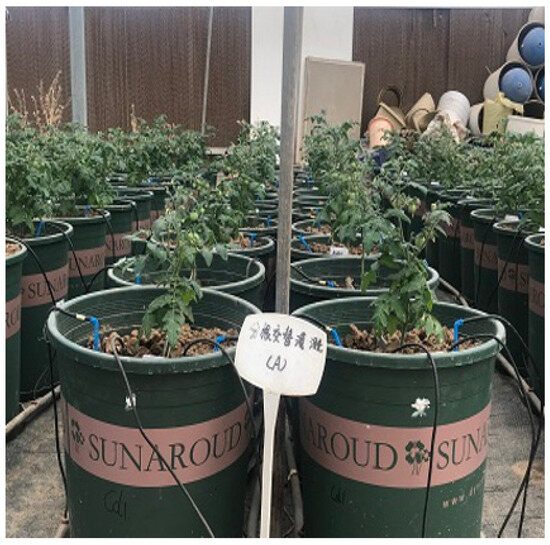
Each composite sample was divided into two parts and placed in clean self-sealing bags after being sieved through a 2 mm sieve. One part was air-dried and stored at room temperature to determine the basic physical and chemical properties of the soil, while the other part was used for subsequent assessment of microbial community diversity in triplicate (Figure 1).
Figure 1.
Potted experiment of partial root-zone alternate irrigation with reclaimed water in cadmium-contaminated soil.
2.3.2. Physicochemical Soil Analysis
The analysis of soil physicochemical properties was conducted in accordance with the methods described by [31] Bao. Soil pH was determined potentiometrically in a 1:5 (w/v) soil-water suspension using a laboratory pH meter (Orion™ Star™ A211 Thermo Scientific, Waltham, MA, USA). Soil electrical conductivity (EC) was measured in the same suspension using a portable conductivity meter (Model DDB-303A, Shanghai INESA Scientific Instrument Co., Ltd., Shanghai, China). Available potassium (AK) content was analyzed by sodium hydroxide fusion and flame photometry. Available phosphorus content (AP) was extracted by NaHCO3 extraction-molybdenum antimony anti-colorimetric method, and the concentrations of total nitrogen (TN) and total phosphorus (TP) were determined simultaneously by continuous flow analysis using an Auto Analyzer 3 (Auto Analyzer 3, BRAN LUEBBE, Norderstedt, Germany, sensitivity 0.001 AUFS). Soil organic matter content (SOM) was measured by the potassium dichromate oxidation method with spectrophotometric detection (sensitivity 0.001AUFS).
Total Cd digestion: Soil samples were digested using the EPA 3050B method (HNO3-H2O2 digestion system). Briefly, 0.5 g of air-dried soil was weighed into a digestion tube, added with 10 mL of concentrated HNO3, and heated at 120 °C for 2 h. After cooling, 3 mL of 30% H2O2 was added, and the mixture was heated at 150 °C until the solution became clear. The digested solution was filtered through a 0.45 μm filter membrane and diluted to 50 mL with deionized water. It denotes the sum of cadmium across all chemical forms in the soil, encompassing soluble, exchangeable, carbonate-bound, iron–manganese oxide-bound, organic-bound, and residual fractions, and reflects the overall soil pollution load and long-term accumulation of Cd in the soil environment.
Available Cd extraction: Extracted using the DTPA method (0.005 mol/L DTPA + 0.01 mol/L CaCl2 + 0.1 mol/L TEA, adjusted to pH 7.3 with HCl). A 10 g soil sample was mixed with 50 mL of DTPA extractant, shaken at 180 rpm for 2 h at 25 °C, and then filtered. This indicator denotes the biologically active cadmium fraction available for direct uptake and utilization by plant root systems. It is the most relevant indicator for assessing the ecological risk of Cd contamination and the potential for Cd accumulation in agricultural products.
Instrumental analysis: Cd concentrations were determined using a flame atomic absorption spectrophotometer (AA-6300, Shimadzu, Kyoto, Japan) with a detection limit of 0.002 mg/L.
Calibration and quality control: A standard curve was prepared using serial dilutions of a 1000 mg/L Cd standard solution, with a correlation coefficient R2 > 0.999. Each batch of analysis included blank samples, national standard soil reference material (GBW07405), and 10% duplicate samples. The recovery rate of the standard material was 92–105%, and the relative standard deviation of duplicate samples was less than 5%.
2.3.3. DNA Extraction
Total genomic DNA was extracted from soil samples using the power Soil DNA isolation Kits (Mo-Bio Laboratories, Carlsbad, CA, USA). The quality and concentration of the extracted DNA were assessed using a NanoDrop 2000 spectrophotometer (Thermo Fisher Scientific, Inc., Waltham, MA, USA). DNA samples that passed quality control were stored at −20 °C for subsequent analysis.
2.3.4. PCR Amplification
Amplification of the bacterial 16S rRNA gene V3-V4 region was carried out with barcoded primers 338F and 806R. To enable sample tracking, an 8 bp barcode was appended to the 5′ end of both forward and reverse primers. Each 25 μL PCR reaction comprised 12.5 μL of 2× Taq Plus Master Mix II (Vazyme Biotech, Nanjing, China), 3 μL of BSA (2 ng/μL), and template DNA. The PCR protocol included an initial denaturation step (95 °C, 5 min), 28 cycles of amplification (95 °C for 45 s, 55 °C for 50 s, 72 °C for 45 s), and a final extension (72 °C, 10 min) performed on an ABI 9700 thermal cycler. The amplicons were electrophoresed on a 1% agarose gel for size verification and subsequently purified with the Agencourt AMPure XP kit (Beckman Coulter, Inc., Brea, CA, USA) prior to sequencing.
2.3.5. Library Construction and MiSeq Sequencing
The purified PCR products were used for library construction with the NEB Next Ultra II DNA Library Prep Kit (New England Biolabs, Inc., Ipswich, MA, USA). The prepared libraries were then sequenced pair-end on an Illumina MiSeq system PE300 (Illumina, Inc., Santiago, CA, USA) through a commercial service provided by Beijing Allwegene Technology Co., Ltd. (Beijing, China). The sequenced raw sequences were uploaded to NCBI’s SRA database. The different samples used the same sequencing specification, and the library types were as follows: library strategy was amplicon, library source was other, library selection was PCR, and library layout was paired. The sequencing platform instrument was Illumina, and the model used was Illumina MiSeq. The target sequencing region was 16S V3-V4, and the original file format was fastq.
2.4. Data Analysis
The initial processing of the raw sequencing data was conducted using QIIME v1.8.0 (Gregory Caporaso, Flagsta, AZ, USA) to demultiplex the sequences by identifying and matching barcodes to their corresponding samples. Following sample separation, the paired-end reads from each sample were assembled into single, longer sequences using the PEAR tool (v0.9.6) for merging overlapping regions and quality control [32].
Data processing was performed as follows: First, paired-end reads were merged and quality-filtered using PEAR (v0.9.6). Quality filtering involved the removal of reads with average quality scores below 20, those containing ambiguous bases, and those with primer mismatches. The merging was conducted with a minimum overlap requirement of 10 bp and a permitted mismatch rate of 0.1. Subsequently, the resulting sequences were further filtered using Vsearch v2.7.1 [33] to discard any sequences shorter than 230 bp. Finally, chimeric sequences were detected and eliminated by comparing the dataset against the Gold database using the UCHIME method [34]. Following quality control, the sequences were clustered into Operational Taxonomic Units (OTUs) using the UPARSE algorithm within Vsearch (version 2.7.1). Clustering was performed at a 97% sequence similarity threshold. Subsequently, the representative sequence of each OTU was subjected to taxonomic classification by aligning against the SILVA 138 database using the BLAST (v2.9.0) algorithm. A maximum e-value threshold of 1 × 10⁻⁵ was applied to ensure the significance of the matches and assign species-level annotations. Within-sample α-diversity was assessed by calculating several indices with QIIME (v1.8.0). These indices captured different aspects of community complexity: the Chao1 index served as a measure of species richness, whereas the Shannon and Simpson indices were employed as estimators of overall diversity, incorporating both the number of species (richness) and the distribution of individuals among those species (evenness). Furthermore, the absolute number of observed OTUs and Good’s coverage index, which quantifies the sequencing depth, were also determined to evaluate the adequacy of the sampling effort. The phylogenetic diversity of the microbial communities was evaluated using the PD_whole_tree index, a measure that accounts for the abundance of species and their phylogenetic distances. In addition, a compositional histogram detailing the relative abundances of different species was generated through analysis of the species annotation data, performed with R software v3.6.0 (Robert Gentleman & Ross Ihaka, NJ, USA). A beta diversity distance matrix was calculated based on weighted UniFrac distances employing QIIME (v1.8.0). Based on this matrix, cluster analysis and Principal Coordinate Analysis (PCoA) were performed within the R statistical framework (v3.6.0) to visualize community similarities. Intergroup variation in community composition was tested for significance using the metastatis method in Mothur (v1.34.4) (Ann Arbor, MI, USA). Graphical representations of the results and data tabulation were prepared using GraphPad Prism 9 and Microsoft Excel 2016, respectively.
3. Results
3.1. Changes in pH, EC, and SOM of Moderate to Mild Cadmium-Contaminated Soil in PRA with Reclaimed Water
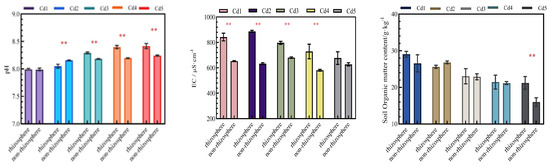
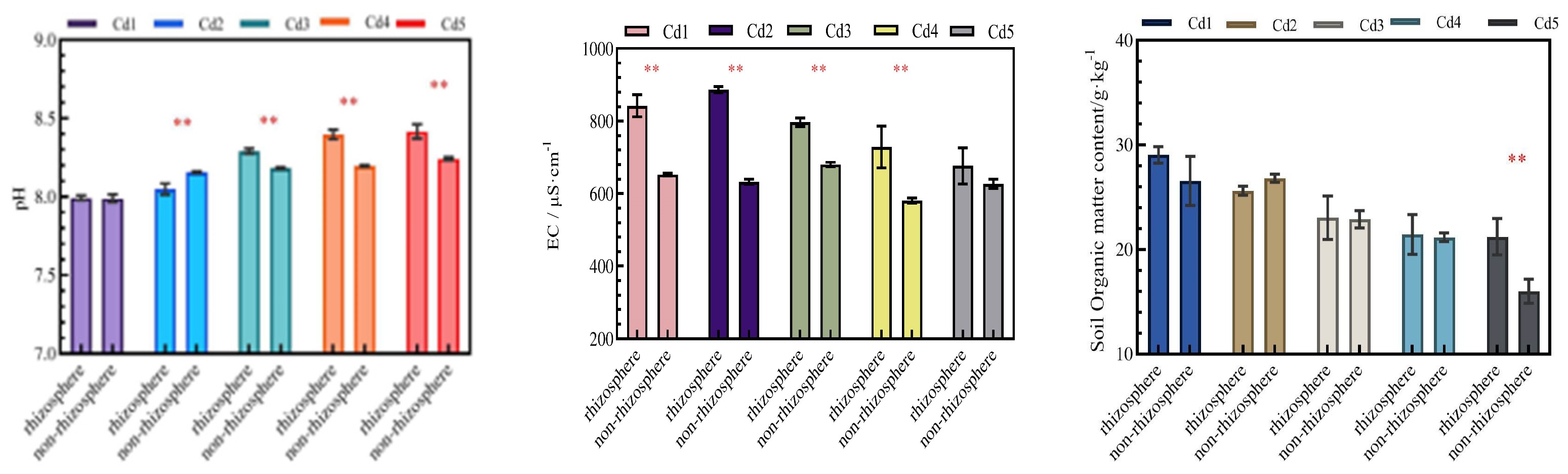
As shown in Figure 2, the pH of both rhizosphere and non-rhizosphere soils under PRA with reclaimed water treatment increased with increasing cadmium concentration. In slightly cadmium-contaminated (Cd2) soil, a significantly lower pH value was observed in the rhizosphere soil compared to the non-rhizosphere soil. While in mildly cadmium-contaminated (Cd3), and moderately cadmium-contaminated (Cd4, Cd5) soils, the pH of the rhizosphere soil was greater than that of the non-rhizosphere soil. The pH difference between rhizosphere and non-rhizosphere soils was highly significant (p < 0.01) at all cadmium concentrations, except for the no pollution (Cd1) soil, which showed no significant difference. Specifically, compared with the Cd1, the Cd5 showed a 0.42-unit increase in rhizosphere soil pH (p < 0.01). The changes in soil EC and pH had different trends. The EC values showed highly significant differences between rhizosphere and non-rhizosphere soils under the PRA with reclaimed water treatment (p < 0.01) in Cd1, Cd2, Cd3, and Cd4 soils. However, in rhizosphere soils, the EC decreased with increasing cadmium concentration, while in non-rhizosphere soils, there was no clear pattern of variation. The changing pattern of soil organic matter (SOM) was similar to the changing pattern of EC. In the rhizosphere soil, the SOM gradually decreased with increasing cadmium concentration, while in the non-rhizosphere soil, the SOM showed a trend of a small increase followed by a gradual decrease. In Cd5 soils, the difference in SOM between rhizosphere and non-rhizosphere soils was highly significant (p < 0.01), while at other cadmium concentrations, the difference was not significant.
Figure 2.
Chang es in pH, electrical conductivity (EC), and soil organic matter content (SOM) in the rhizosphere and non-rhizosphere soils with moderate to mild cadmium contamination for each treatment under partial root-zone alternate irrigation with reclaimed water. Note: “**” means highly significant differences at the 0.01 level, respectively.
3.2. Changes in Total Nitrogen, Total Phosphorus, Available Phosphorus, and Available Potassium in Moderate to Mildly Cadmium-Contaminated Soil in PRA with Reclaimed Water
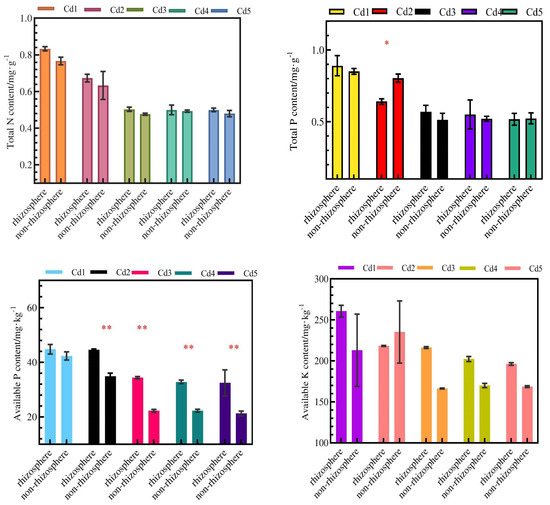
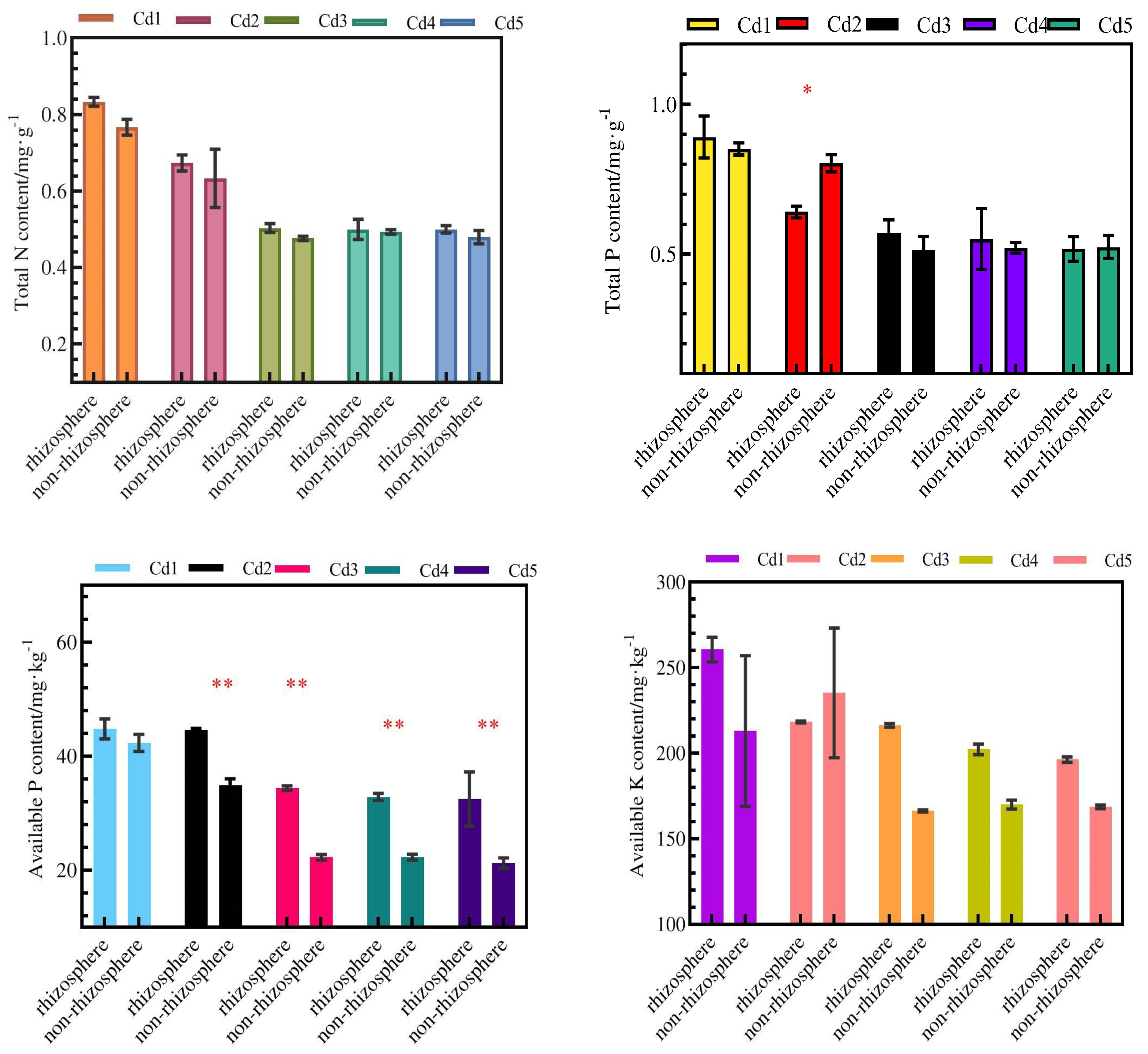
Figure 3 shows that the total nitrogen content in both rhizosphere and non-rhizosphere soils under PRA with reclaimed water decreased steadily with increasing cadmium concentration until Cd3 remained nearly constant in the last three treatments. The total nitrogen (TN) content was consistently higher in rhizosphere soils than in non-rhizosphere soils at all cadmium concentrations. Nevertheless, no statistically significant difference was observed. (p > 0.05). Total phosphorus (TP) content also decreased with increasing cadmium concentration. While the trend of the TN content was gradual, the decrease in the TP content was more abrupt, and the content remained relatively constant after decreasing to a certain level. In the non-rhizosphere soil, the trend of the TP content was similar to that of the TN content. In Cd2 soil, the difference between the TP content in the rhizosphere and non-rhizosphere soils was significant (p < 0.05), but at other cadmium concentrations, no significant differences were observed (p > 0.05). The trend of available phosphorus (AP) content was similar to that of the TP content, and the AP content in both rhizosphere and non-rhizosphere soils decreased with increasing cadmium concentration. The AP content in rhizosphere soils was consistently higher than that in non-rhizosphere soils at all Cd concentrations, and the difference between rhizosphere and non-rhizosphere soils was highly significant (p < 0.01) in Cd2, Cd3, Cd4, and Cd5 soils. The available potassium (AK) content in the rhizosphere soil decreased with increasing cadmium concentration, and the same trend was observed in the non-rhizosphere soil. The difference between the AK content in the rhizosphere and non-rhizosphere soils for each treatment was not significant (p > 0.05).
Figure 3.
Changes in total nitrogen (TN), total phosphorus (TP), available phosphorus (AP), and available potassium (AK) in the rhizosphere and non-rhizosphere soils with moderate to mild cadmium contamination for each treatment under partial root-zone alternate irrigation with reclaimed water. Note: “*” and “**” indicate significant differences at the 0.05 level and highly significant differences at the 0.01 level, respectively.
3.3. Characteristics of Cadmium and Moderate to Mild Light Cadmium-Contaminated Soil Under PRA with Reclaimed Waters
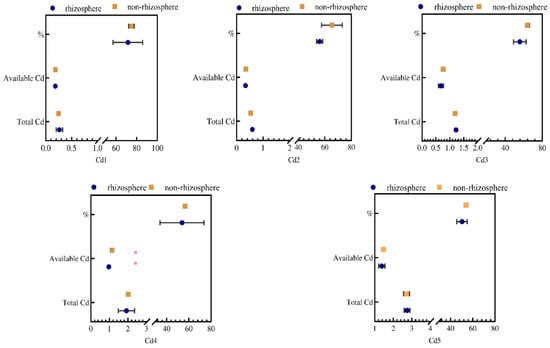
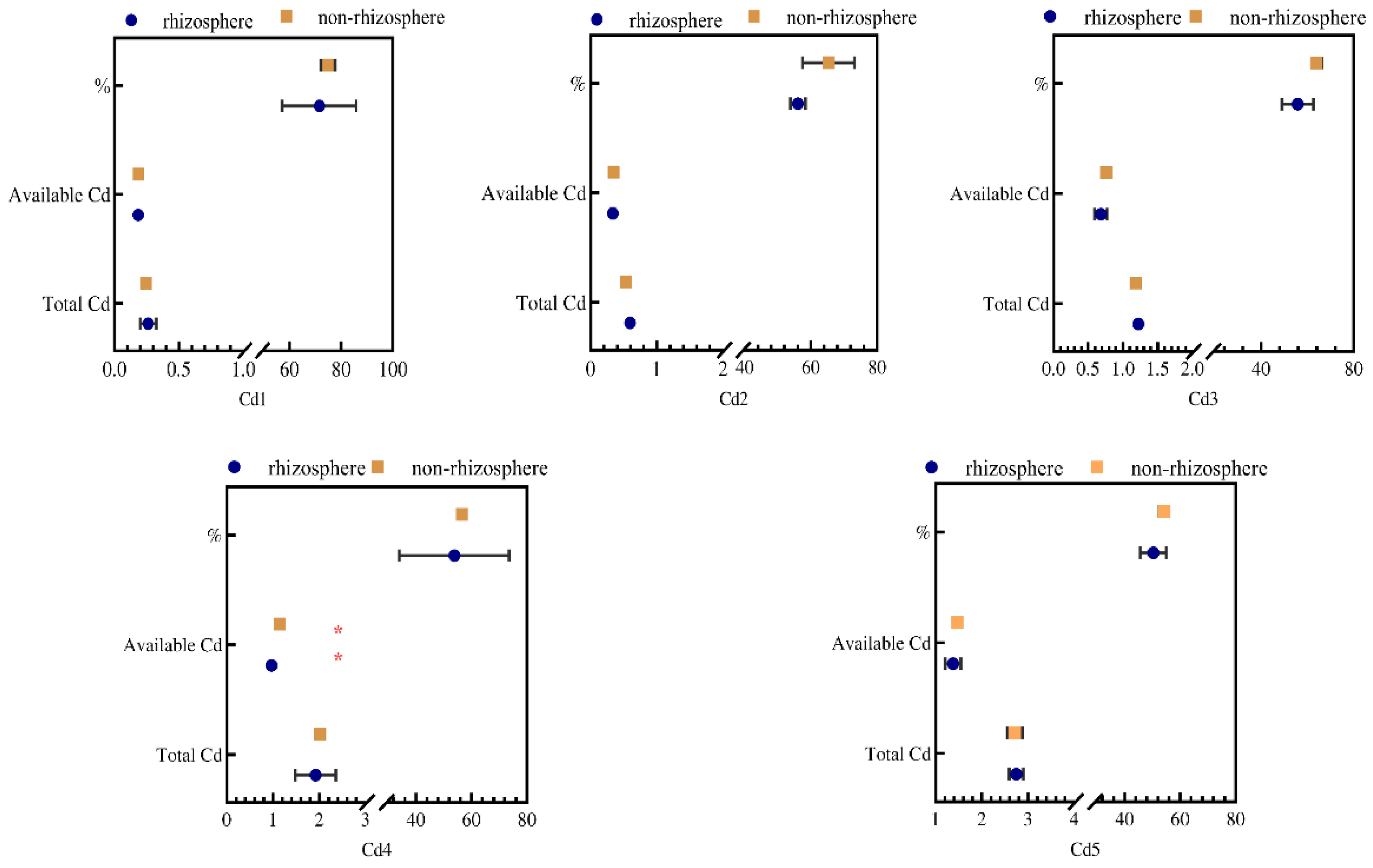
Figure 4 shows that the total Cd content under PRA with reclaimed water did not exceed the set range of the original experiment. Only in the Cd4 treatment group was a highly significant difference observed in soil-available Cd content between the rhizosphere and non-rhizosphere groups (p < 0.01), while in other cadmium concentrations, the total Cd content, available Cd content, and the percentage of available Cd content did not show significant differences. The available Cd content and the percentage of available Cd content were consistently higher in non-rhizosphere soils than in rhizosphere soils at all cadmium concentrations. The percentage of available Cd content showed a gradual decrease in both rhizosphere and non-rhizosphere soils.
Figure 4.
Cd content, available Cd content, and percentage of available Cd in the rhizosphere and non-rhizosphere soil at moderate to mild cadmium contamination. Note: “*” means highly significant differences at the 0.01 level, respectively.
3.4. Changes in Enzyme Activity of Moderate to Mild Light Cadmium-Contaminated Soil in PRA with Reclaimed Water
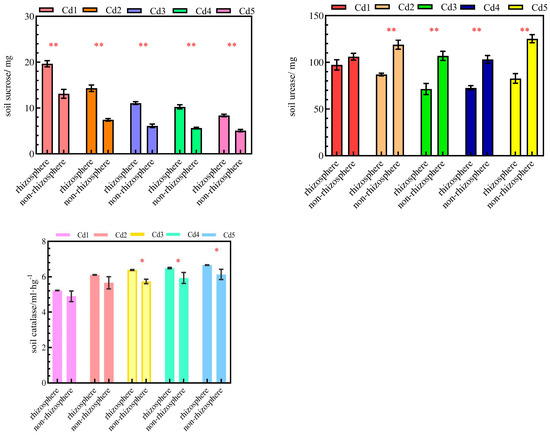
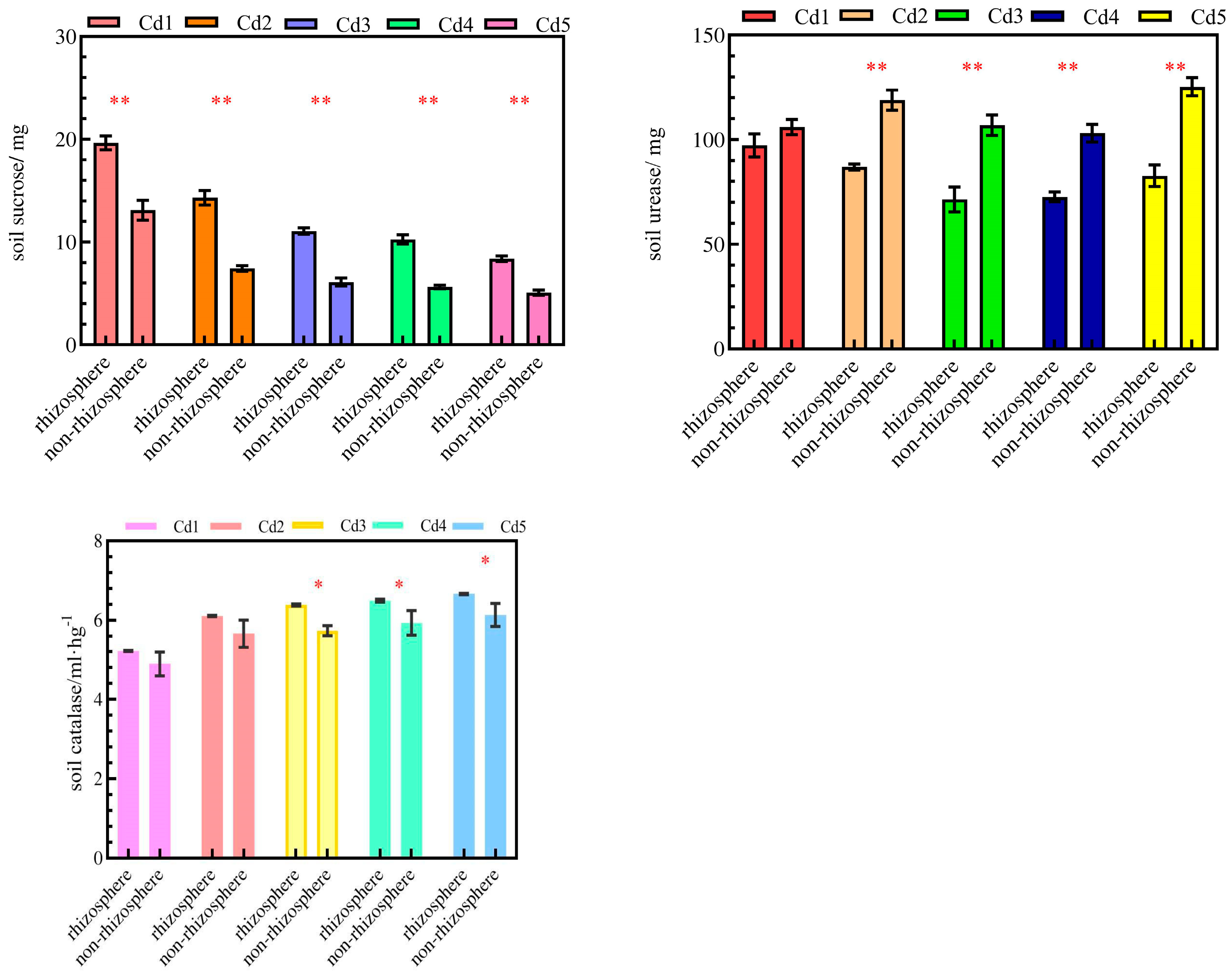
The trends of sucrase, urease, and catalase activities in soils under PRA with reclaimed water were different. Sucrase activity decreased with increasing cadmium concentration in both rhizosphere and non-rhizosphere soils and was consistently higher in rhizosphere soil than in non-rhizosphere soil across all Cd treatments. The difference was observed to reach a highly significant level between rhizosphere and non-rhizosphere soils (p < 0.01) at each cadmium concentration. The trends of urease activity differed between rhizosphere and non-rhizosphere soils, with non-rhizosphere soils showing higher urease activity than rhizosphere soils at corresponding cadmium concentrations. Except for Cd1 soils, the urease activity in both rhizosphere and non-rhizosphere soils reached a highly significant level of difference (p < 0.01) at all cadmium concentrations. In rhizosphere soils, urease activity decreased with increasing cadmium concentration, but non-rhizosphere soils did not show the same trend. In contrast to sucrase and urease, soil catalase activity showed an increasing trend with rising cadmium concentration and was consistently higher in rhizosphere soil than in non-rhizosphere soil across all Cd treatments. However, the rhizosphere soils showed consistently higher catalase activity than non-rhizosphere soils, and the difference between rhizosphere and non-rhizosphere soils reached a significant level (p < 0.05) only in Cd3, Cd4, and Cd5 soils (Figure 5).
Figure 5.
Changes in soil sucrose/urease/catalase in the rhizosphere and non-rhizosphere soils with moderate to mild cadmium contamination for each treatment under partial root-zone alternate irrigation with reclaimed water. Note: “*” and “**” indicate significant differences at the 0.05 level and highly significant differences at the 0.01 level, respectively.
3.5. Microbial Community Structure and Diversity Analysis
High-quality sequences were clustered into operational taxonomic units (OTUs) at a 97% sequence similarity threshold, yielding a total of 4972 OTUs. To ensure comparability across samples with differing sequencing depths, rarefaction (subsampling) was performed, resulting in a normalized set of 4934 sequences per sample for all subsequent analyses. The species classification statistics were carried out, including 42 phyla, 112 classes, 257 orders, 393 families, 701 genera, and 550 species. The Simpson index, which predicts microbial diversity under PRA with reclaimed water at different cadmium concentrations, did not show significant differences, indicating that the differences in soil microbial diversity were not significant at different cadmium concentrations. The index of Good’s coverage, which was used to calculate the community with the increase in sequencing depth, also did not show significant differences, which demonstrates that the sequencing effort adequately captured the microbial community structure, allowing for an accurate characterization of the samples. The observed species index of the number of OTUs actually observed showed significant differences among the different cadmium concentration treatments, indicating that the number of OTUs under PRA with reclaimed water varied greatly at different cadmium concentrations.
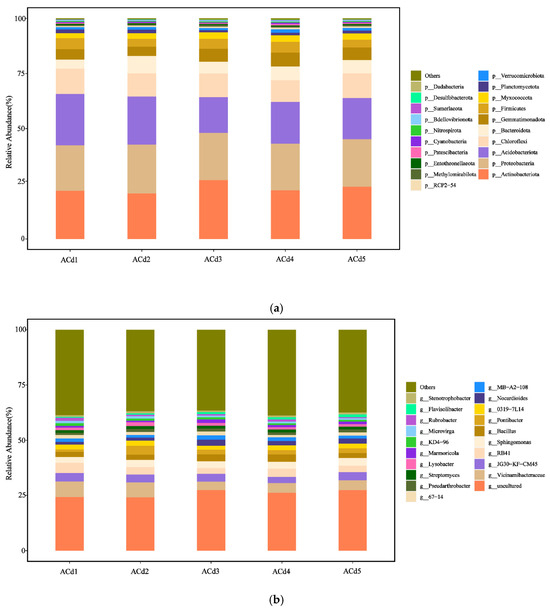
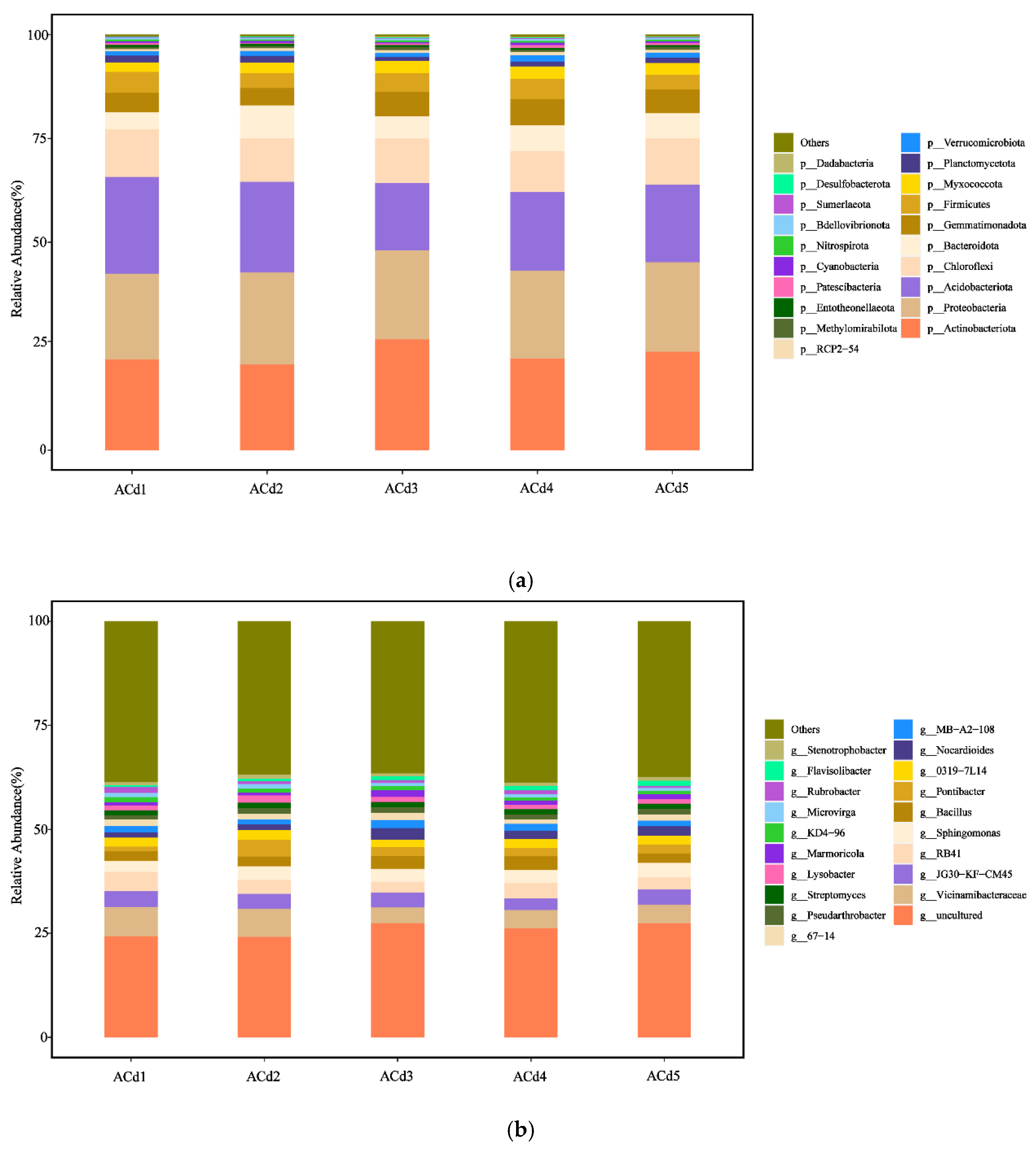
The community composition of rhizosphere soil bacteria at the phylum and genus levels for each treatment is presented in Figure 6. At the phylum level, the bacterial community structure was highly consistent across all treatments. The dominant phyla were Actinobacteria (13.7–20.7%), Proteobacteria (20.0–27.3%), Acidobacteria (16.3–23.3%), Chloroflexi (9.8–11.4%), Bacteroidetes (4.2–7.8%), and Gemmatimonadetes (4.2–6.3%). Collectively, these six phyla constituted over 80% of the total bacterial community. At the genus level, the ten most abundant genera accounted for 50.9–52.4% of the community, and their relative abundances showed only minor variations among the different treatments.
Figure 6.
Bacterial community composition in the rhizosphere soil. Relative abundances of the dominant bacterial communities are shown at the (a) phylum and (b) genus taxonomic levels.
3.6. Correlation Analysis of Bacterial Community Clustering Characteristics and Environmental Factors
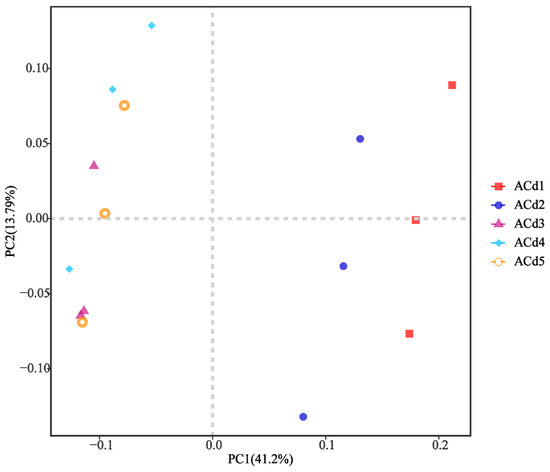
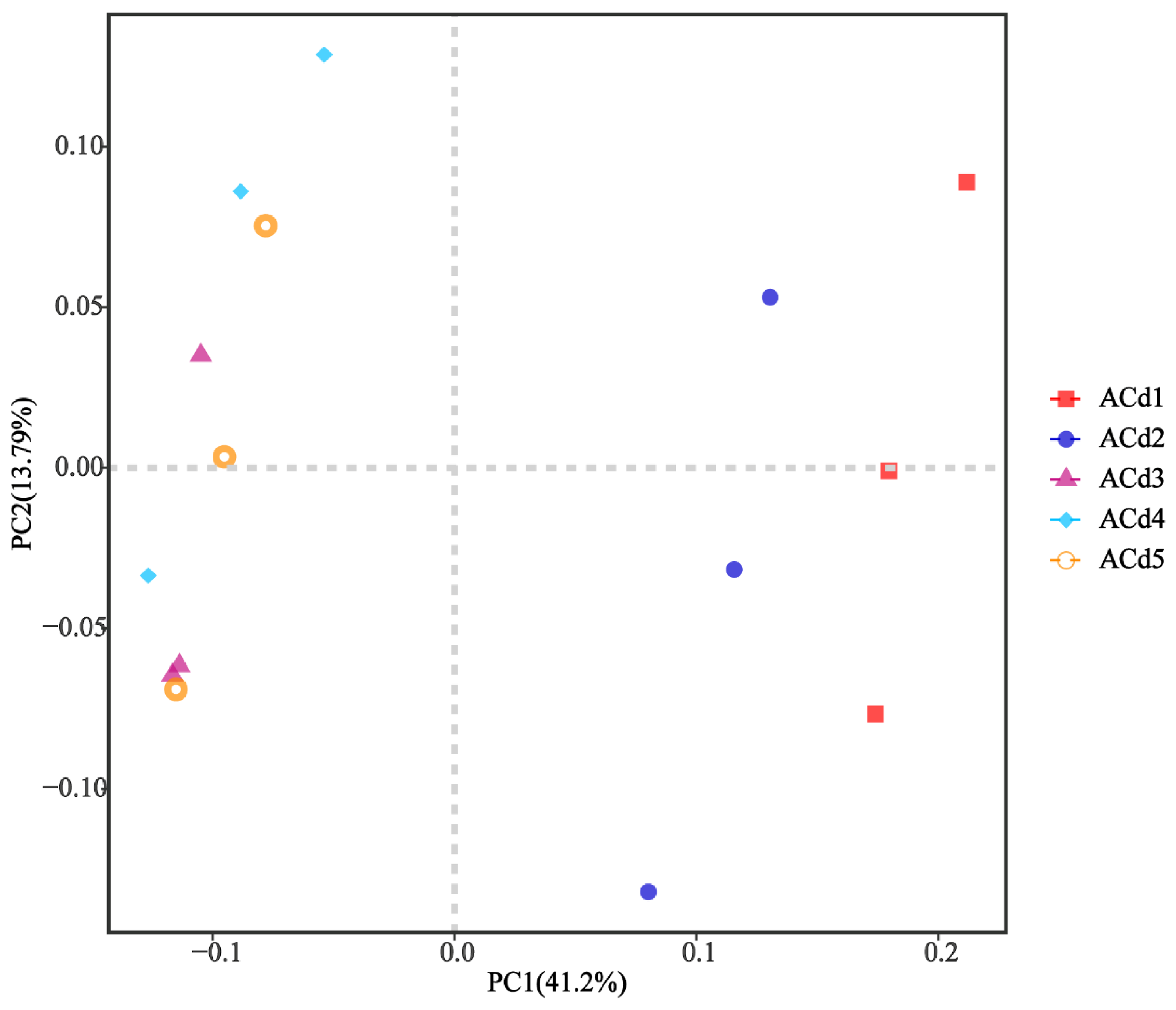
In Figure 7, we performed a principal coordinate analysis (PCoA) based on weighted UniFrac distances to visualize differences in bacterial community structure. Each symbol shape represents a different treatment. The first two principal coordinates (PC1 and PC2) explained 41.20% and 13.79% of the total variance, respectively, resulting in a cumulative explanation of 54.99%.
Figure 7.
PCoA of rhizosphere bacterial communities based on distances across treatments.
The results showed that the bacterial communities of moderate to mildly cadmium-contaminated rhizosphere soils under PRA with reclaimed water were more variable. Cd1 and Cd2 soil samples were on the right side, and the soil samples under the remaining Cd concentrations were on the left side. On the left side, the samples between treatments were widely spaced, while the samples were closely spaced within treatments. While the samples in the Cd3, Cd4, and Cd5 groups were closer together and had similar microbial communities, the samples in the Cd1 and Cd2 groups were farther apart and had different microbial communities. The rhizosphere soil bacterial communities’ composition was significantly impacted by the cadmium concentration, as shown by the shrinking distances between samples within groups and the shrinking differences in microbial community similarity. The sample coverage area between all treatment samples did not overlap in the figure. The sample points were far away from each other, indicating that the microbial community compositions of low cadmium concentration (Cd1, Cd2) and high cadmium concentration (Cd3, Cd4, Cd5) were dissimilar.
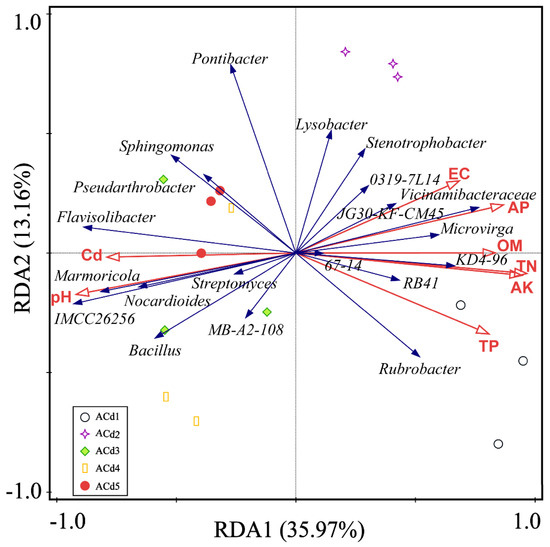
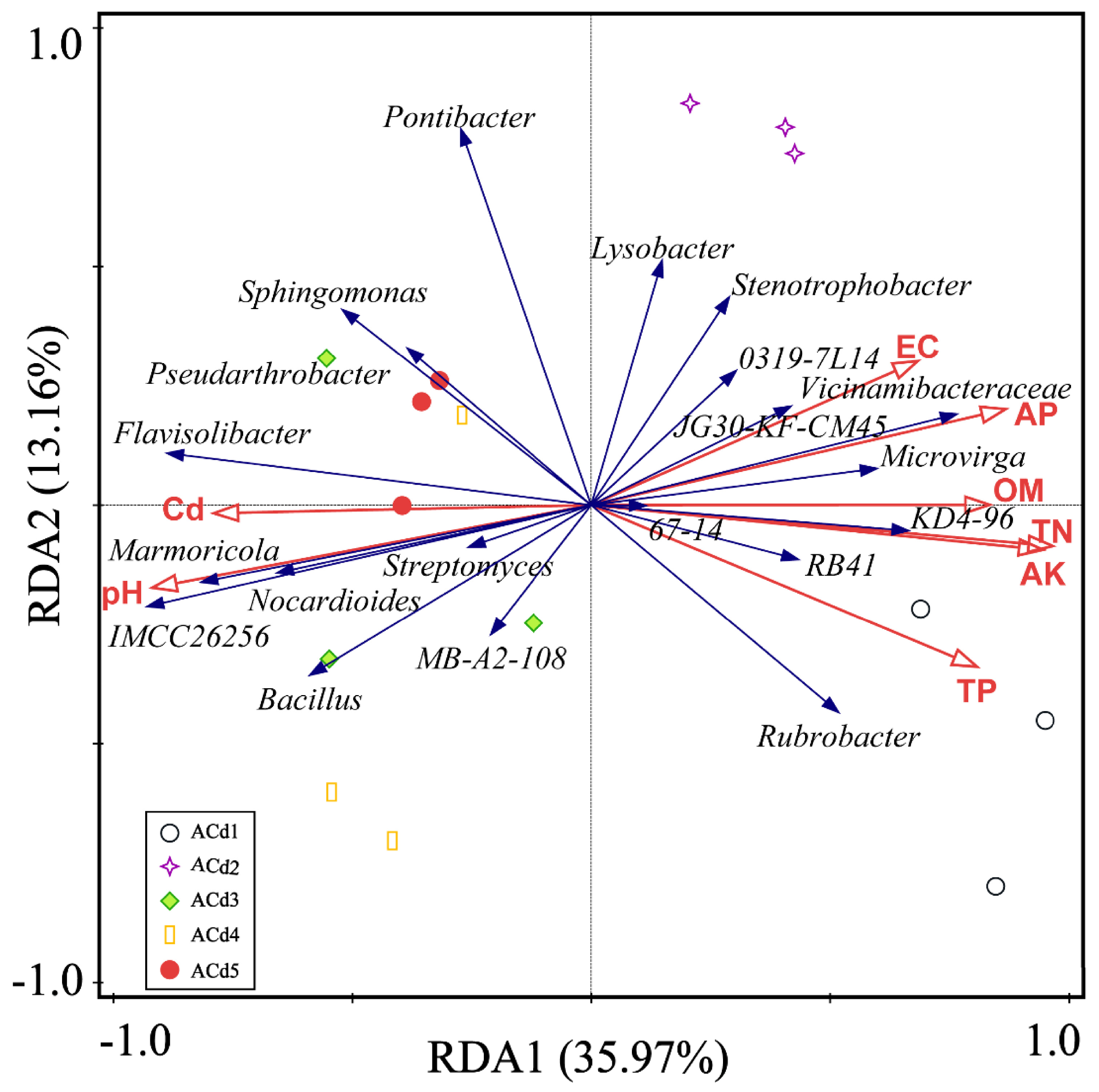
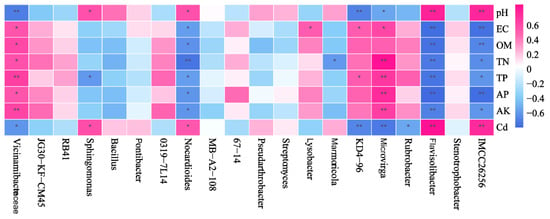
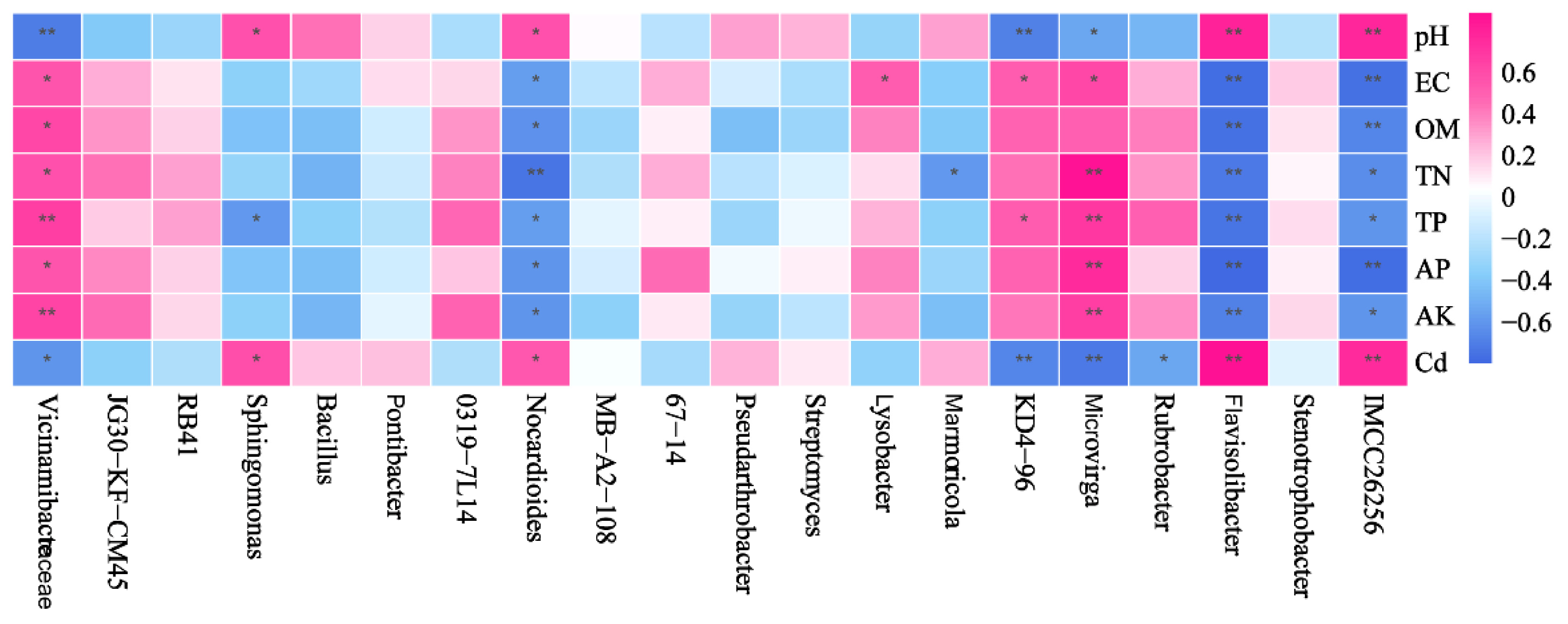
Redundancy analysis (RDA) was performed to explore the relationships between environmental factors and rhizosphere bacterial community composition at the genus level, and pairwise correlations were visualized using a heatmap (Figure 8 and Figure 9).
Figure 8.
RDA of the relationship between bacterial communities and environmental factors under different treatments.
Figure 9.
Heatmap of Spearman’s correlation between environmental factors and bacterial communities. Note: “*” and “**” indicate significant differences at the 0.05 level and highly significant differences at the 0.01 level, respectively.
Flavisolibacter showed highly significant positive correlations with soil pH (r = 0.802, p < 0.001) and total Cd concentration (r = 0.889, p < 0.001), and highly significant negative correlations with all other measured environmental factors. Similarly, Nocardioides exhibited significant positive correlations with pH (r = 0.572, p = 0.026) and total Cd (r = 0.543, p = 0.036) and significant negative correlations with soil nutrients. The genus IMCC26256 also showed highly significant positive correlations with pH (r = 0.786, p < 0.001) and total Cd (r = 0.802, p = 0.001), and highly significant negative correlations with total nitrogen (TN, r = −0.639, p = 0.01), total phosphorus (TP, r = −0.606, p = 0.017), and available potassium (AK, r = −0.601, p = 0.018).
In contrast, Microvirga showed significant negative correlations with pH (r = −0.537, p = 0.039) and total Cd (r = −0.711, p = 0.003), but significant positive correlations with TN (r = 0.857, p < 0.001), TP (r = 0.692, p = 0.002), available phosphorus (AP, r = 0.768, p < 0.01), AK (r = 0.668, p = 0.007), and electrical conductivity (EC, r = 0.625, p = 0.013). The family Vicinamibacteraceae exhibited a similar pattern, with significant negative correlations with pH (r = −0.699, p = 0.004) and total Cd (r = −0.596, p = 0.019), and highly significant positive correlations with TP (r = 0.668, p = 0.007), AK (r = 0.643, p = 0.010), EC (r = 0.564, p = 0.028), soil organic matter (SOM, r = 0.625, p = 0.013), TN (r = 0.582, p = 0.023), and AP (r = 0.554, p = 0.032).
4. Discussion
4.1. Effects of Partial Root-Zone Alternate Irrigation (PRA) with Reclaimed Water on Soil Physicochemical Properties and Enzyme Activity of Moderate to Mild Cadmium Contaminated Soil
Compared to the Cd1 soil, the rhizosphere soil pH under PRA with reclaimed water increased with increasing cadmium concentration (Figure 2), which is consistent with previous studies [35]. In contrast, the EC content showed the opposite trend, decreasing with increasing cadmium concentration (Figure 2). Previous studies have reported that irrigation with reclaimed water may lead to salinity accumulation and salinization [36,37,38]. However, the experimental results suggest that the cyclic wetting and drying process induced by PRA promotes water use efficiency and effective salt uptake [39]. Nonetheless, long-term monitoring of soil EC is necessary to prevent the accumulation of soil salts compared to rhizosphere soils. In non-rhizosphere soils, the trends of pH, EC, and SOM are different. Specifically, the pH is lower in non-rhizosphere soils under Cd3, Cd4, and Cd5, while the EC in non-rhizosphere soils is smaller than in rhizosphere soils under different cadmium contamination. The SOM of rhizosphere and non-rhizosphere soils did not differ significantly.
Nutrient indicators in the soil, including SOM, TN, TP, AP, and AK, are crucial for the growth and development of crops. However, the values of the nutrient indicators decreased with increasing cadmium concentration in soils under PRA with reclaimed water at different cadmium concentrations. Previous studies have reported that irrigation with reclaimed water can increase soil nutrients [40,41]. PRA can also alter soil respiration and regulate soil nutrient profiles [42]. However, the experimental results suggest that long-term cadmium stress may have already damaged soil quality, and the short-term improvement of soil quality by a combination of reclaimed water irrigation and alternate root-splitting irrigation patterns will have a limited effect. Soil enzyme activities also showed different trends under PRA with reclaimed water. Compared to no pollution (Cd1) soil, sucrase and urease activities decreased with increasing cadmium concentration, which was similar to the results of [43]. The reason is that as the concentration of cadmium increases, cadmium ions in the soil alter the conditions of enzymatic reaction equilibrium or form other compounds [44]. Additionally, cadmium had a direct inhibitory effect on urease activity, and catalase activity increased with cadmium concentration; on the other hand, some studies have pointed out that cadmium has a greater direct inhibitory effect on catalase activity [45]. Combined with our experimental results, the reason may be that irrigation with reclaimed water changes the original ecological environment of the soil and stimulates catalase activity instead. Sucrase activity and catalase activity were lower in non-rhizosphere soil than in rhizosphere soil, probably because PRA can stimulate root growth and enhance root vigor, leading to more root exudates that promote enzymatic reactions [46]. On the other hand, Urease showed the opposite trend, probably due to the uneven distribution of wet and dry soil subjected to PRA with reclaimed water, resulting in higher urease activity in non-rhizosphere soils.
4.2. Effect of PRA with Reclaimed Water on Cadmium and Its Morphological Changes in Moderate to Light Cadmium-Contaminated Soil
There was no significant difference (p > 0.05) between rhizosphere and non-rhizosphere soil total Cd in soil under PRA with reclaimed water. However, the available state content of non-rhizosphere soil was higher than that of rhizosphere soil, and the percentage of available state content decreased with increasing cadmium concentration as observed in both the rhizosphere and non-rhizosphere soils. The extent of heavy metal damage to soil and crops depends on the form and quantity of the heavy metals present in the soil, and not all the heavy metal content will be transformed into migration. The available state of heavy metals can provide information on the likelihood of heavy metal migration transformation, the magnitude of toxicity, and the effectiveness of bioavailability [47]. Cadmium is the most common source of pollution, and it is necessary to study the relationship between the available state of cadmium in the soil and the total amount of cadmium. The size of the effective state of cadmium is not only related to its unique nature and content but is also influenced by soil physicochemical properties, microenvironments, agronomic measures, and human behavior [48,49].
4.3. Evolutionary Patterns of Rhizosphere Microbial Community Diversity in Moderate to Mild Cadmium-Contaminated Soils in PRA with Reclaimed Waters
The study aimed to understand the mechanism of root-splitting alternation by examining the microbial community changes in PRA with reclaimed water. The diversity index comparison results revealed that microbial communities’ diversity at different cadmium concentrations was not significantly different [14]. Previous studies have shown that heavy metal stress reduces microbial community diversity [50]. However, the sequencing results (Table 2) did not indicate a significant reduction in microbial diversity due to the increase in cadmium concentration, possibly because PRA could enhance the number of soil microorganisms [51] and compensate for the decrease in diversity caused by heavy metal stress. The dominant bacterial groups in the soil, such as Proteobacteria and Actinobacteria, play crucial roles in the nitrogen cycle, the decay process of organic matter, and soil structure. The Proteobacteria and Actinobacteria showed an eventual increase with the increase of cadmium concentration (Figure 6, Figure 7, Figure 8 and Figure 9), possibly because the PRA increased the uneven distribution of water and alternate irrigation led to frequent soil drying and wetting, resulting in changes in soil nutrients that promoted the growth of Proteobacteria and Actinobacteria [52,53]. Acidobacteria, belonging to heterotrophic flora, are also closely related to heavy metal stress and can potentially change the soil structure. Chloroflexi, involved in the carbon cycle and soil respiration, also play an important role in the soil. However, the relative abundance of the Acidobacteria phylum decreases with the increase in cadmium concentration, following the trend of SOM. Gemmatimonadetes, which can adapt to low-humidity environments, and Bacteroidetes, which can secrete active enzymes and participate in the soil nutrient cycling process, are important parts of the microbial community diversity in the soil [54,55]. The relative abundance of the genus Bacillus showed no statistically significant difference across Cd-contaminated soils under PRA with reclaimed water (Figure 6). At the genus level, Bacillus exhibited a downward trend with increasing Cd concentration; specifically, its relative abundance in the Cd5 treatment was lower than that in the Cd1 treatment under PRA with reclaimed water. This trend is consistent with previous findings that PRA can reduce the relative abundance of potentially pathogenic bacterial taxa in soil [13,56]. The PCoA analysis revealed that the structural composition of microbial communities in Cd1, Cd2, Cd3, Cd4, and Cd5 soils differed significantly. This could be attributed to the frequent dry and wet conditions resulting from PRA, which altered the hydrothermal conditions in the soil environment [57,58]. The key genera, such as Flavisolibacter and Nocardioides, along with environmental factors, showed highly significant positive and negative correlations and were important factors driving the structure of the rhizosphere soil bacterial community. Additionally, they were important influencing factors of the rhizosphere soil bacterial community structure. Flavisolibacter (Bacteroidota/Chitinophagaceae) has repeatedly been recovered as a heavy-metal-tolerant taxon in Cd- and metal-contaminated farmland and has been associated with plant-growth promotion; its enrichment alongside rising pH and Cd is consistent with a pH-favored, metal-tolerant lifestyle. We present Flavisolibacter as a candidate bioindicator of soil status under combined PRA–reclaimed-water–Cd conditions. To further explore the underlying mechanisms, microbial community composition data alone cannot distinguish diverse functional pathways. Therefore, integrated analyses of metagenomics and functional verification experiments are required for in-depth research.
Table 2.
The bacterial community diversity indices for the different treatments.
5. Conclusions
This study demonstrates that the application of partial root-zone alternate irrigation (PRA) with reclaimed water significantly influences the soil microenvironment and mitigates the ecological risks associated with moderate to mild cadmium (Cd) contamination. The principal conclusions are as follows:
1. PRA with RW modulates rhizosphere physicochemical properties to directly reduce Cd bioavailability. This irrigation regime significantly increased rhizosphere soil pH by 0.42 units and decreased electrical conductivity (EC) by 18.7% in the highest Cd treatment. The elevated pH promotes the formation of insoluble Cd hydroxides and carbonates, while reduced EC alleviates cation competition for adsorption sites on soil particles. These changes collectively reduced the proportion of available Cd by 12.3%, without altering the total Cd load in the soil.
2. PRA with RW optimizes rhizosphere microbial community structure to enhance Cd immobilization. The combined treatment enriched beneficial microbial groups, increasing the relative abundance of Actinobacteria by 8.26% and Proteobacteria by 4.64%. These phyla contribute to Cd fixation through extracellular polysaccharide adsorption and biomineralization. Concurrently, the relative abundance of the genus Bacillus decreased by 11.8%. This compositional shift may partially account for the reduced Cd bioavailability, yet this potential causal relationship remains to be validated by dedicated functional experiments.
3. Key microbial genera serve as reliable indicators of soil remediation effectiveness. Multivariate analyses identified Flavisolibacter and Nocardioides as the core genera driving community shifts under PRA with RW treatment. Their strong positive correlations with soil pH and total Cd concentration (r > 0.54, p < 0.05) suggest their potential involvement in Cd immobilization processes, rather than merely being passive responders to Cd contamination. These genera can be used as sensitive biomarkers to monitor the performance of this irrigation strategy in field applications.
4. Several limitations must be acknowledged in this study. Primarily, the absence of systematic data on crop Cd uptake and accumulation precludes the direct quantification of this strategy’s efficacy in mitigating Cd risk in agricultural products. Consequently, the quantitative relationship between microbial-mediated Cd immobilization and plant Cd translocation remains unresolved. Additionally, as a short-term pot experiment, this study limits the extrapolation of long-term field efficacy, and the molecular mechanisms underlying the functional roles of core microbial genera require further elucidation. To address these gaps, future research should prioritize the integration of plant Cd accumulation data (across roots, shoots, and edible tissues) and conduct long-term, multi-site field trials across diverse soil types and climatic conditions. Concurrently, deeper mechanistic investigations into the regulatory pathways of functional microbiota are essential to refine the theoretical framework and bolster the practical application of this irrigation strategy.
Author Contributions
J.C.: conceptualization, data curation, formal analysis, writing—original draft, and funding acquisition. P.L.: methodology, validation, funding acquisition, project administration, and writing—review and editing. T.L. and W.G.: resources, investigation, and formal analysis. M.S.H.: investigation and writing—review and editing. J.L.: funding acquisition and writing—review and editing. All authors have read and agreed to the published version of the manuscript.
Funding
We are grateful to the Henan Institute of Science and Technology Doctoral Startup Project, the Key Research and Development Special Project of Henan Province (No: 241111320100), the Agricultural Science and Technology Innovation Program (No. CAAS-ZDRW202407, CAAS-ASTIP-IFI-05), Key Science and Technology Project of Henan Province (No. 262102311250) and National Natural Science Foundation of China (No: 51679241).
Data Availability Statement
The original contributions presented in the study are included in the article; further inquiries can be directed to the corresponding authors. The datasets generated and analyzed during the current study are available in the NCBI repository, with the accession number PRJNA853538.
Conflicts of Interest
The authors declare that the research was conducted in the absence of any commercial or financial relationships that could be construed as a potential conflict of interest. Soil samples were collected from agricultural lands in the Huang-Huai-Hai Plain with explicit written permission obtained from the Environmental Field Research Station of Xinxiang, Chinese Academy of Agricultural Sciences. All sampling activities strictly complied with the relevant regulations of the People’s Republic of China on agricultural land use and environmental protection. No permits were required for the described non-commercial, academic research activities beyond the aforementioned written consents, and no endangered or protected species were involved in the sampling process.
References
- de Souza, C.C.R.; Maroco, J.P.; Santos, T.P.D.; Rodrigues, M.L.; Lopes, C.M.; Pereira, J.S.; Manuela, M. Partial rootzone drying: Regulation of stomatal aperture and carbon assimilation in field-grown grapevines (Vitis vinifera cv. Moscatel). Funct. Plant Biol. 2003, 30, 653–662. [Google Scholar] [CrossRef] [Scilit]
- De Souza, C.R.; Maroco, J.P.; dos Santos, T.P.; Rodrigues, M.L.; Lopes, C.M.; Pereira, J.S.; Chaves, M.M. Control of stomatal aperture and carbon uptake by deficit irrigation in two grapevine cultivars. Agric. Ecosyst. Environ. 2005, 106, 261–274. [Google Scholar] [CrossRef] [Scilit]
- Kang, S.; Zhang, J.; Liang, Z.; Hu, X.; Cai, H. The Controlled Alternative Irrigation—A New Approach for Water Saving Regulation in Farmland. Agric. Res. Arid Areas 1997, 15, 1–6. [Google Scholar]
- Su, F. Xerophytophysiological Regulations and Xeric Gene Expressions in Response to Partial Root-Zone Alternate Irrigation in Potato Crops; Northeast Agricultural University: Harbin, China, 2014. [Google Scholar]
- Hu, X. Mechanism of Water-Saving of Local Controlled Irrigation for Tomato in Greenhouse and Its Water Deficiency Diagnosis; Northwest A & F University: Yangling, China, 2012. [Google Scholar]
- Dbara, S.; Haworth, M.; Emiliani, G.; Ben Mimoun, M.; Gómez-Cadenas, A.; Centritto, M. Partial Root-Zone Drying of Olive (Olea europaea var. ‘Chetoui’) Induces Reduced Yield under Field Conditions. PLoS ONE 2016, 11, e0157089. [Google Scholar] [CrossRef] [Scilit] [PubMed]
- Du, T.; Kang, S.; Zhang, J.; Li, F. Water use and yield responses of cotton to alternate partial root-zone drip irrigation in the arid area of north-west China. Irrig. Sci. 2008, 26, 147–159. [Google Scholar] [CrossRef] [Scilit]
- Shahnazari, A.; Liu, F.; Andersen, M.N.; Jacobsen, S.-E.; Jensen, C.R. Effects of partial root-zone drying on yield, tuber size and water use efficiency in potato under field conditions. Field Crops Res. 2007, 100, 117–124. [Google Scholar] [CrossRef] [Scilit]
- Wang, L. Adaptation of Ginkgo biloba to Alternate Irrigation in the Divided Root Zone; Nanjing Forestry University: Nanjing, China, 2013. [Google Scholar]
- Zhao, D. Research on Effect of Alternate Root-Zone Drip Irrigation on Physiological, Growth and Yield of Processing Tomato; Shihezi University: Shihezi, China, 2019. [Google Scholar]
- Fu, F.; Li, F.; Kang, S. Alternate partial root-zone drip irrigation improves water– and nitrogen– use efficiencies of sweet-waxy maize with nitrogen fertigation. Sci. Rep. 2017, 7, 17256. [Google Scholar] [CrossRef] [Scilit] [PubMed]
- Liu, R.; Yang, Y.; Wang, Y.; Wang, X.; Rengel, Z.; Zhang, W.; Shu, L. Alternate partial root-zone drip irrigation with nitrogen fertigation promoted tomato growth, water and fertilizer-nitrogen use efficiency. Agric. Water Manag. 2020, 233, 106049. [Google Scholar] [CrossRef] [Scilit]
- Stikic, R.; Popovic, S.; Srdic, M.; Savic, D.; Jovanovic, Z.; Prokic, L.J.; Zdravkovic, J. Partial Root Drying (PRD): A New Technique For Growing Plants That Saves Water and Improves the Quality of Fruit. Bulg. J. Plant Physiol. 2003, 164–171. Available online: http://www.bio21.bas.bg/ippg/bg/wp-content/uploads/2011/06/03_essa_164-171.pdf (accessed on 1 April 2026).
- Wang, J.; Niu, W.; Zhang, M.; Li, Y. Effect of alternate partial root-zone drip irrigation on soil bacterial communities and tomato yield. Appl. Soil Ecol. 2017, 119, 250–259. [Google Scholar] [CrossRef] [Scilit]
- Liu, F.; Shahnazari, A.; Andersen, M.N.; Jacobsen, S.-E.; Jensen, C.R. Effects of deficit irrigation (DI) and partial root drying (PRD) on gas exchange, biomass partitioning, and water use efficiency in potato. Sci. Hortic. 2006, 109, 113–117. [Google Scholar] [CrossRef] [Scilit]
- Mingo, D.M.; Theobald, J.C.; Bacon, M.A.; Davies, W.J.; Dodd, I.C. Biomass allocation in tomato (Lycopersicon esculentum) plants grown under partial rootzone drying: Enhancement of root growth. Funct. Plant Biol. 2004, 10, 971. [Google Scholar] [CrossRef] [Scilit]
- Xu, H.; Qin, F.; Xu, Q.; Tan, J.; Liu, G. Applications of xerophytophysiology in plant production—The potato crop improved by partial root zone drying of early season but not whole season. Sci. Hortic. 2011, 129, 528–534. [Google Scholar] [CrossRef] [Scilit]
- Zhao, D.; Wang, Z.; Zhang, J.; Li, W.; Wang, F. Effects of Different Irrigation Methods and Irrigation Amount on Physiological Growth and Yield of Processing Tomato in Northern Xinjiang. J. Soil Water Conserv. 2018, 6, 175–185. [Google Scholar]
- Fatta-Kassinos, D.; Cytryn, E.; Donner, E.; Zhang, T. Challenges related to antimicrobial resistance in the framework of urban wastewater reuse. Water Res. 2020, 170, 115308. [Google Scholar] [CrossRef] [Scilit] [PubMed]
- Shtull-Trauring, E.; Cohen, A.; Ben-Hur, M.; Israeli, M.; Bernstein, N. NPK in treated wastewater irrigation: Regional scale indices to minimize environmental pollution and optimize crop nutritional supply. Sci. Total Environ. 2022, 806, 150387. [Google Scholar] [CrossRef] [Scilit] [PubMed]
- Grattan, S.R.; Díaz, F.J.; Pedrero, F.; Vivaldi, G.A. Assessing the suitability of saline wastewaters for irrigation of citrus spp. emphasis on boron and specific-ion interactions. Agric. Water Manag. 2015, 157, 48–58. [Google Scholar] [CrossRef] [Scilit]
- Alcaide Zaragoza, C.; Fernández García, I.; Martín García, I.; Camacho Poyato, E.; Rodríguez Díaz, J.A. Spatio-temporal analysis of nitrogen variations in an irrigation distribution network using reclaimed water for irrigating olive trees. Agric. Water Manag. 2022, 262, 107353. [Google Scholar] [CrossRef] [Scilit]
- Li, P.; Fan, X.; Qi, X.; Fan, T.; Zhao, Z.; Zhao, X. Influence of Soil Residual Nitrogen and Coliforms in Potato Under Alternate Irrigation with Chlorine Reclaimed Water. Chin. Agric. Sci. Bull. 2013, 29, 82–87. [Google Scholar]
- Xue, B.Q.; Huang, Z.D.; Qiao, D.M.; Li, P.; Zhao, Z.J.; Fan, T.; Wu, H.Q.; Fan, X.Y.; Hu, C.; Zhu, D.H.; et al. Effect of New Irrigation Technology on the Physiology and Water Use Efficiency of Potato by Reclaimed Water Irrigation. Adv. Mater. Res. 2013, 726–731, 3035–3039. [Google Scholar] [CrossRef] [Scilit]
- Qi, X.; Li, P.; Fan, X.; Zhao, Z.; Fan, T.; Huang, Z.; Qiao, D. Soil heavy metal residue under different treated waste-water irrigation technique and management. Chin. J. Eco-Agric. 2008, 16, 839–842. [Google Scholar] [CrossRef] [Scilit]
- Zou, J.; Xin, J.; Wang, T.; Song, Q. Impact of alternate partial root-zone irrigation on the rhizosphere microbiota of alfalfa plants inoculated with rhizobia. Front. Microbiol. 2024, 15, 1372542. [Google Scholar] [CrossRef] [Scilit] [PubMed]
- Lei, Z.; Zhang, H.; Liu, W.; Sheng, J.; Zhang, H.; Wang, Y.; Tang, Y.; Wang, H.; Ding, C.; Qiao, W.; et al. Dynamic and Stable Core Microbiota Assist Plants in Enriching Selenium and Reducing Cadmium Absorption. Adv. Sci. 2025, 12, e00862. [Google Scholar] [CrossRef] [Scilit]
- Zhao, S.; Meng, Y.; Yang, Z.; Li, B.L.; Li, Y.; Han, H.; Liu, L.; Duan, P.; Chen, Z. Rhizosphere microbiome metagenomics in PGPR-mediated alleviation of combined stress from polypropylene microplastics and Cd in hybrid Pennisetum. Front. Microbiol. 2025, 16, 1549043. [Google Scholar] [CrossRef] [Scilit] [PubMed]
- National Soil Pollution Survey Bulletin; Ministry of Environmental Protection & Ministry of Land and Resources: Beijing, China, 2014.
- Smalla, K.; Wieland, G.; Buchner, A.; Zock, A.; Parzy, J.; Kaiser, S.; Roskot, N.; Heuer, H.; Berg, G. Bulk and Rhizosphere Soil Bacterial Communities Studied byDenaturing Gradient Gel Electrophoresis: Plant-Dependent Enrichment and Seasonal Shifts Revealed. Appl. Environ. Microbiol. 2001, 67, 4742–4751. [Google Scholar] [CrossRef] [Scilit] [PubMed]
- Bao, S. The Soil Agrochemical Analysis, 3rd ed.; China Agriculture Press: Beijing, China, 2000. [Google Scholar]
- Zhang, J.; Kobert, K.; Flouri, T.; Stamatakis, A. PEAR: A fast and accurate Illumina Paired-End reAd mergeR. Bioinformatics 2014, 30, 614–620. [Google Scholar] [CrossRef] [Scilit] [PubMed]
- Rognes, T.; Flouri, T.; Nichols, B.; Quince, C.; Mahé, F. VSEARCH: A versatile open source tool for metagenomics. PeerJ 2016, 4, e2584. [Google Scholar] [CrossRef] [Scilit] [PubMed]
- Edgar, R.C. UPARSE: Highly accurate OTU sequences from microbial amplicon reads. Nat. Methods 2013, 10, 996–998. [Google Scholar] [CrossRef] [Scilit] [PubMed]
- Da Fonseca, A.F.; Melfi, A.J.; Montes, C.R. Maize Growth and Changes in Soil Fertility After Irrigation with Treated Sewage Effluent. I. Plant Dry Matter Yield and Soil Nitrogen and Phosphorus Availability. Commun. Soil Sci. Plant Anal. 2005, 36, 1965–1981. [Google Scholar] [CrossRef] [Scilit]
- Corry, M.; While, A.; Neenan, K.; Smith, V. A systematic review of systematic reviews on interventions for caregivers of people with chronic conditions. J. Adv. Nurs. 2015, 71, 718–734. [Google Scholar] [CrossRef] [Scilit] [PubMed]
- Han, Y. Effects of Different Irrigation Levels of Reclaimed Water on Soil Quality and Distribution of Soil Pathogens; Chinese Academy of Agricultural Sciences: Beijing, China, 2019. [Google Scholar]
- Chen, W.; Lu, S.; Pan, N.; Jiao, W. Impacts of long-term reclaimed water irrigation on soil salinity accumulation in urban green land in Beijing. Water Resour. Res. 2013, 49, 7401–7410. [Google Scholar] [CrossRef] [Scilit]
- Chen, J. Effect of Alternated Different Irrigation Amount Modes and Salt Treatment on Growth and Na+ Accumulate of Jatropha curcas L.; Kunming University of Science & Technology: Kunming, China, 2016. [Google Scholar]
- Gong, X. The Research About The Variation Regulation of Soil Chemical Properties and Microorganisms in the Process of Reclaimed Water Reuse; Harbin Normal University: Harbin, China, 2015. [Google Scholar]
- Guo, X.; Ma, T.; Chen, L.; Liu, L. Quantitative Analysis of Soil Pores under Sewage Irrigation Using Computerized Tomography. Earth Sci.-J. China Univ. Geosci. 2015, 40, 1896–1903. [Google Scholar]
- Pu, J.; Fan, Y.; Feng, X.; Liu, Y.; Qiao, S.; Liu, R. Effects of alternate partial root-zone irrigation on soil moisture and nutrient conditions and crop growth. Soil Fertil. Sci. China 2022, 9, 209–215. [Google Scholar] [CrossRef]
- Wang, Y.; Yan, A.; Dai, J.; Wang, N.; Wu, D. Accumulation and tolerance characteristics of cadmium in Chlorophytum comosum: A popular ornamental plant and potential Cd hyperaccumulator. Environ. Monit. Assess. 2011, 184, 929–937. [Google Scholar] [CrossRef] [Scilit] [PubMed]
- He, W.; Zhu, M.; Zhang, Y. Recent Advance in Relationship between Soil Enzymes and Heavy Metals. Soil Environ. Sci. 2000, 9, 139–142. [Google Scholar]
- Guo, B.; Chen, X.; Jing, F.; Zhang, X.; Liu, W. Effects of exogenous cadmium on microbial biomass and enzyme activity in red paddy soil. J. Agro-Environ. Sci. 2018, 37, 1850–1855. [Google Scholar] [CrossRef]
- Yang, S.; Li, B.; Qi, G.; Guo, S.; Hu, Z. Effects of alternate partial rootzone irrigation on roots activity, stem sap flow and fruit of apple. Trans. CSAE 2010, 26, 73–79. [Google Scholar] [CrossRef]
- Ure, A.M. Single extraction schemes for soil analysis and related applications. Sci. Total Environ. 1996, 178, 3–10. [Google Scholar] [CrossRef] [Scilit]
- Xie, Y. Study on the Correlation Between Available Cadmium in Soil and Cadmium Content in Rice Under Different pH Paddy Fields; Hunan University: Changsha, China, 2019. [Google Scholar]
- Zhong, X.; Zhou, S.; Li, J.; Zhao, Q. Soil Available Cd, Cu, Pb Distribution Characteristic and Its Influencing Factors. Sci. Geogr. Sin. 2010, 30, 254–260. [Google Scholar]
- Wu, W.; Chen, Y.; Li, G.; Zhang, W.; Lin, H.; Lin, Z.; Zhen, Z. Effects of rice straw biochar on tomato yield and quality in farmland affected by Cd contamination. J. Agro-Environ. Sci. 2022, 41, 492–503. [Google Scholar] [CrossRef]
- Wu, J.; Jiang, Y.; Wu, Y.; Xu, J. Effect of complex heavy metal pollution on biomass and community structure of soil microbes in paddy soil. Acta Pedol. Sin. 2008, 45, 1102–1109. [Google Scholar]
- Cheung, M.K.; Au, C.H.; Chu, K.H.; Kwan, H.S.; Wong, C.K. Composition and genetic diversity of picoeukaryotes in subtropical coastal waters as revealed by 454 pyrosequencing. ISME J. 2010, 4, 1053–1059. [Google Scholar] [CrossRef] [Scilit] [PubMed]
- Sánchez-Martín, L.; Vallejo, A.; Dick, J.; Skiba, U.M. The influence of soluble carbon and fertilizer nitrogen on nitric oxide and nitrous oxide emissions from two contrasting agricultural soils. Soil Biol. Biochem. 2008, 40, 142–151. [Google Scholar] [CrossRef] [Scilit]
- Selim, T.; Berndtsson, R.; Persson, M.; Somaida, M.; El-Kiki, M.; Hamed, Y.; Mirdan, A.; Zhou, Q. Influence of geometric design of alternate partial root-zone subsurface drip irrigation (APRSDI) with brackish water on soil moisture and salinity distribution. Agric. Water Manag. 2012, 103, 182–190. [Google Scholar] [CrossRef] [Scilit]
- Li, S.; Fan, X.; Cui, E.; Gao, F.; Wu, H.; Li, S.; Cui, B.; Hu, C. Effects of Dripping Rate with Reclaimed Water on Typical Microbial Community Structure in the Root Zone Soil of Tomato. J. Irrig. Drain. 2021, 40, 26–35. [Google Scholar] [CrossRef]
- Xian, W.; Zhang, X.; Li, W. Research status and prospect on bacterial phylum Chloroflexi. Microbiol. Technol. Microb. Ecol. Theory 2020, 60, 1801–1820. [Google Scholar] [CrossRef]
- Loveys, B.R.; Dry, P.R.; Stoll, M.; McCarthy, M.G. Using Plant Physiology to Improve the Water Use Efficiency of Horticultural Crops. Acta-Hortic. 2001, 537, 187–197. [Google Scholar]
- Wang, Y.; Liu, F.; de Neergaard, A.; Jensen, L.S.; Luxhøi, J.; Jensen, C.R. Alternate partial root-zone irrigation induced dry/wet cycles of soils stimulate N mineralization and improve N nutrition in tomatoes. Plant Soil 2010, 337, 167–177. [Google Scholar] [CrossRef] [Scilit]

Disclaimer/Publisher’s Note: The statements, opinions and data contained in all publications are solely those of the individual author(s) and contributor(s) and not of MDPI and/or the editor(s). MDPI and/or the editor(s) disclaim responsibility for any injury to people or property resulting from any ideas, methods, instructions or products referred to in the content. |
© 2026 by the authors. Licensee MDPI, Basel, Switzerland. This article is an open access article distributed under the terms and conditions of the Creative Commons Attribution (CC BY) license.