


Abstract
Background/Objectives: We examined seasonal changes in bronchiolitis-related hospital use following the introduction of respiratory syncytial virus (RSV) prevention in France. Methods: This single-center observational study included 7083 emergency department presentations over five pre-implementation (2018–2023) and two post-implementation (2023–2025) seasons. Conventional ward hospitalization proportions were compared between infants aged <1 year and older children using difference-in-differences regression. Immunization histories were unavailable; virological information was limited to selectively tested subsets. Results: Infant hospitalization proportions decreased from 35.2% to 31.6%, while proportions among older children increased from 24.9% to 29.9%. The older-versus-infant interaction incidence rate ratio was 1.339 (95% confidence interval 1.038–1.727; p = 0.025) with Poisson regression but was not significant with quasi-Poisson regression (95% confidence interval 0.950–1.886; p = 0.087). Excluding 2023–2024 removed statistical significance. Conclusions: An age-specific temporal association was observed, with uncertainty across models and seasons. Two post-implementation seasons, maternal vaccination introduced only in the second, incomplete virological ascertainment, absent immunization histories, and changing care organization prevent causal attribution or separation of the contributions of nirsevimab and maternal vaccination.
1. Introduction
Bronchiolitis is a clinical syndrome caused by RSV and other respiratory viruses. RSV-associated lower respiratory tract infection places a substantial burden on infants, particularly during the first months of life [1]. French surveillance during the COVID-19 pandemic documented delayed or unusually intense epidemics and changes in the age distribution of cases [2,3]. These disruptions complicate comparisons across seasons. Before the introduction of broadly offered infant prevention, palivizumab prophylaxis was used predominantly in selected high-risk children, including those with prematurity, bronchopulmonary dysplasia, or congenital heart disease [4]. Nirsevimab subsequently provided a single-dose preventive option supported by randomized trials [5,6]. At the same time, maternal RSVpreF vaccination provided passive infant protection via transplacental antibodies, as supported by the MATISSE randomized trial and its follow-up [7,8]. French studies that incorporate documented preventive exposure and RSV-specific outcomes have estimated the effectiveness against hospitalization [9,10,11,12].
Recent evidence extends this context beyond the first implementation season. Multicenter French studies have evaluated laboratory-confirmed RSV bronchiolitis with documented nirsevimab exposure [13], while population-based surveillance in the United States has assessed both nirsevimab and maternal vaccination [14]. Hospitalization trends also reflect pandemic-related changes in seasonality and age distribution [15]. These different designs address distinct questions and should not be interpreted as interchangeable measures of preventive benefit.
These effectiveness studies do not directly describe every aspect of local, all-cause bronchiolitis service use. In particular, RSV-specific hospitalization incidence and the proportion of syndromic bronchiolitis emergency department (ED) presentations that are followed by conventional-ward admission are distinct outcomes. Our contribution is a seven-season description of this conditional admission proportion, with a contemporaneous age comparison and several sensitivity analyses. It complements, rather than substitutes for, studies of individual preventive effectiveness. We compared pre-to-post changes in infants aged <1 year with those in older children at the University Hospital of Saint-Étienne; the study was not designed to attribute changes to any particular preventive product.
2. Methods and Statistical Analysis
2.1. Study Design and Population
We conducted a single-center observational study of routinely recorded ED presentations at the University Hospital of Saint-Étienne over seven consecutive respiratory seasons, from 1 September 2018 to 31 August 2025. Each season extended from 1 September to 31 August. The study size was determined by the available seven-season departmental dataset, rather than a prospective sample-size calculation. The analytic units for regression were the 14 season-by-age cells. Counts represent presentations, not necessarily unique children; seasonal aggregation does not establish independence of repeated presentations or successive seasons.
Bronchiolitis presentations were retrospectively identified using standardized departmental diagnostic coding in the pediatric ED electronic records (Easily extraction module v1.0.27.0, ASUR module, and internal University Hospital of Saint-Etienne software). The primary departmental definition was retained, with a broader ICD-10 J21-based sensitivity definition. Case ascertainment was syndromic, without systematic RSV confirmation. Aggregate rapid-antigen testing and positivity counts were available by age and period, including among hospitalized children (Supplementary Table S3), but no complete individual-level virological dataset was linked to preventive exposure, severity, and seasonal outcomes. These aggregate counts were used descriptively and not to classify all presentations as RSV-positive or RSV-negative.
2.2. RSV Prevention Context and Data Availability
The French nirsevimab campaign began on 15 September 2023 for infants entering their first RSV season, initially including those born on or after 6 February 2023 [16]. Nirsevimab remained available in 2024–2025 for eligible infants entering their first season. Maternal RSVpreF vaccination was introduced in September 2024 as an alternative route for infant protection, recommended at 32–36 weeks of gestation during the seasonal campaign. Both were offered as voluntary, recommended preventive strategies rather than mandatory immunizations [17,18]. Individual eligibility and receipt were not ascertainable from our calendar-age categories.
Availability is distinct from uptake. For 2023–2024, national modeling estimated 215,000 nirsevimab doses administered by 31 January 2024, a utilization estimate rather than a coverage percentage [16]; coverage in two major Lyon maternity units was 79.3% [10]. For 2024–2025, a single French maternity study reported a 41.4% uptake of neonatal nirsevimab [18]. National maternal RSVpreF uptake was 27.2% among 264,471 eligible women, and the reported crude proportion in Auvergne-Rhône-Alpes was 29.7% [17]. The populations and observation windows differ, so these estimates cannot be pooled or applied to Saint-Étienne. Center-specific coverage for either season and individual palivizumab histories were unavailable (Supplementary Tables S6 and S7).
The feasibility of retrospective ascertainment was assessed with respect to the source dataset. Individual nirsevimab administration, maternal RSV vaccination, palivizumab use, and linked laboratory confirmation of RSV were not collected in the study source record. The underlying hospital-record database exists, but its availability does not provide these missing study variables or a complete linked maternal–infant immunization and virology history. No validated linkage to an external immunization, maternity, or laboratory database was available for this revision, and no additional individual-level extraction or linkage was performed. The available aggregate rapid-antigen counts were retained as descriptive information; they do not constitute individual RSV ascertainment.
2.3. Study Periods and Outcomes
Five seasons (2018–2019 to 2022–2023) were classified as pre-implementation and two (2023–2024 and 2024–2025) as post-implementation. These are calendar categories, not individual exposure categories. The primary outcome was the proportion of bronchiolitis ED presentations resulting in conventional-ward hospitalization. The PICU organization changed between November 2023 and November 2025, overlapping with the post-implementation period and accompanied by expanded criteria for intermediate-care admissions. PICU admissions were therefore reported descriptively; total hospitalization (conventional ward plus PICU) was retained as a secondary, supportive outcome. Selecting conventional ward admission does not eliminate bias from redistribution between care levels. Longitudinal information on conventional-ward bed capacity, occupancy, staffing, and admission thresholds was unavailable, so their stability could not be established.
2.4. Primary Analysis
Analyses compared infants aged <1 year, the age stratum most closely aligned with broad infant RSV prevention, with children aged ≥1 year. The older group was a contemporaneous internal comparator, not an exchangeable untreated control. Age strata do not precisely indicate program eligibility or receipt: some high-risk older children may have been eligible for prophylaxis, and some infants may not have received prevention. Baseline admission risk, viral susceptibility, and the clinical coding of bronchiolitis or wheezing differ by age.
The difference-in-differences (DiD) analysis compared pre-to-post changes in the admission proportion between age groups rather than estimating a simple before-and-after contrast. Its interpretation as a causal effect would require additional assumptions that cannot be verified here, including parallel counterfactual trends on the modeled scale, the absence of age-differential time-varying confounding, and the absence of relevant spillover [19,20]. Accordingly, the interaction is interpreted as an age-specific temporal association.
We fitted Poisson regression to the number of conventional-ward admissions in each season-by-age cell, with the logarithm of bronchiolitis ED presentations as an offset and terms for age group, period, and their interaction. Infants and the pre-implementation period were the reference categories. The exponentiated interaction equals the post-admission-to-pre-admission proportion ratio in older children, divided by the corresponding ratio in infants. Thus, an interaction >1 indicates a larger relative increase, or a smaller relative decrease, in older children. Estimates are labeled incidence rate ratios (IRRs) to match the count-model output, but describe ratios of conditional admission proportions, not population-based hospitalization incidence. Confidence intervals (CIs) are reported at the 95% level.
Overdispersion was assessed using residual deviance/df, Pearson χ2/df, and a score test. Quasi-Poisson and negative-binomial models were used as alternative specifications. For the quasi-Poisson sensitivity analysis, the covariance scaling factor was the greater of 1 and the Pearson χ2/df statistic, with two-sided Student.
t inference using residual degrees of freedom; the primary model had 10 residual degrees of freedom. Quasi-Poisson CIs and p-values use the same reference distribution. Poisson and negative binomial estimates are presented alongside this analysis, rather than treating significance in any one specification as confirmation of robustness (Supplementary Tables S4 and S8).
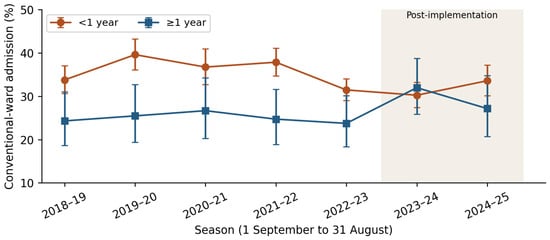
The parallel-trends assumption concerns the trends that would have occurred without the period-related changes, not equality of baseline admission proportions. For this log-link model, the relevant assumption is on a multiplicative scale. Seasonal admission proportions and Wilson binomial CIs were plotted by age (Figure 1), and placebo contrasts were examined in pre-implementation seasons (Supplementary Table S1). Scenario A compared 2018–2019 and 2019–2020 with 2020–2021 and 2021–2022; scenario B compared 2018–2019 to 2020–2021 with 2021–2022 and 2022–2023. Only four and five seasons, respectively, informed these checks. Visual similarity and non-significant placebo interactions do not establish parallel counterfactual trends, particularly with limited power and pandemic-related age-specific changes [19,20].
Figure 1.
Conventional-ward admission proportions by season and age group with 95% Wilson binomial confidence intervals. Visual pre-period comparisons are descriptive and do not validate parallel counterfactual trends.
With only seven seasons, the regression was kept parsimonious. No patient-level confounder adjustment or complex time-series model was undertaken. The nominal CIs and p-values are conditional on model assumptions and may not fully reflect within-season dependence or serial correlation; seven seasons do not support reliable cluster-based inference. Sensitivity analyses assess selected specifications but cannot remove unmeasured time-varying confounding.
2.5. Sensitivity Analyses
Several complementary analyses were performed to assess whether the main findings were sensitive to the case definition, individual seasons, model specification, or choice of denominator.
Case definition. The primary analysis used the strict departmental bronchiolitis definition (n = 7083). The analysis was repeated using a broader ICD-10 J21-based definition from the hospital-wide pediatric ED database (J21.x as a principal or associated diagnosis; n = 7251).
Exclusion of 2022–2023. Analyses were repeated after excluding this unusually intense season. It comprised 1498 presentations, compared with a mean of 899.8 (SD 166.2) in the other four pre-implementation seasons, and a conventional-ward admission proportion of 31.5% among infants, compared with 33.8–39.6% in those four seasons. This sensitivity analysis addresses the influence of one season, not all pandemic-related changes.
Influence of individual seasons. The primary DiD analysis was repeated after removing each season in turn (leave-one-season-out analysis; Supplementary Table S2) to assess whether the findings were driven by a single season.
Non-bronchiolitis respiratory comparison outcome. We examined non-bronchiolitis respiratory presentations (ICD-10 J* excluding J21, with R05, R06.0, R06.2, R06.5, R06.8 and R06.9; n = 31,376) as a negative-control-type outcome. Such a comparison can reveal broader changes in respiratory service use, but its interpretation requires assumptions about shared confounding and diagnostic classification [19]. It cannot, by itself, exclude age-specific confounding or shifts between bronchiolitis and other respiratory codes.
Alternative denominator. Because the primary outcome is conditional on presenting to the ED with bronchiolitis, an additional analysis used total pediatric ED presentations for all causes as the denominator (n = 226,069 across the seven seasons). This analysis expressed bronchiolitis hospitalizations relative to overall pediatric ED activity rather than relative to bronchiolitis presentations. It was considered a complementary analysis and not a population-based denominator.
2.6. Statistical Software and Reporting
The original analyses were conducted using Python 3.12 with statsmodels, scipy.stats, and pandas. Tests were two-sided, with α = 0.05. Age and ED length of stay are presented as medians with interquartile ranges (IQRs), seasonal counts as means with SDs, and categorical variables as counts and percentages. Distributional diagnostics for patient-level continuous variables were not documented in the available analysis record; these summaries are therefore descriptive, without a claim that normality was established. Aggregate testing counts are reported with their observed denominators; missing virological results were not treated as negative, and absent immunization or severity information was not imputed. Multiple sensitivity analyses were exploratory and did not undergo multiplicity adjustment. The revised manuscript follows STROBE reporting principles; Supplement S1 identifies both the reported items and remaining information gaps.
All estimates, tables, and figures reported in the revised manuscript and supplement were systematically checked by the study team against the underlying source data. The primary conventional-ward Poisson and quasi-Poisson interaction estimates were additionally reproduced from the 14 seasonal age-specific cells in Supplementary Table S5. The aggregate-data check complements the study team’s source-data verification; it does not establish patient-level data completeness. Analysis code and anonymized aggregate data can be supplied as additional Supplementary Material upon a reasonable, justified request. Supplementary Tables S3 and S5 already provide the principal reported aggregate counts.
3. Results
3.1. Study Period and Bronchiolitis Presentation
Among 7083 bronchiolitis ED presentations, 5097 occurred in the five pre-implementation seasons and 1986 in the two post-implementation seasons (Supplementary Table S3). Mean seasonal volumes were 1019.4 and 993.0, respectively. Infants accounted for 4233/5097 (83.0%) and 1638/1986 (82.5%) presentations. Male patients accounted for 2992/5097 (58.7%) and 1180/1986 (59.4%). Age-specific median ages and ED length-of-stay summaries are given in Table S3. Total hospitalizations numbered 1855 before implementation and 710 after implementation, corresponding to means of 371 and 355 per season, and admission proportions of 36.4% and 35.8%, respectively. These seasonal volumes are reported descriptively.
3.2. Available Virological Information
Among hospitalized infants, rapid-antigen testing was recorded for 1016/1630 (62.3%) presentations before implementation and 223/595 (37.5%) afterward; 721/1016 (71.0%) and 134/223 (60.1%) tested positive, respectively. Among older hospitalized children, 107/225 (47.6%) and 43/115 (37.4%) were tested, with positivity rates of 66/107 (61.7%) and 30/43 (69.8%), respectively. Testing status for all ED presentations and the age-specific counts are shown in Supplementary Table S3. Untested hospitalized presentations numbered 614 and 372 among infants, and 118 and 72 among older children, before and after implementation, respectively.
3.3. Primary Analysis: Conventional Ward Hospitalizations
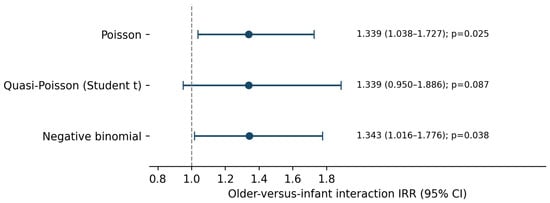
Among infants aged <1 year, the conventional-ward admission proportion decreased from 1492/4233 (35.2%) to 518/1638 (31.6%; IRR 0.897, 95% CI 0.812–0.992; p = 0.033). Among children aged ≥1 year, it increased from 215/864 (24.9%) to 104/348 (29.9%; IRR, 1.201; 95% CI, 0.950–1.518; p = 0.125). The older-versus-infant interaction IRR was 1.339 (95% CI 1.038–1.727; p = 0.025) with Poisson regression, 1.343 (95% CI 1.016–1.776; p = 0.038) with negative-binomial regression, and 1.339 (95% CI 0.950–1.886; p = 0.087) with quasi-Poisson regression (Figure 2). Pearson dispersion was 1.40. Across four pre-implementation seasons, infant proportions ranged from 33.8% to 39.6% and older-child proportions from 23.7% to 26.7%; the age-group difference was smaller in 2022–2023. Neither placebo specification yielded a significant interaction (all Poisson p ≥ 0.88; Table S1).
Figure 2.
Older-versus-infant age-by-period interaction for conventional-ward hospitalization across model specifications. Whiskers show 95% confidence intervals. Quasi-Poisson inference uses Pearson scaling and a Student t reference distribution with 10 residual degrees of freedom. An IRR >1 denotes a relatively less favorable post/pre change in older children. All estimates concern conditional admission proportions.
3.4. Secondary Outcomes
For total hospitalization (conventional ward + PICU), the proportion among infants aged <1 year decreased from 38.5% to 36.3%, although this change was not statistically significant (IRR 0.943, 95% CI 0.859–1.036; p = 0.223). Among children aged ≥1 year, it increased from 26.0% to 33.0% (IRR 1.269, 95% CI 1.014–1.589; p = 0.038), although this association was no longer statistically significant with quasi-Poisson regression (p = 0.092).
For total hospitalization, the older-versus-infant interaction IRR was 1.345 (95% CI 1.054–1.716; p = 0.017) in Poisson regression; the quasi-Poisson and negative binomial p-values were 0.038 and 0.017, respectively. These supportive outcomes, including PICU admissions, are subject to the documented change in care organization.
PICU admissions numbered 138/4233 (3.3%) and 77/1638 (4.7%) among infants before and after implementation, respectively, and 10/864 (1.2%) and 11/348 (3.2%) among older children (Supplementary Figure S2). They are reported descriptively because admission classification changed during the study.
3.5. Sensitivity Analyses
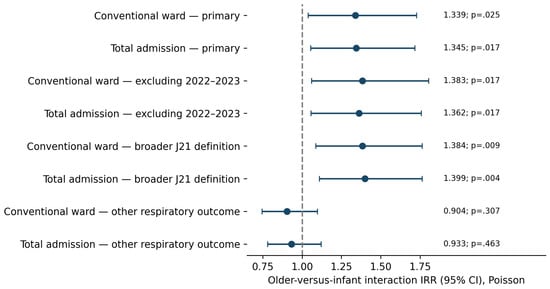
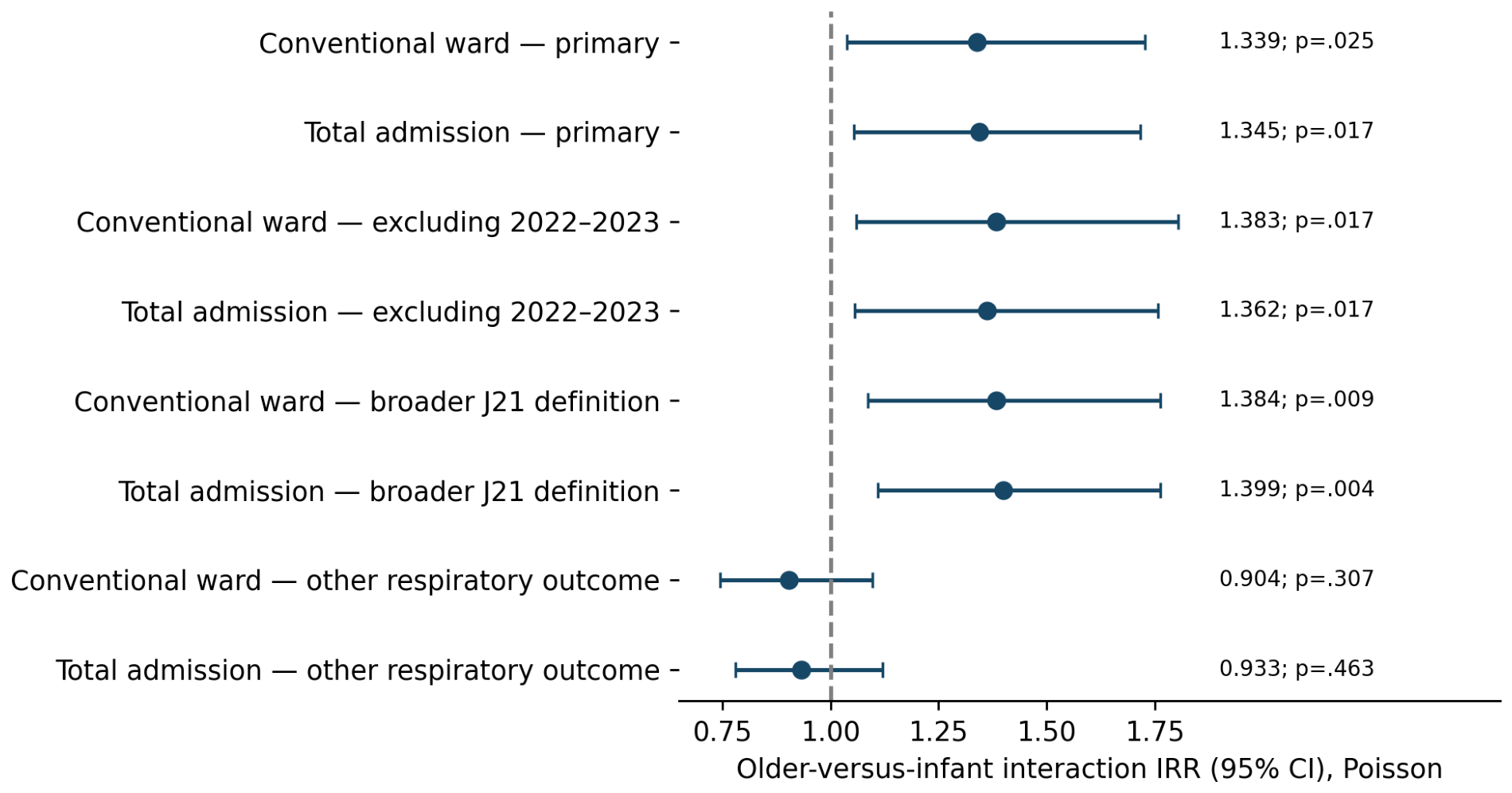
The main findings were examined in several complementary analyses (Figure 3).
Figure 3.
Poisson age-by-period interactions across sensitivity analyses. This figure displays one model specification; significance varied across quasi-Poisson analyses and season exclusions. The estimates are temporal associations. The vertical dashed line at IRR = 1.0 represents the null value (no interaction on the multiplicative scale).
Broader bronchiolitis definition. Using the broader ICD-10 J21-based case definition (n = 7251), the age-by-period interaction for conventional-ward hospitalization remained statistically significant with Poisson (IRR 1.384, 95% CI 1.086–1.764; p = 0.009), quasi-Poisson (p = 0.047), and negative-binomial models (p = 0.015). Similar findings were observed for total hospitalization (Poisson IRR 1.399, 95% CI 1.110–1.763, p = 0.004; quasi-Poisson p = 0.017).
Exclusion of the 2022–2023 season. After excluding the atypically intense 2022–2023 season, the conventional-ward hospitalization IRR among infants aged <1 year was 0.856 (95% CI 0.771–0.951; p = 0.004), compared with 0.897 in the primary analysis. The age-by-period interaction for conventional-ward hospitalization remained statistically significant across the Poisson (IRR 1.383; p = 0.017), quasi-Poisson (p = 0.044), and negative binomial models (p = 0.017). Overdispersion was lower after excluding this season.
Influence of individual seasons. All seven leave-one-season-out Poisson interactions were >1; six had p < 0.05. Excluding 2023–2024 yielded IRR 1.145 (95% CI 0.798–1.645; p = 0.462), whereas excluding 2024–2025 yielded IRR 1.498 (95% CI 1.101–2.038; p = 0.010). Only one of the seven corresponding quasi-Poisson p-values was <0.05 (range 0.044–0.564; Supplementary Table S2).
Non-bronchiolitis respiratory outcome. Among infants, the post/pre IRR was 1.572 (95% CI 1.327–1.862; p < 0.001) for conventional-ward admission and 1.615 (95% CI 1.373–1.899; p < 0.001) for total admission. The age-by-period interaction for conventional-ward admission was 0.904 (95% CI 0.745–1.097; p = 0.307).
All-cause ED denominator. With 226,069 pediatric ED presentations as the denominator, the infant post/pre IRR was 0.821 (95% CI 0.743–0.907; p < 0.001) for bronchiolitis conventional-ward hospitalization and 0.863 (95% CI 0.786–0.948; p = 0.002) for total bronchiolitis hospitalization. In older children, the corresponding IRRs were 0.976 (p = 0.840) and 1.031 (p = 0.787).
3.6. Historical-Standardized Count Difference
Applying the pooled pre-implementation infant conventional-ward admission proportion (1492/4233) to the 1638 post-implementation presentations gives approximately 577 admissions, compared with 518 observed, a difference of approximately 59. This is an arithmetic historical standardization, not an estimate of prevented admissions, and it does not apply the DiD counterfactual.
4. Discussion
The principal observation was a lower proportion of infants admitted to conventional wards in 2023–2025 than in 2018–2023, with a different temporal pattern among older children. The Poisson and negative-binomial interaction tests were significant, but the quasi-Poisson test was not. The association also depended on the seasons retained. These findings describe local use of syndromic bronchiolitis services; they do not estimate the effectiveness of nirsevimab, maternal RSV vaccination, or any combined prevention program.
External effectiveness evidence provides context but cannot identify the cause of this association. The Paris case–control study reported nirsevimab’s effectiveness of 83% against RSV-associated hospitalization and 59% against all-cause bronchiolitis hospitalization [9]. The Lyon study estimated 78.3% effectiveness against RSV-associated lower respiratory tract infection hospitalization [10], and a national test-negative study reported 84.9% effectiveness during 2024–2025 [11]. National modeling also estimated a reduction in RSV-associated hospitalizations during the first campaign [16]. These studies used different exposure information, virological ascertainment, or modeling assumptions. Their findings cannot replace missing exposure and outcome information in our dataset or convert our temporal contrast into an estimate of effectiveness.
The broader literature supports RSV-specific protection in settings with measured exposure. The French ENVIE matched case–control study estimated nirsevimab effectiveness of 83.0% (95% CI 73.4–89.2) against RSV-bronchiolitis hospitalization [13]. In Galicia, the initial NIRSE-GAL population cohort estimated effectiveness of 82.0% (65.6–90.2), with high program uptake [21]. A 2025 meta-analysis reported a pooled odds ratio for RSV hospitalization of 0.17 (0.12–0.23), although substantial between-study heterogeneity (I2 = 85.8%) limits the interpretation of a single summary estimate [22]. Canadian test-negative data in 2026 likewise supported protection against laboratory-confirmed RSV hospitalization [23]. These studies strengthen the external evidence for nirsevimab, but neither their relative estimates nor their coverage can be transferred to our conditional all-cause admission proportion.
Evidence for maternal vaccination has also expanded. Alongside the French nationwide study [12], US population surveillance estimated maternal vaccine effectiveness of 70% (95% CI 37–86) against RSV hospitalization, with nirsevimab effectiveness of 81% (71–87) [14]. A separate US network estimated the effectiveness of maternal vaccination during hospitalization at 82% (54–93) and of nirsevimab at 77% (61–87) [24]. These estimates arose from separate observational analyses and do not establish comparative superiority. A French head-to-head cohort study associated nirsevimab with a lower hazard of hospitalization than maternal RSVpreF (adjusted HR 0.74, 95% CI 0.61–0.88) [25]. In contrast, a recent California matched cohort found no significant difference, with only 12 hospitalizations in the primary comparison [26]. Differences in selection, timing, precision, and residual confounding preclude a universal product ranking and underscore why our dataset, without individual exposure ascertainment, cannot separate product contributions.
Recent service-use studies are particularly relevant to our outcome. A French four-season study of 509 hospitalized infants described changes in age, oxygen use, length of stay, and viral distribution after the introduction of prevention [27]; its hospitalized-only population and recorded clinical and virological information differ from those of our ED-based dataset. In England, a time-series study after maternal vaccine implementation estimated reductions of 39.3% in all bronchiolitis admissions and 62.6% in RSV-coded bronchiolitis admissions among infants younger than 3 months [28]. An Irish multicenter study combined test-negative effectiveness estimation with modeled ED bronchiolitis attendances, illustrating the need to distinguish individual protection from population service use and uptake [29]. Such population rates, modeled counts, and clinical endpoints are not directly comparable with the proportion admitted among children already attending an ED.
Follow-up beyond the first season remains informative but unsettled. The two-season NIRSE-GAL study reported lower RSV-related hospitalization rates into the second season compared with historical cohorts [30]. Conversely, French matched national cohorts showed first-year effectiveness in successive campaigns but no protective association during second-year follow-up [31]. These are different comparisons, not a direct contradiction within one estimand; historical controls, cohort composition, and follow-up differ. Neither finding justifies assuming stable age-specific counterfactual trends in our seven-season series. The prevention landscape now also includes randomized evidence for clecrovimab [32], which provides prospective context rather than an explanation for the French implementation periods we observed.
Our outcome differs from both the incidence of RSV-specific hospitalization and the risk of hospitalization among immunized versus unimmunized infants. A conditional admission proportion may change if disease severity, referral patterns, attendance for mild illness, coding, or admission practices change. Similar mean seasonal ED counts for bronchiolitis do not indicate that these components were stable. The non-bronchiolitis respiratory comparison identifies a different activity pattern, but the non-significant interaction does not rule out shared or age-specific confounding. Likewise, the all-cause ED denominator yielded an association in the same direction among infants but remains dependent on service utilization and does not supply a catchment-population denominator.
The short post-implementation period is particularly limiting. Removing 2023–2024, the first season after nirsevimab introduction, removed statistical significance, whereas the estimate was larger when 2024–2025 was omitted. Maternal vaccination was available only during 2024–2025. Consequently, neither separate product contributions nor a combined program effect can be identified. The French maternal vaccination effectiveness study used documented maternal exposure and matched infant follow-up [12]; our study lacks both features. Additional seasons alone would improve temporal description, but would not resolve missing exposure ascertainment.
The aggregate virological results warrant explicit consideration. Among hospitalized infants, testing coverage fell from 62.3% before implementation to 37.5% afterward, while positivity among those tested was 71.0% and 60.1%, respectively. These percentages pertain to different selected subsets and cannot establish a reduction in the incidence of RSV-associated hospitalization or in the RSV-attributable fraction of all bronchiolitis. Untested children cannot be classified as RSV-negative. Changes in clinical test selection, assay use, or documentation could alter these proportions; a linked seasonal virological dataset would be needed for an RSV-specific analysis.
The pandemic affected more than the unusually intense 2022–2023 season. Regional and national studies documented delayed RSV circulation in 2020–2021 and a changed epidemic in 2021–2022 [2,3]. Changes in susceptibility, virus circulation, healthcare-seeking behavior, and service pressure may have affected age groups differently throughout the observation period. Exclusion of 2022–2023 and one-season-at-a-time checks does not account for these joint changes. The direction of residual bias cannot be reliably predicted. US multicenter data also documented a marked post-pandemic rebound and older hospitalized children [15]. Separately, a 2024 PICU study linked rising bronchiolitis admissions to increased use of high-flow and noninvasive support without a corresponding significant rise in invasive ventilation [33]. This supports the consideration of care practices as a potential contributor to admission trends; it does not demonstrate that the same mechanisms explain our local findings.
A strength is the consistent institutional data source over seven seasons, with transparent presentation of complementary analyses. However, the older group is an imperfect counterfactual because baseline risk, respiratory viral epidemiology, and diagnostic coding differ by age. Non-significant placebo tests, based on four or five seasons, have limited power to detect departures from parallel trends, and pre-period patterns cannot establish post-period counterfactual behavior. DiD and negative-control-type comparisons require assumptions rather than automatically controlling all time-varying confounding [19,20]. The 14 aggregated cells also contain only seven seasons; larger presentation counts do not remove uncertainty from this small temporal sample.
The absence of individual histories of nirsevimab, maternal RSV vaccination, palivizumab, and linked RSV laboratory confirmation remains the principal limitation of this study. These variables were not collected in the study source record; access to the existing hospital-record database cannot by itself reconstruct a complete exposure and virological history. No validated external linkage was available for this revision. Aggregate rapid-antigen counts remain informative only for selected tested subsets. The pre-implementation period was not necessarily unprotected, and the calendar period cannot identify eligibility, product receipt, timing, or protection. External coverage estimates cannot be assigned to our patients. Oxygen requirement, respiratory support, standardized severity scores, and inpatient length of stay were also unavailable in the analytic dataset; their completeness and retrievability in clinical records were not established. ED length of stay, reported in Table S3, is not inpatient length of stay. These gaps prevent exposure-adjusted, severity-adjusted, and individual RSV-specific analyses.
The care organization provides another plausible explanation. PICU restructuring overlapped both post-implementation seasons and may have redirected children who would previously have entered conventional wards to intermediate or intensive care. Selecting conventional ward admission, therefore, does not isolate clinical severity. Conventional-ward bed availability, admission criteria, and referral practices were not documented longitudinally; we cannot state that they remained unchanged. As a result, an organizational contribution to the observed change in ward admissions cannot be quantified or ruled out.
Finally, statistical uncertainty remains substantial. The primary quasi-Poisson CI includes the null and is wider than the Poisson CI; six of seven quasi-Poisson leave-one-season-out tests were non-significant. Estimates were not adjusted for multiple sensitivity analyses and may not fully capture dependence across age groups or seasons. The approximately 59-admission historical-standardized difference is not the number of admissions prevented: the single-center setting and the absence of a population denominator limit generalisability. Multicentre follow-up with documented preventive exposure, systematic or well-characterized virological testing, standardized severity measures, and explicit care-capacity information is required.
5. Conclusions
In this seven-season single-center study, the conditional proportion of bronchiolitis ED presentations followed by conventional-ward hospitalization decreased among infants relative to older children across the two post-implementation seasons. Statistical support varied by model, and the overall association was particularly influenced by 2023–2024. Maternal vaccination was introduced only in the second post-implementation season; its contribution cannot be separated from that of nirsevimab. Incomplete virological ascertainment, the absence of individual immunization histories, and changing care organization prevent attribution to RSV prevention. These observations support further investigation of service-use trends, not a causal conclusion about preventive effectiveness.
Supplementary Materials
The following supporting information can be downloaded at: https://www.mdpi.com/article/10.3390/jcm15228764/s1, Figure S1: Total hospitalization proportions by season with all ages combined and 95% Wilson binomial CIS, calculated from Table S5. Total admissions include PICU admissions; post-period care reorganization limits comparisons. This descriptive figure does not assess age-specific parallel trends; Figure S2: Stratified post/pre-admission proportion ratios. Poisson 95% CIs and p values are shown for conventional-ward and total admissions. PICU point estimates describe observed proportions only; inferential tests and CIs are omitted because care-level classification changed. These ratios must not be interpreted as preventive effectiveness or changes in disease severity; Table S1: Placebos contrast with fictitious implementation dates. All interaction IRRs below use the older-versus-infant orientation of the main analysis; values <1 or >1 do not establish parallel-trends; Table S2: Leave-one-season-out DiD interactions. The direction is older versus infant. Poisson and quasi-Poisson conventional-ward results were checked against the seasonal aggregate numerators and denominators in Table S5; Table S3: Characteristics and available aggregate virological information by age group and period; Table S4: Overdispersion diagnostics for the primary DiD models; Table S5: Seasonal counts and proportions. Seasons run from 1 September to 31 August. N, presentations; hosp, any hospital admission; ward, conventional ward; ICU, pediatric intensive care; y, year. Percentages use the corresponding ED denominator; Table S6: External implementation and uptake context; Table S7: Available data and limits on additional analyses; Table S8: Primary conventional-ward interaction and numerical check. Supplement S1: Updated STROBE checklist.
Author Contributions
All authors contributed to study design, data analysis/interpretation, manuscript drafting/revision, and approved the final version. All authors have read and agreed to the published version of the manuscript.
Funding
This research received no external funding.
Institutional Review Board Statement
The study was conducted in accordance with the Declaration of Helsinki and approved by the Ethics Committee of the University Hospital of Saint-Étienne (reference: IRBN1212023/CHUSTE, date of approval: 27 September 2023).
Informed Consent Statement
Patient consent was waived because the study used de-identified, routinely collected data retrospectively.
Data Availability Statement
The hospital-record database underlying this study exists. An anonymized extract of the available hospital-record data may be requested from the corresponding author, subject to applicable institutional and confidentiality requirements. Individual nirsevimab administration, maternal RSV vaccination, palivizumab use, and linked RSV confirmation were not collected in the study source record and cannot be supplied as study variables. Anonymized aggregate data and analysis code are available upon reasonable, justified request and can be provided as additional Supplementary Material. The principal aggregate counts are reported in Supplementary Tables S3 and S5.
Conflicts of Interest
The authors declare no conflicts of interest.
References
- Li, Y.; Wang, X.; Blau, D.M.; Caballero, M.T.; Feikin, D.R.; Gill, C.J.; A Madhi, S.; Omer, S.B.; Simões, E.A.F.; Campbell, H.; et al. Global, regional, and national disease burden estimates of acute lower respiratory infections due to respiratory syncytial virus in children younger than 5 years in 2019: A systematic analysis. Lancet 2022, 399, 2047–2064. [Google Scholar] [CrossRef] [Scilit] [PubMed]
- Casalegno, J.-S.; Ploin, D.; Cantais, A.; Masson, E.; Bard, E.; Valette, M.; Fanget, R.; Targe, S.C.; Myar-Dury, A.-F.; Doret-Dion, M.; et al. Characteristics of the delayed respiratory syncytial virus epidemic, 2020/2021, Rhône Loire, France. Eurosurveillance 2021, 26, 2100630. [Google Scholar] [CrossRef] [Scilit] [PubMed]
- Vaux, S.; Viriot, D.; Forgeot, C.; Pontais, I.; Savitch, Y.; Barondeau-Leuret, A.; Smadja, S.; Valette, M.; Enouf, V.; du Chatelet, I.P. Bronchiolitis epidemics in France during the SARS-CoV-2 pandemic: The 2020–2021 and 2021–2022 seasons. Infect. Dis. Now 2022, 52, 374–378. [Google Scholar] [CrossRef] [Scilit] [PubMed]
- Garegnani, L.; Styrmisdóttir, L.; Roson Rodriguez, P.; Escobar Liquitay, C.M.; Esteban, I.; Franco, J.V. Palivizumab for preventing severe respiratory syncytial virus (RSV) infection in children. Cochrane Database Syst. Rev. 2020, 11, CD013757. [Google Scholar] [CrossRef] [Scilit] [PubMed]
- Hammitt, L.L.; Dagan, R.; Yuan, Y.; Cots, M.B.; Bosheva, M.; Madhi, S.A.; Muller, W.J.; Zar, H.J.; Brooks, D.; Grenham, A.; et al. Nirsevimab for Prevention of RSV in Healthy Late-Preterm and Term Infants. N. Engl. J. Med. 2022, 386, 837–846. [Google Scholar] [CrossRef] [Scilit] [PubMed]
- Drysdale, S.B.; Cathie, K.; Flamein, F.; Knuf, M.; Collins, A.M.; Hill, H.C.; Kaiser, F.; Cohen, R.; Pinquier, D.; Felter, C.T.; et al. Nirsevimab for Prevention of Hospitalizations Due to RSV in Infants. N. Engl. J. Med. 2023, 389, 2425–2435. [Google Scholar] [CrossRef] [Scilit] [PubMed]
- Kampmann, B.; Madhi, S.A.; Munjal, I.; Simões, E.A.; Pahud, B.A.; Llapur, C.; Baker, J.; Marc, G.P.; Radley, D.; Shittu, E.; et al. Bivalent Prefusion F Vaccine in Pregnancy to Prevent RSV Illness in Infants. N. Engl. J. Med. 2023, 388, 1451–1464. [Google Scholar] [CrossRef] [Scilit] [PubMed]
- Simões, E.A.F.; Pahud, B.A.; Madhi, S.A.M.; Kampmann, B.; Shittu, E.; Radley, D.; Llapur, C.; Baker, J.; Marc, G.P.; Barnabas, S.L.M.; et al. Efficacy, Safety, and Immunogenicity of the MATISSE (Maternal Immunization Study for Safety and Efficacy) Maternal Respiratory Syncytial Virus Prefusion F Protein Vaccine Trial. Obstet. Gynecol. 2025, 145, 157–167. [Google Scholar] [CrossRef] [Scilit] [PubMed]
- Carbajal, R.; Boelle, P.-Y.; Pham, A.; Chazette, Y.; Schellenberger, M.; Weil, C.; Colas, A.-S.; Lecarpentier, T.; Schnuriger, A.; Guedj, R.; et al. Real-world effectiveness of nirsevimab immunisation against bronchiolitis in infants: A case–control study in Paris, France. Lancet Child Adolesc. Health 2024, 8, 730–739. [Google Scholar] [CrossRef] [Scilit] [PubMed]
- Chauvel, C.; Horvat, C.; Javouhey, E.; Gillet, Y.; Hassenboehler, J.; Chakra, C.N.A.; Ragouilliaux, C.; Plaisant, F.; Ploin, D.; Butin, M.; et al. Changes in Respiratory Syncytial Virus-Associated Hospitalisations Epidemiology After Nirsevimab Introduction in Lyon, France. Influenza Other Respir. Viruses 2024, 18, e70054. [Google Scholar] [CrossRef] [Scilit] [PubMed]
- Furgier, A.; Brehin, C.; Levy, C.; Basmaci, R.; Launay, E.; Jung, C.; Assad, Z.; Lenglart, L.; Naudin, J.; Mary, A.-L.; et al. Effectiveness of nirsevimab against hospitalisation for RSV-bronchiolitis during high RSV-B circulation in the second year of nationwide implementation in France: A test-negative case-control study. Lancet Reg. Health Eur. 2025, 58, 101443. [Google Scholar] [CrossRef] [Scilit] [PubMed]
- Jabagi, M.-J.; Bertrand, M.; Gabet, A.; Tréluyer, L.; Kolla, E.; Rachas, A.; Olié, V.; Zureik, M. Maternal RSVpreF Immunisation Against Infant RSV Hospitalisation: Nationwide Population-Based Effectiveness and Durability Study. Lancet Reg. Health Eur. 2026, 67, 101756. [Google Scholar] [CrossRef] [Scilit] [PubMed]
- Assad, Z.; Romain, A.-S.; Aupiais, C.; Shum, M.; Schrimpf, C.; Lorrot, M.; Corvol, H.; Prevost, B.; Ferrandiz, C.; Giolito, A.; et al. Nirsevimab and Hospitalization for RSV Bronchiolitis. N. Engl. J. Med. 2024, 391, 144–154. [Google Scholar] [CrossRef] [Scilit] [PubMed]
- Moline, H.L.; Tannis, A.; Goldstein, L.; Englund, J.A.; Staat, M.A.; Boom, J.A.; Selvarangan, R.; Michaels, M.G.; Weinberg, G.A.; Halasa, N.B.; et al. Effectiveness and Impact of Maternal RSV Immunization and Nirsevimab on Medically Attended RSV in US Children. JAMA Pediatr. 2026, 180, 314. [Google Scholar] [CrossRef] [Scilit] [PubMed]
- Remien, K.A.; Amarin, J.Z.; Horvat, C.M.; Nofziger, R.A.; Page-Goertz, C.K.; Besunder, J.B.; Potts, B.K.; Forbes, M.L.; Halasa, N.; Pelletier, J.H. Admissions for Bronchiolitis at Children’s Hospitals Before and During the COVID-19 Pandemic. JAMA Netw. Open 2023, 6, e2339884. [Google Scholar] [CrossRef] [Scilit] [PubMed]
- Brault, A.; Pontais, I.; Enouf, V.; Debeuret, C.; Bloch, E.; Paireau, J.; Rameix-Welti, M.-A.; White, M.; Baudemont, G.; Lina, B.; et al. Effect of nirsevimab on hospitalisations for respiratory syncytial virus bronchiolitis in France, 2023–2024: A modelling study. Lancet Child Adolesc. Health 2024, 8, 721–729. [Google Scholar] [CrossRef] [Scilit] [PubMed]
- Gabet, A.; Bertrand, M.; Jabagi, M.-J.; Olié, V.; Zureik, M. Social and Regional Inequalities in Maternal Respiratory Syncytial Virus Vaccination in France. JAMA Netw. Open 2025, 8, e2533530. [Google Scholar] [CrossRef] [Scilit] [PubMed]
- Soussan, S.; Peyronnet, V.; Henriet, E.; Dias, P.; Floch, C.; Mandelbrot, L.; Picone, O. RSV immunization campaign among pregnant women and newborns in a French tertiary maternity in 2024–2025. J. Gynecol. Obstet. Hum. Reprod. 2026, 55, 103148. [Google Scholar] [CrossRef] [Scilit] [PubMed]
- Newsome, S.J.; Daniel, R.M.; Carr, S.B.; Bilton, D.; Keogh, R.H. Using Negative Control Outcomes and Difference-in-Differences Analysis to Estimate Treatment Effects in an Entirely Treated Cohort: The Effect of Ivacaftor in Cystic Fibrosis. Am. J. Epidemiol. 2021, 191, 505–515. [Google Scholar] [CrossRef] [Scilit] [PubMed]
- Sutton, M.; Francetic, I.; O’NEill, S.; Hugh-Jones, S.; Munford, L. Guide to recent advances in difference-in-differences methodology for population health studies. J. Epidemiol. Community Health 2026, 80, 745–751. [Google Scholar] [CrossRef] [Scilit] [PubMed]
- Ares-Gómez, S.; Mallah, N.; Santiago-Pérez, M.-I.; Pardo-Seco, J.; Pérez-Martínez, O.; Otero-Barrós, M.-T.; Suárez-Gaiche, N.; Kramer, R.; Jin, J.; Platero-Alonso, L.; et al. Effectiveness and impact of universal prophylaxis with nirsevimab in infants against hospitalisation for respiratory syncytial virus in Galicia, Spain: Initial results of a population-based longitudinal study. Lancet Infect. Dis. 2024, 24, 817–828. [Google Scholar] [CrossRef] [Scilit] [PubMed]
- Sumsuzzman, D.M.; Wang, Z.; Langley, J.M.; Moghadas, S.M. Real-world effectiveness of nirsevimab against respiratory syncytial virus disease in infants: A systematic review and meta-analysis. Lancet Child Adolesc. Health 2025, 9, 393–403. [Google Scholar] [CrossRef] [Scilit] [PubMed]
- Buchan, S.A.; Xie, J.; Bhatt, M.; Papenburg, J.; Goldfarb, D.M.; Pernica, J.M.; Burstein, B.; Gravel, J.; Berthelot, S.; Kam, A.J.; et al. Respiratory Syncytial Virus–Related Hospitalizations Among Infants Receiving Nirsevimab. JAMA Netw. Open 2026, 9, e2633621. [Google Scholar] [CrossRef] [Scilit] [PubMed]
- Payne, A.B.; Battan-Wraith, S.; Reese, S.E.; Hathaway, C.A.; Tartof, S.Y.; Natarajan, K.; Irving, S.A.; Grannis, S.; Chickery, S.; Vazquez-Benitez, G.; et al. Effectiveness of RSV Prevention Strategies in US Infants: 2024–2025. Pediatrics 2026, 158, e2026076089. [Google Scholar] [CrossRef] [Scilit] [PubMed]
- Jabagi, M.-J.; Bertrand, M.; Gabet, A.; Kolla, E.; Olié, V.; Zureik, M. Nirsevimab vs RSVpreF Vaccine for Respiratory Syncytial Virus–Related Hospitalization in Newborns. JAMA 2026, 335, 787–798. [Google Scholar] [CrossRef] [Scilit] [PubMed]
- Jacobson, K.B.; Watson, A.J.; Liao, L.D.; Stephens, S.C.; Merchant, M.; Zerbo, O.; Klein, N.P. Maternal Vaccination vs Nirsevimab Use and Respiratory Syncytial Virus Infection Among Full-Term Infants. JAMA Netw. Open 2026, 9, e2636760. [Google Scholar] [CrossRef] [Scilit] [PubMed]
- Tarizzo, M.; Mesinèle, J.; Prevost, B.; Denamur, S.; Peulier-Maitre, E.; Guillot, L.; Nathan, N.; Corvol, H. Impact of RSV Preventive Strategies on Hospitalizations for Bronchiolitis in Infants. Pediatr. Pulmonol. 2026, 61, e71689. [Google Scholar] [CrossRef] [Scilit] [PubMed]
- Broad, J.; Wilson, M.; Borjas-Howard, J.; Voysey, M.; Drysdale, S.B.; Andrews, N.; Watson, C.H.; Whitaker, H.J. Early impact of maternal RSV vaccination on bronchiolitis hospitalisation and critical care admissions in infants under age 3 months, England, September 2024 to March 2026. Eurosurveillance 2026, 31, 2600752. [Google Scholar] [CrossRef] [Scilit] [PubMed]
- Treston, B.; O’HAgan, S.; Barrett, M.; Marlow, R.; Williams, T.; Lyttle, M.; Roland, D.; Walsh, A.; Waterfield, T.; Geoghegan, S.; et al. Effectiveness of nirsevimab and maternal RSVpreF vaccination against infant hospitalization across the island of Ireland. Int. J. Infect. Dis. 2026, 171, 109038. [Google Scholar] [CrossRef] [Scilit] [PubMed]
- Razzini, J.L.; Giné-Vázquez, I.; Jin, J.; Santiago-Pérez, M.-I.; Pérez-Martínez, O.; Otero-Barrós, M.-T.; Suárez-Gaiche, N.; Kramer, R.; Platero-Alonso, L.; Álvarez-Gil, R.-M.; et al. Impact of universal nirsevimab prophylaxis in infants on hospital and primary care outcomes across two respiratory syncytial virus seasons in Galicia, Spain (NIRSE-GAL): A population-based prospective observational study. Lancet Infect. Dis. 2026, 26, 522–534. [Google Scholar] [CrossRef] [Scilit] [PubMed]
- Gabet, A.; Kolla, E.; Tréluyer, L.; Bertrand, M.; Jabagi, M.-J.; Weill, O.; Rachas, A.; Olié, V.; Zureik, M. First- and Second-Year Outcomes After Nirsevimab Immunization. JAMA Pediatr. 2026, 180, 1222. [Google Scholar] [CrossRef] [Scilit] [PubMed]
- Zar, H.J.; Simões, E.A.; Madhi, S.A.; Ramilo, O.; Senders, S.D.; Shepard, J.S.; Laoprasopwattana, K.; Piedrahita, J.; Novoa, J.M.; Vargas, S.L.; et al. Clesrovimab for Prevention of RSV Disease in Healthy Infants. N. Engl. J. Med. 2025, 393, 1292–1303. [Google Scholar] [CrossRef] [Scilit] [PubMed]
- Pelletier, J.H.; Maholtz, D.E.; Hanson, C.M.; Nofziger, R.A.; Forbes, M.L.; Besunder, J.B.; Horvat, C.M.; Page-Goertz, C.K. Respiratory Support Practices for Bronchiolitis in the Pediatric Intensive Care Unit. JAMA Netw. Open 2024, 7, e2410746. [Google Scholar] [CrossRef] [Scilit] [PubMed]
Disclaimer/Publisher’s Note: The statements, opinions and data contained in all publications are solely those of the individual author(s) and contributor(s) and not of MDPI and/or the editor(s). MDPI and/or the editor(s) disclaim responsibility for any injury to people or property resulting from any ideas, methods, instructions or products referred to in the content. |
© 2026 by the authors. Licensee MDPI, Basel, Switzerland. This article is an open access article distributed under the terms and conditions of the Creative Commons Attribution (CC BY) license.