


Abstract
Background/Objectives: Obesity hypoventilation syndrome (OHS) is a heterogeneous disorder characterized by obesity, chronic daytime hypercapnia, and sleep-disordered breathing. Noninvasive ventilation (NIV) provides ventilatory support during acute hypercapnic respiratory failure and for persistent hypoventilation in OHS, while continuous positive airway pressure (CPAP) is appropriate for selected stable patients with coexisting severe obstructive sleep apnea (OSA). This narrative review synthesizes determinants of NIV success and failure across acute and chronic OHS care. Methods: A targeted narrative search was conducted using PubMed/MEDLINE, Embase, and Scopus. Priority was given to OHS-specific cohort studies, randomized trials, individual patient data analyses, and relevant systematic reviews, with broader NIV evidence used cautiously when OHS-specific data were limited. Results: NIV success in OHS is best interpreted as a context-dependent trajectory rather than a single threshold. Acute success involves favorable trends in pH and PaCO2, reduced work of breathing, improved alertness, avoidance of invasive mechanical ventilation, and safe transition from the acute episode. Chronic success is reflected by sustained hypoventilation control, adherence, interface tolerance, symptom improvement, and fewer recurrent decompensations. Failure may reflect persistent physiological derangement, ineffective NIV delivery, or both. Conclusions: Phenotype-guided positive airway pressure (PAP) selection, early reassessment, technical optimization, adherence support, and structured follow-up may support the management of NIV outcomes in OHS. Distinguishing physiological failure from ineffective NIV delivery may help guide clinical reassessment and escalation decisions, although this conceptual framework requires prospective validation.
1. Introduction
Obesity hypoventilation syndrome (OHS) involves obesity, awake daytime hypercapnia, and sleep-disordered breathing after exclusion of alternative causes of alveolar hypoventilation. Its variable clinical presentation includes patients recognized during sleep-medicine assessment and those first diagnosed during acute-on-chronic respiratory failure. Delayed recognition and associated cardiopulmonary disease contribute to the complexity of management [1,2].
Positive airway pressure (PAP) is the principal ventilatory treatment for OHS. Continuous positive airway pressure (CPAP) can be an appropriate initial option in stable ambulatory patients with OHS and concomitant severe obstructive sleep apnea (OSA), whereas noninvasive ventilation (NIV) provides active ventilatory assistance when hypoventilation predominates or acute hypercapnic respiratory failure requires support. Clinical reassessment is important because selection of device mode, correction of sleep-disordered breathing, early blood-gas response, and long-term control are different treatment questions [1,3,4].
The meaning of NIV success or failure depends on the setting and endpoint. During an acute episode, relevant outcomes include the course of respiratory acidosis, work of breathing, airway safety, and avoidance of intubation; following discharge, continuity of treatment and readmission become important. In stable OHS, sustained improvement in ventilation, symptoms, and treatment effectiveness must be distinguished from device use alone. Accordingly, baseline characteristics that may be associated with risk should not be conflated with evolving indicators of response, modifiable delivery barriers, or clinical outcomes [5,6,7].
Previous reviews have addressed important parts of this field. Sequeira et al. [8] discussed NIV in critically ill patients with OHS, including acute respiratory failure, postoperative care, and weaning, and proposed an acute management algorithm. More recent reviews by Pépin et al. [2] and Vultur et al. [9] emphasize OHS phenotypes, broader management, comorbidities, and multidisciplinary care; Rabec et al. [10] provide a physiological perspective on ventilatory management in obesity. These publications also discuss treatment selection and practical management. Building on previous reviews, this article provides an outcome-oriented synthesis linking acute NIV response, post-acute transition, and long-term treatment effectiveness.
This narrative review examines factors associated with NIV response in OHS while distinguishing direct OHS clinical findings from results extrapolated from broader NIV populations and from physiological reasoning. It organizes the literature into baseline patient characteristics, early response indicators, effective NIV delivery, and care-system factors, with attention to how the relevant endpoints differ. The accompanying physiology-versus-delivery framework illustrates potentially overlapping mechanisms that can inform clinical reassessment; it is conceptual, has not been prospectively validated, and should not be interpreted as a prediction tool or a substitute for established escalation criteria.
2. Materials and Methods
2.1. Review Design
This narrative review examines factors associated with NIV success and failure in OHS across acute, post-acute, and chronic care. A narrative design was selected to integrate clinical evidence from heterogeneous populations, settings, study designs, and outcome definitions rather than estimate a single pooled treatment effect. The synthesis distinguishes direct OHS clinical evidence from findings extrapolated from broader NIV populations and from physiological or expert interpretation.
2.2. Literature Search
Relevant literature was identified through searches of PubMed/MEDLINE, Embase, and Scopus, supplemented by targeted searches and screening of reference lists from relevant studies, clinical practice guidelines, and reviews. Publications available through September 2026 were considered. Search terms included “obesity hypoventilation syndrome”, “OHS”, “noninvasive ventilation”, “bilevel positive airway pressure”, “continuous positive airway pressure”, “CPAP”, “acute hypercapnic respiratory failure”, “home mechanical ventilation”, “NIV failure”, “adherence”, “mask leak”, “patient–ventilator asynchrony”, and “telemonitoring”. These terms were combined as appropriate to identify studies addressing acute NIV outcomes, positive airway pressure modality selection, long-term ventilatory management, treatment effectiveness, and care transitions. The search was designed to support a focused narrative synthesis rather than a systematic review.
2.3. Study Selection and Evidence Prioritization
Studies were selected for their relevance to NIV or PAP outcomes in OHS, including acute treatment response or failure, discharge management, chronic gas-exchange control, treatment modality selection, adherence, hospitalization, survival, and patient-centered outcomes. For OHS-specific treatment claims, randomized trials and original observational studies reporting relevant outcomes were prioritized. Individual patient data syntheses, systematic reviews, and clinical practice guidelines informed broader conclusions and recommendations; narrative reviews were used primarily to provide clinical context and identify foundational primary studies. Study relevance, design, endpoint appropriateness, and limitations took precedence over publication date.
Evidence was differentiated according to population and applicability. Direct OHS evidence included studies reporting outcomes in patients diagnosed with OHS; studies combining confirmed and suspected OHS or focusing on obesity-related acute hypercapnic respiratory failure were interpreted with attention to diagnostic uncertainty. Research involving mixed-etiology respiratory failure, chronic obstructive pulmonary disease (COPD), other hypoventilation disorders, or general NIV populations were treated as indirect evidence and used primarily where OHS-specific data were unavailable. Reports from overlapping Pickwick trial cohorts were interpreted as related analyses rather than independent patient samples. Studies predicting the presence of OHS were not treated as evidence predicting NIV treatment failure.
2.4. Evidence Extraction and Narrative Synthesis
For selected clinical studies, information was extracted on design, population and sample size, setting, intervention or exposure, definition of the reported outcome, follow-up, numerical findings and effect estimates where available, adjustment for relevant confounders, and important study limitations. Selected principal clinical studies were organized by acute, post-acute, and chronic care context.The synthesis placed emphasis on study-specific outcome definitions and on statistically nonsignificant findings as well as significant associations.
The evidence was synthesized across baseline patient characteristics and phenotype, early indicators of physiological response, ventilator and interface delivery barriers, adherence and treatment effectiveness, and care-system factors. Baseline predictors, markers of evolving treatment response, technical impediments, and outcomes defining NIV failure were considered distinct concepts, while recognizing their possible clinical overlap. The term “independent predictor” was reserved for associations supported by multivariable analyses within the relevant study population and endpoint. No pooled meta-analysis or formal study-by-study risk-of-bias scoring was undertaken; limitations in design, population directness, and causal interpretation were considered narratively.
3. Pathophysiological Basis of NIV Response in OHS
OHS is physiologically heterogeneous. Chronic hypercapnia can result from varying combinations of obesity-related mechanical restriction, reduced respiratory system compliance, upper-airway obstruction, altered ventilatory control, and cardiometabolic comorbidity [2,10]. This heterogeneity helps explain why a uniform PAP strategy is unlikely to fit all patients. Phenotype-oriented descriptions of OHS continue to develop and may inform future modality selection and outcome prediction [11].
Obesity-related respiratory restriction increases the ventilatory load that PAP therapy must overcome. Increased abdominal and thoracic mass reduces lung volumes, raises pleural pressure, limits diaphragmatic excursion, and promotes airway closure, especially during sleep and in the supine position [10]. As a result, some patients require higher levels of inspiratory pressure support to improve alveolar ventilation and reduce PaCO2. However, higher pressures can also increase leak, discomfort, aerophagia, and patient–ventilator asynchrony, converting an apparently appropriate prescription into ineffective delivered ventilation [12,13].
Impaired ventilatory drive is another important mechanism. Leptin-mediated pathways and leptin resistance have been proposed as contributors to inadequate ventilatory compensation in severe obesity, helping explain why not all individuals with obesity develop chronic daytime hypercapnia [14]. In clinical terms, reduced ventilatory drive may increase reliance on effective nocturnal ventilatory support and may become more apparent during rapid eye movement (REM) sleep, acute illness, sedative exposure, or fluid overload.
The frequent coexistence of OSA further modifies the PAP response. OSA-predominant OHS may improve with CPAP when upper-airway obstruction is the dominant driver of nocturnal hypoventilation. By contrast, patients with milder OSA, predominant sleep hypoventilation, persistent daytime hypercapnia, or marked restrictive mechanics may require bilevel PAP or NIV to provide active ventilatory assistance [15,16]. Comparative OHS data also show that baseline PaCO2 alone is insufficient as a universal selector between CPAP and NIV in patients with OHS and coexisting severe OSA, reinforcing the need for phenotype- and response-guided reassessment [17].
Systematic reviews and network meta-analyses suggest that different PAP modes are associated with improvements in gas exchange and sleep-related parameters in OHS, but mode rankings should not be interpreted as universal clinical superiority for every phenotype [18,19]. Real-world effectiveness appears to depend on whether the selected mode achieves adequate expiratory positive airway pressure (EPAP) for obstruction control, sufficient pressure support for ventilation, and tolerable delivery with manageable leaks and side effects [10].
Taken together, the NIV response in OHS is likely to depend on three aligned elements: adequate ventilatory support, effective delivery of that support, and reassessment of clinical response. Adequate ventilatory support requires EPAP that is sufficient to stabilize the upper airway and pressure support that is sufficient to improve ventilation. Effective delivery requires comfort, leak control, synchrony, and adherence. Reassessment helps determine whether the selected strategy is achieving clinical and physiological improvement.
4. Definitions of NIV Success and Failure
NIV outcomes in OHS are best understood as related endpoint domains rather than as a single universal definition of success or failure. In acute care, endpoints include early physiological stabilization, avoidance of invasive mechanical ventilation (IMV), and safe transition out of acute respiratory failure. In chronic care, endpoints shift toward sustained control of hypoventilation, adherence, prevention of recurrent decompensation, reduced hospitalization, and patient-centered improvement [16,20].
In acute hypercapnic respiratory failure, practical success is usually indicated by improving pH, falling or stabilizing PaCO2, reduced work of breathing (WOB), improved alertness, and clinical stabilization without immediate need for IMV. Failure may include persistent or worsening acidosis, rising PaCO2, refractory hypoxemia, deteriorating mental status, inability to protect the airway, hemodynamic instability, intolerance, uncontrolled leak, or escalation to IMV [20,21].
In chronic OHS, success is not defined by an initial arterial blood gas (ABG) response alone. It requires sustained improvement in daytime ventilation, control of nocturnal hypoventilation and residual obstructive events, adequate nightly exposure, tolerable interface use, reduced symptoms, and fewer recurrent decompensations or hospitalizations [22,23]. Long-term studies of ventilatory therapy and chronic hypercapnic respiratory failure suggest that sustained treatment exposure and PaCO2 reduction are associated with clinically important outcomes, although some data are broader than OHS-specific and should be interpreted accordingly [24,25,26,27].
A key limitation in the literature is that many thresholds for early NIV failure are derived from mixed-etiology cohorts, often dominated by COPD or broader acute respiratory failure populations. In OHS, severe baseline derangement may still improve with optimized NIV if the precipitating illness is reversible and delivery is effective. Therefore, OHS response should be interpreted as a trajectory rather than as a single ABG value or isolated reassessment time point [28,29].
The acute, post-acute, and chronic endpoint domains are summarized in Table 1.
Table 1.
Practical indicators and endpoint domains for noninvasive ventilation (NIV) success and failure in obesity hypoventilation syndrome (OHS).
5. Determinants of NIV Success and Failure
Selected primary OHS studies and related evidence are summarized in Table 2, organized by acute, post-acute, and chronic care. Because the endpoints and study designs differ, the entries are interpreted individually rather than pooled.
Table 2.
Principal clinical studies informing the interpretation of noninvasive ventilation outcomes in obesity hypoventilation syndrome.
5.1. Patient-Related Determinants
Patient characteristics should be interpreted according to the outcome being examined. Baseline obesity burden, daytime hypercapnia, sleep-disordered breathing phenotype, coexisting cardiopulmonary disease, and the cause of acute decompensation can inform clinical risk assessment, but they are not interchangeable predictors of acute NIV failure, long-term CPAP inadequacy, or mortality. Greater obesity-related mechanical load possibly raises ventilatory requirements; the extent to which body mass index (BMI) independently predicts a specific NIV outcome in OHS remains uncertain.
In acute OHS-related respiratory failure, the precipitating illness and overall organ dysfunction appear more informative than isolated baseline PaCO2. In a prospective series of 76 patients with decompensated OHS, Lemyze et al. [6] reported NIV failure in 13 (17%); pneumonia was present in 12/13 failures versus 9/63 successes, and admission severity scores were higher among failures. These associations were observed, not validated independent predictors, because the small number of failures precluded reliable multivariable modeling. In the ICU cohort of Chebib et al. [30], 33 of 36 patients initially treated with NIV avoided the study’s failure endpoint (intubation or ICU death); lower vital capacity was associated with ICU admission in adjusted analysis, but the analysis did not establish a predictor of NIV failure itself.
The association between obesity severity and acute NIV failure is particularly uncertain. Mathew et al. [31] observed differences in NIV failure across BMI categories in 188 ICU patients with known or suspected OHS, but subgroup size, diagnostic uncertainty, confounding, and multiple-testing adjustment limit interpretation. Accordingly, a higher or lower BMI should not be used in isolation to predict NIV success or justify withholding a monitored NIV trial. Similarly, prognostic findings from long-term cohorts address different endpoints: Budweiser et al. [37] identified baseline PaO2, pH, and leukocyte count as mortality-associated factors in an adjusted analysis of 126 NIV-treated OHS patients, but these are not established predictors of acute NIV treatment failure.
Sleep-disordered breathing phenotype provides stronger evidence for selection of chronic PAP modality than for prediction of acute NIV failure. In stable ambulatory OHS with severe OSA, the 2019 American Thoracic Society (ATS) guideline conditionally favors CPAP as initial treatment. In the Pickwick randomized trial, Masa et al. [3] reported improvements in gas exchange and symptoms with both CPAP and NIV, without a significant difference between the active modalities for the principal PaCO2 comparison. In the related long-term analysis, Masa et al. [4] found 1.63 versus 1.44 hospitalization days per patient-year with CPAP and NIV, respectively (adjusted rate ratio 0.78; 95% CI 0.34–1.77; p = 0.561). These reports involve related trial populations and should not be counted as independent cohorts.
For OHS without severe OSA, the physiological rationale for ventilatory assistance is different. In the parallel Pickwick trial, NIV improved daytime PaCO2 relative to lifestyle modification in the short term [34]; its later follow-up did not demonstrate a significant reduction in hospitalization days [35]. Neither comparison was a head-to-head trial of NIV versus CPAP in this phenotype. Treatment choice should therefore consider clinical stability, OSA severity, residual hypoventilation, and objectively assessed response rather than a universal ranking of modes. In an OHS cohort with mild-to-moderate OSA (apnea–hypopnea index < 30 events/h), BaHammam et al. evaluated 54 patients and reported successful initial CPAP titration in 36 (66.7%), whereas 18 required bilevel PAP. This describes titration feasibility and one-month adherence assessment, not long-term comparative effectiveness [41].
Three distinct forms of apparent treatment failure should not be conflated. Incomplete CPAP titration during a single study night does not necessarily establish persistent long-term CPAP failure; this distinction is illustrated by Lastra et al. [42]. Long-term CPAP inadequacy involves recurrent or persistent ventilatory disturbance despite an adequately delivered and reassessed treatment trial, potentially prompting transition to NIV. In the retrospective cohort of de Llano et al. [36], 29% of patients who received CPAP were subsequently switched to NIV; the model associated final treatment modality with BMI, weight change, FEV1/FVC, and nocturnal supplemental oxygen requirement. This was a single-center, nonrandomized model of eventual PAP mode, not an externally validated prediction rule for future CPAP failure. NIV failure refers to a different event or endpoint and must be defined according to acute or chronic care context. Conversely, an interventional study by Arellano-Maric et al. evaluated a selected group of 42 stable, NIV-treated patients with OHS; 30 (71%) maintained daytime PaCO2 ≤ 45 mmHg following the planned short-term NIV-to-CPAP switch process. The results support carefully monitored transitions in selected patients but cannot establish long-term safety or generalize to unstable OHS [43].
Cardiac dysfunction, fluid overload, pulmonary hypertension, sedative exposure, and substantial weight changes may further influence clinical course and treatment needs. Their potential physiological relevance is credible, but associations with specific NIV outcomes should be distinguished from general OHS morbidity, diagnostic recognition, or long-term mortality. These variables warrant individualized assessment without assuming that all are independently predictive of NIV success or failure.
5.2. Early Physiological Response
Early response to NIV is an evolving clinical indicator rather than a fixed baseline predictor. Reassessment should consider the direction of change in pH and PaCO2 together with respiratory rate, work of breathing, alertness, oxygenation, hemodynamic status, and the patient’s overall condition. A rising pH, falling respiratory effort, and improving consciousness provide evidence of clinical response even when PaCO2 remains above the normal range. Conversely, worsening respiratory or circulatory status requires urgent evaluation irrespective of a single blood-gas measurement.
Direct OHS evidence cautions against labeling an incomplete early blood-gas response as inevitable failure. Lemyze et al. [6] found that 33 of 63 patients (53%) who were ultimately successfully treated with NIV had delayed correction of hypercapnic acidosis during the first six hours. This observation applies to patients whose clinical condition supported continued monitored treatment; it does not justify prolonging NIV when airway safety, hemodynamics, consciousness, or breathing effort deteriorates. Chebib et al. [30] likewise documented frequent acute NIV success despite substantial initial hypercapnia and acidemia, but their small number of failures precluded a validated early-failure model.
At the bedside, an unsatisfactory trend should trigger simultaneous evaluation of the acute precipitant and the effectiveness of delivered ventilatory support. Residual upper-airway obstruction, insufficient pressure support, interface leak, patient–ventilator asynchrony, inappropriate positioning, and unresolved fluid overload or infection may contribute to a poor response. Correction of these potentially reversible problems is reasonable in a patient who remains clinically safe, while assessment for escalation should not be postponed if deterioration is occurring. More detailed reassessment and escalation considerations are developed in Section 6.
Improved oxygen saturation (SpO2) alone does not establish resolution of hypoventilation, because supplemental oxygen may increase SpO2 without correcting carbon dioxide retention. Repeat pH and PaCO2 measurements, interpreted alongside clinical examination, remain important in acute care. In chronic NIV users, persistent daytime hypercapnia despite documented use is a different problem and should prompt assessment of leak, residual events, effective settings, adherence, and competing causes rather than automatic classification as acute NIV failure. Evidence from broader hypercapnic respiratory failure populations can support this approach but should not be represented as an OHS-specific prediction rule.
5.3. Ventilator and Interface Determinants
The effectiveness of NIV depends on the support delivered, not only the prescribed ventilator mode or pressure. EPAP is used to address upper-airway obstruction, whereas the difference between inspiratory positive airway pressure (IPAP) and EPAP provides pressure support to assist ventilation. Inadequate EPAP can leave obstructive events untreated, while insufficient effective pressure support may leave alveolar hypoventilation unresolved. Higher pressures are not invariably better: excessive pressure, poor mask fit, or poorly matched ventilator timing may increase leak, discomfort, and asynchrony. These are physiological and technical principles supported largely by broader NIV literature and should not be presented as independently validated OHS-specific outcome predictors.
Practical troubleshooting begins by checking mask position and seal, intentional versus unintentional leak, signs of residual obstructive events, patient comfort, and available ventilator measurements. If obstruction persists, EPAP adequacy should be reviewed; if ventilation remains insufficient despite control of obstruction, effective pressure support and backup-rate adequacy can be reassessed. Trigger sensitivity, cycling, rise time, and interface selection may need adjustment when there is missed triggering, premature or delayed cycling, excessive leak, or distress. Changes should be individualized and evaluated using measures of gas exchange and patient tolerance, rather than relying solely on device-derived estimates. Specific monitoring and escalation principles are discussed further in Section 6.
Interface intolerance and leak can generate a feedback loop: inadequate delivered assistance contributes to persistent hypercapnia, while discomfort or aerophagia reduces nightly exposure. Observational studies in mixed hypoventilation populations, including Forbes et al. [44], associate technical and interface characteristics with NIV usage. These associations provide practical reasons to troubleshoot, but do not establish that a particular interface or ventilator adjustment independently improves OHS-specific survival or hospitalization outcomes.
In chronic care, adherence and ventilatory effectiveness must be reported separately. Four hours per night is a commonly used device-adherence threshold, but it does not establish that nocturnal hypoventilation is controlled. In a prospective OHS cohort, Bouloukaki et al. [39] observed greater improvements in gas exchange and patient-reported outcomes among patients using PAP for more than six hours nightly than among less adherent patients. This observational association does not define a universal therapeutic threshold. A Saudi prospective study by Almeneessier et al. [40] reported that 43.6% met its acceptable PAP adherence definition at 12 months, underscoring the need to assess sustained use while retaining distinct physiological outcomes. In a mixed-diagnosis long-term NIV cohort that included 158 patients with OHS, Rantala et al. reported that 67% of the OHS subgroup used NIV for at least five hours daily at six months. Experienced benefit, side effects, and treatment center were independently associated with adherence in the mixed cohort, but these are not validated OHS-only adherence predictors [45].
Assessing treatment effectiveness therefore requires combined consideration of nightly usage, excessive leak, residual respiratory events, symptoms, and objective measures of ventilation, including daytime PaCO2 where appropriate. A patient may show apparently satisfactory hours of use while experiencing ineffective ventilation because of leak, residual obstruction, or inadequate delivered pressure support. Conversely, persistent hypercapnia should prompt evaluation of timing, measurement conditions, and comorbidity before attributing it entirely to device failure. Agossou et al. [23] studied 75 NIV-treated OHS patients and did not demonstrate that previous CPAP exposure improved subsequent NIV adherence or quality; this cross-sectional finding should not be interpreted causally. In a retrospective OHS-specific study, Payen et al. reported greater initial NIV usage over six months among patients aged over 75 years and those hospitalized for acute exacerbation (reported differences of 2.73 and 1.47 h/day, respectively). These associations concern hours of use rather than confirmed control of hypoventilation [46].
5.4. System- and Setting-Related Determinants
The ability to deliver, monitor, and adjust NIV differs across emergency departments, wards, intensive care units, sleep services, and home-ventilation pathways. Staff familiarity, access to repeat blood gases, interface availability, escalation processes, and continuity of treatment may all affect clinical management. These are important care-delivery considerations, but few have been independently tested as predictors of NIV failure specifically in OHS. Accordingly, clinical recommendations in this domain draw on direct OHS cohorts together with broader NIV implementation literature. In a scoping review of 22 local hospital NIV guidance documents, Buchan et al. found that 13 (59.1%) did not specify medical-review criteria and 13 (59.1%) did not specify clinical-escalation criteria. This provides indirect evidence of ward-level implementation variability, not proof of a specific OHS outcome benefit [47].
In acute care, selected patients with OHS or obesity-related hypercapnic respiratory failure can respond to NIV outside intensive care if appropriate monitoring and timely escalation are available. Faqihi et al. [29] evaluated ward-based NIV for acute hypercapnic respiratory failure unrelated to COPD; therefore, these findings are relevant but not specific to OHS. In a direct OHS ICU cohort, Chebib et al. [30] reported NIV success in 33/36 initially treated patients, but this does not establish that the same outcomes can be expected in less intensively monitored environments. Staffing and setting should therefore be evaluated alongside illness severity and the ability to respond promptly to deterioration.
Care continuity after acute decompensation is another clinically relevant exposure. In an individual patient data meta-analysis, Mokhlesi et al. [7] reported three-month mortality of 2.3% among patients discharged with PAP versus 16.8% among those without PAP after hospitalization for OHS or suspected OHS. Because the underlying evidence was observational and rated very low certainty, the association should not be interpreted as proof of a causal mortality benefit. Consistent with this concern, the ATS guideline conditionally recommends interim NIV at discharge for hospitalized patients with suspected OHS until timely outpatient diagnostic assessment and PAP titration are completed, ideally within approximately three months.
Longer-term registry findings also require careful interpretation. In the Swedish DISCOVERY cohort, Einarsson et al. [22] analyzed 2445 patients starting home mechanical ventilation (HMV). The proportion hospitalized decreased from 84% during the HMV-initiation year to 54% in the following year, and annualized hospitalization frequency fell after initiation. However, the initiation year included the index clinical event and there was no concurrent untreated control group; the change therefore supports an association and cannot isolate the treatment’s causal effect. Acute versus elective HMV initiation also reflects different baseline case mixes, which limits unadjusted comparisons.
Telemonitoring can provide device-derived information such as nightly usage, leak estimates, residual respiratory events, and, depending on the ventilator, respiratory rate and other estimates of delivered ventilation. Such data may trigger assessment of fit, adherence, settings, symptoms, or gas exchange, but they are not direct substitutes for physiological evaluation. Khirani et al. [48] summarized home NIV telemonitoring approaches, and the exploratory randomized eVENT study [49] evaluated remote support in a broader home-NIV population. Neither establishes that telemonitoring reduces hospitalizations or mortality specifically in OHS. Whether telemonitoring improves OHS-specific clinical outcomes, including hospitalization and mortality, remains to be established.
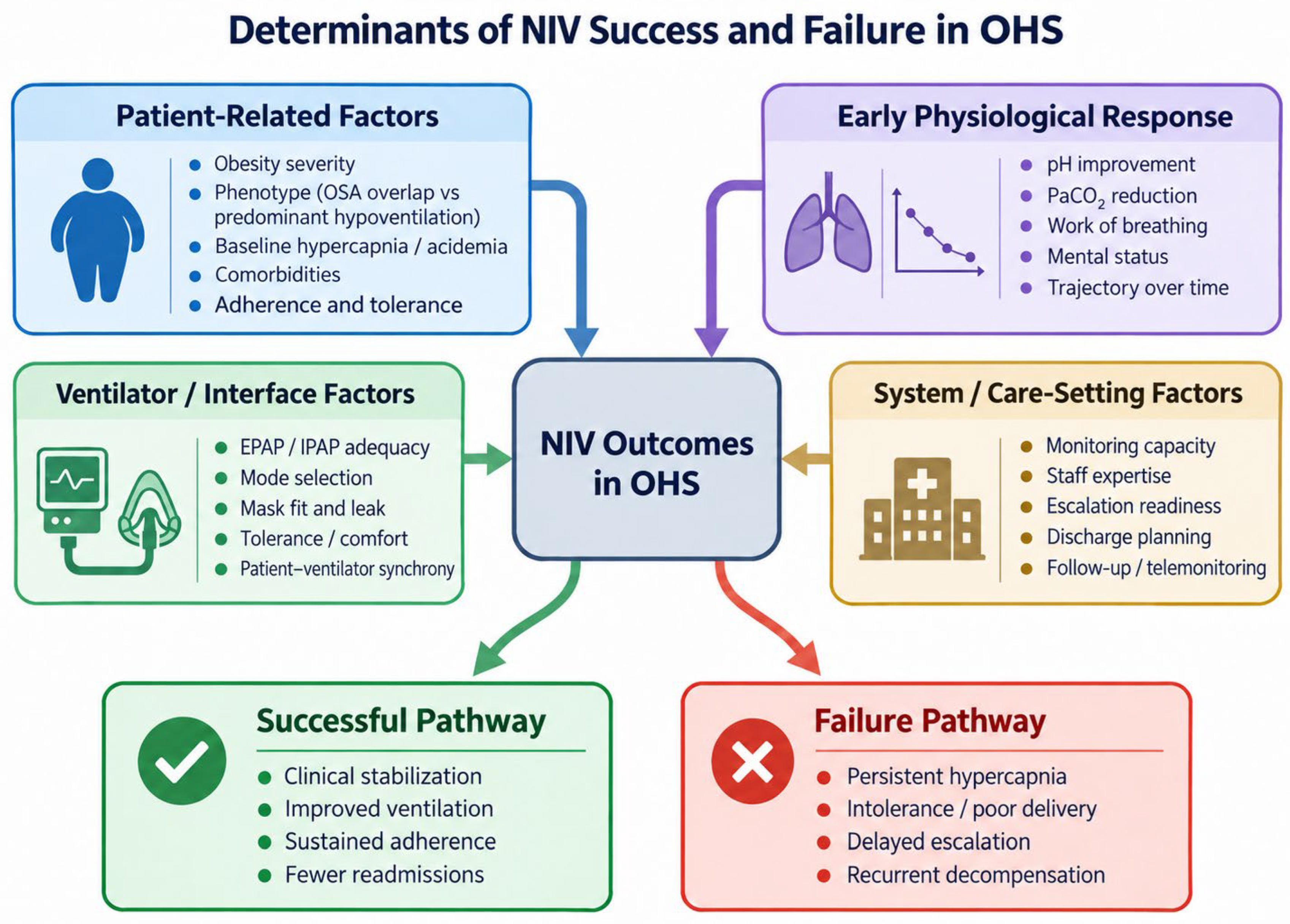
Successful implementation ultimately depends on coherent care pathways: documented responsibility for interface troubleshooting, repeat evaluation after NIV initiation, timely provision of discharge equipment, patient and caregiver education, and accessible follow-up. These measures follow established service principles, whereas the magnitude of any OHS-specific outcome benefit remains uncertain. Figure 1 summarizes the interaction between patient characteristics, physiological response, treatment delivery, and system factors; the categories are interdependent, not mutually exclusive or individually validated prediction domains.
Figure 1.
Determinants of noninvasive ventilation (NIV) success and failure in obesity hypoventilation syndrome (OHS). The figure summarizes patient-related, physiological, ventilator/interface, and system-level factors shaping acute and chronic NIV outcomes.
6. Patterns and Mechanisms of NIV Failure
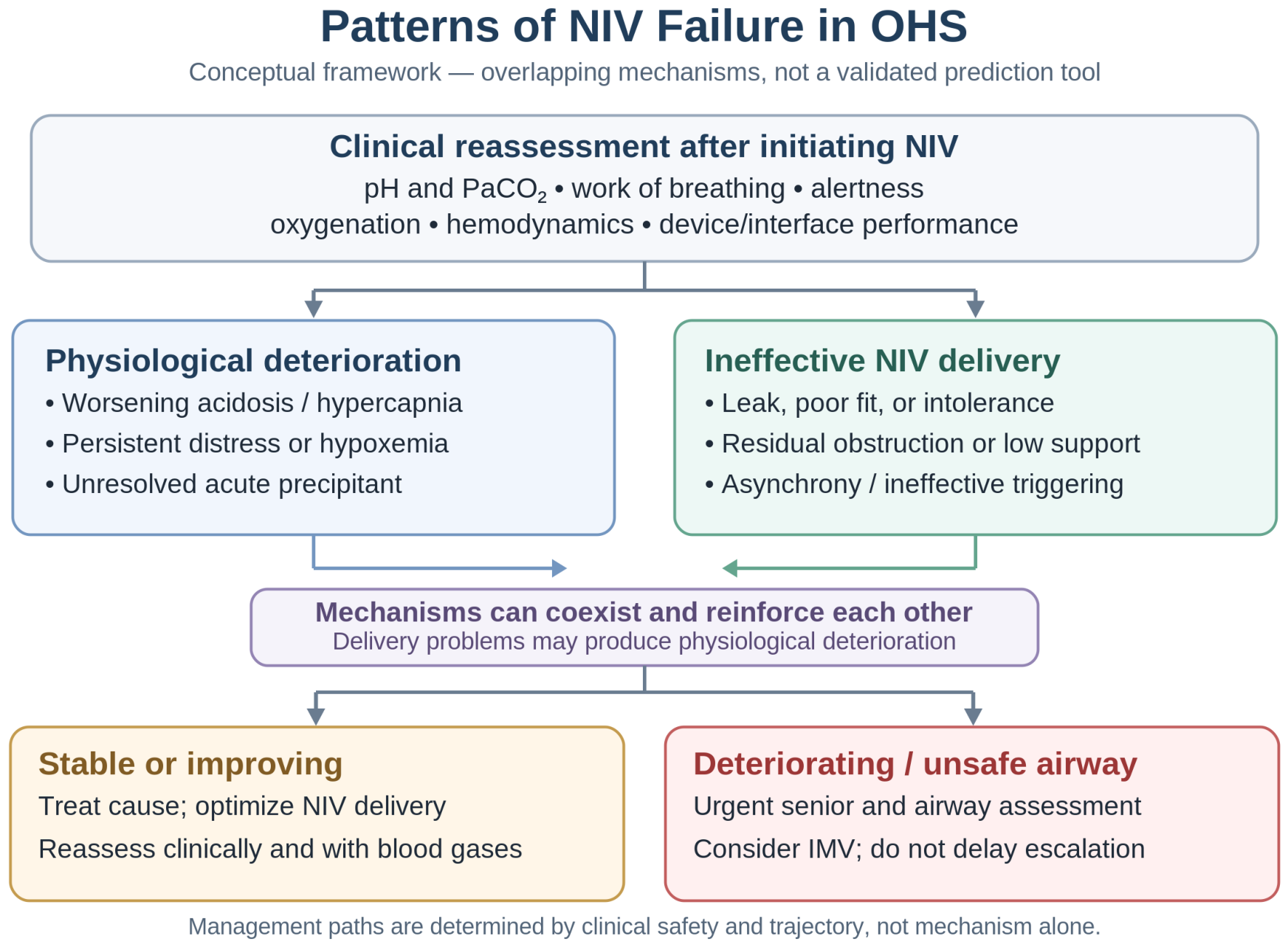
In OHS, an unsatisfactory response to NIV can arise from persistent physiological derangement, failure to deliver the prescribed assistance effectively, or both. These are interacting clinical mechanisms rather than mutually exclusive diagnostic categories. For example, substantial mask leak or ineffective triggering may reduce alveolar ventilation and aggravate hypercapnia; conversely, worsening respiratory distress may impair tolerance and increase leak. The distinction is offered as an interpretive framework, not as a prospectively validated prediction rule or an alternative to conventional assessment of NIV failure [12,20]. Figure 2 illustrates this relationship.
Figure 2.
Conceptual and potentially overlapping patterns of noninvasive ventilation (NIV) failure in obesity hypoventilation syndrome (OHS). Ineffective NIV delivery may contribute to physiological deterioration; repeated assessment determines whether optimization with close monitoring is appropriate or urgent evaluation for invasive mechanical ventilation (IMV) is required. The framework is interpretive and has not been prospectively validated.
Acute reassessment should begin with a documented clinical and blood-gas baseline and continue throughout NIV. Changes in pH and PaCO2 should be considered alongside respiratory rate, accessory-muscle use, oxygenation, level of consciousness, hemodynamic stability, and the patient’s overall trajectory. General British Thoracic Society acute NIV quality standards recommend repeat blood gases within two hours of initiation and specialist review within 30 min when blood gases fail to improve; reassessment must occur earlier if deterioration develops [50]. These are general acute NIV process standards, not OHS-specific validated thresholds for intubation.
Delayed correction of hypercapnic acidosis must be distinguished from progressive clinical failure. As discussed in Section 5.2, Lemyze et al. [6] documented delayed physiological correction among patients who ultimately responded to NIV. Continued monitored NIV may be reasonable when respiratory effort, alertness, and hemodynamics are stable or improving despite persistent hypercapnia. This observation does not justify waiting when a patient is deteriorating; pneumonia and greater organ dysfunction were associated with failure in that cohort, without establishing validated independent OHS-specific predictors.
When delivery appears ineffective, assessment should identify the likely mechanism before reflexively increasing pressures. Mask displacement and unintentional leak call for refitting or a suitable interface; persistent obstructive events warrant review of EPAP; continued hypoventilation despite obstruction control warrants reassessment of effective inspiratory pressure support (IPAP minus EPAP) and, when applicable, backup-rate adequacy. Ineffective triggering, mistimed cycling, discomfort, and high leak require review of synchrony and available device waveforms or measurements. Positioning, secretion management, humidification, and treatment of fluid overload or infection may also be relevant. These adjustments are individualized troubleshooting principles derived partly from broader NIV guidance and should not be interpreted as an OHS-specific settings protocol [12,51].
Correction of delivery problems and evaluation for escalation should proceed in parallel when clinical status is uncertain. An inability to protect the airway, respiratory arrest or impending arrest, worsening encephalopathy, progressive respiratory exhaustion, major hemodynamic instability, or refractory hypoxemia despite appropriate support requires immediate senior and airway assessment. Persistently worsening acidosis or hypercapnia despite effective NIV and treatment of the precipitant also raises concern for physiological failure. Mask intolerance or leak in a stable patient may be remediable; loss of airway protection is not an equivalent technical problem. Neither the proposed framework nor a single blood-gas value should delay IMV when clinically indicated [21,51].
Failure can also occur after initial stabilization. Renewed hypercapnia, increased work of breathing, worsening alertness, or recurrent hypoxemia should prompt assessment for a new precipitant, insufficient effective ventilation, and the need for a higher level of care. In chronic OHS, persistent daytime hypercapnia despite documented nocturnal device use requires a different, longitudinal evaluation of adherence, leak, residual obstruction, ventilatory effectiveness, and comorbidity rather than automatic classification as acute NIV failure. Thus, the same broad mechanistic framework may help structure reassessment across settings, but its ability to improve patient outcomes has not been prospectively evaluated.
7. Clinical Implications
For acute OHS-related hypercapnic respiratory failure, the practical question is whether the patient’s clinical condition and ventilation are improving, rather than whether a single PaCO2 value has normalized. Serial clinical examinations and blood-gas measurements should be interpreted together. A delayed physiological response can occur despite eventual NIV success, as reported by Lemyze et al. [6], but this does not justify continued NIV in the presence of worsening alertness, respiratory exhaustion, hemodynamic instability, or an unsafe airway. Section 6 outlines the clinical distinction between ongoing monitored optimization and urgent evaluation for invasive ventilation.
In chronic OHS, decisions to change PAP modality should reflect longitudinal reassessment. Trials involving stable OHS with severe OSA have not demonstrated consistent superiority of NIV over CPAP for long-term clinical endpoints [3,4], whereas patients with prominent hypoventilation or persistent inadequate control require individualized reassessment. Incomplete CPAP titration, later CPAP inadequacy, and NIV failure describe different clinical events. Neither phenotype nor baseline PaCO2 alone provides a universally validated rule for selecting or changing modality [1,36,42]. Short-term evidence also suggests that selected clinically stable OHS patients can transition from effective NIV to CPAP under reassessment, although longer follow-up is required [43].
Across the transition from hospital to home, clinical effectiveness depends on more than prescribing equipment or documenting hours of use. Device-derived usage, leak, and residual-event estimates should be interpreted with symptoms and physiological measures, including daytime PaCO2 where indicated. Observational discharge and home-ventilation studies support the relevance of continuity of care but cannot by themselves establish that a particular care pathway or telemonitoring strategy improves OHS-specific mortality or readmission outcomes [7,22,48].
The proposed distinction between failure of physiology and failure of NIV delivery is best used as a prompt to investigate potentially reversible causes of inadequate ventilation while assessing the need for escalation at the same time. Because these mechanisms can coexist, assigning a patient to one category should never delay established clinical safety decisions. This framework has not been tested for predictive accuracy, clinical utility, or effects on patient outcomes; it is an interpretive aid rather than a validated bedside algorithm.
8. Knowledge Gaps and Future Directions
Outcome heterogeneity limits comparison across OHS studies. Acute NIV investigations commonly report intubation, death, or early changes in blood gases, whereas chronic treatment studies report gas-exchange control, adherence, symptoms, hospitalization, or survival. Future studies should prespecify care setting, OHS diagnostic certainty, treatment modality, and clinically meaningful outcomes, allowing baseline risk factors, early response indicators, and final outcomes to be analyzed separately [4,5,6].
Prospective OHS-specific research is needed to determine whether baseline features and dynamic measurements provide reproducible prediction of acute NIV failure or long-term treatment inadequacy. Candidate measures may include acid-base trajectory, respiratory effort, precipitating illness, cardiopulmonary comorbidity, sleep-disordered breathing phenotype, interface performance, and effective ventilation. Factors associated with mortality, ICU admission, or subsequent CPAP-to-NIV transition should not automatically be assumed to predict acute NIV failure. Prediction models would require appropriate event counts, adjustment, calibration, external validation, and assessment of clinical consequences before adoption.
The relation between device exposure and achieved ventilatory effectiveness also warrants stronger investigation. Studies should evaluate hours of use alongside leak, residual obstructive events, nocturnal ventilation, symptoms, and daytime hypercapnia, and should test whether structured troubleshooting alters patient-centered outcomes. Telemonitoring may make these measures easier to review, but trials in OHS are needed before an improvement in device metrics can be equated with reduced hospitalization or mortality [23,48,49].
Care-pathway research should address safe ward NIV delivery, monitoring and escalation capability, continuity of PAP after discharge, follow-up access, and the contribution of respiratory therapists and multidisciplinary services. Future comparative and implementation studies should also measure sleep quality, symptom burden, patient experience, and quality of life, not only blood gases and hospital utilization [7,22,52]. Variability in ward NIV guidance, including incomplete review and escalation instructions, reinforces the need for prospective implementation research [47].
The proposed physiology-versus-delivery framework remains an explanatory construct rather than an evaluated intervention. Its ability to improve recognition of reversible problems, prevent delayed escalation, or change clinical outcomes has not been tested. Moreover, this narrative review integrates heterogeneous primary studies, reviews, guidelines, and indirect NIV evidence without a pooled estimate or formal study-level risk-of-bias scoring; selective inclusion, confounding, and indirectness therefore limit the certainty and generalizability of some interpretations. The included clinical evidence is intended to inform assessment and future research, not to validate a prognostic tool.
9. Conclusions
NIV outcomes in OHS depend on the clinical endpoint and care setting. Evidence from acute cohorts, randomized PAP trials, and longitudinal observational studies supports distinguishing baseline patient characteristics, evolving physiological response, treatment-delivery barriers, and longer-term treatment effectiveness. However, the strength of evidence differs across these domains, and associations with mortality, hospitalization, or long-term CPAP change should not be presented as established predictors of acute NIV failure.
The distinction between failure of physiology and failure of NIV delivery offers a practical way to organize reassessment, while recognizing that the mechanisms may overlap and that airway safety and escalation take precedence over troubleshooting. This proposed framework has not been prospectively validated, and its capacity to improve patient outcomes is unknown. Future OHS-specific studies should use clearer outcome definitions, validate prediction approaches, and test whether integrated acute-to-chronic care pathways improve clinically meaningful outcomes.
Funding
This research received no external funding.
Institutional Review Board Statement
The study was reviewed and scientifically approved by the Research Office at King Abdullah International Medical Research Center (KAIMRC) and was exempted from IRB review because it did not involve human subjects or relevant human data (Protocol No. NRA26/002/9).
Informed Consent Statement
Not applicable.
Data Availability Statement
No new data were created or analyzed in this study. Data sharing is not applicable to this article.
Acknowledgments
AI-assisted tool, ChatGPT GPT-5.5 (OpenAI), supported literature organization, editorial refinement, and visual preparation. The author remains responsible for reviewing, verifying, and approving the final scientific content.
Conflicts of Interest
The author declares no conflicts of interest.
Abbreviations
The following abbreviations are used in this manuscript:
| ABG | arterial blood gas |
| AHRF | acute hypercapnic respiratory failure |
| BMI | body mass index |
| CPAP | continuous positive airway pressure |
| EPAP | expiratory positive airway pressure |
| ICU | intensive care unit |
| IMV | invasive mechanical ventilation |
| IPAP | inspiratory positive airway pressure |
| NIV | noninvasive ventilation |
| OHS | obesity hypoventilation syndrome |
| OSA | obstructive sleep apnea |
| PAP | positive airway pressure |
| PaCO2 | arterial carbon dioxide tension |
| SDB | sleep-disordered breathing |
| WOB | work of breathing |
References
- Mokhlesi, B.; Masa, J.F.; Brozek, J.L.; Gurubhagavatula, I.; Murphy, P.B.; Piper, A.J.; Tulaimat, A.; Afshar, M.; Balachandran, J.S.; Dweik, R.A. Evaluation and management of obesity hypoventilation syndrome. An official American Thoracic Society clinical practice guideline. Am. J. Respir. Crit. Care Med. 2019, 200, e6–e24, Correction in Am. J. Respir. Crit. Care Med. 2019, 200, 1326. [Google Scholar] [CrossRef] [Scilit] [PubMed]
- Pépin, J.-L.; Baillieul, S.; Tamisier, R. Obesity hypoventilation syndrome: Current status and future directions for optimizing care of a complex and diverse condition (a narrative review). Sleep Med. 2025, 131, 106491. [Google Scholar] [CrossRef] [Scilit] [PubMed]
- Masa, J.; Corral, J.; Alonso, M.; Ordax, E.; Troncoso, M.; Gonzalez, M.; Lopez-Martínez, S.; Marin, J.; Marti, S.; Díaz-Cambriles, T.; et al. Efficacy of Different Treatment Alternatives for Obesity Hypoventilation Syndrome. Pickwick Study. Am. J. Respir. Crit. Care Med. 2015, 192, 86–95. [Google Scholar] [CrossRef] [Scilit] [PubMed]
- Masa, J.F.; Mokhlesi, B.; Benítez, I.; de Terreros, F.J.G.; Sánchez-Quiroga, M.Á.; Romero, A.; Caballero-Eraso, C.; Terán-Santos, J.; Alonso-Álvarez, M.L.; Troncoso, M.F.; et al. Long-term clinical effectiveness of continuous positive airway pressure therapy versus non-invasive ventilation therapy in patients with obesity hypoventilation syndrome: A multicentre, open-label, randomised controlled trial. Lancet 2019, 393, 1721–1732. [Google Scholar] [CrossRef] [Scilit] [PubMed]
- Carrillo, A.; Ferrer, M.; Gonzalez-Diaz, G.; Lopez-Martinez, A.; Llamas, N.; Alcazar, M.; Capilla, L.; Torres, A. Noninvasive ventilation in acute hypercapnic respiratory failure caused by obesity hypoventilation syndrome and chronic obstructive pulmonary disease. Am. J. Respir. Crit. Care Med. 2012, 186, 1279–1285. [Google Scholar] [CrossRef] [Scilit] [PubMed]
- Lemyze, M.; Taufour, P.; Duhamel, A.; Temime, J.; Nigeon, O.; Vangrunderbeeck, N.; Barrailler, S.; Gasan, G.; Pepy, F.; Thevenin, D.; et al. Determinants of noninvasive ventilation success or failure in morbidly obese patients in acute respiratory failure. PLoS ONE 2014, 9, e97563. [Google Scholar] [CrossRef] [Scilit] [PubMed]
- Mokhlesi, B.; Masa, J.F.; Afshar, M.; Almadana Pacheco, V.; Berlowitz, D.J.; Borel, J.-C.; Budweiser, S.; Carrillo, A.; Castro-Añón, O.; Ferrer, M.; et al. The effect of hospital discharge with empiric noninvasive ventilation on mortality in hospitalized patients with obesity hypoventilation syndrome. An individual patient data meta-analysis. Ann. Am. Thorac. Soc. 2020, 17, 627–637. [Google Scholar] [CrossRef] [Scilit] [PubMed]
- Sequeira, T.C.; BaHammam, A.S.; Esquinas, A.M. Noninvasive ventilation in the critically ill patient with obesity hypoventilation syndrome: A review. J. Intensive Care Med. 2017, 32, 421–428. [Google Scholar] [CrossRef] [Scilit] [PubMed]
- Vultur, M.A.; Grigorescu, B.L.; Huțanu, D.; Ianoși, E.S.; Budin, C.E.; Jimborean, G. A multidisciplinary approach to obesity hypoventilation syndrome: From diagnosis to long-term management—A narrative review. Diagnostics 2025, 15, 2120. [Google Scholar] [CrossRef] [Scilit] [PubMed]
- Rabec, C.; Janssens, J.-P.; Murphy, P.B. Ventilation in the obese: Physiological insights and management. Eur. Respir. Rev. 2025, 34, 240190. [Google Scholar] [CrossRef] [Scilit] [PubMed]
- Masa-Jiménez, J.F.; Ramírez-Molina, V.R.; De Dios-Calama, C. Phenotypes of obesity hypoventilation syndrome: Characteristics and outcomes. In Proceedings of the Seminars in Respiratory and Critical Care Medicine; Thieme Medical Publishers, Inc.: New York, NY, USA, 2025; pp. 202–212. [Google Scholar]
- Rezoagli, E.; Nova, A.; Carteaux, G.; Giani, M.; Grieco, D.L.; Pettenuzzo, T.; Lucchini, A.; Navalesi, P.; Antonelli, M.; Foti, G.; et al. A clinical guide to non-invasive respiratory support in acute respiratory failure: Ventilation settings, technical optimization and clinical indications. Crit. Care 2025, 29, 496. [Google Scholar] [CrossRef] [Scilit] [PubMed]
- Sirakaya, H.A.; Ferrández, A.T.; Esquinas, A.M. Adverse events in non-invasive ventilation approaches: Systematic review. Thorac. Res. Pract. 2025, 26, 340. [Google Scholar] [CrossRef] [Scilit] [PubMed]
- Amorim, M.R.; Aung, O.; Mokhlesi, B.; Polotsky, V.Y. Leptin-mediated neural targets in obesity hypoventilation syndrome. Sleep 2022, 45, zsac153. [Google Scholar] [CrossRef] [Scilit] [PubMed]
- Mokhlesi, B.; Won, C.H.; Make, B.J.; Selim, B.J.; Sunwoo, B.Y.; Gay, P.C.; Owens, R.L.; Wolfe, L.F.; Benditt, J.O.; Aboussouan, L.S.; et al. Optimal NIV Medicare access promotion: Patients with hypoventilation syndromes: A technical expert panel report from the American College of Chest Physicians, the American Association for Respiratory Care, the American Academy of Sleep Medicine, and the American Thoracic Society. Chest 2021, 160, e377–e387. [Google Scholar] [CrossRef] [Scilit] [PubMed]
- Orozco González, B.N.; Rodriguez Plascencia, N.; Palma Zapata, J.A.; Llamas Domínguez, A.E.; Rodríguez González, J.S.; Diaz, J.M.; Ponce Muñoz, M.; Ponce-Campos, S.D. Obesity hypoventilation syndrome, literature review. Sleep Adv. 2024, 5, zpae033. [Google Scholar] [CrossRef] [Scilit] [PubMed]
- Masa, J.F.; Benítez, I.D.; Sánchez-Quiroga, M.Á.; de Terreros, F.J.G.; Corral, J.; Romero, A.; Caballero-Eraso, C.; Ordax-Carbajo, E.; Troncoso, M.F.; González, M.; et al. Effectiveness of CPAP vs. noninvasive ventilation based on disease severity in obesity hypoventilation syndrome and concomitant severe obstructive sleep apnea. Arch. Bronconeumol. 2022, 58, 228–236. [Google Scholar] [CrossRef] [Scilit] [PubMed]
- Xu, J.; Wei, Z.; Li, W.; Wang, W. Effect of different modes of positive airway pressure treatment on obesity hypoventilation syndrome: A systematic review and network meta-analysis. Sleep Med. 2022, 91, 51–58. [Google Scholar] [CrossRef] [Scilit] [PubMed]
- Iftikhar, I.H.; Greer, M.; Wigger, G.W.; Collop, N.A. A network meta-analysis of different positive airway pressure interventions in obesity hypoventilation syndrome. J. Sleep Res. 2021, 30, e13158. [Google Scholar] [CrossRef] [Scilit] [PubMed]
- Criner, G.J.; Gayen, S.; Zantah, M.; Dominguez Castillo, E.; Naranjo, M.; Lashari, B.; Pourshahid, S.; Gangemi, A. Clinical review of non-invasive ventilation. Eur. Respir. J. 2024, 64, 2400396. [Google Scholar] [CrossRef] [Scilit] [PubMed]
- Perez, J.; Brandan, L.; Telias, I. Monitoring patients with acute respiratory failure during non-invasive respiratory support to minimize harm and identify treatment failure. Crit. Care 2025, 29, 147. [Google Scholar] [CrossRef] [Scilit] [PubMed]
- Einarsson, J.; Palm, A.; Ahmadi, Z.; Ekström, M. Home mechanical ventilation and risk of hospitalization in obesity hypoventilation syndrome: The population-based DISCOVERY study. Ann. Am. Thorac. Soc. 2025, 22, 422–429. [Google Scholar] [CrossRef] [Scilit] [PubMed]
- Agossou, M.; Awanou, B.; Inamo, J.; Rejaudry-Lacavalerie, M.; Arnal, J.-M.; Dramé, M. Impact of Previous Continuous Positive Airway Pressure Use on Noninvasive Ventilation Adherence and Quality in Obesity Hypoventilation Syndrome: A Pragmatic Single-Center Cross-Sectional Study in Martinique. Biomedicines 2023, 11, 2753. [Google Scholar] [CrossRef] [Scilit] [PubMed]
- Kreivi, H.-R.; Itäluoma, T.; Bachour, A. Effect of ventilation therapy on mortality rate among obesity hypoventilation syndrome and obstructive sleep apnoea patients. ERJ Open Res. 2020, 6, 00101-2019. [Google Scholar] [CrossRef] [Scilit] [PubMed]
- Patout, M.; Lhuillier, E.; Kaltsakas, G.; Benattia, A.; Dupuis, J.; Arbane, G.; Declercq, P.-L.; Ramsay, M.; Marino, P.; Molano, L.-C.; et al. Long-term survival following initiation of home non-invasive ventilation: A European study. Thorax 2020, 75, 965–973. [Google Scholar] [CrossRef] [Scilit] [PubMed]
- Jimenez, J.V.; Ackrivo, J.; Hsu, J.Y.; Wilson, M.W.; Labaki, W.W.; Hansen-Flaschen, J.; Hyzy, R.C.; Choi, P.J. Lowering PCO2 with noninvasive ventilation is associated with improved survival in chronic hypercapnic respiratory failure. Respir. Care 2023, 68, 1613–1622. [Google Scholar] [CrossRef] [Scilit] [PubMed]
- Thomas, A.; Jaffré, S.; Guardiolle, V.; Perennec, T.; Gagnadoux, F.; Goupil, F.; Bretonnière, C.; Danielo, V.; Morin, J.; Blanc, F.-X. Does PaCO2 correction have an impact on survival of patients with chronic respiratory failure and long-term non-invasive ventilation? Heliyon 2024, 10, e26437. [Google Scholar] [CrossRef] [Scilit] [PubMed]
- Msaad, S.; Gargouri, R.; Kotti, A.; Kallel, N.; Saidane, A.; Jmal, Y.; Ketata, W.; Moussa, N.; Bahloul, A.; Kammoun, S.; et al. Characteristics of obese patients with acute hypercapnia respiratory failure admitted in the department of pneumology: An observational study of a North African population. Sleep Disord. 2022, 2022, 5398460. [Google Scholar] [CrossRef] [Scilit] [PubMed]
- Faqihi, B.M.; Parekh, D.; Trethewey, S.P.; Morlet, J.; Mukherjee, R.; Turner, A.M. Ward-Based Noninvasive Ventilation for Acute Hypercapnic Respiratory Failure Unrelated to Chronic Obstructive Pulmonary Disease. Can. Respir. J. 2021, 2021, 4835536, Correction in Can. Respir. J. 2025, 2025, 9846527. [Google Scholar] [CrossRef] [Scilit] [PubMed]
- Chebib, N.; Nesme, P.; Freymond, N.; Argaud, L.; Rimmelé, T.; Bohé, J.; Devouassoux, G.; Souquet, P.-J.; Guérin, C. Acute respiratory failure in obesity-hypoventilation syndrome managed in the ICU. Respir. Care 2019, 64, 1545–1554. [Google Scholar] [CrossRef] [Scilit] [PubMed]
- Mathew, R.; Box, N.R.; Patri, S.; Reyes, S.; Ploch, M.; Lee, C.; Pueringer, M.; Estrada-Y-Martin, R.M.; Zhang, S.; Cherian, S.V. Characteristics of Patients with Acute Respiratory Failure in Obesity Hypoventilation Syndrome in the Intensive Care Unit: A Retrospective Cohort Study. Respir. Med. 2026, 261, 108999. [Google Scholar] [CrossRef] [Scilit] [PubMed]
- Piper, A.J.; Wang, D.; Yee, B.J.; Barnes, D.J.; Grunstein, R.R. Randomised trial of CPAP vs bilevel support in the treatment of obesity hypoventilation syndrome without severe nocturnal desaturation. Thorax 2008, 63, 395–401. [Google Scholar] [CrossRef] [Scilit] [PubMed]
- Howard, M.; Piper, A.; Stevens, B.; Holland, A.; Yee, B.; Dabscheck, E.; Mortimer, D.; Burge, A.; Flunt, D.; Buchan, C.; et al. A randomised controlled trial of CPAP versus non-invasive ventilation for initial treatment of obesity hypoventilation syndrome. Thorax 2017, 72, 437–444. [Google Scholar] [CrossRef] [Scilit] [PubMed]
- Masa, J.; Corral, J.; Caballero, C.; Barrot, E.; Terán-Santos, J.; Alonso-Álvarez, M.; Gomez-Garcia, T.; González, M.; López-Martín, S.; Lucas, P.; et al. Non-invasive ventilation in obesity hypoventilation syndrome without severe obstructive sleep apnoea. Thorax 2016, 71, 899–906. [Google Scholar] [CrossRef] [Scilit] [PubMed]
- Masa, J.F.; Benítez, I.; Sánchez-Quiroga, M.Á.; de Terreros, F.J.G.; Corral, J.; Romero, A.; Caballero-Eraso, C.; Alonso-Álvarez, M.L.; Ordax-Carbajo, E.; Gomez-Garcia, T.; et al. Long-term noninvasive ventilation in obesity hypoventilation syndrome without severe OSA: The Pickwick randomized controlled trial. Chest 2020, 158, 1176–1186. [Google Scholar] [PubMed]
- de Llano, L.P.; Castro-Añón, O.; Castro-Cabana, L.; Mendez Marote, L.; Golpe, R. Long-term effectiveness of CPAP in patients with severe obesity-hypoventilation syndrome. Sleep Breath. 2021, 25, 947–950. [Google Scholar] [CrossRef] [Scilit] [PubMed]
- Budweiser, S.; Riedl, S.; Jörres, R.A.; Heinemann, F.; Pfeifer, M. Mortality and prognostic factors in patients with obesity-hypoventilation syndrome undergoing noninvasive ventilation. J. Intern. Med. 2007, 261, 375–383. [Google Scholar] [CrossRef] [Scilit] [PubMed]
- Priou, P.; Hamel, J.F.; Person, C.; Meslier, N.; Racineux, J.L.; Urban, T.; Gagnadoux, F. Long-term outcome of noninvasive positive pressure ventilation for obesity hypoventilation syndrome. Chest 2010, 138, 84–90. [Google Scholar] [CrossRef] [Scilit] [PubMed]
- Bouloukaki, I.; Mermigkis, C.; Michelakis, S.; Moniaki, V.; Mauroudi, E.; Tzanakis, N.; Schiza, S.E. The association between adherence to positive airway pressure therapy and long-term outcomes in patients with obesity hypoventilation syndrome: A prospective observational study. J. Clin. Sleep Med. 2018, 14, 1539–1550. [Google Scholar] [CrossRef] [Scilit] [PubMed]
- Almeneessier, A.S.; Aleissi, S.; Olaish, A.H.; BaHammam, A.S. Long-term adherence to positive airway pressure therapy in Saudi ambulatory patients with obesity hypoventilation syndrome and severe obstructive sleep apnea: A one-year follow-up prospective observational study. Nat. Sci. Sleep 2021, 13, 63–74. [Google Scholar] [CrossRef] [Scilit] [PubMed]
- BaHammam, A.S.; Aleissi, S.A.; Nashwan, S.Z.; Olaish, A.H.; Almeneessier, A.S. Results of CPAP Titration and short-term adherence rates in patients with obesity hypoventilation syndrome and Mild/Moderate obstructive sleep apnea. Nat. Sci. Sleep 2022, 14, 1137–1148. [Google Scholar] [CrossRef] [Scilit] [PubMed]
- Lastra, A.C.; Masa, J.F.; Mokhlesi, B. CPAP titration failure is not equivalent to long-term CPAP treatment failure in patients with obesity hypoventilation syndrome: A case series. J. Clin. Sleep Med. 2020, 16, 1975–1981. [Google Scholar] [CrossRef] [Scilit] [PubMed]
- Arellano-Maric, M.P.; Hamm, C.; Duiverman, M.L.; Schwarz, S.; Callegari, J.; Storre, J.H.; Schmoor, C.; Spielmanns, M.; Galetke, W.; Windisch, W. Obesity hypoventilation syndrome treated with non-invasive ventilation: Is a switch to CPAP therapy feasible? Respirology 2020, 25, 435–442. [Google Scholar] [CrossRef] [Scilit] [PubMed]
- Forbes, R.; Duce, B.; Hukins, C.; Ellender, C. Factors associated with noninvasive ventilation usage in patients with hypoventilation disorders. Sleep Adv. 2024, 5, zpae046. [Google Scholar] [CrossRef] [Scilit] [PubMed]
- Rantala, H.A.; Leivo-Korpela, S.; Beerling, C.; Helminen, M.; Wijkstra, P.J.; Duiverman, M.L. Experienced benefits and side effects affect adherence with long-term noninvasive ventilation. Respir. Med. 2025, 249, 108427. [Google Scholar] [CrossRef] [Scilit] [PubMed]
- Payen, F.; Greil, A.; Caillaud, D. Obesity hypoventilation syndrome and initial compliance with non-invasive ventilation. Rev. Des Mal. Respir. 2020, 37, 783–789. [Google Scholar]
- Buchan, C.; Chukwu, I.; Walker, A.; Dabscheck, E.; Smallwood, N. Non-Invasive Ventilation Therapy Implementation in Medical Wards—A Scoping Review to Understand Hospitals’ Protocols and Procedures. J. Clin. Med. 2025, 14, 8152. [Google Scholar] [CrossRef] [Scilit] [PubMed]
- Khirani, S.; Patout, M.; Arnal, J.-M. Telemonitoring in non-invasive ventilation. Sleep Med. Clin. 2024, 19, 443–460. [Google Scholar] [CrossRef] [Scilit] [PubMed]
- Prigent, A.; Texereau, J.B.; Schmitz, C.; Ropars, C.; Degreef, J.-M.; Teulier, M.; Darne, C.; Lavergne, F.; Pasche, H.; Morelot-Panzini, C. Real-world telemonitoring and remote support for home non-invasive ventilation to improve therapy effectiveness: The exploratory, multicentre randomised eVENT study. Thorax 2025, 80, 720–729. [Google Scholar] [CrossRef] [Scilit] [PubMed]
- Davies, M.; Allen, M.; Bentley, A.; Bourke, S.C.; Creagh-Brown, B.; D’Oliveiro, R.; Glossop, A.; Gray, A.; Jacobs, P.; Mahadeva, R.; et al. British Thoracic Society Quality Standards for acute non-invasive ventilation in adults. BMJ Open Respir. Res. 2018, 5, e000283. [Google Scholar] [CrossRef] [Scilit] [PubMed]
- Davidson, A.C.; Banham, S.; Elliott, M.; Kennedy, D.; Gelder, C.; Glossop, A.; Church, A.C.; Creagh-Brown, B.; Dodd, J.W.; Felton, T.; et al. BTS/ICS guideline for the ventilatory management of acute hypercapnic respiratory failure in adults. Thorax 2016, 71, ii1–ii35, Correction in Thorax 2017, 72, 588. [Google Scholar] [CrossRef] [Scilit] [PubMed]
- Georgakopoulou, V.E.; Lazaridou, A.; Voulgaris, A.; Archontogeorgis, K.; Dalamaga, M.; Nena, E.; Steiropoulos, P. Sleep quality and well-being in obesity-hypoventilation syndrome versus obstructive sleep apnea with obesity: A comparative study. Metab. Open 2025, 26, 100367. [Google Scholar] [CrossRef] [Scilit] [PubMed]

Disclaimer/Publisher’s Note: The statements, opinions and data contained in all publications are solely those of the individual author(s) and contributor(s) and not of MDPI and/or the editor(s). MDPI and/or the editor(s) disclaim responsibility for any injury to people or property resulting from any ideas, methods, instructions or products referred to in the content. |
© 2026 by the author. Licensee MDPI, Basel, Switzerland. This article is an open access article distributed under the terms and conditions of the Creative Commons Attribution (CC BY) license.