


Abstract
Background: Kidney transplantation (KTx) is a safe procedure that improves the life expectancy and quality of life of patients requiring it. However, despite the known benefits for patients who receive a kidney transplant, non-adherence to immunosuppressive medication is an unsolved problem, reflected mainly by graft rejection. Objective: The aim of this study is to systematically review the existing literature on adherence factors to medication after renal transplantation. Methods: A systematic literature review of studies published since 2010 was conducted in three databases. Records for the search were limited to publications from 2010 to 2024, available in full-text. The search was carried out in July 2024. In total, 2632 abstracts were downloaded from the different databases. Inclusion criteria were papers of any type (quantitative or qualitative) whose objective was the identification of predictors of adherence for patients who were prescribed immunosuppressive medication after kidney transplantation. Results: The predictors of adherence to treatment found in the systematic review were grouped into the following categories of the World Health Organization classification: socio-economic factors, factors related to the treatment/therapy, patient-related factors, disease-related factors, and health care system factors. Most of the studies were excluded, and in the end, 30 were included in the final analysis. According to these studies, a set of strong predictors was identified, but discrepancies among the variables of gender in young patients, pre-emptive transplantation, and the time of the transplantation were detected. Conclusions: In this study, we identified specific predictors and directions for the association of those predictors with adherence to immunosuppressive medication for patients after KTx. Further research should consider conducting reviews for different patient sub-groups on medication adherence and the development and validation of a screening instrument for adherence/non-adherence factors that clinicians could use as a detection tool for subjects at risk of low adherence.
1. Introduction
Kidney transplantation (KTx) stands as the preferential treatment for end-of-stage kidney disease (ESRD) [1]. KTx is a safe procedure that improves the life expectancy and quality of life of patients requiring such therapy. The number of patients requiring a kidney transplant is growing, both in Europe and in the United States [2,3]. Deceased donor kidney transplantation (DDRTx) is more frequent than from a living donor [2] despite the known benefits for patients who receive a kidney transplant from a living donor (LDRTx). Generally, an organ from a living donor is generally healthier and more resistant to the occurrence and extension of the subsequent ischemia, leading to better graft survival outcomes compared to DDRTx. Moreover, LDRTx have a lower incidence of delayed graft function, thus reducing the period of hospitalization and the need for kidney replacement therapy after transplantation [4].
Graft rejection is a major issue after KTx. Non-adherence to immunosuppressive medication is an important factor for graft rejection and loss after a successful KTx [5,6,7,8,9]. Non-adherence can be highly prevalent in kidney transplant recipients, reaching rates of up to 78%, with a high variability in the results of the studies [5,10,11,12,13,14,15]. A review of recent systematic literature [16] revealed a lack of uniformity in the definition of non-adherence, which explains the wide range of non-adherence prevalence. It is, then, very important to understand the factors that promote better adherence among patients after undergoing KTx [17]. Non-compliance, defined as the voluntary behavior of not following the medication plan recommended for the immunosuppressive medication (contrary to non-adherence, which is not necessarily a voluntary act), has been shown to have similar negative effects for patients, showing that non-compliant patients have higher rates of graft rejection and lower survival rates [18,19].
The World Health Organization (WHO) has provided a classification of factors that have an influence on adherence in general [20]. These include health system factors, socioeconomic factors, factors related to the treatment/therapy, patient-related factors, and disease-related factors. The literature has identified factors that are specifically associated with adherence for patients after KTx. Non-adherence of these patients has, in particular, been associated with a heterogeneous number of factors, including mental health problems, such as anxiety [6,7,12] or depressive symptoms [6,7,11,12,21,22], poor quality of life [10,13,23], beliefs regarding IM [10,12,15,22,24,25], or social support [25]. The perceived susceptibility to rejection and perceived benefits of adherence to treatment have proven to be predictors of adherence rates [26].
The aim of this study is to systematically review the existing literature on adherence factors for medication after renal transplantation based on the WHO classification for adherence factors.
2. Materials and Methods
This systematic literature review followed the Preferred Reporting Items for Systematic Reviews and Meta-Analyses (PRISMA) statement [27]. The review protocol was not registered. The framework of this systematic review, according to PIO [28], was as follows: population—people with KTx; intervention—factors of adherence; outcomes—adherence and non-adherence to the treatment recommended by a clinician after KTx.
2.1. Search Strategy
A search was conducted in three main databases—Web of Science (WOS), Cochrane Database of Randomized Clinical Trials, and PROQUEST—for this systematic literature review. Other sources (Google Scholar) were also consulted to complete the search, with papers that were not identified in the main databases consulted but that were known to be relevant by the authors of this paper.
To ensure a systematic and comprehensive bibliographic search, key terms were identified through a preliminary review of relevant literature, considering synonyms, linguistic variations, and discipline-specific terminology. Controlled vocabularies like MeSH were consulted for standardized terms. The terms were categorized based on study concepts (population and outcomes). Expert consultation further ensured the terms’ precision and comprehensiveness, supporting replicability and minimizing the risk of missing relevant studies. The PICO method was applied to the structure and combination of keywords regarding KTx (which included “Kidney transplant*” and “renal transplant*”), as well as keywords for adherence (“adherence”, “compliance”). The search equations are included in Table A1.
2.2. Eligibility Criteria
Records for the search were limited to publications from 2010 to 2024, available in full-text, in the main databases. The bibliographic search was carried out in July 2024. In addition to the search for articles in English, Spanish language was an additional requirement for records sought in Google Scholar due to the study’s interest in collecting representative predictors that reflect both international and regional realities. The main inclusion criteria were quantitative and qualitative studies evaluating adherence of patients after KTx and identifying adherence or non-adherence factors associated with KTx after transplantation. Exclusion criteria were systematic reviews, patients under 18 years of age, and studies that did not show reliable results (were unfinished or presented unreliable data to draw conclusions, such as case reports).
2.3. Study Selection and Data Extraction
After completing the search in each database, all references were imported into Zotero 6.0.22, the software program used for reference management in which the selection of the studies was conducted. The selection of the studies included the screening of all titles and abstracts identified in the database searches in the initial stage and of full texts in the second stage, conducting a forward and backward search. The search and study selection were conducted in July 2024 by two researchers working independently from each other (LE, SC). Any doubts or disagreements arising between the two researchers were discussed with a third researcher (EM). The extraction tool was designed based on recommendations from the Cochrane handbook and adapted to the specificities of this review. The methodology followed for data extraction was reviewed and approved by all authors. It was not necessary to contact any of the authors of the papers included in this review for completion of any missing relevant information from the articles.
2.4. Risk of Bias and Quality Assessment of Records
The risk of bias assessment was carried out by two of the co-authors, who discussed the results of the analysis in case of discrepancy until agreement. The method developed by Parmar et al. [29] was chosen for assessing the risk of bias in the records we included. These authors developed a Bias & Quality Assessment tool to be implemented in systematic literature reviews when the review accepts studies from very different sources and methodologies. The tool includes seven key domains: selection bias, ecological fallacy, confounding bias, reporting bias, time bias, measurement error in the exposure indicator, and measurement error in health outcomes. For each publication, each of the above-mentioned domains was scored as follows, and as suggested by the authors who developed the tool: a score of 1 was given for a low risk of bias study, 2 for a moderate risk, and 3 for a high risk. Then, the overall rating was computed as follows: 1 (strong) was given if none of its domains was rated as weak, 2 (moderate) if up to two domains were rated as weak, or 3 (weak) if three or more domains were rated as weak.
Some of these questions needed to be adapted for this review. For example, for randomized controlled trials, because representability does not apply, selection bias was evaluated by analyzing the appropriateness of the sampling methods (e.g., the study shows strong sampling methods reported, large enough sample sizes, blinding, appropriate randomization methods, etc.). Regarding confounding bias assessment, studies that included control variables in their analyses were considered as stronger in terms of quality. Regarding time bias, the longer the period (in years) between the time frame analyzed and the time of publication, the higher the risk of time bias was considered. A higher risk of measurement error in the exposure variable or in the outcome measurement (adherence or non-adherence to medication) was assumed for self-reported measures of adherence, respectively, especially when the measurement instrument used was not a psychometrically validated scale.
3. Results
3.1. Study Selection
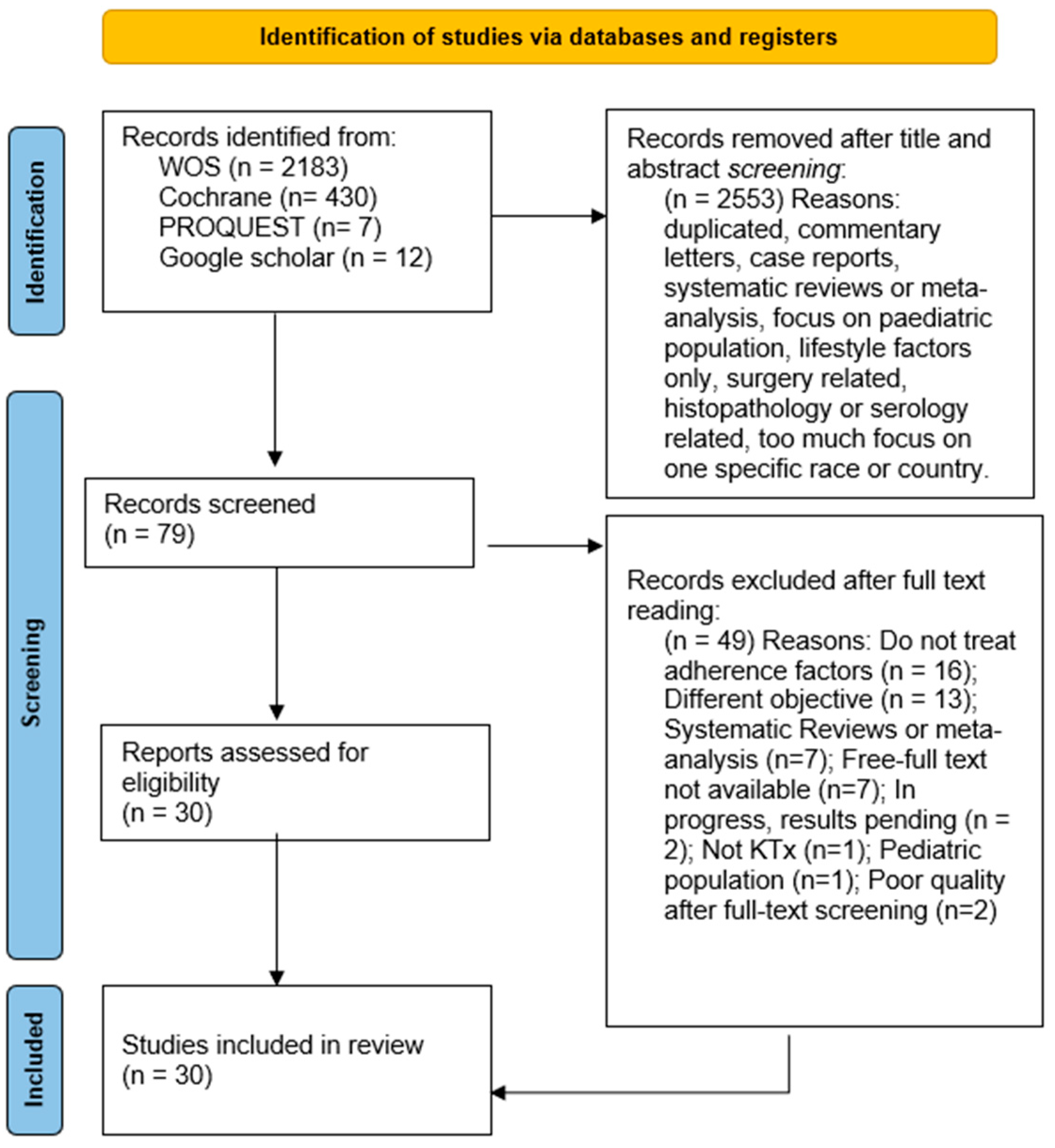
The search strategy identified 2632 potential studies from WOS (2183), Cochrane Clinical Trials database (430), PROQUEST (7), and Google Scholar (12). After eliminating duplicates and reading the titles and abstracts, 87 articles remained. In the second phase, the complete texts were read, considering the inclusion and exclusion criteria. Finally, 30 articles were selected, from which the information for this systematic review was extracted. Some papers were excluded after performing the risk-of-bias check (n = 2). The search and process of exclusion and the selection of the papers are presented in Figure 1 below.
Figure 1.
The PRISMA flow diagram.
Reference lists of primary research reports were cross-checked in an attempt to identify additional studies.
3.2. Risk-of-Bias and Quality Assessment
Each item of the quality and bias scales was rated into one of three categories according to its Risk of Bias as previously described. Among the included studies, there were twenty-one studies rated as strong (having no “weak” ratings) and nine studies considered of moderate quality (with a maximum of one “weak” rating).
After full-text screening and assessment of the quality of the reports and bias assessment, a total of 30 articles, all of them considered to be of moderate or high quality, were kept for the systematic review. Predictors of adherence to immunosuppressive medication as well as for risk of non-adherence to it, were identified from these articles (Table A2).
3.3. The Main Results
Table 1 below summarizes the information extracted from the studies ultimately included in this systematic review, including the main and more relevant results for this review (Table 1). Also, the main results are presented in detail in Table 2 with the summary of the 30 studies included in this review (Table 2).
- Socio-demographic and economic factors
Socioeconomic factors such as gender, age, education, social support, income, and employment status were found as predictors of non-adherence to IM after KTx. This review found that women are more adherent than men [30] and that aging increases the likelihood for adherence when it is not controlled by gender [25]. Contradictory results of two studies were discovered, one finding young women more adherent than men of the same age in the US and Canada [31], the second one finding young men being more adherent in the UK [32]. In particular, findings show that men are more likely not to adhere to the medication regime recommended by the doctor [33]. Younger individuals, under 50 years of age, were also found to have a higher risk of non-adherence [34,35]. Non-adherence risk was also found to increase for women with high levels of education [36] or for patients with low levels of literacy [22,37].
The quality of social support [38] and social interactions appear to be good predictors of adherence, whether it is from social interactions [39], family [40,41], or other patients [41]. A predictor for men seems to be having a good marital relationship [36] and a stable partner [42]. For example, living with parents appeared to be an important predictor for adherence [32], as well as the awareness of the importance of the prescription and recommendations provided by a doctor [43].
Economic factors were also found to be good predictors of non-adherence in several of the records included. Specifically, it was found that patients with lower income were at a higher risk of non-adherence [33,43,44], especially if low income was accompanied by high levels of education, as shown in two of the articles included [22,33]. Higher income is also a predictor for non-adherence, but this was found in a study conducted in Brazil, where the lower-income population groups have benefits in terms of better health care coverage and assistance [45]. In relation to demographic variables, rural living and vocational education favored adherence behaviors [35]
- Treatment-related factors
In relation to the transplantation process and its follow-up, patients who had at least one previous KTx [46]; had received a transplant from a living organ donor [22]; missed health care appointments [47]; or neglected physical activity recommendations [42]; and those appearing to be concerned about the medication and its complexity, such as the duration of treatment, number of pills, size and taste or side effects, were those most likely not to adhere to the recommended medication [22,33,37,48]. In addition, an increased perception of the symptoms induced by the medical treatment increased the probability of non-adherence, as shown by one of the papers [46]. A lower self-efficacy value regarding medication taking [25,46] and the perception of difficulties in complying with the recommended medication regime, such as challenging nutritional recommendations [44], concomitant medications [30], or complementary medicine [49], were other relevant predictors of the risk of non-adherence found in this category. Finally, in relation to the treatment, the changing of the medication regime to once a day was related to adherence [50].
- Patient-related factors
Regarding patient-related factors, being unaware of the complications associated with non-adherence [32,41,43] and other personality traits, such as a reluctance to accept new experiences [11], were found to be good predictors of non-adherence. Other patient-related factors found were the risk of forgetting to take the medication when out of the normal routine [37,51], procrastination [43], low physical function in general [11], depressive syndromes [11,33,34,43], anxiety or emotional distress [22], and a lower QoL in general [34]. Better scores in regard to quality of life matters increase the probability of adherence according to several authors [30,36,39,52]. The ability of patients to self-manage their own health and health care [32], illness acceptance [35], and ability to solve daily-life problems [53] is another example of patient-related factors.
A consistent finding in two articles was that the self-perception of the severity of the disease when not taking the medication as prescribed [54] or the greater effects of kidney malfunction as perceived by the patient [39] increase the probability of adherence to medication for patients after KTx. A lack of knowledge regarding the utility of the medication prescribed [30], decision making processes comparing cost evaluation against perceived benefits [22], or confusion as to when or which medication to take [30] were also predictors identified in this review.
- Disease-related factors
Concerning disease-related predictors, the best predictors of non-adherence were previous dialysis treatment [32,46], except in one study [26]. Other predictors of non-adherence were a greater amount of time since KTx [26,33,38,55] and having other health problems like comorbidities [22,32], cognition problems such as mild cognitive impairment [56], autoimmune nephritis [22], and serious infections after KTx [26].
- Health care system factors
In relation to health care system-related factors, satisfaction with the doctor [32] as well as with the condition and resources offered by the facility or clinic where the consultation took place, such as the number of hospital beds or the structure of the waiting room [42], were important predictors found for adherence to the medication of patients after KTx. The absence of health care personnel for consultation in the case of forgetting to take the medication as prescribed [46] and the problem of pharmacies not supplying medications on time [43] were the main predictors of the non-adherence found.
Table 1.
Conceptual framework of predictors of adherence to medication for KTx patients.
Table 2.
Summary of studies: description, objective, and main findings.
4. Discussion
This systematic review is aimed at assessing the evidence available on the predictors of adherence and non-adherence to immune-suppressive medication by patients who underwent KTx. The goal was to identify literature gaps, document the current cutting-edge knowledge, and initiate a discussion regarding the direction in which further research should be focused. To our knowledge, this is one of the few studies that concentrate exclusively on the identification of specific predictors and the association of those predictors with adherence to immune-suppressive medication in patients after KTx.
Our review results indicate that socio-demographic factors, patient-related factors, treatment-related factors, disease-related factors, and health care system-related factors are good categories for establishing the predictors of both adherence and non-adherence to immune-suppressive medication in the targeted patients. This structure was proposed by the WHO, and it is appropriate for categorizing adherence and non-adherence predictors within the context of this review.
In view of the number of abstracts collected by our search strategy, one might think that there is extensive literature on this topic. However, a large number of studies were excluded (N = 2553 excluded abstracts in the abstract screening phase, and 58 excluded records in the full-text screening phase), and the final number of records included (n = 30) represented 1% of all the records found and 32% of the full-text records screened (as stated in the PRISMA flow diagram).
There are several contradictory findings that need to be explored in greater depth by expanding research to further study these matters and increasing sample sizes of similar studies in the future. For example, contradictions were found for gender: some studies found women were more adherent than men [31], and other studies found the opposite situation in favor of men [32]. Differences in adherence results by gender may be explained, in part, by the different methodologies used in the studies analyzed. For example, one study [31] found that young women had higher adherence compared to young men using a randomized study design with no intervention and follow-up with electronic pillboxes. In contrast, another study [32], a cross-sectional survey study in the UK, found that young men showed higher adherence when they lived with their parents and were associated with high levels of awareness about the importance of treatment. These methodological differences could be influencing the findings, as studies using self-reporting tend to reflect perception biases, while those using objective measures, such as the use of electronic pillboxes, may capture more accurate data on actual adherence behavior. Another source of discrepancy is the variability in the contextual factors considered in each study. While some studies examine adherence based on psychosocial factors such as family support and quality of life, others focus on demographic or economic variables. The impact of gender on adherence might be mediated by factors such as education, economic stability, and social support structure. The lack of a homogeneous approach in the selection of variables and assessment methods highlights the need for more standardized studies that would allow for more consistent conclusions about the role of gender in treatment adherence.
Similarly, being on dialysis treatment before the kidney transplant was found to be a predictor for both adherence [26] and non-adherence [32,46]. Another contradiction was found in regard to the amount of time elapsed since the transplantation; some studies found that the more recent the transplantation [56], the higher the risk of non-adherence, and other studies found that longer periods of time since the transplantation are associated with higher probabilities for non-adherence [26,33,38,55].
This review represents an improvement over previous systematic reviews carried out, as it focuses exclusively on describing in detail the existing evidence on the factors related to adherence to treatment. This review contributes to the existing literature by applying the WHO framework to deepen the understanding of adherence factors, categorizing them into socioeconomic, treatment-related, patient-related, disease-related, and health care system factors [59,60]. The evidence should be accompanied by quality indicators as a guarantee of the reliability of the conclusions. Possessing structured evidence is crucial to enhancing knowledge about the factors that should be the focus of attention, both for establishing screening programs for patients at risk of non-adherence and for designing personalized intervention strategies focused especially on those modifiable strategies. In this sense, it is important to anticipate those factors that predict good adherence, as well as those predictors of non-adherence. In this way, clinicians can take steps in advance with patients showing a high risk of non-adherence. Therefore, it is necessary for clinicians to rely on validated tools that will help them anticipate situations of risk of non-adherence, thus increasing the chances that patients will adhere to medical prescriptions and show clinical improvement and health-related quality of life. Further research should focus on the development and validation of a suitable screening instrument for adherence/non-adherence factors that will serve clinicians as a detection tool for subjects at risk of low adherence. In addition, this type of screening tool has to be accompanied by specific and validated protocols and guidelines for action once these factors are identified in clinical practice, and they will help in adopting individualized clinical decisions for each patient and their specific environment.
Our paper has several limitations. First, the evidence was mostly based on self-reported measures of adherence and non-adherence and does not allow for a true extrapolation of the results in most studies due to questions either of small sample sizes and/or selection bias. In many studies, there was an under-representation of the population of non-adherent patients merely because of the requirement that the participant had to be able to attend the consultation. This also justifies the fact that many studies had a small sample size, given the difficulties of recruiting patients to participate in the study. Second, contrary to other reviews [16], we did not include papers published before 2010. The reason for this limitation is that most publications were issued after this year and also that most measures for adherence of patients were only validated in this past decade. Moreover, immune-suppressant protocols prior to 2010 were quite different from those today, so we considered that a study focusing on papers as of 2010 would be more accurate. In this sense, the focus of this review is on predictors of adherence, but the existing heterogeneity of adherence measures is an interesting topic to address in future research focused on measures. Third, given that the objective of the review was to determine adherence and non-adherence predictors, in order to fill the gaps left by previous literature, papers of all kinds of methodologies were included. This means that the identification of predictors includes sources that range from purely theoretical works to purely quantitative or qualitative studies, which could lead to certain conflicts and difficulties in aggregating predictors within categories or themes or might even be the reason for the contradictions found. Socio-demographic and economic factors appear to be highly dependent on the type of health care system in which the transplant was performed—for example, US health care systems versus universal health care systems. This aspect should be considered when interpreting the results of this review. Also, restricting the inclusion to English and Spanish studies may have led to the omission of relevant research in other languages, potentially affecting the generalizability of the findings, especially for Asian and European populations. Finally, this review identified predictors of adherence and non-adherence for a specific type of patient, and therefore, it may not be a framework that could be applied to other patient sub-groups. This study includes considerable heterogeneity in study design, populations, and outcome measures; however, the lack of a formal heterogeneity assessment and subgroup analysis limits the interpretation of findings across different contexts. The lack of a standardized definition of adherence and variation in measurement tools limits meaningful comparisons across studies and could be addressed in future research. It would be relevant to conduct a meta-analysis in future studies, as it could provide valuable insights by exploring the magnitude and precision of associations across more homogeneous study designs, populations, and outcome measures. Further research should explore these specific factors. Other suggestions would be to explore the possibility of conducting similar studies on adherence, focusing on the importance of using validated measures in assessing medication adherence. Following guidelines could improve the quality of the literature on this important topic and explain some of the contradictory findings detected in our review [61].
5. Conclusions
This review provides a conceptual framework for predictors of adherence and non-adherence of patients who underwent KTx. This framework is based on the WHO proposed categories for medication adherence but provides specific predictors and directions of associations for those predictors of adherence and non-adherence in the targeted patients. This framework is specific to this patient population and cannot be used for other patient populations. Further research should consider conducting reviews on different patient sub-groups regarding medication adherence in order to be able to inform health care institutions and providers of health care services on how to improve adherence to medication regardless of the condition of the patients.
Author Contributions
All authors participated in the conceptualization, design, and review of the manuscript draft; E.L. and C.S. conducted the review and wrote the manuscript; E.M., M.I.D., M.G.-P., E.G., A.G.-D., E.I.N., A.M.P., I.P., A.S. and N.M. contributed to the discussion and conclusions and reviewed the final version of the article. All authors have read and agreed to the published version of the manuscript.
Funding
Chiesi España sponsored this project without participating in study design, data analysis, or preparation of the manuscript.
Institutional Review Board Statement
Not applicable.
Informed Consent Statement
Not applicable.
Data Availability Statement
Data are contained within the article.
Conflicts of Interest
Some of the authors of this article declare financial conflicts of interest due to received honoraria and consulting fees and working as a speaker in projects promoted by pharmaceutical companies.
Appendix A
Table A1.
Search equations.
Appendix B
Table A2.
Evaluation of the risk of bias and quality assessment of the studies included in the review according to the Parmar et al.’s assessment scale [29].
References
- Lemoine, M.; Titeca Beauport, D.; Lobbedez, T.; Choukroun, G.; Hurault de Ligny, B.; Hazzan, M.; Guerrot, D.; Bertrand, D. Risk Factors for Early Graft Failure and Death After Kidney Transplantation in Recipients Older Than 70 Years. Kidney Int. Rep. 2019, 4, 656–666. [Google Scholar] [CrossRef] [Scilit]
- Eurotransplant Eurotransplant Annual Report 2021 2021. Available online: https://www.eurotransplant.org/wp-content/uploads/2024/06/ETP_AR2023_LowRes.pdf (accessed on 21 February 2025).
- Saran, R.; Robinson, B.; Abbott, K.C.; Agodoa, L.Y.C.; Albertus, P.; Ayanian, J.; Balkrishnan, R.; Bragg-Gresham, J.; Cao, J.; Chen, J.L.T.; et al. US Renal Data System 2016 Annual Data Report: Epidemiology of Kidney Disease in the United States. Am. J. Kidney Dis. 2017, 69, A7–A8. [Google Scholar] [CrossRef] [Scilit]
- Bellini, M.I.; Courtney, A.E.; McCaughan, J.A. Living Donor Kidney Transplantation Improves Graft and Recipient Survival in Patients with Multiple Kidney Transplants. J. Clin. Med. 2020, 9, 2118. [Google Scholar] [CrossRef] [Scilit] [PubMed]
- Butler, J.A.; Roderick, P.; Mullee, M.; Mason, J.C.; Peveler, R.C. Frequency and Impact of Nonadherence to Immunosuppressants after Renal Transplantation: A Systematic Review. Transplantation 2004, 77, 769. [Google Scholar] [CrossRef] [Scilit]
- Denhaerynck, K.; Dobbels, F.; Cleemput, I.; Desmyttere, A.; Schäfer-Keller, P.; Schaub, S.; De Geest, S. Prevalence, Consequences, and Determinants of Nonadherence in Adult Renal Transplant Patients: A Literature Review. Transpl. Int. 2005, 18, 1121–1133. [Google Scholar] [CrossRef] [Scilit] [PubMed]
- Pabst, S.; Bertram, A.; Zimmermann, T.; Schiffer, M.; de Zwaan, M. Physician Reported Adherence to Immunosuppressants in Renal Transplant Patients: Prevalence, Agreement, and Correlates. J. Psychosom. Res. 2015, 79, 364–371. [Google Scholar] [CrossRef] [Scilit]
- Scheel, J.F.; Schieber, K.; Reber, S.; Stoessel, L.; Waldmann, E.; Jank, S.; Eckardt, K.-U.; Grundmann, F.; Vitinius, F.; de Zwaan, M.; et al. Psychosocial Variables Associated with Immunosuppressive Medication Non-Adherence after Renal Transplantation. Front. Psychiatry 2018, 9, 23. [Google Scholar] [CrossRef] [Scilit] [PubMed]
- Sellares, J.; de Freitas, D.G.; Mengel, M.; Reeve, J.; Einecke, G. Sis Understanding the Causes of Kidney Transplant Failure: The Dominant Role of Antibody-Mediated Rejection and Nonadherence. Am. J. Transplant. 2012, 12, 1121–1133. [Google Scholar] [CrossRef] [Scilit]
- Chisholm-Burns, M.; Pinsky, B.; Parker, G.; Johnson, P.; Arcona, S.; Buzinec, P.; Chakravarti, P.; Good, M.; Cooper, M. Factors Related to Immunosuppressant Medication Adherence in Renal Transplant Recipients. Clin. Transplant. 2012, 26, 706–713. [Google Scholar] [CrossRef] [Scilit]
- Gorevski, E.; Succop, P.; Sachdeva, J.; Cavanaugh, T.M.; Volek, P.; Heaton, P.; Chisholm-Burns, M.; Martin-Boone, J.E. Is There an Association between Immunosuppressant Therapy Medication Adherence and Depression, Quality of Life, and Personality Traits in the Kidney and Liver Transplant Population? Patient Prefer. Adherence 2013, 7, 301–307. [Google Scholar] [CrossRef] [Scilit]
- Reber, S.; Morawa, E.; Stößel, L.; Jank, S.; Vitinius, F.; Eckardt, K.-U.; Erim, Y. Prevalence and Modifiable Determinants of Non-Adherence in Adult Kidney Transplant Recipients in a German Sample. Z. Für Psychosom. Med. Psychother. 2016, 62, 270–283. [Google Scholar] [CrossRef] [Scilit] [PubMed]
- Sabbatini, M.; Garofalo, G.; Borrelli, S.; Vitale, S.; Capone, D.; Russo, L.; Pisani, A.; Carrano, R.; Gallo, R.; Federico, S.; et al. Efficacy of a Reduced Pill Burden on Therapeutic Adherence to Calcineurin Inhibitors in Renal Transplant Recipients: An Observational Study. Patient Prefer. Adherence 2014, 8, 73–81. [Google Scholar] [CrossRef] [Scilit]
- Scheel, J.F.; Reber, S.; Stoessel, L.; Waldmann, E.; Jank, S.; Eckardt, K.-U.; Grundmann, F.; Vitinius, F.; de Zwaan, M.; Bertram, A.; et al. Patient-Reported Non-Adherence and Immunosuppressant Trough Levels Are Associated with Rejection after Renal Transplantation. BMC Nephrol. 2017, 18, 107. [Google Scholar] [CrossRef] [Scilit]
- Tielen, M.; van Exel, J.; Laging, M.; Beck, D.K.; Khemai, R.; van Gelder, T.; Betjes, M.G.H.; Weimar, W.; Massey, E.K. Attitudes to Medication after Kidney Transplantation and Their Association with Medication Adherence and Graft Survival: A 2-Year Follow-Up Study. J. Transplant. 2014, 2014, e675301. [Google Scholar] [CrossRef] [Scilit] [PubMed]
- Gokoel, S.R.M.; Gombert-Handoko, K.B.; Zwart, T.C.; van der Boog, P.J.M.; Moes, D.J.A.R.; de Fijter, J.W. Medication Non-Adherence after Kidney Transplantation: A Critical Appraisal and Systematic Review. Transplant. Rev. 2020, 34, 100511. [Google Scholar] [CrossRef] [Scilit] [PubMed]
- Vrijens, B.; De Geest, S.; Hughes, D.A.; Przemyslaw, K.; Demonceau, J.; Ruppar, T.; Dobbels, F.; Fargher, E.; Morrison, V.; Lewek, P.; et al. A New Taxonomy for Describing and Defining Adherence to Medications. Br. J. Clin. Pharmacol. 2012, 73, 691–705. [Google Scholar] [CrossRef] [PubMed]
- Chhiba, P.D.; Moore, D.P.; Levy, C.; Do Vale, C. Factors Associated with Graft Survival in South African Adolescent Renal Transplant Patients at CMJAH over a 20-Year Period (GRAFT-SAT Study). Pediatr. Transplant. 2022, 26, e14148. [Google Scholar] [CrossRef] [Scilit]
- Berben, L.; Dobbels, F.; Engberg, S.; Hill, M.N.; De Geest, S. An Ecological Perspective on Medication Adherence. West. J. Nurs. Res. 2012, 34, 635–653. [Google Scholar] [CrossRef] [Scilit] [PubMed]
- Burkhart, P.V.; Sabaté, E. Adherence to Long-Term Therapies: Evidence for Action. J. Nurs. Sch. 2003, 35, 207. [Google Scholar] [CrossRef] [Scilit]
- Chilcot, J.; Spencer, B.W.J.; Maple, H.; Mamode, N. Depression and Kidney Transplantation. Transplantation 2014, 97, 717–721. [Google Scholar] [CrossRef] [Scilit]
- Griva, K.; Davenport, A.; Harrison, M.; Newman, S.P. Non-Adherence to Immunosuppressive Medications in Kidney Transplantation: Intent Vs. Forgetfulness and Clinical Markers of Medication Intake. Ann. Behav. Med. 2012, 44, 85–93. [Google Scholar] [CrossRef] [Scilit]
- Shabany Hamedan, M.; Mohamad Aliha, J. Relationship between Immunosuppressive Medications Adherence and Quality of Life and Some Patient Factors in Renal Transplant Patients in Iran. Glob. J. Health Sci. 2014, 6, p205. [Google Scholar] [CrossRef] [Scilit]
- Massey, E.K.; Tielen, M.; Laging, M.; Beck, D.K.; Khemai, R.; van Gelder, T.; Weimar, W. The Role of Goal Cognitions, Illness Perceptions and Treatment Beliefs in Self-Reported Adherence after Kidney Transplantation: A Cohort Study. J. Psychosom. Res. 2013, 75, 229–234. [Google Scholar] [CrossRef] [Scilit] [PubMed]
- Russell, C.L.; Ashbaugh, C.; Peace, L.; Cetingok, M.; Hamburger, K.Q.; Owens, S.; Coffey, D.; Webb, A.W.; Hathaway, D.; Winsett, R.P.; et al. Time-in-a-Bottle (TIAB): A Longitudinal, Correlational Study of Patterns, Potential Predictors, and Outcomes of Immunosuppressive Medication Adherence in Adult Kidney Transplant Recipients. Clin. Transplant. 2013, 27, E580–E590. [Google Scholar] [CrossRef] [Scilit] [PubMed]
- Kung, P.-C.; Yeh, M.C.; Lai, M.-K.; Liu, H.-E. Renal Transplant Recipients: The Factors Related to Immunosuppressive Medication Adherence Based on the Health Belief Model. J. Nurs. Res. 2017, 25, 392–397. [Google Scholar] [CrossRef] [Scilit] [PubMed]
- Page, M.J.; McKenzie, J.E.; Bossuyt, P.M.; Boutron, I.; Hoffmann, T.C.; Mulrow, C.D.; Shamseer, L.; Tetzlaff, J.M.; Akl, E.A.; Brennan, S.E.; et al. The PRISMA 2020 Statement: An Updated Guideline for Reporting Systematic Reviews. BMJ 2021, 372, n71. [Google Scholar] [CrossRef] [Scilit]
- Sackett, D.L.; Strauss, S.E.; Richardson, W.S.; Rosenberg, W.; Haynes, R.B. Evidence-Based Medicine: How to Practice and Teach EBM, 2nd ed.; Elsevier; Churchill Livingstone: Philadelphia, PA, USA, 2000; Volume 16. [Google Scholar]
- Parmar, D.; Stavropoulou, C.; Ioannidis, J.P.A. Health Outcomes during the 2008 Financial Crisis in Europe: Systematic Literature Review. BMJ 2016, 354, i4588. [Google Scholar] [CrossRef] [Scilit] [PubMed]
- Ganjali, R.; Ghorban Sabbagh, M.; Nazemiyan, F.; Mamdouhi, F.; Badiee Aval, S.; Taherzadeh, Z.; Heshmati Nabavi, F.; Golmakani, R.; Tohidinezhad, F.; Eslami, S. Factors Associated With Adherence To Immunosuppressive Therapy And Barriers In Asian Kidney Transplant Recipients. ImmunoTargets Ther. 2019, 8, 53–62. [Google Scholar] [CrossRef] [Scilit] [PubMed]
- Boucquemont, J.; Pai, A.; Dharnidharka, V.; Hebert, D.; Furth, S.; Foster, B. Gender Differences in Medication Adherence Among Adolescent and Young Adult Kidney Transplant Recipients. Transplantation 2019, 103, 798–806. [Google Scholar] [CrossRef] [Scilit]
- Hamilton, A.J.; Caskey, F.J.; Casula, A.; Inward, C.D.; Ben-Shlomo, Y. Associations with Wellbeing and Medication Adherence in Young Adults Receiving Kidney Replacement Therapy. Clin. J. Am. Soc. Nephrol. 2018, 13, 1669–1679. [Google Scholar] [CrossRef] [Scilit] [PubMed]
- Weng, L.-C.; Yang, Y.-C.; Huang, H.-L.; Chiang, Y.-J.; Tsai, Y.-H. Factors That Determine Self-Reported Immunosuppressant Adherence in Kidney Transplant Recipients: A Correlational Study. J. Adv. Nurs. 2017, 73, 228–239. [Google Scholar] [CrossRef] [Scilit] [PubMed]
- Villeneuve, C.; Rousseau, A.; Rerolle, J.-P.; Couzi, L.; Kamar, N.; Essig, M.; Etienne, I.; Westeel, P.-F.; Büchler, M.; Esposito, L.; et al. Adherence Profiles in Kidney Transplant Patients: Causes and Consequences. Patient Educ. Couns. 2020, 103, 189–198. [Google Scholar] [CrossRef] [Scilit] [PubMed]
- Zachciał, J.; Uchmanowicz, I.; Krajewska, M.; Banasik, M. Adherence to Immunosuppressive Therapies after Kidney Transplantation from a Biopsychosocial Perspective: A Cross-Sectional Study. J. Clin. Med. 2022, 11, 1381. [Google Scholar] [CrossRef] [Scilit] [PubMed]
- Neubert, L.; Peters, L.; Tkachenko, D.; Zimmermann, T. Couples After Renal Transplantation: Impact of Sex and Relationship Quality on Adherence in a Prospective Study. Transplant. Proc. 2021, 53, 1599–1605. [Google Scholar] [CrossRef] [Scilit]
- Weng, F.L.; Chandwani, S.; Kurtyka, K.M.; Zacker, C.; Chisholm-Burns, M.A.; Demissie, K. Prevalence and Correlates of Medication Non-Adherence among Kidney Transplant Recipients More than 6 Months Post-Transplant: A Cross-Sectional Study. BMC Nephrol. 2013, 14, 261. [Google Scholar] [CrossRef] [Scilit] [PubMed]
- Zhao, L.; Yan, J.; Yang, G.-L.; Liu, Y. A Study on Adherence to Follow-up, Quality of Life, and Associated Factors Among Renal Transplant Recipients in China. Transplant. Proc. 2017, 49, 1285–1290. [Google Scholar] [CrossRef] [Scilit] [PubMed]
- Díaz-Soto, C.M.; Présiga-Ríos, P.A.; Zapata-Rueda, C.M. Calidad de vida relacionada con la salud y adherencia al tratamiento en pacientes con enfermedad renal crónica en Antioquia-Colombia. Rev. De. Educ. Y Desarro. 2017, 41, 17–25. [Google Scholar]
- Cheung, C.Y.; Chan, K.M.; Tang, G.; Cheung, A.; Chak, W.L. Immunosuppressive Medication Adherence in Kidney Transplant Recipients During the COVID-19 Pandemic: A Cross-Sectional Study in Hong Kong. Transpl. Proc. 2021, 53, 2447–2450. [Google Scholar] [CrossRef] [Scilit] [PubMed]
- Chironda, G.; Bhengu, B.R. Motivators of Adherence to Integrated Management among Patients with Chronic Kidney Disease: A Qualitative Study. Nurs. Health Sci. 2019, 21, 63–70. [Google Scholar] [CrossRef] [Scilit]
- Sanders-Pinheiro, H.; Colugnati, F.A.B.; Denhaerynck, K.; Marsicano, E.O.; Medina, J.O.P.; De Geest, S.; Individuals, A.B.S.T.A.B. study team includes the following Multilevel Correlates of Immunosuppressive Nonadherence in Kidney Transplant Patients: The Multicenter ADHERE BRAZIL Study. Transplantation 2021, 105, 255–266. [Google Scholar] [CrossRef] [Scilit] [PubMed]
- Israni, A.; Dean, C.; Kasel, B.; Berndt, L.; Wildebush, W.; Wang, C.J. Why Do Patients Forget to Take Immunosuppression Medications and Miss Appointments: Can a Mobile Phone App Help? JMIR Public. Health Surveill. 2016, 2, e15. [Google Scholar] [CrossRef] [Scilit] [PubMed]
- Matos Trevín, G.; Martín Alfonso, L.; Álvarez Vázquez, B.; Remón Rivera, L.; González Gacel, J.; Matos Trevín, G.; Martín Alfonso, L.; Álvarez Vázquez, B.; Remón Rivera, L.; González Gacel, J. Adherencia Terapéutica de Pacientes Con Insuficiencia Renal Crónica En Tratamiento Dialítico. Rev. Habanera Cienc. Médicas 2019, 18, 666–677. [Google Scholar]
- Marsicano, E.O.; Fernandes, N.S.; Colugnati, F.A.B.; Fernandes, N.M.S.; De Geest, S.; Sanders-Pinheiro, H. Multilevel Correlates of Non-Adherence in Kidney Transplant Patients Benefitting from Full Cost Coverage for Immunosuppressives: A Cross-Sectional Study. PLoS ONE 2015, 10, e0138869. [Google Scholar] [CrossRef] [Scilit] [PubMed]
- Kobayashi, S.; Tsutsui, J.; Okabe, S.; Hideki, I.; Akaho, R.; Nishimura, K. Medication Nonadherence after Kidney Transplantation: An Internet-Based Survey in Japan. Psychol. Health Med. 2020, 25, 91–101. [Google Scholar] [CrossRef] [Scilit] [PubMed]
- Taber, D.J.; Fleming, J.N.; Fominaya, C.E.; Gebregziabher, M.; Hunt, K.J.; Srinivas, T.R.; Baliga, P.K.; McGillicuddy, J.W.; Egede, L.E. The Impact of Health Care Appointment Non-Adherence on Graft Outcomes in Kidney Transplantation. Am. J. Nephrol. 2017, 45, 91–98. [Google Scholar] [CrossRef] [Scilit] [PubMed]
- Neuberger, J.M.; Bechstein, W.O.; Kuypers, D.R.J.; Burra, P.; Citterio, F.; De Geest, S.; Duvoux, C.; Jardine, A.G.; Kamar, N.; Krämer, B.K.; et al. Practical Recommendations for Long-Term Management of Modifiable Risks in Kidney and Liver Transplant Recipients: A Guidance Report and Clinical Checklist by the Consensus on Managing Modifiable Risk in Transplantation (COMMIT) Group. Transplantation 2017, 101, S1. [Google Scholar] [CrossRef] [Scilit]
- Markell, M.S.; Terebelo, S. Complementary Medicine Use, Symptom Burden and Non-Adherence in Kidney Transplant Recipients. Explore 2018, 14, 414–419. [Google Scholar] [CrossRef] [Scilit] [PubMed]
- Oh, C.-K.; Bang, J.B.; Kim, S.-J.; Huh, K.H.; Kim, S.J.; Jeon, J.S.; Han, S.Y.; Cho, H.R.; Kwon, Y.J.; Lee, S.H.; et al. Improvement of Medication Adherence with Simplified Once-Daily Immunosuppressive Regimen in Stable Kidney Transplant Recipients: A Prospective Cohort Study. Asian J. Surg. 2020, 43, 660–667. [Google Scholar] [CrossRef] [Scilit] [PubMed]
- Cossart, A.R.; Staatz, C.E.; Campbell, S.B.; Isbel, N.M.; Cottrell, W.N. Investigating Barriers to Immunosuppressant Medication Adherence in Renal Transplant Patients. Nephrology 2019, 24, 102–110. [Google Scholar] [CrossRef] [Scilit]
- Zhao, S.M.; Dong, F.F.; Qiu, H.Z.; Li, D. Quality of Life, Adherence Behavior, and Social Support Among Renal Transplant Recipients in China: A Descriptive Correlational Study. Transplant. Proc. 2018, 50, 3329–3337. [Google Scholar] [CrossRef] [Scilit] [PubMed]
- Paterson, T.S.E.; O’Rourke, N.; Shapiro, R.J.; Loken Thornton, W. Medication Adherence in Renal Transplant Recipients: A Latent Variable Model of Psychosocial and Neurocognitive Predictors. PLoS ONE 2018, 13, e0204219. [Google Scholar] [CrossRef] [Scilit] [PubMed]
- Xia, M.; Yan, J.; Liu, S.; Liu, J. Beliefs of Immunosuppressive Medication Among Chinese Renal Transplant Recipients, as Assessed in a Cross-Sectional Study With the Basel Assessment of Adherence to Immunosuppressive Medications Scale. Transplant. Proc. 2019, 51, 742–748. [Google Scholar] [CrossRef] [Scilit]
- Costa-Requena, G.; Cantarell, M.C.; Moreso, F.; Parramon, G.; Seron, D. Adherencia al tratamiento tras trasplante renal como indicador de calidad de la información recibida: Estudio longitudinal con un seguimiento de 2 años. Rev. De Calid. Asist. 2017, 32, 33–39. [Google Scholar] [CrossRef] [Scilit] [PubMed]
- Patzer, R.E.; Serper, M.; Reese, P.P.; Przytula, K.; Koval, R.; Ladner, D.P.; Levitsky, J.M.; Abecassis, M.M.; Wolf, M.S. Medication Understanding, Non-Adherence, and Clinical Outcomes among Adult Kidney Transplant Recipients. Clin. Transpl. 2016, 30, 1294–1305. [Google Scholar] [CrossRef] [Scilit] [PubMed]
- Sanders-Pinheiro, H.; Colugnati, F.A.B.; Marsicano, E.O.; De Geest, S.; Medina, J.O.P.; Adhere Brazil Consortium Group. Prevalence and Correlates of Non-Adherence to Immunosuppressants and to Health Behaviours in Patients after Kidney Transplantation in Brazil—The ADHERE BRAZIL Multicentre Study: A Cross-Sectional Study Protocol. BMC Nephrol. 2018, 19, 41. [Google Scholar] [CrossRef] [Scilit]
- Boucquemont, J.; Pai, A.L.; Dharnidharka, V.R.; Hebert, D.; Zelikovsky, N.; Amaral, S.; Furth, S.L.; Foster, B.J. Association between Day of the Week and Medication Adherence among Adolescent and Young Adult Kidney Transplant Recipients. Am. J. Transpl. 2020, 20, 274–281. [Google Scholar] [CrossRef] [Scilit] [PubMed]
- Belaiche, S.; Décaudin, B.; Dharancy, S.; Noel, C.; Odou, P.; Hazzan, M. Factors Relevant to Medication Non-Adherence in Kidney Transplant: A Systematic Review. Int. J. Clin. Pharm. 2017, 39, 582–593. [Google Scholar] [CrossRef] [Scilit]
- Corr, M.; Walker, A.; Maxwell, A.P.; McKay, G.J. Non-Adherence to Immunosuppressive Medications in Kidney Transplant Recipients- a Systematic Scoping Review. Transplant. Rev. 2025, 39, 100900. [Google Scholar] [CrossRef] [Scilit]
- De Geest, S.; Zullig, L.L.; Dunbar-Jacob, J.; Helmy, R.; Hughes, D.A.; Wilson, I.B.; Vrijens, B. ESPACOMP Medication Adherence Reporting Guideline (EMERGE). Ann. Intern. Med. 2018, 169, 30–35. [Google Scholar] [CrossRef] [Scilit]

Disclaimer/Publisher’s Note: The statements, opinions and data contained in all publications are solely those of the individual author(s) and contributor(s) and not of MDPI and/or the editor(s). MDPI and/or the editor(s) disclaim responsibility for any injury to people or property resulting from any ideas, methods, instructions or products referred to in the content. |
© 2025 by the authors. Licensee MDPI, Basel, Switzerland. This article is an open access article distributed under the terms and conditions of the Creative Commons Attribution (CC BY) license (https://creativecommons.org/licenses/by/4.0/).