


Abstract
This study evaluated the accuracy of predicting unplanned the intensive care unit (ICU) readmission using the Nursing Activities Score (NAS) at ICU discharge based on nursing workloads, and compared it to the accuracy of the prediction made using the Stability and Workload Index for Transfer (SWIFT) score. Patients admitted to the ICU of Sapporo Medical University Hospital between April 2014 and December 2017 were included, and unplanned ICU readmissions were retrospectively evaluated using the SWIFT score and the NAS. Patient characteristics, such as age, sex, the Charlson Comorbidity Index, and sequential organ failure assessment score at ICU admission, were used as covariates, and logistic regression analysis was performed to calculate the odds ratios for the SWIFT score and NAS. Among 599 patients, 58 (9.7%) were unexpectedly readmitted to the ICU. The area under the receiver operating characteristic curve of NAS (0.78) was higher than that of the SWIFT score (0.68), and cutoff values were 21 for the SWIFT and 53 for the NAS. Multivariate analysis showed that the NAS was an independent predictor of unplanned ICU readmission. The NAS was superior to the SWIFT in predicting unplanned ICU readmission. NAS may be an adjunctive tool to predict unplanned ICU readmission.
1. Introduction
Unplanned readmission to the intensive care unit (ICU) is associated with unfavorable outcomes, such as poor prognosis [1] and prolonged ICU stay [2].
These adverse effects also have a negative impact on ICU bed utilization restrictions [3] and increased hospital costs [4]. Because unplanned ICU readmissions are related to hospital performance, increased hospital costs not only affect patients, but also impact the entire hospital system [5,6]. However, no methods have been set up to prevent ICU readmissions. Unplanned ICU readmissions occur in 4.5% to 9.2% of patients who are discharged from the ICU and are events that need to be prevented.
High severity of illness scores at ICU admission [7], the physiological indices at ICU discharge [8], and malignancy [9] are known risk factors associated with unplanned ICU readmission.
Various attempts have been made to predict unplanned ICU readmission. The aggregation of physiological indices, such as the National Early Warning Score [10] and the Stability and Workload Index for Transfer (SWIFT) [11] at the time of ICU discharge, can predict unplanned ICU readmission. However, factors that affect unplanned ICU readmission, and the validation of these tools for predicting unplanned ICU readmission, have not been fully elucidated.
The mortality rate and severity of illness in patients in the ICU are closely associated with the workload of the medical staff, including nurses. da Silva et al. [12] demonstrated that the nursing workload (NW) at the time of ICU discharge was associated with mortality and ICU readmission. NWs not only include nursing care, but also organ support status, and can comprehensively depict the patient’s condition. There are several scoring tools, such as the therapeutic intervention scoring system [13], nine equivalents of nursing manpower [14], and the Nursing Activity Score (NAS) [15], that can evaluate NWs in the ICU. The NAS has been widely used to evaluate the workload and allocation of medical resources in the ICU and to objectively measure the content of treatment [16]. Moreover, NAS has been independently associated with ICU readmission as a dichotomous variable [17]. However, there have been no comparisons between unplanned ICU readmissions using NWs and physiological indices. Since there are accurate predictive tools to prevent ICU readmission, we consider it meaningful to examine these from different perspectives. Therefore, we conducted this study to clarify the efficacy of predicting ICU readmissions using the NAS at ICU discharge compared to the prediction made by the SWIFT score.
2. Materials and Methods
2.1. Design, Setting, and Inclusion Criteria
This was a single-center, retrospective, observational study conducted at a university hospital. The study design and protocol were approved by the Institutional Review Board (IRB) of Sapporo Medical University (IRB-authorized number: 322-55, 9 September 2020). Patients with unplanned ICU admission during the period from January 2014 to December 2017 at the Sapporo Medical University Hospital were selected based on the electronic healthcare records (EHR). Among these patients, those who were discharged from the ICU and did not meet the exclusion criteria were enrolled.
Our hospital does not have a step-down unit. Rapid response teams have been established to facilitate early detection of patients who have a sudden deterioration in health.
Three researchers collected the data between August 2021 and September 2021. We initiated a post-ICU evaluation round to prevent ICU readmission in January 2018. We used data from 2014 to 2017 because of the potential influence of this post-ICU round on incidence of ICU readmission. ICU readmission was defined as readmission to the ICU within 7 days of ICU discharge, as previously described [18,19,20].
2.2. Exclusion Criteria
Patients who (1) were <18 years of age, (2) died in the ICU, (3) received a DNAR order during hospital stay, (4) were transferred to the different hospital within 7 days after ICU discharge, and (5) had missing electronic healthcare records data to calculate the SWIFT score and the NAS at the time of ICU discharge were excluded from this study.
2.3. Population
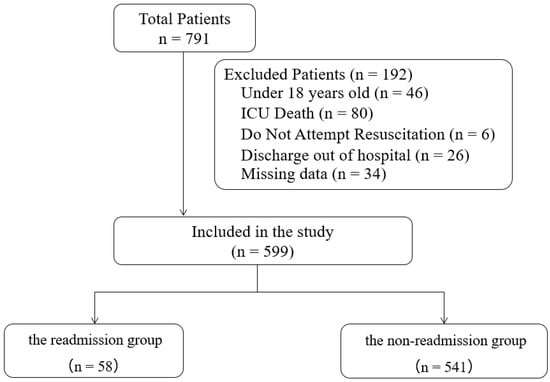
Figure 1 shows a flow chart of patient enrollment. Among 791 patients who were inadvertently admitted to our ICU during the study period, 192 were excluded based on the exclusion criteria. The 34 patients for whom data on blood gas analysis were not collected within 24 h prior to ICU discharge were excluded. The remaining 599 patients were included in this study. A total of 58 patients (9.7%) were readmitted to the ICU within 7 days of ICU discharge.
Figure 1.
Patient enrolment flowchart.
2.4. Data Collection
The most recent patient data within 24 h before ICU discharge were collected from the EHR of our university hospital. Patient characteristics such as age, sex, and underlying disease were collected, and the Charlson comorbidity index (CCI), ventilator days, length of ICU stay, mortality, acute physiology and chronic health evaluation II (APACHE II) score, and sequential organ failure assessment (SOFA) score were calculated at ICU admission.
The variables of the SWIFT score at ICU discharge included the ICU admission source, length of ICU stay, the Glasgow Coma Scale score, PaO2/FIO2, and PaCO2 (Appendix A). The NAS was developed by Miranda et al. in 2003 to comprehensively describe nursing activities in the ICU beyond those related to the severity of illness [15]. The NAS represents approximately 80% of nursing activities in the ICU, which is more representative than the 43% obtained by the TISS-28 [15]. The NAS is an index comprising seven categories: basic activities, ventilatory, cardiovascular, renal, neurological, and metabolic support, and other specific interventions and 23 nursing activities, with weights ranging from 1.2 to 32 points (Appendix B). The NAS was calculated from the data collected according to the instruction manual [15].
2.5. Criteria for ICU Discharge
Intensivists, attending physicians, and ICU medical staff shared the status of a patient through rounds and meetings held every morning and discussed whether the patient was suitable for ICU discharge according to the guidelines for ICU admission, discharge, and triage [21]. In summary, the criteria for ICU discharge in our ICU were as follows.
Stable patients who did not require treatment or monitoring in the ICU.
Confirmation that the patient was ready for ICU discharge in a multidisciplinary conference with the attending physician.
2.6. Statistical Analysis
Data were assessed for Gaussian distribution using the Shapiro–Wilk normality test. Normally distributed data were presented as the mean ± standard deviation (SD), and non-normally distributed data were presented as the median and interquartile range (IQR). Categorical data were presented as counts and corresponding frequencies (%). Patient characteristics were analyzed using the Mann–Whitney U test for continuous variables and Fisher’s exact test for categorical variables. The SWIFT and the NAS were analyzed using the receiver operating characteristic (ROC) curves for each score and compared with the corresponding area under the receiver operating characteristic curve (AUROC). The cutoff value for predicting ICU readmission was calculated using the Youden index. We hypothesized that the NAS would be more useful than the SWIFT in predicting unplanned ICU readmission. To evaluate this hypothesis, logistic regression analysis was performed using unplanned ICU readmission as the dependent variable and SWIFT and the NAS as the independent variables. The SWIFT and the NAS were categorized by cutoff values in the ROC analysis and entered into the multivariate analysis. Variables that overlapped with the NAS and the SWIFT were not included in the multivariate analysis to avoid multicollinearity. Finally, age, sex, CCI, and SOFA scores upon ICU admission were selected as adjustment factors and entered into the multivariate analysis. CCI and SOFA were selected as covariates, because previous studies have reported their association with unplanned ICU readmission [22,23]. Statistical significance was set at p < 0.05. Statistical analyses were performed using SPSS software version 27 (IBM Corp., Armonk, NY, USA).
3. Results
3.1. Patient Characteristics
Patient characteristics are shown in Table 1. Sex, length of ICU stay, and the number of patients who received CRRT were significantly higher in the readmission compared to the non-readmission group. The SWIFT scores and the NAS in the readmission group were significantly higher than those in the non-readmission group.
Table 1.
Patient characteristics.
3.2. Comparison of ROC Curves for Unplanned ICU Readmission between the SWIFT Score and NAS
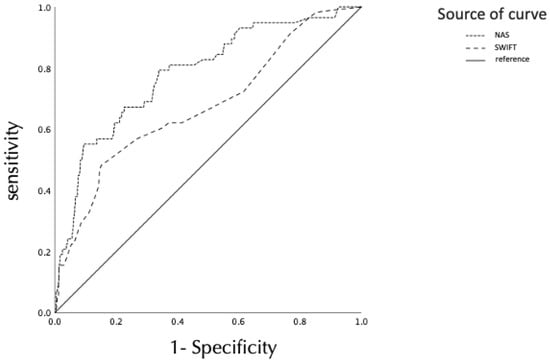
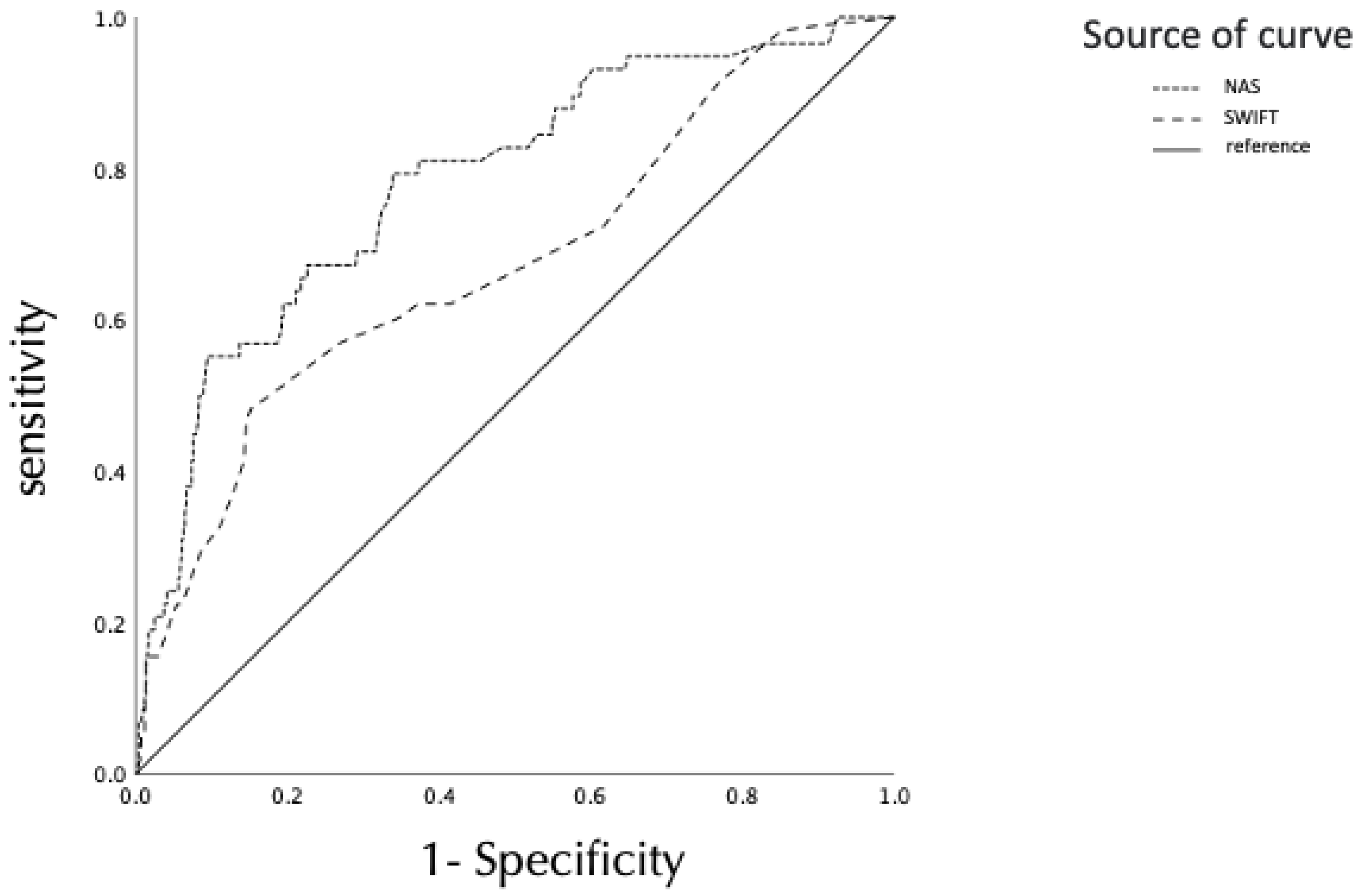
The AUROCs of the SWIFT scores and the NAS are shown in Figure 2 and Table 2. The results of the ROC analysis showed that the optimal cutoff points of the SWIFT score and the NAS for predicting unplanned ICU readmission were 21 (sensitivity, 48%; specificity, 85%; AUROC, 0.68; 95% CI, 0.60–0.75) and 53 (sensitivity, 79%; specificity, 66%; AUROC, 0.78; 95% confidence interval (CI), 0.72–0.85), respectively.
Figure 2.
Area under the receiver operating characteristic curve for the NAS and SWIFT scores calculated at the time of intensive care unit discharge. NAS, Nursing Activities Score; SWIFT, Stability and Workload Index for Transfer.
Table 2.
Comparison of predictive power and clinical utility of SWIFT and NAS of ICU readmission.
3.3. Odds Ratio of the SWIFT Score and the NAS to Predict ICU Readmission
The results of the logistic regression analysis using the SWIFT score and the NAS are shown in Table 3. The odds ratio for predicting unplanned ICU readmission was 6.07-fold higher among patients with NAS > 53 than among those with NAS < 53 (95% CI, 3.04–12.1). In addition, the odds ratio for predicting unplanned ICU readmission was 3.61-fold higher among patients with SWIFT > 21 than among those with SWIFT < 21 (95% CI, 1.94–6.69).
Table 3.
Multivariate analysis of factors for prediction of unplanned ICU readmission.
3.4. Comparison of Each Item in the Nursing Activities Score
The comparison of each NAS item from the time of ICU discharge to 24 h prior to ICU discharge between the unplanned ICU readmission and the non-readmission group is shown in Table 4. The following components were significantly higher in the readmission than the non-readmission group: monitoring and titration, hygiene procedures, mobilization and positioning, support and care of relatives and patient, respiratory support, treatment for improving lung function, cardiovascular support, renal support, metabolic support, specific intervention(s) in the ICU, and specific interventions outside the ICU.
Table 4.
Comparison of NAS activities score items between the readmission group compared to the non-readmission group.
4. Discussion
Unplanned ICU readmission is associated with unfavorable outcomes [1] and prolonged hospital stay [2]. Severity scores [24] at ICU discharge and the National Early Warning Score [10] can predict unplanned ICU readmissions. Nursing care plays an important role in the management of critically ill patients. Traditionally, NW is associated with patient prognosis and severity. In this study, to clarify the relationship between NWs and unplanned ICU readmission, we compared the SWIFT score, which assesses unplanned ICU readmission, with the NAS at ICU discharge. The SWIFT score and the NAS in the readmission group were significantly higher than those in the non-readmission group. Moreover, the NAS within 24 h of ICU discharge was a better predictor of unplanned ICU readmission than SWIFT. Therefore, the NAS at ICU discharge may be a useful adjunctive tool for predicting unplanned ICU readmission.
There are several possible explanations for the superiority of the NAS at ICU discharge in predicting unplanned ICU readmission. A study showing an association between the mean NAS during ICU stay and ICU death reported the mean NAS to be 54.81 ± 2.34 points and that the risk of death increased with the NAS at ICU admission [25]. The cutoff value for the NAS in our study was 53 points, indicating that the NAS was as high as that reported for patients at high risk of ICU mortality. Although we did not calculate the NAS to determine ICU discharge, it was apparent that patients were discharged from the ICU with an unexpectedly high NAS. NW at ICU admission was correlated with the severity score [26]. However, the severity score has been reported to be more accurate than NW in predicting adverse events in the ICU [27]. ICU staff often use mechanical support, vital signs, and improved laboratory data as the basis for deciding to discharge patients from the ICU, and NW is rarely used as a criterion for ICU discharge. However, the results of this study suggest that NW may have an unexpectedly large impact on unplanned ICU readmission.
The NAS is a tool to evaluate nursing workload based on organ support as well as nursing care. Regarding the analysis of the categories of NAS, monitoring, hygiene procedures, mobilization and various organ supports were significantly higher in the readmission than in the non-readmission group. The risk factors reported for ICU readmission include ventilator support [3,9,28,29] and the need for pulmonary physical therapy [30,31,32] at ICU discharge. The most common reason for ICU readmission in this study was respiratory failure, which is similar to the results of previous studies [30,31]. Therefore, patients who require respiratory care at the time of ICU discharge require continuous pulmonary care for respiration in the general wards. When patients need pulmonary care at discharge from the ICU, we need to share information about their respiratory status with the medical staff in the general wards.
Patients who require more hours of patient care at ICU discharge are more frequently observed after ICU discharge due to readmission; however, in general wards, nurses must take care of multiple patients and cannot spend sufficient time on patient care, unlike in the ICU. Increased NW in general wards has been associated with an increased risk of pneumonia, urinary tract infections [33], nosocomial infections [34], and failure-to-rescue rates [35]. Furthermore, patient mortality increases as the number of patients cared for by each nurse increases [35]. ICU discharge with high NW may be linked to poor observation in general wards. Therefore, discharge from the ICU with a high NAS may increase the burden on nurses, and delays in the detection and appropriate treatment for complications may result in unplanned ICU readmission. In contrast, patients may be forcibly discharged from the ICU despite having a high NAS because of medical resource limitation issues, such as a limited number of ICU beds [21]. A follow-up system after ICU discharge reduced unplanned ICU readmission for patients who had to be discharged early from the ICU [36]. If patients at risk for unplanned ICU readmission are involuntarily discharged from the ICU, transition to a step-down unit, where nurses can observe them more frequently than general wards and provide adequate care including rehabilitation, should be considered. Moreover, considering the NAS as an adjunctive tool for the decision of ICU discharge may be useful in reducing unplanned ICU readmissions regarding the concern of the decreased quality of care in general wards.
Previous studies have reported that the SWIFT score is useful for predicting unplanned ICU readmission [37,38]. Kareliusson et al. showed that a SWIFT score ≥ 15 increased the risk of unplanned ICU readmission [38]. Gagic et al. also reported the usefulness of the SWIFT score vs. the APACHE III (AUROC of APACHE III vs. SWIFT; 0.62 vs. 0.75) [11]. In our study, the AUROC for the SWIFT score was 0.68, which was lower than that of NAS, suggesting that NAS at ICU discharge is superior to the SWIFT score for predicting unplanned ICU readmission. Similarly, Rosa et al. [23] concluded that the SWIFT score is not useful for predicting ICU readmission because of its low accuracy (AUROC, 0.65). However, the observation of physiological parameters is also important to assess the condition of critically ill patients. Although the SWIFT is less accurate than the NAS in predicting unplanned ICU readmission, we consider that comprehensive assessment, including physiological parameters and nursing WL, is necessary to predict unplanned ICU readmission.
This study has three limitations. First, this study was a retrospective observational study; thus, detailed information on the stability of chronic diseases at the time of ICU discharge was not available.
Second, this was a single-center, retrospective, observational study conducted at a university hospital. Therefore, whether the optimal cutoff point for NAS can be used to predict unplanned ICU readmission needs to be prospectively examined.
Third, when calculating the NAS, 23 items must be collected according to the NAS definition; therefore, the NAS may not be an easier-to-use triage tool than the SWIFT score for predicting ICU readmission. However, if a system such as the automatic calculation of the NAS by EHR can be developed, it may be possible to easily use the NAS to prevent unplanned ICU readmission. This study may provide a theoretical basis for future prospective investigations of whether the NAS can be used to prevent unplanned ICU readmissions.
5. Conclusions
We demonstrated the accuracy of the SWIFT score and the NAS for predicting unplanned ICU readmission. Our study showed that predicting availability of the NAS at the ICU discharge was superior to that of the SWIFT score. It may be useful to use the NAS at ICU discharge as an adjunctive tool for preventing unplanned ICU readmission.
Author Contributions
J.H., H.T. and Y.M. designed the work, collected and analyzed the data, and wrote the initial draft of the manuscript. T.S. contributed to the analysis and interpretation of the data and assisted in the preparation of the manuscript. All authors have read and agreed to the published version of the manuscript.
Funding
The authors have not received any funding.
Institutional Review Board Statement
The study design and protocol were approved by the Institutional Review Board (IRB) of Sapporo Medical University (IRB-authorized number: 322-58, 9 September 2020).
Informed Consent Statement
Due to the observational nature of this study, the information was released on an opt-out basis.
Data Availability Statement
Not applicable.
Acknowledgments
We would like to thank the patients who participated in this study.
Conflicts of Interest
The authors declare no conflict of interest.
Appendix A
Table A1.
Stability and Work Load Index for Transfer.
Appendix B
Table A2.
Nursing Activities Score.
References
- Kramer, A.A.; Higgins, T.L.; Zimmerman, J.E. The association between ICU readmission rate and patient outcomes. Crit. Care Med. 2013, 41, 24–33. [Google Scholar] [CrossRef] [Scilit]
- Chan, K.S.; Tan, C.K.; Fang, C.S.; Tsai, C.L.; Hou, C.C.; Cheng, K.C.; Lee, M.C. Readmission to the intensive care unit: An indicator that reflects the potential risks of morbidity and mortality of surgical patients in the intensive care unit. Surg. Today 2009, 39, 295–299. [Google Scholar] [CrossRef] [Scilit] [PubMed]
- Fakhry, S.M.; Leon, S.; Derderian, C.; Al-Harakeh, H.; Ferguson, P.L. Intensive care unit bounce back in trauma patients: An analysis of unplanned returns to the intensive care unit. J. Trauma Acute Care Surg. 2013, 74, 1528–1533. [Google Scholar] [CrossRef] [Scilit] [PubMed]
- Christmas, A.B.; Freeman, E.; Chisolm, A.; Fischer, P.E.; Sachdev, G.; Jacobs, D.G.; Sing, R.F. Trauma intensive care unit “bouncebacks”: Identifying risk factors for unexpected return admission to the intensive care unit. Am. Surg. 2014, 80, 778–782. [Google Scholar] [CrossRef] [Scilit] [PubMed]
- Brown, S.E.S.; Ratcliffe, S.J.; Halpern, S.D. An empirical comparison of key statistical attributes among potential ICU quality indicators. Crit. Care Med. 2014, 42, 1821–1831. [Google Scholar] [CrossRef] [Scilit] [PubMed]
- Bice, T. ICU readmissions: Good for reflection on performance but not a reflection of quality. Crit. Care Med. 2016, 44, 1790–1791. [Google Scholar] [CrossRef] [Scilit]
- Wong, E.G.; Parker, A.M.; Leung, D.G.; Brigham, E.P.; Arbaje, A.I. Association of severity of illness and intensive care unit readmission: A systematic review. Heart Lung 2016, 45, 3–9.e2. [Google Scholar] [CrossRef] [Scilit]
- Rosenberg, A.L.; Hofer, T.P.; Hayward, R.A.; Strachan, C.; Watts, C.M. Who bounces back? Physiologic and other predictors of intensive care unit readmission. Crit. Care Med. 2001, 29, 511–518. [Google Scholar] [CrossRef] [Scilit]
- Jeong, B.H.; Na, S.J.; Lee, D.S.; Chung, C.R.; Suh, G.Y.; Jeon, K. Readmission and hospital mortality after ICU discharge of critically ill cancer patients. PLoS ONE 2019, 14, e0211240. [Google Scholar] [CrossRef] [Scilit]
- Mcneill, H.; Khairat, S. Impact of Intensive Care Unit readmissions on patient outcomes and the evaluation of the national early warning score to prevent readmissions: Literature review. JMIR Perioper. Med. 2020, 3, e13782. [Google Scholar] [CrossRef] [Scilit]
- Gajic, O.; Malinchoc, M.; Comfere, T.B.; Harris, M.R.; Achouiti, A.; Yilmaz, M.; Schultz, M.J.; Hubmayr, R.D.; Afessa, B.; Farmer, J.C. The Stability and Workload Index for Transfer score predicts unplanned intensive care unit patient readmission: Initial development and validation. Crit. Care Med. 2008, 36, 676–682. [Google Scholar] [CrossRef] [Scilit] [PubMed]
- Silva, M.C.; Sousa, R.M.; Padilha, K.G. Factors associated with death and readmission into the Intensive Care Unit. Rev. Lat. Am. Enfermagem. 2011, 19, 911–919. [Google Scholar] [CrossRef] [Scilit] [PubMed]
- Miranda, D.R.; de Rijk, A.; Schaufeli, W. Simplified Therapeutic Intervention Scoring System: The TISS-28 items-results from a multicenter study. Crit. Care Med. 1996, 24, 64–73. [Google Scholar] [CrossRef] [Scilit] [PubMed]
- Reis Miranda, D.; Moreno, R.; Iapichino, G. Nine equivalents of nursing manpower use score (NEMS). Intensive Care Med. 1997, 23, 760–765. [Google Scholar] [CrossRef] [Scilit]
- Miranda, D.R.; Nap, R.; de Rijk, A.; Schaufeli, W.; Iapichino, G.; TISS Working Group. Therapeutic Intervention Scoring System. Nursing activities score. Crit. Care Med. 2003, 31, 374–382. [Google Scholar] [CrossRef] [Scilit]
- Racy, S.; Davidson, P.M.; Peeler, A.; Hager, D.N.; Street, L.; Koirala, B. A review of inpatient nursing workload measures. J. Clin. Nurs. 2021, 30, 1799–1809. [Google Scholar] [CrossRef] [Scilit]
- Azevedo, A.V.; Tonietto, T.A.; Boniatti, M.M. Nursing workload on the day of discharge from the intensive care unit is associated with readmission. Intensive Crit. Care Nurs. 2022, 69, 103162. [Google Scholar] [CrossRef] [Scilit]
- Shankar-Hari, M.; Saha, R.; Wilson, J.; Prescott, H.C.; Harrison, D.; Rowan, K.; Rubenfeld, G.D.; Adhikari, N.K.J. Rate and risk factors for rehospitalisation in sepsis survivors: Systematic review and meta-analysis. Intensive Care Med. 2020, 46, 619–636. [Google Scholar] [CrossRef] [Scilit]
- Brown, S.E.S.; Ratcliffe, S.J.; Halpern, S.D. An empirical derivation of the optimal time interval for defining ICU readmissions. Med. Care 2013, 51, 706–714. [Google Scholar] [CrossRef] [Scilit]
- Kastrup, M.; Powollik, R.; Balzer, F.; Röber, S.; Ahlborn, R.; von Dossow-Hanfstingl, V.; Wernecke, K.D.; Spies, C.D. Predictive ability of the stability and workload index for transfer score to predict unplanned readmissions after ICU discharge. Crit. Care Med. 2013, 41, 1608–1615. [Google Scholar] [CrossRef] [Scilit]
- Nates, J.L.; Nunnally, M.; Kleinpell, R.; Blosser, S.; Goldner, J.; Birriel, B.; Fowler, C.S.; Byrum, D.; Miles, W.S.; Bailey, H.; et al. ICU admission, discharge, and triage guidelines: A framework to enhance clinical operations, development of institutional policies, and further research. Crit. Care Med. 2016, 44, 1553–1602. [Google Scholar] [CrossRef] [Scilit] [PubMed]
- Ho, K.M.; Dobb, G.J.; Lee, K.Y.; Finn, J.; Knuiman, M.; Webb, S.A.R. The effect of comorbidities on risk of intensive care readmission during the same hospitalization: A linked data cohort study. J. Crit. Care 2009, 24, 101–107. [Google Scholar] [CrossRef] [Scilit]
- Rosa, R.G.; Roehrig, C.; Oliveira, R.P.; Maccari, J.G.; Antônio, A.C.; Castro, S.; Neto, F.L.; Balzano, C.; Teixeira, C. Comparison of unplanned Intensive Care Unit readmission scores: A prospective cohort study. PLoS ONE 2015, 10, e0143127. [Google Scholar] [CrossRef] [Scilit] [PubMed]
- Lee, H.; Lim, C.W.; Hong, H.P.; Ju, J.W.; Jeon, Y.T.; Hwang, J.W.; Park, H.P. Efficacy of the Apache II score at ICU discharge in predicting post-ICU mortality and ICU readmission in critically ill surgical patients. Anaesth. Intensive Care 2015, 43, 175–186. [Google Scholar] [CrossRef] [Scilit] [PubMed]
- Fasoi, G.; Patsiou, E.C.; Stavropoulou, A.; Kaba, E.; Papageorgiou, D.; Toylia, G.; Goula, A.; Kelesi, M. Assessment of nursing workload as a mortality predictor in intensive care units (ICU) using the Nursing Activities Score (NAS) scale. Int. J. Environ. Res. Public Health 2020, 18, 79. [Google Scholar] [CrossRef] [Scilit]
- Rivera, D.I.C.; Torres, C.C.; Romero, L.A.L. Factors associated with nursing workload in three intensive care units. Rev. Esc. Enferm. USP 2021, 55, e20200272. [Google Scholar] [CrossRef] [Scilit] [PubMed]
- Serafim, C.T.R.; Dell’Acqua, M.C.Q.; Castro, M.C.N.E.; Spiri, W.C.; Nunes, H.R.C. Severity and workload related to adverse events in the ICU. Rev. Bras. Enferm. 2017, 70, 942–948. [Google Scholar] [CrossRef] [Scilit]
- Rubano, J.A.; Vosswinkel, J.A.; McCormack, J.E.; Huang, E.C.; Shapiro, M.J.; Jawa, R.S. Unplanned intensive care unit admission following trauma. J. Crit. Care 2016, 33, 174–179. [Google Scholar] [CrossRef] [Scilit]
- Ranney, S.E.; Amato, S.; Callas, P.; Patashnick, L.; Lee, T.H.; An, G.C.; Malhotra, A.K. Delay in ICU transfer is protective against ICU readmission in trauma patients: A naturally controlled experiment. Trauma Surg. Acute Care Open 2021, 6, e000695. [Google Scholar] [CrossRef] [Scilit]
- Lin, W.T.; Chen, W.L.; Chao, C.M.; Lai, C.C. The outcomes and prognostic factors of the patients with unplanned intensive care unit readmissions. Medicine 2018, 97, e11124. [Google Scholar] [CrossRef] [Scilit]
- Lee, J.Y.; Park, S.K.; Kim, H.J.; Hong, S.B.; Lim, C.M.; Koh, Y. Outcome of early intensive care unit patients readmitted in the same hospitalization. J. Crit. Care 2009, 24, 267–272. [Google Scholar] [CrossRef] [Scilit] [PubMed]
- Ashton, C.M.; Del Junco, D.J.; Souchek, J.; Wray, N.P.; Mansyur, C.L. The association between the quality of inpatient care and early readmission: A meta-analysis of the evidence. Med. Care 1997, 35, 1044–1059. [Google Scholar] [CrossRef] [Scilit] [PubMed]
- Needleman, J.; Buerhaus, P.; Mattke, S.; Stewart, M.; Zelevinsky, K. Nurse-staffing levels and the quality of care in hospitals. N. Engl. J. Med. 2002, 346, 1715–1722. [Google Scholar] [CrossRef] [Scilit]
- Archibald, L.K.; Manning, M.L.; Bell, L.M.; Banerjee, S.; Jarvis, W.R. Patient density, nurse-to-patient ratio and nosocomial infection risk in a pediatric cardiac intensive care unit. Pediatr. Infect. Dis. J. 1997, 16, 1045–1048. [Google Scholar] [CrossRef] [Scilit] [PubMed]
- Aiken, L.H.; Clarke, S.P.; Sloane, D.M.; Sochalski, J.; Silber, J.H. Hospital nurse staffing and patient mortality, nurse burnout, and job dissatisfaction. JAMA 2002, 288, 1987–1993. [Google Scholar] [CrossRef] [Scilit]
- Hervé, M.E.W.; Zucatti, P.B.; Lima, M.A.D.D.S. Transition of care at discharge from the Intensive Care Unit: A scoping review. Rev. Lat. Am. Enfermagem. 2020, 28, e3325. [Google Scholar] [CrossRef] [Scilit]
- Oakes, D.F.; Borges, I.N.K.; Forgiarini Junior, L.A.; Rieder, M. Assessment of ICU readmission risk with the Stability and Workload Index for Transfer score. J. Bras. Pneumol. 2014, 40, 73–76. [Google Scholar] [CrossRef] [Scilit]
- Kareliusson, F.; De Geer, L.; Tibblin, A.O. Risk prediction of ICU readmission in a mixed surgical and medical population. J. Intensive Care 2015, 3, 30. [Google Scholar] [CrossRef] [Scilit]

Publisher’s Note: MDPI stays neutral with regard to jurisdictional claims in published maps and institutional affiliations. |
© 2022 by the authors. Licensee MDPI, Basel, Switzerland. This article is an open access article distributed under the terms and conditions of the Creative Commons Attribution (CC BY) license (https://creativecommons.org/licenses/by/4.0/).