



Next Issue
Volume 15, December
Previous Issue
Volume 15, October


Membranes, Volume 15, Issue 11 (November 2025) – 23 articles
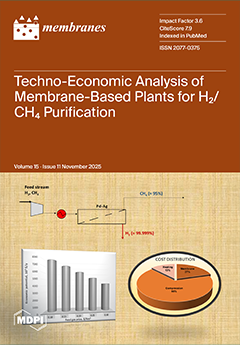
Cover Story (view full-size image): The continuous transition towards renewable energy and sustainable processes requires the use of technologies and raw materials alternative to conventional ones. In this regard, membrane processes can be adopted for gas purification of H2-containing mixtures to obtain gas streams with high levels of purity. This work investigates the potential of inorganic membranes to purify H2 and CH4 from their binary mixture by a simulation analysis, offering single- and multistage configurations that include the use of Pd-Ag and zeolite membranes. The use of the metallic membrane guarantees extremely pure H2, while simultaneously recovering CH4 at a concentration of 95%. The economic evaluation reveals the good potential of the proposed solutions, since the predicted values of profit and net present value are estimated to be positive. View this paper
  • Issues are regarded as officially published after their release is announced to the table of contents alert mailing list.
  • You may sign up for e-mail alerts to receive table of contents of newly released issues.
  • PDF is the official format for papers published in both, html and pdf forms. To view the papers in pdf format, click on the "PDF Full-text" link, and use the free Adobe Reader to open them.
Order results
Result details
Section
Select all
Export citation of selected articles as:
17 pages, 4745 KB  
Article
Microfiltration of Post-Fermentation Broths: Long-Term Studies on the Use of Modules with Polymeric Membranes
by Wirginia Tomczak and Marek Gryta
Membranes 2025, 15(11), 345; https://doi.org/10.3390/membranes15110345 - 19 Nov 2025
Viewed by 550
Abstract
A primary target in the long-term microfiltration (MF) of fermentation broths is to ensure the high-quality permeate and stable system operation. This can be achieved by the choice of the most profitable membrane material and development of an effective membrane cleaning procedure. However, [...] Read more.
A primary target in the long-term microfiltration (MF) of fermentation broths is to ensure the high-quality permeate and stable system operation. This can be achieved by the choice of the most profitable membrane material and development of an effective membrane cleaning procedure. However, selecting the appropriate module configuration is also of key importance. This study assessed the suitability of capillary and spiral-wound modules for MF 1,3-propanediol (1,3-PD) fermentation broths, which were clarified only by 2 h of sedimentation. The obtained results demonstrated that the MF process allowed the removal of almost 100% of suspended solids from a feed. Consequently, the obtained high-quality permeate was characterized by the turbidity of 0.4–0.7 NTU. Fouling was mitigated by membranes’ washing with NaOH solution; hence, chemically resistant polytetrafluoroethylene (PTFE) and polypropylene (PP) membranes were installed in the modules. In order to determine dominant fouling mechanism, the Hermia model was applied. It has been shown that a decrease in the process performance was mainly caused by the formation of a cake layer on the membrane’s surface. A significant amount of the deposit also formed inside the mesh filling of the module channel, which excluded the use of spirally wound modules for the MF broth pretreated only by sedimentation. To avoid this phenomenon, the capillary PP membranes (diameter 1.8 mm) were applied. During long-term tests (over 700 h) membranes were periodically cleaned with the 1% NaOH solution, which removed most of the foulants. However, in this case, residual deposits formed by silicates remained on the membrane surface, requiring an additional membrane cleaning method. Finally, it has been noted that the PP membranes showed an excellent resistance to the frequent exposure to the foulants present in the fermentation broths and the alkaline agent. Full article
Show Figures

Figure 1

20 pages, 3709 KB  
Article
Polysulfone/MMT Clay Mixed Matrix Membranes for Efficient Diclofenac Removal and Improved Antifouling Performance in Wastewater Treatment
by Zouhair Salah, Hajer Aloulou, Catia Algieri, Lasaad Dammak and Raja Ben Amar
Membranes 2025, 15(11), 344; https://doi.org/10.3390/membranes15110344 - 18 Nov 2025
Viewed by 466
Abstract
Due to industrialization and globalization, water sources are increasingly contaminated with drugs. Among the various methods available, adsorption remains one of the most widely used techniques for drug removal. This work was to develop polysulfone (PSF) membranes integrated with montmorillonite (MMT) clay. The [...] Read more.
Due to industrialization and globalization, water sources are increasingly contaminated with drugs. Among the various methods available, adsorption remains one of the most widely used techniques for drug removal. This work was to develop polysulfone (PSF) membranes integrated with montmorillonite (MMT) clay. The fabricated membranes were subsequently evaluated for their performance in removing diclofenac (DCF) from aqueous solutions. The membranes were characterized using scanning electron microscopy (SEM), energy-dispersive X-ray spectroscopy (EDX), Fourier transform infrared spectroscopy (FTIR), contact angle measurements, as well as chemical and mechanical tests. Adding MMT at 1.5 and 2 wt% improved both hydrophilicity and mechanical strength. The natural hydrophilicity of MMT also accelerates the non-solvent/solvent exchange during phase inversion, resulting in higher porosity. These structural and surface modifications increased water permeability (16.36 L·m−2·h−1·bar−1), achieved 79% DCF removal, and enhanced antifouling properties. However, increasing the MMT clay content to 2.5 wt% caused particle aggregation, which reduced membrane performance. Fouling resistance tests with bovine serum albumin (BSA) as a model foulant showed a rejection rate of 89% and a flux recovery ratio (FRR) above 82% using an optimized membrane. These findings demonstrate that PSF/MMT membranes can serve as promising candidates for sustainable pharmaceutical wastewater treatment. Full article
(This article belongs to the Section Membrane Applications for Water Treatment)
Show Figures

Figure 1

14 pages, 2609 KB  
Article
Stable Ti3C2 MXene-Based Nanofiltration Membrane Prepared by Bridging for Efficient Dye Wastewater Treatment
by Yu Zhang and Ming Qiu
Membranes 2025, 15(11), 343; https://doi.org/10.3390/membranes15110343 - 18 Nov 2025
Viewed by 507
Abstract
Transition metal carbides/nitrides (MXenes) nanosheets have emerged as promising candidates for constructing high-performance nanofiltration (NF) membranes for separation processes. However, MXene membranes exhibit limited feasibility due to the instability of their microstructure, which can lead to failure in the filtration process. This study [...] Read more.
Transition metal carbides/nitrides (MXenes) nanosheets have emerged as promising candidates for constructing high-performance nanofiltration (NF) membranes for separation processes. However, MXene membranes exhibit limited feasibility due to the instability of their microstructure, which can lead to failure in the filtration process. This study presents a bridging strategy (polyethyleneimine and polydopamine) to prepare a stable titanium carbide (Ti3C2) membrane, resulting in superior nanofiltration efficiency. Polyethyleneimine intercalation can inhibit the tendency to swell, while polydopamine enhances the force between the substrate and nanosheets. The optimized membrane possesses a permeate flux of 112.3 L m−2 h−1 bar−1 (1.6 times higher than pristine Ti3C2 membrane) and good selectivity (methyl blue rejection rate: ~99.5%; Na2SO4 rejection rate: <5.0%). In addition, the prepared membrane has good long-time durability and is more suitable for low pressure nanofiltration. Notably, the bridging strategy is also applicable to various two-dimensional lamellar membranes. This strategy provides a universal method for enhancing the stability of two-dimensional membranes, thereby promoting their practical applications in robust separation processes. Full article
Show Figures

Figure 1

10 pages, 2124 KB  
Perspective
From Clever Composites to Credible Technologies
by Qieyuan Gao, Libing Zheng, Daliang Xu and Bart Van der Bruggen
Membranes 2025, 15(11), 342; https://doi.org/10.3390/membranes15110342 - 17 Nov 2025
Viewed by 479
Abstract
Composite membranes are a hot topic in the field of membrane research. With the continuous progress of technology, its development has advanced from the application of simple copolymers to diversified material combinations. This Perspective examines why many composite membranes that excel in the [...] Read more.
Composite membranes are a hot topic in the field of membrane research. With the continuous progress of technology, its development has advanced from the application of simple copolymers to diversified material combinations. This Perspective examines why many composite membranes that excel in the lab struggle to deliver credible, durable performance at scale. Our aim is to connect four issues that are often treated in isolation—interfacial stability, manufacturability, data quality, and circular design—and to translate them into practical reporting and testing habits for the community. The novelty lies in treating “credibility” as the target function: we propose discipline-first guidelines that couple dynamic interfacial measurements with standardized long-run fouling and cleaning protocols, techno-economic and life-cycle reporting, and process-aware chemistry that fits existing hardware. We outline near-term applications in water treatment and resource recovery where drop-in formats and safer solvents already enable pilot-level operation. The future scope includes round-robin builds, FAIR data deposits, and durability metrics aligned with widely used standards for fouling potential and system benchmarking. Progress, we argue, will be measured less by first-day flux and more by what survives months of operation with uncertainty and costs on the page. Full article
(This article belongs to the Special Issue Functional Composite Membranes: Properties and Applications)
Show Figures

Figure 1

27 pages, 5501 KB  
Article
Fabrication of Polyamide Thin-Film Composite/Polyethersulfone-Coreshell-Fe3O4/ZnO Membranes for the Efficient Removal of Pb(II) from Wastewater
by Nompumelelo Sharol Mbali Kubheka, Muthumuni Managa, Makwena Justice Moloto and Edward Ndumiso Nxumalo
Membranes 2025, 15(11), 341; https://doi.org/10.3390/membranes15110341 - 17 Nov 2025
Viewed by 492
Abstract
Thin-film composite nanofiltration membranes were fabricated via the interfacial polymerization method from optimized polyethersulfone (PES) mixed matrix membranes, using m-phenylenediamine and trimesoyl chloride monomers, which produced a selective polyamide layer and were used for heavy metal removal. The concentration of trimesoyl chloride (TMC) [...] Read more.
Thin-film composite nanofiltration membranes were fabricated via the interfacial polymerization method from optimized polyethersulfone (PES) mixed matrix membranes, using m-phenylenediamine and trimesoyl chloride monomers, which produced a selective polyamide layer and were used for heavy metal removal. The concentration of trimesoyl chloride (TMC) is a critical factor to govern the properties of the selective polyamide layer, which directly influences the surface morphology and selective performance of (0.5 wt%) PES-coreshell-Fe3O4/ZnO membranes. Morphological structure, illustrated by SEM images, elucidated the role of TMC addition. FTIR spectra validated the successful formation of the amine and acyl chloride groups. Performance studies illustrated that NF3 (made from 0.1 w/v% of TMC) showed a unique salt rejection trend (NaCl > Na2SO4 > MgCl2) with an optimal salt rejection of 52.64%, 50.91%, and 12.67%. A low concentration of 0.1 w/v% of the NF3 membrane was the most optimal high-performance membrane. The adsorption rate of NF3 for Pb(II) ions in real environmental wastewater is attributed to the tailored surface chemistry of the polyamide layered thin-film/PES-coreshell-Fe3O4/ZnO nanocomposites of the membranes. The maximum Langmuir adsorption capacity at the optimal pH = 5 was 8.8573 mg/g at 25 °C. The fabricated adsorptive nanofiltration membranes alleviated the presence of Pb(II) ions and other competing ions present in environmental wastewater. Full article
Show Figures

Figure 1

21 pages, 8458 KB  
Article
Chemo-Ultrasonication Rehabilitation of Thin-Film Composite Ultrapure Water Membrane for Spent Dialysate Recovery
by Nuhu Dalhat Mu’azu, Mukarram Zubair, Mohammad Saood Manzar, Aesha H. Alamri, Ishraq H. Alhamed, Asaad Al Alawi and Muhammad Nawaz
Membranes 2025, 15(11), 340; https://doi.org/10.3390/membranes15110340 - 14 Nov 2025
Viewed by 561
Abstract
The ever-increasing number of discarded end-of-life dialysate polyamide thin-film composite membranes (DEoLMs) from presents both environmental and economic challenges for health centers. Traditional thermo-chemical cleaning techniques have been deployed for the rehabilitation of DEoLMs. This study further investigated the application of chemo-ultrasonication rehabilitation [...] Read more.
The ever-increasing number of discarded end-of-life dialysate polyamide thin-film composite membranes (DEoLMs) from presents both environmental and economic challenges for health centers. Traditional thermo-chemical cleaning techniques have been deployed for the rehabilitation of DEoLMs. This study further investigated the application of chemo-ultrasonication rehabilitation of dialysate-production-related DEoLM for potential reuse in spent dialysate recovery considering salt and creatinine—a typical uremic toxin-removal from water. The DEoLM was rehabilitated using low-concentration citric acid (CA) and sodium lauryl sulfate (SLS) under ultrasonic waves (45 kHz, 30 min agitation). Considering different rehabilitation protocols, the synergistic effects of heating (HT) and the chemical agents, with and without and ultrasonic waves (SC) were evaluated through FTIR, SEM, and EDX analyses, and the performance of the rehabilitated DEoLM was assessed via water flux and permeance, and efficiencies for conductivity and creatinine rejection. The fully integrated protocol chemo-ultrasonication (HT + SC + chemical agents) yielded the highest performance, achieving 93.56% conductivity and 96.83% creatinine removal, with water flux of 113.48 L m−2 h−1 and permeances of 6.31 L m−2 h−1 bar−1, at markedly reduced pressures. The chemo-sonic-rehabilitated-DEoLM removed the organic–inorganic foulants beyond thermo-chemical cleaning. This suggests that the sonication waves had a great impact regarding rejuvenating the fouled DEoL dialysate membrane, offering a sustainable, cost-effective pathway for extending membrane life, and supporting sustainable water management to achieve circular economy goals within healthcare centers. Full article
(This article belongs to the Topic Separation Techniques and Circular Economy)
Show Figures

Figure 1

15 pages, 293 KB  
Article
Relaxed Boundary Conditions in Poisson–Nernst–Planck Models: Identifying Critical Potentials for Multiple Cations
by Xiangshuo Liu, Henri Ndaya, An Nguyen, Zhenshu Wen and Mingji Zhang
Membranes 2025, 15(11), 339; https://doi.org/10.3390/membranes15110339 - 13 Nov 2025
Viewed by 583
Abstract
Ion channels are protein pores that regulate ionic flow across cell membranes, enabling vital processes such as nerve signaling. They often conduct multiple ionic species simultaneously, leading to complex nonlinear transport phenomena. Because experimental techniques provide only indirect measurements of ion channel currents, [...] Read more.
Ion channels are protein pores that regulate ionic flow across cell membranes, enabling vital processes such as nerve signaling. They often conduct multiple ionic species simultaneously, leading to complex nonlinear transport phenomena. Because experimental techniques provide only indirect measurements of ion channel currents, mathematical models—particularly Poisson–Nernst–Planck (PNP) equations—are indispensable for analyzing the underlying transport mechanisms. In this work, we examine ionic transport through a one-dimensional steady-state PNP model of a narrow membrane channel containing multiple cation species of different valences. The model incorporates a small fixed charge distribution along the channel and imposes relaxed electroneutrality boundary conditions, allowing for a slight charge imbalance in the baths. Using singular perturbation analysis, we first derive approximate solutions that capture the boundary-layer structure at the channel—reservoir interfaces. We then perform a regular perturbation expansion around the neutral reference state (zero fixed charge with electroneutral boundary conditions) to obtain explicit formulas for the steady-state ion fluxes in terms of the system parameters. Through this analytical approach, we identify several critical applied potential values—denoted Vka (for each cation species k), Vb, and Vc—that delineate distinct transport regimes. These critical potentials govern the sign of the fixed charge’s influence on each ion’s flux: depending on whether the applied voltage lies below or above these thresholds, a small positive permanent charge will either enhance or reduce the flux of each ion species. Our findings thus characterize how a nominal fixed charge can nonlinearly modulate multi-ion currents. This insight deepens the theoretical understanding of nonlinear ion transport in channels and may inform the interpretation of current–voltage relations, rectification effects, and selective ionic conduction in multi-ion channel experiments. Full article
17 pages, 4105 KB  
Article
Ion Exchange Membrane-like Deposited Electrodes for Capacitive De-Ionization: Performance Evaluation and Mechanism Study
by Siyue Xue, Chengyi Wang, Tianxiao Leng, Chenglin Zhang, Long-Fei Ren and Jiahui Shao
Membranes 2025, 15(11), 338; https://doi.org/10.3390/membranes15110338 - 11 Nov 2025
Viewed by 468
Abstract
Capacitive de-ionization (CDI) holds great promise for water desalination, while the widely used activated carbon (AC) electrodes suffer from a low salt adsorption capacity (SAC) and poor long-term stability due to the co-ion effect and electrode oxidation. Inspired by membrane-based CDI, we deposited [...] Read more.
Capacitive de-ionization (CDI) holds great promise for water desalination, while the widely used activated carbon (AC) electrodes suffer from a low salt adsorption capacity (SAC) and poor long-term stability due to the co-ion effect and electrode oxidation. Inspired by membrane-based CDI, we deposited polyethyleneimine (PEI), an ion exchange polymer with positive charge and ion selectivity, onto an AC electrode to serve as an anode for addressing these issues. Firstly, compared to traditional AC and commercial AEM-AC, the PEI-doped AC (PDAC) anode delivered a superior SAC of 36.3 mg/g, as the positively charged PEI enhanced electrostatic attraction, suppressed the co-ion effect, and offered extra sites. However, it showed poor cycling stability with 77.1% retention, owing to mass loss and anode oxidation. We further developed an electrode coated with a PEI-based membrane (PMAC), which exhibited a balanced performance with a high SAC of 33.4 mg/g and significantly improved long-term retention of 97.5%. The hydrophilic PEI membrane, strongly adhered to the AC surface, shortened the ion diffusion resistance and effectively prolonged the electrode lifespan. A systematic comparison between AC, AEM-AC, PDAC, and PMAC revealed the mechanism for PMAC’s notable enhancement. These findings establish a framework for designing novel CDI electrodes and advancing sustainable water desalination. Full article
Show Figures

Figure 1

18 pages, 1116 KB  
Review
Anammox-MBR Technology: Breakthroughs and Challenges in Sustainable Nitrogen Removal from Wastewater
by Sumayya Abdul Rahiman and Hazim Qiblawey
Membranes 2025, 15(11), 337; https://doi.org/10.3390/membranes15110337 - 10 Nov 2025
Viewed by 1100
Abstract
Wastewater nitrogen pollution is a serious environmental problem, and traditional treatment techniques are frequently constrained by their high energy requirements and operational complexity. The anaerobic ammonium oxidation (anammox) process combined with membrane bioreactor (MBR) technology (anammox-MBR) offers a practical and energy-efficient solution for [...] Read more.
Wastewater nitrogen pollution is a serious environmental problem, and traditional treatment techniques are frequently constrained by their high energy requirements and operational complexity. The anaerobic ammonium oxidation (anammox) process combined with membrane bioreactor (MBR) technology (anammox-MBR) offers a practical and energy-efficient solution for the sustainable removal of nitrogen, further enhanced by its potential to minimize emissions of nitrous oxide (N2O), a potent greenhouse gas with a global warming potential nearly 300 times that of carbon dioxide. This review outlines the most recent advancements in anammox-MBR systems, highlighting their ability to achieve nitrogen removal efficiencies of more than 70–90% and, in integrated systems with reverse osmosis, to recover up to 75% of the inflow as high-quality reusable water. Significant advancements such as high-rate activated sludge coupling, reverse osmosis integration, microaeration methods, and membrane surface modifications have decreased membrane fouling, accelerated startup times, and enhanced system stability. Despite these achievements, there are still issues that hinder widespread use, such as membrane fouling exacerbated by hydrophobic anammox metabolites, sensitivity to low temperatures (≤10 °C), and the persistent challenge of suppressing nitrite-oxidizing bacteria (NOB), which compete for the essential nitrite substrate. To enable cost-effective, energy-efficient, and environmentally sustainable large-scale applications, future research directions will focus on creating cold-tolerant anammox strains, advanced anti-fouling membranes, and AI-driven process optimization. Full article
Show Figures

Figure 1

17 pages, 2877 KB  
Article
Techno-Economic Analysis of Membrane-Based Plants for H2/CH4 Purification
by Pasquale Francesco Zito
Membranes 2025, 15(11), 336; https://doi.org/10.3390/membranes15110336 - 7 Nov 2025
Viewed by 759
Abstract
In the context of the growing adoption of alternative gas separation processes, combined with the interest in hydrogen as a fuel and energy carrier, the use of membrane technology in H2/CH4 purification is analyzed in this work, focusing on the [...] Read more.
In the context of the growing adoption of alternative gas separation processes, combined with the interest in hydrogen as a fuel and energy carrier, the use of membrane technology in H2/CH4 purification is analyzed in this work, focusing on the techno-economic aspects. In particular, the separation and economic performance of three Pd–Ag/Si-CHA membrane plants are simulated, aiming to achieve high degrees of purity and recovery paired with cost-effective configurations. A single Pd–Ag membrane stage operating at 20 atm and 350 °C can theoretically guarantee a CH4 concentration of 95%, while a completely pure H2 stream leaves the plant as a permeate product. The choice of a less selective Si-CHA membrane allows a temperature reduction but implies the use of more stages to achieve the desired CH4 target. In addition, H2 purity does not exceed 98%. A two-stage hybrid process, in which the retentate gas leaving the Pd–Ag membrane is cooled and fed to the Si-CHA unit, is also a cost-effective solution, as feed pressure can be reduced to 10 atm with significant compression cost savings. All the configurations are able to provide positive values of economic potential (EP); however, the single Pd–Ag membrane plant is the best option since it guarantees the highest EP, net profit and net present value (NPV). Full article
Show Figures

Figure 1

12 pages, 929 KB  
Article
Membrane Technology for the Valorization of Wood Vinegar from Grape Pomace Pyrolysis
by Alexandre Giacobbo, Amanda de Sampaio Callegari, Mateus Torres Nazari, Valdecir Ferrari, Tania Maria Basegio, Carlos Pérez Bergmann, Marco Antônio Siqueira Rodrigues, Maria Norberta de Pinho and Andréa Moura Bernardes
Membranes 2025, 15(11), 335; https://doi.org/10.3390/membranes15110335 - 5 Nov 2025
Viewed by 621
Abstract
The valorization of wood vinegar from biomass pyrolysis has been a significant research subject in recent years, but further studies to reduce its phytotoxicity and improve agricultural applications are still needed. This study investigates the application of ultrafiltration and nanofiltration membranes in treating [...] Read more.
The valorization of wood vinegar from biomass pyrolysis has been a significant research subject in recent years, but further studies to reduce its phytotoxicity and improve agricultural applications are still needed. This study investigates the application of ultrafiltration and nanofiltration membranes in treating the wood vinegar from grape pomace pyrolysis, aiming to valorize it. Wood vinegar treated with nanofiltration (NF270 membrane) and diluted 100 times acted as a root growth inducer in cucumber seeds, achieving a germination index of 145%. This interesting result suggests that nanofiltration is emerging as a promising technology for enhancing the value of wood vinegar, while also promoting sustainability and the circular economy in the agro-industrial sector. Full article
Show Figures

Figure 1

16 pages, 5579 KB  
Article
Microscopic Exploration of Water Permeation and Ion Rejection for Edge Amine-Functionalized GO Nanoslits
by Yinfeng Pei, Wenjin Li and Xiaoning Yang
Membranes 2025, 15(11), 334; https://doi.org/10.3390/membranes15110334 - 4 Nov 2025
Viewed by 707
Abstract
Layered graphene oxide (GO) has emerged as an ideal membrane structure for water desalination. In GO-stacked structures, the slit gaps between GO nanosheets can serve as critical pathways for molecule permeation. Exploring the permeation mechanisms of functionalized GO nanoslits is critical for improving [...] Read more.
Layered graphene oxide (GO) has emerged as an ideal membrane structure for water desalination. In GO-stacked structures, the slit gaps between GO nanosheets can serve as critical pathways for molecule permeation. Exploring the permeation mechanisms of functionalized GO nanoslits is critical for improving the separation performance. Herein, molecular simulations were performed to investigate the water permeation and ion rejection for six types of ionic solutions by considering edge-amino functionalized GO (NGO) slit membranes. The NGO slit exhibits higher ion retention while maintaining reasonable water permeability. Edge amine groups can interact strongly with water molecules and immobilize ions, thus enhancing ion rejection. The thermodynamic free energy for ion passing was simulated to explain the unique ion rejection mechanism of amine-functionalized GO slits. The thermodynamic barrier for ion rejection can be considered as the delicate combination of the ion dehydration effect and the slit-generated attraction. The ion dehydration accounts for a repulsive contribution, which is the controlling portion in governing the free-energy profile. Overall, our work is important and valuable for the development and design of new-type layered GO membranes. Full article
(This article belongs to the Section Membrane Applications for Water Treatment)
Show Figures

Figure 1

19 pages, 9109 KB  
Article
High Current Induction for the Effective Bending in Ionic Polymer Metal Composite
by Hirohisa Tamagawa, Rintaro Fujiwara and Iori Kojima
Membranes 2025, 15(11), 333; https://doi.org/10.3390/membranes15110333 - 3 Nov 2025
Viewed by 508
Abstract
Ionic Polymer–Metal Composites (IPMCs) are promising electroactive polymers for artificial muscles, as their bending motion depends on the induced current—greater current leads to greater bending. While conventional IPMCs use cation exchange membranes, this study explores IPMCs containing both immobile positive and negative charges, [...] Read more.
Ionic Polymer–Metal Composites (IPMCs) are promising electroactive polymers for artificial muscles, as their bending motion depends on the induced current—greater current leads to greater bending. While conventional IPMCs use cation exchange membranes, this study explores IPMCs containing both immobile positive and negative charges, resembling real muscle tissue. Considering that an IPMC consists of an ion-exchange membrane sandwiched between two thin metal coatings serving as electrodes, we found that (i) improving the contact between the metal coating (electrode) and the ion exchange membrane is an effective way to enhance current induction. Achieving tight electrode membrane contact can drastically increase the induced current by up to four orders of magnitude, and even samples that previously showed no current induction can exhibit measurable current after improvement. (ii) Doping with mobile ions is another well-known method of enhancing IPMC current. However, we found that simply introducing dopants into the IPMC body is not effective; the choice of dopant is crucial. In this work, we identified silver ions as effective dopants for enhancing current induction. Considering that real muscles consume oxygen for activation, we also attempted to supply oxygen to the IPMC surface. We confirmed that (iii) supplying oxygen to the IPMC surface is another effective means of enhancing current induction, which in turn resulted in a significant improvement in IPMC bending performance. Full article
(This article belongs to the Section Membrane Applications for Other Areas)
Show Figures

Figure 1

31 pages, 2913 KB  
Review
Mitigation Techniques of Membranes’ Biofouling in Bioelectrochemical Cells (BEC Cells): Recent Advances
by Shatha Alyazouri, Muhammad Tawalbeh and Amani Al-Othman
Membranes 2025, 15(11), 332; https://doi.org/10.3390/membranes15110332 - 1 Nov 2025
Viewed by 1082
Abstract
Biofouling remains a critical challenge in bioelectrochemical cells (BECs), hindering their efficiency and performance. This research article reviews advances in biofouling mitigation techniques within BEC systems during the period from 2019 to 2025, focusing on membrane modifications and electro-assisted membrane technologies. Through comprehensive [...] Read more.
Biofouling remains a critical challenge in bioelectrochemical cells (BECs), hindering their efficiency and performance. This research article reviews advances in biofouling mitigation techniques within BEC systems during the period from 2019 to 2025, focusing on membrane modifications and electro-assisted membrane technologies. Through comprehensive analysis, it is revealed that Nafion alternatives, including ceramic membranes and recycled nonwoven fabrics like polypropylene, have emerged as significant contenders due to their combination of low cost and high performance. Additionally, the incorporation of silver, zeolite, and graphene oxide onto membranes has demonstrated efficacy in mitigating biofouling under laboratory conditions. Furthermore, the application of direct current electric fields has shown potential as a chemical-free preventative measure against biofouling in BECs. However, challenges related to long-term stability, scalability, and cost-effectiveness must be addressed for widespread adoption. Full article
(This article belongs to the Section Membrane Applications for Energy)
Show Figures

Figure 1

13 pages, 3161 KB  
Article
Optimizing Pretreatment Parameters for Enhanced Phosphorus Recovery from High-Phosphorus Wastewater via Nanofiltration
by Guodong Wu, Lu Wang, Bing Qin, Fanbin Meng, Yonghu He, Xin Wang, Jing Bai, Jingpeng Zhang and Yuanhao Wang
Membranes 2025, 15(11), 331; https://doi.org/10.3390/membranes15110331 - 31 Oct 2025
Viewed by 549
Abstract
The effects of pretreatment pH value, operating pressure, and concentration factors on the performance of nanofiltration membrane concentration and the recovery of phosphorus-containing wastewater were systematically studied. A novel pretreatment strategy using solid sodium hydroxide was developed to adjust the feed solution pH, [...] Read more.
The effects of pretreatment pH value, operating pressure, and concentration factors on the performance of nanofiltration membrane concentration and the recovery of phosphorus-containing wastewater were systematically studied. A novel pretreatment strategy using solid sodium hydroxide was developed to adjust the feed solution pH, achieving optimal solid removal and minimized conductivity at pH = 5. Unlike conventional calcium-based methods, this approach avoids excessive chemical sludge formation and mitigates membrane scaling, enhancing system stability. Experimental results demonstrate that both phosphorus rejection and desalination efficiency are significantly influenced by feed solution pH, operating pressure, and concentration ratio. While increasing pH and pressure improve total phosphorus (TP) rejection and desalination rates, these benefits are accompanied by reduced membrane flux due to elevated osmotic pressure and intensified concentration polarization. The membrane exhibited optimal performance at a feed pH of 5 and an operating pressure of 3 MPa, with sustained flux and enhanced separation efficiency. Under these conditions, when the wastewater was concentrated fivefold at 25 °C, the TP rejection rate and desalination efficiency reached 92.9% and 91.8%, respectively. Full article
Show Figures

Figure 1

15 pages, 2918 KB  
Article
Fouling Mitigation of PVDF Membrane Induced by Sodium Dodecyl Sulfate (SDS)-TiO2 Micelles
by Jie Zhang, Shiying Bo, Chunhua Wang, Zicong Jian, Yuehuan Chu, Si Qiu, Hongyan Chen, Qiancheng Xiong, Xiaofang Yang, Zicheng Xiao and Guocong Liu
Membranes 2025, 15(11), 330; https://doi.org/10.3390/membranes15110330 - 30 Oct 2025
Viewed by 705
Abstract
As a favorable hydrophilic additive for antifouling modification of polyvinylidene fluoride (PVDF) membrane, titanium dioxide (TiO2) nanoparticles have been applied for years. Sodium dodecyl sulfonate (SDS), a representative anionic surfactant, has been proven to benefit the dispersion of nano-TiO2 via [...] Read more.
As a favorable hydrophilic additive for antifouling modification of polyvinylidene fluoride (PVDF) membrane, titanium dioxide (TiO2) nanoparticles have been applied for years. Sodium dodecyl sulfonate (SDS), a representative anionic surfactant, has been proven to benefit the dispersion of nano-TiO2 via an electro-spatial stabilizing mechanism. In this study, various proportionally SDS-functionalized TiO2 nanoparticles were adopted to modify PVDF membrane. Dispersion and stability of SDS-functionalized TiO2 nanoparticles in casting solutions were evaluated by multiple light scattering technology. The properties and antifouling performance of PVDF/SDS-TiO2 composite membranes were assessed. The uniformity of surface pores as well as structures on cross-section morphologies was modified. The finger-like structure of PVDF/SDS-TiO2 composite membrane was adequately developed at the SDS/TiO2 mass ratio of 1:1. The improved antifouling performance was corroborated by the increasing free energy of cohesion and adhesion as well as the interaction energy barrier between membrane surfaces and approaching foulants assessed by classic extended Derjaguin–Landau–Verwey–Overbeek (XDLVO) theory, the low flux decline during bovine serum albumin (BSA) solution filtration process, and the high critical flux (38 L/(m2·h·kPa)) in membrane bioreactor. This study exploits a promising way to modify PVDF membrane applicable to the wastewater treatment field. Full article
(This article belongs to the Special Issue Membrane Fouling Control: Mechanism, Properties, and Applications)
Show Figures

Figure 1

24 pages, 815 KB  
Review
Recent Advances in Polymeric Membrane Integration for Organic Solvent Mixtures Separation: Mini-Review
by Abdellah Halloub and Wojciech Kujawski
Membranes 2025, 15(11), 329; https://doi.org/10.3390/membranes15110329 - 30 Oct 2025
Cited by 1 | Viewed by 1343
Abstract
Membrane technology offers considerable potential for enhancing or partially replacing conventional separation techniques, which could eventually lead to substantial energy savings. This review focuses on recent advancements in membrane separation technologies including organic solvent pervaporation (OSPV), organic solvent reverse osmosis (OSRO), organic solvent [...] Read more.
Membrane technology offers considerable potential for enhancing or partially replacing conventional separation techniques, which could eventually lead to substantial energy savings. This review focuses on recent advancements in membrane separation technologies including organic solvent pervaporation (OSPV), organic solvent reverse osmosis (OSRO), organic solvent nanofiltration (OSN), and organic solvent ultrafiltration (OSUF) that are increasingly vital in the pharmaceutical, biochemical, and petrochemical industries. Although hybrid and inorganic membranes exhibit promising performance, polymeric membranes provide advantages in scalability and processability. The development of materials capable of operating under demanding conditions that include exposure to organic solvents, high temperatures, extreme pH levels, and oxidative environments remains critical. Here, we examine recent innovations in membrane materials and their integration into organic solvent systems. Key challenges, including material swelling, fouling, and scaling, are discussed, along with recent strategies to address these issues. Finally, we identify emerging research directions that could drive further progress in membrane technology for organic media applications. Full article
(This article belongs to the Collection Featured Reviews in Membrane Science)
Show Figures

Figure 1

16 pages, 3822 KB  
Article
Ergothioneine Thione Spontaneously Binds to and Detaches from the Membrane Interphase
by José Villalaín
Membranes 2025, 15(11), 328; https://doi.org/10.3390/membranes15110328 - 29 Oct 2025
Viewed by 1054
Abstract
Ergothioneine is a potent non-toxic and very stable antioxidant which is synthesized by fungi, algae, and bacteria but not animals or higher plants. Ergothioneine has been widely used in cosmetics; dietary supplements; and medicine to treat diabetes, cancer, as well as cardiovascular, neurodegenerative, [...] Read more.
Ergothioneine is a potent non-toxic and very stable antioxidant which is synthesized by fungi, algae, and bacteria but not animals or higher plants. Ergothioneine has been widely used in cosmetics; dietary supplements; and medicine to treat diabetes, cancer, as well as cardiovascular, neurodegenerative, and liver diseases. Ergothioneine presents two tautomeric forms: thione, the majoritarian and more stable form (ERGO), and thiol (ERGT). Ergothioneine cannot cross cell membranes, and human cells rely on a specific transporter, OCTN1, to transport ingested ERGO to different parts of the body. Ergothioneine is very hydrophilic, and it is supposed to act at the water level but not at the membrane one. In this work, I studied the interaction of ERGO and ERGT with a complex biomembrane using molecular dynamics (MD). MD suggests that ERGO, but not ERGT, inserts spontaneously into the membrane interphase and can move from the membrane interphase to the water phase and vice versa, and no oligomerization was observed. Furthermore, ERGO, when inserted in the membrane, does not alter the hydrocarbon chain order. Therefore, ERGO (the thione form of ergothioneine), but not ERGT (the thiol form), might act at both the water and membrane interphase levels. Full article
(This article belongs to the Section Biological Membranes)
Show Figures

Figure 1

12 pages, 2322 KB  
Article
Engineering Thermal Cross-Linking in Nanofiltration Membranes for Efficient Nicotine Extraction from Tobacco Extract
by He Du, Xinyuan Wang, Baodan Na, Yajun Ye, Yuemei Qiao, Linda Li, Ye Tian, Xiaoping Ning, Zhigang Wang, Xingquan Zhao and Chen Chen
Membranes 2025, 15(11), 327; https://doi.org/10.3390/membranes15110327 - 28 Oct 2025
Viewed by 744
Abstract
Tobacco extract contains numerous valuable components, among which nicotine possesses significant potential for high-value applications despite its well-known health risks. However, the efficient extraction of nicotine is challenging due to the complex composition of tobacco extracts and the limitations of conventional separation techniques. [...] Read more.
Tobacco extract contains numerous valuable components, among which nicotine possesses significant potential for high-value applications despite its well-known health risks. However, the efficient extraction of nicotine is challenging due to the complex composition of tobacco extracts and the limitations of conventional separation techniques. In this work, an integrally asymmetric nanofiltration membrane was developed via thermal cross-linking for highly efficient nicotine separation. A poly(aryl ether ketone) (PEK)-based ultrafiltration membrane was first prepared via non-solvent induced phase separation (NIPS), followed by controlled thermal cross-linking to tailor the membrane pore size toward the molecular weight of nicotine. To mitigate pore collapse and enhance flux, TiO2 nanoparticles were incorporated in situ through a sol–gel method. The resulting thermally cross-linked membrane exhibited a molecular weight cut-off of ~180 Da, a nicotine rejection rate of 93.2%, and a permeation flux of 143 L/(m2·h)—representing a 259% increase over the control membrane. Moreover, the thermally cross-linked membranes demonstrated exceptional chemical stability in various organic solvents and extreme pH conditions. This work offers a feasible and sustainable strategy for fabric high-performance nanofiltration membranes for the targeted extraction of bioactive molecules from complex plant extracts. Full article
(This article belongs to the Special Issue Applications of Membrane Filtration and Separation)
Show Figures

Figure 1

12 pages, 2457 KB  
Article
Enhancing Yellow Pea Protein Extraction and Purification Through Ultrafiltration
by Muhammad Nurdarwis Bin Anuar and Jian Zuo
Membranes 2025, 15(11), 326; https://doi.org/10.3390/membranes15110326 - 28 Oct 2025
Viewed by 871
Abstract
The growing demand for sustainable, high-quality plant-based proteins has increased the need for efficient extraction and purification methods for yellow pea protein (Pisum sativum L.). Conventional techniques, such as isoelectric precipitation (IEP) and wet fractionation, often result in moderate protein recovery (50–70%), [...] Read more.
The growing demand for sustainable, high-quality plant-based proteins has increased the need for efficient extraction and purification methods for yellow pea protein (Pisum sativum L.). Conventional techniques, such as isoelectric precipitation (IEP) and wet fractionation, often result in moderate protein recovery (50–70%), reduced functionality, and high water consumption. This study evaluates ultrafiltration (UF) as a mild, membrane-based alternative for yellow pea protein extraction. Under optimized conditions, UF achieved protein recovery above 85% while maintaining high solubility (>90%) and emulsification capacity. Additionally, incorporating water recycling into the UF process reduced total water use by up to 60%. These results demonstrate that UF offers a more efficient and environmentally sustainable approach for producing functional yellow pea protein compared with traditional methods. Full article
(This article belongs to the Special Issue Membrane Applications for Molecular Purification)
Show Figures

Figure 1

15 pages, 1477 KB  
Article
Microwave-Assisted Syntheses of 1-Acetyl 2-Methylbenzimidazole Sodium Bisulfate pH-Responsive Ionic Draw Solute for Forward Osmosis Applications
by Ahmed A. Bhran, Abdelrahman G. Gadallah, Hanaa M. Ali, Sahar S. Ali, Hanaa Gadallah and Rania Sabry
Membranes 2025, 15(11), 325; https://doi.org/10.3390/membranes15110325 - 26 Oct 2025
Viewed by 741
Abstract
This work is related to the development of a highly efficient pH-responsive ionic draw solute for forward osmosis applications utilizing microwave-assisted fast heating. This solute is classified as an ionic compound, a sodium salt originating from imidazole, with the scientific acronym 1-acetyl-2-methylbenzimidazole sodium [...] Read more.
This work is related to the development of a highly efficient pH-responsive ionic draw solute for forward osmosis applications utilizing microwave-assisted fast heating. This solute is classified as an ionic compound, a sodium salt originating from imidazole, with the scientific acronym 1-acetyl-2-methylbenzimidazole sodium bisulfate (AMBIM-Na). The synthesized compound was analyzed by X-ray diffraction (XRD), Fourier transform infrared spectroscopy (FTIR), as well as additional physical characteristics. The baseline performance was initially evaluated at various molar concentrations against distilled water as the feed solution (FS). The results indicated that the produced solute exhibits elevated osmotic pressure, resulting in a water flux of up to 130 LMH for a 1 M concentration, coupled with the absence of reverse salt flux. The synthesized AMBIM-Na at a concentration of 1 M was utilized as a draw solution (DS) against synthetic brackish water. The water flux declined progressively with the increase in FS concentration, decreasing from 130 LMH with distilled water to 99, 70, and 41 LMH at NaCl concentrations of 5, 10, and 15 g/L, respectively. The regeneration of the draw solute was assessed using pH adjustment, revealing that 100% regeneration occurs by reducing the pH to 2. Full article
Show Figures

Figure 1

13 pages, 7189 KB  
Communication
Comparative Study on Structural and Transport Properties of SSC and LSC PFSA Ionomers in PEMFCs with Coexistence of O2 and N2: Molecular Dynamics Simulation Approach
by Guanghua Wei, Jingjing Huang, Lina Yu, Jinghao Zhou, Jiabin You, Zhu Ling, Shenrong Ye and Junliang Zhang
Membranes 2025, 15(11), 324; https://doi.org/10.3390/membranes15110324 - 22 Oct 2025
Viewed by 882
Abstract
Efficient O2 transport through the ionomer film in cathode catalyst layers (CCLs) is a critical factor for the output performance of proton exchange membrane fuel cells (PEMFCs), yet the molecular mechanisms of gas transport in ionomers remain elusive. Herein, molecular dynamics (MDs) [...] Read more.
Efficient O2 transport through the ionomer film in cathode catalyst layers (CCLs) is a critical factor for the output performance of proton exchange membrane fuel cells (PEMFCs), yet the molecular mechanisms of gas transport in ionomers remain elusive. Herein, molecular dynamics (MDs) simulations are employed to investigate short-side-chain (SSC) and long-side-chain (LSC) perfluorosulfonic acid (PFSA) ionomers on Pt/C surfaces with the coexistence of O2/N2. The results reveal that the side-chain structures significantly modulate the ionomer nanostructures and gas transport. SSC ionomers form compact hydrophobic domains and more interconnected hydrophilic–hydrophobic interfaces, thereby facilitating more efficient O2 transport pathways than LSC ionomers, particularly at low hydration (λ = 3). At high hydration (λ = 11), swelling of water domains attenuates these structural disparities and becomes the dominant factor governing gas transport. In addition, O2 diffusion consistently exceeds that of N2, while the diffusion coefficients of O2, N2 and H3O+ become larger at high hydration. Collectively, these findings demonstrate the structural advantages of SSC ionomers in facilitating coupled oxygen and proton transport, offering molecular-level insights to inform the rational design of high-performance PEMFCs. Full article
Show Figures

Figure 1

16 pages, 2823 KB  
Article
Evaluation of End-of-Life Reverse Osmotic Membrane for High-Retention Anaerobic Membrane Bioreactor
by Oriol Morató Torras, Hiren D. Raval, Bianca Zappulla-Sabio, Ignasi Rodriguez-Roda, Hèctor Monclús and Gaetan Blandin
Membranes 2025, 15(11), 323; https://doi.org/10.3390/membranes15110323 - 22 Oct 2025
Viewed by 1097
Abstract
Following on from a circular economy in water, membrane technologies can play a role in resource recovery and high-quality water production but should also consider membrane industry circularity. Anaerobic membrane bioreactors (AnMBRs) are being used for advanced wastewater treatment, and their applications are [...] Read more.
Following on from a circular economy in water, membrane technologies can play a role in resource recovery and high-quality water production but should also consider membrane industry circularity. Anaerobic membrane bioreactors (AnMBRs) are being used for advanced wastewater treatment, and their applications are growing due to advantages like lower sludge volume, better permeate quality, and the generation of biogas. High-Rejection (HR) AnMBRs retain a higher fraction of dissolved and particulate components to further promote resource recovery and obtain improved effluent quality. With the development of membrane technologies, end-of-life (EOL) membrane recycling is emerging for various applications. The feasibility of transforming EOL Reverse Osmosis (RO) membranes into ultrafiltration (UF)- and nanofiltration (NF)-like membranes and applying these membranes to submerged HR-AnMBR applications was evaluated. A small pilot AnMBR with granular biomass was operated with EOL RO membranes converted to submerged UF- and NF-like membranes and compared to commercial microfiltration (MF) membranes. UF- and NF-like plates were constructed, characterized, and introduced step-by-step into the AnMBR by the substitution of MF plates. A chemical oxygen demand (COD) removal study showed that while 77% removal of COD was possible with MF membranes, improved COD removal (i.e., 81.40% and 88.39%) was achieved using UF-like and NF-like membranes, respectively. Because of the higher retention of salts of the NF-like membrane, the salinity in the membrane bioreactor increased from 1300 to 1680 µS·cm−1 but stabilized quickly and without a negative impact on system performance. Even without cleaning, minimal fouling and flux decline were observed for all tested configurations thanks to the use of granular biomass and low permeation flux. Permeate flux in the case of the NF-like membrane was slightly lower due to the required higher pressure. The present study demonstrated that the EOL-RO membranes may find applications in HR-AnMBRs to achieve superior permeate quality and move toward circular membrane processes. Full article
Show Figures

Figure 1

Previous Issue
Next Issue
Back to TopTop
