
Techno-Economic Analysis of Membrane-Based Plants for H2/CH4 Purification

Abstract
1. Introduction

| Zeolite-Type | Temperature, Feed Pressure and Composition | H2 Permeance, mol m−2 s−1 Pa−1 | H2/CH4 Selectivity, - | Ref. |
|---|---|---|---|---|
| Si-CHA | 25 °C, 3 bar, equimolar | 14.4 × 10⁻⁷ | 85 | [20] |
| 25 °C, 11 bar, equimolar | ≈9.0 × 10⁻⁷ | ≈45 | ||
| SAPO-34 | 25 °C, 3 bar, equimolar | 14.5 × 10⁻⁷ | 42.2 | [21] |
| 25 °C, 13 bar, equimolar | ≈7.0 × 10⁻⁷ | ≈18 | ||
| SSZ-13 | 25 °C, 3 bar, equimolar | 1.8 × 10⁻⁷ | 43 | [22] |
| 25 °C, 11 bar, equimolar | ≈1.2 × 10⁻⁷ | 17 | ||
| AIPO-18 | 25 °C, 3 bar, equimolar | 1.0 × 10⁻⁷ | 22 | [23] |
| 25 °C, 11 bar, equimolar | ≈0.6 × 10⁻⁷ | ≈18 |
2. Materials and Methods
- No pressure drops along the membrane modules;
- Validity of Dalton’s law;
- H2 permeation through Pd–Ag membrane described by Sievert’s law (Equation (2));
- H2/CH4 infinite selectivity through Pd–Ag membranes;
- Constant permeance and selectivity values along the Si-CHA membranes.
3. Results and Discussion
3.1. Purification by Pd–Ag Membrane Plant
3.2. Purification by Si-CHA Membrane Plant
3.3. Purification by a Hybrid Pd–Ag/Si-CHA Membrane Plant
4. Conclusions and Perspectives
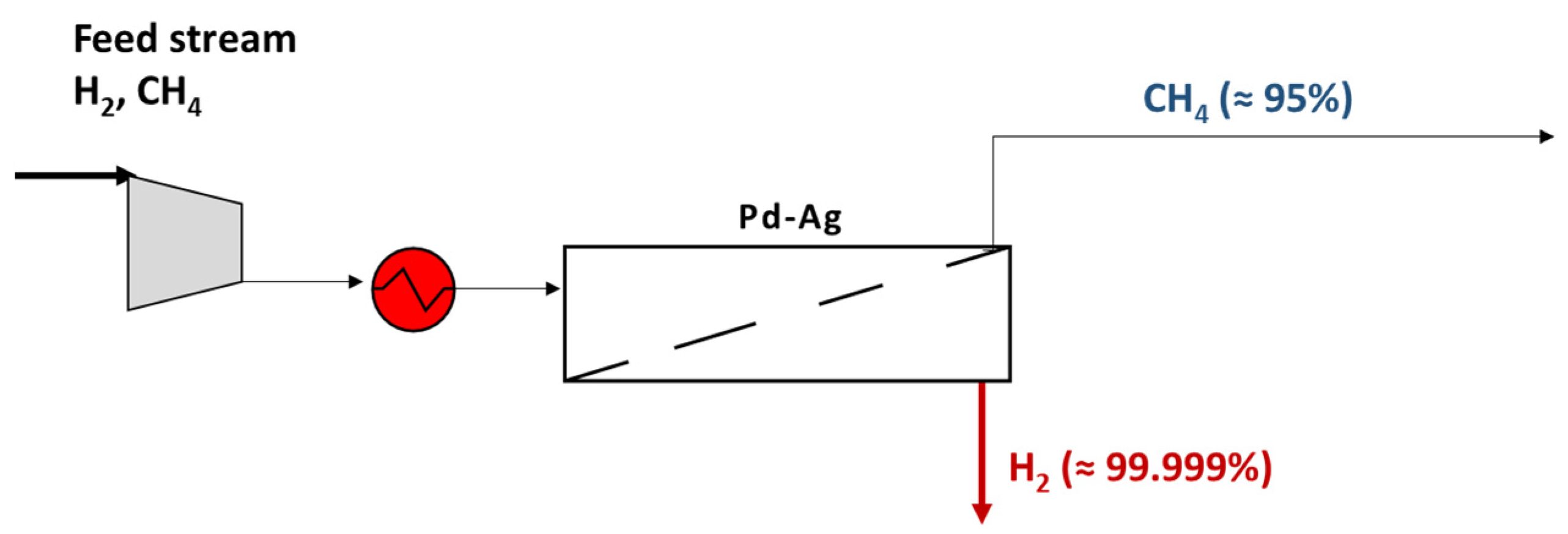
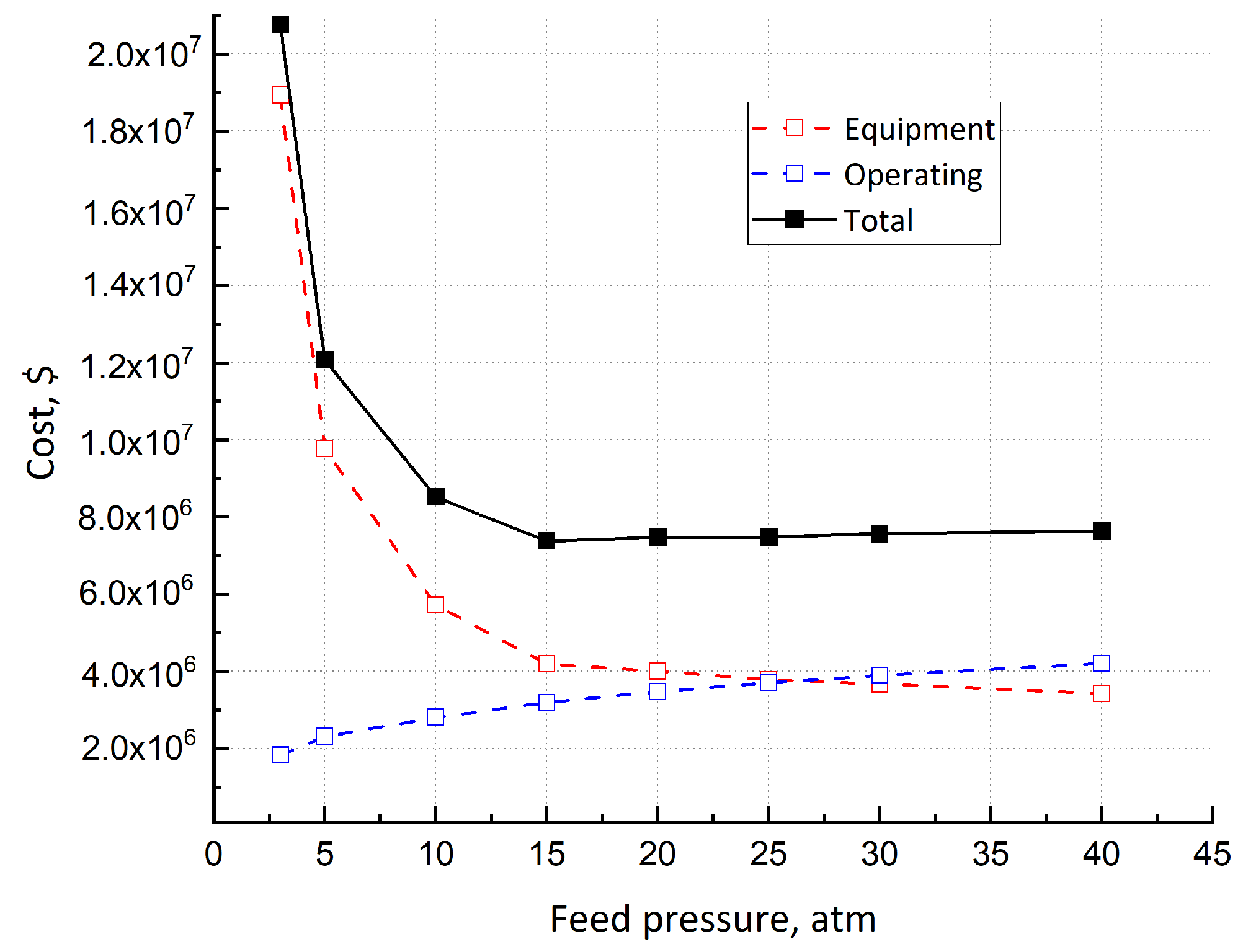
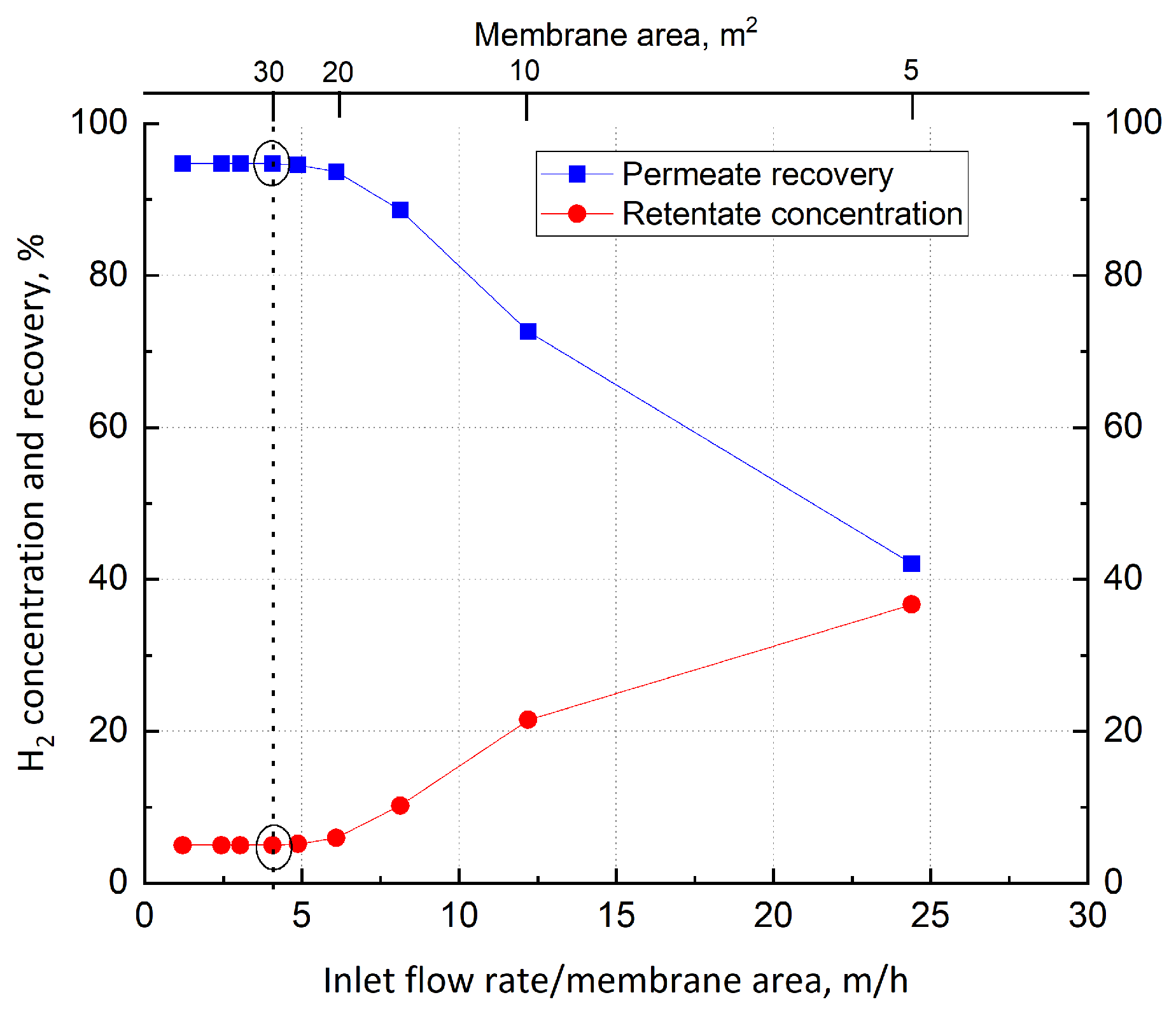
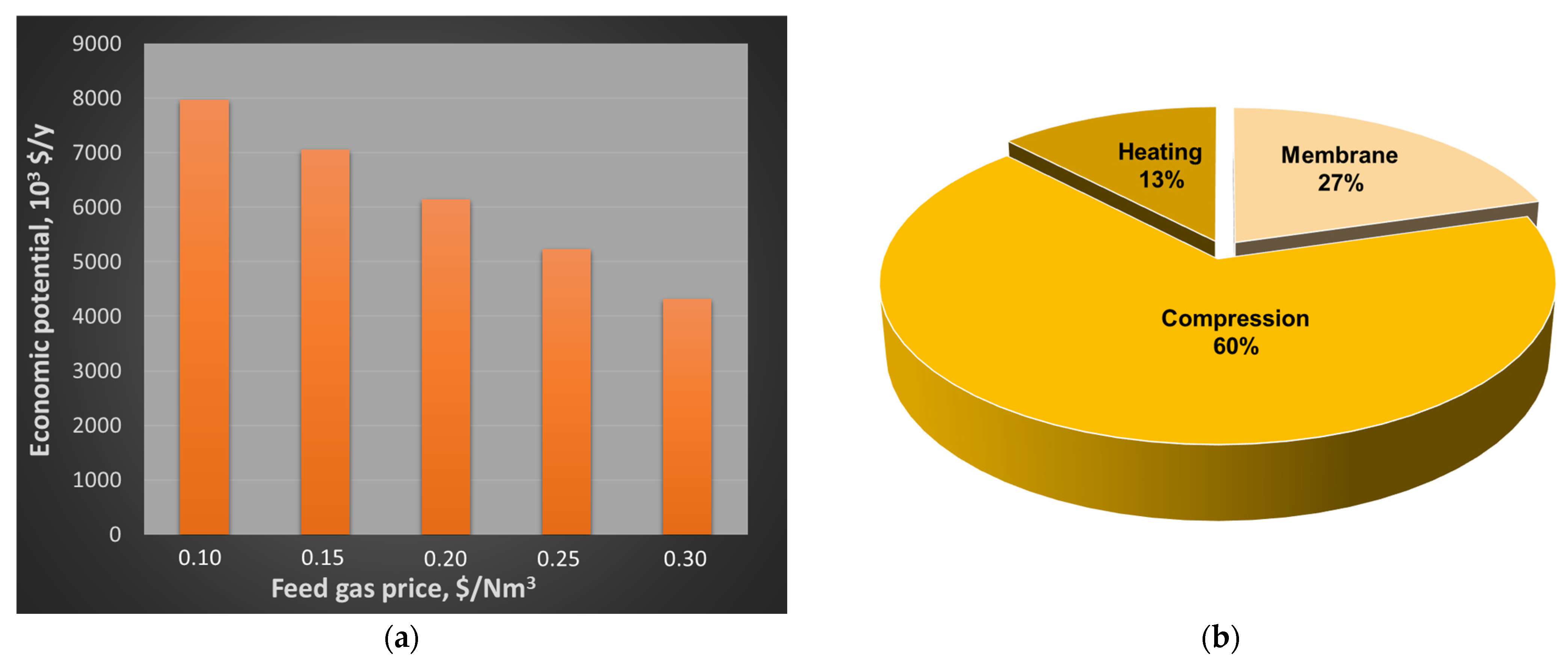
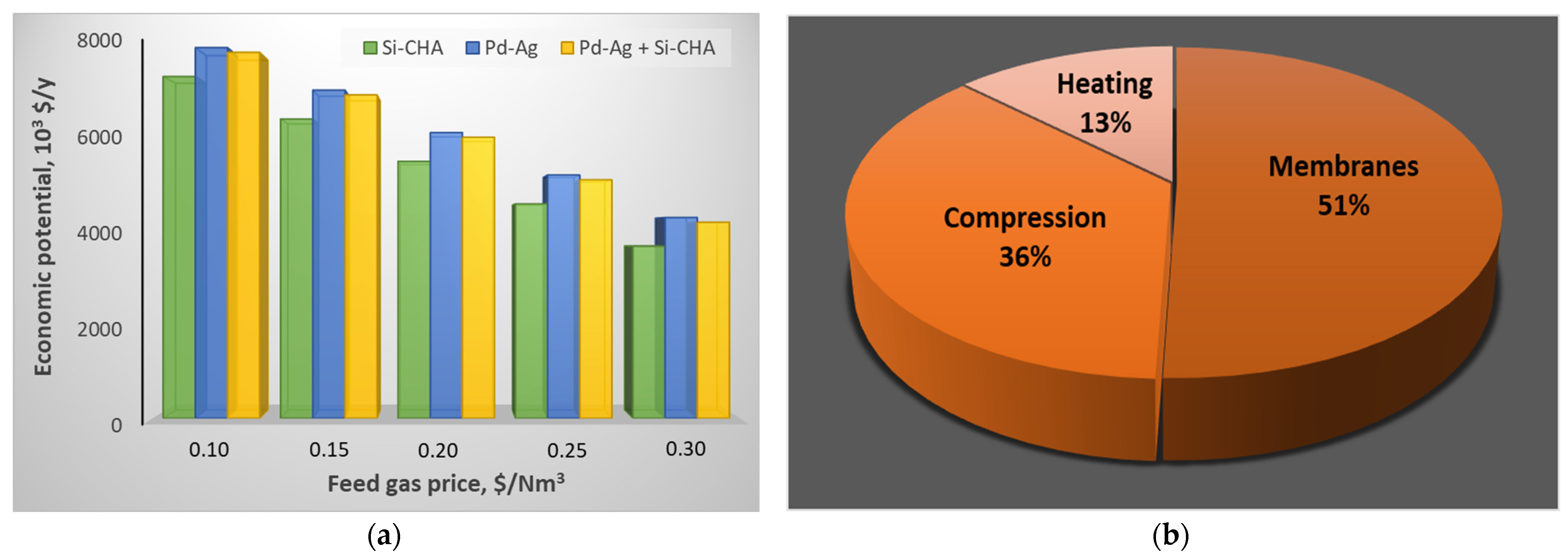
- A single Pd–Ag membrane stage can achieve ultrapure H2 with a recovery of about 95%, whereas all CH4 is recovered on the retentate with a purity of 95%. This configuration is the most cost-effective solution, having the highest EP, net profit and NPV.
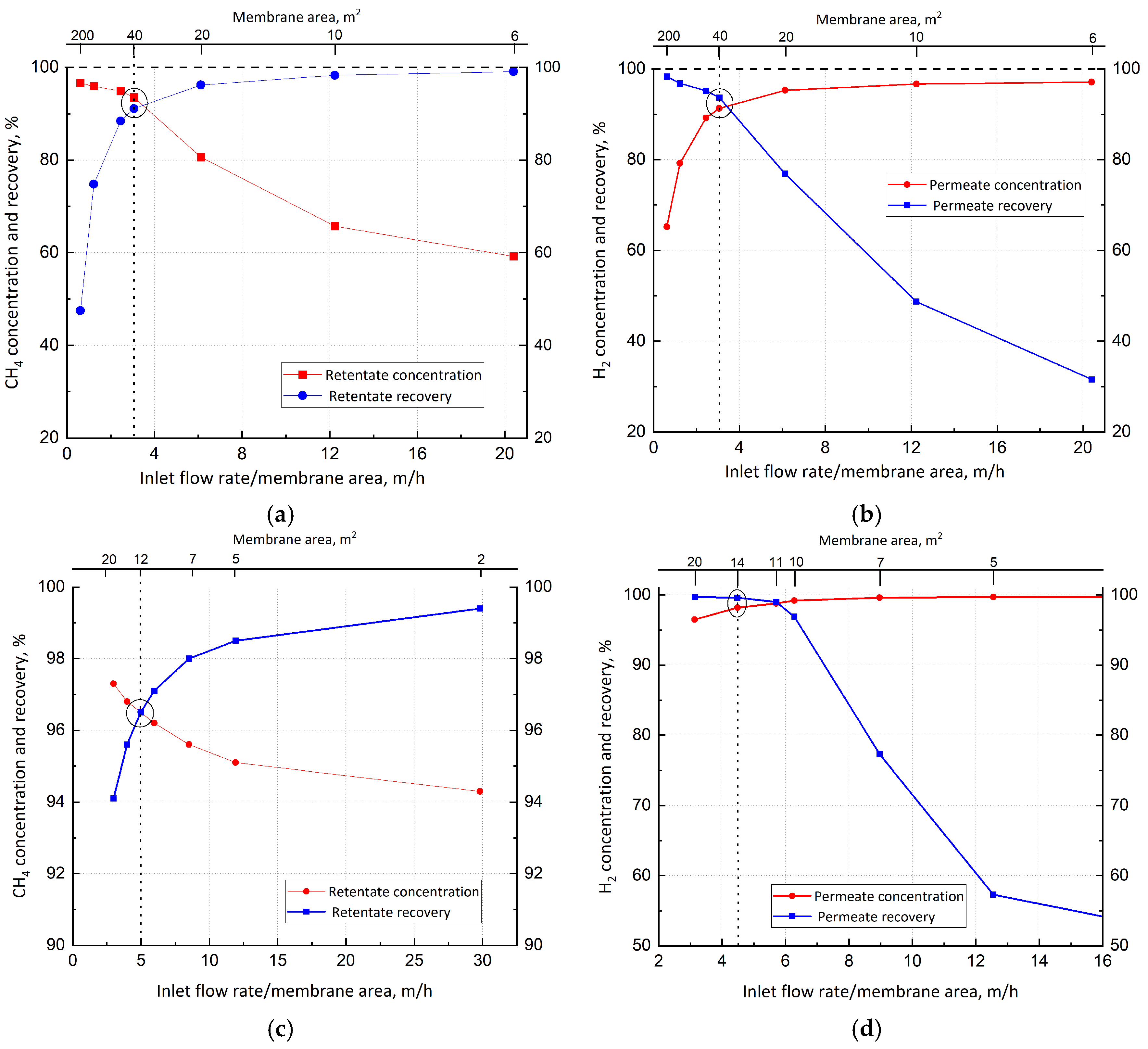
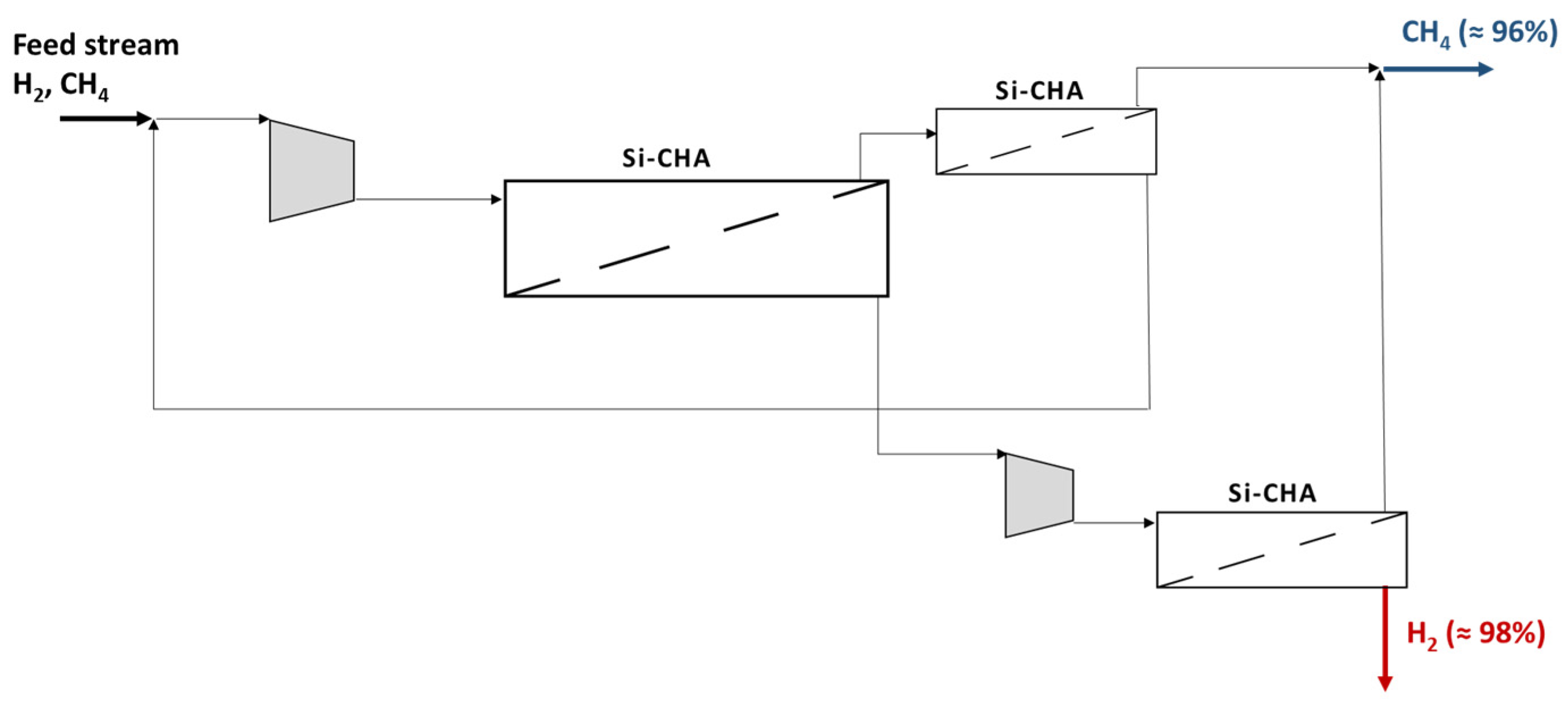
- A three-stage Si-CHA configuration achieves a lower H2 purity of 98.3% combined with higher compression costs and lower EP.
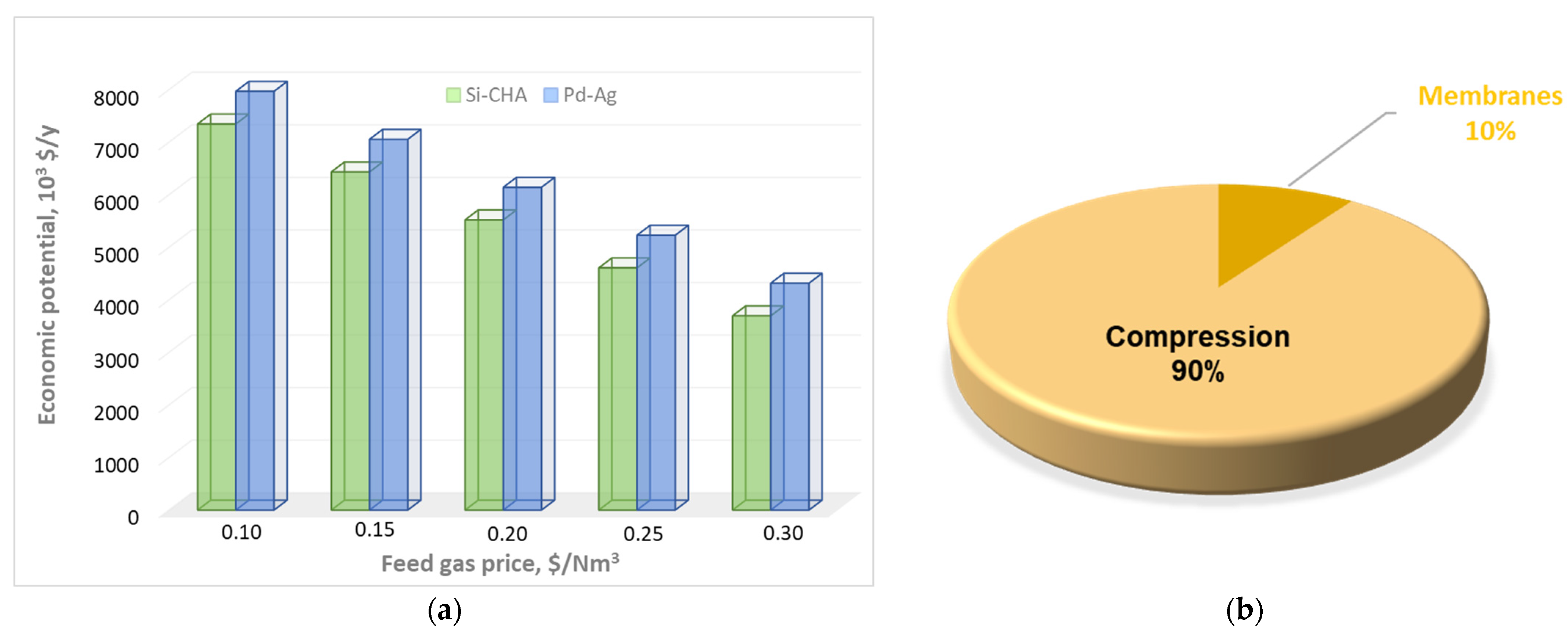
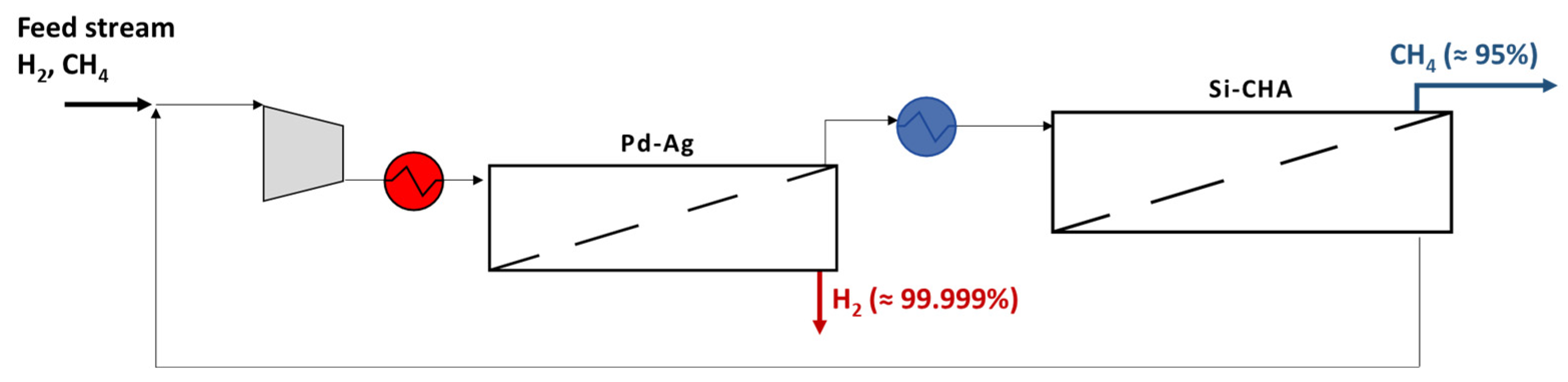
- The hybrid Pd–Ag/Si-CHA scheme shows similar separation performance to the single Pd–Ag solution, but slightly lower EP, net profit and NPV. In addition, this configuration entails a greater process complexity compared to the single-stage Pd–Ag.
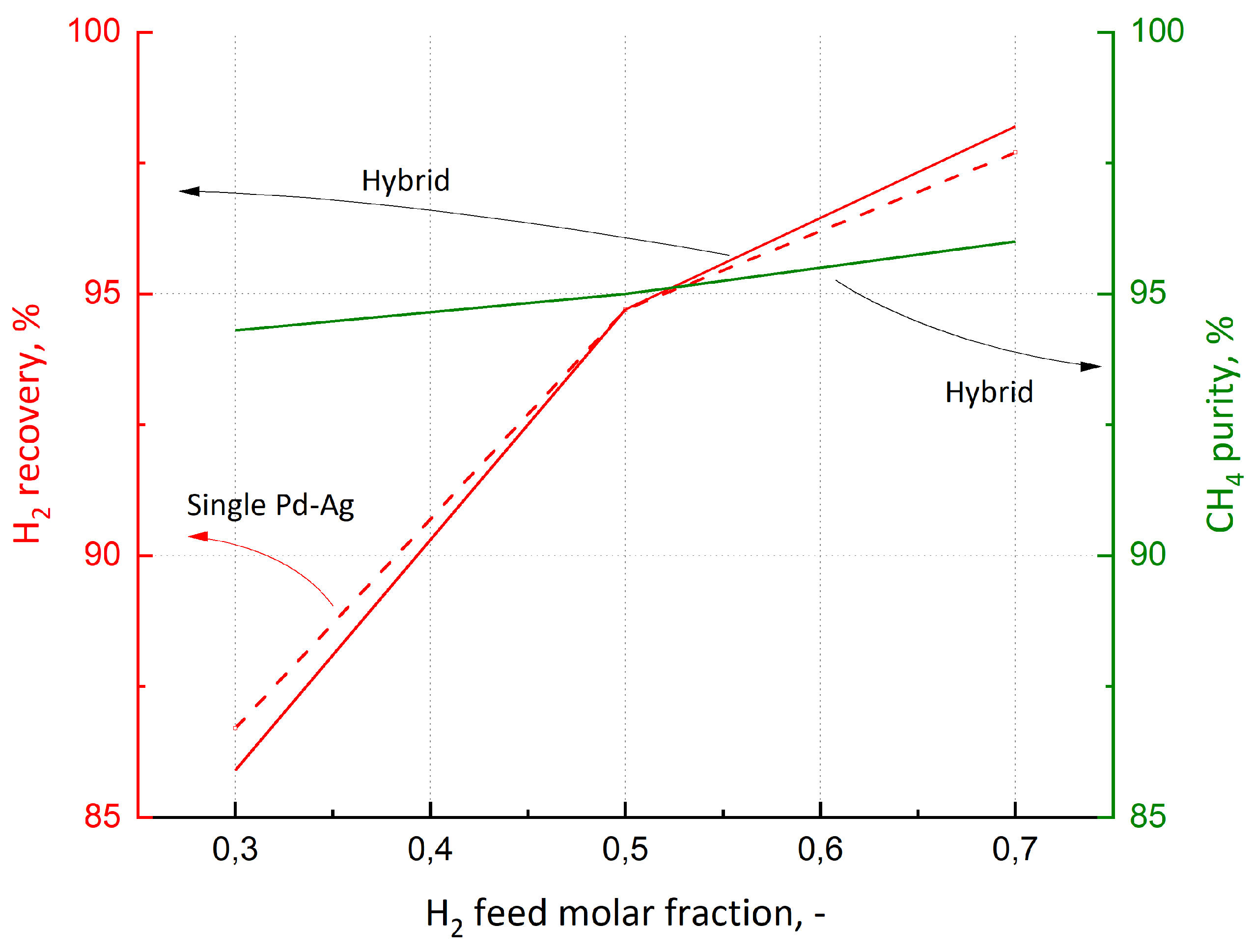
- The proposed plants are flexible: in fact, a change in feed gas concentration does not significantly affect the separation performance.
- Concerning the Pd–Ag membrane, infinite selectivity is a typical condition of single gas measurements on H2 and N2. Mixture measurements could provide finite values of selectivity and a lower H2 permeance, causing a reduction in purity and an increment in area.
- Regarding the zeolite membrane modules, permeance values could be affected by changes in gas concentration; therefore, in a real application, more membrane area could be necessary to realize the desired purification.
- Concentration polarization is neglected, leading to an overestimation of permeating flux. In a real application, their presence produces an increment in the required membrane area. However, a proper distribution of membrane area and recovery factor between the modules can bring concentration polarization closer to the ideal condition [47].
- Scaling up from a laboratory to a larger scale can affect the gas permeation.
- A real industrial gas mixture contains other components and impurities that influence the separation performance and require other separation equipment.
Funding
Data Availability Statement
Acknowledgments
Conflicts of Interest
Abbreviations
| A | Area, ft2 |
| CCF | Capital Charge Factor, y−1 |
| EP | Economic Potential, $/y |
| F | Molar flow, mol/h |
| fc | Parameter for estimating the equipment installation cost, - |
| fd | Parameter for estimating the equipment installation cost, - |
| fm | Parameter for estimating the equipment installation cost, - |
| fp | Parameter for estimating the equipment installation cost, - |
| hp | Theoretical horsepower, hp |
| M&S | Marshall and Swift index, - |
| NPV | Net Present Value, $ |
| P | Total gas pressure, Pa |
| Pe | Permeance, mol m−2 s−1 Pa−n |
| Tot. Prod. Cost | Total production cost, $/y |
| z | Axial coordinate, m |
| π | Mathematical constant equal to 3.14159… |
Appendix A
References
- Global Energy and Climate Model Documentation-2024. Available online: https://iea.blob.core.windows.net/assets/89a1aa9a-e1bd-4803-b37b-59d6e7fba1e9/GlobalEnergyandClimateModelDocumentation2024.pdf (accessed on 29 September 2025).
- Global Hydrogen Review 2024—Hydrogen Demand. Available online: https://www.iea.org/reports/global-hydrogen-review-2024/hydrogen-demand (accessed on 29 September 2025).
- Global Hydrogen Review 2025—Executive Summary. Available online: https://www.iea.org/reports/global-hydrogen-review-2025/executive-summary (accessed on 21 October 2025).
- Hydrogen in Industrial Applications. Available online: https://fchea.org/learning-center/hydrogen-in-industrial-application/ (accessed on 21 October 2025).
- Capurso, T.; Stefanizzi, M.; Torresi, M.; Camporeale, S.M. Perspective of the role of hydrogen in the 21st century energy transition. Energy Convers. Manag. 2022, 251, 114898. [Google Scholar] [CrossRef]
- Oni, A.O.; Anaya, K.; Giwa, T.; Di Lullo, G.; Kumar, A. Comparative assessment of blue hydrogen from steam methane reforming, autothermal reforming, and natural gas decomposition technologies for natural gas-producing regions. Energy Convers. Manag. 2022, 254, 115245. [Google Scholar] [CrossRef]
- Chai, S.; Zhang, G.; Li, G.; Zhang, Y. Industrial hydrogen production technology and developments status in China: A review. Clean Technol. Environ. 2021, 23, 1931–1946. [Google Scholar] [CrossRef]
- A Hydrogen Strategy for a Climate-Neutral Europe. Available online: https://energy.ec.europa.eu/system/files/2020-07/hydrogen_strategy_0.pdf (accessed on 29 September 2025).
- Xue, Z.; Jiangfeng, T.; Lulu, G. Review of H2/CH4 separation via pressure swing adsorption: Separation characteristics, competitive adsorption exploration, and functionalised methods on adsorbents. Sep. Purif. Technol. 2025, 359, 130538. [Google Scholar] [CrossRef]
- Król, A.; Gajec, M.; Holewa-Rataj, J.; Kukulska-Zając, E.; Rataj, M. Hydrogen Purification Technologies in the Context of Its Utilization. Energies 2024, 17, 3794. [Google Scholar] [CrossRef]
- Ulucan, T.H.; Akhade, S.A.; Ambalakatte, A.; Autrey, T.; Cairns, A.; Chen, P.; Cho, Y.W.; Gallucci, F.; Gao, W.; Grinderslev, J.B.; et al. Hydrogen storage in liquid hydrogen carriers: Recent activities and new trends. Prog. Energy 2023, 5, 012004. [Google Scholar] [CrossRef]
- Sun, S.; Li, S.; Chen, Y. Factors affecting the performance of membranes for H2/CH4 separation from the perspective of separation mechanisms. Green Energy Environ. 2025, in press. [CrossRef]
- Du, Z.; Liu, C.; Zhai, J.; Guo, X.; Xiong, Y.; Su, W.; He, G. A Review of Hydrogen Purification Technologies for Fuel Cell Vehicles. Catalysts 2021, 11, 393. [Google Scholar] [CrossRef]
- Hatlevik, Ø.; Gade, S.K.; Keeling, M.K.; Thoen, P.M.; Davidson, A.P.; Way, J.D. Palladium and palladium alloy membranes for hydrogen separation and production: History, fabrication strategies, and current performance. Sep. Purif. Technol. 2010, 73, 59–64. [Google Scholar] [CrossRef]
- Gallucci, F.; Fernandez, E.; Corengia, P.; van Sint Annaland, M. Recent advances on membranes and membrane reactors for hydrogen production. Chem. Eng. Sci. 2013, 92, 40–66. [Google Scholar] [CrossRef]
- Binazadeh, M.; Mamivand, S.; Sohrabi, R.; Taghvaei, H.; Iulianelli, A. Membrane reactors for hydrogen generation: From single stage to integrated systems. Int. J. Hydrogen Energy 2023, 48, 39225–39253. [Google Scholar] [CrossRef]
- Saini, N.; Awasthi, K. Insights into the progress of polymeric nano-composite membranes for hydrogen separation and purification in the direction of sustainable energy resources. Sep. Purif. Technol. 2022, 282, 120029. [Google Scholar] [CrossRef]
- Kamble, A.R.; Patel, C.M.; Murthy, Z.V.P. A review on the recent advances in mixed matrix membranes for gas separation processes. Renew. Sustain. Energy Rev. 2021, 145, 111062. [Google Scholar] [CrossRef]
- Han, X.; Xu, W.; Meng, F.; Liu, Z.; Liao, C. Recent advances in zeolite membranes for gas separation and pervaporation in petrochemicals. J. Mater. Chem. A 2025, 13, 10358–10387. [Google Scholar] [CrossRef]
- Wu, T.; Shu, C.; Liu, S.; Xu, B.; Zhong, S.; Zhou, R. Separation performance of Si-CHA zeolite membrane for a binary H2/CH4 mixture and ternary and quaternary mixtures containing impurities. Energy Fuels 2020, 34, 11650–11659. [Google Scholar] [CrossRef]
- Mei, W.; Du, Y.; Wu, T.; Gao, F.; Wang, B.; Duan, J.; Zhou, J.; Zhou, R. High-flux CHA zeolite membranes for H2 separations. J. Membr. Sci. 2018, 565, 358–369. [Google Scholar] [CrossRef]
- Wang, B.; Zheng, Y.; Zhang, J.; Zhang, W.; Zhang, F.; Xing, W.; Zhou, R. Separation of light gas mixtures using zeolite SSZ-13 membranes. Microporous Mesoporous Mater. 2019, 275, 191–199. [Google Scholar] [CrossRef]
- Wang, B.; Hu, N.; Wang, H.; Zheng, Y.; Zhou, R. Improved AIPO-18 membranes for light gas separation. J. Mater. Chem. A 2015, 3, 12205–12212. [Google Scholar] [CrossRef]
- Morreale, B.D.; Ciocco, M.V.; Enick, R.M.; Morsi, B.I.; Howard, B.H.; Cugini, A.V.; Rothenberger, K.S. The permeability of hydrogen in bulk palladium at elevated temperatures and pressures. J. Membr. Sci. 2003, 212, 87–97. [Google Scholar] [CrossRef]
- Zito, P.F.; Brunetti, A.; Barbieri, G. Renewable biomethane production from biogas upgrading via membrane separation: Experimental analysis and multistep configuration design. Renew. Energy 2022, 200, 777–787. [Google Scholar] [CrossRef]
- Brunetti, A.; Scura, F.; Barbieri, G.; Drioli, E. Membrane technologies for CO2 separation. J. Membr. Sci. 2010, 359, 115–125. [Google Scholar] [CrossRef]
- Brunetti, A.; Zito, P.F.; Borisov, I.; Grushevenko, E.; Volkov, V.; Volkov, A.; Barbieri, G. CO2 separation from humidified ternary gas mixtures using a polydecylmethylsiloxane composite membrane. Fuel Process. Technol. 2020, 210, 106550. [Google Scholar] [CrossRef]
- Scholz, M.; Alders, M.; Lohaus, T.; Wessling, M. Structural optimization of membrane-based biogas upgrading processes. J. Membr. Sci. 2015, 474, 1–10. [Google Scholar] [CrossRef]
- Zito, P.F.; Iulianelli, A. CO2 capture combined with H2 and CH4 purification via a membrane plant: Process design, energy integration and economic analysis. Energy Convers. Manag. 2025, 347, 120538. [Google Scholar] [CrossRef]
- Wang, X.; Feng, X.; Yang, L.; An, Y.; Yao, Y.; Chen, K.; Song, J.; Shi, Y.; Chen, C.; Luo, W. Highly efficient and direct recovery of low-pressure hydrogen isotopes from tritium extraction gas by PdY alloy membrane permeator. Fusion Eng. Des. 2024, 202, 114348. [Google Scholar] [CrossRef]
- Bernardo, P.; Drioli, E. Membrane Gas Separation Progresses for Process Intensification Strategy in the Petrochemical Industry. Pet. Chem. 2010, 50, 271–282. [Google Scholar] [CrossRef]
- Brunetti, A.; Caravella, A.; Fernandez, E.; Pacheco Tanaka, D.A.; Gallucci, F.; Drioli, E.; Curcio, E.; Viviente, J.L.; Barbieri, G. Syngas upgrading in a membrane reactor with thin Pd-alloy supported membrane. Int. J. Hydrogen Energy 2015, 40, 10883–10893. [Google Scholar] [CrossRef]
- Jazani, O.; Elharati, M.A.; Liguori, S. Effects of porous supports and binary gases on hydrogen permeation in Pd–Ag–Y alloy membrane. J. Membr. Sci. 2025, 713, 123327. [Google Scholar] [CrossRef]
- Alique, D.; Leo, P.; Martinez-Diaz, D.; Calles, J.A.; Sanz, R. Environmental and cost assessments criteria for selection of promising palladium membranes fabrication strategies. Int. J. Hydrogen Energy 2024, 51, 302–319. [Google Scholar] [CrossRef]
- Martinez-Diaz, D.; Martínez del Monte, D.; García-Rojas, E.; Alique, D.; Calles, J.A.; Sanz, R. Comprehensive permeation analysis and mechanical resistance of electroless pore-plated Pd-membranes with ordered mesoporous ceria as intermediate layer. Sep. Purif. Technol. 2021, 258, 118066. [Google Scholar] [CrossRef]
- Omidifar, M.; Babaluo, A.A. Steam and methanol effects on H2 recovery and stage cut in Pd–Ni composite membranes. J. Membr. Sci. 2025, 734, 124462. [Google Scholar] [CrossRef]
- Koutsiantzi, C.; Mitrakas, M.; Zouboulis, A.; Kellartzis, I.; Stavropoulos, G.; Kikkinides, E.S. Evaluation of polymeric membranes’ performance during laboratory-scale experiments, regarding the CO2 separation from CH4. Chemosphere 2022, 299, 134224. [Google Scholar] [CrossRef] [PubMed]
- Douglas, J.M. Conceptual Design of Chemical Processes; McGraw-Hill, Inc.: Columbus, OH, USA, 1988. [Google Scholar]
- Go, K.-S.; Chu, Y.-H.; McFarland, E.W. Techno-economic analysis of bromine mediated propane oxidative dehydrogenation to produce propylene. Chem. Eng. J. 2023, 473, 145260. [Google Scholar] [CrossRef]
- Xie, Y.; Björkmalm, J.; Ma, C.; Willquist, K.; Yngvesson, J.; Wallberg, O.; Ji, X. Techno-economic evaluation of biogas upgrading using ionic liquids in comparison with industrially used technology in Scandinavian anaerobic digestion plants. Appl. Energy 2018, 227, 742–750. [Google Scholar] [CrossRef]
- Sawaki, N.; Chen, C.-L. Cost evaluation for a two-staged reverse osmosis and pressure retarded osmosis desalination process. Desalination 2021, 497, 114767. [Google Scholar] [CrossRef]
- Wang, H.; Ma, C.; Yang, Z.; Lu, X.; Ji, X. Improving high-pressure water scrubbing through process integration and solvent selection for biogas upgrading. Appl. Energy 2020, 276, 115462. [Google Scholar] [CrossRef]
- Ulrich, G.D.; Vasudevan, P.T. How to estimate utility costs. Chem. Eng. 2006, 113, 66–69. [Google Scholar]
- Zito, P.F.; Prenesti, G.; Caravella, A. H2 and CO purification by CO2 removal from syngas coupling membrane module and water-absorption unit: An economic analysis. Int. J. Hydrogen Energy 2024, 95, 1274–1283. [Google Scholar] [CrossRef]
- Geletukha, G.; Kucheruk, P.; Matveev, Y. Prospects and potential for biomethane production in Ukcraine. Ecol. Eng. Environ. Technol. 2022, 23, 67–80. [Google Scholar] [CrossRef]
- Peppers, J.; Li, Y.; Xue, J.; Chen, X.; Alaimo, C.; Wong, L.; Young, T.; Green, P.G.; Jenkins, B.; Zhang, R.; et al. Performance analysis of membrane separation for upgrading biogas to biomethane at small scale production sites. Biomass Bioenergy 2019, 128, 105314. [Google Scholar] [CrossRef]
- Ongis, M.; Ververs, W.; Di Marcoberardino, G.; Gallucci, F.; Binotti, M. Modelling hydrogen deblending from natural gas using Pd-based dense metallic membranes with an empirical polarization model. J. Membr. Sci. 2025, 717, 123537. [Google Scholar] [CrossRef]




| Parameter | Assumed Value |
|---|---|
| Feed flow rate, mol h−1 | 100,000 |
| Feed composition, - | H2:CH4 = 50:50 H2:CH4 = 70:30 H2:CH4 = 30:70 |
| Feed pressure, atm | 10, 20 |
| Permeate pressure, atm | 1 |
| H2 permeance, mol m−2 s−1 Pa−1 | 1.9 × 10⁻³ (Pd–Ag); 9.0 × 10⁻⁷ (Si-CHA) |
| H2/CH4 selectivity, - | Unlimited (Pd–Ag) 45 (Si-CHA) |
| Parameter | Target |
|---|---|
| H2 purity | >98% |
| CH4 purity | ≥95% |
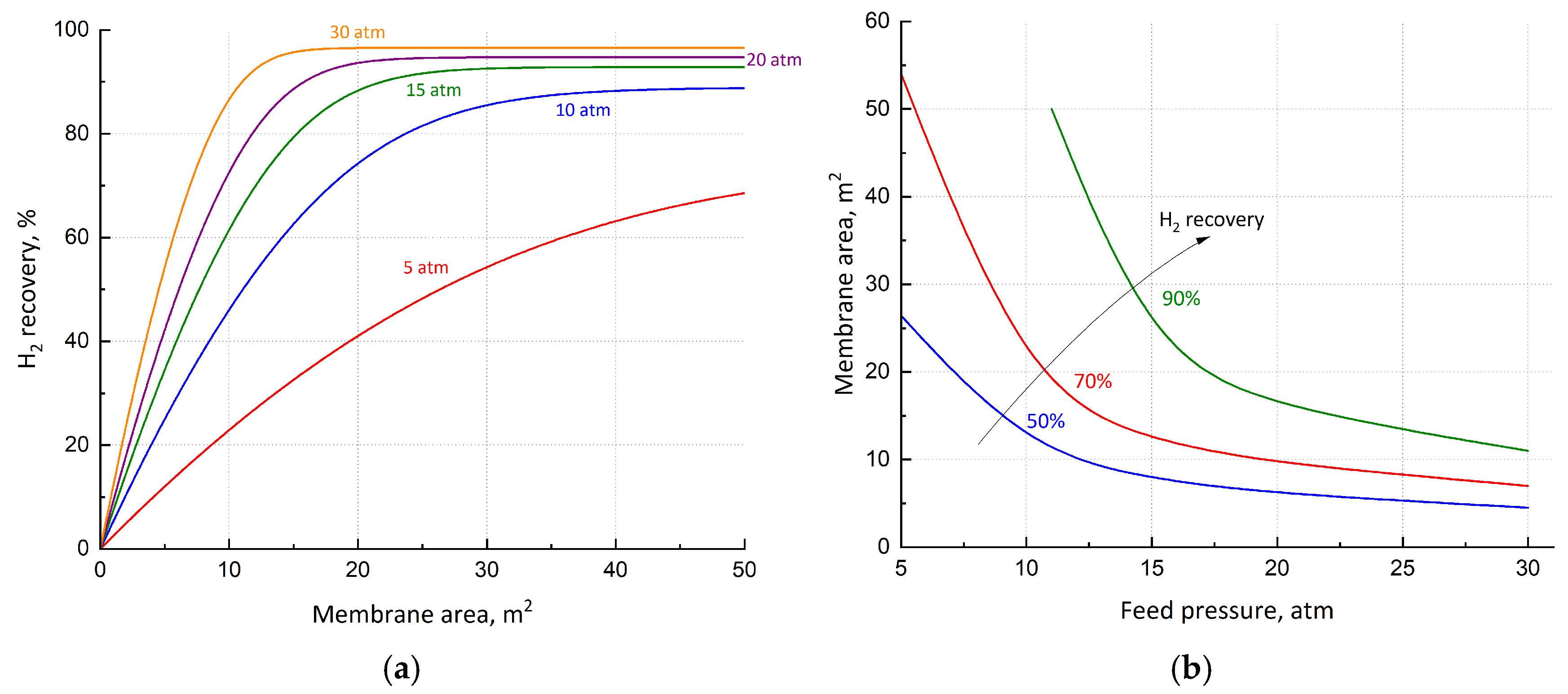
| H2 recovery | >90% |
| Term of Equation (3) | Parameter | Assumed Value |
|---|---|---|
| Raw material | Feed gas price, $/Nm3 | From 0.05 to 0.50 |
| Onsite | Pd–Ag installation cost, $/m2 | 14,000 |
| Si-CHA installation cost, $/m2 | 2500 | |
| M&S, - | 2031.9 [39] | |
| fc compressor, - | 1 [38] | |
| fm heat exchanger, - | 1 [38] | |
| fd heat exchanger, - | 1 [38] | |
| fp heat exchanger, - | 0.52 [38] | |
| Utilities | Electricity cost, $/kWh | 0.10 [40,41] |
| Cooling water cost, $/kg | 0.000048 [42,43] | |
| Compressed steam cost, $/kg | 0.029 [44] | |
| Revenues | H2 price, $/Nm3 | 0.50 [44] |
| CH4 price, $/Nm3 | 0.70 [45] | |
| Saturated steam price, $/kg | 0.025 [44] |
| Si-CHA Unit | Retentate | Permeate |
|---|---|---|
| Concentration | Flow rate = 50,621 mol h−1 CH4 purity = 93.2% | Flow rate = 52,640 mol h−1 H2 purity = 91.6% |
| H2 purification | Flow rate = 3745 mol h−1 CH4 purity = 94.8% | Flow rate = 48,895 mol h−1 H2 purity = 98.3% |
| CH4 purification | Flow rate = 47,360 mol h−1 CH4 purity = 96.3% | Flow rate = 3261 mol h−1 H2 purity = 50.8% |
| Membrane Unit | Retentate | Permeate |
|---|---|---|
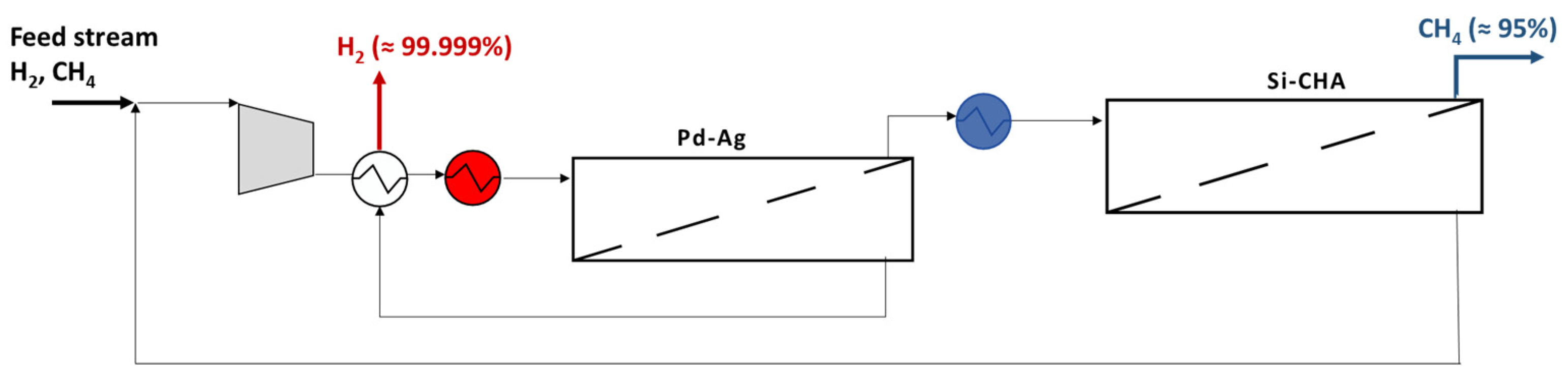
| Pd–Ag | Flow rate = 60,563 mol h−1 CH4 purity = 89.9% | Flow rate = 47,373 mol h−1 H2 purity = 99.999% |
| Si-CHA | Flow rate = 52,627 mol h−1 CH4 purity = 95.0% | Flow rate = 7936 mol h−1 H2 purity = 43.8% |
| Parameter Type | Name | Pd–Ag | Pd–Ag + Si-CHA |
|---|---|---|---|
| Input | Feed gas price, $/Nm3 | 0.15 | |
| Tax index, - | 0.48 [38] | ||
| Labor cost, $/h | 15.6 [29] | ||
| Interest, - | 0.06 [46] | ||
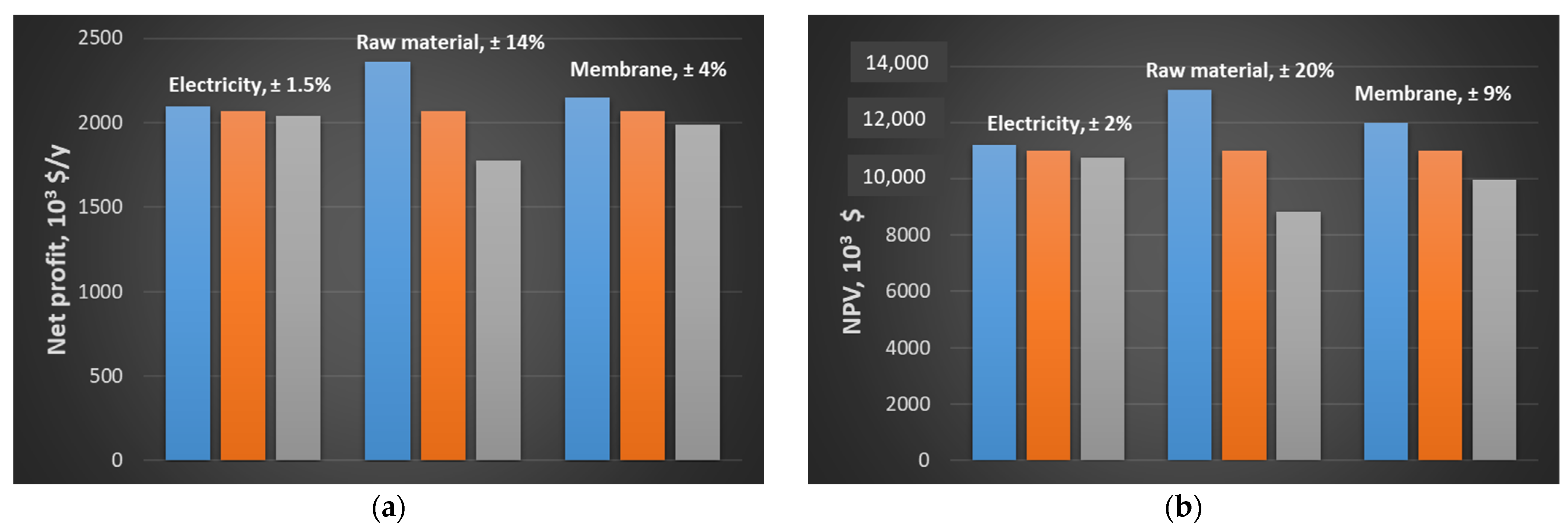
| Output | Net profit, 103 $/y | 2069 | 1660 |
| Net present value, 103 $ | 10,984 | 5552 | |
| Internal rate of return, - | 0.26 | 0.132 | |
| Membrane Configuration | EP Variation |
|---|---|
| Pd–Ag | −10% (H2 feed = 70%) +10% (H2 feed = 30%) |
| Hybrid | −10% (H2 feed = 70%) +12% (H2 feed = 30%) |
Disclaimer/Publisher’s Note: The statements, opinions and data contained in all publications are solely those of the individual author(s) and contributor(s) and not of MDPI and/or the editor(s). MDPI and/or the editor(s) disclaim responsibility for any injury to people or property resulting from any ideas, methods, instructions or products referred to in the content. |
© 2025 by the author. Licensee MDPI, Basel, Switzerland. This article is an open access article distributed under the terms and conditions of the Creative Commons Attribution (CC BY) license (https://creativecommons.org/licenses/by/4.0/).
Share and Cite
Zito, P.F. Techno-Economic Analysis of Membrane-Based Plants for H2/CH4 Purification. Membranes 2025, 15, 336. https://doi.org/10.3390/membranes15110336
Zito PF. Techno-Economic Analysis of Membrane-Based Plants for H2/CH4 Purification. Membranes. 2025; 15(11):336. https://doi.org/10.3390/membranes15110336
Chicago/Turabian StyleZito, Pasquale Francesco. 2025. "Techno-Economic Analysis of Membrane-Based Plants for H2/CH4 Purification" Membranes 15, no. 11: 336. https://doi.org/10.3390/membranes15110336
APA StyleZito, P. F. (2025). Techno-Economic Analysis of Membrane-Based Plants for H2/CH4 Purification. Membranes, 15(11), 336. https://doi.org/10.3390/membranes15110336