Moonlighting Functions of Mammalian Peroxiredoxins in Cellular Signaling

Abstract
1. Introduction
2. Major Functions and Biological Roles of Prdxs
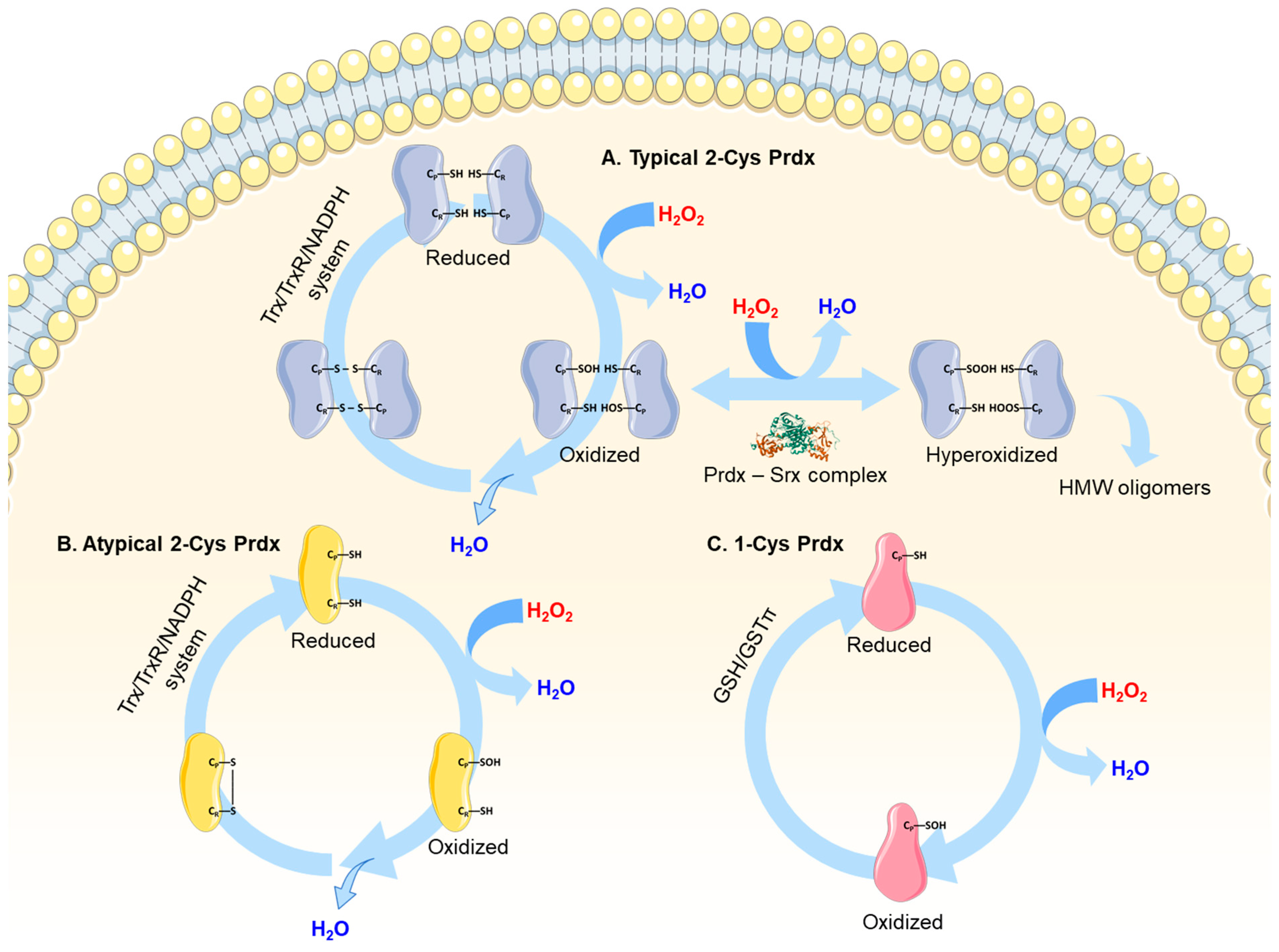
2.1. Peroxidase Activity
2.2. Chaperone Activity
2.3. Circadian Rhythm
2.4. Damage-Associated Molecular Pattern (DAMP)
2.5. Mitophagy Regulator
2.6. Lactylation-Associated Marker
2.7. Redox Signal Amplifier
2.8. Reproductive Biomarker
2.9. Mitochondrial Protector
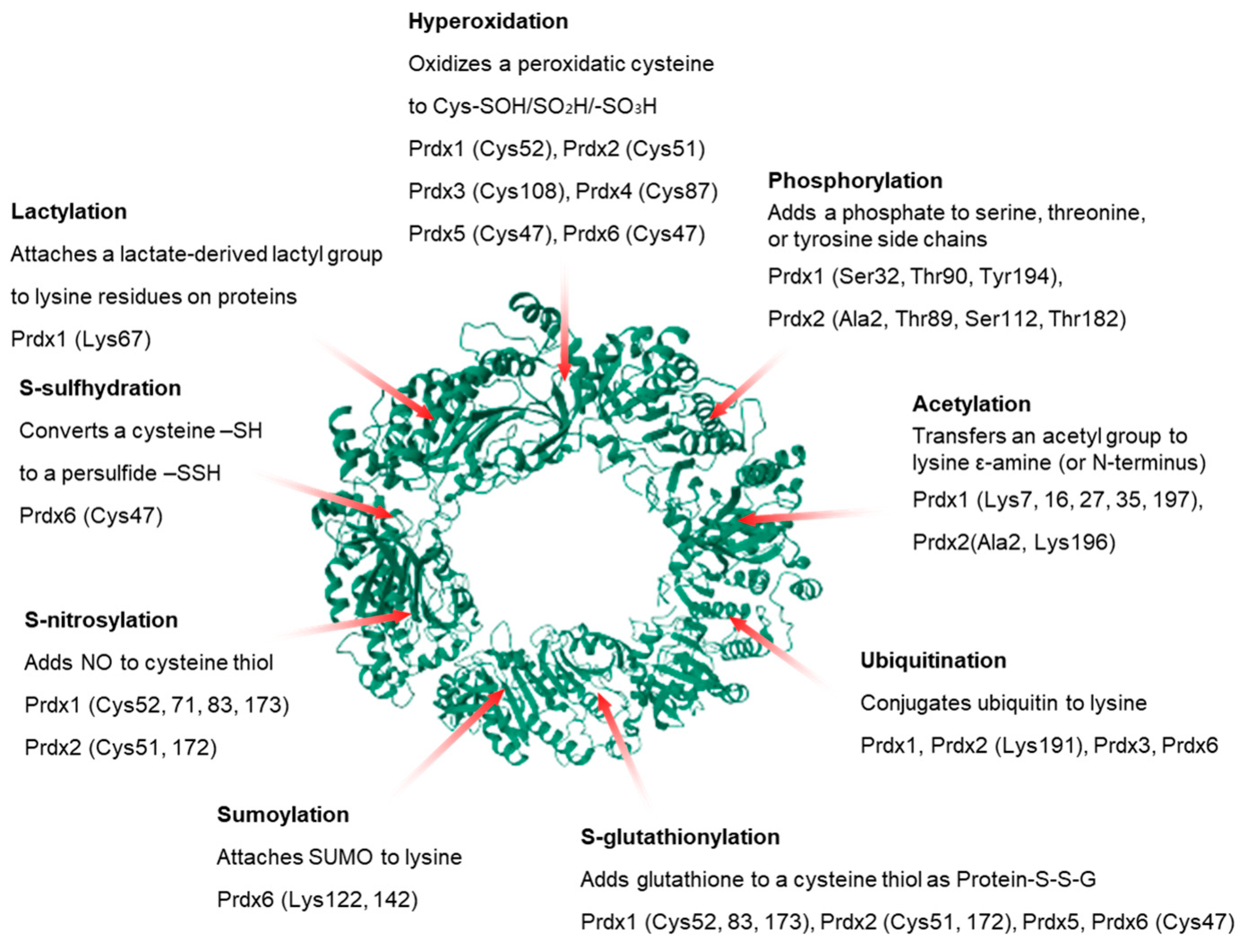
3. PTMs of Prdxs
3.1. Hyperoxidation
3.2. Phosphorylation
3.3. Acetylation
3.4. Ubiquitination
3.5. S-Glutathionylation
3.6. Sumoylation
3.7. S-Nitrosylation
3.8. S-Sulfhydration (Persulfidation)
3.9. Lactylation
4. Conclusions
Author Contributions
Funding
Institutional Review Board Statement
Informed Consent Statement
Data Availability Statement
Conflicts of Interest
Abbreviations
| aiPLA2 | Acidic Ca2+-independent phospholipase A2 |
| ATP | Adenosine triphosphate |
| CP | Peroxidatic cysteine |
| CR | Resolving cysteine |
| CSE | Cystathionine γ-lyase |
| COX1 | Cyclooxygenase-1 |
| DAMP | Damage-associated molecular pattern |
| ER | Endoplasmic reticulum |
| ERK | Extracellular signal-regulated kinase |
| IL-1β | Interleukin-1 beta |
| IVF | In vitro fertilization |
| FCD | Focal cortical dysplasia |
| Grx1 | Glutaredoxin 1 |
| GSH | Glutathione |
| GSTπ | GSH S-transferase pi |
| GPx | GSH peroxidase |
| GSDMD | Gasdermin D |
| GSNO | S-nitrosoglutathione |
| H2O2 | Hydrogen peroxide |
| HMW | High-molecular-weight |
| HDAC6 | Histone deacetylase 6 |
| HCC | Hepatocellular carcinoma |
| LPS | Lipopolysaccharide |
| MOF | Males absent on the first |
| NF-κB | Nuclear factor kappa-light-chain-enhancer of activated b cells |
| NLRP3 | NOD-, LRR- and pyrin domain-containing protein 3 |
| NO | Nitric oxide |
| NRF2 | Nuclear factor erythroid 2–related factor 2 |
| NASH | Non-alcoholic steatohepatitis |
| ONOO− | Peroxynitrite |
| OSCC | Oral squamous cell carcinoma |
| PTP | Protein tyrosine phosphatase |
| Prdxs | Peroxiredoxins |
| PTM | Post-translational modification |
| PTK | Protein tyrosine kinase |
| PTX | Paclitaxel |
| RA | Rheumatoid arthritis |
| RNS | Reactive nitrogen species |
| ROS | Reactive oxygen speciesRGF: Regorafenib |
| SNOC | S-nitrosocysteine |
| STAT | Signal transducer and activator of transcription |
| Srx | Sulfiredoxin |
| TNF-α | Tumor necrosis factor alpha |
| Trx | Thioredoxin |
| TrxR | Thioredoxin reductase |
| ZNF207 | Zinc finger protein 207 |
References
- Jomova, K.; Alomar, S.Y.; Alwasel, S.H.; Nepovimova, E.; Kuca, K.; Valko, M. Several lines of antioxidant defense against oxidative stress: Antioxidant enzymes, nanomaterials with multiple enzyme-mimicking activities, and low-molecular-weight antioxidants. Arch. Toxicol. 2024, 98, 1323–1367. [Google Scholar] [CrossRef]
- Jomova, K.; Raptova, R.; Alomar, S.Y.; Alwasel, S.H.; Nepovimova, E.; Kuca, K.; Valko, M. Reactive oxygen species, toxicity, oxidative stress, and antioxidants: Chronic diseases and aging. Arch. Toxicol. 2023, 97, 2499–2574. [Google Scholar] [CrossRef]
- Reddy, V.P. Oxidative Stress in Health and Disease. Biomedicines 2023, 11, 2925. [Google Scholar] [CrossRef]
- Song, I.K.; Lee, J.J.; Cho, J.H.; Jeong, J.; Shin, D.H.; Lee, K.J. Degradation of Redox-Sensitive Proteins including Peroxiredoxins and DJ-1 is Promoted by Oxidation-induced Conformational Changes and Ubiquitination. Sci. Rep. 2016, 6, 34432. [Google Scholar] [CrossRef] [PubMed]
- Edgar, R.S.; Green, E.W.; Zhao, Y.; van Ooijen, G.; Olmedo, M.; Qin, X.; Xu, Y.; Pan, M.; Valekunja, U.K.; Feeney, K.A.; et al. Peroxiredoxins are conserved markers of circadian rhythms. Nature 2012, 485, 459–464. [Google Scholar] [CrossRef]
- Yoshida, K.; Hara, A.; Sugiura, K.; Fukaya, Y.; Hisabori, T. Thioredoxin-like2/2-Cys peroxiredoxin redox cascade supports oxidative thiol modulation in chloroplasts. Proc. Natl. Acad. Sci. USA 2018, 115, E8296–E8304. [Google Scholar] [CrossRef] [PubMed]
- Bozonet, S.M.; Findlay, V.J.; Day, A.M.; Cameron, J.; Veal, E.A.; Morgan, B.A. Oxidation of a eukaryotic 2-Cys peroxiredoxin is a molecular switch controlling the transcriptional response to increasing levels of hydrogen peroxide. J. Biol. Chem. 2005, 280, 23319–23327. [Google Scholar] [CrossRef] [PubMed]
- Bolduc, J.; Koruza, K.; Luo, T.; Malo Pueyo, J.; Vo, T.N.; Ezerina, D.; Messens, J. Peroxiredoxins wear many hats: Factors that fashion their peroxide sensing personalities. Redox Biol. 2021, 42, 101959. [Google Scholar] [CrossRef]
- Kim, Y.; Jang, H.H. Role of Cytosolic 2-Cys Prx1 and Prx2 in Redox Signaling. Antioxidants 2019, 8, 169. [Google Scholar] [CrossRef]
- Rhee, S.G.; Kil, I.S. Multiple Functions and Regulation of Mammalian Peroxiredoxins. Annu. Rev. Biochem. 2017, 86, 749–775. [Google Scholar] [CrossRef]
- Forshaw, T.E.; Holmila, R.; Nelson, K.J.; Lewis, J.E.; Kemp, M.L.; Tsang, A.W.; Poole, L.B.; Lowther, W.T.; Furdui, C.M. Peroxiredoxins in Cancer and Response to Radiation Therapies. Antioxidants 2019, 8, 11. [Google Scholar] [CrossRef]
- Rhee, S.G.; Woo, H.A. Multiple functions of 2-Cys peroxiredoxins, I and II, and their regulations via post-translational modifications. Free Radic. Biol. Med. 2020, 152, 107–115. [Google Scholar] [CrossRef]
- Liao, J.; Zhang, Y.; Yang, J.; Chen, L.; Zhang, J.; Chen, X. Peroxiredoxin 6 in Stress Orchestration and Disease Interplay. Antioxidants 2025, 14, 379. [Google Scholar] [CrossRef] [PubMed]
- Aran, M.; Ferrero, D.S.; Pagano, E.; Wolosiuk, R.A. Typical 2-Cys peroxiredoxins--modulation by covalent transformations and noncovalent interactions. FEBS J. 2009, 276, 2478–2493. [Google Scholar] [CrossRef]
- Sun, H.N.; Ma, D.Y.; Guo, X.Y.; Hao, Y.Y.; Jin, M.H.; Han, Y.H.; Jin, X.; Kwon, T. Peroxiredoxin I and II as novel therapeutic molecular targets in cervical cancer treatment through regulation of endoplasmic reticulum stress induced by bleomycin. Cell Death Discov. 2024, 10, 267. [Google Scholar] [CrossRef]
- Liu, Y.; Wang, P.; Hu, W.; Chen, D. New insights into the roles of peroxiredoxins in cancer. Biomed. Pharmacother. 2023, 164, 114896. [Google Scholar] [CrossRef]
- Zhou, F.; Chen, F.; Ouyang, Z.; Zhu, R.; Zhou, R.; Hu, W.; Lu, C. Functions of Peroxiredoxins and Their Roles in Autoimmune Diseases. Antioxid. Redox Signal. 2024, 40, 329–344. [Google Scholar] [CrossRef] [PubMed]
- Jeong, S.J.; Park, J.G.; Oh, G.T. Peroxiredoxins as Potential Targets for Cardiovascular Disease. Antioxidants 2021, 10, 1244. [Google Scholar] [CrossRef]
- Han, Y.; Wang, S.; Xiong, Y.; Tu, S.; Xiong, Z.; Li, S.; She, W.; Zhang, Y.; He, X.; Zou, S.; et al. Peroxiredoxin-1 aggravates hypoxia-induced renal injury by promoting inflammation through the TLR4/MAPK/NF-kappaB signaling pathway. Free Radic. Biol. Med. 2025, 236, 176–187. [Google Scholar] [CrossRef] [PubMed]
- Heaton, R.A.; Ball, S.T.; Staunton, C.A.; Mouly, V.; Jones, S.W.; McArdle, A.; Jackson, M.J. Peroxiredoxin 2 mediates redox-stimulated adaptations to oxidative phosphorylation induced by contractile activity in human skeletal muscle myotubes. Free Radic. Biol. Med. 2025, 227, 395–406. [Google Scholar] [CrossRef]
- Ge, M.M.; Zhang, X.M.; Xu, C.; Miao, C.H.; Liao, Q.W. Peroxiredoxins in central nervous system: Implications for chronic pain and anaesthetic-induced neurotoxicity management. Redox Biol. 2025, 87, 103898. [Google Scholar] [CrossRef]
- Nicolussi, A.; D’Inzeo, S.; Capalbo, C.; Giannini, G.; Coppa, A. The role of peroxiredoxins in cancer. Mol. Clin. Oncol. 2017, 6, 139–153. [Google Scholar] [CrossRef]
- Ismail, T.; Kim, Y.; Lee, H.; Lee, D.S.; Lee, H.S. Interplay Between Mitochondrial Peroxiredoxins and ROS in Cancer Development and Progression. Int. J. Mol. Sci. 2019, 20, 4407. [Google Scholar] [CrossRef]
- Gomes, F.; Turano, H.; Haddad, L.A.; Netto, L.E.S. Human mitochondrial peroxiredoxin Prdx3 is dually localized in the intermembrane space and matrix subcompartments. Redox Biol. 2024, 78, 103436. [Google Scholar] [CrossRef]
- Homma, T.; Kurahashi, T.; Ishii, N.; Shirasawa, N.; Fujii, J. Testis-specific peroxiredoxin 4 variant is not absolutely required for spermatogenesis and fertility in mice. Sci. Rep. 2020, 10, 17934. [Google Scholar] [CrossRef]
- Karpenko, I.L.; Valuev-Elliston, V.T.; Ivanova, O.N.; Smirnova, O.A.; Ivanov, A.V. Peroxiredoxins-The Underrated Actors during Virus-Induced Oxidative Stress. Antioxidants 2021, 10, 977. [Google Scholar] [CrossRef] [PubMed]
- Kim, Y.; Jang, H.H. The Role of Peroxiredoxin Family in Cancer Signaling. J. Cancer Prev. 2019, 24, 65–71. [Google Scholar] [CrossRef] [PubMed]
- Wood, Z.A.; Schroder, E.; Robin Harris, J.; Poole, L.B. Structure, mechanism and regulation of peroxiredoxins. Trends Biochem. Sci. 2003, 28, 32–40. [Google Scholar] [CrossRef] [PubMed]
- Hall, A.; Karplus, P.A.; Poole, L.B. Typical 2-Cys peroxiredoxins--structures, mechanisms and functions. FEBS J. 2009, 276, 2469–2477. [Google Scholar] [CrossRef]
- Troussicot, L.; Burmann, B.M.; Molin, M. Structural determinants of multimerization and dissociation in 2-Cys peroxiredoxin chaperone function. Structure 2021, 29, 640–654. [Google Scholar] [CrossRef]
- Bolduc, J.A.; Nelson, K.J.; Haynes, A.C.; Lee, J.; Reisz, J.A.; Graff, A.H.; Clodfelter, J.E.; Parsonage, D.; Poole, L.B.; Furdui, C.M.; et al. Novel hyperoxidation resistance motifs in 2-Cys peroxiredoxins. J. Biol. Chem. 2018, 293, 11901–11912. [Google Scholar] [CrossRef]
- Knoops, B.; Goemaere, J.; Van der Eecken, V.; Declercq, J.P. Peroxiredoxin 5: Structure, mechanism, and function of the mammalian atypical 2-Cys peroxiredoxin. Antioxid. Redox Signal. 2011, 15, 817–829. [Google Scholar] [CrossRef]
- Fisher, A.B. Peroxiredoxin 6: A bifunctional enzyme with glutathione peroxidase and phospholipase A(2) activities. Antioxid. Redox Signal. 2011, 15, 831–844. [Google Scholar] [CrossRef]
- Fisher, A.B.; Dodia, C.; Sorokina, E.M.; Li, H.; Zhou, S.; Raabe, T.; Feinstein, S.I. A novel lysophosphatidylcholine acyl transferase activity is expressed by peroxiredoxin 6. J. Lipid Res. 2016, 57, 587–596. [Google Scholar] [CrossRef]
- Jonsson, T.J.; Johnson, L.C.; Lowther, W.T. Structure of the sulphiredoxin-peroxiredoxin complex reveals an essential repair embrace. Nature 2008, 451, 98–101. [Google Scholar] [CrossRef]
- de Paula, C.P.; de Oliveira da Silva, J.P.M.; Romanello, K.S.; Bernardo, V.S.; Torres, F.F.; da Silva, D.G.H.; da Cunha, A.F. Peroxiredoxins in erythrocytes: Far beyond the antioxidant role. J. Mol. Med. 2023, 101, 1335–1353. [Google Scholar] [CrossRef] [PubMed]
- Cho, C.S.; Yoon, H.J.; Kim, J.Y.; Woo, H.A.; Rhee, S.G. Circadian rhythm of hyperoxidized peroxiredoxin II is determined by hemoglobin autoxidation and the 20S proteasome in red blood cells. Proc. Natl. Acad. Sci. USA 2014, 111, 12043–12048. [Google Scholar] [CrossRef] [PubMed]
- He, Y.; Li, S.; Tang, D.; Peng, Y.; Meng, J.; Peng, S.; Deng, Z.; Qiu, S.; Liao, X.; Chen, H.; et al. Circulating Peroxiredoxin-1 is a novel damage-associated molecular pattern and aggravates acute liver injury via promoting inflammation. Free Radic. Biol. Med. 2019, 137, 24–36. [Google Scholar] [CrossRef]
- He, Y.; Liu, J.; Zhou, N.; Xie, L.X.; Jiang, Y.F.; Chen, C.L. Peroxiredoxin 1 inhibits tumorigenesis by activating the NLRP3/GSDMD pathway to induce pyroptosis of colorectal cancer cells. World J. Gastroenterol. 2025, 31, 111557. [Google Scholar] [CrossRef]
- Park, J.W.; Sonn, S.K.; Lee, B.H.; Oh, G.T.; Chang, T.S. Peroxiredoxin III mitigates mitochondrial H(2)O(2)-mediated damage and supports quality control in cardiomyocytes under hypoxia-reoxygenation stress. Redox Biol. 2025, 86, 103799. [Google Scholar] [CrossRef] [PubMed]
- Wu, Q.; Cao, H.; Jin, J.; Ma, D.; Niu, Y.; Yu, Y.; Wang, X.; Xia, Y. Integrated multi-omics analysis reveals the functional and prognostic significance of lactylation-related gene PRDX1 in breast cancer. Front. Mol. Biosci. 2025, 12, 1580622. [Google Scholar] [CrossRef] [PubMed]
- Meng, J.; Wang, Y.; Lv, Z.; Qiao, X.; Ye, A.; Zhu, Q.; Chen, C. Redox-stress response resistance (RRR) mediated by hyperoxidation of peroxiredoxin 2 in senescent cells. Sci. China Life Sci. 2023, 66, 2280–2294. [Google Scholar] [CrossRef]
- Yi, Q.; Meng, C.; Cai, L.B.; Cui, Y.G.; Liu, J.Y.; Meng, Y. Peroxiredoxin 4, a new oxidative stress marker in follicular fluid, may predict in vitro fertilization and embryo transfer outcomes. Ann. Transl. Med. 2020, 8, 1049. [Google Scholar] [CrossRef]
- Yin, W.; Xu, H.; Bai, Z.; Wu, Y.; Zhang, Y.; Liu, R.; Wang, Z.; Zhang, B.; Shen, J.; Zhang, H.; et al. Inhibited peroxidase activity of peroxiredoxin 1 by palmitic acid exacerbates nonalcoholic steatohepatitis in male mice. Nat. Commun. 2025, 16, 598. [Google Scholar] [CrossRef]
- Suh, J.; Eom, J.H.; Baik, J.; Shim, W.; Tischfield, M.A.; Woo, H.A.; Lee, Y.S. PRDX5 Regulates Mitochondrial Function and Nuclear Spreading in Myogenesis and Acts With PRDX3 to Delay Muscle Aging. J. Cachexia Sarcopenia Muscle 2025, 16, e70098. [Google Scholar] [CrossRef]
- Shu, M.; Liu, Y.; Wang, J. Protein post-translational modifications in serine synthetic pathway: Functions and molecular mechanisms. Cell Commun. Signal. 2025, 23, 311. [Google Scholar] [CrossRef]
- Riquier, S.; Breton, J.; Abbas, K.; Cornu, D.; Bouton, C.; Drapier, J.C. Peroxiredoxin post-translational modifications by redox messengers. Redox Biol. 2014, 2, 777–785. [Google Scholar] [CrossRef]
- Lim, J.C.; Choi, H.I.; Park, Y.S.; Nam, H.W.; Woo, H.A.; Kwon, K.S.; Kim, Y.S.; Rhee, S.G.; Kim, K.; Chae, H.Z. Irreversible oxidation of the active-site cysteine of peroxiredoxin to cysteine sulfonic acid for enhanced molecular chaperone activity. J. Biol. Chem. 2008, 283, 28873–28880. [Google Scholar] [CrossRef] [PubMed]
- Jang, H.H.; Lee, K.O.; Chi, Y.H.; Jung, B.G.; Park, S.K.; Park, J.H.; Lee, J.R.; Lee, S.S.; Moon, J.C.; Yun, J.W.; et al. Two enzymes in one; two yeast peroxiredoxins display oxidative stress-dependent switching from a peroxidase to a molecular chaperone function. Cell 2004, 117, 625–635. [Google Scholar] [CrossRef] [PubMed]
- Wood, Z.A.; Poole, L.B.; Karplus, P.A. Peroxiredoxin evolution and the regulation of hydrogen peroxide signaling. Science 2003, 300, 650–653. [Google Scholar] [CrossRef]
- Nguyen Huu, T.; Park, J.; Zhang, Y.; Park, I.; Yoon, H.J.; Woo, H.A.; Lee, S.R. Redox Regulation of PTEN by Peroxiredoxins. Antioxidants 2021, 10, 302. [Google Scholar] [CrossRef] [PubMed]
- Sobotta, M.C.; Liou, W.; Stocker, S.; Talwar, D.; Oehler, M.; Ruppert, T.; Scharf, A.N.; Dick, T.P. Peroxiredoxin-2 and STAT3 form a redox relay for H2O2 signaling. Nat. Chem. Biol. 2015, 11, 64–70. [Google Scholar] [CrossRef] [PubMed]
- Jarvis, R.M.; Hughes, S.M.; Ledgerwood, E.C. Peroxiredoxin 1 functions as a signal peroxidase to receive, transduce, and transmit peroxide signals in mammalian cells. Free Radic. Biol. Med. 2012, 53, 1522–1530. [Google Scholar] [CrossRef]
- Yan, Y.; Sabharwal, P.; Rao, M.; Sockanathan, S. The antioxidant enzyme Prdx1 controls neuronal differentiation by thiol-redox-dependent activation of GDE2. Cell 2009, 138, 1209–1221. [Google Scholar] [CrossRef]
- Nassour, H.; Wang, Z.; Saad, A.; Papaluca, A.; Brosseau, N.; Affar, E.B.; Alaoui-Jamali, M.A.; Ramotar, D. Peroxiredoxin 1 interacts with and blocks the redox factor APE1 from activating interleukin-8 expression. Sci. Rep. 2016, 6, 29389. [Google Scholar] [CrossRef]
- Kwak, M.S.; Kim, H.S.; Lkhamsuren, K.; Kim, Y.H.; Han, M.G.; Shin, J.M.; Park, I.H.; Rhee, W.J.; Lee, S.K.; Rhee, S.G.; et al. Peroxiredoxin-mediated disulfide bond formation is required for nucleocytoplasmic translocation and secretion of HMGB1 in response to inflammatory stimuli. Redox Biol. 2019, 24, 101203. [Google Scholar] [CrossRef] [PubMed]
- Fernandez-Caggiano, M.; Schroder, E.; Cho, H.J.; Burgoyne, J.; Barallobre-Barreiro, J.; Mayr, M.; Eaton, P. Oxidant-induced Interprotein Disulfide Formation in Cardiac Protein DJ-1 Occurs via an Interaction with Peroxiredoxin 2. J. Biol. Chem. 2016, 291, 10399–10410. [Google Scholar] [CrossRef]
- Woo, H.A.; Yim, S.H.; Shin, D.H.; Kang, D.; Yu, D.Y.; Rhee, S.G. Inactivation of peroxiredoxin I by phosphorylation allows localized H(2)O(2) accumulation for cell signaling. Cell 2010, 140, 517–528. [Google Scholar] [CrossRef]
- Rhee, S.G.; Woo, H.A. Multiple functions of peroxiredoxins: Peroxidases, sensors and regulators of the intracellular messenger H2O2, and protein chaperones. Antioxid. Redox Signal. 2011, 15, 781–794. [Google Scholar] [CrossRef]
- Chang, T.S.; Jeong, W.; Choi, S.Y.; Yu, S.; Kang, S.W.; Rhee, S.G. Regulation of peroxiredoxin I activity by Cdc2-mediated phosphorylation. J. Biol. Chem. 2002, 277, 25370–25376. [Google Scholar] [CrossRef]
- Qu, D.; Rashidian, J.; Mount, M.P.; Aleyasin, H.; Parsanejad, M.; Lira, A.; Haque, E.; Zhang, Y.; Callaghan, S.; Daigle, M.; et al. Role of Cdk5-mediated phosphorylation of Prx2 in MPTP toxicity and Parkinson’s disease. Neuron 2007, 55, 37–52. [Google Scholar] [CrossRef] [PubMed]
- Parmigiani, R.B.; Xu, W.S.; Venta-Perez, G.; Erdjument-Bromage, H.; Yaneva, M.; Tempst, P.; Marks, P.A. HDAC6 is a specific deacetylase of peroxiredoxins and is involved in redox regulation. Proc. Natl. Acad. Sci. USA 2008, 105, 9633–9638. [Google Scholar] [CrossRef]
- Choi, H.; Kim, H.J.; Kim, J.; Kim, S.; Yang, J.; Lee, W.; Park, Y.; Hyeon, S.J.; Lee, D.S.; Ryu, H.; et al. Increased acetylation of Peroxiredoxin1 by HDAC6 inhibition leads to recovery of Abeta-induced impaired axonal transport. Mol. Neurodegener. 2017, 12, 23. [Google Scholar] [CrossRef]
- Kumar, S.; Shanker, O.R.; Parambath, S.D.; Banerjee, J.; Tripathi, M.; Chandra, P.S.; Sharma, M.C.; Lalwani, S.; Siraj, F.; Dixit, A.B. HDAC6 inhibition enhances peroxiredoxin 1 acetylation to mitigate oxidative stress and seizure activity in focal cortical dysplasia. Exp. Neurol. 2025, 392, 115367. [Google Scholar] [CrossRef] [PubMed]
- Chen, H.R.; Sun, Y.; Mittler, G.; Rumpf, T.; Shvedunova, M.; Grosschedl, R.; Akhtar, A. MOF-mediated PRDX1 acetylation regulates inflammatory macrophage activation. Cell Rep. 2024, 43, 114682. [Google Scholar] [CrossRef]
- Kim, Y.; Kim, E.K.; Chey, Y.; Song, M.J.; Jang, H.H. Targeted Protein Degradation: Principles and Applications of the Proteasome. Cells 2023, 12, 1846. [Google Scholar] [CrossRef]
- Tao, R.R.; Wang, H.; Hong, L.J.; Huang, J.Y.; Lu, Y.M.; Liao, M.H.; Ye, W.F.; Lu, N.N.; Zhu, D.Y.; Huang, Q.; et al. Nitrosative stress induces peroxiredoxin 1 ubiquitination during ischemic insult via E6AP activation in endothelial cells both in vitro and in vivo. Antioxid. Redox Signal. 2014, 21, 1–16. [Google Scholar] [CrossRef]
- Choi, H.J.; Lee, J.Y.; Kim, K. Glutathionylation on RNA-binding proteins: A regulator of liquid–liquid phase separation in the pathogenesis of amyotrophic lateral sclerosis. Exp. Mol. Med. 2023, 55, 735–744. [Google Scholar] [CrossRef]
- Park, J.W.; Piszczek, G.; Rhee, S.G.; Chock, P.B. Glutathionylation of peroxiredoxin I induces decamer to dimers dissociation with concomitant loss of chaperone activity. Biochemistry 2011, 50, 3204–3210. [Google Scholar] [CrossRef]
- Park, J.W.; Mieyal, J.J.; Rhee, S.G.; Chock, P.B. Deglutathionylation of 2-Cys peroxiredoxin is specifically catalyzed by sulfiredoxin. J. Biol. Chem. 2009, 284, 23364–23374. [Google Scholar] [CrossRef] [PubMed]
- Peskin, A.V.; Pace, P.E.; Behring, J.B.; Paton, L.N.; Soethoudt, M.; Bachschmid, M.M.; Winterbourn, C.C. Glutathionylation of the Active Site Cysteines of Peroxiredoxin 2 and Recycling by Glutaredoxin. J. Biol. Chem. 2016, 291, 3053–3062. [Google Scholar] [CrossRef]
- Salzano, S.; Checconi, P.; Hanschmann, E.M.; Lillig, C.H.; Bowler, L.D.; Chan, P.; Vaudry, D.; Mengozzi, M.; Coppo, L.; Sacre, S.; et al. Linkage of inflammation and oxidative stress via release of glutathionylated peroxiredoxin-2, which acts as a danger signal. Proc. Natl. Acad. Sci. USA 2014, 111, 12157–12162. [Google Scholar] [CrossRef]
- Fratelli, M.; Demol, H.; Puype, M.; Casagrande, S.; Villa, P.; Eberini, I.; Vandekerckhove, J.; Gianazza, E.; Ghezzi, P. Identification of proteins undergoing glutathionylation in oxidatively stressed hepatocytes and hepatoma cells. Proteomics 2003, 3, 1154–1161. [Google Scholar] [CrossRef] [PubMed]
- Zhou, S.; Sorokina, E.M.; Harper, S.; Li, H.; Ralat, L.; Dodia, C.; Speicher, D.W.; Feinstein, S.I.; Fisher, A.B. Peroxiredoxin 6 homodimerization and heterodimerization with glutathione S-transferase pi are required for its peroxidase but not phospholipase A2 activity. Free Radic. Biol. Med. 2016, 94, 145–156. [Google Scholar] [CrossRef] [PubMed]
- Chhunchha, B.; Kubo, E.; Fatma, N.; Singh, D.P. Sumoylation-deficient Prdx6 gains protective function by amplifying enzymatic activity and stability and escapes oxidative stress-induced aberrant Sumoylation. Cell Death Dis. 2017, 8, e2525. [Google Scholar] [CrossRef] [PubMed]
- Sharma, V.; Fernando, V.; Letson, J.; Walia, Y.; Zheng, X.; Fackelman, D.; Furuta, S. S-Nitrosylation in Tumor Microenvironment. Int. J. Mol. Sci. 2021, 22, 4600. [Google Scholar] [CrossRef]
- Engelman, R.; Weisman-Shomer, P.; Ziv, T.; Xu, J.; Arner, E.S.; Benhar, M. Multilevel regulation of 2-Cys peroxiredoxin reaction cycle by S-nitrosylation. J. Biol. Chem. 2013, 288, 11312–11324. [Google Scholar] [CrossRef]
- Truzzi, D.R.; Alves, S.V.; Netto, L.E.S.; Augusto, O. The Peroxidatic Thiol of Peroxiredoxin 1 is Nitrosated by Nitrosoglutathione but Coordinates to the Dinitrosyl Iron Complex of Glutathione. Antioxidants 2020, 9, 276. [Google Scholar] [CrossRef]
- Zhang, Y.; Sun, C.; Xiao, G.; Shan, H.; Tang, L.; Yi, Y.; Yu, W.; Gu, Y. S-nitrosylation of the Peroxiredoxin-2 promotes S-nitrosoglutathione-mediated lung cancer cells apoptosis via AMPK-SIRT1 pathway. Cell Death Dis. 2019, 10, 329. [Google Scholar] [CrossRef]
- Sunico, C.R.; Sultan, A.; Nakamura, T.; Dolatabadi, N.; Parker, J.; Shan, B.; Han, X.; Yates, J.R., 3rd; Masliah, E.; Ambasudhan, R.; et al. Role of sulfiredoxin as a peroxiredoxin-2 denitrosylase in human iPSC-derived dopaminergic neurons. Proc. Natl. Acad. Sci. USA 2016, 113, E7564–E7571. [Google Scholar] [CrossRef]
- Liu, F.; Li, L.; Yuan, L.; Yang, J.; Tang, X.; Liu, J.; Liu, S.; Chen, Y.; Lu, Y.; Cheng, J.; et al. S-sulfhydration: Novel insights into the antioxidant and antiinflammation in age-related diseases. J. Adv. Res. 2025. [Google Scholar] [CrossRef]
- Doka, E.; Ida, T.; Dagnell, M.; Abiko, Y.; Luong, N.C.; Balog, N.; Takata, T.; Espinosa, B.; Nishimura, A.; Cheng, Q.; et al. Control of protein function through oxidation and reduction of persulfidated states. Sci. Adv. 2020, 6, eaax8358. [Google Scholar] [CrossRef]
- Bibli, S.I.; Hu, J.; Leisegang, M.S.; Wittig, J.; Zukunft, S.; Kapasakalidi, A.; Fisslthaler, B.; Tsilimigras, D.; Zografos, G.; Filis, K.; et al. Shear stress regulates cystathionine gamma lyase expression to preserve endothelial redox balance and reduce membrane lipid peroxidation. Redox Biol. 2020, 28, 101379. [Google Scholar] [CrossRef]
- Yang, T.; Zhang, S.; Nie, K.; Cheng, C.; Peng, X.; Huo, J.; Zhang, Y. ZNF207-driven PRDX1 lactylation and NRF2 activation in regorafenib resistance and ferroptosis evasion. Drug Resist. Updates 2025, 82, 101274. [Google Scholar] [CrossRef]
- Villar, S.F.; Ferrer-Sueta, G.; Denicola, A. The multifaceted nature of peroxiredoxins in chemical biology. Curr. Opin. Chem. Biol. 2023, 76, 102355. [Google Scholar] [CrossRef] [PubMed]
- Finelli, M.J. Redox Post-translational Modifications of Protein Thiols in Brain Aging and Neurodegenerative Conditions-Focus on S-Nitrosation. Front. Aging Neurosci. 2020, 12, 254. [Google Scholar] [CrossRef] [PubMed]
- Shahnaj, S.; Chowhan, R.K.; Meetei, P.A.; Kakchingtabam, P.; Herojit Singh, K.; Rajendrakumar Singh, L.; Nongdam, P.; Fisher, A.B.; Rahaman, H. Hyperoxidation of Peroxiredoxin 6 Induces Alteration from Dimeric to Oligomeric State. Antioxidants 2019, 8, 33. [Google Scholar] [CrossRef]
- Elko, E.A.; Manuel, A.M.; White, S.; Zito, E.; van der Vliet, A.; Anathy, V.; Janssen-Heininger, Y.M.W. Oxidation of peroxiredoxin-4 induces oligomerization and promotes interaction with proteins governing protein folding and endoplasmic reticulum stress. J. Biol. Chem. 2021, 296, 100665. [Google Scholar] [CrossRef] [PubMed]
- van Dam, L.; Pages-Gallego, M.; Polderman, P.E.; van Es, R.M.; Burgering, B.M.T.; Vos, H.R.; Dansen, T.B. The Human 2-Cys Peroxiredoxins form Widespread, Cysteine-Dependent- and Isoform-Specific Protein-Protein Interactions. Antioxidants 2021, 10, 627. [Google Scholar] [CrossRef]
- Dalla Rizza, J.; Randall, L.M.; Santos, J.; Ferrer-Sueta, G.; Denicola, A. Differential parameters between cytosolic 2-Cys peroxiredoxins, PRDX1 and PRDX2. Protein Sci. 2019, 28, 191–201. [Google Scholar] [CrossRef]



| Isoform | Subfamily | CP | CR | Disulfide Bond | Subcellular Localization |
|---|---|---|---|---|---|
| Prdx1 | Typical 2-Cys | 52 | 173 | Intermolecular | Cytosol, nucleus, plasma membrane |
| Prdx2 | 51 | 172 | Cytosol, nucleus, plasma membrane | ||
| Prdx3 | 108 | 229 | Mitochondria | ||
| Prdx4 | 87 | 208 | ER, extracellular space | ||
| Prdx5 | Atypical 2-Cys | 47 | 151 | Intramolecular | Cytosol, mitochondria, peroxisome |
| Prdx6 | 1-Cys | 47 | – | – | Cytosol, lysosome |
Disclaimer/Publisher’s Note: The statements, opinions and data contained in all publications are solely those of the individual author(s) and contributor(s) and not of MDPI and/or the editor(s). MDPI and/or the editor(s) disclaim responsibility for any injury to people or property resulting from any ideas, methods, instructions or products referred to in the content. |
© 2026 by the authors. Licensee MDPI, Basel, Switzerland. This article is an open access article distributed under the terms and conditions of the Creative Commons Attribution (CC BY) license.
Share and Cite
Kim, Y.; Kim, E.-K.; Jang, H.H. Moonlighting Functions of Mammalian Peroxiredoxins in Cellular Signaling. Antioxidants 2026, 15, 231. https://doi.org/10.3390/antiox15020231
Kim Y, Kim E-K, Jang HH. Moonlighting Functions of Mammalian Peroxiredoxins in Cellular Signaling. Antioxidants. 2026; 15(2):231. https://doi.org/10.3390/antiox15020231
Chicago/Turabian StyleKim, Yosup, Eun-Kyung Kim, and Ho Hee Jang. 2026. "Moonlighting Functions of Mammalian Peroxiredoxins in Cellular Signaling" Antioxidants 15, no. 2: 231. https://doi.org/10.3390/antiox15020231
APA StyleKim, Y., Kim, E.-K., & Jang, H. H. (2026). Moonlighting Functions of Mammalian Peroxiredoxins in Cellular Signaling. Antioxidants, 15(2), 231. https://doi.org/10.3390/antiox15020231