


Highlights
What are the main findings?
- A novel multidisciplinary online program simultaneously integrated five non-pharmacological therapeutic domains for people with Parkinson’s disease.
- After 6 months, the intervention significantly improved health-related quality of life, with a 12.9% reduction in the PDQ-39 total score, compared with 1.5% in controls.
- The program also significantly improved mood and reduced the non-motor symptom burden in treated participants.
What are the implications of the main findings?
- High adherence and the absence of reported adverse events support the feasibility and safety of comprehensive online care in Parkinson’s disease.
Abstract
Objectives: Non-pharmacological therapies are a cornerstone of Parkinson’s disease (PD) treatment, but there is not enough evidence of their benefit when delivered altogether online. Our objective was to analyze the efficacy and safety of an online comprehensive care therapy program (OL-CCTP) in people with PD (PwP). Material and methods: This was a proof-of-concept experimental, prospective, 6-month interventional study comparing a PD treatment group (PwP-T) with a control group (PwP-C). The OL-CCTP included group sessions of physical therapy/therapeutic exercise, nutrition, speech therapy, cognitive stimulation, and psychological support (126 sessions over 6 months). The primary outcome was the change in quality of life at 6 months, as measured by the PDQ-39 questionnaire. Mood (Beck Depression Inventory-II [BDI-II]), the non-motor symptom burden (Non-Motor Symptoms Scale [NMSS]), and disability (Schwab and England Activities of Daily Living Scale [ADLS]) were also assessed. Results: Sixty patients (36 PwP-T and 24 PwP-C) completed the assessments. A reduction of 12.9% (from 78.4 ± 17.9 to 68.3 ± 18.7; p < 0.0001) was observed in the PDQ-39 total score in the PwP-T group (p < 0.0001), compared to 1.5% (from 77.8 ± 22.2 to 76.6 ± 27.9; p = 0.438) in the PwP-C group (p = 0.009). The BDI-II and NMSS scores decreased significantly by 13.1% (p = 0.001) and 20.3% (p = 0.046), respectively, in the PwP-T group but not in the PwP-C group. There were no significant changes in ADLS in either group. No adverse events were reported. Conclusions: After 6 months of OL-CCTP, an improvement of 12.9% was observed in the quality of life of patients with PD.
1. Introduction
Parkinson’s disease (PD) is a complex disorder in which there is not only a dopamine deficiency that causes motor symptoms but also deficiencies in other neurotransmitters, resulting in the development of non-motor symptoms (NMS) such as depression, anxiety, apathy, pain, fatigue, or cognitive impairment [1]. Pharmacological treatment for PD is symptomatic, with levodopa and other dopaminergic therapies being shown to improve motor symptoms, NMS, and quality of life (QoL) [2]. However, in the management of people with PD (PwP), other complementary therapies that have shown a benefit, such as physical exercise, physiotherapy, or speech therapy, are also important. Exercise is now an integral part of PD treatment, with evidence supporting aerobic, resistance, and balance training as effective physical therapy [3]. Physical therapy reduces disability and improves QoL, with early referral recommended to establish an evidence-based program [4]. Speech therapy (including the LSVT LOUD program) improves voice, speech intelligibility, and swallowing, with benefits maintained for up to 2 years post-treatment [5]. In addition to the above, it is important to highlight the importance of adequate emotional support and proper nutrition [6]. In this context, a multidisciplinary approach integrating occupational therapy, physical therapy, speech language pathology/therapy, and psychology/neuropsychology is recommended across all stages of the disease [7]. However, a problem for many patients is access to these therapies. They are often not covered by healthcare systems and are administered by experts from PD patient associations. Given that many patients live far from an association where they can receive these therapies, an alternative would be to conduct them online.
A recent systematic review confirmed that telerehabilitation physiotherapy interventions were at least as effective as traditional rehabilitation, with high patient satisfaction and adherence equivalent to in-person care [8]. e-Exercise is optimal for motor function and physical performance, while e-cognitive care is most effective for psychological and cognitive challenges [9]. Multiple randomized clinical trials demonstrate the non-inferiority of speech therapy/LSVT LOUD online compared to face-to-face therapy for the treatment of hypokinetic dysarthria [10]. Moreover, telerehabilitation is considered safe, with most reported adverse events being rare, non-serious or mild, and unrelated to telerehabilitation protocols [11]. The main advantages of telerehabilitation are access for rural patients, reduced travel costs, and improved adherence. On the other hand, the main current limitations are the scarcity of studies with large samples, the lack of standardized protocols, and the need for more multidisciplinary studies [12]. In summary, these findings highlight the importance of tailoring telemedicine programs with a multidisciplinary approach to address specific therapeutic needs in PD management.
A comprehensive care system for PwP, based on specialized care (psychology, physiotherapy, nutrition, and speech therapy), can be organized into a single program that centralizes and coordinates the different therapeutic actions and delivers them through virtual group sessions. This would reduce the management complexity and costs for patients. We hypothesize that receiving comprehensive online therapy, compared to not doing so, will have a positive impact on the QoL of patients with PwP. In this context, the aim of this study was to evaluate the effects on the QoL of PwP of an online comprehensive care therapy program (OL-CCTP) based on five axes that included physical therapy/therapeutic exercise, nutrition, speech therapy, cognitive stimulation, and psychological support applied online. Specifically, a group of PwP treated (PwP-T) with this program was compared in terms of efficacy with a group of PwP who did not receive the treatment (control group; PwP-C).
2. Material and Methods
This was a prospective proof-of-concept experimental study with 2 randomized arms (2:1) consisting of intervention (PwP-T) versus no intervention (PwP-C), with prospective follow-up for 6 months, conducted in PwP. The inclusion criteria were a diagnosis of PD according to the 2015 MDS criteria [13], based on a medical report issued by the neurologist who was monitoring the patient; the capacity to freely decide to participate; Hoehn and Yahr stage (H&Y) 1 to 3; a stable dose of PD medication and no anticipated changes in it from baseline throughout the study duration based on the clinical status during screening and prior to randomization; availability for follow-up during the study period (6 months); and signing of an informed consent form. PwP with the following criteria were excluded: another cause of parkinsonism other than PD; cognitive impairment and/or dementia affecting comprehension and appropriate decision-making; active psychosis with hallucinations and/or delusions; severe major depression refractory to medication; H&Y 4 or 5; total dependence for basic activities of daily living; inability to participate in follow-up; comorbidities that limited the possibility of carrying out the intervention; already actively receiving comprehensive therapy in person at a patient association or other setting; another justified reason, at the discretion of the coordinating investigator (DSG), that precluded participation in the therapy.
Patient enrollment was conducted through the Degen Community website. This website is an information channel offering various services for PwP and has been operational since 28 February 2025 (https://www.fundaciondegen.org/comunidad/, accessed on 24 August 2026). The Degen Foundation is the entity responsible for this domain. If a patient wished to participate, he/she had to complete an initial form with data related to sociodemographic aspects and factors related to PD. Subsequently, the information was reviewed by D.S.G., as a neurologist and expert on PD, and the patient’s eligibility was confirmed. Participants were not specifically assessed by D.S.G. face-to-face. Participants were randomized to the intervention (PwP-T) or control (PwP-C) group at a 2:1 allocation ratio using a permuted block randomization procedure with a fixed block size of three participants. Within each block, two participants were allocated to the intervention group and one to the control group, with the order of assignments randomly permuted. The allocation sequence was generated and retained exclusively by an external member of the project team (F.D.), who was not involved in participant recruitment, eligibility assessment, clinical evaluations, or the delivery of the intervention. The investigators responsible for recruitment and eligibility assessment had no access to the allocation sequence, and the corresponding assignment was communicated only after eligibility had been confirmed and the participant had been formally enrolled. No computerized central randomization system or sequentially numbered opaque sealed envelopes were used. The participant recruitment period lasted 3 months (from April to June 2025).
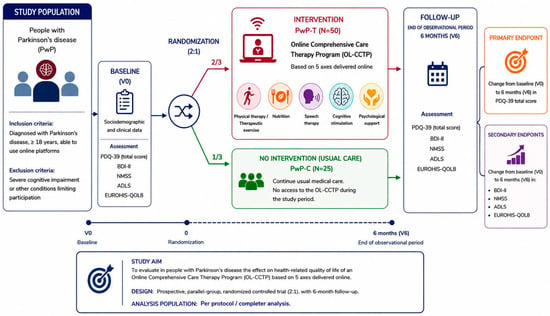
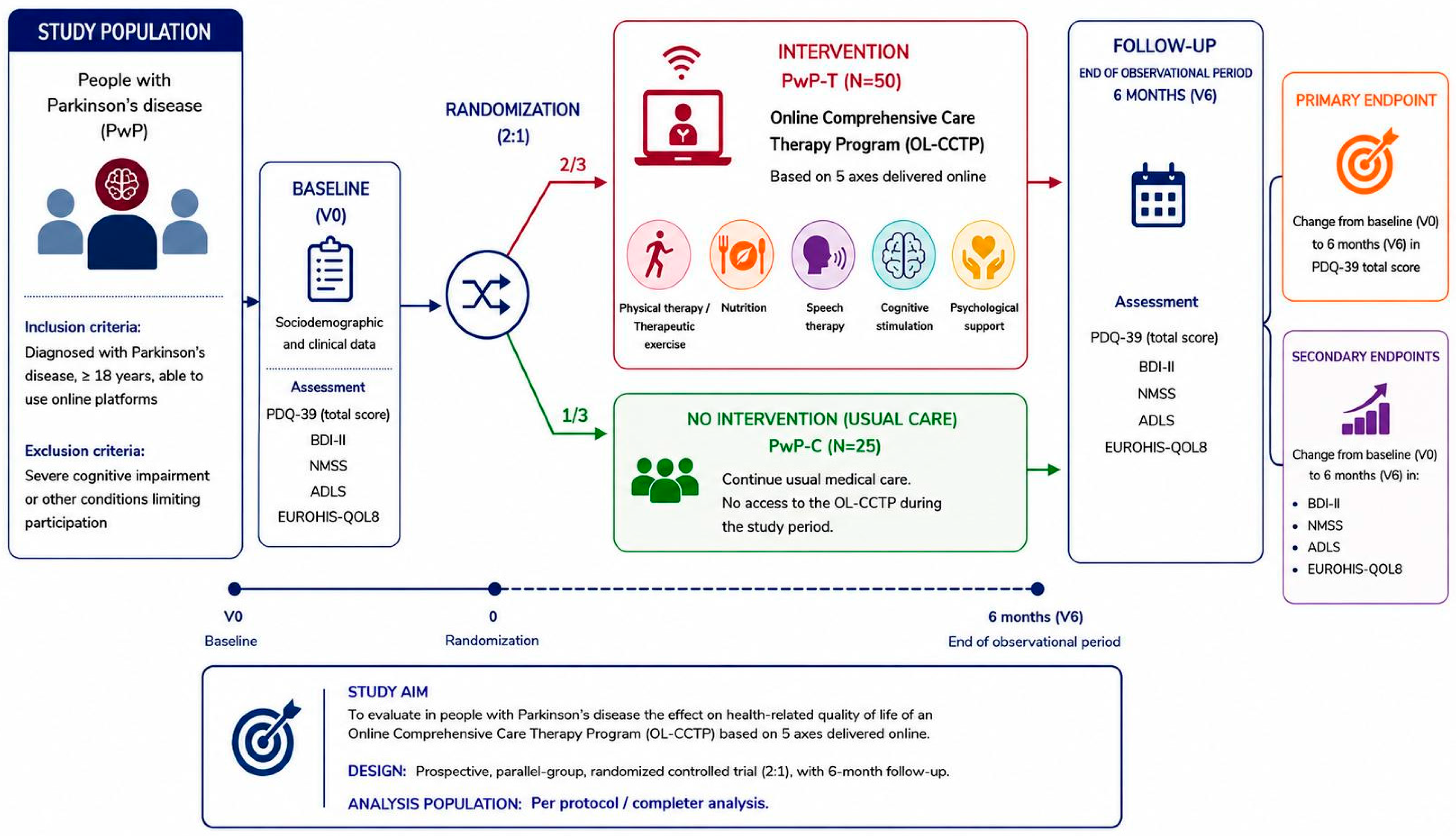
PwP who received the OL-CCTP (PwP-T) were divided into groups of 9–12 participants according to their characteristics and clinical status. The OL-CCTP included online group sessions for psychological support and cognitive stimulation with one session per week, with a total of 24 sessions over 6 months; online group exercise sessions (multicomponent exercise program with aerobic exercise, strength–power, balance, coordination, and flexibility) with two sessions per week, with a total of 48 sessions over 6 months; online group nutrition sessions with one session per month, with a total of 6 sessions over 6 months; and online group speech therapy sessions with a maximum of two sessions per week, depending on the specific needs of each patient, with a maximum of 48 sessions over 6 months. Overall, the total number of therapies received across 6 months per patient reached a maximum of 126 (24 + 48 + 6 + 48), with each one lasting about 1 h (Figure 1). All therapies were implemented by professionals who were experts in each of the interventions: C.M.B.G., a psychologist; L.D.G., a physiotherapist and rehabilitation specialist in therapeutic exercise; J.P.N., a nutrition expert; and J.B.L., a speech therapist.
Figure 1.
Study protocol with description of the two arms (intervention vs. control) and therapies performed during 6-month follow-up.
Participants completed a series of validated scales at baseline before randomization (V0) and subsequently every month up to 6 months (±15 days) of follow-up (V6): the Beck Depression Inventory-II (BDI-II) [14] to assess depressive symptoms; the Non-Motor Symptoms Scale (NMSS) [15] to assess NMS; the 39-item Parkinson’s Disease Questionnaire (PDQ-39) [16] to assess health-related QoL; the EUROHIS 8-item questionnaire (EUROHIS-QOL8) [17] to assess global QoL; and the Schwab and England Activities of Daily Living Scale (ADLS) [18] to assess disability.
2.1. Statistical Analysis
Data were processed using SPSS 20.0 (IBM, Chicago, IL, USA) for Windows. Different variables were expressed as quantitative and/or qualitative variables. The distributions of variables were verified by the one-sample Kolmogorov–Smirnov test. The primary efficacy outcome was the change from baseline (V0) to the end of the observational period (V6) in the PDQ-39 total score. There were 39 items grouped into 8 domains: (1) “mobility” (items 1 to 10); (2) “activities of daily living” (items 11 to 16); (3) “emotional well-being” (items 17 to 22); (4) “stigmatization” (items 23 to 26); (5) “social support” (items 27 to 29); (6) “cognition” (items 30 to 33); (7) “communication” (items 34 to 36); and (8) “bodily discomfort” (items 37 to 39). For each item, the score may range from 0 (never) to 4 (always). The symptoms referred to the 4 weeks prior to assessment. The total score ranged from 0 to 156 (maximum, 39 × 4). Every domain was expressed as a percentage to be able to perform comparisons. Secondary efficacy measures were the change from V0 to V6 in the total score on the BDI-II, NMSS, EUROHIS-QOL8, and ADLS.
Given the proof-of-concept nature of the study, no formal hypothesis-driven sample size calculation was performed. A target sample of 75 participants was considered feasible and adequate to provide preliminary estimates of the efficacy and safety of the intervention. Participants were planned to be randomized at a 2:1 ratio, corresponding to 50 participants in the intervention group (PwP-T) and 25 in the control group (PwP-C). This sample size also took into account an anticipated rate of approximately 20–30% of participants not being evaluable for the primary efficacy analysis because of insufficient adherence, incomplete assessments, or other eligibility or follow-up issues.
The efficacy analysis was performed on those participants who had adherence ≥80% in the OL-CCTP (PwP-T) and ≥80% [19] in the completion of the questionnaires (PwP-T and PwP-C), with all questionnaires being completed at V0 and V6 also mandatory. Firstly, a Wilcoxon’s rank sum test was performed to test the change from V0 to V6 in each group, PwP-T and PwP-C. To evaluate the magnitude of the change, in addition to the difference between V0 and V6, the relative change [RC = (mean TestV6 − mean TestV0) × 100/mean TestV0] [20] and Cohen’s dav effect size [ES = (mean TestV6 − mean TestV0)/SDpooled)] [21] were calculated. The values were considered as follows: negligible, <0.2; small, 0.2–<0.5; moderate, 0.5–<0.8; large, 0.8–1.3; very large, ≥1.3. Secondly, a repeated-measures ANOVA was performed to test the “group × time” interaction between the group that received the intervention (PwP-T) and the control group (PwP-C) at post-treatment compared to pre-treatment, unadjusted and adjusted for covariates (age, sex, and disease duration). The change in a variable was considered to show a significant difference when the p-value was <0.05. The study was considered to have achieved the main objective when the change in PDQ-39 from V0 to V6 (primary endpoint) in the PwP-T group showed a significant reduction with p < 0.05 for the three proposed analyses (Wilcoxon’s rank sum and repeated-measures ANOVA). Correlations between the change in health-related QoL (PDQ-39) from V0 to V6 and the changes in other continuous variables from V0 to V6 (BDI-II; NMSS; ADLS; EUROHIS-QOL8) in both groups were analyzed using Pearson or Spearman correlation coefficients, depending on the data distribution. Correlations were interpreted as weak (≤0.29), moderate (0.30–0.59), or strong (≥0.60). The estimated sample size was 75 participants (50 in the PwP-T group and 25 in the PwP-C group) with an estimated 20 to 30% of failure or selection problems and/or inadequate completion of the study.
Regarding the safety analysis, and considering the type of intervention, only potential adverse events directly or indirectly related to the therapy were recorded at the discretion of the therapy team. These could have been physical, emotional, or of a different nature. The safety dataset consisted of all subjects for whom the study was initiated.
2.2. Standard Protocol Approvals, Registrations, and Patient Consent
For this study, we received approval from the Comité de Ética de Investigación de Medicamentos de Galicia (CEImG) in Spain (2025/131; 24 April 2025). Written informed consent was obtained from all participants in this study.
2.3. Data Availability
The protocol and the statistical analysis plan are available on request. Deidentified participant data are not available for legal and ethical reasons.
3. Results
A total of 60 out of 75 PD patients were included and valid for the analysis (80% of the proposed sample). Of these, 36 PD patients received the intervention (PwP-T) (72% of the proposed sample), whereas 24 were in the control group (PwP-C) (96% of the proposed sample). The reason for excluding 14 patients from the PwP-T was insufficient adherence to the questionnaires. All patients who received the intervention and were finally included in the analysis had adherence to the online sessions of greater than 90%. One control subject was also excluded for not completing the questionnaires properly. The mean age was 58.3 ± 8.7 years old, and 68.3% were women. About three out of four patients were from Spain, with the rest from other countries (Argentina, Ecuador, Mexico, Colombia, Peru, Nicaragua, and the United Kingdom). Only 11.7% of patients had a principal caregiver (Table 1). The three most frequent disabling symptoms reported by the patients were bradykinesia (38.3%), rigidity (38.3%), and tremor (28.3%). Regarding baseline sociodemographic and PD-related characteristics, no differences were detected between the two groups (Table 1).
Table 1.
Sociodemographic and PD-related aspects of patients who finally participated in the study and completed the visits adequately (N = 60).
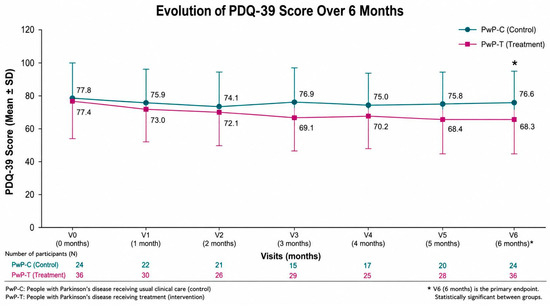
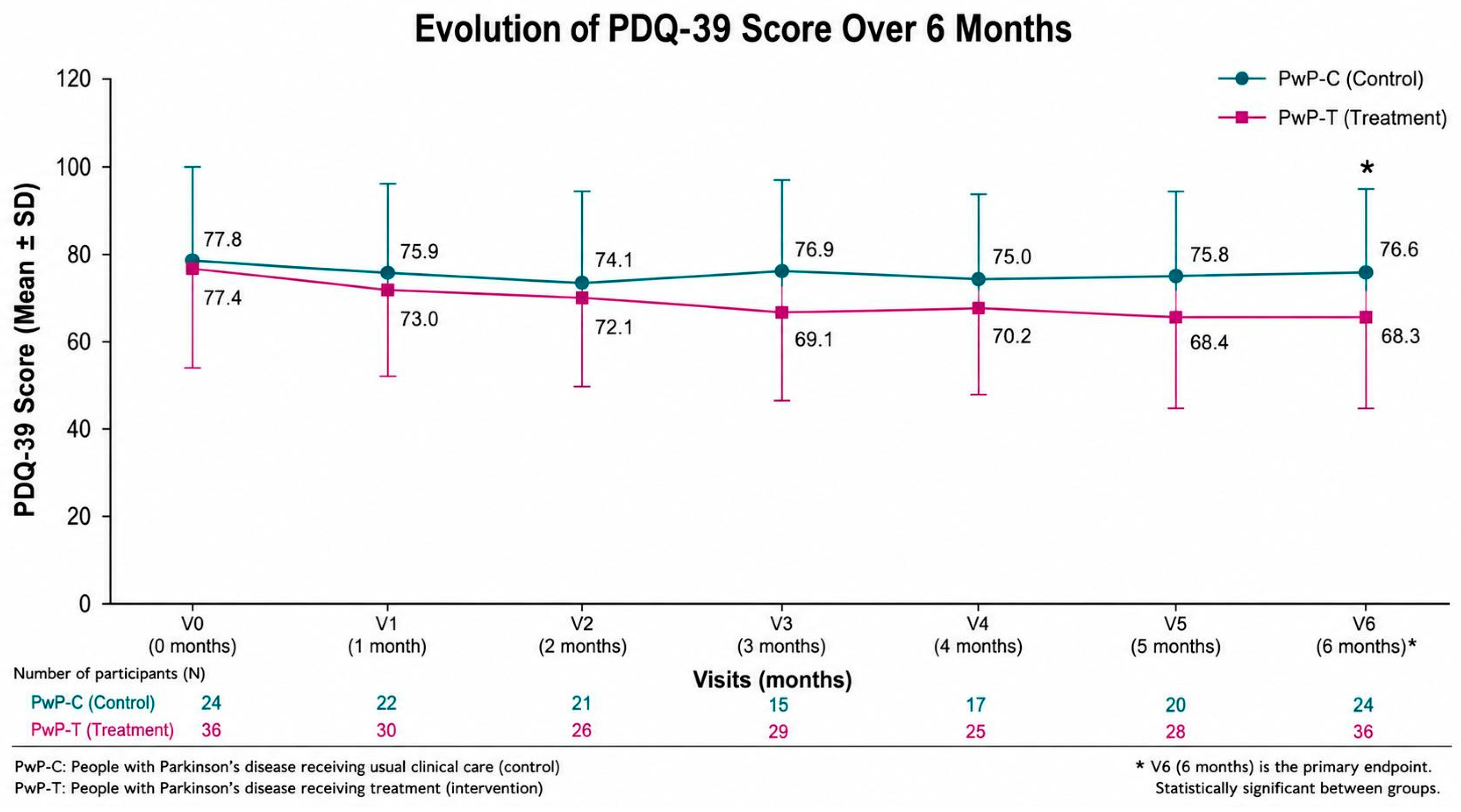
From baseline (V0) to the final observational period (V6), the PDQ-39 total score decreased significantly from 78.4 ± 17.9 to 68.3 ± 18.7 (RC = −12.9%; p < 0.0001) in the PwP-T group but not in the PwP-C group (from 77.8 ± 22.2 to 76.6 ± 27.9; RC = −1.5%; p = 0.438) (Table 2 and Figure 2). The difference in the change from V0 to V6 in the PDQ-39 between groups (PwP-T vs. PwP-C) was significant without (p = 0.011) and after adjusting for covariates (p = 0.009). By domain, a significant improvement was observed in the PwP-T group in mobility (RC = −9.1%; p = 0.038), emotional well-being (RC = −20.6%; p < 0.0001), stigma (RC = −20.6%; p = 0.001), cognition (RC = −9.6%; p = 0.026), communication (RC = −17.8%; p = 0.002), and bodily discomfort (RC = −12.9%; p = 0.029) (Table 2). The largest effect, according to the ES, was detected for communication (ES = 2.17), followed by emotional well-being (ES = 2.15). After adjustment for multiple comparisons using the Bonferroni correction (adjusted significance threshold, p < 0.00625), only the improvements in emotional well-being, stigma, and communication remained statistically significant. Other domain-level findings with nominal p values <0.05 should therefore be considered exploratory. No improvement was detected for any domain of the PDQ-39 in the PwP-C group. In the repeated-measures ANOVA, a significant difference indicating an improvement in activities of daily living, emotional well-being, communication, and bodily discomfort was detected in favor of the PwP-T group compared to the PwP-C group (Table 2). At the end of follow-up (V6), 13.9% (5/36) of PwP who received the intervention (PwP-T) had a higher score on the PDQ-39 questionnaire, compared to 33.3% (8/24) in the control group (PwP-C).
Table 2.
Change from baseline (pre-therapy; V0) to the final observational period (V6) in the primary endpoint (PDQ-39 total score) and its domains, as well as other secondary variables, in the PwP-C group (N = 24) compared to the PwP-T group (N = 36).
Figure 2.
Change in the PDQ-39 total score from baseline visit (V0) to the end of the intervention period (V6) over 6 months of follow-up in both groups of PwP, i.e., treated (PwP-T) and controls (PwP-C). * Significance (p < 0.05) at V6 (primary endpoint).
Regarding the secondary variables, an improvement was observed in the Pw-P-T group in mood and NMSS burden, with a decrease from V0 to V6 in the BDI-II and NMSS total scores from 13.7 ± 7.3 to 11.9 ± 16.1 (RC = −13.1%; p = 0.001) and from 47.2 ± 31.4 to 37.6 ± 28.0 (RC = −20.3%; p = 0.046), respectively. No significant change was detected in the treated group in either autonomy for activities of daily living (ADLS) or global QoL (EUROHIS-QOL8) (Table 2). In the PwP-C, no significant changes were observed from V0 to V6 in any of the secondary variables (Table 2). A strong correlation between the improvement detected in PwP-T from V0 to V6 in health-related QoL (PDQ-39) and mood (BDI-II) was found (r = 0.609; p < 0.0001), whereas moderate correlations were found between the change from V0 to V6 in the PDQ-39 total score and the scores on the NMSS, ADLS, and EUROHIS-QOL8 (Table 3). In the repeated-measures ANOVA, no differences in the change from V0 to V6 in any secondary variable between the two groups, PwP-T vs. PwP-C, were detected (Table 2).
Table 3.
Correlation between the change from V0 to V6 (Δ) in the PDQ-39 total score and the changes from V0 to V6 (Δ) in the other scores (BDI-II, NMSS, ADLS, EUROHIS-QOL8) in both groups, PwP-C (N = 24) and PwP-T (N = 36).
Regarding side effects, no adverse events (e.g., falls, fainting, injuries, etc.) were observed by therapists and/or reported by patients during the intervention procedure (at the time). Moreover, no patient reported any adverse events afterward that they believed were due to the intervention (e.g., pain resulting from excessive muscle activity, dizziness, confusion, etc.).
4. Discussion
This study observed that a multidisciplinary, non-pharmacological intervention (physical therapy/therapeutic exercise, nutrition, speech therapy, cognitive stimulation, and psychological support), completed online by PwP, contributed to an improvement in their perceived QoL. In particular, the primary endpoint of the study was met despite the fact that it was an experimental study with a small sample size. Although a large, comprehensive randomized controlled trial would be necessary, to our knowledge, these findings are novel, since this is the first study to apply an online therapy based on five axes simultaneously (physical therapy/therapeutic exercise + nutrition + speech therapy + cognitive stimulation + psychological support). Specifically, there is a substantial and growing body of evidence for online/telerehabilitation in PD, with studies covering these domains either individually or in various combinations, but a trial with all aspects at the same time has not yet been published [22]. This is particularly relevant given the high percentage of patients with limited access to these complementary therapies.
Other complementary therapies to pharmacological treatment have been shown to improve the clinical status and QoL of PwP [4,5,6,7,8,9,10]. In fact, some non-pharmacological interventions are now beginning to be included in therapy guidelines [23]. However, one of the problems is access to these treatments. In Spain, they are often provided through patient associations, but only an estimated 6% to 10% of PwP in Spain actively access or belong to formal patient associations. The online use of these complementary therapies eliminates the barrier regarding the time needed to travel to distant locations, and, importantly, they are applied by qualified professionals and in an appropriate manner. In addition, it is of interest that, in our study, women represented nearly 70% of the sample. While PD affects roughly 1.5 times more men than women, extensive health informatics and behavioral research demonstrate that women are more proactive as online health information seekers. For women living with PD, this digital resource-seeking behavior is driven by specific clinical, social, and caregiving disparities [24,25]. Another important point is age, with the participants in our study being younger, with an average age of just under 60 years. PwP under 65 are more likely to use internet sources to acquire disease-specific knowledge and connect with digital health communities, whereas older PwP (>65 years old) generally use digital tools less frequently, instead prioritizing direct communication with neurologists or healthcare professionals for health guidance [26]. Obviously, this poses a potential limitation when considering online treatment for older people, and studies specifically conducted on elderly individuals are needed. Also noteworthy is the high PDQ-39 total score found at baseline, with an average of 78 points, equivalent to 50 on the PDQ-39SI (Summary Index). The higher participation of women, who are known to tend to score higher [27], may have contributed to this, along with a possible bias in the participation of patients who subjectively felt worse and required complementary therapies despite being young and having a relatively short disease duration. Furthermore, the questionnaires were self-administered.
In our study, we observed that PwP who received, over 6 months, an OL-CCTP that included physical therapy/therapeutic exercise, nutrition, speech therapy, cognitive stimulation, and psychological support achieved improvements in health-related QoL, mood, and NMS burden, which was not observed in PwP who did not receive the intervention. In particular, activities of daily living, emotional well-being, communication, and bodily discomfort related to QoL perception improved in the treated PD patients as compared to those without the intervention. Multidisciplinary rehabilitation (physical therapy/therapeutic exercise speech therapy, occupational therapy, psychology/neuropsychology) is strongly endorsed by guidelines as an essential, non-pharmacological pillar of PD management across all disease stages [4] and can improve QoL for individuals with PD [28]. A 2023 Cochrane systematic review and network meta-analysis (156 RCTs) confirmed the beneficial effects of most physical exercise types on both motor severity and health-related QoL [29]. Telerehabilitation (online delivery) has been shown to produce outcomes comparable to those of in-person therapy for PD patients, with benefits in motor function, QoL, mood, activities of daily living, and cognition [22]. A 2025 systematic review and network meta-analysis (23 RCTs, n = 1330) found that e-exercise produced the greatest motor improvements and e-cognitive interventions yielded the greatest cognitive and psychological gains [9]. The optimal telerehabilitation dosing is approximately 1 h/day, 3–4 days/week, for 4–12 weeks, being particularly beneficial in early-stage PD with preserved cognition [30], in line with the intervention carried out in our study if we take into account the other activities complementary to physical therapy. In comparison with other previous studies, and as a novelty of the present approach, in our study, the online intervention was carried out at multiple levels, not only working on the physical state but also the cognitive, emotional, and communication levels. The vCare trial [31] is the closest existing study to a multi-intervention, with an online multidomain virtual training platform (ICT-based) for PD addressing motor function, cognition (MoCA), QoL, and autonomy for activities of daily living. The PD group who received the intervention exhibited significantly improved QoL, cognition, motor symptoms, and daily life activities compared to the control group, but only 10 patients were included in each group. Online/telehealth speech therapy (notably Lee Silverman Voice Treatment delivered via videoconferencing) has RCT evidence of non-inferiority to face-to-face delivery in PD [32]. Online cognitive telerehabilitation in PD has RCT evidence for improvements in cognitive performance [33]. Online psychological interventions (CBT by telephone) have been tested in an RCT format in PD, showing improvements in depression and anxiety [28]. Nutrition delivered online as part of a multimodal PD program is the least-studied component and is the most notable gap in the online multimodal literature [34]. In this context, the Movement Disorder Society (MDS) Telemedicine Study Group has an active subgroup specifically developing recommendations for online non-pharmacological multimodal rehabilitation in PD, and many other diverse expert proposals are underway [35], whereas the Spanish Society of Neurology (SEN) 2024 Parkinson Guideline addresses telemedicine in PD management, noting high patient satisfaction with remote consultations, alongside some concerns [36]. The fact that aspects of QoL such as the perception of emotional well-being, activities of daily living, and communication improved in our study as compared to not receiving the intervention suggests the importance of a multi-intervention approach to different symptoms of the disease. Although no differences were observed between groups in the change in mood stage (BDI-II), it did improve in the treated group, and its improvement was correlated with the improvement in QoL, which is known and reported in PD [37]. The correlation of changes in health-related QoL with the other aspects of the disease (mood, NMS burden, autonomy, and overall QoL) gives consistency to the findings and highlights the possibility of a bidirectional relationship with the influence of mood—that is, an improvement in symptoms positively impacts the perception of QoL and mood, and a better mood leads to better perceived QoL and a more optimistic attitude when answering the questionnaires. Furthermore, telemedicine can not only be effective in improving certain symptoms in PwP but also cost-efficient [38].
The present study has some limitations. First, the sample size of the groups was small and differed between treated patients (N = 36) and controls (N = 24). Furthermore, a proportion of the participants allocated to the intervention group were not included in the final efficacy analysis due to insufficient adherence to questionnaire completion, which may have introduced selection bias. However, they were comparable in that no differences were detected in sociodemographic and PD-related aspects (PDQ-39, BDI-II, NMSS, ADLS, and EUROHIS-QOL8) at baseline. Second, the intervention time with subsequent evaluation was limited to 6 months, but the delayed effect of the therapy after stopping the intervention was not assessed. Third, this was not a blind study with respect to the intervention, which is common in this type of study, so there could have been an added placebo effect. Furthermore, although the allocation sequence during randomization was retained by an external team member and was not disclosed until participant enrollment, the use of a fixed block size of three without a formal centralized allocation concealment system may have introduced some allocation predictability and selection bias. Fourth, the different items of the NMSS and BDI-II scales were not analyzed, focusing only their total scores. In addition, given the multiple comparisons performed across the PDQ-39 domains, some nominally significant findings did not remain significant after Bonferroni correction and should therefore be interpreted with caution. Fifth, some assessments, such as a cognitive test, weight, or other biological markers, were not evaluated. Sixth, although PD patients at baseline had to be on a stable regimen of PD medication without anticipated changes in it from baseline throughout the study, the dopaminergic medication type, doses, and changes were not collected. Seventh, since all outcomes were self-reported and the study was not blinded, it cannot be ruled out that part of the observed improvement (particularly in the PDQ-39 emotional well-being domain and the BDI-II) reflects non-specific effects related to social support or attention, rather than the specific therapeutic components of the intervention. Finally, some minor side effects of the intervention (fatigue, muscle soreness, etc.) not reported by patients cannot be ruled out.
5. Conclusions
In conclusion, this randomized study, comparing a simultaneous, multifaceted online intervention based on five axes versus no intervention, observed an improvement in QoL after 6 months. This study highlights the importance of a multidisciplinary approach to PD with non-pharmacological therapies and the potential of telerehabilitation to facilitate its use in clinical practice. Further studies along these lines with a larger number of patients are needed.
Author Contributions
D.S.G.: conception, organization, and execution of the project; statistical analysis; writing of the first draft of the manuscript; review of the eligibility criteria for each study participant. P.C.P.: conception of the project; review and critique. C.M.B.G.: delivery of the online group psychological support and cognitive stimulation intervention; review of the manuscript. L.D.G.: application of physiotherapy and physical exercise therapy to each participant; review and critique. J.P.N.: application of nutrition program; review and critique. J.B.L.: application of speech therapy to each participant; review and critique. F.D.: conception, organization, and execution of the project; obtaining and managing resources for project development; dissemination. All authors have read and agreed to the published version of the manuscript.
Funding
This study was funded by the Degen Foundation through a donation from the Juana Polo Ferrer Foundation.
Institutional Review Board Statement
This study received approval from the Comité de Ética de Investigación de Medicamentos de Galicia (CEImG) in Spain (2025/131; 24 April 2025).
Informed Consent Statement
Written informed consent was obtained from all participants in this study.
Data Availability Statement
The protocol and the statistical analysis plan are available on request. Deidentified participant data are not available for legal and ethical reasons.
Acknowledgments
The authors thank the patients who participated in the study and all members of the Degen Community and the institutions that support the Degen Foundation who collaborated in the financing of this project. In particular, we would like to thank the Juana Polo Ferrer Foundation, since this study was made possible thanks to a donation from this entity. During the preparation of this manuscript, the authors used ChatGPT Images 2.0 for the purposes of generating Figure 1 and Graphical Abstract. The authors have reviewed and edited the output and take full responsibility for the content of this publication.
Conflicts of Interest
Diego Santos-García has received honoraria for educational presentations and advice services from Abbvie, UCB Pharma, Lundbeck, KRKA, Zambon, Bial, Italfarmaco, Teva, Archímedes, Esteve, Stada, and Orion Pharma; financial compensation for INIBIC/Fundación Professor Novoa Santos in relation to activities as a PI in phase 2 to phase 4 clinical trials for Parkinson’s disease and other movement disorders; compensation for Fundación Degen in relation to different projects; and grants from the “Fundación Professor Novoa Santos” as a result of the “CONVOCATORIA DE AYUDAS PARA LA REALIZACIÓN DE PROYECTOS DE INVES-TIGACIÓN PARA GRUPOS EMERGENTES Y ASOCIADOS DEL INIBIC (2023/2024)”. Pablo Campo Prieto has received honoraria for educational presentations from Bial; compensation for Fundación Degen in relation to different projects; and grants from the “Fundación Pública Galega de Investigación Biomédica Galicia Sur” as a result of the “Convocatoria de Ayudas Intramurales 2022 para el desarrollo de proyectos de I+D+I, categoría: Grupo Emergente”. Carmen María Breijo García has received professional fees from Fundación Degen for delivering the psychological support and cognitive stimulation components of the program described in this manuscript. She reports no other financial disclosures or conflicts of interest. Lucía Dafonte Gil has received honoraria compensation for Fundación Degen projects. Juan Pereiro Nogueira has received honoraria compensation for Fundación Degen projects. Jessica Blanco López has received honoraria compensation for Fundación Degen projects. Francisco Doblas discloses no conflicts of interest.
Abbreviations
The following abbreviations are used in this manuscript:
| ADLS | Schwab and England Activities of Daily Living Scale |
| BDI-II | Beck Depression Inventory-II |
| EUROHIS-QOL8 | EUROHIS 8-item questionnaire |
| H&Y | Hoehn and Yahr stage |
| NMS | Non-motor symptoms |
| NMSS | Non-Motor Symptoms Scale |
| OL-CCTP | Online comprehensive care therapy program |
| PD | Parkinson’s disease |
| PDQ-39 | 39-Item Parkinson’s Disease Questionnaire |
| PwP | People with PD |
| QoL | Quality of life |
References
- Armstrong, M.J.; Okun, M.S. Diagnosis and Treatment of Parkinson Disease: A Review. JAMA 2020, 323, 548–560. [Google Scholar] [CrossRef] [Scilit]
- Foltynie, T.; Bruno, V.; Fox, S.; Kühn, A.A.; Lindop, F.; Lees, A.J. Medical, surgical, and physical treatments for Parkinson’s disease. Lancet 2024, 403, 305–324. [Google Scholar] [CrossRef] [Scilit]
- Osborne, J.A.; Botkin, R.; Colon-Semenza, C.; DeAngelis, T.R.; Gallardo, O.G.; Kosakowski, H.; Martello, J.; Pradhan, S.; Rafferty, M.; Readinger, J.L.; et al. Physical Therapist Management of Parkinson Disease: A Clinical Practice Guideline From the American Physical Therapy Association. Phys. Ther. 2022, 102, zab302. [Google Scholar] [CrossRef] [Scilit]
- Goldman, J.G.; Volpe, D.; Ellis, T.D.; Hirsch, M.A.; Johnson, J.; Wood, J.; Aragon, A.; Biundo, R.; Di Rocco, A.; Kasman, G.S.; et al. Delivering Multidisciplinary Rehabilitation Care in Parkinson’s Disease: An International Consensus Statement. J. Park. Dis. 2024, 14, 135–166. [Google Scholar] [CrossRef] [Scilit]
- Xu, H.; Bao, Z.; Liang, D.; Li, M.; Wei, M.; Ge, X.; Liu, J.; Li, J. Speech and Language Therapy for Voice Problems in Parkinson’s Disease: A Meta-Analysis. J. Neuropsychiatry Clin. Neurosci. 2020, 32, 344–351. [Google Scholar] [CrossRef] [Scilit]
- Lister, T. Nutrition and Lifestyle Interventions for Managing Parkinson’s Disease: A Narrative Review. J. Mov. Disord. 2020, 13, 97–104. [Google Scholar] [CrossRef] [Scilit]
- Weise, D.; Claus, I.; Dresel, C.; Kalbe, E.; Liepelt-Scarfone, I.; Lorenzl, S.; Redecker, C.; Urban, P.P. Multidisciplinary care in Parkinson’s disease. J. Neural Transm. 2024, 131, 1217–1227. [Google Scholar] [CrossRef] [Scilit]
- Nicolas, B.; Leblong, E.; Fraudet, B.; Gallien, P.; Piette, P. Telerehabilitation solutions in patient pathways: An overview of systematic reviews. Digit Health 2024, 10, 20552076241294110. [Google Scholar] [CrossRef] [Scilit]
- Dou, J.; Wang, J.; Gao, X.; Wang, G.; Bai, Y.; Liang, Y.; Yang, K.; Yang, Y.; Zhang, L. Effectiveness of Telemedicine Interventions on Motor and Nonmotor Outcomes in Parkinson Disease: Systematic Review and Network Meta-Analysis. J. Med. Internet Res. 2025, 27, e71169. [Google Scholar] [CrossRef] [Scilit]
- Cherney, L.R.; van Vuuren, S. Telerehabilitation, virtual therapists, and acquired neurologic speech and language disorders. Semin. Speech Lang. 2012, 33, 243–257. [Google Scholar] [CrossRef] [Scilit]
- Shnitzer, H.; Chan, J.; Yau, T.; McIntyre, M.; Andreoli, A.; Kua, A.; Bayley, M.; Leochico, C.F.; Guo, M.; Munce, S. The Safety of Telerehabilitation: Systematic Review. JMIR Rehabil. Assist. Technol. 2025, 12, e68681. [Google Scholar] [CrossRef] [Scilit]
- Duncan, R.P.; Earhart, G.M. Remote Delivery of Allied Health Therapies in Parkinson’s Disease. J. Park. Dis. 2024, 14, S219–S226. [Google Scholar] [CrossRef] [Scilit]
- Postuma, R.B.; Berg, D.; Stern, M.; Poewe, W.; Olanow, C.W.; Oertel, W.; Obeso, J.; Marek, K.; Litvan, I.; Lang, A.E.; et al. MDS clinical diagnostic criteria for Parkinson’s disease. Mov. Disord. 2015, 30, 1591–1601. [Google Scholar] [CrossRef] [Scilit]
- Beck, A.T.; Steer, R.A.; Brown, G.K. Beck Depression Inventory, 2nd ed.; Manual; The Psychological Corporation: San Antonio, TX, USA, 1996. [Google Scholar]
- Chaudhuri, K.R.; Martinez-Martin, P.; Brown, R.G.; Sethi, K.; Stocchi, F.; Odin, P.; Ondo, W.; Abe, K.; MacPhee, G.; MacMahon, D.; et al. The metric properties of a novel non-motor symptoms scale for Parkinson’s disease: Results from an international pilot study. Mov. Disord. 2007, 22, 1901–1911. [Google Scholar] [CrossRef] [Scilit]
- Jenkinson, C.; Fitzpatrick, R.; Peto, V.; Greenhall, R.; Hyman, N. The Parkinson’s Disease Questionnaire (PDQ-39): Development and validation of a Parkinson’s disease summary index score. Age Ageing 1997, 26, 353–357. [Google Scholar] [CrossRef] [Scilit]
- Da Rocha, N.S.; Power, M.J.; Bushnell, D.M.; Fleck, M.P. The EUROHIS-QOL 8-item index: Comparative psychometric properties to its parent WHOQOL-BREF. Value Health 2012, 15, 449–457. [Google Scholar] [CrossRef] [Scilit]
- Schwab, R.S.; England, A.C. Third Symposium on Parkinson’s Disease; E. And S. Livingstone: Edinburgh, Scotland, 1969; pp. 152–157. [Google Scholar]
- Baumgartner, P.C.; Haynes, R.B.; Hersberger, K.E.; Arnet, I. A Systematic Review of Medication Adherence Thresholds Dependent of Clinical Outcomes. Front. Pharmacol. 2018, 9, 1290. [Google Scholar] [CrossRef] [Scilit]
- Deyo, R.A.; Centor, R.M. Assessing the responsiveness of functional scales to clinical change: An analogy to diagnostic test performance. J. Chronic Dis. 1986, 39, 897–906. [Google Scholar] [CrossRef] [Scilit]
- Lakens, D. Calculating and reporting effect sizes to facilitate cumulative science: A practical primer for t-tests and ANOVAs. Front. Psychol. 2013, 4, 863. [Google Scholar] [CrossRef] [Scilit]
- Sun, M.; Tang, F.; Min, L.; Wen, S.; Wang, S.; Jiang, H. Effects of Telehealth Interventions for People With Parkinson Disease: Systematic Review and Meta-Analysis of Randomized Controlled Trials. JMIR mHealth uHealth 2026, 14, e70994. [Google Scholar] [CrossRef] [Scilit]
- Kalbe, E.; Bloem, B.R.; Kalia, L.V.; Nieuwboer, A. Special Issue: Non-Pharmacological Interventions for People with Parkinson’s Disease: Are We Entering a New Era? J. Park. Dis. 2024, 14, S1–S4. [Google Scholar] [CrossRef] [Scilit]
- Bidmon, S.; Terlutter, R. Gender Differences in Searching for Health Information on the Internet and the Virtual Patient-Physician Relationship in Germany: Exploratory Results on How Men and Women Differ and Why. J. Med. Internet Res. 2015, 17, e156. [Google Scholar] [CrossRef] [Scilit]
- Picchiello, M.; Rule, P.; Lu, T.; Carpenter, B. Gender Differences in Online Health-Related Search Behaviors Among Older Adults. Innov. Aging 2021, 5, 657. [Google Scholar] [CrossRef] [Scilit]
- Riggare, S.; Höglund, P.J.; Hvitfeldt Forsberg, H.; Eftimovska, E.; Svenningsson, P.; Hägglund, M. Patients are doing it for themselves: A survey on disease-specific knowledge acquisition among people with Parkinson’s disease in Sweden. Health Inform. J. 2019, 25, 91–105. [Google Scholar] [CrossRef] [Scilit]
- Santos-García, D.; Laguna, A.; Hernández-Vara, J.; de Deus Fonticoba, T.; Bartolomé, C.C.; Painceiras, M.J.F.; Íñiguez-Alvarado, M.C.; Díaz, I.G.; Jesús, S.; Boungiorno, M.T.; et al. Sex Differences in Motor and Non-Motor Symptoms among Spanish Patients with Parkinson’s Disease. J. Clin. Med. 2023, 12, 1329. [Google Scholar] [CrossRef] [Scilit]
- Ahn, S.; Chen, Y.; Bredow, T.; Cheung, C.; Yu, F. Effects of Non-Pharmacological Treatments on Quality of Life in Parkinson’s Disease: A Review. J. Park. Dis. Alzheimers Dis. 2017, 4, 10. [Google Scholar] [CrossRef] [Scilit]
- Ernst, M.; Folkerts, A.K.; Gollan, R.; Lieker, E.; Caro-Valenzuela, J.; Adams, A.; Cryns, N.; Monsef, I.; Dresen, A.; Roheger, M.; et al. Physical exercise for people with Parkinson’s disease: A systematic review and network meta-analysis. Cochrane Database Syst. Rev. 2024, 4, CD013856. [Google Scholar]
- Vellata, C.; Belli, S.; Balsamo, F.; Giordano, A.; Colombo, R.; Maggioni, G. Effectiveness of Telerehabilitation on Motor Impairments, Non-motor Symptoms and Compliance in Patients With Parkinson’s Disease: A Systematic Review. Front. Neurol. 2021, 12, 627999. [Google Scholar] [CrossRef] [Scilit]
- Del Pino, R.; de Echevarría, A.O.; Díez-Cirarda, M.; Ustarroz-Aguirre, I.; Caprino, M.; Liu, J.; Gand, K.; Schlieter, H.; Gabilondo, I.; Gómez-Esteban, J.C. Virtual Coach and Telerehabilitation for Parkinson’s Disease Patients: vCare System. J. Public Health 2025, 33, 1583–1596. [Google Scholar] [CrossRef] [Scilit]
- Raymond, M.J.; Christie, L.J.; Kramer, S.; Malaguti, C.; Mok, Z.; Gardner, B.; Giummarra, M.J.; Alves-Stein, S.; Hudson, C.; Featherston, J.; et al. Delivery of Allied Health Interventions Using Telehealth Modalities: A Rapid Systematic Review of Randomized Controlled Trials. Healthcare 2024, 12, 1217. [Google Scholar] [CrossRef] [Scilit]
- Maggio, M.G.; Baglio, F.; Arcuri, F.; Borgnis, F.; Contrada, M.; Diaz, M.D.M.; Leochico, C.F.; Neira, N.J.; Laratta, S.; Suchan, B.; et al. Cognitive telerehabilitation: An expert consensus paper on current evidence and future perspective. Front. Neurol. 2024, 15, 1338873. [Google Scholar] [CrossRef] [Scilit]
- Russell, R.D.; Black, L.J.; Begley, A. Nutrition Education Programs for Adults with Neurological Diseases Are Lacking: A Scoping Review. Nutrients 2022, 14, 1577. [Google Scholar] [CrossRef] [Scilit]
- Cubo, E.; Delgado-López, P.D. Telemedicine in the Management of Parkinson’s Disease: Achievements, Challenges, and Future Perspectives. Brain Sci. 2022, 12, 1735. [Google Scholar] [CrossRef] [Scilit]
- Alonso Cánovas, A.; Kurtis Urra, M. Terapias alternativas y complementarias en la enfermedad de Parkinson. In Manual de Práctica Clínica En La Enfermedad de Parkinson, Recomendaciones Diagnóstico—Terapeúticas de La SEN 2024; Capítulo 15, Depósito Legal: M-6287-2025; Sociedad Española de Neurología: Madrid, Spain, 2024; pp. 345–363. ISBN 978-84-19832-81-8. [Google Scholar]
- Santos García, D.; de Deus Fonticoba, T.; Cores, C.; Muñoz, G.; González, J.M.P.; Miró, C.M.; Suárez, E.; Jesús, S.; Aguilar, M.; Pastor, P.; et al. COPPADIS Study Group. Predictors of clinically significant quality of life impairment in Parkinson’s disease. npj Park. Dis. 2021, 7, 118. [Google Scholar]
- Cubo, E.; Rohani, M.; Eissazade, N.; Garcia-Bustillo, Á.; Ramírez-Sanz, J.M.; Garrido-Labrador, J.L.; Olivares-Gil, A.; Valiñas-Sieiro, F.; Allende-Río, M.; Gonzalez-Santos, J.; et al. Cost-utility analysis of a coadjutant telemedicine intervention for fall prevention in Parkinson’s disease. Eur. J. Neurol. 2025, 32, e16561. [Google Scholar] [CrossRef] [Scilit]

Disclaimer/Publisher’s Note: The statements, opinions and data contained in all publications are solely those of the individual author(s) and contributor(s) and not of MDPI and/or the editor(s). MDPI and/or the editor(s) disclaim responsibility for any injury to people or property resulting from any ideas, methods, instructions or products referred to in the content. |
© 2026 by the authors. Licensee MDPI, Basel, Switzerland. This article is an open access article distributed under the terms and conditions of the Creative Commons Attribution (CC BY) license.