


Eye-Movements in a Text Reading Task: A Comparison of Preterm Children, Children with Dyslexia and Typical Readers




Abstract
1. Introduction
The Present Study
2. Materials and Methods
2.1. Participants
2.2. Materials
- -
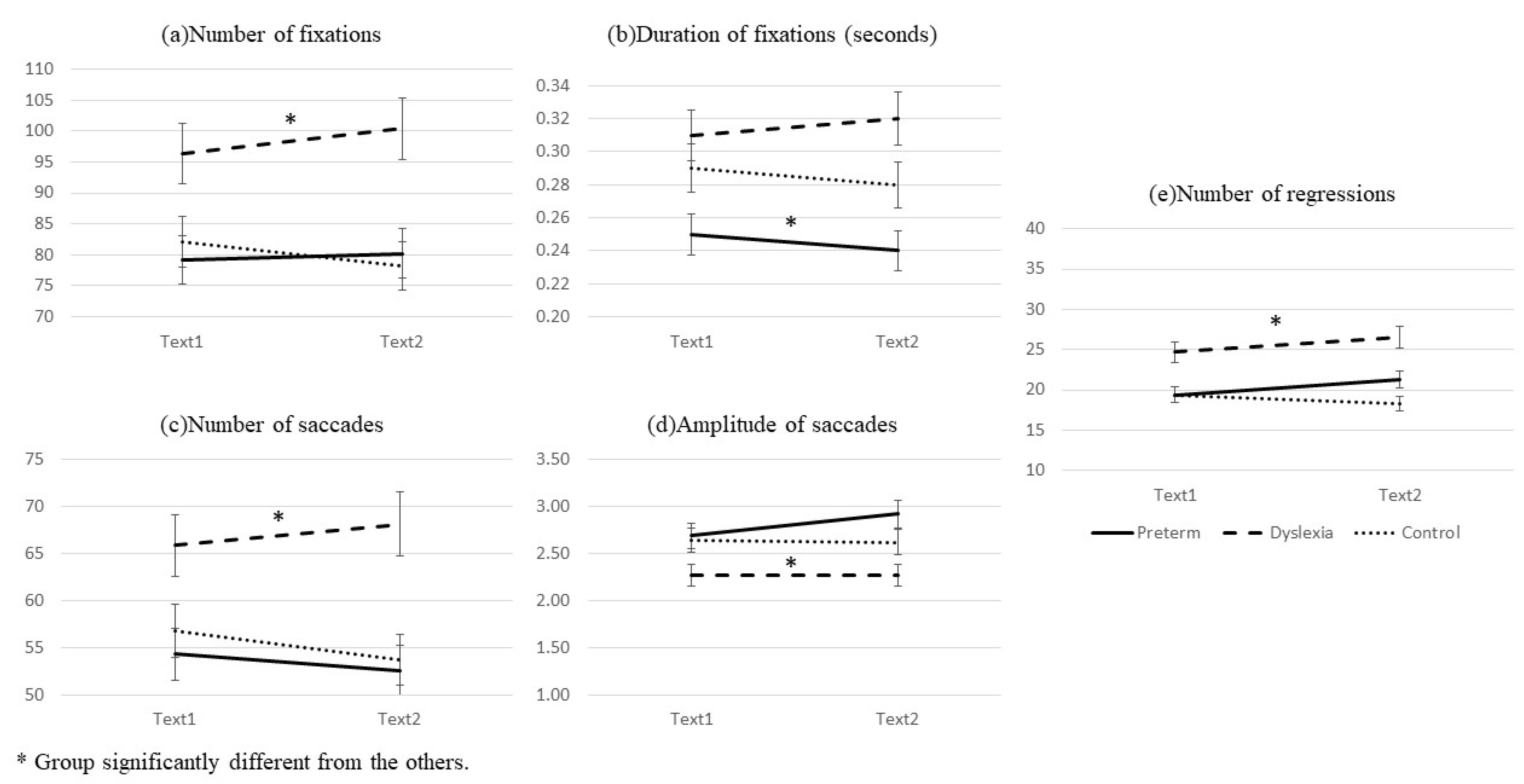
- Number and duration of fixations: a drift in the viewer’s gaze by less than 1° within 0.1 s identified a fixation; only the fixations that lasted for at least 0.1 s were considered. The total number and the mean duration (in seconds) of fixations were calculated for each participant;
- -
- Number and amplitude of saccades: saccades correspond to gaze shifts between fixations and are computed as the number of horizontal movements in the text from left to right, e.g., [36]; the amplitude is referred to the degrees of visual angle covered by the saccade. Saccades higher than 10° were excluded.
- -
- Number of regressions: regressions are referred to saccades from right to left in the text, denoting a look back at the text. The number of regressions was computed.
2.3. Procedure
2.4. Data Analysis
3. Results
3.1. Standardized Tasks
3.2. Eye-Movement Variables
4. Discussion
5. Conclusions
Author Contributions
Funding
Institutional Review Board Statement
Informed Consent Statement
Data Availability Statement
Acknowledgments
Conflicts of Interest
References
- Blencowe, H.; Cousens, S.; Oestergaard, M.Z.; Chou, D.; Moller, A.B.; Narwal, R.; Adler, A.; Garcia, C.V.; Rohde, S.; Say, L.; et al. National, regional, and worldwide estimates of preterm birth rates in the year 2010 with time trends since 1990 for selected countries: A systematic analysis and implications. Lancet 2012, 379, 2162–2172. [Google Scholar] [CrossRef] [Scilit]
- World Health Organization. March of Dimes, PMNCH, Save the Children, World Health Organization. Born Too Soon: The Global Action Report on Preterm Birth. 2012. Available online: https://www.who.int/pmnch/media/news/2012/201204_borntoosoonreport.pdf (accessed on 13 February 2023).
- Sansavini, A.; Guarini, A.; Caselli, M.C. Preterm birth: Neuropsychological profiles and atypical developmental pathways. Dev. Disabil. Res. Rev. 2011, 17, 102–113. [Google Scholar] [CrossRef] [Scilit] [PubMed]
- EFCNI. European Standards of Care for Newborn Health Project Report; Mader, N.S., Thiele, J.M.W., Eds.; EFCNI: Munich, Germany, 2018. [Google Scholar]
- Aarnoudse-Moens, C.S.H.; Weisglas-Kuperus, N.; van Goudoever, J.B.; Oosterlaan, J. Meta-analysis of neurobehavioral outcomes in very preterm and/or very low birth weight children. Pediatrics 2009, 124, 717–728. [Google Scholar] [CrossRef] [Scilit] [PubMed]
- Moreira, R.S.; Magalhães, L.C.; Alves, C.R. Effect of preterm birth on motor development, behavior, and school performance of school-age children: A systematic review. J. Pediatr. 2014, 90, 119–134. [Google Scholar] [CrossRef] [Scilit] [PubMed]
- Twilhaar, E.S.; de Kieviet, J.F.; Aarnoudse-Moens, C.S.; van Elburg, R.M.; Oosterlaan, J. Academic performance of children born preterm: A meta-analysis and meta-regression. Arch. Dis. Child. Fetal 2017, 103, F322–F330. [Google Scholar] [CrossRef] [Scilit] [PubMed]
- Kovachy, V.N.; Adams, J.N.; Tamaresis, J.S.; Feldman, H.M. Reading abilities in school-aged preterm children: A review and meta-analysis. Dev. Med. Child Neurol. 2015, 57, 410–419. [Google Scholar] [CrossRef] [Scilit]
- Guarini, A.; Bonifacci, P.; Tobia, V.; Alessandroni, R.; Faldella, G.; Sansavini, A. The profile of very preterm children on academic achievement. A cross-population comparison with children with specific learning disorders. Res. Dev. Disabil. 2019, 87, 54–63. [Google Scholar] [CrossRef] [Scilit]
- D’Souza, D.; Booth, R.; Connolly, M.; Happé, F.; Karmiloff-Smith, A. Rethinking the concepts of “local or global processors”: Evidence from Williams syndrome, Down syndrome, and Autism Spectrum Disorders. Dev. Sci. 2016, 19, 452–468. [Google Scholar] [CrossRef] [Scilit]
- Gráf, R.; Kalmár, M.; Harnos, A.; Boross, G.; Nagy, A. Reading and spelling skills of prematurely born children in light of the underlying cognitive factors. Cogn. Process. 2021, 22, 311–319. [Google Scholar] [CrossRef] [Scilit]
- American Psychiatric Association. Diagnostic and Statistical Manual of Mental Disorders (DSM-5®); American Psychiatric Association: Washington, DC, USA, 2013. [Google Scholar]
- McGrath, L.M.; Peterson, R.L.; Pennington, B.F. The multiple deficit model: Progress, problems, and prospects. Sci. Stud. Read. 2020, 24, 7–13. [Google Scholar] [CrossRef] [Scilit]
- Pennington, B.F. From single to multiple deficit models of developmental disorders. Cognition 2006, 101, 385–413. [Google Scholar] [CrossRef] [Scilit]
- Peters, L.; Ansari, D. Are specific learning disorders truly specific, and are they disorders? Trends Neurosci. Educ. 2019, 17, 100115. [Google Scholar] [CrossRef] [Scilit] [PubMed]
- Peterson, R.L.; McGrath, L.M.; Willcutt, E.G.; Keenan, J.M.; Olson, R.K.; Pennington, B.F. How specific are learning disabilities? J. Learn. Disabil. 2021, 54, 466–483. [Google Scholar] [CrossRef] [Scilit] [PubMed]
- Premeti, A.; Bucci, M.P.; Isel, F. Evidence from ERP and eye movements as markers of language dysfunction in dyslexia. Brain Sci. 2022, 12, 73. [Google Scholar] [CrossRef] [Scilit] [PubMed]
- Rayner, K. Eye movements and the perceptual span in beginning and skilled readers. J. Exp. Child Psychol. 1986, 41, 211–236. [Google Scholar] [CrossRef] [Scilit]
- Booth, R.W.; Weger, U.W. The function of regressions in reading: Backward eye movements allow rereading. Mem. Cogn. 2013, 41, 82–97. [Google Scholar] [CrossRef] [Scilit]
- Bucci, M.P.; Caldani, S.; Boutillier, B.; Frérot, A.; Farnoux, C.; Virlouvet, A.-L.; Rideau-Batista-Novais, A.; Trousson, C.; Biran, V. Immaturity of Oculomotor Capabilities During a Reading Task in Children Born Prematurely: An Eye Tracker Study. Percept. Mot. Ski. 2022, 129, 454–467. [Google Scholar] [CrossRef] [Scilit]
- Miladinović, A.; Quaia, C.; Ajčević, M.; Diplotti, L.; Cumming, B.G.; Pensiero, S.; Accardo, A. Ocular-following responses in school-age children. PLoS ONE 2022, 17, e0277443. [Google Scholar] [CrossRef] [Scilit]
- Guarini, A.; Tobia, V.; Bonifacci, P.; Faldella, G.; Sansavini, A. Magnitude comparisons, number knowledge and calculation in verypreterm children and children with specific learning disability: A cross-population study using eye-tracking. J. Learn. Disabil. 2021, 54, 83–96. [Google Scholar] [CrossRef] [Scilit]
- Rayner, K.; Pollatsek, A.; Ashby, J.; Clifton, C., Jr. Psychology of Reading; Psychology Press: London, UK, 2012. [Google Scholar]
- Eden, G.F.; Stein, J.F.; Wood, H.M.; Wood, F.B. Differences in eye movements and reading problems in dyslexic and normal children. Vis. Res. 1994, 34, 1345–1358. [Google Scholar] [CrossRef] [Scilit]
- Bilkova, Z.; Dobias, M.; Dolezal, J.; Fabian, V.; Havlisova, H.; Jost, J.; Malinovska, O. Eye tracking using nonverbal tasks could contribute to diagnostics of developmental dyslexia and developmental language disorder. In Dyslexia; IntechOpen: London, UK, 2021; pp. 1–16. [Google Scholar] [CrossRef] [Scilit]
- Bucci, M.P.; Nassibi, N.; Gerard, C.L.; Bui-Quoc, E.; Seassau, M. Immaturity of the oculomotor saccade and vergence interaction in dyslexic children: Evidence from a reading and visual search study. PLoS ONE 2012, 7, e33458. [Google Scholar] [CrossRef] [Scilit]
- Hutzler, F.; Wimmer, H. Eye movements of dyslexic children when reading in a regular orthography. Brain Lang. 2004, 89, 235–242. [Google Scholar] [CrossRef] [Scilit]
- De Luca, M.; Borrelli, M.; Judica, A.; Spinelli, D.; Zoccolotti, P. Reading words and pseudowords: An eye movement study of developmental dyslexia. Brain Lang. 2002, 80, 617–626. [Google Scholar] [CrossRef] [Scilit]
- Bellocchi, S.; Muneaux, M.; Bastien-Toniazzo, M.; Ducrot, S. I can read it in your eyes: What eye movements tell us about visuo-attentional processes in developmental dyslexia. Res. Dev. Disabil. 2013, 34, 452–460. [Google Scholar] [CrossRef] [Scilit] [PubMed]
- Rayner, K. Eye movements in reading and information processing: 20 years of research. Psychol. Bull. 1998, 124, 372–422. [Google Scholar] [CrossRef] [Scilit] [PubMed]
- PARCC. DSA Documento D′intesa [Consensus Conference on SLD]. 2011. Available online: http://www.lineeguidadsa.it/download_documentiDSA/Raccomandazioni_clinica_DSA11.zip (accessed on 31 October 2021).
- Bonifacci, P.; Nori, R. KBIT-Kaufman Brief Intelligence Test Second Edition. In Contributo Alla Taratura Italiana [Contribution to Italian Standardization]; Giunti-OS: Florence, Italy, 2016. [Google Scholar]
- Bonifacci, P.; Snowling, M.J. Speed of processing and reading disability: A cross-linguistic investigation of dyslexia and borderline intellectual functioning. Cognition 2008, 107, 999–1017. [Google Scholar] [CrossRef] [Scilit]
- Sartori, G.; Job, R.; Tressoldi, P.E. DDE-Batteria per la Valutazione Della Dislessia e Disortografia Evolutiva–2 [DDE-Battery for the Assessment of Developmental Dyslexia and Dysorthographia-2]; Giunti-OS: Florence, Italy, 2007. [Google Scholar]
- Cornoldi, C.; Colpo, G. Prove di Lettura MT-2 per la Scuola Primaria [MT-2 Tasks for the Assessment of Reading in Primary School]; Giunti-OS: Florence, Italy, 2011. [Google Scholar]
- Glaholt, M.G.; Reingold, E.M. The time course of gaze bias in visual decision tasks. Vis. Cogn. 2009, 17, 1228–1243. [Google Scholar] [CrossRef] [Scilit]
- Bender, R.; Lange, S. Adjusting for multiple testing—When and how? J. Clin. Epidemiol. 2001, 54, 343–349. [Google Scholar] [CrossRef] [Scilit] [PubMed]
- De Luca, M.; Pontillo, M.; Primativo, S.; Spinelli, D.; Zoccolotti, P. The eye-voice lead during oral reading in developmental dyslexia. Front. Hum. Neurosci. 2013, 7, 696. [Google Scholar] [CrossRef] [Scilit]
- Bucci, M.P.; Caldani, S.; Boutillier, B.; Frérot, A.; Farnoux, C.; Virlouvet, A.L.; Rideau-Batista-Novais, A.; Trousson, C.; Biran, V. Immature brain structures were associated with poorer eye movement performance at 8 years of age in preterm born children. Acta Paediatr. 2022, 111, 559–565. [Google Scholar] [CrossRef] [Scilit]
- Imafuku, M.; Kawai, M.; Niwa, F.; Shinya, Y.; Inagawa, M.; Myowa-Yamakoshi, M. Preference for dynamic human images and gaze-following abilities in preterm infants at 6 and 12 months of age: An eye-tracking study. Infancy 2017, 22, 223–239. [Google Scholar] [CrossRef] [Scilit] [PubMed]
- Ryu, H.; Han, G.; Choi, J.; Park, H.K.; Kim, M.J.; Ahn, D.H.; Lee, H.J. Object permanence and the development of attention capacity in preterm and term infants: An eyetracking study. Ital. J. Pediatr. 2017, 43, 90. [Google Scholar] [CrossRef] [Scilit] [PubMed]
- Downes, M.; Kelly, D.; Day, K.; Marlow, N.; de Haan, M. Visual attention control differences in 12-month-old preterm infants. Infant Behav. Dev. 2018, 50, 180–188. [Google Scholar] [CrossRef] [Scilit] [PubMed]
- Horowitz-Kraus, T.; DiCesare, C.; Kiefer, A.W. Longer Fixation Times During Reading Are Correlated With Decreased Connectivity in Cognitive-Control Brain Regions During Rest in Children. Mind Brain Educ. 2018, 12, 49–60. [Google Scholar] [CrossRef] [Scilit] [PubMed]
- Brignoni-Pérez, E.; Dubner, S.E.; Ben-Shachar, M.; Berman, S.; Mezer, A.A.; Feldman, H.M.; Travis, K.E. White matter properties underlying reading abilities differ in 8-year-old children born full term and preterm: A multi-modal approach. NeuroImage 2022, 256, 119240. [Google Scholar] [CrossRef] [Scilit]

| Variable | Preterm | Dyslexia | Control | |
|---|---|---|---|---|
| Cognitive variables | Verbal IQ | 109.56 (13.69) | 114.94 (12.60) | 116.21 (13.04) |
| Non-verbal IQ | 99.67 (14.66) | 100.61 (12.23) | 102.64 (10.92) | |
| Composite IQ | 102.39 (12.16) | 106.72 (13.25) | 106.14 (9.61) | |
| Speed of processing | 247.71 (78.21) | 279.83 (75.80) | 238.80 (44.61) | |
| Reading variables * | Word reading—accuracy | −0.07 (1.14) | −1.94 (1.89) | 0.51 (0.54) |
| Non-word reading—accuracy | −0.07 (1.47) | −1.94 (1.21) | 0.34 (0.59) | |
| Text reading—accuracy | −0.13 (1.14) | −2.84 (1.49) | 0.34 (0.53) | |
| Word reading—speed | 0.48 (0.91) | −1.02 (1.01) | 0.90 (1.10) | |
| Non-word reading—speed | 0.33 (0.84) | −0.99 (0.63) | 0.53 (1.13) | |
| Text reading—speed | 0.17 (0.61) | −0.99 (0.54) | 0.65 (0.70) | |
| Reading comprehension | −0.58 (1.43) | −0.85 (1.02) | 0.34 (0.87) |
| Variable | Preterm | Dyslexia | Control | |
|---|---|---|---|---|
| Silent reading speed (syll/sec) | Text 1 | 4.79 (1.21) | 3.07 (1.26) | 4.73 (1.41) |
| Text 2 | 4.60 (1.14) | 3.26 (1.73) | 4.80 (1.20) | |
| Number of fixations | Text 1 | 79.17 (23.09) | 96.39 (34.00) | 82.12 (19.95) |
| Text 2 | 80.17 (24.84) | 100.39 (37.43) | 78.23 (26.16) | |
| Duration of fixations (seconds) | Text 1 | 0.25 (0.07) | 0.31 (0.07) | 0.29 (0.04) |
| Text 2 | 0.24 (0.06) | 0.32 (0.06) | 0.28 (0.05) | |
| Number of saccades | Text 1 | 54.28 (16.04) | 65.83 (22.33) | 56.76 (13.79) |
| Text 2 | 52.56 (17.71) | 68.11 (23.17) | 53.69 (12.25) | |
| Amplitude of saccades (degrees of visual angle) | Text 1 | 2.69 (0.43) | 2.27 (0.43) | 2.64 (0.49) |
| Text 2 | 2.92 (0.68) | 2.27 (0.38) | 2.62 (0.51) | |
| Number of regressions | Text 1 | 19.39 (8.74) | 24.67 (13.41) | 19.40 (7.49) |
| Text 2 | 21.22 (9.96) | 26.56 (14.54) | 18.26 (5.67) | |
Disclaimer/Publisher’s Note: The statements, opinions and data contained in all publications are solely those of the individual author(s) and contributor(s) and not of MDPI and/or the editor(s). MDPI and/or the editor(s) disclaim responsibility for any injury to people or property resulting from any ideas, methods, instructions or products referred to in the content. |
© 2023 by the authors. Licensee MDPI, Basel, Switzerland. This article is an open access article distributed under the terms and conditions of the Creative Commons Attribution (CC BY) license (https://creativecommons.org/licenses/by/4.0/).
Share and Cite
Bonifacci, P.; Tobia, V.; Sansavini, A.; Guarini, A. Eye-Movements in a Text Reading Task: A Comparison of Preterm Children, Children with Dyslexia and Typical Readers. Brain Sci. 2023, 13, 425. https://doi.org/10.3390/brainsci13030425
Bonifacci P, Tobia V, Sansavini A, Guarini A. Eye-Movements in a Text Reading Task: A Comparison of Preterm Children, Children with Dyslexia and Typical Readers. Brain Sciences. 2023; 13(3):425. https://doi.org/10.3390/brainsci13030425
Chicago/Turabian StyleBonifacci, Paola, Valentina Tobia, Alessandra Sansavini, and Annalisa Guarini. 2023. "Eye-Movements in a Text Reading Task: A Comparison of Preterm Children, Children with Dyslexia and Typical Readers" Brain Sciences 13, no. 3: 425. https://doi.org/10.3390/brainsci13030425
APA StyleBonifacci, P., Tobia, V., Sansavini, A., & Guarini, A. (2023). Eye-Movements in a Text Reading Task: A Comparison of Preterm Children, Children with Dyslexia and Typical Readers. Brain Sciences, 13(3), 425. https://doi.org/10.3390/brainsci13030425

