


You are currently viewing a new version of our website. To view the old version click .

Brain Sciences, Volume 11, Issue 7

July 2021 - 135 articles

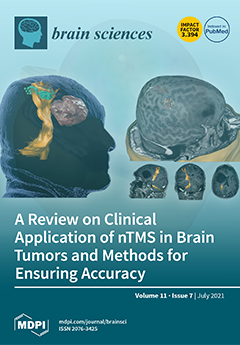
Cover Story: Navigated transcranial magnetic stimulation (nTMS) has developed into a reliable non-invasive clinical and scientific tool over the past decade, being particularly used for motor mapping in patients with brain tumors. In this article, we review the evidence for the feasibility of motor mapping and derived models (risk stratification and prediction, nTMS-based fiber tracking, improvement of clinical outcome, and assessment of functional plasticity) and provide collected sets of evidence for the applicability of quantitative mapping with nTMS. In addition, we provide evidence-based demonstrations on factors that ensure methodological feasibility and accuracy of the motor mapping procedure. View this paper
  • Issues are regarded as officially published after their release is announced to the table of contents alert mailing list .
  • You may sign up for email alerts to receive table of contents of newly released issues.
  • PDF is the official format for papers published in both, html and pdf forms. To view the papers in pdf format, click on the "PDF Full-text" link, and use the free Adobe Reader to open them.

Articles (135)

  • Systematic Review
  • Open Access
9 Citations
3,166 Views
18 Pages

Purpose: The olfactory system is particularly vulnerable in an ageing brain, both anatomically and functionally, and these brain changes are more pronounced among individuals with trisomy 21. Furthermore, the age of the system starts to deteriorate,...

  • Article
  • Open Access
6 Citations
3,516 Views
15 Pages

Quality of Life and Psychological Distress in Portuguese Older Individuals with Tinnitus

  • Haúla F. Haider,
  • Sara F. Ribeiro,
  • Derek J. Hoare,
  • Graça Fialho,
  • Deborah A. Hall,
  • Marília Antunes,
  • Helena Caria and
  • João Paço

Tinnitus is the perception of a sound without an external source, often associated with adverse psychological and emotional effects leading to impaired quality of life (QoL). The present study investigated QoL and psychological distress in tinnitus p...

  • Review
  • Open Access
15 Citations
4,868 Views
12 Pages

Cofilin and Neurodegeneration: New Functions for an Old but Gold Protein

  • Tamara Lapeña-Luzón,
  • Laura R. Rodríguez,
  • Vicent Beltran-Beltran,
  • Noelia Benetó,
  • Federico V. Pallardó and
  • Pilar Gonzalez-Cabo

Cofilin is an actin-binding protein that plays a major role in the regulation of actin dynamics, an essential cellular process. This protein has emerged as a crucial molecule for functions of the nervous system including motility and guidance of the...

  • Article
  • Open Access
2 Citations
5,773 Views
14 Pages

Scent of a Woman—Or Man: Odors Influence Person Knowledge

  • Nicole L. Hovis,
  • Paul R. Sheehe and
  • Theresa L. White

First impressions of social traits are regularly, rapidly, and readily determined from limited information about another individual. Relatively little is known about the way that olfactory information, particularly from scents that are not body odors...

  • Article
  • Open Access
1 Citations
3,260 Views
12 Pages

Endogenous Expression of G-CSF in Rat Dorsal Root Ganglion Neurons after Nerve Injury

  • Chun-Chang Yeh,
  • Chih-Ping Yang,
  • Kuo-Hsing Ma,
  • Jui-Hu Shih,
  • Ching-San Tseng and
  • Yuahn-Sieh Huang

Granulocyte colony-stimulating factor (G-CSF) has been reported to modulate pain function following nerve injury. However, the expression of endogenous G-CSF in the dorsal root ganglion (DRG) and the response to nerve injury remain unclear. In the pr...

  • Article
  • Open Access
18 Citations
7,186 Views
19 Pages

Effects of Neurofeedback on the Working Memory of Children with Learning Disorders—An EEG Power-Spectrum Analysis

  • Benito J. Martínez-Briones,
  • Jorge Bosch-Bayard,
  • Rolando J. Biscay-Lirio,
  • Juan Silva-Pereyra,
  • Lucero Albarrán-Cárdenas and
  • Thalía Fernández

Learning disorders (LDs) are diagnosed in children impaired in the academic skills of reading, writing and/or mathematics. Children with LDs usually exhibit a slower resting-state electroencephalogram (EEG), corresponding to a neurodevelopmental lag....

  • Systematic Review
  • Open Access
41 Citations
9,964 Views
82 Pages

Therapeutic Neurostimulation in Obsessive-Compulsive and Related Disorders: A Systematic Review

  • Nicola Acevedo,
  • Peter Bosanac,
  • Toni Pikoos,
  • Susan Rossell and
  • David Castle

Invasive and noninvasive neurostimulation therapies for obsessive-compulsive and related disorders (OCRD) were systematically reviewed with the aim of assessing clinical characteristics, methodologies, neuroanatomical substrates, and varied stimulati...

  • Article
  • Open Access
3 Citations
5,201 Views
11 Pages

Oxcarbazepine for Behavioral Disorders after Brain Injury: Factors Influencing Efficacy

  • Marco Pozzi,
  • Paolo Avantaggiato,
  • Valentina Pastore,
  • Carla Carnovale,
  • Emilio Clementi and
  • Sandra Strazzer

Carbamazepine and oxcarbazepine are used for behavioral disorders following organic diseases. After severe acquired brain injury, patients may develop frontal symptoms. In our neurological rehabilitation routine, oxcarbazepine is used for better safe...

  • Article
  • Open Access
12 Citations
3,482 Views
18 Pages

Substance Use Outcomes from Two Formats of a Cognitive-Behavioral Intervention for Aggressive Children: Moderating Roles of Inhibitory Control and Intervention Engagement

  • John E. Lochman,
  • Caroline L. Boxmeyer,
  • Chuong Bui,
  • Estephan Hakim,
  • Shannon Jones,
  • Francesca Kassing,
  • Kristina McDonald,
  • Nicole Powell,
  • Lixin Qu and
  • Thomas Dishion

Although cognitive-behavioral interventions have reduced the risk of substance use, little is known about moderating factors in children with disruptive behaviors. This study examined whether aggressive preadolescents’ inhibitory control and interven...

  • Article
  • Open Access
10 Citations
5,359 Views
16 Pages

Episodic Memory Encoding and Retrieval in Face-Name Paired Paradigm: An fNIRS Study

  • Qian Yu,
  • Boris Cheval,
  • Benjamin Becker,
  • Fabian Herold,
  • Chetwyn C. H. Chan,
  • Yvonne N. Delevoye-Turrell,
  • Ségolène M. R. Guérin,
  • Paul Loprinzi,
  • Notger Mueller and
  • Liye Zou

Background: Episodic memory (EM) is particularly sensitive to pathological conditions and aging. In a neurocognitive context, the paired-associate learning (PAL) paradigm, which requires participants to learn and recall associations between stimuli,...

of 14

Get Alerted

Add your email address to receive forthcoming issues of this journal.

XFacebookLinkedIn
Brain Sci. - ISSN 2076-3425