


Abstract
Technology and innovations have fueled the evolution of Industry 4.0, the fourth industrial revolution. Industry 4.0 encourages growth and development through its efficiency capacity, as documented in the literature. The growth of the construction industry is a subset of the universal set of the gross domestic product value; thus, Industry 4.0 has a spillover effect on the engineering and construction industry. In this study, we aimed to map the state of Industry 4.0 in the construction industry, to identify its key areas, and evaluate and interpret the available evidence. We focused our literature search on Web of Science and Scopus between January 2015 and May 2019. The search was dependent on the following keywords: “Industry 4.0” OR “Industrial revolution 4.0” AND TOPIC: “construction” OR “building”. From the 82 papers found, 20 full-length papers were included in this review. Results from the targeted papers were split into three clusters: technology, security, and management. With building information modelling (BIM) as the core in the cyber-physical system, the cyber-planning-physical system is able to accommodate BIM functionalities to improve construction lifecycle. This collaboration and autonomous synchronization system are able to automate the design and construction processes, and improve the ability of handling substantial amounts of heterogeneity-laden data. Industry 4.0 is expected to augment both the quality and productivity of construction and attract domestic and foreign investors.
1. Introduction
The world has never evolved as fast as in the last couple of decades. To provide context, the global construction industry has been affected by the world’s urban population rising by 200,000 people per day [1]. The demand for affordable housing has never been higher [2], affected by a concomitant need for social, utility, and transportation infrastructure. Such challenges have ensured that the construction industry continues to review and revamp itself. The changes that occur here impact on society as a whole—the construction costs will fall, and the environment will benefit. This is achieved by efficiently using scarce resources and/or ensuring that buildings are being constructed with eco-efficiency in mind [3]. This positively impacts the economy by ensuring that the global infrastructure gap is narrowed, and economic development is boosted overall. During the last couple of decades, most industries have undergone an evolution and have instilled product and process innovations into the core of their operations. The engineering and construction sector has not kept pace in terms of technological opportunities that can help improve production and productivity, resulting in a stagnation of labor productivity as well [4]. Several internal and external challenges are responsible for this situation, including the industry dealing with consistent fragmentation, trouble recruiting a workforce with the right talent, insufficient links to contractors and suppliers, and inadequate transfer of knowledge from one project to another [5]. Despite the industry’s vast potential, increasing efficacy and productivity can only result from digitalization, new techniques for construction, and innovations. Tools such as three-dimensional (3D) scanning, building information modelling (BIM), drones, and augmented reality have all reached market maturity [6]. By incorporating these innovations, firms can exploit them to increase productivity level, safety, and quality, and improve project management. To use this potential, a strategy must be devised for concerted and committed efforts across many different areas, including operations, technology, personnel, regulation, and more.
The fourth industrial revolution 4.0 or Industry 4.0 has introduced digital technologies, sensor systems, intelligent machines, and smart materials to the construction industry where BIM has become the central repository for collating digital information about a project [5,7]. BIM is an ideal stage for the development of powerful and innovative applications for the construction industry by providing an additional layer of data that are able to interact and collaborate in real time throughout the project life cycle [8]. The innovation of BIM manages computational data for improving construction efficiency and economy [9]. With open BIM, existing construction management tools can be integrated with BIM to extend its capabilities in the construction ecosystem [10]. BIM has been widely accepted in the construction industry [11] though not many firms have taken full advantage of its potential despite the investment in BIM being proven to be well worth the cost of implementation to organizations [12]. Therefore, we decided to examine the present status of BIM in the Industry 4.0 in the context of the construction industry to identify evidence on the integration of BIM with digital technologies such as intelligent machines, sensor systems, and smart materials. To achieve our goal, we conducted a bibliometric mapping study using a scoping review technique to discuss the current trend of Industry 4.0 in the construction industry to identify the patterns of existing research in the aforementioned context, identify gaps in the research, and provide suggestions for future research directions.
2. Background
Humanity has had a significant impact on the industrial landscape, which includes the construction industry [13]. The basic technological revolution elements can be divided into three aspects, material, energy power, and control technology, which determine the operation and power modes of the things designed, thereby determining the ways people feel, the mode and scale of human perception, and the method through which people cognize knowledge, so that a new living method can be constructed [14]. Prior to the 19th century, clear engineering limits defined the building weight, height, and strength due to the limited types of material such as humanmade materials along with those available in nature: timber, stone, lime mortar, and concrete [13]. During the first industrial revolution (from 1760 to about 1830), the mechanical heavy industry experienced exponential growth leading to the creation of a whole host of new building materials. These included glass, cast iron, and even steel—all of which were created by engineers and architects to create buildings no one had ever imagined could exist in terms of form, frame, and functionality [15]. The second industrial revolution (1870–1914) was characterized by dense innovation based on useful knowledge being mapped onto technologies that drove the industry with cheap and more efficient mass production of steel, electricity, telegraphs, and railroads [16]. This revolution drove the construction industry in terms of innovation in architectural design and lightening vertical space [13] alongside new prefabrication technology and the beginning of computer-aided design (CAD) [17], which provided numerous unforeseen opportunities [9].
In the late 1950s, the Internet, information technology (IT), and the availability of personal computers enabled a new digital revolution where mechanical and analogue were digitized and mass production shifted to mass customization [9,18]. The third industrial revolution created a new relationship between architecture and technology that challenged the production industry [19]. Architects started using diffused 3D computer-aided design software as a representational tool to improve precision and expand the limits of their creations [20]. Digital architecture creations require architects to use their perceptual and cognitive abilities to construct digital geometric forms in the computer program using certain underlying computational foundations with action and reaction rules [19]. The complex constructed geometries were able to be constructed using computer numerically controlled (CNC) fabrication processes, which perform the basic controlling functions over the movement of a machine tool using a set of coded instructions [19]. CNC became the connector between 3D-CAD models and computer aided manufacturing (CAM) to produce mass-customization and computerized production of building elements [21]. Complex construction became more economical and seemed unnecessarily difficult to build as the digital fabrication and digital architecture tools evolved and matured [20].
Research on Industry 4.0 is relatively a new topic. The term is well known not only in academia but also in industry [22]. By definition, Industry 4.0 or the forth industrial revolution refers to the Internet of Things (IoT) and the Internet of Services integrated with the manufacturing environment where all industrial businesses around the globe connect and control their machinery, factories, and warehousing facilities intelligently through cyber-physical systems by sharing information that triggers actions [23]. This revolution has challenged the industry by demonstrating the construction digitization potential with the availability of digital data and online digital access that can be used to automatically gather and process electronic data discrete tasks into the value chain [24]. Robotic technologies have been merged with the construction industry, known as construction automation technologies, to create elements of buildings, building components, and building furniture [25]. The integration of BIM into the IT environment enables transitioning the current ‘react to event’ practice to ‘predict the event’ practice [26]. The integration of BIM into cloud computing allows project stakeholders to collaborate in real-time from different locations to enhance decision-making and ensure project deliverability [5]. The IoT, together with BIM, is able to maximize productivity [27], enhance the information flow during a project life cycle [28], optimize energy efficiency [29], and improve security and safety [30,31], as well as the planning, managing, and monitoring of resources [31].
The number of research publications covering topics related to Industry 4.0 and construction have grown tremendously. For example, in the Scopus database, for “Industry 4.0” OR “Industrial revolution 4.0” AND TOPIC “construction” OR “building” search keywords, the number of publications have increased every year. In year 2015, eight papers were recorded. This increased to 27 papers in 2016, 59 in 2017, 163 in 2018, and the numbers is growing in 2019 with 364 published papers as of May 2019. Of these, 196 papers were conference papers, 105 were journal articles, 10 papers were review papers, and the rest were other types of publications. Most of the papers were published in Advances in Intelligent Systems and Computing (17 papers), Procedia Manufacturing (13 papers), IFIP Advances in Information and Communication Technology (11 papers), and IOP Conference Series Materials Science and Engineering (11 papers).
From all the papers found, only three review papers provided significant impact related to Industry 4.0 in construction: “Understanding the implications of digitization and automation in the context of Industry 4.0: A triangulation approach and elements of a research agenda for the construction industry” [32], “Industry 4.0 as an enabler of proximity for construction supply chains: A systematic literature review” [33], and “Digital construction: From point solutions to IoT ecosystem” [26]. These three publications provided an overview of the potential of the industrial revolution in the construction industry in term of practice and supply chain. Much room exists for exploration related to this topic in the construction industry as the pattern and structure in this area of study are still in their infancy and conceptual.
A mapping study was used to provide a systematic and objective procedure to identify the pattern and structure of an existing study [34] to discover little evidence likely exists in a broad topic [35] such as construction within Industry 4.0. Our underlying research question was to determine how extensive the studies related to the topic are, with a secondary question to discuss the methodological approaches used in the studies to understand the movement of the topic. The objectives of this systematic review were (1) to identify, assess, and analyze the published studies to understand the prevalent patterns and structures in existing work related to Industry 4.0; (2) to identify the gaps in this topic; and (3) to propose a framework that links the current research topics to future research directions. With these objectives, we identified the most relevant authors, the topics that have already been covered, and, finally, potential future research directions. This overview will help researchers understand the current state of the construction industry within the Industry 4.0 era and reduce the digital gap throughout a project life-cycle.
This paper is structured as follows. Section 3 explains the selection of the information resources and information mapping. The next section provides reports and discussion of the results in some fields, knowledge area, authors, and keywords. Finally, Section 5 provides our conclusions and suggestions for future research.
3. Methodology
3.1. Literature Search
In this review-based study, we adopted the bibliometric mapping study method [36] and scoping review technique [37] to provide a systematic and holistic review of Industry 4.0 and the construction industry and the two are linked. We collected bibliometric studies of papers published from 2015 to May 2019 in Web of Science and Scopus. The following keywords were used for the search: “Industry 4.0” OR “Industrial revolution 4.0” AND TOPIC “construction” OR “building” the result obtained as listed in Table 1 and Table 2.
Table 1.
Numbers of papers in Web of Science (WoS) database based on the query “Industry 4.0” OR “Industrial revolution 4.0” AND TOPIC “construction” OR “building”.
Table 2.
Numbers of papers in Scopus database based on the query “Industry 4.0” OR “Industrial revolution 4.0” AND TOPIC “construction” OR “building”.
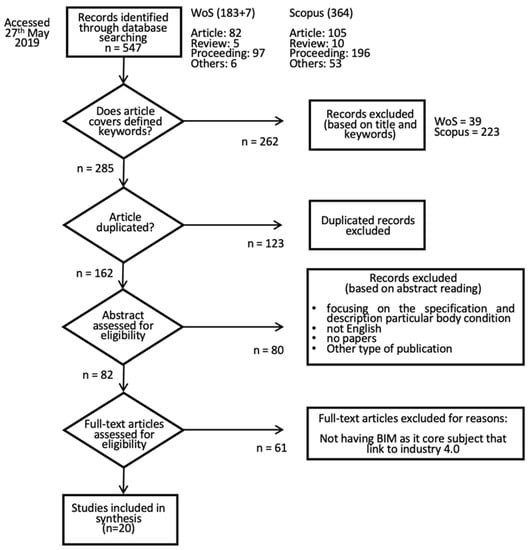
The methodological framework introduced by Arksey and O’Malley involves five stages of research flow. First, the research questions are outlined, then appropriate research work is found, and then the process of selection occurs. Subsequently, the data are charted, after which information is collated and summarized, and the results are reported [37]. The flow diagram in Figure 1 demonstrates the Preferred Reporting Items for Systematic Reviews and Meta-Analyses (PRISMA 2009) flow of articles from search to final selection.
Figure 1.
Preferred Reporting Items for Systematic Reviews and Meta-Analyses (PRISMA) flow diagram of search process.
A total of 547 papers related to Industry 4.0 studies on the construction industry were identified, with 183 papers and 364 papers on Web of Science and Scopus, respectively, with keyword search “Industry 4.0” OR “Industrial revolution 4.0” AND TOPIC “construction” OR “building. An additional 7 papers were found in Web of Science using the snowballing method. Manual scoping was required to finalize the desirable papers due to the broad keyword search and inability to refine search by specific subject areas and keywords in the database. Almost all the works identified were false positives: they contained the right properties; however, the content therein had no relevance to the topic under discussion.
Once the unrelated works were eliminated through the process of keyword screening, a total of 285 papers remained for further processing. The removal of duplicated works eliminated 123 papers. After the final manual screening of abstracts, 82 papers were eligible for full paper assessment and only 20 full-length papers were assessed and synthesized.
3.2. Data Extraction and Study Quality Evaluation
Eligible work was sorted by researchers who had independently reviewed the studies. Every paper was examined in terms of the following elements: the country of publication, title, the author(s), and publication type. For a study to be chosen for further review, it had to meet the following specific set of criteria:
- (1)
- Published until May 2019,
- (2)
- Focusing on the construction industry,
- (3)
- Dealing with questions concerning technology adoption,
- (4)
- Discussing the Industry 4.0 trends, opportunities, and challenges for the construction industry,
- (5)
- Discussing the innovative approaches for managing operational processes of Industry 4.0 for the construction industry, and
- (6)
- Written in English.
Publications were excluded if the following criteria applied:
- (1)
- Focusing on the specification and description of a particular condition, for example, “Industry 4.0 for construction industry in circular economy” or “smart manufacturing”;
- (2)
- Focusing on specific technology, for example, “smart metering”, “measuring application”, and “human behavior sensing”;
- (3)
- Discussing a specific solution;
- (4)
- Written in a language other than English;
- (5)
- Inaccessible papers; or
- (6)
- Not having BIM as its core subject that link to Industry 4.0.
4. Results
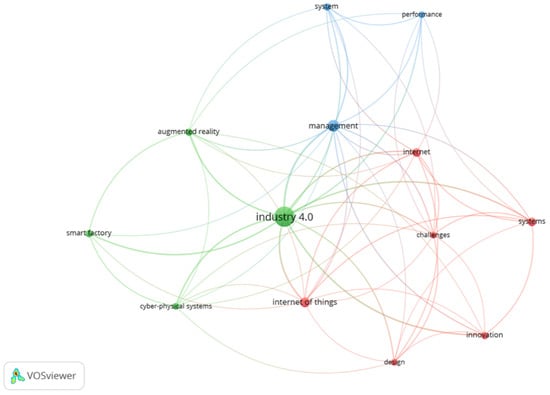
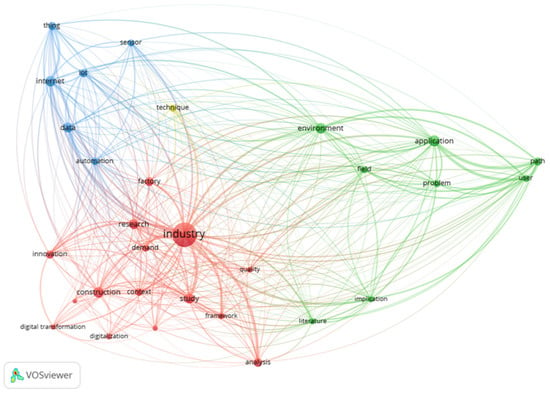
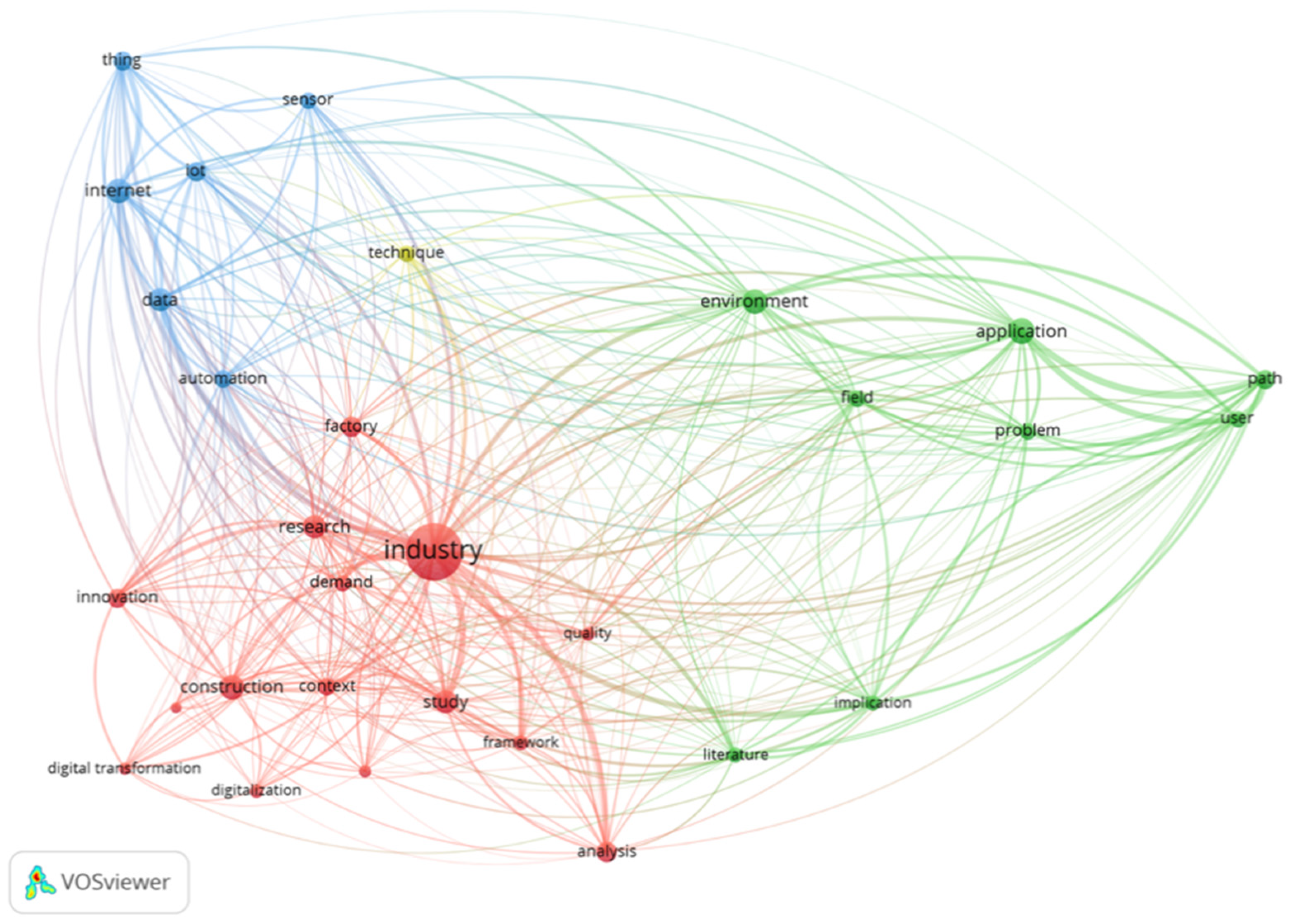
We started with a broader theme to identify, assess, and analyze the published papers to discover the structure and patterns for the query “Industry 4.0” OR “Industrial revolution 4.0” AND TOPIC: “construction” OR “building”. At this stage, the identified papers indicated that these were the most popular keywords used for Industry 4.0 that could be clustered into at minimum three clusters, as illustrated in Figure 2 and Figure 3.
Figure 2.
The most commonly co-occurring keyword search related to “Industry 4.0” OR “Industrial revolution 4.0” AND TOPIC “construction” OR “building” in Web of Science, with 183 publications.
Figure 3.
The most commonly co-occurring keyword search related to “Industry 4.0” OR “Industrial revolution 4.0” AND TOPIC “construction” OR “building” in Scopus with 364 publications.
Figure 2 shows the most co-occurring keyword search related to “Industry 4.0” OR “Industrial revolution 4.0” AND TOPIC “construction” OR building” in Web of Science with the minimum number of occurrence of keywords being at least five occurrences. From 490 keywords, 13 met the threshold. For each of the 13 keywords, the total strength of the co-occurrence links with other keywords was generated. Figure 2 shows the most co-occurring keyword search related to “Industry 4.0” OR “Industrial revolution 4.0” AND TOPIC “construction” OR “building” in Scopus with the minimum number of occurrence of keywords being at least five occurrences. From 3633 keywords, 197 met the threshold. Only the 30 strongest keywords were selected.
For each of the selected keywords, the total strength of the co-occurrence links with other keywords was generated. Only the keywords with the greatest total link strength were selected. Co-occurrence is the term used to describe the proximity of keywords in the title, abstract, or keyword list in publication [38] to find connections so that the research topic can be identified [39]. The link indicates the strength of their occurrences.
Table 3 and Table 4 show the available cluster of the co-occurrence keywords and strongest occurrences from the selected keyword search in Web of Science and Scopus, respectively. Table 5 and Table 6 show the total link strength of the linked keywords to the keyword search. Industry 4.0, Management, Internet, Internet of Things, and System were the major keywords in Web of Science; Industry, Application, Internet, Construction, Environment, and Data were the major keywords in Scopus. These tables show that using the keyword search “Industry 4.0” OR “Industrial revolution 4.0” AND TOPIC “construction” OR “building”, the keyword Industry 4.0 co-occurred 43 times, Management co-occurred 14 times, Internet co-occurred 8 times, Internet of Things co-occurred 10 times, and System co-occurred 8 times in Web of Science. Industry 4.0 had 11 links that held the strongest links of all keywords. It was linked to all the keywords, forming the core of every available keyword. In Scopus, Industry co-occurred with the keywords search for 250 times, Application co-occurred 51 times, Internet 49 times, Construction 48 times, Environment 46 times, and Data 41 times.
Table 3.
Cluster of keywords that co-occurred together in Web of Science under keyword search related to “Industry 4.0” OR “Industrial revolution 4.0” AND TOPIC “construction” OR “building”.
Table 4.
Cluster of keywords that co-occurred together in Scopus under keyword search related to “Industry 4.0” OR “Industrial revolution 4.0” AND TOPIC: “construction” OR “building”.
Table 5.
Most common co-occurring keywords of “Industry 4.0” OR “Industrial revolution 4.0” AND TOPIC “construction” OR “building” in Web of Science.
Table 6.
Most commonly co-occurring keywords of “Industry 4.0” OR “Industrial revolution 4.0” AND TOPIC “construction” OR “building” in Scopus.
Table 7 and Table 8 show the total link strength of the keyword Industry 4.0 with its linked keywords. In Web of Science, keyword Industry 4.0 was linked to Management, Internet, IoT, System, Augmented Reality, Innovation, System, Cyber-Physical System, Design Performance, and Small Factory. Construction Industry, Construction, Digital Transformation, Innovation, Digitalization, Factory, Automation, Data, Internet, Sensor, IoT, Thing, Environment, and Application were the keywords linked to the Industry 4.0 keyword in Scopus. Keywords that hold higher strength with the linked keywords show how tightly these keywords are networked together. For example, keywords Data and Internet have the strongest link to keyword Industry 4.0. This means that keywords Data and Internet are significantly related to Industry 4.0 as data are the proverbial new oil in the digital era and are only useful used in real time and are exchangeable with other applications using an Internet connection.
Table 7.
Total link strength of keyword Industry 4.0 with its linked keywords in Web of Science.
Table 8.
Total link strength of keyword Industry 4.0 with its linked keywords in Scopus.
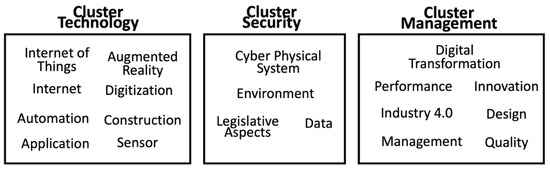
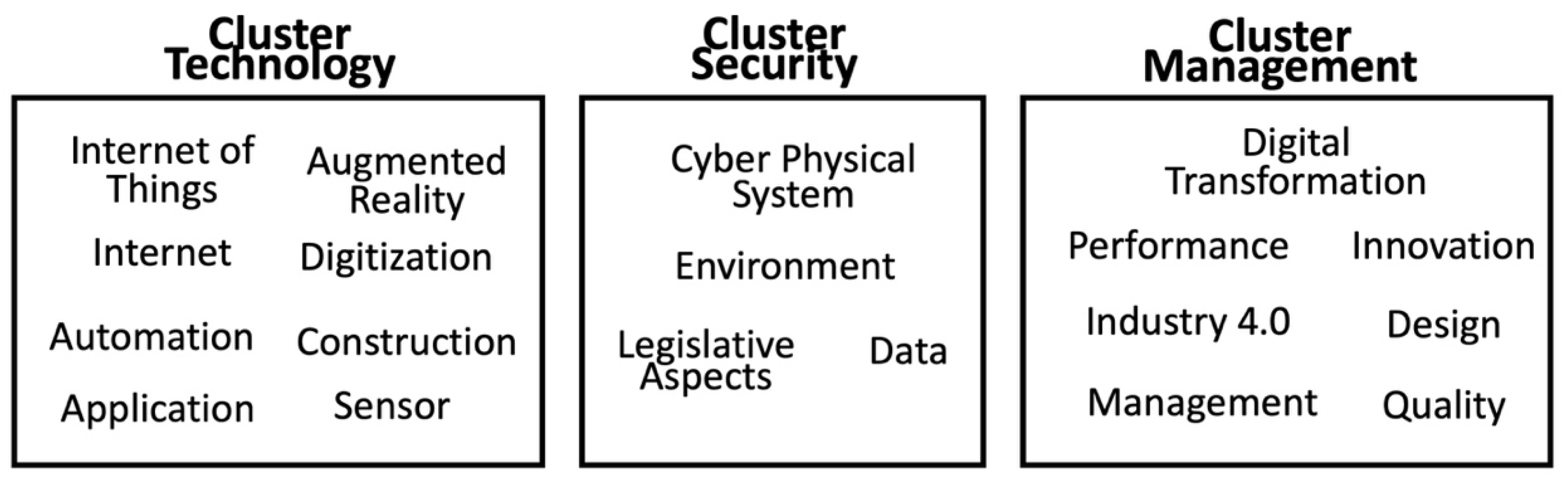
From all the keywords search findings, we conclude that all the keywords fall under one of three clusters: technology, security, and management cluster (Figure 4). Note that these keywords have highest total link strength, and other keywords that related to Industry 4.0 and the construction industry were ignored. The first cluster includes a wide range of technologies available in Industry 4.0; the second cluster deals with cybersecurity used to protect systems, networks, and programs from digital attacks, unauthorized access, changing, or destroying sensitive information, and others; and the third cluster focuses on the management issues in Industry 4.0 in the construction industry. These clusters are further explained in the discussion section. This clustering helped us to find patterns in the literature from the concept matrix (Table 9 and Table 10).
Figure 4.
Clustering of the keywords (Source Author’s illustration).
Table 9.
Clustered topics discussed in 20 targeted papers (articles).
Table 10.
Clustered topics discussed in 20 targeted papers (conference papers).
Concept matrix in Table 9 and Table 10 elaborate upon the topic discussed by the targeted papers. The pattern in the table shows that the topics focused more on the possible application of Industry 4.0 for the construction industry from a managerial aspect and less on the application of technology and security. The pattern also shows a lack of studies from the legislative perspective and cyber physical systems under cluster security for Industry 4.0 within the construction industry.
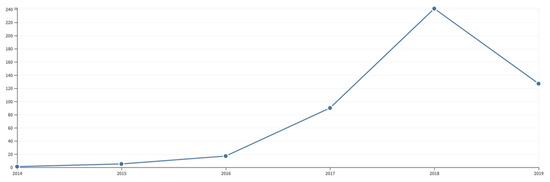
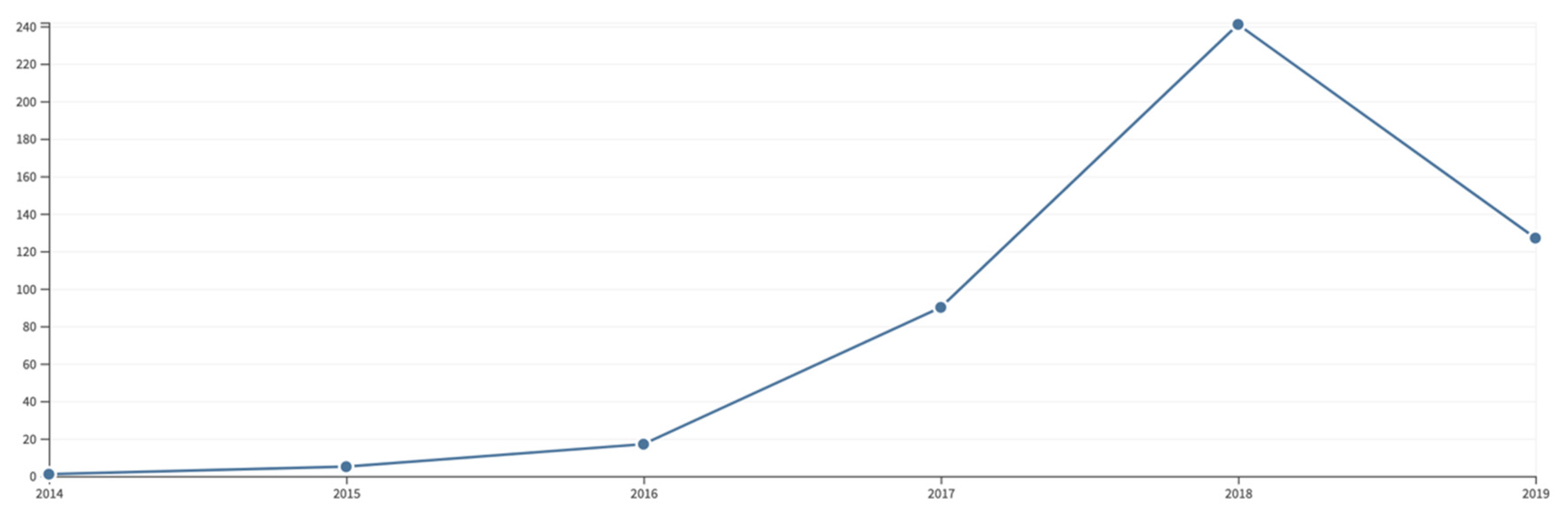
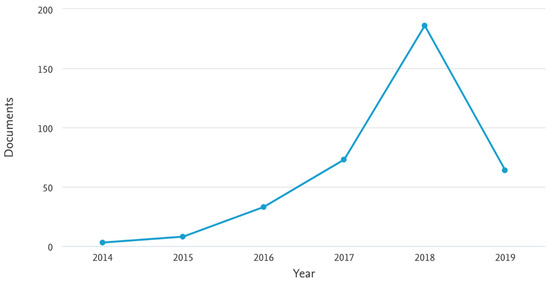
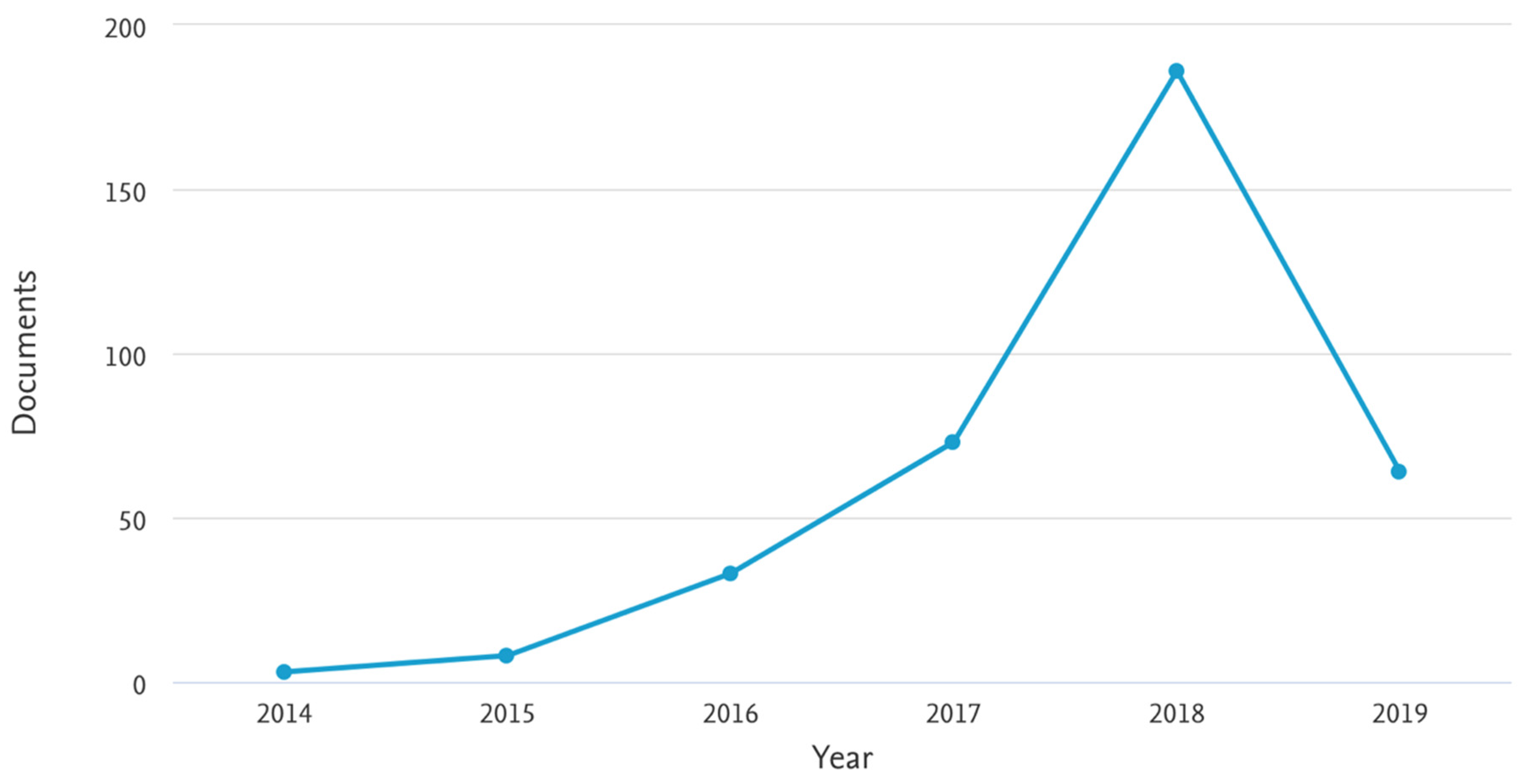
The contents of the keyword search “Industry 4.0” OR “Industrial revolution 4.0” AND TOPIC “construction” OR “building” were analyzed after the first keyword and abstract inspection. Then, we examined the selected papers and their citations to further evaluate a particular author’s and publication’s contributions. The number of citations increased drastically in 2018 both in Web of Science and Scopus, which indicates the increase in the interest in and the value of this research topic (Figure 5 and Figure 6). The papers most frequently cited are listed in Table 11.
Figure 5.
Sum of times cited per year of “Industry 4.0” OR “Industrial revolution 4.0” AND TOPIC “construction” OR “building” keyword from 2014 to 2019 in Web of Science.
Figure 6.
Sum of times cited per year of “Industry 4.0” OR “Industrial revolution 4.0” AND TOPIC “construction” OR “building” keyword from 2014–2019 in Scopus.
Table 11.
Most frequently cited papers.
A detailed description of the targeted papers that concentrated on BIM as its core subject that link to Industry 4.0 is provided in Table 12, which lists the main objective, methodology used, findings, and the limitation of each paper.
Table 12.
Summary of 20 targeted papers.
5. Discussion
5.1. State-Of-The-Art Industry 4.0 in the Construction Industry
Whereas the first industrial revolution introduced mechanical power, the second industrial revolution lightened up the industry, and the third industrial revolution digitized the information and production [15,16,19], Industry 4.0 has amalgamated the physical world with the information era directed by the cyber-physical system approach [24]. Industry 4.0 is also known as “smart manufacturing”, “industrial internet”, or “integrated industry”, which has shifted the value chain of organization and management across the lifecycle of products by integrating complex devices, machines, and networked sensors and software, deployed to predict, control, and plan for better business and societal outcomes [60]. The combination of these digital innovations is collectively called the Internet of Things (IoT) in the cyber-physical system, which are able to meet new emergent needs and provide capabilities that instigate the next evolution of society and its organization or institution [26] and transform how products are designed, fabricated, used, operated, maintained, and serviced [61]. Robotic technologies have been merged with the construction industry, known as construction automation technologies, to create elements of buildings, building components, and building furniture [25].
Industry 4.0 has challenged the construction industry by providing a glimpse of the construction digitization potential with the availability of digital data and online digital access that automatically gather and process electronic data into the value chain on discrete tasks [24]. BIM (within the planning domain), as the center of construction digitization together with Industry 4.0 (production domain), is able to close the digital gap that still exists and sustain the impact on future building processes [59]. The innovation in and approaches to construction automation are still in their infancy [62] and not fully employed as the technical aspects of the available technologies are still being investigated though some technologies have reached maturity, such as BIM, cloud computing, mobile computing, and modularization [32]. The fact that construction projects are becoming increasingly complex despite construction being a flat market for the previous five decades requires Industry 4.0 as a solution for a new business model [24,25]. This has occurred because, currently, the construction industry has one of the lowest capital investments as well as low capital intensity [25] with the lowest R&D intensity [32] compared to other sectors despite being a major contributor to the employment and economy of many countries [63]. The fragmented supply chain of the construction industry, which includes several small- and medium-sized enterprises (SMEs), limits the ability to invest in innovative technologies [33]. Another reason behind the slow adoption is because the gap between construction and manufacturing is relatively huge though both industries are categorized into the same group and work together [24]. The unavailability of a dedicated process change strategy, dedicated implementation plan, and business strategy alignment have also contributed to the slow adoption. Since Industry 4.0 creates value that transforms the overall business strategy in the construction industry, there is a need to propose some strategies for implementation. With the capability to automate both design and manufacturing processes and the possibility of handling a heterogeneous and significant amount of information, Industry 4.0 is expected to be able to improve the quality and productivity of construction and attract domestic and foreign investors.
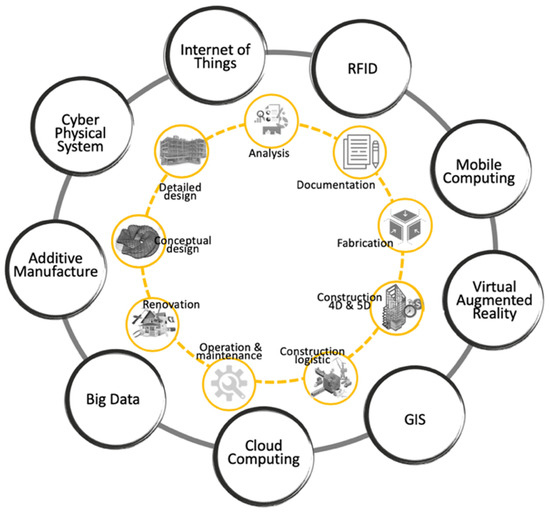
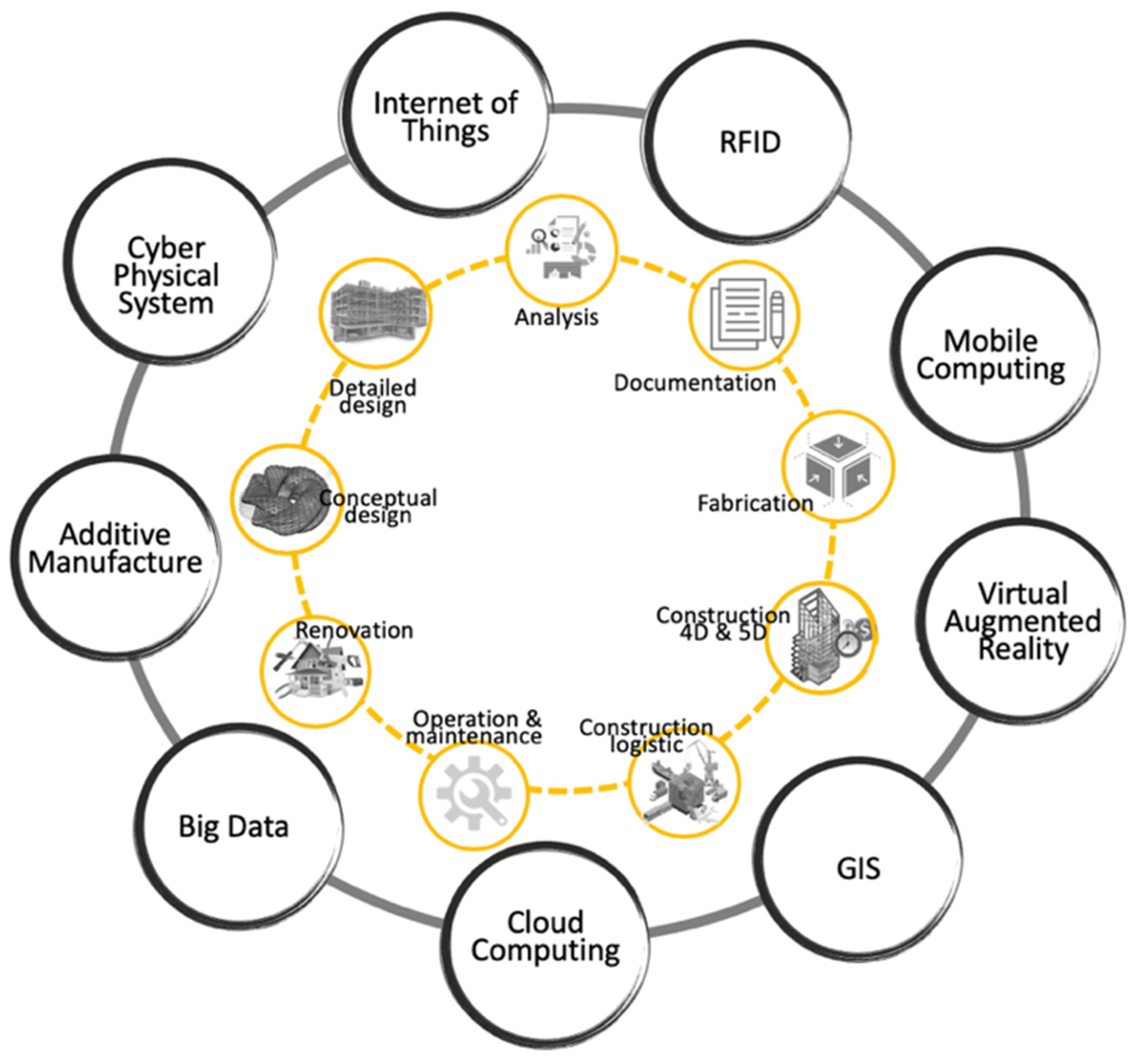
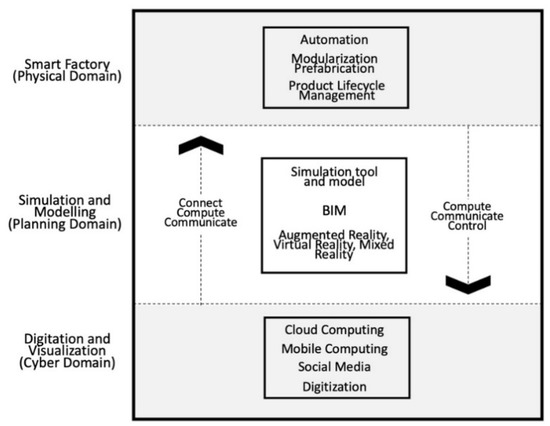
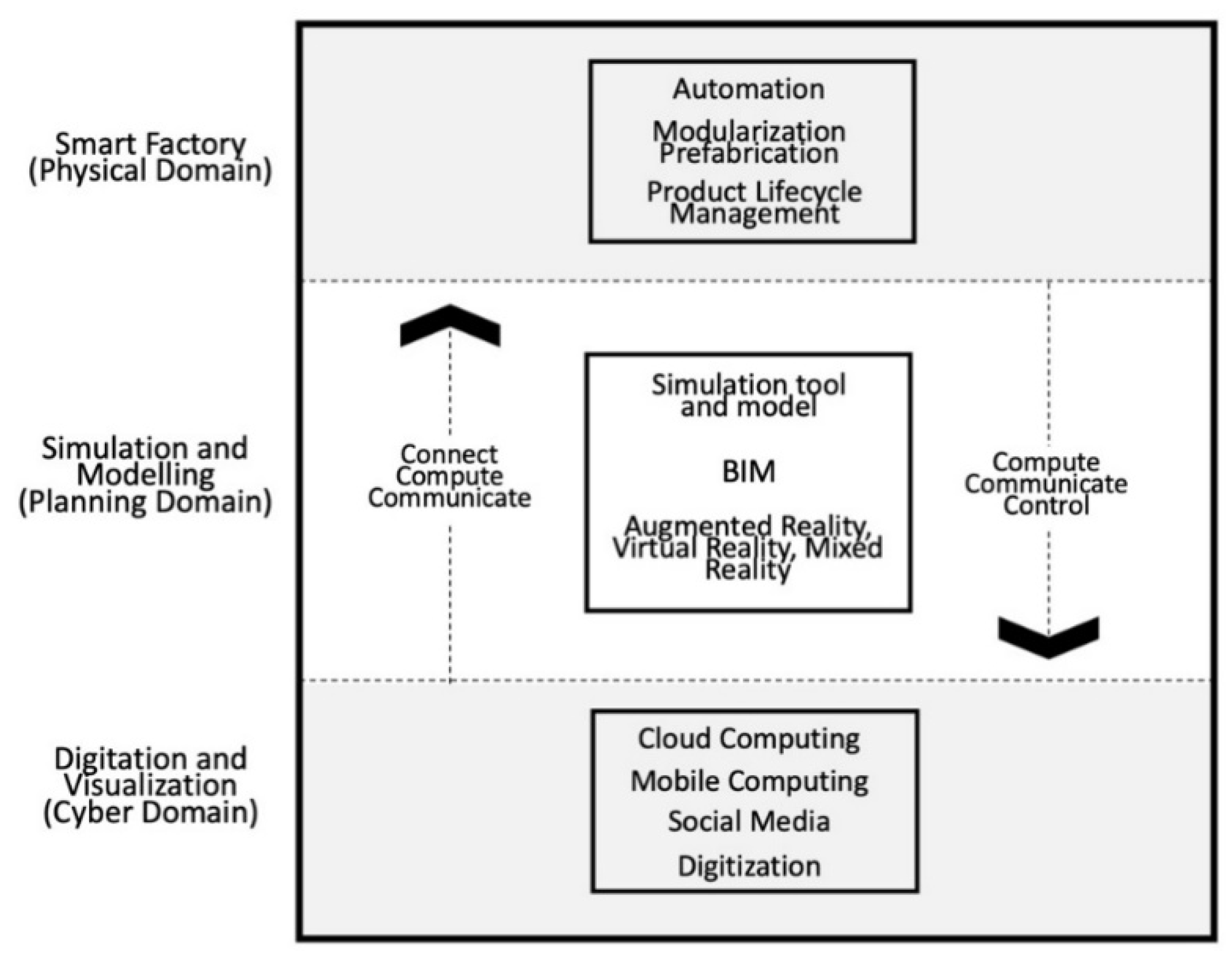
This review, though we are not claiming it to be exhaustive, has provided an overview of Industry 4.0 concept in construction industry in the last five years. The selected papers revealed the active collaboration between BIM with technologies from Industry 4.0 (Figure 7), such as the use of BIM to support design decisions for mass customization production [54], structural health monitoring (SHM) using open BIM [43], allowing schedule monitoring in real time [50], smart steel bridge construction enabled by BIM and IoT [51], and a digital platform that uses augmented reality (AR) combined with BIM to provide workers with relevant information in real-time [58]. However, the pattern of topics discussed are broad and conceptual. The targeted papers only mention the benefit of Industry 4.0 to the construction industry conceptually. A detailed study should be completed to understand the benefits brought by Industry 4.0 to the construction industry. In addition, studies are lacking on management processes for overall project life cycle as well as the operation, and tactical and strategic planning in this collaborative and autonomous synchronization system. Studies in this area are needed in order to transform the construction network and construction economy and to integrate BIM with Industry 4.0 technology. The relationship of Industry 4.0 as the production domain with BIM as the planning domain acts as the core structure of the cyber-planning-physical system, influenced by the benefits and challenges of Industry 4.0 for the construction industry is illustrated in Figure 8 [32,59,64]. Figure 7 shows how the physical and cyber domains are controlled by the planning domain.
Figure 7.
Concept of technologies in Industry 4.0 with BIM as its core structure with collaboration and an autonomous synchronization system.
Figure 8.
The relationships in the cyber-planning-physical system with BIM as its core. Adapted from previous studies [32,59,64].
The bi-directional coordination between the physical domain and cyber domain has the potential to improve real-time progress monitoring and control the construction process, track changes, model updates, and exchange information between the design and operational stages [65]. This is a solution to the infamous construction practice epitomized by the management inefficiencies that result in delays, unforeseen costs, and poor work quality [66]. Since BIM is the core of this bi-directional coordination, its role is to digitize and control the overall process of the construction life cycle. However, for this to be realized, the construction industry needs to accommodate their activities with BIM functionalities, as BIM tools have the potential to be used for managing different activities [67]. BIM functionalities include six components [68]:
- (1)
- Team communication and integration,
- (2)
- Parametric modelling and visualization,
- (3)
- Building performance analysis and simulation,
- (4)
- Automatic document generation,
- (5)
- Improved building lifecycle management, and
- (6)
- Software interoperability with other applications.
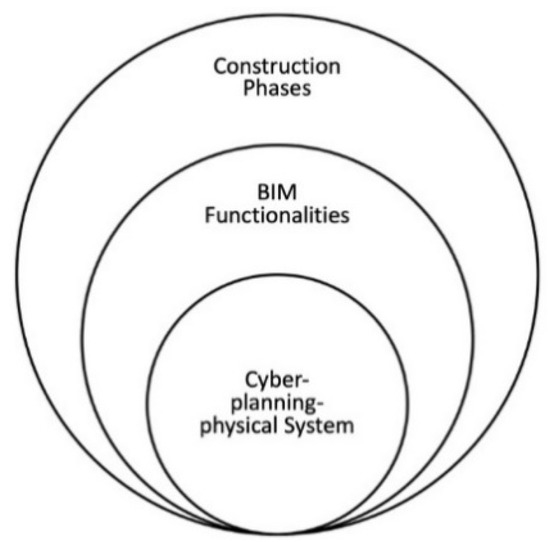
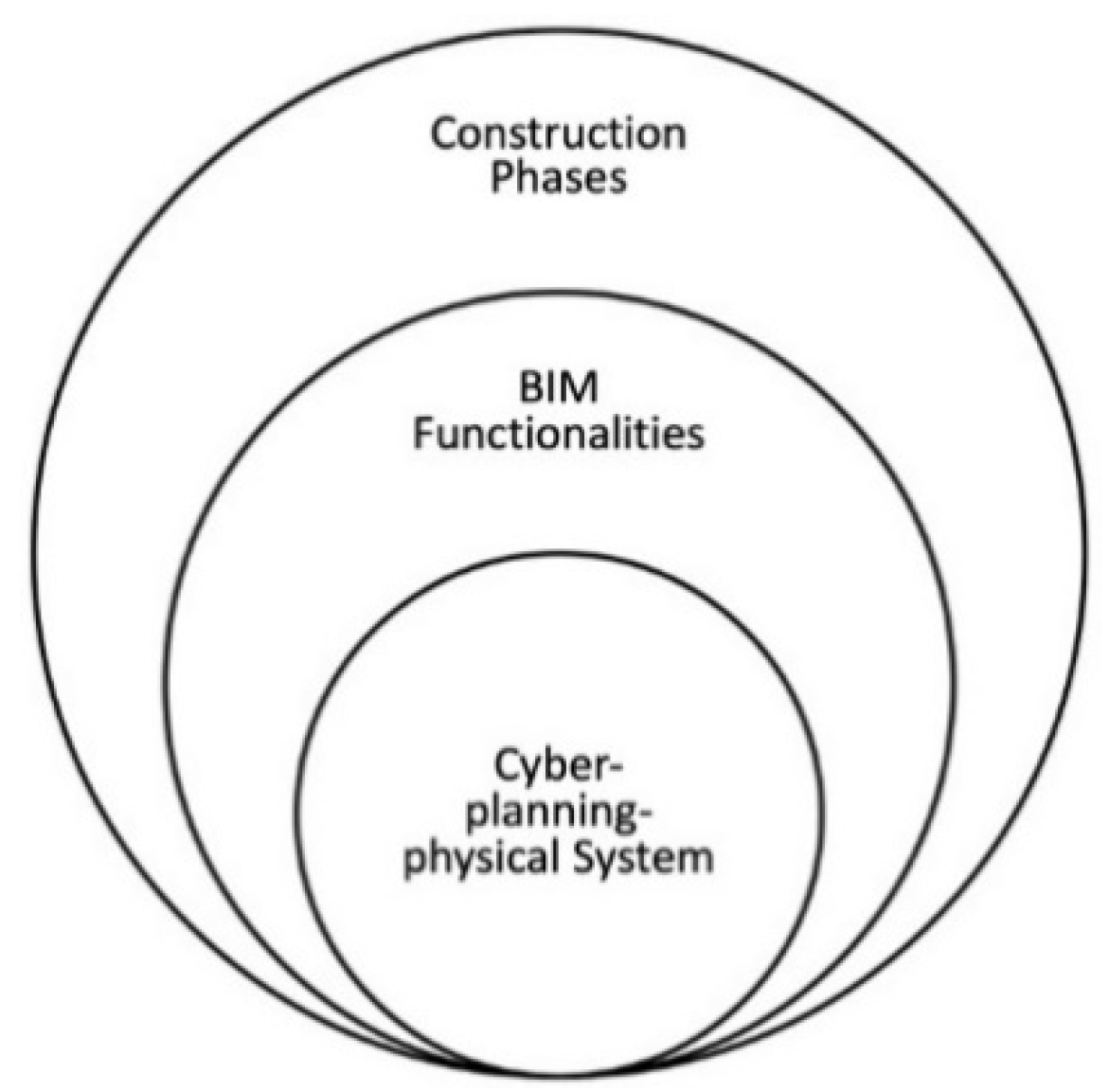
The relationship between the cyber-planning-physical system, BIM functionalities, and construction phases is illustrated in Figure 9. However, this improvement requires data transparency, concurrent viewing and editing of a single federated model, and controlled coordination of information access [69]. For this to be implemented, the three main components clustered in the findings need to be highlighted.
Figure 9.
Relationship between cyber-planning-physical system, BIM functionalities, and construction phases.
5.1.1. Cluster Technology
The first cluster includes a wide range of technologies available in Industry 4.0: internet, automatic equipment, Internet of Things, augmented reality technology, and sensors. This cluster completes the cyber-planning-physical ecosystem by integrating physical machineries and devices, non-physical technologies, and BIM to accommodate BIM functionalities to improve construction activities during different phases. The application of these technologies in the construction industry could not possibly be realized without the digitization of data from BIM as the collaboration medium. For example, design automation combining the BIM model with advanced simulation tools and genetic algorithms was able to mass-customize housing construction [54]; the use of BIM in the navigation core provided an augmented reality navigation system to navigate pathways in building [47]; the use of Bluetooth Low Energy (BLE) Beacons, Extended Markup Language (XML) formatted informative BIM, and BIM model on the Unity platform provided workers with relevant information in real-time based on their current position on the construction site through augmented reality [59]; and BIM, IoT, sensors, data computing, and advanced analytics tools were used to simulate, re-simulate, and map the simulation for steel bridge performance monitoring as the core enabling the technology system [51]. Automated real-time construction technologies would help the construction industry to improve the productivity and quality of a project throughout its lifecycle. As such, the availability of the Internet and Internet of Things enables the creation of a cyber domain to support these smart technologies in the physical domain with the support of BIM in the planning domain.
5.1.2. Cluster Security
Cluster two includes system, cyber-physical system, data, environment, and legislative aspects that can be categorized as a security cluster in Industry 4.0 for construction. Since Industry 4.0 involves data and systems in a virtual environment, it is crucial to be concerned about the security issues as any wrong information has the potential to have negative consequences [70]. BIM, as the planning domain, possesses rich information and data about the construction life cycle that can easily be extracted and reused [71]. BIM open standards were developed to represent information in a building information model and openly exchange this information [68]. The BIM open standard has been recognized a standardization to exchange information and documents with other partners that previously could not be executed automatically [69]. These standards include the Industry Foundation Classes (IFC), Green Building XML, and the newer Construction Operations Building Information Exchange [68]. Green Building XML is an open schema created to facilitate the transfer of building data stored in BIM to engineering analysis tools. However, most construction professionals are still unaware of the legal implications arising from BIM adoption, although several BIM protocols and contracts have been developed [11]. This requires protection of the ownership of the model through copyright laws [72] to avoid data loss, theft of intellectual property, or misuse during data exchanges within a common data environment [73]. However, security issues faced by Industry 4.0 in the construction industry are not only limited to the ownership of the data in BIM, but also include the system security and data security associated with the cyber-planning-physical system security, software, and hardware. The main objectives of cyber-physical system security are confidentiality, integrity, availability, and authenticity [74]. Without a properly designed cyber-planning-physical system security, the whole system might be at risk of cyber-attacks such DDOS (Distributed Denial of Service), data theft, eavesdropping, and malicious software. The attacker can delete, modify, steal, or exploit the information and resources for inappropriate reasons [75]. Most published papers did not properly cover providing security involved with BIM. Further studies on the cyber-planning-physical system security are required.
5.1.3. Cluster Management
Cluster three included articles related to management related to Industry 4.0, including management, innovation, design, performance, quality, and digital transformation, which are related to BIM functionalities. Management in the Industry 4.0 era with BIM as its core has slowly been revolutionized, as shown by higher performance and good quality in construction practices. The targeted papers have demonstrated the successful implementation of Industry 4.0 technologies by achieving real-time project management [49], smart technology management [51], smart indoor navigation management [47], creating a digital twin for facility management [53], road construction management [50], as well as mass-customization of design management [54]. With the clear distribution of managerial framework for the integration of BIM and Industry 4.0, the construction industry is able to capture the benefits from BIM and Industry 4.0 from a management perspective and is expected to develop and deploy more technologies to enhance productivity. As the core of the project with a collaborative and autonomous synchronization system, BIM provides a new means to predict, manage, and monitor the quality and performance of the project throughout the whole project life cycle.
5.2. Methodological Concerns
Concept papers have flourished in the Industry 4.0 for construction research topic. This review provided a summary of the current state of the research related to Industry 4.0 in the construction industry, both conceptually and providing an in-depth systematic discussion. From 20 targeted papers, 9 papers were concept papers. Concept papers generally contain a clear description of the research topic, including a summary of what is already known about that topic and the importance of the studies without documenting statistical evidence of the sources for the purpose of attracting readers to understand what the researcher is currently investigating, usually published during earlier stages of research [76]. Four papers were categorized as systematic literature reviews (SLRs), reviewing the trend toward digitization and automation of the construction industry and identifying and classifying the pattern of the research themes. SLRs are used to comprehensively locate and synthesize related research, using organized, transparent, and replicable procedures at each step in the process [77]. Another method of review used in the summarized papers was Longitudinal Literature Review (LLR). LLR is the science of tracing changes by repeatedly measuring the same phenomenon under the same circumstances over a long period of time [78]. This procedure is often used in standard SLR, but is differentiated by the extensive length of the observation period to identify the changing trend and determine how the trend influences the surroundings. This targeted review of these specific types of papers is able to help other researchers to overview what is currently happening to the construction industry due to the dramatic change due to the Industry 4.0 era. The suggestions for future research and the overview of the benefits and challenges of the research topic were rigorously documented using the evidence from the implementation in other industries.
Original research (primary sources) of the targeted papers was limited. Only seven original papers were found, all of which used quantitative research on specific research topics that were not related to each other: augmented reality [58], facility management [53], structural monitoring [43], data management [48], design management [52], and real-time project management [49]. All selected papers discussed experiments and the result obtained. The articles included detailed descriptions of the methods used to produce the results for future verification or knowledge transfer by other researchers.
To obtain an in-depth understanding of the theories underpinning Industry 4.0 for construction, qualitative research is needed as it focuses on “why” rather than the “what” to examine the natural phenomena of the research topic. However, the selected papers contained no qualitative original research, as the research topic is still in its infancy. Qualitative research papers are able to dive deeper into the problem of the research topic by reporting the phenomena from multiple perspectives, identifying many factors involved in the situation, and generally sketch the bigger picture that emerges. This limitation provides an opportunity to further explore this research topic qualitatively as the phenomena is immature due to a lack of theory and a limited number of available studies.
6. Conclusions
Findings show a clear, active, and unfinished discussion about Industry 4.0 in the construction industry. This review demonstrates the lack of a complete understanding on what Industry 4.0 entails for the construction industry as the number of original papers are limited. The available studies focused on the concept of the possibility of adopting Industry 4.0 in the construction industry rather than providing a solid theoretical development to realizing the adoption. Most of the papers elaborated upon the existing technologies and how creative innovation can be used to adopt these technologies into different sectors or industries. The selected papers revealed the active collaboration between BIM and technologies from Industry 4.0—how BIM became the agent of collaboration between cyber systems and physical system to complete a cyber-planning-physical ecosystem to accommodate BIM functionalities throughout construction project lifecycles. However, the pattern of topics discussed are broad and conceptual. The targeted papers only conceptually mentioned the benefit of Industry 4.0 in the construction industry and how BIM can possibly be deployed to enhance productivity. Detailed studies on the implementation should be completed to evaluate the potential of Industry 4.0 in the construction industry. In additional, studies are lacking on the management processes of the overall project life cycle as well as the operation, tactical, and strategic planning in this collaborative and autonomous synchronization system. Studies in this area are needed in order to transform the construction network and construction economy and to integrate BIM with Industry 4.0 technology. We are currently moving in the right direction as BIM together with Industry 4.0 are being introduced to the industry, transforming how the industry has been operating for decades, improving the quality and performance of the overall construction life cycle. More qualitative research is needed to explore and understand the issue, challenges, and future direction of these new technologies to allow more experimental design research for realizing BIM and Industry 4.0 in the construction industry.
We discussed the eligibility of the selected papers in our research approach in Section 3.2. However, there is a limitation in this search. We reviewed all publications in Web of Science and Scopus for the past five years. We focused on a wider view of the overall Industry 4.0 component to depict overall mapping. Since the topic Industry 4.0 is relatively new, the extracted data were unable to justify the relatedness of every component. A new search with different keywords from different databases needs to be completed to extend the findings. It may be helpful to perform the same type of analysis with different keywords. This could provide a different perspective and a different aspect from which to understand the trends in BIM in Industry 4.0 in the construction industry.
Future research on collaborative and autonomous synchronization systems with BIM as the core of the structure in the cyber-planning-physical system could fill the gap that we highlighted. It would be interesting to gain further insights into the management scope, especially on the role and responsibility of the stakeholders as well as the operation, tactical, and strategic management in construction companies during different construction phases throughout the construction lifecycle. More analyses and experimentation are required about the changes in working culture in the new construction network. Finally, we think that our contribution provides a resourceful foundation about the collaborative and autonomous synchronization in cyber-planning-physical systems. With the capability to automate both the design and construction processes and the possibility of handling large amounts of heterogeneous data, BIM in Industry 4.0 for the construction industry is expected to improve the quality and productivity of construction and attract domestic and foreign investors.
Author Contributions
Conceptualization, R.M., A.S. and K.N.A.; Methodology, R.M., A.S., P.M. and O.K.; Analysis, R.M., A.S., P.M. and O.K.; Writing-Original Draft Preparation, R.M., A.S. and P.M.; Writing-Review & Editing, R.M., A.S., O.K., and P.M.; Visualization, R.M.; Supervision, A.S. and K.N.A.; Project Administration, R.M.; Funding Acquisition, A.S., O.K., and P.M.
Funding
This research was funded by Universiti Teknologi Malaysia (UTM) under Research University Grant Vot-20H04, Malaysia Research University Network (MRUN) Vot 4L876 and the Fundamental Research Grant Scheme (FRGS) Vot 5F073 supported under Ministry of Education Malaysia for the completion of the research. The work was partially funded by the SPEV project, University of Hradec Kralove, FIM, Czech Republic (ID: 2103–2019).
Acknowledgments
We are also grateful for the support of student Jan Hruska and Sebastien Mambou in consultations regarding application aspects.
Conflicts of Interest
The authors declare no conflict of interest.
References
- UN. 68% of the world population projected to live in urban areas by 2050, says UN | UN DESA | United Nations Department of Economic and Social Affairs. United Nations News, 16 May 2018; pp. 2–5.
- Adabre, M.A.; Chan, A.P.C. Critical success factors (CSFs) for sustainable affordable housing. Build. Environ. 2019, 156, 203–214. [Google Scholar] [CrossRef] [Scilit]
- De Wilde, P. Ten questions concerning building performance analysis. Build. Environ. 2019, 153, 110–117. [Google Scholar] [CrossRef] [Scilit]
- Livotov, P.; Sekaran, A.P.C.; Law, R.; Reay, D.; Sarsenova, A.; Sayyareh, S. Eco-Innovation in Process Engineering: Contradictions, Inventive Principles and Methods; Elsevier Ltd.: Amsterdam, The Netherlands, 2019; Volume 9. [Google Scholar]
- Craveiro, F.; Duarte, J.P.; Bartolo, H.; Bartolo, P.J. Additive manufacturing as an enabling technology for digital construction: A perspective on Construction 4.0. Autom. Constr. 2019, 103, 251–267. [Google Scholar] [CrossRef] [Scilit]
- Gao, H.; Koch, C.; Wu, Y. Building information modelling based building energy modelling: A review. Appl. Energy 2019, 238, 320–343. [Google Scholar] [CrossRef] [Scilit]
- King, M. How Industry 4.0 and BIM are Shaping the Future of the Construction Environment. GIM Int. Worldw. Mag. GEOMATICS 2018, 31, 24–25. [Google Scholar]
- Bilal, M.; Oyedele, L.O.; Qadir, J.; Munir, K.; Akinade, O.O.; Ajayi, S.O.; Alaka, H.A.; Owolabi, H.A. Analysis of critical features and evaluation of BIM software: Towards a plug-in for construction waste minimization using big data. Int. J. Sustain. Build. Technol. Urban Dev. 2015, 6, 211–228. [Google Scholar] [CrossRef] [Scilit]
- Yanagawa, K. reIndustrializing Architecture. Int. J. Archit. Comput. 2016, 14, 158–166. [Google Scholar] [CrossRef] [Scilit]
- Autodesk, BIM 360 API. Available online: https://forge.autodesk.com/en/docs/bim360/v1/overview/introduction/ (accessed on 1 May 2019).
- Fan, S.L.; Chong, H.Y.; Liao, P.C.; Lee, C.Y. Latent Provisions for Building Information Modeling (BIM) Contracts: A Social Network Analysis Approach. KSCE J. Civ. Eng. 2019, 23, 1427–1435. [Google Scholar] [CrossRef] [Scilit]
- Porter, S.; Tan, T.; Tan, T.; West, G. Breaking into BIM: Performing static and dynamic security analysis with the aid of BIM. Autom. Constr. 2014, 40, 84–95. [Google Scholar] [CrossRef] [Scilit]
- Gildow, C. M9—Architecture and the Industrial Revolu on. Module 9. Architecture, 2012. Available online: https://learn.canvas.net/courses/24/pages/m9-architecture-and-the-industrial-revolution?module_item_id=44477 (accessed on 30 December 2018).
- Wang, Y.; Li, X.; Li, X. Eco-Topia: Design 4.0 and the Construction of E-Image City. In Proceedings of the 1st International Conference on Arts, Design and Contemporary Education, Moscow, Russia, 22–24 April 2015; Volume 23, pp. 414–417. [Google Scholar]
- Sreekanth, P.S. Impact of Industrial revolution on architecture. The Archi Blog Not Just another Architecture Blog. 2011. Available online: https://thearchiblog.wordpress.com/2011/06/02/impact-of-industrial-revolution-on-architecture/ (accessed on 20 April 2019).
- Mokyr, J. The Second Industrial Revolution, 1870–1914. In Storia dell’economia Mondiale; Valerio, C., Ed.; Laterza: Rome, Italy, 1998. [Google Scholar]
- Bethany, How CAD Has Evolved Since 1982. 2017. Available online: https://www.scan2cad.com/cad/cad-evolved-since-1982/#history-of-cad (accessed on 30 December 2018).
- Fisher, T. Welcome to the Third Industrial Revolution: The Mass-Customisation of Architecture, Practice and Education. In Architectural Design; John Wiley & Sons Ltd.: Hoboken, NJ, USA, 2015; Vol 85, pp. 40–45. Available online: https://onlinelibrary.wiley.com/doi/abs/10.1002/ad.1923 (accessed on 11 May 2019).
- Kolarevic, B. Designing and Manufacturing Architecture in the digital age. In Architectural Information Management, Proceedings of the 19th eCAADe Conference; Helsinki University of Technology: Helsinki, Finland, 2001; pp. 117–123. [Google Scholar]
- Naboni, R.; Paoletti, I. Advanced Customization in Architectural Design and Construction; Springer: Milano, Italy, 2015. [Google Scholar]
- Howard, R. Describing the Changes in Architectural Information Technology to Understand Design Complexity and Free-Form Architectural Expression. J. Inf. Technol. Constr. ITcon 2006, 11, 395–408. [Google Scholar]
- Oztemel, E.; Gursev, S. Literature review of Industry 4. 0 and related technologies. J. Intell. Manuf. 2018, 1–56. [Google Scholar] [CrossRef] [Scilit]
- Gilchrist, A. Industry 4.0: The Industrial Internet of Things; Apress: New York, NY, USA, 2016. [Google Scholar]
- Alaloul, W.S.; Liew, M.S.; Amila, N.; Abdullah, W.; Mohammed, B.S. Industry Revolution IR 4.0: Future Challenges in Construction Industry Opportunities and. MATEC Web Conf. 2018, 02010, 1–7. [Google Scholar] [CrossRef] [Scilit]
- Bock, T. The future of construction automation: Technological disruption and the upcoming ubiquity of robotics. Autom. Constr. 2015, 59, 113–121. [Google Scholar] [CrossRef] [Scilit]
- Woodhead, R.; Stephenson, P.; Morrey, D. Digital construction: From point solutions to IoT ecosystem. Autom. Constr. 2018, 93, 35–46. [Google Scholar] [CrossRef] [Scilit]
- Li, C.Z.; Hong, J.; Xue, F.; Shen, G.Q.; Xu, X.; Luo, L. SWOT analysis and Internet of Things-enabled platform for prefabrication housing production in Hong Kong. Habitat Int. 2016, 57, 74–87. [Google Scholar] [CrossRef] [Scilit]
- Dave, B.; Kubler, S.; Pikas, E.; Holmström, J.; Singh, V.; Främling, K.; Koskela, L. Intelligent Products: Shifting the Production Control Logic in Construction (With Lean and BIM). In Proceedings of the 23rd Annual Conference of the International Group for Lean Construction, Perth, Australia, 29–31 July 2015; pp. 341–350. [Google Scholar]
- Bottaccioli, L.; Aliberti, A.; Ugliotti, F.; Patti, E.; Osello, A.; Macii, E.; Acquaviva, A. Building Energy Modelling and Monitoring by Integration of IoT Devices and Building Information Models. In Proceedings of the 2017 IEEE 41st Annual Computer Software and Applications Conference (COMPSAC), Turin, Italy, 4–8 July 2017; pp. 914–922. [Google Scholar]
- Li, C.Z.; Hong, J.; Xue, F.; Shen, G.Q.; Xu, X.; Mok, M.K. Schedule risks in prefabrication housing production in Hong Kong: A social network analysis. J. Clean. Prod. 2016, 134, 482–494. [Google Scholar] [CrossRef] [Scilit]
- Fang, Y.; Cho, K.Y.; Zhang, S.; Perez, E. Case Study of BIM and Cloud–Enabled Real-Time RFID Indoor Localization for Construction Management Applications. J. Constr. Eng. Manag. 2016, 142, 1–12. [Google Scholar] [CrossRef] [Scilit]
- Oesterreich, T.D.; Teuteberg, F. Understanding the implications of digitisation and automation in the context of Industry 4.0: A triangulation approach and elements of a research agenda for the construction industry. Comput. Ind. 2016, 83, 121–139. [Google Scholar] [CrossRef] [Scilit]
- Dallasega, P.; Rauch, E.; Linder, C. Industry 4.0 as an enabler of proximity for construction supply chains: A systematic literature review. Comput. Ind. 2018, 99, 205–225. [Google Scholar] [CrossRef] [Scilit]
- Budgen, D.; Turner, M.; Brereton, P.; Kitchenham, B. Using mapping studies in software engineering. PPIG 2008, 8, 195–204. [Google Scholar]
- Kitchenham, B.; Charters, S. Guidelines for performing Systematic Literature reviews in Software Engineering Version 2.3. Engineering 2007, 45, 1051. [Google Scholar]
- Leung, X.Y.; Sun, J.; Bai, B. Bibliometrics of social media research: A co-citation and co-word analysis. Int. J. Hosp. Manag. 2017, 66, 35–45. [Google Scholar] [CrossRef] [Scilit]
- Arksey, H.; O’Malley, L. Scoping studies: Towards a methodological framework. Int. J. Soc. Res. Methodol. Theory Pract. 2005, 8, 19–32. [Google Scholar] [CrossRef] [Scilit]
- Van Eck, N.J.; Waltman, L. Visualizing Bibliometric Networks; Springer: Berlin/Heidelberg, Germany, 2014. [Google Scholar]
- Wang, W.; Laengle, S.; Merigó, J.M.; Yu, D.; Herrera-Viedma, E.; Cobo, M.J.; Bouchon-Meunier, B. A Bibliometric Analysis of the First Twenty-Five Years of the International Journal of Uncertainty, Fuzziness and Knowledge-Based Systems. Int. J. Uncertainty Fuzziness Knowl.-Based Syst. 2018, 26, 169–193. [Google Scholar] [CrossRef] [Scilit]
- Baccarelli, E.; Naranjo, P.G.V.; Scarpiniti, M.; Shojafar, M.; Abawajy, J.H. Fog of Everything: Energy-Efficient Networked Computing Architectures, Research Challenges, and a Case Study. IEEE Access 2017, 5, 9882–9910. [Google Scholar] [CrossRef] [Scilit]
- Shafiq, S.I.; Sanin, C.; Szczerbicki, E.; Toro, C. Virtual engineering object/virtual engineering process: A specialized form of cyber physical system for industrie 4.0. Procedia Comput. Sci. 2015, 60, 1146–1155. [Google Scholar] [CrossRef] [Scilit]
- Kleineidam, G.; Krasser, M.; Reischböck, M. The cellular approach: Smart energy region Wunsiedel. Testbed for smart grid, smart metering and smart home solutions. Electr. Eng. 2016, 98, 335–340. [Google Scholar] [CrossRef] [Scilit]
- Theiler, M.; Smarsly, K. IFC Monitor—An IFC schema extension for modeling structural health monitoring systems. Adv. Eng. Inform. 2018, 37, 54–65. [Google Scholar] [CrossRef] [Scilit]
- Nguyen, H.V.; Iacono, L.L. RESTful IoT Authentication Protocols; Elsevier Inc.: Amsterdam, The Netherlands, 2016. [Google Scholar]
- Li, J.; Yang, H. A Research on Development of Construction Industrialization Based on BIM Technology under the Background of Industry 4.0. MATEC Web Conf. 2017, 100, 02046. [Google Scholar] [CrossRef] [Scilit]
- Dallasega, P.; Marcher, C.; Marengo, E.; Rauch, E.; Matt, D.T.; Nutt, W. A Decentralized and Pull-based Control Loop for On-Demand Delivery in ETO Construction Supply Chains. In Proceedings of the 24th Annual Conference of the International Group for Lean Construction, Boston, MA, USA, 18–24 July 2016; pp. 33–42. [Google Scholar]
- Delbrügger, T.; Lenz, L.T.; Losch, D.; Roßmann, J. A navigation framework for digital twins of factories based on building information modeling. In Proceedings of the 2017 22nd IEEE International Conference on Emerging Technologies and Factory Automation (ETFA), Limassol, Cyprus, 12–15 September 2017; pp. 1–4. [Google Scholar]
- Scheffer, M.; Konig, M.; Engelmann, T.; Tagliabue, L.C.; Ciribini, A.L.C.; Rinaldi, S.; Pasetti, M. Evaluation of Open Data Models for the Exchange of Sensor Data in Cognitive Building. In Proceedings of the 2018 Workshop on Metrology for Industry 4.0 and IoT, Brescia, Italy, 16–18 April 2018; pp. 151–156. [Google Scholar]
- Dallasega, P.; Frosolini, M.; Matt, D.T.T. An approach supporting real-time project management in plant building and the construction industry. In Proceedings of the 21st XXI Summer School Francesco Turco, Naples, Italy, 13–15 September 2016; pp. 247–251. [Google Scholar]
- Axelsson, J.; Froberg, J.; Eriksson, P. Towards a system-of-systems for improved road construction efficiency using lean and industry 4.0. In Proceedings of the 2018 13th Annual Conference on System of Systems Engineering (SoSE), Paris, France, 19–22 June 2018; pp. 576–582. [Google Scholar]
- Ding, K.; Shi, H.; Hui, J.; Liu, Y.; Zhu, B.; Zhang, F.; Cao, W. Smart steel bridge construction enabled by BIM and Internet of Things in industry 4.0: A framework. In Proceedings of the 2018 IEEE 15th International Conference on Networking, Sensing and Control (ICNSC), Zhuhai, China, 27–29 March 2018; pp. 1–5. [Google Scholar]
- Monizza, G.P.; Bendetti, C.; Matt, D.T. Parametric and Generative Design techniques in mass-production environments as effective enablers of Industry 4.0 approaches in the Building Industry. Autom. Constr. 2018, 92, 270–285. [Google Scholar] [CrossRef] [Scilit]
- Trapp, M.; Richter, R. Towards The Generation of Digital Twins for Facility Management Based on 3D Point Clouds Urban Analytics View project Visual Analytics for Sensor Data View project Vladeta Stojanovic Hasso Plattner Institute. In Proceedings of the ARCOM 2018: 34th Annual Conference, Belfast, UK, 3–5 September 2018. [Google Scholar]
- Bianconi, F.; Filippucci, M.; Buffi, A. Automated design and modeling for mass-customized housing. A web-based design space catalog for timber structures. Autom. Constr. 2019, 103, 13–25. [Google Scholar] [CrossRef] [Scilit]
- Pruskova, K. Beginning of Real Wide us of BIM Technology in Czech Republic. IOP Conf. Ser. Mater. Sci. Eng. 2019, 471, 102010. [Google Scholar] [CrossRef] [Scilit]
- Correa, F.R. Cyber-physical systems for construction industry. In Proceedings of the 2018 IEEE Industrial Cyber-Physical Systems (ICPS), St. Petersburg, Russia, 15–18 May 2018; pp. 392–397. [Google Scholar]
- Hotový, M. Dynamic model of implementation efficiency of Building Information Modelling (BIM) in relation to the complexity of buildings and the level of their safety. MATEC Web Conf. 2018, 146, 01010. [Google Scholar] [CrossRef] [Scilit]
- Schweigko, A.; Monizza, G.P.; Domi, E.; Popescu, A.; Ratajczak, J.; Marcher, C.; Riedl, M.; Matt, D. Development of a digital platform based on the integration of augmented reality and BIM for the management of information in construction processes. In Proceedings of the IFIP International Conference on Product Lifecycle Management, Turin, Italy, 2–4 July 2018; Volume 540, pp. 46–55. [Google Scholar]
- De Lange, P.; Bähre, B.; Finetti-Imhof, C.; Klamma, R.; Koch, A.; Oppermann, L. Socio-Technical challenges in the digital gap between building information modeling and industry 4.0. CEUR Workshop Proc. 2017, 1854, 33–46. [Google Scholar]
- Maresova, P.; Soukal, I.; Svobodova, L.; Hedvicakova, M.; Javanmardi, E.; Selamat, A.; Krejcar, O. Consequences of Industry 4.0 in Business and Economics. Economies 2018, 6, 48. [Google Scholar] [CrossRef] [Scilit]
- Rahim, Z.A.; Yusoff, M.R.M. Standard and Guidelines to Malaysia Fourth Industrial Revolution: Assessment, Readiness and Development Program, 1st ed.; Siri Sdn Bhd: Kuala Lumpur, Malaysia, 2018. [Google Scholar]
- Niu, Y.; Lu, W.; Chen, K.; Huang, G.G.; Anumba, C. Smart Construction Objects. J. Comput. Civ. Eng. 2016, 30, 04015070. [Google Scholar] [CrossRef] [Scilit]
- Hampson, K.; Kraatz, J.A.; Sanchez, A.X. The Global Construction Industry and R & D. In R&D Investment and Impact in the Global Construction Industry, 1st ed.; Routledge: Oxon, UK, 2014; p. 364. [Google Scholar]
- Boulila, N. Guidelines for Modeling Cyber-Physical Systems–A Three-Layered Architecture for Cyber Physical Systems; Siemens AG, Corporate Technology: Munich, Germany, 2017. [Google Scholar]
- Akanmu, A.; Anumba, C.J. Cyber-physical systems integration of building information models and the physical construction. Eng. Constr. Archit. Manag. 2015, 22, 516–535. [Google Scholar] [CrossRef] [Scilit]
- Ellis, M. Industry 4.0 and The Future of Construction. 2018. Available online: https://rebim.io/industry4-0-and-the-future-of-construction/ (accessed on 30 May 2019).
- Latiffi, A.A.; Mohd, S.; Kasim, N.; Fathi, M.S. Building Information Modeling (BIM) application in Malaysian construction industry. Int. J. Constr. Eng. Manag. 2013, 2, 1–6. [Google Scholar]
- Akinade, O.O. Bim-Based Software for Construction Waste Analytics Using Artificial Intelligence Hybrid Models; University of the West of England: Bristol, UK, 2017. [Google Scholar]
- Grilo, A.; Jardim-Goncalves, R. Value proposition on interoperability of BIM and collaborative working environments. Autom. Constr. 2010, 19, 522–530. [Google Scholar] [CrossRef] [Scilit]
- Carneiro, J.; Rossetti, R.J.F.; Silva, D.C.; Oliveira, C. BIM, GIS, IoT, and AR/VR Integration for Smart Maintenance and Management of Road Networks: A Review. In Proceedings of the 2018 IEEE International Smart Cities Conference, ISC2, Kansas City, MO, USA, 16–19 September 2018. [Google Scholar]
- Fan, S.-L. Intellectual Property Rights in Building Information Modeling Application in Taiwan. J. Constr. Eng. Manag. 2014, 139, 556–563. [Google Scholar] [CrossRef] [Scilit]
- Azhar, S. Research Impact Principles and Framework. Australian Research Council. 2013. Available online: https://www.arc.gov.au/policies-strategies/strategy/research-impact-principles-framework (accessed on 1 July 2019).
- Boyes, H. Security, Privacy, and the Built Environment. IT Prof. 2015, 17, 14–18. [Google Scholar] [CrossRef] [Scilit]
- Ali, S.; Al Balushi, T.; Nadir, Z.; Hussain, O.K. ICS/SCADA System Security for CPS; Studies in Computational Intelleigence; Springer-Verlag: Cham, Switzerland, 2018; Volume 768, pp. 89–113. [Google Scholar]
- Huda, S.; Miah, S.; Hassan, M.M.; Islam, R.; Yearwood, J.; Alrubaian, M.; Almogren, A. Defending unknown attacks on cyber-physical systems by semi-supervised approach and available unlabeled data. Inf. Sci. 2017, 379, 211–228. [Google Scholar] [CrossRef] [Scilit]
- Spickard, J. Useful Ideas for Doctoral Research. 2008. Available online: http://www.coolsociology.net/Handouts/Spickard—What is a Concept Paper (CC License).pdf (accessed on 1 January 2019).
- Böke, J.; Knaack, U.; Hemmerling, M. State-of-the-art of intelligent building envelopes in the context of intelligent technical systems. Intell. Build. Int. 2018, 11, 27–45. [Google Scholar] [CrossRef] [Scilit]
- Kehr, F.; Kowatsch, T. Quantitative Longitudinal Research: A Review of IS Literature, and a Set of Methodological Guidelines. In Proceedings of the ECIS 2015, Münster, Germany, 26–29 May 2015. [Google Scholar]

© 2019 by the authors. Licensee MDPI, Basel, Switzerland. This article is an open access article distributed under the terms and conditions of the Creative Commons Attribution (CC BY) license (http://creativecommons.org/licenses/by/4.0/).