


Abstract
Optimizing the recovery of bioactive compounds is critical for the accurate assessment of the quality of freeze-dried vegetables. In this context, Response Surface Methodology (RSM) was performed to optimize the ultrasound-assisted extraction (UAE) of phenolic compounds from freeze-dried broccoli (cv ‘Thassos’) and cauliflower (cv ‘Cercy’) florets. The influence of three process parameters, namely solvent-to-material ratio (20 to 60 mL/g), extraction time (10 to 40 min) and solvent mixture (methanol: water) composition (60 to 100% methanol) was evaluated. Multi-response optimization identified the optimal process conditions for both cultivars (composite desirability = 0.996) as a 60 mL/g ratio, 10 min extraction time and 76% methanol content. The application of the optimized extraction conditions to broccoli ‘Naxos’ and cauliflower ‘Guideline’ cultivars, confirmed the model applicability and revealed significant genotypic heterogeneity (p < 0.05). Pearson’s Correlation Analysis revealed a very high positive (r > 0.9) correlation between TPC and ABTS for both broccoli and cauliflower, high (r = 0.78) correlation between TPC and FRAP for broccoli and moderate (r = 0.63) for cauliflower. These findings confirm that process parameter optimization is crucial for the maximum recovery of phenolic compounds from freeze-dried broccoli and cauliflower, and UAE conditions should be carefully selected to ensure accurate cultivar evaluation.
1. Introduction
Brassica oleracea L. is an important diploid (2n = 18) species belonging to the Brassicaceae or Cruciferae family, characterized by remarkable morphological diversity and significant nutraceutical value [1,2]. While most B. oleraceae varieties are characterized by modified vegetative structures, the Italica (broccoli) and Botrytis (cauliflower groups) are distinguished as the only cultivars that produce a hypertrophic reproductive organ [3,4]. These vegetables are characterized by a diverse profile of bioactive phytochemicals, associated with various health-promoting properties and therapeutic benefits [5,6].
One of the main categories of bioactive compounds contained in broccoli and cauliflower are phenolic compounds, a group of secondary metabolites synthesized by plants in response to physiological and environmental stimuli, playing an important role in defense against pathogens and herbivores, UV protection, cell wall integrity, pollinator attraction and signal transduction [6,7]. In humans, phenolic compounds are associated with significant biological activities, exhibiting antioxidant, anticancer and anticoagulant effects, along with the capacity to modulate enzymatic pathways [8].
To meet the growing demand for sustainable processing, alternative extraction technologies are being evaluated for their ability to maintain high extraction quality and yield while reducing energy consumption, extraction and processing time, and environmental impact [9,10,11]. Ultrasound-assisted extraction (UAE) has been identified as a viable alternative to conventional extraction methods, facilitating higher recovery of target compounds with reduced solvent requirements and shorter extraction durations [12,13]. The efficiency of UAE is primarily attributed to acoustic cavitation, a process involving the formation, growth and violent collapse of bubbles, leading to the release of high-energy waves that disrupt cell walls [14,15,16]. This mechanical action, combined with localized increases in temperature and pressure, facilitates non-specific cell rupture and the subsequent release of intracellular compounds, enhancing the mass transfer of cell content to the extraction solvent [17,18].
Selection of appropriate extraction parameters is critical for maximizing the recovery of target bioactive compounds. While traditional ‘one-factor-at-a-time’ approaches are resource-intensive, modern computational models allow for the rapid optimization of extraction yields. One such approach is Response Surface Methodology (RSM), which integrates mathematical and statistical techniques to construct empirical models that determine the optimal response by evaluating the interactions between multiple independent variables [19].
Freeze-drying (FD) is an advanced dehydration technology that removes moisture through ice sublimation under low temperature and pressure, effectively preserving the structural integrity and nutritional profile of various food matrices [20,21]. FD has also been shown to enhance the extraction of bioactive compounds, such as phenolic compounds and other phytochemical antioxidants by preventing enzymatic activity while reducing the degradation of heat-sensitive components [22,23]. Apart from preserving bioactive compounds, FD has also been shown to improve the extraction of bioactive compounds. The structural modifications, particularly the increased porosity, induced by FD, have been implicated in the improvement of extraction efficiency, due to increased surface area and solvent penetration [24,25,26]. This method has been widely adopted for obtaining high quality extracts from Brassica vegetables, including broccoli and cauliflower [27,28]. It has also been widely adopted in studies aiming to obtain samples with enhanced properties compared to traditional drying techniques [29,30].
The efficiency of phenolic compounds’ extraction is critically dependent on processing parameters such as solvent type, extraction duration, and the solvent-to-material ratio. While data on the phytochemical composition of Brassica vegetables exists, comprehensive studies focusing on the optimization of ultrasound-assisted extraction conditions for freeze-dried broccoli and cauliflower are limited. On this basis, this study aimed to optimize the UAE process for the efficient recovery of phenolic compounds from these matrices and to serve as a rapid extraction method for the laboratory-scale assessment and comparative analysis of Brassica oleraceae cultivars in terms of their phenolic content. The optimization was based on a Box–Behnken experimental design, and the validity of the model was confirmed by (a) assessing the antioxidant and radical scavenging activities of the extracts and (b) comparing TPC from different cultivars extracted under optimized and low-yield conditions.
2. Materials and Methods
2.1. Chemicals and Reagents
All solvents and reagents were of analytical grade, purchased from Merck KGaA (Darmstadt, Germany), Carlo Erba Reagents (Val de Reuil, France), Sigma-Aldrich (Saint Quentin Fallavier, France) and Sigma Chemical (St. Louis, MO, USA). Methanol, ≥99.8%, was purchased from Thermo Fisher Scientific (Waltham, MA, USA).
2.2. Plant Material and Pretreatment
Broccoli (Brassica oleracea var. italica cvs. ‘Thassos’ and ‘Naxos’) and cauliflower (Brassica oleracea var. botrytis cv. ‘Cercy’) heads were obtained from a local producer in the region of Pella (Greece). Additionally, a commercial cauliflower cultivar (cv. ‘Guideline’, originating from Poland) was purchased from a local market. Seven samples of each cultivar were transported to the laboratory, where leaves were removed and stem parts were separated from the florets. Τhe floret samples were frozen at −80 °C for 48 h and then freeze-dried at 0.80 mbar for 75 h using a Gellert CryoDryer20 pilot-scale freeze dryer at the autodrying operation (Gellert CryoDryer20, Superco Engineering & Handels GmbH, Langweid a. Lech, Germany). Moisture content was determined using a Vacutherm 6025 vacuum dryer (Heraeus Instruments, Hanau, Germany). The freeze-dried material was then blended in a domestic food processor, and stored at −20 °C until further analysis.
2.3. Extraction Process
A total of 0.5 g of freeze-dried material was placed in 50 mL Falcon centrifuge tubes with the appropriate volume of solvent mixture (methanol:water) according to the experimental design (Section 2.5. The tubes were placed in an ice bath to account for temperature rise during the extraction procedure, and the temperature was recorded during the extraction procedure with a thermometer. For all experimental runs, the initial temperature was approximately 20 °C, and the final temperature did not exceed 27 °C. Extractions were carried out using a Sonoplus HD 2070 (Bandelin Sonoplus, Berlin, Germany) ultrasonic homogenizer, with a maximum nominal power of 70 W, operating at a constant frequency of 20 kHz. The system was equipped with a titanium probe with a tip diameter of 3 mm. The probe was positioned centrally in the extraction vessel, ensuring a minimum clearance of 1.5 cm from both the liquid surface and the bottom of the tube to optimize acoustic cavitation and prevent sample foaming. Ultrasound was applied at an amplitude of 50%. The extractions were performed in triplicate using a continuous cycle for predetermined time periods according to the experimental design (Section 2.5). After extraction, samples were centrifuged using a SL 16R (Thermo Fisher Scientific, Waltham, MA, USA) centrifuge at 3500 rpm, at 18 °C for 15 min. Extracts were then filtered, and the volume was recorded prior to subsequent analysis.
2.4. Spectrophotometric Assays
2.4.1. Determination of Total Phenolic Content (TPC)
The total phenolic content of extracts was determined using a modified micro-scale Folin–Ciocalteu assay, according to Andreou et al. [31]. Absorbance was measured at 750 nm with a Vis spectrophotometer (Spectro 23, Digital Spectrophotometer, Labomed, Inc., Los Angeles, CA, USA). The total phenolic content was expressed as mg gallic acid equivalent (GAE)/100 g d.w., using a standard curve with 25–4000 mg/L gallic acid (y = 0.0004x − 0.0241, R2 = 0.995). Measurements were carried out in triplicate.
2.4.2. Scavenging Activity on 2,2′-Azino-bis-(3-ethylbenzothiazoline-6-sulfonic Acid) Radical (ABTS•+)
The radical scavenging activity of broccoli and cauliflower extracts was evaluated following the method of Lantzouraki et al. [32]. Absorbance was measured at 734 nm using a Vis spectrophotometer (Spectro 23, Digital Spectrophotometer, Labomed, Inc., Los Angeles, CA, USA). Quantification was based on a Trolox standard curve in the concentration range of 0.20–1.50 mM (y = 0.2876x − 0.002, R2 = 0.999). Results were expressed as mg of Trolox equivalents (TE) per 100 g d.w. Measurements were carried out in triplicate.
2.4.3. Ferric Reducing/Antioxidant Power Assay (FRAP)
The ferric reducing antioxidant power (FRAP) of the extracts was determined according to the procedure described by Lantzouraki et al. [32]. The assay is based on the reduction of the ferric-2,4,6-tripyridyl-s-triazine complex to its ferrous form. Antioxidant activity of extracts was calculated as mg of FeSO4·7H2O per 100 g d.w., using a calibration curve (y = 0.0030x + 0.0065, R2 = 0.999), with FeSO4·7H2O concentrations ranging from 600 to 2000 μΜ. Measurements were carried out in triplicate.
2.5. Experimental Design
Response Surface Methodology was applied to determine the optimal UAE conditions to maximize total phenolic content (TPC), which was the response variable (Y). A three-level, 15-run Box–Behnken design (BBD) including three replicates at the center point, was developed in order to evaluate the effect of three independent variables, namely solvent-to-material ratio (X1), extraction time (X2) and solvent mixture composition (methanol: water, v/v) (X3), as well as their interactions on the response variable. The three independent variables were investigated at three levels (−1, 0, +1). The range of values was chosen according to preliminary experiments and the literature data [33], as following (Table 1): 20–60 mL/g for the solvent-to-material ratio (20, 40 and 60 mL/g), 10–40 min for the extraction time (10, 25 and 40 min) and 60–100% methanol proportion in the extracting solvent (60, 80 and 100%) (Table 1). To model the relationship between the response variable (Y) and the independent variables (X1, X2, X3), a regression equation was developed. The model includes 10 coefficients, accounting for the linear and quadratic effects on the individual variables, as well as the linear effects on their pairwise interactions, and can be described by the following second-order polynomial model:
where βο is the constant coefficient (model intercept), βi is the linear coefficient of the main factors, βii is the quadratic coefficient for the main factors, and βij is the second-order interaction coefficient.
Table 1.
Actual and coded values of the investigated variables.
Variable selection was based on the reduction in the Predicted Residual Error Sum of Squares (PRESS), as recommended by Myers at al. (2016) [34]. The PRESS statistic is defined as the sum of squares of the n prediction errors obtained by systematically excluding each data point, calculated as follows:
where is the observed response and is the predicted response for the omitted observation.
Statistical analysis of the experimental data was conducted using Minitab® statistical software (trial version 22, Minitab, LLC, State College, PA, USA) and the 3D response graphs were plotted using RStudio (version 2026.01.0+392, PBC, Boston, MA, USA). All measurements were carried out at confidence level of 95% (p-value 0.05).
3. Results
3.1. Model Fitting and Statistical Analysis
The Box–Behnken experimental design (BBD) with three independent variables was employed to optimize the extraction of polyphenols from freeze-dried broccoli and cauliflower samples and to evaluate the combined effects of solvent-to-plant material ratio (X1), extraction time (X2), and solvent mixture composition (X3) on total phenolic content (TPC) (Y). The experimental plan consisted of 15 experimental runs arranged in random order, including three replicates at the center point to estimate pure experimental error and to minimize potential systematic bias. Table 2 summarizes the actual levels of the independent variables (X1, X2, and X3) as well as the corresponding observed TPC values (mg GAE/100 g dry weight) for all experimental runs.
Table 2.
Experimental runs and total phenolic content for cv Thassos and cv Cercy.
TPC ranged from 279.7 to 691.9 mg GAE/100 g d.w. for cv ‘Thassos’ extracts, and from for 163.0 to 485.7 mg GAE/100 g d.w. for cv ‘Cercy’ extracts. The highest extraction yield for both cultivars was obtained in Run 2, with a solvent-to-material ratio of 60:1 mL/g, extraction time of 10 min and 80% v/v methanol content in the solvent mixture. An analysis of variance was employed to estimate the significance and suitability of the proposed models, the results of which are presented in Table 3.
Table 3.
Analysis of variance (ANOVA) for the response surface models.
As seen in Table 2, the models yielded high F-values (153.60 for cv ‘Cercy’ and 54.42 for cv ‘Thassos’), with corresponding p-values < 0.001, confirming that the regression terms explain the observed variability in the responses. The lack-of-fit tests were non-significant (p > 0.05), indicating that both models adequately represent the experimental data. Model reliability was further supported by high coefficients of determination (R2) (0.9899 and 0.9964 for cv ‘Thasos’ and cv ‘Cercy’, respectively) and adjusted coefficients of determination (R2adj) (0.9717 and 0.9899 for cv ‘Thasos’ and cv ‘Cercy’, respectively). The above fact indicated that the model is highly representative of the extraction process and provided a reliable fit for the experimental data. The coefficients of variation (C.V.%) were 4.16% for cv ‘Thasos’ and 2.75% for cv ‘Cercy’, confirming the reproducibility and reliability of the experimental results.
The experimental data for both cultivars were fitted to a second-order polynomial model, as shown in Table 4.
Table 4.
Second-order polynomial equations and statistical parameters of the fitted models.
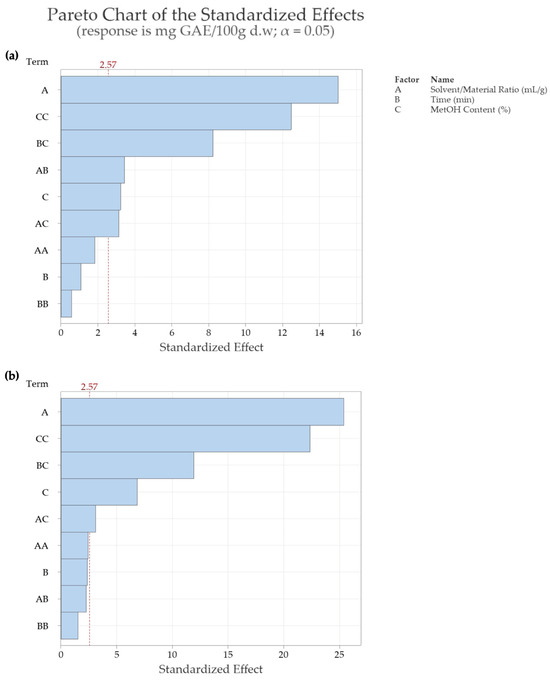
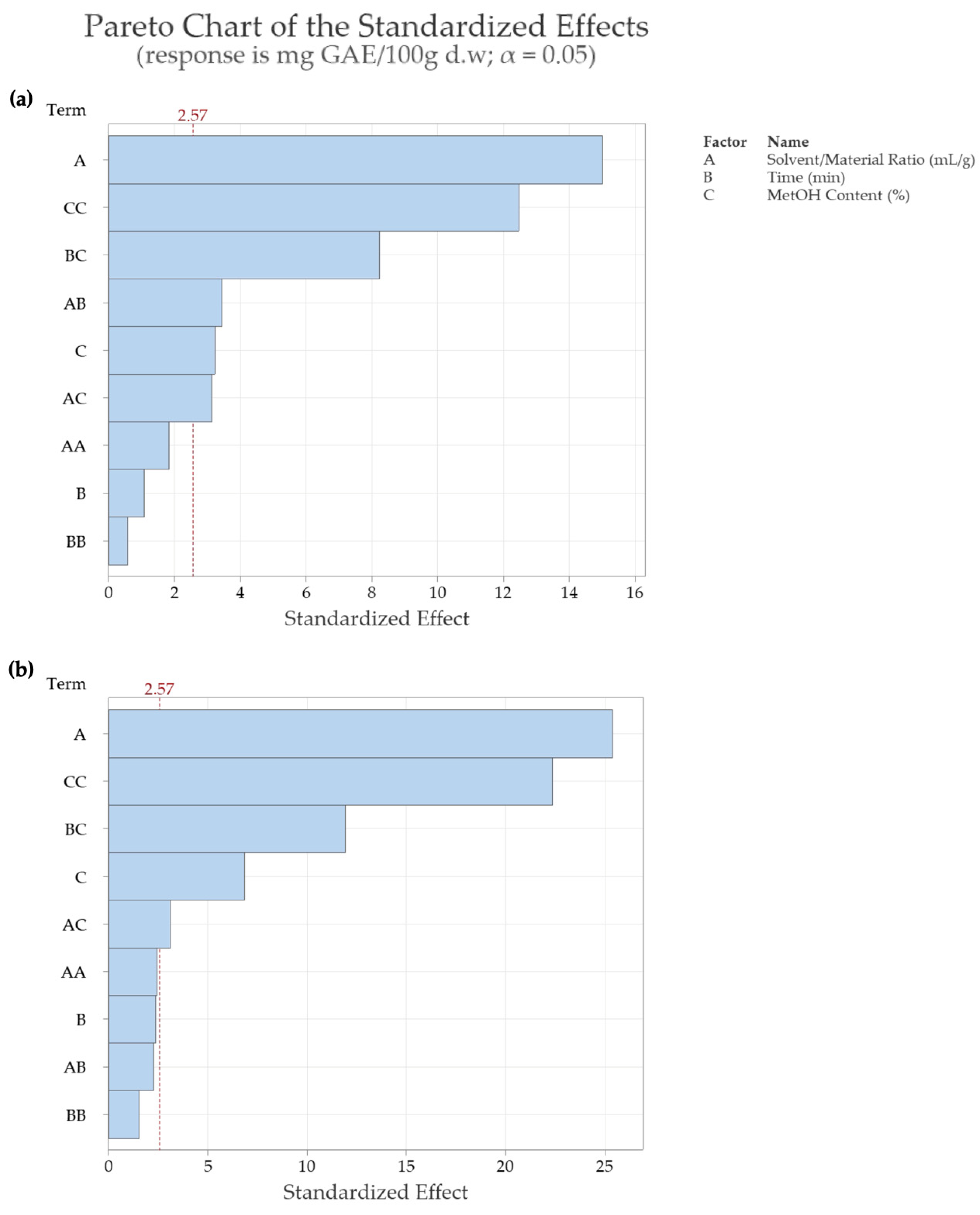
The relative importance of the model terms is illustrated in the Pareto chart of standardized effect (Figure 1). Terms crossing the vertical reference line (95% confidence level) are identified as statistically significant factors affecting the recovery of phenolic compounds.
Figure 1.
Pareto chart of standardized effects for (a) cv ‘Thassos’ and (b) cv ‘Cercy’.
The variable selection focused on retaining the full quadratic model in order to preserve predictive capability and hierarchy. All linear terms were retained in order to provide a hierarchical final model. Model reduction was only performed if it resulted in a substantial improvement in the Predicted Residual Error Sum of Squares (PRESS), as recommended by Myers at al. (2016) [34]. For the cultivar ‘Thassos’, the quadratic term X22 was removed, as it significantly enhanced the model’s predictive capacity, reducing the Predicted Residual Sum of Squares (PRESS) by 29% (from 24,038.5 to 17,027.5), and increasing the predicted R-squared (R2pred) from 87.76% to 91.33%. Additionally, the refined model exhibited a non-significant lack-of-fit (p = 0.460), confirming the accuracy of the model. The final reduced predictive model for cultivar ‘Thassos’ is therefore given by the following equation:
For cauliflower cv ‘Cercy’, removing the quadratic terms X22 (p = 0.186) resulted in the appearance of a large residual, indicating that a simplified model was unable to adequately approximate the response at certain points of the design. The lack-of-fit was also significantly lower compared to the full model (p = 0.065 and p = 0.117, respectively), while PRESS and R2pred were not improved significantly. Similar trends were observed for all terms with p > 0.05. Therefore, all model terms were retained.
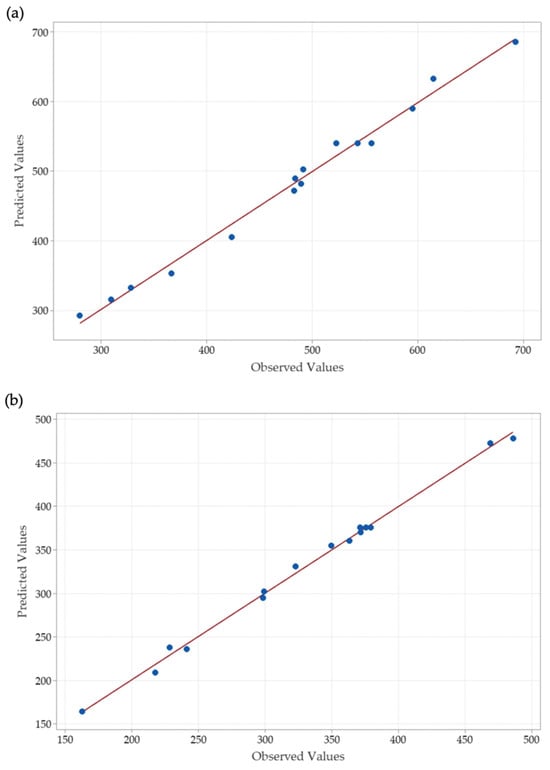
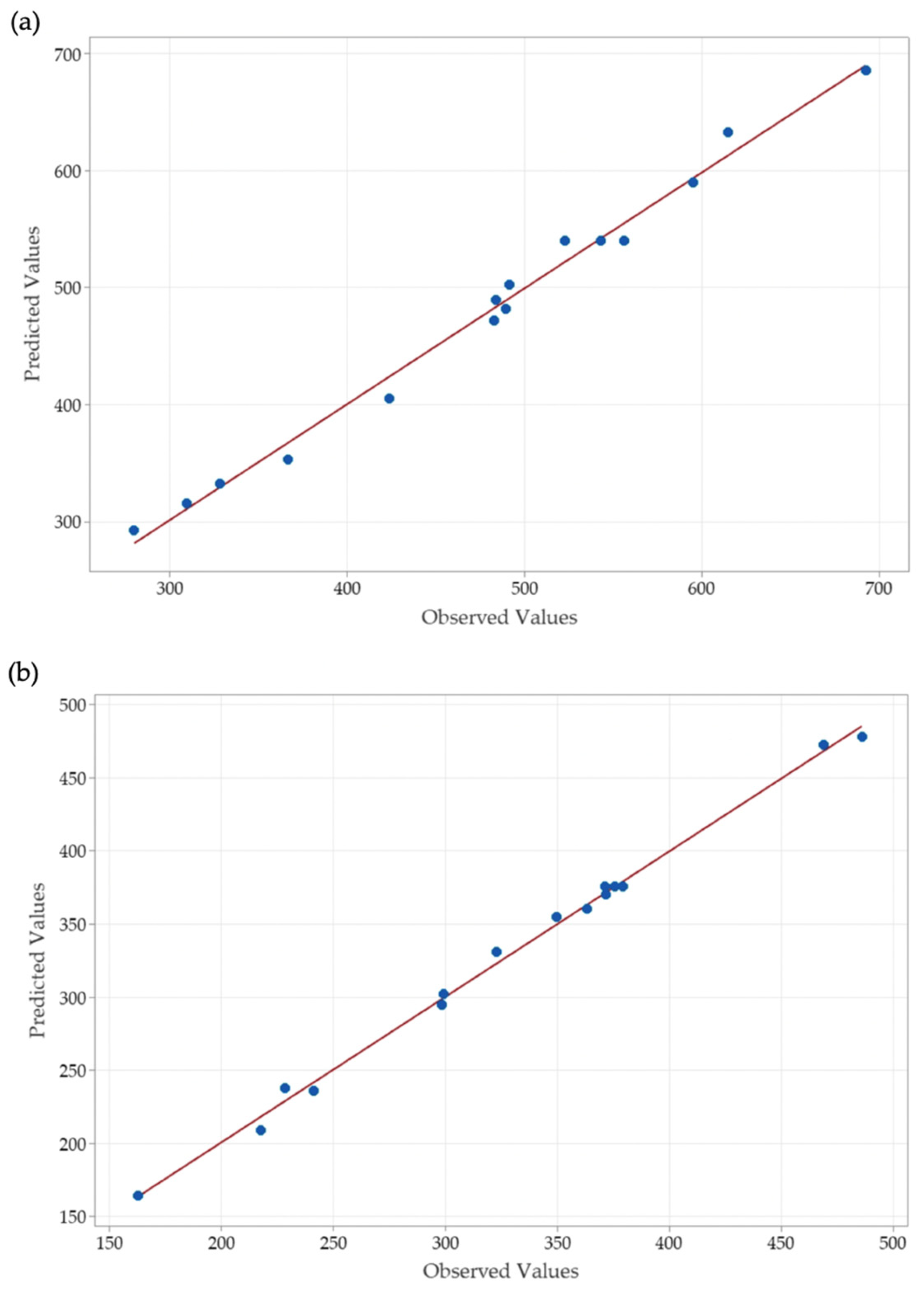
The predictive capability of the established models is presented in the plots of observed vs predicted values (Figure 2).
Figure 2.
Plots of observed versus predicted values for (a) cv ‘Thassos’ and (b) cv ‘Cercy’.
3.2. Response Surface Analysis
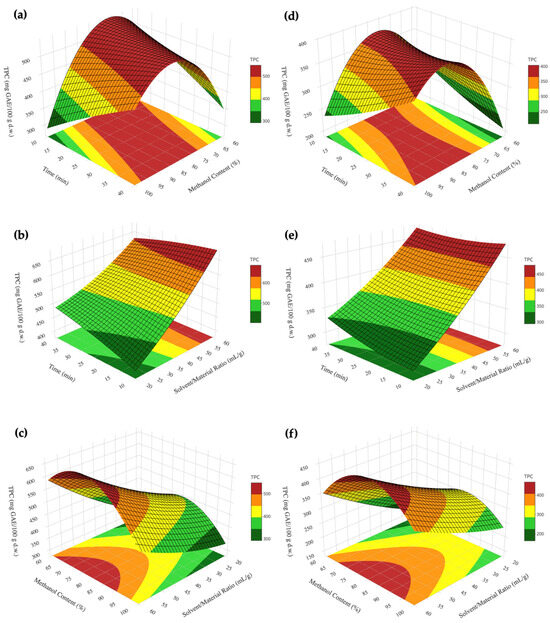
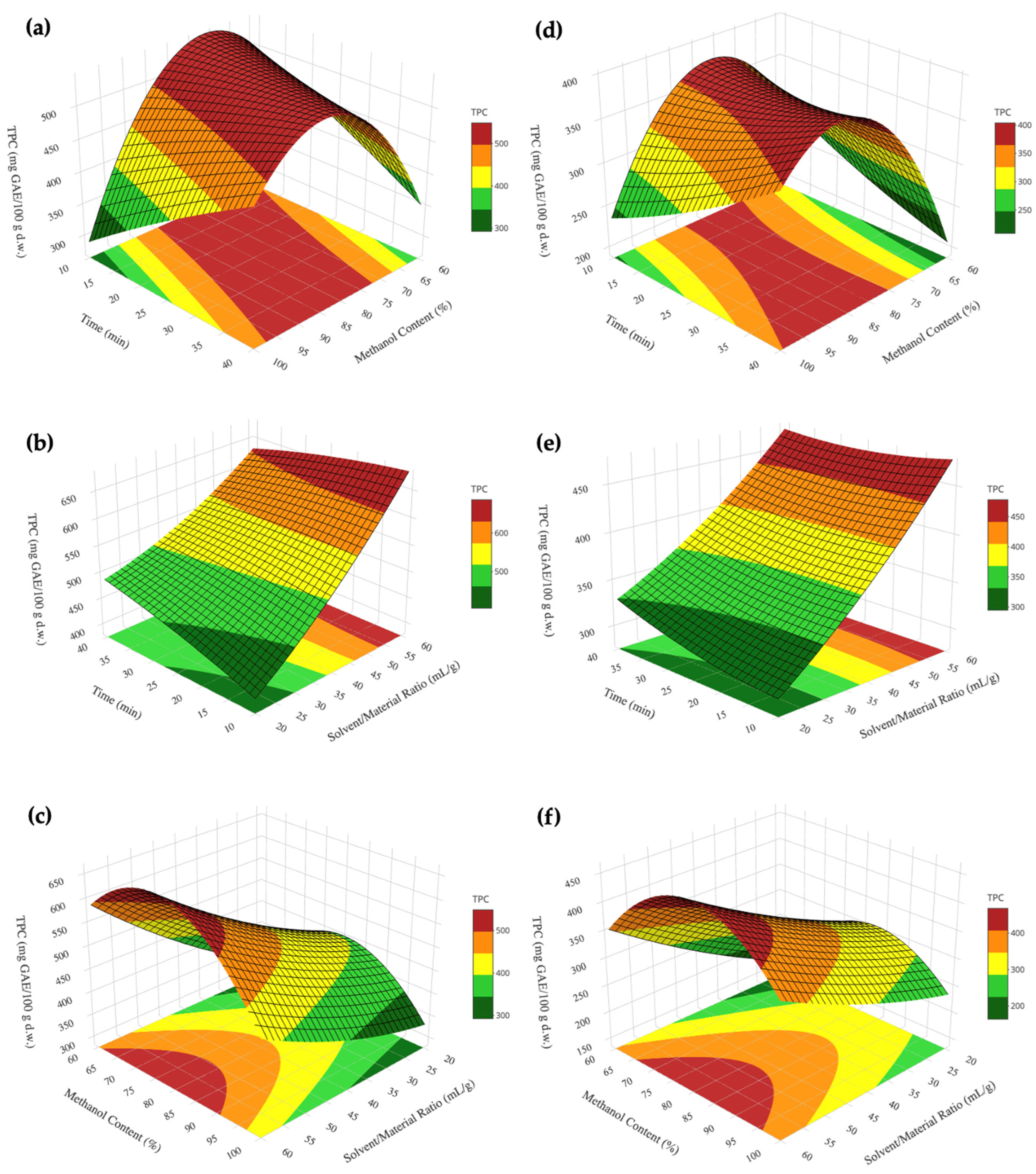
Response surface plots are 3D graphical representations generated from the mathematical second-order polynomial model. These plots illustrate the relationship between the experimental response and two independent variables, keeping the third factor constant at its central level (hold value) [35]. The response surface plots for both cultivars are depicted in Figure 3.
Figure 3.
Response surface plots for (a–c) cv ‘Thassos’ and (d–f) cv ‘Cercy’.
3.2.1. Effect of Extraction Time on TPC
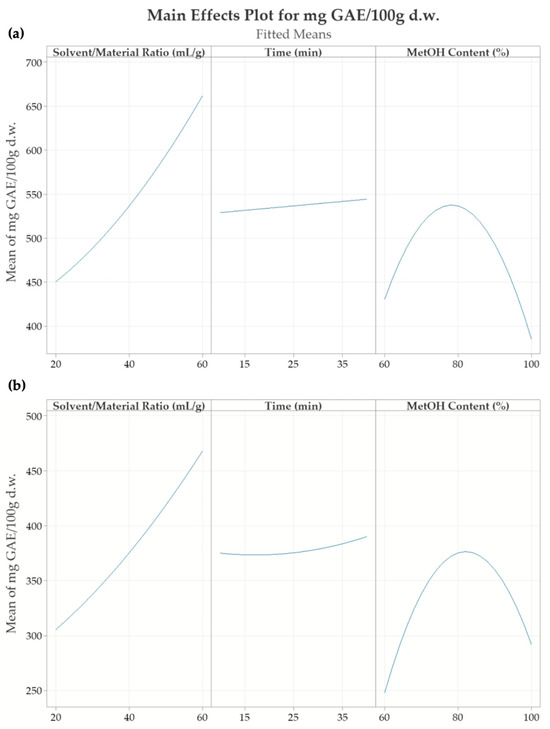
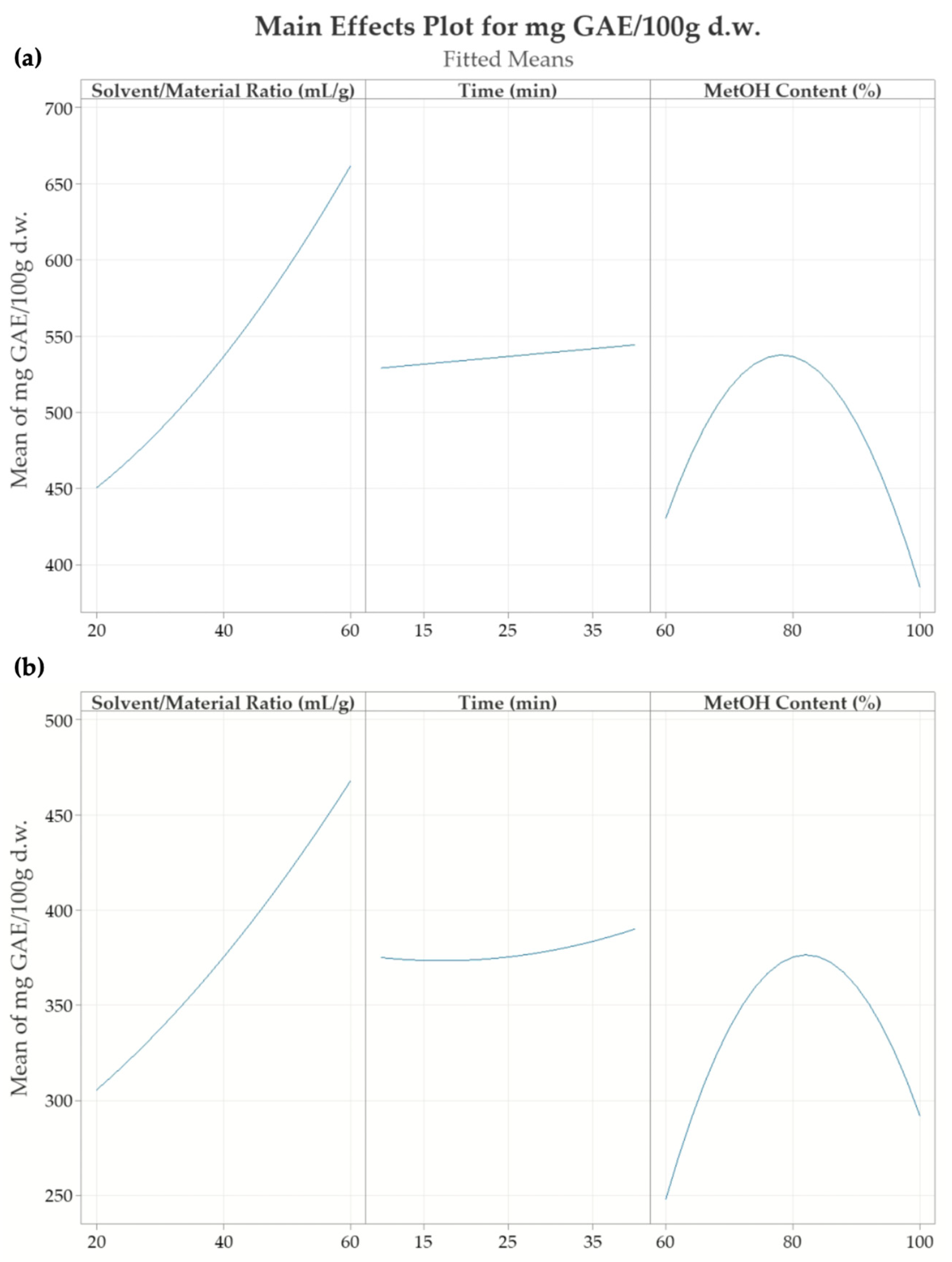
Figure 3a,d depict the interaction of extraction time with methanol proportion for broccoli and cauliflower, respectively, while the interaction with solvent/material ratio is displayed in Figure 3b for broccoli and Figure 3e for cauliflower. As evident from the surface plots involving solvent/material ratio (Figure 3b,e), the surface is relatively flat along the time axis, indicating that extraction yield remains relatively stable with an increase in extraction time. This is also evident from the main effect plots (Figure 4). However, Figure 3a,d reveal a significant interaction between extraction time and methanol proportion, which is more pronounced at the extreme limits of methanol proportion (60% and 100%), where the slope regarding extraction time varies considerably. In contrast, around the optimal methanol proportion (80%), the response to extraction time is relatively stable, confirming that prolonging the extraction process offers no substantial benefits under optimized conditions. Additionally, prolonged exposure to ultrasound treatment may lead to the degradation of phenolic compounds, as it has been previously reported [36,37]. Consequently, shorter extraction times can be selected without significant yield loss, which is advantageous for reducing energy consumption and protecting sensitive compounds from degradation [38].
Figure 4.
Main effect plot for (a) broccoli and (b) cauliflower.
3.2.2. Effect of Solvent/Material Ratio on TPC
The interaction between the solvent/material ratio and extraction time is depicted in Figure 3b for broccoli and Figure 3e for cauliflower, while the interaction with methanol proportion is illustrated in Figure 3c,f for broccoli and cauliflower, respectively. The response surface plots reveal a pronounced, linear increase in extraction yield as the solvent/material ratio increases from 20 mL/g to 60 mL/g in both matrices, irrespective of the other two factors. A high solid–liquid ratio enhances the concentration gradient between the surface and the interior of the matrix, allowing more solvent to penetrate the material [39]. Furthermore, freeze-drying increases the specific surface area and porosity of the material [26,40]. This facilitates deeper solvent penetration, while the combination of a highly porous matrix and a high solvent ratio effectively reduce the saturation level of the liquid phase, improving the extraction yield.
3.2.3. Effect of Methanol Proportion on TPC
The influence of methanol proportion on phenolic compounds yield is presented in Figure 3a,c for broccoli and Figure 3d,f for cauliflower (interactions with extraction time and solvent/material ratio, respectively). The response surfaces for methanol proportion display a characteristic quadratic curvature, evident by the convex shape, with a maximum response within the design boundaries. This leads to an increase in yield as methanol proportion increases from 60% to approximately 80% in the extracting solvent, followed by a significant decrease at 100%. High-purity methanol is permitted for use in specific food processing applications, such as an extraction solvent for plant constituents, provided it complies with strict regulatory guidelines [41]. Water acts as a swelling agent, increasing the surface area and facilitating solvent diffusion, which improves the mass transfer of phenolic compounds [42]. Moreover, pure methanol is not sufficient for extraction of highly polar phenolic glycosides [43]. On the other hand, the decrease in total phenolic content observed when water percentage increased in the extracting solvent can be attributed to the existence of less polar compounds in the matrix, since their solubility decreases in high-water mixtures [44].
3.3. Response Optimization
To determine optimal extraction conditions for maximizing the recovery of phenolic compounds from both cultivars simultaneously, a multi-response was performed using Minitab’s response optimizer. The results are presented in Table 5. The optimal conditions were identified as a solvent-to-material ratio of 60 mL/g, an extraction time of 10 min, and a methanol proportion in the solvent of approximately 76% (v/v). Under these experimental parameters, the model yielded the highest composite desirability (D = 0.996), indicating an excellent fit between the predicted values and experimental goals. The parameters were validated experimentally. Triplicate experiments were carried out under optimized conditions, yielding 708.3 ± 7.2 mg GAE/100 g d.w. for broccoli and 481.8 ± 2.2 mg GAE/100 g d.w. for cauliflower, strongly in agreement with the predicted values (711.7 and 483.0 mg GAE/100 g d.w., respectively) (Table 5). The TPC values for both studied cultivars are very close to the predicted ones, proving the model’s capacity for prediction.
Table 5.
Optimization and validation of the total phenolic content (TPC) responses.
3.4. Evaluation of Antioxidant and Radical Scavenging Activities
Optimized broccoli and cauliflower extracts were further analyzed in order to determine their radical scavenging and antioxidant activity using the ABTS and FRAP, respectively. In order to assess the practical impact of the optimization process, these results were compared against the experimental runs yielding the lowest total phenolic content.
As shown in Table 6, the results of the radical scavenging and antioxidant activity via ABTS and FRAPs for broccoli cv ‘Thassos’ ranged from 409.5 ± 17.0 mg Fe(II)/100 g d.w. and 285.9 ± 26.5 mg TE/100 g d.w. in the extracts with the lowest phenolic content, to 1177.0 ± 25.6 mg Fe(II)/100 g d.w. and 651.2 ± 19.9 mg TE/100 g d.w. in the optimized extracts, respectively. Similarly, the corresponding values for cauliflower cv ‘Cercy’ ranged from 510.9 ± 5.7 mg Fe(II)/100 g d.w. and 217.0 ± 7.1 mg TE/100 g d.w. to 990.6 ± 4.1 mg Fe(II)/100 g d.w. and 510.9 ± 5.7 mg TE/100 g d.w. in the optimized extracts. Both the antioxidant and radical scavenging activities under optimized extraction conditions were higher in the broccoli extracts.
Table 6.
Antioxidant and radical scavenging activities of broccoli and cauliflower.
Furthermore, correlation analysis revealed a positive relationship between the total phenolic content (TPC) and antioxidant/radical scavenging activities. For the broccoli extracts, a very strong positive (r = 0.99), correlation was observed between TPC and radical scavenging activity and a strong positive (r = 0.78) correlation between TPC and antioxidant activity. Similarly, cauliflower extracts exhibited a very strong positive (r = 0.94) correlation between TPC and radical scavenging activity and moderate (r = 0.63) correlation between the TPC and antioxidant activity. Bhandari and Kwak (2015) [28] also reported moderate (r = 0.698) correlation between total phenolic content and antioxidant activity in broccoli and cauliflower. This may be due to the fact that other compounds other than phenolics influence antioxidant activity in brassica vegetables, including certain polysaccharides and ascorbic acid [45,46].
3.5. Verification of Extraction Efficiency on Broccoli Naxos and Cauliflower Guideline Cultivars
The external validity of the model was tested on two additional freeze-dried cultivars, broccoli cv ‘Naxos’ and cauliflower cv ‘Guideline’, to ensure its applicability beyond the initial samples set. Samples were subjected to UAE under optimized conditions (Section 3.2), and the experimental conditions that yielded the lowest phenolic content in the initial design.
As shown in Table 7, optimized conditions consistently led to increased TPC. Under optimized conditions, broccoli cv ‘Naxos’ yielded 607.1 ± 7.6 mg GAE/100 g d.w., compared to 323.0 ± 2.3 mg GAE/100 g d.w. achieved under low-yield conditions. Similarly, the respective values for cauliflower cv ‘Guideline’ yields were 529.0 ± 5.3 and 325.3 ± 1.5 mg GAE/100 g d.w. in extracts obtained under optimized and low-yield conditions. These findings demonstrate that the optimized UAE method can be applied to different genotypes, maximizing total phenolic yield.
Table 7.
Comparative yield of total phenolic content (TPC) from examined Brassica cultivars.
The results of the one-way analysis of variance (ANOVA) demonstrated that both genotype and extraction conditions have a significant impact on the extraction yield (p < 0.05). As shown in Table 6, the highest TPC value across all cultivars was achieved under optimized extraction conditions (60 mL/g solvent-to-material ratio, 10 min extraction time and 76% methanol proportion in the extraction solvent). Under these conditions, the broccoli cultivars consistently displayed higher TPC values than the cauliflower ones. Specifically, cv ‘Thassos’ exhibited the highest TPC value (708.3 ± 7.2 mg GAE/100 g d.w.), followed by ‘Naxos’ (607.1 ± 7.6 mg GAE/100 g d.w.), ‘Guideline’ (529.1 ± 5.3 mg GAE/100 g d.w.) and ‘Cercy’ (481.8 ± 2.2 mg GAE/100 g d.w.).
4. Discussion
The experimental values of total phenolic content (TPC) obtained under different extraction conditions varied from 278.0 to 691.9 mg GAE/100 g dry weight (d.w.) for cv ‘Thassos’ and 163.0 to 485.7 mg GAE/100 g dry weight (d.w.) for cultivar ‘Cercy’. These values are mostly in agreement to those reported for various freeze-dried broccoli and cauliflower cultivars extracted with 80% methanol. Bhandari and Kwak (2015) [28] reported TPC values ranging from 599.6 to 740.1 mg GAE/100 g d.w. for three freeze-dried broccoli cultivars. In another study, TPC of a traditional Spanish Brassica oleraceae var. italica crop varied between 549 and 1321 mg GAE/100 g d.w. [47]. Hwang et al. (2019) [48] reported values of 35.01 mg GAE/g d.w. for freeze-dried cauliflower obtained after extraction with 80% ethanol with a solvent-to-material ratio of 25 mL/g.However, the values obtained in this study were significantly higher than those reported by Karatas et al. (2024) [49], where TPC in dried broccoli extracted via UAE ranged from 74.44 to 291.73 mg GAE/100 g d.w. These discrepancies may be attributed to differences in the sample pre-treatment (convection drying compared to freeze-drying). This is further supported by Hameed et al. (2023) [27], who demonstrated that freeze-drying as a pre-treatment significantly increases TPC (225.80 ± 4.04 mg GAE/g d.w.) compared to sun drying (104.83 ± 4.60 mg GAE/g d.w.) or hot air drying (176.85 ± 3.31 mg GAE/100 g d.w.). Similar results were also obtained by Xu et al. (2020) [50], with TPC varying from 2.51 mg GAE/g d.w. for broccoli samples subjected to hot air drying, compared to 4.98 mg GAE/g d.w. for samples subjected to freeze-drying.
Drabinska et al. (2021) [51] reported a TPC of 276 mg GAE/100 g d.w. for cultivar ‘Guideline’ using a standard extraction protocol with a solvent-to-material ratio of 6.7 mL/g. This value is lower than the 325.29 mg GAE/100 g d.w. obtained for the same cultivar in the current study under low-yield conditions (20 mL/g) and significantly lower than the 529.91 mg GAE/100 g d.w. achieved under optimized conditions (60 mL/g). This further supports the assumption of a positive correlation between the solvent volume and extraction efficiency, suggesting that lower solvent ratios may lead to saturation, particularly in freeze-dried samples.
Broccoli extracts were characterized by higher antioxidant and radical scavenging activities compared to cauliflower, which is in accordance with previous studies [52,53]. This association also aligns with the literature identifying hydroxycinnamic acids and flavonoids as the dominant bioactive constituents in Brassica species. Broccoli extracts also exhibited stronger correlation between total phenolic content and antioxidant capacity compared to cauliflower extracts, identifying a possible link between the specific phenolic profile of different Brassica varieties and their redox potential and radical scavenging activities. In these species, antioxidant capacity is dependent primarily on their phenolic profile and content, since these compounds often exhibit stronger antioxidant activity than vitamins and carotenoids. The antioxidant capacity of phenolic compounds is also highly dependent on their structure, with flavonoids exhibiting higher free radical scavenging activity due to their multiple hydroxyl groups and highly conjugated aromatic ring structures [54].
Martinez-Zamora et al. (2024) [55] investigated the effect of solid:liquid ratio, temperature, and time on the UAE of bioactive compounds from freeze-dried broccoli florets (cv ‘Naxos’). Their findings align with the results obtained from this study, with optimal TPC achieved under lower solid:liquid ratio (1:25 g/mL) and a relatively short extraction time (12.5 min). However, they reported a significantly higher TPC for cv ‘Naxos’ compared to our study (approx. 1300 mg GAE/100 g d.w. and 607.09 ± 7.55 mg GAE/100 g d.w., respectively), which may be attributed to differences in ultrasound parameters such as power and frequency, as well as pre-harvest factors like cultivation techniques and environmental conditions.
According to another optimization study, the optimal TPC for broccoli florets (cv ‘Imperial’) was obtained under low solid:liquid ratio (1:50 g/mL) and 80% ethanol, which is in close agreement with the solvent and ratio established in this study. The prolonged extraction duration (40 min) reported in their findings is likely attributed to the extraction method, as their study relied on agitation rather than the application of UAE [56].
The food industry has at its disposal a powerful “green” technology that involves the use of ultrasound-assisted extraction (UAE) in freeze-drying fruits and vegetables. This technology achieves a balance between high efficiency and the preservation of sensitive compounds. Both processes operate at relatively moderate temperatures, reducing the risk of heat degradation and oxidation of bioactive compounds, and lyophilization occurs under vacuum to guarantee the extract maintains its biological activity. However, the wider application of freeze-drying technique may be limited by high capital cost, long drying times, relatively low throughput, and significant energy demand. Furthermore, UAE uses lower volumes of solvents and less energy per unit of extracted material, making it more environmentally friendly. Despite its effectiveness, there are a number of challenges to overcome before the technology can be used in industry. The main limitation of this study is scalability, since achieving consistent ultrasonic intensity in large-scale tanks is challenging and costly. Additionally, efficiency may depend on the matrix and on the operating variables (solvent, time, temperature, etc.), necessitating further research for each new raw material. Specialist engineering is also required to integrate high-power ultrasonic probes into sterile freeze-drying conditions in order to guarantee the durability of the equipment and prevent contamination. Therefore, the construction of industrial freeze-drying and ultrasound systems is economically unfeasible, making commercial production challenging.
5. Conclusions
In conclusion, Response Surface Methodology was effectively applied to optimize phenolic extraction from freeze dried broccoli and cauliflower. Based on the regression model, the most significant parameters affecting recovery were the solvent-to-material ratio and methanol proportion in the solvent mixture. The application of the optimal UAE conditions is a quick method for the evaluation of different B. oleraceae var. botrytis and B. oleraceae var. italica cultivars in a laboratory setting, which consistently led to higher phenolic yield and revealed significant genotypic differences. Finally, the positive correlation between TPC, antioxidant and radical scavenging activities confirmed that optimized conditions effectively maximize the functional quality of the extracts.
Author Contributions
Conceptualization, O.S. and I.F.S.; methodology, O.S., T.T., A.E.L., V.J.S. and I.F.S.; software, O.S.; validation, O.S.; formal analysis, O.S.; investigation, O.S.; resources, I.F.S.; data curation, O.S. and I.F.S.; writing—original draft preparation, O.S.; writing—review and editing, O.S., T.T., A.E.L., V.J.S. and I.F.S.; visualization, O.S.; supervision, I.F.S. All authors have read and agreed to the published version of the manuscript.
Funding
This research received no external funding.
Institutional Review Board Statement
Not applicable.
Data Availability Statement
The original contributions in this study are included in the article. Further inquiries can be directed to the corresponding author.
Conflicts of Interest
The authors declare no conflicts of interest.
References
- Zuluaga, D.L.; D’Agostino, N.; Blanco, E.; Curci, P.L.; Sonnante, G. Genetic Relationships and Molecular Signatures of Divergence in Traditional Landraces and Morphotypes of Brassica Oleracea. Plants 2024, 14, 20. [Google Scholar] [CrossRef] [Scilit]
- Jabeen, N. Agricultural, Economic and Societal Importance of Brassicaceae Plants. In The Plant Family Brassicaceae; Hasanuzzaman, M., Ed.; Springer: Singapore, 2020; pp. 45–128. [Google Scholar]
- Branca, F.; Chiarenza, G.L.; Cavallaro, C.; Gu, H.; Zhao, Z.; Tribulato, A. Diversity of Sicilian Broccoli (Brassica oleracea Var. italica) and Cauliflower (Brassica oleracea Var. botrytis) Landraces and Their Distinctive Bio-Morphological, Antioxidant, and Genetic Traits. Genet. Resour. Crop Evol. 2018, 65, 485–502. [Google Scholar] [CrossRef] [Scilit]
- Babula, D.; Kaczmarek, M.; Ziółkowski, P.A.; Sadowski, J. Brassica Oleracea. In Vegetables; Kole, C., Ed.; Springer: Berlin/Heidelberg, Germany, 2007; pp. 227–285. [Google Scholar]
- Lo Scalzo, R.; Bianchi, G.; Picchi, V.; Campanelli, G.; Ficcadenti, N.; Treccarichi, S.; Arena, D.; Sestili, S.; Branca, F. Compositional Traits of Hybrid Populations of Brassica oleracea L. Var. italica (Broccoli) and Brassica oleracea L. Var. botrytis (Cauliflower) during Four Organic Breeding Cycles. J. Food Compos. Anal. 2024, 131, 106209. [Google Scholar] [CrossRef] [Scilit]
- Favela-González, K.M.; Hernández-Almanza, A.Y.; De La Fuente-Salcido, N.M. The Value of Bioactive Compounds of Cruciferous Vegetables (Brassica) as Antimicrobials and Antioxidants: A Review. J. Food Biochem. 2020, 44, e13414. [Google Scholar] [CrossRef] [Scilit]
- Lin, D.; Xiao, M.; Zhao, J.; Li, Z.; Xing, B.; Li, X.; Kong, M.; Li, L.; Zhang, Q.; Liu, Y.; et al. An Overview of Plant Phenolic Compounds and Their Importance in Human Nutrition and Management of Type 2 Diabetes. Molecules 2016, 21, 1374. [Google Scholar] [CrossRef] [Scilit]
- Ramirez, D.; Abellán-Victorio, A.; Beretta, V.; Camargo, A.; Moreno, D.A. Functional Ingredients from Brassicaceae Species: Overview and Perspectives. Int. J. Mol. Sci. 2020, 21, 1998. [Google Scholar] [CrossRef] [Scilit] [PubMed]
- Roselló-Soto, E.; Galanakis, C.M.; Brnčić, M.; Orlien, V.; Trujillo, F.J.; Mawson, R.; Knoerzer, K.; Tiwari, B.K.; Barba, F.J. Clean Recovery of Antioxidant Compounds from Plant Foods, by-Products and Algae Assisted by Ultrasounds Processing. Modeling Approaches to Optimize Processing Conditions. Trends Food Sci. Technol. 2015, 42, 134–149. [Google Scholar] [CrossRef] [Scilit]
- Tiwari, B.K. Ultrasound: A Clean, Green Extraction Technology. TrAC Trends Anal. Chem. 2015, 71, 100–109. [Google Scholar] [CrossRef] [Scilit]
- Chemat, F.; Rombaut, N.; Sicaire, A.-G.; Meullemiestre, A.; Fabiano-Tixier, A.-S.; Abert-Vian, M. Ultrasound Assisted Extraction of Food and Natural Products. Mechanisms, Techniques, Combinations, Protocols and Applications. A Review. Ultrason. Sonochemistry 2017, 34, 540–560. [Google Scholar] [CrossRef] [Scilit]
- Shen, L.; Pang, S.; Zhong, M.; Sun, Y.; Qayum, A.; Liu, Y.; Rashid, A.; Xu, B.; Liang, Q.; Ma, H.; et al. A Comprehensive Review of Ultrasonic Assisted Extraction (UAE) for Bioactive Components: Principles, Advantages, Equipment, and Combined Technologies. Ultrason. Sonochemistry 2023, 101, 106646. [Google Scholar] [CrossRef] [Scilit] [PubMed]
- Sethi, S.; Rathod, V.K. Recent Advances in Ultrasound-Assisted Extraction of Natural Products Using Novel Solvents: A Mini-Review. Curr. Opin. Chem. Eng. 2025, 48, 101132. [Google Scholar] [CrossRef] [Scilit]
- Bleakley, S.; Hayes, M. Algal Proteins: Extraction, Application, and Challenges Concerning Production. Foods 2017, 6, 33. [Google Scholar] [CrossRef] [Scilit]
- Kumar, K.; Srivastav, S.; Sharanagat, V.S. Ultrasound Assisted Extraction (UAE) of Bioactive Compounds from Fruit and Vegetable Processing by-Products: A Review. Ultrason. Sonochemistry 2021, 70, 105325. [Google Scholar] [CrossRef] [Scilit]
- Jannesar, R.; Zare, F.; Ghaedi, M.; Daneshfar, A. Dispersion of Hydrophobic Magnetic Nanoparticles Using Ultarsonic-Assisted in Combination with Coacervative Microextraction for the Simultaneous Preconcentration and Determination of Tricyclic Antidepressant Drugs in Biological Fluids. Ultrason. Sonochemistry 2016, 32, 380–386. [Google Scholar] [CrossRef] [Scilit]
- Picó, Y. Ultrasound-Assisted Extraction for Food and Environmental Samples. TrAC Trends Anal. Chem. 2013, 43, 84–99. [Google Scholar] [CrossRef] [Scilit]
- Ashokkumar, M. Applications of Ultrasound in Food and Bioprocessing. Ultrason. Sonochemistry 2015, 25, 17–23. [Google Scholar] [CrossRef] [Scilit]
- Sarker, S.D.; Nahar, L. An Introduction to Computational Phytochemistry. In Computational Phytochemistry; Elsevier: Amsterdam, The Netherlands, 2018; pp. 1–41. [Google Scholar]
- Feng, Y.; Ping Tan, C.; Zhou, C.; Yagoub, A.E.A.; Xu, B.; Sun, Y.; Ma, H.; Xu, X.; Yu, X. Effect of Freeze-Thaw Cycles Pretreatment on the Vacuum Freeze-Drying Process and Physicochemical Properties of the Dried Garlic Slices. Food Chem. 2020, 324, 126883. [Google Scholar] [CrossRef] [Scilit] [PubMed]
- Chumroenphat, T.; Somboonwatthanakul, I.; Saensouk, S.; Siriamornpun, S. Changes in Curcuminoids and Chemical Components of Turmeric (Curcuma longa L.) under Freeze-Drying and Low-Temperature Drying Methods. Food Chem. 2021, 339, 128121. [Google Scholar] [CrossRef] [Scilit]
- Krakowska-Sieprawska, A.; Kiełbasa, A.; Rafińska, K.; Ligor, M.; Buszewski, B. Modern Methods of Pre-Treatment of Plant Material for the Extraction of Bioactive Compounds. Molecules 2022, 27, 730. [Google Scholar] [CrossRef] [Scilit] [PubMed]
- Maisl, C.; Doppler, M.; Seidl, B.; Bueschl, C.; Schuhmacher, R. Untargeted Plant Metabolomics: Evaluation of Lyophilization as a Sample Preparation Technique. Metabolites 2023, 13, 686. [Google Scholar] [CrossRef] [Scilit]
- Liu, Z.; Wu, S.; Zuo, H.; Lin, J.; Zheng, H.; Lei, H.; Yu, Q.; Wu, X.; Guo, Z. Freeze-Drying Pretreatment of Watermelon Peel to Improve the Efficiency of Pectin Extraction: RSM Optimization, Extraction Mechanism, and Characterization. Int. J. Biol. Macromol. 2023, 249, 125944. [Google Scholar] [CrossRef] [Scilit]
- Santos, A.A.D.L.; Leal, G.F.; Marques, M.R.; Reis, L.C.C.; Junqueira, J.R.D.J.; Macedo, L.L.; Corrêa, J.L.G. Emerging Drying Technologies and Their Impact on Bioactive Compounds: A Systematic and Bibliometric Review. Appl. Sci. 2025, 15, 6653. [Google Scholar] [CrossRef] [Scilit]
- Senevirathna, N.; Hassanpour, M.; O’Hara, I.; Karim, A. Investigation of the Effects of Energy-Efficient Drying Techniques and Extraction Methods on the Bioactive and Functional Activity of Banana Inflorescence. Energies 2024, 17, 4119. [Google Scholar] [CrossRef] [Scilit]
- Hameed, A.; Fatima, N.; Iftikhar, H.; Mehmood, A.; Tariq, M.R.; Ali, S.W.; Ali, S.; Shafiq, M.; Ahmad, Z.; Ali, U.; et al. Effect of Different Drying and Cooking Treatments on Phytochemicals and Antioxidant Activity in Broccoli: An Experimental in Vitro Study. Food Sci. Technol. 2023, 43, e101622. [Google Scholar] [CrossRef] [Scilit]
- Bhandari, S.; Kwak, J.-H. Chemical Composition and Antioxidant Activity in Different Tissues of Brassica Vegetables. Molecules 2015, 20, 1228–1243. [Google Scholar] [CrossRef] [Scilit]
- Coşkun, N.; Sarıtaş, S.; Jaouhari, Y.; Bordiga, M.; Karav, S. The Impact of Freeze Drying on Bioactivity and Physical Properties of Food Products. Appl. Sci. 2024, 14, 9183. [Google Scholar] [CrossRef] [Scilit]
- Uwineza, A.; Zhang, X. Application of Freeze-Drying Technology in the Food Industry: A Review. Foods 2026, 15, 790. [Google Scholar] [CrossRef] [Scilit]
- Andreou, V.; Strati, I.F.; Fotakis, C.; Liouni, M.; Zoumpoulakis, P.; Sinanoglou, V.J. Herbal Distillates: A New Era of Grape Marc Distillates with Enriched Antioxidant Profile. Food Chem. 2018, 253, 171–178. [Google Scholar] [CrossRef] [Scilit] [PubMed]
- Lantzouraki, D.Z.; Sinanoglou, V.J.; Zoumpoulakis, P.G.; Glamočlija, J.; Ćirić, A.; Soković, M.; Heropoulos, G.; Proestos, C. Antiradical–Antimicrobial Activity and Phenolic Profile of Pomegranate (Punica granatum L.) Juices from Different Cultivars: A Comparative Study. RSC Adv. 2015, 5, 2602–2614. [Google Scholar] [CrossRef] [Scilit]
- Tsiaka, T.; Stavropoulou, N.A.; Giannakourou, M.C.; Strati, I.F.; Sinanoglou, V.J. Optimization of Ultrasound-Assisted Extraction and Characterization of the Phenolic Compounds in Rose Distillation Side Streams Using Spectrophotometric Assays and High-Throughput Analytical Techniques. Molecules 2023, 28, 7403. [Google Scholar] [CrossRef] [Scilit] [PubMed]
- Myers, R.H.; Montgomery, D.C.; Anderson-Cook, C.M. Response Surface Methodology: Process and Product Optimization Using Designed Experiments, 4th ed.; New York Academy of Sciences Series; John Wiley & Sons, Incorporated: Hoboken, NJ, USA, 2016. [Google Scholar]
- Baş, D.; Boyacı, İ.H. Modeling and Optimization I: Usability of Response Surface Methodology. J. Food Eng. 2007, 78, 836–845. [Google Scholar] [CrossRef] [Scilit]
- Prawira-Atmaja, M.I.; Puangpraphant, S. Effects of Ultrasound-Assisted Bath, Probe, and Extraction Time on Bioactive Compounds and Antioxidant Activity in White Tea (Camellia Sinensis) Extracts from Purple- and Green-Leaf Cultivars. J. Saudi Soc. Agric. Sci. 2025, 24, 10. [Google Scholar] [CrossRef] [Scilit]
- Aliaño-González, M.J.; Jarillo, J.A.; Carrera, C.; Ferreiro-González, M.; Álvarez, J.Á.; Palma, M.; Ayuso, J.; Barbero, G.F.; Espada-Bellido, E. Optimization of a Novel Method Based on Ultrasound-Assisted Extraction for the Quantification of Anthocyanins and Total Phenolic Compounds in Blueberry Samples (Vaccinium corymbosum L.). Foods 2020, 9, 1763. [Google Scholar] [CrossRef] [Scilit]
- González, M.; Barrios, S.; Budelli, E.; Pérez, N.; Lema, P.; Heinzen, H. Ultrasound Assisted Extraction of Bioactive Compounds in Fresh and Freeze-Dried Vitis Vinifera Cv Tannat Grape Pomace. Food Bioprod. Process. 2020, 124, 378–386. [Google Scholar] [CrossRef] [Scilit]
- Septiani, I.E.; Kumoro, A.C.; Djaeni, M. The Effect of Solvent Volume Ratio and Extraction Time on the Yield of Red Dye from Sappanwood. IOP Conf. Ser. Mater. Sci. Eng. 2021, 1053, 012128. [Google Scholar] [CrossRef] [Scilit]
- Hu, X.; Zhang, B.; Du, X.; Zhang, H.; Zhu, T.; Zhang, S.; Yang, X.; Zhang, Z.; Yang, T.; Wang, X.; et al. Recent Advances and Future Perspectives on Heat and Mass Transfer Mechanisms Enhanced by Preformed Porous Media in Vacuum Freeze-Drying of Agricultural and Food Products. Foods 2025, 14, 2966. [Google Scholar] [CrossRef] [Scilit]
- European Parliament. Council Directive 2009/32/EC of the European Parliament and of the Council of 23 April 2009 on the Approximation of the Laws of the Member States on Extraction Solvents Used in the Production of Foodstuffs and Food Ingredients; The European Parliament and the Council of the European Union: Strasbourg, France, 2009; pp. 1–12. [Google Scholar]
- Plaskova, A.; Mlcek, J. New Insights of the Application of Water or Ethanol-Water Plant Extract Rich in Active Compounds in Food. Front. Nutr. 2023, 10, 1118761. [Google Scholar] [CrossRef] [Scilit]
- Xiang, Z.; Liu, L.; Xu, Z.; Kong, Q.; Feng, S.; Chen, T.; Zhou, L.; Yang, H.; Xiao, Y.; Ding, C. Solvent Effects on the Phenolic Compounds and Antioxidant Activity Associated with Camellia Polyodonta Flower Extracts. ACS Omega 2024, 9, 27192–27203. [Google Scholar] [CrossRef] [Scilit] [PubMed]
- Jovanović, A.A.; Đorđević, V.B.; Zdunić, G.M.; Pljevljakušić, D.S.; Šavikin, K.P.; Gođevac, D.M.; Bugarski, B.M. Optimization of the Extraction Process of Polyphenols from Thymus serpyllum L. Herb Using Maceration, Heat- and Ultrasound-Assisted Techniques. Sep. Purif. Technol. 2017, 179, 369–380. [Google Scholar] [CrossRef] [Scilit]
- Tien, P.-Y.; Yang, P.-F.; Weng, Y.-M.; Yu, Z.-R.; Wang, B.-J. Antioxidant Properties and Sensory Preference of Broccoli Affected by Culinary Practices. Curr. Res. Nutr. Food Sci. J. 2024, 12, 1409–1420. [Google Scholar] [CrossRef] [Scilit]
- Multesku, M.; Susman, I.E.; Burnichi, F.; Israel-Roming, F. Antioxidant Activity in Selected Brassicaceae Vegetables. Sci. Bull. Ser. F. Biotechnol. 2021, 25, 51–58. [Google Scholar]
- Montaner, C.; Mallor, C.; Laguna, S.; Zufiaurre, R. Bioactive Compounds, Antioxidant Activity, and Mineral Content of Bróquil: A Traditional Crop of Brassica oleracea Var. italica. Front. Nutr. 2023, 9, 1006012. [Google Scholar] [CrossRef] [Scilit]
- Hwang, E.-S. Effect of Cooking Method on Antioxidant Compound Contents in Cauliflower. Prev. Nutr. Food Sci. 2019, 24, 210–216. [Google Scholar] [CrossRef] [Scilit]
- Karataş, M.; Erzen, B.; Deniz, Ş.; Aydoğmuş, E. Enhancing Phenolic Content in Dried Broccoli: Insights from Ultrasonic Assisted Extraction and Response Surface Methodology. Int. J. Adv. Nat. Sci. Eng. Res. 2024, 8, 559–564. [Google Scholar]
- Xu, Y.; Xiao, Y.; Lagnika, C.; Song, J.; Li, D.; Liu, C.; Jiang, N.; Zhang, M.; Duan, X. A Comparative Study of Drying Methods on Physical Characteristics, Nutritional Properties and Antioxidant Capacity of Broccoli. Dry. Technol. 2020, 38, 1378–1388. [Google Scholar] [CrossRef] [Scilit]
- Drabińska, N.; Jeż, M.; Nogueira, M. Variation in the Accumulation of Phytochemicals and Their Bioactive Properties among the Aerial Parts of Cauliflower. Antioxidants 2021, 10, 1597. [Google Scholar] [CrossRef] [Scilit]
- Sikora, E.; Cieślik, E.; Leszczyńska, T.; Filipiak-Florkiewicz, A.; Pisulewski, P.M. The Antioxidant Activity of Selected Cruciferous Vegetables Subjected to Aquathermal Processing. Food Chem. 2008, 107, 55–59. [Google Scholar] [CrossRef] [Scilit]
- Dos Reis, L.C.R.; De Oliveira, V.R.; Hagen, M.E.K.; Jablonski, A.; Flôres, S.H.; De Oliveira Rios, A. Carotenoids, Flavonoids, Chlorophylls, Phenolic Compounds and Antioxidant Activity in Fresh and Cooked Broccoli (Brassica oleracea Var. Avenger) and Cauliflower (Brassica oleracea Var. Alphina F1). LWT-Food Sci. Technol. 2015, 63, 177–183. [Google Scholar] [CrossRef] [Scilit]
- Ross, I.A. The Bioactive Components of Brassicaceae. In Plant-Based Therapeutics, Volume 2; Springer Nature: Cham, Switzerland, 2024; pp. 17–95. [Google Scholar]
- Martínez-Zamora, L.; Hashemi, S.; Cano-Lamadrid, M.; Bueso, M.C.; Aguayo, E.; Kessler, M.; Artés-Hernández, F. Ultrasound-Assisted Extraction of Bioactive Compounds from Broccoli By-Products. Foods 2024, 13, 1441. [Google Scholar] [CrossRef] [Scilit]
- González, F.; Quintero, J.; Del Río, R.; Mahn, A. Optimization of an Extraction Process to Obtain a Food-Grade Sulforaphane-Rich Extract from Broccoli (Brassica oleracea Var. italica). Molecules 2021, 26, 4042. [Google Scholar] [CrossRef] [Scilit]

Disclaimer/Publisher’s Note: The statements, opinions and data contained in all publications are solely those of the individual author(s) and contributor(s) and not of MDPI and/or the editor(s). MDPI and/or the editor(s) disclaim responsibility for any injury to people or property resulting from any ideas, methods, instructions or products referred to in the content. |
© 2026 by the authors. Licensee MDPI, Basel, Switzerland. This article is an open access article distributed under the terms and conditions of the Creative Commons Attribution (CC BY) license.