


Featured Application
The proposed framework can be applied to knowledge-intensive natural language processing tasks, including open-domain question answering, multi-hop reasoning, and fact verification.
Abstract
Retrieval-Augmented Generation (RAG) has become an important paradigm for knowledge-intensive natural language processing, as it enables Large Language Models (LLMs) to access external evidence beyond their parametric memory. However, existing RAG pipelines often rely on static user queries and predominantly semantic matching, which makes them less effective in data-intensive scenarios that require structured knowledge and multi-hop evidence aggregation. To address these limitations, we propose DMAR, a dynamic multi-anchor retrieval framework for retrieval refinement in knowledge-augmented generation. DMAR first identifies high-confidence anchor documents from an initial candidate pool through a dual-path evaluator that combines semantic relevance with knowledge-graph-based structural association. The selected anchors are then used to guide generative query reformulation, producing an enriched query for second-stage retrieval, followed by fidelity-controlled reranking to preserve alignment with the user’s original intent. We further model structural relevance using Subgraph Shapley Values and a learnable Siamese GNN-based similarity module. Experiments on five knowledge-intensive benchmarks, covering open-domain question answering, multi-hop reasoning, and fact verification, show that DMAR consistently improves retrieval and downstream answer quality over strong baselines. For example, DMAR achieves an F1 score of 62.5% on HotpotQA and 79.0% on TriviaQA. These results demonstrate that dynamically integrating semantic retrieval, structural knowledge, and query reformulation is an effective approach for robust knowledge-augmented NLP systems.
1. Introduction
This section is organized as follows: Section 1.1 introduces the research background and motivation of this study. Section 1.2 discusses the limitations of existing methods, and Section 1.3 summarizes the main contributions of the proposed framework.
1.1. Research Background and Motivation
In recent years, the rapid development of Large Language Models (LLMs), such as the GPT series [1], has substantially advanced research in natural language processing, information retrieval, and text mining. Despite their strong generative and reasoning capabilities, LLMs remain limited by the temporal scope of their pre-training data, are prone to factual hallucinations [2,3], and cannot directly exploit external or domain-specific knowledge repositories. These limitations are particularly evident in knowledge-intensive NLP tasks, where accurate responses depend on retrieving, integrating, and validating evidence from large-scale heterogeneous data sources. Retrieval-Augmented Generation (RAG) [4] has therefore emerged as a practical framework for combining the generative capacity of LLMs with explicit access to external knowledge.
However, the effectiveness of a RAG system depends fundamentally on the quality of its retrieval module [5,6]. As the upstream component of the pipeline, retrieval determines the evidence boundary available to the downstream generator, and thus largely sets the upper bound of final answer quality. This makes retrieval refinement a central problem in modern RAG systems, especially for knowledge-intensive tasks such as open-domain question answering, multi-hop reasoning, and fact verification.
Existing retrieval approaches face a persistent trade-off. Efficient dense retrievers [7] offer low-latency semantic matching, but they often struggle with the semantic gap between user queries and corpus language and remain insensitive to structured entity relations [8] that are crucial for complex reasoning. More expressive retrieval or reranking methods can better exploit multi-hop or structure-aware signals, but they usually incur substantially higher computational overhead. Motivated by this gap, this work focuses on improving retrieval refinement for knowledge-augmented generation in scenarios that require structured knowledge and multi-hop evidence aggregation [9,10].
1.2. Limitations of Existing Methods
Despite the great success of RAG, its practical effectiveness remains fundamentally constrained by the quality of the retrieval stage. In practice, existing retrieval approaches face a persistent trade-off between efficiency and expressiveness: efficient dense retrievers provide low-latency semantic matching, whereas more expressive retrieval or reranking methods can better exploit complex signals but usually incur substantially higher computational overhead. Within this broader trade-off, two core and closely related limitations are especially restrictive in knowledge-intensive settings:
1.2.1. Sub-Optimal Retrieval Due to Static Queries
In efficient retrieval pipelines, especially those built on dense first-stage retrieval, the user’s original query is often used directly as the retrieval instruction. However, a user’s initial phrasing is often concise, colloquial, or even ambiguous, which can create a significant “semantic gap” with the structured and specialized language style of documents in a knowledge base. As pointed out in a recent series of studies [9,11], using such unoptimized static queries for retrieval often fails to retrieve information-rich documents, leading to sub-optimal retrieval, which in turn degrades generation quality. This weakness is particularly pronounced in multi-hop or evidence-aggregation settings, where the required intermediate entities or relations are rarely stated explicitly in the original query.
1.2.2. Limitation of Purely Semantic Relevance Estimation
Current mainstream retrieval methods, especially dense retrievers, primarily rely on vector-space similarity, such as cosine similarity, to estimate relevance. While this design is effective for capturing broad semantic correspondence, it remains inherently limited when the connection between a query and a document depends on structured knowledge, entity relationships, or latent reasoning paths rather than direct semantic overlap. Several studies have attempted to address this issue by incorporating external structured information such as knowledge graphs [12,13,14]. For example, two entities that are not directly similar in surface semantics may still be strongly related through a specific path in a knowledge graph, and relying exclusively on semantic similarity can therefore overlook critical evidence. More expressive structure-aware retrieval or reranking methods can partially mitigate this problem, but they often introduce substantially higher computational cost and inference latency, which limits their practicality in real-world deployment [9,13,14].
Taken together, these limitations show that the challenge in modern RAG retrieval is not merely to improve relevance estimation in isolation but to do so in a way that remains computationally practical for real deployment. In other words, the core problem is to refine retrieval under complex information needs while balancing retrieval accuracy, structural awareness, and efficiency. This broader challenge motivates the framework presented in the following section.
1.3. Our Contributions
To systematically address the aforementioned issues, we propose the Dynamic Multi-Anchor Guided Retrieval (DMAR) framework. The core idea of DMAR is to dynamically understand user intent and guide the retrieval process through a multi-stage, hierarchical refinement flow. The framework first identifies a small set of high-confidence “anchor” documents from an initial pool of retrieved candidates using a dual-path evaluation framework that jointly assesses semantic similarity and knowledge-graph-based structural association. To quantify this structural association, we use the Shapley value from cooperative game theory for contribution attribution. Subsequently, these anchors are used to guide a generative model in reformulating the user’s static query into an enriched query that better captures user intent. Finally, the system performs second-stage retrieval based on this dynamic query and conducts Fidelity-Controlled Reranking conditioned on the user’s original query.
Specifically, we propose the Dynamic Multi-Anchor Guided Retrieval (DMAR) framework, which refines retrieval through a multi-stage hierarchical process. DMAR first identifies a small set of high-confidence anchor documents from an initial candidate pool using a dual-path evaluator that jointly measures semantic relevance and knowledge-graph-based structural association. It then uses these anchors as evidence to guide generative query reformulation, producing an enriched query for second-stage retrieval, followed by fidelity-controlled reranking with respect to the original query. Through this design, retrieval is transformed from a single-pass operation into a cascaded evidence acquisition process that is better aligned with complex information needs.
The main contributions of this paper can be summarized as follows:
- We propose DMAR, a unified multi-stage retrieval framework for knowledge-augmented generation that jointly addresses query under-specification and the limitations of purely semantic relevance estimation in knowledge-intensive tasks.
- We introduce an evidence-guided query reformulation module and a structural relevance modeling method based on Subgraph Shapley Values and a Siamese GNN-based similarity module, enabling adaptive integration of semantic and knowledge-graph signals during retrieval refinement.
- We conduct extensive experiments on five public benchmarks spanning open-domain question answering, multi-hop reasoning, and fact verification, showing that DMAR consistently improves retrieval effectiveness and downstream answer quality over strong baselines.
2. Related Work
This section aims to review the technological advancements in three core areas closely related to this research: (1) the evolving paradigms of Retrieval-Augmented Generation (RAG); (2) query reformulation techniques for improving retrieval performance; (3) various methods for integrating Knowledge Graphs (KGs) into language models.
2.1. Retrieval-Augmented Generation (RAG)
Retrieval-Augmented Generation (RAG), as an effective paradigm for enhancing the capabilities of Large Language Models (LLMs) with external knowledge bases, has become a mainstream technology for knowledge-intensive Natural Language Processing tasks. The basic RAG framework utilizes a two-stage “retrieve-then-generate” process, where documents retrieved from a knowledge base are used as context, fed along with the user query to a generator, thereby effectively improving the factual accuracy of the generated content and reducing “hallucinations” [4].
However, researchers have gradually realized the limitations of this simple, single-pass retrieval mechanism. Incorporating a fixed number of retrieved documents without discrimination may degrade generation quality due to irrelevant content or harm the model’s versatility in scenarios where external knowledge is not required [15,16]. To address this challenge, more advanced RAG paradigms have been proposed. For example, the SELF-RAG framework empowers the model to adaptively decide when to retrieve and to critique both the retrieved content and its own generated output by training the language model to generate special “reflection tokens” [15]. For example, Blended RAG seeks to improve initial retrieval precision by fusing sparse and dense retrieval signals to provide higher-quality context for the subsequent generator [17]. These efforts collectively drive the evolution of RAG from a static process to a more dynamic and self-regulating framework. Nevertheless, most of these advances still operate at the paradigm level, focusing on when to retrieve, how much to retrieve, or how to regulate generation. They do not fully address the finer-grained problem of retrieval refinement when relevant evidence is structurally dispersed, only weakly semantically matched, or distributed across multiple hops.
2.2. Query Reformulation
Query reformulation is a classic problem in the field of information retrieval, aiming to bridge the “language gap” between a user’s original query and the relevant text in a document corpus. With the rise of large language models, leveraging their generative capabilities for query reformulation has become a promising research direction [9,10,18,19].
Existing research has primarily explored two paths for LLM-based query reformulation. The first is generating a “pseudo document.” In this line of work, exemplified by HyDE [9], an LLM is prompted to generate a hypothetical, content-complete document based on the original query, which may contain fabricated information. The vector representation of this document is believed to capture the user’s deeper information needs more effectively than the original short query, thus better locating relevant real documents in the vector space. The second path involves generating expansion words or phrases. For instance, research by Jagerman et al. [10] has shown that directly prompting an LLM to generate a series of related keywords or alternative phrasings for the original query, and then appending them to it, can also effectively improve the recall of the retrieval system. The core of these methods lies in utilizing the vast world knowledge stored within the LLM to optimize the query without reference to external documents.
While these methods are effective at enriching short or under-specified queries, they remain predominantly query-side semantic enhancement strategies. Because the reformulation process is often driven by the model’s parametric knowledge rather than task-specific retrieved evidence, the generated query may drift away from the actual evidence distribution of the corpus, especially in multi-hop settings that require explicit intermediate entities or relations.
2.3. Knowledge Graph Enhanced Natural Language Processing
Integrating symbolic Knowledge Graphs (KGs) with neural network models is a crucial approach for addressing the shortcomings of the latter in handling structured factual knowledge. Related work can be broadly categorized into two main classes: fusion during the pre-training phase and fusion during the application phase.
In terms of pre-training phase fusion, researchers have attempted to modify model architectures or training objectives. For example, K-BERT [20] injects KG triples related to entities in the text directly into BERT’s input sequence through a “sentence tree” structure, controlling the scope of knowledge influence with a visible matrix. KEPLER [21], on the other hand, takes a different approach by jointly optimizing two objectives—Knowledge Embedding (KE) and Masked Language Model (MLM)—to encode entities (represented by their textual descriptions) and text into a unified semantic space.
In application phase fusion, the focus is on how to use KGs as a readily available external knowledge source. A work highly relevant to RAG is KAPING [22], which, in a zero-shot scenario, first retrieves relevant triple facts from a KG for a given query. It then prepends the textual form of these facts directly into the LLM’s prompt to provide direct knowledge for answer generation. Additionally, in the field of neural information retrieval, the EDRM [23] model constructs a “duet” interaction matrix of words and entities, using entity information as an independent signal that participates alongside traditional lexical signals in the document ranking computation. These methods demonstrate the flexibility and potential of KG-aware retrieval without altering the pre-trained model itself.
However, existing KG-enhanced approaches often use structured knowledge either as auxiliary prompt content or as an additional interaction signal, rather than treating structural relevance as a first-class factor in retrieval refinement itself. As a result, they do not fully exploit knowledge graphs for dynamically selecting high-value evidence, guiding query reformulation, or calibrating final reranking decisions under complex information needs.
2.4. Advanced Reranking and Multi-Stage Retrieval
The standard retrieve-and-rank pipeline typically includes an initial retrieval stage and a subsequent reranking stage [24]. The introduction of BERT substantially influenced modern reranking research. Through its Cross-Encoder architecture, the model can model the interaction between the query and each candidate document in detail, achieving strong ranking performance and serving as a widely used reranking baseline on several benchmarks [25].
Despite their strong ranking performance, such rerankers also have limitations. First, they are computationally expensive and difficult to apply over large candidate pools at scale [26]. Second, most reranking methods still model relevance primarily through query–document interaction in text space, without explicitly incorporating structured knowledge signals. Third, they usually optimize document relevance directly, but do not explicitly control whether the final ranking remains faithful to the user’s original intent after query reformulation or multi-stage retrieval [27].
2.5. Summary and Positioning of This Work
Based on the analysis above, existing research has made significant progress in advancing RAG towards more dynamic and knowledge-aware paradigms. However, current solutions to static queries and purely semantic relevance estimation remain fragmented. Query reformulation methods can enrich under-specified queries, but they often rely heavily on parametric knowledge and lack grounding in retrieval-time evidence. KG-enhanced approaches incorporate structured information, but many of them use retrieved triples mainly as auxiliary prompt content or local ranking signals, without fully integrating structural relevance into the retrieval refinement process.
In contrast, DMAR is designed as a unified cascaded retrieval–refinement framework, in which structural evaluation, evidence-grounded reformulation, and fidelity-preserving reranking are coordinated rather than optimized as isolated components. This design allows retrieval refinement to be guided by both semantic evidence and structured knowledge under complex information needs.
3. Methodology
To address the limitations of traditional Retrieval-Augmented Generation (RAG) models in handling complex information needs, such as static queries and single-dimensional relevance assessment, we propose a Dynamic Multi-Anchor Guided Retrieval (DMAR) framework. This section presents its system architecture and core components. DMAR adopts a four-stage cascaded retrieval pipeline designed to provide the downstream language model with contextual evidence of high relevance, precision, and faithfulness through progressive refinement. Section 3 contains several methodological components grounded in earlier foundational studies, including BM25-based lexical retrieval, cosine similarity, Z-score normalization, Shapley-value attribution, and contrastive graph representation learning. We retain these references because they define standard formulations that remain valid and widely used in current retrieval and graph-learning research; more recent studies have mainly extended their applications rather than overturning their underlying assumptions. At the same time, the task setting and design motivation of DMAR are positioned with respect to recent RAG and knowledge-augmented retrieval literature, as reviewed in Section 1.1 and Section 1.2. In this paper, “adaptive fusion mechanism” and “fidelity-controlled reranking” denote the two design elements newly introduced in DMAR and are defined in the following subsections.
3.1. Overall System Architecture
The overall architecture of DMAR (as illustrated in Figure 1) follows a Hierarchical Refinement design philosophy. This architecture eschews a linear pipeline in favour of tightly coupled stages that operate synergistically. Its core mechanism is to first dynamically identify and validate a small set of high-quality “anchor” documents from a broad initial pool of recalled candidates. These validated anchors then serve as a reliable contextual foundation to guide the subsequent query reformulation and reranking processes, thereby systematically improving the final quality of information retrieval.
Figure 1.
The overall architecture of the DMAR framework. This figure illustrates the four main modules: Initial Retrieval, Dual-Path Anchor Selection, Anchor-Guided Query Reformulation, and Fidelity-Controlled Reranking. Source: Prepared by the authors.
3.2. Phase One: Candidate Recall
As the foundational step of the information retrieval process, the main objective of this stage is to efficiently construct an initial candidate set with high recall from the large-scale document corpus . We accomplish this task using the classic BM25 algorithm [28,29], which is based on term frequency-inverse document frequency statistics. It offers low computational complexity and robust performance for keyword-oriented queries. Its relevance scoring function is defined as follows:
Here, the term weight is calculated as
We rank all documents based on this score and select the top-n documents to form the initial candidate set . Although this stage ensures broad content coverage, the signal-to-noise ratio of the resulting candidate set is typically low. To mitigate noise propagation to subsequent precision-oriented stages, a dedicated follow-up stage for refining high-value information is essential.
3.3. The Core Evaluation Framework
To improve document discrimination beyond conventional retrieval pipelines, we introduce a unified multi-dimensional relevance evaluation framework at key decision points in DMAR. Rather than relying on a single relevance signal, this framework assesses documents along two orthogonal dimensions: semantic relevance and structural association.
3.3.1. Semantic Similarity
This dimension leverages the generalization power of pre-trained language models to assess the association between the query and a document at the semantic level. We employ a dense encoder (e.g., SimCSE [30]) and compute cosine similarity between the vector representations of the query Q and the document :
3.3.2. Entity and Structural Association
This dimension aims to compensate for the deficiency of semantic models in capturing structured knowledge. We utilize an external Knowledge Graph () to analyze the deep relationships between entities present in the query and the document. To fairly attribute the contribution of each piece of knowledge, we employ the Shapley value [31], a tool originating from cooperative game theory. Compared with simple entity overlap or path counting, Shapley-value-based attribution allows us to estimate how much each query-side subgraph contributes to the relevance of a candidate document under different coalition contexts. This makes the structural score more sensitive to non-trivial bridge evidence rather than to surface entity co-occurrence alone. The final score is given by the following formula:
Here, represents the Shapley contribution of the j-th knowledge subgraph from the query to the relevance of document . The detailed calculation of this value is one of the core innovations of this research and will be thoroughly discussed in Section 3.7.
3.4. Phase Two: Multi-Dimensional Anchor Selection
In this section, we formally introduce the concept of “anchor” documents. Within the DMAR framework, anchor documents are defined as a small set (m documents) of high-confidence, information-rich candidates selected from the large pool of documents recalled in Phase One. This selection is performed by the dual-path evaluation framework, which jointly assesses semantic similarity and structural association. These anchors provide a stable contextual basis for subsequent query reformulation and help bridge the semantic gap. Anchor documents are therefore not merely the top-m highest-scoring candidates in a lexical or semantic ranking list. Instead, they are intended to function as stable contextual pivots that preserve both semantic relevance and structural connectedness, thereby providing reliable evidence for downstream query reformulation. In multi-hop settings, a useful anchor set should ideally cover not only directly relevant evidence but also bridge evidence that exposes latent intermediate entities or relations.
The primary goal is to accurately identify m high-quality anchor documents from the high-recall candidate set produced in the previous stage, doing so in order to construct the anchor set . To achieve this, every document in is scored using the multi-dimensional relevance evaluation framework defined in the preceding section.
We refer to this KG-availability-aware fallback design as an adaptive fusion mechanism. Before structural scoring is applied, the system first checks whether sufficient entities or subgraphs can be reliably linked on both the query side and the document side. If the linked structural evidence is too sparse, the model suppresses the structural branch by setting to 0 and falls back to purely semantic evaluation. After obtaining the two raw scores, we use Z-score normalization to map them onto the same standard distribution:
Here, and are the mean and standard deviation of the corresponding scores within the candidate set , respectively. Subsequently, instead of using fixed fusion weights, we designed a Learnable Gating Network (as shown in Figure 2) to dynamically generate fusion weights based on the current context. This network is a parameter-efficient multi-layer perceptron (MLP). Its input is the concatenation of the query and document vectors, and its output, after being normalized by a Softmax function, produces the dynamic fusion weights and :
Figure 2.
The architecture of the Learnable Gating Network. Source: Prepared by the authors.
The final anchor score is obtained via dynamic weighted fusion:
This dynamic fusion allows the model to vary the relative importance of semantic and structural evidence across different query–document pairs, rather than relying on a single globally tuned trade-off.
3.5. Phase Three: Generative Query Reformulation and Second-Stage Retrieval
The established high-confidence anchor set provides the foundation for addressing the problem of “static queries” in traditional RAG. We feed the original query Q along with the anchor set into a lightweight generative model (e.g., T5 [32]) to synthesize a more informative and structurally explicit enriched query . We adopt a lightweight reformulator to balance efficacy with computational overhead and latency, enhancing practical deployability. To guide the model, we design a structured prompt. The input format is as follows:
[Original Query: <Q>]
[Evidence 1: <D_a1_snippet>]
[Evidence 2: <D_a2_snippet>]
…
[Evidence m: <D_am_snippet>]
Reformulate:
Where <Q> is the user’s original query, and <D_ai_snippet> is a key snippet extracted from the i-th anchor document. To balance context window constraints and information density, we do not pass the full text of anchor documents to the reformulator, because excessively long evidence may dilute key structural cues and introduce unnecessary noise. Instead, we extract compact snippets that preserve query-relevant entities and their immediate structural neighborhood. The model (T5-base) is trained to generate a more informative and explicit query . This reformulated query is expected to contain key intermediate entities or terms (e.g., “Nolan” and “Hathaway” in our case study) derived from the anchor documents, thereby aligning it more closely with the retrieval space. Importantly, the reformulator is not used to answer the user query directly. Its role is to produce a retrieval-oriented reformulation that explicitly surfaces intermediate entities, relations, or constraints grounded in anchor evidence, making the second-stage retrieval process more faithful and more effective.
To efficiently perform a global search, we pre-build an Approximate Nearest Neighbor (ANN) index on the vectors of all documents in the full corpus . The enriched query is then used as the new retrieval instruction to conduct a fast search within this ANN index, resulting in the second-stage candidate set .
3.6. Phase Four: Dual-Path Fusion Reranking
The second-stage candidate set represents a high-quality pool of documents, but a final, fine-grained ranking is required to produce a definitive list of evidence. In this stage, we once again apply the multi-dimensional evaluation framework defined in Section 3.3 for rescoring. A crucial principle is that the benchmark for all relevance calculations must be the user’s original query Q. This design serves as a necessary Fidelity Control Mechanism to ensure that the final ranked results are strictly aligned with the user’s initial intent, effectively suppressing semantic drift. In this sense, fidelity control is not an additional heuristic layered on top of reranking, but a design principle: the enriched query helps recall better candidates, whereas the original query remains the reference signal for final ranking. This prevents the reformulated query from dominating the final objective and reduces the risk of over-expansion.
This stage first rescores each document in through the dual-path process, obtaining the raw semantic score and entity score (which also includes the adaptive fusion mechanism). Subsequently, we normalize the scores and employ a Learnable Gating Network similar to the one in Phase Two for dynamic fusion. This gating network can either share parameters with the Phase Two model or be trained independently to learn a more discriminative fusion strategy for the reranking stage. The calculation process is as follows:
First, the scores are normalized using Z-score:
Here, the symbols with a prime (e.g., ) represent the mean and standard deviation calculated within the second-stage candidate set . Next, the gating network generates dynamic weights and based on the context:
The final reranking score is formed by the dynamic weighted fusion:
The system ranks the second-stage candidate set in descending order based on this FinalScore and selects the top-k documents to form the final evidence set for the downstream LLM to generate the answer.
3.7. Subgraph Shapley Value Calculation
As described in Section 3.3, the core of our entity and structural association evaluation lies in the calculation of the Shapley value. This section elaborates on this process. To quantify knowledge contribution, we use the Shapley value to attribute the marginal contribution of each query subgraph. Since calculating the exact Shapley value is an NP-hard problem, we employ Monte Carlo sampling for approximation. Formally, the approximate Shapley contribution of a query-side subgraph is computed as
Here, denotes the query-side subgraph whose contribution is being estimated, is the randomly sampled coalition in the t-th trial that does not contain , is the set of document-side subgraphs, is the utility function, and T is the number of Monte Carlo trials.
3.7.1. Main Process: Monte Carlo Approximation of Shapley Value
The overall computation process is defined in Algorithm 1. The algorithm first extracts sets of knowledge subgraphs, and , from the query Q and document D, respectively. It then iterates through each subgraph in the query and estimates its marginal contribution through T independent random sampling trials. In each trial, the algorithm randomly generates a subgraph “coalition” S that does not contain , and then calculates the utility gain brought by adding to this coalition, using a utility function . This gain represents the marginal contribution of in the current trial. The Shapley value for subgraph is defined as the average of these marginal contributions over T trials. The process is illustrated in Figure 3.
Figure 3.
The Shapley value calculation module. Source: Prepared by the authors.
Figure 3 illustrates the three-stage flow of the Shapley estimation module. First, query and document texts are linked to the knowledge graph and converted into subgraph sets and . Second, Monte Carlo simulation repeatedly samples coalitions and computes the marginal contribution of the target query subgraph with respect to the utility function . Third, these marginal contributions are aggregated into the final structural contribution score.
Concretely, for each query-side subgraph , we repeatedly sample a random ordering of the remaining query subgraphs, select a random prefix as coalition , and measure how much the utility increases when is inserted into that coalition. Averaging these marginal gains over T trials yields the approximate Shapley contribution of . The final entity-association score is then obtained by averaging the contributions of all query-side subgraphs.
For example, suppose the query-side subgraph set is , and we wish to estimate the contribution of . In one Monte Carlo trial, a random permutation of the remaining subgraphs may be , and a random prefix may yield . The marginal contribution of in this trial is then computed as . Repeating this process over T sampled coalitions yields the approximation of .
3.7.2. Core Component: The Utility Function
In each simulation step of Algorithm 1, a unified standard is required to measure the comprehensive relevance between an arbitrary query subgraph coalition S and the set of document subgraphs . This standard is provided by the utility function , the implementation of which is detailed in Algorithm 2. This function provides a comprehensive evaluation from the following two dimensions:
- 1.
- Coverage: Measures the content overlap at the node level, i.e., the proportion of entities in the query coalition that also appear in the document’s entities.
- 2.
- Learnable Graph Structural Similarity: Evaluates the average topological similarity between the subgraphs in the query coalition and the document subgraphs.
| Algorithm 1 Subgraph Shapley Value Approximation Source: Prepared by the authors. |
|
The final utility score is a weighted fusion of the scores from these two dimensions, as given by the formula:
Here, is a weighting hyperparameter that balances the relative importance of coverage and structural similarity.
Intuitively, the coverage term checks whether the document contains the right entities, whereas the structural-similarity term checks whether these entities are connected in the right way.
The design of the utility function is critical to DMAR’s structure-awareness. We therefore select Coverage and Structural Similarity as two complementary dimensions for the following reasons:
- 1.
- Coverage (defined in Algorithm 2) acts as a fast, coarse-grained signal based on entity counts. It rewards document subgraphs that contain more query-relevant entities. However, it cannot distinguish whether these entities merely co-exist or are connected in a meaningful way.
- 2.
- Structural Similarity (defined in Algorithm 3) provides a deeper, topological evaluation. It specifically compensates for the shortcomings of coverage by using a learnable GNN to assess the topological similarity between the query and document subgraphs. For example, a query path (A) → (B) → (C) and a document path (A) → (C) → (B) might have identical entity coverage, but their structural similarity scores would differ significantly.
By fusing these two dimensions via the hyperparameter, our utility function rewards documents that both “contain the right entities” and “connect them in the right way”, enabling a deep utilization of structured knowledge.
3.7.3. Underlying Metric: Learnable Graph Structural Similarity
The utility function (Algorithm 2) relies on an underlying metric module for calculating structural similarity. This module is responsible for computing a similarity score between any two individual subgraphs ( and ). To replace the computationally expensive and heuristic-dependent Graph Edit Distance (GED) used in traditional methods, we designed a learnable Siamese Graph Neural Network (Siamese GNN) model. The specific application of this model is described in Algorithm 3. It employs a parameter-sharing GNN encoder, , pre-trained via contrastive learning, to encode the two input subgraphs into high-dimensional vectors. The cosine similarity between these two vectors is then calculated to serve as the final score of their structural similarity. This data-driven approach allows for a more flexible and accurate measurement of structural similarity. Compared with heuristic graph-edit-based similarity, this learned metric is also easier to integrate into the overall training and evaluation pipeline.
3.7.4. Contrastive Pre-Training of the Siamese GNN
To enable to effectively learn a vector space sensitive to graph topology, we pre-train it using a dedicated contrastive learning task. The objective is to train to produce closer vector representations for topologically similar subgraphs (positive samples) and more distant representations for dissimilar ones (negative samples).
Positive and Negative Sampling: The construction of training data is crucial. For each anchor subgraph from the knowledge graph, we construct a positive sample and a negative sample :
- Positive Sample (): Generated by applying minor topological perturbations to the anchor subgraph . Specifically, we randomly perform “Node Drop” or “Edge Drop” operations with a low probability . The resulting is highly similar to in both semantics and structure.
- Negative Sample (): We construct two types of negative samples to enhance the model’s discriminatory power: (a) Simple Negatives: Sampled randomly from the KG, with no node overlap with . (b) Hard Negatives: Generated by applying strong topological perturbations to with a high probability (), such as randomly adding/deleting nodes and edges. This makes the hard negative topologically distinct, even if it shares some node types with .
| Algorithm 2 Utility Function Calculation Source: Prepared by the authors. |
|
Contrastive Loss Function: We use the Triplet Loss as our objective function. For each triplet , the loss is defined as
Here, are the graph-level vector representations of the anchor, positive, and negative subgraphs encoded by , respectively. is the Cosine Distance, and m is a predefined margin hyperparameter. This loss pushes the distance of positive pairs to be smaller than that of negative pairs by at least m. By pre-training on this structure-aware contrastive task, the Siamese GNN learns a vector space that is highly sensitive to graph topological patterns, providing a reliable and learnable structural similarity metric for the subsequent utility function calculation.
| Algorithm 3 Learnable Graph Structural Similarity Calculation Source: Prepared by the authors. |
|
4. Experiments
We conduct experiments on a series of knowledge-intensive question answering (QA) and fact verification benchmarks. This section introduces the experimental setup, including the datasets, evaluation metrics, baselines, and implementation details, and then presents the main results and ablation studies used to assess the performance of DMAR and the contribution of its components.
4.1. Datasets
We evaluate DMAR on five public benchmarks, which cover a range of tasks including open-domain question answering, knowledge graph question answering, multi-hop reasoning, and fact verification. These benchmarks fall into two task families. NQ, TriviaQA, WebQSP, and HotpotQA are answer-centric QA benchmarks, whereas FEVER is an evidence-grounded claim verification benchmark. Although the output format differs, both settings evaluate the same retrieval-grounding pipeline: DMAR first retrieves and refines evidence, and the downstream model then predicts either an answer string or a verification label. This design allows us to evaluate the generality of DMAR across both answer generation and evidence-grounded classification.
We follow the official dataset splits and usage conditions provided by the original releases. For FEVER, the downstream task is label prediction conditioned on retrieved evidence; for the other four benchmarks, the downstream task is answer prediction.
A concise summary of the benchmark characteristics, evidence sources, split sizes, and usage conditions is provided in Table 1. The benchmarks used are defined as follows:
Table 1.
Summary of benchmark datasets used in this study. Source: Compiled by the authors from official dataset releases.
- 1.
- Natural Questions (NQ) [33]: A large-scale open-domain QA benchmark derived from real user search queries, with short-answer annotations on linked Wikipedia pages. We use the short-answer setting in our evaluation.
- 2.
- TriviaQA [34]: An open-domain QA benchmark with relatively low lexical overlap between questions and answers, making retrieval and evidence matching more challenging.
- 3.
- WebQuestionsSP (WebQSP) [35]: A knowledge graph question answering benchmark grounded in Freebase, making it suitable for evaluating structural reasoning over entity relations.
- 4.
- HotpotQA [36]: A multi-hop QA benchmark that requires evidence aggregation across multiple supporting documents.
- 5.
- FEVER (Fact Extraction and VERification) [37]: A fact verification benchmark in which the model predicts “Supported”, “Refuted”, or “NotEnoughInfo” from retrieved Wikipedia evidence. We report classification accuracy on this dataset.
4.2. Evaluation Metrics
For NQ, TriviaQA, WebQSP, and HotpotQA, we adopt the following end-to-end question answering performance metrics:
- Exact Match (EM): Measures the proportion of generated answers that are identical to the ground truth answers.
- F1-Score: Calculates the token-level harmonic mean between the generated and ground truth answers, making it a more robust metric.
For FEVER, we use classification accuracy as the evaluation metric. More specifically, NQ, TriviaQA, WebQSP, and HotpotQA are evaluated with EM and token-level F1, whereas FEVER is evaluated with label accuracy.
The Exact Match score is defined as
where and denote the predicted and gold answers for the i-th example, respectively.
For token-level F1, we first compute per-example precision and recall as
and then define
where and denote the token sets of the predicted and gold answers, respectively.
For FEVER, classification accuracy is computed as
where and denote the predicted and gold class labels.
4.3. Baselines
We compare DMAR with the following representative baselines:
- BM25 [28,29]: A strong sparse retrieval baseline based on lexical matching, which contains no neural components.
- RAG [4]: A standard retrieval-augmented generation model. We use its end-to-end fine-tuned variant as a reference implementation of the basic RAG paradigm.
- BERT Reranker [25]: A powerful two-stage baseline that first uses BM25 for initial recall and then employs a BERT-based Cross-Encoder for fine-grained reranking of candidate documents.
- HyDE [9]: A query reformulation method that utilizes an LLM to generate a “hypothetical” document to optimize the query’s vector representation. It is a representative method for unsupervised query optimization.
- KAPING [22]: A method that also leverages a knowledge graph to enhance RAG. It works by directly injecting fact triples retrieved from the KG into the LLM’s prompt, making it a strong competitor in the KG-enhancement application domain.
- SELF-RAG [15]: An advanced RAG framework with self-reflection capabilities. It represents another significant technical route in advanced RAG paradigms by training the model to adaptively decide when to retrieve and to critique its own output.
Together, these baselines cover sparse retrieval, standard RAG, cross-encoder reranking, query reformulation, KG-enhanced prompting, and self-reflective RAG, providing a representative comparison set for evaluating the design choices of DMAR.
4.4. Implementation Details
This subsection is organized as follows: Section 4.4.1 introduces the model components and data resources. Section 4.4.2 describes the training procedure. Section 4.4.3 reports the computational environment and software stack. Section 4.4.4 explains how the core hyperparameters were selected.
4.4.1. Model Components and Data Resources
Our DMAR framework is built upon publicly available pre-trained models. Specifically, the dense encoder employs the SimCSE-BERT-base-uncased model [30]. The generative query reformulation module uses the T5-base model [32]. The final answer generator utilizes Qwen2-7B-Instruct [38]. For the knowledge graph component, we used a 2023 snapshot of Wikidata [39]. The ANN index for second-stage retrieval was constructed using the FAISS vector database [40].
The document vectors used in second-stage retrieval are precomputed offline and indexed using FAISS to ensure efficient ANN search at inference time.
Regarding the learnable components, the Siamese GNN for calculating structural similarity employs a 3-layer GraphSAGE network architecture [41] and is pre-trained on Wikidata subgraph samples through contrastive learning. The learnable gating network is a multi-layer perceptron (MLP) [42] containing two hidden layers, each with 32 neurons and using the ReLU activation function.
In terms of core hyperparameter settings, the initial recall candidate set size is , the final number of returned documents is , the number of anchor documents is , and the second-stage retrieval candidate set size is . The weight coefficient in the utility function is determined through a grid search on the validation set of each respective task. The number of Monte Carlo sampling iterations for the subgraph Shapley value calculation is .
4.4.2. Training Procedure
The training procedure follows a task-specific collaborative setup. Non-parametric components, including BM25-based initial recall, entity-to-KG linking, knowledge graph lookup, subgraph extraction, and Monte Carlo Shapley estimation, are treated as fixed modules during training. The Siamese GNN used for structural similarity is contrastively pre-trained and then kept fixed when training the full DMAR pipeline. The trainable modules in the final system include the dense semantic encoder used for semantic scoring, the gating network for semantic–structural fusion, and the T5-based reformulator. This design reflects the hybrid nature of DMAR, in which retrieval, graph-based feature construction, and generation interact, but not all components are differentiable or jointly trainable.
4.4.3. Computational Environment and Software
All experiments were implemented in Python using PyTorch and Hugging Face Transformers, with FAISS for ANN indexing and standard graph-processing tooling for structural modeling. The experiments were conducted on a server equipped with 6 NVIDIA RTX 3090 GPUs. A unified preprocessing, retrieval, and evaluation pipeline was used across all tasks. The codebase is publicly available at https://github.com/qiyehuiyue/DMAR (accessed on 15 April 2026). In the released reference environment, the main software stack includes Python 3.12.2, PyTorch 2.9.1, Transformers 4.57.3, Sentence-Transformers 5.2.0, Datasets 4.4.2, Rank-BM25 0.2.2, and spaCy 3.8.11 for optional entity-oriented preprocessing. The implementation is based on standard Python deep-learning and retrieval toolchains and can be deployed in common Windows and Linux environments once the required dependencies are installed. The study relies exclusively on public benchmark datasets and public knowledge resources and therefore does not involve personal or sensitive user information.
4.4.4. Hyperparameter Selection
The core hyperparameters were selected on the development set through small-scale grid search under a fixed computational budget, with the final choice based on the joint consideration of downstream answer quality and per-query latency. Specifically, we evaluated , , , and . We selected because expanding the initial recall pool from 50 to 100 substantially improved retrieval coverage, whereas further increases to 150 or 200 yielded only marginal gains while increasing the cost of anchor scoring and structural evaluation. We selected because second-stage retrieval quality improved appreciably from 10 to 20, but the marginal benefit beyond 20 remained limited relative to the additional reranking cost.
For the anchor number, provided the most balanced trade-off between complementary evidence coverage and redundancy. Using only one anchor often under-covered the evidence chain required by multi-hop questions, whereas larger anchor sets tended to introduce overlapping or weakly informative context into the reformulation stage. For the final number of returned documents, was preferred over and because it provided a better balance between evidence completeness and context noise: larger evidence sets increased context length and latency, but did not yield a meaningful improvement in downstream answer quality. Representative pilot results on the HotpotQA development set are summarized in Table 2.
Table 2.
Pilot results for core hyperparameter selection on the HotpotQA development set. Selected values are shown in bold, and relative latency is normalized within each parameter group ( = selected value). Source: Experimental results obtained by the authors.
Among the above parameters, the Monte Carlo budget T deserves separate discussion because it directly controls the approximation quality and computational cost of Shapley-value estimation. Unlike retrieval-depth or evidence-count parameters, T is tied to the stability of the structural contribution score itself. We therefore additionally report a targeted sensitivity analysis for T to justify the adopted setting.
The sensitivity of DMAR to the Monte Carlo budget T on HotpotQA is summarized in Table 3. As T increases from small values to around 50, both the mean and median variance of repeated Monte Carlo estimates of the structural contribution scores decrease steadily, while downstream F1 improves and then gradually saturates. Further increasing T beyond 50 yields only limited additional gains, which supports the use of as a practical compromise between estimation stability and runtime. These observations are also consistent with the ablation and sensitivity analyses reported later, which support the role of multi-anchor evidence aggregation and the practical stability of the selected Monte Carlo budget.
Table 3.
Sensitivity of DMAR to the Monte Carlo budget T on HotpotQA. Source: Experimental results obtained by the authors.
4.5. Main Results and Analysis
Table 4 shows the end-to-end performance of DMAR and all baseline models on the five benchmark datasets.
Table 4.
Performance comparison between DMAR and baseline models across datasets. Source: Experimental results obtained by the authors.
As shown in Table 4, DMAR consistently outperforms all baselines across the five benchmarks. The gains over standard RAG and strong retrieval-oriented baselines indicate that the proposed retrieval–refinement strategy improves not only evidence retrieval quality but also downstream answer generation and verification performance.
The improvements are particularly pronounced on WebQSP and HotpotQA, which require structured reasoning or multi-hop evidence aggregation. This pattern suggests that the joint use of structural relevance modeling and evidence-guided reformulation is especially beneficial when relevant evidence is not directly recoverable through surface semantic similarity alone.
DMAR also achieves stable gains on TriviaQA and FEVER, indicating that the framework is not limited to explicitly multi-hop settings and can generalize to tasks involving low lexical overlap or evidence-grounded classification. Overall, these results indicate that DMAR improves retrieval grounding across heterogeneous task formats, including open-domain QA and evidence-grounded classification.
4.6. Ablation Study
To further examine the contribution of each component in DMAR, we conduct targeted ablation studies based on the full model. Performance degradation is reported on WebQSP and HotpotQA to assess the role of each component across different task types.
The results of the ablation study in Table 5 show the contribution of each component in DMAR:
Table 5.
Ablation results of DMAR on the WebQSP and HotpotQA datasets (F1 score in %). Source: Experimental results obtained by the authors.
- The removal of Query Reformulation led to a noticeable performance drop, especially on HotpotQA, which requires integrating multiple information sources, highlighting the contribution of dynamic query optimization.
- Removing the Knowledge Graph evaluation path resulted in the largest performance decline on WebQSP (−5.1%), indicating that structured knowledge is particularly helpful for KGQA tasks.
- Replacing multi-anchor selection with a single anchor also hurts performance on both datasets, showing that one high-scoring document is often insufficient to represent the full evidence need of a complex query. Multiple anchors improve coverage of complementary aspects of the information need and reduce the risk that downstream reformulation and reranking overfit to a single evidence branch. This effect is particularly important when useful evidence is distributed across documents with different semantic or structural roles.
- Removing the Gating Network leads to a smaller but consistent decline, which is still meaningful because it reveals that fixed fusion weights are not robust across heterogeneous query types. Some queries are primarily resolved by semantic similarity, while others benefit more from structural evidence; the gating mechanism allows DMAR to adapt this balance dynamically instead of imposing a single global trade-off. The consistency of this drop across both benchmarks indicates that adaptive fusion improves calibration even when the relative strength of the two signal paths changes from task to task.
- Replacing the learnable Siamese GNN with a traditional, heuristic-based GED approximation algorithm also resulted in performance loss, indicating that the learnable graph similarity module provides a more effective structural signal in this setting.
In summary, the gains of DMAR are not derived from any single component but from the interaction of its modules.
Another noteworthy observation is that the relative importance of modules changes with task characteristics. WebQSP is more sensitive to the removal of graph-based components because its answer space is tightly constrained by entity relations, whereas HotpotQA is more sensitive to the removal of reformulation because evidence must be collected and connected across multiple passages. This dataset-dependent variation is consistent with the design goal of DMAR: semantic refinement and structural reasoning should not be viewed as competing alternatives, but as complementary capabilities whose utility depends on the retrieval difficulty posed by the query.
4.7. Discussion
DMAR yields its most visible gains on WebQSP and HotpotQA, where question answering depends either on structured entity reasoning or on aggregating evidence across multiple documents. This suggests that the framework is particularly effective when lexical or shallow semantic matching alone is insufficient to recover the evidence chain required by the task.
The role of reformulation in DMAR is not simple query expansion. Instead, it serves as an evidence-grounded transformation step that makes latent intermediate entities and relations explicit in the retrieval query. This helps reduce the gap between the original user query and the evidence distribution of the corpus, which is especially important when the original query is short, implicit, or compositionally underspecified.
Structural modeling complements semantic retrieval in two ways. First, KG-based evidence can surface weakly matched but logically connected documents that would otherwise be missed by surface-semantic matching. Second, Shapley-based attribution provides a principled way to estimate marginal structural contribution, while the gating network allows the semantic and structural branches to be weighted adaptively across contexts rather than by a single fixed trade-off.
These improvements are accompanied by additional cost. Compared with simpler retrieve-and-rank pipelines, DMAR introduces extra complexity through knowledge graph processing, Monte Carlo approximation, and multi-stage inference. This trade-off motivates future work on more efficient structural scoring and lighter-weight anchor selection strategies, but it does not alter the central empirical finding that retrieval refinement benefits from jointly modeling semantic evidence and structured relations.
4.8. Case Study: Workflow Analysis of DMAR on a Multi-Hop Reasoning Task
This section provides a step-by-step analysis of a representative multi-hop reasoning question from HotpotQA to illustrate how DMAR operates through its cascaded refinement process. The case study provides an interpretable illustration of how the proposed cascaded retrieval mechanism operates in a representative multi-hop reasoning scenario. The example question we selected is:
“Which science fiction movie did the actress who starred in The Devil Wears Prada and also collaborated with the director of Inception star in?”
To answer this question, the model must complete the following reasoning chain:
- 1.
- Identify the director of Inception as Christopher Nolan.
- 2.
- Identify the star of The Devil Wears Prada as Anne Hathaway.
- 3.
- Find movies directed by Nolan and starring Hathaway, e.g., Interstellar.
- 4.
- Filter these movies to identify the “science fiction movie”, ultimately pinpointing the answer as Interstellar.
This is a typical challenge because the key intermediate entities, “Nolan” and “Hathaway”, are not explicitly mentioned in the original query.
4.8.1. Failure Analysis of Baseline RAG Models
When a standard RAG model (e.g., RAG or BERT Reranker) receives this original query, it performs a one-time semantic retrieval based on keywords:
- Retrieval Results: Owing to the lack of reasoning capabilities, it is likely to retrieve two separate sets of documents: one discussing the plot or director of Inception, and another detailing the plot or actors of The Devil Wears Prada.
- Reason for Failure: The retrieved context is fragmented, lacking the “bridge” documents necessary to connect Nolan and Hathaway. Consequently, the downstream language model cannot establish the complete reasoning chain from this isolated information, leading to an incorrect answer or an inability to answer.Quantitative Outcome: In our reproduction, the baseline ranks Interstellar at position ≥20 and achieves 0 F1 on this instance.
4.8.2. DMAR’s Dynamic Refinement Process
DMAR successfully addresses the aforementioned challenges through its multi-stage refinement process. The entire procedure can be broken down into the following key steps:
Step 1: Initial Retrieval and Anchor Selection
DMAR’s initial retrieval also recalls a noisy, mixed set of documents. The key difference lies in the activation of DMAR’s dual-path evaluator, which assesses not only semantic similarity but also structural relevance via Subgraph Shapley Values. This allows it to identify two high-confidence “anchors”:
- Anchor Document A: An introduction to the movie Interstellar. This document contains both “Christopher Nolan” and “Anne Hathaway”. Despite these entities not being in the original query, their strong structural connection in the knowledge graph yields a high structural score.
- Anchor Document B: Anne Hathaway’s biography. This document mentions her role in The Devil Wears Prada, achieving a high semantic score.
By fusing these scores using the adaptive gating network, DMAR successfully identifies these two documents.
Step 2: Evidence-Guided Query Reformulation
DMAR feeds the original query and the high-quality anchors into the reformulator, generating an enriched query based on solid evidence:
Original Query: “Which science fiction movie did the actress who starred in The Devil Wears Prada and also collaborated with the director of Inception star in?”
Reformulated Query: “Which science fiction movies directed by Christopher Nolan and starring Anne Hathaway exist, for example, Interstellar?”
This new query fills in the key entities and also includes an example, which facilitates subsequent retrieval.
Step 3: Second-Stage Retrieval and Final Answer Generation
Using the reformulated query, DMAR retrieves documents about Interstellar. After fidelity-controlled reranking, the LLM reasons over the resulting evidence context and generates the correct answer: “Interstellar”.
Quantitative Comparison: On this single example, DMAR ranks Interstellar at position 1 and obtains 100% F1, while SELF-RAG remains at position 18 with 0 F1. To examine whether this behavior extends beyond a single case, we additionally sampled 50 multi-hop failure cases (F1 < 30%) from the HotpotQA development set; DMAR improves average answer rank from 16.3 → 2.1 and F1 from 12.4 → 68.7, indicating consistent improvement.
5. Conclusions and Future Work
This section is organized as follows. Section 5.1 summarizes the main findings of this study and highlights the quantitative gains achieved by DMAR. Section 5.2 discusses the broader significance and main limitations of the proposed framework, and Section 5.3 outlines several directions for future work.
5.1. Conclusions
In this paper, we investigated two persistent limitations in Retrieval-Augmented Generation (RAG): the use of static user queries and the reliance on predominantly semantic relevance estimation. These limitations are especially restrictive in knowledge-intensive NLP scenarios, where effective answer generation depends on retrieving and integrating evidence from large-scale textual and structured knowledge sources. To address this problem, we proposed DMAR, a dynamic multi-anchor retrieval framework that combines semantic retrieval, structural knowledge modeling, evidence-guided query reformulation, and fidelity-controlled reranking within a unified pipeline.
Quantitatively, DMAR achieves 58.3 F1 on NQ, 79.0 F1 on TriviaQA, 57.6 F1 on WebQSP, 62.5 F1 on HotpotQA, and 81.3 accuracy on FEVER, consistently outperforming strong baselines across open-domain question answering, multi-hop reasoning, and fact verification. The ablation results further confirm the importance of the proposed design: removing query reformulation causes a 4.4-point F1 drop on HotpotQA, while removing the knowledge-graph path causes a 5.1-point F1 drop on WebQSP.
Overall, DMAR transforms retrieval from a single-pass operation into a multi-stage evidence acquisition process that is better aligned with complex information needs. These findings suggest that tightly integrating semantic retrieval, structured knowledge, and evidence-grounded query reformulation is a promising direction for building robust knowledge-augmented NLP systems.
5.2. Broader Significance and Limitations
Beyond the empirical gains reported above, this work suggests that retrieval in RAG may benefit from moving beyond a single-pass retrieve-and-generate pipeline toward a more deliberative refinement process. In particular, the use of a small set of high-confidence anchors to guide subsequent query reformulation and reranking provides a potentially useful design principle for other knowledge-intensive retrieval settings.
Despite its empirical effectiveness, DMAR still has several limitations:
- 1.
- Computational Complexity: The introduction of the knowledge graph and the calculation of subgraph Shapley values improve performance, but these factors also increase computational overhead. Although techniques such as ANN indexing and Monte Carlo sampling reduce part of this cost, latency remains an important concern in real-time applications with stringent response-time requirements.
- 2.
- Dependence on Knowledge Graph: The effectiveness of the structural evaluation path depends on the coverage and quality of the external knowledge graph. Although the adaptive fusion mechanism allows the framework to fall back to semantic-only evaluation when structured evidence is insufficient, the overall performance ceiling of this path is still constrained by the underlying KG.
- 3.
- Training Cost of Advanced Components: DMAR introduces additional learnable components, such as the gating network and the Siamese GNN, which increase both training complexity and the demand for high-quality supervision signals. This makes the framework more expensive to train than simpler retrieval baselines.
5.3. Future Work
The above limitations suggest several directions for future work:
- 1.
- End-to-End Shapley Value Learning: Currently, the Shapley value calculation relies on Monte Carlo sampling, which is computationally expensive. Future research could explore methods for the end-to-end learning of Shapley values, potentially using graph neural network-based approaches to directly predict the marginal contribution of subgraphs, thereby significantly reducing latency.
- 2.
- Optimization of Anchor Selection Strategy: DMAR currently uses a top-m strategy for selecting anchor documents, which is simple and effective. Future work could explore diversity-aware or complementarity-aware selection mechanisms, such as Maximal Marginal Relevance (MMR), to improve evidence coverage and reduce redundancy among anchors.
- 3.
- Fusion of Multi-modal Knowledge: Another promising direction is to extend DMAR beyond textual and structured knowledge to multi-modal retrieval settings. This would require mechanisms for identifying and evaluating anchor evidence from images, audio, or video, as well as for integrating such signals into the same cascaded retrieval–refinement pipeline.
Author Contributions
Conceptualization, Z.L. and Y.X.; methodology, Y.X.; software, Y.X.; validation, Y.X. and S.C.; formal analysis, Z.L.; investigation, Y.X.; resources, S.C.; data curation, Y.X.; writing—original draft preparation, Y.X.; writing—review and editing, Z.L. and S.C.; visualization, Y.X.; supervision, Z.L. and S.C.; project administration, S.C.; funding acquisition, Z.L. and S.C. All authors have read and agreed to the published version of the manuscript.
Funding
This research was funded in part by the Ministry of Education industry–university cooperative education project grant number 231101418285337 and in part by Shanghai University under grant number 22H00324.
Institutional Review Board Statement
Not applicable.
Informed Consent Statement
Not applicable.
Data Availability Statement
Publicly available datasets were analyzed in this study, including Natural Questions, TriviaQA, WebQSP, HotpotQA, and FEVER. The knowledge graph data were derived from a public Wikidata snapshot. Processed data and implementation details are available from the corresponding author upon reasonable request.
Conflicts of Interest
The authors declare no conflicts of interest. The funders had no role in the design of the study; the collection, analyses, or interpretation of data; the writing of the manuscript; or the decision to publish the results.
Abbreviations
The following abbreviations are used in this manuscript:
| DMAR | Dynamic Multi-Anchor Retrieval |
| RAG | Retrieval-Augmented Generation |
| LLM | Large Language Model |
| NLP | Natural Language Processing |
| KG | Knowledge Graph |
| KGQA | Knowledge Graph Question Answering |
| GNN | Graph Neural Network |
| ANN | Approximate Nearest Neighbor |
| EM | Exact Match |
| GED | Graph Edit Distance |
References
- Brown, T.B.; Mann, B.; Ryder, N.; Subbiah, M.; Kaplan, J.; Dhariwal, P.; Neelakantan, A.; Shyam, P.; Sastry, G.; Askell, A.; et al. Language models are few-shot learners. In Proceedings of the Advances in Neural Information Processing Systems, Red Hook, NY, USA, 6–12 December 2020; NIPS’ 20. pp. 1877–1901. [Google Scholar]
- Ji, Z.; Lee, N.; Frieske, R.; Yu, T.; Su, D.; Xu, Y.; Ishii, E.; Bang, Y.J.; Madotto, A.; Fung, P. Survey of Hallucination in Natural Language Generation. Acm Comput. Surv. 2023, 55, 248:1–248:38. [Google Scholar] [CrossRef] [Scilit]
- Huang, L.; Yu, W.; Ma, W.; Zhong, W.; Feng, Z.; Wang, H.; Chen, Q.; Peng, W.; Feng, X.; Qin, B.; et al. A Survey on Hallucination in Large Language Models: Principles, Taxonomy, Challenges, and Open Questions. Acm Trans. Inf. Syst. 2025, 43, 42:1–42:55. [Google Scholar] [CrossRef] [Scilit]
- Lewis, P.; Perez, E.; Piktus, A.; Petroni, F.; Karpukhin, V.; Goyal, N.; Küttler, H.; Lewis, M.; Yih, W.t.; Rocktäschel, T.; et al. Retrieval-Augmented Generation for Knowledge-Intensive NLP Tasks. In Proceedings of the Advances in Neural Information Processing Systems, Red Hook, NY, USA, 6–12 December 2020; Volume 33, pp. 9459–9474. [Google Scholar]
- Redman, T.C. Data Quality: The Field Guide; Data management Series; Elsevier Science: Amsterdam, The Netherlands, 2001. [Google Scholar]
- Yoran, O.; Wolfson, T.; Ram, O.; Berant, J. Making Retrieval-Augmented Language Models Robust to Irrelevant Context. In Proceedings of the 12th International Conference on Learning Representations, Vienna, Austria, 7–11 May 2024; OpenReview.net. pp. 46991–47013. [Google Scholar]
- Karpukhin, V.; Oguz, B.; Min, S.; Lewis, P.; Wu, L.; Edunov, S.; Chen, D.; Yih, W. Dense Passage Retrieval for Open-Domain Question Answering. In Proceedings of the 2020 Conference on Empirical Methods in Natural Language Processing, Online, 16–20 November 2020; pp. 6769–6781. [Google Scholar] [CrossRef] [Scilit]
- Sciavolino, C.; Zhong, Z.; Lee, J.; Chen, D. Simple Entity-Centric Questions Challenge Dense Retrievers. In Proceedings of the 2021 Conference on Empirical Methods in Natural Language Processing, Punta Cana, Dominican Republic, 7–11 November 2021; pp. 6138–6148. [Google Scholar] [CrossRef] [Scilit]
- Gao, L.; Ma, X.; Lin, J.; Callan, J. Precise Zero-Shot Dense Retrieval without Relevance Labels. In Proceedings of the 61st Annual Meeting of the Association for Computational Linguistics (Volume 1: Long Papers), Toronto, ON, Canada, 4–9 June 2023; pp. 1762–1777. [Google Scholar] [CrossRef] [Scilit]
- Jagerman, R.; Zhuang, H.; Qin, Z.; Wang, X.; Bendersky, M. Query Expansion by Prompting Large Language Models. arXiv 2023, arXiv:2305.03653. [Google Scholar] [CrossRef] [Scilit]
- Jiang, Z.; Xu, F.; Gao, L.; Sun, Z.; Liu, Q.; Dwivedi-Yu, J.; Yang, Y.; Callan, J.; Neubig, G. Active Retrieval Augmented Generation. In Proceedings of the 2023 Conference on Empirical Methods in Natural Language Processing, Singapore, 6–10 December 2023; pp. 7969–7992. [Google Scholar] [CrossRef] [Scilit]
- Jiang, Z.; Xu, F.F.; Araki, J.; Neubig, G. How Can We Know What Language Models Know? Trans. Assoc. Comput. Linguist. 2020, 8, 423–438. [Google Scholar] [CrossRef] [Scilit]
- Xu, Y.; He, S.; Chen, J.; Wang, Z.; Song, Y.; Tong, H.; Liu, G.; Zhao, J.; Liu, K. Generate-on-Graph: Treat LLM as both Agent and KG for Incomplete Knowledge Graph Question Answering. In Proceedings of the 2024 Conference on Empirical Methods in Natural Language Processing, Miami, FL, USA, 12–16 November 2024; pp. 18410–18430. [Google Scholar] [CrossRef] [Scilit]
- Zhou, T.; Chen, Y.; Liu, K.; Zhao, J. CogMG: Collaborative Augmentation Between Large Language Model and Knowledge Graph. In Proceedings of the 62nd Annual Meeting of the Association for Computational Linguistics, (Volume 3: System Demonstrations), Bangkok, Thailand, 11–16 August 2024; pp. 365–373. [Google Scholar] [CrossRef] [Scilit]
- Asai, A.; Wu, Z.; Wang, Y.; Sil, A.; Hajishirzi, H. Self-RAG: Learning to Retrieve, Generate, and Critique through Self-Reflection. In Proceedings of the International Conference on Learning Representations, Vienna, Austria, 7–11 May 2024; pp. 9112–9141. [Google Scholar]
- Opoku, D.O.; Sheng, M.; Zhang, Y. DO-RAG: A Domain-Specific QA Framework Using Knowledge Graph-Enhanced Retrieval-Augmented Generation. arXiv. 2025.
- Sawarkar, K.; Mangal, A.; Solanki, S.R. Blended RAG: Improving RAG (Retriever-Augmented Generation) Accuracy with Semantic Search and Hybrid Query-Based Retrievers. In Proceedings of the 7th IEEE International Conference on Multimedia Information Processing and Retrieval, San Jose, CA, USA, 7–9 August 2024; pp. 155–161. [Google Scholar] [CrossRef] [Scilit]
- Li, Z.; Wang, J.; Jiang, Z.; Mao, H.; Chen, Z.; Du, J.; Zhang, Y.; Zhang, F.; Zhang, D.; Liu, Y. DMQR-RAG: Diverse Multi-Query Rewriting for RAG. arXiv 2024, arXiv:2411.13154. [Google Scholar] [CrossRef] [Scilit]
- Ma, X.; Gong, Y.; He, P.; Zhao, H.; Duan, N. Query Rewriting in Retrieval-Augmented Large Language Models. In Proceedings of the 2023 Conference on Empirical Methods in Natural Language Processing, Singapore, 6–10 December 2023; pp. 5303–5315. [Google Scholar] [CrossRef] [Scilit]
- Liu, W.; Zhou, P.; Zhao, Z.; Wang, Z.; Ju, Q.; Deng, H.; Wang, P. K-BERT: Enabling Language Representation with Knowledge Graph. In Proceedings of the 32nd Innovative Applications of Artificial Intelligence Conference; AAAI Press: Washington, DC, USA, 2020; pp. 2901–2908. [Google Scholar] [CrossRef] [Scilit]
- Wang, X.; Gao, T.; Zhu, Z.; Zhang, Z.; Liu, Z.; Li, J.; Tang, J. KEPLER: A Unified Model for Knowledge Embedding and Pre-trained Language Representation. Trans. Assoc. Comput. Linguist. 2021, 9, 176–194. [Google Scholar] [CrossRef] [Scilit]
- Baek, J.; Aji, A.F.; Saffari, A. Knowledge-Augmented Language Model Prompting for Zero-Shot Knowledge Graph Question Answering. In Proceedings of the 1st Workshop on Natural Language Reasoning and Structured Explanations, Toronto, ON, Canada, 13 June 2023; pp. 78–106. [Google Scholar] [CrossRef] [Scilit]
- Liu, Z.; Xiong, C.; Sun, M.; Liu, Z. Entity-Duet Neural Ranking: Understanding the Role of Knowledge Graph Semantics in Neural Information Retrieval. In Proceedings of the 56th Annual Meeting of the Association for Computational Linguistics, (Volume 1: Long Papers), Melbourne, Australia, 15–20 July 2018; pp. 2395–2405. [Google Scholar] [CrossRef] [Scilit]
- Wang, X.; Wang, Z.; Gao, X.; Zhang, F.; Wu, Y.; Xu, Z.; Shi, T.; Wang, Z.; Li, S.; Qian, Q.; et al. Searching for Best Practices in Retrieval-Augmented Generation. In Proceedings of the 2024 Conference on Empirical Methods in Natural Language Processing, Miami, FL, USA, 12–16 November 2024; pp. 17716–17736. [Google Scholar] [CrossRef] [Scilit]
- Nogueira, R.; Cho, K. Passage Re-ranking with BERT. arXiv 2020, arXiv:1901.04085. [Google Scholar] [CrossRef] [Scilit]
- Song, J.; Jin, C.; Zhao, W.; McCallum, A.; Lee, J. Comparing Neighbors Together Makes it Easy: Jointly Comparing Multiple Candidates for Efficient and Effective Retrieval. In Proceedings of the 2024 Conference on Empirical Methods in Natural Language Processing, Miami, FL, USA, 12–16 November 2024; pp. 22255–22269. [Google Scholar] [CrossRef] [Scilit]
- Yu, Y.; Ping, W.; Liu, Z.; Wang, B.; You, J.; Zhang, C.; Shoeybi, M.; Catanzaro, B. RankRAG: Unifying Context Ranking with Retrieval-Augmented Generation in LLMs. In Proceedings of the Advances in Neural Information Processing Systems, Vancouver, BC, Canada, 10–15 December 2024; pp. 121156–121184. [Google Scholar]
- Robertson, S.E.; Jones, K.S. Relevance weighting of search terms. J. Am. Soc. Inf. Sci. 1976, 27, 129–146. [Google Scholar] [CrossRef] [Scilit]
- Robertson, S.E.; Walker, S.; Jones, S.; Hancock-Beaulieu, M.; Gatford, M. Okapi at TREC-3. In Proceedings of the 3rd Text REtrieval Conference; Harman, D.K., Ed.; National Institute of Standards and Technology (NIST): Gaithersburg, MD, USA, 1994; NIST Special Publication; pp. 109–126. [Google Scholar]
- Gao, T.; Yao, X.; Chen, D. SimCSE: Simple Contrastive Learning of Sentence Embeddings. In Proceedings of the 2021 Conference on Empirical Methods in Natural Language Processing, Punta Cana, Dominican Republic, 7–11 November 2021; pp. 6894–6910. [Google Scholar] [CrossRef] [Scilit]
- Shapley, L.S. A value for n-person games. In Contributions to the Theory of Games; Number 28 in Annals of Mathematics Studies; Princeton University Press Princeton: Princeton, NJ, USA, 1953; Volume 2, pp. 307–317. [Google Scholar]
- Raffel, C.; Shazeer, N.; Roberts, A.; Lee, K.; Narang, S.; Matena, M.; Zhou, Y.; Li, W.; Liu, P.J. Exploring the limits of transfer learning with a unified text-to-text transformer. J. Mach. Learn. Res. 2020, 21, 140:1–140:67. [Google Scholar]
- Kwiatkowski, T.; Palomaki, J.; Redfield, O.; Collins, M.; Parikh, A.; Alberti, C.; Epstein, D.; Polosukhin, I.; Devlin, J.; Lee, K.; et al. Natural Questions: A Benchmark for Question Answering Research. Trans. Assoc. Comput. Linguist. 2019, 7, 452–466. [Google Scholar] [CrossRef] [Scilit]
- Joshi, M.; Choi, E.; Weld, D.; Zettlemoyer, L. TriviaQA: A Large Scale Distantly Supervised Challenge Dataset for Reading Comprehension. In Proceedings of the 55th Annual Meeting of the Association for Computational Linguistics, (Volume 1: Long Papers), Vancouver, BC, Canada, 30 July–4 August 2017; pp. 1601–1611. [Google Scholar] [CrossRef] [Scilit]
- Berant, J.; Chou, A.; Frostig, R.; Liang, P. Semantic Parsing on Freebase from Question-Answer Pairs. In Proceedings of the 2013 Conference on Empirical Methods in Natural Language Processing, Seattle, DC, USA, 18–21 October 2013; pp. 1533–1544. [Google Scholar] [CrossRef] [Scilit]
- Yang, Z.; Qi, P.; Zhang, S.; Bengio, Y.; Cohen, W.; Salakhutdinov, R.; Manning, C.D. HotpotQA: A Dataset for Diverse, Explainable Multi-hop Question Answering. In Proceedings of the 2018 Conference on Empirical Methods in Natural Language Processing, Brussels, Belgium, 31 October–4 November 2018; pp. 2369–2380. [Google Scholar] [CrossRef] [Scilit]
- Thorne, J.; Vlachos, A.; Christodoulopoulos, C.; Mittal, A. FEVER: A Large-scale Dataset for Fact Extraction and VERification. In Proceedings of the 2018 Conference of the North American Chapter of the Association for Computational Linguistics: Human Language Technologies, Volume 1 (Long Papers), New Orleans, LA, USA, 1–6 June 2018; pp. 809–819. [Google Scholar] [CrossRef] [Scilit]
- Yang, A.; Yang, B.; Hui, B.; Zheng, B.; Yu, B.; Zhou, C.; Li, C.; Li, C.; Liu, D.; Huang, F.; et al. Qwen2 Technical Report. arXiv 2024, arXiv:2407.10671. [Google Scholar] [CrossRef] [Scilit]
- Vrandečić, D.; Krötzsch, M. Wikidata: A free collaborative knowledgebase. Commun. Acm 2014, 57, 78–85. [Google Scholar] [CrossRef] [Scilit]
- Douze, M.; Guzhva, A.; Deng, C.; Johnson, J.; Szilvasy, G.; Mazaré, P.; Lomeli, M.; Hosseini, L.; Jégou, H. The Faiss library. arXiv 2024, arXiv:2401.08281. [Google Scholar] [CrossRef] [Scilit]
- Hamilton, W.; Ying, Z.; Leskovec, J. Inductive Representation Learning on Large Graphs. In Proceedings of the Advances in Neural Information Processing Systems; Curran Associates, Inc.: Red Hook, NY, USA, 2017; Volume 30, pp. 1025–1035. [Google Scholar]
- Rumelhart, D.E.; McClelland, J.L.; Group, P.R. Parallel Distributed Processing, Volume 1: Explorations in the Microstructure of Cognition: Foundations; The MIT Press: Cambridge, MA, USA, 1986. [Google Scholar] [CrossRef] [Scilit]
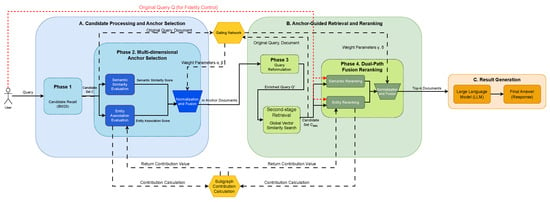
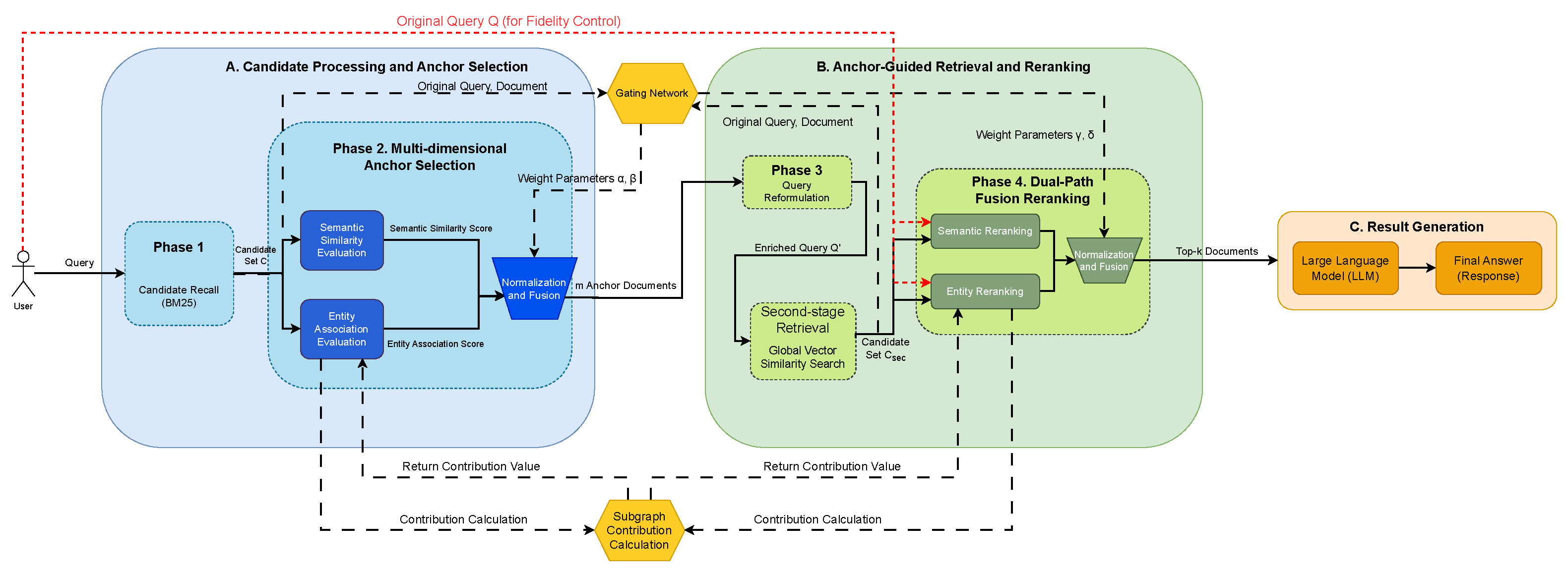
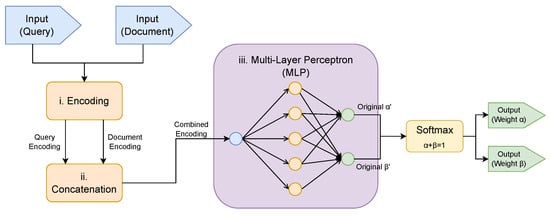
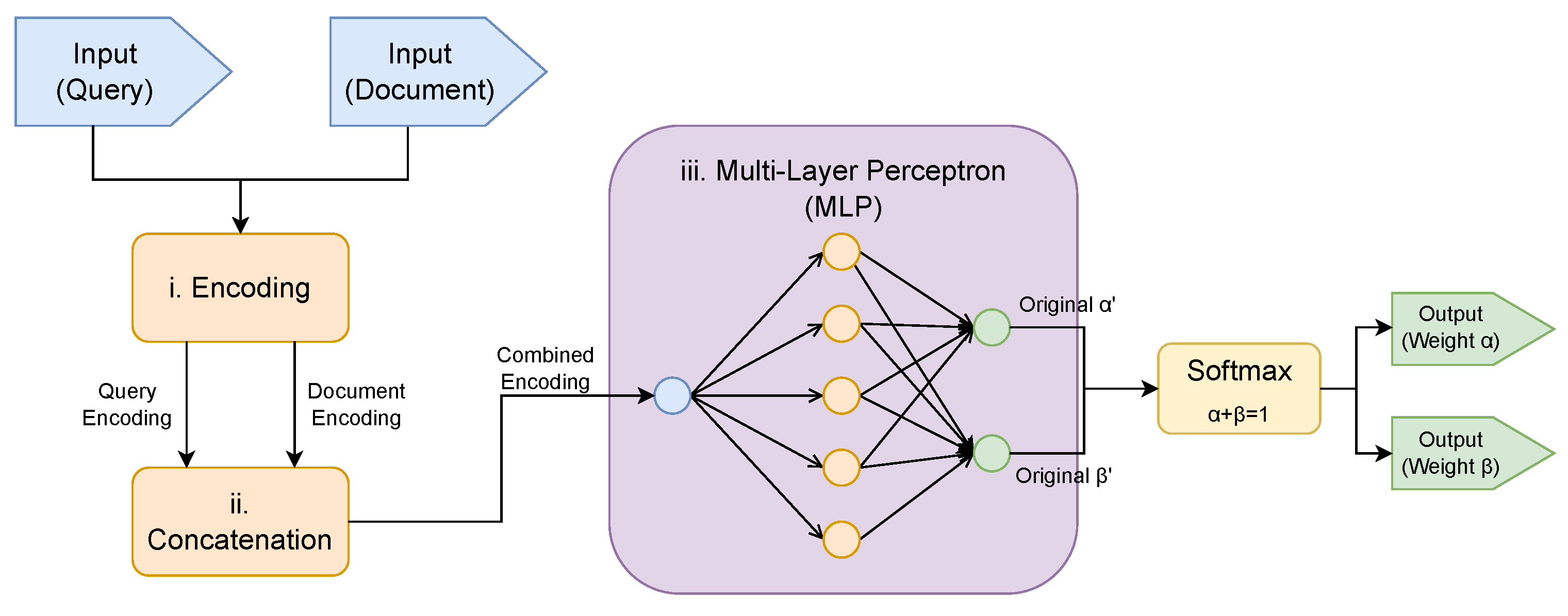
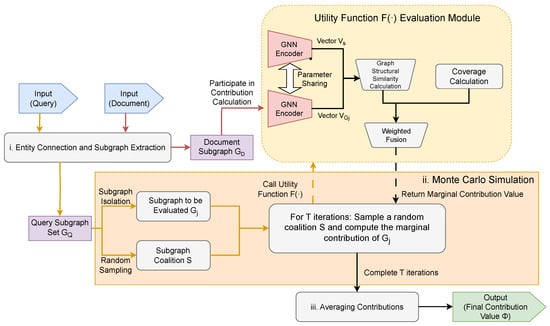
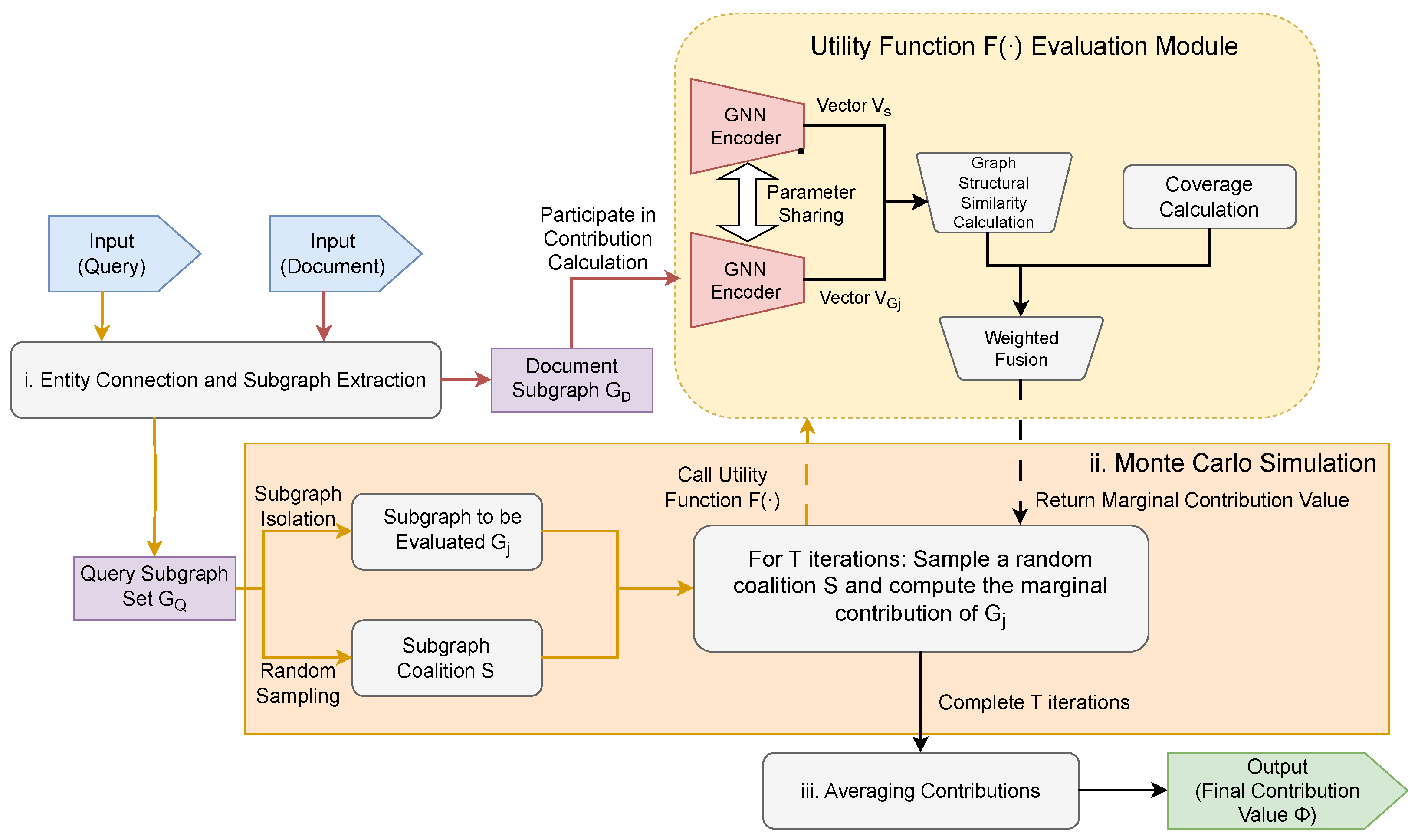

Disclaimer/Publisher’s Note: The statements, opinions and data contained in all publications are solely those of the individual author(s) and contributor(s) and not of MDPI and/or the editor(s). MDPI and/or the editor(s) disclaim responsibility for any injury to people or property resulting from any ideas, methods, instructions or products referred to in the content. |
© 2026 by the authors. Licensee MDPI, Basel, Switzerland. This article is an open access article distributed under the terms and conditions of the Creative Commons Attribution (CC BY) license.