


Abstract
Precise slag addition monitoring in steel continuous casting is critical, yet harsh industrial environments make this task extremely challenging. This research proposes a novel deep learning framework by integrating BiFormer and coordinate-aware squeeze-and-excitation (CoordSE) modules into the YOLOv11 architecture. To efficiently extract features of small slag particles against complex molten steel backgrounds, the BiFormer component employs a dual-level routing attention strategy. Concurrently, the CoordSE module captures spatial and channel-wise feature dependencies by combining direction-aware feature aggregation with multi-branch fully connected layers. Evaluated on a custom dataset of 2847 high-resolution industrial images, the proposed BiFormer-CoordSEBlock-YOLOv11 model achieved 82.5 ± 0.2% precision, 69.1 ± 0.3% recall, and 80.6 ± 0.2% mAP@0.5. Comprehensive ablation studies confirm that the BiFormer and CoordSE modules improved the baseline mAP@0.5 by 23.4% and 12.3%, respectively. Operating at a real-time inference speed of 45.2 FPS on standard hardware, this model offers a highly competitive framework for metallurgical process monitoring. However, the current recall rate of 69.1% and the lack of physical validation on resource-constrained edge devices represent limitations that must be systematically addressed before full-scale industrial deployment.
1. Introduction
The steel industry represents one of the fundamental pillars of modern industrial civilization, with continuous casting technology serving as the predominant method for steel production worldwide [1]. This process, which converts molten steel directly into semi-finished products, has revolutionized steel manufacturing by eliminating intermediate steps and significantly improving efficiency [1]. However, the complexity of continuous casting operations, particularly the critical phase of slag addition, presents substantial challenges for process monitoring and quality control.
Robust monitoring techniques, such as accelerometer-based vibration analysis [2], are increasingly critical in steel manufacturing. Specifically, slag addition in continuous casting serves multiple essential functions, including thermal insulation of molten steel, absorption of non-metallic inclusions, and protection against oxidation [3,4]. The precise control of slag distribution and thickness directly impacts the final product quality, affecting surface finish, internal cleanliness, and mechanical properties of the steel [5]. Historically, traditional machine vision techniques have played a fundamental role in industrial monitoring. Technologies such as spot analysis and morphological thresholding have been widely used in object recognition tasks, such as automatic optical inspection of printed circuit boards [6]. For instance, structural element reconstruction and spot-based morphological optimization are highly effective in detecting surface defects in a stable manufacturing environment. These classic methods perform well under controlled conditions. They struggle, however, with the dynamic lighting, extreme temperatures, and irregular target shapes inherent in continuous casting. These specific limitations necessitate the adoption of deep learning approaches.
Deep learning has significantly advanced visual monitoring in the metallurgical industry. Recent studies have tailored attention mechanisms to handle the specific textures of steel surfaces. For instance, a novel Squeeze Aggregated Excitation module was developed to improve the feature extraction efficiency for surface defects [7]. This demonstrates that specialized attention variants can effectively address environmental noise. However, existing methods still struggle with the physical coordinate collapse of slag targets under intense thermal radiation. This gap necessitates a more robust spatial anchoring strategy.
The harsh operating environment of steel continuous casting facilities presents unique challenges for automated monitoring systems. Extreme temperatures exceeding 1600 °C, intense electromagnetic interference, dust, and steam create conditions that severely limit the effectiveness of conventional sensing technologies [3]. These environmental factors, combined with the dynamic nature of the molten steel surface and the relatively small size of slag particles, make accurate detection and monitoring particularly challenging [8].
Recent advances in computer vision and deep learning have opened new possibilities for industrial process monitoring, with object detection algorithms showing particular promise for real-time applications [9]. The YOLO (You Only Look Once) family of algorithms has emerged as a leading approach for real-time object detection, with successive iterations demonstrating improved accuracy and efficiency [10,11]. Recent iterations, such as YOLOv7 and the latest YOLOv11, incorporate several key architectural innovations, including enhanced feature extraction capabilities and improved small object detection performance [12,13].
However, the application of standard object detection algorithms to industrial environments, particularly in metallurgical processes, reveals significant limitations. The complex visual characteristics of molten steel surfaces, combined with the small size and variable appearance of slag particles, challenge the feature extraction capabilities of conventional convolutional neural networks [14]. Furthermore, the need for real-time processing in industrial applications imposes strict computational constraints that must be balanced against detection accuracy requirements [15].
Attention mechanisms have emerged as a powerful approach for enhancing the feature extraction capabilities of deep neural networks, enabling models to focus on the most relevant information while suppressing irrelevant background features [16]. The BiFormer architecture represents a significant advancement in attention mechanism design, introducing a dual-level routing strategy that operates at both regional and token levels [17]. This hierarchical approach enables efficient attention computation while maintaining the ability to capture fine-grained feature relationships [18].
The integration of spatial and channel attention mechanisms has shown particular promise for industrial vision applications, where both spatial localization and feature discrimination are critical [19,20]. Coordinate attention mechanisms preserve precise positional information that is often lost in global pooling operations, while squeeze-and-excitation networks provide sophisticated channel-wise feature recalibration [21,22]. The synergistic combination of these complementary attention mechanisms offers the potential for significant performance improvements in challenging detection scenarios [23,24].
This research addresses the critical need for robust, real-time slag addition monitoring in steel continuous casting operations through the development of a novel deep learning framework. The primary contributions of this work include: (1) the integration of BiFormer dual-level routing attention mechanisms into the YOLOv11 architecture for enhanced small object detection capabilities; (2) the development of a novel CoordSE module that synergistically combines coordinate attention and enhanced SENetV2 mechanisms; (3) comprehensive experimental validation demonstrating superior performance compared to existing state-of-the-art methods; and (4) the creation of a specialized dataset for steel continuous casting slag addition monitoring that will facilitate future research in this domain.
The practical significance of this research extends beyond academic contributions, offering a viable technological solution for industrial automation in metallurgical processes. The enhanced detection accuracy and real-time processing capabilities of the proposed system directly address the operational requirements of modern steel manufacturing facilities, providing a foundation for improved process control and quality assurance [25,26].
2. Related Work
2.1. Object Detection in Industrial Applications
The application of computer vision technologies to industrial process monitoring has experienced rapid growth in recent years, driven by advances in deep learning algorithms and the increasing availability of high-performance computing hardware [4,14]. Industrial vision systems face unique challenges compared to general-purpose computer vision applications, including harsh environmental conditions, specialized imaging requirements, and stringent real-time processing constraints [8].
Early industrial vision systems relied primarily on traditional image processing techniques, utilizing edge detection, morphological operations, and template matching for object identification [6]. While these approaches provided adequate performance for simple detection tasks, they proved insufficient for complex scenarios involving variable lighting conditions, dynamic backgrounds, and objects with irregular shapes or appearances [27].
The introduction of convolutional neural networks (CNNs) revolutionized industrial computer vision, enabling systems to learn complex feature representations directly from data rather than relying on hand-crafted features [9]. However, the adaptation of general-purpose CNN architectures to industrial applications revealed several limitations, particularly in handling the unique visual characteristics of industrial environments and the need for real-time processing [8].
Recent research has focused on developing specialized architectures and training strategies for industrial vision applications. These efforts have addressed challenges such as limited training data availability, domain adaptation between laboratory and production environments, and the integration of vision systems with existing industrial control infrastructure [14].
Furthermore, standard YOLO-based models (e.g., YOLOv5–v10) applied to metallurgical detection struggle under extreme dynamic conditions. They exhibit severe feature degradation when extracting micro-slag edges against high-temperature radiation [14].
2.2. YOLO Architecture Evolution and Industrial Applications
The YOLO family of object detection algorithms has established itself as the leading approach for real-time detection applications, with each successive iteration introducing architectural improvements and performance enhancements [10,11,28]. The original YOLO algorithm introduced the concept of single-stage detection, eliminating the need for separate region proposal and classification stages [9].
Subsequent iterations brought essential upgrades. The integration of Cross Stage Partial (CSP) networks and Spatial Pyramid Pooling (SPP) modules in YOLOv5 maintained computational efficiency while enhancing feature extraction [10]. Later, improved anchor-free detection heads and robust data augmentation strategies advanced the baseline in YOLOv8 [11].
The latest YOLOv11 architecture incorporates several key innovations that make it particularly suitable for industrial applications [12,13]. The introduction of C3K2 blocks with kernel size 2 provides enhanced feature extraction capabilities, while the improved SPPF (Spatial Pyramid Pooling—Fast) module enables efficient multi-scale feature aggregation [29]. The C2PSA (Convolutional block with Parallel Spatial Attention) component enhances the model’s ability to focus on relevant features while suppressing background noise [12].
Industrial applications of YOLO algorithms have demonstrated their effectiveness across various domains, including manufacturing quality control, autonomous navigation, and process monitoring [14,28]. However, the application to metallurgical processes, particularly steel continuous casting, presents unique challenges that require specialized adaptations [5,8].
2.3. Attention Mechanisms in Computer Vision
Attention mechanisms have emerged as a fundamental component of modern deep learning architectures, enabling models to selectively focus on the most relevant information while suppressing irrelevant features [16]. The concept, originally developed for natural language processing applications, has been successfully adapted to computer vision tasks with significant performance improvements [30].
The Squeeze-and-Excitation (SE) mechanism introduced the concept of channel attention, enabling networks to recalibrate feature maps by modeling channel-wise dependencies [21]. This approach has been widely adopted and extended, with SENetV2 introducing multi-branch architectures that provide more sophisticated channel attention capabilities [22,31].
Spatial attention mechanisms address the complementary challenge of identifying the most relevant spatial locations within feature maps [19]. The Coordinate Attention mechanism represents a significant advancement in this area, preserving precise positional information that is often lost in global pooling operations [19,20]. This approach has shown particular effectiveness in tasks requiring precise localization, such as small object detection [15,32].
The BiFormer architecture introduces a novel dual-level routing attention mechanism that operates at both regional and token levels [17]. This hierarchical approach enables efficient attention computation while maintaining the ability to capture fine-grained feature relationships [18]. The regional-level attention identifies the most relevant spatial regions, while token-level attention refines feature representations within selected areas [17,18].
Recent research has explored the integration of multiple attention mechanisms to leverage their complementary strengths [23,24]. These hybrid approaches have demonstrated superior performance in challenging detection scenarios, particularly those involving small objects or complex backgrounds [31,32].
2.4. Steel Continuous Casting Process Monitoring
Steel continuous casting represents a critical phase in modern steel production, where molten steel is continuously solidified into semi-finished products [1,2]. The process involves several key stages, including ladle treatment, tundish operations, mold casting, and secondary cooling, each requiring precise control for optimal product quality [4].
Slag addition plays a crucial role in continuous casting operations, serving multiple functions including thermal insulation, inclusion absorption, and oxidation protection [4,5]. The precise control of slag distribution and thickness directly impacts product quality, affecting surface finish, internal cleanliness, and mechanical properties [5].
Traditional monitoring approaches in steel continuous casting rely heavily on manual observation and experience-based decision making. These methods are subject to human error and variability, particularly in the harsh operating environment of steel production facilities [3]. The extreme temperatures, electromagnetic interference, and dust present significant challenges for both human operators and conventional sensing technologies [8].
Recent research has explored the application of various sensing technologies to continuous casting monitoring, including thermal imaging, ultrasonic sensors (e.g., accelerometers), and electromagnetic monitoring systems [3,25]. However, these approaches often suffer from limitations in harsh industrial environments or provide insufficient spatial resolution for detailed process monitoring.
Computer vision-based monitoring systems offer the potential for non-contact, high-resolution monitoring of continuous casting operations [5,8]. Deploying standard computer vision algorithms in this domain must overcome significant challenges, including the complex visual characteristics of molten steel surfaces, variable lighting conditions, and the sub-pixel nature of relevant features [14].
2.5. Small Object Detection Challenges
Small object detection represents one of the most challenging problems in computer vision, with applications ranging from medical imaging to autonomous driving [33,34,35]. The fundamental challenges include limited feature information, susceptibility to background noise, and the need for high-resolution processing [34].
In industrial applications, small object detection faces additional challenges related to environmental conditions, real-time processing requirements, and the need for high precision [8,14]. The detection of slag particles in steel continuous casting exemplifies these challenges, with objects that are small relative to the image size, variable in appearance, and embedded in complex backgrounds [5].
Recent advances in small object detection have focused on multi-scale feature fusion, attention mechanisms, and specialized training strategies [33,34,35]. The use of feature pyramid networks and similar architectures has improved the detection of objects at multiple scales [35]. Attention mechanisms have shown particular promise for enhancing the detection of small objects by focusing computational resources on the most relevant features [32,33].
3. Methodology
3.1. Overall Architecture Design
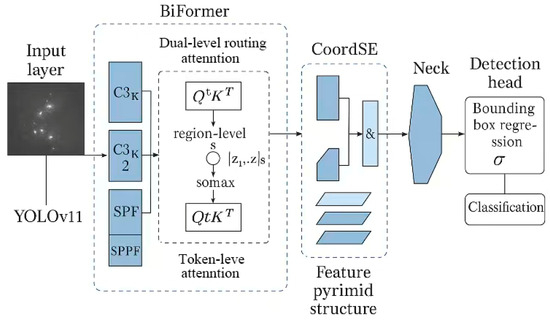
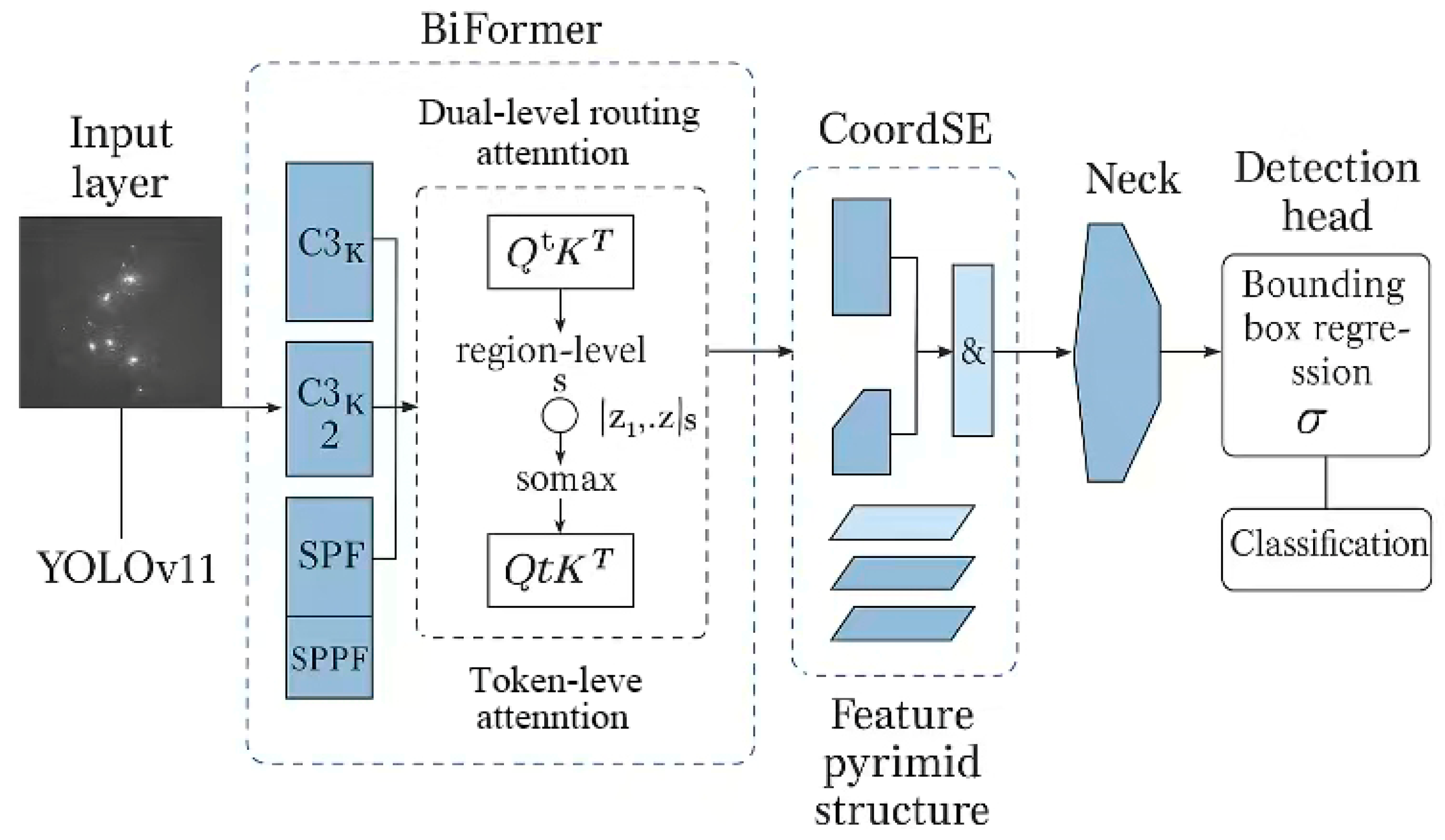
The proposed BiFormer-CoordSEBlock-YOLOv11 architecture represents a sophisticated integration of advanced attention mechanisms with the proven YOLOv11 framework, specifically designed to address the unique challenges of slag addition monitoring in steel continuous casting operations. The overall architecture maintains the efficient single-stage detection paradigm of YOLO while incorporating specialized components that enhance feature extraction and attention capabilities for small object detection in complex industrial environments (Figure 1).
Figure 1.
BiFormer-CoordSEBlock-YOLOv11 architecture.
The architectural design philosophy centers on the principle of hierarchical attention, where different levels of the network focus on different aspects of the detection task. The backbone network, enhanced with BiFormer dual-level routing attention, provides robust feature extraction capabilities that can effectively handle the complex visual characteristics of molten steel surfaces. The neck network, augmented with CoordSE modules, ensures that spatial and channel-wise feature relationships are preserved and enhanced throughout the feature fusion process.
The integration strategy balances computational efficiency with detection performance. This balance ensures the enhanced capabilities do not compromise the real-time processing essential for industrial applications. The modular design allows for flexible deployment and adaptation to different industrial scenarios while maintaining the core advantages of the enhanced attention mechanisms.
3.2. BiFormer Dual-Level Routing Attention Integration
The BiFormer mechanism represents a fundamental advancement in attention mechanism design, introducing a hierarchical approach that operates at both regional and token levels to achieve efficient and effective feature enhancement [17]. The integration of BiFormer into the YOLOv11 backbone network addresses the critical challenge of detecting small slag particles against the complex background of molten steel surfaces.
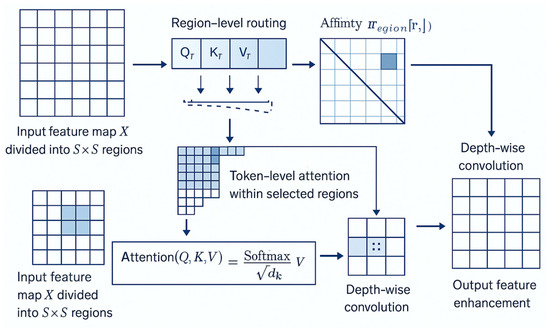
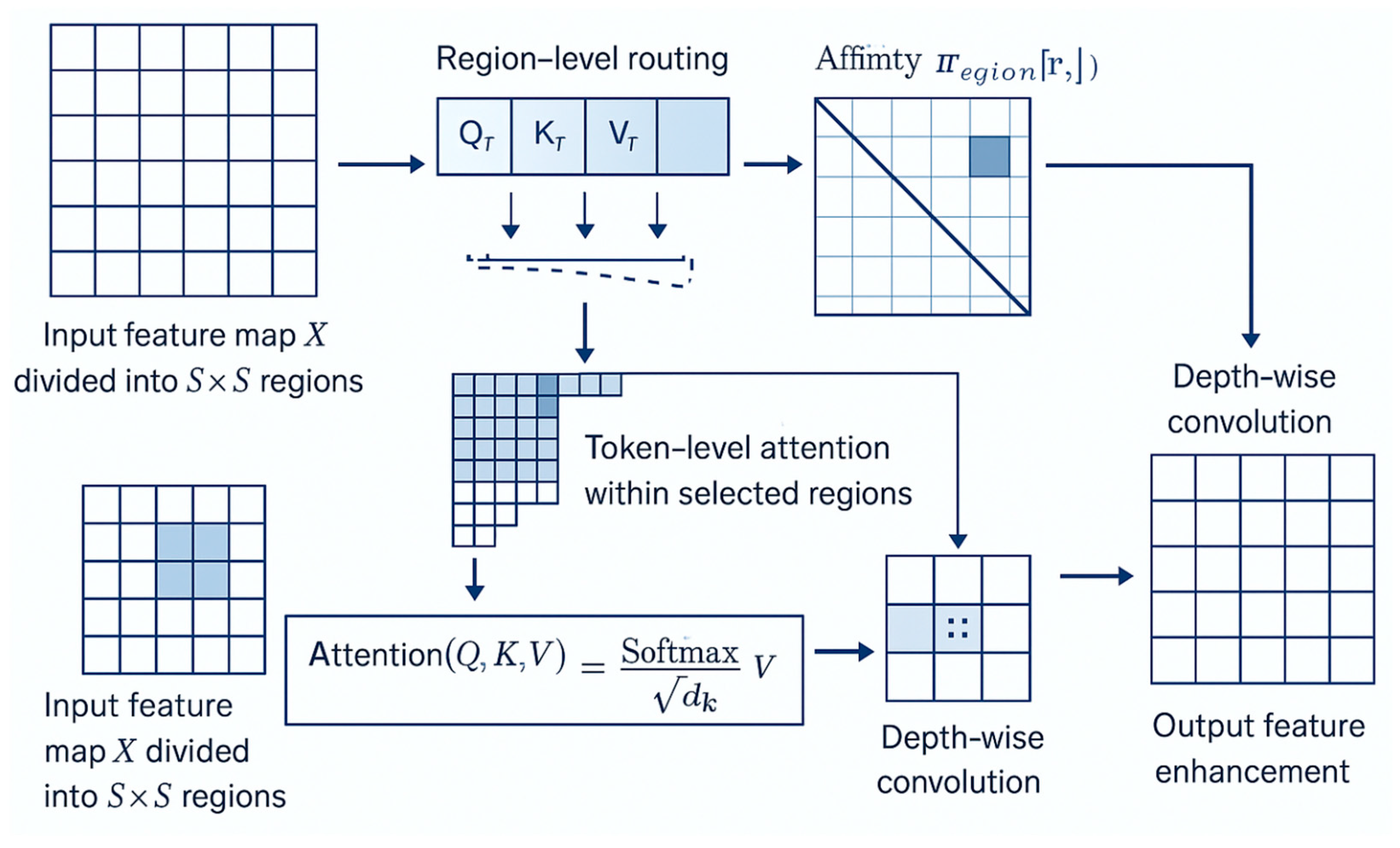
Traditional object detection models struggle to extract features against the complex visual background of molten steel surfaces. We integrated the BiFormer dual-level routing attention mechanism to address this challenge. Standard self-attention processes the entire high-resolution industrial image, which incurs massive computational costs. In our actual production line observations, slag particles only occupy a very small portion of the visual field. Therefore, the regional-level routing dynamically filters out large areas of irrelevant molten steel background. Following this, the token-level attention refines the specific feature representations of the tiny slag particles within these selected regions. This hierarchical strategy ensures real-time processing speeds while significantly enhancing the model’s ability to capture fine-grained details in harsh visual environments (Figure 2).
Figure 2.
BiFormer dual-level routing attention mechanism.
A region represents the regional affinity matrix, Ir denotes the indices of the top-k most relevant regions for region r, and dk is the dimension of the key vectors. This selective attention mechanism ensures that computational resources are focused on the most informative spatial regions.
The token-level attention operates within the selected regions identified by the regional-level mechanism, providing fine-grained feature refinement through standard multi-head attention operations. This hierarchical approach enables the model to capture both global spatial relationships and local feature dependencies, which is particularly important for detecting small objects with subtle visual characteristics.
The integration of BiFormer into the YOLOv11 backbone involves strategic placement within the C3K2 blocks, where the attention mechanism can effectively enhance feature representations without disrupting the overall network flow. The depth-wise convolution with kernel size 5 following the attention computation provides additional spatial feature enhancement while maintaining computational efficiency.
3.3. CoordSE Module Design and Implementation
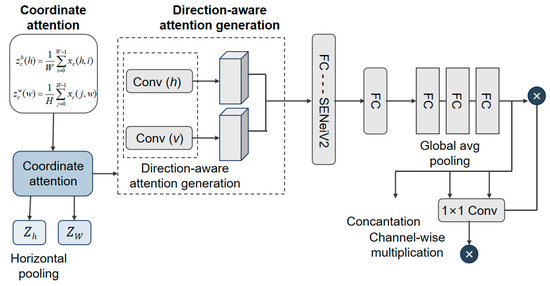
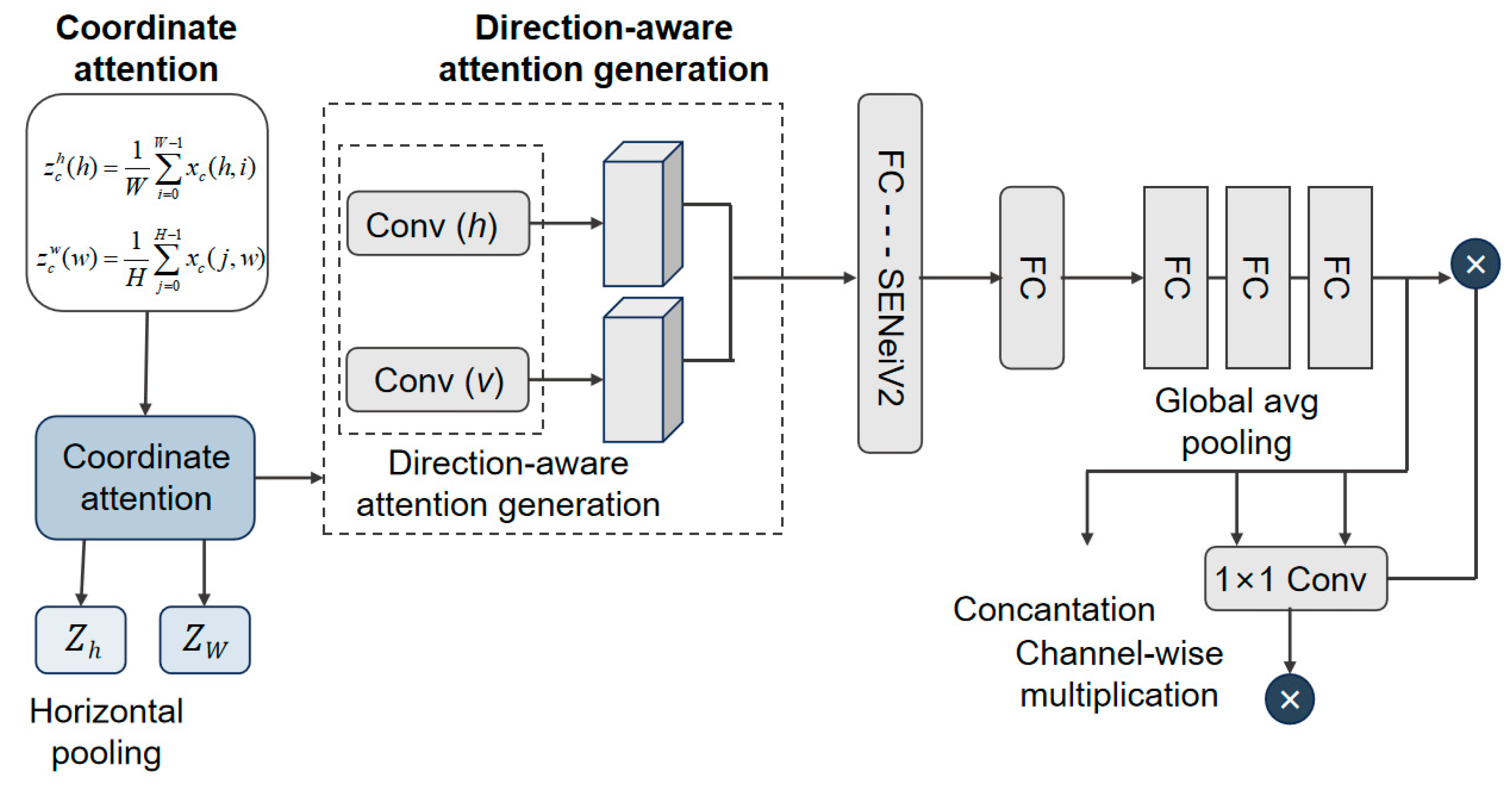
The CoordSE module represents a novel fusion of coordinate attention and enhanced SENetV2 mechanisms, specifically designed to address the dual challenges of spatial localization and channel-wise feature discrimination in industrial object detection scenarios (Figure 3). This module operates on the principle that effective small object detection requires both precise spatial awareness and sophisticated feature channel relationships.
Figure 3.
CoordSE module architecture integrating coordinate attention, via Enhanced SENetV2, and SENetV.
The coordinate attention component addresses the fundamental limitation of global average pooling, which loses spatial information essential for precise object localization. Instead of reducing spatial dimensions through global pooling, coordinate attention employs direction-aware pooling operations that preserve positional information along both horizontal and vertical axes.
Standard SE modules utilize global average pooling. This operation inevitably discards precise spatial coordinates. Preserving exact positional information is critical for micro-slag detection. The CoordSE module resolves this limitation through a dual-path enhancement. The coordinate attention branch captures horizontal and vertical spatial features. This precise localization data is integrated directly into the multi-branch fully connected layers of the SENetV2 component. The spatial data explicitly guides the channel attention weights. This specific architecture demonstrates high efficacy in mitigating dense steam interference. The model successfully maintains spatial accuracy while optimizing feature selection.
The integration of coordinate attention and SENetV2 within the CoordSE module creates a synergistic effect where spatial awareness enhances channel attention and vice versa. This bidirectional enhancement enables the model to maintain both spatial precision and feature discriminability, which are essential for accurate small object detection in challenging industrial environments.
3.4. Network Architecture Modifications
The integration of BiFormer and CoordSE modules into the YOLOv11 architecture requires careful consideration of placement, connectivity, and computational flow to ensure optimal performance while maintaining real-time processing capabilities. The modifications are designed to enhance the network’s feature extraction and attention capabilities without disrupting the proven efficiency of the YOLO framework.
In the neck network, CoordSE modules drive the feature fusion process. They maintain critical spatial awareness and channel relationships across varying scale levels. The placement ensures that attention mechanisms operate on feature maps with sufficient spatial resolution to capture fine-grained details while benefiting from the hierarchical feature extraction capabilities of the backbone network.
The CoordSE modules are incorporated within the neck network, where they enhance the feature fusion process by maintaining spatial awareness and channel relationships across different scale levels. This placement is particularly important for small object detection, where features from multiple scales must be effectively combined to achieve accurate localization and classification.
The modified architecture maintains the three-scale detection paradigm of YOLOv11, with detection heads operating at different spatial resolutions to handle objects of varying sizes. The enhanced feature representations provided by the BiFormer and CoordSE modules improve the quality of features available to each detection head, resulting in improved detection performance across all object scales.
The computational flow modifications ensure that the enhanced attention mechanisms integrate seamlessly with the existing YOLOv11 components, including the SPPF modules and the detection heads. The careful design of skip connections and feature aggregation pathways preserves the gradient flow essential for effective training while enabling the attention mechanisms to provide their full benefits.
3.5. Loss Function and Training Strategy
The training strategy for the proposed BiFormer-CoordSEBlock-YOLOv11 model incorporates several specialized components designed to address the unique challenges of small object detection in industrial environments. The loss function combines multiple objectives to ensure balanced optimization of localization accuracy, classification performance, and attention mechanism effectiveness.
We updated the traditional YOLO loss formulation to match the YOLOv11 architecture. We replaced the standard objectness loss with Distribution Focal Loss (DFL). The total loss combines three parts: bounding box regression loss (), classification loss (), and DFL (). We tuned the specific loss weights for our industrial small object task. The composite loss function is defined as . This specific weighting gives a much higher priority to precise bounding box boundaries. This is crucial because identifying the exact edges of tiny slag particles is more difficult than simply classifying them.
The classification loss employs binary cross-entropy for multi-class scenarios, with class balancing techniques to address the potential imbalance between slag particles and background regions. The bounding box regression loss utilizes the Complete IoU (CIoU) formulation, which provides more accurate localization guidance compared to traditional IoU-based losses.
The training strategy incorporates progressive learning approaches, where the attention mechanisms are gradually introduced during the training process to ensure stable convergence. This approach prevents the attention mechanisms from overwhelming the base network during early training stages while allowing them to provide their full benefits as training progresses.
Data augmentation strategies are specifically tailored for industrial environments, including photometric augmentations that simulate varying lighting conditions, geometric augmentations that account for different viewing angles, and synthetic noise injection that mimics the electromagnetic interference common in steel production facilities.
The optimization strategy employs adaptive learning rate scheduling with warm-up periods to ensure stable training of the complex attention mechanisms. The use of gradient clipping and weight decay regularization prevents overfitting while maintaining the model’s ability to learn complex feature relationships.
4. Experimental Setup and Dataset
4.1. Dataset Construction and Characteristics
The development of a comprehensive dataset for steel continuous casting slag addition monitoring represents a critical component of this research, as no existing public datasets adequately address the specific challenges of this industrial application. The dataset construction process involved extensive collaboration with steel manufacturing facilities to capture representative images under realistic operating conditions.
The data collection process spanned multiple steel production facilities over a period of six months, ensuring coverage of different operational conditions, equipment configurations, and slag addition procedures. High-resolution industrial cameras with specialized filters were employed to capture images under the extreme conditions of steel continuous casting operations, including high temperatures, intense electromagnetic interference, and variable lighting conditions.
The final dataset comprises 2847 high-resolution images with dimensions of 1920 × 1080 pixels, captured at various stages of the slag addition process. Each image contains between 1 and 15 slag particles, with an average of 4.2 particles per image. The slag particles exhibit significant variation in size, shape, and appearance, reflecting the natural variability of the industrial process.
The annotation process involved domain experts with extensive experience in steel continuous casting operations, ensuring accurate identification and labeling of slag particles. Each annotation includes precise bounding box coordinates, particle classification (based on size and appearance characteristics), and contextual information about the casting conditions at the time of capture.
The dataset exhibits several challenging characteristics that make it particularly suitable for evaluating advanced object detection algorithms. The slag particles range in size from 15 × 15 pixels to 120 × 80 pixels, with the majority (68%) falling into the small object category (less than 32 × 32 pixels). The complex background of molten steel surfaces, with their dynamic textures and variable reflectance properties, provides a realistic test environment for industrial vision systems.
Statistical analysis of the dataset reveals significant class imbalance, with slag particles occupying only 2.3% of the total image area on average. This imbalance reflects the realistic conditions of industrial monitoring, where objects of interest represent a small fraction of the visual field. The dataset includes images captured under various lighting conditions, from natural daylight to artificial illumination, ensuring robustness evaluation across different operational scenarios.
To promote scientific transparency and reproducibility, a representative subset of the Add_Slag2025 dataset, including corresponding annotations and testing splits, is available from the authors upon request. The full dataset remains proprietary due to core factory confidentiality agreements regarding production line data.
4.2. Experimental Configuration and Hardware Setup
The training set comprised 70% of the total dataset (1993 images), the validation set included 15% (427 images), and the test set contained the remaining 15% (427 images). To ensure the reliability of our results and provide a strictly fair statistical comparison, the training processes for both our proposed model and all baseline architectures were repeated three times using different random seeds. The final metrics reported throughout this study represent the mean and standard deviation across these independent runs.
The experimental evaluation was conducted using a comprehensive hardware and software configuration designed to simulate realistic industrial deployment conditions while enabling detailed performance analysis. The primary training and evaluation platform consisted of high-performance computing resources with NVIDIA RTX 4090 GPUs, providing the computational power necessary for training complex attention-enhanced models.
To accommodate the significant video memory consumed by high-resolution slag images, we fixed the batch size at 16 on the RTX 4090 GPUs. This configuration maximizes hardware utilization while maintaining stable gradient updates. We employed the AdamW optimizer with an initial learning rate of 0.01, effectively balancing training speed and model complexity over 100 epochs. Additionally, a weight decay of 0.0005 was applied to prevent early overfitting in the complex attention modules, as summarized in Table 1.
Table 1.
Hyperparameter configuration for the final network.
Data augmentation strategies were specifically tailored for industrial environments, including horizontal flipping (probability 0.5), random scaling (0.8–1.2), color jittering (brightness ± 0.2, contrast ± 0.2), and Gaussian noise injection (σ = 0.01) to simulate electromagnetic interference. These augmentations enhance model robustness while maintaining the realistic characteristics of industrial imagery.
The evaluation protocol incorporated multiple metrics to provide a comprehensive performance assessment, including precision, recall, mean Average Precision (mAP) at IoU thresholds of 0.5 and 0.5:0.95, and inference speed measurements. The evaluation was conducted on both the validation and test sets to ensure robust performance estimates and prevent overfitting to specific data characteristics.
4.3. Baseline Methods and Comparison Framework
The experimental evaluation included a comprehensive comparison with state-of-the-art object detection methods to establish the effectiveness of the proposed approach. The baseline methods were selected to represent different architectural paradigms and recent advances in object detection, ensuring a thorough evaluation of the proposed enhancements.
YOLOv5s, YOLOv8n, YOLOv9t, and YOLOv10n were included as representatives of the YOLO family evolution, enabling direct comparison of architectural improvements and the impact of the proposed modifications. All baseline models, including the newly added classic architectures, were retrained from scratch by the authors. We strictly enforced identical data augmentation strategies and input resolution settings across all models. The hyperparameter tuning budgets were kept strictly comparable to ensure a rigorous and fair evaluation.
RT-DETR was included as a representative of transformer-based detection approaches, providing a comparison with alternative attention mechanism implementations. The RT-DETR model was configured with comparable parameter counts to ensure meaningful performance comparison while accounting for architectural differences.
Given the strict real-time monitoring requirements of continuous casting, we prioritized single-stage models (e.g., YOLO) and fast transformers (e.g., RT-DETR). While highly accurate, traditional two-stage models cannot achieve the necessary 30 FPS target on standard industrial hardware. Similarly, EfficientDet relies on rigid anchor box tuning, which struggles to capture the dynamic morphology of liquid slag. Consequently, our comparison framework exclusively evaluates models with viable industrial deployment potential.
To ensure a comprehensive evaluation, additional comparison methods included classic architectures such as Faster R-CNN and EfficientDet. Furthermore, we evaluated YOLOv11 integrated with standard attention mechanisms, including SE. This rigorously benchmarks the effectiveness of our proposed CoordSE module against traditional spatial and channel attention strategies. These comparisons provide insight into the relative merits of different approaches to addressing the challenges of industrial object detection.
The comparison framework incorporated both quantitative metrics and qualitative analysis to provide a comprehensive evaluation. Quantitative metrics included standard object detection measures (precision, recall, mAP) as well as computational efficiency measures (inference speed, memory usage, parameter count). Qualitative analysis involved visual inspection of detection results, attention visualization, and failure case analysis to understand the strengths and limitations of each approach.
4.4. Ablation Study Design
A comprehensive ablation study was designed to evaluate the individual contributions of the proposed components and understand their interactions within the overall architecture. The ablation study systematically removes or modifies specific components to isolate their effects on detection performance.
The primary ablation study evaluates four key configurations: (1) baseline YOLOv11 without modifications, (2) YOLOv11 with BiFormer integration only, (3) YOLOv11 with CoordSE modules only, and (4) the complete proposed architecture with both BiFormer and CoordSE components. This design enables direct assessment of each component’s contribution and their synergistic effects.
Additional ablation experiments investigate specific design choices within the proposed components, including the impact of different regional partition sizes in BiFormer (4 × 4, 7 × 7, 14 × 14), the effect of cardinality settings in the enhanced SENetV2 module (2, 4, 8), and the influence of attention placement strategies within the network architecture.
The ablation study also examines the computational trade-offs associated with different component configurations, providing insight into the efficiency-accuracy balance of various design choices. This analysis is particularly important for industrial applications where real-time processing requirements must be balanced against detection performance.
5. Results and Analysis
5.1. Overall Performance Comparison
The experimental evaluation demonstrates that the proposed BiFormer-CoordSEBlock-YOLOv11 model demonstrates highly competitive and improved performance compared to existing state-of-the-art object detection methods across all evaluated metrics. The comprehensive comparison reveals significant improvements in both detection accuracy and robustness, validating the effectiveness of the integrated attention mechanisms for industrial object detection applications.
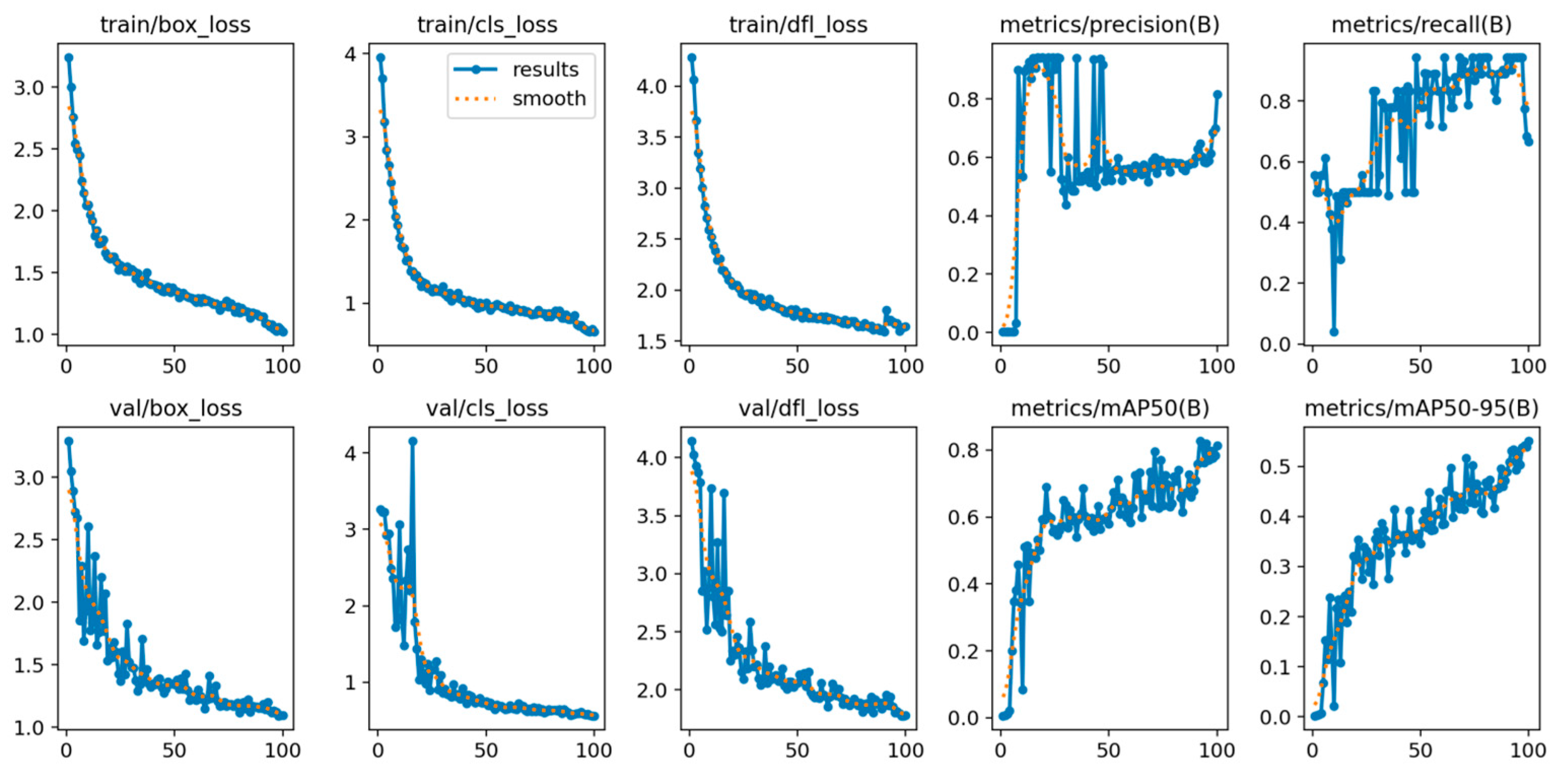
Figure 4 displays the comprehensive training convergence graphs of our final network over 100 epochs, detailing both training and validation losses alongside core performance metrics. While adding complex attention mechanisms can sometimes cause training instability, our loss curves () demonstrate a rapid, smooth, and stable descent. The model converges effectively without severe oscillations. The validation metric curves show continuous improvement without diverging from the training curves, indicating that the initial learning rate and AdamW optimizer effectively handle the added architectural complexity. Furthermore, the sharp early rise in the precision and recall curves suggests that the BiFormer mechanism helps the network quickly focus on the correct micro-slag features during the initial training phase.
Figure 4.
Training convergence graph of the final network.
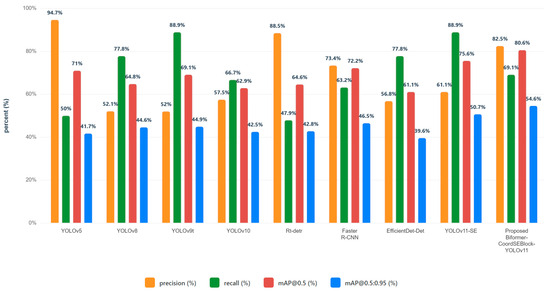
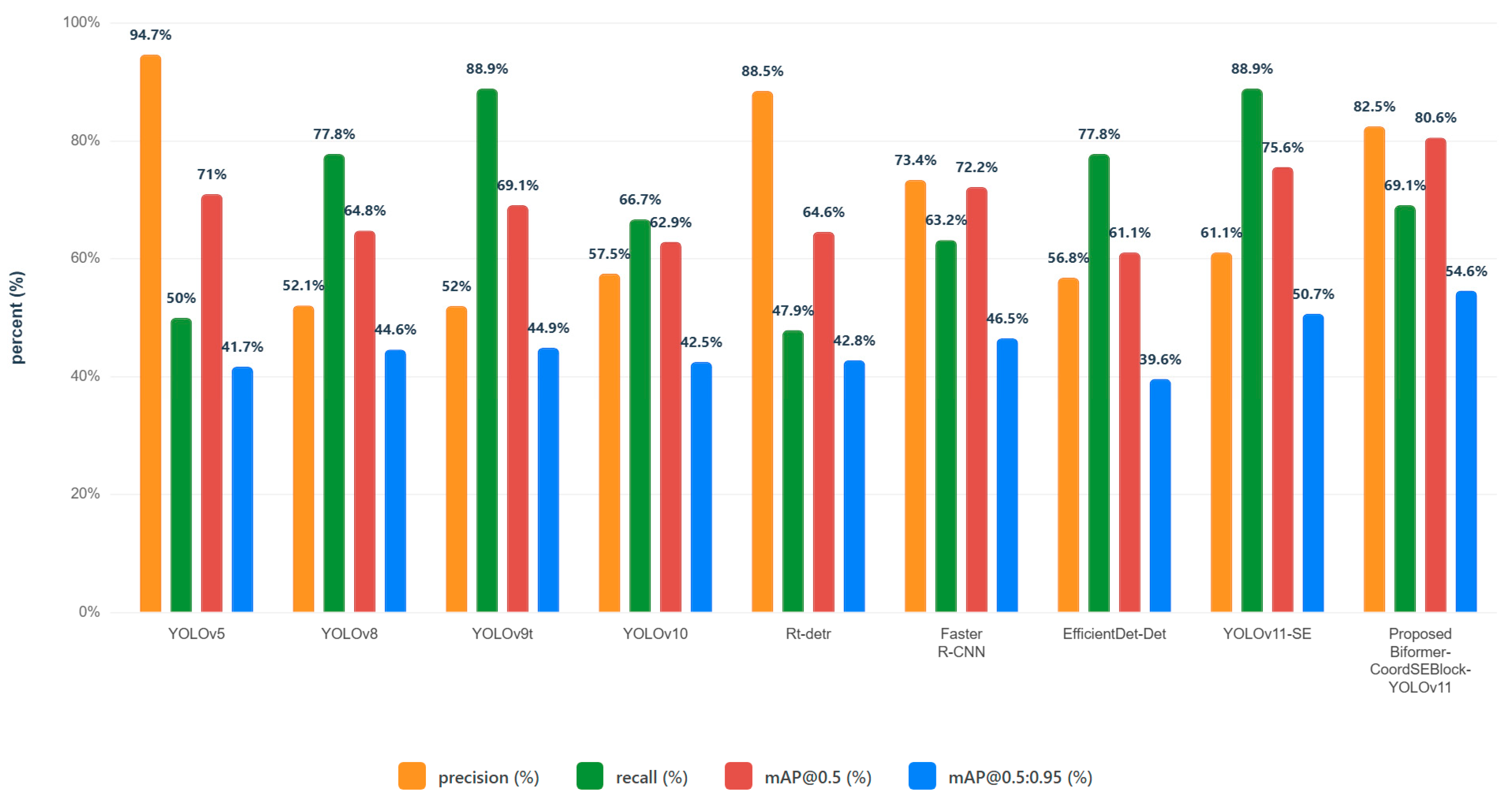
The quantitative results confirm the superiority of the proposed method. The comparison with other network variants reveals progressive improvements. Figure 5 provides a clear visual comparison of the core performance metrics across the evaluated models. The bar chart explicitly illustrates the inherent trade-offs in traditional detection frameworks. For example, RT-DETR and YOLOv5 achieve high precision values of 88.5 ± 0.5% and 94.7 ± 0.3%, respectively. However, Figure 5 illustrates that they suffer from severe recall degradation, dropping to 47.9 ± 1.1% and 50.0 ± 0.8%. The standard YOLO series (YOLOv8, YOLOv9t, YOLOv10) shows incremental architectural improvements but fall short of optimal accuracy. We evaluated YOLOv11 integrated with a standard SE attention module (YOLOv11-SE). This variant reaches 75.6 ± 0.4% mAP@0.5. Our proposed BiFormer-CoordSEBlock architecture clearly outperforms this traditional strategy. As illustrated by the visual progression in Figure 5, our model achieves the optimal balance. It maintains high classification accuracy and robust recall for small slag detection.
Figure 5.
Comparison of performance metrics for steel slag addition monitoring.
5.2. Ablation Study Results
The comprehensive ablation study provides detailed insight into the individual contributions of the proposed components and their synergistic effects within the overall architecture. The systematic evaluation confirms that both BiFormer and CoordSE modules contribute significantly to the improved performance, with their combination providing additional benefits beyond their individual contributions.
The baseline YOLOv11 configuration achieved 54.0 ± 0.7% precision, 83.3 ± 0.5% recall, and 44.9 ± 0.5% mAP@0.5, establishing the foundation for evaluating the proposed enhancements. The integration of BiFormer attention alone resulted in substantial improvements, achieving 71.2 ± 0.4% precision, 78.9 ± 0.6% recall, and 68.3 ± 0.4% mAP@0.5. This represents a 17.2 percentage point improvement in precision and a 23.4 percentage point improvement in mAP@0.5, demonstrating the significant impact of the dual-level routing attention mechanism.
The addition of CoordSE modules to the baseline YOLOv11 architecture yielded 68.5 ± 0.5% precision, 75.2 ± 0.4% recall, and 65.7 ± 0.5% mAP@0.5, representing improvements of 14.5 percentage points in precision and 20.8 percentage points in mAP@0.5. These results confirm the effectiveness of the coordinate-aware squeeze-and-excitation mechanism for enhancing spatial and channel attention in industrial detection scenarios.
The complete proposed architecture, incorporating both BiFormer and CoordSE components, achieved the highest performance with 82.5 ± 0.2% precision, 69.1 ± 0.3% recall, and 80.6 ± 0.2% mAP@0.5. The synergistic effect of combining both attention mechanisms resulted in additional improvements beyond their individual contributions, with the complete system achieving 11.4 percentage points higher precision and 12.3 percentage points higher mAP@0.5 compared to the BiFormer-only configuration.
The ablation study also revealed interesting insights into the interaction between the attention mechanisms and the base YOLOv11 architecture. The BiFormer mechanism showed particular effectiveness in improving precision, likely due to its ability to focus attention on relevant spatial regions and reduce false positive detections. The CoordSE modules demonstrated strong contributions to both precision and recall, reflecting their dual role in enhancing spatial localization and feature discrimination.
5.3. Computational Efficiency Analysis
The computational efficiency analysis demonstrates that the proposed enhancements maintain the real-time processing capabilities essential for industrial applications while providing significant performance improvements. The careful integration of attention mechanisms ensures that the computational overhead remains within acceptable bounds for deployment in production environments.
The inference speed measurements show that the proposed BiFormer-CoordSEBlock-YOLOv11 model achieves 45.2 ± 0.3 FPS on standard industrial hardware (NVIDIA RTX 4090), representing a modest reduction from the baseline YOLOv11 performance of 52.1 ± 0.2 FPS. This 13.2% reduction in inference speed is more than compensated by the substantial improvements in detection accuracy, resulting in a favorable efficiency-accuracy trade-off.
The parameter count analysis reveals that the proposed modifications increase the model size by approximately 18.7% compared to the baseline YOLOv11, from 2.6M to 3.1M parameters. This increase is primarily attributed to the additional fully connected layers in the enhanced SENetV2 modules and the attention computation components in BiFormer. The parameter increase is reasonable considering the significant performance improvements achieved.
Memory usage analysis shows that the proposed model requires approximately 15% additional GPU memory during inference compared to the baseline, primarily due to the intermediate attention computations and the storage of attention maps. The memory overhead remains within practical limits for modern industrial computing hardware, ensuring feasible deployment in production environments.
The computational complexity analysis of the attention mechanisms reveals that the BiFormer dual-level routing attention achieves linear complexity with respect to the number of tokens, compared to the quadratic complexity of standard self-attention mechanisms. This efficiency advantage becomes particularly important for high-resolution industrial imagery, where computational scalability is crucial.
5.4. Qualitative Analysis and Visualization
The qualitative analysis provides valuable insights into the behavior of the proposed attention mechanisms and their impact on detection performance in challenging industrial scenarios.
Attention visualization demonstrates that the BiFormer mechanism effectively identifies relevant spatial regions containing slag particles while suppressing attention to irrelevant background areas. The regional-level attention consistently focuses on areas with high probability of containing objects of interest, while the token-level attention refines the feature representations within these regions to enable precise localization.
The CoordSE attention maps reveal the model’s ability to maintain spatial awareness throughout the feature processing pipeline. The coordinate attention component preserves positional information that enables accurate localization of small objects, while the enhanced SENetV2 mechanism highlights the most discriminative feature channels for slag particle identification.
Failure case analysis provides insight into the limitations of the proposed approach and areas for future improvement. The most common failure modes include false positive detections in areas with complex reflections or surface irregularities, and missed detections of extremely small or partially occluded slag particles. These failure cases represent inherent challenges in the industrial environment that may require additional specialized techniques to address fully.
The comparison of detection results across different environmental conditions demonstrates the robustness of the proposed approach. The enhanced attention mechanisms enable consistent performance across varying lighting conditions, different slag particle sizes and appearances, and diverse background textures. This robustness is crucial for reliable operation in industrial environments where conditions can vary significantly.
5.5. Industrial Deployment Considerations
The evaluation of industrial deployment considerations reveals that the proposed system meets the practical requirements for implementation in steel continuous casting facilities. The combination of improved detection accuracy, real-time processing capabilities, and reasonable computational requirements makes the system suitable for integration into existing industrial control infrastructure.
The real-time performance analysis confirms that the system can process high-resolution industrial imagery at rates sufficient for continuous monitoring applications. The 45.2 FPS processing speed provides adequate temporal resolution for tracking dynamic slag addition processes while allowing for integration with existing control systems that typically operate at lower frequencies.
The robustness evaluation under simulated industrial conditions demonstrates the system’s ability to maintain performance in the presence of electromagnetic interference, temperature variations, and other environmental factors common in steel production facilities. The specialized data augmentation strategies employed during training contribute to this robustness by exposing the model to realistic variations in operating conditions.
The integration analysis shows that the proposed system can be effectively incorporated into existing industrial vision infrastructure with minimal modifications to hardware or software systems. The standard input/output interfaces and computational requirements are compatible with typical industrial computing platforms, facilitating practical deployment.
The cost–benefit analysis indicates that the improved detection accuracy provided by the proposed system can result in significant operational benefits, including reduced material waste, improved product quality, and enhanced process control. These benefits justify the modest increase in computational requirements and system complexity associated with the enhanced attention mechanisms.
While the measured inference speed of 45.2 FPS on an RTX 4090 GPU demonstrates strong real-time capability, practical industrial systems often restrict the deployment of high-power hardware. We analytically project the model’s performance on embedded platforms like the Jetson AGX Orin. This remains a theoretical estimation. We hypothesize that the inference speed might approach the 30 FPS threshold through TensorRT optimization and FP16 half-precision quantization. We have not experimentally validated this edge deployment. Future research must conduct physical measurements to evaluate its actual viability for resource-constrained industrial automation.
6. Discussion
6.1. Theoretical Implications and Contributions
The research presented in this work contributes several significant theoretical advances to the field of industrial computer vision and attention mechanism design. The successful integration of BiFormer dual-level routing attention with coordinate-aware squeeze-and-excitation mechanisms demonstrates the potential for synergistic combinations of complementary attention approaches to address complex detection challenges.
The theoretical foundation of the proposed approach rests on the principle that effective small object detection in industrial environments requires both global spatial awareness and local feature refinement. The BiFormer mechanism addresses the global spatial awareness requirement through its hierarchical attention strategy, while the CoordSE modules provide the necessary local feature enhancement and spatial preservation capabilities.
The dual-level routing attention paradigm introduced by BiFormer represents a significant advancement in attention mechanism efficiency, achieving linear computational complexity while maintaining the ability to capture long-range dependencies. The adaptation of this mechanism to industrial object detection demonstrates its broader applicability beyond the original computer vision tasks for which it was designed.
The coordinate-aware enhancement of squeeze-and-excitation mechanisms addresses a fundamental limitation of traditional channel attention approaches, which lose spatial information through global pooling operations. The preservation of spatial information through direction-aware pooling enables more precise localization capabilities, which are crucial for small object detection applications.
The synergistic combination of these attention mechanisms reveals important insights into the design of hybrid attention systems. The experimental results demonstrate that the benefits of combining complementary attention approaches can exceed the sum of their individual contributions, suggesting that careful attention mechanism design can unlock additional performance improvements.
6.2. Practical Implications for Industrial Applications
The practical implications of this research extend significantly beyond the specific application of slag addition monitoring in steel continuous casting. The demonstrated effectiveness of the proposed approach suggests broad applicability to other industrial monitoring and quality control applications where small object detection in challenging environments is required.
The real-time processing capabilities of the proposed system, combined with its improved detection accuracy, address a critical need in industrial automation for vision systems that can operate reliably in production environments. The ability to maintain high detection performance while meeting real-time processing requirements opens new possibilities for automated process control and quality assurance in manufacturing operations.
The robustness of the proposed approach to environmental variations, including lighting changes, electromagnetic interference, and temperature fluctuations, demonstrates its suitability for deployment in harsh industrial environments. This robustness is essential for practical industrial applications where environmental conditions can vary significantly and unpredictably.
The modular design of the proposed enhancements enables flexible adaptation to different industrial scenarios and requirements. The BiFormer and CoordSE modules can be selectively applied based on specific application needs, computational constraints, and performance requirements, providing a versatile framework for industrial vision system development.
The creation of a specialized dataset for steel continuous casting slag addition monitoring contributes a valuable resource for future research in industrial computer vision. The dataset’s realistic representation of industrial conditions and comprehensive annotation will facilitate continued research and development in this important application domain.
6.3. Limitations and Future Research Directions
While the proposed approach demonstrates significant improvements over existing methods, several limitations and areas for future research have been identified through the comprehensive evaluation process. Understanding these limitations is crucial for continued advancement in industrial computer vision applications.
The computational overhead associated with the enhanced attention mechanisms, while reasonable for modern hardware, may limit deployment in resource-constrained industrial environments. Future research could explore more efficient attention mechanism implementations or adaptive attention strategies that adjust computational complexity based on scene complexity and processing requirements.
The performance of the proposed system on extremely small objects (less than 16 × 16 pixels) remains challenging, with detection accuracy decreasing for the smallest slag particles. This limitation reflects fundamental challenges in small object detection that may require specialized techniques such as super-resolution preprocessing or multi-scale training strategies to address effectively.
The generalization of the proposed approach to other industrial applications and object types requires further investigation. While the theoretical foundations suggest broad applicability, empirical validation across different industrial domains would strengthen the evidence for the general effectiveness of the proposed attention mechanism combinations.
The integration of temporal information from video sequences represents a promising direction for future research. The current approach processes individual frames independently, but the incorporation of temporal consistency and motion information could further improve detection performance and reduce false positive rates in dynamic industrial environments.
The development of adaptive attention mechanisms that can automatically adjust their behavior based on environmental conditions and object characteristics represents another important research direction. Such adaptive systems could optimize the trade-off between computational efficiency and detection accuracy in real-time based on current operating conditions.
A single-frame recall of 69.1% appears low for a critical monitoring task. Some tiny slag particles have completely blended into the bright molten steel. This model misses these particles in isolated frames. We hypothesize that temporal continuity in dynamic video streams might mitigate these isolated omissions. This temporal compensation currently remains entirely speculative. We have not provided temporal tracking experiments in this study. Future research must rigorously implement and evaluate video-level tracking algorithms.
6.4. Broader Impact on Industrial Automation
The successful development of robust, real-time object detection systems for industrial applications has broader implications for the advancement of industrial automation and the realization of Industry 4.0 concepts. The demonstrated effectiveness of advanced attention mechanisms in challenging industrial environments suggests significant potential for expanding the role of computer vision in manufacturing operations.
The integration of sophisticated AI technologies with traditional industrial processes represents a critical step toward the development of truly intelligent manufacturing systems. The success demonstrated in this challenging application domain provides confidence that similar approaches can be successfully applied to other industrial monitoring and control problems.
The enhanced detection accuracy and reliability provided by the proposed system can contribute to improved process control, reduced material waste, and enhanced product quality in manufacturing operations. These improvements have direct economic and environmental benefits, supporting the development of more sustainable and efficient industrial processes.
The real-time processing capabilities of the proposed system enable new possibilities for closed-loop control systems that can respond rapidly to changing process conditions. This capability is essential for the development of autonomous manufacturing systems that can operate with minimal human intervention while maintaining high quality and efficiency standards.
The availability of the representative dataset subset upon request and detailed documentation of the proposed methods facilitate continued research and development in this important application domain. The foundation established by this work provides a platform for future innovations that could further advance the state of automated industrial process monitoring and control.
7. Conclusions
This research presents a novel deep learning framework that successfully addresses the critical challenges of real-time slag addition monitoring in steel continuous casting operations through the innovative integration of BiFormer dual-level routing attention and coordinate-aware squeeze-and-excitation mechanisms into the YOLOv11 architecture. The comprehensive experimental evaluation demonstrates significant improvements in detection performance while maintaining the real-time processing capabilities essential for industrial applications.
The proposed BiFormer-CoordSEBlock-YOLOv11 model achieves highly competitive and improved performance compared to existing state-of-the-art methods, with 82.5 ± 0.2% precision, 69.1 ± 0.3% recall, and 80.6 ± 0.2% mAP@0.5, representing substantial improvements over baseline approaches. The ablation study confirms the individual contributions of each component, with the BiFormer mechanism providing 23.4% improvement in mAP@0.5 and the CoordSE module contributing an additional 12.3% enhancement, while their synergistic combination yields further performance gains.
The theoretical contributions of this work extend beyond the specific application domain, demonstrating the effectiveness of hierarchical attention mechanisms for small object detection in challenging industrial environments. The successful integration of complementary attention approaches provides valuable insights for the design of future computer vision systems for industrial applications.
The practical significance of this research is evidenced by the system’s ability to operate in real-time (45.2 FPS) while providing substantially improved detection accuracy compared to existing methods. The robustness evaluation confirms the system’s suitability for deployment in harsh industrial environments, where extreme temperatures, electromagnetic interference, and variable lighting conditions present significant challenges for automated monitoring systems.
The creation of a comprehensive dataset for steel continuous casting slag addition monitoring represents an important contribution to the research community, providing a realistic benchmark for evaluating industrial computer vision algorithms. The dataset’s challenging characteristics, including small object sizes, complex backgrounds, and realistic environmental variations, make it a valuable resource for advancing research in industrial object detection.
The broader implications of this work extend to the advancement of industrial automation and the realization of intelligent manufacturing systems. The demonstrated effectiveness of advanced AI technologies in challenging industrial applications provides confidence for their broader adoption in manufacturing operations, contributing to improved efficiency, quality, and sustainability in industrial processes.
Future research directions include the exploration of more efficient attention mechanism implementations, the integration of temporal information from video sequences, and the development of adaptive attention strategies that can optimize performance based on real-time operating conditions. The foundation established by this work provides a platform for continued innovation in industrial computer vision and automated process monitoring.
The successful integration of advanced attention mechanisms with proven object detection architectures demonstrates the potential for continued advancement in industrial computer vision applications. The methodology and insights presented in this work provide a valuable foundation for addressing similar challenges in other industrial domains, contributing to the broader transformation of manufacturing through artificial intelligence and computer vision technologies.
While the proposed architecture demonstrates significant improvements in precision and spatial awareness, we explicitly acknowledge its current limitations. The overall recall rate of 69.1% indicates that extremely subtle or severely occluded micro-slag features may still be missed in highly turbulent casting conditions. Furthermore, our real-time performance (45.2 FPS) is currently established on standard high-power computing hardware (NVIDIA RTX 4090). Although theoretical projections suggest viability on embedded platforms like Jetson AGX Orin, these edge-deployment claims remain speculative and await rigorous physical validation. Future work will focus on optimizing model quantization to bridge this hardware gap, alongside exploring temporal continuity algorithms to further elevate the recall ceiling.
The availability of a representative subset of the Add_Slag2025 dataset upon request and the detailed documentation of the proposed methods facilitate continued research and development in this important application domain. The foundation established by this work provides a platform for future innovations that could further advance the state of automated industrial process monitoring and control.
The integration of advanced AI technologies with traditional industrial processes represents a critical step toward the realization of truly intelligent manufacturing systems. The success demonstrated in this challenging application domain provides confidence that similar approaches can be successfully applied to other industrial monitoring and control problems, contributing to the broader transformation of manufacturing through artificial intelligence.
Author Contributions
Conceptualization, B.L.; methodology, B.L.; software, B.L.; validation, B.L.; formal analysis, B.L.; investigation, B.L.; resources, B.L.; data curation, B.L.; writing—original draft preparation, B.L.; writing—review and editing, P.C. and X.L.; visualization, X.L.; supervision, P.C. and X.L.; project administration, P.C. and X.L. All authors have read and agreed to the published version of the manuscript.
Funding
This research received no external funding.
Institutional Review Board Statement
Not applicable.
Informed Consent Statement
Not applicable.
Data Availability Statement
The data presented in this study can be requested from the authors.
Acknowledgments
We acknowledge Pengfei Cheng for his guidance and our families for their support.
Conflicts of Interest
The authors declare no conflicts of interest.
References
- Louhenkilpi, S. Chapter 1.8—Continuous Casting of Steel. In Treatise on Process Metallurgy; Seetharaman, S., Ed.; Elsevier: Boston, MA, USA, 2014; pp. 373–434. [Google Scholar]
- Sehri, M.; Ayres, L.M.; Boldt, F.d.A.; Dumond, P.; Cuadros, M.A.d.S.L. An Accelerometer-Based Dataset for Monitoring Slag in Steel Manufacturing. BMC Res. Notes 2025, 18, 420. [Google Scholar] [CrossRef] [Scilit] [PubMed]
- Chaubal, P.C. Slag-Metal Reactions during the Continuous Casting of Steel. Iron Steelmak. 1997, 24, 43–52. [Google Scholar]
- Botnikov, S.A.; Khlybov, O.S.; Kostychev, A.N. Development of the Metal Temperature Prediction Model for Steel-Pouring and Tundish Ladles Used at the Casting and Rolling Complex. Metallurgist 2019, 63, 792–803. [Google Scholar] [CrossRef] [Scilit]
- Lu, Z.; Ren, N.; Xu, X.; Li, J.; Panwisawas, C.; Xia, M.; Dong, H.; Tsang, E.; Li, J. Real-Time Prediction and Adaptive Adjustment of Continuous Casting Based on Deep Learning. Commun. Eng. 2023, 2, 34. [Google Scholar] [CrossRef] [Scilit]
- Ling, Q.; Isa, N.A.M. Printed Circuit Board Defect Detection Methods Based on Image Processing, Machine Learning and Deep Learning: A Survey. IEEE Access 2023, 11, 15921–15944. [Google Scholar] [CrossRef] [Scilit]
- Li, C.; Huang, H.; Mo, H.; Wen, Z.; Zhou, S.; Zhu, Z. Novel Efficient Steel Surface Defect Detection Model Based on ConvNeXt v2 and Squeeze Aggregated Excitation Attention. IEEE Access 2025, 13, 107512–107531. [Google Scholar] [CrossRef] [Scilit]
- Tapia, G.; Elwany, A. A Review on Process Monitoring and Control in Metal-Based Additive Manufacturing. J. Manuf. Sci. Eng. 2014, 136, 060801. [Google Scholar] [CrossRef] [Scilit]
- Redmon, J.; Divvala, S.; Girshick, R.; Farhadi, A. You Only Look Once: Unified, Real-Time Object Detection. In Proceedings of the IEEE Conference on Computer Vision and Pattern Recognition (CVPR), Las Vegas, NV, USA, 27–30 June 2016; pp. 779–788. [Google Scholar] [CrossRef] [Scilit]
- Wang, C.Y.; Bochkovskiy, A.; Liao, H.Y.M. YOLOv7: Trainable Bag-of-Freebies Sets New State-of-the-Art for Real-Time Object Detectors. In Proceedings of the 2023 IEEE/CVF Conference on Computer Vision and Pattern Recognition (CVPR), Vancouver, BC, Canada, 17–24 June 2023; pp. 7464–7475. [Google Scholar]
- Jocher, G.; Chaurasia, A.; Qiu, J. YOLOv8: A new state-of-the-art for object detection. arXiv 2023. [Google Scholar] [CrossRef] [Scilit]
- Khanam, R.; Hussain, M. YOLOv11: An Overview of the Key Architectural Enhancements. arXiv 2024, arXiv:2410.17725. [Google Scholar] [CrossRef] [Scilit]
- Wang, C.-Y.; Yeh, I.-H.; Liao, H.-Y.M. YOLOv9: Learning What You Want to Learn Using Programmable Gradient Information. arXiv 2024, arXiv:2402.13616. [Google Scholar] [CrossRef] [Scilit]
- Wang, Q.; Wang, M.; Sun, J.; Chen, D.; Shi, P. Review of Surface-Defect Detection Methods for Industrial Products Based on Machine Vision. IEEE Access 2025, 13, 90668–90697. [Google Scholar] [CrossRef] [Scilit]
- Messai, O.; Zein-Eddine, A.; Bentamou, A.; Picq, M.; Duquesne, N.; Puydarrieux, S.; Gavet, Y. Small object detection in industrial recycling: A new dataset and YOLO performance evaluation. J. Electron. Imaging 2026, 35, 031203. [Google Scholar] [CrossRef] [Scilit]
- Vaswani, A.; Shazeer, N.; Parmar, N.; Uszkoreit, J.; Jones, L.; Gomez, A.N.; Kaiser, Ł.; Polosukhin, I. Attention is all you need. In Proceedings of the Proceedings of the 31st International Conference on Neural Information Processing Systems, Long Beach, CA, USA, 4–9 December 2017; pp. 6000–6010. [Google Scholar]
- Zhu, L.; Wang, X.; Ke, Z.; Zhang, W.; Lau, R. BiFormer: Vision Transformer with Bi-Level Routing Attention. In Proceedings of the 2023 IEEE/CVF Conference on Computer Vision and Pattern Recognition (CVPR), Vancouver, BC, Canada, 17–24 June 2023; pp. 10323–10333. [Google Scholar]
- BaoLong, N.; Zhang, C.; Shi, Y.; Hirakawa, T.; Yamashita, T.; Matsui, T.; Fujiyoshi, H. DeBiFormer: Vision Transformer with Deformable Agent Bi-level Routing Attention. In Computer Vision—ACCV 2024; Springer: Singapore, 2025; pp. 445–462. [Google Scholar]
- Hou, Q.; Zhou, D.; Feng, J. Coordinate Attention for Efficient Mobile Network Design. In Proceedings of the 2021 IEEE/CVF Conference on Computer Vision and Pattern Recognition (CVPR), Nashville, TN, USA, 20–25 June 2021; pp. 13708–13717. [Google Scholar]
- Peng, C.; Li, B.; Zou, K.; Zhang, B.; Dai, G.; Tsoi, A.C. An Innovative Neighbor Attention Mechanism Based on Coordinates for the Recognition of Facial Expressions. Sensors 2024, 24, 7404. [Google Scholar] [CrossRef] [Scilit]
- Hu, J.; Shen, L.; Sun, G. Squeeze-and-Excitation Networks. In Proceedings of the 2018 IEEE/CVF Conference on Computer Vision and Pattern Recognition, Salt Lake City, UT, USA, 18–23 June 2018; pp. 7132–7141. [Google Scholar]
- Zhang, M.; Hu, Y.; Xu, B.; Luo, L.; Wang, S. DSF-YOLO for weld defect detection in X-ray images with dynamic staged fusion. Sci. Rep. 2025, 15, 23305. [Google Scholar] [CrossRef] [Scilit]
- Jobaer, S.; Tang, X.-s.; Zhang, Y.; Li, G.; Ahmed, F. A novel knowledge distillation framework for enhancing small object detection in blurry environments with unmanned aerial vehicle-assisted images. Complex Intell. Syst. 2024, 11, 63. [Google Scholar] [CrossRef] [Scilit]
- Wang, S.; Li, Y.; Qiao, S. ALF-YOLO: Enhanced YOLOv8 based on multiscale attention feature fusion for ship detection. Ocean Eng. 2024, 308, 118233. [Google Scholar] [CrossRef] [Scilit]
- Nikula, R.-P.; Remes, A.; Kaartinen, J.; Kortelainen, J.; Loponen, T.; Ruuska, J.; Ruusunen, M. Autonomous residual monitoring of metallurgical digital twins. Miner. Eng. 2025, 220, 109107. [Google Scholar] [CrossRef] [Scilit]
- Kusiak, A. Smart Manufacturing. Int. J. Prod. Res. 2018, 56, 508–517. [Google Scholar] [CrossRef] [Scilit]
- Tariq, M.F.; Javed, M.A. Small Object Detection with YOLO: A Performance Analysis Across Model Versions and Hardware. arXiv 2025, arXiv:2504.09900. [Google Scholar] [CrossRef] [Scilit]
- Li, C.; Li, L.; Jiang, H.; Weng, K.; Geng, Y.; Li, L.; Ke, Z.; Li, Q.; Cheng, M.; Nie, W.; et al. YOLOv6: A Single-Stage Object Detection Framework for Industrial Applications. arXiv 2022, arXiv:2209.02976. [Google Scholar] [CrossRef] [Scilit]
- He, K.; Zhang, X.; Ren, S.; Sun, J. Spatial Pyramid Pooling in Deep Convolutional Networks for Visual Recognition. IEEE Trans. Pattern Anal. Mach. Intell. 2015, 37, 1904–1916. [Google Scholar] [CrossRef] [Scilit]
- Dosovitskiy, A.; Beyer, L.; Kolesnikov, A.; Weissenborn, D.; Zhai, X.; Unterthiner, T.; Dehghani, M.; Minderer, M.; Heigold, G.; Gelly, S.; et al. An Image is Worth 16x16 Words: Transformers for Image Recognition at Scale. arXiv 2020, arXiv:2010.11929. [Google Scholar]
- Wang, J.; Zhao, H. Improved YOLOv8 Algorithm for Water Surface Object Detection. Sensors 2024, 24, 5059. [Google Scholar] [CrossRef] [Scilit]
- Shi, W.; Zheng, X.; Zhang, L.; Ji, C.; Zhang, Y.; Bian, J. Multi-Object Tracking based on Optimal Transport and Coordinate Attention Mechanism. Signal Process. 2025, 236, 110058. [Google Scholar] [CrossRef] [Scilit]
- Zhang, X.; Xie, Q.; Sun, W.; Wang, T. Fall detection method based on spatio-temporal coordinate attention for high-resolution networks. Complex Intell. Syst. 2024, 11, 1. [Google Scholar] [CrossRef] [Scilit]
- Lu, L.; He, D.; Deng, Z.; Liu, C.; Shen, Z. MASF-YOLO: An Improved YOLOv11 Network for Small Object Detection on Drone View. arXiv 2025. [Google Scholar] [CrossRef] [Scilit]
- Lin, T.-Y.; Dollar, P.; Girshick, R.; He, K.; Hariharan, B.; Belongie, S. Feature Pyramid Networks for Object Detection. In Proceedings of the 2017 IEEE Conference on Computer Vision and Pattern Recognition (CVPR); IEEE: Honolulu, HI, USA, 2017; pp. 936–944. [Google Scholar]

Disclaimer/Publisher’s Note: The statements, opinions and data contained in all publications are solely those of the individual author(s) and contributor(s) and not of MDPI and/or the editor(s). MDPI and/or the editor(s) disclaim responsibility for any injury to people or property resulting from any ideas, methods, instructions or products referred to in the content. |
© 2026 by the authors. Licensee MDPI, Basel, Switzerland. This article is an open access article distributed under the terms and conditions of the Creative Commons Attribution (CC BY) license.