


Featured Application
The proposed framework can be directly applied to Building Information Modeling (BIM) governance and contractual publication control in hybrid railway depots (workshops and stabling yards) by embedding a Pre-Published Quality Gate within the ISO 19650 Common Data Environment (CDE) workflow. It enables asset owners and delivery teams to operationalize publish/hold decisions per Industry Foundation Classes (IFC) deliverable and revision, supported by a persistent evidence package (file report, package summary, decision record, and Nonconformity Report (NCR)/BIM Collaboration Format (BCF) traceability). In practice, the approach is suitable for multi-phase depot programs (design → construction → as-built) where building, mechanical, electrical and plumbing (MEP)/industrial systems, and linear railway packages must be federated under consistent spatial referencing, semantic interpretability, and stage-aligned information requirements. The framework also supports Project Information Model → Asset Information Model (PIM → AIM) continuity by governing Functional Unit (FU)-based structuring and by preserving an auditable decision history, improving downstream readiness for operations and maintenance and reducing the risk of premature publication of non-federable or non-exploitable IFC deliverables.
Abstract
Hybrid railway assets such as workshops and depots combine building, mechanical, electrical and plumbing (MEP)/industrial, and linear infrastructure domains, increasing coordination complexity and challenging continuity from the Project Information Model (PIM) to the Asset Information Model (AIM). Although Employer’s Information Requirements (EIR), Asset Information Requirements (AIR), and the BIM Execution Plan (BEP) prescribe deliverables and processes, a persistent gap remains between documentary prescriptions and the auditable evidence needed to support traceable decisions within the Common Data Environment (CDE). This paper proposes an ISO 19650-aligned governance framework that operationalizes the EIR/AIR → BEP → CDE transition by: (i) structuring the asset using Functional Units (FUs) as a stable anchor for PIM → AIM continuity; and (ii) implementing a pre-Published Quality Gate that separates control into three non-substitutable dimensions (spatial, semantic, and data). The approach is implemented as a tool-neutral, reproducible workflow (inputs → checks → outputs → publish) and produces a minimal, persistent evidence package in the CDE (file-level report, package summary, publish/hold decision record, and Nonconformity Report (NCR)/BIM Collaboration Format (BCF) traceability), with explicit roles governing the Shared → Published transition. Across 22 Industry Foundation Classes (IFC), deliverables from two depot cases and multiple delivery states, All Gates Pass ranged from 25.0% to 44.4% depending on Case × State; overall, 14/22 deliverables (63.6%) would be held pending correction under the gate. Although validated on Spanish railway depots, the framework is grounded in ISO/openBIM standards and is designed for transferability to other international contexts and complex asset types where multidisciplinary federation and PIM → AIM continuity pose similar challenges.
1. Introduction
1.1. Problem Statement: Hybrid Railway Assets and PIM → AIM Continuity
Industrial railway facilities—workshops and depots, for both tram and heavy-rail systems—constitute hybrid railway assets. They integrate building-type domains (architecture/structure), MEP and industrial systems (power, fluids, ventilation, fire protection, and maintenance equipment), and railway packages (track, electrification, urbanization and interfaces with the network), each with different modeling logics, scales, referencing practices, and levels of semantic maturity. In such environments, coordination issues rarely stem from “a lack of BIM”, but from cross-domain friction: what is coherent within a single authoring tool or discipline can become inconsistent when models are federated, exchanged as IFC, or prepared for publication and downstream use.
This hybridization makes coordination intrinsically more difficult for three operational reasons. First, federation is fragile: inconsistencies in georeferencing, orientation, or anchoring across disciplines can invalidate downstream coordination and propagate across packages even if each isolated model appears “correct”. Second, openBIM exchanges tend to degrade semantic interpretability (e.g., incomplete typing or dominant use of generic/proxy entities), breaking object traceability and limiting reuse outside the authoring environment and the demonstrability of compliance. Third, PIM → AIM continuity depends less on “more geometry” and more on delivering minimum verifiable data per stage, structured through a stable organizational layer, so that the handover to operations and maintenance can be closed without loss of information integrity [1].
In workshops and depots, these fragilities are amplified by the criticality of the asset. Unstable federation or premature publication translates into systematic rework, contractually weak acceptance decisions, and reduced reusability for operations, with direct implications for safety, availability, and maintainability. In brownfield settings (interventions on in-service facilities), tolerance for inconsistencies is even lower: coordination must coexist with operational constraints, heterogeneous legacy documentation, and highly sensitive interfaces. Therefore, the central challenge is not merely “producing models”, but governing the transition towards reliable and defensible information for federation, contractual delivery, and PIM → AIM continuity in a hybrid railway asset context.
In practice, this difficulty is tangible. A depot concentrates incompatible tolerances and referencing logics across domains (e.g., industrial building and MEP versus track and urbanization), and errors tend to emerge at high-risk interfaces: maintenance pits and platforms, internal clearances, access geometry and radii in track yards, singular points for electrification and power supply, ventilation and extraction in work areas, compartmented fire protection and evacuation, and connections to external networks. At these points, a spatial inconsistency or an IFC semantic degradation (proxies/generic objects) is no longer a “BIM issue” but a coordination failure with contractual and operational impact, because it compromises acceptance decisions, construction planning, and information continuity towards operations.
Unlike stations or purely linear corridors, a workshop/depot concentrates railway infrastructure, industrial building systems, and maintenance processes within a single facility. Consequently, BIM coordination cannot be addressed as “building + MEP” or “linear infrastructure” in isolation, it requires explicit interface control and evidence-based publication governance within the CDE (Table 1).
Table 1.
Key definitions used in this paper (hybrid railway assets and publication governance).
1.2. Research Gap: From Documentary Prescriptions to Governed Evidence in the CDE
The ISO 19650 series [2] provides a robust information management framework based on roles, responsibilities, and CDE states (Work in Progress (WIP)–Shared–Published; Table 1). In practice, however, a decisive question often remains unresolved: how to translate owner requirements (Employer’s Information Requirements (EIR) and Asset Information Requirements (AIR)) and their operationalization in the BIM Execution Plan (BEP) into deliverable-level publication decisions supported by auditable evidence (e.g., IFC) [3,4]. In multi-actor settings, if this translation is not made explicit, Published risks becoming an administrative or consensus milestone rather than a state with technical and contractual meaning [5,6].
A related structural issue concerns the transition from delivery (ISO 19650-2) [7] to asset management in use (ISO 19650-3) [8], which is not always institutionalized with continuity. This creates a gap between the delivered PIM and the AIM required for operations and maintenance [9,10]. When delivery information requirements (EIR) are not coherently derived from organizational and asset needs (OIR/AIR) and from an explicit asset information management plan, information may be produced and published without robust update criteria, without clear long-term responsibilities, and without an asset information schema aligned with operational uses. As a result, the AIM often fails to consolidate: information degrades after commissioning and models rapidly lose validity as O&M supports. This discontinuity is particularly critical in hybrid railway assets, where operations depend on structured, traceable, and auditable information to support multi-subsystem maintenance, operational safety, and intervention traceability [11,12]. In this paper, an “operable AIM” is not understood as a static final model, but as a governed set of information containers that remain traceable and updatable after project close-out, with assigned responsibilities, change rules, and persistent evidence stored in the CDE.
Recent reviews indicate that automation is most effective when requirements are well formalized [13], whereas ambiguous or interpretation-dependent requirements remain a bottleneck, especially for complex geometric conditions or contextual semantics [14]. Accordingly, decentralized and open-standard approaches have been proposed to evaluate which requirements can be automatically checked and which require human interpretation or negotiation of meaning [15]. This line has expanded towards knowledge graph and formal knowledge representation techniques, showing potential to systematize requirement interpretation and traceability, yet still facing limitations when models are not prepared for robust processing [16,17]. In parallel, compliance-oriented work has addressed the challenge of translating regulations and specifications expressed in natural language into executable rules, proposing ontologies and semantic verification frameworks linking (a) normative concepts, (b) IFC entities, and (c) checking/reporting procedures [16]. Across these approaches, a key practical point emerges—even when checks are automated, value depends on embedding verification into a governance circuit (decision, traceability, responsibilities, and record keeping), not merely on generating an “error report” [18].
IFC interoperability studies on real-world models further highlight a recurring pattern: there is often a gap between what the standard enables and what teams produce in practice, with semantic misalignment, export losses, and modeling inconsistencies that penalize automated processing [19]. Likewise, model checking and automated compliance checking has progressed substantially in verification techniques, but frequently treats verification outputs as technical reports detached from governance: who decides, with which persistent evidence, how nonconformities are recorded, and how traceability is enforced within the CDE [20,21]. In hybrid assets, this disconnect is not a nuance, it becomes a primary source of repeated failures because spatial, semantic, and data risks are non-substitutable and do not manifest uniformly across disciplines or stages.
This article addresses the above gap from a deliberately CDE-centered perspective tailored to hybrid railway assets, where building/structure, MEP–industrial systems, and linear railway packages (track/site works and, where applicable, electrification/power) must be coordinated through high-risk interfaces. We propose converting the chain prescription → artifacts → decision into an executable procedure prior to Published, with assigned responsibilities and archived evidence in the CDE. The implementation is aligned with the corporate BIM environment of Ferrocarrils de la Generalitat Valenciana (FGV), Spain, where information maturity follows WIP–Shared–Published–Archive and Published models have contractual relevance. An empirical demonstration on two depot cases and multiple delivery states (N = 22 IFC files) reports aggregated gate pass rates and exemplifies how the Shared → Published decision can be made auditable at a deliverable level.
In response to this gap, the paper proposes an ISO 19650-aligned, CDE-centered operational framework that turns the EIR/AIR → BEP → CDE chain into an executable and auditable procedure supporting deliverable-level publication control for IFC deliverables (Table 1). The contribution is articulated as: (i) state- and evidence-based governance that assigns technical–contractual meaning to Published; (ii) asset structuring via Functional Units (FUs) to stabilize interfaces and sustain PIM → AIM continuity; (iii) a pre-Published three-dimensional Quality Gate (spatial/semantic/data) with explicit roles and persistent artifacts; and (iv) a longitudinal crosswalk preserving comparability when prescriptive baselines evolve in multi-stage programs. The method relies on procedural validation (executability and auditability) supported by an empirical demonstration and by explicit rule and threshold definitions summarized in this manuscript.
1.3. Contributions
Within this framework, the paper contributes:
- An ISO 19650-ready, BEP-aligned governance model for hybrid railway assets, defining the roles, CDE states, and artifacts required to make Published a defensible technical–contractual outcome supported by auditable evidence stored in the CDE, explicitly connecting EIR/BEP prescriptions to artifacts and decisions.
- An operations-oriented asset structuring layer based on Functional Units (FUs), stabilizing interfaces in hybrid assets (where disciplinary and operational boundaries do not coincide) and providing methodological support for PIM → AIM continuity.
- A pre-Published Quality Gate formulated as a governance checkpoint (rather than KPI-only reporting), separating three non-substitutable risks (spatial, semantic, and data) so that control remains actionable and responsibility-assignable.
- A reproducible and auditable workflow (inputs → checks → outputs → publish/hold) mapped to roles within the CDE, enabling each decision to be justified through evidence linked to deliverables and revisions.
- A longitudinal crosswalk preserving comparability when corporate prescriptive frameworks evolve, preventing BEP/manual changes from breaking decision histories in multi-stage programs and long-lived assets.
Accordingly, the study addresses the following research questions:
- RQ1: How can an ISO 19650 CDE workflow be operationalized so that the Shared → Published transition becomes a traceable publish/hold decision at IFC deliverable level?
- RQ2: How can an operations-oriented asset structuring layer (Functional Units) be used to stabilize interfaces in hybrid railway depots and support PIM → AIM continuity?
- RQ3: How can a pre-Published Quality Gate be specified as an auditable procedure (inputs → checks → outputs → decision) generating persistent evidence and enabling longitudinal comparability across evolving prescriptions?
1.4. Paper Structure
Section 2 summarizes the background on ISO 19650, CDE workflows, and the role of IFC in open, evidence-oriented exchanges. Section 3 presents the materials and methods and the operational framework, including the implementation context, the EIR → BEP → CDE translation aligned with the owner’s BIM manual, and governance through roles, Functional Units, and the publish/hold circuit. Section 4 introduces the longitudinal crosswalk as a comparability (bias-control) layer parameterizing the applicable evaluation baseline by period and Case × State. Section 5 reports the results, including an aggregated empirical demonstration on real IFC deliverables. Section 6 discusses implications for ISO 19650 governance, transferability and limitations. Section 7 concludes with key findings and directions for future work.
2. Literature Review and Theoretical Background
This section reviews the normative and technical foundations underpinning the proposed framework. It combines (i) ISO 19650 concepts on state-based governance in the Common Data Environment (CDE), where information maturity and responsibility are expressed through controlled transitions; (ii) openBIM deliverables, particularly IFC, as tool-independent contractual evidence when accompanied by defined metadata and persistent verification artifacts; and (iii) interface-driven risks in hybrid railway assets (building/MEP/linear infrastructure) that motivate treating spatial, semantic, and data quality as non-substitutable dimensions. Together, these foundations justify a CDE-centered approach in which verification outputs are not merely technical reports but inputs to governed publish/hold decisions recorded as auditable evidence prior to Shared → Published.
2.1. ISO 19650: States, the CDE, and Information Governance
The ISO 19650 series establishes a reference framework for information management in the built environment, placing emphasis on governance: who produces which information, under which rules, with which validations, and at what points in the delivery cycle [3]. Within this approach, the Common Data Environment (CDE) is not a passive repository but the mechanism that structures information flow and ensures traceability through controlled states and transitions. A state logic such as WIP–Shared–Published–Archive allows each delivery to be associated with an explicit reliability level and purpose, and requires that progression to higher states is conditioned on verifiable requirements and responsibilities [6].
In multi-actor settings, the practical value of the CDE depends on an operational correspondence between what is prescribed in the EIR/BEP and publication practice. Published should not be an administrative label, it should represent an authorized/accepted state with technical and contractual meaning, assigned only when content is considered fit for federation, coordination, and, where applicable, formal delivery [5]. ISO 19650 thus provides a foundation for turning information control into a governed, auditable, and repeatable process, avoiding ad hoc decisions and reducing ambiguity across teams and disciplines.
This requirement is especially critical in hybrid railway assets (workshops/depots), where publication directly conditions interdisciplinary federation and interface-based acceptance.
2.2. IFC Deliverables as Contractual Evidence
The Industry Foundation Classes (IFC) standard, developed by buildingSMART [22,23] and published as an ISO standard (ISO 16739-1) [24], enables openBIM exchange and tool-independent auditing. From a contracting and quality assurance perspective, this supports a key principle: an IFC deliverable can be treated as contractual evidence of compliance, provided that what constitutes a deliverable is clearly defined, that contextual metadata are attached (e.g., discipline, state, package, and functional location), and that verification artifacts are generated and preserved alongside the file [1,25].
Applied experience in FGV indicates that translating information requirements into Information Delivery Specifications (IDSs) and verifying them against IFC can operationalize IFC as auditable evidence by producing reproducible outputs (e.g., checking reports and BCF-type issue objects) that can be linked to specific deliverables [26]. This is consistent with an audit-trail QA/QC logic: each file carries contextual metadata and is associated with a verifiable outcome prior to the publish/hold decision [20,27]. In this setting, open specifications such as IDS facilitate expressing verifiable requirements over IFC and particularly support the semantic and data dimensions of control; however, they do not replace governance. Without a circuit of states, accountable roles, and persistent evidence recording in the CDE, verification remains a technical layer without contractual effect. The contribution of this paper therefore lies in integrating rules and checks into a governed publish/hold decision within the CDE.
This approach shifts the center of gravity from “reviewing models” to auditing deliverables: each IFC is subjected to traceable checks whose outputs are recordable in the CDE (reports, flags, NCR/BCF issues, audit trail, and publication decision). Without reporting quantitative indicators (since this article focuses on procedures and artifacts), the core concept is that acceptance is based on reproducible evidence tied to concrete files and explicit decisions (publish/hold), strengthening accountability and supporting information continuity across phases.
2.3. Hybrid–Asset Interfaces as a Driver for Control
Hybrid railway assets exhibit particularly sensitive interfaces across domains that, in practice, are often modeled using different conventions. Building-type components (envelope, structure, and spaces) typically rely on spatial containment logics and relatively stable typologies. MEP and industrial systems, in contrast, involve high element density, strong dependence on semantic classification, and connectivity relationships. Finally, linear/infrastructure packages (alignments, segments, external networks, and site works) introduce larger scales, extended spatial referencing, and domain-specific geometric tolerances, especially at depot interfaces (maintenance pits, internal clearances, track access geometry, and perimeter site works).
These interfaces generate three recurrent, non-substitutable problems for PIM → AIM continuity: (i) spatial coherence when federating disciplines (georeferencing, orientation, and anchoring); (ii) semantic coherence enabling unambiguous interpretation (consistent typing and avoidance of generic/proxy objects that break traceability); and (iii) information coherence sustaining downstream uses (minimum stage-aligned data organized according to the asset’s operational logic). Consequently, hybridization itself becomes a control driver; it motivates a governance framework that separates verification dimensions and inserts control into the CDE publication cycle as an evidence-based pre-Published condition, ensuring that what is declared fit for federation and delivery is defensible and repeatable.
A clear trend in the literature is the shift from “model checking” as isolated model verification towards exchange- and use-oriented validation: rules and validation processes aimed at ensuring that data are interoperable and fit for specific scenarios (coordination, analysis, and handover to operations). In this context, many failures are not explained by isolated geometric errors, but by data structure and semantic issues during IFC exchange: incomplete classification, excessive use of generic entities, export losses, and divergences between MVDs and exchange purposes. Empirical evidence from real IFC models supports that control should focus on interfaces and reuse conditions, not only on visual inspection [28].
The state-of-the-art reinforces this need from multiple fronts. First, interoperability studies show that problems are not limited to geometry; they emerge from how tools interpret IFC semantics, properties, and structures, affecting data reliability when reused outside the authoring environment [19,29]. This is particularly critical in hybrid assets because coordination and operational decisions depend on objects “meaning the same” across disciplines and systems.
Second, comparative evidence from BIM-GIS/GeoBIM integration highlights georeferencing and reference transformations as enabling conditions for federating infrastructure models. GeoBIM benchmark studies indicate that consistent read/write behavior for georeferencing information in IFC is not guaranteed across tools, and that spatial harmonization issues become a major source of downstream inconsistency [19,29,30]. Reviews on BIM-GIS integration for digital twins and urban applications further emphasize that, beyond geometric transformation, semantic and ontological strategies are needed to sustain cross-domain integration [31,32].
A third line connects empirical FM evidence to PIM → AIM continuity: BIM-for-FM research repeatedly indicates that continuity failures rarely result from “missing models”, but from information quality and suitability for operational uses (coherence, completeness, and traceability) [11,12]. Empirical studies based on real issues have identified recurring information-quality criteria in design BIM that condition reliability for FM, linking them to production practices and to the absence of verification mechanisms tied to concrete uses [33]. Recent work on operational information requirements (aligned with ISO 19650 and related standards) similarly stresses that BIM value in FM depends on defining verifiable requirements and capturing them during the project, not at the end [10,34].
Recent applications of Information Delivery Specification (IDS) in FGV’s corporate environment suggest that IDS can act as an open layer for specifying verifiable information requirements over IFC and facilitating the generation of checking evidence linked to deliverables [26]. However, this experience also identifies practical adoption limitations (e.g., applicability/selection strategies, difficulties with certain entities and common structures, lack of exclusion operators, and variability across checking engines), reinforcing that technical verification alone does not guarantee contractual consistency or PIM → AIM continuity [26]. Consequently, even with IDS, operational value depends on embedding verification within a CDE governance circuit (traceability, accountable roles, nonconformity recording, and audit trail) and translating outcomes into an explicit publish/hold decision [1,27].
From an operational standpoint, the challenge intensifies in hybrid assets because building–MEP–linear interfaces combine different scales and conventions and often require integration with GIS or corporate systems (asset management, inventory, and maintenance). The literature on BIM/GIS integration and infrastructure management shows that geospatial interoperability and reference alignment (anchoring, geometric representation, and profile transformations) are decisive to avoid inconsistencies when combining sources. This supports that spatial control is not a minor technical detail, but a structural condition for federation and continuity in infrastructure contexts [35].
In summary, the BIM-FM literature consistently indicates that the main obstacle to continuity is not the absence of models, but the quality and relevance of information for operations: poorly defined requirements, criteria that are not verifiable during design/construction, and handover discontinuities. OpenBIM approaches for BIM-FM emphasize that continuity requires governance (states, responsibilities, and evidence) in addition to technical interoperability, aligning with the present article’s view of interfaces as a driver for control [36]. Therefore, in hybrid assets, control cannot be formulated as isolated model checking, it must be structured into non-substitutable dimensions (spatial, semantic, and data) and implemented as an evidence-backed pre-Published decision within the CDE, supported by Functional Units as a PIM → AIM continuity layer.
2.4. Positioning of the Proposed Framework Relative to Prior Methodologies
Prior work on BIM model checking and automated compliance checking has advanced rule formalization and verification outputs, often producing issue lists or technical reports [13,14,18,20]. Parallel developments such as Information Delivery Specification (IDS) and Level of Information Need (LOIN) aim to formalize information requirements and make them machine-checkable [23,25]. However, these approaches typically stop at the verification layer: they do not prescribe how results are translated into an auditable publish/hold decision embedded in ISO 19650 CDE state transitions, nor what minimum evidence must persist per deliverable/revision for contractual accountability [3,5].
The framework proposed here is designed specifically to bridge this “verification-to-governance” gap in hybrid railway assets by (i) adopting the IFC deliverable per revision as the governed unit, (ii) placing a pre-Published Quality Gate as a mandatory checkpoint within the Shared → Published transition, (iii) persisting a minimal evidence package (reports, issue records, and decision record) in the CDE, (iv) separating spatial, semantic and data risks as non-substitutable publication conditions, and (v) adding asset structuring and longitudinal comparability mechanisms (Functional Units and crosswalk) to support PIM → AIM continuity across multi-stage programs. Table 2 summarizes this positioning against representative prior approaches.
Table 2.
Comparison of the proposed framework with representative prior approaches.
3. Materials and Methods
3.1. Research Design
The study follows an applied, implementation-oriented research design aimed at formalizing a CDE-based governance and publication-control framework (publish/hold) that is transferable to hybrid railway assets (Figure 1). To ensure operational realism, the framework is deployed on a set of project cases used exclusively as an implementation and procedural validation context: they allow verifying workflow executability, artifact completeness, and decision auditability within the CDE using real IFC deliverables in multidisciplinary settings with typical variability in phases and actors (including, at minimum, design and construction).
Figure 1.
Research design and procedural validation workflow for deliverable-centric Common Data Environment (CDE) governance. The workflow shows how IFC (Industry Foundation Classes) deliverables (one file per revision) are checked in the Shared area of CDE through a pre-publication Quality Gate to generate an evidence package and a publish/hold decision prior to the Shared → Published transition. Acronyms: BCF, BIM Collaboration Format; NCR, nonconformity register.
The unit of analysis is deliverable-centric: (i) each IFC file per revision as an auditable object, and (ii) each CDE state transition (Shared → Published or hold) as a governed event supported by persistent evidence. The empirical corpus comprises 22 IFC deliverables (IFC2x3) from two tram/rail depot projects (El Campello and Nazaret) across multiple delivery states (Existing, Projected, and Executed Works). The cases serve as an implementation testbed to verify workflow executability, artifact completeness, and decision auditability within the CDE.
The empirical corpus (N = 22 IFC deliverables) was extracted from the owner’s CDE as a deliverable-level snapshot for two independent depot projects (El Campello and Nazaret) and three delivery states (Existing, Projected, and Executed Works). Selection followed four steps: (i) identify the BEP-defined discipline/package deliverables intended for controlled publication in each Case × State; (ii) retrieve the corresponding IFC containers issued to the Shared area (one IFC file per deliverable and revision) together with their CDE metadata; (iii) exclude non-deliverable coordination/federation files, non-IFC formats, and duplicate revisions; and (iv) evaluate the revision proposed for the Shared → Published transition at the time of extraction. The resulting corpus composition is summarized in Table 3.
Table 3.
Composition of the empirical corpus used in the empirical demonstration (N = 22 IFC deliverables).
Because the goal is procedural validation, the executability and auditability of the deliverable-level publish/hold circuit within the CDE, rather than statistical inference, is sufficiency assessed by coverage of expected variability and failure modes—the corpus contains multiple instances of spatial, semantic, data, and mixed failures—enabling the evidence package and decision-record traceability to be exercised end-to-end. The complete list of evaluated deliverables (file identifiers and gate outputs) is reported in Appendix A (Table A1). Nevertheless, the corpus is limited to two Spanish depots and 22 files; aggregated pass rates are therefore indicative of feasibility rather than population estimates, and we complement them with a ±10% threshold sensitivity analysis (Appendix C) showing stable qualitative findings (relative ranking and dominant bottlenecks by Case × State).
The selected cases represent tram/rail depots (workshops and stabling yards) where building elements, MEP/industrial systems, and railway packages coexist, providing an extreme hybridization setting to challenge both spatial federation and semantic/data continuity. Section 5 reports aggregated Quality Gate outcomes by Case × State, while Appendix A provides the corresponding file-level metrics and publish/hold decision records (Table A1, Table A2, Table A3 and Table A4) to support replication and auditability.
3.2. From EIR to BEP to the CDE: From Prescription to Artifacts
The starting point is the systematic translation of information requirements—defined in the EIR/AIR and consolidated in the BEP—into artifacts and decisions that exist and are recorded within the CDE. Figure 2 summarizes this transformation chain: (i) prescriptions define what information is needed, who produces it, and under which rules; (ii) the BEP operationalizes those prescriptions through conventions, responsibilities, packages, and delivery conditions; and (iii) the CDE materializes control through states and controlled transitions, linking each deliverable to verification evidence and to an explicit publish/hold decision. Consistent with the FGV BIM Manual as the operational prescriptive baseline, the minimum evidence set per deliverable includes: an IFC-level checking report, a nonconformity register (NCR), issue records in BCF, container–revision–decision traceability, and a persistent publish/hold log stored in the CDE. Importantly, the mapping introduces the Functional Unit (FU) as CDE container metadata so that functional structuring participates in the publish/hold decision and in deliverable-level contractual traceability. The evidence package content and its persistence rules are detailed in Section 3.5.
Figure 2.
ISO 19650 information management flow from requirements to controlled publication in the CDE. The diagram illustrates how Employer’s/Asset Information Requirements (EIR/AIR) are operationalized in the BIM Execution Plan (BEP) and implemented as containerized deliverables moving through CDE states (WIP–Shared–Published–Archive), where publication is conditioned by a deliverable-level publish/hold decision and persisted evidence.
This approach prevents compliance from depending on informal interpretation and turns Published into a governed outcome supported by file-linked evidence persisted in the CDE as an auditable record. In the FGV environment, Published is not merely “available”, but authorized/validated information with contractual relevance within the WIP–Shared–Published–Archive CDE workflow. Operationally, the Shared → Published transition is formalized as a publish/hold decision supported by the deliverable evidence package and signed off by the phase BIM Responsible (design/construction/works supervision/FM), followed by final approval by the Contract Responsible (FGV).
Table 4 operationalizes the above chain through a compact set of mapping rules connecting prescriptions and control: each requirement is translated into an executable artifact (rule, checklist, IDS where applicable), persistent evidence (reports and records), an assigned responsible role, and a specific state transition (Shared → Published or hold). These rules enable deliverable-level auditing (IFC per revision), avoiding acceptance based on implicit or non-traceable checks.
Table 4.
Mapping from EIR/AIR/BEP prescriptions to executable artifacts, persisted evidence, accountable roles, and CDE-state implications 1.
Finally, the framework distinguishes between transferable invariants and implementation-adaptable elements. Invariants include: (i) CDE state-based governance and, in particular, Shared → Published as a governed event; (ii) an explicit publish/hold decision prior to Published; and (iii) the production and preservation of auditable, deliverable-level evidence (evidence package, decision record, and persistent issue objects such as BCF/NCR). Adaptable elements include corporate naming, package/container granularity, phase-specific nominal roles, and organizational templates (BEP, checklists, and reporting formats). In FGV, this instantiation is formalized through the BIM Manual and its responsibility allocation, where contractual publication is conditioned on sign-off by the phase BIM Responsible (design/construction/works supervision/FM) and final approval by the Contract Responsible.
3.3. Functional Units (FUs) as an Asset-Structuring Layer for PIM → AIM Continuity
To ensure continuity towards operations, the framework introduces Functional Units (FUs) as a structuring layer that connects project modeling and information to the asset’s operational logic. An FU is not merely an object grouping mechanism, it acts as an operational information container that stabilizes asset interpretation when building–MEP–infrastructure domains coexist. In workshops and depots, where disciplinary boundaries rarely coincide with functional boundaries (industrial building, power systems, external networks, and track coexist within the same facility), FUs provide a stable unit to coordinate interfaces and sustain PIM → AIM continuity.
In the baseline situation, the FU (and the Technical Location, UT) is primarily recorded within the IFC as an element-level property, which supports downstream use but does not, by itself, guarantee publication governance or contractual traceability in the CDE. The proposed framework therefore introduces a dual representation of FU: (i) it is maintained as an attribute/classification at IFC element level (the FU of the object); and (ii) it is incorporated as CDE container metadata (the FU of the deliverable). This second layer, FU as container metadata, enables governance—it allows grouping, auditing, and deciding publish/hold along functional structure—stabilizing interfaces in a hybrid asset and preserving PIM → AIM continuity across revisions and phases. In governance terms, the container-level FU is authoritative for contractual packaging and publication control, while the IFC provides verifiable evidence at object level.
The transition from the Project Information Model (PIM) to the Asset Information Model (AIM) is articulated through a hierarchical decomposition based on FUs. This process links geometry to the attributes needed for maintenance, reducing information loss at phase handovers. The hierarchy is represented in Figure 3, where the FU acts as the nexus between geometry and operations-oriented data, supporting aggregation by functional scope and preserving that structure across design, construction, as-built, and operations.
Figure 3.
Information hierarchy schema. The “Functional Unit” acts as the linking node, grouping geometric elements with maintenance parameters and facilitating the transition from the Project Information Model (PIM) to the Asset Information Model (AIM).
As a minimum governance rule, the framework requires that every IFC deliverable is associated with a valid FU as CDE container metadata, and that applicable IFC elements include their FU (and, where relevant, their UT) as a verifiable object-level property/classification. If FU assignment is missing or invalid, either at container level or at element level, a nonconformity (NCR/BCF) is recorded against the container and revision, a discipline-responsible party is assigned for correction, and the deliverable remains on hold (in Shared) until re-issuance and re-verification within the Data Gate. In this way, FU becomes an operational condition for sustaining PIM → AIM continuity and ensuring that delivered information remains exploitable and maintainable.
In the reported cases, the FU used for contractual packaging and for CDE container metadata is maintained as a manual source of truth, as it is negotiated, approved, and version-controlled within the EIR/BEP under owner governance. The IFC is then leveraged as an independent verification layer; automated extraction is used to check presence, single-valuedness, and alignment of FU/discipline/state fields within each deliverable, and to support aggregation (e.g., pass rates and evidence summaries), using FU as the primary key. This separation preserves auditability without conflating governance decisions with authoring variability across disciplines and tools.
From a governance perspective, FUs provide a stable unit to: (i) contextualize IFC deliverables in the CDE, (ii) maintain longitudinal consistency across phases and actors, and (iii) stabilize interfaces in hybrid assets by providing a shared interpretation frame between disciplines and operations. In particular, FUs decouple asset organization from discipline-based segmentation (which varies across authors and tools), enabling a functional scope to be consistently understood and audited by both railway infrastructure teams and building/MEP teams, reinforcing AIM continuity as a problem of operational meaning, not geometry alone.
3.4. Quality Gate Definition: Non-Substitutable Dimensions and Governed Publish/Hold
The Quality Gate is defined as a pre-publication control mechanism that structures verification into three complementary dimensions, each associated with typical risks in hybrid railway assets. These dimensions are non-substitutable: a spatial failure cannot be “compensated” by passing semantic or data checks, and strong semantic performance cannot validate a deliverable with anchoring inconsistencies. Accordingly, publication is formulated as a publish/hold decision and requires simultaneous compliance with the three blocks to authorize transition to Published.
- Spatial block (Spatial Gate). This block checks anchoring coherence and spatial consistency required for multidisciplinary federation. Its purpose is to prevent reference, orientation, or location inconsistencies from invalidating coordination and generating systemic errors when models are combined. In hybrid railway assets, this control is critical at building-track/site-work interfaces (e.g., aligning facility enclosures and access geometry with linear packages, maintaining consistent referencing between external site layout and industrial halls, and ensuring cross-discipline anchoring when combining building models with alignments and site works).
- Semantic block (Semantic Gate). This block evaluates interpretability through entity classification and adequacy of object typing. Its aim is to reduce ambiguity and prevent meaning loss when models are reused outside the authoring environment, particularly in MEP/industrial domains where typing is critical. In workshops and depots, this directly affects industrial equipment and systems (e.g., maintenance machinery, lifts/cranes, industrial ventilation, fire protection, and fluid networks), where degradation into generic/proxy entities breaks traceability and undermines reuse for coordination and operations.
- Data block (Data Gate). This block verifies the presence and adequacy of stage-required information to sustain PIM → AIM continuity. Its purpose is to ensure deliverables do not merely “represent geometry” but contain the minimum information required for owner-defined downstream uses. In hybrid railway assets, this includes operations-oriented functional identification (Functional Units) and baseline maintenance attributes (e.g., asset/equipment identification, functional location, FU membership, and minimum O&M data per stage), reducing reliance on post-handover data reconstruction.
Quality Gate execution is integrated into the CDE workflow as a contractual audit procedure tied to state transition, rather than as a standalone software process. Operationally, deliverables are subjected to the gate while in Shared, and the publish/hold decision determines whether they may transition to Published. The gate is executed by the BIM Coordinator and/or the BIM Technical Office, producing evidence linked to the deliverable and its revision (checking reports and issue records in BCF/NCR form). If the outcome is hold, the deliverable is not published: a nonconformity is recorded against the file and revision, a discipline-responsible party is assigned for correction, and re-issuance in a new revision is required for re-verification. In FGV, the decision is formalized through sign-off by the phase BIM Responsible (design/construction/works supervision/FM) and approval by the Contract Responsible (FGV), ensuring traceability via (i) a publish/hold decision record, (ii) container–revision–evidence linking, and (iii) persistence of issue history and closures within the CDE.
In this article, the Quality Gate is presented as a governance and control architecture (what is checked and why, and how it is embedded into the contractual CDE workflow). For transparency and replication, Table 5 centralizes the operational rule definitions, indicators, thresholds, and decision logic used in the empirical demonstration.
Table 5.
Operational rules and thresholds used in the empirical demonstration (Quality Gate).
Thresholds are adopted here as operational decision boundaries to make the publish/hold act contractualizable within the CDE. They are not proposed as universal optimal values; instead, they provide a stable prescriptive baseline that can be parameterized to the asset owner’s requirements and project context. To mitigate arbitrariness, a robustness check varying the main thresholds by ±10% was performed; results show that the relative ranking by Case × State and the identification of dominant bottlenecks are stable, with changes mainly affecting files close to the boundary (Appendix C). Accordingly, the paper’s main contribution is the governance mechanism (procedure architecture, roles, artifacts, and evidence traceability) that makes any chosen thresholds executable and auditable.
3.5. Reproducible Procedure: Inputs → Checks → Outputs → Publish
Framework reproducibility is operationalized through an explicit procedure (Figure 4) that connects inputs, checks, outputs, and decision, adopting a deliverable-centric approach: evaluation and the publish/hold decision are taken at the level of the IFC container and its revision, not on an abstract “model”. This ensures that each CDE state transition, especially Shared → Published, is unambiguously linked to an auditable artifact and identifiable responsibilities.
Figure 4.
Reproducible IFC Quality Gate workflow (inputs → checks → outputs → publish). IFC deliverables and their metadata (including Functional Unit, FU) are ingested, evaluated across the spatial/semantic/data blocks, and exported as file-level reports, issue records, and a publish/hold decision record persisted in the CDE.
- Inputs. IFC deliverables and their context (discipline, package, and phase/state metadata), together with the functional assignment required for PIM → AIM continuity. In the baseline situation, such assignment typically resides in IFC properties (FU/Technical Location at element level). The proposed framework extends this assignment into the CDE by incorporating FU as container metadata, making it a governance key for traceability, aggregation, and publish/hold decision-making by functional scope.For the procedure to be reproducible and auditable, each IFC deliverable must be ingested into the CDE with a minimum set of mandatory metadata enabling unambiguous contextualization. These metadata do not replace file naming conventions or owner internal codes; rather, they provide a stable traceability layer across tools and packages. The recommended minimum includes a unique deliverable identifier (reproducible ID), discipline (e.g., architecture/structure/MEP/infrastructure), delivery phase or milestone (design, construction, as-built), CDE container state (WIP/Shared/Published, per ISO 19650), revision (code and date), author and responsible organization, contractual package/scope, and Functional Unit (FU) assignment as CDE container metadata (in addition to FU presence in IFC at element level) as the operational PIM → AIM link. Where the CDE lacks an internal container identifier, the unique deliverable identifier can be derived from corporate file naming plus revision code and strengthened through a persisted hash stored in the evidence log. This keeps IFC → evidence → NCR/BCF → decision traceability unequivocal without platform dependencies. Recording export software and version (and, where relevant, the export preset/configuration) is also recommended to support root-cause analysis when exchange inconsistencies are detected.This minimum metadata set ensures container-level traceability, associates evidence with a specific deliverable version, and makes the publish/hold decision defensible under audit. In hybrid assets, the discipline–phase–FU combination is particularly valuable to avoid frequent ambiguities where disciplinary segmentation does not match functional scope and where AIM continuity requires preserving the link between deliveries and operational structure.
- Checks. Execution of the three-block Quality Gate (spatial, semantic, and data), generating evidence linked to the evaluated file.
- Outputs. Persistent CDE artifacts (file-level report, package-level summary, and traceability records enabling justification of the decision).
- Publish decision. An operational decision to publish/hold prior to federation, aligned with ISO 19650 state meaning.
To ensure inputs → checks → outputs → publish operates as a reproducible and auditable procedure (rather than an ad hoc verification), the framework is executed as a defined deliverable-level sequence:
- Ingest the IFC container into the CDE in Shared, registering minimum metadata and revision.
- Container validation (basic integrity; consistency between metadata–package–discipline–phase–FU).
- Execute the Spatial Gate on the IFC and its references (anchoring/orientation/georeferencing, as applicable).
- Execute the Semantic Gate (typing, proxy/generic entity usage, and semantic consistency for reuse).
- Execute the Data Gate (presence/adequacy of stage-required information; FU and minimum PIM → AIM data).
- Consolidate block-level outcomes (pass/fail) and determine dominant nonconformity driver(s).
- Generate file-level reports and update the package-level summary.
- Open and link issues where applicable (BCF/NCR), associating each issue with container, revision, and failing block.
- Create a publish/hold decision record for the container/revision with explicit references to evidence and responsible roles.
- Update state: If hold, the deliverable remains in Shared with open NCR/BCF until correction and re-issuance; if publish, authorize transition to Published according to the defined governance.
For reproducibility across tools, the Quality Gate relies on computable definitions that can be implemented with any IFC-parsing technology; they are summarized here and documented in detail in Appendix B:
- Anchor and georeferencing: Extract a reference point per file and verify that georeferencing/origin information is present and consistent; compute anchor_dist_m to the package reference and evaluate anchor_pass against the discipline tolerance τ(disc).
- TrueNorth coherence: Convert IfcGeometricRepresentationContext. TrueNorth to degrees and flag outliers within each Case × State package using a robust deviation rule (MAD-based), yielding tn_outlier for the Spatial Gate.
- Geometry scale classification (scale_class): Classify whether geometry is in a federation-ready regime (e.g., projected meters) versus extreme regimes (e.g., millimeter/large-scale) that prevent reliable federation.
- Proxy ratio (proxy_pct): Compute the proportion of generic entities (IfcBuildingElementProxy/IfcProxy) among physical elements; semantic_pass = 1 if proxy_pct < 50%.
In this framework, control evidence is not limited to a “technical report”, it is formalized as a persistent CDE object per deliverable and revision. The evidence package is defined as the minimum set of artifacts associated with an IFC container/revision: {file report, package summary, publish/hold decision record, references to NCR/BCF and their traceability log}. This package constitutes the auditable basis that justifies the decision and preserves container–revision–evidence traceability across phases and actors.
To unambiguously link metadata and evidence to each deliverable, Table 6 summarizes the recommended minimum metadata per IFC container and the associated evidence record (reports, publish/hold decision, and NCR/BCF log), ensuring that each state transition, especially towards Published, is linked to a specific container version and identifiable responsibilities.
Table 6.
Minimum metadata and evidence record required per IFC deliverable to enable traceability, auditability, and PIM → AIM continuity 1.
3.6. FGV BIM Manual and the EIR → BEP → CDE Flow
The framework is anchored in the owner’s corporate BIM Manual (FGV) as an operational prescriptive baseline because it defines: (i) the contractual meaning of CDE states, (ii) the allocation of responsibilities by phase and actor, and (iii) the control processes required before a delivery can be considered “fit for purpose”. Consistent with ISO 19650, this anchoring enables transforming documentary prescriptions (EIR/AIR) and their operationalization (BEP) into a governance circuit where the Shared → Published transition is treated as a governed and auditable event, not as a mere folder/status change in software.
At the prescriptive level, the owner’s EIR/AIR defines what information is required, for which uses, under which structure, and according to which acceptance criteria, including management requirements (e.g., model structuring, coding, information levels, coordination, and quality control). The BEP translates these prescriptions into an operational agreement between parties: how information will be produced, how models will be partitioned, which conventions apply, which responsibilities each role assumes, and how coordination will be performed. The framework contribution is to close the common gap between “what the BEP declares” and “what the CDE can prove”: prescriptions are materialized into control artifacts (reports, issues, and decision records) and transition rules persisted as evidence within the CDE.
In the FGV environment, the WIP–Shared–Published–Archived logic is interpreted as a maturation process with explicit validation and traceability criteria: WIP corresponds to internal development; Shared supports interdisciplinary coordination and nonconformity closure (with feedback via BCF or equivalent mechanisms); Published represents contractually validated and authorized information; and Archived preserves a historical record of versions. This interpretation is critical to the paper’s argument: Published is not mere availability, but a contractual condition supported by auditable evidence.
Control is formulated at the level of the IFC deliverable per revision, not at the level of an abstract “model”. Each IFC intended for Published must be accompanied by its evidence package and a publish/hold decision record connecting: (a) the deliverable and revision, (b) Quality Gate outcomes, (c) associated open/closed issues, and (d) authorization of the Shared → Published transition. This deliverable-centric approach strengthens auditability and prevents informal interpretations in multi-actor settings.
To ensure traceability and segregation of duties, the procedure distinguishes between those who execute control and those who authorize the state change:
- Quality Gate execution (pre-Published): BIM Coordinator and/or BIM Technical Office, running the three blocks (spatial/semantic/data) and consolidating evidence.
- Phase technical sign-off: The phase BIM Responsible (design/construction/works supervision/FM, as applicable), validating correction and evidence sufficiency for the phase scope.
- Contractual authorization of Published: The Contract Responsible (FGV), approving Published after phase BIM sign-off, formalizing the contractual nature of the state.
Figure 5 synthesizes the flow, showing how EIR/AIR prescriptions are operationalized in the BEP and implemented as a contractual audit process within the CDE. The diagram makes explicit the WIP → Shared → Published sequence, the functional separation between Quality Gate execution and Published authorization, and the nonconformity loop managed through BCF when the outcome is hold. It also represents the three non-substitutable gate blocks (spatial/semantic/data) and their consolidation into the deliverable-level evidence package supporting traceability and the publish/hold decision.
Figure 5.
Role-based swimlane implementing the EIR/AIR → BEP → CDE governance circuit and the pre-Published Quality Gate. The flow separates (i) gate execution in Shared by coordination/QA-QC roles, (ii) technical sign-off by the phase BIM Responsible, and (iii) contractual authorization by the owner (FGV) to move an IFC deliverable from Shared to Published or to hold it with traceable NCR/BCF issues. Acronyms: EIR, Employer’s Information Requirements; AIR, Asset Information Requirements; BEP, BIM Execution Plan.
If the Quality Gate determines hold, the deliverable remains in Shared and the nonconformity circuit is triggered: (i) creation/update of issues (ideally in BCF for traceability and coordination), (ii) assignment of a discipline-responsible party for correction, (iii) re-delivery of a new IFC revision, (iv) re-execution of the gate, and (v) issue closure/verification prior to proposing Published. This design makes it explicit that coordination is not based on emails or tacit consensus: the CDE functions as a record of evidence and decisions.
In hybrid railway assets, continuity towards operations requires stabilizing information beyond disciplinary breakdown. Therefore, the prescription → artifacts → decision flow is complemented by asset structuring through Functional Units (FUs) and Technical Location (UT) (corporate naming): (a) at source, these classifications may exist as verifiable IFC element-level properties; (b) the framework’s governance objective is to elevate FU/UT into the CDE as governed metadata so that control (and its evidence) can be aggregated, audited, and assigned by FU/UT, not only by discipline/package. This methodological choice reinforces that the gate does not only validate “BIM quality” but also prepares operational continuity.
In this paper, elements are treated as framework invariants when they are ISO 19650- and openBIM-grounded and therefore implementable in any CDE (state logic, three-gate structure, evidence package, and decision circuit), whereas they are treated as FGV instantiation parameters when they depend on the owner’s BIM Manual and corporate conventions (role taxonomy, templates, nomenclature such as UT, and the parameter values used in the demonstration). Although the implementation is illustrated in the FGV corporate environment, the design separates transferable invariants from adaptable instantiations. Universal invariants include: (i) state-based governance (WIP/Shared/Published/Archived or equivalents), (ii) publish/hold as an explicit act, (iii) deliverable- and revision-linked persistent evidence, (iv) a traceable nonconformity loop, and (v) segregation between executing checks and authorizing publication. Adaptable elements include corporate nomenclature (e.g., UT), templates and reporting formats, the exact distribution of internal roles, CDE configuration, and the BIM Manual’s documentary conventions.
In many projects, delivery (ISO 19650-2) is executed without a practical preparation for in-use asset information management (ISO 19650-3). If the client does not establish or activate an operational logic (OIR/AIR/AIMP and asset-management responsibilities), the PIM may be delivered without clear update criteria and without a structure capable of sustaining the AIM, degrading rapidly after project close-out. In workshops and depots—operationally critical assets—this discontinuity is particularly damaging because operations depend on structured data for maintenance, safety, intervention traceability, and facilities management. In this framework, the Data Gate and FU/UT governance mitigate this “PIM death” risk by requiring minimum, stage-verifiable information and integrating that structure into the CDE, creating conditions for Published information to remain reusable and maintainable as AIM, rather than becoming a mere documentary closure.
3.7. CDE-Aligned Role Governance, Segregation of Duties, and an Auditable NCR/BCF Loop
In hybrid railway assets (workshops and depots), CDE state-based governance must be operationalized through segregation of duties and contractual traceability: those who produce information are not the ones who validate it, and those who validate it are not the ones who authorize publication. For this reason, the framework implementation relies on the phase-based role taxonomy defined in the FGV BIM Manual—Phase BIM Responsible (design/construction/works supervision/FM), BIM Coordinator, Model/Discipline Lead, and BIM Technical Office (construction/works supervision), among others—as the basis for assigning responsibilities and sustaining an auditable circuit over IFC deliverables.
Figure 6 positions the Quality Gate within an ISO 19650-aligned CDE implementation and defines roles and responsibilities so that control is both executable and auditable. Operationally, the framework distinguishes between: (i) parties responsible for information production and delivery, (ii) parties responsible for coordination and QA/QC control, and (iii) parties responsible for authorizing transitions to publication states, thereby enforcing segregation of duties and decision traceability.
Figure 6.
CDE implementation and segregation of duties for Quality Gate execution and publication authorization (ISO 19650-aligned). The diagram shows how information producers, coordinators (QA/QC), and authorizing roles interact across CDE states so that publish/hold decisions are based on persistent evidence and nonconformities are managed through a traceable NCR/BCF loop.
The operational logic is organized by states. In WIP, each discipline produces and performs internal self-checks. In Shared, information is exposed to interdisciplinary coordination and the Quality Gate is executed on each IFC deliverable and its revision (the governed unit), generating persistent evidence and a publish/hold decision record. Published is reserved for authorized information with contractual meaning and evidence archived in the CDE; Archived preserves the historical record of versions and decisions. This embedding turns the Shared → Published transition into a contractual audit act, rather than a software formality.
At execution level, the framework specifies that the BIM Coordinator and/or BIM Technical Office runs the Quality Gate in Shared (spatial/semantic/data blocks), consolidates results, and assembles the deliverable-level evidence package per container/revision (file report, package summary, decision record, and NCR/BCF references). When the outcome is HOLD, the deliverable remains in Shared and a nonconformity loop is triggered through traceable issues (preferably BCF, in addition to the NCR register) assigned to the discipline lead for correction and re-issuance of a new IFC revision. This mechanism preserves container–revision–evidence–issue–decision traceability and prevents coordination from relying on informal agreements.
Publication authorization is explicitly formulated as a two-condition governance requirement. First, the CDE must contain the complete evidence package associated with the deliverable and its revision. Second, the publish/hold decision must be formalized by roles: the phase BIM Responsible (design/construction/works supervision/FM) provides technical sign-off on evidence sufficiency and publishability, and the Contract Responsible (FGV) performs contractual approval authorizing transition to Published. This separation protects the contractual meaning of Published and makes auditable who authorized which transition, when, and on the basis of which evidence.
To make responsibility allocation explicit, the paper introduces a minimal RACI matrix linking gate activities and the nonconformity loop to roles and CDE states. In Table 7, R (Responsible) denotes who executes a task, A (Accountable) who holds final accountability and makes the decision, C (Consulted) who provides input or technical validation, and I (Informed) who must be notified of the outcome.
Table 7.
RACI matrix for the Quality Gate.
4. Methodological Core: Longitudinal Crosswalk for Comparability
The crosswalk is critical in multi-stage public-sector programs (design → construction → operations), where corporate standards and BEPs may evolve without breaking traceability or comparability across contracts. This section introduces a longitudinal crosswalk as a comparability (bias-control) layer. In this article, the crosswalk is not intended to “create compliance”; rather, it defines the applicable evaluation baseline by period and asset state (Case × State), so that longitudinal comparisons are made only under equivalent prescriptive conditions. This avoids attributing to deliverable quality differences that actually arise from changes in BIM manuals, BEPs, or stage information profiles. Consequently, any longitudinal analysis is restricted to comparable sets (same evaluation baseline by period and Case × State); when this condition is not satisfied, cases are reported separately to avoid bias.
The crosswalk defines the evaluation baseline; the Quality Gate executes spatial/semantic/data checks according to that baseline, generating evidence and enabling the publish/hold decision prior to Shared → Published.
4.1. The 2018–2021 Crosswalk
A recurring challenge in long-duration BIM programs is that prescriptive requirements (manuals, EIR/AIR, BEP, and templates) evolve over time: terminology changes, breakdown structures shift, required levels of detail/information are adjusted, and in some cases the definition of what constitutes a “deliverable” is modified. This variability makes it difficult to compare deliveries across stages or contracts without introducing biases stemming from prescriptive maturity rather than from intrinsic deliverable quality.
Crosswalk construction starts from versioned prescriptive artifacts (corporate manual, EIR/AIR, BEP, and applicable templates) and assigns an explicit evaluation baseline to each period and Case × State (e.g., applicable corporate profile vs. a BEP-only baseline). This assignment performs two functions: it determines the applicability of stage data checks and prevents mixing deliveries evaluated against non-equivalent frameworks within a single longitudinal comparison.
To address this problem, the study defines an operational crosswalk harmonizing the 2018–2021 framework and mapping requirements and verification artifacts to a common reference set. Table 8 materializes this alignment by identifying correspondences between requirement versions and their functional equivalents, so that the same governance action (e.g., publish, hold, and request correction) can be justified with comparable evidence even when the source prescriptive documentation differs across periods.
Table 8.
Longitudinal crosswalk defining the applicable evaluation baseline by period and Case × State 1.
For a tangible example of how the crosswalk is expressed as an operational artifact (timeline + baseline table) and how it preserves decision comparability across periods and Case × State, see Appendix D.
Operationally, the crosswalk is built through mapping rules that: (i) identify the prescriptive baseline in force for each period, (ii) translate categories/terminology into functional equivalents, and (iii) specify which parts of control are stable (e.g., spatial/semantic dimensions) and which depend on the applicable information profile (stage data requirements). Table 8 consolidates this mapping as a single reference for executing audits and recording decisions consistently over time.
From the operational framework perspective, the crosswalk fulfills two essential functions. First, it reduces ambiguity by preventing incompatible interpretations of “what is required” at each stage. Second, it stabilizes auditing: by translating heterogeneous requirements into a common structure, it supports a reproducible CDE procedure in which deliverables are evaluated and recorded with coherent criteria over time, without relying on the literal wording of a specific manual version.
To prevent opportunistic reinterpretations (cherry-picking), the crosswalk is treated as a governed artifact: it is versioned, dated, assigned an authoring responsibility, and persisted in the CDE alongside the baselines it references. Once a reporting period is closed, the crosswalk for that period is frozen; any later adjustments are recorded as a new revision and do not retroactively rewrite already published decisions.
4.2. Implications for Multi-Stage Deliveries and Continuity Towards FM
The definitions used in this section are as follows. Case × State denotes the evaluated context and phase (e.g., design/construction/as-built); evaluation baseline denotes the applicable prescriptive framework (corporate profile vs. BEP-only baseline); comparable set denotes the subset of cases sharing the same evaluation baseline; deliverable denotes the IFC container evaluated per revision; and the governed event denotes the publish/hold decision enabling (or not) the Shared → Published transition, supported by evidence.
In multi-stage deliveries (design, construction, and commissioning), information continuity frequently breaks at transfer points: actors change, deliverables are re-packaged, tools are replaced, and the “validity” of information is reinterpreted. In workshops and depots (hybrid assets), this need intensifies due to asymmetric maturity across domains (building/MEP versus linear railway and industrial packages), which can bias longitudinal comparisons unless the applicable prescriptive baseline is explicitly stated.
The proposed crosswalk acts as a consistency control mechanism across stages: it maintains traceability of “what must exist” and “how it is evidenced” even as documentary structures vary. In practical terms, this supports a stable CDE governance system in which publication states rely on comparable evidence, and BEP evolution does not retroactively invalidate decision histories.
From an implementation standpoint, the crosswalk parameterizes the stage data profile (Data Gate) and the deliverable/revision-level Quality Gate verification circuit, so that archived evidence and the Shared → Published decision are comparable only when they share the same evaluation baseline.
The crosswalk also strengthens continuity towards Facility Management (FM) and operational uses by framing PIM → AIM as a governed maturity sequence rather than an abrupt end-of-project jump. By harmonizing requirements across periods, the owner can define stage information profiles converging towards operational needs (e.g., FU-based structuring and metadata consistency), minimizing context loss and facilitating linkage between project deliverables and asset structure. Accordingly, the crosswalk contributes to continuity by ensuring requirement progression across stages and preventing manual/BEP changes from breaking decision histories or enabling retrospective reinterpretations.
In hybrid assets, this continuity is further supported by the FU layer (Section 3.3) as a stable operations structure and by the CDE publication circuit (Section 3.7) as an evidence mechanism: the crosswalk aligns what is required at each stage with what is archived and defensible as reliable information for downstream FM uses.
5. Results
The Results provide an empirical snapshot to evidence executability and auditability of the proposed workflow in a multi-phase testbed. In addition to aggregated pass rates, we report the distribution of primary failure drivers leading to hold decisions to illustrate where control is most frequently required. Detailed file-level metrics and publish/hold decision records are provided in Appendix A, while tool-independent computable definitions and robustness checks supporting replication are provided in Appendix B, Appendix C and Appendix D.
The crosswalk described in Section 4 operates as a comparability layer that defines the applicable evaluation baseline by period and Case × State, preventing longitudinal comparisons across non-equivalent prescriptive frameworks. An illustrative crosswalk artifact (CW-1) is provided in Appendix D to make this methodological layer tangible.
Taken together, the gate outputs operationalize non-substitutability as a decision rule: All Gates Pass defines publishability, and the block-level breakdown identifies bottlenecks (spatial/semantic/data), enabling targeted corrective actions and traceable closure via NCR/BCF. In the empirical corpus (N = 22 IFC deliverables), eight files (36.4%) satisfied all conditions and would be eligible for Published, while 14 (63.6%) would be held in Shared pending correction and evidence update.
To demonstrate executability beyond conceptual specification, the framework was applied to an empirical corpus of IFC deliverables (N = 22) from two railway depot projects and multiple delivery states (Case × State). The IFC file was used as the unit of analysis. The Quality Gate was executed per file across three non-substitutable dimensions (spatial, semantic, and data), producing a publish/hold decision and auditable file-level evidence (reports and decision record) linked to the originating deliverable and revision. File-level outputs supporting Table 9 and Figure 7 are reported in Appendix A (Table A1, Table A2, Table A3 and Table A4).
Table 9.
Summary of Quality Gate pass rates by Case × State 1.
Figure 7.
Pareto distribution of primary failure drivers leading to hold decisions (N = 14 held IFC deliverables).
Table 9 summarizes Quality Gate outcomes by Case × State, reporting sample size (N) and pass rates (%) for: (i) the Spatial Gate (spatial governance and inter-model anchoring consistency), (ii) the Semantic Gate (IFC exchange robustness against generic/proxy degradation), (iii) the Data Gate (stage-specific core PSET compliance), and (iv) All Gates Pass as the publishability criterion.
To illustrate the practical impact of binding publication to a governed multi-block decision (as opposed to running checks in isolation), we computed how many deliverables would be considered publishable under single-gate logics compared with the full All Gates Pass criterion. While a majority of files would pass the data-only or spatial-only conditions, only a smaller subset passes all three blocks simultaneously, evidencing that one-dimensional control can allow premature publication of deliverables that remain non-federable or non-exploitable for downstream purposes (Table 10).
Table 10.
Publishability rates under alternative decision logics (N = 22).
The aggregated outcomes show that publishability is governed by the weakest gate and that bottlenecks vary by asset state. In the Existing (EX) package, Semantic Gate Pass is low (25.0%), which constrains All Gates Pass to 25.0%. In contrast, the Executed Works (EW) state exhibits higher semantic and data pass rates but lower Spatial Gate Pass (44.4%), shifting the dominant limitation towards spatial governance and federation readiness. Figure 7 summarizes the distribution of primary failure drivers among held deliverables (N = 14). Mixed failures (more than one gate) are most frequent (8/14), followed by semantic-only fails (4/14); spatial-only and data-only fails occur as isolated cases (1/14 each). Additional breakdowns by discipline and Spatial Gate sub-components are reported in Appendix B.
6. Discussion
6.1. Why the Gate Must Be Placed Before Published
A primary implication of the framework is to reinterpret Published as a state with technical and contractual meaning, rather than as an administrative milestone. In ISO 19650, the progression WIP → Shared → Published is intended to reflect increasing validity and “fitness for purpose”; here, that meaning is operationalized through CDE state and validation criteria (Section 3.6 and Figure 5). Publishing without an explicit filter turns the CDE into a passive repository and weakens traceability of responsibilities. Accordingly, the Quality Gate is defined as the checkpoint immediately preceding Published, ensuring that the transition is supported by verifiable, deliverable-linked evidence and remains consistent with both CDE state logic and BEP obligations (Figure 4, Figure 5 and Figure 6).
In contrast, the model checking and automated compliance checking literature has advanced the formalization of requirements and the production of verification outputs [13,14,16,18,20]. However, the “verification → governance” segment is often under-specified: who is accountable for the publish decision, how outputs are embedded in CDE states and transitions, what minimum evidence is persistently archived per container and revision, and how the correction loop is closed in an auditable manner [4,17]. Here, closure is operationalized via the NCR/BCF circuit and explicit responsibility allocation across roles and CDE states (Section 3.7; Figure 6; Table 7), so that control is enacted as a governance act (publish/hold) rather than merely a technical check. This preserves the technical–contractual meaning of the Shared → Published transition and aligns verification outcomes with ISO 19650-compliant accountability and audit trails [6].
6.2. Why the Functional Unit (FU) Is Key to Sustaining PIM → AIM Continuity
A second structural implication is that PIM → AIM continuity is not achieved by simply “requesting more information”, but by organizing the asset through a stable unit that survives changes in phase, discipline, and suppliers. In the proposed framework, the Functional Unit (FU) provides this organizing layer: it enables deliverables and objects to be tagged according to an operational logic (operations/maintenance) that does not necessarily match disciplinary or contractual breakdowns, and it allows the CDE to preserve traceability of “what belongs to what” as the project evolves. The FU hierarchy and its definition are established in Section 3.3 (Figure 3).
The contrast with the BIM-for-FM literature is direct: operational value depends less on “delivering more data” than on ensuring that delivered information is fit for purpose, quality-assured, and governed throughout handover [10,11,12,33,36]. In parallel, ISO 19650-aligned guidance stresses the need to translate owner requirements into actionable, traceable information deliveries across the lifecycle [9]. However, a substantial portion of the work still relies on requirement taxonomies or handover matrices without operationally resolving how the asset structure is fixed within the CDE so that each delivery is consistently anchored to an exploitable organization across phases, disciplines, and suppliers. As defined here, the FU provides that stable operational layer: it acts as a “glue” between ISO 19650 governance and AIM continuity by enabling deliverables and objects to be tagged and traced against a functional structure that survives project evolution, thereby complementing approaches focused solely on requirement lists.
In hybrid assets—where building, industrial MEP, and linear railway domains coexist—the FU reduces interface ambiguity and helps turn models into viable AIM candidates by linking geometry and data to the asset’s actual functional scope. Accordingly, the framework elevates the FU to a verifiable attribute (an input condition for control workflows), rather than treating it as documentary guidance without auditability. In practice, this auditability is enabled by treating FU/UT as verifiable attributes at deliverable and element levels and persisting them as part of the evidence package (Section 3.5; Table 6).
6.3. What Risks Each Gate Covers
Our empirical snapshot indicates that only 8/22 IFC deliverables (36.4%) met all three publication conditions, while 14/22 (63.6%) would be held pending correction (Table 9; Figure 7). Semantic degradation—captured via proxy overuse—was the single most frequent primary driver for hold decisions (4/14), and mixed failures combining semantic with spatial and/or data issues were also common. This pattern is consistent with broad inspections of IFC models from practice and domain-specific interoperability assessments reporting pervasive semantic loss and inconsistent property/structure interpretation across tools [19,29]. At the same time, it reinforces the shift from isolated “model checking” towards exchange- and use-oriented validation focused on interoperability and reuse conditions [20,28]. Our added value is to make this validation operational within ISO 19650 CDE governance—turning check results into auditable publish/hold decisions supported by a persistent evidence package and explicit responsibility assignment.
The three-block approach starts from an operational premise: “BIM quality” is not a single model attribute, but a set of non-substitutable risks affecting coordination, contractual delivery, and downstream use. Accordingly, the publish/hold decision must be interpreted as a composite condition: acceptable performance in one dimension does not compensate failure in another when the transition to Published is treated as a technical–contractual milestone. This non-substitutability principle is formalized in Section 3.4 and executed per deliverable/revision according to the procedure in Section 3.5 (Figure 3), producing file-level evidence and a decision record.
- Spatial risk (Spatial Gate). Interoperability and BIM-GIS/GeoBIM research consistently identifies georeferencing, reference alignment, and anchoring/orientation consistency as enabling conditions for reliable federation and downstream use: transformations, alternative representations (e.g., clipping), and tool-dependent handling of IFC geometry can introduce divergences that become systemic when models are federated or integrated with territorial systems [30,32,35]. Practice-oriented analyses of IFC further show that spatial consistency is not guaranteed by IFC exchange alone, particularly when heterogeneous contexts and scales must be reconciled across disciplines [19]. In hybrid railway assets—where linear packages (track, electrification, and urbanization) coexist with building-like domains—this risk is amplified; unstable referencing contaminates subsequent checks, undermines comparability across revisions, and makes federation intrinsically fragile. The Spatial Gate is therefore defined as a precondition for publishability (Section 3.4), preventing publication of information that is not federable due to reference inconsistency; evidence is generated per file and consolidated into the publish/hold decision (Section 3.5; Table 6).
- Semantic risk (Semantic Gate). State-of-the-art model checking and automated compliance checking increasingly leverage ontologies, semantic web approaches, and knowledge-based methods—often including knowledge graphs—because meaning cannot be inferred from geometry alone [15,16,18,28]. However, these approaches critically depend on robust IFC semantics in practice—consistent classification, stable entity typing, and the avoidance of semantic degradation into generic/proxy entities—which can undermine interpretability and reusability across tools and disciplines [19,29]. The Semantic Gate addresses the risk of meaning degradation during exchange; extensive use of proxies hinders interdisciplinary coordination, reduces reuse, and compromises downstream processes, particularly in linear/railway domains. The framework treats such degradation not as a minor technical detail but as a governance risk, requiring discipline-aware rules and nonconformity management within the QA/QC circuit prior to publication (Section 3.7; Figure 6).
- Data risk (Data Gate). BIM-FM research consistently shows that major handover friction stems from information quality and from misalignment between owner requirements and what is actually delivered, often resulting in incomplete or non-reusable handovers [10,33,36]. In response, more formal and machine-readable approaches have emerged to specify and validate information requirements—such as LOIN-based definitions and IDS-style requirements—supporting more automatable checking of delivered data [25,34]. However, these mechanisms do not replace governance; their effectiveness depends on being embedded in an ISO 19650 workflow with explicit accountability, CDE states, and persistent evidence per container/revision.The Data Gate therefore covers the risk that a deliverable may be geometrically correct yet insufficient for stage purposes and for continuity towards AIM/FM. The framework separates this dimension explicitly to avoid misleading diagnoses (“the model is wrong”) and to allocate NCRs to the appropriate loop (production, coordination, or validation), preserving traceability and corrective efficiency (Figure 5). This separation is reinforced through stage-specific profiles and longitudinal comparability via the crosswalk (Section 4; Table 8).
6.4. Transferability and International Adoption: A Practical Guide
Although the empirical validation was performed on two Spanish railway depots, the governance mechanism is grounded in ISO 19650 and openBIM and relies on invariant principles that are broadly transferable: (i) state-based CDE governance; (ii) an explicit publish/hold decision anchored to auditable IFC deliverables; (iii) a pre-publication Quality Gate separating three non-substitutable risks (spatial, semantic, and data); (iv) a persistent evidence package with NCR/BCF traceability; and (v) an operational asset-structuring layer (e.g., Functional Units) to sustain PIM → AIM continuity beyond disciplinary splits. The railway depot setting represents an extreme hybridization case, but the same invariants apply wherever multidisciplinary federation and downstream reuse depend on reliable referencing, semantics, and core data. Appendix A provides a complete example of the file-level evidence outputs used to operationalize the publish/hold decision and can serve as a reporting template for implementation.
To instantiate these invariants in a different country, organization, or sector (e.g., airports, ports, hospitals, or road/rail corridors), the transferable value lies in separating requirement → container → verification → decision and anchoring this chain within the CDE workflow. To replicate the approach with low friction, four minimum conditions are required:
- An ISO 19650-operational CDE workflow (states and metadata) with the ability to link evidence (reports, issues, and traces) to each container/deliverable.
- Actionable EIR/BEP provisions defining IFC deliverables as auditable units and establishing what “publish” means beyond uploading files, aligned with the EIR → BEP → CDE flow (Section 3.6).
- Asset structuring via a stable unit (e.g., Functional Units) connecting deliverables to operational scope and supporting PIM → AIM continuity (Section 3.7).
- Stage profiles (even minimal) enabling a meaningful Data Gate without unrealistic checklists; when available, this can progressively be supported by IDS-like approaches to formalize information requirements.
For example, in a port or airport environment, the Spatial Gate may emphasize alignment to national geodetic reference systems and multi-source surveys, whereas in hospital estates, the Data Gate may prioritize equipment identification and maintenance attributes; in all cases, the same publish/hold governance logic and evidence package apply.
Operationally, transfer is implemented by: (i) defining the gate as a mandatory checkpoint prior to Published, (ii) deploying roles (who validates, who coordinates, and who authorizes the transition), and (iii) ensuring that gate outputs become persistent and actionable records in the CDE (roles and authorization for the Shared → Published transition: Figure 6; Table 7).
6.5. Threats to Validity
Threats to validity were considered to position the empirical evidence and to avoid over-claiming from a small corpus:
- Construct validity: Proxy usage (proxy_pct) is used as a conservative proxy for semantic degradation; however, it is influenced by authoring and exporter practices. Results should therefore be interpreted within the toolchain context.
- Internal validity: Deliverables belong to different phases and contracts; the longitudinal crosswalk is used to avoid biased comparisons across non-equivalent baselines. Nevertheless, uncontrolled confounders (team practices, BEP maturity, and contractual constraints) can affect outcomes.
- External validity: The empirical corpus is limited (N = 22 IFC deliverables from two depot cases); results demonstrate executability and governance feasibility, while generalization to other asset types or programs requires replication.
- Conclusion validity: Thresholds are operational boundaries; a ±10% sensitivity analysis indicates stable ranking and bottleneck identification (Appendix C), but borderline files may shift when parameters are tuned.
- Benefit measurement: Governance benefit is evidenced here as prevention of premature publication (14/22 files held under the gate) and as improved traceability (deliverable-linked evidence and NCR/BCF loop). Quantifying downstream impacts (e.g., rework reduction, schedule or cost) requires longitudinal project tracking beyond the scope of this article.
6.6. Limitations and Future Work
The framework is deliberately tool-neutral at the governance/workflow level, but it is not exporter- or ecosystem-independent: its effectiveness depends on the quality of the available IFC deliverables, exporter configurations, and the availability of complete governance documentation (EIR/AIR, BEP, and templates) to interpret causes and responsibilities. Export losses and schema constraints can affect computed indicators (e.g., proxy_pct and PSET coverage); therefore, the approach should be understood as a consistent decision mechanism with auditable evidence traceability, while local toolchain validation and parameter calibration remain necessary. In particular, when legacy packages or deliverables produced under earlier prescriptions are present, additional dispersion may appear and limit absolute comparability; such deliverables should be treated as diagnostic context rather than as a basis for corporate scoring when requirements were not enforceable at the time.
A second limitation is that a gate executed on IFC2x3 inherits semantic constraints from the standard and from the practical level of support provided by exporters, limitations that are especially relevant in infrastructure/linear domains. In these cases, part of the “problem” is not the control itself but the representational and exchange capacity available. This motivates the use of complementary strategies (discipline-aware mapping, corporate PSETs, and discipline profiles) until the standard and its industrial adoption provide sufficient semantic maturity.
Third, while the framework can robustly classify deliverables as publishable/non-publishable, some root causes (e.g., why a discipline exports with semantic degradation) may require access to authoring configurations, libraries, templates, or more detailed BEP rules. In other words, the gate provides traceability and prioritization, but it does not replace technical root-cause analysis when process improvement is the goal.
Finally, recent progress towards machine-readable information requirements (e.g., buildingSMART IDS) suggests a trajectory in which parts of the Data Gate could be specified and validated in a more standardized and automatable manner. However, IDS alone does not address ISO 19650 governance (states, responsibilities, and decision recording), which remains the primary focus of this article.
These limitations are consistent with the deliberate scope of this paper: to formalize a governance framework, roles and auditable evidence that makes the publish/hold decision executable (Section 3; Figure 4, Figure 5 and Figure 6 and Table 6). Although the primary contribution is procedural, this manuscript also reports an aggregated empirical demonstration (Table 9; Figure 7) and provides explicit operational thresholds for the three gates (Section 3.4). Further deployments should recalibrate thresholds and exporter-specific assumptions to the contractual and technical context, and extend empirical reporting with additional projects, revisions, and longitudinal monitoring of corrective actions within the Shared → Published circuit.
7. Conclusions
This paper presents an operational governance framework for hybrid railway depot assets (workshops and stabling yards) that translates EIR/BEP prescriptions into auditable publish/hold decisions within the CDE, aligned with ISO 19650 state logic. The main contribution is not the introduction of new indicators, but the operationalization of governance: placing control immediately before Published and turning the Shared → Published transition into a technical–contractual event supported by evidence and traceability at the container/revision level.
Operationally, the framework is instantiated as a minimal set of persistent artifacts (an evidence package): file-level reports, package-level summaries, a publish/hold decision record, and traceability to NCR/BCF issues. This makes acceptance reconstructable (“what was published, when, by whom, with which evidence, and with which nonconformities closed”), preventing Published from degrading into a purely administrative milestone.
A second key contribution is the introduction of Functional Units (FUs) as a stable structuring layer to sustain PIM → AIM continuity. In hybrid assets, where disciplinary boundaries do not match operational boundaries, FUs act as anchors to organize deliverables, stabilize interfaces, and support downstream traceability for operations and maintenance, elevating FU governance from documentary guidance to a verifiable attribute within the publication circuit.
The framework further implements a three-dimensional Quality Gate (spatial, semantic, and data) formulated as non-substitutable risks. This separation enables robust diagnosis and allocation of nonconformities to the correct loop (production, coordination, or validation), preserving the contractual meaning of Published by basing the decision on reproducible checks and explicit responsibilities tied to CDE roles/states. As an empirical anchor, an aggregated demonstration on two depot cases and multiple delivery states (N = 22 IFC files) shows that the integrated publish/hold outcome is governed by the weakest gate and that dominant failure drivers may shift with asset state.
As a methodological core for real-world programs, the paper proposes a longitudinal crosswalk that maintains comparability when prescriptive baselines evolve (manuals/BEPs/stage profiles), stabilizing the operational meaning of requirements in multi-stage programs and reducing biases induced by prescription changes.
From a transferability perspective, the framework’s value lies in governing the chain requirement → container → verification → decision and in defining minimum adoption conditions: (i) an ISO 19650-operational CDE workflow with the ability to link evidence, (ii) actionable EIR/BEP provisions defining what “publish” means, (iii) a stable, operations-oriented structuring unit (e.g., Functional Units), and (iv) stage profiles enabling meaningful data verification without unrealistic checklists.
Finally, the contribution is positioned against the state-of-the-art: while much of the model checking and automated compliance checking literature advances verification techniques, this work emphasizes integration into ISO 19650 governance so that verification becomes a decision, persistent evidence, and assignable responsibility. Future work includes increasing CDE orchestration/automation, mitigating semantic degradation (proxies), and progressing towards standards and mechanisms that improve semantic stability and machine-readable requirements (e.g., IFC 4.3 and IDS) with stronger AIM/FM integration. Given the limited corpus (two depot cases, N = 22), the reported pass rates should be interpreted as indicative; broader replication across asset types, countries, and regulatory contexts is required to further calibrate thresholds and confirm external validity.
Author Contributions
Conceptualization, J.A.G., I.T. and L.A.; methodology, J.A.G. and I.T.; software, J.A.G.; validation, J.A.G., I.T. and L.B.; formal analysis, J.A.G. and L.B.; investigation, J.A.G.; resources, L.A.; data curation, J.A.G. and I.T.; writing—original draft preparation, J.A.G.; writing—review and editing, I.T., L.A. and L.B.; visualization, J.A.G. and L.B.; supervision, L.B. and L.A.; project administration, L.B. and L.A. All authors have read and agreed to the published version of the manuscript.
Funding
This research received no external funding.
Institutional Review Board Statement
Not applicable.
Informed Consent Statement
Not applicable.
Data Availability Statement
Derived file-level Quality Gate outputs supporting the aggregated pass rates in Table 9 and the driver distribution in Figure 7 are reported in Appendix A (Table A1, Table A2, Table A3 and Table A4). Tool-independent computable definitions, diagnostic breakdowns, and robustness checks are reported in Appendix B, Appendix C and Appendix D. The underlying IFC deliverables and corporate governance documents include contractual and operationally sensitive information and are therefore not publicly available; access may be possible upon reasonable request subject to approvals by the asset owner.
Acknowledgments
The authors acknowledge Ferrocarrils de la Generalitat Valenciana (FGV) and the involved project stakeholders for enabling access to the governance context and IFC deliverables used in the empirical demonstration.
Conflicts of Interest
The authors declare no conflicts of interest.
Abbreviations
The following abbreviations are used in this manuscript:
| AIM | Asset Information Model |
| AIR | Asset Information Requirements |
| AIMP | Asset Information Management Plan |
| BCF | BIM Collaboration Format |
| BEP | BIM Execution Plan |
| BIM | Building Information Modeling |
| BS | British Standard |
| BSI | British Standard Institution |
| CDE | Common Data Environment |
| DF | Works Supervision |
| EIR | Employer’s Information Requirements |
| EW | Executed Works (asset state) |
| EX | Existing (asset state) |
| FGV | Ferrocarrils de la Generalitat Valenciana (Spain) |
| FM | Facility Management |
| FU | Functional Unit |
| GeoBIM | Geospatial BIM (BIM-GIS integration) |
| GIS | Geographic Information System |
| ID | Identifier |
| IDS | Information Delivery Specification |
| IFC | Industry Foundation Classes |
| ISO | International Organization for Standardization |
| KPI | Key Performance Indicator |
| LOIN | Level of Information Need |
| MAD | Median Absolute Deviation |
| MEP | Mechanical, Electrical and Plumbing |
| MVD | Model View Definition |
| NCR | Nonconformity Report |
| O&M | Operations and Maintenance |
| OIR | Organizational Information Requirements |
| PC | Projected (asset state) |
| PIM | Project Information Model |
| PSET | Property Set |
| QA/QC | Quality Assurance/Quality Control |
| RACI | Responsible, Accountable, Consulted, Informed |
| SAP | Systems, Applications and Products in Data Processing |
| UT | Technical Location (UBICACION TECNICA; corporate term) |
| WIP | Work In Progress |
Appendix A. File-Level Quality Gate Outputs
This appendix reports the file-level Quality Gate outputs that support the aggregated pass rates in Table 9 and the empirical driver analysis in Figure 7. For clarity, data_pass corresponds to the Data Gate binary pass/fail (core PSET compliance by stage), whereas overall_I is reported as a continuous completeness KPI and is not used as the binary gate criterion in this dataset. Tool-independent computable definitions, diagnostic breakdowns, and robustness checks are provided in Appendix B, Appendix C and Appendix D.
Table A1.
File-level gate metrics and publish/hold decision record (N = 22).
Table A2.
Metadata and spatial fields per IFC deliverable (N = 22).
Table A3.
Semantic and data KPI fields per IFC deliverable (N = 22).
Table A4.
Corporate PSET group coverage flags per IFC deliverable (N = 22).
Appendix B. Tool-Independent Computable Definitions and Diagnostic Breakdowns
This appendix complements Section 3.4 and Section 3.5 by documenting the tool-independent computable definitions used to derive the gate outputs and by providing compact diagnostic breakdowns (discipline/domain and Spatial Gate sub-components). The underlying file-level evidence remains reported in Appendix A (Table A1, Table A2, Table A3 and Table A4).
Tool-Independent Per-File Gate Execution (Step-by-Step)
- Parse the IFC file to extract schema, metadata (Case × State, discipline), and geometric context.
- Compute Spatial Gate inputs: georeferencing/origin flags, file reference point (anchor), anchor distance to the package reference, TrueNorth angle and deviation, and geometry scale class.
- Compute Semantic Gate input: proxy_pct as the proportion of generic entities (IfcBuildingElementProxy/IfcProxy) among physical elements.
- Compute Data Gate input: verify presence of stage-specific core PSET groups (data_core_pass); compute overall_I as a continuous completeness KPI for monitoring (not used as a binary gate in this dataset).
- Evaluate spatial_pass, semantic_pass, data_pass and all_gates_pass (=spatial ∧ semantic ∧ data), and apply the discipline-aware NoPK/Align rule where applicable.
- Persist evidence in the CDE (file report, publish/hold decision record, and NCR/BCF traceability) and classify the primary failure driver (spatial/semantic/data/mixed).
Table A5.
Tool-independent computable definitions and where they are reported.
Table A6.
Hold/publish breakdown by discipline code (N = 22 IFC deliverables) 1.
Table A7.
Spatial Gate sub-component failures (counts may overlap) 1.
Table A8.
Primary failure drivers among held deliverables, by Case × State (counts).
Appendix C. Threshold Robustness and ±10% Sensitivity Analysis
To check whether the main conclusions depend on exact threshold values, key parameters were perturbed by ±10% around the baseline settings used in the empirical demonstration. Table A9 reports the tested ranges, and Table A10 reports the resulting All Gates Pass (%) by Case × State. Overall, the relative ranking and bottleneck interpretation remain stable; changes primarily affect borderline files under relaxed semantic thresholds.
Table A9.
Sensitivity settings (baseline and ±10% variation).
Table A10.
All Gates Pass (%) by Case × State under sensitivity scenarios.
Diagnostic note: In this corpus, no file reaches overall_I ≥ 0.72 (or higher), so using overall_I as a binary acceptance threshold would result in zero publishable deliverables. This supports reporting overall_I as a monitoring KPI rather than as a gate criterion in this manuscript.
Appendix D. Longitudinal Crosswalk Artifact CW-1 (Timeline + Baseline Table)
This appendix provides a tangible representation of the longitudinal crosswalk described in Section 4, as it would be persisted as a governed artifact in the CDE. It makes explicit which prescriptive baseline applies to each period and Case × State, supporting reproducible longitudinal comparisons across evolving requirements.
Figure A1.
CW-1 crosswalk timeline: governed evaluation baselines by period and Case × State.
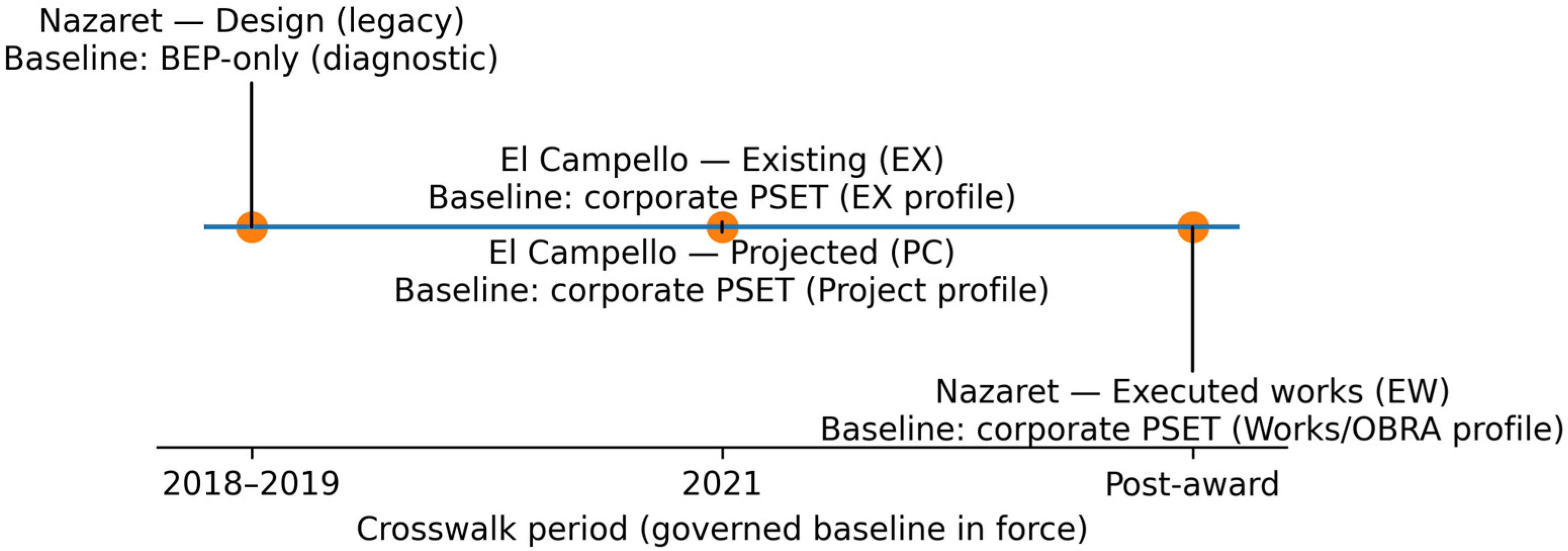
Table A11.
CW-1 baseline-selection record (simplified) corresponding to Table 8 1.
References
- Cavka, H.; Staub-French, S.; Poirier, E. Levels of BIM compliance for model handover. J. Inf. Technol. Constr. (ITcon) 2018, 23, 243–258. [Google Scholar]
- ISO 19650-1:2018; Organization and Digitization of Information About Buildings and Civil Engineering Works, Including Building Information Modelling (BIM)-Information Management Using Building Information Modelling-Part 1: Concepts and Principles. BSI Standards Limited: London, UK, 2018.
- UK BIM Framework. Information Management According to BS EN ISO 19650-Guidance Part 2: Processes for Project Delivery, 4th ed.; UK BIM Framework: London, UK, 2020. [Google Scholar]
- Godager, B.; Mohn, K.; Merschbrock, C.; Klakegg, O.; Huang, L. Towards an improved framework for enterprise BIM: The role of ISO 19650. J. Inf. Technol. Constr. (ITcon) 2022, 27, 1075–1103. [Google Scholar] [CrossRef] [Scilit]
- UK BIM Framework. Information Management According to BS EN ISO 19650-Guidance Part C: Facilitating the Common Data Environment (Workflow and Technical Solutions), 1st ed.; UK BIM Framework: London, UK, 2020. [Google Scholar]
- Abanda, F.; Balu, B.; Adukpo, S.; Akintola, A. Decoding ISO 19650 Through Process Modelling for Information Management and Stakeholder Communication in BIM. Buildings 2025, 15, 431. [Google Scholar] [CrossRef] [Scilit]
- ISO 19650-2:2018; Organization and Digitization of Information About Buildings and Civil Engineering Works, Including Building Information Modelling (BIM)-Information Management Using Building Information Modelling Part 2: Delivery Phase of the Assets. BSI Standards Limited: London, UK, 2018.
- ISO 19650-3:2020; Organization and Digitization of Information About Buildings and Civil Engineering Works, Including Building Information Modelling (BIM)-Information Management Using Building Information Modeling-Part 3: Operational Phase of Assets. BSI Standards Limited: London, UK, 2020.
- Ashworth, S.; Dillinger, M.; Körkemeyer, K. BIM guidance to optimize the operational phase: Defining information requirements based on ISO 19650. Facilities 2023, 41, 337–356. [Google Scholar] [CrossRef] [Scilit]
- Pärn, E.A.; Edwards, D.J.; Sing, M.C.P. The building information modelling trajectory in facilities management: A review. Autom. Constr. 2017, 75, 45–55. [Google Scholar] [CrossRef] [Scilit]
- Kiviniemi, A.; Codinhoto, R. Challenges in the implementation of BIM for FM-Case Manchester Town Hall Complex. In Computing in Civil and Building Engineering (2014); Engineers, A.S., Ed.; ASCE Press: Reston, VA, USA, 2014; pp. 665–672. [Google Scholar] [CrossRef] [Scilit]
- Leygonie, R.; Motamedi, A.; Iordanova, I. Development of quality improvement procedures and tools for facility management BIM. Dev. Built Environ. 2022, 11, 100075. [Google Scholar] [CrossRef] [Scilit]
- Eastman, C.; Lee, J.; Jeong, Y.; Lee, J. Automatic rule-based checking of building designs. Autom. Constr. 2009, 18, 1011–1033. [Google Scholar] [CrossRef] [Scilit]
- Greenwood, D.; Lockley, S.; Malsane, S.; Matthew, J. Automated compliance checking using building information models. In Proceedings of the Cobra 2010—Construction, Building and Real Estate Research Conference of the Royal Institution of Chartered Surveyors, Paris, France, 2–3 September 2010; pp. 266–274. [Google Scholar]
- Pauwels, P.; van den Bersselaar, E.; Verhelst, L. Validation of technical requirements for a BIM model using semantic web technologies. Adv. Eng. Inform. 2024, 60, 102426. [Google Scholar] [CrossRef] [Scilit]
- Jia, L.; Chen, M.; Chen, C.; Jin, Y. A semantic web and IFC-based framework for automated BIM compliance checking. Buildings 2025, 15, 2633. [Google Scholar] [CrossRef] [Scilit]
- Peng, J.; Liu, X. Automated code compliance checking research based on BIM and knowledge graph. Sci. Rep. 2023, 13, 7065. [Google Scholar] [CrossRef] [Scilit]
- Ma, Z.; Zhu, H.; Xiang, X.; Turk, Ž.; Klinc, R. Automatic compliance checking of BIM models against quality standards based on ontology technology. Autom. Constr. 2024, 166, 105656. [Google Scholar] [CrossRef] [Scilit]
- Noardo, F.; Arroyo Ohori, K.; Krijnen, T.; Stoter, J. An inspection of IFC models from practice. Appl. Sci. 2021, 11, 2232. [Google Scholar] [CrossRef] [Scilit]
- Andrich, W.; Daniotti, B.; Pavan, A.; Mirarchi, C. Check and validation of building information models in detailed design phase: A check flow to pave the way for BIM based renovation and construction processes. Buildings 2022, 12, 154. [Google Scholar] [CrossRef] [Scilit]
- Noardo, F.; Wu, T.; Arroyo Ohori, K.; Krijnen, T.; Stoter, J. IFC models for semi-automating common planning checks for building permits. Autom. Constr. 2022, 134, 104097. [Google Scholar] [CrossRef] [Scilit]
- buildingSMART International. What Do Facility Managers Need from BIM? (Industry Insight); buildingSMART International: Hertfordshire, UK, 2022; Available online: https://www.buildingsmart.org/wp-content/uploads/2022/05/Industry-Insight_What-do-Facility-Managers-Need-from-BIM.pdf (accessed on 19 January 2026).
- buildingSMART International. Information Delivery Specification (IDS) (Version 1.0); buildingSMART International: Hertfordshire, UK, 2024; Available online: https://www.buildingsmart.org/standards/bsi-standards/information-delivery-specification-ids/ (accessed on 19 January 2026).
- ISO 16739-1:2024; Industry Foundation Classes (IFC) for Data Sharing in the Construction and Facility Management Industries. International Organization for Standardization: Geneva, Switzerland, 2014.
- Akbas, E.; Bolpagni, M.; Borrmann, A.; Boeykens, S.; Mellenthin Filardo, M.; Liu, L.; Beetz, J. A holistic approach to information requirements: Integration of level of information need and information delivery specification. J. Inf. Technol. Constr. (ITcon) 2025, 30, 731–744. [Google Scholar] [CrossRef] [Scilit]
- Martínez-Soler, I.; Pastor-Villanueva, J.; Pérez-García, A.; Mateu-Gozálvez, D.; Loza-Remón, R.; García-Cerezo, J.A. IDS for the Verification of Project Information Requirements: A Case Study at Ferrocarrils de la Generalitat Valenciana. In Proceedings of EUBIM 2025-BIM International Conference/14th BIM Users Meeting, Valencia, Spain, 21–24 May 2025; Fuentes Giner, B., Oliver Faubel, I., Eds.; Editorial Universitat Politècnica de València: Valencia, Spain, 2025; pp. 271–280. [Google Scholar] [CrossRef] [Scilit]
- Ciribini, A.; Ventura, S.; Bolpagni, M. Informative content validation is the key to success in a BIM-based project. Territ. Ital. 2015, 2, 9–29. [Google Scholar] [CrossRef] [Scilit]
- Lee, Y. Rules and validation processes for interoperable BIM data exchange standards. J. Comput. Des. Eng. 2021, 8, 97–114. [Google Scholar] [CrossRef] [Scilit]
- Gerbino, S.; Cieri, L.; Rainieri, C.; Fabbrocino, G. On BIM interoperability via the IFC standard: An assessment from the structural engineering and design viewpoint. Appl. Sci. 2021, 11, 11430. [Google Scholar] [CrossRef] [Scilit]
- Noardo, F.; Harrie, L.; Arroyo Ohori, K.; Biljecki, F.; Ellul, C.; Krijnen, T.; Eriksson, H.; Guler, D.; Hintz, D.; Jadidi, M.A.; et al. Tools for BIM-GIS Integration (IFC Georeferencing and Conversions): Results from the GeoBIM Benchmark 2019. ISPRS Int. J. Geo-Inf. 2020, 9, 502. [Google Scholar] [CrossRef] [Scilit]
- Liu, X.; Wang, X.; Wright, G.; Cheng, J.; Li, X.; Liu, R. A state-of-the-art review on the integration of Building Information Modeling (BIM) and Geographic Information System (GIS). ISPRS Int. J. Geo-Inf. 2017, 6, 53. [Google Scholar] [CrossRef] [Scilit]
- Zhu, J.; Wang, X.; Chen, M.; Wu, P.; Kim, M. Integration of BIM and GIS: IFC geometry transformation to shapefile using enhanced open-source approach. Autom. Constr. 2019, 106, 102859. [Google Scholar] [CrossRef] [Scilit]
- Tsay, G.; Lin, Y.; Yuen, C. BIM for FM: Understanding information quality issues in terms of compliance with owner’s building information modeling requirements. Front. Built Environ. 2023, 9, 1117066. [Google Scholar] [CrossRef] [Scilit]
- Kładź, M.; Borkowski, A.S. IDS Standard and bSDD Service as Tools for Automating Information Exchange and Verification in Projects Implemented in the BIM Methodology. Buildings 2025, 15, 378. [Google Scholar] [CrossRef] [Scilit]
- Zhu, J.; Wu, P.; Chen, M.; Kim, M.; Wang, X.; Fang, T. Automatically processing IFC clipping representation for BIM and GIS integration at the process level. Appl. Sci. 2020, 10, 2009. [Google Scholar] [CrossRef] [Scilit]
- Otranto, R.B.; Junior, G.M.; Pellanda, P.C. BIM-FM integration through openBIM: Solutions for interoperability towards efficient operations. J. Inf. Technol. Constr. (ITcon) 2025, 30, 298–318. [Google Scholar] [CrossRef] [Scilit]
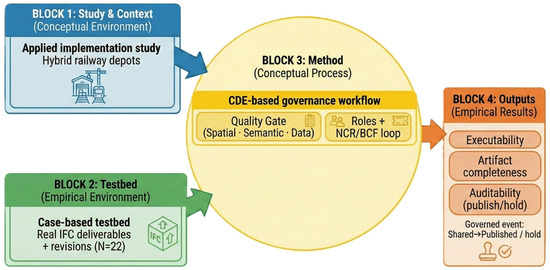
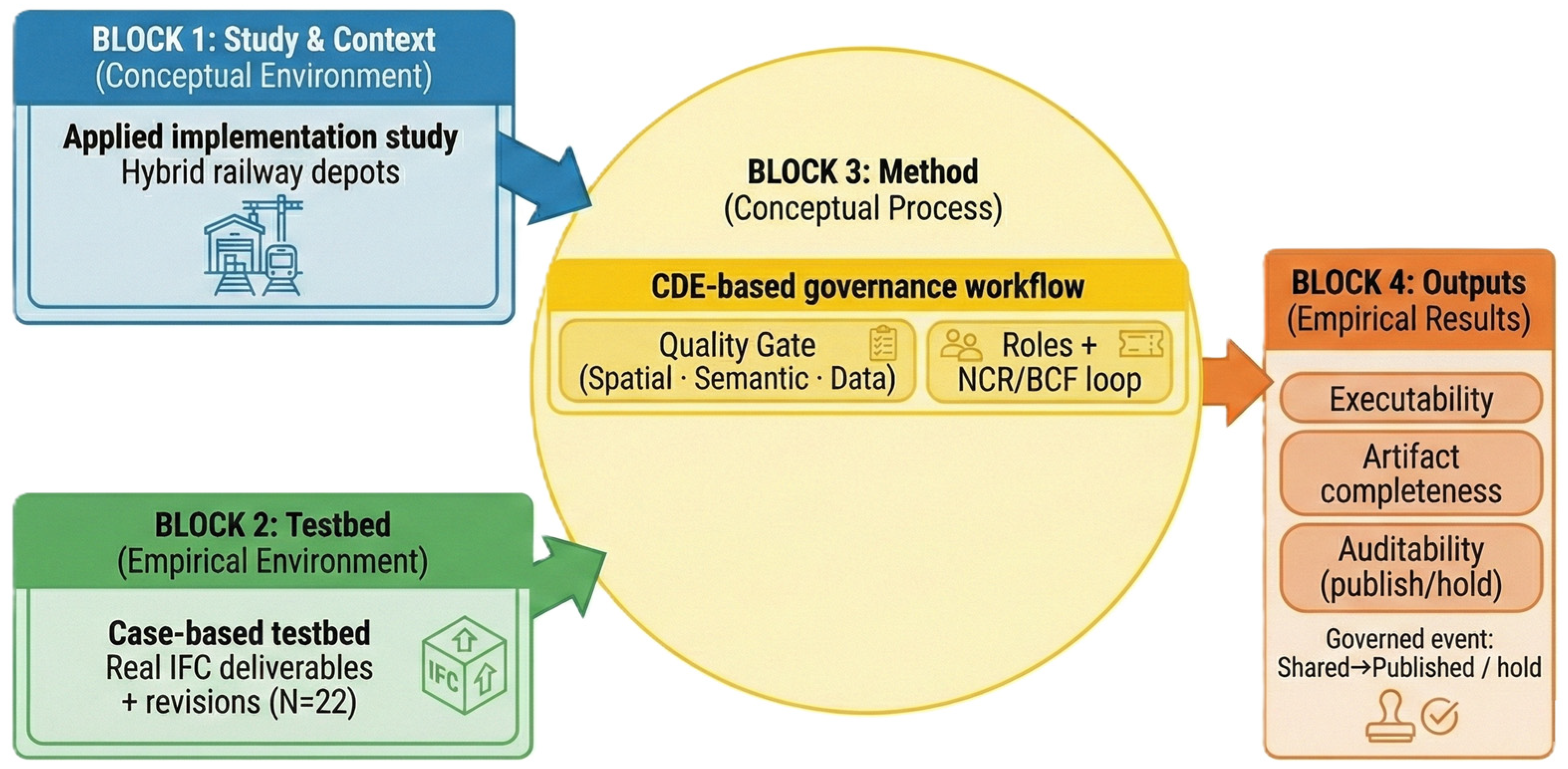
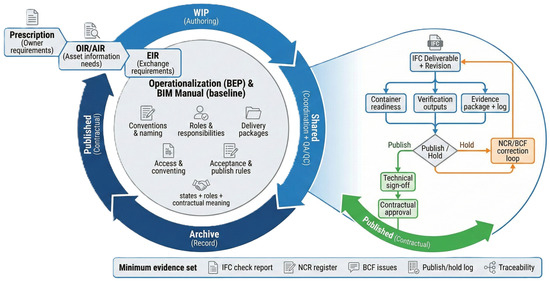
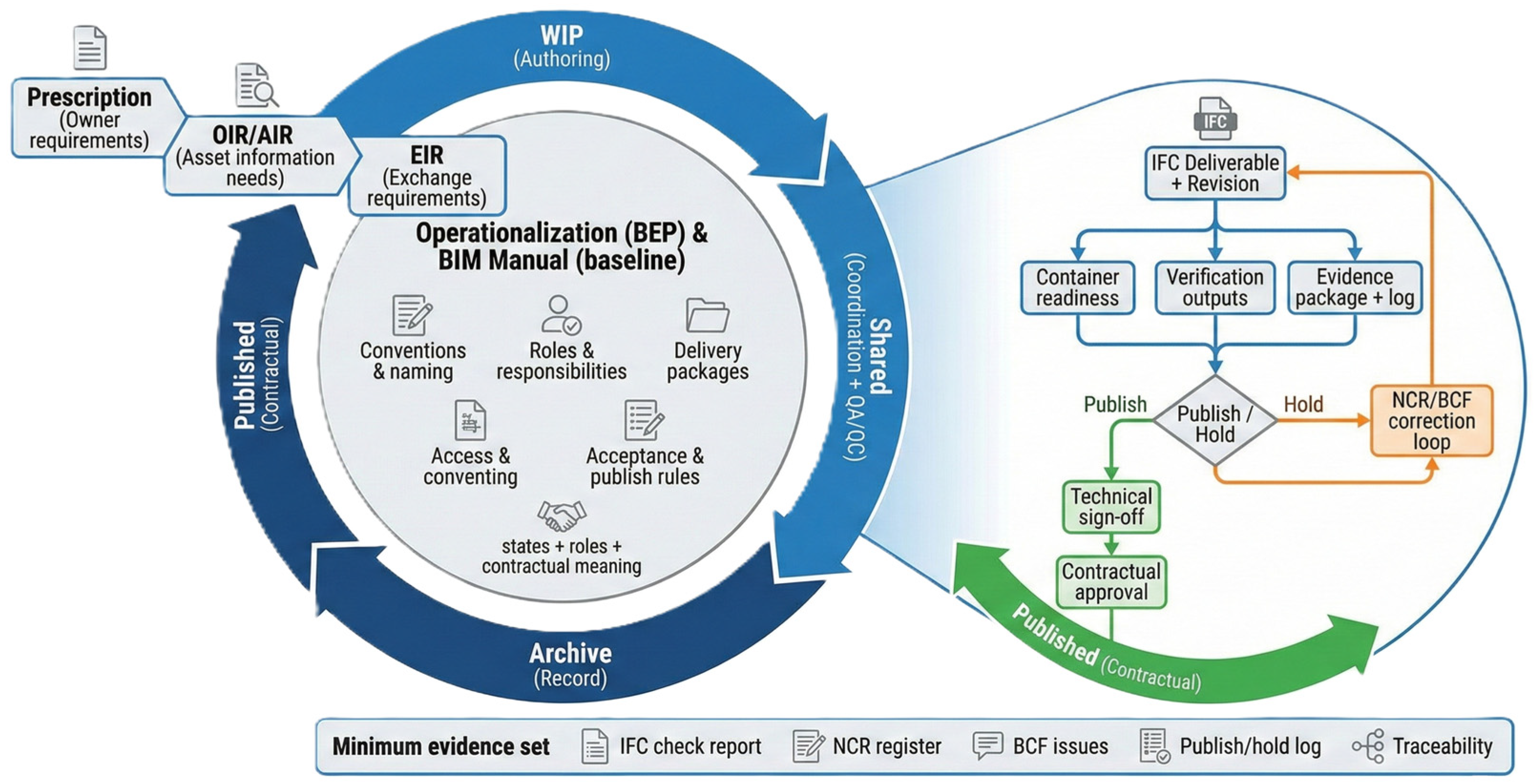
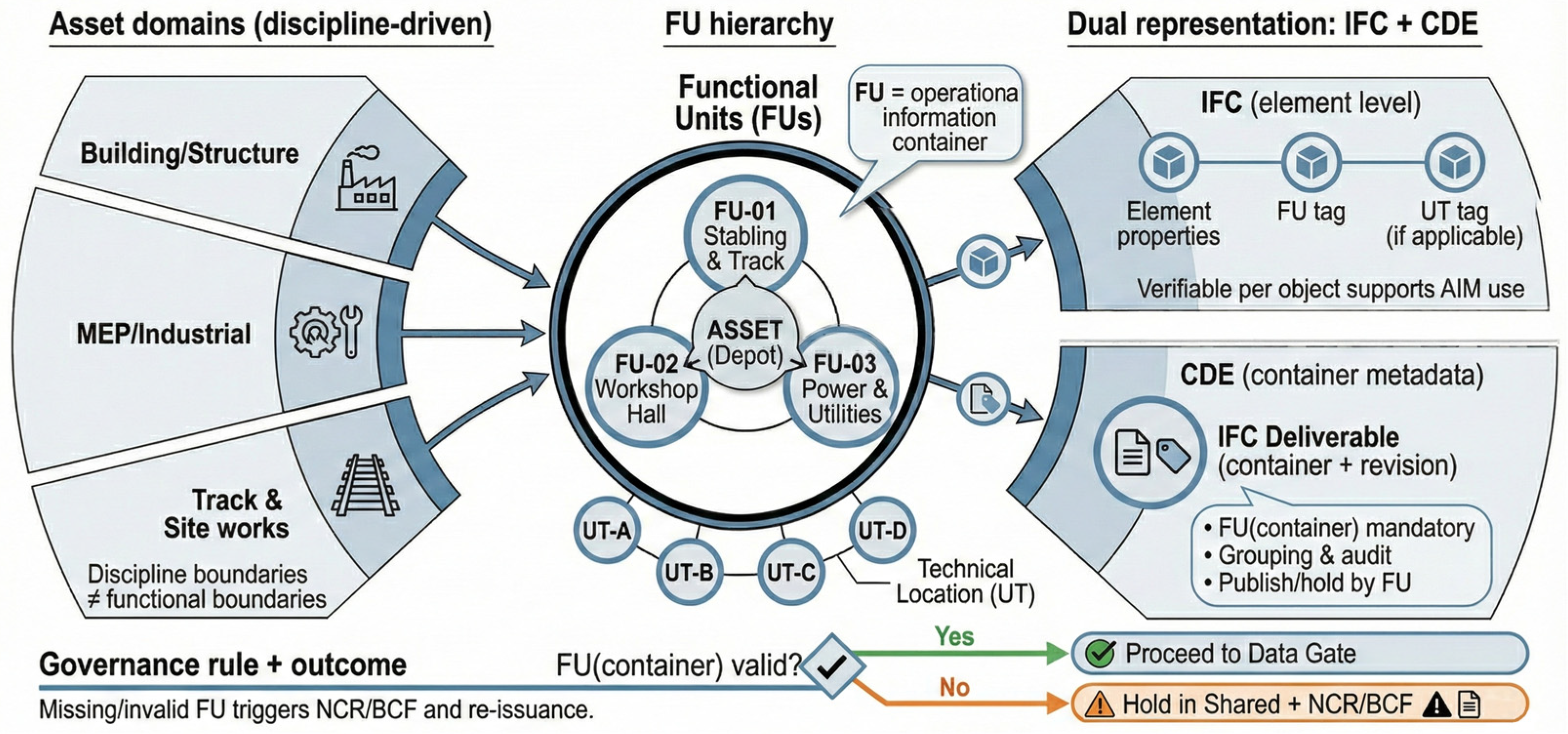
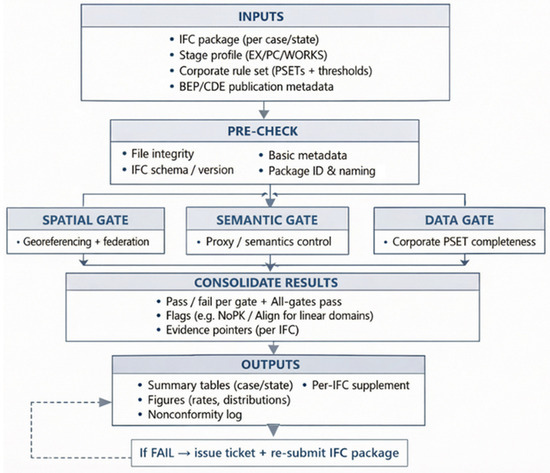
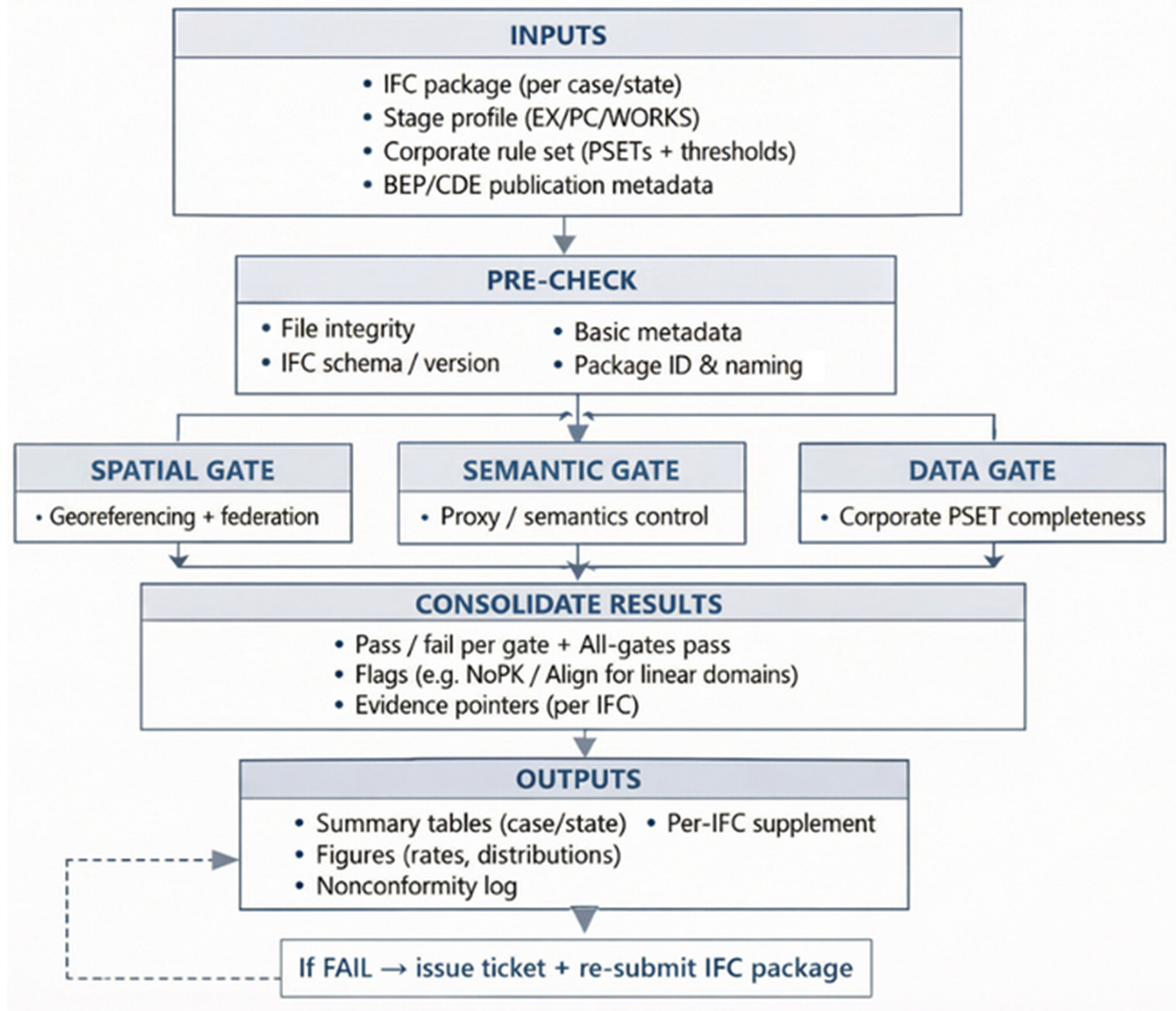
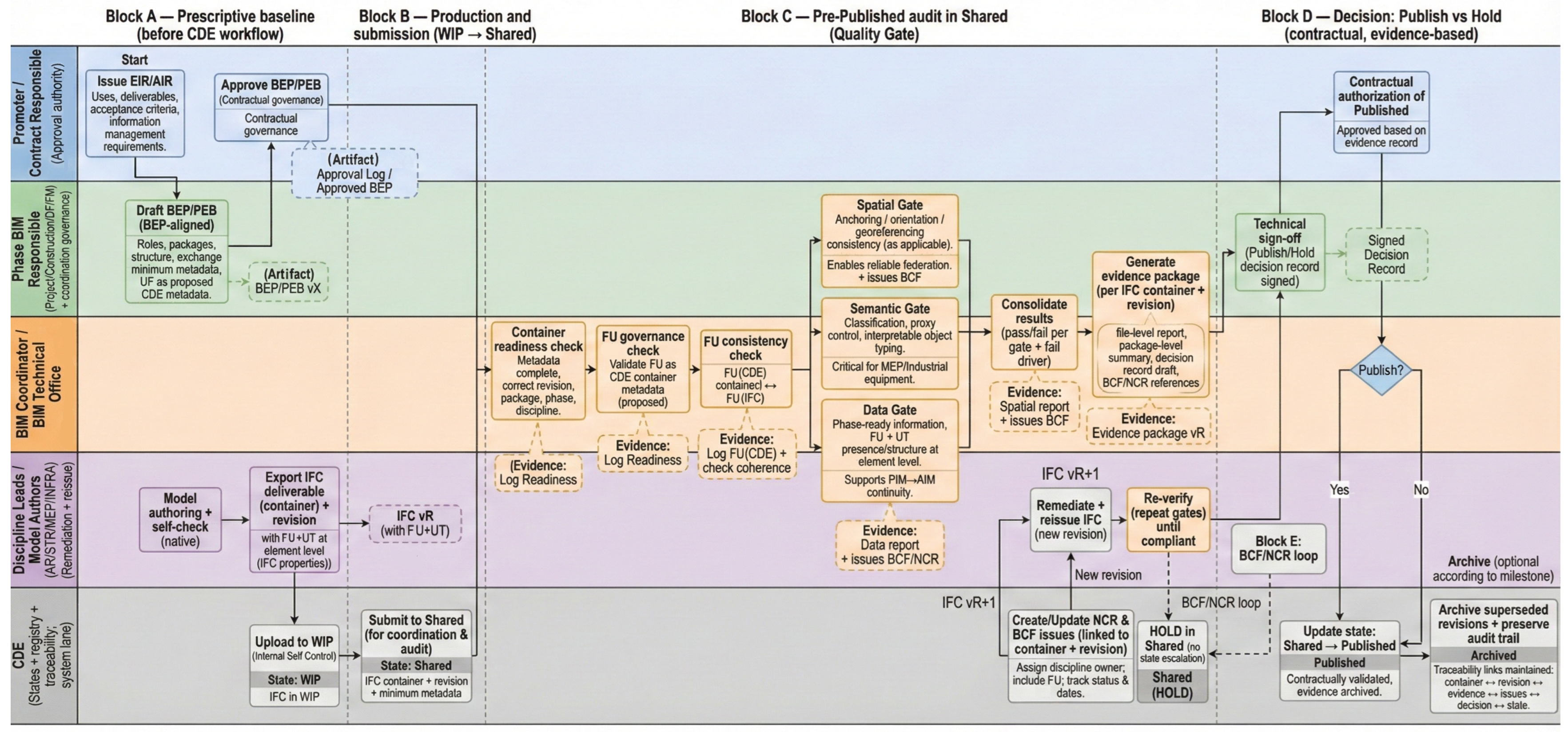
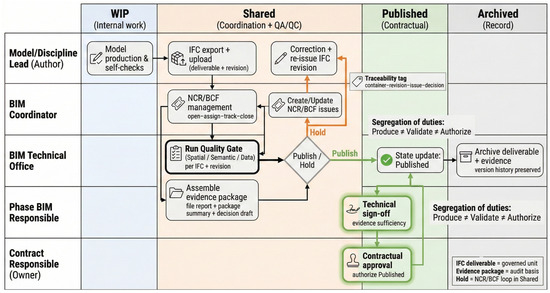
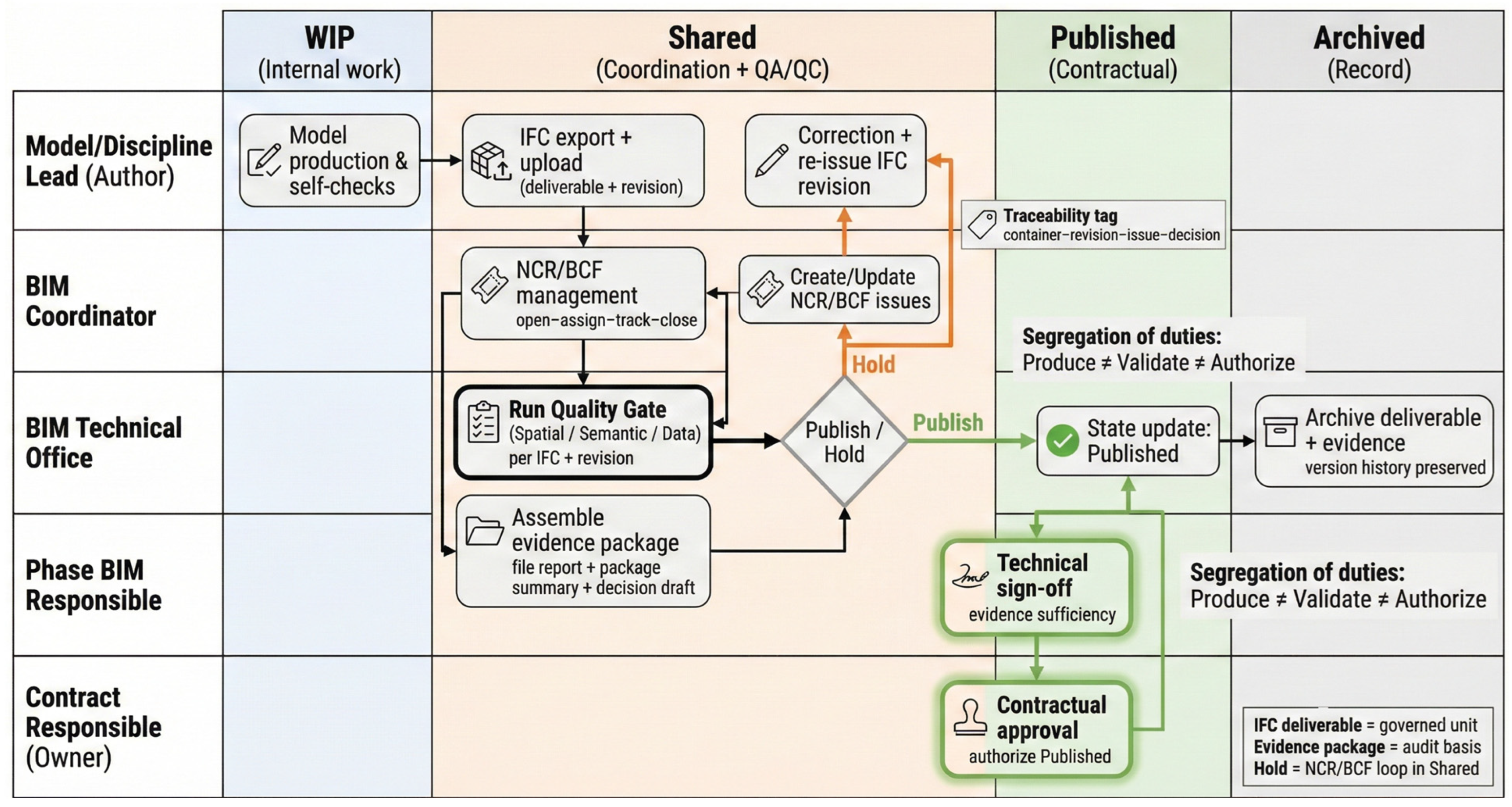
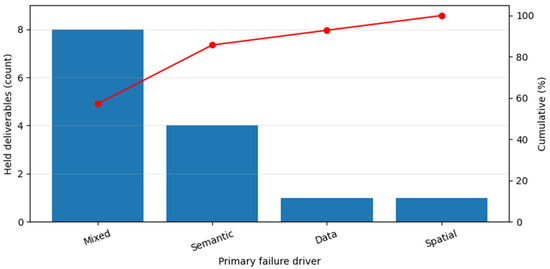
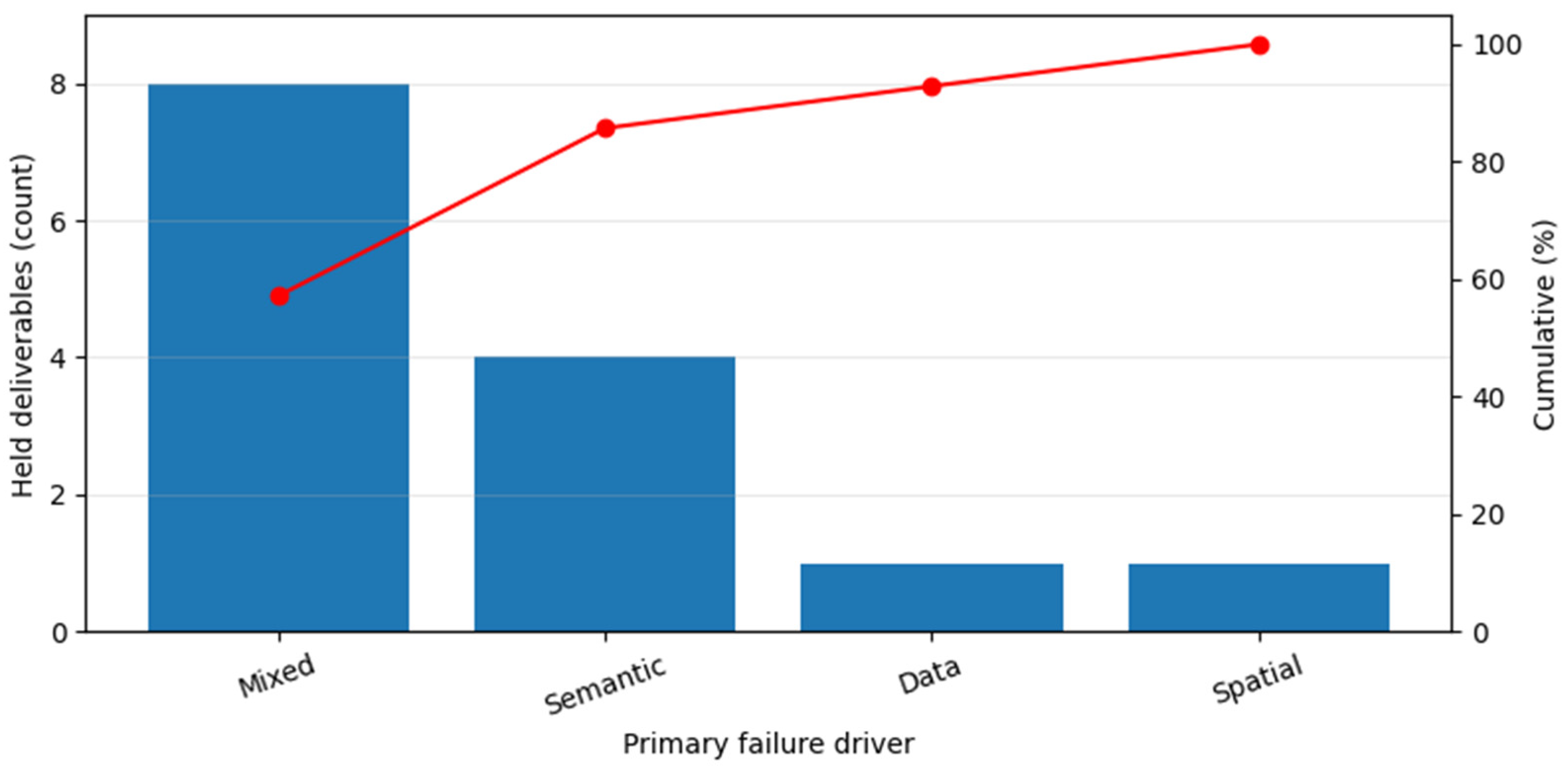

Disclaimer/Publisher’s Note: The statements, opinions and data contained in all publications are solely those of the individual author(s) and contributor(s) and not of MDPI and/or the editor(s). MDPI and/or the editor(s) disclaim responsibility for any injury to people or property resulting from any ideas, methods, instructions or products referred to in the content. |
© 2026 by the authors. Licensee MDPI, Basel, Switzerland. This article is an open access article distributed under the terms and conditions of the Creative Commons Attribution (CC BY) license.