


Featured Application
The work presented in this article describes an accessible and flexible video game-based approach aimed at fostering executive functions in young neurotypical children, potentially supporting their cognitive, emotional, and social development from an early age.
Abstract
Executive functions, which are fundamental to children’s cognitive and academic development, undergo significant maturation during early childhood. This highlights the importance of supporting these pivotal processes from a young age. Recently, the development of serious games designed to train executive functions has become an active area of research. However, most studies have focused on children with deficits, such as those with attention-deficit/hyperactivity disorder, leaving the effects in typically developing children largely unexplored. In this work, eight serious games have been developed with the aim of training various executive functions within an academic setting. In a one-month pilot case series study, a group of 16 neurotypical primary school children who engaged with the games showed statistically significant improvements in working memory, inhibition, initiation, planning, task monitoring, and organization of materials, along with a reduction in parental burden. These exploratory results suggest that serious games may represent a promising approach to support executive function development in neurotypical children, addressing a gap in the literature.
1. Introduction
Executive functions (EFs) refer to a set of cognitive processes and skills that enable an individual to anticipate, plan, initiate, monitor, modify, and terminate goal-directed, voluntary behavior [1]. They first manifest in early childhood, undergo rapid development during the preschool years, and continue to mature throughout adolescence in parallel with the development of the prefrontal cortex [2]. EFs play a fundamental role in academic achievement [3]. Several research studies have shown that EF skills throughout the preschool period are significantly associated with early academic outcomes and can predict later academic achievement, emphasizing their key role in children’s school competence [4,5,6]. EFs are not only linked to cognitive processes but are also involved in emotional regulation and social competence. Self-regulation, an integrated construct including attention control, emotion regulation, and engagement in positive social interactions with teachers and peers, has been shown to be critically important for children’s adaptive behavior and social functioning [7].
Although there is no consensus regarding the exact number of EFs, Best et al. pointed out that inhibition, working memory, cognitive flexibility, and planning, which includes reasoning, are the most frequently studied components in previous investigations [8]. In addition to these, attention (both sustained and selective) is also recognized as a core EF, playing a crucial role in supporting and coordinating goal-directed behavior [9]. All of these EFs play a crucial role in a child’s academic development: cognitive shifting allows children to move between tasks or subjects, inhibition helps them manage distractions, attention supports focus on instructions provided by the teacher, working memory aids in retaining and manipulating information, and planning and reasoning guide goal setting, problem solving, and classroom participation.
Given the importance of EFs in children’s academic, emotional, and social development, a wide range of interventions have been proposed and shown to yield positive outcomes [10]. These include programs based on physical exercise, behavioral interventions integrated into the classroom curriculum, and approaches focused on parental involvement. More recently, research has begun to explore the potential of emerging technologies, including robotics, virtual reality, and digital interventions delivered through computers, tablets, and mobile devices. However, technology-intensive approaches such as robotics and virtual reality often pose substantial practical challenges, including high hardware costs, the need for specialized infrastructure, and additional training requirements for teachers, which can limit their accessibility and scalability in real-world educational settings. Consequently, digital interventions have attracted increasing attention, as they can be more easily and universally accessed.
However, most research on children has focused on those with special needs. This, combined with evidence that training benefits are largest in low-performing children [11], highlights the need to evaluate whether these interventions produce similar effects in neurotypical children. Furthermore, the majority of research on digital interventions in children with learning difficulties has concentrated on working memory training [12,13], raising the open question of whether digital interventions can also enhance other, less-studied EFs.
This study aims to advance knowledge on the development of serious video games designed to support EFs in children with neurotypical development. As noted above, the development of EFs is important for academic achievement, emotional regulation, and social skills in neurotypical children. Moreover, video games can serve as a valuable tool to understand normative development, as they offer the added advantage of ecological, continuous, near-daily monitoring, providing detailed data across multiple sessions. In addition, insights gained from neurotypical children might help in the early identification of children with neurodevelopmental disorders, who may display atypical patterns of performance in the video games compared to their neurotypical peers. For this purpose, it is important that serious video games target both commonly trained EFs and those that have been less frequently explored in the literature. Specifically, eight original videogames were developed with the aim to target these particular domains: selective attention, sustained attention, inhibitory control, cognitive flexibility, working memory, organization, and problem solving.
Our hypothesis is that administering the games may lead to improvements in the EFs of the participating children. To this end, children will engage in repeated practice of cognitive tasks specifically designed to train the seven target domains. This approach is grounded in Kirk et al.’s work [14], showing that repeated practice within a domain can improve efficiency and may transfer to untrained domains, and in Galván’s work [15], which describes how repetition strengthens neural connections through neuroplasticity. By structuring the sessions in this way, we aim to create measurable improvements in the targeted EFs.
The following section reviews related work. Section 3 details the eight developed video games, the primary school sample and the procedure, detailing which games were administered each day, as well as the evaluation methods employed. Section 4 presents the results of the pre-post assessment. Finally, the article concludes with a discussion of the findings and suggestions for future research.
2. Related Works
Although the first experiments with computer-based games date back to the 1950s and 1960s, commercial video games that have been shown to potentially improve specific cognitive skills started to emerge around the 1990s. Among these, Larose, Gagnon, Ferland, and Pépin (1989) conducted one of the earliest experimental investigations into the use of video games as a tool within cognitive rehabilitation programs for children and adolescents with attentional and cognitive difficulties [16]. Their intervention specifically employed an adaptation of the game Super Breakout. The results suggested that computerized training using this game could lead to improvements in attention and visual tracking, indicating that digital games may be effectively integrated as a therapeutic adjunct in clinical settings. Another pioneering contribution is the work by Okagaki and Frensch (1994), who reported that the classic game Tetris could enhance visuospatial skills in adolescents, a cognitive domain closely associated with working memory and spatial processing [17]. Years later, Flynn and Colon (2016) extended this line of research by exploring the use of commercial active video games (exergames), such as Just Dance 4 for Nintendo Wii. They examined children with attention-deficit/hyperactivity disorder (ADHD) and autism spectrum disorders, comparing gameplay individually versus with a peer [18]. The authors found that children who played individually showed improvements in inhibitory control, highlighting the potential of commercial active video games to support EFs.
Among the earliest non-commercial games specifically developed to enhance EFs in children is Braingame Brian. This game was designed to target cognitive processes such as working memory, inhibitory control, and cognitive flexibility, providing structured exercises within a game-like environment. Its development represents an important step in the transition from experimental and educational computer games toward interventions explicitly aimed at training EFs in pediatric populations.
The rise of gamified applications aimed at improving EFs accelerated after the U.S. Food and Drug Administration (FDA) approved EndeavorRx [19] as the first serious game authorized for clinical prescription to treat the core symptoms of ADHD in children [20]. This approval marked a milestone, as it was the first time a video game was not only scientifically evaluated but also officially recognized as a therapeutic tool for targeting EFs in the pediatric population.
The impact of this work can be appreciated in several recent literature reviews, such as those by Peñuelas et al. [21], Schultz et al. [22], Lin and Woo-Rin [23] and Rodrigo-Yanguas et al. [24]. Although not the most recent, the review by Rodriguez-Yanguas et al. analyzed a particularly large number of studies (n = 128), categorizing them into treatment, diagnostic, and behavioral applications of video game use. Among the treatment-focused studies, the EFs most frequently targeted were inhibitory control and working memory, followed by attention. Other EFs, such as cognitive flexibility, planning, organization, problem solving, and task switching/set-shifting, were addressed far less frequently. Among these games, Plan-It Commander stands out as one of the few that targets, in a playful way, task planning, organization, time management, and social cooperation in children with ADHD. The intervention includes three main minigames, with Labyrinth training time management, Explorobot targeting planning and organization through basic action sequencing, and Space Travel Trainer promoting social skills and cooperation by requiring children to coordinate with virtual characters. All games take place within an adventure narrative and include rewards and achievements, which contributes to motivation and engagement with the tasks [25]. The Secret Trail of Moon is also noteworthy as a virtual reality serious game developed for children with ADHD, as it incorporates problem-solving tasks, an EF that has been relatively underrepresented in previous serious-game interventions. The game includes activities based on puzzles and decision-making, requiring the player to plan and select strategies to progress. It is designed for primary school children and is grounded in principles of problem-based learning and self-regulation [26]. This interest in developing interventions to address cognitive and behavioral difficulties associated with ADHD has also extended to other neurodevelopmental disorders [27], such as autism spectrum disorder [28] and intellectual disabilities [29].
Comparatively fewer studies have investigated the use of these video games to enhance EFs in neurotypical children. Among these, Sánchez-Pérez et al. implemented a digital training program for neurotypical primary school students that combined adaptive working memory exercises with adaptive digital mathematics tasks [30]. The working memory activities required students to remember and manipulate sequences of information, while the mathematics tasks aimed to reinforce arithmetic operations and problem-solving skills. Their results suggested improvements in EFs, particularly working memory and inhibition, as well as in academic performance in mathematics and reading.
In another work, Johann and Karbach implemented both game-based and standard EF training in typically developing children, including working memory, inhibition, and flexibility tasks [12]. The game-based version added a cover story, points, and choices to enhance motivation, perceived competence, and autonomy. Both trainings produced significant gains in EF, with domain-specific transfer to reading abilities, and children with lower baseline performance showed the largest improvements.
In these studies involving neurotypical children, the games are typically adaptations of classical psychological paradigms, including the flanker task, go/no-go tasks, and the Stroop test. This pattern is also observed in the CoCon game developed by Song, Yi, and Park, which consists of 10 mini-games incorporating general cognitive experimental paradigms, such as visual search, Stroop, flanker, and categorization tasks embedded within a narrative-driven video game environment [31]. These mini-games can be considered gamified interfaces for cognitive assessment, linking classical cognitive tests with engaging gameplay.
A study closer to a traditional video game format was conducted by Mondéjar et al. [32]. In this study, a group of neurotypical children played five video games designed around different mechanics: accurate action, timely action, mimic sequence, pattern learning, and logical puzzles. Participants also completed three classical psychometric assessments: the Trails test, the Stroop test, and the Tower of Hanoi. EEG signals were recorded during all eight tasks (five video games and three psychometric assessments). The results showed predominant activation in the frontal lobe and revealed that three of the videogames were correlated with the classical neuropsychological tests, suggesting the activation of EFs such as working memory, inhibition, and planning.
This article investigates the use of conventional video games specifically designed to train EFs, in contrast to previous studies that have primarily employed commercial video games. These games feature mechanics more closely aligned with traditional video games, unlike other studies that include or adapt psychometric tests as the basis for intervention. Moreover, the games target not only the EFs most commonly studied in prior research, such as working memory, inhibition, and attention, but also less frequently explored EFs such as shifting, problem solving, and planning. To support the transfer of these EFs to academic performance, educational elements are integrated into the gameplay experience. Finally, the study focuses on neurotypical children, a relatively underexplored population compared with the majority of research, which tends to concentrate on individuals with neurodevelopmental disorders.
3. Materials and Methods
This section provides an overview of the study sample, the digital games used in the intervention, the assessment instruments, and the procedure implemented to evaluate their effects.
3.1. Participants
The sample consisted of 16 primary school students, with a mean age of 5.86 ± 0.34 years, of whom 81.2% were girls. All participants were recruited from a local primary school. Participants did not receive any compensation for taking part in the study.
Inclusion criteria required children to be enrolled in the first year of primary education and to have typical neurodevelopment. None of the participants had any neurodevelopmental disorders reported at the time of the study. Parental informed consent was obtained prior to participation, and the study was approved by the Ethics Committee of Hospital 12 October (registration number 23/342).
3.2. Digital Games
A set of eight serious video games was designed with the goal of training different EFs. The games were developed using the Unity game engine for mobile devices, given their high prevalence of use among children and adolescents [33]. Using this engine, it is straightforward to export the games to both Android and iOS platforms. All game content was designed to be completed independently by children aged 5–6 years, without the need for adult assistance. Game interactions rely on simple touchscreen gestures, such as tapping and dragging on-screen elements. All gameplay data are automatically captured during play and transmitted telemetrically.
Before starting each game, the application provides a brief explanation of the task. In all games, the objective is to achieve the highest possible score by completing presented goals as accurately as possible. During gameplay, children receive immediate feedback on each action, reinforcing correct responses and signaling errors.
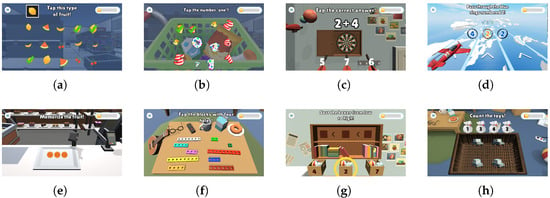
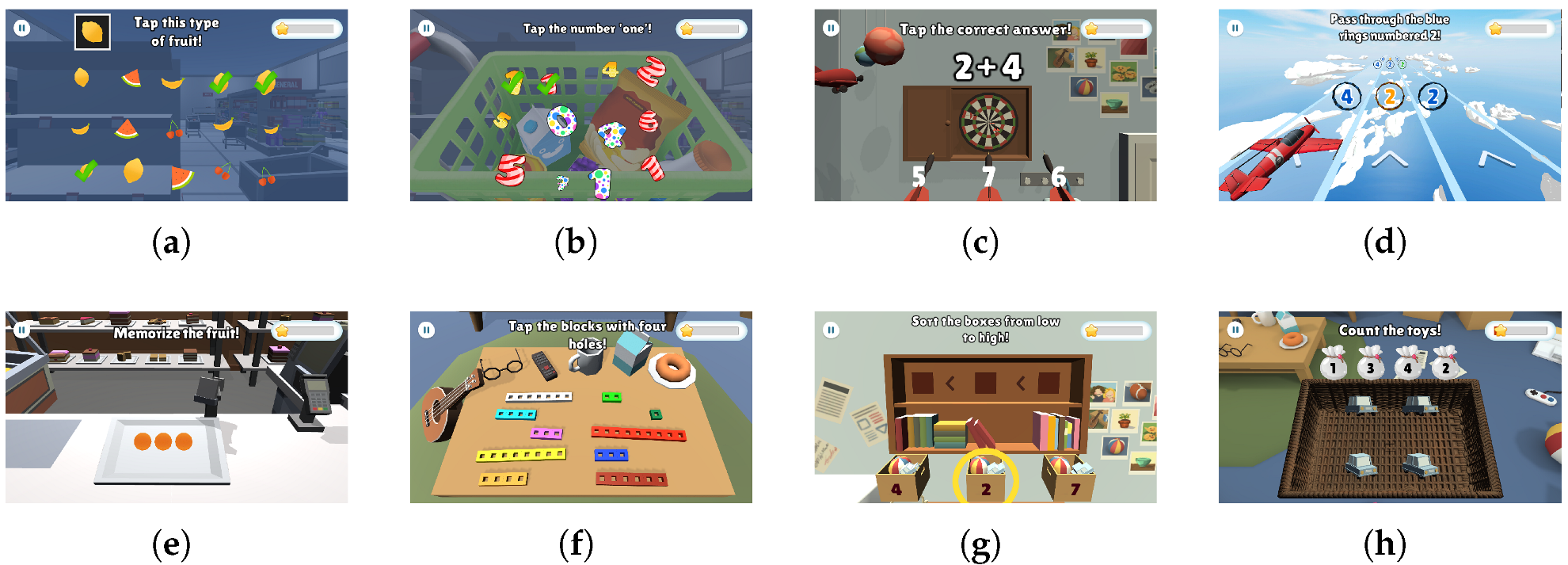
The eight games are described below, and their interfaces are illustrated in Figure 1.
Figure 1.
Interfaces of the developed digital games: (a) Fruit Tapping. (b) Number Tapping. (c) Simple Additions. (d) Number Selection. (e) Fruit Memory. (f) Block Tapping. (g) Ordering. (h) Object Count.
Fruit Tapping. In this game, the screen displays a set of cartoon fruits arranged randomly and rotated in various ways. Children are instructed to tap only the fruits that match a specific type. This task is repeated ten times, with additional fruits appearing in each cycle. The game is based on the Mouse Challenge [34], and targets the EFs of selective attention, working memory, and cognitive flexibility.
Number Tapping. This game is a variation of Fruit Tapping that uses numerical digits (1–9) instead of pictures of fruits. Children must recognize the digits and match them to the corresponding written number (“one”–“nine”) provided in the instructions. This additional challenge is based on simple mathematical tasks used for the detection of dyscalculia in children [35]. This game targets selective attention, working memory, and cognitive flexibility.
Simple Additions. In this game, children are tasked with solving a series of simple addition problems. Each problem is presented with three possible answers, of which only one is correct. To make the activity more engaging, the game frames it as a dartboard challenge: a correct response results in a bullseye, while an incorrect response misses the shot. This game is also based on basic tasks used for the detection of dyscalculia in children [35]. The activity targets working memory and inhibitory control.
Number Selection. This game is based on the endless runner genre and previous studies assessing EFs through continuous tasks [36,37,38]. Children control a plane that continuously flies forward and can strafe left or right. During play, a series of numbered rings appear. Children must navigate the plane through the rings displaying a specific number indicated by the game, while avoiding all others. The target number changes over time. This task targets selective attention, sustained attention, inhibitory control, and cognitive flexibility.
Fruit Memory. In this game, groups of identical cartoon fruits are displayed sequentially. Each group is represented by a different type of fruit and contains a varying number of pieces (e.g., three oranges, nine apples, six pears). Children must memorize the number and type of fruits in each group and then answer a question after all groups have been shown (e.g., “How many apples did you see?”). This game targets sustained attention, cognitive flexibility, and working memory. It is based on counting tasks similar to those used in dyscalculia screening tests and on previous studies focusing on working memory games [39,40].
Block Tapping. In this game, the screen displays a series of toy blocks, each with a different number of holes. Children are tasked with counting the holes in each block and collecting only those that match a specific target number, which changes after every cycle. The game is based on the serious game 3DAG for the detection of dyscalculia [41], and targets the EFs of selective attention, cognitive flexibility, and working memory.
Ordering. In this game, children are tasked with sorting groups of values in ascending or descending order. The values are represented as boxes containing varying numbers of toys which must be placed on a shelf. This game targets selective attention, organization, and problem-solving, following guidelines established in studies on number-based games for children [42,43].
Object Count. In this game, a series of baskets containing sets of one to nine toys are displayed. Children are tasked with counting the number of toys in each basket and selecting the button that shows the correct answer while ignoring buttons with incorrect responses. This game targets selective attention and inhibitory control and is also based on tasks used for the detection of dyscalculia in children [35].
3.3. Questionnaires
To analyze changes in EFs, the BRIEF-2 (Behavior Rating Inventory of Executive Function, Second Edition) was administered before and after the intervention. In addition, the Zarit Burden Interview (ZBI) was also administered pre- and post-intervention to assess potential effects on caregiver burden. The following provides a brief description of each instrument.
Executive function assessment. The BRIEF-2is a standardized parent- and teacher-report questionnaire designed to assess EFs in children aged 5–18 years. It consists of a 63-item Likert-type scale that evaluates specific daily behaviors related to executive functioning. The instrument assesses nine clinical scales: Inhibition, Cognitive Flexibility (Shift), Emotional Control, Initiation, Working Memory, Planning and Organization, Organization of Materials, Task Monitoring, and Self-Monitoring [44]. Each item is rated on a three-point scale ranging from 1 (“Never”) to 3 (“Often”). These scales are grouped into three broader indices: the Behavioral Regulation Index, the Emotion Regulation Index, and the Cognitive Regulation Index. A Global Executive Composite provides an overall measure of executive functioning by combining these indices.
All BRIEF-2 scores are reported as T-scores, allowing standardized comparisons across participants. The BRIEF-2 was selected as the sole EF assessment tool in this pilot study because it comprehensively covers the executive domains targeted by our serious games and can be completed by parents without imposing substantial burden or disrupting naturalistic data collection. Given that it captures executive functioning as manifested in everyday contexts, the BRIEF-2 is particularly suitable for evaluating interventions with serious video games, as it allows the assessment of potential changes beyond performance on laboratory tasks or game-specific measures. Previous studies have also used the BRIEF-2 to evaluate outcomes following video game–based interventions [39,45,46].
Parental burden assessment. According to the Balance between Risks and Resources theory [47], parental burnout results from an imbalance between excessive parenting demands and limited caregiving resources. Parental stress is not limited to contexts of illness or disability, but may arises when the demands of parenting exceed the caregiver’s resources, regardless of the child’s physical or mental health [48]. Evidence from studies in the general population, including parents of children aged 0–18 years without clinical diagnoses, indicates that parenting stress is a relevant phenomenon that warrants attention and may affect up to approximately 10% of parents [49]. The ZBI is a 22-item Likert-type questionnaire designed to assess caregivers’ perceived burden [50]. Each item is rated from 0 (“Never”) to 4 (“Nearly Always”), with higher scores indicating greater burden. The total score provides a general measure of perceived stress and strain associated with caregiving.
3.4. Procedure
Participants engaged in up to three sessions per week, each consisting of three games. The study was conducted over a period of four weeks in an uncontrolled setting, with all assessments carried out remotely. After downloading and installing an APK file on their mobile devices, the children accessed the games from their own homes via an application server, where performance data, including response times and errors, were securely stored. The games had been previously tested in a separate group of children of the same age during a single in-person session. No compensation was provided to the families in order to preserve a naturalistic assessment of engagement.
The schedule of games across sessions and weeks is presented in Table 1. The number and distribution of game sessions were established by an educational expert to align game content with the children’s curricular progression and the skills being addressed at that stage of learning. Each session lasted approximately 20 min.
Table 1.
Schedule of the 8 serious games across 4 weeks. “S1–S3” indicate sessions 1 to 3 in each week. An “✓” marks the sessions in which a game was played.
3.5. Data Analysis
A pre-post study design was used to evaluate changes in the measured outcomes. Differences between pre- and post-intervention scores for each indicator were analyzed using the Wilcoxon signed-rank test for paired data, with a one-sided alternative hypothesis testing for decreases in scores. The one-sided alternative hypothesis reflects our directional expectation that administering the games would be associated with improvements in the EFs of the participating children. The p-values are reported for all comparisons. Statistical significance was assessed at an -level of 0.05 significance level, with Holm–Bonferroni correction applied to account for multiple comparisons. Confidence intervals were also calculated via bootstrap.
4. Results
The average number of games played was 63.3 ± 25.4. Questionnaires were completed by both parents in 87.5% of cases, while for only two children the questionnaire was answered by just one parent.
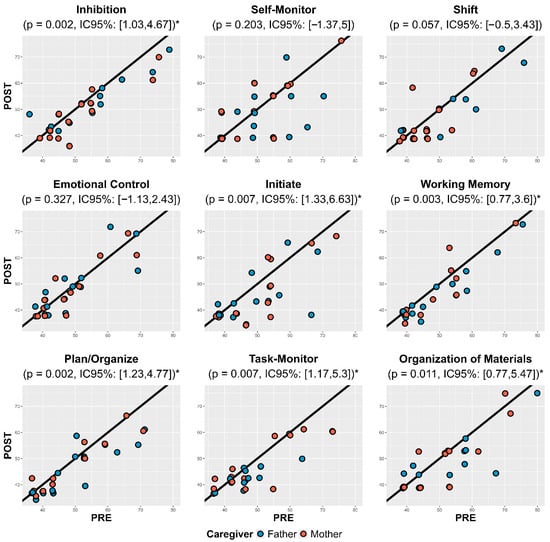
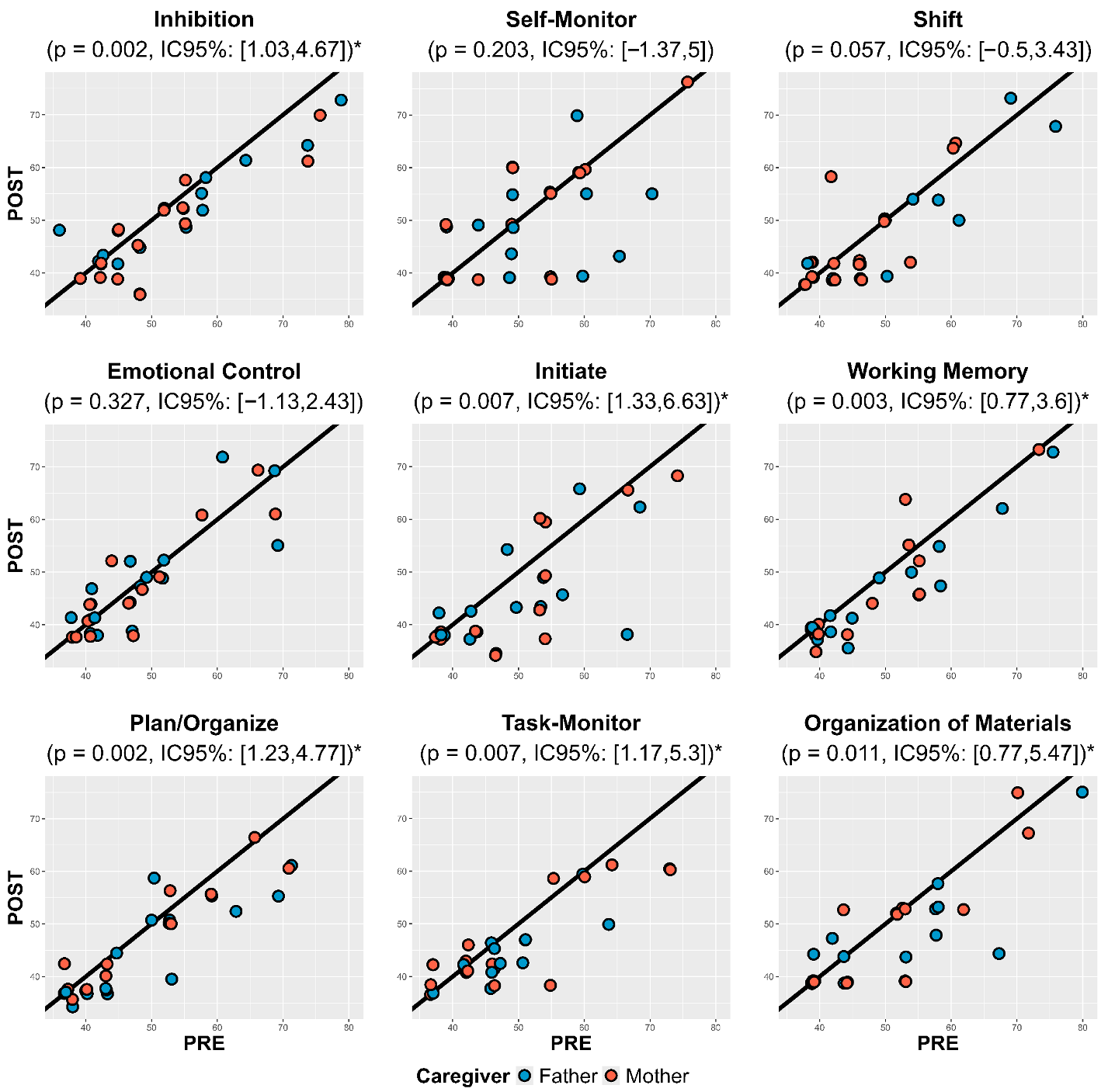
Figure 2 shows scatter plots of pre- and post-intervention scores for each of the nine EFs assessed with the BRIEF-2. Observations falling below the reference line indicate improvements in performance.
Figure 2.
Executive Functions Pre-Post Comparison (BRIEF-2). Asterisks indicate pre-post differences that are statistically significant according to Holm–Bonferroni correction (original p-values are shown; = 0.05 was used for corrected thresholds). Confidence intervals (95% bootstrap) for pre-post differences are also reported.
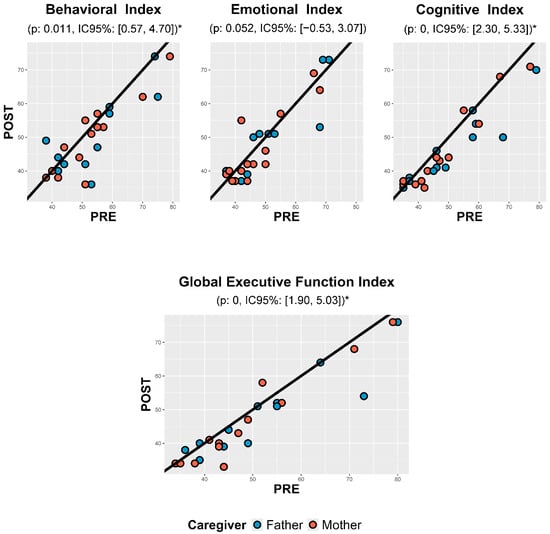
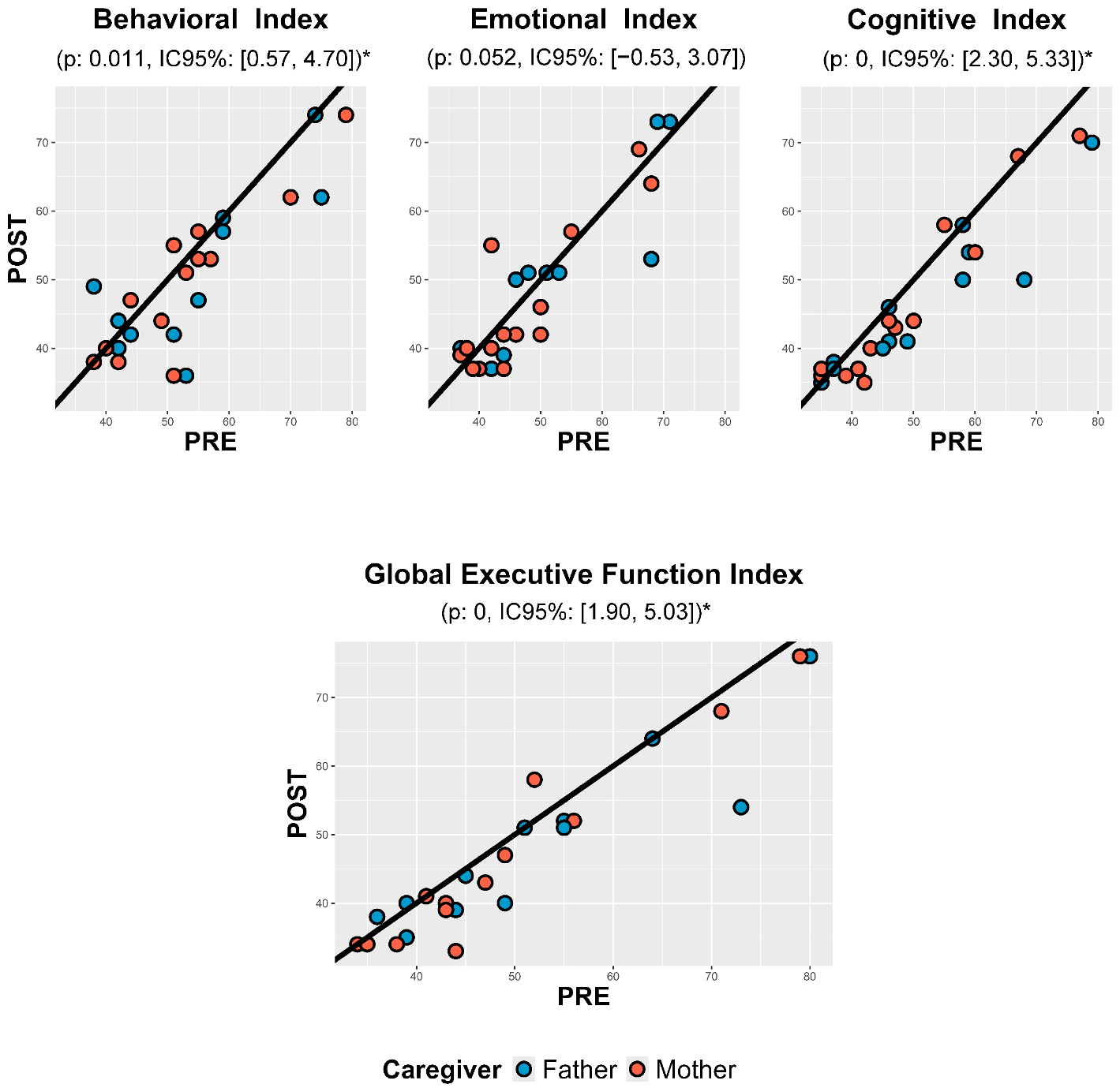
These graphs show a statistically significant improvement at a 95% confidence level in six EFs: inhibition, initiate, working memory, planning, task-monitoring, and organization of materials. The intervention did not produce improvements in self-monitoring of emotional control, which is consistent with the fact that the games were not designed to target these two EFs.
Figure 3 displays the BRIEF-2 indices, including the behavioral, emotional, and cognitive domains, as well as the global executive function index.
Figure 3.
BRIEF-2 indices across domains (behavioral, emotional, cognitive) and the global executive function index. Asterisks indicate pre-post differences that are statistically significant according to Holm-Bonferroni correction (original p-values are shown; = 0.05 was used for corrected thresholds). Confidence intervals (95% bootstrap) for pre-post differences are also reported.
Regarding parental burden, the mean ZBI score was 12.53 (±8.7) before the intervention and 6.77 (±7.11) afterward. This difference was statistically significant (p < 0.01).
5. Discussion
In this pilot study, eight serious video games were developed to enhance different EFs. Unlike the vast majority of existing studies, which focused on children with deficits, this study was conducted with neurotypical children. Studying neurotypical children provides important insight into normative EF development, which is essential for understanding how these processes typically evolve and may be strengthened.
The exploratory results showed statistically significant improvements in six EFs: working memory, inhibition, initiation, planning, task monitoring, and organization of materials. Although these results come from a preliminary study, they suggest that a multi-game intervention may improve EFs in neurotypical children. It is important to note that improvements in any given EF cannot be attributed to a single game alone, as other games in the collection, as well as transfer effects across EFs may also contribute.
These findings may have relevant future implications. Improvements in working memory, attention, and planning could support academic performance and task completion, while better inhibition, cognitive flexibility, and task monitoring may contribute to emotional regulation, persistence, and adaptive behavior [3,7]. Early strengthening of EFs may also be associated with long-term cognitive and social adaptation [51] and could help inform future preventive or enrichment interventions, extending the scope of EF training beyond clinical or high-risk groups where previous research suggests that measurable benefits may be more readily observed.
Furthermore, establishing normative performance patterns in neurotypical children may provide a valuable reference framework. Children with neurodevelopmental conditions, for example, ADHD, often exhibit atypical performance trajectories, and identifying deviations from normative patterns could support earlier detection and intervention. From a practical perspective, serious video games offer the added advantage of ecological, continuous, near-daily monitoring, enabling detailed tracking of performance across multiple sessions rather than relying on a single assessment.
Moreover, video games may increase accessibility compared with traditional cognitive-behavioral interventions, which often involve substantial costs and logistical barriers. In this context, they represent a valuable tool, as previous research has shown that children from lower socio-economic backgrounds tend to exhibit poorer self-regulation, which in turn is associated with greater difficulties in academic and behavioral adjustment during early schooling [52]. Delivering the intervention directly in participants’ homes further enhances its accessibility and feasibility for everyday use.
Another interesting finding from our study is that our proposed serious games led to a reduction in parental burden, as measured by the ZBI. This relates to previous research showing that using serious games with children with emotional dysregulation can reduce family stress and improve parent–child interactions [53]. The observed reduction in parental burden suggests that improvements in the child’s executive functioning may translate into meaningful benefits in everyday life. However, the reduction in parental burden observed through the use of serious games should be validated in future studies using additional measures that may be more appropriate for neurotypical children, such as the Parenting Stress Index, and in populations with other neurodevelopmental profiles.
Among the limitations of this study, which will be addressed in future research, are the sample size, as only a single school participated, and the duration of the intervention, which in this pilot study lasted only one month. It would be informative to examine the effects of such interventions over a full academic year across multiple schools, using a controlled study design instead of a case series. However, despite the small sample size, the cohort has a notable characteristic, as all participants were six years old, except for two children who were approaching their sixth birthday at the time of the study. This developmental stage is particularly relevant, as it corresponds to the age at which ADHD is typically first diagnosed in many countries. Considering that prior research indicates cognitive training interventions often produce more pronounced improvements in children with neurodevelopmental disorders than in neurotypical samples [54,55], it is plausible that these games could also benefit children with ADHD at an early age, potentially supporting more favorable developmental outcomes. Additionally, reliance solely on the BRIEF-2 questionnaire for EF assessment inherently entails some level of subjectivity and bias, given its dependence on parent-reported perceptions.
Adherence in the present study was slightly lower than that reported in previous research (typically 75–80%) [56]. Nevertheless, this level of adherence can be considered acceptable, as many of those studies involved children with cognitive or attentional deficits who may have been more motivated to complete the intervention [57]. Moreover, several of these studies provided monetary or other forms of compensation to participants [58], whereas no incentives were offered in the present study, factors that may have contributed to higher adherence rates compared to our intervention.
As a future line of research, we plan to develop games specifically designed to enhance the two EFs that did not show improvements, emotional control and self-monitoring, and to explore whether these games may also support improvements in mathematics performance, as the games incorporate ecological numerical elements intended to facilitate potential transfer between cognitive and academic skills. Moreover, leveraging digital tools to deliver tailored interventions could be particularly useful. This approach would allow games to be selected automatically for children based on their specific cognitive and academic profiles, rather than having all children play the same set of games. This could be achieved by integrating gamified academic and cognitive assessment tasks directly into the application. Incorporating automated cognitive assessments, such as Continuous Performance Tasks (CPTs), may also help reduce subjectivity and expectancy biases associated with reliance on the BRIEF-2 questionnaire.
6. Conclusions
This study aimed to address a gap in the literature regarding the integration of specifically designed digital video games into educational contexts to support the development of EFs during early childhood. While many previous interventions have relied on commercial video games or computerized adaptations of psychometric tasks, the present work focuses on games intentionally created to train EFs while incorporating age-appropriate academic content.
Despite the limited sample size, the findings provide preliminary evidence that this approach can be feasibly implemented and may contribute to improvements in EFs during a critical developmental period. Early childhood represents a time of high neural plasticity, when EFs undergo rapid development and may be particularly responsive to structured cognitive stimulation.
An additional strength of the study lies in the homogeneity of the cohort, as nearly all participants were six years old. This contrasts with many previous studies that include wider age ranges, where age must be statistically controlled and it remains unclear whether the benefits are consistent across developmental stages. Focusing on a single developmental window allows for a more precise interpretation of the findings. Moreover, this stage is particularly relevant because it coincides with the age at which ADHD is commonly first diagnosed in many countries. In this context, the present findings suggest that early, developmentally targeted interventions of this type may have potential applicability for children at risk of ADHD, while acknowledging that further research is needed to confirm these effects in clinical populations.
Furthermore, the incorporation of mathematical elements specifically tailored to this age group represents an effort to bridge EF training and academic performance, thereby enhancing ecological validity and supporting potential transfer to the classroom context.
Nevertheless, these findings should be interpreted with caution. Future studies with larger samples, multiple schools, longer intervention periods, and controlled experimental designs, including clinical populations, will be necessary to confirm and extend these results. Longitudinal research will also be essential to determine the stability of the observed effects and their potential long-term educational implications.
In conclusion, this work contributes preliminary but meaningful evidence supporting the integration of purpose-designed video games into early educational settings as a promising and accessible approach for fostering EF development.
Author Contributions
Conceptualization, A.Q.-L., E.M.G.-H., E.P.-G. and D.D.-G.; methodology, A.Q.-L. and D.D.-G.; software, A.Q.-L. and M.D.-M.; validation, D.D.-G.; formal analysis, D.D.-G.; investigation, A.Q.-L., E.M.G.-H., I.P.-C. and D.D.-G.; resources, E.M.G.-H.; data curation, A.Q.-L. and D.D.-G.; writing—original draft preparation, A.Q.-L. and D.D.-G.; writing—review and editing, A.Q.-L., E.M.G.-H., I.P.-C., M.D.-M., E.P.-G. and D.D.-G.; visualization, A.Q.-L. and D.D.-G.; supervision, A.Q.-L. and D.D.-G.; project administration, D.D.-G.; funding acquisition, D.D.-G. All authors have read and agreed to the published version of the manuscript.
Funding
This research was funded by Ministerio de Ciencia, Innovación y Universidades, la Agencia and Fondo Europeo de Desarrollo Regional (PID2024-158631OB-I00 and TED2021-130980B-I00 by MICIN/AEI/10.13039/501100011033/FEDER, UE) and by the European Union NextGeneration EU/PRTR.
Institutional Review Board Statement
The study was conducted in accordance with the Declaration of Helsinki, and approved by the Ethics Committee of Hospital Universitario 12 de Octubre (protocol code 23/342 with date 25 July 2023).
Informed Consent Statement
Informed consent was obtained from all subjects involved in the study.
Data Availability Statement
The data are not publicly available due to ethical restrictions, as the study involves minors and the informed consent obtained did not include permission for data sharing.
Acknowledgments
The authors would like to thank Colegio Moncayo for their collaboration and support in this study, as well as the children and their parents for their altruistic participation.
Conflicts of Interest
The authors declare no conflicts of interest.
Abbreviation
The following abbreviation is used in this manuscript:
| EF | Executive function |
References
- Brown, B.B.; Prinstein, M.J. Encyclopedia of Adolescence; Academic Press: Cambridge, MA, USA, 2011. [Google Scholar]
- Anderson, P. Assessment and development of executive function (EF) during childhood. Child Neuropsychol. 2002, 8, 71–82. [Google Scholar] [CrossRef] [Scilit]
- Diamond, A. Executive functions. Annu. Rev. Psychol. 2013, 64, 135–168. [Google Scholar] [CrossRef] [Scilit]
- Ahmed, S.F.; Montroy, J.; Skibbe, L.; Bowles, R.; Morrison, F. The timing of executive function development is associated with growth in math achievement from preschool through second grade. Learn. Instr. 2023, 83, 101713. [Google Scholar] [CrossRef] [Scilit]
- Michel, E.; Martin, G.; Pope, M. Predictions of pre-academic mathematical and literacy skills by kindergarten executive functions. Cogn. Dev. 2025, 73, 101532. [Google Scholar] [CrossRef] [Scilit]
- Johann, V.; Könen, T.; Karbach, J. The unique contribution of working memory, inhibition, cognitive flexibility, and intelligence to reading comprehension and reading speed. Child Neuropsychol. 2020, 26, 324–344. [Google Scholar] [CrossRef] [Scilit]
- Blair, C.; Raver, C.C. School readiness and self-regulation: A developmental psychobiological approach. Annu. Rev. Psychol. 2015, 66, 711–731. [Google Scholar] [CrossRef] [Scilit]
- Best, J.R.; Miller, P.H.; Jones, L.L. Executive functions after age 5: Changes and correlates. Dev. Rev. 2009, 29, 180–200. [Google Scholar] [CrossRef] [Scilit]
- Talalay, I.V. The development of sustained, selective, and divided attention in school-age children. Psychol. Sch. 2024, 61, 2223–2239. [Google Scholar] [CrossRef] [Scilit]
- Gkora, V.; Drigas, A. Enhancing executive functions in children: A comprehensive review of interventions via digital technologies and future directions. Sci. Electron. Arch. 2024, 17, 49–100. [Google Scholar] [CrossRef] [Scilit]
- Vernucci, S.; Canet-Juric, L.; Richard’s, M.M. Effects of working memory training on cognitive and academic abilities in typically developing school-age children. Psychol. Res. 2023, 87, 308–326. [Google Scholar] [CrossRef] [Scilit]
- Johann, V.E.; Karbach, J. Effects of game-based and standard executive control training on cognitive and academic abilities in elementary school children. Dev. Sci. 2020, 23, e12866. [Google Scholar] [CrossRef] [Scilit] [PubMed]
- Karbach, J.; Könen, T.; Spengler, M. Who benefits the most? Individual differences in the transfer of executive control training across the lifespan. J. Cogn. Enhanc. 2017, 1, 394–405. [Google Scholar] [CrossRef] [Scilit]
- Kirk, H.E.; Gray, K.M.; Ellis, K.; Taffe, J.; Cornish, K.M. Computerised attention training for children with intellectual and developmental disabilities: A randomised controlled trial. J. Child Psychol. Psychiatry 2016, 57, 1380–1389. [Google Scholar] [CrossRef] [Scilit]
- Galván, A. Neural plasticity of development and learning. Hum. Brain Mapp. 2010, 31, 879–890. [Google Scholar] [CrossRef] [Scilit] [PubMed]
- Larose, S.; Gagnon, S.; Ferland, C.; Pépin, M. Psychology of computers: XIV. Cognitive rehabilitation through computer games. Percept. Mot. Skills 1989, 69, 851–858. [Google Scholar] [CrossRef] [Scilit] [PubMed]
- Okagaki, L.; Frensch, P.A. Effects of video game playing on measures of spatial performance: Gender effects in late adolescence. J. Appl. Dev. Psychol. 1994, 15, 33–58. [Google Scholar] [CrossRef] [Scilit]
- Flynn, R.M.; Colon, N. Solitary Active Videogame Play Improves executive functioning more than collaborative play for children with special needs. Games Health J. 2016, 5, 398–404. [Google Scholar] [CrossRef] [Scilit]
- Hooker, T.B.; Karnes, M.S. More than serious: Medicine, games, and care. Comput. Compos. 2022, 65, 102727. [Google Scholar] [CrossRef] [Scilit]
- Kollins, S.H.; DeLoss, D.J.; Cañadas, E.; Lutz, J.; Findling, R.L.; Keefe, R.S.; Epstein, J.N.; Cutler, A.J.; Faraone, S.V. A novel digital intervention for actively reducing severity of paediatric ADHD (STARS-ADHD): A randomised controlled trial. Lancet Digit. Health 2020, 2, e168–e178. [Google Scholar] [CrossRef] [Scilit]
- Penuelas-Calvo, I.; Jiang-Lin, L.K.; Girela-Serrano, B.; Delgado-Gomez, D.; Navarro-Jimenez, R.; Baca-Garcia, E.; Porras-Segovia, A. Video games for the assessment and treatment of attention-deficit/hyperactivity disorder: A systematic review. Eur. Child Adolesc. Psychiatry 2022, 31, 5–20. [Google Scholar] [CrossRef] [Scilit]
- Schultz, B.K.; Evans, S.W.; Carter, K.M.; Dembowski, A.; Lojinger, K.; Murray, E.R.; Walcott, C. A systematic review and content analysis of serious video games for children with ADHD. Front. Psychiatry 2025, 16, 1605744. [Google Scholar] [CrossRef] [Scilit]
- Lin, J.; Chang, W.R. Effectiveness of Serious Games as Digital Therapeutics for Enhancing the Abilities of Children With Attention-Deficit/Hyperactivity Disorder (ADHD): Systematic Literature Review. JMIR Serious Games 2025, 13, e60937. [Google Scholar] [CrossRef] [Scilit]
- Rodrigo-Yanguas, M.; González-Tardón, C.; Bella-Fernández, M.; Blasco-Fontecilla, H. Serious video games: Angels or demons in patients with attention-deficit hyperactivity disorder? A quasi-systematic review. Front. Psychiatry 2022, 13, 798480. [Google Scholar] [CrossRef] [Scilit]
- Bul, K.C.; Franken, I.H.; Van der Oord, S.; Kato, P.M.; Danckaerts, M.; Vreeke, L.J.; Willems, A.; Van Oers, H.J.; Van den Heuvel, R.; Van Slagmaat, R.; et al. Development and user satisfaction of “Plan-It Commander,” a serious game for children with ADHD. Games Health J. 2015, 4, 502–512. [Google Scholar] [CrossRef] [Scilit] [PubMed]
- Martin-Moratinos, M.; Bella-Fernández, M.; Rodrigo-Yanguas, M.; González-Tardón, C.; Li, C.; Wang, P.; Royuela, A.; Lopez-Garcia, P.; Blasco-Fontecilla, H. Effectiveness of a Virtual Reality Serious Video Game (The Secret Trail of Moon) for Emotional Regulation in Children With Attention-Deficit/Hyperactivity Disorder: Randomized Clinical Trial. JMIR Serious Games 2025, 13, e59124. [Google Scholar] [CrossRef] [Scilit] [PubMed]
- Lozano-Álvarez, M.; Rodríguez-Cano, S.; Delgado-Benito, V.; Mercado-Val, E. A systematic review of literature on emerging technologies and specific learning difficulties. Educ. Sci. 2023, 13, 298. [Google Scholar] [CrossRef] [Scilit]
- Jiménez-Muñoz, L.; Peñuelas-Calvo, I.; Calvo-Rivera, P.; Díaz-Oliván, I.; Moreno, M.; Baca-García, E.; Porras-Segovia, A. Video games for the treatment of autism spectrum disorder: A systematic review. J. Autism Dev. Disord. 2022, 52, 169–188. [Google Scholar] [CrossRef] [Scilit]
- Suárez-Iglesias, D.; Martínez-de Quel, Ó.; Marin Moldes, J.R.; Ayan Perez, C. Effects of videogaming on the physical, mental health, and cognitive function of people with intellectual disability: A systematic review of randomized controlled trials. Games Health J. 2021, 10, 295–313. [Google Scholar] [CrossRef] [Scilit]
- Sánchez-Pérez, N.; Castillo, A.; López-López, J.A.; Pina, V.; Puga, J.L.; Campoy, G.; González-Salinas, C.; Fuentes, L.J. Computer-based training in math and working memory improves cognitive skills and academic achievement in primary school children: Behavioral results. Front. Psychol. 2018, 8, 2327. [Google Scholar] [CrossRef] [Scilit]
- Song, H.; Yi, D.J.; Park, H.J. Validation of a mobile game-based assessment of cognitive control among children and adolescents. PLoS ONE 2020, 15, e0230498. [Google Scholar] [CrossRef] [Scilit]
- Mondéjar, T.; Hervás, R.; Johnson, E.; Gutierrez, C.; Latorre, J.M. Correlation between videogame mechanics and executive functions through EEG analysis. J. Biomed. Inform. 2016, 63, 131–140. [Google Scholar] [CrossRef] [Scilit] [PubMed]
- Kabali, H.K.; Irigoyen, M.M.; Nunez-Davis, R.; Budacki, J.G.; Mohanty, S.H.; Leister, K.P.; Bonner, R.L., Jr. Exposure and use of mobile media devices by young children. Pediatrics 2015, 136, 1044–1050. [Google Scholar] [CrossRef] [Scilit] [PubMed]
- CogniFit Inc. Mouse Challenge: Brain Game. Available online: https://www.cognifit.com/mouse-challenge (accessed on 26 November 2025).
- Kariyawasam, R.; Nadeeshani, M.; Hamid, T.; Subasinghe, I.; Ratnayake, P. A Gamified Approach for Screening and Intervention of Dyslexia, Dysgraphia and Dyscalculia. In Proceedings of the 2019 International Conference on Advancements in Computing (ICAC), Malabe, Sri Lanka, 5–7 December 2019. [Google Scholar] [CrossRef] [Scilit]
- Sujar, A.; Bayona, S.; Delgado-Gómez, D.; Miguélez-Fernández, C.; Ardoy-Cuadros, J.; Peñuelas-Calvo, I.; Baca-García, E.; Blasco-Fontecilla, H. Attention Deficit Hyperactivity Disorder Assessment Based on Patient Behavior Exhibited in a Car Video Game: A Pilot Study. Brain Sci. 2022, 12, 877. [Google Scholar] [CrossRef] [Scilit]
- Delgado-Gómez, D.; Sújar, A.; Ardoy-Cuadros, J.; Bejarano-Gómez, A.; Aguado, D.; Miguelez-Fernandez, C.; Blasco-Fontecilla, H. Objective Assessment of Attention-Deficit Hyperactivity Disorder (ADHD) Using an Infinite Runner-Based Computer Game: A Pilot Study. Brain Sci. 2020, 10, 716. [Google Scholar] [CrossRef] [Scilit]
- Mwamba, H.M.; Fourie, P.R.; van-den Heever, D. PANDAS: Paediatric Attention-Deficit/Hyperactivity Disorder Application Software. Appl. Sci. 2019, 9, 1645. [Google Scholar] [CrossRef] [Scilit]
- Revollo Carrillo, N.; Gutiérrez-Ruiz, K.; Iglesias Rodríguez, T.; Lewis Harb, S. Exploring the potential of Braingame Brian for executive function improvement in Spanish-speaking children with ADHD: A pilot study. Neuropsychol. Rehabil. 2025, 35, 1570–1598. [Google Scholar] [CrossRef] [Scilit]
- Peijnenborgh, J.; Hurks, P.; Aldenkamp, A.; van-der Spek, E.; Rauterberg, M.; Vles, J.; Hendriksen, J. A Study on the Validity of a Computer-Based Game to Assess Cognitive Processes, Reward Mechanisms, and Time Perception in Children Aged 4-8 Years. JMIR Serious Games 2016, 4, e15. [Google Scholar] [CrossRef] [Scilit]
- Pudjoatmodjo, B.; Salam, S.; Che-Pee, N.; Aherliwan-Rudavan, R.; Prihatmanto, S.; Alomoush, A. The 3D Dyscalculia Assessment Game Framework for Dyscalculia Identification. Int. J. Comput. Digit. Syst. 2022, 11, 451–461. [Google Scholar] [CrossRef] [Scilit]
- Harju, H.; Hoof, J.; Nanu, C.; McMullen, J.; Hannula-Sormunen, M. Spontaneous focusing on numerical order and numerical skills of 3- to 4-year-old children. Educ. Stud. Math. 2024, 117, 43–65. [Google Scholar] [CrossRef] [Scilit]
- Chien-Heng, L. Developing mental number line games to improve young children’s number knowledge and basic arithmetic skills. J. Exp. Child Psychol. 2022, 222, 105479. [Google Scholar] [CrossRef] [Scilit] [PubMed]
- Gioia, G.A.; Isquith, P.K.; Guy, S.C.; Kenworthy, L. Behavior Rating Inventory of Executive Function®, 2nd ed.; PsycTESTS Dataset; American Psychological Association (APA): Washington, DC, USA, 2015. [Google Scholar]
- Rodrigo-Yanguas, M.; Martín-Moratinos, M.; González-Tardón, C.; Sanchez-Sanchez, F.; Royuela, A.; Bella-Fernández, M.; Blasco-Fontecilla, H. Effectiveness of a personalized, chess-based training serious video game in the treatment of adolescents and young adults with attention-deficit/hyperactivity disorder: Randomized controlled trial. JMIR Serious Games 2023, 11, e39874. [Google Scholar] [CrossRef] [Scilit] [PubMed]
- Kirk, H.; Spencer-Smith, M.; Jobson, L.; Nicolaou, E.; Cornish, K.; Melzak, E.; Hrysanidis, C.; Moriarty, C.; Davey, B.; Whyman, T.; et al. A digital intervention to support childhood cognition after the COVID-19 pandemic: A pilot trial. Sci. Rep. 2024, 14, 14065. [Google Scholar] [CrossRef] [Scilit] [PubMed]
- Mikolajczak, M.; Roskam, I. A theoretical and clinical framework for parental burnout: The balance between risks and resources (BR2). Front. Psychol. 2018, 9, 886. [Google Scholar] [CrossRef] [Scilit] [PubMed]
- Fang, Y.; Luo, J.; Boele, M.; Windhorst, D.; van Grieken, A.; Raat, H. Parent, child, and situational factors associated with parenting stress: A systematic review. Eur. Child Adolesc. Psychiatry 2024, 33, 1687–1705. [Google Scholar] [CrossRef] [Scilit]
- Ren, X.; Cai, Y.; Wang, J.; Chen, O. A systematic review of parental burnout and related factors among parents. BMC Public Health 2024, 24, 376. [Google Scholar] [CrossRef] [Scilit]
- Zarit, S.H.; Todd, P.A.; Zarit, J.M. Subjective burden of husbands and wives as caregivers: A longitudinal study. Gerontologist 1986, 26, 260–266. [Google Scholar] [CrossRef] [Scilit]
- Moffitt, T.E.; Arseneault, L.; Belsky, D.; Dickson, N.; Hancox, R.J.; Harrington, H.; Houts, R.; Poulton, R.; Roberts, B.W.; Ross, S.; et al. A gradient of childhood self-control predicts health, wealth, and public safety. Proc. Natl. Acad. Sci. USA 2011, 108, 2693–2698. [Google Scholar] [CrossRef] [Scilit]
- Miech, R.; Essex, M.J.; Goldsmith, H.H. Socioeconomic status and the adjustment to school: The role of self-regulation during early childhood. Sociol. Educ. 2001, 74, 102–120. [Google Scholar] [CrossRef] [Scilit]
- Wintner, S.R.; Waters, S.E.; Peechatka, A.; Gonzalez-Heydrich, J.; Kahn, J. Evaluation of a scalable online videogame-based biofeedback program to improve emotion regulation: A descriptive study assessing parent perspectives. Internet Interv. 2022, 28, 100527. [Google Scholar] [CrossRef] [Scilit]
- Klingberg, T.; Fernell, E.; Olesen, P.J.; Johnson, M.; Gustafsson, P.; Dahlström, K.; Gillberg, C.G.; Forssberg, H.; Westerberg, H. Computerized training of working memory in children with ADHD-a randomized, controlled trial. J. Am. Acad. Child Adolesc. Psychiatry 2005, 44, 177–186. [Google Scholar] [CrossRef] [Scilit]
- Diamond, A.; Lee, K. Interventions shown to aid executive function development in children 4 to 12 years old. Science 2011, 333, 959–964. [Google Scholar] [CrossRef] [Scilit] [PubMed]
- Vitija, A.; Amirthalingam, A.; Soltani, A. The impact of digital interventions on medication adherence in paediatric populations with attention deficit hyperactivity disorder, depression, and/or anxiety: A rapid systematic review and meta-analysis. Res. Soc. Adm. Pharm. 2022, 18, 4017–4027. [Google Scholar] [CrossRef] [Scilit]
- Zhao, L.; Agazzi, H.; Du, Y.; Meng, H.; Maku, R.; Li, K.; Aspinall, P.; Garvan, C.W.; Fang, S. A Digital Cognitive-Physical Intervention for Attention-Deficit/Hyperactivity Disorder: Randomized Controlled Trial. J. Med Internet Res. 2024, 26, e55569. [Google Scholar] [CrossRef] [Scilit] [PubMed]
- Anguera, J.A.; Rowe, M.; Volponi, J.; Elkurdi, M.; Jurigova, B.; Simon, A.J.; Anguera-Singla, R.; Gallen, C.; Gazzaley, A.; Marco, E. Enhancing attention in children using an integrated cognitive-physical videogame: A pilot study. npj Digit. Med. 2023, 6, 65. [Google Scholar] [CrossRef] [Scilit] [PubMed]

Disclaimer/Publisher’s Note: The statements, opinions and data contained in all publications are solely those of the individual author(s) and contributor(s) and not of MDPI and/or the editor(s). MDPI and/or the editor(s) disclaim responsibility for any injury to people or property resulting from any ideas, methods, instructions or products referred to in the content. |
© 2026 by the authors. Licensee MDPI, Basel, Switzerland. This article is an open access article distributed under the terms and conditions of the Creative Commons Attribution (CC BY) license.