


Abstract
Bridge maintenance decision-making is challenged by the “data-rich but knowledge-poor” nature of unstructured inspection and maintenance reports. A bridge maintenance knowledge graph (BMKG) construction framework is proposed, developed from a corpus of 275 inspection reports, to enable structured representation of engineering knowledge and decision support. A standards-aligned domain ontology provides semantic constraints for downstream information extraction and organization. Building on this ontology, a RoBERTa–BiGRU–CRF named entity recognition (NER) model is developed, achieving a precision of 90.8%, recall of 93.8%, and a micro-averaged F1-score (micro-F1) of 92.3%. Inter-annotator agreement for the NER annotations was quantified using Cohen’s kappa, yielding κ = 0.86. To avoid the cost of large-scale relation annotation, relations are constructed using interpretable, rule-based constraints. Through manual verification audit of randomly sampled relationship instances under a strict exact-match criterion (i.e., requiring exact matches for entity boundaries, entity types, and relationship types), an overall manual verification rate of 93.67% was obtained. Unlike existing KG methods that rely heavily on annotated data, the BMKG framework integrates ontological constraints with a rule-driven approach, prioritizing interpretability and reducing dependency on large-scale relation labeling. Consequently, the resulting knowledge graph supports semantic retrieval and visual exploration, enabling efficient disease-to-recommendation queries for refined bridge maintenance management.
1. Introduction
With the maturation of global transportation networks, the paradigm of infrastructure management has gradually shifted from large-scale new construction toward the sustainable maintenance of existing assets [1]. A significant proportion of highway bridges have entered a critical phase of deterioration. Under the combined effects of increasing traffic loads, environmental exposure (e.g., chloride ingress [2,3]), and material aging, structural diseases such as cracking, corrosion [2,3,4], and scour become inevitable [5]. Extending the service life of these bridges through accurate preventive maintenance is widely recognized as a key strategy for reducing the substantial carbon footprint and resource consumption associated with demolition and reconstruction [6,7,8]. Given the extensive use of concrete and steel in bridge construction [9], optimizing the life cycle of existing structures is not only an economic necessity but also a critical pathway toward achieving carbon neutrality in civil engineering [10]. Therefore, transforming traditional maintenance practices that rely heavily on manual experience and reactive responses into decision support systems based on structured engineering knowledge has become a key issue for improving the efficiency and consistency of bridge maintenance management [11].
However, effective decision-making is currently hindered by the dilemma of being data-rich but knowledge-poor [12]. This gap is mainly reflected in limited scalability to heterogeneous report narratives, high dependence on annotations, and insufficient traceability for safety-critical decision support. Although modern bridge management systems (BMSs) have successfully digitized structured data such as geometric parameters and technical condition ratings [13,14,15], critical diagnostic information remains largely embedded in unstructured textual documents, including routine inspection logs, special assessment reports, and maintenance records. These documents often exhibit substantial linguistic variability, as different inspection agencies may use inconsistent terminology to describe the same disease (e.g., “spalling” versus “delamination”) [16]. Moreover, valuable expert knowledge regarding disease mechanisms, causal relationships, and maintenance interventions is fragmented across heterogeneous documents [17]. Traditional information retrieval methods, which primarily rely on keyword matching [18], fail to capture the semantic context required for complex engineering queries [19], posing significant challenges for non-semantic search engines [20]. General-purpose natural language processing (NLP) models often perform poorly in this domain due to the lack of specialized engineering knowledge to resolve such ambiguities, leading to the so-called semantic gap [21]. This deficiency in semantic understanding frequently results in inefficient risk assessment and delayed maintenance interventions [22]. Although recent studies have attempted to integrate information for structural health monitoring (SHM) to support monitoring-informed maintenance decision-making [23,24,25], a unified semantic framework is still lacking [26]. Reported bridge maintenance knowledge graphs often face a trade-off among scalability across projects, annotation cost, and interpretability required for auditable decision support.
To address these challenges, this paper proposes a unified framework for constructing a bridge maintenance knowledge graph (BMKG). Unlike approaches that rely solely on rules or purely data-driven models, the proposed framework integrates a domain-specific ontology with deep learning-based entity recognition and adopts an engineering-constrained, rule-driven strategy for relationship construction. The main contributions of this study are summarized as follows:
(1) A standards-aligned bridge maintenance ontology and graph schema are developed to define the entity types, relation types, and type constraints, providing a consistent and auditable specification for subsequent annotation and graph construction.
(2) A high-quality annotated corpus of 275 bridge inspection reports is established using a two-annotator workflow, and inter-annotator agreement is quantified using Cohen’s kappa with κ = 0.86. Based on this corpus, the RoBERTa-BiGRU-CRF NER model is evaluated under a strict exact-match criterion, achieving a precision of 0.908, recall of 0.938, and micro-averaged F1-score (micro-F1) of 0.923, and outperforming representative baselines.
(3) A reliability-oriented, rule-driven relationship construction pipeline is designed to reduce cross-bridge mismatches, preserve the uniqueness of bridge-level attributes, and maintain interpretability. Its extraction quality is quantified through a precision-oriented manual audit, reporting pooled precision across relation types.
(4) A knowledge graph storage and interactive exploration system is implemented on Neo4j. A practitioner-oriented evaluation with 20 engineers reports an overall usability score of 4.3/5, providing quantitative evidence of practical utility for maintenance decision support.
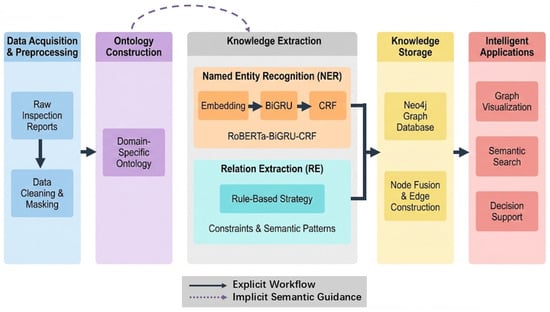
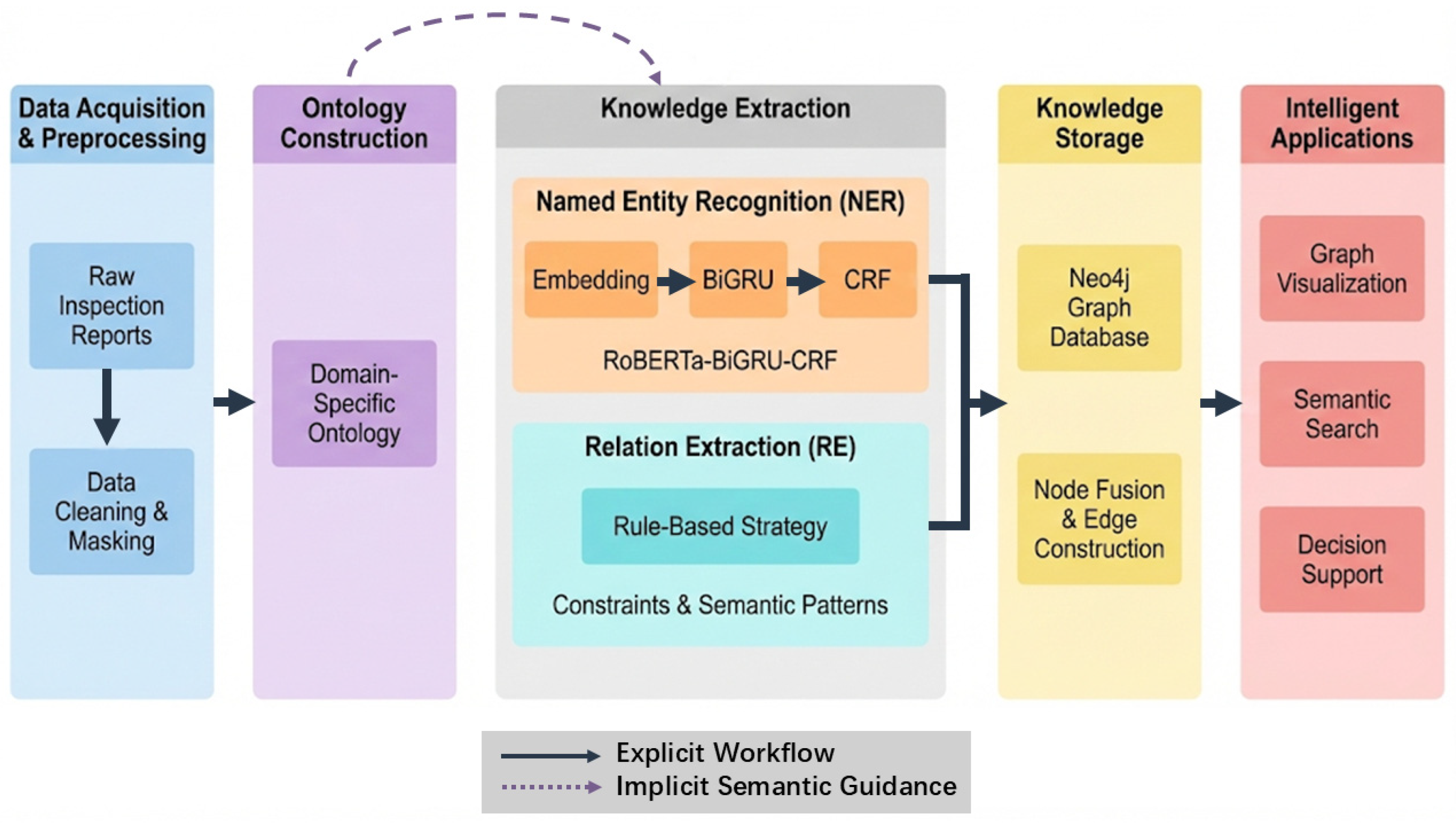
The overall architecture of the proposed framework is illustrated in Figure 1, which depicts the complete workflow from raw data preprocessing and ontology-guided annotation to deep learning-based information extraction and final knowledge graph construction and application. From a sustainability perspective, the proposed BMKG framework supports resource-efficient maintenance decision-making by enabling traceable disease-to-recommendation queries and more consistent preventive interventions. (Absolute CO2 reduction is not quantified here, as LCA-based estimation requires deployment-scale maintenance records [8,9,10].)
Figure 1.
Overall Process Framework.
2. Related Work
2.1. Text Mining in Infrastructure Management
NLP techniques have increasingly been applied to the digitization of civil infrastructure data. Early approaches mainly relied on dictionary-based matching or rule-based parsing to extract disease-related information from inspection logs [27]. While these methods are effective for highly standardized document formats, they struggle to cope with the linguistic variability and complex syntactic structures commonly found in manually written inspection reports. For example, the same disease may be described by different inspectors using inconsistent terms, such as “spalling,” “peeling,” or “layer separation,” which leads to low recall in information retrieval tasks.
In recent years, deep learning models have demonstrated superior performance in processing unstructured engineering texts. Li et al. [28] explored BERT-based models for automated information extraction. However, most existing studies focus primarily on flat entity extraction and tend to overlook the semantic relationships between entities that are essential for forming actionable engineering knowledge. Moreover, standard NLP models often have difficulty handling the domain-specific ambiguity inherent in bridge engineering texts [29]. This challenge is further amplified when processing Chinese inspection reports due to several language-specific factors. First, the lack of explicit word delimiters introduces substantial tokenization ambiguity. Second, regional lexical variants and non-standard abbreviations intensify terminological inconsistency. Third, syntactic phenomena common in Chinese, such as subject omission and zero anaphora, increase the difficulty of semantic role assignment and coreference resolution.
The unique challenges of Chinese inspection reports are exemplified by tokenization ambiguity, terminological variation, and syntactic ellipsis; therefore, an NER model with strong contextual disambiguation is required [30,31]. While domain-adaptive pre-training is viable, it introduces an additional pre-training pipeline and its incremental gains can be sensitive to the scale and representativeness of the available in-domain text [32,33]. Accordingly, the present study selects RoBERTa as a strong general-purpose backbone with consistent transfer performance, which is well suited for resolving referential ambiguities central to the target task [34,35]. Domain specificity is then introduced through a downstream BiGRU–CRF architecture and ontology-guided constraints, forming a pragmatic “transfer-and-constrain” strategy that prioritizes interpretability and controllability under engineering constraints [35,36]. Table 1 provides a structured comparison of representative NER-related studies cited in this section, including task, method, datasets, language, and reported performance.
Table 1.
Structured comparison of representative NER-related studies cited in this work.
To address these identified gaps—the prevailing focus on flat entities at the expense of relationships, and the challenge of domain-specific linguistic variability—the framework proposed herein advances a two-fold approach: it employs a domain-adapted RoBERTa-BiGRU-CRF model to improve the accurate recognition of variant engineering terminology, and, crucially, it introduces the rule-based relationship extraction method (detailed in Section 5.2) to explicitly construct the semantic relationships between entities. This integrated process enables the transformation of unstructured text into a connected knowledge graph for decision support.
2.2. Knowledge Graphs for Intelligent Decision Support
Knowledge graphs (KGs) provide a structured approach to managing complex domain knowledge and serve as a semantic backbone for intelligent maintenance systems [37]. Unlike traditional relational databases that store isolated data records, knowledge graphs connect heterogeneous information into a semantic network, enabling machines to perform relational reasoning. Recent studies have demonstrated the potential of knowledge graphs in the built environment domain. For instance, Fang et al. [38] integrated computer vision with a safety ontology to construct a construction-safety knowledge graph and, under the constraints of safety regulations, automatically identified hazards via rule-based reasoning, demonstrating that a KG can represent and execute decision rules rather than merely store data. Similarly, Nakhaee et al. [39] applied knowledge graphs to automated compliance checking tasks.
Methodologically, the construction of domain-specific knowledge graphs in engineering generally follows one of three paradigms: ontology-driven, data-driven, or hybrid. Ontology-driven approaches rely on predefined schemas and rules, ensuring interpretability and consistency but often at the expense of scalability and adaptability to unstructured text. Data-driven approaches leverage statistical models from large corpora, improving coverage but requiring extensive annotation and offering limited interpretability. A hybrid paradigm, which integrates formal ontological constraints with data-driven learning to balance reliability and scalability, remains less explored in bridge maintenance.
In bridge maintenance, knowledge graphs must support decision contexts grounded in rich historical disease–action records and heterogeneous, non-standardized inspection narratives, which increases the difficulty of end-to-end integration across information extraction, constraint enforcement, and decision support [11,29,40].
By transforming unstructured inspection logs into queryable knowledge representations, knowledge graphs facilitate more precise maintenance decision-making [40]. This capability is particularly important in infrastructure management, as it allows engineers to identify structural risks at an early stage and supports more informed intervention planning. Despite these advances, existing knowledge graph applications in bridge engineering often exemplify one paradigm over another, still lack a hybrid, unified semantic framework that integrates domain ontologies, robust information extraction, and interpretable relationship construction.
Recent studies have started to integrate large language models (LLMs) with knowledge graphs for information extraction, graph construction, and semantic retrieval, aiming to reduce manual feature engineering and improve coverage [41,42,43]. However, such pipelines typically require substantial computational resources and careful control of model reliability and output variability, which can complicate deployment in safety-critical bridge maintenance where traceability and reproducibility are essential [44]. These practical constraints motivate a more controllable and auditable design for bridge maintenance decision support, favoring explicit semantic constraints and interpretable rules to ensure traceable and reproducible outcomes. In this context, “relational reasoning” in BMKG is realized through query-based multi-hop traversal of explicit semantic relationships constructed via interpretable, rule-driven constraints, rather than relying on complex automated reasoning models.
To address this limitation, this study proposes the BMKG framework, a unified approach that couples semantic scaffolding via a domain ontology with robust entity extraction using deep learning and interpretable, rule-driven relationship construction under engineering constraints. The proposed integration closes the gap from raw data to actionable knowledge for bridge maintenance decision-making.
3. Methodology
An ontology serves as the schema and backbone of a knowledge graph, formally defining entity types, attributes, and their interrelationships. Following ontology-based knowledge representation methodologies [45], and drawing on the infrastructure life-cycle ontology modeling concepts proposed by Liu et al. [46], this study adopts a top-down ontology construction strategy. The domain-specific ontology is developed based on relevant industry standards, including the Technical Condition Evaluation Standard for Highway Bridges (JTG/T H21-2011) [47] and the Code for Maintenance of Highway Bridges and Culverts, to ensure engineering consistency and practical applicability.
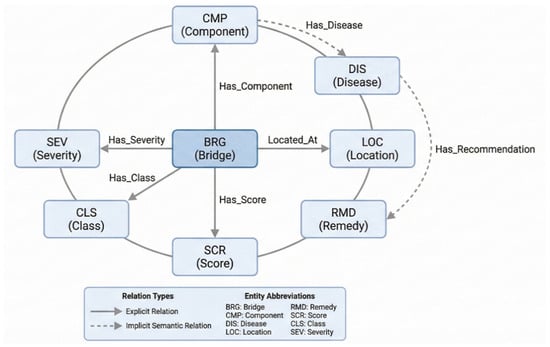
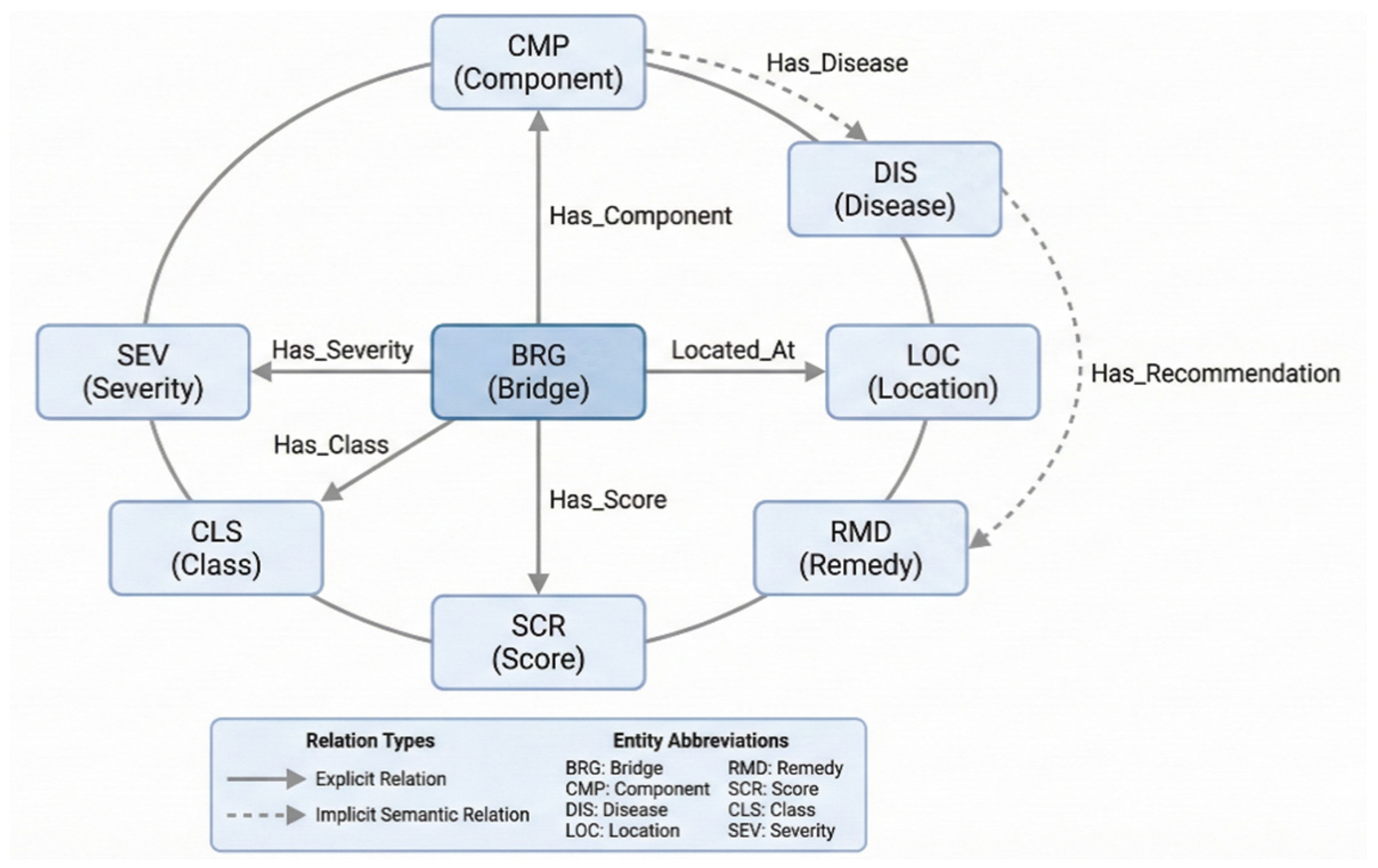
As illustrated in Figure 2. Ontology Definition Strategy, the core schema layer of the BMKG visualizes eight categories of entities and their relationships. These entity types are designed to cover the full life cycle of bridge maintenance data and mainly include the following: bridge attributes (e.g., bridge name, location (chainage), bridge type, severity level, and quantitative rating); structural information (e.g., structural components such as piers, girders, and deck pavements); disease descriptions (e.g., cracks and honeycombing); and intervention measures (e.g., maintenance or remedial actions). The selection and taxonomy of the eight core entity types were derived from two complementary evidence sources to ensure both normative compliance and practical relevance. First, authoritative Chinese industry standards—most notably Technical Condition Evaluation Standard for Highway Bridges (JTG/T H21-2011)—were consulted to obtain formal definitions for key assessment constructs, including condition classes, severity levels, and common disease categories. Second, an inductive analysis of a corpus of 275 real-world inspection reports was conducted, through which representative entity instances (e.g., component names) and their lexical variants were systematically identified. This hybrid, standards-informed and data-driven procedure yields an ontology schema that is semantically consistent with regulatory frameworks while remaining lexically aligned with engineering practice.
Figure 2.
Ontology Definition Strategy.
The ontology distinguishes between explicit attribute relationships (represented by solid lines in Figure 2. Ontology Definition Strategy) and implicit semantic relationships (represented by dashed lines). For example, the HAS_COMPONENT relationship links a bridge to its structural components, while the semantic relationship HAS_RECOMMENDATION connects diseases to corresponding maintenance measures. This strictly defined schema provides logical constraints for subsequent data annotation and information extraction processes.
4. Data Processing and Annotation
4.1. Data Sources and Preprocessing
The dataset was compiled from 275 bridge inspection reports collected from a highway maintenance program in Northeast China, covering chainages from K0+286 to K762+944. The bridges span multiple types, including major bridges, interchange bridges, ramp bridges, overpass bridges, pedestrian bridges, and viaducts. The reports provide unstructured narratives describing bridge components and disease conditions, together with quantitative assessment scores and maintenance recommendations. The raw texts exhibit pronounced domain-specific characteristics, such as extensive technical abbreviations, inconsistent formatting, and noisy or irrelevant characters.
To ensure data quality and suitability for model training, the following preprocessing steps were performed.
(1) Text cleaning: headers, footers, page numbers, and meaningless special symbols were removed.
(2) Sentence segmentation: long inspection reports were segmented into individual sentences based on punctuation and layout features, resulting in a clean sentence-level corpus for annotation and training.
(3) Data anonymization: sensitive information such as personal names was masked to comply with data privacy requirements.
After preprocessing, the bridge inspection reports have an average length of approximately 12,000 characters per report and about 200 sentences per report, with an average vocabulary size of roughly 1100 unique tokens per report. The raw narratives were further analyzed to quantify domain-specific abbreviations and ambiguous or vague qualifiers. Each report contains approximately 110 occurrences of abbreviations, while ambiguous qualifiers occur about 50 times per report and appear in roughly 10% of sentences. These observations indicate pronounced domain specificity and noise in the inspection texts, motivating abbreviation normalization and the incorporation of engineering constraints during relationship construction to mitigate the propagation of ambiguity.
4.2. Annotation Strategy
High-quality annotated data are essential for supervised learning tasks. In the NER task, this study adopts the BIO (Begin–Inside–Outside) tagging scheme. Specifically, the annotation rules are defined as follows:
B-tag (Begin) marks the starting token of an entity (e.g., B-DIS indicates the beginning of a disease entity);
I-tag (Inside) marks tokens inside an entity span (e.g., I-DIS);
O-tag (Outside) marks tokens that do not belong to any entity.
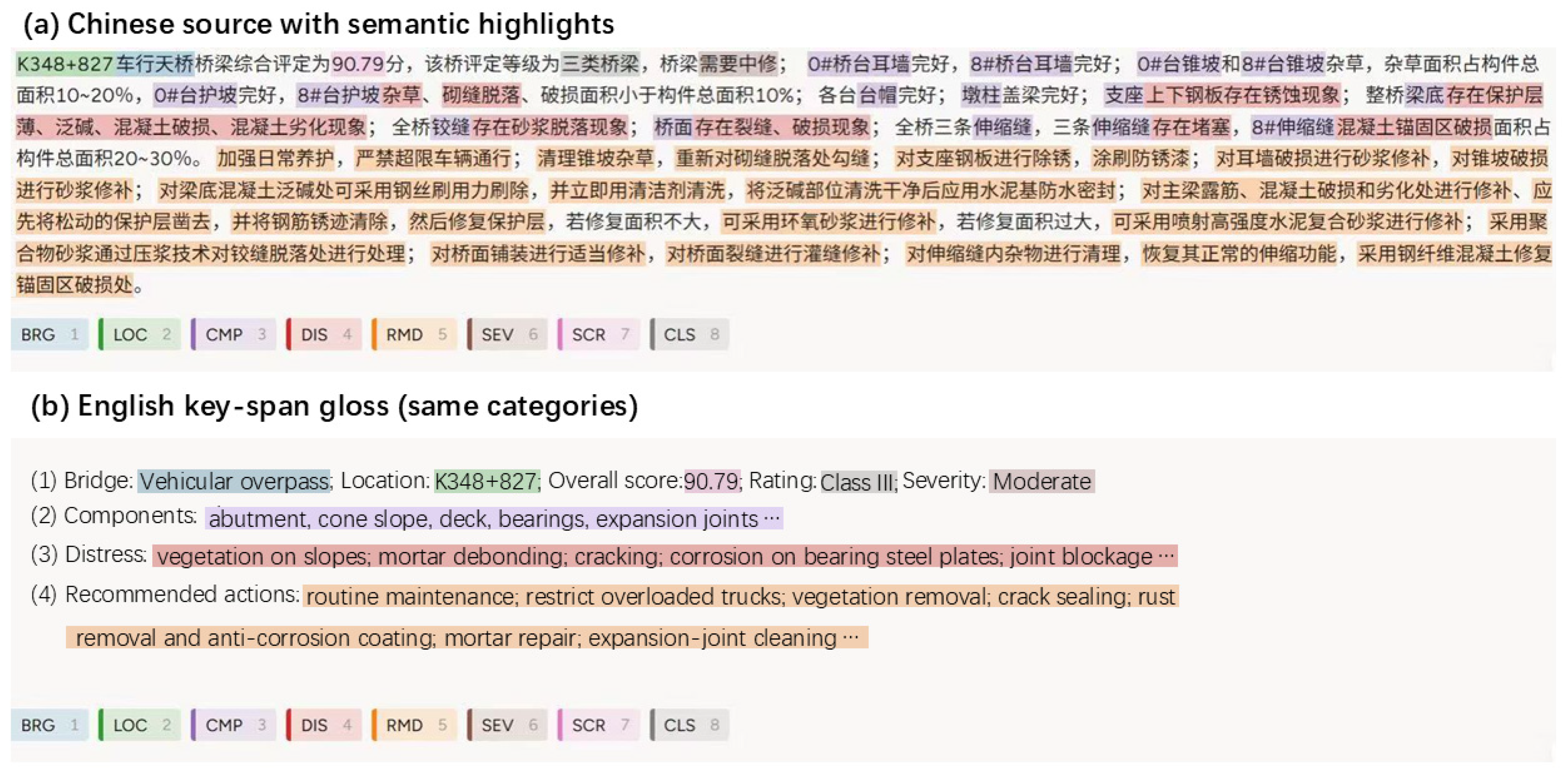
To assess annotation consistency, 10% of the reports were double-annotated by an experienced bridge engineer and a trained student. Inter-annotator agreement was quantified using Cohen’s kappa (κ = 0.86). The total manual effort was approximately 1.5 h per report. The annotation workflow comprised guideline training (developing annotation guidelines), pilot annotation to harmonize span-boundary decisions, full-scale annotation, and expert verification of difficult or ambiguous cases. During full-scale annotation, uncertain or ambiguous instances were flagged by the annotator and finalized through expert verification, helping maintain consistent boundary decisions and labeling conventions across the corpus. Figure 3. Annotation Example presents an example of the annotation process. For instance, in the sentence “K348+827 车行天桥桥梁综合评定为 90.79 分, 该桥梁评定等级为三类桥梁” (Bridge K348+827, a vehicular overpass, received an overall assessment rating of 90.79, classifying it as a Class III bridge), the annotation scheme is applied as follows:
“K348+827” is labeled as a location entity [B−LOC,I−LOC];
“车行天桥” (a vehicular overpass) is labeled as a bridge name entity [B−BRG,I−BRG];
“90.79” is labeled as a score entity [B−SCR,I−SCR];
“三类桥梁” (Class III bridge) is labeled as a classification entity [B−CLS,I−CLS].
Figure 3.
Annotation example from the bridge inspection report corpus. (a) Original Chinese report excerpt with color-coded span highlights for the eight entity types (BRG, LOC, CMP, DIS, RMD, SEV, SCR, CLS). (b) English key-span gloss of the same excerpt using the same span categories. The Chinese text is retained to preserve the original corpus.
4.3. Dataset Partitioning and Label Distribution
To ensure training stability and objective performance evaluation, the annotated corpus was randomly divided into a training set, validation set, and test set at a ratio of 8:1:1. This 8:1:1 hold-out protocol is widely used in recent NER studies and provides a practical balance between model learning and unbiased evaluation [48]. In this corpus, the validation and test subsets contain 3395 and 3758 token–label pairs, respectively (Table 2), which is sufficient for stable hyperparameter tuning and objective performance reporting. The sizes of the subsets were measured in terms of token–label pairs, and their distributions and purposes are summarized in Table 2. In addition to token–label pair counts, the entity-type frequencies of the annotated entity mentions were computed, including counts and proportions. These statistics indicate a clear imbalance across entity types. For example, DIS has 4564 mentions, whereas SEV has 275 mentions.
Table 2.
Dataset Split.
5. Deep Learning Framework
5.1. Named Entity Recognition Model: RoBERTa-BiGRU-CRF
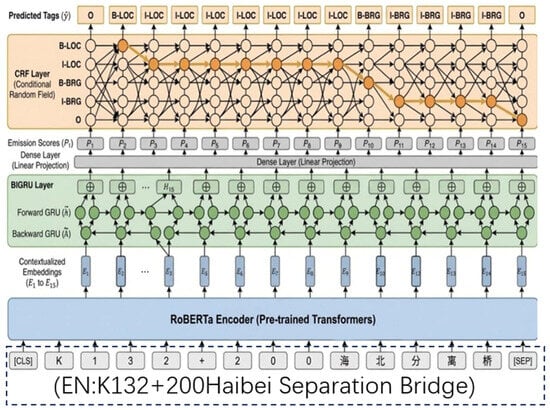
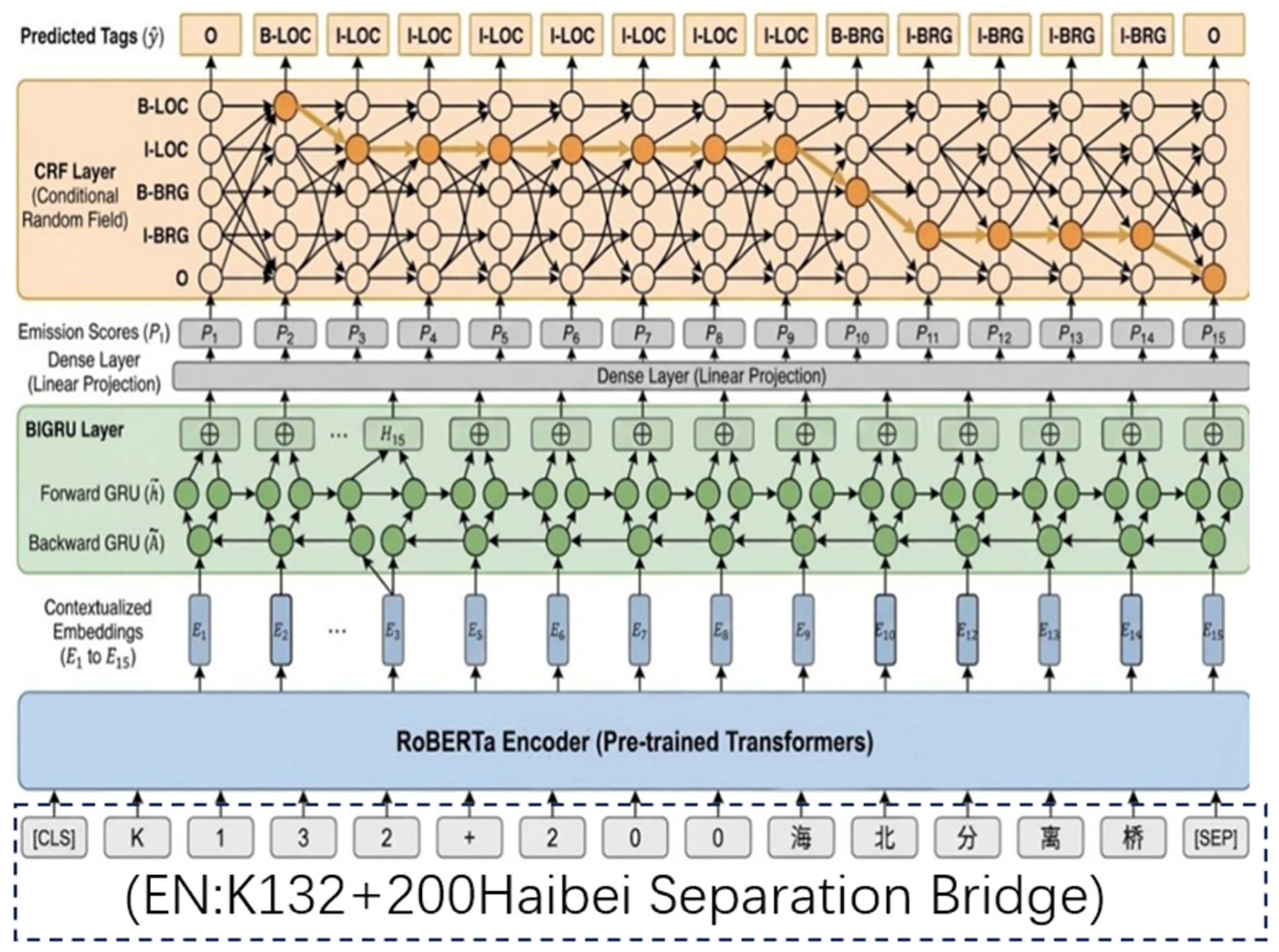
To accurately extract entities from unstructured bridge inspection texts and address challenges such as mixed character types (Chinese characters, English letters, digits, and symbols) and domain-specific ambiguity (e.g., the term “bridge” may refer to either an entire structure or a component category), a hybrid deep learning model is constructed in this study. As illustrated in Figure 4. Model Architecture, the model adopts a bottom-up hierarchical architecture consisting of four main components: an input representation layer, a RoBERTa embedding layer, a BiGRU feature extraction layer, and a CRF decoding layer.
Figure 4.
Model Architecture.
To support component-level interpretation of the proposed architecture, Section 6.3 reports controlled baseline comparisons in which only one major module (pretrained encoder or recurrent feature extractor) is varied while the CRF decoding scheme is kept consistent.
5.1.1. Embedding Layer: RoBERTa
The input to the model is a token sequence obtained after text cleaning and tokenization. The encoder was initialized from the Chinese RoBERTa checkpoint hfl/chinese-roberta-wwm-ext. Here, “character-level” refers to the token sequence produced by the tokenizer associated with hfl/chinese-roberta-wwm-ext (BERT-style WordPiece vocabulary); for Chinese text, tokens predominantly correspond to single characters. As shown at the bottom of Figure 4. Model Architecture, the input sequence includes not only standard Chinese characters but also digits (e.g., “1”, “3”), letters (e.g., “K”), and special symbols (e.g., “+”), with special tokens and added at the beginning and end of each sequence.
Unlike BERT, which adopts a static masking strategy, RoBERTa is used as the pretrained encoder in this study. RoBERTa employs a dynamic masking mechanism, whereby the masking patterns vary during training, enabling the model to better capture contextual semantics. After RoBERTa encoding, the input sequence is mapped into a sequence of high-dimensional contextual embedding vectors, :
where represents the dense vector embedding of the -th token, containing rich semantic information under the given context [49].
5.1.2. Encoding Layer: BiGRU
To further capture long-range dependencies and extract sequential features, the embedding vectors, , are fed into a bidirectional gated recurrent unit (BiGRU) layer. As shown in the green block of Figure 4. Model Architecture, the BiGRU layer consists of two GRU networks operating in opposite directions: a forward GRU that reads the sequence from left to right, and a backward GRU that reads the sequence from right to left.
Compared with long short-term memory (LSTM) networks, GRUs require fewer parameters and converge faster. At each time step , the GRU computes the update gate and reset gate as follows:
The candidate hidden state and the final hidden state are computed by:
Finally, the forward hidden state and the backward hidden state are concatenated (represented by the symbol in the figure) to form the final feature representation fusing bidirectional contextual information:
This representation integrates bidirectional contextual information for each token [50].
5.1.3. Decoding Layer: CRF
The output of the BiGRU layer is passed through a fully connected layer (Dense Layer) to generate emission scores , where represents the unnormalized probability of assigning the -th label to the -th token. However, emission scores alone are insufficient to enforce logical constraints between labels (e.g., an I-LOC tag must follow a B-LOC tag rather than an O tag).
To address this issue, a conditional random field (CRF) layer is introduced at the top of the model, as illustrated by the orange block in Figure 4. Model Architecture. The CRF layer learns a transition matrix that models the transition probabilities between labels. For a given input sequence and a predicted label sequence , the overall score is defined as the sum of emission scores and transition scores:
As shown in Figure 4. Model Architecture, the CRF layer searches for the label sequence with the highest overall score among all possible paths (highlighted in deep orange in the figure) to output the globally optimal prediction sequence (e.g., B-LOC, I-LOC). During training, the model parameters are optimized by minimizing the negative log-likelihood loss:
By incorporating global sequence-level constraints, the CRF layer ensures consistency and validity in the predicted label sequences.
5.2. Rule-Based Bridge Maintenance Relation Extraction Method
In the relationship extraction phase, this study adopts a rule-based relationship extraction method, designed with the overall premise that each bridge is treated as an independent unit of analysis for relationship construction [51]. Specifically, each bridge is distinguished by a unique identifier (e.g., id276, id277). Texts corresponding to different bridges are completely isolated during the rule execution phase. All relationship candidate generation, rule triggering, and result verification are strictly confined within the scope of a single bridge, thereby preventing attribute confusion across bridges or structural mismatches.
Regarding bridge-level attribute relationship extraction, relationships such as AT_LOCATION, HAS_SCORE, HAS_CLASS, and HAS_SEVERITY adopt strict one-to-one correspondence constraints. That is, in the knowledge graph, each bridge is permitted to have only one location, one technical condition rating, one evaluation class, and one maintenance severity level. When multiple candidate expressions appear in the text, conflicts are resolved based on rule priority, semantic completeness, and text position (e.g., giving priority to the conclusion section) to retain only the most representative result, ensuring consistency and engineering rationality in bridge attribute descriptions.
For structural relationship extraction, this study uniformly establishes the HAS_COMPONENT relationship between a bridge and its components. All component entities identified within the text of a single bridge are considered parts of that bridge. Furthermore, for each disease mention, a directed HAS_DISEASE edge is created from the corresponding component node to the disease node (CMP → DIS), where the disease is paired only with the forward nearest component in the textual sequence. This rule, combining character distance and word order constraints, effectively reduces the risk of incorrect pairing caused by coordinate structures and long sentences, aligning with the common writing pattern in bridge inspection reports where “component precedes disease”.
The relationship triggering mechanism relies on domain keywords, fixed phrase patterns, and regular expressions. For instance, relationships are triggered by high-frequency expressions such as “located at”, “rated as”, “classified as Class X”, “exists XX disease”, and “recommend XX treatment”. Simultaneously, regular expression matching is applied to numerical ratings, class numbers, and chainage locations to improve recognition stability. To minimize false matches, context window constraints are introduced during rule triggering, requiring entities involved in a relationship to maintain reasonable semantic proximity within the text.
For the HAS_RECOMMENDATION relationship, this study does not employ cross-paragraph or global matching strategies but relies on explicit semantic pointing rules. When a maintenance recommendation explicitly mentions measures with clear engineering directives (e.g., “concrete repair”, “crack sealing”, “rebar rust removal”), a HAS_RECOMMENDATION relationship is established between the disease and the recommendation only if the corresponding disease (e.g., concrete damage, cracks, rebar corrosion) has been identified in the preceding text. If the recommendation content does not explicitly point to a specific disease or component (e.g., general maintenance methods like “strengthen routine maintenance” and “prohibit overloaded vehicles”), no relationship is extracted. This approach prioritizes the reliability and interpretability of the results. This rule set is intentionally conservative and is positioned as a high-precision, engineering-oriented extraction strategy that prioritizes structural correctness, interpretability, and traceability over exhaustive recall; the resulting precision–coverage trade-off is quantitatively audited in Section 6.5.
After rule execution, all extracted results undergo type consistency and relationship completeness verification. Each relationship type is strictly limited to specific combinations of head and tail entity types. Conflicting relationships or low-confidence results appearing within the same bridge are resolved through rule priority and nearest-neighbor principles, while indeterminable relationships are directly filtered out. The final retained relationships are output as standard triples and used for the subsequent construction of the bridge maintenance knowledge graph.
Through the combined design of bridge-level isolation, one-to-one constraints, forward nearest matching, and semantic triggering with consistency verification, this study achieves a relationship extraction scheme that ensures engineering semantic consistency, reproducibility, and applicability to actual bridge maintenance scenarios without requiring large-scale relation annotation or model training [52]. Collectively, these constraints act as reliability safeguards for practice-oriented relationship construction. Without bridge-level isolation, entities from different bridges mentioned in the same report can be inadvertently linked; without forward-nearest matching or bounded context windows, disease or recommendation mentions may be anchored to non-corresponding components across clauses, yielding spurious edges in chained relations. The definitions, corresponding entities, and triggering mechanisms for these core relationships are systematically summarized in Table 3. Formally, Table 3 specifies the domain and range of each property via its head and tail entity types. AT_LOCATION is defined as a functional property with domain BRG and range LOC, enforcing an exactly one (1-to −1) constraint per bridge instance. HAS_SCORE, HAS_CLASS, and HAS_SEVERITY follow the same functional one-to-one constraint on BRG (BRG → SCR/CLS/SEV). In contrast, HAS_COMPONENT is a one-to-many relation (BRG → CMP). HAS_DISEASE and HAS_RECOMMENDATION are directed relations CMP → DIS and DIS → RMD, respectively; for HAS_DISEASE, each disease mention is paired only with the forward nearest component within the same bridge text.
Table 3.
Summary of relationship definitions and triggering mechanisms in the BMKG.
For reproducibility and implementation clarity, the overall rule execution pipeline is formalized as pseudocode in Algorithm 1.
| Algorithm 1: Rule-Based Relation Extraction with Semantic Isolation |
| Input: Entity List E = {e1, e2, …, en}, Text Sequence S Output: Relation Set R |
| 1: Initialize R ← Ø 2: Group entities by Bridge ID: G ← GroupByBridge(E) 3: For each bridge group g ∈ G do: 4: b_curr ← GetBridgeEntity(g) 5: //Constraint 1: One-to-One Attribute Mapping 6: Extract Attr(b_curr) using priority rules (Score, Class, Severity) 7: //Constraint 2: Structural Topology 8: For each component c ∈ g do: 9: Add (b_curr, HAS_COMPONENT, c) to R 10: //Constraint 3: Forward Nearest Neighbor for Diseases 11: d ← FindNearestDiseases (c, S, window = 50) 12: If d ≠ null Then Add (c, HAS_DISEASE, d) to R 13: End For 14: End For 15: Return R |
To make the alignment between Chinese inspection expressions and BMKG labels explicit and reusable, Table 4 summarizes a crosswalk from representative report terms (Chinese), their English glosses, BMKG labels, and the corresponding relationship properties.
Table 4.
Crosswalk between standard/report terminology and BMKG labels (CN–EN separated).
6. Results and Discussion
6.1. Experimental Setup
The experiments were conducted on a workstation equipped with an NVIDIA RTX 4090 GPU (24 GB video memory), using the PyTorch 2.7.0 framework. The pretrained encoder was initialized from the Chinese RoBERTa checkpoint hfl/chinese-roberta-wwm-ext, and tokenization was performed using its associated tokenizer (BERT-style WordPiece vocabulary). The final settings were batch size 32, max sequence length 256, training epochs 30 with early stopping patience 5, dropout rate 0.5, and the AdamW optimizer.
Regarding the learning rate strategy, a layered learning rate approach was adopted to prevent catastrophic forgetting of pretrained weights. The Transformer layers (RoBERTa) were fine-tuned with a lower learning rate (), while the BiGRU-CRF head used a higher learning rate () to accelerate the convergence of the specific NER task. To ensure reproducibility, the random seed was fixed to 42 for all experiments.
6.2. Evaluation Metrics
Model performance was evaluated using Precision, Recall, and micro-F1, computed by Equations (9)–(11).
where denotes True Positives, denotes False Positives, and denotes False Negatives. Entity matching was evaluated using strict exact match (correct type and identical token-level start and end boundaries), and the overall F1-score (denoted as micro-F1) was micro-averaged over all entity instances. A 95% confidence interval of micro-F1 is estimated for each model by bootstrap resampling of the test reports.
6.3. Comparison of NER Models
To systematically evaluate the contribution of each component in the proposed RoBERTa–BiGRU–CRF architecture, component-wise controlled comparisons were conducted using four representative baselines. Their selection is motivated as follows: BiGRU–CRF serves as a non-pretrained sequence-labeling baseline, quantifying the fundamental gain from pretrained language representations. BERT–CRF represents a standard strong baseline of a pretrained Transformer with a CRF decoder; comparing against it tests whether an additional recurrent encoder provides benefits beyond pretrained representations alone. BERT–BiLSTM–CRF and BERT–BiGRU–CRF keep the pretrained encoder and CRF decoder unchanged while varying only the recurrent encoder type, enabling a direct comparison of the modeling capacity of LSTM versus GRU within an otherwise identical architecture.
Component Contribution Analysis (Controlled Comparisons). Although dedicated ablation experiments that remove one module at a time were not performed, the baseline set in Table 5 enables controlled comparisons to assess the marginal effect of key components. Under an identical CRF decoder, introducing BiGRU on top of BERT-CRF improves micro-F1 from 0.890 to 0.910 (+0.020). Replacing the contextual encoder from BERT to RoBERTa while keeping the BiGRU-CRF head unchanged increases micro-F1 from 0.910 to 0.923 (+0.013). In addition, comparing BiGRU-CRF to BERT-CRF indicates the benefit of pretrained representations over non-pretrained sequence tagging (micro-F1: 0.850 to 0.890, +0.040). Because CRF is retained across all variants to ensure BIO-constrained structured decoding, its independent contribution is not disentangled in the current experiments and is left for future work.
Table 5.
Comparison of experimental results.
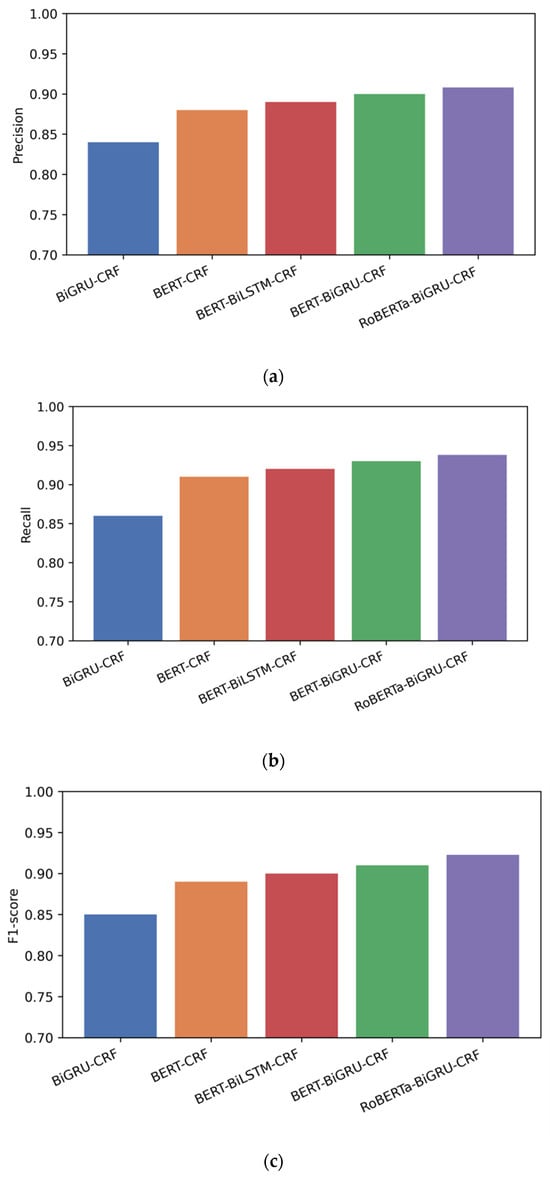
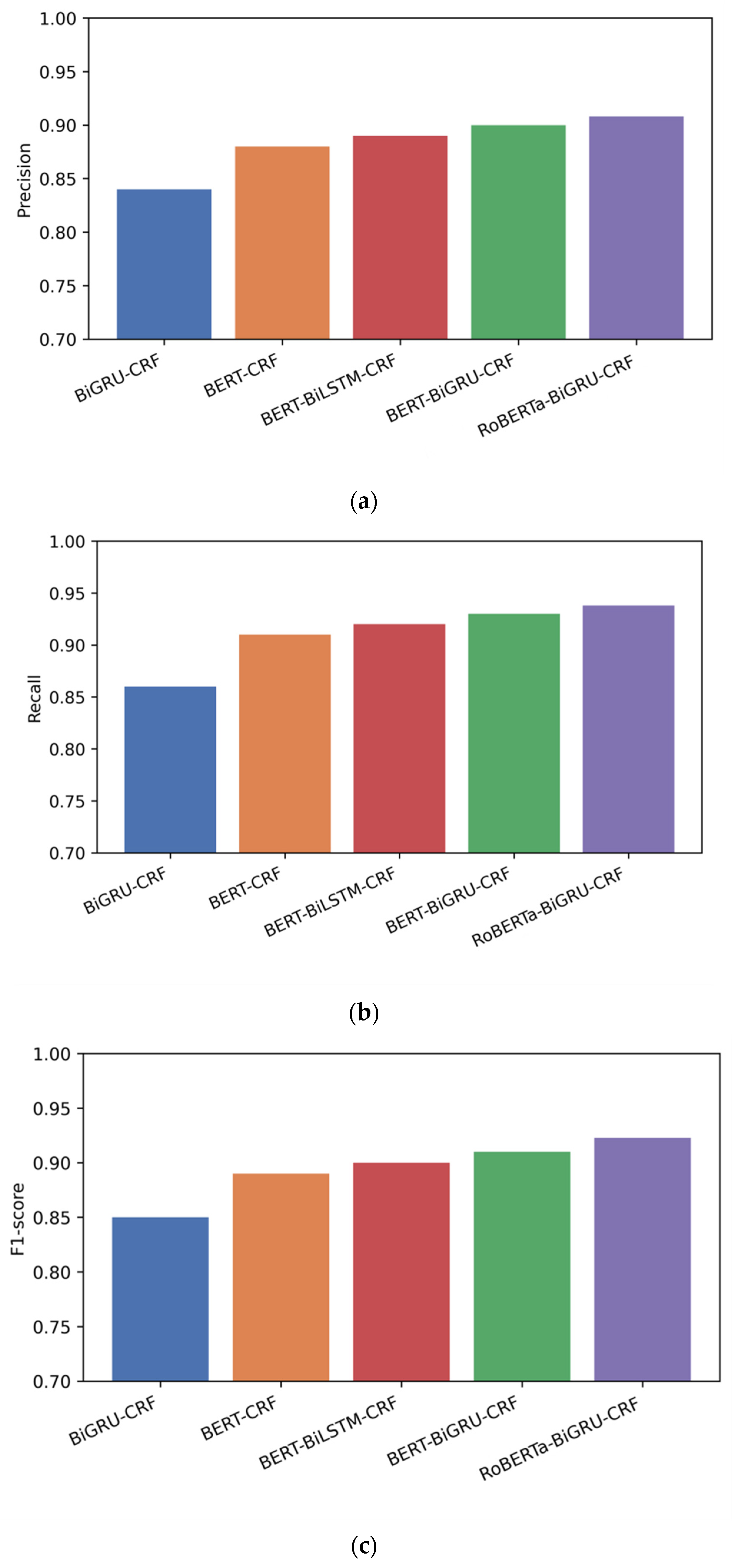
Figure 5 illustrates the comparative performance of different NER models on the test set. Specifically, Figure 5a–c present the results in terms of Precision, Recall, and micro-F1, respectively. As shown in the figure, the BiGRU-CRF model without a pretrained language encoder consistently exhibits the lowest performance across all three metrics. This observation indicates that relying solely on traditional sequence modeling is insufficient for capturing the contextual semantics of domain-specific engineering terminology in bridge maintenance texts.
Figure 5.
NER Model Comparison: (a) comparison of precision rates across models; (b) comparison of recall rates across models; (c) comparison of micro-F1 across models.
With the introduction of pretrained BERT-based encoders, the performance of all models improves substantially. The BERT-CRF and BERT-BiGRU-CRF models demonstrate relatively balanced behavior in terms of Precision and Recall, while the BERT-BiLSTM-CRF model shows a slight advantage in Recall, suggesting that LSTM structures remain effective in modeling longer contextual dependencies. However, the overall improvement in micro-F1 among these BERT-based variants becomes gradually marginal, reflecting the increasing difficulty of achieving further gains in this task.
In contrast, the proposed RoBERTa-BiGRU-CRF model achieves the best performance across all three evaluation metrics. Specifically, it attains a Precision of 0.908, a Recall of 0.938, and a micro-F1 of 0.923, indicating a more favorable balance between recognition accuracy and entity coverage. The results demonstrate that the proposed model maintains a consistent advantage over all baseline methods even within a high-performance range.
To further quantify the performance differences, Table 5 summarizes the exact numerical results of all compared NER models on the test set. In addition to the overall micro-averaged scores, Table 6 reports Precision, Recall, and per-type F1-score decomposed by entity type under the same strict exact-match criterion defined in Section 6.2. Table 7 reports the entity-type distribution of the gold NER entity instances (annotated spans) in the same corpus (N = 275 reports), providing context for the per-type F1 scores under class imbalance. Consistent with the trends observed in Figure 5. NER Model Comparison, the table clearly highlights the absolute performance gaps among different models. Notably, the proposed RoBERTa-BiGRU-CRF model shows stable improvements in Precision and micro-F1 compared with other BERT-based architectures, while achieving a more pronounced gain in Recall. This indicates that the model not only reduces misclassification errors but also enhances entity coverage, which is particularly important for downstream knowledge graph construction.
Table 6.
Per-entity-type NER performance of RoBERTa–BiGRU–CRF on the test set.
Table 7.
Entity-type distribution in the annotated corpus (N = 275 reports).
By jointly analyzing Figure 5. NER Model Comparison and Table 5, it can be concluded that the dynamic masking strategy employed by RoBERTa enables more effective modeling of ambiguous and domain-specific engineering terms. Meanwhile, the BiGRU structure captures essential contextual dependencies with a relatively compact parameter scale. Combined with the global sequence optimization enforced by the CRF decoding layer, the proposed model exhibits strong stability and consistency across different evaluation metrics.
It should be noted that this study does not aim to optimize a single metric in isolation, but rather focuses on achieving balanced and reliable performance under realistic engineering text scenarios. The consistent results obtained by the RoBERTa-BiGRU-CRF model provide a solid foundation for reliable entity extraction in subsequent bridge maintenance knowledge graph construction.
Error Analysis: Despite the strong overall scores, several recurrent errors remain in complex inspection phrases. Entity boundaries may become unstable in coordination, for example, “severe cracking and spalling of the concrete cover,” where the shared object can be attached inconsistently and the second disease is occasionally missed. Recall can also be affected by inconsistent abbreviations, such as “0# Abutment” versus “No.0 Abt.”, which introduces surface forms that are rare in training. In addition, numbers without explicit units (e.g., “0.2”) may be interpreted as scores or location markers rather than geometric measurements. Long directional modifiers sometimes lead to incomplete spans, as in “web of the left side span box girder,” where the core component is detected but part of the prefix is omitted. These cases indicate that abbreviation normalization and boundary handling are the primary remaining challenges before downstream relation construction. These errors mainly appear as false negatives in missed disease spans under coordination and abbreviation variation, and as false positives when unitless numbers are misinterpreted as location or score mentions.
6.4. Relationship Extraction Results and Analysis
Based on the rule-based relationship extraction method described in Section 5.2, this study further analyzes the overall characteristics of the extracted relationships to evaluate the method’s performance in real-world bridge inspection texts and its engineering applicability.
Regarding the distribution of relationship types, bridge-level attribute relationships (e.g., AT_LOCATION, HAS_SCORE, HAS_CLASS, and HAS_SEVERITY) demonstrate highly consistent extraction results across different bridge instances. These relationships typically possess clear semantic boundaries and relatively fixed expressions, enabling the rule-based method to stably identify corresponding relationships and maintain good consistency across different reports. This characteristic is significant for cross-project and cross-year information comparison in bridge asset management.
In contrast, chained relationships such as component–disease and disease–maintenance recommendation exhibit greater structural complexity in the text. On one hand, these relationships are often accompanied by coordinate descriptions or long sentences, increasing the uncertainty of relationship determination. On the other hand, some maintenance recommendations are general or empirical in nature, and their semantics do not always explicitly point to a single disease. In such cases, the rule-based method adopts a conservative extraction behavior, prioritizing the retention of relationship instances with clear semantic pointing and engineering meaning, while discarding uncertain relationships.
From an engineering application perspective, this result characteristic reflects a “reliability-first” orientation. Although the coverage of relationships may be reduced in certain implicit or weak semantic scenarios, this approach effectively minimizes false associations and semantic ambiguities, providing a more robust foundation for subsequent knowledge graph querying, reasoning, and decision support. For the safety-sensitive field of bridge maintenance, this trade-off is reasonable and necessary.
Overall, the rule-driven relationship extraction results present clear, stable, and interpretable characteristics within the semantic structure of bridge maintenance, offering reliable data support for constructing a practice-oriented bridge maintenance knowledge graph. This reliability-first behavior is further quantified by the strict exact-match manual verification audit reported in Section 6.5.
6.5. Rule-Based Relationship Extraction Evaluation Results
Since this study did not construct a large-scale relation annotation dataset or train a relationship extraction model for comparative evaluation, the performance of relationship extraction was assessed through random sampling and manual verification to validate the consistency and reliability of the rule-based method in actual texts. Therefore, Table 8 reports a precision-oriented manual audit of the extracted relations; full recall and F1 are not claimed without exhaustive relation annotation. A simple heuristic baseline was additionally evaluated under the same manual-audit protocol, and its pooled audited precision is 0.781 (Table 8).
Table 8.
Precision-oriented manual audit of rule-based relationship extraction results.
Specifically, N = 300 extracted relationship instances were selected via stratified random sampling across relation types and manually verified against the corresponding source text. A strict exact-match criterion was applied: an instance was counted as correct only when the head and tail entity spans had identical token-level start and end boundaries with correct entity types, and the relation type was also correct. In this audit, 281/300 (93.67%) instances were verified as correct, and this value is reported as a precision-oriented quantification of the conservative, reliability-first relationship construction. For this audited precision (281/300), a 95% confidence interval is estimated as 0.903–0.959 using the Wilson score interval. This interval reflects sampling uncertainty under random auditing. Full Recall and F1-score are not claimed, because estimating false negatives would require exhaustive relation annotation within the sampled texts. Under this strict audit, general recommendations without explicit disease targets are intentionally left unlinked, such as “strengthen routine maintenance” and “prohibit overloaded vehicles”, to avoid spurious HAS_RECOMMENDATION edges. Moreover, the token-level exact-match criterion marks an instance incorrect when the head or tail span shifts by one token in modifier-rich or coordinated descriptions, and this boundary shift can propagate to chained relations.
To further quantify the qualitative rule-sensitivity discussed in Section 5.2, a compact 50-instance mini-ablation audit was conducted under the same strict exact-match criterion as above. Under the baseline setting with bounded context windows, audited precision is 94%, corresponding to 47 correct instances out of 50. After removing the bounded context window while keeping all other rules unchanged, audited precision decreases to 88%, corresponding to 44 correct instances out of 50. This represents a six-percentage-point drop, with the number of errors increasing from three to six. The result supports the qualitative sensitivity discussion by indicating that bounded context windows help curb spurious cross-assignment links in chained relations through locally bounded candidate matching.
This audit is reported to validate the stability and semantic plausibility of rule-based relation construction under engineering constraints, rather than to compete with learning-based relation extraction models.
7. Knowledge Graph Storage and Exploration
7.1. Graph Model Construction and Storage
The extracted entities and relationships are not merely stored as isolated triples but are synthesized into a property graph to preserve graph-level structural integrity. Drawing on the concept of graph-level features proposed in TGformer [53], the storage schema designed in the Neo4j graph database aims to capture the global contextual dependencies between bridge components and diseases, rather than just local point-to-point connections.
The data fusion process comprises two key steps.
(1) Node Fusion: Entities referring to the same object across different reports (e.g., “Pier 3”, “P3”, and “The third pier”) are merged into a single node with a unique ID. This step effectively resolves the coreference resolution problem, ensuring the connectivity of the semantic network and preventing the formation of information silos.
(2) Edge Construction: Semantic relationships are materialized as directed edges (e.g., (Vehicular Overpass)-[AT_LOCATION]->(K348+827)). Unlike relational databases that require complex JOIN operations, this native graph storage supports efficient multi-hop traversal, laying the foundation for subsequent diagnostic and maintenance tasks.
7.2. Interactive Visual Exploration and Decision Support
To transform the structured information stored in the knowledge graph into actionable engineering insights, this study implements an interactive visual exploration paradigm inspired by KGScope [54]. The overall visualization effect is shown in Figure 6.
Figure 6.
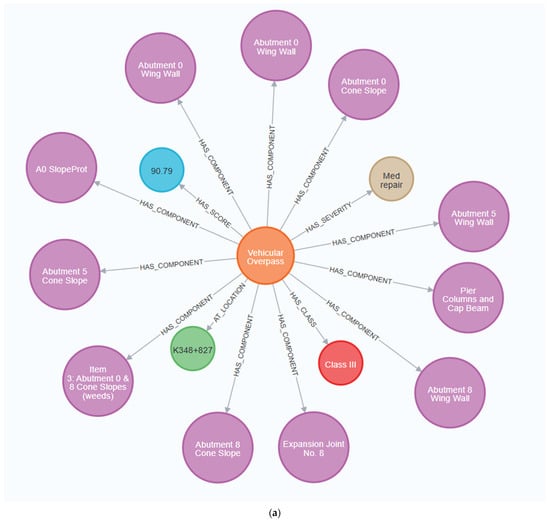
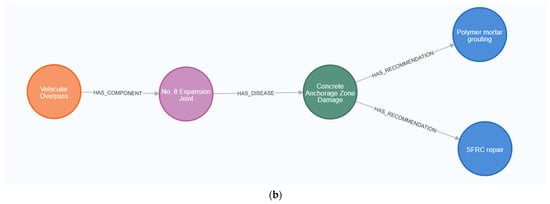
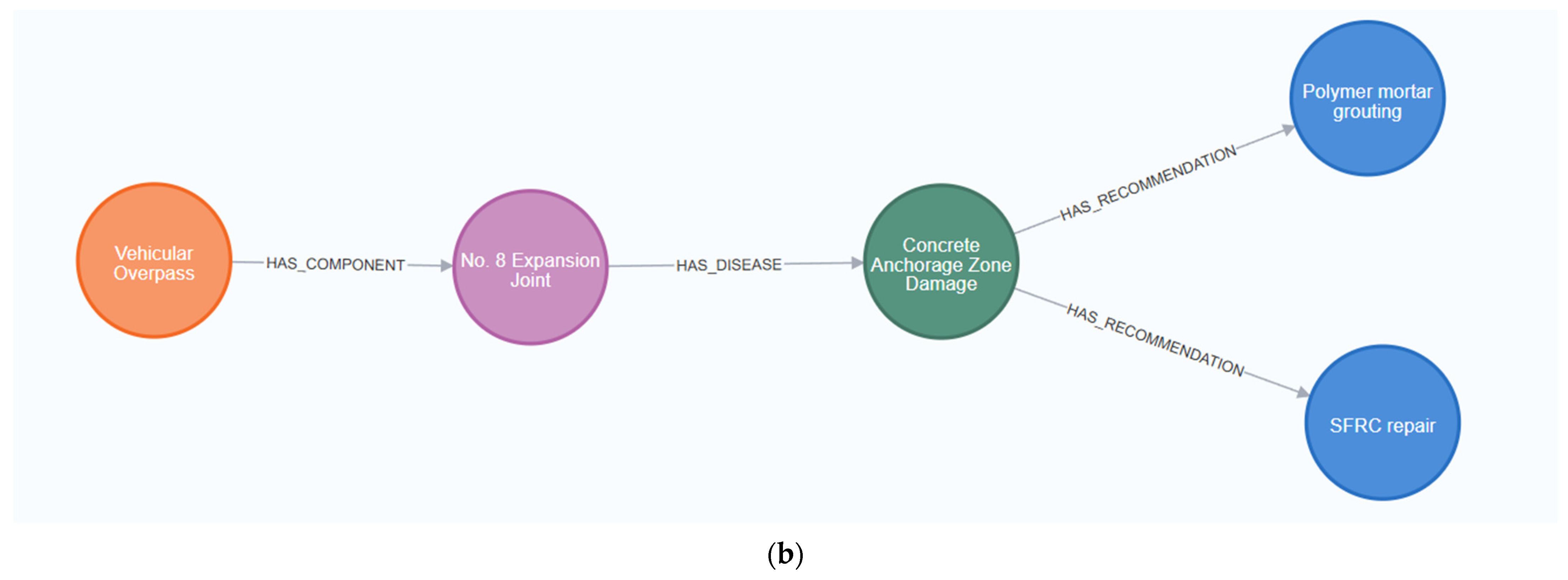
Knowledge Graph Examples: (a) Bridge-Level Knowledge Graph Global View; (b) example of Disease-Driven Maintenance Decision-Making Pathway. Node background colors indicate entity types, consistent with the annotation scheme.
Figure 6 presents a knowledge graph example. The system semantically aggregates multi-source heterogeneous information related to bridge maintenance via a graphical interface, enabling engineers to intuitively understand bridge conditions and supporting maintenance decision-making.
As shown in Figure 6a, the system provides a global visualization view of the bridge-level knowledge graph. This view takes a single bridge as the core node, presenting attribute information such as location, technical condition rating, evaluation class, and maintenance severity. It connects bridge component nodes through semantic relationships, forming a star-shaped topology centered on the bridge. Heterogeneous information originally scattered across different sections of inspection reports is integrated into unified semantic clusters. Engineers can comprehensively grasp the overall health status of the bridge without repeatedly consulting codes and historical archives. This global view provides foundational support for the rapid assessment of bridge asset status and subsequent refined analysis.
To complement the interface description above, practitioner feedback from an engineering evaluation is also reported. Engineers rated the system’s usability, perceived correctness, and applicability using a 1–5 Likert-scale questionnaire (1 = very poor, 5 = excellent). Based on feedback from 20 participating engineers, the system achieved an overall usability score of 4.3/5.
Building on this, the system further supports semantic path exploration tailored to specific disease scenarios. As shown in Figure 6b, taking “Vehicular Overpass” as an example, a typical disease-driven maintenance decision reasoning path is demonstrated. Engineers can start from the bridge node, locate specific components (e.g., expansion joints) via the HAS_COMPONENT relationship, identify the disease type existing in that component (e.g., damage in the concrete anchorage zone) via the HAS_DISEASE relationship, and finally retrieve maintenance recommendations corresponding to the disease along the HAS_RECOMMENDATION relationship. This process is essentially a layer-by-layer traversal of explicit semantic relationships within the knowledge graph, rather than relying on complex automated reasoning models, thereby ensuring result interpretability and engineering credibility. Compared with keyword-based search over raw inspection texts, which typically returns dispersed term matches and still requires manual verification of bridge context, BMKG retrieves structured nodes and relations and enables direct traversal from bridges to components, diseases, and recommendations.
Representative instantiated triples corresponding to Figure 6 are provided below. To retain traceability to the Chinese inspection reports, each Chinese mention is accompanied by an English gloss.
(1) ⟨车行天桥 (Vehicular Overpass), AT_LOCATION, K348+827⟩
(2) ⟨车行天桥 (Vehicular Overpass), HAS_CLASS, 三类桥梁 (Class III Bridge)⟩
(3) ⟨车行天桥 (Vehicular Overpass), HAS_SCORE, 90.79分 (Score: 90.79)⟩
(4) ⟨车行天桥 (Vehicular Overpass), HAS_SEVERITY, 需要中修 (Medium repair required)⟩
(5) ⟨车行天桥 (Vehicular Overpass), HAS_COMPONENT, 8#伸缩缝 (No. 8 Expansion Joint)⟩
(6) ⟨8#伸缩缝 (No. 8 Expansion Joint), HAS_DISEASE, 混凝土锚固区破损 (Concrete Anchorage Zone Damage)⟩
(7) ⟨混凝土锚固区破损 (Concrete Anchorage Zone Damage), HAS_RECOMMENDATION, 采用聚合物砂浆 (Using Polymer Mortar)⟩
Through the aforementioned end-to-end semantic path of “Bridge—Component—Disease—Remedial Measure”, the system links scattered inspection conclusions with maintenance experience, providing intuitive and traceable decision support for on-site engineers. This interactive exploration mode based on the knowledge graph effectively reduces the time cost of manual retrieval of standards and historical archives, offering technical support for the transformation of bridge maintenance from reactive response to proactive and refined management. Under a single-machine deployment on the workstation described in Section 6.1, a representative query that retrieves a bridge by ID, expands one hop to its LOC node via AT_LOCATION, and returns the corresponding location was executed 30 times, yielding a median application-level end-to-end response time of 75 ms. Under the same setup, an offline relevance test on 50 representative maintenance queries reports Precision@10 = 0.763 based on manual relevance judgment of the top-10 results.
8. Conclusions
To address the issues of data heterogeneity and low knowledge utilization efficiency in bridge maintenance, this paper proposes a deep learning-based framework for constructing a bridge maintenance knowledge graph (BMKG). By integrating a domain-specific ontology, a RoBERTa-BiGRU-CRF entity recognition model, and a rule-based relationship extraction strategy, this study adopts a rule-driven relationship construction method. Experimental results demonstrate that the proposed NER model achieves a precision of 90.8%, recall of 93.8%, and a micro-averaged F1-score (micro-F1) of 92.3%. Inter-annotator agreement for the NER annotations was quantified using Cohen’s kappa (κ = 0.86), which supports the reliability of the annotated corpus and the credibility of the reported NER performance. Compared to relationship models that rely on large-scale annotated data and high computational costs, this approach aligns better with the practical needs of bridge maintenance—namely, data sensitivity, regulatory stability, and long-term maintainability. This reflects the sustainability advantages inherent in the digitization process of engineering knowledge.
Unstructured inspection reports were successfully transformed into structured semantic networks. Experimental results confirm the high accuracy of the proposed method. The constructed system, through interactive graph exploration, breaks down information silos and enables engineers to efficiently access implicit diagnostic logic. This not only improves decision-making efficiency but also provides strong technical support for achieving sustainable development goals in civil engineering by supporting precise preventive maintenance and extending the service life of infrastructure.
This study has several limitations that also motivate future research.
(1) The proposed framework is developed and validated primarily on Chinese inspection reports produced under specific national standards, which may limit its direct generalizability to other languages or regulatory regimes. This limitation can be discussed at two layers: linguistic transferability and ontological transferability. The text-extraction layer is language- and terminology-dependent and therefore requires adaptation for other languages, whereas the ontology structure is expected to be largely standard-agnostic at the upper conceptual layer, and cross-standard transfer can be achieved through crosswalk mapping or targeted extension of leaf-level defect taxonomies and attribute definitions. At present, an explicit mapping and crosswalk between JTG/T H21-2011 terminology and international standard systems (e.g., AASHTO, ISO, and Eurocodes) is not established. In addition, the current evaluation is based on a single regional report corpus, and cross-project validation on independent datasets remains to be conducted.
(2) The rule-based relationship construction is deliberately designed to favor precision and interpretability; however, its robustness may decrease when confronted with unseen linguistic patterns, inconsistent writing styles, or highly irregular report formats. The rule set complexity and its runtime behavior on substantially larger corpora have not been systematically analyzed.
(3) Although the practitioner-oriented evaluation provides encouraging initial evidence, rigorous long-term field deployment is still required to quantify the framework’s effects on real-world maintenance decision cycles, operational efficiency, and downstream outcomes. Future work will therefore focus on cross-lingual and cross-standard adaptation, hybrid relationship construction that integrates rules with learning-based models, and longitudinal field studies.
(4) The current system is text-centric and does not yet fuse inspection images with the textual knowledge graph. Future work will use a vision encoder to extract disease evidence from images and align it to textual entities via contrastive image–text learning and entity-level linking, then inject image-grounded relations into the graph to enable multimodal querying and more reliable life-cycle decision support.
Accordingly, future research will focus on cross-lingual and cross-standard adaptation, hybrid relationship construction that integrates rules with learning-based models, longitudinal field studies, and multimodal fusion.
Author Contributions
Conceptualization, Y.Z. and H.G.; Methodology, Y.Z.; Software, Y.Z.; Validation, H.G.; Formal analysis, Y.Z.; Investigation, Y.Z.; Resources, H.G.; Data curation, Y.Z.; Writing—original draft, Y.Z.; Writing—review and editing, H.G.; Visualization, Y.Z.; Supervision, H.G.; Project administration, H.G.; Funding acquisition, H.G. All authors have read and agreed to the published version of the manuscript.
Funding
This work was supported by the Heilongjiang Province 2025 College Students’ Innovation and Entrepreneurship Training Program—Provincial General Project Number: S202510212113X.
Institutional Review Board Statement
Not applicable.
Informed Consent Statement
Not applicable.
Data Availability Statement
The data supporting the findings of this study are available from the corresponding author upon reasonable request. The data are not publicly available due to confidentiality restrictions.
Conflicts of Interest
The authors declare no conflicts of interest.
References
- Chen, L.; Fan, Z.; Liu, P.; Qian, Z. Optimization Model of Network-Level Pavement Maintenance Decision Considering User Travel Time and Vehicle Fuel Consumption Costs. Adv. Civ. Eng. 2021, 2021, 4699838. [Google Scholar] [CrossRef] [Scilit]
- Li, R.; He, H.; Sun, H. Durability Evolution of RC Bridges under the Coupled Action of Fatigue Effect and Chloride Attack. Structures 2024, 67, 106965. [Google Scholar] [CrossRef] [Scilit]
- Cui, H.; Zhuo, Y.; Ke, D.; Li, Z.; Li, S. Chloride Ion Erosion of Pre-Stressed Concrete Bridges in Cold Regions. J. Infrastruct. Preserv. Resil. 2023, 4, 12. [Google Scholar] [CrossRef] [Scilit]
- Ibrahim, A.; Abdelkhalek, S.; Zayed, T.; Qureshi, A.H.; Mohammed Abdelkader, E. A Comprehensive Review of the Key Deterioration Factors of Concrete Bridge Decks. Buildings 2024, 14, 3425. [Google Scholar] [CrossRef] [Scilit]
- Taherkhani, A.; Mo, W.; Bell, E.; Han, F. Towards Equitable Infrastructure Asset Management: Scour Maintenance Strategy for Aging Bridge Systems in Flood-Prone Zones Using Deep Reinforcement Learning. Sustain. Cities Soc. 2024, 114, 105792. [Google Scholar] [CrossRef] [Scilit]
- Xu, G.; Guo, F. Sustainability-Oriented Maintenance Management of Highway Bridge Networks Based on Q-Learning. Sustain. Cities Soc. 2022, 81, 103855. [Google Scholar] [CrossRef] [Scilit]
- Wang, J.; Wang, Y.; Zhang, Y.; Liu, Y.; Shi, C. Life Cycle Dynamic Sustainability Maintenance Strategy Optimization of Fly Ash RC Beam Based on Monte Carlo Simulation. J. Clean. Prod. 2022, 351, 131337. [Google Scholar] [CrossRef] [Scilit]
- Xia, B.; Xiao, J.; Ding, T.; Guan, X.; Chen, J. Life Cycle Assessment of Carbon Emissions for Bridge Renewal Decision and Its Application for Maogang Bridge in Shanghai. J. Clean. Prod. 2024, 448, 141724. [Google Scholar] [CrossRef] [Scilit]
- Qian, F.; Ding, Y.; Shi, X.; Shu, C.; Zhang, X. A Comparative Study of Life Cycle Carbon Emissions of Two Commonly Used Simple-Supported Beam Bridges. Sci. Rep. 2025, 15, 14873. [Google Scholar] [CrossRef] [Scilit] [PubMed]
- Milić, I.; Bleiziffer, J. Life Cycle Assessment of the Sustainability of Bridges: Methodology, Literature Review and Knowledge Gaps. Front. Built Environ. 2024, 10, 1410798. [Google Scholar] [CrossRef] [Scilit]
- Gao, Y.; Xiong, G.; Li, H.; Richards, J. Exploring Bridge Maintenance Knowledge Graph by Leveraging GrapshSAGE and Text Encoding. Autom. Constr. 2024, 166, 105634. [Google Scholar] [CrossRef] [Scilit]
- Zhang, B.; Ren, Y.; He, S.; Gao, Z.; Li, B.; Song, J. A Review of Methods and Applications in Structural Health Monitoring (SHM) for Bridges. Measurement 2025, 245, 116575. [Google Scholar] [CrossRef] [Scilit]
- Brighenti, F.; Caspani, V.F.; Costa, G.; Giordano, P.F.; Limongelli, M.P.; Zonta, D. Bridge Management Systems: A Review on Current Practice in a Digitizing World. Eng. Struct. 2024, 321, 118971. [Google Scholar] [CrossRef] [Scilit]
- Pallante, L.; Meriggi, P.; D’Amico, F.; Gagliardi, V.; Napolitano, A.; Paolacci, F.; Quinci, G.; Lorello, M.; de Felice, G. An Integrated Data-Driven System for Digital Bridge Management. Buildings 2024, 14, 253. [Google Scholar] [CrossRef] [Scilit]
- Santos, C.; Luleci, F.; Amado, J.; Matos, J.C.; Catbas, F.N. Automating Inspection Data from Bridge Management System into Bridge Information Model. Autom. Constr. 2025, 174, 106128. [Google Scholar] [CrossRef] [Scilit]
- Xin, G.; Galant, F.L.; Zhang, W.; Xia, Y.; Zhang, G. A Practical Data Extraction, Cleaning, and Integration Method for Structural Condition Assessment of Highway Bridges. Infrastructures 2023, 8, 183. [Google Scholar] [CrossRef] [Scilit]
- Jiang, Y.; Yang, G.; Li, H.; Zhang, T. Knowledge Driven Approach for Smart Bridge Maintenance Using Big Data Mining. Autom. Constr. 2023, 146, 104673. [Google Scholar] [CrossRef] [Scilit]
- Zhang, Y.; Liu, Y.; Lei, G.; Liu, S.; Liang, P. An Enhanced Information Retrieval Method Based on Ontology for Bridge Inspection. Appl. Sci. 2022, 12, 10599. [Google Scholar] [CrossRef] [Scilit]
- Yang, X.; Yang, J.; Li, R.; Li, H.; Zhang, H.; Zhang, Y. Complex Knowledge Base Question Answering for Intelligent Bridge Management Based on Multi-Task Learning and Cross-Task Constraints. Entropy 2022, 24, 1805. [Google Scholar] [CrossRef] [Scilit]
- Huettemann, S.; Mueller, R.M.; Dinter, B. Designing Ontology-Based Search Systems for Research Articles. Int. J. Inf. Manag. 2025, 83, 102901. [Google Scholar] [CrossRef] [Scilit]
- Wang, Y.; Zhu, Y.; Xiong, W.; Cai, C.S. A Few-Shot Word-Structure Embedded Model for Bridge Inspection Reports Learning. Adv. Eng. Inf. 2024, 62, 102664. [Google Scholar] [CrossRef] [Scilit]
- Khan, S.U.; Zhao, Q.; Wisal, M.; Shah, K.A.; Shah, S.S. A Data-Driven Bayesian Belief Network Influence Diagram Approach for Socio-Environmental Risk Assessment and Mitigation in Major Ecosystem- and Landscape-Modifier Projects. Sustainability 2025, 17, 3537. [Google Scholar] [CrossRef] [Scilit]
- Torzoni, M.; Manzoni, A.; Mariani, S. Enhancing Bayesian Model Updating in Structural Health Monitoring via Learnable Mappings. Eng. Comput. 2025, 41, 4953–4975. [Google Scholar] [CrossRef] [Scilit]
- Buka-Vaivade, K.; Nicoletti, V.; Gara, F. Advancing Bridge Resilience: A Review of Monitoring Technologies for Flood-Prone Infrastructure. Open Res. Eur. 2025, 5, 26. [Google Scholar] [CrossRef] [Scilit] [PubMed]
- Yu, Z.; Shan, D.; Sun, R. State of the Art for Knowledge Transfer in Bridge Structural Health Monitoring: Methodology, Applications, and Challenges. Measurement 2026, 262, 120008. [Google Scholar] [CrossRef] [Scilit]
- Nhamage, I.A.; Horas, C.S.; Dang, N.-S.; Campos e Matos, J.A.; Poças Martins, J. Strategies for Maximising the Value of Digital Twins for Bridge Management and Structural Monitoring: A Systematic Review. Arch. Comput. Methods Eng. 2025, 32, 4555–4586. [Google Scholar] [CrossRef] [Scilit]
- Wu, C.; Li, X.; Guo, Y.; Wang, J.; Ren, Z.; Wang, M.; Yang, Z. Natural Language Processing for Smart Construction: Current Status and Future Directions. Autom. Constr. 2022, 134, 104059. [Google Scholar] [CrossRef] [Scilit]
- Li, R.; Mo, T.; Yang, J.; Li, D.; Jiang, S.; Wang, D. Bridge Inspection Named Entity Recognition via BERT and Lexicon Augmented Machine Reading Comprehension Neural Model. Adv. Eng. Inf. 2021, 50, 101416. [Google Scholar] [CrossRef] [Scilit]
- Zhang, C.; Lei, X.; Xia, Y.; Sun, L. Automatic Bridge Inspection Database Construction through Hybrid Information Extraction and Large Language Models. Dev. Built Environ. 2024, 20, 100549. [Google Scholar] [CrossRef] [Scilit]
- Xu, Z. WBA: Word Boundary Attention for Chinese Named Entity Recognition. PLoS ONE 2025, 20, e0336942. [Google Scholar] [CrossRef] [Scilit]
- Yang, N.; Zhang, J.; Ma, L.; Lu, Z. A Study of Zero Anaphora Resolution in Chinese Discourse: From the Perspective of Psycholinguistics. Front. Psychol. 2021, 12, 663168. [Google Scholar] [CrossRef] [Scilit]
- Hwang, J.; Lee, S.; Kim, H.; Jeong, Y.-S. Subset Selection for Domain Adaptive Pre-Training of Language Model. Sci. Rep. 2025, 15, 9539. [Google Scholar] [CrossRef] [Scilit]
- Huang, D.; Cole, J.M. Cost-Efficient Domain-Adaptive Pretraining of Language Models for Optoelectronics Applications. J. Chem. Inf. Model. 2025, 65, 2476–2486. [Google Scholar] [CrossRef] [Scilit]
- Cui, X.; Song, C.; Li, D.; Qu, X.; Long, J.; Yang, Y.; Zhang, H. RoBGP: A Chinese Nested Biomedical Named Entity Recognition Model Based on RoBERTa and Global Pointer. Comput. Mater. Contin. 2024, 78, 3603–3618. [Google Scholar] [CrossRef] [Scilit]
- Ahmed, K.; Khurshid, S.K.; Hina, S. CyberEntRel: Joint Extraction of Cyber Entities and Relations Using Deep Learning. Comput. Secur. 2024, 136, 103579. [Google Scholar] [CrossRef] [Scilit]
- Huang, X.; Yang, C.; Zhang, Y.; Lou, S.; Kong, L.; Zhou, H. Ontology Guided Multi-Level Knowledge Graph Construction and Its Applications in Blast Furnace Ironmaking Process. Adv. Eng. Inf. 2024, 62, 102927. [Google Scholar] [CrossRef] [Scilit]
- Zhong, L.; Wu, J.; Li, Q.; Peng, H.; Wu, X. A Comprehensive Survey on Automatic Knowledge Graph Construction. ACM Comput. Surv. 2023, 56, 94. [Google Scholar] [CrossRef] [Scilit]
- Zhang, Y.; Liu, J.; Hou, K. Building a Knowledge Base of Bridge Maintenance Using Knowledge Graph. Adv. Civ. Eng. 2023, 2023, 6047489. [Google Scholar] [CrossRef] [Scilit]
- Nakhaee, A.; Elshani, D.; Wortmann, T. A Vision for Automated Building Code Compliance Checking by Unifying Hybrid Knowledge Graphs and Large Language Models. In Proceedings of the Scalable Disruptors; Eversmann, P., Gengnagel, C., Lienhard, J., Ramsgaard Thomsen, M., Wurm, J., Eds.; Springer Nature: Cham, Switzerland, 2024; pp. 445–457. [Google Scholar]
- Yang, J.; Xiang, F.; Li, R.; Zhang, L.; Yang, X.; Jiang, S.; Zhang, H.; Wang, D.; Liu, X. Intelligent Bridge Management via Big Data Knowledge Engineering. Autom. Constr. 2022, 135, 104118. [Google Scholar] [CrossRef] [Scilit]
- Ibrahim, N.; Aboulela, S.; Ibrahim, A.; Kashef, R. A Survey on Augmenting Knowledge Graphs (KGs) with Large Language Models (LLMs): Models, Evaluation Metrics, Benchmarks, and Challenges. Discov. Artif. Intell. 2024, 4, 76. [Google Scholar] [CrossRef] [Scilit]
- Pan, S.; Luo, L.; Wang, Y.; Chen, C.; Wang, J.; Wu, X. Unifying Large Language Models and Knowledge Graphs: A Roadmap. IEEE Trans. Knowl. Data Eng. 2024, 36, 3580–3599. [Google Scholar] [CrossRef] [Scilit]
- Zhu, Y.; Wang, X.; Chen, J.; Qiao, S.; Ou, Y.; Yao, Y.; Deng, S.; Chen, H.; Zhang, N. LLMs for Knowledge Graph Construction and Reasoning: Recent Capabilities and Future Opportunities. World Wide Web 2024, 27, 58. [Google Scholar] [CrossRef] [Scilit]
- Zhou, L.; Schellaert, W.; Martínez-Plumed, F.; Moros-Daval, Y.; Ferri, C.; Hernández-Orallo, J. Larger and More Instructable Language Models Become Less Reliable. Nature 2024, 634, 61–68. [Google Scholar] [CrossRef] [Scilit]
- Wu, C.; Wu, P.; Wang, J.; Jiang, R.; Chen, M.; Wang, X. Ontological Knowledge Base for Concrete Bridge Rehabilitation Project Management. Autom. Constr. 2021, 121, 103428. [Google Scholar] [CrossRef] [Scilit]
- Liu, K.; El-Gohary, N. Bridge Deterioration Knowledge Ontology for Supporting Bridge Document Analytics. J. Constr. Eng. Manag. 2022, 148, 04022030. [Google Scholar] [CrossRef] [Scilit]
- JTG/T H21-2011; Technical Condition Evaluation Standard for Highway Bridges. People’s Communications Press: Beijing, China, 2011; ISBN 978-7-114-09324-1. (In Chinese)
- Joseph, V.R. Optimal Ratio for Data Splitting. Stat. Anal. Data Min. ASA Data Sci. J. 2022, 15, 531–538. [Google Scholar] [CrossRef] [Scilit]
- Moon, S.; Lee, G.; Chi, S.; Oh, H. Automated Construction Specification Review with Named Entity Recognition Using Natural Language Processing. J. Constr. Eng. Manag. 2021, 147, 04020147. [Google Scholar] [CrossRef] [Scilit]
- Li, R.; Li, D.; Yang, J.; Xiang, F.; Ren, H.; Jiang, S.; Zhang, L. Joint Extraction of Entities and Relations via an Entity Correlated Attention Neural Model. Inf. Sci. 2021, 581, 179–193. [Google Scholar] [CrossRef] [Scilit]
- Moon, S.; Lee, G.; Chi, S. Semantic Text-Pairing for Relevant Provision Identification in Construction Specification Reviews. Autom. Constr. 2021, 128, 103780. [Google Scholar] [CrossRef] [Scilit]
- Wang, X.; Hu, J. An Open Relation Extraction Method for Domain Text Based on Hybrid Supervised Learning. Appl. Sci. 2023, 13, 2962. [Google Scholar] [CrossRef] [Scilit]
- Shi, F.; Li, D.; Wang, X.; Li, B.; Wu, X. TGformer: A Graph Transformer Framework for Knowledge Graph Embedding. IEEE Trans. Knowl. Data Eng. 2025, 37, 526–541. [Google Scholar] [CrossRef] [Scilit]
- Yuan, C.-W.H.; Yu, T.-W.; Pan, J.-Y.; Lin, W.-C. KGScope: Interactive Visual Exploration of Knowledge Graphs with Embedding-Based Guidance. IEEE Trans. Vis. Comput. Graph. 2024, 30, 7702–7716. [Google Scholar] [CrossRef] [Scilit] [PubMed]

Disclaimer/Publisher’s Note: The statements, opinions and data contained in all publications are solely those of the individual author(s) and contributor(s) and not of MDPI and/or the editor(s). MDPI and/or the editor(s) disclaim responsibility for any injury to people or property resulting from any ideas, methods, instructions or products referred to in the content. |
© 2026 by the authors. Licensee MDPI, Basel, Switzerland. This article is an open access article distributed under the terms and conditions of the Creative Commons Attribution (CC BY) license.