


Abstract
Conventional production methods of aragonite production utilize chemical inducers to promote the evolution of the calcite crystalline phase to the aragonite phase of calcium carbonate. The chemical inducers used require a considerable amount of magnesium chloride (MgCl2) to induce crystallization, which is a major operational cost. Application of such materials in large amounts can be a deterrent to achieving a sustainable and economically feasible end-product derived from carbon dioxide (CO2) molecules. A number of previous research works focused mainly on optimizing the usage of MgCl2 or introducing alternative chemical inducers for aragonite production. In this work, we are proposing the usage of natural seawater as it is a naturally available and abundant resource to induce the synthesis and continuous production of aragonite compounds. Due to inconsistent quality and salinity of the natural seawater sampled, harvested, and dried, Red Sea Salt is utilized, blended at 33 g/L throughout the laboratory experiments for better statistical control, and is referred to as blended or artificial seawater. A methodology of utilizing seawater, which has a considerable concentration of MgCl2 compound, can be utilized as a sustainable, natural, and economically feasible natural inducer to synthesize aragonite has been developed by utilizing artificial seawater for laboratory proof of concept. The main effects identified for the optimization of aragonite synthesis are lime (CaO) feedstock concentration in seawater, reaction temperature, and reaction duration. The experiment results indicated that only by increasing temperature and reaction duration, or both, can the aragonite yield be increased. It is suggested that the range of operation to obtain > 80% aragonite purity has been identified with the reaction temperature at 90 °C, reaction duration of 10 min, and CaO concentration in seawater at 1 g/L. The quality of the aragonite synthesized via seawater is characterized using XRD, ICP, FESEM, and TGA, and compared with aragonite particles synthesized using MgCl2 inducers. In comparison, seawater aragonite has lower residual alkalinity compared to both calcite and aragonite via MgCl2 and has a mixture of predominantly needle-shaped crystalline structure and remnants of cubic-shaped particles, presumably calcite, suitable for application in food, beverages, and pharmaceuticals (calcium antacids, nutritional supplements, chewable, lozenges).
1. Introduction
Carbon dioxide (CO2) is a major anthropogenic greenhouse gas that affects the heat radiation balance of the Earth, where increased CO2 concentrations across the globe are one of the main drivers for global warming phenomena [1]. Consequently, an increase in CO2 emissions resulting from the use of fossil fuels will continue to raise serious concerns in relation to its greenhouse effect, and as a result, there is a tremendous need to reduce CO2 accumulation. Based on pre-industrial emission levels, the current global CO2 emissions would have to be reduced by at least 50% to limit the global average temperature increase to below 2 °C by 2050, but remains a huge challenge as Carbon Capture, Utilization and Sequestration CCUS technology is still in a developmental stage [2,3,4,5]. CO2 conversion refers to its transformation to chemically different form of molecular structure that contain the carbon of CO2 or that makes use of active “oxygen atom” from CO2. The main CO2 utilization routes are commonly classified into three groups: chemical, mineralization, and bio-based routes [6,7,8,9,10]. As an option, CO2 gaseous emissions can also be effectively utilized through mineralization conversion pathways to form various products or carbonate precipitates, as it is a thermodynamically favorable reaction where a variety of feedstocks, such as natural silicate ores and alkaline solid wastes, can be utilized to react with CO2 [11,12]. According to Ghiat, I. et al. (2021) [13], mineralization can be achieved through four main approaches which are firstly, direct carbonation, i.e., the reaction of CO2 with alkaline slurry or mixture in a single reactor; secondly, indirect carbonation, i.e., the extraction of ions of interest for the production of high-purity chemicals such as CaCO3 and K2SO4 via multiple steps; thirdly, carbonation curing such as the use of CO2 for curing of cement-based materials to enhance their strength and durability; and lastly, electrochemical mineralization. However, Zhien Zhang et al. [14] are of the opinion that significant technological breakthroughs are required before deployment in a cost-effective manner can be realized for mineral carbonation technology, which includes a robust novel reactor design, process intensification, heat integration, and system optimization.
On the upside, the aragonite crystalline phase of CaCO3 has the potential to become a valuable filler/extender material for the production of paper, paints, plastics, food, pharmaceuticals, and cosmetics. The synthesis of high-purity aragonite with controlled crystallographic and morphological characteristics is highly crucial for the calcium carbonate specialty products specification [15,16,17,18,19,20,21]. However, the application of such chemical inducers, such as MgCl2, in large amounts can be a deterrent to producing a sustainable and economically feasible chemical end-product derived from carbon dioxide CO2 molecules, as pointed out by Giannolakis et al. (2014) [22] and Sanna et al. (2014) [23]. Hence, a number of previous studies had already acknowledged the necessity of reducing the usage of chemical inducers such as MgCl2 in aragonite production. In view of this, a study to synthesize aragonite crystals using artificial or natural seawater as a replacement for magnesium chloride is hereby proposed. The design of the experiment to evaluate parameters pertaining to the optimization of seawater-aragonite yield was undertaken by varying the parameters studied, such as flow rate, reaction temperature, lime feed concentration, and reaction time. The mineral carbonate precipitates from these experiments were recovered, dried, and characterized to determine the properties and characteristics of the seawater aragonite. Focus is also given to ascertain whether any such undesirable physical, chemical, or physicochemical properties deviation took effect from the substitution of MgCl2 by artificial or natural seawater.
2. Literature Review
2.1. Natural Aragonite Formation in Seawater
Seawater is a natural and sustainable earth resource and cheaper than most chemical solvents. Interestingly, seawater has an alkalinity of between pH 8.0 and 8.2 with an abundant ionic content of Ca2+ and Mg2+, an excellent starting material to react with CO2 via the mineral carbonation pathway to form carbonate end products [24]. Biogenic aragonites crystalline phase exists naturally in the environment, as pointed out by Berner (1975) [25], and mainly consists of naturally occurring coral skeletons, containing organic molecules, including proteins, glycoproteins and polysaccharides as further elaborated by Alvarez et al. (2024) [26], Cuif et al. (1999) [27], Dauphin (2004) [28] and earlier by C.L. Christ et al. (1970) [29]. These organisms usually produce CaCO3 minerals at specialized calcification sites and increase the pH of the calcification medium to promote mineral formation, as studied by Al Horani et al. [30] and Liu et al. [31]. In these natural environments, the main physicochemical parameters controlling the precipitation rates of CaCO3 minerals are the degree of supersaturation of fluid, the temperature and the presence of additives such as amino acids influencing CaCO3 nucleation, growth, morphology and types of polymorph synthesized as reported by Wolf et al. (2007) [32], Picker et al. (2012) [33], Montanari et al. (2016) [34], Stepic et al. (2020) [35], and Fang et al. (2023) [36]. These studies agreed that the main factor influencing aragonite precipitation is the CaCO3 saturation state of seawater (Ω), which is a function of calcium and bicarbonate ions [Ca2+], [CO32−] and the solubility product (Ksp), which depends on temperature, salinity, pressure, and is mineral specific, as concluded by Mucci (1983) [37]. Nevertheless, the role of bicarbonate is still considered unclear at this point in time, as stated by Wolthers et al. (2012) [38].
2.2. Role of Magnesium in Aragonite Formation
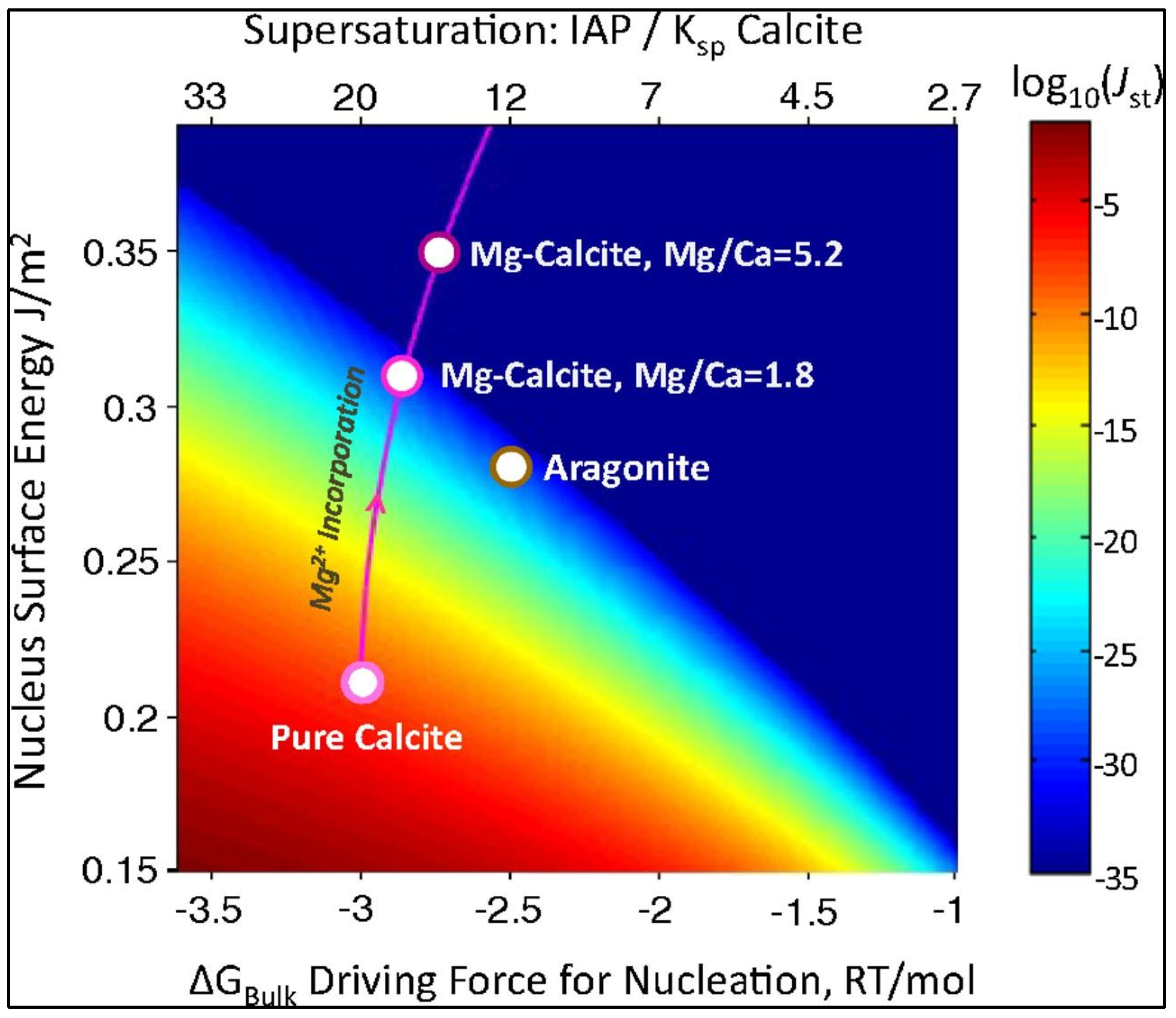
It is also well documented in the literature that magnesium exerts a significant influence on calcium carbonate crystallization, and that aragonite typically crystallizes in preference to the thermodynamically stable polymorph calcite, only when the magnesium Mg2+ concentration is sufficiently high, as reported by Zhien Zhang et al. [39]. Additionally, Katz [40], along with Plummer and Mackenzie (1975) [41], predicted that the most stable calcite in Ca-Mg exchange equilibrium with seawater contains between 2 and 7 mole percent of MgCO3 in solid solution. Earlier, R.A. Berner (1967) [42], suggested that the rate inhibited by magnesium in seawater is due to its incorporation within the calcite crystal structure during growth, which causes the resulting magnesian-calcite to be considerably more soluble than pure calcite. While it is widely established that Mg2+ is known to favor the synthesis of aragonite at high concentrations as mentioned by Park et al. (2008) [43] in which a number of theories have been proposed to explain this observation such as the calcite poisoning model, inhibition of calcite nucleation, adsorption at the growth site, distortion of the calcite lattice, change of the surface charge, and the kinetic problem of cation dewatering as previously reviewed by Nancollas et al. [44]. Nevertheless, the exact role that Mg2+ plays in the precipitation of aragonite as opposed to calcite is still not firmly understood and is still widely a subject of debate. The most commonly expressed idea is that Mg2+ inhibits the growth site of calcite and therefore allows aragonite phase to crystallize rapidly as pointed out by Bischoff, 1968 [45]; Bischoff and Fyfe, 1968 [46]; Berner, 1975 [25]; Astilleros et al., 1996 [47]; De Choudens-Sánchez [48]. Thus, Mg2+ generally inhibits calcite growth by “poisoning” the growth sites on the calcite crystal faces by Mg2+ ions, which are more strongly hydrated than calcium ions, as pointed out by Meldrum (2003) [49] and J. Erez et al. (1978) [50]. In terms of molecular simulation work, WenHao Sun. et al. [51] discovered that the incorporation of Mg2+ on the calcite surface drastically inhibits calcite nucleation. Surface energies, which are obtained from Discrete Fourier Transform DFT computations of hydrated calcium carbonate surface slabs with partial Mg2+ substitution on calcium sites, are shown in Figure 1 below. The kinetic phase diagram study showed that at an Mg/Ca ratio of 5.2 in modern seawater, only aragonite is preferentially nucleated. In contrast, concurrent nucleation of calcite and aragonite occurs over a broad range of supersaturation near Mg/Ca = 2, which potentially yields brucite or hydro magnesite as well.
The use of alkali-based minerals to improve the CO2 dissolution in seawater has been investigated by Li et al. (2018) [52], while Kim et al. (2016) [53] experimented with mineral carbonation using seawater with paper sludge ash and reported that, by using seawater, greater CO2 uptake capacity was observed than by using ultrapure water. Soda ash waste can also be utilized to control the Ca/Mg ratio and play a major role in decalcification and CO2 fixation, as demonstrated by Y. Zhao et al. (2017) [54,55,56,57], while H.K. Bharadwaj et al. (2013) [58] worked on utilizing magnesium hydroxide from a coal-fired plant for the CO2 dissolution and fixation process and using a bipolar membrane electrodialysis, T. Chen et al. (2022) [59] were able to utilize magnesium from seawater for carbon capture, while La Plante et al. [60] proposed a seawater CO2 sequestration system that manipulates the DIC equilibria by introducing electrochemical intervention to disrupt pH equilibria in the mineralization system.
Figure 1.
Dimensionless log10 steady-state nucleation rates of calcium carbonate polymorphs at 25 °C are plotted (color-coded) as a function of nucleus surface energy and the bulk driving force for nucleation. Inhibition of calcite nucleation upon Mg2+ uptake is primarily due to an increase in the surface energy rather than a reduction in bulk driving force from increased solubility [53].
2.3. Effect of pH, Temperature and Other Factors in Aragonite Formation
Additionally, Omar et al. (2009) [61] studied the role of pH in changing the level of supersaturation by seeding seawater with calcium carbonate (calcite) at different initial pH values. They concluded that the level of supersaturation can be manipulated by changing the pH and the temperature of seawater to promote the crystallization of calcium carbonate in seawater. Detailed experimentations on the precise temperature range resulting in aragonite formation were reported as early as 1928 by Suganuma [62], suggesting that calcite phases are usually formed at <50 °C, while aragonite phases are formed when temperature T > 50 °C. Later, Goto (1961) [63] reported that aragonite formed when the temperature T > 60 °C, while Roques and Girou (1974) [64] experimentally demonstrated that the CaCO3 phase transitioned from vaterite to calcite and, finally, to aragonite as the temperature T was increased from ambient conditions. Chakrabarty and Mahapatra (1999) [65] found that vaterite forms at T < 15 °C, calcite forms at room temperature, and aragonite forms at T > 70 °C. Supporting this argument, Nebel and Epple (2008) [66] proposed from their work that vaterite precipitates at low T, calcite at room T, and aragonite at high T. Recently, Chen and Xiang (2009) [67] reported that vaterite forms between 30 and 40 °C, and that at 50 °C and above, aragonite precipitation increased. The effect of temperature and incorporation of Mg2+ in aragonite was experimentally investigated by Mavromatis et al. (2022) [68] as a function of mineral growth rate at 5, 15, and 25 °C using the constant addition technique, and was found to be the major parameter affecting the Mg-partitioning coefficient. The utilization of waste material, such as fine recycling concrete waste FRCW was demonstrated by Peiliang Shen et al. (2023) [69] via a wet carbonation method to produce aragonite whisker-rich materials, where magnesium ions are chosen to promote the aragonite nucleation during the carbonation process.
Utilizing physical treatment, such as ultrasound under high power, Xiao et al. (2024) [70] observed that such procedures promote aragonite formation, while the usage of magnetic field treatment also enhances aragonite precipitation, with its content increasing with field strength. In terms of reactor development, Noh, MGM et al. (2025) [71] successfully investigated methods for synthesizing aragonite crystalline particles using a continuous mineral carbonation reactor system and optimized its operating parameters, establishing an experimental design to identify the main effects and maximize aragonite production using MgCl2. In another pilot-plant scaling-up study, Ellyta Sari et al. (2024) [72] investigated the synthesis of aragonite via low temperatures at 30 °C and 55 °C with the addition of 50 and 75 g/L of ammonium chloride, NH4Cl, as a chemical inducer.
2.4. Theory
Classical mineral carbonation using seawater, as reported by Jeon, J. et al. (2019) and Hsing-JH et al. (2023) [55,73], is based on the equilibrium described by Equations (1)–(9), which form the building blocks for the reaction steps of the CO2 carbonation process pertaining to aragonite synthesis using magnesium as a chemical inducer. These reaction steps are adopted for seawater mineral carbonation as described below:
Ca(OH)2(s) + MgCl2(aq)[from seawater] <==> Mg(OH)2(s) + CaCl2(aq)
Ca(Cl)2(aq) + H2CO3(aq) + Mg(OH)2(s) <==> CaCO3(s) + MgCl2(aq) + 2H2O
CO2 absorption
CO2(g) <==> CO2(aq)
Hydration of dissolved CO2
Reaction of hydroxyl ions with dissolved CO2 in the case of high pH of the solution
CO2(aq) + H2O <==> H2CO3(aq)
CO2(aq) + OH− (aq) <==> HCO3−(aq)
HCO3−(aq) + OH−(aq) <==> CO32−(aq) + H2O
Dissociation of calcium hydroxide
Ca(OH)2(aq) <==> Ca2+ + 2OH−(aq)
Ca(OH)2(s) + Mg2+ + 2Cl−(aq) <==> Mg(OH)2(s) + Ca2+(aq) + 2Cl−(aq)
Complete Precipitation
In terms of reaction kinetics, carbonate precipitation reactions are characterized by a timescale, as proposed by Mitchell et al. [74]. Under well-mixed conditions (i.e., free of mass transport limitations) at 25 °C and at 1 atm, the equilibrium described by reaction 8 reached equilibrium within a 5.0 × 10⁻¹¹ s time frame.
The aqueous species H2, CO3, HCO3−, and CO32−, as described by reactions (9)–(11), reach equilibrium within a 10−2 s order of magnitude.
However, the equilibrium with respect to the precipitation of Ca2+ (i.e., reactions (12) and (13)) is reached only on the timescale of 103 s, which corresponds roughly to between 10 and 20 min.
Hence, aragonite formation is not instantaneous but requires a lag period that reflects delays in the nucleation step. Celleste Kellock et al. (2022) [75] reported a lag period of up to 1800 s or 30 min, which occurred for aragonite precipitation in both natural and artificial seawater under various experimental conditions. In this work, we attempt to develop a design of experiment establishing the main factors and effects, yield parameters such as the kinetics of reaction or aragonite lag period, optimization, and product characterization for the synthesis of aragonite using seawater as a natural inducer in a continuous mineral carbonation reactor.
Ca(Cl)2(aq) + CO32−(aq) + H2O+ Mg(OH)2(s) <==> CaCO3(s)+ MgCl2(aq)+ 2H2O
CO2(g) <==> CO2(aq)
CO2(aq) + H2O <==> H2CO3 + HCO3−(aq)
H2CO3 <==> H+ + HCO3−(aq)
HCO3−(aq) <==> H+(aq) + CO32−(aq)
Ca2+(aq) + CO32−(aq) <==> CaCO3(aq)
CaCO3(aq) <==> CaCO3 (s)
3. Materials and Methods
3.1. Experimental Setup
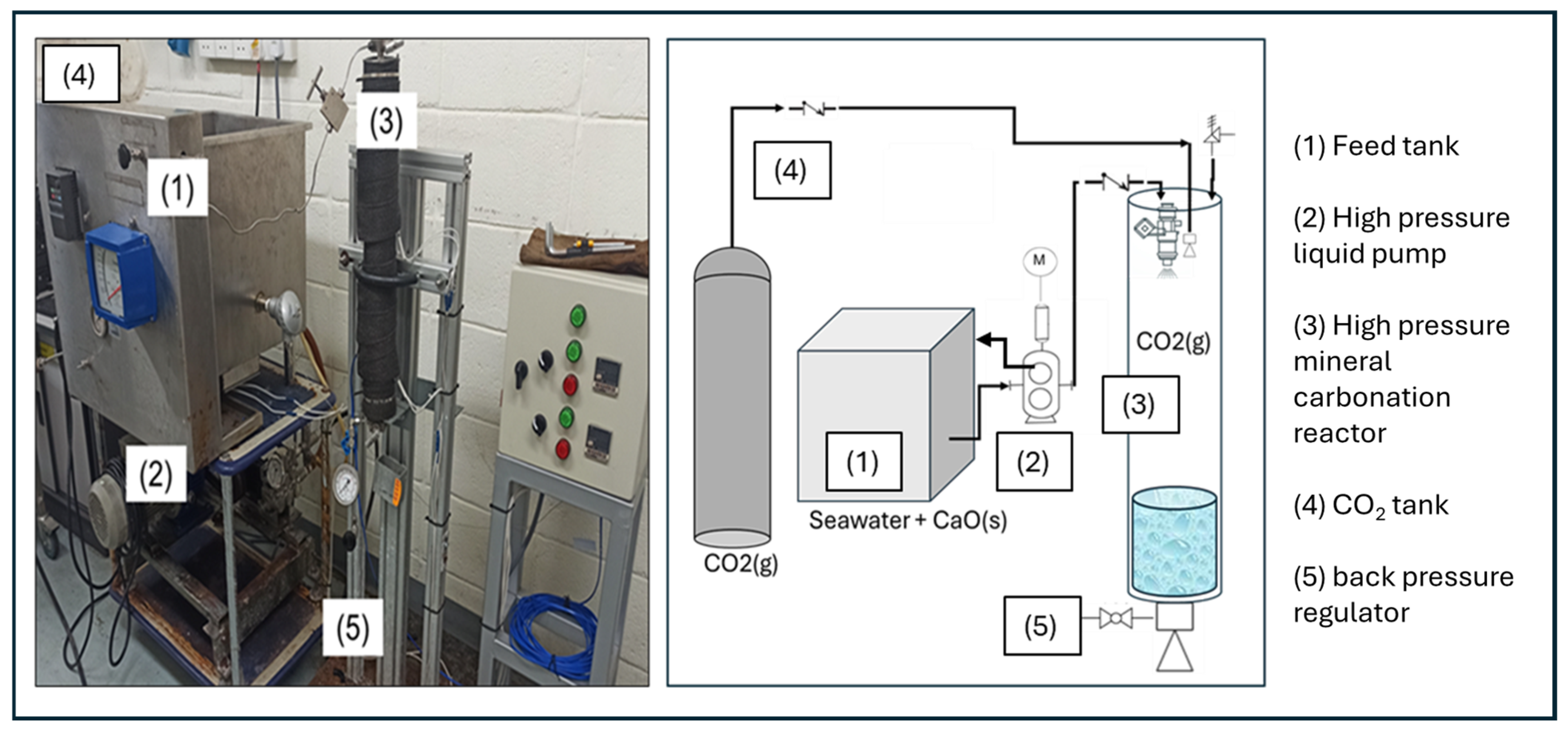
The laboratory setup shown in Figure 1 below is designed and constructed to investigate and optimize the effects of solution temperature T, Mg-to-Ca ratio r, and reaction duration t in order to maximize aragonite yield. The setup consists of a 0.8 L high-pressure tubular reactor vessel (3), feedstock tank (1), mechanical liquid recirculation system (2), heating plate and level controller (5), CO2 gas compressor, and a high-pressure CO2 gas pressure regulation and metering system (4). A lime solution with artificial seawater, prepared in accordance with the procedure below, formed a slurry feedstock, which is subjected to continuous recirculation in the feedstock tank (1). The visual of the setup is shown in Figure 2 below.
Figure 2.
Laboratory setup for aragonite synthesis from lime solution and artificial seawater at 33 g/L concentration.
3.2. Procedure Using Continuous Mineral Carbonation Reactor
The artificial seawater is prepared using a 33 g/L concentration blend of Red Sea salt [76]. The Red Sea salt blend is a naturally harvested salt from the Red Sea, with a salt composition compared to a typical seawater [77], as shown in Table S1 in the Supplementary Material S1.
The Red Sea salt is slowly dissolved into deionized water until the concentrations of Ca2+ are in the range of ~400 ppm, while Mg2+ reaches the range of ~1100 ppm. Subsequently, lime CaO is added into the artificial seawater solution at 1 g/L and 5 g/L blends to form a slurry feedstock with the pH of the solution stabilizing between pH 12.2 and pH 12.4. Then, the blend is transferred into the feedstock tank and heated to the target temperature of 30 °C and 90 °C. CO2 feed gas is injected into the reactor until the desired starting pressure is reached, between 10 and 20 bar. The test rig starts up with the injection of slurry feedstock at a constant flow rate between 20 mL/min and 120 mL/min to allow the reaction time of between 1 min and 10 min for the slurry feedstocks to take place in accordance with the design of experiment running condition established. Subsequently, the slurry solution is continuously flowed out via the bottom liquid ejector at a controlled flow rate after a pre-determined retention time has been achieved by the slurry reactant feedstock in the reactor. Fully reacted product forms a whitish precipitate, which is recovered until the required volume or mass balance is achieved. The artificial seawater, which has been utilized in the reaction above, is referred to as spent seawater, and the solid precipitates formed after the reaction were separated via vacuum filtration. The solids were analyzed using microscopy imaging (FESEM), X-ray diffraction (XRD), inductively coupled plasma (ICP), and thermogravimetric analysis (TGA). As for baseline or reference datasets, these tests were repeated, but with the feedstock switched to a lime (CaO) solution with MgCl2 as a chemical inducer for aragonite synthesis.
3.3. Analytical Equipment Settings
The primary analysis in this study, the XRD diffractogram, was obtained using the Bruker D8 Advance model (Diffrac Plus EVA, Bruker Physik-AG, Karlsruhe, Germany), equipped with a copper tube anode. The one-dimensional fast Lynk-Eye detection is set with the °2Θ range locked between 5° and 80°, a step size of 0.025°, and a step duration of 0.3 s/step. All diffractograms were analyzed using Diffrac Plus EVA. The relative concentrations of aragonite, calcite, and other related minerals in the sample are determined by quantitative analyses using the following established method, as reported by Dickinson et al. (2001) [78]. Expanding the basis for quantitative analyses, it was established that the aragonite phase has the greatest peak (111) at °2Θ = 31, and the other prominent peaks (200) at °2Θ = 36, (130) at °2Θ = 38, and most importantly (221) at °2Θ = 45 as a secondary signature indicator of the presence and abundance of aragonite as a monocrystalline phase of calcium carbonate. Calcite has a prominent peak of (104) at °2Θ = 34 to the right of aragonite’s (111) peak. Nevertheless, the prominent aragonite peak dwindled when aragonite content goes below 25%, and quantitative detection can be misleading if not properly interpreted. By using the aragonite (221) peak as an alternative indicator to the abundance of aragonite, a comparative ratio with the calcite (104) peak can be performed. In addition, the particle size analysis (PSA) was carried out using the Malvern Mastersizer 3000E Particle Size Analyzer (Malvern Panalytical Ltd., Malvern, UK) to determine the particle size distribution using the wet method. The ionic concentration in the spent liquid reactant was analyzed using the ICP-OES Avio 550 (Perkin Elmer, Shelton, CT, USA) and the APHA Method 4110B: Standard Methods for the Examination of Water and Wastewater. The pH analysis was carried out in accordance with the APHA 4500H+. At the same time, the determination of fluoride, chloride, nitrite, nitrate, bromide, phosphate, and sulphate was conducted in accordance with the APHA4110B after leaching by the distilled water method. The equipment utilized for this analysis is a Rigaku Nex-CG Energy-Dispersive X-ray Fluorescence Spectrometer (Rigaku Corporation (Tokyo), Akishima-shi, Japan). The sample preparation for both aragonite from seawater and MgCl2 underwent an oxide infusion procedure at high temperature to improve the accuracy of the elemental detection for powder and non-homogeneous types of samples using in-house standard procedures. The rationale for utilizing this technique is to eliminate particle size and mineralogical effects for consistent results and enable broad concentration range analysis. The reported values are in oxide weight percentage. For both seawater aragonite and MgCl2-aragonite, they are strictly for comparative elemental abundance of major elements and contaminants and should not be taken as absolute.
3.4. Design of Experiment
A Two-Level Full Factorial Design was chosen to initiate a simplified design of experiment methodology to briefly establish the main factors and effects and establish the optimized range dominantly affecting the purity of aragonite crystal synthesized in this study. The test consists of randomized runs to evaluate three experimental parameters, each at two levels (a high level and a low level) with three replicates, totaling 24 runs. The parameters under investigation are as follows: (1) Temperature: 30–90 °C, (2) Concentration of CaO in seawater: 1 g/L and 5 g/L, and (3) Reaction time: 1 and 10 min. The 24 experimental runs are randomized as shown in Table S1 in the supplementary section to cover the three factors, with the response measured as a percentage of aragonite crystal yield or purity. The aragonite yield or purity is calculated as the percentage of aragonite crystals over calcite crystals formed, or Y aragonite/Y calcite × 100.
4. Results and Discussion
4.1. Two-Level Full Factorial Design XRD Analytical Results
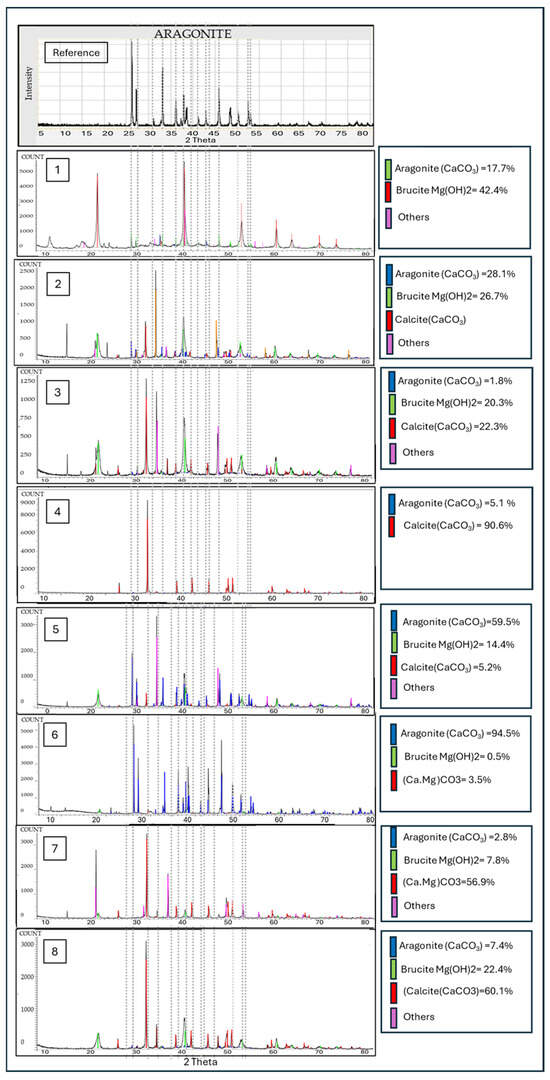
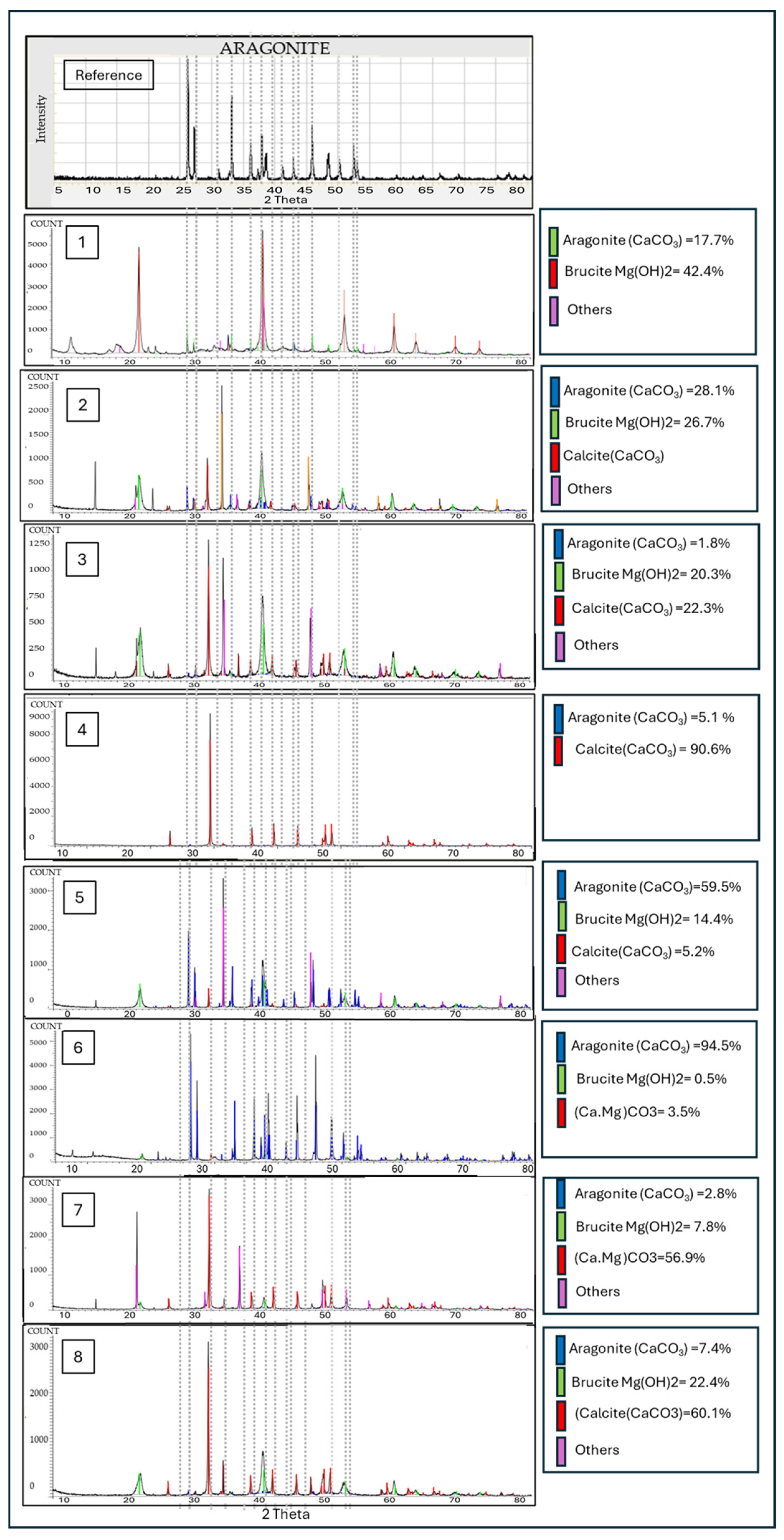
All XRD diffractograms analyzed using the Diffrac Plus EVA software (https://www.bruker.com/en/products-and-solutions/diffractometers-and-x-ray-microscopes/x-ray-diffractometers/diffrac-suite-software/diffrac-eva.html, (accessed on 30 January 2026)) are shown in Figure 3 below. Diffractograms are shown for each of the 8 experimental points based on the two-level full factorial design main factors and effects determination. The full results of the aragonite yield derived from the X-ray diffractograms are tabulated in Table S2, while the methodology to calculate the sum of responses and average responses at each permutation point is included in Figure S1 in the Supplementary Material Section S3. These datasets are subsequently simplified and tabulated in Table 1 below.
Figure 3.
Selected XRD diffractogram results for the 8-point factor permutations from the two-level full factorial design of experiments for main factors and effects determination.
Table 1.
Sum of seawater aragonite yield (Y), repeatability runs R1, R2, R3, average, and standard deviation from factorial runs pertaining to the respective factors—temperature, concentration of CaO in seawater, and reaction duration—to maximize aragonite yield using seawater as a natural inducer.
4.2. Investigation of Main Factors for Aragonite Yield
Referring to the calculated effects provided in Table S4 in Supplementary Material Section S5, for the individual factor interactions, the following is deduced: the interaction factors A, B, C, AB, AC, and BC are found to be significant as main effects for aragonite yield. Only by increasing temperature and reaction duration, or both, can the aragonite yield be increased. However, increasing CaO concentration in seawater will have a significant negative effect on aragonite yield. Hence, the two-way interaction of factors AC has the most dominant effect to increase the aragonite yield using seawater as a natural inducer. The yield of the aragonite main factor interactions equation is updated as follows:
Yield Seawater Aragonite = α_1 × A − α_2 × B + α_3 × C − α_4 × AB − α_5 ×BC + α_6 × AC
4.3. Production Curvature of Aragonite Yield Induced by Seawater
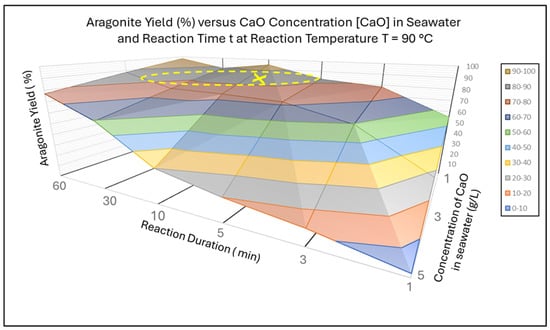
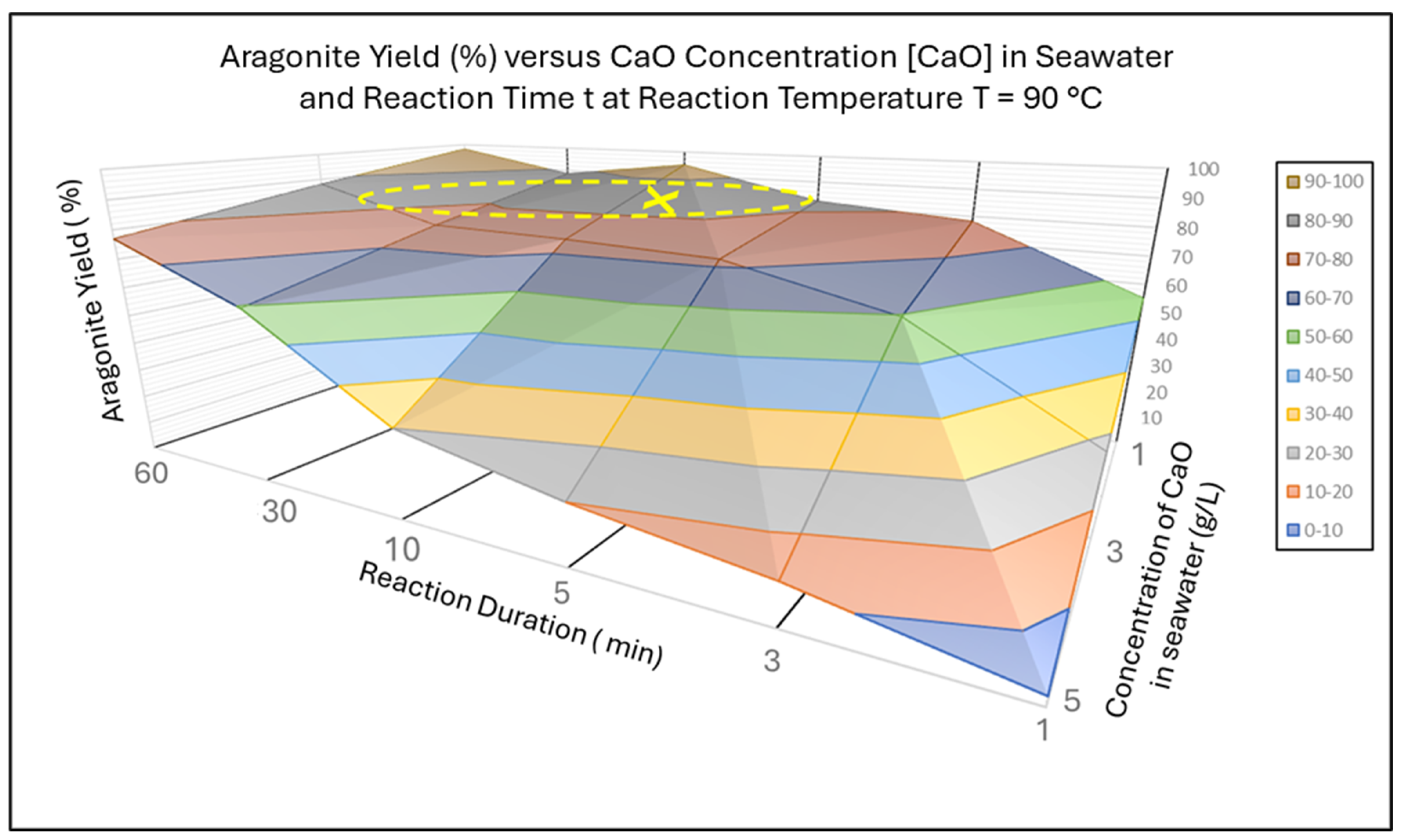
The basic 8-point experimental runs to establish the effects of the main factors were extended to produce a contour that includes additional points for reaction time and temperature, which are the main effects on aragonite yield in seawater. Reaction temperature, or Factor A, on its own, has the biggest effect in increasing the seawater aragonite yield at 90 °C; hence, the surface response contour was developed at 90 °C for the seawater aragonite yield with reaction time and [CaO] as variables. The additional experimental points included to finalize the surface response contour are reaction time t at 3 min, 5 min, 30 min, and 60 min, and a CaO concentration of 3 g/L. The full plot of the yield or aragonite yield/purity at reaction temperature 90 °C is shown in Figure 4 below.
Figure 4.
The correlation developed at 90 °C for the best aragonite yield for reaction time between 1 and 60 min and concentration of CaO between 1 g/L and 5 g/L is provided in the 3D curvature graph below.
Referring to the 3D response surface curvature in Figure 4 above, the trend suggests that aragonite yield is highest when the reaction time approaches the higher ranges of >10 min and when the concentration of CaO is kept below 3 g/L. The corresponding area within the yellow dotted lines on the 3D curvature represents the range of operation that produces aragonite with >80% yield. Three points of interest considered here are to produce aragonite with >80% purity. The first corresponds to a reaction time of 10 min with a concentration of CaO of 1 g/L; the second with the combination of 30 min and 3 g/L, and the third with the combination of 60 min and 4.5 g/L. The dimensional parameter proposed in this process reflects the process intensity. Qintensity is taken to be yield or purity over reaction time = [CaO]/(reaction time), or in terms of physical unit {(g/L)/min} or g/(L*min) is chosen for seawater aragonite production. The process intensity corresponding to the three points is therefore as follows:
- (i)
- First point Qintensity_10min|1gpl = 0.100 gL−1 min−1
- (ii)
- Second point Qintensity_30min|1.5gpl = 0.050 gL−1 min−1
- (iii)
- Third point Qintensity_60min 3gpl = 0.050 gL−1 min−1
From above, the first point corresponding to the [CaO] = 1 g/L and reaction time 10 mins at 90 °C is taken to be the proposed operating parameter for aragonite production with >80 % purity for the continuous mineral carbonation reactor operation marked in Figure 4 above as “X”.
4.4. Kinetics of Aragonite Formation in Seawater Media
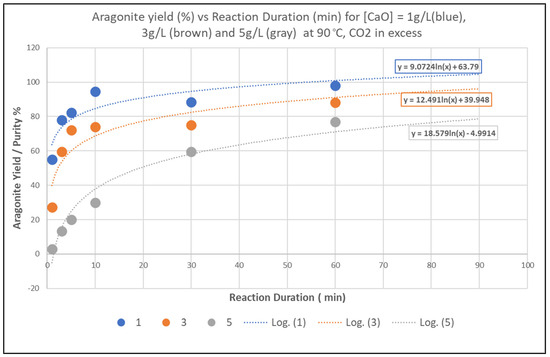
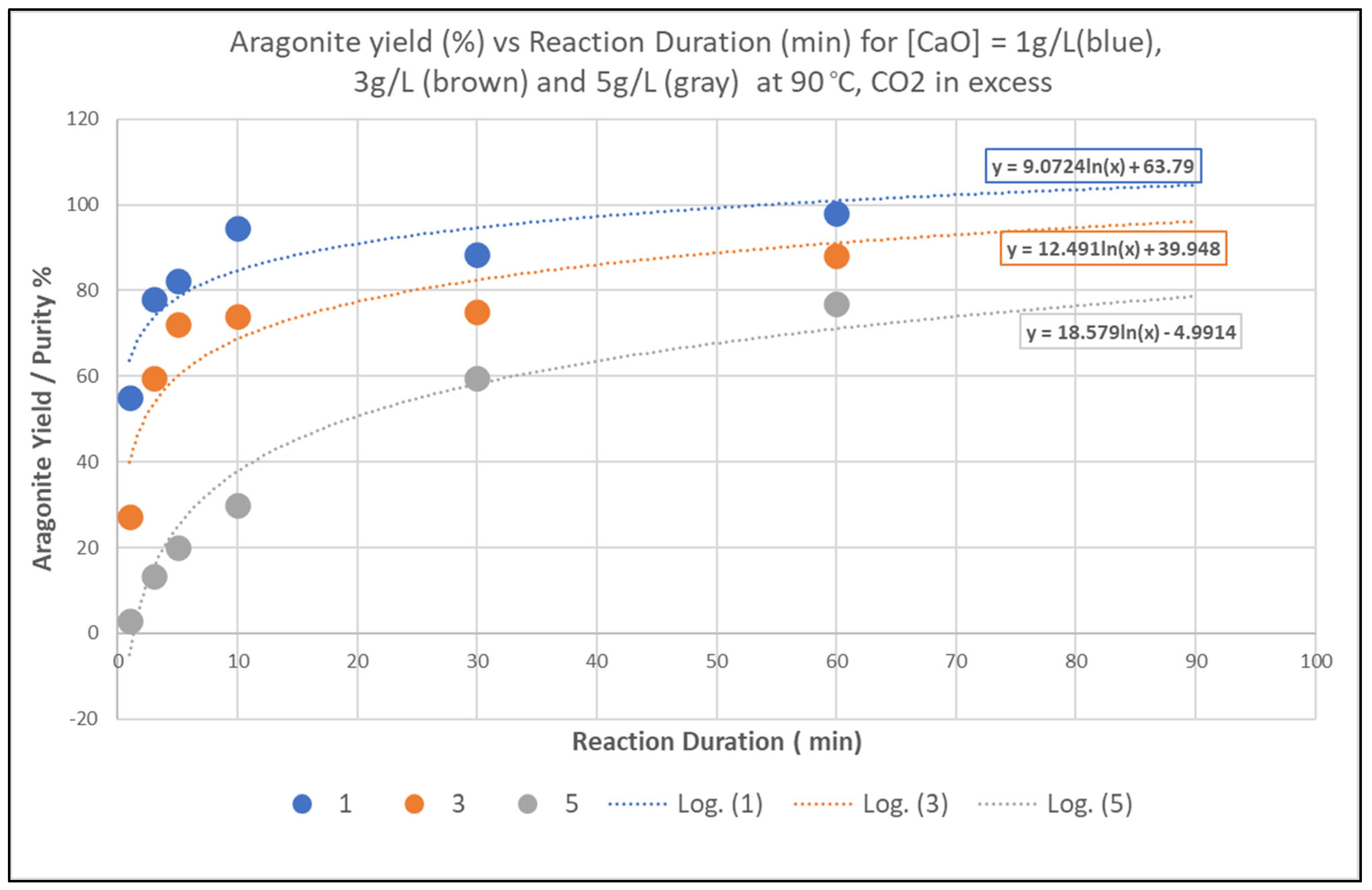
The experimental datasets pertaining to the operating temperature of 90 °C are therefore tabulated to investigate the underlying trends when the concentration of CaO varies at 1 g/L, 3 g/L, and 5 g/L at reaction cut times of 1 min, 3 min, 5 min, 10 min, 30 min, and 60 min. The results are tabulated in Table S4 as provided in the Supplementary Material Section S5, and plotted as in Figure 5 below.
Figure 5.
Correlation graph for aragonite yield (%) versus reaction time (min) for [CaO] at 1 g/L, 3 g/L, and 5 g/L at 90 °C with seawater as a chemical inducer.
The general trend in aragonite yield in seawater reaffirms earlier results on the main interaction factors, whereby factor C, the concentration of CaO, has a significantly negative effect on aragonite yield. Increasing the concentration of CaO from 1 g/L to 5 g/L results in the aragonite yield percentage being drastically reduced from 94.5% to a low of 28.5% at a 10-min reaction time. The general trend follows a logarithmic correlation, with aragonite yield reaching a plateau or asymptotic value near the theoretical limit of 100% after reaction time exceeds 60 min. The performance target of 80% aragonite yield or purity was based on product benchmarking performed on a commercially available product for quality benchmarking [17]. A reaction time of more than 60 min is required to produce a yield of 80% and above if a CaO concentration of 3–5 g/L is used. Therefore, as stated in Section 4.3, selection of [CaO] = 1 g/L has been demonstrated to yield > 80% aragonite after a 10 min reaction time.
4.5. Other Components Analysis in the Aragonite Formation in Seawater Media
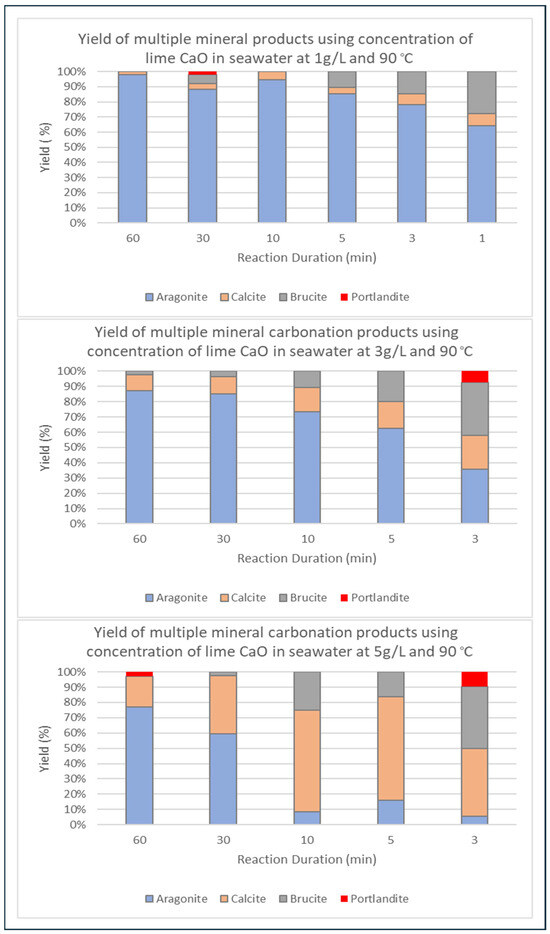
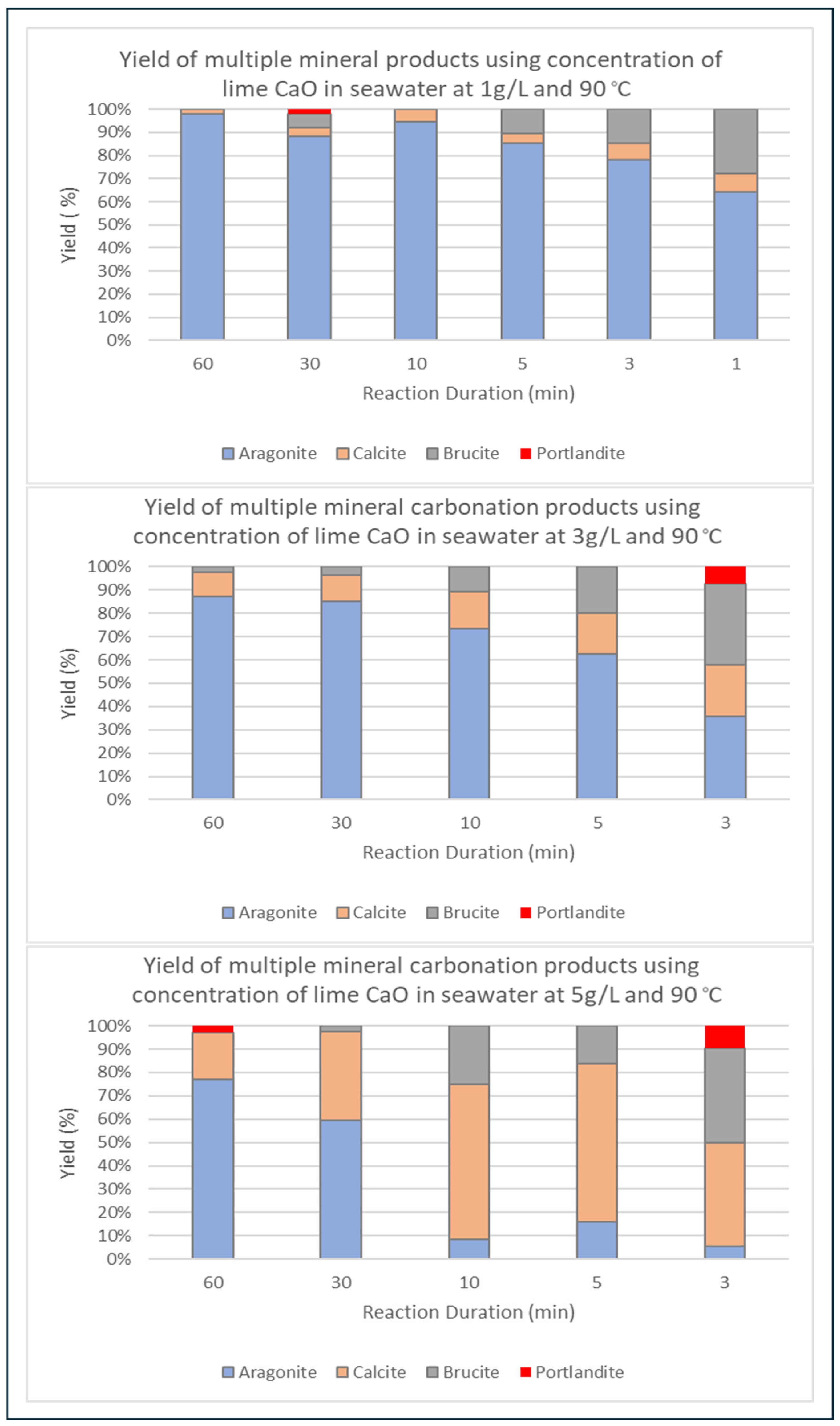
The other components in the aragonite products formed at 90 °C at various CaO concentrations of 1 g/L, 3 g/L, and 5 g/L, and reaction times between 1 min and 60 min were analyzed and confirmed via XRD in terms of their crystalline phase compositions. Datasets pertaining to the aragonite, calcite, brucite, and portlandite products formed at 90 °C at various CaO concentrations of 1 g/L, 3 g/L, and 5 g/L and reaction times between 1 min and 60 min are provided in Table S5 in the Supplementary Material Section S6. At the same time, the corresponding trend graph and bar charts are plotted in Figure 6 below.
Figure 6.
Correlation bar chart and trend graphs pertaining to the aragonite, calcite, brucite, and portlandite products formed at 90 °C at various lime CaO concentrations of 1 g/L, 3 g/L, and 5 g/L, and reaction times between 1 min and 60 min.
With reference to the trend in Figure 6 above, the ratio of aragonite/calcite formation generally increases with the use of lower CaO concentration in seawater. The ultimate composition or purity of aragonite upon reaction reaching steady-state conditions varies according to the concentration of CaO used. The purity of aragonite dropped from a high of 97.9% to 76.9% only when the concentration of CaO was increased from 1 g/L to 5 g/L, following a logarithmic uptrend. Inversely, the intermittent compounds such as brucite and portlandite decreased as aragonite was continuously formed in the crystalline lattice when the reaction duration was extended further until 60 min.
4.5.1. Brucite
Brucite composition is significantly high at the initial phases of the reaction time, < 10 min. Brucite, which has magnesium metal ions as part of its molecular structure, is proposed by Meldrum et al. (2001) [79] to exist intermittently, adsorbing at the surface while forming a complex with calcite lattices, which in turn limits calcite formation in favor of aragonite formation. Ultimately, once all the remaining calcite lattices have been morphologically evolved to aragonite structures, brucite ceases to be present. Also, there is a strong correlation between the relative concentration of calcite and brucite, especially when a higher concentration of the initial [CaO] reactant was used at 5 g/L. This observation is supported by early research works by Berner (1967) [42], Bischoff (1968) [45], R.A. Berner (1975) [25], Berner (1983) [80], and M. Reddy, K.K. Wang (1980) [81]; Y.W. Liu (2020) [31] and Woon Kyoung Park et al. (2008) [43]. The work of A.E. Stephenson et al. (2009) [82], Picker et al. (2017) [83], Xin Yan et al. (2023) [84], and Addadi et al. (2014) [85] on biomineralization and crystalline growth mechanisms provides an important hypothesis on the formation of intermittent brucite complex CO2-Ca-Mg, shown as a grey bar-column figure. This intermittent complex formation signals an incomplete reaction and indicates that more reaction duration is needed to obtain a higher purity of aragonite crystalline product.
4.5.2. Portlandite
Portlandite (red bar-column) presence was only detected at the first minute of reaction duration for 3 g/L and 5 g/L, possibly due to insufficient flow of the CO2 reactant. This can also be used as a signal, indicating that the flow rate of the CO2 reactant must be increased due to the presence of the unreacted hydrated form of CaO, or portlandite.
5. Physicochemical Characteristics of Seawater Aragonite Synthesized
The physicochemical characteristics of the crystalline precipitate seawater aragonite were carried out with the following analytical test methods. The primary analysis in this study, XRD, was conducted using a Bruker D8 Advance with a copper tube anode. This one-dimensional fast Lynx-Eye detection is set as follows with a °2Θ range between 5° and 80°, a step size of 0.025°, and a step duration of 0.3 s/step. All the collected diffractograms were analyzed using the software provided by Diffrac Plus EVA. In addition to the XRD analysis, the particle size analysis (PSA) was carried out using the Malvern Mastersizer 3000E Particle Size Analyzer to determine the particle size distribution using the wet method. The ionic concentration in the spent liquid reactant was analyzed using the equipment ICP-OES Avio 550 (Perkin Elmer) and the APHA Method 3120: Standard Methods for the Examination of Water and Wastewater, and high-magnification imaging using FESEM. The properties of seawater aragonite produced are compared against aragonite produced with MgCl2 as a chemical inducer.
5.1. X-Ray Diffractogram XRD Analysis
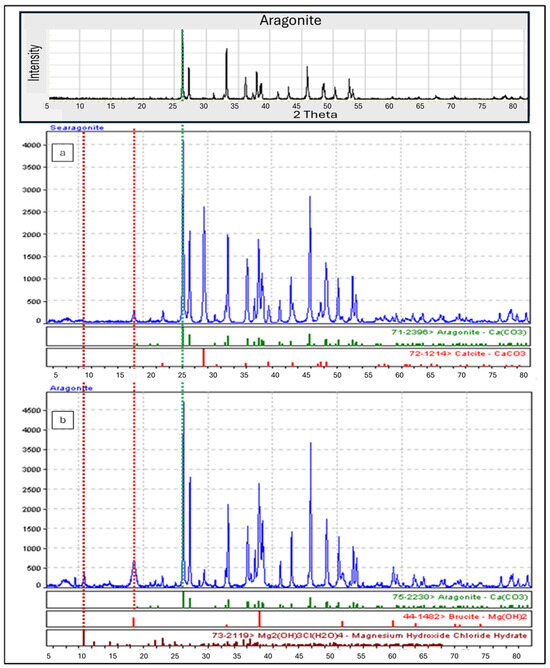
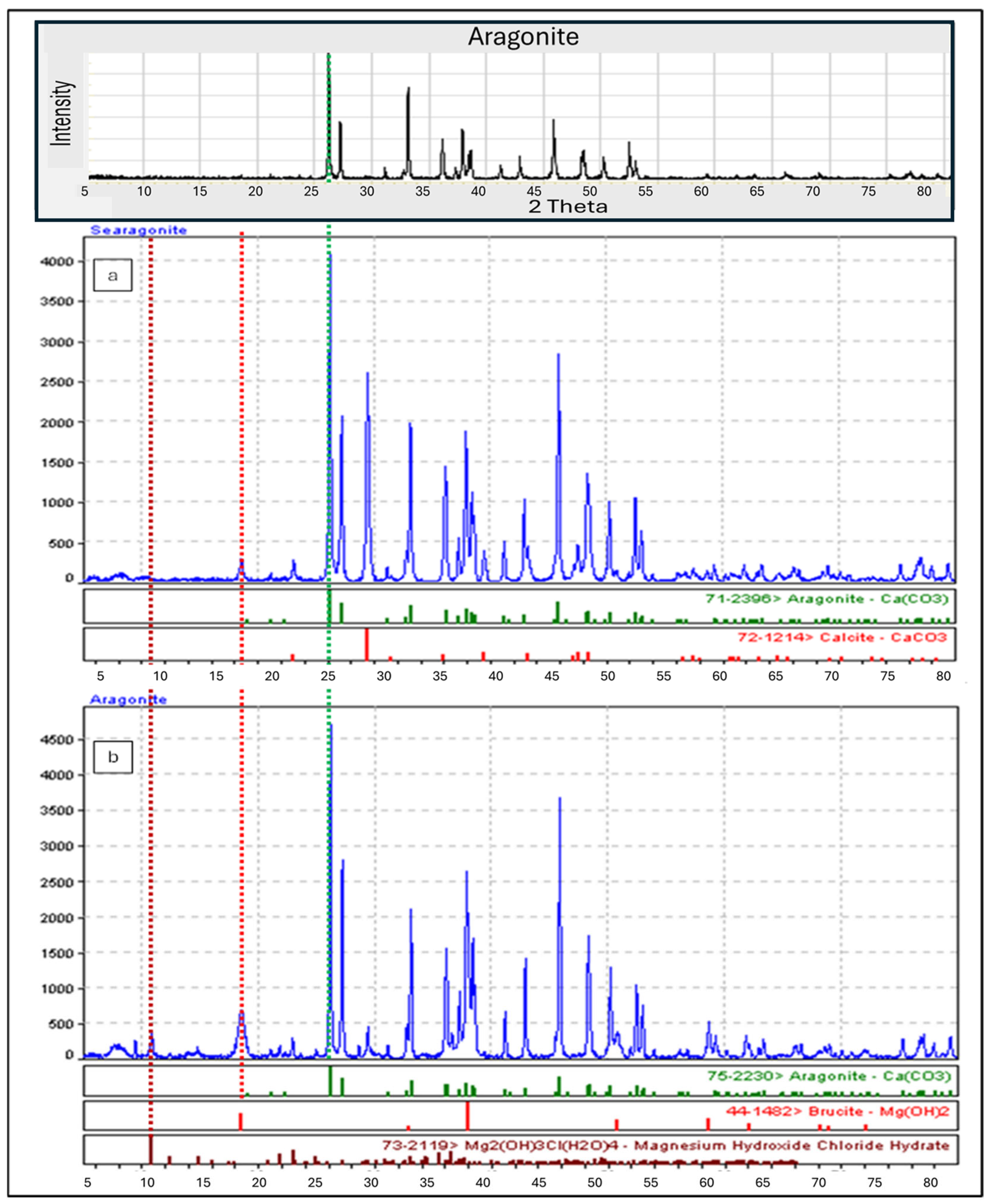
X-ray diffractogram of aragonite via MgCl2 and seawater aragonite are shown in Figure 7a, seawater aragonite (top), and Figure 7b, aragonite via MgCl2 (below), in comparison with diffract reference standards and the RRUF minerology database [86]. The diffractograms suggest that the aragonite phase crystal was dominant in both samples (green guide for aragonite, the most dominant component). For the synthesis of aragonite using MgCl2, traces of magnesium in the form of brucite Mg(OH)2 and magnesium hydroxide chloride hydrate Mg2(OH)3Cl(H2O)4 complex were also detected by the XRD diffractogram (brown and red guides for brucite and hydro magnesite, the most dominant component). This suggests that the reaction still has remnants of Mg2+ adsorbed on the aragonite crystalline site, or, alternatively, that simple magnesium ions have undergone oxidation to form oxide complex hydrated precipitates. However, for the seawater aragonite, no apparent traces of magnesium complex were evident. In the final product recovered, only calcite was found apart from seawater aragonite, signaling that the carbonation process is fully completed and Mg2+ had subsequently detached itself from the lattice face of aragonite; a mechanism which was proposed earlier by Meldrum et al. (2001) [79].
Figure 7.
(a). Comparative X-ray diffractogram of aragonite via MgCl2 (top) and (b). seawater aragonite (bottom).
5.2. Alkalinity and pH Level
The relative values of pH for the seawater aragonite, aragonite via MgCl2, and reference calcite are provided in Table 2 below. Seawater aragonite synthesized by the continuous reactor has lower alkalinity compared to aragonite using MgCl2 as an inducer. A possible explanation is that supersaturation of MgCl2 and residual precipitates of hydrated Mg-complexes trapped within the aragonite crystal structure supply OH− species, increasing alkalinity to up to 10.05 pH. This is supported by the XRD analysis in Figure 8 above, whereby for the synthesis of aragonite using MgCl2, traces of magnesium in the form of brucite Mg(OH)2 and magnesium hydroxide chloride hydrate Mg2(OH)3Cl(H2O)4 complex were also detected by the XRD diffractogram (yellow/brown guide). Seawater aragonite crystalline structure does not indicate any quantifiable precipitation of magnesium complexes from the XRD diffractogram, thus lacking any alkali-based substance to have substantially affected its alkalinity. However, both aragonite compounds have elevated levels of pH as compared to calcite synthesized using the continuous mineral carbonation method.
Table 2.
pH value for samples synthesized from the continuous mineral carbonation reactor.
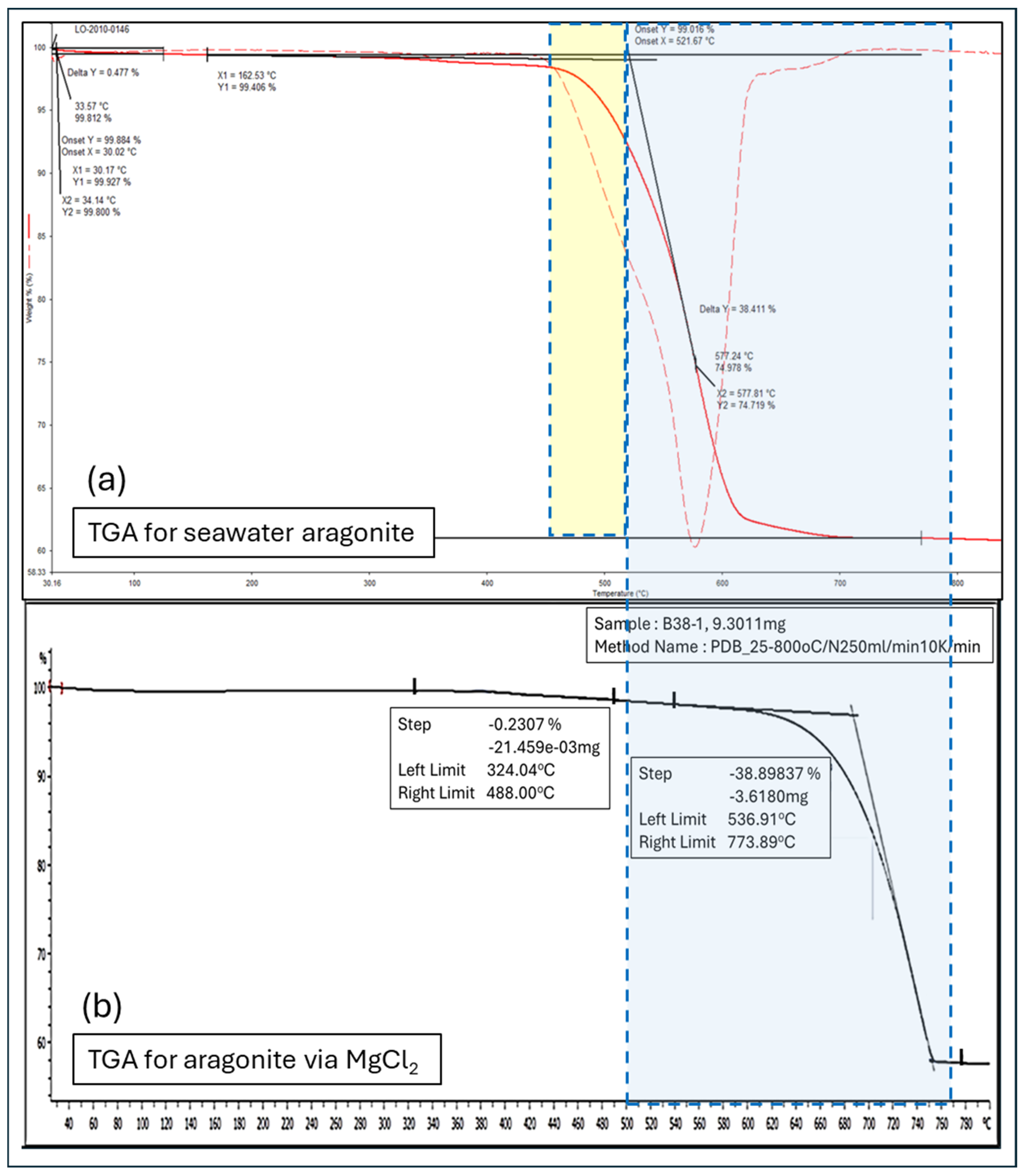
Figure 8.
(a) Top and (b) bottom show the thermal decomposition graph of both seawater aragonite and aragonite via MgCl2.
5.3. Anions
The results of anions associated with seawater aragonite, calcite, and MgCl2-aragonite are shown in Table 3 below. Observations from Table 3 indicate that seawater aragonite has a significantly lower chloride content than the equivalent aragonite synthesized via MgCl2. For synthesis using MgCl2 as an inducer, the loss of MgCl2 concentration during each synthesis cycle was significant in the aqueous spent-reaction media. These MgCl2 losses end up adsorbed onto the surface of aragonite crystalline formations as detected by the XRD diffractogram above in Figure 8, resulting in very high levels of chloride Cl− exceeding 30,000 ppm. Additionally, seawater aragonite has exceptionally higher sulphate content in comparison to aragonite synthesized via MgCl2. One explanation is that sulphate originated from the Red Sea salts seawater blends [76], having high sulphate levels of up to 3078 mg/L.
Table 3.
ICP results on seawater aragonite, calcite, and MgCl2-aragonite.
5.4. X-Ray Fluoroscopy XRF
In this study, from XRF analysis, it is observed that aragonite produced from seawater was found to have much lower magnesium (Mg) content and chlorine (Cl) content, which are both regarded as undesirable contaminants. However, XRF analysis confirms elevated levels of sulphur oxide (SO3) in seawater aragonite at 1.46% versus aragonite via MgCl2 at 0.15%. This higher SO3 has a high possibility of having originated from the seawater, which has approximately high sulphate levels of up to 3078 mg/L, as previously mentioned above. The most important feature is that seawater aragonite, which is synthesized from artificially blended seawater, has significantly higher calcium oxide CaO weight percentage content in comparison to MgCl2-aragonite synthesized using MgCl2 as a chemical inducer, as tabulated in Table 4 below.
Table 4.
X-ray fluorescence results from the in-house oxide infusion method. The left-hand side of the table shows the metal oxide elements for aragonite synthesized via MgCl2, and the right-hand side of the table shows the concentrations of metal oxide elements for seawater aragonite precipitates.
5.5. Thermal Gravimetric Analysis TGA
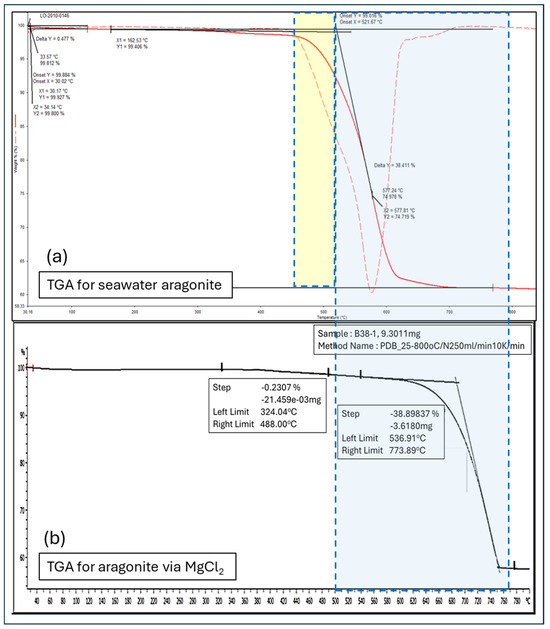
The thermal decomposition analysis of calcium carbonate has been extensively studied. The decomposition mechanism and reaction kinetics reported by a number of studies revealed that the decomposition of calcium carbonate takes place at a definite boundary between the calcium oxide and calcium carbonate crystalline phases [87]. Zhuang, D et al. [88] concluded that the general thermal decomposition curve of calcium carbonate consists of three distinct stages, with the first stage occurring from 50 °C due to the release of free and bound water, leading to the second stage of mass loss which is the main decomposition of calcium carbonate releasing carbon dioxide gas, and the final third stage, where the mass loss is unrelated to calcium carbonate decomposition. Also, Galan et al. [89] reported slightly different TGA decomposition curves at the third stage due to the pyrolysis effect between 850 °C and 950 °C. Hence, the thermal decomposition graphs of both seawater aragonite and aragonite via MgCl2 are compared back-to-back in Figure 8a,b below.
Similar levels of thermal composition between seawater aragonite and aragonite synthesized via MgCl2, with both materials decomposing to lose approximately 45% of their weight (CO2 in gaseous form released), confirming carbonate stoichiometric characteristics. Seawater aragonite begins to decompose between 460 °C and 720 °C (see yellow area in Figure 9a), which is at a temperature range slightly lower than that of MgCl2-aragonite, which decomposes between 500 °C and 750 °C (see blue area in Figure 8).
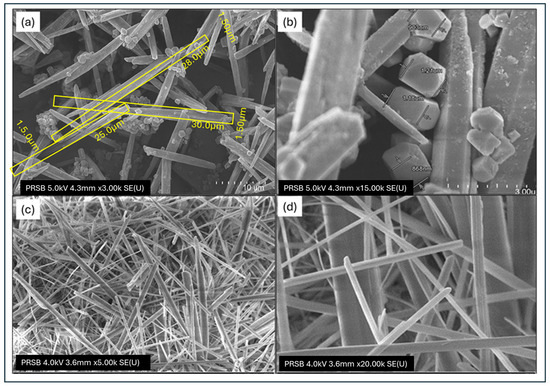
Figure 9.
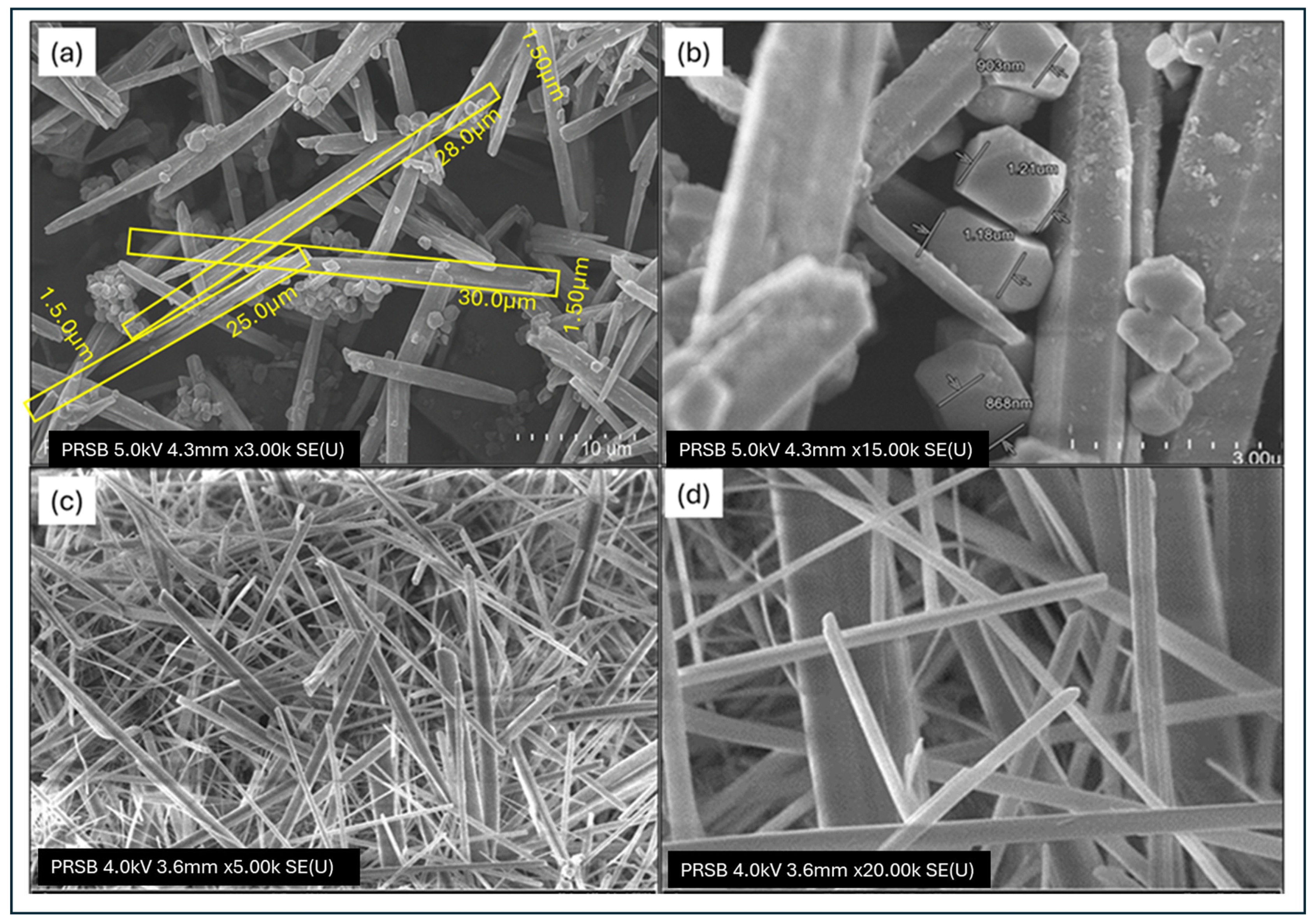
(a,b) Top—the FESEM images of seawater aragonite at 10 min reaction duration, and (c,d) Bottom—the FESEM images of aragonite synthesized via MgCl2 inducer.
5.6. FESEM Imaging
The FESEM images in Figure 9a–d indicate different crystallization shapes of both the aragonite precipitates. A mixture of needle-shaped and smaller-sized rhombic-shaped particles was observed for the seawater aragonite, comparable to Figure 10a, having a close resemblance to the work of Saulat et al. (2019) [90], which produced CaCO3 whisker material having a needle-like structure with a high length/diameter ratio, a diameter of 0.5–1.0 μm, and a length of 20–30 μm. With higher image resolution, Figure 10b shows the smaller rhombic calcite particles, similar to the synthetic calcite produced by Hashim et al. (2020) [91], with an average particle size of 1 micron for the reaction of seawater aragonite with a reaction duration of 10 min. The high-aspect-ratio needle-like shape of aragonite synthesized via MgCl2 is evident in the images shown in Figure 9c,d. The different physical crystallization shapes obtained provided different available application opportunities for both synthesis methods and starting feedstock.
Figure 10.
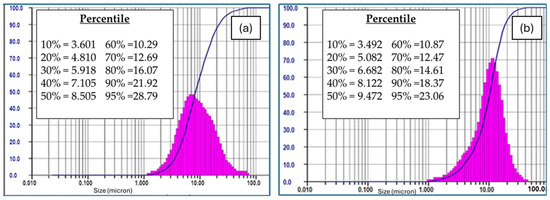
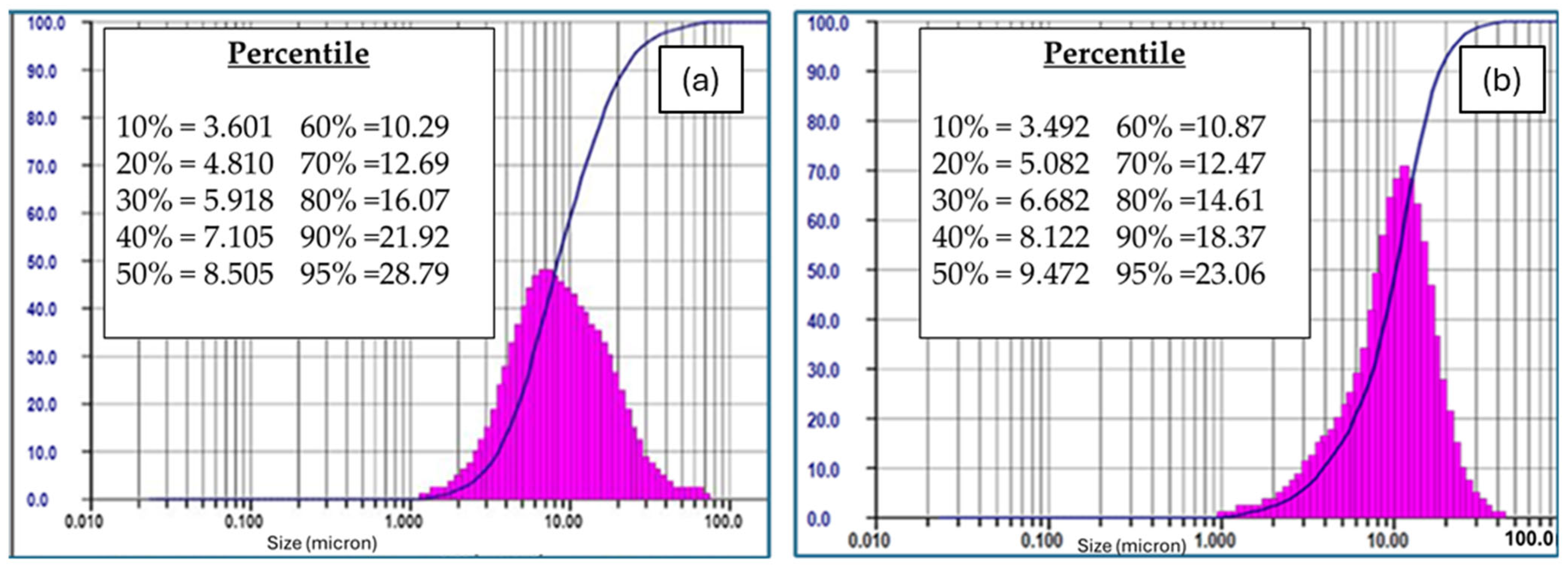
(a) Left—particle size analysis for seawater aragonite, and (b) Right—for aragonite synthesized via MgCl2.
5.7. Particle Size Analysis
The particle size distribution (PSD) analysis is shown in Figure 10a,b. It is important to refer to the results of the PSD analysis in the context of the FESEM images obtained for both seawater aragonite and MgCl2-aragonite. Due to the high aspect ratio of the aragonites formed by both methods, the PSD analysis indicated an orientation bias, where long needles may scatter light differently depending on the measurement alignment. The reported size may reflect either the length or the width, depending on the particle alignment.
Hence, relatively, considering the alignment bias, seawater aragonite is observed to have a slightly longer spread of particle distribution compared to aragonite synthesized via MgCl2, with P10–P90 distribution of 3.601 microns to 21.92 microns and 3.49 microns to 18.37 microns, respectively, for seawater aragonite and aragonite via MgCl2. The average particle size P50 was recorded at 8.51 microns for seawater aragonite in comparison to 9.47 microns for aragonite via MgCl2. In terms of relative bulk properties, the PSD results are still relevant in real-time applications to provide a relative indicative performance for particles with similar shapes or aspect ratios when undergoing real-time production processes, such as mechanical sieving, mechanical hoppers, and auger processes. The P50 of 8.51 microns for seawater aragonite is suitable for food-grade applications, whereas industrial averages between 3.5 microns and 17 microns are recommended by commercial suppliers’ datasheets [92].
6. Conclusions
Successful synthesis of an aragonite crystalline precipitate was demonstrated using an artificial seawater blend that replaced MgCl2 as the conventional chemical inducer. The significance of the results in this study has a bearing on the economics of the synthesis and the unit cost of industrial-scale production of aragonite compounds by potentially reducing the cost of chemical inducers such as MgCl2 by using seawater. A significant reduction in the unit cost of producing aragonite compounds may help prevent further destruction of sensitive marine ecosystems and habitats, which are natural producers of aragonite, by promoting more cost-effective, artificially synthesized aragonite at an industrial scale. This is greener and more sustainable than using natural seawater.
Based on the proposed design of experiment (DOE) model, it was determined that the effect of increasing the temperature to 90 °C is the most dominant factor to maximize seawater aragonite yield, and increasing the reaction duration is the second most dominant factor with respect to the ranges of temperature and reaction time of interest in this study. The optimum operating condition to produce seawater aragonite crystalline precipitate with >80% purity using the continuous mineral carbonation reactor was established at a concentration of 1 g/L CaO in seawater for 10 min at 90 °C reaction temperature. In terms of chemical composition, seawater aragonite has a high value of carbonate percentage compared to MgCl2-aragonite, by limiting the accumulation of magnesium as a contaminant from the MgCl2 inducer. In terms of alkalinity, seawater aragonite has lower residual alkalinity compared to both calcite and MgCl2-aragonite, and, more importantly, lower chlorine and nitrate content, too. Morphologically, seawater aragonite has a mixture of needle-shaped and rhombic-shaped crystalline particle structure, which provides flexibility to fine-tune the proportions of both crystalline particles, an advantage for multiple applications in F&B, and suitable for food-grade application in line with industrial specifications recommended by several industrial datasheets.
In terms of future research, it is highly recommended to construct a full-scale pilot plant for the production of aragonite from natural seawater instead of the artificial seawater used in this proof-of-concept study. A pilot plant assessment will be able to produce a sizeable volume of aragonite for the purpose of market seeding and product stewardship purposes. A higher technology readiness level can be achieved from the current laboratory-scale production by designing, constructing, and operationalizing a pilot plant for a minimal period of time to assess the robustness, reliability, and techno-economics of the continuous aragonite production using seawater as a natural chemical inducer.
Supplementary Materials
The following supporting information can be downloaded at: https://www.mdpi.com/article/10.3390/app16041933/s1, Table S1: Comparative salt composition of red sea salt utilized in this design of experiments and typical sea water compositions for selected ions; Table S2: Randomised run for the response “Seawater Aragonite Yield” for the respective factors, temperature, concentration and reaction time; Figure S1: 3D factors interaction cube representing the responses of individual responses, two-way factor interaction responses and three-way factor interaction responses of temperature, lime CaO concentration in seawater and reaction duration to maximise aragonite yield using seawater as natural inducer; Table S3: Calculation of single, two-way and three-way interaction factors related to the factor’s temperature, concentration and reaction time pertaining to aragonite yield in seawater media; Table S4: Aragonite Yield (%) versus reaction time(min) for [CaO] = 1 g/L, 3 g/L and 5 g/L at 90 °C with seawater as chemical inducer data sets; Table S5: Datasets pertaining to the percentage aragonite, calcite, brucite and portlandite products formed at 90 °C at various CaO concentration of 1 g/L, 3 g/L and 5 g/L and reaction time between 1 min to 60 min. References [79,80] are cited in the Supplementary Materials.
Author Contributions
The following authors provided their contributions based on the following technical experimentations or manuscript preparations as follows: Conceptualization, M.G.M.N.; methodology, M.G.M.N.; software, M.G.M.N.; validation, M.G.M.N.; formal analysis, M.G.M.N.; investigation, M.G.M.N., M.S.O. and R.S.; resources, M.G.M.N., M.S.O. and R.S.; data curation, M.G.M.N.; writing—original draft preparation, M.G.M.N.; writing—review and editing, M.G.M.N., N.Y.Y. and M.H.H.J.; visualization, M.G.M.N.; supervision, N.Y.Y. and M.H.H.J.; project administration, N.Y.Y.; funding acquisition, N.Y.Y. All authors have read and agreed to the published version of the manuscript.
Funding
This research was funded by PRSB-UKM, grant number KK2021-017, and The Development of Continuous CO2 Mineral Carbonation Process was funded by PRSB-UKM, grant number KK2021-017.
Institutional Review Board Statement
Not applicable.
Informed Consent Statement
Not applicable.
Data Availability Statement
Restrictions apply to the datasets. The datasets presented in this article are not readily available because the data are part of an ongoing study and are undergoing a market seeding process. Requests to access the datasets should be directed to mghadaffi_mnor@petronas.com.
Acknowledgments
During the preparation of this manuscript, I would like to record my sincere acknowledgement of Nasir Darman, for endorsing this research grant with UKM. Also to Hatarmizi Hassan and M. Faizal Sedaralit for meticulously following the progress of this project from start to finish. Last but not least, to my fellow scientists, especially M. Syazwan Onn and Ruzilah Sanum, who provided their utmost support, energy, and wit day in, day out until the day we finally achieved the much-sought victory!
Conflicts of Interest
Authors Mohammad Ghaddaffi, M. Noh, Onn M. S., and Sanum R. were employed by the company PETRONAS Research Sdn. The remaining authors declare that the research was conducted in the absence of any commercial or financial relationships that could be construed as potential conflicts of interest.
References
- International Energy Agency. Net Zero by 2050: A Roadmap for the Global Energy Sector; International Energy Agency: Paris, France, 2021. [Google Scholar]
- Intergovernmental Panel on Climate Change. Summary for Policymakers; Intergovernmental Panel on Climate Change: Geneva Switzerland, 2014. [Google Scholar]
- Ma, J.; Li, L.; Wang, H.; Du, Y.; Ma, J.; Zhang, X.; Wang, Z. Carbon Capture and Storage: History and the Road Ahead. Engineering 2022, 14, 33–43. [Google Scholar] [CrossRef] [Scilit]
- Wang, M.; Oko, E. Special issue on carbon capture in the context of carbon capture, utilization and storage (CCUS). Int. J. Coal Sci. Technol. 2017, 4, 1–4. [Google Scholar] [CrossRef] [Scilit]
- Dziejarski, B.; Krzyżyńska, R.; Andersson, K. Current status of carbon capture, utilization, and storage technologies in the global economy: A survey of technical assessment. Fuel 2023, 342, 127776. [Google Scholar] [CrossRef] [Scilit]
- Chauvy, R.; Meunier, N.; Thomas, D.; De Weireld, G. Selecting emerging CO2 utilization products for short- to mid-term deployment. Appl. Energy 2019, 236, 662–680. [Google Scholar] [CrossRef] [Scilit]
- Hanson, E.; Nwakile, C.; Hammed, V.O. Carbon capture, utilization, and storage (CCUS) technologies: Evaluating the effectiveness of advanced CCUS solutions for reducing CO2 emissions. Results Surf. Interfaces 2025, 18, 100381. [Google Scholar] [CrossRef] [Scilit]
- Sakakura, T.; Choi, J.-C.; Yasuda, H. Transformation of Carbon Dioxide. Chem. Rev. 2007, 107, 2365–2387. [Google Scholar] [CrossRef] [Scilit]
- Chang, S.-F.; Chiu, H.-H.; Jao, H.-S.; Shang, J.; Lin, Y.-J.; Yu, B.-Y. Comprehensive evaluation of various CO2 capture technologies through rigorous simulation: Economic, equipment footprint, and environmental analysis. Carbon Capture Sci. Technol. 2025, 14, 100342. [Google Scholar] [CrossRef] [Scilit]
- LeClerc, H.O.; Erythropel, H.C.; Backhaus, A.; Lee, D.S.; Judd, D.R.; Paulsen, M.M.; Ishii, M.; Long, A.; Ratjen, L.; Bertho, G.G.; et al. The CO2 Tree: The Potential for Carbon Dioxide Utilization Pathways. ACS Sustain. Chem. Eng. 2025, 13, 5–29. [Google Scholar] [CrossRef] [Scilit]
- Aresta, M.; Dibenedetto, A.; Angelini, A. The changing paradigm in CO2 utilization. J. CO2 Util. 2013, 3–4, 65–73. [Google Scholar] [CrossRef] [Scilit]
- Aresta, M.; Quaranta, E.; Tommasi, I.; Giannoccaro, P.; Ciccarese, A. Interaction of CO2 with C–C Multiple Bonds: Reactions with Olefins, Cumulated and Conjugated Dienes, and Alkynes. In Reaction Mechanisms in Carbon Dioxide Conversion; Springer: Berlin/Heidelberg, Germany, 2016; pp. 143–182. [Google Scholar] [CrossRef] [Scilit]
- Ghiat, I.; Al-Ansari, T. A review of carbon capture and utilization as a CO2 abatement opportunity within the EWF nexus. J. CO2 Util. 2021, 45, 101432. [Google Scholar] [CrossRef] [Scilit]
- Zhang, Z.; Wang, T.; Blunt, M.J.; Anthony, E.J.; Park, A.-H.A.; Hughes, R.W.; Webley, P.A.; Yan, J. Advances in carbon capture, utilization and storage. Appl. Energy 2020, 278, 115627. [Google Scholar] [CrossRef] [Scilit]
- D’amora, M.; Liendo, F.; Deorsola, F.A.; Bensaid, S.; Giordani, S. Toxicological profile of calcium carbonate nanoparticles for industrial applications. Colloids Surf. B Biointerfaces 2020, 190, 110947. [Google Scholar] [CrossRef] [Scilit] [PubMed]
- Memar, M.Y.; Adibkia, K.; Farajnia, S.; Kafil, H.S.; Dizaj, S.M.; Ghotaslou, R. Biocompatibility, cytotoxicity and antimicrobial effects of gentamicin-loaded CaCO3 as a drug delivery to osteomyelitis. J. Drug Deliv. Sci. Technol. 2019, 54, 101307. [Google Scholar] [CrossRef] [Scilit]
- Available online: https://polymer-additives.specialchem.com/product/a-specialty-minerals-sturcal-f (accessed on 21 January 2026).
- Wong, C.W.; Chan, Y.S.; Jeevanandam, J.; Pal, K.; Bechelany, M.; Elkodous, M.A.; El-Sayyad, G.S. Response Surface Methodology Optimization of Mono-dispersed MgO Nanoparticles Fabricated by Ultrasonic-Assisted Sol–Gel Method for Outstanding Antimicrobial and Antibiofilm Activities. J. Clust. Sci. 2020, 31, 367–389. [Google Scholar] [CrossRef] [Scilit]
- Hu, Z.; Shao, M.; Li, H.; Cai, Q.; Zhong, C.; Xianming, Z.; Deng, Y. Synthesis of Needle-Like Aragonite Crystals in the Presence of Magnesium Chloride and Their Application in Papermaking. Adv. Compos. Mater. 2009, 18, 315–326. [Google Scholar] [CrossRef] [Scilit]
- Gill, R.; Scott, W. The relative effects of different calcium carbonate filler pigments on optical properties. Tappi J. 1987, 70, 93–99. [Google Scholar]
- Shang, W.; Liu, Q.; He, E.; Chen, S. Study on properties of polymers packed by aragonite whisker. In Proceedings of the 6th International Conference on Properties and Applications of Dielectric Materials, Xi’an, China, 21–26 June 2000; IEEE: New York, NY, USA; Volume 1, pp. 431–434.
- Giannoulakis, S.; Volkart, K.; Bauer, C. Life cycle and cost assessment of mineral carbonation for carbon capture and storage in European power generation. Int. J. Greenh. Gas Control. 2014, 21, 140–157. [Google Scholar] [CrossRef] [Scilit]
- Sanna, A.; Uibu, M.; Caramanna, G.; Kuusik, R.; Maroto-Valer, M.M. A review of mineral carbonation technologies to sequester CO2. Chem. Soc. Rev. 2014, 43, 8049–8080. [Google Scholar] [CrossRef] [Scilit]
- Li, H.; Zhang, R.; Wang, T.; Wu, Y.; Xu, R.; Wang, Q.; Tang, Z. Performance evaluation and environment risk assessment of steel slag enhancement for seawater to capture CO2. Energy 2022, 238, 121861. [Google Scholar] [CrossRef] [Scilit]
- Berner, R.A. The Role of Magnesium in the Crystal Growth of Calcite and Aragonite from Sea Water. Geochim. Cosmochim. Acta 1975, 39, 489–494. [Google Scholar] [CrossRef] [Scilit]
- Alvarez, C.C.; Penkman, K.; Kröger, R.; Finch, A.A.; Clog, M.; Brasier, A.; Still, J.; Allison, N. Insights into the response of coral biomineralization to environmental change from aragonite precipitations in vitro. Geochim. Cosmochim. Acta 2024, 364, 184–194. [Google Scholar] [CrossRef] [Scilit]
- Cuif, J.-P.; Dauphin, Y.; Gautret, P. Compositional diversity of soluble mineralizing matrices in some recent coral skeletons compared to fine-scale growth structures of fibres: Discussion of consequences for biomineralization and diagenesis. Int. J. Earth Sci. 1999, 88, 582–592. [Google Scholar] [CrossRef] [Scilit]
- Cuif, J.; Dauphin, Y.; Berthet, P.; Jegoudez, J. Water and organic compounds in coral skeletons: Quantitative thermogravimetry coupled to infrared absorption spectrometry. Geochem. Geophys. Geosyst. 2004, 5, 11. [Google Scholar] [CrossRef] [Scilit]
- Christ, C.L.; Hostetler, P.B. Studies in the system MgO-SiO2-CO2-H2O (II): The activity-product of magnesite. Am. J. Sci. 1970, 268, 439–453. [Google Scholar] [CrossRef] [Scilit]
- Al-Horani, F.A.; Al-Moghrabi, S.M.; De Beer, D. The mechanism of calcification and its relation to photosynthesis and respiration in the scleractinian coral Galaxea fascicularis. Mar. Biol. 2003, 142, 419–426. [Google Scholar] [CrossRef] [Scilit]
- Liu, Y.-W.; Sutton, J.N.; Ries, J.B.; Eagle, R.A. Regulation of calcification site pH is a polyphyletic but not always governing response to ocean acidification. Sci. Adv. 2020, 6, eaax1314. [Google Scholar] [CrossRef] [Scilit]
- Wolf, S.E.; Loges, N.; Mathiasch, B.; Panthöfer, M.; Mey, I.; Janshoff, A.; Tremel, W. Tremel Phase selection of calcium carbonate through the chirality of adsorbed amino acids. Angew. Chem. Int. Ed. Engl. 2007, 46, 5618–5623. [Google Scholar] [CrossRef] [Scilit]
- Picker, A.; Kellermeier, M.; Seto, J.; Gebauer, D.; Cölfen, H. The multiple effects of amino acids on the early stages of calcium carbonate crystallization. Z. Für Krist.-Cryst. Mater. 2012, 227, 744. [Google Scholar] [CrossRef] [Scilit]
- Montanari, G.; Lakshtanov, L.Z.; Tobler, D.J.; Dideriksen, K.; Dalby, K.N.; Bovet, N.; Stipp, S.L.S. Effect of aspartic acid and glycine on calcite growth. Cryst. Growth Des. 2016, 16, 4813. [Google Scholar] [CrossRef] [Scilit]
- Stepić, R.; Jurković, L.; Klementyeva, K.; Ukrainczyk, M.; Gredičak, M.; Smith, D.M.; Kralj, D.; Smith, A.-S. Adsorption of aspartate derivatives to calcite surfaces in aqueous environment. Cryst. Growth Des. 2020, 20, 2853. [Google Scholar] [CrossRef] [Scilit]
- Fang, Y.; Lee, S.; Xu, H.; Farfan, G.A. Organic controls over biomineral Ca–Mg carbonate compositions and morphologies. Cryst. Growth Des. 2023, 23, 4872–4882. [Google Scholar] [CrossRef] [Scilit]
- Mucci, A. The solubility of calcite and aragonite in seawater at various salinities, temperatures, and one atmosphere total pressure. Am. J. Sci. 1983, 283, 780–799. [Google Scholar] [CrossRef] [Scilit]
- Wolthers, M.; Nehrke, G.; Gustafsson, J.P.; Van Cappellen, P. Calcite growth kinetics: Modeling the effect of solution stoichiometry. Geochim. Cosmochim. Acta 2012, 77, 121–134. [Google Scholar] [CrossRef] [Scilit]
- Zhang, Z.; Pan, S.-Y.; Li, H.; Cai, J.; Olabi, A.G.; Anthony, E.J.; Manovic, V. Recent advances in carbon dioxide utilization. Renew. Sustain. Energy Rev. 2020, 125, 109799. [Google Scholar] [CrossRef] [Scilit]
- Katz, A. The interaction of magnesium with calcite during crystal growth at 25–90 °C and one atmosphere. Geochim. Cosmochim. Acta 1973, 37, 1563–1586. [Google Scholar] [CrossRef] [Scilit]
- Plummer, L.N.; Mackenzie, F.T. Predicting mineral solubility from rate data: Application to the dissolution of magnesian calcites. Am. J. Sci. 1974, 274, 61–83. [Google Scholar] [CrossRef] [Scilit]
- Berner, R.A. Comparative dissolution characteristics of carbonate minerals in the presence and absence of aqueous magnesium ion. Am. J. Sci. 1967, 265, 45–70. [Google Scholar] [CrossRef] [Scilit]
- Park, W.K.; Ko, S.-J.; Lee, S.W.; Cho, K.-H.; Ahn, J.-W.; Han, C. Effects of magnesium chloride and organic additives on the synthesis of aragonite precipitated calcium carbonate. J. Cryst. Growth 2008, 310, 2593–2601. [Google Scholar] [CrossRef] [Scilit]
- Nancollas, G.; Sawada, K. Formation of Scales of Calcium Carbonate Polymorphs: The Influence of Magnesium Ion and Inhibitors. J. Pet. Technol. 1982, 34, 645–652. [Google Scholar] [CrossRef] [Scilit]
- Bischoff, J.L. Kinetics of calcite nucleation: Magnesium ion inhibition and ionic strength catalysis. J. Geophys. Res. 1968, 73, 3315–3322. [Google Scholar] [CrossRef] [Scilit]
- Bischoff, J.L.; Fyfe, W.S. Catalysis, inhibition, and the calcite-aragonite problem; [Part] 1, The aragonite-calcite transformation. Am. J. Sci. 1968, 266, 65–79. [Google Scholar] [CrossRef] [Scilit]
- Astilleros, J.; Fernández-Díaz, L.; Putnis, A. The role of magnesium in the growth of calcite: An AFM study. Chem. Geol. 2010, 271, 52–58. [Google Scholar] [CrossRef] [Scilit]
- De Choudens-Sanchez, V.; Gonzalez, L.A. Calcite and Aragonite Precipitation Under Controlled Instantaneous Su-persaturation: Elucidating the Role of CaCO3 Saturation State and Mg/Ca Ratio on Calcium Carbonate Polymorphism. J. Sediment. Res. 2009, 79, 363–376. [Google Scholar] [CrossRef] [Scilit]
- Meldrum, F.C. Calcium carbonate in biomineralization and biomimetic chemistry. Int. Mater. Rev. 2003, 48, 187–224. [Google Scholar] [CrossRef] [Scilit]
- Erez, J. Vital effect on stable-isotope composition seen in foraminifera and coral skeletons. Nature 1978, 273, 199–202. [Google Scholar] [CrossRef] [Scilit]
- Sun, W.; Jayaraman, S.; Chen, W.; Persson, K.A.; Ceder, G. Nucleation of metastable aragonite CaCO3 in seawater. Proc. Natl. Acad. Sci. USA 2015, 112, 3199–3204. [Google Scholar] [CrossRef] [Scilit]
- Li, H.; Tang, Z.; Xing, X.; Guo, D.; Cui, L.; Mao, X.-Z. Study of CO2 capture by seawater and its reinforcement. Energy 2018, 164, 1135–1144. [Google Scholar] [CrossRef] [Scilit]
- Kim, D.; Kim, M.-J. Study on Carbon Dioxide Storage through Mineral Carbonation using Sea Water and Paper Sludge Ash. J. Korean Soc. Mar. Environ. Energy 2016, 19, 18–24. [Google Scholar] [CrossRef] [Scilit]
- Zhao, Y.; Zhang, Y.; Liu, J.; Gao, J.; Ji, Z.; Guo, X.; Liu, J.; Yuan, J. Trash to treasure: Seawater pretreatment by CO2 mineral carbonation using brine pretreatment waste of soda ash plant as alkali source. Desalination 2017, 407, 85–92. [Google Scholar] [CrossRef] [Scilit]
- Jeon, J.; Kim, M.-J. CO2 storage and CaCO3 production using seawater and an alkali industrial by-product. Chem. Eng. J. 2019, 378, 122180. [Google Scholar] [CrossRef] [Scilit]
- Zhao, Y.; Wu, M.; Ji, Z.; Wang, Y.; Li, J.; Liu, J.; Yuan, J. A combination process of mineral carbonation with SO2 disposal for simulated flue gas by magnesia-added seawater. Front. Chem. Sci. Eng. 2019, 13, 832–844. [Google Scholar] [CrossRef] [Scilit]
- Zhao, Y.; Wu, M.; Guo, X.; Zhang, Y.; Ji, Z.; Wang, J.; Liu, J.; Liu, J.; Wang, Z.; Chi, Q.; et al. Thorough conversion of CO2 through two-step accelerated mineral carbonation in the MgCl2-CaCl2-H2O system. Sep. Purif. Technol. 2019, 210, 343–354. [Google Scholar] [CrossRef] [Scilit]
- Bharadwaj, H.K.; Lee, J.-Y.; Li, X.; Liu, Z.; Keener, T.C. Dissolution kinetics of magnesium hydroxide for CO2 separation from coal-fired power plants. J. Hazard. Mater. 2013, 250–251, 292–297. [Google Scholar] [CrossRef] [Scilit] [PubMed]
- Chen, T.; Bi, J.; Zhao, Y.; Du, Z.; Guo, X.; Yuan, J.; Ji, Z.; Liu, J.; Wang, S.; Li, F.; et al. Carbon dioxide capture coupled with magnesium utilization from seawater by bipolar membrane electrodialysis. Sci. Total Environ. 2022, 820, 153272. [Google Scholar] [CrossRef] [Scilit] [PubMed]
- La Plante, E.C.; Simonetti, D.A.; Wang, J.; Al-Turki, A.; Chen, X.; Jassby, D.; Sant, G.N. Saline Water-Based Mineralization Pathway for Gigatonne-Scale CO2 Management. ACS Sustain. Chem. Eng. 2021, 9, 1073–1089. [Google Scholar] [CrossRef] [Scilit]
- Omar, W.; Al-Zoubi, H.; Ulrich, J. Seeded crystallization of calcite and aragonite in seawater as a pretreatment scale control process, a study of supersaturation limits. Desalination Water Treat. 2009, 3, 236–240. [Google Scholar] [CrossRef] [Scilit]
- Suganuma, I. On the Constituents and Genesis of a Few Minerals Produced from Hot Springs and Their Vicinities in Japan. III. Calcium Carbonate Minerals Deposited from Effervescent Springs. Bull. Chem. Soc. Jpn. 1928, 3, 87–89. [Google Scholar] [CrossRef] [Scilit]
- Goto, M. Some mineralo-chemical problems concerning calcite and aragonite, with special reference to the genesis of aragonite. J. Fac. Sci. Hokkaido Univ. Ser. 4 Geol. Mineral. 1961, 10, 571–640. [Google Scholar]
- Roques, H.; Girou, A. Kinetics of the formation conditions of carbonate tartars. Water Res. 1974, 8, 907–920. [Google Scholar] [CrossRef] [Scilit]
- Chakrabarty, D.; Mahapatra, S. Aragonite crystals with unconventional morphologies. J. Mater. Chem. 1999, 9, 2953–2957. [Google Scholar] [CrossRef] [Scilit]
- Nebel, H.; Epple, M. Continuous preparation of calcite, aragonite and vaterite, and of magnesium-substituted amorphous calcium carbonate (Mg-ACC). J. Inorg. Gen. Chem. 2008, 634, 1439–1443. [Google Scholar] [CrossRef] [Scilit]
- Chen, J.; Xiang, L. Controllable synthesis of calcium carbonate polymorphs at different temperatures. Powder Technol. 2009, 189, 64–69. [Google Scholar] [CrossRef] [Scilit]
- Mavromatis, V.; Brazier, J.-M.; Goetschl, K.E. Controls of temperature and mineral growth rate on Mg incorporation in aragonite. Geochim. Cosmochim. Acta 2022, 317, 53–64. [Google Scholar] [CrossRef] [Scilit]
- Shen, P.; Jiang, Y.; Zhang, Y.; Liu, S.; Xuan, D.; Lu, J.; Zhang, S.; Poon, C.S. Production of aragonite whiskers by carbonation of fine recycled concrete wastes: An alternative pathway for efficient CO2 sequestration. Renew. Sustain. Energy Rev. 2023, 173, 113079. [Google Scholar] [CrossRef] [Scilit]
- Xiao, Z.; Zhang, J.; Hu, X.; Khaskhoussi, A.; He, P.; You, X.; Su, X.; Chen, W.; Shi, C. An overview on polymorphs of calcium carbonate formed during carbon mineralization of cementitious materials. J. Sustain. Cem.-Based Mater. 2025, 14, 1005–1027. [Google Scholar] [CrossRef] [Scilit]
- Noh, M.G.M.; Yuhana, N.Y.; Jumali, M.H.H.; Onn, M.S.; Sanum, R. Experimental Optimization, Scaling Up, and Characterization for Continuous Aragonite Synthesis from Lime Feedstock Using Magnesium Chloride as Chemical Inducer. Processes 2025, 13, 3142. [Google Scholar] [CrossRef] [Scilit]
- Sari, E.; Desmiarti, R.; Zulhadjri, Z.; Alif, M.F.; Rosadi, M.Y.; Arief, S. Synthesis of Aragonite from Precipitated Calcium Carbonate: A Pilot Scale Study. Indones. J. Chem. 2024, 24, 1650–1660. [Google Scholar] [CrossRef] [Scilit]
- Ho, H.-J.; Iizuka, A. Mineral carbonation using seawater for CO2 sequestration and utilization: A review. Sep. Purif. Technol. 2023, 307, 122855. [Google Scholar] [CrossRef] [Scilit]
- Mitchell, M.J.; Jensen, O.E.; Cliffe, K.A.; Maroto-Valer, M.M. A Model of Carbon Dioxide Dissolution and Mineral Carbonation Kinetics. Proc. Math. Phys. Eng. Sci. 2010, 466, 1265–1290. [Google Scholar] [CrossRef] [Scilit]
- Kellock, C.; Alvarez, M.C.C.; Finch, A.; Penkman, K.; Kröger, R.; Clog, M.; Allison, N. Optimising a method for aragonite precipitation in simulated biogenic calcification media. PLoS ONE 2022, 17, e0278627. [Google Scholar] [CrossRef] [Scilit]
- Available online: https://g1.redseafish.com/red-sea-salts/red-sea-salt (accessed on 13 January 2026).
- Turekian, K.K.; Oceans, P.H. Englewood Cliffs; Prentice-Hall: Hoboken, NJ, USA, 1968. [Google Scholar]
- Dickinson, S.R.; McGrath, K.M. Quantitative determination of binary and tertiary calcium carbonate mixtures using powder X-ray diffraction. Analyst 2001, 126, 1118–1121. [Google Scholar] [CrossRef] [Scilit]
- Loste, E.; Meldrum, F.C. Control of calcium carbonate morphology by transformation of an amorphous precursor in a constrained volume. Chem. Commun. 2001, 10, 901–902. [Google Scholar] [CrossRef] [Scilit]
- Berner, R.A.; Lasaga, A.C.; Garrels, R.M. The carbonate-silicate geochemical cycle and its effect on atmospheric carbon dioxide over the past 100 million years. Am. J. Sci. 1983, 283, 641–683. [Google Scholar] [CrossRef] [Scilit]
- Reddy, M.M.; Wang, K. Crystallization of calcium carbonate in the presence of metal ions. I. Inhibition by magnesium ion at pH 8.8 and 25 °C. J. Cryst. Growth 1980, 50, 470–480. [Google Scholar] [CrossRef] [Scilit]
- Stephenson, A.E.; DeYoreo, J.J.; Wu, L.; Wu, K.J.; Hoyer, J.; Dove, P.M. Peptides enhance magnesium signature in calcite: Insights into origins of vital effects. Science 2008, 322, 724–727. [Google Scholar] [CrossRef] [Scilit] [PubMed]
- Picker, A.; Nicoleau, L.; Burghard, Z.; Bill, J.; Zlotnikov, I.; Labbez, C.; Nonat, A.; Cölfen, H. Mesocrystalline calcium silicate hydrate: A bioinspired route toward elastic concrete materials. Sci. Adv. 2017, 3, e1701216. [Google Scholar] [CrossRef] [Scilit] [PubMed]
- Yan, X.; Zhang, Q.; Ma, X.; Zhong, Y.; Tang, H.; Mai, S. The mechanism of biomineralization: Progress in mineralization from intracellular generation to extracellular deposition. Jpn. Dent. Sci. Review 2023, 59, 181–190. [Google Scholar] [CrossRef] [Scilit]
- Addadi, L.; Weiner, S. Biomineralization: Mineral formation by organisms. Phys. Scr. 2014, 89, 098003. [Google Scholar] [CrossRef] [Scilit]
- Available online: https://rruff.info/Aragonite/R040078 (accessed on 13 January 2026).
- Karunadasa, K.S.; Manoratne, C.; Pitawala, H.; Rajapakse, R. Thermal decomposition of calcium carbonate (calcite polymorph) as examined by in-situ high-temperature X-ray powder diffraction. J. Phys. Chem. Solids 2019, 134, 21–28. [Google Scholar] [CrossRef] [Scilit]
- Zhuang, D.; Chen, Z.; Sun, B. Thermal Decomposition of Calcium Carbonate at Multiple Heating Rates in Different Atmos-pheres Using the Techniques of TG, DTG, and DSC. Crystals 2025, 15, 108. [Google Scholar] [CrossRef] [Scilit]
- Galan, I.; Glasser, F.P.; Andrade, C. Calcium carbonate decomposition. J. Therm. Anal. Calorim. 2013, 111, 1197–1202. [Google Scholar] [CrossRef] [Scilit]
- Saulat, H.; Cao, M.; Khan, M.; Khan, M.M.; Rehman, A. Preparation and applications of calcium carbonate whisker with a special focus on construction materials. Constr. Build. Mater. 2020, 236, 117613. [Google Scholar] [CrossRef] [Scilit]
- Hashim, M.S.; Kaczmarek, S.E. Evolution of calcite microcrystal morphology during experimental dissolution. J. Sediment. Res. 2021, 91, 229–242. [Google Scholar] [CrossRef] [Scilit]
- Available online: https://www.mineralstech.com/specialty-minerals/specialty-minerals-product-catalog?languages=26480e27-0093-436d-9f88-5cc9b12c4573®ions=3e8a0413-da93-445c-8f0c-5cc0077b81d6 (accessed on 13 January 2026).

Disclaimer/Publisher’s Note: The statements, opinions and data contained in all publications are solely those of the individual author(s) and contributor(s) and not of MDPI and/or the editor(s). MDPI and/or the editor(s) disclaim responsibility for any injury to people or property resulting from any ideas, methods, instructions or products referred to in the content. |
© 2026 by the authors. Licensee MDPI, Basel, Switzerland. This article is an open access article distributed under the terms and conditions of the Creative Commons Attribution (CC BY) license.