


Abstract
Textile waste management remains a critical environmental challenge. Valorization through thermochemical routes such as pyrolysis offers a sustainable pathway within the circular economy. In this study, carbonaceous materials were obtained from the pyrolysis of 100% cotton textile residues and subsequently activated with sodium thiosulfate (Na2S2O3). The physicochemical and leaching behaviors of the activated (CA) and non-activated (C) chars were assessed in aqueous solution under controlled pH conditions (3, 7, and 11). Activation significantly increased the specific surface area (from 90 to 975 m2 g−1). Leaching tests revealed that acidic conditions (pH = 3) enhanced the release of major elements following the order Na > Ca > K for C and S > Ca > Na for CA. Despite this, all concentrations of major and trace metals remained well below regulatory discharge limits. Anionic species (Cl−, SO42−) increased slightly after activation but also stayed within safe thresholds, and chemical oxygen demand (COD) values were low (0–9 mg O2 L−1), indicating negligible organic leaching. Overall, the findings show that the structural quality of textile-derived chars was improved by Na2S2O3 activation without compromising their environmental stability, validating their applicability as effective and safe adsorbents for wastewater treatment applications.
1. Introduction
The need for novel technologies that can recover textile waste and contribute to the transition from the traditional linear paradigm in favor of closed-loop, sustainable alternatives has been prompted by the increasing production of this waste [1]. In this context, a variety of recycling technologies have been investigated, and, in this context, thermochemical processes, particularly pyrolysis, have shown great potential. Pyrolysis is defined as the thermal decomposition of organic matter in the absence of oxygen [2]. Three fractions are normally formed during this thermochemical process: (i) a gaseous fraction enriched in non-condensable hydrocarbons; (ii) a condensable liquid fraction (bio-oil), and (iii) a solid carbonaceous fraction, sometimes referred as char [3], with feedstock composition and operational conditions having a significant impact on the distribution and properties of these products [4].
Due to its versatility in turning different types of waste as plastics [5], biomass [6], and, more recently, textile waste [4,7] into high-value products, this technology has attracted a lot of attention lately. Recently, some researchers have examined the pyrolysis-based valorization of textile waste. For example, Sina and Monsurat [8] showed how textile pyrolysis can be used in Nigeria to produce and purify petrochemical compounds. Similarly, Ciuffi et al. [9] studied the slow pyrolysis of textile waste to produce char and found that the resulting material had an interesting microporous structure (<2 nm) and a high surface area of about 319 m2/g. Other works, such as Arjona et al. [10], Xia et al. [11], and Silva et al. [12], have reported on the potential of textile waste in the production of charcoal.
Several studies have further focused on the production of activated carbons using activating agents such as KOH [13], H3PO4 [14], and ZnCl2 [15], obtaining highly porous materials with a high adsorption capacity for emerging pollutants and dyes. In contrast, in the present study, Na2S2O3 was selected as an alternative activating agent due to its lower toxicity, reduced corrosiveness, and easier handling, aiming to balance adsorption performance and environmental safety.
Although numerous studies have evaluated the adsorption capacity of waste-derived carbons, the potential leaching of organic compounds and trace metals from these materials has been far less investigated. In this context, the investigation of leaching processes emerges as a critical component of a comprehensive environmental assessment, as the potential release of organic molecules, trace metals, or other chemical species could compromise the environmental benefits of this material by introducing uncontrolled secondary pollution [16,17,18]. Furthermore, although specific regulatory standards for acceptable leaching from textile-based carbons have not yet been established, the present work provides fundamental data to support future risk assessments and the development of appropriate regulatory frameworks [19,20,21].
For example, alkali-activated and Portland cement pervious concretes have demonstrated effective removal of multiple heavy metals from water while exhibiting limited leaching of adsorbed metals under long-term operation conditions [16]. Similarly, iron-based oxy-hydroxide adsorbents have achieved high removal efficiencies for Sb(III) in water and were classified as inert waste after leaching tests [17], highlighting the importance of post-adsorption environmental assessment. In pyrolysis-derived carbons, activation and stabilization of chars from plastic or contaminated organic wastes significantly enhanced adsorption capacity for heavy metals while reducing the leaching of organic compounds and trace elements [22]. Additionally, studies on heavy metal fate during pyrolysis show that most metals are retained in the solid fraction, though leachability depends on feedstock, temperature, and matrix properties [18], emphasizing the need for systematic leaching evaluations.
Currently, there are no specific regulations for the study of activated carbons derived from textile waste. However, standards applicable to conventional activated carbon and solid waste have been used as a reference, including tests for physical, chemical and leaching properties relevant to water treatment [23].
It should be noted that when these materials are intended for use in water treatment for human consumption, the applicable regulations establish more stringent safety criteria. For powdered activated char, Spanish standard UNE-EN 12903 [24] is used, and for granular carbon, UNE-EN 12915-1 [25] and UNE-EN 12915-2 [26] are used. The selection of these standards is based on the geographical relevance of the study, which was conducted in Spain. Moreover, as Spanish standards are aligned with European regulations, they are widely recognized in the European scientific literature, ensuring methodological consistency and comparability of the results. On the other hand, to ensure the quality and performance of activated char in a variety of applications, the American Society for Testing and Materials (ASTM) sets strict guidelines for its use and characterization [23,27]. Although these standards do not specifically address activated char derived from textile waste, they provide a useful framework for assessing material quality.
Leaching tests were carried out in compliance with the UNE-EN 12457-2 standard [28]. Both European and local classification criteria were applied, as they are complementary and ensure a robust interpretation of the potential substances that may be released into the environment under different discharge scenarios. Specifically, the European framework (Decision 2003/33/EC) addresses waste intended for landfill disposal and provides a broad technical scope and population coverage, thereby facilitating comparison with similar studies worldwide [29]. In addition, the inclusion of local regulatory criteria focused on discharges into municipal sewer systems (Municipal Wastewater Discharge Ordinance) is essential for contextualizing the findings within a practical local management framework. It should be noted that this local regulatory framework is based on Spanish water legislation, which in turn transposes the relevant European directives [30,31,32].
2. Materials and Methods
2.1. Methods for the Characterization of the Char
The chars were obtained by pyrolysis of textile waste (jeans waste) at 800 °C in a Nabertherm R50/250/12 tubular furnace (Lilienthal, Germany) operated under an N2 atmosphere (50 L h−1). The reactor, constructed of 316 stainless steel, had an internal diameter of 4 cm and a length of 34.25 cm. The process was conducted at a heating rate of 10 °C min−1 and a residence time of 90 min. The conditions have been chosen in accordance with the previous work of the authors [22,33]. Activated char was subsequently prepared by chemical impregnation with Na2S2O3. To do this, 15 g of denim was cut, placed in a stainless-steel crucible, and impregnated with a solution containing 15 g of thiosulfate dissolved in 20 mL of water. The impregnated fabric was placed in an oven at 120 °C for 24 h to evaporate the water. The impregnated and dried denim was subjected to chemical activation at 800 °C, under the same conditions as for the preparation of the C, as described above.
The materials were characterized by Fourier Transform Infrared Spectroscopy (FTIR) using a Perkin Elmer Spectrum 65 spectrometer (Shelton, CT, USA), equipped with an Attenuated Total Reflectance (ATR) accessory, operating within the spectral range of 4000 to 550 cm−1.
The apparent density (compacted and uncompacted) was determined in accordance with the Spanish standard UNE-EN 12902 [34].
pH was measured using a CRISON digital potentiometer, model BasiC 20 (Hospitalet de Llobergat, Spain), previously calibrated with buffer solutions. Conductivity was measured using a CRISON multimeter, model MM 40 (Hospitalet de Llobergat, Spain).
The specific surface area (SBET) was determined from nitrogen adsorption–desorption isotherms measured at 77 K using a physisorption gas station 200 Sync from 3P-Instrusments® (Odelzhausen, Germany) and applying the Brunauer–Emmett–Teller (BET) standardized method. Prior to the analysis, the sample was degassed at 100 °C for 24 h. The BET method was applied using a relative pressure (P/P0) range from 0 to 1.
In addition, the proximate analysis, moisture, volatile matter, fixed carbon, and ash In addition, the proximate analysis—moisture, volatile matter, fixed carbon, and ash content—was determined by thermogravimetric analysis (TGA) using a PerkinElmer thermobalance, model STA 6000 (Shelton, CT, USA), following these steps: (i) moisture content was determined as the mass loss after heating the sample at 105 °C until constant weight, in accordance with UNE-EN ISO 18134-2:2024 [35]; (ii) volatile matter was quantified as the mass loss occurring after heating the dried sample under an inert atmosphere, according to UNE-EN ISO 18123:2024 [36]; (iii) ash content was determined as the residue remaining after complete combustion of the sample in air, following UNE-EN ISO 18122:2023 [37]; and (iv) fixed carbon was calculated by difference.
The major and minor elements in the dry material were quantified using an inductively coupled plasma optical emission spectrometer (ICP-OES) and an inductively coupled plasma mass spectrometer (ICP-MS), Optima 8300 and Nexion 300D, both of Perkin Elmer (Shelton, CT, USA), after digestion according to UNE-EN ISO 54321:2021 [38].
Finally, elemental analysis (C, H, N, and S) was performed in compliance with UNE-EN ISO 16948:2015 [39] using a ThermoScientific CHNS analyzer model Flash 2000 (Waltham, MA, USA), while oxygen content was estimated by difference.
2.2. Leaching Tests
Leaching tests were performed on C and CA materials. This study was based on a protocol previously developed by our research group, with specific adaptations for the current objectives [22]. The experiments were carried out in 100 mL Erlenmeyer flasks, in which the samples were suspended in ultrapure Milli-Q water (resistance 18.2 MΩ·cm) at a solid–liquid ratio of 2 g L−1. Although UNE-EN 12457-2 specifies a liquid-to-solid ratio of 10 L kg−1, a lower solid loading (2 g L−1) was intentionally used in this study to better approximate realistic operating conditions in wastewater treatment applications rather than landfill disposal scenarios.
The tests were performed at three representative pH values: acidic (pH = 3), neutral (pH = 7), and alkaline (pH = 11), adjusted by adding HCl and NaOH solutions. The samples were coded as follows: non-activated carbon (C) at the three pH values (C-3, C-7, C-11) and carbon activated with Na2S2O3 (CA) at the corresponding pH conditions (CA-3, CA-7, CA-11). These pH values were selected to cover neutral conditions representative of most natural water environments, together with acidic and alkaline extremes to evaluate the leaching behavior under worst-case scenarios.
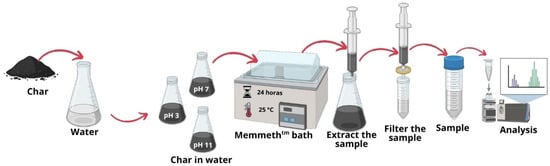
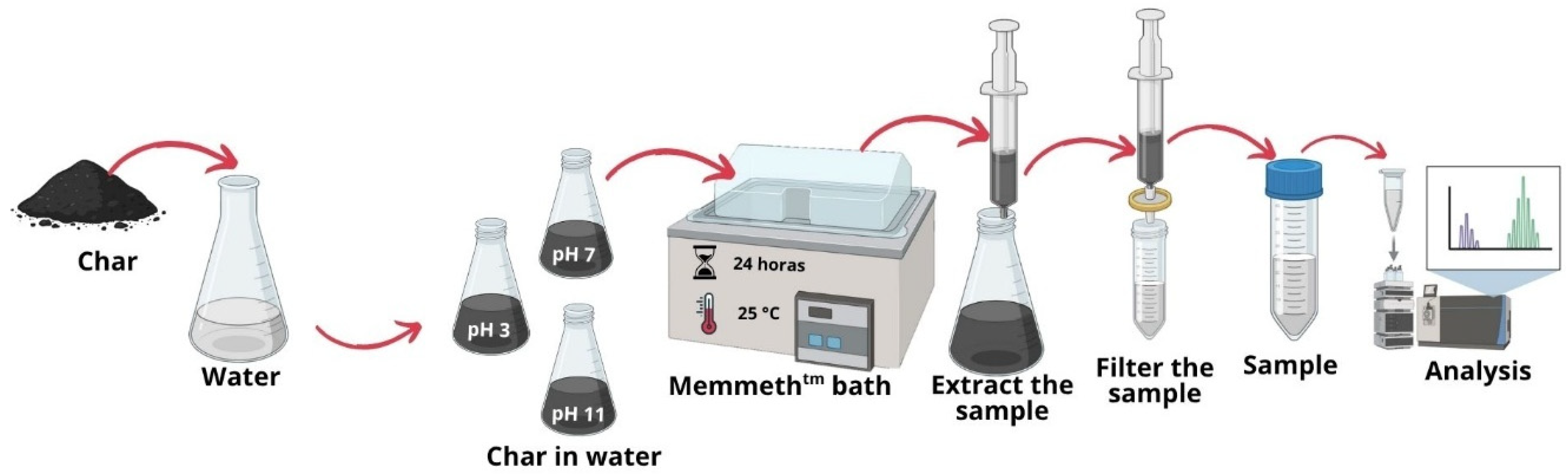
Suspensions were continuously stirred at 24 ± 1 °C for 24 h to ensure equilibrium, using a Memmert™ thermostatic bath (Schwabach, Germany). After this period, samples were collected and filtered through 0.45 µm PVDF syringe filters, as shown in Figure 1. All experiments were performed in triplicate, and results are reported as the mean of the three measurements. Relative standard deviations were below 5% in all cases.
Figure 1.
Experimental setup for leaching tests of activated and non-activated chars.
2.3. Analysis of Leachate Composition
Chemical oxygen demand (COD) was measured using a commercial kit (HI93754X-25) from the commercial company HANNA instruments (Woonsocket, RI, USA). The major and minor elements were quantified using an inductively coupled plasma optical emission spectrometer (ICP-OES) and an inductively coupled plasma mass spectrometer (ICP-MS), Optima 8300 and Nexion 300D, both from Perkin Elmer (Shelton, CT, USA), and ionic species were quantified using a 940 Professional IC Vario ion chromatograph from Metrohm (Herisau, Switzerland).
3. Results and Discussion
3.1. Characterization of Char
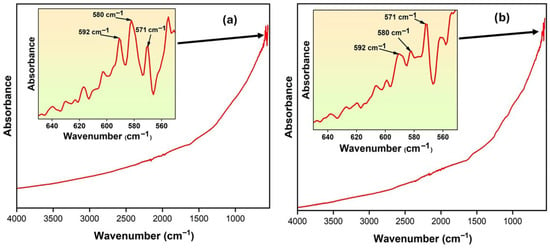
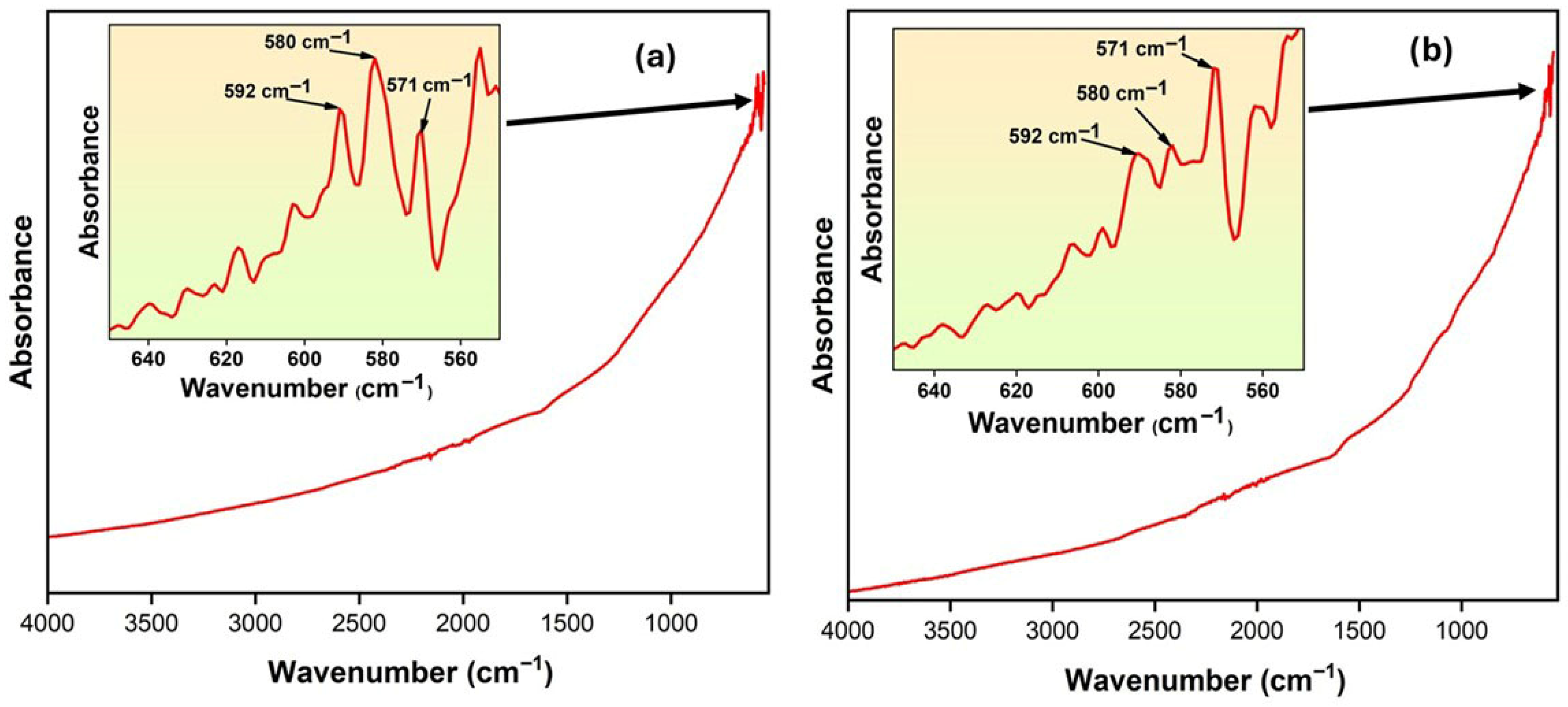
Figure 2 shows the FTIR spectra of C (Figure 2a) and CA (Figure 2b). No significant bands are observed in either material in the range between 4000 and 650 cm−1, with only the signals in the low-frequency region (650–550 cm−1) being more evident. In the C samples, two peaks are identified in the range of 600 to 580 cm−1, which are associated with out-of-plane bending vibrations of C–H bonds in aromatic systems or with the presence of inorganic traces [40].
Figure 2.
FTIR spectra of char (a) and activated char with Na2S2O3 (b).
In contrast, in CA, these peaks remain, although with lower intensity, and greater absorbance is observed at 571 cm−1, indicating the presence of C–O–C functional groups and metals, in accordance with the report by Patel et al. (2021) [41]. The general absence of bands in both spectra is related to the high production temperature of the charcoal. At 800 °C, the pyrolysis reaction is practically complete, leading to a significant reduction in the functional groups present on the surface of the material [42].
The results of the analysis of the physicochemical characteristics of C and CA are summarized in Table 1. The apparent density of CA was higher than that of C in both non-compacted (128.0 vs. 84.1 kg m−3) and compacted (176.8 vs. 141.7 kg m−3) forms, suggesting that partial densification of the carbon matrix and structural rearrangement were encouraged by the activation process. March and Rodríguez [43] reported densities of powdered and granular carbon and indicated that this is important for determining the degree of carbon required for an existing system. This directly implies its importance in logistical considerations, as it directly influences the transport and storage of the material. Higher compacted density means that a greater mass of products can be contained in a smaller volume, thus optimizing costs and operational efficiency.
Table 1.
Physicochemical characteristics of char and activated char.
In terms of pH, both materials have a similar slightly basic pH (7.9) when measured in aqueous suspension, indicating that activation does not substantially alter the surface acidity under these conditions. However, the electrical conductivity of the suspension containing CA (198.8 µS cm−1) was approximately 13 times higher than that of the non-activated char (15.0 µS cm−1), reflecting the release of a higher amount of soluble ionic species or exchangeable surface functionalities introduced during chemical activation.
The SBET of material C is approximately 90 m2 g−1, while for material CA, this value increases to 974 m2 g−1. Although the use of this activating agent has been little studied, the results obtained demonstrate its high potential for generating highly porous structures. This is also reflected in the ratio of microporous volume to total volume, which increases from 19.8% in C to 68.0% in CA. These data indicate that chemical activation significantly improves the microporosity of the material, making it very promising for applications in contaminant adsorption.
Regarding the proximate analysis, fixed carbon increased (from 33.9% to 51.8%) while volatile matter decreased (from 57.7% to 22.9%), reflecting enhanced carbonization of the char matrix. The high ash content of the CA sample can be attributed to inorganic species introduced during chemical activation. However, elemental analysis showed minor variations in carbon, hydrogen, and nitrogen, while sulfur was notably increased in the CA sample, consistent with the use of Na2S2O3 as an activating agent. Under the high-temperature activation conditions (800 °C), thiosulfate is thermally unstable and can decompose into a mixture of oxidized and reduced sulfur species.
Table 2 and Table 3 show the results of the ICP-OES and ICP-MS elemental analyses of major and minor metals on a dry basis for C and CA. Also, it should be noted that during wet digestion methods for elemental analysis, sample losses may occur due to adsorption, volatilization, or co-extraction, and the extraction process may depend on the type of matrix in which the elements are found [44].
Table 2.
Major metals in dry material.
Table 3.
Minor metals in dry material.
As shown in Table 2, material C is mainly composed of Na and Ca, followed by K and Fe. After activation (CA), Na and Ca are followed by K and Fe. After activation (CA), Na and Ca remain the dominant elements, but noticeable changes in elemental composition are observed. In particular, S, which is not detected in C, becomes one of the major elements in CA, reaching 13.10 g kg−1. This increase indicates the incorporation of S into the carbon matrix as a consequence of the thiosulfate (S2O32−) treatment. In addition, Al appears after activation, while K and Fe show moderate increases.
As for minor metals, shown in Table 3, the results indicate that the activation process significantly alters both the distribution and concentration of several metals. The presence of these metals is related to the intrinsic composition of the textile, since metals are used during the production process as catalysts, in dyes, pigments, or as finishing agents [44,45,46,47].
Ar, Ca, and Hg showed low values in both samples, with no significant variations after activation. In contrast, the activation process resulted in a substantial increase in the concentrations of several metals, particularly Ba, Sn, Pb, Cr, and Ni. Notably, Sn and Ba exhibited the most pronounced enrichment after activation, increasing from 6.32 to 565.7 mg kg−1 and from 0.016 to 76.37 mg kg−1, respectively.
This increase in metal concentrations in CA may be attributed to their incorporation or retention on the char surface during treatment with Na2S2O3. Thiosulfate, which exhibits both oxidizing and reducing behavior due to the presence of multiple sulfur oxoanions, can promote the formation of stable metal–sulfur complexes [48]. Combined with the high porosity developed during activation, these conditions favor metal adsorption and retention, limiting their removal during the washing steps.
Zn and Cu already presented relatively high concentrations in the raw char (133.7 and 52.9 mg kg−1, respectively), suggesting enrichment during pyrolysis because of organic matter volatilization and the concentration of non-volatile elements in the solid residue. After activation, both metals showed a moderate increase, indicating that, rather than being leached, they were partially retained or further concentrated in the activated char matrix [49,50].
Given the structural differences after activation, leaching tests were performed to evaluate chemical stability and the main results are provided in the following sections.
3.2. Characterization of Water-Extractable Substances
3.2.1. Major and Minor Metals
Table 4 summarizes the concentrations of the main leached elements from both C and CA material under acidic (pH = 3), neutral (pH = 7), and alkaline (pH = 11) conditions, together with the regulatory limits established by the Granada municipal ordinance whose objective is to regulate the conditions to which wastewater discharges into the municipal sewerage network must comply, with the aim of protecting water resources, preserving the environment, and ensuring public health [30].
Table 4.
Concentrations of major metals leached from C and CA, compared with regulatory limits.
A clear influence of pH on the leaching behavior of major elements was observed for both materials. In general, acidic conditions (pH = 3) promoted higher metal release, particularly Na and Ca, while neutral and alkaline conditions reduced metal mobility. This pattern agrees with the protonation of surface functional groups that promotes electrostatic repulsion of cationic species, enhancing their desorption from the solid matrix.
Activation with Na2S2O3 significantly modified the leaching behavior of several major elements. Ca exhibited the most pronounced increase after activation, particularly under acidic conditions, where its concentration rose from 2.37 mg L−1 in the C to 8.95 mg L−1 in the CA at pH = 3.
Na concentrations in the leachates increased consistently after activation across all pH values, reaching 8.66 mg L−1 at pH = 3 in CA samples compared to 3.53 mg L−1 in the C. This behavior reflects the incorporation of Na-containing species during chemical activation with Na2S2O3 and their subsequent partial release into the aqueous phase during leaching. In contrast, iron exhibited negligible variations between activated and non-activated samples under all pH conditions, with concentrations remaining close to 1.1 mg L−1, indicating strong retention within the carbon matrix and limited sensitivity to both activation and pH changes.
Sulfur was detected exclusively in the leachates of the activated char, with concentrations ranging from 5.76 to 17.3 mg L−1 depending on pH, confirming the successful incorporation of sulfur-containing species during the activation process. Despite this increase, sulfur concentrations remained well below any applicable regulatory thresholds.
Overall, the concentrations of all major elements in the leachates remained well below the discharge limits established by the Granada municipal ordinance (20 mg L−1 for Al and 15 mg L−1 for Fe). Although regulatory limits are not defined for other major elements in the referenced standards, the measured concentrations were low and comparable to or lower than those reported for other environmentally safe carbonaceous materials [51,52], indicating no significant risk of secondary contamination.
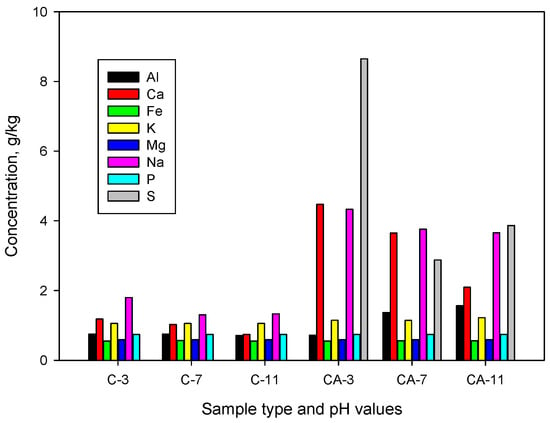
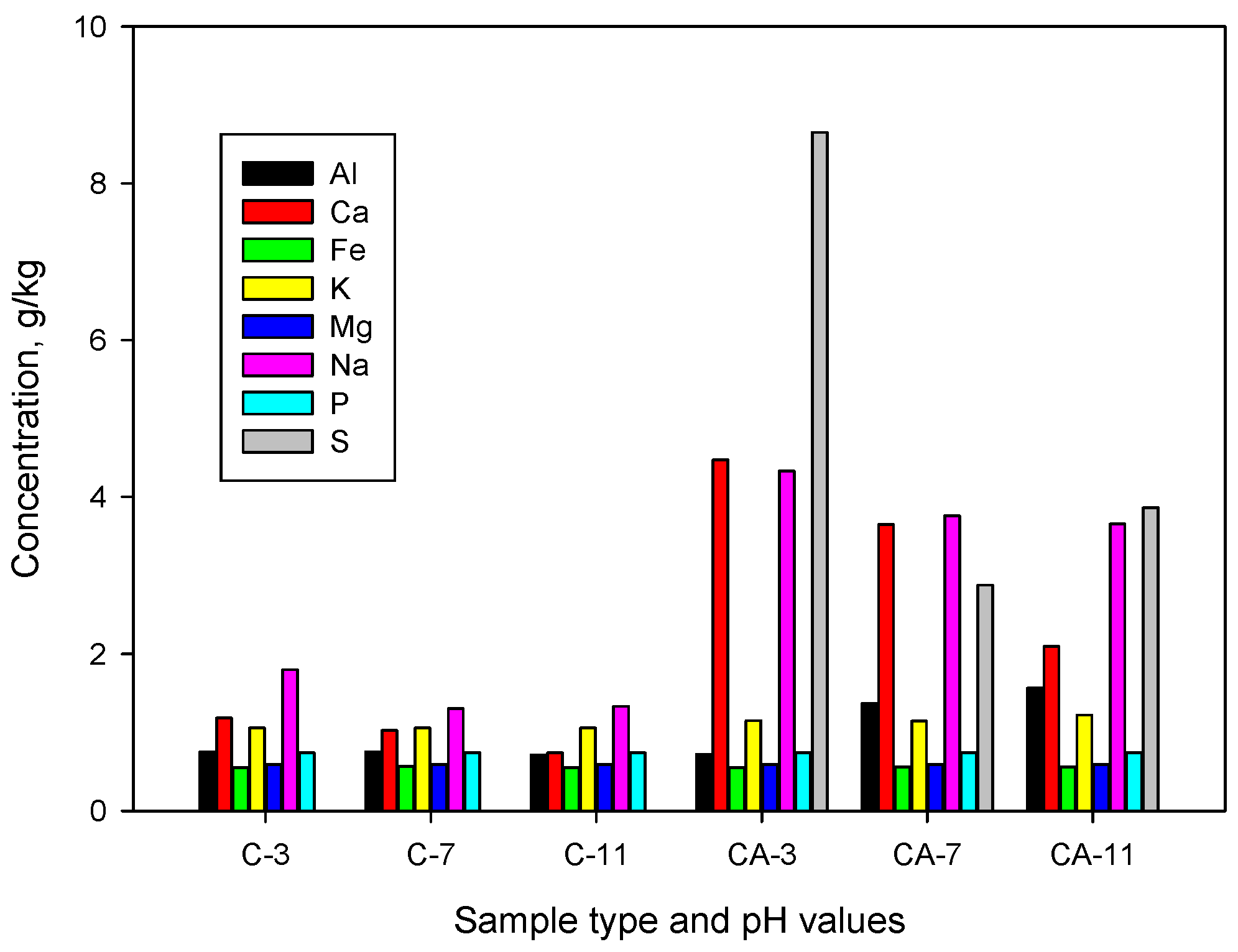
Based on the data obtained in Table 4, at three pH values, expressed in mg L−1, and considering the char: liquid ratio of 2 g L−1, the corresponding conversion was performed to obtain the results in g kg−1 (Figure 3). Thus, the final values represent the amount of metal released per unit mass of char. It is observed that at pH = 3, metal release is greater in both non-activated (C) and thiosulfate-activated char (CA), with pH = 7 being the optimum for working with this type of material.
Figure 3.
Concentrations (g/kg) of major metals leached from C and CA, at the three pH levels studied.
Table 5 lists the minor elements detected in the leachates. Most trace metals were found at very low concentrations, far below the maximum permissible levels established by the Granada ordinance and UNE-EN standards. However, compared to neutral or alkaline environments, some metals, especially Ba, Zn, and Ni, exhibited comparatively increased leaching under acidic conditions (pH 3). For instance, Ni significantly rose to 244.13 µg L−1 in CA-3, while Ba and Zn reached 70.73 µg L−1 and 104.57 µg L−1 in C-3. The slightly higher Ni concentration in CA-3 may result from complexation of Ni2+ with thiosulfate ligands introduced during activation, which can form soluble metal–thiosulfate complexes [53]. Conversely, the reduced leaching of Pb and Cu in CA samples compared with C indicates the possible formation of less soluble metal–sulfur species, which improve immobilization.
Table 5.
Concentrations of minor metals leached from C and CA, compared with regulatory limits.
Although the acidic medium improves the dissolution of metal species weakly bound to the carbon surface [54], all the metals detected are below regulatory limits, confirming that the leachates from both carbons can be classified as environmentally safe.
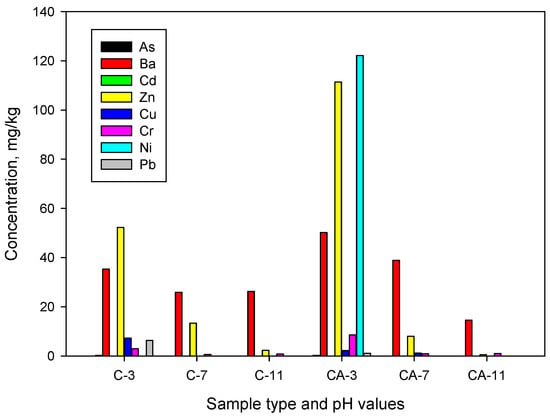
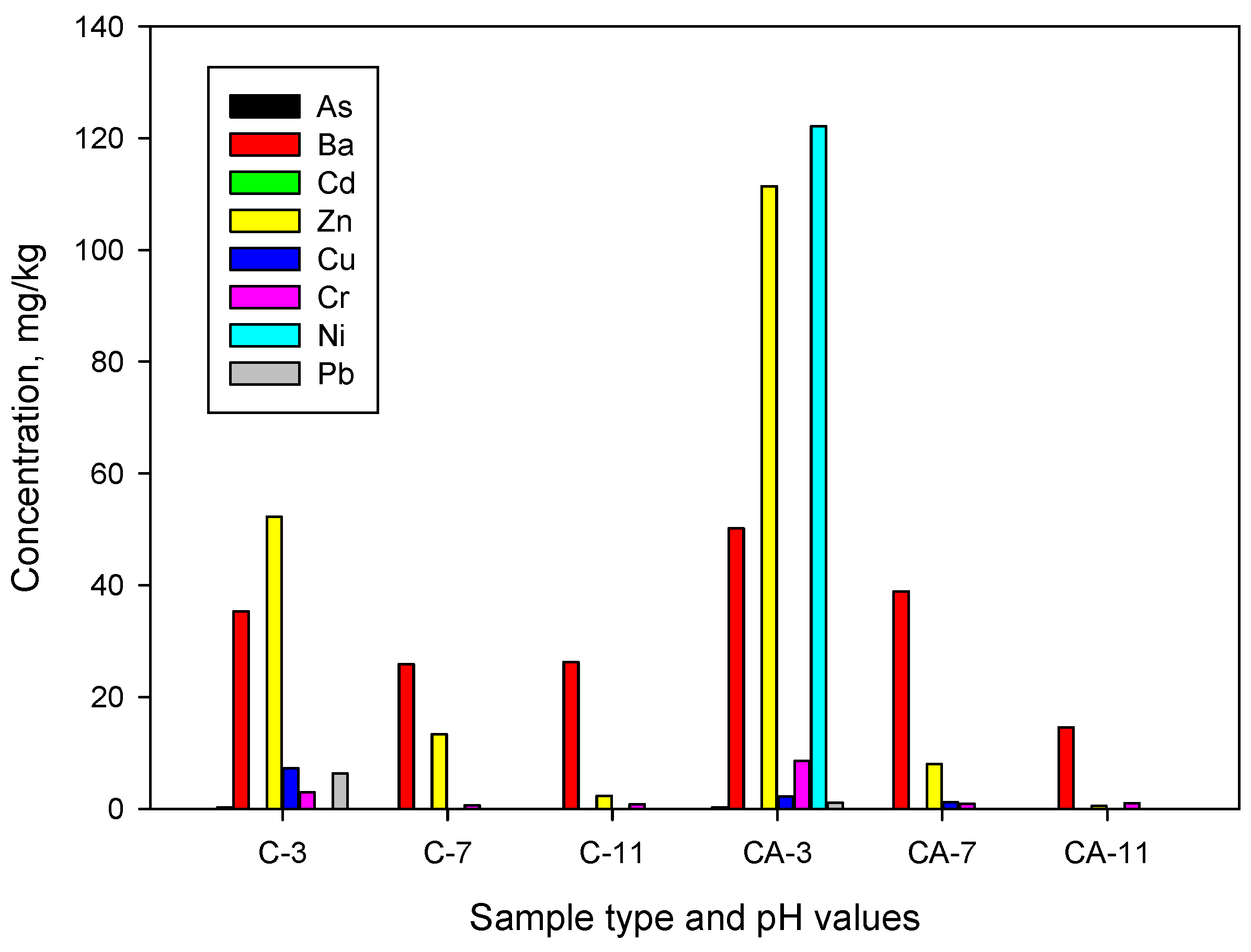
The values shown in Figure 4 were obtained using the same procedure as for Figure 3. Similarly, the results show that at pH = 3, there is a greater release of metals, suggesting that acidic conditions favor the desorption of all metals in the char. With these results, solids can be classified as inert waste according to the leaching criteria established in Decision 2003/33/EC [29], since the concentrations of metals released are within the permitted values.
Figure 4.
Concentrations (mg/kg) of minor metals leached from C and CA, at the three pH levels studied.
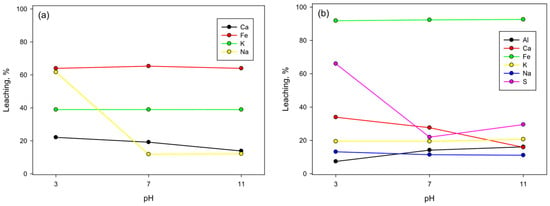
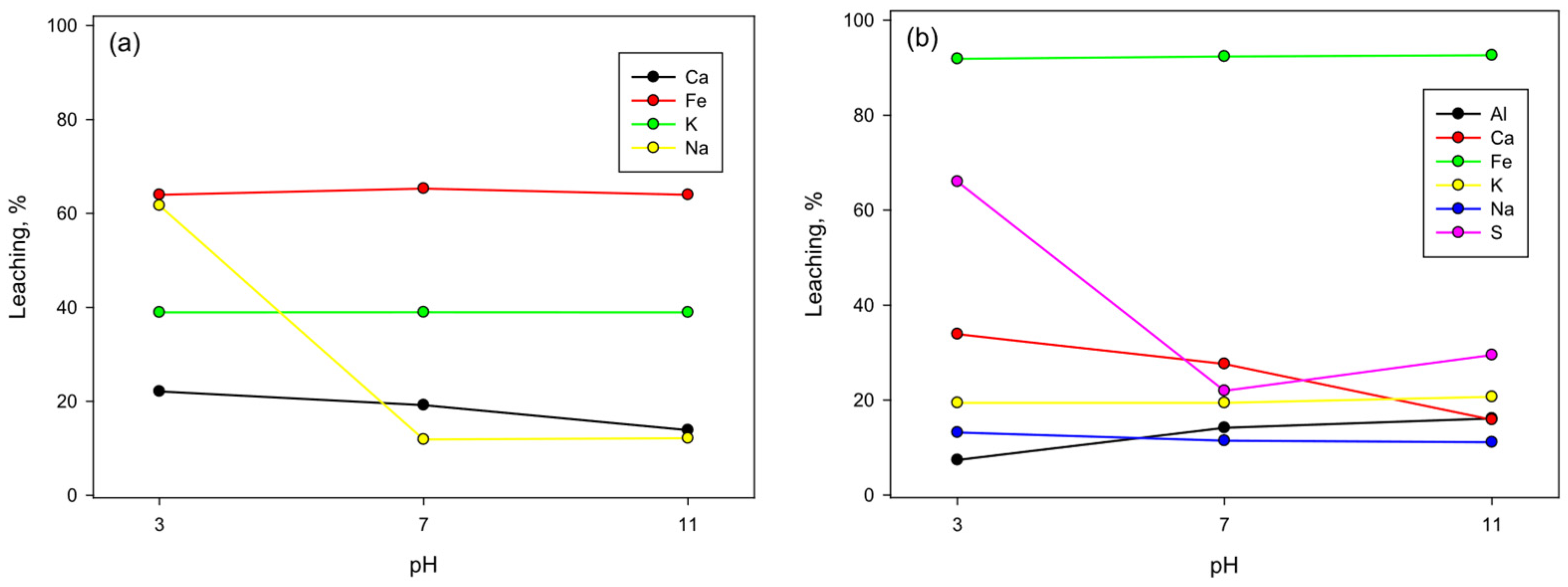
Figure 5 and Figure 6 represent the percentage of metal removed from the original material. In non-activated char (Figure 5a), Na and Fe are the metals showing the highest leaching under acidic conditions, reaching values of up to 61.70% and 63.97%, respectively. Potassium also exhibits significant leaching, with approximately 40% removed regardless of the pH. In contrast, for activated char (Figure 5b), the highest leaching percentage corresponds to Fe, reaching up to 92% independently of pH, followed by sulfur, which shows a leaching percentage of 66.3% under acidic conditions. It should be noted that Figure 5 includes only those metals that could be quantified according to the results presented in Table 2.
Figure 5.
Leaching percentage of major elements, calculated with respect to their total content in the original material, for (a) C and (b) CA.
Figure 6.
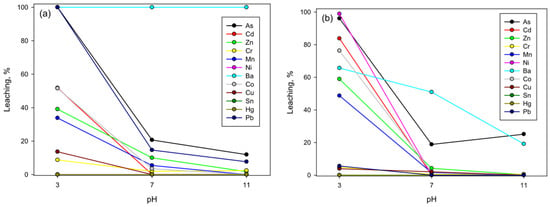
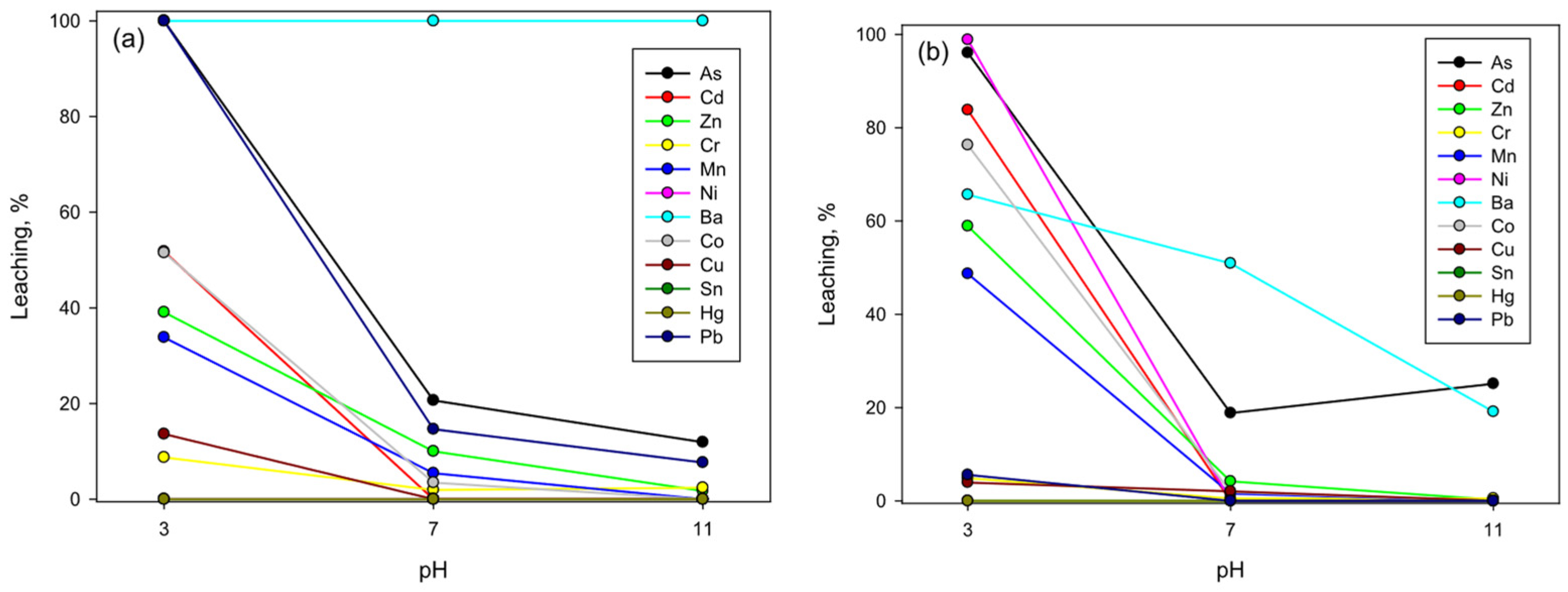
Leaching percentage of minor elements, calculated with respect to their total content in the original material, for (a) C and (b) CA.
On the other hand, minor metals, present in both the non-activated (Figure 6a) and activated (Figure 6b) leachate, show a tendency to be released in greater proportions under acidic conditions.
At pH 3, and consistent with the trends described above, non-activated char shows complete leaching of Ba, As, and Pb, as well as approximately 50% leaching of Cd and Co; however, their release decreases markedly as the pH of the medium increases. In the case of activated char, not only are these metals released, but Zn, Mn, and Ni are also leached. Nevertheless, the pH-dependent trend is similar for both materials, with metal leaching being favored under acidic conditions and decreasing as pH increases.
These results confirm that pH is a key parameter in adsorption processes that use this type of char, as it directly influences metal leaching. Therefore, to prevent the release of both major and minor metals, it is advisable to work under neutral pH conditions. For example, a pH of 6.5 encourages more ionic contact between the negatively charged solid surface and positively charged species, resulting in maximal adsorption, as proposed by Anoop Krishnan et al. [55].
Although the measured concentrations remained below regulatory limits even under these more adverse conditions, this behavior should be considered in applications involving the treatment of acidic wastewater. In adsorption processes, pH is one of the most critical operating parameters, as it governs both the speciation of contaminants and their interaction with the adsorbent. Therefore, in the case of acidic waters, adjusting the pH to values close to neutrality should be considered a preliminary step prior to the adsorption process.
In practice, the associated potential risks can be mitigated through simple operational measures, such as pH adjustment before treatment, preconditioning of the adsorbent to remove weakly bound metals, or the inclusion of an additional polishing step when required by discharge criteria [56].
3.2.2. Anionic Species
The concentrations of anionic species in leachates are shown in Table 6, together with the limits established by the Granada municipal ordinance [30].
Table 6.
Concentrations of leached anionic species from C and CA, compared with regulatory limits.
Although the CA material at pH = 3 had the highest concentration of chloride and sulfates, at concentrations of 78.93 mg L−1 and 85.82 mg L−1, it did not exceed the established limits. This result could be attributed to the nature of the original raw material, to environmental contaminants adsorbed during its preparation, or to the presence of chlorides in the soluble carbons that are released during leaching. In addition, the presence of sulfate ions supports that sulfur introduced during activation is mainly present in oxidized, water-extractable forms.
The observed trend indicates that higher concentrations of acid release a greater amount of anions [57]. When comparing the results with the limit values, none of the measured values exceeded the regulatory thresholds. This demonstrates that both non-activated and activated char can be classified as environmentally safe solid waste under the leaching conditions evaluated.
From an application perspective, the long-term stability of anionic species under repeated adsorption–desorption cycles is an important consideration, especially for chloride and sulfate anions and acidic pH values. Although cyclic stability tests were not included in this study, stability can be further improved by pre-washing or conditioning steps to remove loosely bound species and by operating close to neutral pH.
It should be noted that anion analysis was not performed for the original samples (C and CA) due to disaggregation of the material during leaching, which artificially incorporated anions into the solution. Therefore, the leaching percentage of anions, calculated with respect to their total content in the original material, cannot be calculated.
3.2.3. Chemical Oxygen Demand (COD)
Table 7 provides a summary of the leachates’ chemical oxygen demand (COD) values of the leachates are summarized in. The observed COD levels, which range from 0 to 9 mg O2 L−1, are often quite low, suggesting that the carbonaceous materials have released very little soluble organic molecules.
Table 7.
COD from char (C) and activated char with Na2S2O3 (CA).
Under neutral (pH = 7) conditions, the COD for the non-activated char was negligible, and under acidic and alkaline conditions, it only slightly rose. Similar trends were seen in the activated char, which had low COD values. Probably, the partial solubilization of organic matter under extreme pH, which increases the reactivity and dissolution of small carbonaceous or residual organic fractions, is responsible for this slight rise at acidic and basic pHs.
The COD values found here are far lower than those found in normal leachates from other chars. Although COD in char leachates is generally reported to be low, leachates from char residues produced through the pyrolysis of various wastes often exhibit higher COD levels, ranging from hundreds to thousands mg O2 L−1 [22,56]. Therefore, the materials studied here can be considered environmentally benign in terms of organic leachates.
4. Conclusions
Chars derived from the pyrolysis of textile waste and subsequently activated with Na2S2O3 showed marked changes in physicochemical properties. Chemical activation increased the specific surface area from 90 to 974 m2 g−1 and raised the microporous volume fraction from 19.8% to 68.0%, confirming the strong pore-developing effect of thiosulfate treatment. Fixed carbon content increased from 33.9% to 51.8%, while volatile matter decreased from 57.7% to 22.9%, indicating enhanced carbonization and structural stabilization. Apparent density also increased, which is favorable for handling and packing performance.
Leaching behavior was strongly dependent on pH values. Under acidic conditions (pH = 3), the highest release of major elements was observed, with maximum concentrations of Na = 8.66 mg L−1, Ca = 8.95 mg L−1, and S = 17.3 mg L−1 in activated chars. Even in these worst-case conditions, all major metals remained well below applicable discharge limits (e.g., Al ≤ 3.13 mg L−1 vs. limit 20 mg/L; Fe ≈ 1.1 mg L−1 vs. limit 15 mg L−1). For trace metals, the highest detected values were Ni = 244 µg L−1, Zn = 223 µg L−1, and Ba = 100 µg L−1. While Zn and Ba remained below the regulatory thresholds defined by municipal and UNE-EN standards, Ni exceeded the UNE-EN-12915-1 limit (15 µg L−1) under acidic conditions, indicating a potential risk only under extreme pH scenarios not representative of typical operating conditions.
Anionic species increased after activation but remained far below regulatory limits, with maximum values of Cl− = 78.9 mg L−1 (limit 1500 mg L−1) and SO42− = 85.8 mg L−1 (limit 750 mg L−1). Organic leaching was negligible, with COD values ranging only from 0 to 9 mg O2 L−1, substantially lower than typical values reported for other pyrolytic chars.
These results quantitatively confirm that the produced materials are structurally robust and environmentally stable, supporting their safe application as adsorbents in wastewater treatment.
Author Contributions
Conceptualization, M.C., R.R.S. and M.Á.M.-L.; methodology, L.A. and M.C.; validation, L.A., M.A.Q., R.R.S. and M.Á.M.-L.; formal analysis, L.A. and M.Á.M.-L.; investigation, L.A. and M.A.Q.; resources, M.C.; writing—original draft preparation, L.A. and M.Á.M.-L.; writing—review and editing, M.C., R.R.S. and M.Á.M.-L., supervision, M.C., R.R.S. and M.Á.M.-L.; funding acquisition, M.C. All authors have read and agreed to the published version of the manuscript.
Funding
This research was funded by the project PID2022-139014OB-I00/SRA (State Research Agency), grant number 10.13039/50110001103.
Institutional Review Board Statement
Not applicable.
Informed Consent Statement
Not applicable.
Data Availability Statement
The original contributions presented in this study are included in the article. Further inquiries can be directed to the corresponding authors.
Acknowledgments
Lourdes Arjona would like to thank the National Secretariat of Science, Technology and Innovation (SENACYT) and the Institute of Training and Development of Human Resources (IFARHU) of the Republic of Panama for awarding her a scholarship to undertake doctoral studies (Contract No. 270-2024-187). The authors are grateful for the support provided by the external services of the University of Granada (Centro de Instrumentación Científica, CIC).
Conflicts of Interest
Author Lourdes Arjona was employed by National Secretary of Science and Technology (SENACYT), The remaining authors declare that the research was conducted in the absence of any commercial or financial relationships that could be construed as a potential conflict of interest.
References
- Textile Exchange Materials Market Report. Available online: https://textileexchange.org/knowledge-center/reports/materials-market-report-2025/ (accessed on 2 February 2026).
- Santamaria, L.; Orozco, S.; Comendador, P.; Olazar, L.; Artetxe, M.; Amutio, M.; Olazar, M.; Lopez, G. Pyrolysis of Waste Plastics to Produce Value-Added Chemicals. In Thermochemical Conversion of Biomass Feedstock and Solid Waste into Biofuels Production and Pollutant Control; Woodhead Publishing: Cambridge, UK, 2025; pp. 85–100. [Google Scholar] [CrossRef] [Scilit]
- Xie, M.; Cheng, M.; Yang, Y.; Huang, Z.; Zhou, T.; Zhao, Y.; Xiao, P.; Cen, Q.; Liu, Z.; Li, B. A Review on Catalytic Pyrolysis of Textile Waste to High-Value Products: Catalytic Mechanisms, Products Application and Perspectives. Chem. Eng. J. 2024, 498, 155120. [Google Scholar] [CrossRef] [Scilit]
- Lee, H.S.; Jung, S.; Lin, K.Y.A.; Kwon, E.E.; Lee, J. Upcycling Textile Waste Using Pyrolysis Process. Sci. Total Environ. 2023, 859, 160393. [Google Scholar] [CrossRef] [Scilit]
- Dubdub, I.; Al-Yaari, M. Pyrolysis of Mixed Plastic Waste: I. Kinetic Study. Materials 2020, 13, 4912. [Google Scholar] [CrossRef] [Scilit]
- Akubo, K.; Nahil, M.A.; Williams, P.T. Pyrolysis-Catalytic Steam Reforming of Agricultural Biomass Wastes and Biomass Components for Production of Hydrogen/Syngas. J. Energy Inst. 2019, 92, 1987–1996. [Google Scholar] [CrossRef] [Scilit]
- Kwon, D.; Yi, S.; Jung, S.; Kwon, E.E. Valorization of Synthetic Textile Waste Using CO2 as a Raw Material in the Catalytic Pyrolysis Process. Environ. Pollut. 2021, 268, 115916. [Google Scholar] [CrossRef] [Scilit] [PubMed]
- Sina Ogundaini, R.; Monsurat Osobamiro, T. Textile Waste Pyrolysis: An Innovative Method for Petrochemicals Generation for Sustainable Economic, Technological and Environmental Advancement. Environ. Sci. Pollut. Res. 2024, 31, 65627–65637. [Google Scholar] [CrossRef] [Scilit] [PubMed]
- Ciuffi, B.; Salimbeni, A.; De Vita, E.; Pezzati, N.; Rizzo, A.M.; Chiaramonti, D.; Rosi, L. Slow Pyrolysis of Mixed Textile Waste: Towards Sustainable Recycled Coal and Added Value Chemicals. Waste Manag. 2025, 205, 115013. [Google Scholar] [CrossRef] [Scilit]
- Arjona, L.; Barrós, I.; Montero, Á.; Solís, R.R.; Pérez, A.; Martín-Lara, M.Á.; Blázquez, G.; Calero, M. Pyrolysis of Textile Waste: A Sustainable Approach to Waste Management and Resource Recovery. J. Environ. Chem. Eng. 2024, 12, 114730. [Google Scholar] [CrossRef] [Scilit]
- Xia, M.; Shao, X.; Sun, Z.; Xu, Z. Conversion of Cotton Textile Wastes into Porous Carbons by Chemical Activation with ZnCl2, H3PO4, and FeCl3. Environ. Sci. Pollut. Res. 2020, 27, 25186–25196. [Google Scholar] [CrossRef] [Scilit]
- Silva, T.L.; Cazetta, A.L.; Souza, P.S.C.; Zhang, T.; Asefa, T.; Almeida, V.C. Mesoporous Activated Carbon Fibers Synthesized from Denim Fabric Waste: Efficient Adsorbents for Removal of Textile Dye from Aqueous Solutions. J. Clean. Prod. 2018, 171, 482–490. [Google Scholar] [CrossRef] [Scilit]
- Liew, R.K.; Azwar, E.; Yek, P.N.Y.; Lim, X.Y.; Cheng, C.K.; Ng, J.H.; Jusoh, A.; Lam, W.H.; Ibrahim, M.D.; Ma, N.L.; et al. Microwave Pyrolysis with KOH/NaOH Mixture Activation: A New Approach to Produce Micro-Mesoporous Activated Carbon for Textile Dye Adsorption. Bioresour. Technol. 2018, 266, 1–10. [Google Scholar] [CrossRef] [Scilit]
- Cordero-Lanzac, T.; García-Mateos, F.J.; Rosas, J.M.; Rodríguez-Mirasol, J.; Cordero, T. Flexible Binderless Capacitors Based on P- and N-Containing Fibrous Activated Carbons from Denim Cloth Waste. Carbon 2018, 139, 599–608. [Google Scholar] [CrossRef] [Scilit]
- Yu, J.; Tang, Z.; Zhu, L.; Gao, B.; Hong, J.; Fang, Y.; Kang, J.; Sun, D.; Peng, H.; He, B.; et al. Low-Temperature ZnCl2 Activation of Distinct Miscanthus Lignin as Highly-Porous Biochar Assembly for Efficient Removal of Organic Dyes, Tetracycline and Cr(VI). Ind. Crops Prod. 2026, 240, 122630. [Google Scholar] [CrossRef] [Scilit]
- Azad, A.; Sheikh, M.N.; Hai, F.I. Adsorption of Heavy Metals onto Alkali-Activated Pervious Concrete: Mechanism, Long-Term Performance, and Leaching Behaviour. Sci. Total Environ. 2025, 1007, 180936. [Google Scholar] [CrossRef] [Scilit] [PubMed]
- Simeonidis, K.; Papadopoulou, V.; Tresintsi, S.; Kokkinos, E.; Katsoyiannis, I.A.; Zouboulis, A.I.; Mitrakas, M. Efficiency of Iron-Based Oxy-Hydroxides in Removing Antimony from Groundwater to Levels below the Drinking Water Regulation Limits. Sustainability 2017, 9, 238. [Google Scholar] [CrossRef] [Scilit]
- Sørmo, E.; Dublet-Adli, G.; Menlah, G.; Flatabø, G.Ø.; Zivanovic, V.; Carlsson, P.; Almås, Å.; Cornelissen, G. Heavy Metals in Pyrolysis of Contaminated Wastes: Phase Distribution and Leaching Behaviour. Environments 2024, 11, 130. [Google Scholar] [CrossRef] [Scilit]
- U.S. Environmental Protection Agency. Monitoring by Control Technique—Activated Carbon Adsorber. Available online: https://www.epa.gov/air-emissions-monitoring-knowledge-base/monitoring-control-technique-activated-carbon-adsorber (accessed on 14 July 2025).
- Marzeddu, S.; Décima, M.A.; Camilli, L.; Bracciale, M.P.; Genova, V.; Paglia, L.; Marra, F.; Damizia, M.; Stoller, M.; Chiavola, A.; et al. Physical-Chemical Characterization of Different Carbon-Based Sorbents for Environmental Applications. Materials 2022, 15, 7162. [Google Scholar] [CrossRef] [Scilit]
- Qambrani, N.A.; Rahman, M.M.; Won, S.; Shim, S.; Ra, C. Biochar Properties and Eco-Friendly Applications for Climate Change Mitigation, Waste Management, and Wastewater Treatment: A Review. Renew. Sustain. Energy Rev. 2017, 79, 255–273. [Google Scholar] [CrossRef] [Scilit]
- Solís, R.R.; Martín-Lara, M.Á.; Ligero, A.; Balbís, J.; Blázquez, G.; Calero, M. Revalorizing a Pyrolytic Char Residue from Post-Consumer Plastics into Activated Carbon for the Adsorption of Lead in Water. Appl. Sci. 2022, 12, 8032. [Google Scholar] [CrossRef] [Scilit]
- D3838; Standard Test Method for PH of Activated Carbon. American Society for Testing and Materials: West Conshohocken, PA, USA, 2017. Available online: https://store.astm.org/d3838-80r99.html (accessed on 14 July 2025).
- Norma Española UNE-EN 12903; Products Used for the Treatment of Water Intended for Human Consumption—Powdered Activated Carbon. Asociación Española de Normalización (UNE): Madrid, Spain, 2009.
- Norma Española UNE-EN 12915-1; Products Used for the Treatment of Water Intended for Human Consumption—Granular Activated Carbon—Part 1: Virgin Granular Activated Carbon. Asociación Española de Normalización (UNE): Madrid, Spain, 2009.
- Norma Española UNE-EN 12915-2; Products Used for the Treatment of Water Intended for Human Consumption—Granular Activated Carbon—Part 2: Reactivated Granular Activated Carbon. Asociación Española de Normalización (UNE): Madrid, Spain, 2009.
- ASTM D2867-09; Standard Test Methods for Moisture in Activated Carbon. American Society for Testing and Materials: West Conshohocken, PA, USA, 2014. Available online: https://store.astm.org/d2867-09.html (accessed on 14 July 2025).
- Norma Española UNE-EN 12457-2; Characterization of Waste—Leaching—Compliance Test for Leaching of Granular Waste Materials and Sludges—Part 2: One Stage Batch Test at a Liquid to Solid Ratio of 10 L/kg for Materials with Particle Size Below 4 mm (Without or with Size Reduction). Asociación de Normalización (UNE): Madrid, Spain, 2003.
- European Union Decision 2003/33-EN-EUR-Lex. Available online: https://eur-lex.europa.eu/legal-content/ES/ALL/?uri=celex:32003D0033 (accessed on 8 November 2025).
- de Granada, A. Ordenanza Municipal Reguladora de Los Vertidos a la Red de Alcantarillado Del Ayuntamiento de Granada. Available online: https://www.granada.org/inet/wordenanz.nsf/e933a94a77b5e4ebc125788600361375/d8553cf392d6532ec1257767003df92f!OpenDocument (accessed on 15 October 2025).
- Generales, I.D. Reglamento Marco Del Servicio Público de Saneamiento y Depuración de Aguas Residuales de Galicia. Available online: https://www.xunta.gal/dog/Publicados/2012/20120706/AnuncioCA02-270612-0001_es.html (accessed on 2 February 2026).
- Valenciana, G. Modelo de Ordenanza de Vertidos a La Red Municipal de Alcantarillado. Available online: https://www.epsar.gva.es/sites/default/files/2018-05/117.pdf (accessed on 2 February 2026).
- Ligero, A.; Calero, M.; Martín-Lara, M.Á.; Blázquez, G.; Solís, R.R.; Pérez, A. Fixed-Bed CO2 Adsorption onto Activated Char from the Pyrolysis of a Non-Recyclable Plastic Mixture from Real Urban Residues. J. CO2 Util. 2023, 73, 102517. [Google Scholar] [CrossRef] [Scilit]
- Norma Española UNE-EN 12902; Products Used for Treatment of Water Intended for Human Consumption—Inorganic Supporting and Filtering Materials—Methods of Test. Asociación Española de Normalización (UNE): Madrid, Spain, 2006.
- Norma Española UNE-EN ISO 18134-2; Solid Biofuels—Determination of Moisture Content—Oven Dry Method—Part 2: Total Moisture—Simplified Method. Asociación Española de Normalización (UNE): Madrid, Spain, 2024.
- Norma Española UNE-EN ISO 18123; Solid Biofuels—Determination of the Content of Volatile Matter. Asociación Española de Normalización (UNE): Madrid, Spain, 2024.
- Norma Española UNE-EN ISO 18122; Solid Biofuels—Determination of Ash Content. Asociación Española de Normalización (UNE): Madrid, Spain, 2023.
- Norma Española UNE-EN ISO 54321; Soil, Treated Biowaste, Sludge and Waste—Digestion of Aqua Regia Soluble Fractions of Elements. Asociación Española de Normalización (UNE): Madrid, Spain, 2021.
- Norma Española UNE-EN ISO 16948; Solid Biofuels—Determination of Total Content of Carbon, Hydrogen and Nitrogen. Asociación Española de Normalización (UNE): Madrid, Spain, 2015.
- Ligero, A.; Calero, M.; Pérez, A.; Solís, R.R.; Muñoz-Batista, M.J.; Martín-Lara, M.Á. Low-Cost Activated Carbon from the Pyrolysis of Post-Consumer Plastic Waste and the Application in CO2 Capture. Process Saf. Environ. Prot. 2023, 173, 558–566. [Google Scholar] [CrossRef] [Scilit]
- Patel, N.; Shadangi, K.P.; Kar, P.K. Characterization of Waste Engine Oil Derived Pyrolytic Char (WEOPC): SEM, EDX and FTIR Analysis. Mater. Today Proc. 2021, 38, 2866–2870. [Google Scholar] [CrossRef] [Scilit]
- Guizani, C.; Jeguirim, M.; Valin, S.; Limousy, L.; Salvador, S. Biomass Chars: The Effects of Pyrolysis Conditions on Their Morphology, Structure, Chemical Properties and Reactivity. Energies 2017, 10, 796. [Google Scholar] [CrossRef] [Scilit]
- Marsh, H.; Rodríguez-Reinoso, F. Activated Carbon; Elsevier Science: Amsterdam, The Netherlands, 2026. [Google Scholar]
- Abbruzzini, T.F.; Silva, C.A.; de Andrade, D.A.; de Oliveira Carneiro, W.J. Influence of Digestion Methods on the Recovery of Iron, Zinc, Nickel, Chromium, Cadmium and Lead Contents in 11 Organic Residues. Rev. Bras. Ciência Solo 2014, 38, 166–176. [Google Scholar] [CrossRef] [Scilit]
- Reddy, S.; Osborne, W.J. Heavy Metal Determination and Aquatic Toxicity Evaluation of Textile Dyes and Effluents Using Artemia Salina. Biocatal. Agric. Biotechnol. 2020, 25, 101574. [Google Scholar] [CrossRef] [Scilit]
- Rujido-Santos, I.; Herbello-Hermelo, P.; Barciela-Alonso, M.C.; Bermejo-Barrera, P.; Moreda-Piñeiro, A. Metal Content in Textile and (Nano)Textile Products. Int. J. Environ. Res. Public Health 2022, 19, 944. [Google Scholar] [CrossRef] [Scilit]
- Xiong, M.; Cui, D.; Cheng, Y.; Ma, Z.; Liu, C.; Yan, C.; Li, L.; Xiang, P. Heavy Metals in Infant Clothing: Assessing Dermal Exposure Risks and Pathways for Sustainable Textile Policies. Toxics 2025, 13, 622. [Google Scholar] [CrossRef] [Scilit]
- Miessler, G.L.; Fischer, P.J.; Tarr, D.A. Organic Chemistry; Pearson: Hoboken, NJ, USA, 2013. [Google Scholar]
- de Souza Souza, C.; Bomfim, M.R.; Conceição de Almeida, M.d.; Alves, L.d.S.; de Santana, W.N.; da Silva Amorim, I.C.; Santos, J.A.G. Induced Changes of Pyrolysis Temperature on the Physicochemical Traits of Sewage Sludge and on the Potential Ecological Risks. Sci. Rep. 2021, 11, 974. [Google Scholar] [CrossRef] [Scilit]
- Wang, C.; Zheng, N.; Wan, S.; Wang, J. Assessment of the Modes of Occurrence of Trace Elements in Agricultural Crop Residues and Their Enrichments and Bioavailability in Bio-Chars. Biomass Convers. Biorefin. 2020, 11, 2065–2077. [Google Scholar] [CrossRef] [Scilit]
- Zeng, K.; Li, R.; Minh, D.P.; Weiss-Hortala, E.; Nzihou, A.; Zhong, D.; Flamant, G. Characterization of Char Generated from Solar Pyrolysis of Heavy Metal Contaminated Biomass. Energy 2020, 206, 118128. [Google Scholar] [CrossRef] [Scilit]
- Azargohar, R.; Nanda, S.; Kozinski, J.A.; Dalai, A.K.; Sutarto, R. Effects of Temperature on the Physicochemical Characteristics of Fast Pyrolysis Bio-Chars Derived from Canadian Waste Biomass. Fuel 2014, 125, 90–100. [Google Scholar] [CrossRef] [Scilit]
- Sicius, H. Nickel Group: Elements of the Tenth Subgroup. In Handbook of the Chemical Elements; Springer: Berlin/Heidelberg, Germany, 2024; pp. 757–794. [Google Scholar] [CrossRef] [Scilit]
- Król, A.; Mizerna, K.; Bożym, M. An Assessment of PH-Dependent Release and Mobility of Heavy Metals from Metallurgical Slag. J. Hazard. Mater. 2020, 384, 121502. [Google Scholar] [CrossRef] [Scilit] [PubMed]
- Anoop Krishnan, K.; Sreejalekshmi, K.G.; Vimexen, V.; Dev, V.V. Evaluation of Adsorption Properties of Sulphurised Activated Carbon for the Effective and Economically Viable Removal of Zn(II) from Aqueous Solutions. Ecotoxicol. Environ. Saf. 2016, 124, 418–425. [Google Scholar] [CrossRef] [Scilit] [PubMed]
- Bernardo, M.; Lapa, N.; Gonçalves, M.; Barbosa, R.; Mendes, B.; Pinto, F.; Gulyurtlu, I. Toxicity of Char Residues Produced in the Co-Pyrolysis of Different Wastes. Waste Manag. 2010, 30, 628–635. [Google Scholar] [CrossRef] [Scilit] [PubMed]
- Brisolara, K.F.; Lima, I.M.; Marshall, W.E. Cation and Anion Release from Broiler Litter and Cake Activated Carbons and the Role of Released Anions in Copper Ion Uptake. Waste Biomass Valoriz. 2014, 5, 689–697. [Google Scholar] [CrossRef] [Scilit]

Disclaimer/Publisher’s Note: The statements, opinions and data contained in all publications are solely those of the individual author(s) and contributor(s) and not of MDPI and/or the editor(s). MDPI and/or the editor(s) disclaim responsibility for any injury to people or property resulting from any ideas, methods, instructions or products referred to in the content. |
© 2026 by the authors. Licensee MDPI, Basel, Switzerland. This article is an open access article distributed under the terms and conditions of the Creative Commons Attribution (CC BY) license.