Article

A Hybrid Current Source Converter-Based HVDC System with Power Coordination Control for Enhanced Reactive Power Support

1
State Key Laboratory of Power Transmission Equipment Technology, School of Electrical Engineering, Chongqing University, Chongqing 400044, China
2
Department of Electric Power Engineering, Budapest University of Technology and Economics, 1111 Budapest, Hungary
*
Author to whom correspondence should be addressed.
Appl. Sci. 2026, 16(4), 1868; https://doi.org/10.3390/app16041868
Submission received: 19 January 2026 / Revised: 8 February 2026 / Accepted: 11 February 2026 / Published: 13 February 2026

Abstract

HVDC technologies based on fully controlled devices offer numerous technical advantages, such as flexible active and reactive power control and black-start capability, making them highly promising for large-scale renewable energy integration and long-distance power transmission. However, their widespread adoption is constrained by high costs and significant power losses. Unlike existing hybrid HVDC schemes predominantly based on LCC-MMC structures, this paper proposes a novel hybrid current source converter-based HVDC (HCSC-HVDC) topology composed of IGCTs and thyristors, which enables power decoupling and achieves an approximate 70.5% reduction in high-voltage capacitor requirements, fundamentally improving system economy and structural efficiency. Firstly, the topological structure of the HCSC is introduced and a mathematical model is established. Then, the power operating range of the hybrid converter is quantitatively analyzed, and an optimization method for AC filter parameters is derived, based on which a power decoupling control strategy and a reactive power coordination control (RPCC) strategy are proposed. Finally, PSCAD electromagnetic transient simulations verify the effectiveness and feasibility of the proposed topology and control methods.

1. Introduction

The rapid construction of large-scale clean energy bases has been pivotal in advancing modern power systems. The increasing capacity and transmission distance of renewable energy such as wind power are intensifying the demand for large-capacity, highly reliable, and cost-effective DC transmission channels [1]. Among existing technologies, the thyristor-based line-commutated converter high-voltage direct-current (LCC-HVDC) system is a mature and widely deployed solution for long-distance transmission. However, when integrated with grids containing a high share of renewable energy, LCC-HVDC is susceptible to commutation failure [2,3]. In contrast, insulated-gate bipolar transistor (IGBT)-based voltage source converter HVDC (VSC-HVDC) technology offers high control flexibility and complete immunity to commutation failure, but its implementation cost remains significantly higher than that of LCC-HVDC systems [4,5]. To mitigate costs, hybrid HVDC transmission schemes integrating different converter types have been investigated, leveraging the economic benefits of LCC valves and the control performance of fully controlled converter valves.
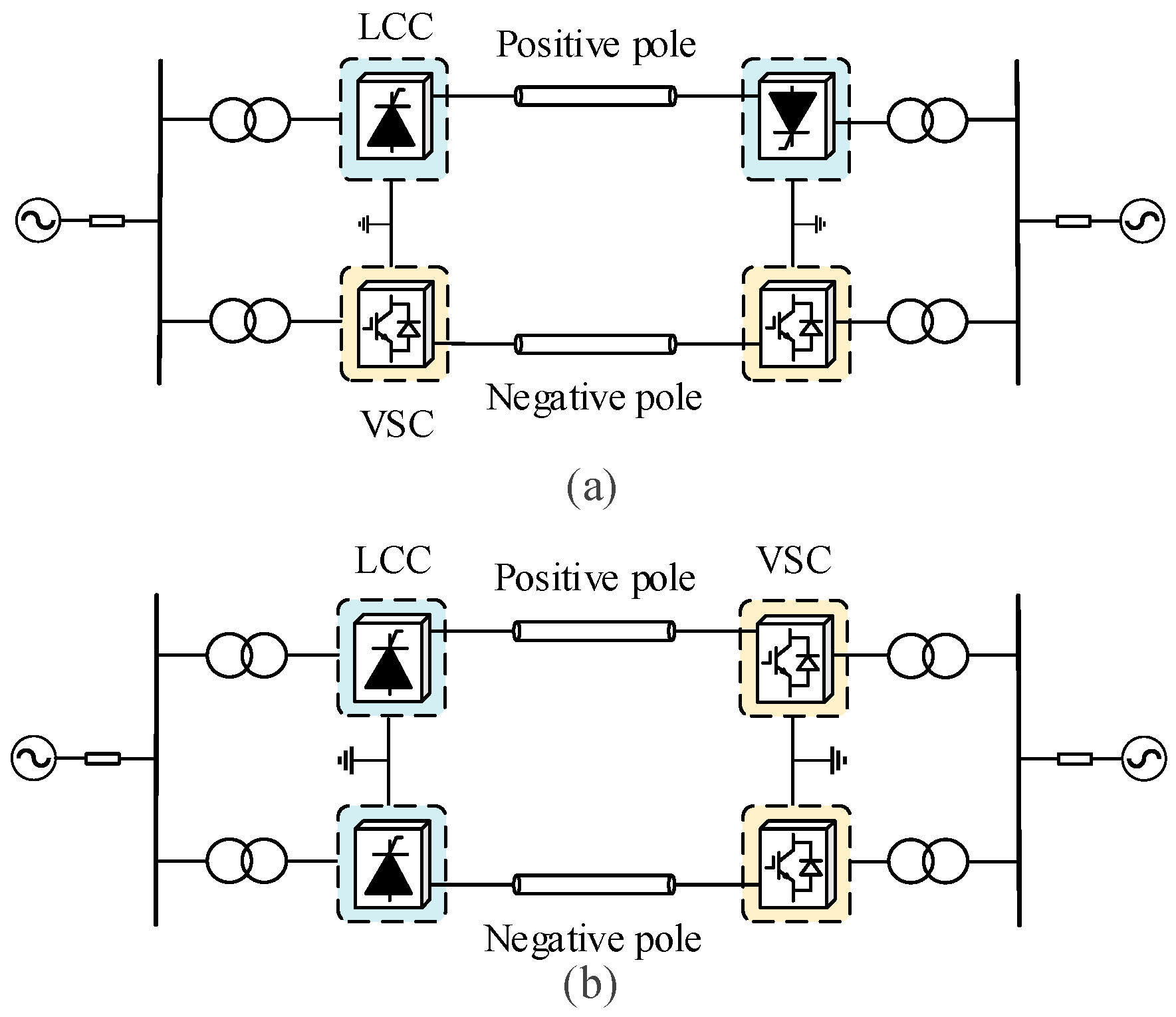
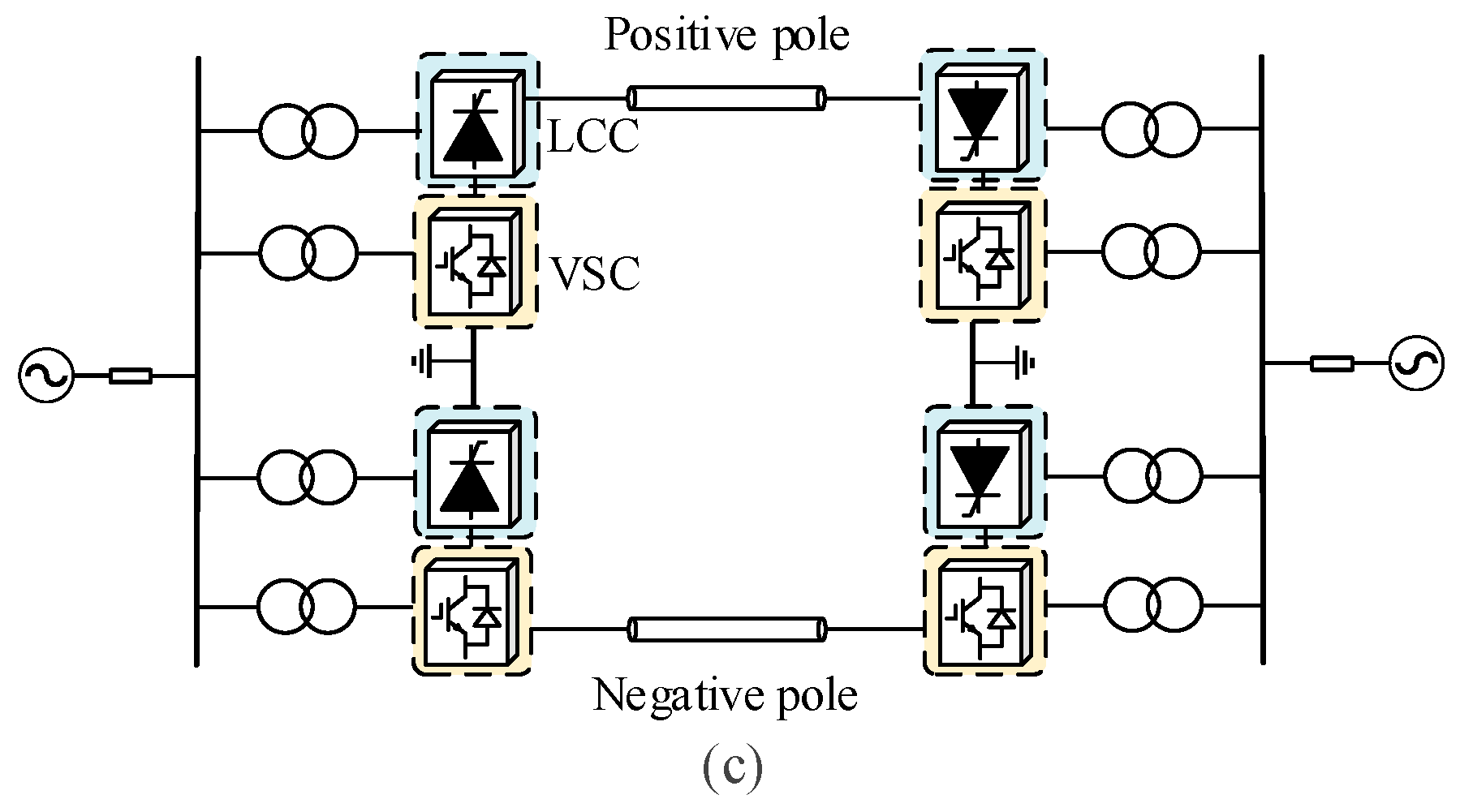
Hybrid HVDC technology combines the economic advantages of LCC with the superior control performance of fully controlled converter valves. Most existing hybrid HVDC topologies adopt combinations of LCC and MMC. In a terminal hybrid HVDC system, the sending side adopts LCC while the receiving side employs MMC, as shown in Figure 1a. The Wudongde HVDC project in China is a representative engineering application of this structure [6,7]. In such schemes, the receiving-end system is immune to commutation failures. However, the DC fault-clearing capability is relatively weak and relies heavily on full-bridge submodules. Moreover, the power capacity of MMC is relatively limited, making it difficult to scale toward higher voltage levels and larger transmission capacities. In 2015, Norway and Denmark implemented the Skagerrak hybrid bipolar HVDC demonstration project, which adopted a positive-pole LCC and a negative-pole VSC, as illustrated in Figure 1b [8]. This configuration enabled unipolar operation, black-start capability, and bidirectional power transfer [9]. Different from this inter-pole heterogeneous architecture, the Baihetan-Jiangsu HVDC system in China employed a cascaded configuration combining LCC and MMC valves at receiving ends, depicted in Figure 1c [10,11]. Operational results demonstrated that the MMC can provide fast voltage support and reactive power regulation under weak-grid conditions at the receiving end. In addition, it can effectively suppress subsequent commutation failures of LCC valves. Furthermore, the forced commutation capability of LCC facilitated rapid DC fault clearance [12]. Nevertheless, hybrid schemes combining LCC and MMC still suffer from several drawbacks. LCC stations occupy a large footprint, and the high cost and losses of MMC valves remain unresolved. In addition, MMC systems require controllable energy dissipation devices to handle surplus power during faults, which further increases land use, investment, and maintenance costs [13,14]. Therefore, this cost–performance gap underscores the urgent need for novel HVDC transmission solutions that combine high operational reliability with economic feasibility.
In response, researchers have proposed an actively commutated current source converter (CSC) employing self-turn-off devices [15] and applied them in HVDC transmission systems. CSCs feature low energy storage capacitor requirements, eliminate the need for large-capacity AC filters, and offer a compact and lightweight design. They provide control flexibility comparable to that of VSC-HVDC while eliminating the risk of commutation failure [16,17]. In addition, CSC can actively reverse the DC voltage polarity to clear DC fault currents, while the smoothing reactor on the output side effectively suppresses DC current fluctuations, thereby exhibiting superior DC fault-clearing capability compared with MMC [18]. However, these topologies require a large number of IGBT or IGCT devices, and although their cost is lower than that of VSC-HVDC technology, it remains higher than LCC-HVDC systems [17,19]. Reference [20] applied a hybrid CSC-based HVDC scheme, in which the receiving-end converter station adopts a cascaded hybrid structure comprising LCC and CSC valves. This design combines economic advantages with stable wind power integration. However, the CSC typically employs fundamental frequency modulation and provides only a single control degree of freedom, which prevents full decoupling of active and reactive power. At present, most hybrid HVDC systems consisting of thyristor-based LCC valves and fully controlled devices are operated in parallel configurations. In such systems, the reactive power compensation of the LCC valve group still follows the traditional design of LCC-HVDC, relying on passive filters to provide reactive power support while meeting harmonic suppression requirements. However, passive filters occupy a large footprint and constitute a major portion of converter station costs, while offering only limited fundamental reactive power compensation [21]. Moreover, the reactive power exchange between the LCC valves and passive AC filters can induce transient overvoltages, posing serious risks to the safety of converter stations and associated equipment [22]. This problem is further aggravated in sending-end AC grids with large-scale integration of renewable energy units, as the reduced grid strength exacerbates the transient overvoltage challenge [23,24,25].
To address these challenges, this paper proposes a high-voltage direct-current transmission scheme based on a hybrid current source converter (HCSC-HVDC) comprising both LCC and CSC valves. Moreover, a power decoupling control and reactive power coordination control (RPCC) strategy are proposed. This paper focuses on HCSC-HVDC, and the main novelties and contributions of this paper are summarized as follows:
(1)
Structural Novelty: Compared with existing hybrid HVDC transmission systems composed of LCC and MMC, the proposed HCSC-HVDC system based on IGCTs and thyristors features lower energy storage capacitor requirements, a more compact and lightweight structure, and higher control flexibility, while also demonstrating superior DC fault-clearing capability.
(2)
Control Framework Novelty: This study reveals the power operating characteristics of the HCSC system. The power decoupling control and reactive power coordination control (RPCC) strategy enables real-time compensation of the reactive power demand of the LCC valve group, facilitates unity power factor operation of the HCSC system, minimizes the reactive power demand on passive filter devices, and reduces the physical footprint of the converter station.
(3)
Robust Fault Ride-Through Performance: Particularly, the proposed RPCC strategy based on power decoupling and surplus power tracking not only ensures robust fault ride-through performance but also effectively mitigates the risk of transient overvoltages.
The structure of this paper is arranged as follows: in Section 2, the proposed HCSC transmission system topology and mathematical model are introduced; Section 3 analyzes the power operating range of the HCSC; in Section 4, the design of ACF parameters are analyzed and a simulation model is built; in Section 5, the power decoupling control and reactive power coordination control (RPCC) strategy is proposed; and a simulation model is built in Section 6 to verify the effectiveness of the proposed method. Section 7 concludes the study.

2. The HCSC-HVDC System

2.1. Topology of HCSC

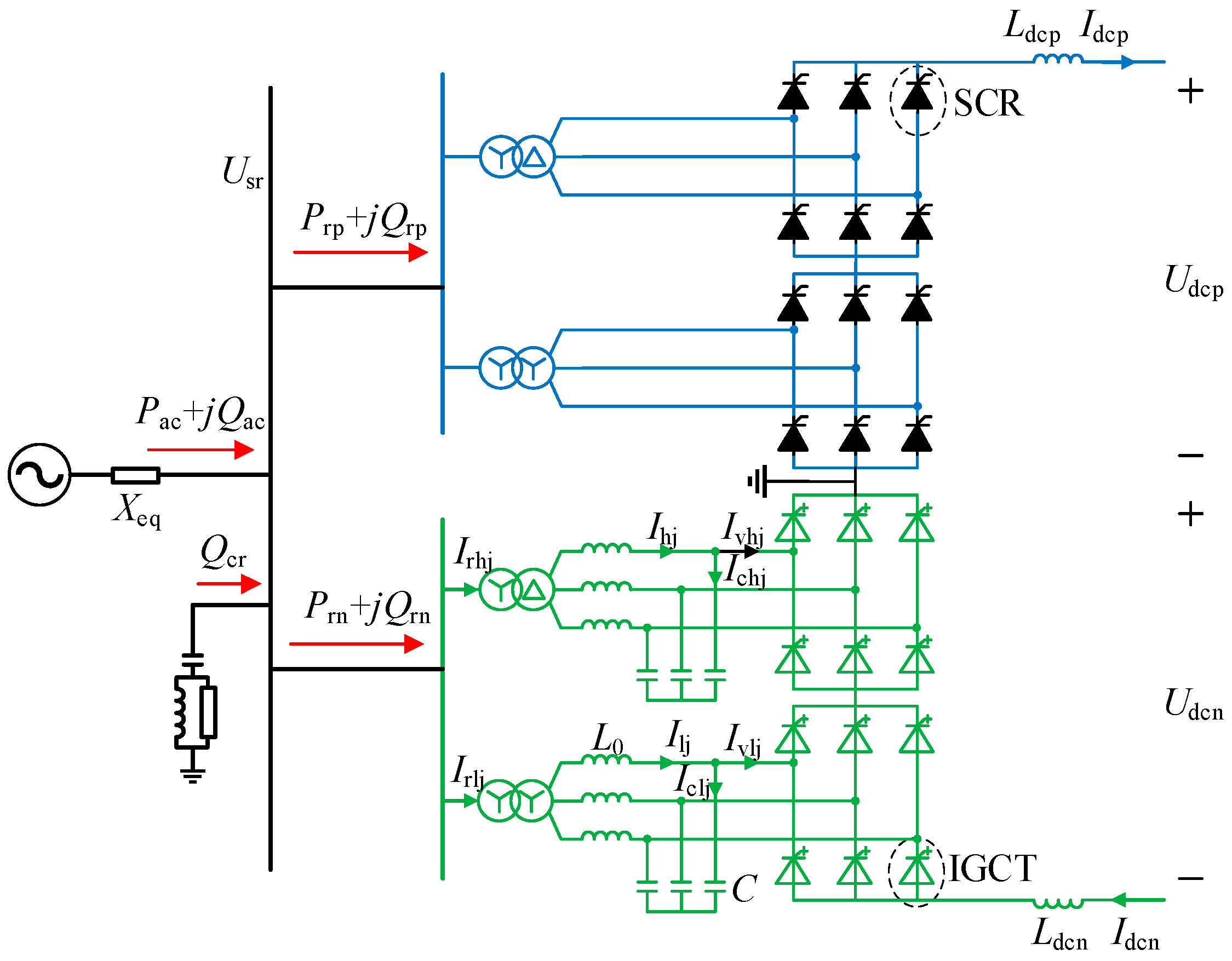
The HCSC-HVDC system proposed in this paper adopts a bipolar configuration. The positive pole consists of two series-connected 6-pulse LCC valve groups, while the negative pole comprises two series-connected 6-pulse CSC valve groups. The system topology is shown in Figure 2. On the AC side, the LCC converter is connected to the AC bus through a converter transformer. The CSC converter is connected to the AC bus via a filter capacitor C filter reactor L0 and a converter transformer. A small capacity passive filter is installed at the AC bus to suppress harmonics introduced by the LCC-HVDC subsystem. The converter transformers for the upper and lower valve groups adopt Δ-Y and Y-Y configurations, respectively. A smoothing reactor Ldc is connected in series at the DC output of each converter. Throughout this paper, the subscripts “r” and “i” denote the rectifier and inverter sides, respectively, while “p” and “n” refer to the positive and negative poles.

2.2. Mathematical Model of HCSC

The positive-pole valve group of the HCSC converter adopts the LCC converter valve and the negative pole valve adopts the CSC converter valve. The basic unit of the positive LCC valve is the SCR, whose topology is illustrated in Figure 2.
The voltage, current and power of the positive LCC valve satisfy the following relationship:
U dcp = 3 2 π T p U sr cos α rp 3 π X r I dcp
P rp = U dcp I dcp
Q rp = 3 2 π T p U sr I dcp 1 cos α rp X r I dcp T p 2 U sr 2
where αrp is the trigger delay angle, μ is the phase change overlap angle, Xr is the phase change reactance of each phase, Tp is the ratio of the converter transformer, Prp is the active power, Qrp is the reactive power, Udcp is the dc voltage, Idcp is the dc current, and Usr is the rms value of the AC bus line voltage.
The basic unit of the negative CSC valve is the RB-IGCT. In Figure 2, Udcn denotes the DC voltage, Idcn denotes the DC current, Ldcn denotes the smoothing reactor, L0 denotes the filter inductor, and C denotes the filter capacitor.
The negative CSC valve can adopt PWM modulation or enhanced fundamental frequency modulation strategy. Among them, the enhanced fundamental frequency modulation has a low switching frequency and is suitable for large-capacity HVDC transmission converter stations, so this paper subsequently analyzes the enhanced fundamental frequency modulation [26] as an example.
Based on the CSC converter topology, and assuming a zero phase angle for the AC bus voltage Urj, when the firing angle is αrn and the compensation angle is θrn, the d- and q-axis components irnd and irnq of the grid-connected AC current Irn in the synchronous rotating reference frame are given as follows:
i rnd = 2 A I dcn cos ( α rn + θ rn ) ( 2 cos θ rn 1 ) T n i rnq = 2 ( B T n 2 A I dcn sin ( α rn + θ rn ) ( 2 cos θ rn 1 ) T n )
Furthermore, the expressions for the active power Prn and reactive power Qrn can be derived.
P rn = 6 T n U sr A I dcn cos ( α rn + θ rn ) ( 2 cos θ rn 1 ) Q rn = 6 U sr A I dcn sin ( α rn + θ rn ) ( 2 cos θ rn 1 ) T n B T n 2
The voltage and current expressions of the negative CSC converter valve can be expressed, respectively, as
U dcrn = 6 T n A U sr cos α rn + θ rn 2 cos θ rn 1 U dcin = 6 T n A U si cos α in + θ in 2 cos θ in 1
I dcn = U dcrn U dcin R dcn
where A = 2 3 X C π ( X C + X L ) , B = j 2 U sr 3 ( X C + X L ) , and Tn is the ratio of the converter transformer.

3. The PQ Operating Range of the HCSC

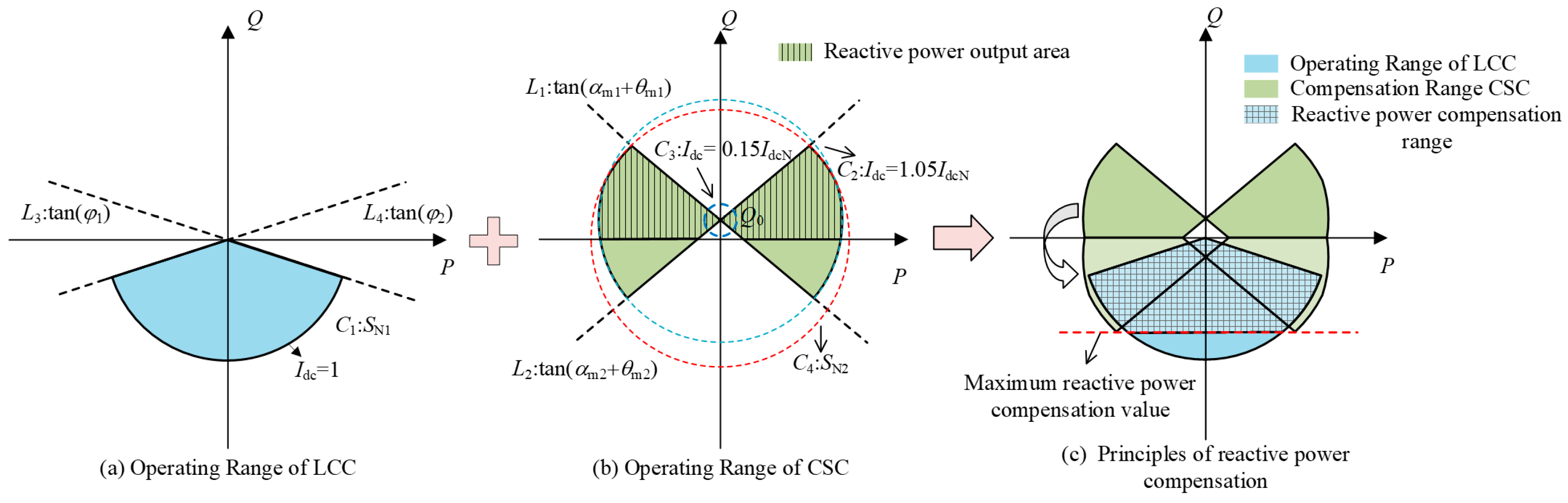
From Equations (1)–(3), it can be seen that the LCC has active–reactive coupling, and a large amount of reactive power needs to be consumed while active power is transmitted. The limiting curve of the trigger angle αrp on the operating range of the PQ is a straight line passing through the origin with a slope of tanj. An increase in DC current leads to an increase in active and reactive power demand, and a decrease in trigger angle leads to an increase in active power consumption and a decrease in reactive power demand.
Figure 3a shows the PQ operating range of the LCC converter valve. In the figure, circle C1 is the LCC DC current operating limit and straight lines L1 and L2 are the αrp limits on the LCC power operating range.
The CSC controls the active and reactive power independently by two degrees of freedom, αrn and θrn. Simplification of Equation (5) yields the limitations of the αrn and θrn on PQ:
tan ( α rn + θ rn ) = Q rn 6 B U s T n 2 P rn
From Equation (8), the limitation of the power of the negative system by the trigger angle and the compensation angle is a straight line with a slope of tan(αrn + θrn).
Similarly, the limitation of power operation range by DC current Idcn can be obtained from Equation (5):
( T n P rn 6 U s B ) 2 + ( T n Q rn 6 U s A B T n A ) 2 = ( 2 cos θ rn 1 ) 2 I dcn 2
As can be seen from Equation (9), the limitation of DC current Idcn on power is a circle with the center of the circle being Q0. To avoid overloading, the maximum DC current is limited to 1.05 times the rated value; at the same time, to avoid overvoltage of the inductor caused by intermittent DC current, the minimum DC current value is limited to 0.15 times the rated value.
In addition, the apparent power rating limits the operating range of PQ as
P 2 + Q 2 S N 2
Figure 3b shows the PQ operating range of the CSC converter valve. In the figure, circle C2 and circle C3 are the maximum and minimum DC current limits of the CSC, respectively, circle C4 is the apparent power operation range of the CSC, and the straight lines L3 and L4 are the limits of αrn + θrn on the power operation range of the CSC.
During power transfer, the active power of the hybrid bipolar DC transmission system is the sum of LCC and CSC, and the reactive power is the difference between the CSC reactive power and the LCC reactive power, and some or all of the reactive power consumption to satisfy the LCC can be compensated by the CSC, as shown in Figure 3c.
P 2 + Q 2 = ( P rn + P rp ) 2 + ( Q rn Q rp ) 2
It should be noted that both active and reactive power of the HCSC can be regulated without changing the positive LCC operating point, and power variations are dynamically compensated for by the CSC.
Under steady-state conditions, the HCSC can realize part of the operating conditions unit power factor operation and at the same time reduce the AC filtering capacity; under fault conditions, the converter’s own control is used to consume surplus reactive power, so as to suppress AC overvoltage.

4. Parameter Design of the AC Filter

According to the analysis in Figure 3c, in order to further realize the system full-condition unit power factor operation, a small-capacity reactive power compensation device needs to be configured, taking into account the AC filtering demand.
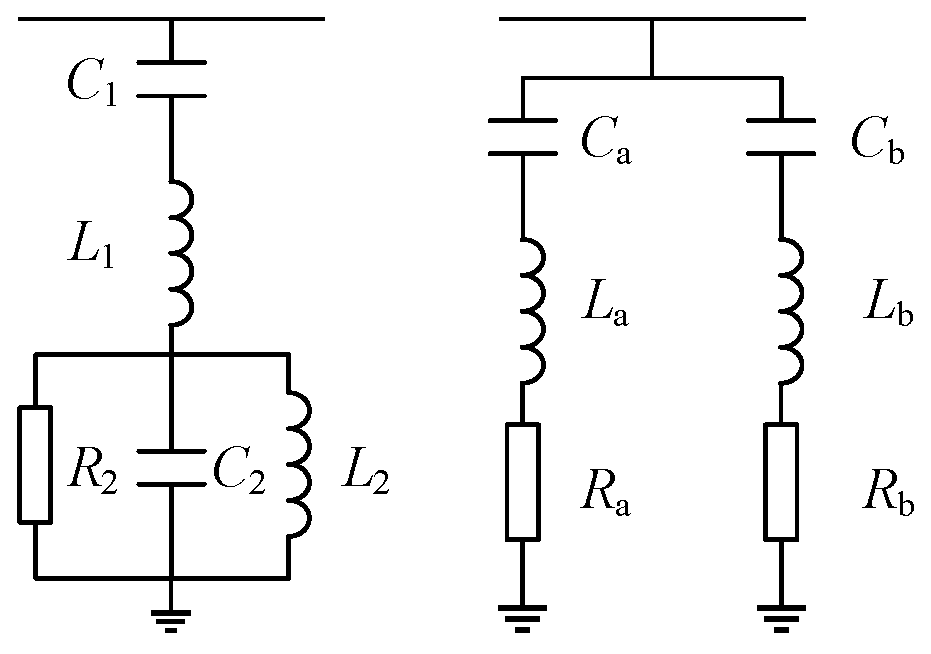
Currently, DC converter stations commonly use double-tuned filters, which can be equated to two single-tuned filters connected in parallel [27], as shown in Figure 4. Neglecting the filter resistance part, the filter capacitors Ca and Cb and filter inductors La and Lb are obtained by Equations (12) and (13).
C a = Q 1 ( N 1 2 1 ) ω N 1 2 U s 2
L a = 1 ω 2 N 1 2 C a
where Q1 is the reactive output of the filter, N1 is the number of harmonics to be suppressed by the filter, and Us is the bus voltage.
Then the four energy storage elements C1, L1, C2, and L2 are calculated by Equations (14)–(17), and the resistor R2 parameters can be given based on engineering experience.
C 1 = C a + C b
L 1 = L a L b L a + L b
C 2 = C a C b ( C a + C b ) ( L a + L b ) 2 ( C a L a C b L b ) 2
L 2 = ( C a L a C b L b ) 2 ( C a + C b ) 2 ( L a + L b )
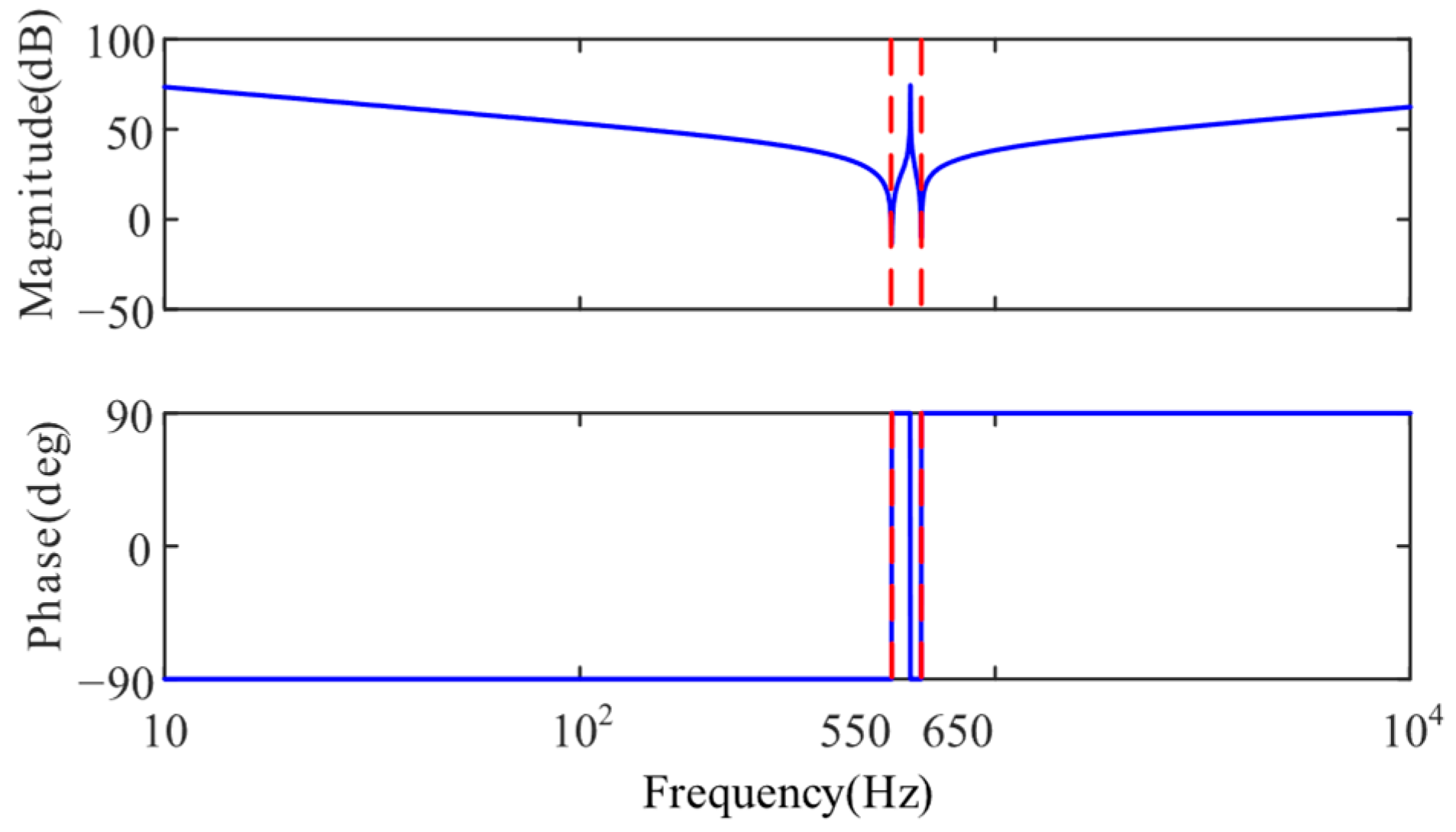
Taking the CIGRE model system parameters as standard, the AC voltage Us is 345 kV, the number of harmonics to be suppressed is 11 and 13, and the reactive power output requirement is 60 Mvar. The C and L parameters of the double-tuned filter are calculated as C1 = 1.593 μF, L1 = 43.85 mH, C2 = 58.18 μF, and L2 = 1.23 mH. The impedance-frequency characteristic of the designed AC filter is illustrated in Figure 5, which demonstrates excellent filtering performance for the 11th and 13th characteristic harmonics.
Passive filters and reactive power compensation capacitors are among the most space-consuming components in conventional DC transmission system converter stations, accounting for approximately one quarter of the converter station’s floor space [28]. The high-voltage capacitors within reactive power compensation units and passive filter banks provide local compensation for fundamental frequency reactive power, calculated using the following formula:
Q cr = U s 2 C × 2 π f
As shown in Equation (18), an increase in the reactive power compensation capacity Qcr leads to a corresponding increase in the capacitance C.
In the LCC CIGRE model, the reactive power compensation capacitors, C-type damping filters, and high-voltage capacitors within the high-pass filters collectively provide reactive power compensation for the LCC system, with corresponding compensation capacities of 125 Mvar, 250 Mvar, and 250 Mvar, respectively. The structure and detailed parameters are shown in Figure A1 in the Appendix A. In the double-tuned filter design proposed in this section, the high-voltage capacitance requirement has been reduced by approximately 70.5%, which is shown in Table 1.
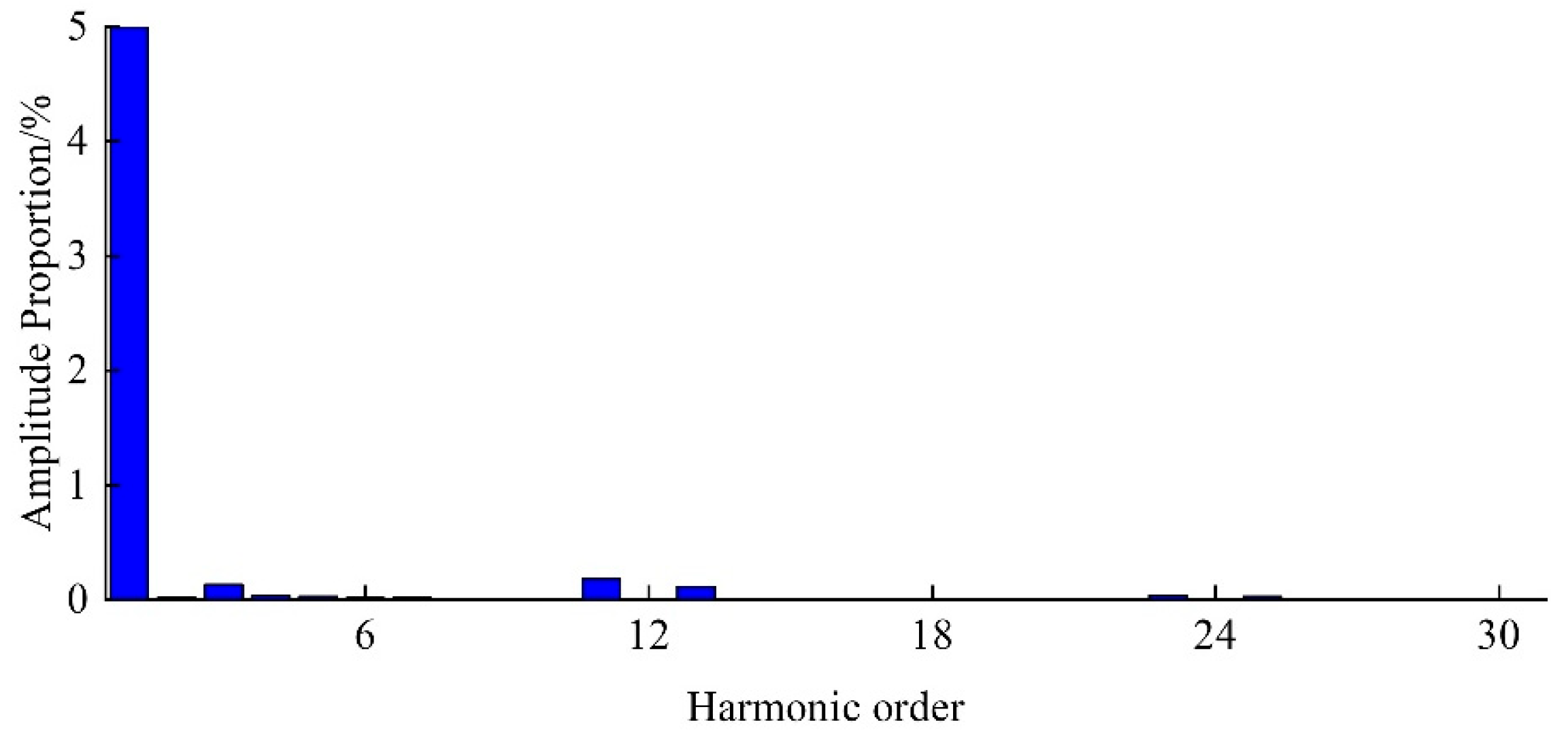
The frequency spectrum of the AC-side current is shown in Figure 6. After filtering, the characteristic harmonics of the HCSC-HVDC system, mainly the 12 k ± 1 harmonic components, are effectively suppressed. As a result, the grid-side AC current exhibits a nearly sinusoidal waveform, with a total harmonic distortion (THD) of only 0.59%. These results demonstrate that the proposed HCSC-HVDC system achieves satisfactory AC harmonic performance under the adopted filter configuration.

5. Reactive Power Coordination Control Strategy Based on Power Decoupling

5.1. Power Decoupling Control Strategy of the HCSC System

5.1.1. LCC Control Strategy

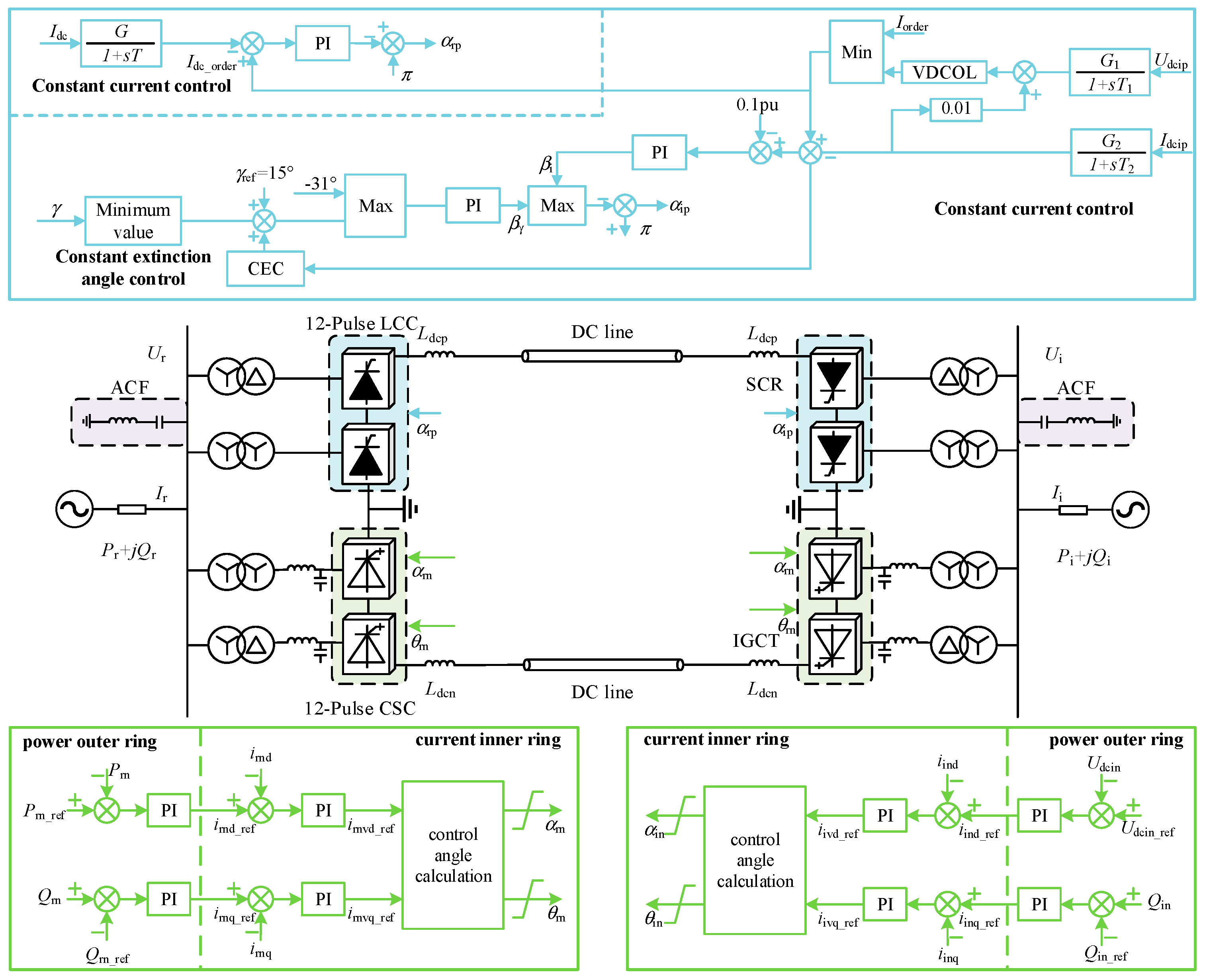
The rectifier-side LCC converter station gets the trigger angle αrp from the constant current control, where the DC current reference value Idcrp is given by the inverter side. The constant current control includes two parts: low-voltage current limiting control and constant minimum trigger angle αrpmin, and the VDCOL device reduces the rectifier side DC voltage by increasing the rectifier-side trigger angle to suppress the growth of the DC current.
The LCC converter station at the receiving end adopts constant current control, and constant extinction angle control is introduced to avoid continuous commutation failure; current deviation control is introduced to ensure that the constant current control and constant extinction angle control links are switched smoothly and the controlled current does not oscillate.

5.1.2. CSC Control Strategy

As indicated by Equation (5), Prn and Qrn are decoupled and are controlled by two degrees of freedom: the firing angle αrn and the compensation angle θrn. The CSC at the rectifier station employs constant active and reactive power control, while the CSC at the inverter station adopts constant voltage control to ensure DC voltage stability and enhance power transmission efficiency. However, under low-load conditions, DC smoothing reactors can result in current discontinuities, which may induce DC overvoltage. To address this, a constant current control mode is implemented as a backup control mechanism. When the output power drops below 0.1 p.u., the control strategy automatically switches from fixed voltage control to a fixed minimum current control mode. The other degree of freedom governs the system’s reactive power, using a control strategy identical to that employed on the rectifier side.
In the dq rotating coordinate system, the control strategy of the CSC converter station consists of a power outer loop, a current inner loop and a trigger angle inversion link. Among these, the power control stage compares the measured active and reactive power on the AC bus, Prn and Qrn, with their respective reference values, Prn_ref and Qrn_ref. The PI controller is used to generate the reference values of the dq-axis components of the grid-side current, irnd_ref and irnq_ref.
The inner-loop current controller compares the measured grid-side current with its reference and, through the PI control loop, generates the d- and q-axis components, irnvd_ref and irnvq_ref, of the equivalent valve outlet current reference.
The control objective of the trigger angle calculation process is to calculate the αrn and θrn based on the equivalent valve outlet current component. This mathematical relationship has been derived in reference [25], as shown in Equation (19).
θ rn = arccos π k T i vd _ ref 2 + i vq _ ref 2 8 3 I dc + 1 2 α rn = arctan i vq _ ref i vd _ ref θ rn
where ivd_ref and ivq_ref denote the d- and q-axis current command values at the outlet of the 12-pulse CSC valve, which are derived from the inner-loop current control strategy.
Since αrn and θrn are fundamentally derived from the switching function, and the reference currents ivd_ref and ivq_ref are produced by the control strategy, the control strategy remains effective during the transient process. The control loop is shown in Figure 7.

5.2. Ideology of RPCC Strategy

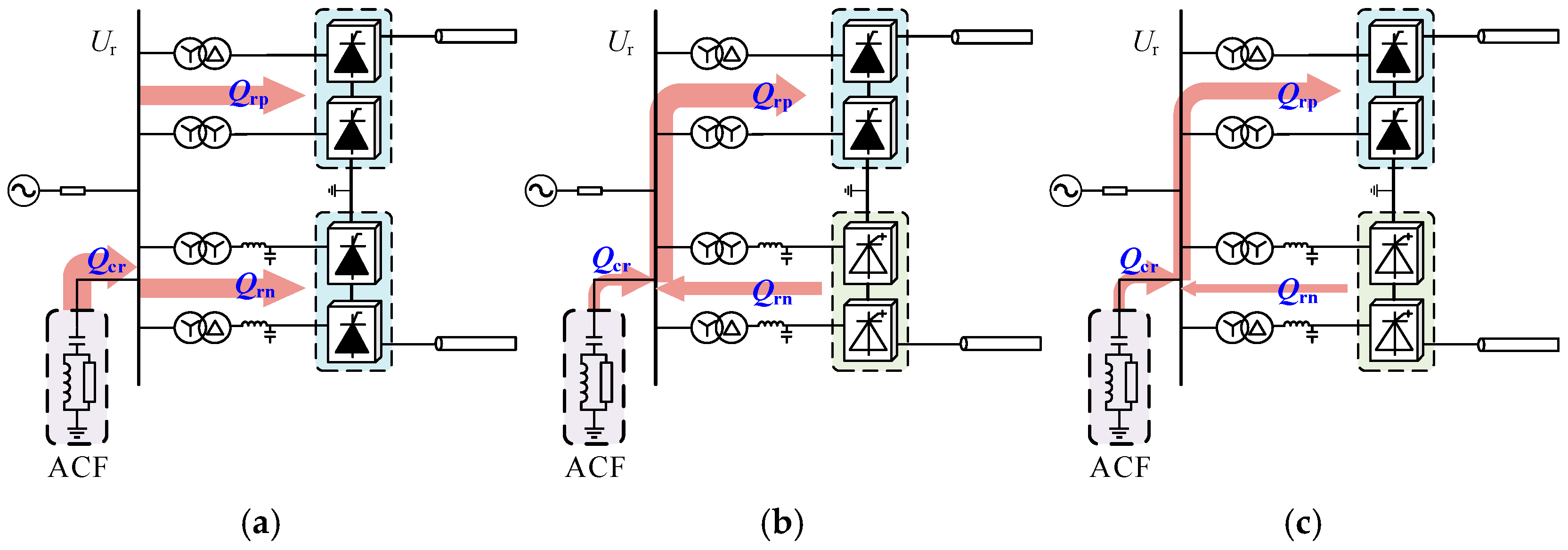
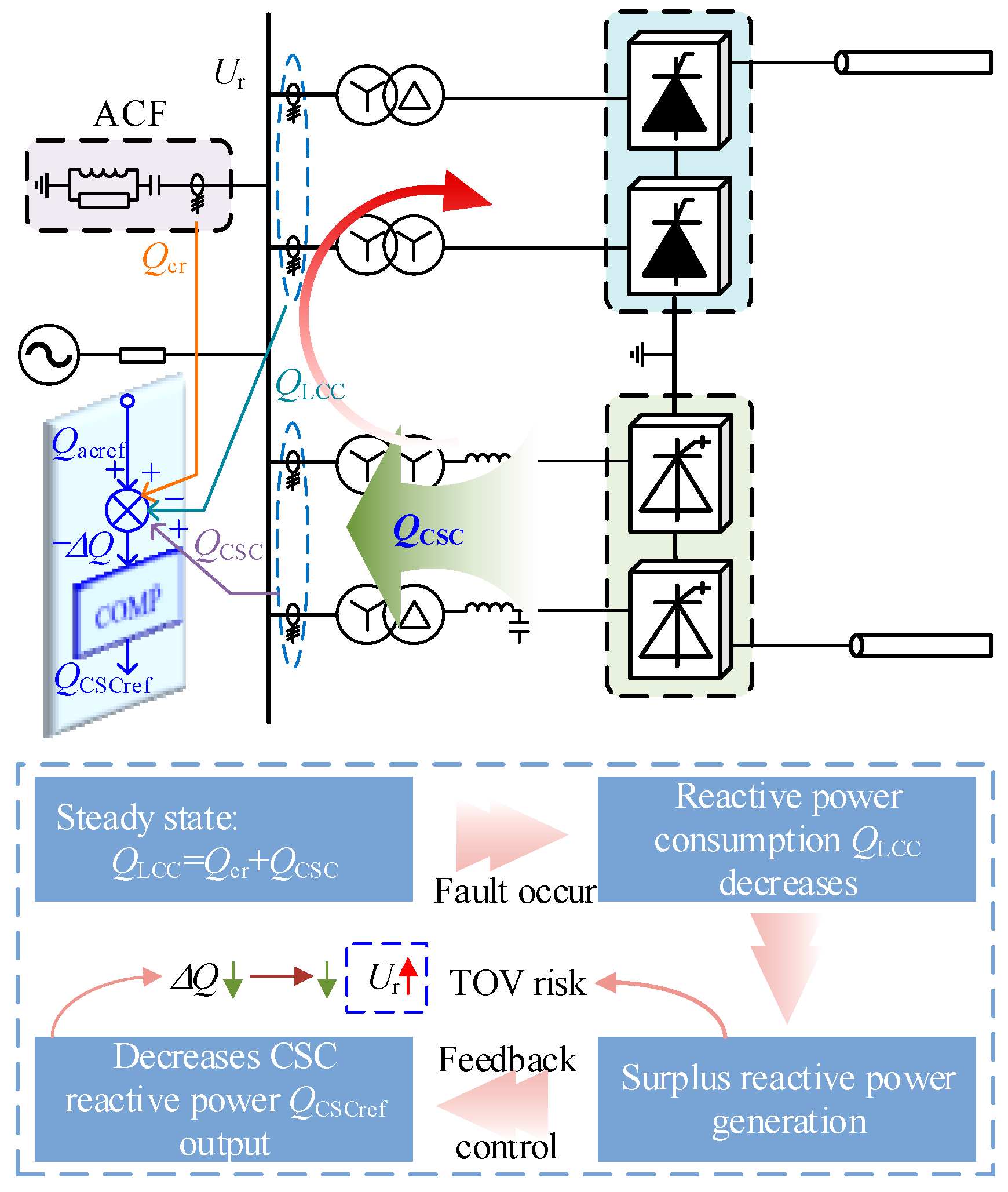
In conventional LCC-HVDC systems, the reactive power demand of the LCC valve group is supplied exclusively by the AC filter, as illustrated in Figure 8a. During fault conditions, the limited switching speed of the AC filter prolongs disconnection delays, resulting in an excessive influx of reactive power, which may induce transient overvoltages on the AC bus and hinder the recovery of the LCC system. The hybrid current source converter (HCSC) proposed in this study incorporates a novel reactive power compensation scheme. Under steady-state conditions, the reactive power demand of the LCC valves is met jointly by the CSC and the AC filter (ACF), with the CSC supplying the majority share, as illustrated in Figure 8b. Under fault conditions, to avoid excessive reactive power injection into the AC system, the control strategy decreases the reactive power output of the CSC, potentially reducing it to zero, as illustrated in Figure 8c.
The hybrid current source converter (HCSC) proposed in this study incorporates a novel reactive power compensation scheme. The reactive power demand of the LCC is supplied by two sources, namely, the CSC and the AC filter. The reactive power interaction is expressed by the following equation:
Q rp = Q rn + Q cr
where Qrp is the reactive demand of LCC, Qrn is the reactive power output of CSC, and Qcr is the reactive power output of AC filter.
Based on the idea of reactive power coordination control and considering the reactive power output capability of the CSC, a reactive power feedback closed-loop control system is designed, as shown in Figure 9. This control structure incorporates the reactive power supplied by the sending-end AC system, the reactive power consumption of the LCC, and the reactive power output of the AC filter and uses the reactive power deficit during transient states as the command value for the CSC. By employing feedback of measured values, closed-loop control of reactive power is achieved. This control strategy facilitates steady-state operation of the HCSC at unity power factor, reducing line losses and improving power transmission efficiency. Under fault conditions, it balances reactive power across all components of the HCSC system, thereby preventing surplus reactive power from flowing into the AC system and causing transient overvoltage on the feeder AC bus, while enabling fault ride-through capability.

5.3. Comparative Analysis of Converter Characteristics

Table 2 provides a benchmark comparison among CSC-HVDC, LCC–MMC hybrid HVDC, and the proposed HCSC-HVDC system. Although the LCC–MMC hybrid HVDC exhibits the strongest reactive power support due to the fully decoupled control capability of MMC, this advantage is accompanied by weak DC fault-clearing capability, high converter cost, and increased system volume. In contrast, CSC-HVDC features strong DC fault self-clearing capability and compact structure but lacks the capability to compensate the reactive power demand of LCC converters.
The proposed HCSC-HVDC system achieves a balanced compromise between these two approaches. By exploiting the partial power decoupling capability of CSC and the proposed RPCC strategy, the CSC provides dynamic reactive power support to the LCC, which significantly reduces the reactive power burden on AC filters and enables downsizing of high-voltage capacitors. Meanwhile, the inherent DC fault self-clearing capability and compact structure of CSC are preserved. Therefore, the proposed HCSC-HVDC offers a cost-effective hybrid topology with coordinated reactive power compensation, enhanced fault tolerance, and reduced filter size.

6. Simulation Analysis

In this paper, the control of HCSC system shown in Figure 7 and the RPCC strategy shown in Figure 9 are modeled in the PSCAD/EMTDC simulation platform to verify the feasibility of the proposed method. In the model, the positive pole is configured as an LCC converter valve and the negative pole as a CSC converter valve. The LCC adopts the CIGRE standard control [23]. The CSC has the same capacity as the LCC and employs a dual closed-loop control strategy combined with an improved fundamental frequency modulation strategy. The system parameters are listed in Table 3, and simulation conditions for the HCSC-HVDC system are listed in Table 4.

6.1. A. Case I: Steady-State Operating Conditions

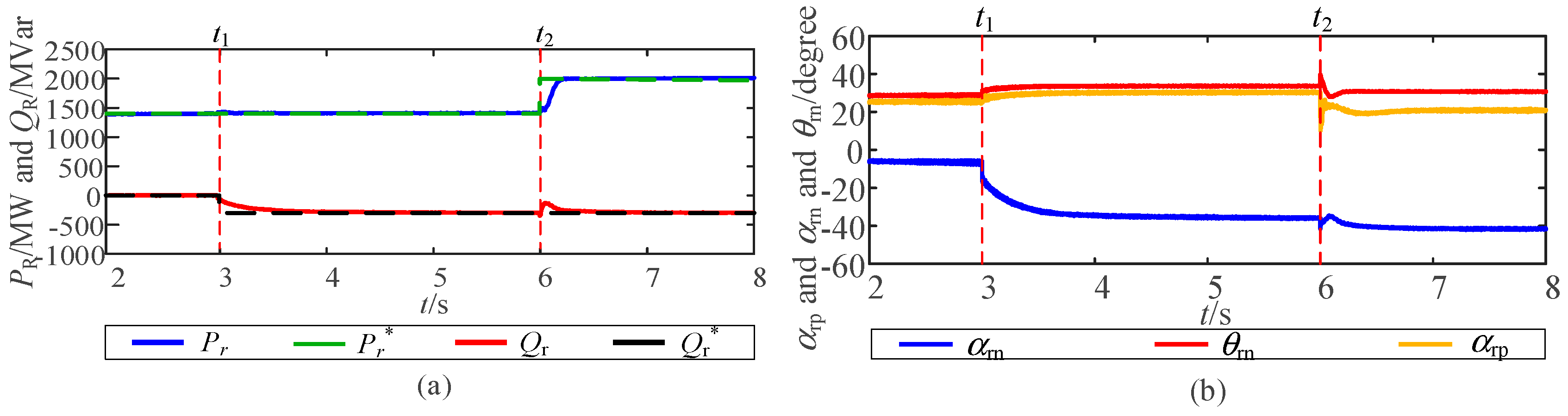
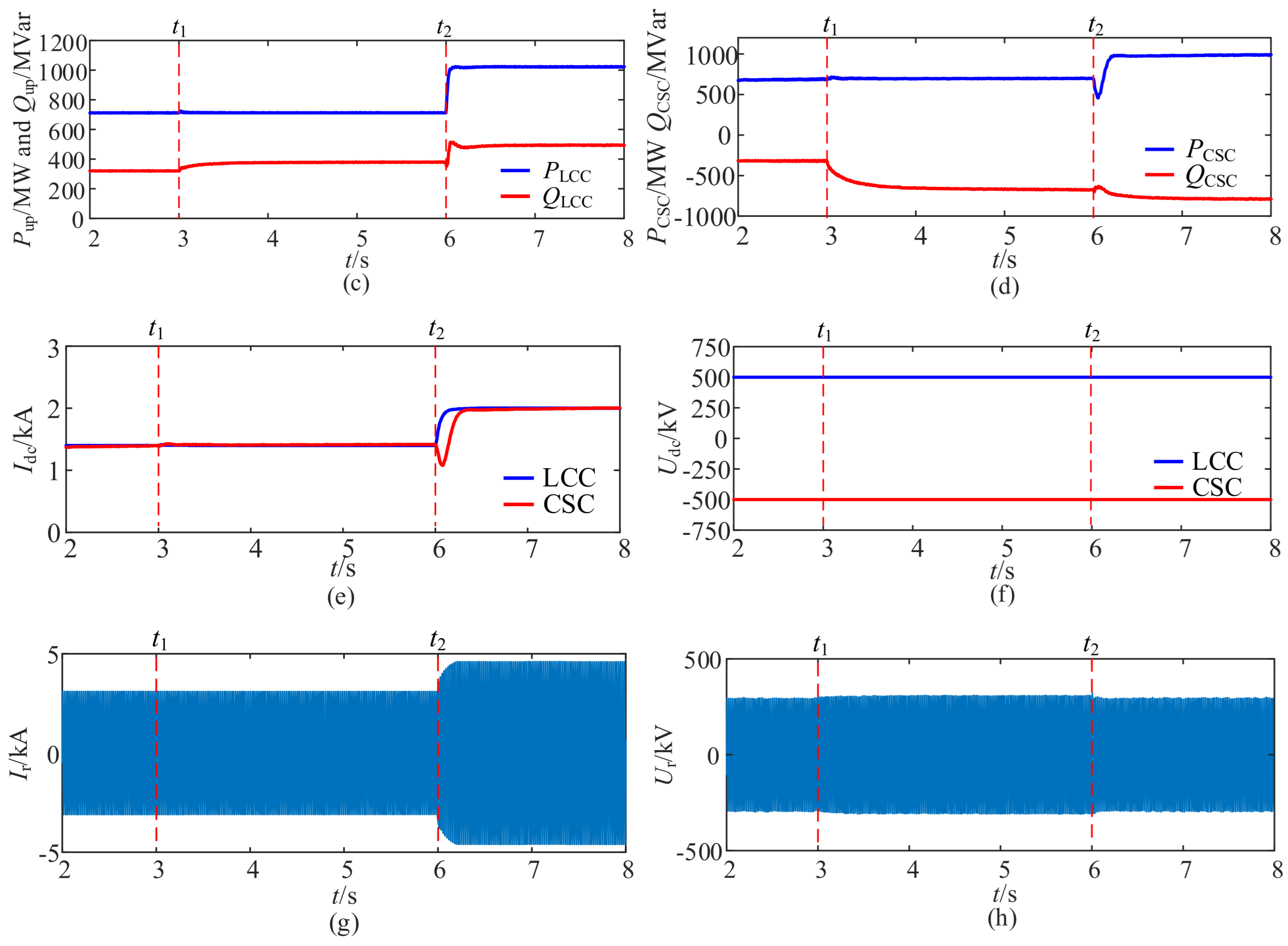
Figure 10 illustrates the dynamic response of the system during the power variation process. Specifically, Figure 10a,c,d presents the active and reactive power waveforms of the overall system, the positive-pole LCC, and the negative-pole CSC, respectively. Figure 10b depicts the trigger signal waveform. Figure 10e,f displays the DC current and DC voltage waveforms of the positive LCC and negative CSC. Finally, Figure 10g,h shows the AC voltage and AC current waveforms of the entire system, respectively.
As shown in Figure 10, before t1 = 3 s, the positive and negative converter stations each transmit 700 MW active power, maintaining system reactive power balance. At t1, the reactive power command steps to −300 Mvar, with active power unchanged and reactive power re-balanced. DC current and voltage remain stable despite trigger signal adjustments, demonstrating the HCSC-HVDC system’s reactive power regulation capability. At t2 = 6 s, the active power command jumps to 1000 MW, causing a corresponding rise in system active power and increased reactive demand at the positive pole. Reactive power balance between poles is re-established, and DC current increases from 1.4 kA to 2 kA, while DC voltage holds at 500 kV. These results confirm that the proposed system achieves fast tracking of active and reactive power commands with good dynamic response. This enhances the operating flexibility of the LCC system and expands the overall power operation range. Furthermore, the RPCC strategy enables the HCSC-HVDC system to operate at unity power factor.

6.2. B. Case II: Characteristics of Inverter-Side AC Fault

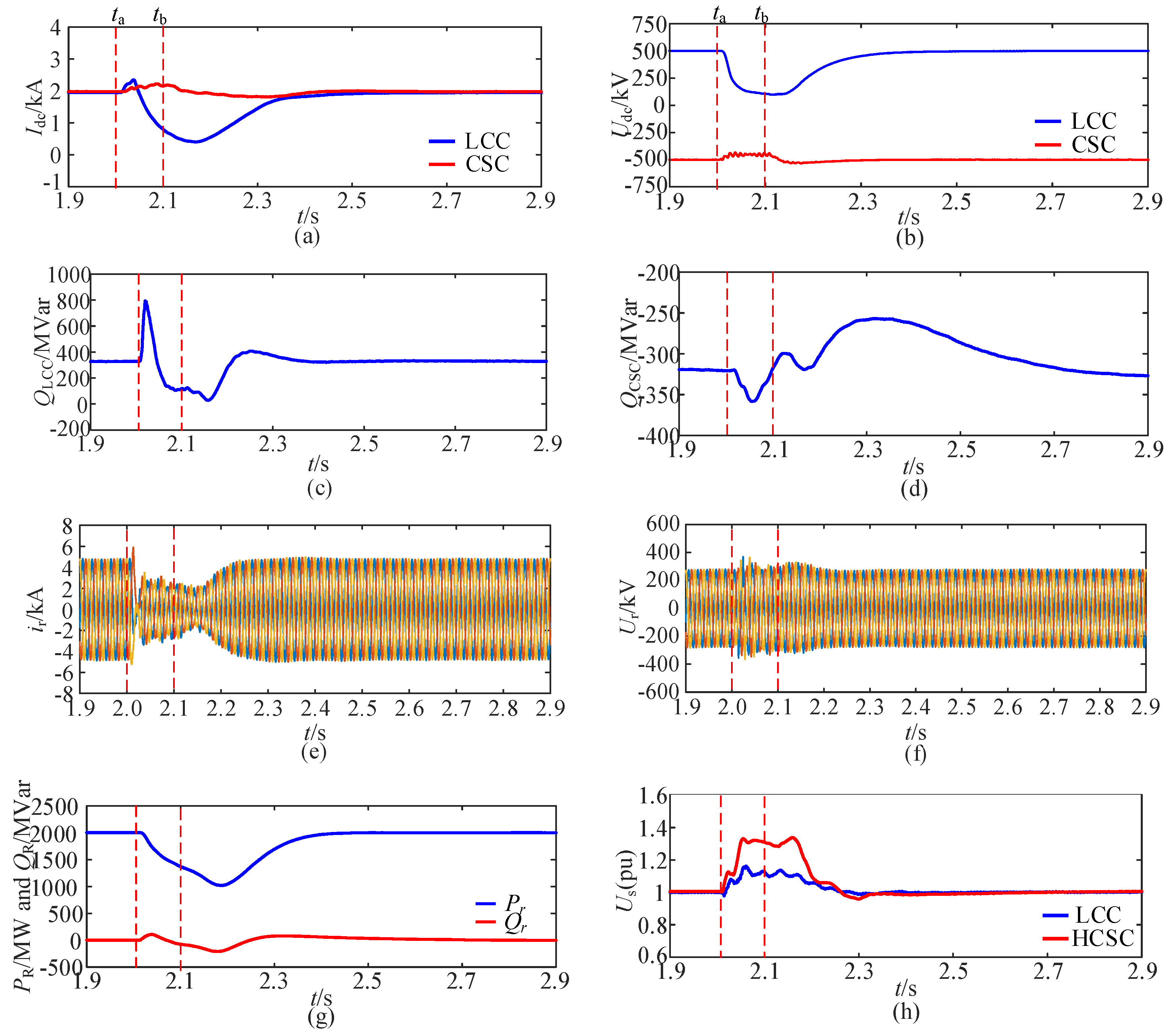
The system operates under rated conditions before the fault. At ta = 2 s, a single-phase short circuit with a grounding resistance of 0.01 Ω occurs on the AC bus at the inverter side of the HCSC-HVDC system, causing commutation failure. The fault lasts for 0.1 s. The simulation waveforms are shown in Figure 11.
Before ta = 2 s, the system operates stably. During tatb (2–2.1 s), a commutation failure occurs at the inverter side of the hybrid HVDC system. Under VDCOL control, the LCC rectifier station rapidly shifts phase, increasing the trigger angle and gradually reducing DC current. Consequently, the active and reactive power consumption of the LCC decrease rapidly. The HCSC adopts the RPCC strategy, reducing reactive power output during the fault to adapt to power changes and suppress transient overvoltage at the sending-end AC system. After fault clearance, the system returns to rated operation as the trigger angle and power consumption are gradually restored, with reactive power supplied by the negative pole and AC filter. As shown in Figure 11h, the AC bus peak transient overvoltage of the LCC-HVDC system under inverter-side AC fault reaches 1.34 p.u., whereas it is only 1.1 p.u. for the proposed HCSC-HVDC system. For a fair comparison, both systems are evaluated under identical grid strength conditions, with the same short-circuit ratio (SCR = 2.5). These results demonstrate that the HCSC-HVDC system has strong ride-through capability and fast recovery under commutation failure, with RPCC effectively mitigating the risk of AC transient overvoltage.

6.3. C. Case III: Characteristics of DC Blocking Fault

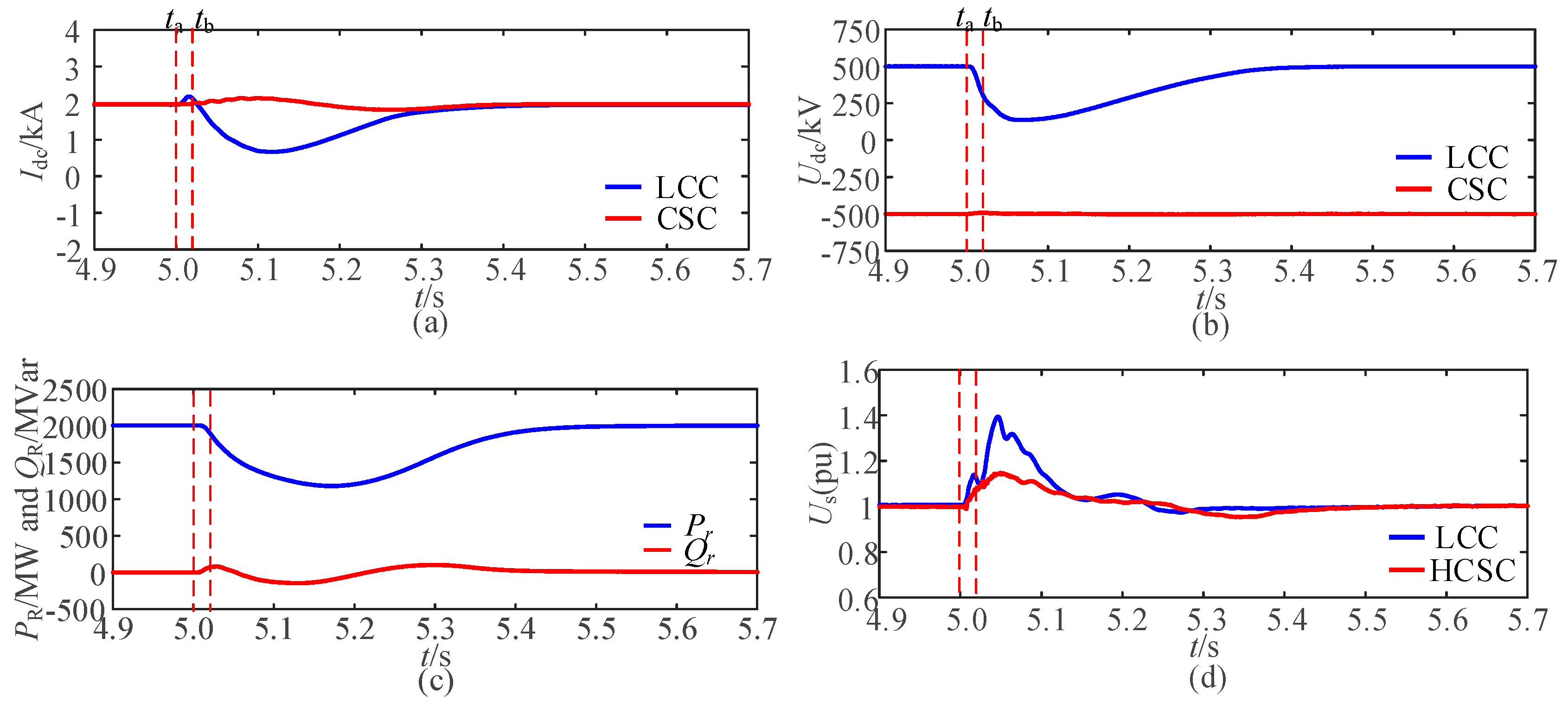
The system operates under rated operating conditions before the fault. At tc = 5 s, a short circuit with zero resistance occurs on the DC line of the positive LCC-HVDC system, lasting 0.02 s. The simulated waveforms are shown in Figure 12.
Before tc = 5 s, the system operates stably. During tctd (5–5.02 s), a DC blocking fault occurs in the positive LCC system. The LCC rectifier station rapidly shifts phase, increasing the trigger angle and entering inverter mode, causing DC current to gradually shut off. Consequently, active and reactive power consumption of the LCC decrease rapidly. The HCSC employs the RPCC strategy, reducing reactive power output during the fault to adapt to power changes and suppress transient overvoltage on the sending-end AC system. After fault clearance, the system returns to rated operation, with the positive LCC’s reactive power demand supplied by the negative CSC and AC filter. As shown in Figure 12d, the AC bus peak transient overvoltage under DC blocking fault reaches 1.4 p.u. for the LCC-HVDC system but only 1.12 p.u. for the proposed hybrid current source HVDC system. These results demonstrate that the proposed HCSC-HVDC system possesses DC fault ride-through capability, fast self-recovery, and effectively mitigates AC bus transient overvoltage caused by DC blocking faults.

6.4. D. Case IV: Characteristics of Rectifier-Side AC Fault

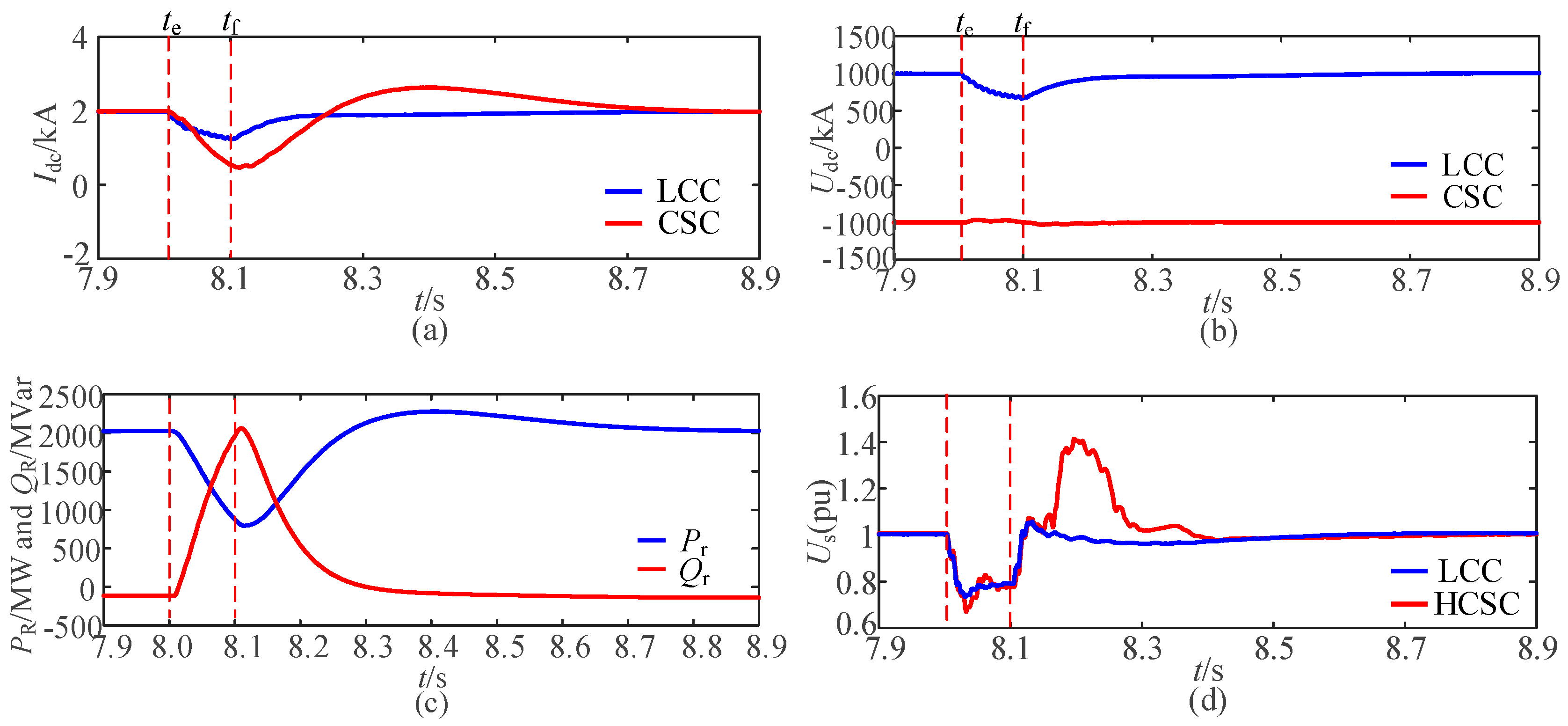
The system is operated at rated operating condition before the fault. At te = 8 s, a single-phase ground fault occurs on the rectifier side of the HCSC-HVDC system, the grounding resistance is 0.01 Ω, and the fault lasts for 0.1 s. The simulation waveform is shown in Figure 13.
The system operates stably until te = 8 s, when a near-area AC fault occurs at the rectifier side during tetf (8–8.1 s). This causes a rapid voltage drop at the rectifier AC bus and a sharp decrease in DC current between the LCC and CSC systems, limiting power transfer capability. After fault clearance, the system gradually returns to rated operation, with the positive LCC’s reactive power demand supplied by the negative CSC and AC filters. Surplus reactive power from the sending-end AC system decreases, suppressing system-wide transient overvoltage. As shown in Figure 13d, the AC bus peak transient overvoltage of LCC-HVDC system under the near-area AC fault reaches 1.4 p.u., while it is only 1.06 p.u. for the proposed HCSC-HVDC system. Simulation results demonstrate that the proposed system has near-area AC fault ride-through capability, fast self-recovery, with RPCC effectively mitigating the risk of AC bus transient overvoltage.

7. Conclusions

This paper proposes a HCSC-HVDC system topology, in which the reactive power output capability of the CSC is utilized to compensate for the reactive power demand of the LCC, thereby further reducing the size of the AC filter. By developing and implementing the RPCC control strategy based on power decoupling control and surplus power dynamic tracking, the proposed topology demonstrates excellent dynamic response and fault ride-through capability.
(1)
The HCSC-HVDC system exhibits low reactive power compensation requirements and does not necessitate large-capacity reactive power compensation capacitors, thereby further reducing the high-voltage capacitor parameters by about 70.5% and enabling more compact and lightweight converter stations.
(2)
Under steady-state operating conditions, the proposed HCSC-HVDC system, combined with the RPCC strategy, enables partial decoupling of active and reactive power, while ensuring unity power factor operation at both the sending- and receiving-end converters.
(3)
The RPCC strategy based on power decoupling control provides fault ride-through capability under DC blocking faults and AC faults at both ends, and effectively mitigates the risk of transient overvoltage that conventional LCC-HVDC cannot withstand.
Future Developments: Although the proposed HCSC-HVDC system demonstrates significant technical advantages, some issues remain to be investigated. Future research will focus on suppressing subsequent commutation failures in hybrid current source converter systems, exploring HCSCs’ role in grid-forming operation, and developing HCSC-based offshore wind power integration strategies.

Author Contributions

Conceptualization, X.G. and Y.L.; methodology, X.G.; software, N.Z.; validation, X.G., Y.L. and R.D.M.; formal analysis, X.G. and N.Z.; investigation, X.G. and L.X.; resources, X.G. and N.Z.; data curation, X.G.; writing—original draft preparation, X.G.; writing—review and editing, Y.L.; visualization, X.G. and Y.W.; supervision, N.Z.; project administration, L.X.; funding acquisition, L.X. All authors have read and agreed to the published version of the manuscript.

Funding

This work was supported by the Young Scientists Fund of the National Natural Science Foundation of China (NSFC) (Grant No.: 52407082) and a grant from the China Postdoctoral Science Foundation (Certificate Number: 2023M740388).

Institutional Review Board Statement

Not applicable.

Informed Consent Statement

Not applicable.

Data Availability Statement

The original contributions presented in the study are included in the article, and further inquiries can be directed to the corresponding author.

Acknowledgments

We are grateful to the other researchers who contributed to this study.

Conflicts of Interest

The authors declare no conflicts of interest.

Abbreviations

The following abbreviations are used in this manuscript:
HCSCHybrid current source converter
RPCCReactive power coordination control
CSCActively commutated current source converter (CSC)
LCCLine commutated converter
MMCModular multilevel converter
SCRSilicon controlled rectifier
IGBTInsulated gate bipolar transistor
IGCTIntegrated gate commutated thyristor
Nomenclature
apFiring angle of the LCC valve group
μCommutation overlap angle of LCC
XrCommutation reactance per phase of LCC
TpTransformer ratio of LCC converter
UsrRMS value of AC bus line voltage
IdcpDC current of LCC
UdcpDC current of LCC
Prp/QrpActive power/Reactive powe of LCC
αnFiring angle of CSC
βnCompensation angle of CSC
irnd/irnqd/q-axis components of CSC AC-side current
Prn/QrnActive power/Reactive powe of CSC
LdcnDC smoothing reactor of CSC
L0AC-side filter inductor of CSC
CAC-side filter capacitor of CSC
TnTransformer ratio of CSC converter

Appendix A

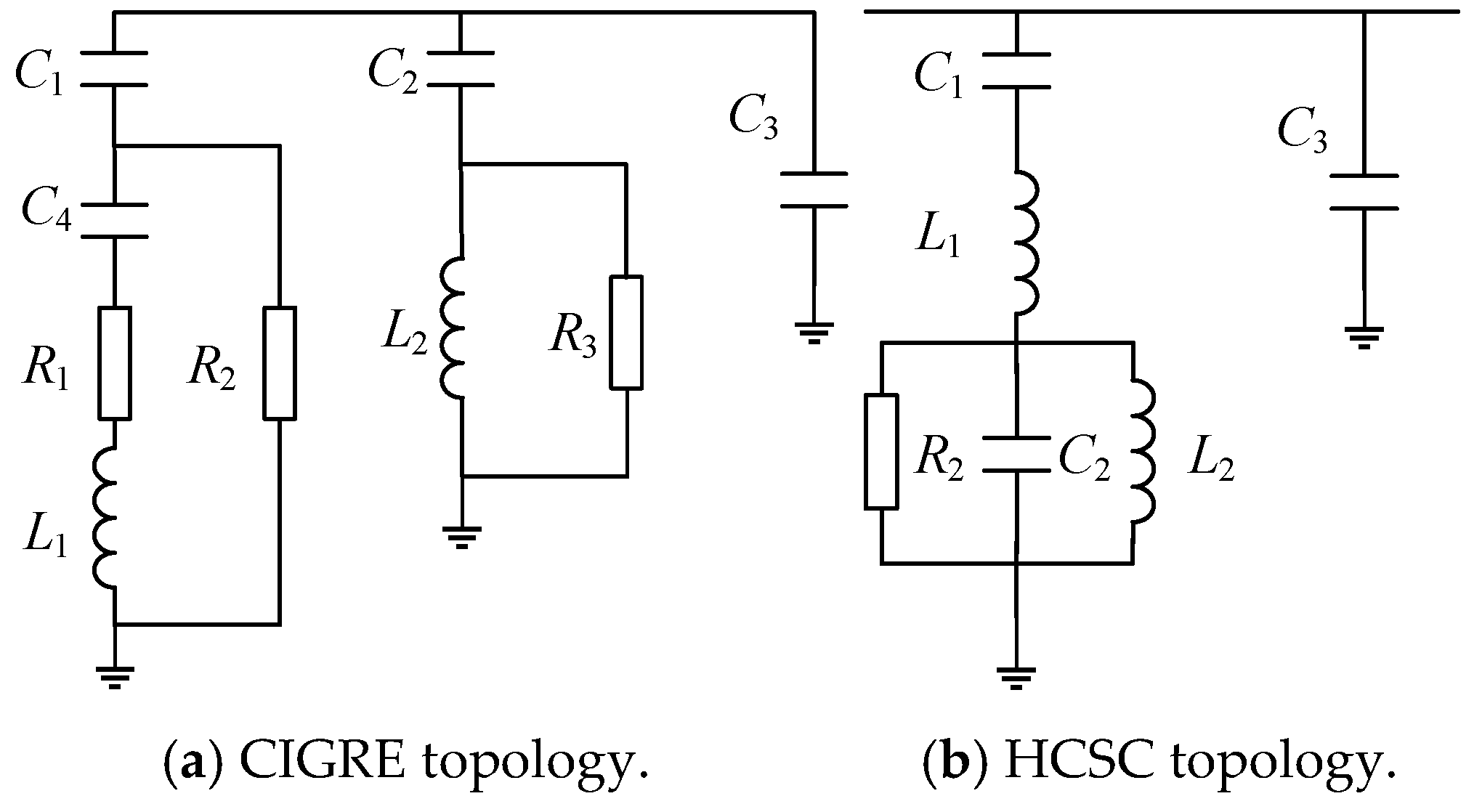
CIGRE model filter, HCSC topology filter and reactive power compensation capacitor configuration and parameters, as shown in Figure A1 and Table A1.
Figure A1. AC Filter Configuration of CIGRE Benchmark Model and HCSC Topology.
Applsci 16 01868 g0a1
Table A1. CIGRE Benchmark Model AC Filter Component Parameters.
DeviceParameterDeviceParameter
C16.685 μFC474.28 μF
C26.685 μFL1136.4 mH
C33.342 μFL213.6 mH

References

  1. Arrillaga, J. High Voltage Direct Current Transmission, 2nd ed.; IET: Hertfordshire, UK, 1998. [Google Scholar]
  2. Mirsaeidi, S.; Dong, X. An enhanced strategy to inhibit commutation failure in line-commutated converters. IEEE Trans. Ind. Electron. 2020, 67, 340–349. [Google Scholar] [CrossRef]
  3. Wang, F.; Liu, T.Q.; Li, X.Y. Decreasing the frequency of HVDC commutation failures caused by harmonics. IET Power Electron. 2017, 10, 215–221. [Google Scholar] [CrossRef]
  4. Debnath, S.; Qin, J.; Bahrani, B.; Saeedifard, M.; Barbosa, P. Operation, Control, and Applications of the Modular Multilevel Converter: A Review. IEEE Trans. Power Electron. 2015, 30, 37–53. [Google Scholar] [CrossRef]
  5. Zhao, C.; Fan, Q.; Li, S.; Xu, J. Operation Method of MMC Capacitance Reduction Under Arm Inductor Switching Control. IEEE Trans. Power Deliv. 2021, 36, 418–428. [Google Scholar] [CrossRef]
  6. Tang, G.; Xu, Z. A LCC and MMC hybrid HVDC topology with DC line fault clearance capability. Int. J. Electr. Power Energy Syst. 2014, 62, 419–428. [Google Scholar] [CrossRef]
  7. Zeng, R.; Xu, L.; Yao, L.; Finney, S.J.; Wang, Y. Hybrid HVDC for integrating wind farms with special consideration on commutation failure. IEEE Trans. Power Deliv. 2016, 31, 789–797. [Google Scholar] [CrossRef]
  8. Goran, A.; Mats, H. Skagerrak the Next Generation; CIGRE: Paris, France, 2015; pp. 1–9. [Google Scholar]
  9. Xiao, H.; Sun, K.; Pan, J.; Li, Y.; Liu, Y. Review of hybrid HVDC systems combining line communicated converter and voltage source converter. Int. J. Electr. Power Energy Syst. 2021, 129, 106713. [Google Scholar] [CrossRef]
  10. Zhao, J.; Zeng, R.; Li, B.; Jiang, Q.; Tao, Y.; Liu, T. Inverter-side robust damping controller design of hybrid HVDC with cascaded multi-infeed mmc converters in asynchronous situation. Int. Trans. Electr. Energy Syst. 2021, 31, 127–136. [Google Scholar] [CrossRef]
  11. Liu, J.; Lin, S.; Xia, L.; Zhao, J.; Liu, L. Mitigation Strategy of Commutation Failure Based on Reactive Power Feedback Control in the Hybrid Cascaded HVDC System. IEEE Trans. Power Deliv. 2024, 39, 2079–2091. [Google Scholar] [CrossRef]
  12. Guo, C.; Zhao, C.; Peng, M.; Liu, W. A hybrid HVDC system with DC fault ride-through capability. CSEE J. Power Energy Syst. 2015, 35, 4345–4352. [Google Scholar] [CrossRef]
  13. Wu, S.; Qi, L.; Jin, M.; He, Z.; Zhang, X. An MMC With Integrated Energy Dissipation Function Using Thyristor-Based Chopper Modules for the Offshore Wind VSC-HVDC System. IEEE Trans. Power Electron. 2024, 39, 1609–1623. [Google Scholar] [CrossRef]
  14. Citroni, R.; Mangini, F.; Frezza, F. Integration of Ultra-low Power Techniques and Energy Harvesting in Self-Sufficient Devices: A Comprehensive Overview of Current Progress and Future Directions. Sensors 2024, 24, 4471. [Google Scholar] [CrossRef] [PubMed]
  15. Xu, C.; Yu, Z.; Zhao, B.; Chen, Z.; Wang, Z.; Ren, C.; Zeng, R. A Novel Hybrid Line Commutated Converter Based on IGCT to Mitigate Commutation Failure for High-Power HVdc Application. IEEE Trans. Power Electron. 2022, 37, 4931–4936. [Google Scholar] [CrossRef]
  16. Wei, Q.; Wu, B.; Xu, D.D.; Zargari, N.R. Optimal Space Vector Sequence Investigation Based on Natural Sampling SVM for Medium-Voltage Current-Source Converter. IEEE Trans. Power Electron. 2017, 32, 176–185. [Google Scholar] [CrossRef]
  17. Xia, J.; Guo, X.; Wang, C.; Xiong, X.; Zhao, C.; Guo, C. Cooperative Control Strategy of Fundamental Frequency Modulation-Based Current Source Converters for Offshore Wind Farms. IEEE Trans. Power Deliv. 2022, 37, 4805–4815. [Google Scholar] [CrossRef]
  18. Fu, S.; Xu, L.; Wang, Q.; Luo, Y.; Zhou, N.; Huang, P.; Lyu, Y.; Tang, Y. Dynamic Models for DC Fault Analysis of Actively Commutated CSC-HVDC under Different Grid Strengths. IEEE Trans. Ind. Electron. 2025, 73, 2300–2310. [Google Scholar] [CrossRef]
  19. Lyu, Y.; Luo, Y.; Jia, Z.; Fu, S.; Tang, Y.; Wang, Q.; Zeng, Y. Benefit evaluation of HVAC and HVDC for offshore wind power transmission system under the multidimensional index. Electr. Power Syst. Res. 2024, 237, 111018. [Google Scholar] [CrossRef]
  20. Xia, J.; Wang, C.; Zhan, R.; Zhao, C.; Guo, C. Hybrid DC transmission system for offshore wind power based on current source converter. Automat. Electric Power Syst. 2021, 45, 129–138. [Google Scholar] [CrossRef]
  21. Nguyen, T.H.; Lee, D.-C.; Kim, C.-K. A Series-Connected Topology of a Diode Rectifier and a Voltage-Source Converter for an HVDC Transmission System. IEEE Trans. Power Electron. 2014, 29, 1579–1584. [Google Scholar] [CrossRef]
  22. Liu, X.; Huang, J.; Zheng, D.; Xin, H.; Bi, T. Analysis and Suppression for Temporary Overvoltage Considering Dynamic Interactions Between LCC-HVDC and Renewable Energy Plants. IEEE Trans. Sustain. Energy 2025, 16, 1849–1859. [Google Scholar] [CrossRef]
  23. Yin, C.; Li, F. Reactive Power Control Strategy for Inhibiting Transient Overvoltage Caused by Commutation Failure. IEEE Trans. Power Syst. 2021, 36, 4764–4777. [Google Scholar] [CrossRef]
  24. Xiao, H.; Li, Y.; Lan, T. Sending end AC faults can cause commutation failure in LCC-HVDC inverters. IEEE Trans. Power Deliv. 2020, 35, 2554–2557. [Google Scholar] [CrossRef]
  25. Xie, Q.; Xiao, X.; Zheng, Z.; Wang, Y.; Song, D.; Du, K.; Zou, Y.; Zhang, J. An improved reactive power control strategy for LCC-HVDC to mitigate sending end transient voltage disturbance caused by commutation failures. Int. J. Electr. Power Energy Syst. 2023, 146, 108706. [Google Scholar] [CrossRef]
  26. Zhao, C.; Feng, D.; Xiong, X.; Li, X.; Yao, C. Enhanced Fundamental Frequency Modulation Based Current Source Converter for HVDC Transmission. CSEE J. Power Energy Syst. 2023, 44, 7726–7738. [Google Scholar] [CrossRef]
  27. Li, P.; Xu, Z.; Huang, Y.; Li, X. Algorithm for the parameters of AC Filters in HVDC transmission system. CSEE J. Power Energy Syst. 2008, 28, 115–121. [Google Scholar]
  28. Xue, Y.; Zhang, X.-P.; Yang, C. AC Filterless Flexible LCC HVDC With Reduced Voltage Rating of Controllable Capacitors. IEEE Trans. Power Syst. 2018, 33, 5507–5518. [Google Scholar] [CrossRef]
Figure 1. Typical topology types of hybrid HVDC system composed of LCC and VSC: (a) pole hybrid HVDC system; (b) terminal hybrid HVDC system; (c) series converter hybrid HVDC system.
Applsci 16 01868 g001aApplsci 16 01868 g001b
Figure 2. Topology of bipolar 12-pulse HCSC.
Applsci 16 01868 g002
Figure 3. PQ operating range of HCSC.
Applsci 16 01868 g003
Figure 4. Dual-Tuned Filter (left) and Equivalent Single-Tuned Filter (right).
Applsci 16 01868 g004
Figure 5. Dual-Tuned Filter Bode Diagram.
Applsci 16 01868 g005
Figure 6. Frequency spectrum diagram of the AC current.
Applsci 16 01868 g006
Figure 7. Control strategy of the HCSC-HVDC system.
Applsci 16 01868 g007
Figure 8. Reactive power flow path: (a) LCC; (b) steady state of HCSC; (c) transcient state of HCSC.
Applsci 16 01868 g008
Figure 9. Reactive power coordination control (RPCC) strategy scheme.
Applsci 16 01868 g009
Figure 10. Steady-state operation condition of HCSC-HVDC: (a) active power and reactive power of LCC; (b) trigger signal; (c) active power and reactive power of CSC; (d) active power and reactive power of HCSC; (e) DC current; (f) DC voltage; (g) AC current; (h) AC voltage.
Applsci 16 01868 g010aApplsci 16 01868 g010b
Figure 11. Response characteristics of inverter-side AC fault: (a) DC current; (b) DC voltage; (c) reactive power of LCC; (d) reactive power of CSC; (e) AC current; (f) AC voltage; (g) active and reactive power of HCSC; (h) voltage comparison between LCC and HCSC.
Applsci 16 01868 g011
Figure 12. Response characteristics of HCSC-HVDC DC faults: (a) DC current; (b) DC voltage; (c) active and reactive power of HCSC; (d) voltage comparison between LCC and HCSC.
Applsci 16 01868 g012
Figure 13. Response characteristics of rectifier-side AC fault: (a) DC current; (b) DC voltage; (c) active and reactive power of HCSC; (d) voltage comparison between LCC and HCSC.
Applsci 16 01868 g013
Table 1. High-Level Capacitor Parameter Comparison.
Value of LCC DeviceValue of HCSC DeviceParameter Reduction Amount
High-voltage capacitorsC1: 6.685 μFC1: 1.593 μF
C3: 3.342 μF
70.5%
C2: 6.685 μF
C3: 3.342 μF
Table 2. Comparison of Converter Characteristics.
Topology SolutionCSC [17,18]LCC-MMC [6,7,8,9]LCC-CSC
Device TypeIGCTThyristor + IGBTThyristor + IGCT
DC Fault-Clearing CapabilityStrongWeakStrong
AC Filter SizeSmallLargeMedium
Reactive Power SupportAchievableAchievableAchievable
DC Fault Ride-ThroughStrongWeakStrong
Volume and WeightSmallLargeMedium
Harmonic Filtering SchemeLC low-pass filtersPassive AC filtersPassive AC filters with LC filters
Table 3. Parameters of HCSC-HVDC System.
Patameter of LCCValue
Rated DC voltage (kV)500
Rated DC current (kA)2
Converter transformer ratio345/213
Smoothing inductor on the DC side of LCC (H)0.5968
Smoothing inductor on the DC side of CSC (H)1.5968
Capacitor on the DC side (Ohm)2.5
Ground capacitor (mF)26
Filter inductor L0 on the AC side0.05
Filter capacitor C on the AC side15
SCR of AC system2.5
Table 4. Operation conditions of HCSC-HVDC system.
Case No.Operation Condition
ISteady-state operating conditions
IICharacteristics of DC blocking fault
IIICharacteristics of inverter-side AC fault
IVCharacteristics of rectifier-side AC fault
Disclaimer/Publisher’s Note: The statements, opinions and data contained in all publications are solely those of the individual author(s) and contributor(s) and not of MDPI and/or the editor(s). MDPI and/or the editor(s) disclaim responsibility for any injury to people or property resulting from any ideas, methods, instructions or products referred to in the content.