


Abstract
The growing demand for gluten-free bakery products requires the development of formulations that overcome their typical technological and nutritional limitations. Using fruit by-products as natural fiber sources, in combination with xanthan gum (XG), supports a sustainable ingredient strategy that improves gluten-free product quality. This study investigated the effect of apple pomace (AP) (5% and 10%) and XG (1%) on the technological properties, texture profile, nutritional composition, and sensory acceptance of gluten-free muffins. Six formulations were prepared by partially replacing maize flour with AP and/or adding XG. AP (5–10%) reduced muffin height and volume compared with the control, whereas 1% XG increased muffin height by 11.16% and raised volume and specific volume by 38.46% and 36.11%, respectively. XG significantly decreased hardness compared with the control, while the effect of AP on texture was concentration-dependent: 5% AP reduced hardness, whereas 10% AP did not further improve softness. Combined use of AP and XG resulted in complementary effects, improving structural properties while increasing dietary fiber content. The muffins supplemented with AP were acceptable, and their overall acceptability did not differ significantly among the tested formulations. Overall, the results demonstrate that incorporating AP together with XG enhances both the technological and nutritional quality of gluten-free muffins, supporting the valorization of fruit-processing by-products in functional bakery applications.
1. Introduction
Celiac disease is a chronic autoimmune disorder triggered by gluten ingestion and is considered a major public health concern in developed countries due to its growing prevalence [1,2]. A strict gluten-free diet is the only effective treatment, as even small amounts of gluten can cause intestinal damage, leading to villous atrophy and impaired absorption of nutrients [2]. Gluten-free products are therefore indispensable for individuals with gluten-related disorders, including celiac disease, non-celiac gluten sensitivity, wheat allergy, and Dermatitis herpetiformis [3]. The consumption of these products continues to increase not only due to medical necessity but also because of growing consumer perception of gluten-free products as healthier alternatives. Market forecasts indicate that the global value of gluten-free products may reach approximately 24 billion USD by 2027 [4].
Despite this increasing demand, gluten-free bakery products frequently show inferior nutritional and technological quality compared to their wheat-based counterparts. They typically contain less protein and dietary fiber and rely heavily on refined starches and sugars [5,6,7]. Numerous researchers therefore emphasize the importance of improving gluten-free formulations through the incorporation of nutritionally valuable, cost-effective, and fiber-rich ingredients [6,8,9].
One promising strategy for nutritional improvement and environmental sustainability is the valorization of agricultural by-products. Each year, the agri-food sector within the European Union generates approximately 88 million tons of food waste and processing by-products [10]. Plant-based side streams contain biologically valuable compounds, including dietary fibers, minerals, polyphenols, pigments, fatty acids, and vitamins [11]. Rather than being used mostly for low-value purposes such as animal feed or bioenergy, these materials can be converted into functional food ingredients, dietary supplements, and high-value functional products [12,13,14,15]. This direction is also supported by the European Commission’s Farm to Fork Strategy, encouraging resource efficiency and circularity in the food supply chain.
Apple pomace (AP) is a major by-product generated during juice processing and it represents approximately 25–35% of the total fruit mass [16,17]. AP contains polyphenols, minerals, vitamins, and substantial amounts of dietary fibers, especially pectin [18,19,20,21,22]. Although nutritionally valuable, most AP is still directed to animal feed, which removes it from the human food chain. Recent research indicates that AP can be successfully incorporated into bakery products, increasing their fiber content and antioxidant potential, while retaining acceptable sensory properties [23,24,25,26]. However, a higher incorporation level may negatively affect technological quality by decreasing loaf volume and increasing hardness [27,28]. At the same time, its high water-binding capacity may delay stalling and improve product freshness [28,29].
Although AP applications in bakery products have been documented, there is still a lack of scientific evidence regarding its suitability in gluten-free muffin formulations, particularly in combination with hydrocolloids such as xanthan gum (XG). Therefore, the aim of this study was to evaluate the effect of AP (5% and 10%) and XG (1%) on the quality properties, texture, nutritional composition, and sensory acceptance of gluten-free muffins. Systematically evaluating AP as a functional ingredient in gluten-free muffins would contribute both to product nutritional improvement and to waste valorization within the circular bioeconomy.
2. Materials and Methods
2.1. Raw Material and Muffin Formulations
The powdered apple pomace (AP) was purchased from “UOGUSULTYS” (Giedriai, Lithuania), in accordance with the supplier’s quality and microbiological specifications. The sample had a moisture content of 8.46% and a particle size below 1 mm. On a dry-weight basis, its chemical composition consisted of 3.59 ± 0.05% crude protein, 1.38 ± 0.15% lipids, 2.43 ± 0.08% ash, 35.66 ± 1.25% dietary fiber, and 46.59 ± 0.93% reducing sugars, according to previously published data [30].
Gluten-free muffins were prepared according to the formulation presented in Table 1. The flour was mixed with baking powder and xanthan gum (XG), and the mixture was subsequently sieved. Fat was placed in a mixer and whipped for 1–2 min. Sugar, vanilla sugar, and salt were then added, and the mixture was beaten for an additional 3–5 min. Eggs and milk were incorporated, followed by mixing for 1–2 min. The sieved flour and AP were then added to the whipped mixture and blended for 1 min to obtain a homogeneous batter. The batter was portioned into muffin molds (50 g per mold). Baking was carried out in an oven (MIWE Michael Wenz GmbH, Arnstein, Germany) at 180 °C for 30 min. After baking, the muffins were cooled to room temperature and weighed.
Table 1.
Formulation of gluten-free muffins.
2.2. Determination of Muffins Characteristic
The height of the muffins was determined by measuring the height of the cross-section using a digital caliper with an accuracy of ±0.01 mm. The moisture content of the muffins was determined according to the Association of Official Analytical Collaboration (AOAC) Method 925.10 by drying the sample (5.00 ± 0.01 g) to a constant weight at 105 °C and expressed as a percentage of the initial sample weight.
The muffin volume was measured using a modification of the AACC 10–05.01 (2000) rapeseed displacement method, in which millet grit (Skanėja, Vilnius, Lithuania) was used instead of rapeseeds. Each muffin was placed in a container of known volume (VC), which was then filled to the brim with millet. After removing the muffin, the volume of displaced millet (VM) was measured using a graduated cylinder. Muffin mass (M) was determined using a digital balance. The specific volume (SV) was calculated according to the following equation:
where SV is the specific volume (cm3/g), VC is the container volume (cm3), VM is the volume of displaced millet (cm3), and M is the muffin mass (g).
SV = (VC − VM)/M
2.3. Texture Analysis
The texture of the muffins was analyzed using a texture analyzer TA-XT.plus (Stable Micro Systems, Godalming, UK) equipment with an SMS P/100 probe (100 mm aluminum cylinder). The parameters determined were hardness, cohesiveness, gumminess, springiness, chewiness and resilience.
2.4. Estimated Nutrient Composition
The nutritional composition of the gluten-free muffins (per 100 g of product) was calculated based on the formulation and the proximate composition of each ingredient by accounting moisture loss during baking [31]. The nutrient contribution of each raw material was obtained by multiplying its inclusion level in the recipe by its nutrient content (g/100 g) and dividing by 100 [32]. This estimation-based approach has been previously applied in gluten-free bakery product development as a time- and cost-efficient tool for comparing alternative formulations [31].
The total energy value (kcal/100 g) was computed using standard Atwater conversion factors: 4 kcal/g for proteins, 9 kcal/g for lipids, 4 kcal/g for carbohydrates, and 2 kcal/g for dietary fiber. The resulting energy content was subsequently converted to kilojoules (kJ) by multiplying by 4.19, corresponding to the energy equivalent of 1 kcal.
2.5. Sensory Analysis
A sensory analysis of the gluten-free muffins was conducted by a panel of 19 trained assessors, consisting of students and staff members from Kaunas University of Technology (Kaunas, Lithuania), aged 25–40 years. All participants provided informed consent prior to participation. The panel evaluated the intensity of sensory attributes of the samples, including color, sweetness, porosity, dryness, crumbliness, hardness, and overall acceptability, in accordance with ISO 6658 guidelines [33]. Muffin samples were coded with random three-digit numbers and served on white plates in a monadic sequence. Water was provided for palate cleansing between the samples, and all evaluations were performed at room temperature.
Prior to the evaluation, the panelists were familiarized with the product characteristics and attribute definitions. Each attribute was assessed using a 7-point intensity scale, where point 1 corresponded to the lowest intensity, and point 7 was corresponded to the highest intensity of the attribute. The same scale was used to evaluate the overall acceptability of the muffins. No personal, sensitive, or health-related data were collected during the sensory evaluation.
2.6. Statistical Analysis
All experiments were conducted in triplicate, and the results were expressed as mean values ± standard deviations. One-way analysis of variance (ANOVA) was applied to identify significant differences among the samples, followed by Tukey’s honest significant difference (HSD) test for multiple comparisons at a significance level of p ≤ 0.05. Statistical analyses were carried out using Statgraphics Centurion 19 software (Statgraphics Technologies, Inc., The Plains, VA, USA).
3. Results
3.1. Muffins Quality Evaluation
The quality properties of gluten-free muffins formulated with AP and XG are presented in Table 2. The incorporation of XG enhanced characteristic of the muffins. Adding 1% XG resulted in an 11.16% increase in muffin height compared with the control, while volume and specific volume were higher by 38.46% and 36.11%, respectively. These improvements indicate that XG promotes better gas-cell retention and supports batter expansion, which leads to a less dense crumb structure [34].
Table 2.
Characteristics of gluten-free muffins.
In contrast, AP had a concentration-dependent negative effect on muffin expansion. The replacement of flour with 5% AP resulted in lower height and volume than the control sample, while increasing AP to 10% produced the lowest values among all formulations. The reduction in structural parameters is consistent with the behavior of fiber-rich ingredients: high fiber content increases matrix compactness and competes with starch for free water, thereby limiting expansion during baking [35,36].
When XG was combined with AP, the structural influence of AP remained dependent on concentration. Muffin height declined from 2.59 ± 0.04 cm (1XG) to 2.10 ± 0.01 cm with 10% AP, while volume declined from 90 ± 0.51 cm3 to 80 ± 0.94 cm3.
Hydrocolloids such as XG support viscoelastic properties of gluten-free batter and stabilize entrapped air cells, leading to better expansion and improved crumb aeration [37]. Conversely, AP increases dietary fiber content and moisture retention but also restricts expansion due to its particulate structure and competition for water [18].
3.2. Texture Properties
The texture profile parameters of the gluten-free muffins—hardness, springiness, cohesiveness, gumminess, chewiness and resilience—are presented in Table 3. Hardness is defined as the maximum force required to compress the muffin crumb to a fixed deformation level. The incorporation of 1% XG led to a significant reduction in hardness compared with the control formulation, indicating that XG improved crumb softness. This effect is consistent with findings reported by Singh et al. [38], who observed that XG interacts with starch and slows its retrogradation, thereby preventing excessive post-baking firming. Due to its high water-binding capacity and ability to form a viscoelastic network, XG increases batter viscosity and stabilizes air cells during baking, resulting in a softer and less dense crumb structure [39,40].
Table 3.
Influence of AP and XG on texture properties of gluten-free muffins.
The influence of AP on hardness was concentration dependent. A 5% addition of AP decreased hardness relative to the control sample, whereas the 10% addition did not produce a statistically significant change. Similar behavior has been documented when dietary fiber from guava pulp powder was incorporated into gluten-free bread: lower concentrations reduced hardness due to enhanced water binding, while higher levels led to reduced specific volume and consequently increased hardness, attributed to weakened structural matrix and reduced CO2 retention [35]. A comparable mechanism was described by O’Shea et al. [36], who attributed increased firmness of pomace-enriched baked products to the physical nature of the fiber, which at higher concentrations restricts batter expansion and results in reduced loaf volume and a firmer crumb.
Increasing the proportion of pomace in other bakery products has also been associated with a decrease in hardness. Bas-Bellver et al. [41] reported that incorporating carrot pomace into muffin formulations progressively reduced hardness and produced a crumblier texture due to the increased fiber content. Pecyna et al. [42] found that the addition of raspberry pomace caused a slight decrease in hardness in fresh gluten-free bread, although the change was not statistically significant; however, hardness increased during storage regardless of pomace level or drying method, highlighting the dynamic effect of fiber on texture during shelf life.
The supplementation of muffins with combination of AP and XG (1XG5AP, 1XG10AP) did not have a significant impact on hardness, and no significant differences were observed compared with the 1XG sample. This is consistent with findings from previous research, where the inclusion of black carrot fibers reduced firmness from 2.4 N to 1.3 N, although the softening effect of XG remained more pronounced than that of fiber alone [38].
The behavior of AP observed in this study aligns with the dual mechanism described in literature. At low incorporation levels, soluble dietary fiber—mainly pectin—exhibits high water-holding capacity and forms gel-like structures during baking. This improves crumb hydration, acts as a plasticizing agent and reduces the force needed to deform the crumb. Kırbaş et al. [43] demonstrated that AP increases batter water absorption and modifies rheology, contributing to changes in texture. However, at higher inclusion levels, the predominance of insoluble fiber (cellulose and hemicellulose) interrupts the continuity of the starch matrix and competes with starch granules for water during gelatinization, limiting gas cell expansion. As a result, the crumb becomes denser, less elastic and harder [43]. AP acts as water-binding components in the gluten-free muffin matrix, modifying the amount and mobility of unbound water in the crumb. Such changes in water distribution and water activity are directly reflected in moisture-driven texture behaviour [29].
Cohesiveness, gumminess, and chewiness are key texture profile parameters and are closely linked to consumer perception and overall acceptance of bakery products. Cohesiveness represents the degree to which the internal structure resists breakdown when subjected to compression and reflects the ability of the product to maintain its integrity during handling, packaging, and transportation. The incorporation of AP influenced muffin cohesiveness in a concentration-dependent manner. A 5% addition of AP did not have impact on cohesiveness compared to the control sample. However, when AP concentration was increased to 10%, cohesiveness decreased by 12.2%. The use of XG alone reduced cohesiveness to 22%. When AP was used in combination with XG, cohesiveness again depended on AP concentration:, cohesiveness was lower at 5% AP was compared to 10% AP.
A similar trend has been reported in muffins enriched with black carrot fiber, where cohesiveness decreased with rising fiber levels up to 6% but increased again at higher concentrations (9% black carrot fiber combined with XG), suggesting that the interaction between fiber particles and XG can either disrupt or reinforce the crumb matrix depending on the amount added [38].
Springiness reflects the elastic behavior of the product and indicates how well the crumb recovers its original height after deformation between the first and second compression cycle. This parameter is generally associated with a fresh, aerated, and elastic crumb structure. In the present study, the addition of XG and AP did not produce significant changes in springiness, suggesting that neither additive altered the elastic response of the muffin crumb. Similar observations have been documented in other fiber-enriched gluten-free bakery systems. Singh et al. [38] reported that springiness increased when 3% black carrot fiber was incorporated into gluten-free muffins, meanwhile decreased again when the fiber content was increased to 6% and 9%, demonstrating that springiness is sensitive to the amount of added fiber.
Gumminess exhibited a concentration-dependent response to fiber addition. The addition of lower (5%) content of AP significantly decreased gumminess, while 10% did not have significant changes. Singht et al. [38] reported that muffins formulated with black carrot fiber, gumminess decreased as fiber concentration increased up to 6%, regardless of whether XG was present, and increased again when 9% fiber was used in combination with XG. Walker et al. [44] also observed that increasing levels of grape pomace in muffin formulations resulted in higher firmness and lower springiness, further supporting the notion that high fiber content may cause a more compact and less elastic crumb structure.
The presence of XG significantly reduced resilience and chewiness in gluten-free muffins. This behavior is associated with the ability of hydrocolloids to bind water and form a continuous viscoelastic network within the batter. XG improves batter rheology, enhances air cell stabilization during baking, and increases product volume; however, its strong water-binding capacity may also reduce elastic recovery and increase energy dissipation during compression, resulting in lower resilience and chewiness. According to Belorio and Gómez [34], XG improves gas retention and volume development and contributes to extended product softness and shelf-life due to its effect on water distribution and texture regulation in both gluten-free and conventional baked goods.
3.3. The Nutritional Composition of Gluten Free Muffins
The nutritional composition of the gluten-free muffins is presented in Table 4. Nutrient values were calculated per 100 g of the final baked product, taking into account baking loss and moisture retention rather than relying solely on raw ingredient quantities. Because moisture evaporation during baking varied among formulations, the final weight of muffins differed, which consequently affected the calculated nutrient density per 100 g of product. This calculation-based approach, using the known composition of the ingredients and the measured baking loss, is commonly applied in formulation-focused studies where the primary aim is to compare the performance of different formulations. However, to comply with labeling requirements and to accurately present nutritional information on packaging, proximate analytical determination remains essential, as it provides the level of precision required for transparent and regulation-compliant nutrient declaration.
Table 4.
Nutritional value of gluten free muffins.
The incorporation of AP increased the dietary fiber content of the muffins and reduced protein content. The highest fiber content was recorded in the formulation containing 1% XG and 10% AP, which contained approximately 2.8-fold more fiber compared with the control. Protein content was lowest in muffins with the highest AP level, likely due to the naturally lower protein content in AP compared with maize flour. Nutrient values were influenced not only by ingredient composition but also by differences in moisture retention and baking loss.
Moisture content increased proportionally with AP addition. The control sample contained 26.25 ± 0.35% moisture, whereas muffins with 10% AP reached 31.94 ± 0.24%. XG also enhanced water retention, with the 1% XG sample reaching 30.00 ± 0.30%. Higher moisture retention contributes to lower energy value per 100 g due to dilution effects.
Belorio and Gómez [34] analyzed commercial gluten-free muffins and reported average values of 4.78 ± 1.55 g protein, 2.12 ± 1.44 g dietary fiber and 22.6 ± 6.7 g fat per 100 g, concluding that nutrient composition did not significantly differ between gluten-free and gluten-containing muffins. Similarly, Singh et al. [38] demonstrated that enriching gluten-free muffins with 0.5% XG and 9% black carrot fiber concentrate increased dietary fiber from 0.83 ± 0.07 to 1.84 ± 0.09 g/100 g. Bianchi et al. [45] reported that adding distilled grape pomace increased total dietary fiber from 0.47 to 2.23 g/100 g (5% addition) and up to 4.29 g/100 g (10% addition), with protein remaining within 4.32–4.48 g/100 g.
The increased moisture observed in muffins supplemented with AP in the present study agrees with findings by Bchir et al. [46], who showed that adding apple and date fiber to cakes increases moisture retention and reduces energy density due to water-binding effects. Similar increases in moisture have also been reported in muffins fortified with grape pomace, brewer’s spent grain, peach fiber, linseed, and wheatgrass powder [45].
3.4. Sensory Analysis
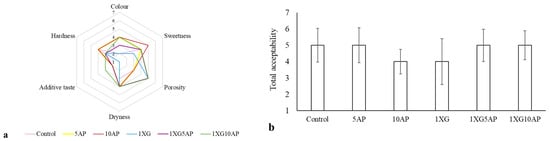
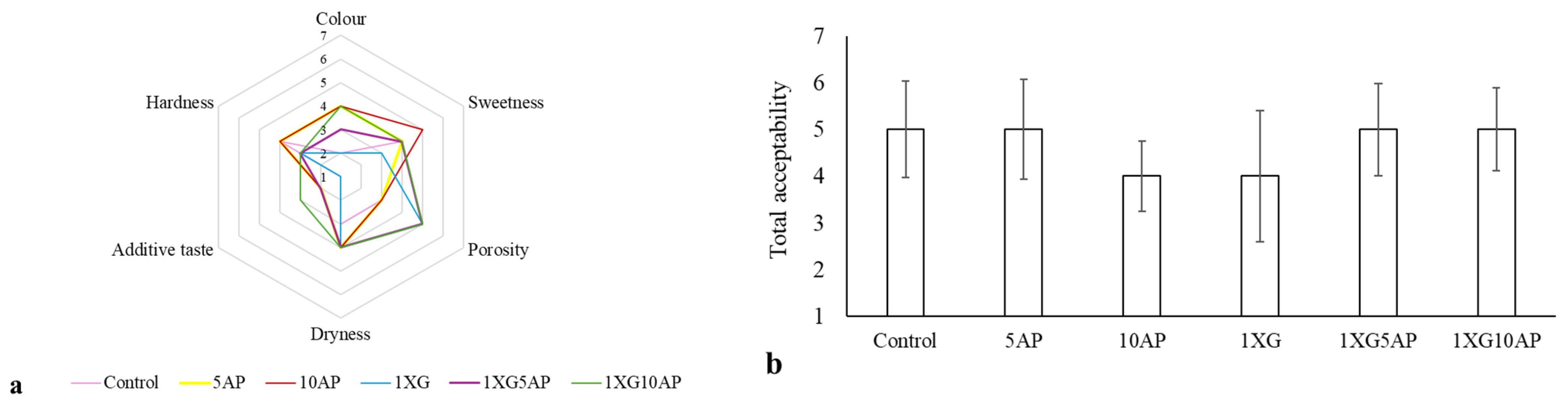
The results of the intensity of sensory attributes are shown in Figure 1a, and the overall acceptability scores are presented in Figure 1b. The addition of XG increased muffin porosity, whereas AP decreased it. Samples 10AP were perceived as the sweetest and had the most pronounced additive-derived flavor. The most porous crumb structure was observed in samples 1XG10AP and 1XG. Muffins formulated with 10AP were perceived as the sweetest, whereas those containing 1XG were rated as the least sweet; both samples received the lowest overall acceptability scores from the sensory panel. Higher hardness was perceived for the muffins formulated with AP and for the control sample. This trend was consistent with the instrumental texture analysis, which likewise showed the highest hardness values for these samples compared with the formulations containing XG. In this study, the visual impact of AP and XG on muffin colour was of primary interest, and colour was therefore assessed as a sensory attribute. The panel rated the muffins containing 10% AP as having the most intense colour, indicating that the level of AP directly affected the perceived colour intensity of the baked products.
Figure 1.
Effect of xanthan gum and apple pomace on gluten free muffin sensory attribute intensity (a) and total acceptability (b). Control—gluten-free formulation without xanthan gum and without apple pomace; 5AP—gluten-free muffins with 5% apple pomace; 10AP—gluten-free muffins with 10% apple pomace; 1XG—gluten-free muffins with 1% xanthan gum (no apple pomace); 1XG5AP—gluten-free muffins with 1% xanthan gum and 5% apple pomace; 1XG10AP—gluten-free muffins with 1% xanthan gum and 10% apple pomace.
Comparable findings have been reported in other studies. Singh et al. [38] observed that gluten-free muffins containing 6% black carrot fiber and 0.5 g XG achieved the highest sensory scores, demonstrating that the combination of XG with a moderate level of fiber can improve sensory quality. Additionally, when AP was incorporated into gluten-free bread formulations, Gumul et al. [47] reported that the addition of AP improved taste and aroma scores relative to the control sample, regardless of the inclusion level. Although the highest AP level (15%) slightly reduced the sensory rating compared with lower levels, it still scored significantly higher than the control bread.
4. Conclusions
The incorporation of apple pomace (5–10%) in gluten-free muffins decreased their height and volume but increased moisture content. Textural properties were influenced by the additive concentration: a 5% apple pomace addition reduced hardness, whereas 10% increased hardness and reduced cohesiveness.
The addition of xanthan gum significantly increased muffin height and volume while reducing hardness, cohesiveness, resilience, and chewiness, indicating its positive effect on the textural properties of gluten-free muffins. In contrast, the incorporation of apple pomace lowered height and volume, and its effect on textural attributes varied according to the level of pomace used. When both xanthan gum and apple pomace were included, the resulting textural characteristics reflected this concentration-dependent behaviour of apple pomace.
Sensory evaluation demonstrated that both xanthan gum and apple pomace altered the perceived quality of the muffins, primarily through their effects on crumb porosity and sweetness intensity. Although formulations with 10% apple pomace and those containing only xanthan gum exhibited the lowest overall acceptability, all muffins remained within an acceptable sensory range, indicating that both ingredients can be incorporated without compromising consumer perception.
Overall, the results show that integrating xanthan gum with apple pomace enables the production of gluten-free muffins with improved technological, nutritional, and sensory properties. These findings support the valorization of fruit-processing by-products as alternative ingredients in gluten-free formulations, contributing to more sustainable product development without compromising consumer acceptance.
Further research could extend the present findings by investigating a wider range of apple pomace and xanthan gum levels to better understand their combined effects on gluten-free muffin quality. In addition, the use of other hydrocolloids, alone or in combination with apple pomace, could be explored to further optimize the textural and structural properties of gluten-free baked products. As the present study focused on selected formulation variants, these findings provide a basis for further research aimed at optimizing gluten-free formulations using fruit by-products and functional ingredients under different quality requirements.
Author Contributions
Conceptualization, L.B. and D.Č.; methodology, D.Č.; software, J.J. and V.M.; validation, J.J. and V.M.; formal analysis, J.J., V.M., D.Č. and L.B.; investigation, V.M.; resources, D.Č.; data curation D.Č.; writing—original draft preparation, V.M., J.J. and D.Č.; writing—review and editing, L.B., D.Č. and J.J.; visualization, J.J. and D.Č.; supervision, D.Č. All authors have read and agreed to the published version of the manuscript.
Funding
This research received no external funding.
Institutional Review Board Statement
This study did not require formal approval by an ethics committee, in accordance with current European regulations on non-invasive consumer research (e.g., Regulation (EU) 2016/679 and the European Code of Conduct for Research Integrity). All procedures involving human participants were conducted in compliance with ISO 6658:2017 Sensory analysis—Methodology—General guidance.
Informed Consent Statement
Informed consent was obtained from all subjects involved in the study.
Data Availability Statement
The original contributions presented in this study are included in the article. Further inquiries can be directed to the corresponding author.
Conflicts of Interest
The authors declare no conflicts of interest.
Abbreviations
The following abbreviations are used in this manuscript:
| AP | Apple pomace |
| XG | Xathan gum |
References
- Lohi, S.; Mustalahti, K.; Kaukinen, K.; Laurila, K.; Collin, P.; Rissanen, H.; Lohi, O.; Bravi, E.; Gasparin, M.; Reunanen, A.; et al. Increasing Prevalence of Coeliac Disease over Time. Aliment. Pharmacol. Ther. 2007, 26, 1217–1225. [Google Scholar] [CrossRef] [Scilit]
- Caio, G.; Volta, U.; Sapone, A.; Leffler, D.A.; De Giorgio, R.; Catassi, C.; Fasano, A. Celiac Disease: A Comprehensive Current Review. BMC Med. 2019, 17, 142. [Google Scholar] [CrossRef] [Scilit]
- Kaliciak, I.; Drogowski, K.; Garczyk, A.; Kopeć, S.; Horwat, P.; Bogdański, P.; Stelmach-Mardas, M.; Mardas, M. Influence of Gluten-Free Diet on Gut Microbiota Composition in Patients with Coeliac Disease: A Systematic Review. Nutrients 2022, 14, 2083. [Google Scholar] [CrossRef] [Scilit]
- Gluten-Free Products Market Size|Industry Report, 2030. Available online: https://www.grandviewresearch.com/industry-analysis/gluten-free-products-market (accessed on 9 November 2025).
- Yano, H. Recent Practical Researches in the Development of Gluten-Free Breads. npj Sci. Food 2019, 3, 7. [Google Scholar] [CrossRef] [Scilit]
- Kupiec, M.; Zbikowska, A.; Marciniak-Lukasiak, K.; Zbikowska, K.; Kowalska, M.; Kowalska, H.; Rutkowska, J. Study on the Introduction of Solid Fat with a High Content of Unsaturated Fatty Acids to Gluten-Free Muffins as a Basis for Designing Food with Higher Health Value. Int. J. Mol. Sci. 2021, 22, 9220. [Google Scholar] [CrossRef] [Scilit]
- Arslan, M.; Rakha, A.; Xiaobo, Z.; Mahmood, M.A. Complimenting Gluten Free Bakery Products with Dietary Fiber: Opportunities and Constraints. Trends Food Sci. Technol. 2019, 83, 194–202. [Google Scholar] [CrossRef] [Scilit]
- Brigagão, T.C.S.; Fortes, R.R.; Lourenço, C.O.; Carvalho, E.E.N.; Cirillo, M.Â.; Nachtigall, A.M.; Vilas Boas, B.M. Optimization of Gluten-free Muffins Made with Pineapple Peel, Banana Peel, and Pumpkin Seed Flours. J. Food Process Preserv. 2021, 45, e16037. [Google Scholar] [CrossRef] [Scilit]
- Marciniak-Lukasiak, K.; Lesniewska, P.; Zielińska, D.; Sowinski, M.; Zbikowska, K.; Lukasiak, P.; Zbikowska, A. The Influence of Chestnut Flour on the Quality of Gluten-Free Bread. Appl. Sci. 2022, 12, 8340. [Google Scholar] [CrossRef] [Scilit]
- Hussain, S.; Jõudu, I.; Bhat, R. Dietary Fiber from Underutilized Plant Resources—A Positive Approach for Valorization of Fruit and Vegetable Wastes. Sustainability 2020, 12, 5401. [Google Scholar] [CrossRef] [Scilit]
- Banerjee, J.; Singh, R.; Vijayaraghavan, R.; MacFarlane, D.; Patti, A.F.; Arora, A. Bioactives from Fruit Processing Wastes: Green Approaches to Valuable Chemicals. Food Chem. 2017, 225, 10–22. [Google Scholar] [CrossRef] [Scilit]
- Tlais, A.Z.A.; Fiorino, G.M.; Polo, A.; Filannino, P.; Cagno, R. Di High-Value Compounds in Fruit, Vegetable and Cereal Byproducts: An Overview of Potential Sustainable Reuse and Exploitation. Molecules 2020, 25, 2987. [Google Scholar] [CrossRef] [Scilit]
- How, Y.H.; Nyam, K.L. Reutilization of Fruit Waste as Potential Prebiotic for Probiotic or Food-Grade Microorganisms in Food Applications: A Review. Probiotics Antimicrob. Proteins 2024, 17, 4314–4339. [Google Scholar] [CrossRef] [Scilit]
- Kandylis, P.; Dimitrellou, D.; Moschakis, T. Recent Applications of Grapes and Their Derivatives in Dairy Products. Trends Food Sci. Technol. 2021, 114, 696–711. [Google Scholar] [CrossRef] [Scilit]
- Jagelavičiutė, J.; Čižeikienė, D.; Bašinskienė, L. Enzymatic Modification of Apple Pomace and Its Application in Conjunction with Probiotics for Jelly Candy Production. Appl. Sci. 2025, 15, 599. [Google Scholar] [CrossRef] [Scilit]
- Shalini, R.; Gupta, D.K. Utilization of Pomace from Apple Processing Industries: A Review. J. Food Sci. Technol. 2010, 47, 365. [Google Scholar] [CrossRef] [Scilit] [PubMed]
- Bhushan, S.; Kalia, K.; Sharma, M.; Singh, B.; Ahuja, P.S. Processing of Apple Pomace for Bioactive Molecules. Crit. Rev. Biotechnol. 2008, 28, 285–296. [Google Scholar] [CrossRef] [Scilit] [PubMed]
- Kauser, S.; Murtaza, M.A.; Hussain, A.; Imran, M.; Kabir, K.; Najam, A.; An, Q.U.; Akram, S.; Fatima, H.; Batool, S.A.; et al. Apple Pomace, a Bioresource of Functional and Nutritional Components with Potential of Utilization in Different Food Formulations: A Review. Food Chem. Adv. 2024, 4, 100598. [Google Scholar] [CrossRef] [Scilit]
- Lyu, F.; Luiz, S.F.; Azeredo, D.R.P.; Cruz, A.G.; Ajlouni, S.; Ranadheera, C.S. Apple Pomace as a Functional and Healthy Ingredient in Food Products: A Review. Processes 2020, 8, 319. [Google Scholar] [CrossRef] [Scilit]
- Ezzat, S.M.; Salama, M.; El Kersh, D.; Salem, M. Apple Pomace as a Source of Nutraceuticals. In Food and Agricultural Byproducts as Important Source of Valuable Nutraceuticals; Springer: Cham, Switzerland, 2022; pp. 75–86. [Google Scholar] [CrossRef] [Scilit]
- Kruczek, M.; Drygas, B.; Habryka, C. Pomace in Fruit Industry and Their Contemporary Potential Application. World Sci. News 2016, 48, 259–265. [Google Scholar]
- Kschonsek, J.; Wolfram, T.; Stöckl, A.; Böhm, V. Polyphenolic Compounds Analysis of Old and New Apple Cultivars and Contribution of Polyphenolic Profile to the In Vitro Antioxidant Capacity. Antioxidants 2018, 7, 20. [Google Scholar] [CrossRef] [Scilit]
- Lu, Q.; Liu, H.; Wang, Q.; Liu, J. Sensory and Physical Quality Characteristics of Bread Fortified with Apple Pomace Using Fuzzy Mathematical Model. Int. J. Food Sci. Technol. 2017, 52, 1092–1100. [Google Scholar] [CrossRef] [Scilit]
- Raczkowska, E.; Wojdyło, A.; Nowicka, P. Effect of the Addition of Apple Pomace and Erythritol on the Antioxidant Capacity and Antidiabetic Properties of Shortbread Cookies. Pol. J. Food Nutr. Sci. 2024, 74, 147–161. [Google Scholar] [CrossRef] [Scilit]
- Patel, A.; Naik, S.N.; Satya, S.; Ghodki, B.M.; Jana, S.; Sharma, P. Utilization of Industrial Waste of Amla and Apple Pomace for Development of Functional Biscuits: Physical, Microstructural, and Macroscopic Properties. J. Food Process Preserv. 2022, 46, e16835. [Google Scholar] [CrossRef] [Scilit]
- Sudha, M.L.; Baskaran, V.; Leelavathi, K. Apple Pomace as a Source of Dietary Fiber and Polyphenols and Its Effect on the Rheological Characteristics and Cake Making. Food Chem. 2007, 104, 686–692. [Google Scholar] [CrossRef] [Scilit]
- Masoodi, F.A.; Chauhan, G.S. Use of Apple Pomace as a Source of Dietary Fiber in Wheat Bread. J. Food Process Preserv. 1998, 22, 255–263. [Google Scholar] [CrossRef] [Scilit]
- Gómez, M.; Martinez, M.M. Fruit and Vegetable By-Products as Novel Ingredients to Improve the Nutritional Quality of Baked Goods. Crit. Rev. Food Sci. Nutr. 2018, 58, 2119–2135. [Google Scholar] [CrossRef] [Scilit]
- Elleuch, M.; Bedigian, D.; Roiseux, O.; Besbes, S.; Blecker, C.; Attia, H. Dietary Fibre and Fibre-Rich by-Products of Food Processing: Characterisation, Technological Functionality and Commercial Applications: A Review. Food Chem. 2011, 124, 411–421. [Google Scholar] [CrossRef] [Scilit]
- Jagelaviciute, J.; Staniulyte, G.; Cizeikiene, D.; Basinskiene, L. Influence of Enzymatic Hydrolysis on Composition and Technological Properties of Apple Pomace and Its Application for Wheat Bread Making. Plant Foods Hum. Nutr. 2023, 78, 307–313. [Google Scholar] [CrossRef] [Scilit]
- Piluk, P.; Khemthong, C.; Chupeerach, C.; Suttisansanee, U.; Chamchan, R.; Thangsiri, S.; On-nom, N. Development and Characterization of High Protein and Fiber Gluten Free Bread Formulations from Egg White Powder and Resistant Starch. LWT 2025, 227, 117984. [Google Scholar] [CrossRef] [Scilit]
- Regulation—1169/2011—EN—Food Information to Consumers Regulation—EUR-Lex. Available online: https://eur-lex.europa.eu/eli/reg/2011/1169/oj/eng (accessed on 23 August 2025).
- ISO 6658; Sensory Analysis—Methodology—General Guidance. ISO: Geneva, Switzerland, 2017.
- Belorio, M.; Gómez, M. Gluten-Free Muffins versus Gluten Containing Muffins: Ingredients and Nutritional Differences. Trends Food Sci. Technol. 2020, 102, 249–253. [Google Scholar] [CrossRef] [Scilit]
- Arslan, M.; Rakha, A.; Khan, M.R.; Zou, X. Complementing the Dietary Fiber and Antioxidant Potential of Gluten Free Bread with Guava Pulp Powder. J. Food Meas. Charact. 2017, 11, 1959–1968. [Google Scholar] [CrossRef] [Scilit]
- O’Shea, N.; Rößle, C.; Arendt, E.; Gallagher, E. Modelling the Effects of Orange Pomace Using Response Surface Design for Gluten-Free Bread Baking. Food Chem. 2015, 166, 223–230. [Google Scholar] [CrossRef] [Scilit] [PubMed]
- Irondi, E.A.; Imam, Y.T.; Ajani, E.O.; Alamu, E.O. Natural and Modified Food Hydrocolloids as Gluten Replacement in Baked Foods: Functional Benefits. Grain Oil Sci. Technol. 2023, 6, 163–171. [Google Scholar] [CrossRef] [Scilit]
- Singh, J.P.; Kaur, A.; Singh, N. Development of Eggless Gluten-Free Rice Muffins Utilizing Black Carrot Dietary Fibre Concentrate and Xanthan Gum. J. Food Sci. Technol. 2016, 53, 1269–1278. [Google Scholar] [CrossRef] [Scilit]
- Ai, J.; Witt, T.; Cowin, G.; Dhital, S.; Turner, M.S.; Stokes, J.R.; Gidley, M.J. Anti-Staling of High-Moisture Starchy Food: Effect of Hydrocolloids, Emulsifiers and Enzymes on Mechanics of Steamed-Rice Cakes. Food Hydrocoll. 2018, 83, 454–464. [Google Scholar] [CrossRef] [Scilit]
- Culetu, A.; Duta, D.E.; Papageorgiou, M.; Varzakas, T. The Role of Hydrocolloids in Gluten-Free Bread and Pasta; Rheology, Characteristics, Staling and Glycemic Index. Foods 2021, 10, 3121. [Google Scholar] [CrossRef] [Scilit]
- Bas-Bellver, C.; Barrera, C.; Betoret, N.; Seguí, L.; Harasym, J. IV-Range Carrot Waste Flour Enhances Nutritional and Functional Properties of Rice-Based Gluten-Free Muffins. Foods 2024, 13, 1312. [Google Scholar] [CrossRef] [Scilit]
- Pecyna, A.; Krzywicka, M.; Buczaj, A.; Blicharz-Kania, A.; Kobus, Z. The Effect of Fruit Pomace Addition on the Color, Texture and Sensory Properties of Gluten-Free Bread. Sci. Rep. 2025, 15, 24510. [Google Scholar] [CrossRef] [Scilit]
- Kırbaş, Z.; Kumcuoglu, S.; Tavman, S. Effects of Apple, Orange and Carrot Pomace Powders on Gluten-Free Batter Rheology and Cake Properties. J. Food Sci. Technol. 2019, 56, 914–926. [Google Scholar] [CrossRef] [Scilit]
- Walker, R.; Tseng, A.; Cavender, G.; Ross, A.; Zhao, Y. Physicochemical, Nutritional, and Sensory Qualities of Wine Grape Pomace Fortified Baked Goods. J. Food Sci. 2014, 79, S1811–S1822. [Google Scholar] [CrossRef] [Scilit]
- Bianchi, F.; Cervini, M.; Giuberti, G.; Rocchetti, G.; Lucini, L.; Simonato, B. Distilled Grape Pomace as a Functional Ingredient in Vegan Muffins: Effect on Physicochemical, Nutritional, Rheological and Sensory Aspects. Int. J. Food Sci. Technol. 2022, 57, 4847–4858. [Google Scholar] [CrossRef] [Scilit]
- Bchir, B.; Jean-François, T.; Rabetafika, H.N.; Blecker, C. Effect of Pear Apple and Date Fibres Incorporation on the Physico-Chemical, Sensory, Nutritional Characteristics and the Acceptability of Cereal Bars. Food Sci. Technol. Int. 2018, 24, 198–208. [Google Scholar] [CrossRef] [Scilit]
- Gumul, D.; Ziobro, R.; Korus, J.; Kruczek, M. Apple Pomace as a Source of Bioactive Polyphenol Compounds in Gluten-Free Breads. Antioxidants 2021, 10, 807. [Google Scholar] [CrossRef] [Scilit]

Disclaimer/Publisher’s Note: The statements, opinions and data contained in all publications are solely those of the individual author(s) and contributor(s) and not of MDPI and/or the editor(s). MDPI and/or the editor(s) disclaim responsibility for any injury to people or property resulting from any ideas, methods, instructions or products referred to in the content. |
© 2026 by the authors. Licensee MDPI, Basel, Switzerland. This article is an open access article distributed under the terms and conditions of the Creative Commons Attribution (CC BY) license.