


Abstract
Underwater sensor networks (USNs) are essential for marine exploration and monitoring, yet their performance is limited by transmission reliability in complex underwater environments. Underwater acoustic (UWA) transmission offers a practical solution, with orthogonal frequency division multiplexing (OFDM) extensively adopted for its high data rate and multiple access capability. However, OFDM is extremely vulnerable to Doppler-induced distortions, which degrade demodulation performance. Conventional cross-ambiguity function (CAF) methods estimate Doppler through signal-level correlation, but achieving high accuracy requires long training sequences, thus incurring frame overhead and reducing effective data rates. To address this issue, a novel bit-level correlation (BLC) Doppler estimation algorithm enables accurate estimation with diminished training overhead. A tailored OFDM frame uses the first two OFDM symbols, modulated with M-sequences, as training sequences. Demodulated bits are correlated with a local M-sequence via vector inner-product computation, converting correlation from the signal level to the bit level. Numerical simulations under three Doppler scales demonstrate the effectiveness of the BLC algorithm. By correlating the demodulated training bits with a local M-sequence reference, the proposed algorithm provides a favorable trade-off between training overhead and estimation accuracy under the tested simulation conditions.
1. Introduction
Recent advances in oceanographic exploration and maritime security have positioned underwater sensor networks (USNs) at the forefront of marine technology [1]. USNs are increasingly deployed in diverse sophisticated applications, such as real-time seafloor seismic monitoring, surveillance of offshore oil and gas infrastructure, and coordinated deployment of autonomous underwater vehicles (AUVs) [2,3,4]. Unlike terrestrial wireless networks, the operational reliability of USNs is fundamentally constrained by the instability of underwater acoustic (UWA) communication links. In particular, the low sound propagation speed, coupled with time-varying boundary reflections, results in a channel environment characterized by severe frequency-selective fading and significant propagation delay [5,6].
Driven by the increasing demand for high-data-rate transmission and reliable multi-user access in these dynamic networks, orthogonal frequency division multiplexing (OFDM) has become a prominent physical-layer technology [7,8]. It partitions the available bandwidth into multiple overlapping orthogonal subcarriers, mitigating inter-symbol interference (ISI) from multipath delays that can extend to tens of milliseconds in shallow water [9,10]. However, the inherent multi-carrier structure of OFDM renders it particularly sensitive to Doppler-induced distortions.
Relative motion in USNs is ubiquitous—from the intentional maneuvers of AUV to uncontrolled stochastic drift of sensor nodes caused by currents and internal waves [11]. This motion produces a wideband time-scaling effect, which destroys subcarrier orthogonality. Even minor Doppler scales induce severe inter-carrier interference (ICI), drastically reducing the signal-to-interference-plus-noise ratio (SINR) and causing demodulation failure [12,13,14]. Hence, accurate Doppler estimation and compensation are indispensable for achieving resilient and high-capacity UWA OFDM communications.
To mitigate the adverse Doppler-induced effects: a number of methodologies have been extensively developed. Conventional approaches typically employ linear frequency modulation (LFM) or hyperbolic frequency modulation (HFM) signals as frame delimiters [15,16]. The Doppler factor is estimated by quantifying the temporal compression or expansion between the preamble and postamble. Although HFM preambles provide greater Doppler invariance, these pulse-timing methods necessitate the full-frame reception prior to estimation, rendering them less suitable for real-time applications. Furthermore, their accuracy is also compromised in diffuse multipath environments due to ambiguous correlation peak identification [17,18].
A common method inserts a signal with a known frequency into the transmitted waveform. The receiver measures the frequency deviation to estimate the Doppler factor [19]. Its estimation accuracy is limited by the Fast Fourier Transform (FFT) resolution, prompting the development of partial FFT and fractional Fourier Transform to improve accuracy and reduce computational cost [20,21].
In OFDM systems, a common strategy is to employ null subcarriers for constructing a Doppler estimation cost function. By separating the carrier frequency shift into integer and fractional components, the computational cost of this strategy is reduced [22]. Additionally, employing Discrete Fourier Transform (DFT) to compute the aggregate energy on null subcarriers mitigates the local extrema issues inherent in such estimation strategies [23].
The single-branch auto-correlation (SBA) approach leverages periodic signal structures to detect Doppler factor by evaluating changes in temporal periodicity. Although offering lower complexity, SBA is inherently limited to constant-velocity scenarios [24,25]. To handle time-varying Doppler, the multi-branch auto-correlation (MBA) algorithm has been developed to provide improved robustness against multipath interference [26,27].
An alternative is to evaluate candidate compensation through the resulting demodulation decisions. Li et al [28] proposed a bit-error-rate (BER) search method that resamples and demodulates a known training sequence for each Doppler candidate and selects the candidate yielding the lowest training BER. This method establishes an approach to bit-level Doppler estimation based on the minimum bit-error-rate (MBER) criterion. This work demonstrates that demodulated training bit decisions can serve as an alternative to signal-level correlation Doppler estimation.
Signal-correlation-based approaches evaluate Doppler candidates by measuring the similarity between a received signal and a local reference signal. In particular, cross-ambiguity function (CAF) estimation searches for a peak over trial delays and Doppler parameters [29,30]. In multipath channels, several arrivals can contribute to the correlation response, complicating peak selection. The computational cost also depends on the observation length, search grid, and correlation implementation [31]. To reduce the search burden of conventional CAF, the cross-correlation quasi-gradient (CCQG) Doppler estimation method uses a quasi-gradient search to update the Doppler estimate instead of performing an exhaustive fine-grid search. Although CCQG reduces the search burden, its candidate metric remains based on signal-level cross-correlation [32,33,34].
To address this issue, based on the use of demodulated training bits, this paper proposes a novel bit-level correlation (BLC) Doppler estimation algorithm that transforms conventional signal-level correlation into a bit-level vector inner-product correlation via a tailored OFDM frame structure. Two OFDM symbols modulated by M-sequence serve as training sequence for Doppler estimation. The binary sequence obtained from demodulating the first two OFDM symbols are correlated with the local M-sequence vector using vector inner-product operations. Whereas CAF evaluates Doppler candidates through signal-level correlation and CCQG reduces the search burden by applying a quasi-gradient update to the same type of correlation metric, the BER search method selects the candidate that yields the lowest training BER. In contrast, BLC selects the candidate that yields the largest bit-level correlation metric between the recovered training-bit sequence and the local reference M-sequence. Numerical simulations under three distinct Doppler scales were employed to evaluate the effectiveness under the tested simulation conditions of the proposed BLC Doppler estimation algorithm.
2. Signal Model and Doppler Estimation Algorithms
2.1. Signal Model
The transmitted signal of one cyclic prefix (CP) OFDM block is formulated as
where is the k-th subcarrier symbol in the OFDM symbol, and K is the number of subcarriers. Let represent the center frequency. The frequency of the k-th subcarrier is written as
where is the duration of the OFDM symbol. is defined as a rectangular window including a CP and one basic OFDM symbol duration given by
where is the CP duration.
The UWA channel can be modeled as a time-varying multipath channel, and its impulse response is written as
where and denote the time-varying amplitude response and delay of the p-th path, respectively, and P represents the number of identifiable multipaths.
Assume the amplitude response of the p-th path experiences slow variation so that within one OFDM symbol duration, and further suppose a common Doppler factor so that ; Equation (4) is approximated as
where is considered as a constant within one OFDM symbol. Within one OFDM symbol, the channel coherence time exceeds the symbol duration, so treating the Doppler factor as constant over a single symbol is a reasonable approximation for the setup used here.
Let the CP-OFDM signal frame pass through the multipath channel described in Equation (5). The received passband signal is formulated as
where represents the additive white Gaussian noise (AWGN). After downconversion, the received baseband OFDM signal is expressed as
where denotes the baseband AWGN. According to these derivations, the primary challenge in suppressing the Doppler effects is to mitigate the impact of for enabling reliable UWA OFDM communications.
2.2. CAF Doppler Estimation Strategy
The CAF for accomplishing Doppler estimation is defined as
where denotes the complex conjugate operation. Let , the Doppler estimation formulate using the CAF is expressed as
where denotes the predefined Doppler search range. In conclusion, the desired Doppler shift is written as
From Equations (8) and (9), we can see that the CAF estimation strategy computes the CAF between the received signal and a local reference, determining the Doppler factor by locating the peak value in the two-dimensional delay-Doppler plane. However, in practical UWA channels, multipath propagation often produces multiple correlation peaks, which complicates the identification of the true Doppler-related peak. Furthermore, improving estimation accuracy generally requires long training signals, leading to significant signal frame overhead. However, a reduction in training length does not necessarily imply a reduction in the computational cost of the complete Doppler search procedure. The computational complexity of this issue is discussed in detail in Section 3.3.
2.3. BLC Doppler Estimation Algorithm
This section presents a novel BLC Doppler estimation algorithm that transforms conventional signal-level correlation operations into the bit-level processing with a tailored OFDM frame structure. The first two OFDM symbols modulated by M-sequence in the transmitted signal frame are employed as training sequences. The M-sequence is generated using a primitive polynomial and exhibits strong autocorrelation characteristics. Its recurrence relation is expressed as
where is the binary sequence element, is the coefficient of the primitive polynomial, and m denotes the number of shift register stages. For a m-stage shift register, the sequence period is given by
Its periodic autocorrelation function satisfies
where denotes the shift or lag of the M-sequence. As described in Equation (13), this property characterizes the ideal M-sequence reference. In BLC, the candidate metric is computed from the recovered training bits, so its behavior also depends on Doppler compensation and differential demodulation.
The cost function for the BLC Doppler estimation algorithm based on vector inner-product correlation is mathematically represented as
where is the local reference M-sequence vector, and denotes the binary vector obtained by demodulating the first two OFDM symbols from the received signal, which is formulated as
where is the conversion function that converts the quaternary sequence into a binary sequence, is defined as the decision function given by
where denotes the phase information of subcarriers in the OFDM symbol, and P represents the recovered phase information matrix expressed as
where indicates the extraction function of phase information on each subcarrier, and F denotes the DFT matrix given by
and E represents the Doppler vector of subcarriers expressed as
Here, is the pre-set Doppler shift, and B denotes the signal bandwidth, which can be written as
where is the frequency interval of adjacent subcarriers.
Let represent the predefined Doppler search window, the inner-product correlation results corresponding to different candidate Doppler shifts is expressed as
where represents the number of searches, and denotes the search step size. As a result, the desired Doppler is determined by maximizing Equation (21) and is given by
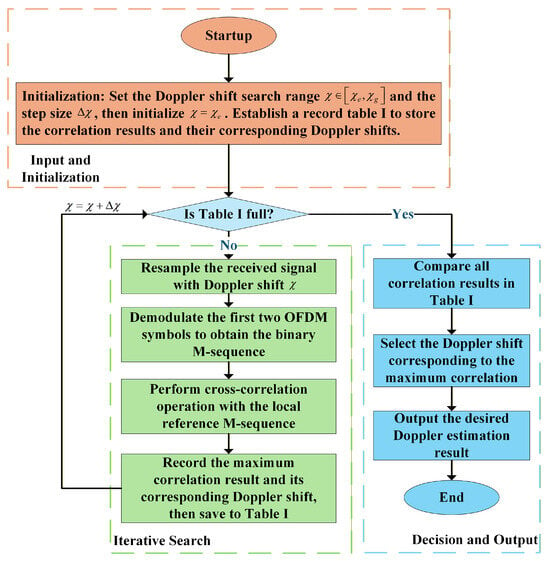
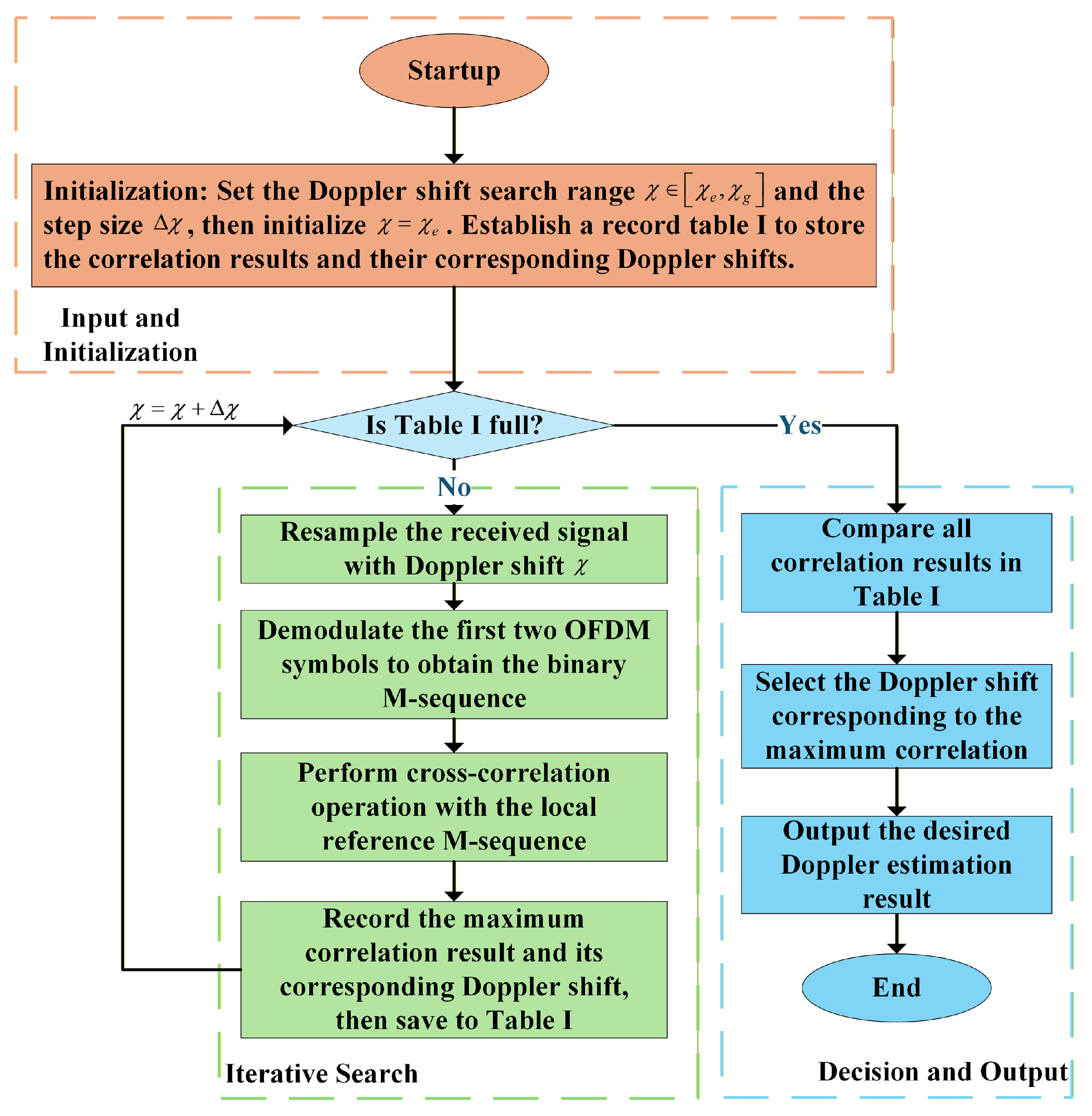
At the receiver, the acquired OFDM signal frame is processed as follows. First, the received signal is resampled over a predefined Doppler search range. For each resampling instance, the first two OFDM symbols are demodulated into the binary bit sequences. Second, a vector inner-product correlation is computed between the demodulated bit vector and the local reference M-sequence vector. This procedure substitutes conventional signal-level correlation with a bit-level vector inner-product correlation, maintaining consistency with the demodulation process.
The key reason why BLC can suppress multipath ambiguity is that multipath components are processed before the correlation operation. In CAF, delayed path components are directly correlated with the local signal and may generate multiple delay-dependent correlation responses. For each candidate Doppler, the received signal is resampled, synchronized, and demodulated with differential detection before the recovered training bits are correlated with the local M-sequence. The resulting bit-level correlation is therefore calculated from the recovered training bits rather than from the superimposed multipath signal. When the CP covers the effective delay spread and the channel varies slowly over the differential detection interval, the multipath delays are mainly represented through the subcarrier channel response, while their residual influence is reflected in the training-bit decisions. The M-sequence provides a distinguishable reference structure, so a candidate that produces training bits more consistent with the reference generally obtains a larger correlation metric. Thus, under the adopted CP-OFDM receiver and the simulated channel conditions, BLC suppress the direct contribution of delayed multipath components to the Doppler-search metric.
The detailed implementation process of the proposed BLC algorithm is illustrated in Figure 1. The root mean square error (RMSE) of Doppler estimates and the BER of the demodulated signals serve as performance indicators for evaluating the proposed BLC Doppler estimation strategy.
Figure 1.
Flowchart of the proposed BLC Doppler estimation algorithm.
The RMSE for Doppler estimation is defined as
where and denote the true and estimated Doppler value, respectively, and n is the number of samples.
3. Numerical Simulations and Discussion
3.1. Numerical Simulations
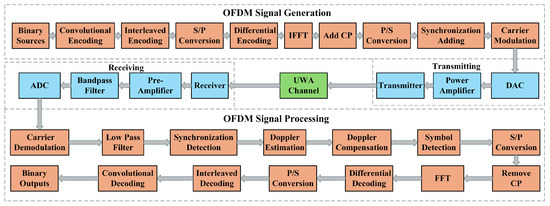
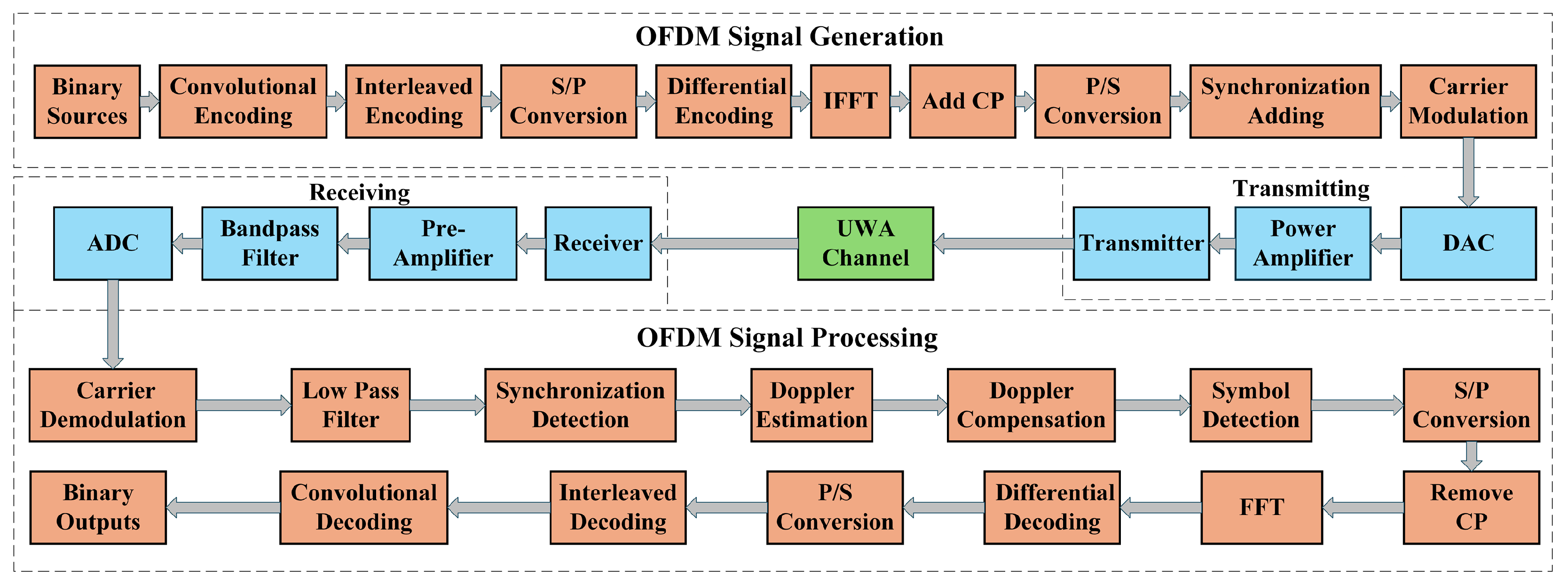
All simulations were implemented in MATLAB R2025b. Numerical simulations were conducted to evaluate the performance of the proposed BLC Doppler estimation algorithm in a simulated UWA multipath channel, compared with conventional block estimation, CAF estimation and CCQG estimation strategies. To circumvent the computational overhead associated with channel estimation and equalization, a classical time-frequency differential OFDM receiver is employed to demodulate the first two OFDM symbols of the signal frame, based on the phase difference between adjacent subcarriers and symbols.
The adopted UWA OFDM receiver structure is illustrated in Figure 2, with OFDM signal generation and processing sections shown in the upper and lower halves, respectively. From Figure 2 we can notice that the procedure for OFDM signal processing is opposite to that of OFDM signal generation in order. The BER and RMSE results from this receiver were adopted as a criterion to appraise the performance of the three methods.
Figure 2.
Block diagram of classical time-frequency differential UWA OFDM communication system.
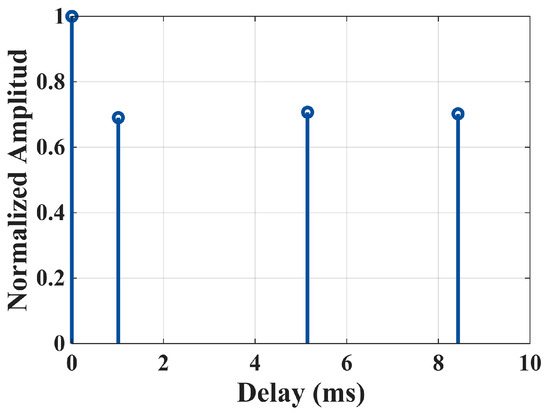
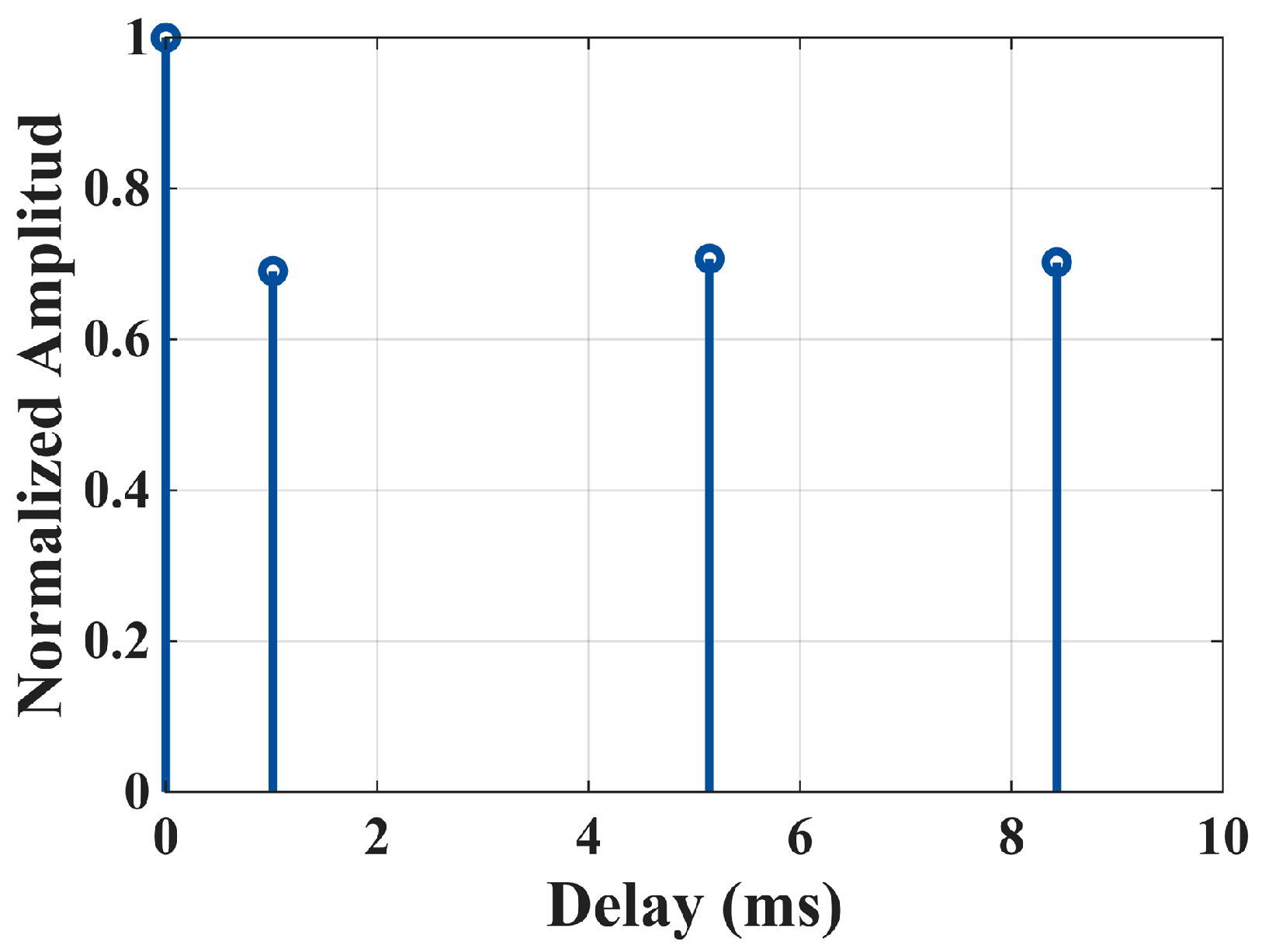
In numerical simulations, the BELLHOP toolbox was employed to simulate the UWA multipath channel. The water depth was set to 25 m, with a horizontal distance of 1000 m between the transmitter and receiver, and both transducers were deployed at a depth of 8 m. The sound speed profile exhibited a positive gradient, ranging from 1540 m/s to 1543 m/s. The underwater medium was homogeneous, with a flat sea surface and seabed. The simulated channel impulse response exhibited four dominant paths with a total delay spread of approximately 8.4 ms, as shown in Figure 3.
Figure 3.
Simulated channel impulse responses.
Bandpass noise at various levels was injected as additive noise, and the signal-to-noise ratio (SNR) is defined as
where and denote the amplitudes of the transmitted OFDM signal and the passband noise signal, respectively.
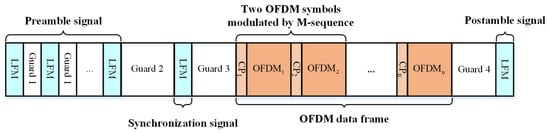
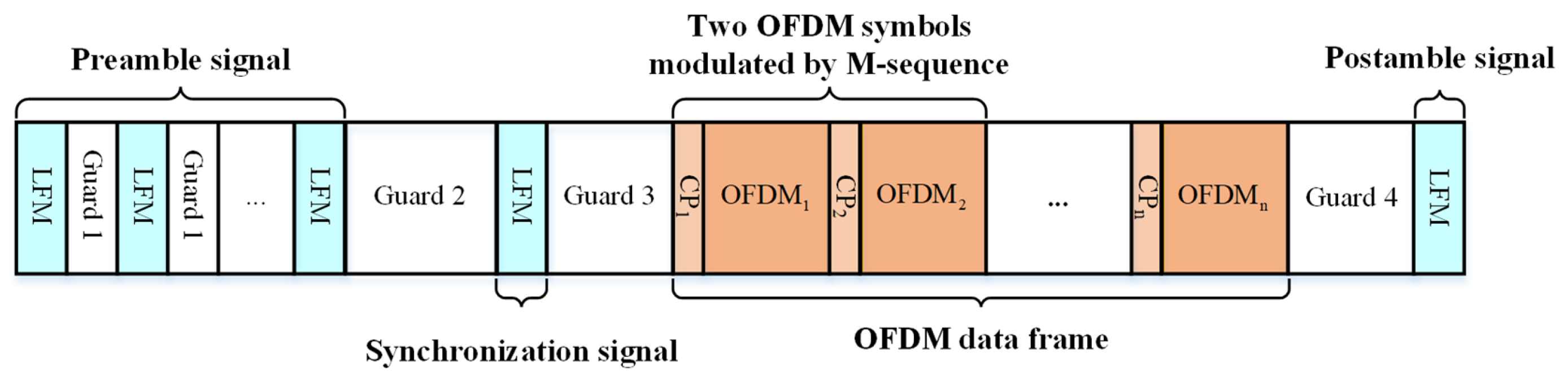
The OFDM frame structure that includes preamble, guard intervals, synchronization, training sequence, OFDM data frame and postamble is illustrated in Figure 4, with the corresponding signal parameters provided in Table 1. The preamble, synchronization and postamble signals are LFM signals, with a duration of 17.71 ms and frequency range of 21,000–29,000 Hz. Specifically, the synchronization LFM and postamble LFM signals are inserted before and after the OFDM data frame for the block Doppler estimation. The training sequence including two consecutive OFDM symbols preceding the OFDM data frame was modulated by an M-sequence for the CAF estimation, CCQG estimation and the proposed BLC estimation algorithms.
Figure 4.
Transmitted signal frame structure.
Table 1.
Simulation parameters.
To evaluate the performance of the proposed BLC Doppler estimation algorithm under different Doppler scales, Doppler shifts of 10 Hz, 25 Hz and 40 Hz were introduced by artificial resampling. The search step size was set to 0.01 Hz. Block estimation, CAF estimation using two and four OFDM training symbols, CCQG estimation, and the proposed BLC estimation methods were included in the performance comparison. The estimated Doppler values were then used to compensate the OFDM data frame. Finally, the time-frequency differential demodulation was performed on the OFDM symbols to acquire BER results for performance evaluation. For each SNR and Doppler condition, 200 Monte Carlo trials were performed, with the transmitted frame and simulated channel impulse response held fixed across trials. In each trial, an independent white Gaussian noise sequence was generated using MATLAB’s randn function, passed through a finite impulse response (FIR) bandpass filter, and scaled to achieve the target SNR before being added to the channel output. Each trial included Doppler estimation, Doppler compensation, and data demodulation and decoding. Furthermore, convolutional coding was employed to further enhance the demodulation performance.
Pointwise 95% confidence intervals were obtained from 10,000 nonparametric bootstrap resamples of the 200 trials for each method, SNR, and Doppler condition. The mean BER and RMSE were recalculated for each resample, and the 2.5th and 97.5th percentiles served as the interval limits. These intervals quantify the statistical uncertainty under the fixed transmitted frame and simulated channel conditions.
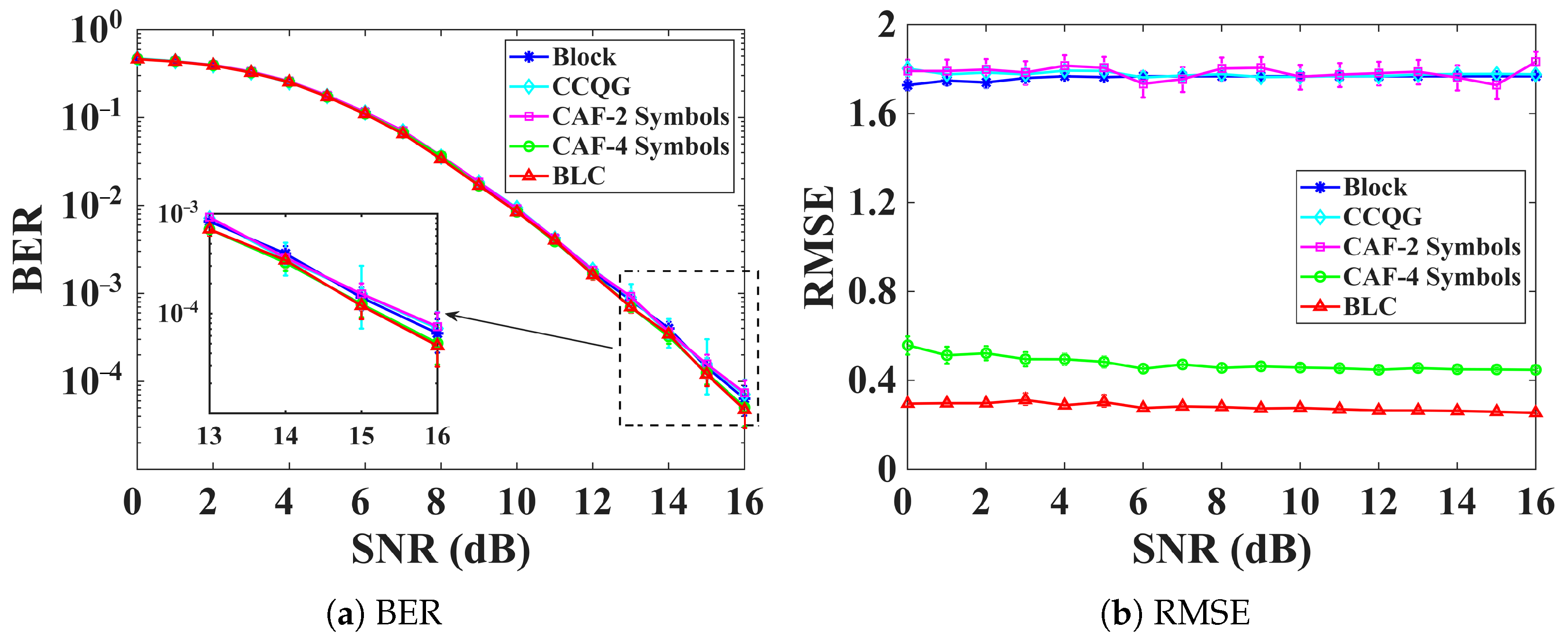
Figure 5 illustrates the BER and RMSE performance of the four algorithms under a small-scale Doppler shift of 10 Hz. As shown in Figure 5a, the BER results of all methods decrease as the SNR increases. While the four algorithms perform similarly at low SNR levels, the proposed BLC algorithm achieves slightly lower BER values than the block estimation, CAF estimation and CCQG estimation methods as SNR increases. In Figure 5b, under the same SNR conditions, the RMSE of the CAF algorithm using two OFDM symbols is comparable to that of the block estimation and CCQG estimation method, while the CAF algorithm using four OFDM symbols fluctuates around 0.48. By contrast, the proposed BLC algorithm attains a lower RMSE of 0.31. Error bars indicate pointwise 95% confidence intervals based on 200 trials.
Figure 5.
The BER and RMSE with respect to SNR (10 Hz).
Under a medium-scale Doppler shift of 25 Hz, the performance comparison is shown in Figure 6. As observed in Figure 6a, all methods exhibit consistent BER performance under low SNR conditions. At high SNR levels, the proposed BLC algorithm maintains marginally better BER performance relative to the block estimation, CAF estimation and CCQG estimation approaches. In Figure 6b, the CAF algorithm with either two or four OFDM training symbols and CCQG method yield the high RMSE, while the block estimation method remains stable at approximately 0.50. Notably, the proposed BLC algorithm reaches a maximum RMSE of 0.33.
Figure 6.
The BER and RMSE with respect to SNR (25 Hz).
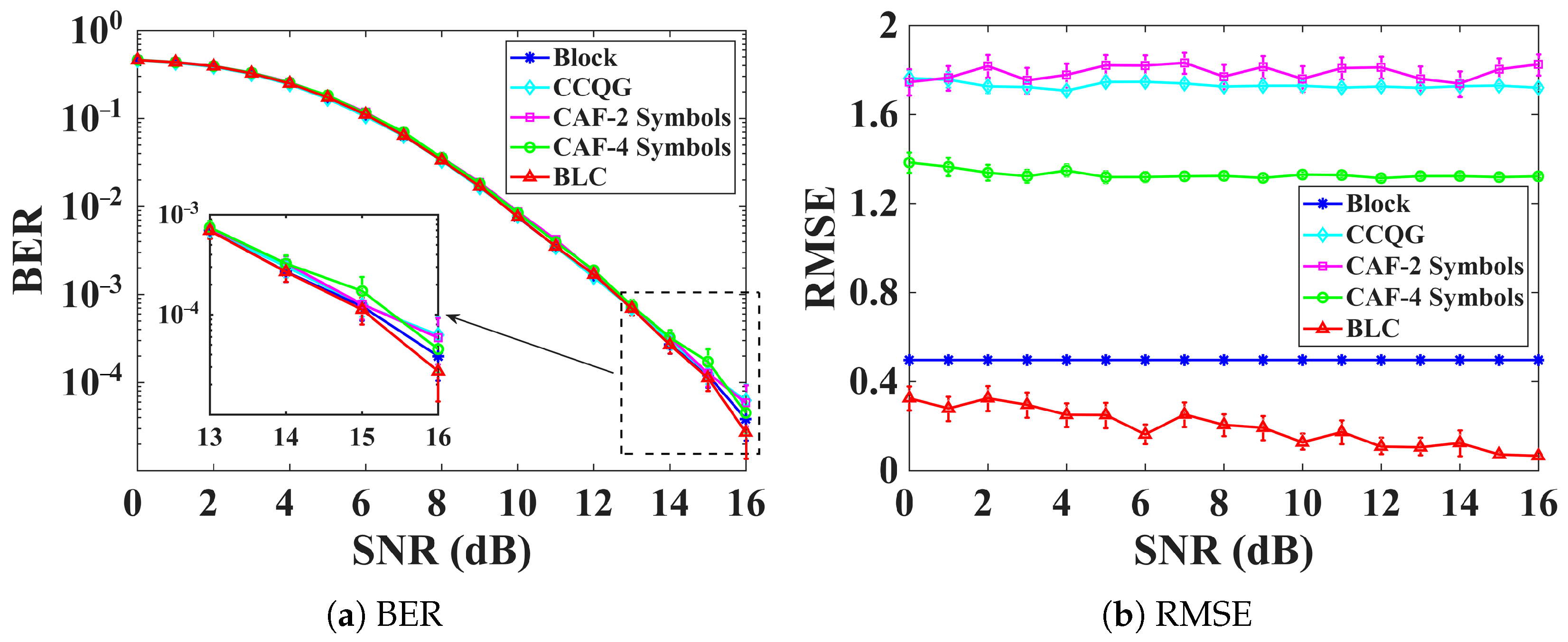
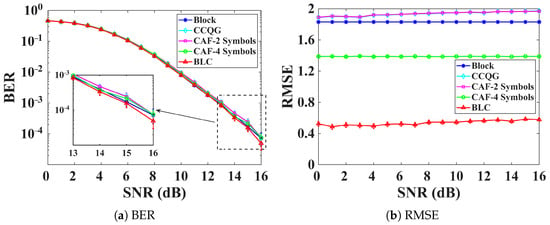
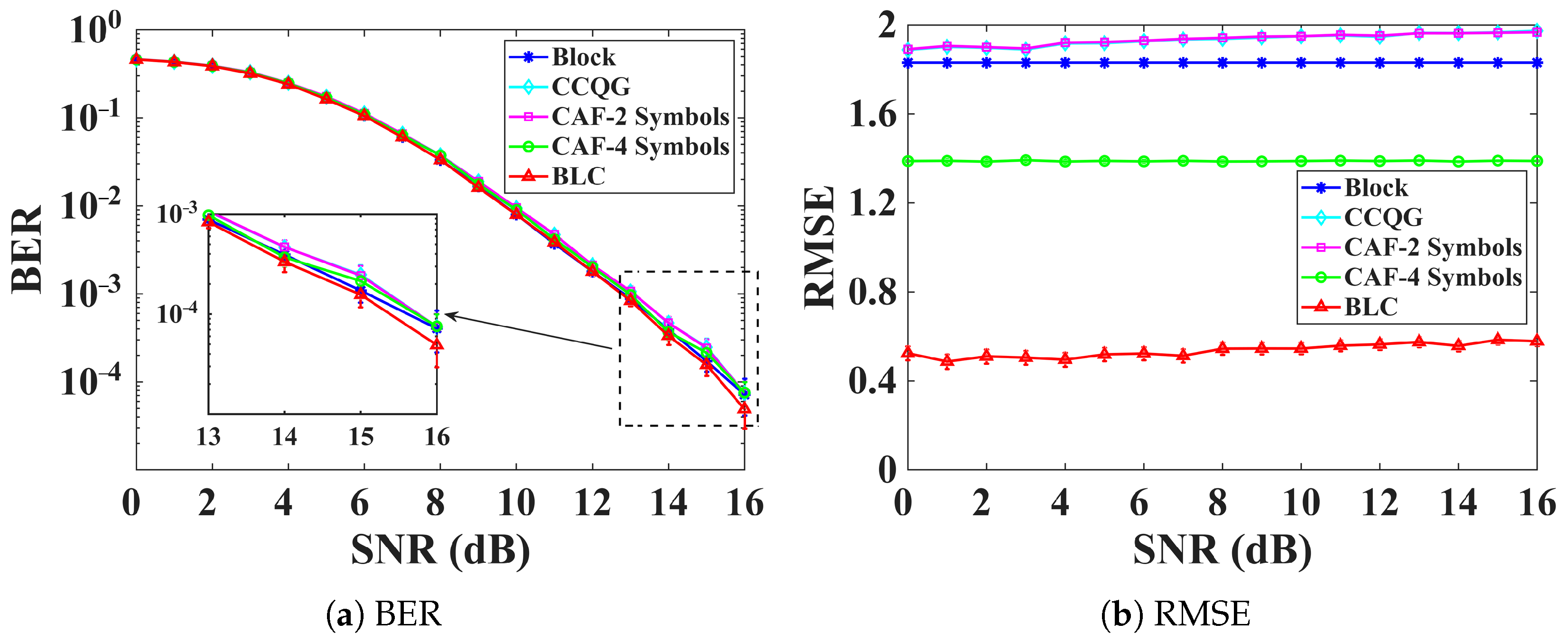
Under a large-scale Doppler shift of 40 Hz, the performance comparison is presented in Figure 7. As shown in Figure 7a, the BER results of all methods decrease with increasing SNR. All methods exhibit similar BER performance at low SNR levels, while the proposed BLC algorithm generally yields lower plotted BER as the SNR increases. In Figure 7b, the block, CAF with two OFDM training symbols, CCQG methods yield the high RMSE, while the CAF estimation with four OFDM symbols maintains an RMSE of approximately 1.39. By contrast, the proposed BLC algorithm achieves the lowest RMSE, ranging from approximately 0.49 to 0.58. These results further demonstrate the effectiveness of the proposed BLC algorithm.
Figure 7.
The BER and RMSE with respect to SNR (40 Hz).
Across Figure 5, Figure 6 and Figure 7, the upper limits of the pointwise 95% RMSE confidence intervals for BLC remain below the lower limits for the compared methods at all tested SNRs. This supports the observed separation in Doppler estimation accuracy under the simulated conditions. The BER confidence intervals overlap at high SNRs, indicating greater uncertainty in the relatively small differences in mean BER. Some intervals are obscured by the plotting markers because of their small width.
In conclusion, the above results indicate that the proposed BLC Doppler estimation algorithm achieves high estimation accuracy both in small-scale, medium-scale and large-scale Doppler scenarios. Moreover, the proposed BLC algorithm yields improved BER performance compared to the other three methods, particularly at high SNR levels. In summary, the proposed BLC algorithm accomplishes accurate Doppler estimation using only two OFDM symbols as the training sequence, thereby enhancing estimation accuracy while reducing signal frame overhead.
Furthermore, rapid channel variations and deep attenuation may cause training bit errors and reduce the discriminability of the candidate correlation metrics. Timing offsets within the effective CP interval can be tolerated, while larger offsets may cause inter-symbol and inter-carrier interference and affect training bit recovery. In addition, when different paths exhibit different Doppler scales, or the intra-frame scale changes significantly, a single unified compensation scale may still retain Doppler distortion. These factors may affect the selected Doppler estimates and the subsequent data demodulation.
3.2. Impact of the Training Sequence Length on Performance
Following the evaluation of the two-symbol baseline configuration, the influence of the M-sequence length on Doppler estimation performance is investigated herein to guide practical system configuration. In the adopted OFDM framework, each symbol contains 170 data subcarriers, with two bits mapped onto each data subcarrier, yielding a capacity of 340 training bits per OFDM symbol. For the 511-bit configuration, 169 padding bits are appended to form a 680-bit training vector, which is mapped onto two consecutive OFDM symbols.
For the 1023-bit configuration, the first 1020 bits of the M-sequence are used to form the training vector, which is mapped onto three consecutive OFDM symbols. In both configurations, the first training symbol also serves as the differential reference for subsequent demodulation. Therefore, the two-symbol training structure applies specifically to the 511-bit baseline configuration and is not maintained in the 1023-bit configuration.
The difference in training symbol allocation also affects transmission overhead. With an IFFT length of 4096, a CP of 1024 samples, and a sampling frequency of 96 kHz, the duration of each OFDM symbol, including the CP, is 53.33 ms. Accordingly, the training durations of the 511-bit and 1023-bit configurations are 106.67 ms and 160.00 ms, respectively. The 1023-bit configuration therefore requires one additional OFDM training symbol, increasing the training duration by 53.33 ms relative to the baseline.
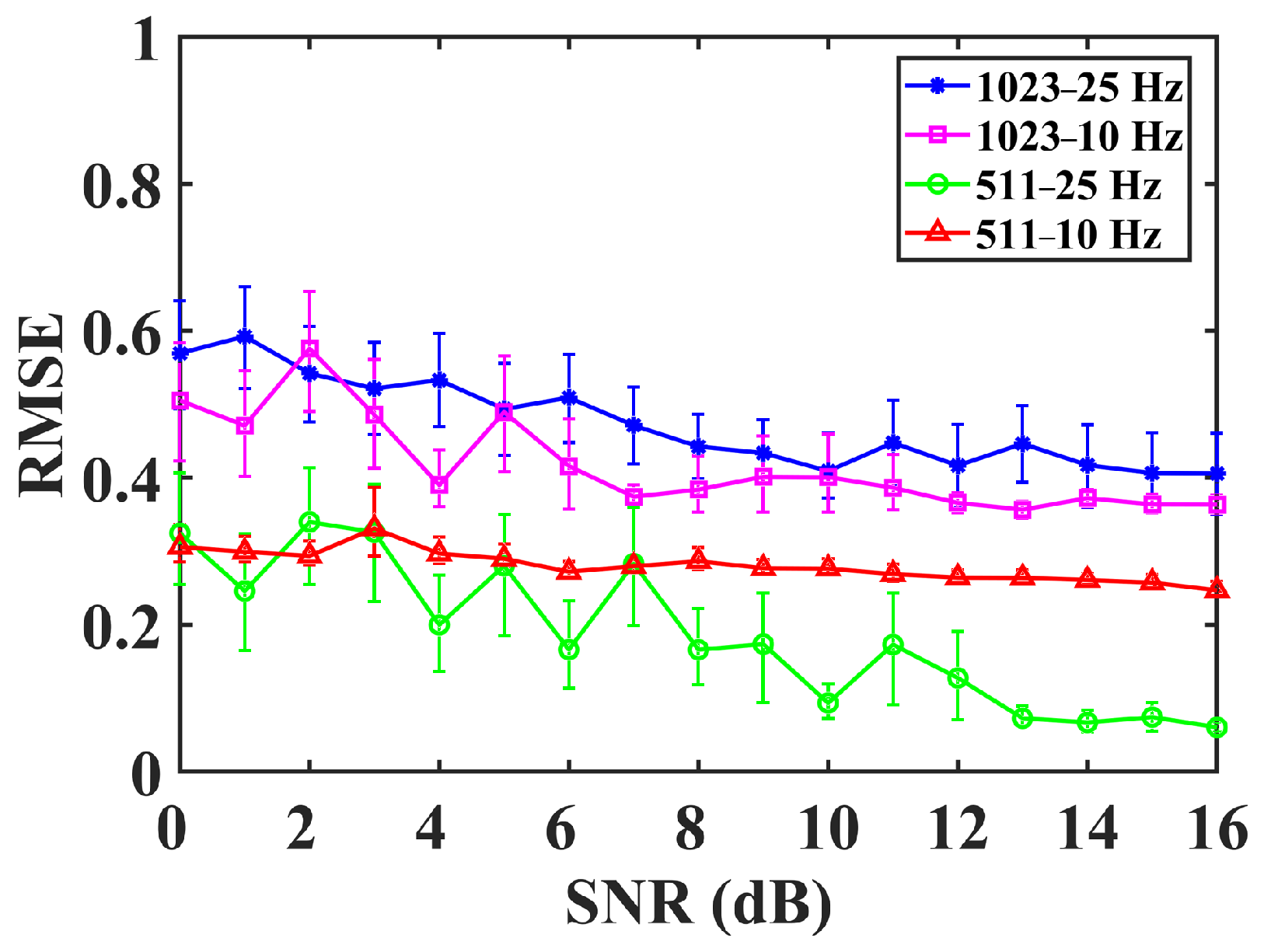
The simulation results in Figure 8 compare the Doppler estimation accuracy for M-sequence lengths of 511 and 1023 under identical channel conditions. Theoretically, a longer M-sequence yields a higher processing gain, which is expected to elevate the correlation peak under low SNR conditions. However, its effectiveness relies critically on the channel’s phase coherence over the entire training sequence. As the proposed OFDM system adopts DQPSK, the second and subsequent training symbols are demodulated using phase differences between adjacent subcarriers and symbols. Although DQPSK is inherently tolerant to small residual frequency offsets, this tolerance is confined to a single differential interval.
Figure 8.
Impact of M-sequence length on RMSE performance under different Doppler scales.
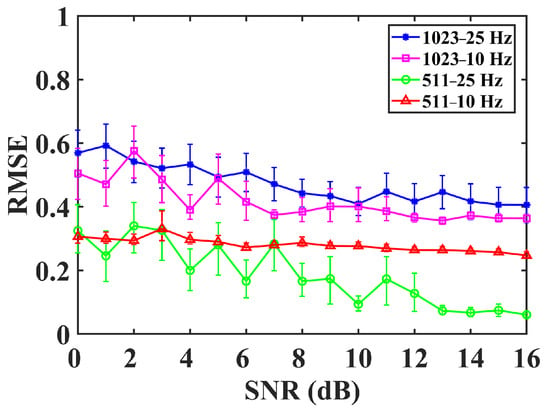
In Figure 8, under the 10 Hz Doppler condition, the 1023-bit configuration exhibits more pronounced RMSE fluctuations and reaches a minimum RMSE of approximately 0.36, whereas the 511-bit configuration remains stable at approximately 0.29. Under the 25 Hz Doppler condition, both configurations exhibit an overall decrease in RMSE with increasing SNR, although fluctuations remain. The 1023-bit configuration reaches a minimum RMSE of approximately 0.41, while the 511-bit configuration achieves a substantially lower minimum RMSE of approximately 0.06. These results indicate that the 511-bit configuration provides better Doppler estimation accuracy under both tested Doppler conditions.
For longer sequences spanning multiple symbols, the demodulation process involves several consecutive differential intervals. In the presence of residual Doppler or rapid channel fluctuations, phase errors accumulate on a symbol-by-symbol basis. This cumulative phase drift undermines the phase coherence required for the bit-level correlation, resulting in a degraded correlation peak and a subsequent loss in estimation accuracy. In contrast, the 511-bit sequence spans fewer symbols, thereby mitigating the impact of cumulative phase drift while still providing adequate processing gain for reliable peak detection under low SNR conditions.
In conclusion, the selection of M-sequence length must be carefully aligned with the channel coherence time and the modulation scheme. The 511-bit sequence achieves an advantageous trade-off between estimation precision and spectral efficiency, making the BLC algorithm particularly suited to environments where the channel remains approximately stationary over a short time window. In scenarios where channel variations exceed the stability of a short training sequence, a more densely sampled strategy is necessitated. The results above are based on BELLHOP channel simulations. At-sea testing under measured channel data is left for future work.
3.3. Computational Complexity Analysis
The computational complexity of the proposed BLC algorithm is evaluated against that of the conventional CAF estimation strategy. The total processing overhead is determined by the number of Doppler candidate evaluations and the computational cost per evaluation. Although the BLC algorithm incorporates an additional OFDM demodulation stage to obtain the demodulated M-sequence for bit-level vector inner-product operation, its primary advantage stems from enabling high estimation accuracy with a significantly reduced signal frame overhead.
In terms of search iterations, the conventional CAF strategy typically resorts to an exhaustive grid search to maintain a resolution of 0.01 Hz across a specified Doppler range, thereby incurring a consistently high evaluations. In contrast, the BLC algorithm capitalizes on the strong impulsive autocorrelation of M-sequences, enabling robust peak localization using only two OFDM training symbols. As a result, the adopted BLC configuration uses two OFDM training symbols, thereby enhancing the effective data transmission rate compared to the conventional CAF strategy.
To quantify the throughput benefit of the reduced training overhead, the normalized payload fraction is defined as the ratio of the OFDM data-frame duration to the total duration of the data frame and training symbols. Accordingly, the training durations of the two-symbol BLC and four-symbol CAF configurations are 106.40 ms and 212.80 ms, respectively, corresponding to normalized payload fractions are 95.36% and 91.13%. Since the data payload, bandwidth, modulation scheme, and coding rate remain identical, the two-symbol BLC configuration yields an approximately 4.64% increase in the effective payload transmission rate relative to the four-symbol CAF configuration.
The theoretical time complexity per evaluation is assessed in terms of real multiplications and additions. For the CAF strategy, each search entails signal-level correlation typically implemented via FFT, with a per-step complexity of . For the BLC algorithm, each evaluation consists of demodulating two OFDM symbols followed by a subsequent vector inner-product computation. According to the adopted system model, demodulating data subcarriers introduces an overhead of real multiplications and real additions per evaluation.
Table 2 summarizes the numbers of real multiplications and additions required for each Doppler candidate evaluation, together with the main differences between the conventional CAF and the proposed BLC algorithm. Although the per-evaluation complexity of BLC, formulated as for multiplications, is higher than that of CAF, this overhead represents an inherent necessary cost for transitioning from signal-level correlation to accurate bit-level correlation.
Table 2.
Comparison between the CAF and the proposed BLC algorithm under the adopted system configuration.
Furthermore, the average estimated running time of BLC and CAF under a 10 Hz Doppler shift with a 10 dB condition was recorded. The results showed that the average running time of BLC was 11.231 s, while CAF took 6.837 s when using two symbols and 7.137 s when using four symbols. Therefore, a shorter training sequence does not necessarily result in lower computational complexity or runtime. In this study, the demonstrated advantage of BLC is primarily the reduction in training and transmission overhead while maintaining the evaluated Doppler estimation performance.
4. Conclusions
This paper proposes a novel BLC Doppler estimation algorithm tailored for mobile UWA OFDM communications. The principal innovation resides in transforming conventional signal-level correlation into a vector inner-product operation performed on demodulated bit sequences. By employing a tailored OFDM frame structure that maps M-sequences onto the first two symbols, the BLC algorithm achieves accurate Doppler scaling estimation.
Simulation results under three distinct Doppler scales demonstrate that the proposed BLC algorithm achieves accurate Doppler estimation in UWA multipath channels. Compared with the conventional CAF method using four OFDM training symbols, the proposed BLC algorithm achieves comparable or higher estimation accuracy using only two OFDM training symbols. Under the simulated conditions, the proposed method provides a favorable trade-off between training overhead and Doppler estimation accuracy in UWA OFDM systems.
Under the tested simulation conditions, BLC achieves lower Doppler-estimation RMSE than the evaluated CAF configurations while using two training symbols. Its demonstrated benefit is the trade-off between training requirements and estimation accuracy. Future work will include at-sea testing under measured channel data and the integration of the BLC framework with adaptive modulation for time-varying, high-mobility scenarios.
Author Contributions
Conceptualization, B.L.; methodology, B.L.; software, B.L.; investigation, W.Y.; visualization, W.Y.; writing—original draft preparation, W.Y.; writing—review and editing, B.L., X.G., W.J., D.B. and Z.Z.; supervision, X.G., W.J., D.B. and Z.Z.; funding acquisition, B.L. and X.G. All authors have read and agreed to the published version of the manuscript.
Funding
This work was supported in part by the National Natural Science Foundation of China under Grant 42306209 and Grant 12304507, in part by the Natural Science Foundation of Fujian Province under Grant 2024J01159, in part by the Natural Science Foundation of Guangdong Province under Grant 2024A1515011512, and in part by the Fujian Provincial Department of Science and Technology Announces Major Special Projects under Grant 2023HZ025003.
Institutional Review Board Statement
Not applicable.
Informed Consent Statement
Not applicable.
Data Availability Statement
The raw data supporting the conclusions of this article will be made available by the authors on request.
Conflicts of Interest
The authors declare no conflicts of interest.
References
- Wang, D.; Hu, X.; Su, W.; Jiang, X.; Xie, Y. Research on multichannel time frequency shift keying for underwater acoustic communication. In Proceedings of the OCEANS 2015-MTS/IEEE Washington, Washington, DC, USA, 19–22 October 2015; pp. 1–5. [Google Scholar]
- Yan, J.; Guan, X.; Yang, X.; Chen, C.; Luo, X. A survey on integration design of localization, communication, and control for underwater acoustic sensor networks. IEEE Internet Things J. 2025, 12, 6300–6324. [Google Scholar] [CrossRef] [Scilit]
- Zhao, R.; Li, J.; Shi, T.; Wang, H. Differential feature-based physical layer authentication for underwater acoustic sensor networks. IEEE Sens. J. 2025, 25, 40834–40848. [Google Scholar] [CrossRef] [Scilit]
- Wang, Y.; Xia, N.; Chen, B.; Yin, Y.; Wei, S.; Zhang, K. Multi-AUV cooperative data collection for underwater acoustic sensor networks using Stackelberg game. IEEE Sens. J. 2024, 24, 33442–33454. [Google Scholar] [CrossRef] [Scilit]
- Von Jackowski, A. Navigating the current landscape of ocean observations: An overview from platform infrastructures to networks related to ocean time series. Front. Mar. Sci. 2025, 11, 1333813. [Google Scholar] [CrossRef] [Scilit]
- Saha, S.S.; Davis, C.; Sandha, S.S.; Park, J.; Geronimo, J.; Garcia, L.A.; Srivastava, M.B. Locomote: AI-driven sensor tags for fine-grained undersea localization and sensing. IEEE Sens. J. 2024, 24, 16999–17018. [Google Scholar] [CrossRef] [Scilit] [PubMed]
- Gupta, S.; Singh, N.P. Underwater wireless sensor networks: A review of routing protocols, taxonomy, and future directions. J. Supercomput. 2024, 80, 5163–5196. [Google Scholar] [CrossRef] [Scilit]
- Li, Y.; Wang, Y.; Huang, Y.; Xiong, Q. Adaptive ICI mitigation based on time-domain resampling for differential underwater acoustic OFDM communications. In Proceedings of the 2023 International Conference on Ubiquitous Communication (Ucom), Xi’an, China, 7–9 July 2023; pp. 160–165. [Google Scholar]
- Wan, L.; Zhao, M. Receiver enhancement for differentially encoded underwater acoustic OFDM incorporating amplitude and phase mismatches. IEEE J. Ocean. Eng. 2024, 49, 553–565. [Google Scholar] [CrossRef] [Scilit]
- Petroccia, R.; Petrioli, C.; Potter, J. Performance evaluation of underwater medium access control protocols: At-sea experiments. IEEE J. Ocean. Eng. 2018, 43, 547–556. [Google Scholar] [CrossRef] [Scilit]
- Zhou, Z.; Yao, B.; Xing, R.; Shu, L.; Bu, S. E-CARP: An energy efficient routing protocol for UWSNs in the Internet of Underwater Things. IEEE Sens. J. 2016, 16, 4072–4082. [Google Scholar] [CrossRef] [Scilit]
- Guan, Q.; Ji, F.; Liu, Y.; Yu, H.; Chen, W. Distance-vector-based opportunistic routing for underwater acoustic sensor networks. IEEE Internet Things J. 2019, 6, 3831–3839. [Google Scholar] [CrossRef] [Scilit]
- Gopinath, M.P.; Tamizharasi, G.S.; Kavisankar, L.; Sathyaraj, R.; Karthi, S.; Aarthy, S.L.; Balamurugan, B. A secure cloud-based solution for real-time monitoring and management of Internet of Underwater Things. Neural Comput. Appl. 2019, 31, 293–308. [Google Scholar] [CrossRef] [Scilit]
- Iqbal, Z.; Lee, H.-N. Spatially concatenated channel-network code for underwater wireless sensor networks. IEEE Trans. Commun. 2016, 64, 3901–3914. [Google Scholar] [CrossRef] [Scilit]
- Yerramalli, S.; Mitra, U. Optimal resampling of OFDM signals for multiscale–multilag underwater acoustic channels. IEEE J. Ocean. Eng. 2011, 36, 126–138. [Google Scholar] [CrossRef] [Scilit]
- Le, T.B.; Makula, P.; Bui, T.T.; Richterova, M.; Tran, X.N. Group successive ICI cancellation for MIMO-OFDM systems in underwater acoustic channels. In Proceedings of the 2016 17th International Conference on Mechatronics–Mechatronika (ME), Prague, Czech Republic, 7–9 December 2016; pp. 1–5. [Google Scholar]
- Capoglu, I.R.; Li, Y.; Swami, A. Effect of Doppler spread in OFDM-based UWB systems. IEEE Trans. Wirel. Commun. 2005, 4, 2559–2567. [Google Scholar] [CrossRef] [Scilit]
- Mason, S.F.; Berger, C.R.; Zhou, S.; Willett, P. Detection, synchronization, and Doppler scale estimation with multicarrier waveforms in underwater acoustic communication. IEEE J. Sel. Areas Commun. 2008, 26, 1638–1649. [Google Scholar] [CrossRef] [Scilit]
- Arikan, T.; Riedl, T.; Singer, A.; Younce, J. Comparison of OFDM and single-carrier schemes for Doppler tolerant acoustic communications. In Proceedings of the OCEANS 2015-Genova, Genoa, Italy, 18–21 May 2015; pp. 1–7. [Google Scholar]
- Sharif, B.S.; Neasham, J.; Hinton, O.R.; Adams, A.E. A computationally efficient Doppler compensation system for underwater acoustic communications. IEEE J. Ocean. Eng. 2000, 25, 52–61. [Google Scholar] [CrossRef] [Scilit]
- Abdelkareem, A.; Sharif, B.; Tsimenidis, C.; Neasham, J.; Hinton, O. Low-complexity Doppler compensation for OFDM-based underwater acoustic communication systems. In Proceedings of the OCEANS 2011 IEEE-Spain, Santander, Spain, 6–9 June 2011; pp. 1–6. [Google Scholar]
- Ling, Z.; Xie, L.; Chen, H. Joint Doppler scale estimation and timing synchronization in underwater acoustic communications. In Proceedings of the 2019 IEEE International Conference on Signal Processing, Communications and Computing (ICSPCC), Dalian, China, 20–22 September 2019; pp. 1–6. [Google Scholar]
- Chen, Y.; Zou, L.; Zhao, A.; Yin, J. Null subcarriers based Doppler scale estimation for multicarrier communication over underwater acoustic non-uniform Doppler shift channels. In Proceedings of the 2016 IEEE/OES China Ocean Acoustics (COA), Harbin, China, 9–11 January 2016; pp. 1–6. [Google Scholar]
- Kay, S.M.; Doyle, S.B. Rapid estimation of the range-Doppler scattering function. IEEE Trans. Signal Process. 2003, 51, 255–268. [Google Scholar] [CrossRef]
- Abdelkareem, A.E.; Sharif, B.S.; Tsimenidis, C.C. Adaptive time varying Doppler shift compensation algorithm for OFDM-based underwater acoustic communication systems. Ad Hoc Netw. 2016, 45, 104–119. [Google Scholar] [CrossRef] [Scilit]
- Li, J.; Zakharov, Y.V.; Henson, B. Multibranch autocorrelation method for Doppler estimation in underwater acoustic channels. IEEE J. Ocean. Eng. 2018, 43, 1099–1113. [Google Scholar] [CrossRef] [Scilit]
- Wan, L.; Wang, Z.; Zhou, S.; Yang, T.C.; Shi, Z. Performance comparison of Doppler scale estimation methods for underwater acoustic OFDM. J. Electr. Comput. Eng. 2012, 2012, 703243. [Google Scholar] [CrossRef] [Scilit]
- Li, B.; Zheng, S.; Tong, F. Bit-error rate based Doppler estimation for shallow water acoustic OFDM communication. Ocean Eng. 2019, 182, 203–210. [Google Scholar] [CrossRef] [Scilit]
- Yao, T.; Zhao, W.; Zhang, Q.; Kou, Y. Estimation of Doppler-shift based on correlation-peak waveform. In Proceedings of the 2007 5th International Conference on Communications, Circuits and Systems, Kokura, Japan, 11–13 July 2007; pp. 99–102. [Google Scholar]
- Tadayon, A.; Stojanovic, M. Low-complexity superresolution frequency offset estimation for high data rate acoustic OFDM systems. IEEE J. Ocean. Eng. 2019, 44, 932–942. [Google Scholar] [CrossRef] [Scilit]
- Jin, Q.; Wong, K.M.; Luo, Z.Q. The estimation of time delay and Doppler stretch of wideband signals. IEEE Trans. Signal Process. 1995, 43, 904–916. [Google Scholar] [CrossRef] [Scilit]
- Li, B.; Tong, F.; Li, J.-H.; Zheng, S.-Y. Cross-correlation quasi-gradient Doppler estimation for underwater acoustic OFDM mobile communications. Appl. Acoust. 2022, 190, 108640. [Google Scholar] [CrossRef] [Scilit]
- Li, B.; Huang, Z.; Gao, X.; Wang, F. Cross-ambiguity function hierarchical optimization Doppler estimation for underwater acoustic OFDM communication. IEEE Sens. J. 2026, 26, 15652–15661. [Google Scholar] [CrossRef] [Scilit]
- Huang, D.; Letaief, K.B. Carrier frequency offset estimation for OFDM systems using null subcarriers. IEEE Trans. Commun. 2006, 54, 813–823. [Google Scholar] [CrossRef] [Scilit]

Disclaimer/Publisher’s Note: The statements, opinions and data contained in all publications are solely those of the individual author(s) and contributor(s) and not of MDPI and/or the editor(s). MDPI and/or the editor(s) disclaim responsibility for any injury to people or property resulting from any ideas, methods, instructions or products referred to in the content. |
© 2026 by the authors. Licensee MDPI, Basel, Switzerland. This article is an open access article distributed under the terms and conditions of the Creative Commons Attribution (CC BY) license.