


Abstract
Milk preservation requires technologies that extend shelf life while minimising undesirable changes in product quality. This study compared the effects of pasteurisation, sterilisation, and high hydrostatic pressure processing (HHP) on the physicochemical properties and protein profiles of raw whole bovine milk. The samples included untreated raw milk as the control, pasteurised milk (72 °C for 42 s), sterilised milk (121 °C for 15 min), and HHP-treated milk processed at 300, 400, 500, or 600 MPa for 5 min. Colour, pH, rheological behaviour, SDS-PAGE, and Native-PAGE were evaluated. Sterilisation caused the greatest total colour difference (ΔE* = 13.95), whereas pasteurisation resulted in a barely perceptible change (ΔE* = 0.64), and HHP-treated samples showed perceptible but lower colour differences (ΔE* = 3.42–3.97). Sterilisation also caused the most pronounced pH decrease and the highest shear stress values over most of the measured shear-rate range. SDS-PAGE profiles of raw and HHP-treated milk remained broadly similar, while Native-PAGE revealed pressure-dependent reductions in native β-lactoglobulin band intensity, particularly at 500 and 600 MPa. Pasteurisation and 600 MPa treatment reduced the κ-casein-associated band intensity by 54% and 58%, respectively. Overall, HHP induced less pronounced physicochemical and electrophoretic changes than sterilisation, although higher pressure levels caused measurable protein restructuring.
1. Introduction
Milk preservation presents a considerable technological challenge because of the highly perishable nature of milk and the need to achieve an appropriate balance between microbial safety, shelf life, and the retention of its natural physical, sensory, and nutritional properties. It provides essential macro- and micronutrients required for human growth and development. Milk proteins are characterised by high biological value, as they contain all essential amino acids and exhibit high digestibility [1]. Conventional thermal preservation methods are well established, economically feasible, and effective in improving milk safety and shelf life. Nevertheless, depending on the intensity of the treatment, they may adversely affect certain sensory, nutritional, and bioactive properties of milk. Although non-thermal processing technologies offer promising alternatives, their widespread implementation remains constrained by challenges related to process standardisation, industrial scalability, and economic feasibility [1,2].
Traditional thermal treatments, including pasteurisation, ultra-high-temperature processing, and sterilisation, may alter protein structure, flavour, and heat-sensitive bioactive components [3,4,5]. Thermal processing may also reduce the retention or biological activity of heat-sensitive nutrients, including certain vitamins and immunologically active proteins [2]. Heating can disrupt protein secondary structures, including α-helices and β-sheets, and promote protein unfolding and aggregation. Under sufficiently severe thermal conditions, proteins such as α-lactalbumin and lactoferrin may undergo structural modification [6]. Whey proteins, particularly β-lactoglobulin, can also form aggregates with other whey proteins and caseins through hydrophobic interactions and disulphide-bond interchange. These changes may reduce protein solubility and modify the functional properties of milk [7,8].
High-pressure processing (HPP) is a non-thermal or minimal-heat food preservation technology in which pressures typically ranging from 300 to 600 MPa, or higher, are applied to inactivate vegetative microorganisms and selected enzymes in milk. It therefore represents a potential alternative to conventional thermal pasteurisation. HPP can improve microbial safety while limiting heat-induced changes in nutritional and sensory characteristics and preserving a substantial proportion of heat-sensitive bioactive components [9]. However, although HPP is effective against vegetative microbial cells, bacterial spores are considerably more pressure-resistant. Consequently, effective spore inactivation at commercially feasible pressure levels may require optimisation of treatment conditions or combination with mild thermal processing [10].
At the molecular level, HPP primarily modifies non-covalent interactions, including hydrophobic interactions and hydrogen bonds, rather than directly disrupting the covalent backbone of proteins. Pressure can compress internal protein cavities and alter hydration and solvation volumes, thereby modifying protein conformation. Although high pressure may cause partial or complete protein unfolding, its structural effects are often less extensive than those induced by severe thermal treatments, allowing a greater proportion of the native protein structure to be retained under appropriately selected conditions [11]. High-pressure treatment can nevertheless induce substantial changes in milk proteins. Pressure-induced disruption or dissociation of casein micelles may alter the distribution of proteins and minerals between the colloidal and soluble phases. Whey proteins may also undergo pressure-dependent unfolding, denaturation, association with casein micelles, and aggregation. These modifications can affect their solubility, technological functionality, and biological activity [12,13,14]. These pressure-induced modifications of bovine milk proteins are influenced by several factors, including pressure level, treatment time, temperature, pH, and the initial composition of the milk matrix [15]. Under specific conditions, HHP has also been reported to modify the immunogenicity of β-lactoglobulin and promote the release of bioactive peptides, suggesting potential applications in the development of functional and reduced-allergenicity dairy products [16]. Under selected pressure and pH conditions, HHP may increase protein solubility and water-holding capacity and modify the antioxidant and antibacterial activities associated with milk proteins [17].
High hydrostatic pressure processing of milk and dairy products has been extensively reviewed, and its effects on microbial safety, physicochemical properties, protein structure, and technological functionality are well documented [18,19]. However, direct experimental comparisons using the same raw whole bovine milk matrix and combining conventional thermal treatments with several HHP levels remain more limited. In particular, fewer studies have evaluated colour, pH, rheological behaviour, SDS-PAGE, and Native-PAGE together in order to relate macroscopic physicochemical changes to denaturing and native electrophoretic protein profiles.
The specific contribution of the present study lies in the combined use of SDS-PAGE and Native-PAGE across pasteurised, sterilised, and pressure-treated milk samples. SDS-PAGE was used to evaluate the apparent molecular mass distribution of milk proteins under denaturing conditions, whereas Native-PAGE was applied to assess changes in native electrophoretic behaviour, which is influenced by protein size, charge, and conformation. The parallel use of these two methods enabled the differentiation of major changes in protein band patterns from more subtle pressure-induced changes in native protein behaviour that may be less apparent under denaturing SDS-PAGE conditions. This complementary approach enabled a more detailed comparison of heat- and pressure-induced protein modifications within the same raw whole bovine milk matrix.
Therefore, the aim of this study was to compare the effects of pasteurisation, sterilisation, and high-pressure treatment at 300–600 MPa on the physicochemical characteristics and electrophoretic protein profiles of raw whole bovine milk.
2. Materials and Methods
2.1. Materials
RAW Milk
Raw, unpasteurised milk samples were obtained from a family farm located in Pápa, Hungary. The herd consisted of Bos taurus Hungarian Simmental dairy cows. The milk did not undergo any preliminary treatment and was considered whole milk. Following collection, the samples were transported to the laboratory under refrigerated conditions (4 °C) until further analysis.
2.2. Methods
2.2.1. High-Pressure Processing (HHP)
High-pressure experiments were performed using a Resato FPU-100-2000 laboratory-scale high-pressure processing system (Resato International B.V., Assen, The Netherlands), consisting of a pressurising unit (1600 mm × 2200 mm × 830 mm) and a control unit (1300 mm × 950 mm × 1400 mm). The milk samples were divided into the following treatment groups: untreated control (0 MPa), pasteurised (72 °C for 42 s), sterilised (121 °C for 15 min), and high-pressure-treated samples at 300, 400, 500, and 600 MPa. The holding time at the target pressure was 5 min for all high-pressure treatments. Before processing, all samples were packaged in pressure- and heat-resistant polyethylene pouches. The headspace was minimised manually before sealing in order to reduce residual oxygen. Propylene glycol (Resato PG fluid) was used as the pressure-transmitting medium in the pressure vessel. The initial temperature of the samples was maintained at 1–3 °C by cooling in ice water. Based on the initial sample temperature of 1–3 °C and the estimated adiabatic temperature increase of approximately 3 °C per 100 MPa, the estimated sample temperatures at the target pressure were approximately 10–12 °C at 300 MPa, 13–15 °C at 400 MPa, 16–18 °C at 500 MPa, and 19–21 °C at 600 MPa. Pressure profiles within the sample holder were continuously monitored throughout the treatments.
2.2.2. Colour Measurements
Colour measurements were performed using a Minolta CR-400 tristimulus colorimeter (Konica Minolta Co., Ltd., Osaka, Japan). Before measurement, the instrument was calibrated using the manufacturer’s standard white calibration plate. Each sample was measured five times under reflectance mode. The instrument provided the CIELAB colour coordinates L*, a*, and b*, which were used to evaluate the colour characteristics and colour changes of the samples. The total colour difference (ΔE*) between untreated and treated samples was calculated using the mean values of L*, a*, and b* according to the following equation:
where ∆L*, ∆a* and ∆b* are the differences between the values of L*, a* and b* in the untreated and treated samples [20].
∆E* = [(∆L*)2 + (∆a*)2 + (∆b*)2]0.5,
2.2.3. pH Measurement
pH measurements were performed using a Testo 206-pH2 pH meter (Testo SE & Co. KGaA, Titisee-Neustadt, Germany). Before use, the instrument was calibrated with standard buffer solutions of pH 4.00 and 7.00 according to the manufacturer’s instructions. The instrument was equipped with an integrated temperature sensor. Measurements were performed in triplicate for each sample.
2.2.4. Rheological Measurements
The rheological behaviour of the samples was determined using a Rheomat 115 rotational viscometer (Contraves, AG, Zürich, Switzerland) according to the modified method of Islam and Azemi [21]. Before the measurements, all samples were conditioned to 4–5 °C. For each measurement, 100 mL of sample was transferred into the No. 145 measuring cup, and the 7/7 measuring system was installed according to the manufacturer’s instructions. Measurements were performed over a shear-rate range of 6.65–1008 s−1, and the corresponding instrument readings (α) were recorded. Each sample was measured three times. The shear stress (τ, mPa) was calculated from the instrument reading using the measuring system constant (z = 195.5) according to the following equation: τ = α × z, where α is the instrument reading. The calculated shear stress values were plotted as a function of shear rate to compare the rheological behaviour of the untreated, thermally treated, and high-pressure-treated milk samples.
2.2.5. SDS-Polyacrylamide Gel Electrophoresis (SDS-PAGE)
SDS-polyacrylamide gel electrophoresis (SDS-PAGE) was performed using handcast 4–15% polyacrylamide gels (acrylamide/bis-acrylamide, 83 × 73 × 1.0 mm) in a vertical electrophoresis system (Mini-PROTEAN® Tetra System, Bio-Rad Laboratories, Hercules, CA, USA). A prestained protein molecular weight marker (Precision Plus Protein™ Standards All Blue, Bio-Rad Laboratories, Hercules, CA, USA) covering the molecular weight range of 10–250 kDa was used. Milk samples were prepared by dilution with 2× Laemmli sample buffer containing 2-mercaptoethanol (Bio-Rad Laboratories, Hercules, CA, USA). After mixing with Laemmli sample buffer, the samples were heated at 95 °C for 5 min to promote protein denaturation and then cooled to room temperature before loading onto the gel. For SDS-PAGE analysis, a protein concentration of approximately 3–5 mg/mL was targeted for all samples. After electrophoresis, the gels were stained with 0.2% Coomassie Brilliant Blue R-250 for 30 min. Gel images were acquired using a Gel Doc™ XR+ System (Bio-Rad Laboratories, Hercules, CA, USA). Band intensities were quantified using Quantity One software version 4.5 (Bio-Rad Laboratories, Hercules, CA, USA). The intensity of each protein band was expressed as relative intensity (%), calculated relative to the corresponding band intensity of the untreated control samples.
2.2.6. Native Polyacrylamide Gel Electrophoresis (Native PAGE)
Native polyacrylamide gel electrophoresis (Native PAGE) was performed using the same handcast 4–15% polyacrylamide gel system described for SDS-PAGE, with the omission of sodium dodecyl sulfate (SDS), reducing agents, and other denaturing agents, according to the method of Wall et al. [22]. Under these conditions, protein separation is based on differences in the charge-to-mass ratio of the native protein molecules. The sample dilutions were identical to those used for SDS-PAGE. However, the samples were prepared using a mixture of sample buffer, running buffer and sucrose (20%, w/v). The running buffer was prepared from 3.03 g Tris and 14.4 g glycine per litre, corresponding to approximately 25 mM Tris and 192 mM glycine, with a nominal pH of approximately 8.3. The same buffer system was used for all samples to maintain consistent electrophoretic conditions during Native-PAGE separation. Electrophoresis was performed at a constant voltage of 200 V for approximately 70 min.
2.2.7. Statistical Analysis
Statistical analyses were performed using IBM SPSS Statistics for Windows, version 20.0 (IBM Corp., Armonk, NY, USA). Data are presented as mean ± standard deviation (SD). The effects of the different treatments were evaluated by one-way analysis of variance (ANOVA). When significant differences were detected (p < 0.05), Tukey’s post hoc test was applied for multiple comparisons of the mean values.
2.2.8. GenAI
During the preparation of this manuscript, the authors used ChatGPT (OpenAI) to review and improve English language clarity, grammar, sentence structure, formatting and readability of text that had already been written by the authors. Scopus AI was used as a literature search engine and discovery tool to identify scientific publications.
3. Results
3.1. Colour
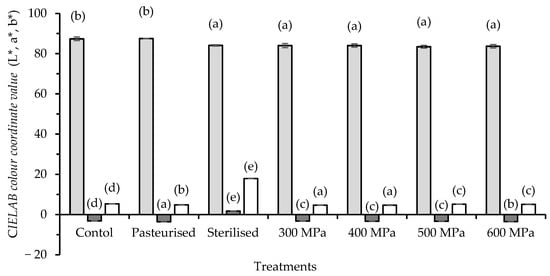
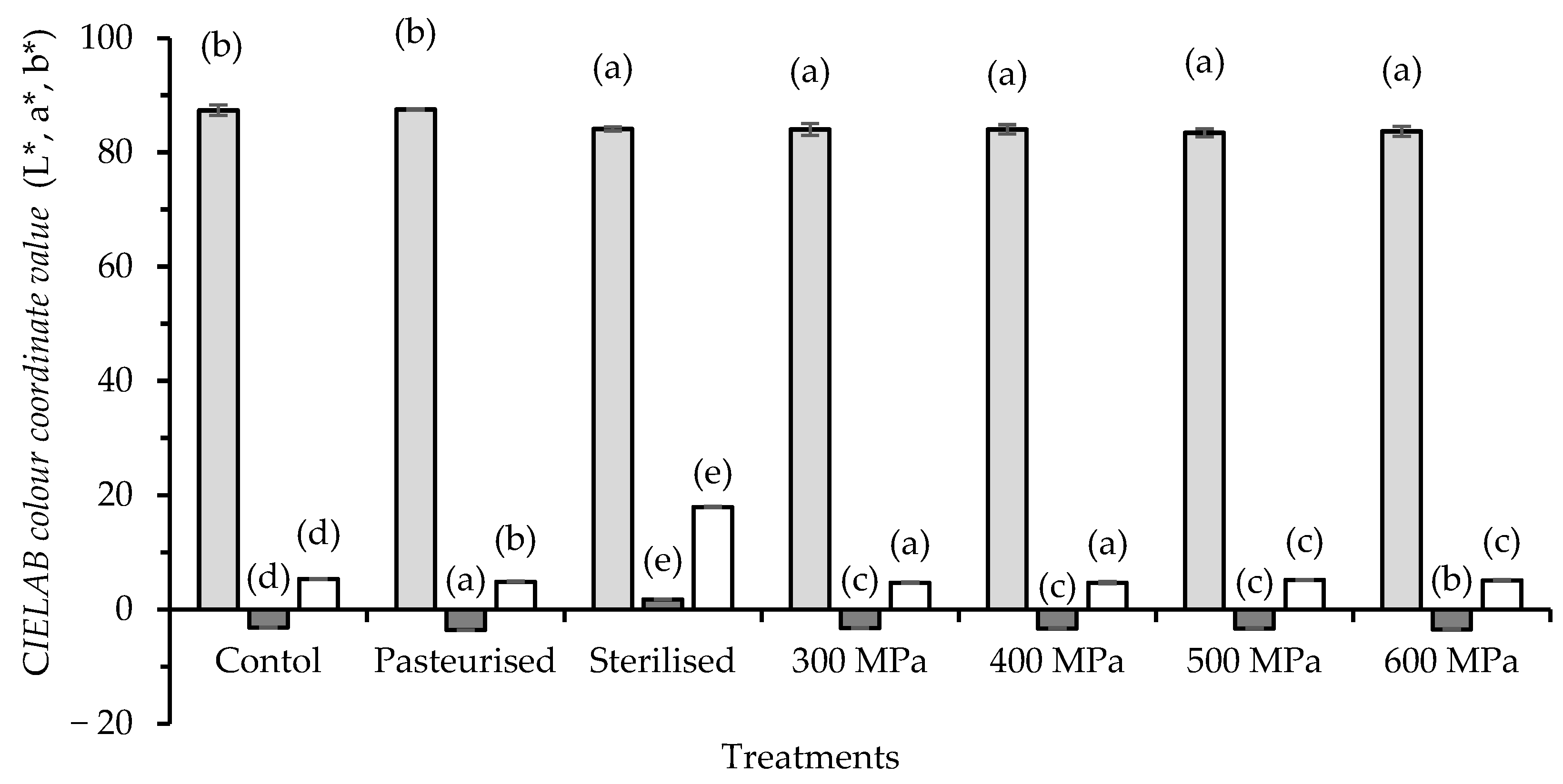
Figure 1 presents the effects of the different treatments on the CIELAB colour coordinates of the milk samples. Previous studies have shown that pressure treatments of 100 and 200 MPa induce only minor changes in the colour of raw milk. Therefore, these pressure levels were not included in the present study. Instead, pasteurised and sterilised milk samples were incorporated to provide a broader comparison with conventional thermal treatments, thereby facilitating a more comprehensive evaluation of the colour changes induced by high-pressure processing. One-way ANOVA revealed significant differences (p < 0.05) in all three CIELAB colour coordinates (L*, a*, and b*) compared with the untreated control samples. Similarly, reported significant changes in all three colour coordinates following high-pressure treatment of skim milk (600 MPa, 15 min) [23].
Figure 1.
CIELAB colour coordinates (L*, a*, and b*) of untreated control, pasteurised, sterilised, and high-pressure-treated milk samples. Within each treatment group, the bars represent L*, a*, and b* values from left to right, respectively. Bars represent mean ± SD. Different lowercase letters above or below the columns indicate significant differences among treatments within the same colour coordinate according to Tukey’s post hoc test (p < 0.05).
The L* values showed that pasteurised milk exhibited colour characteristics similar to those of the high-pressure-treated samples, whereas sterilised milk displayed lower L* values. Tukey’s post hoc test further demonstrated that no significant difference was observed between raw and pasteurised milk. Likewise, the L* values of sterilised milk and samples treated at 300–600 MPa belonged to the same homogeneous group, with no significant differences among them (p = 0.410). The pronounced colour change in sterilised milk may be related to heat-induced protein denaturation, lipid degradation, carotenoid oxidation, and Maillard reactions [3]. Increasing the pressure level from 300 to 600 MPa did not result in any further substantial changes in L*, and these values remained comparable to those of sterilised milk. The comparatively moderate colour changes observed following HPP are broadly consistent, that milk treated at 400–600 MPa for 1–5 min retained key quality characteristics similar to those of raw milk [24].
The a* coordinate showed only minor differences among raw, pasteurised, and high-pressure-treated milk samples (Figure 1), ranging from −3.18 in raw milk to −3.63 in pasteurised milk, whereas sterilised milk exhibited a distinctly different a* value. A similar trend was observed for the b* coordinate; however, sterilised milk showed a substantially higher b* value (17.93) than all other samples, indicating a markedly more yellow appearance.
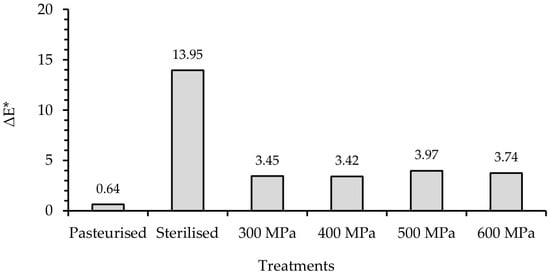
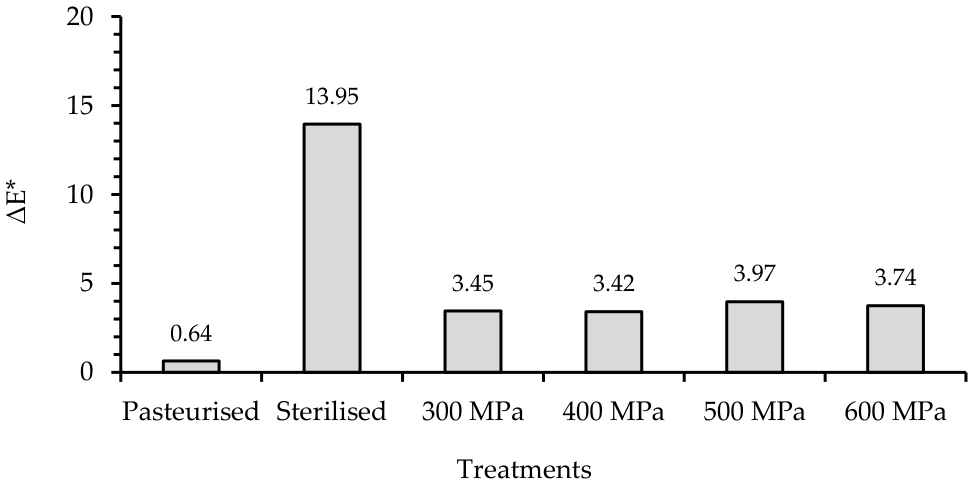
The total colour difference (ΔE*) summarizes the combined changes in the individual colour coordinates (Figure 2). Because ΔE* was calculated relative to the untreated raw milk control, the control sample served as the reference point for all treated samples. According to the ΔE* values, the colour difference between raw and pasteurised milk was barely perceptible. In contrast, all high-pressure-treated samples exhibited clearly perceptible colour differences relative to the untreated control. The ΔE value of sterilised milk corresponded to a large colour difference according to the classification [20], indicating that sterilisation induced substantially greater colour changes than either pasteurisation or high-pressure treatments.
Figure 2.
Total colour difference (ΔE*) of pasteurised, sterilised, and high-pressure-treated milk samples calculated relative to the untreated raw milk control. The untreated control served as the reference for ΔE* calculation; therefore, it does not represent an independently calculated colour-difference value and is not shown as a separate bar.
3.2. pH
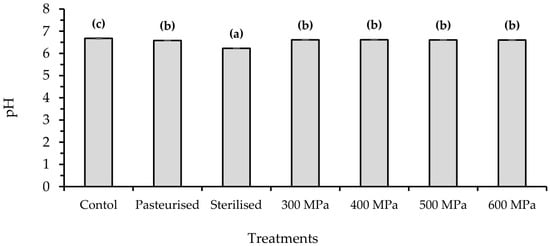
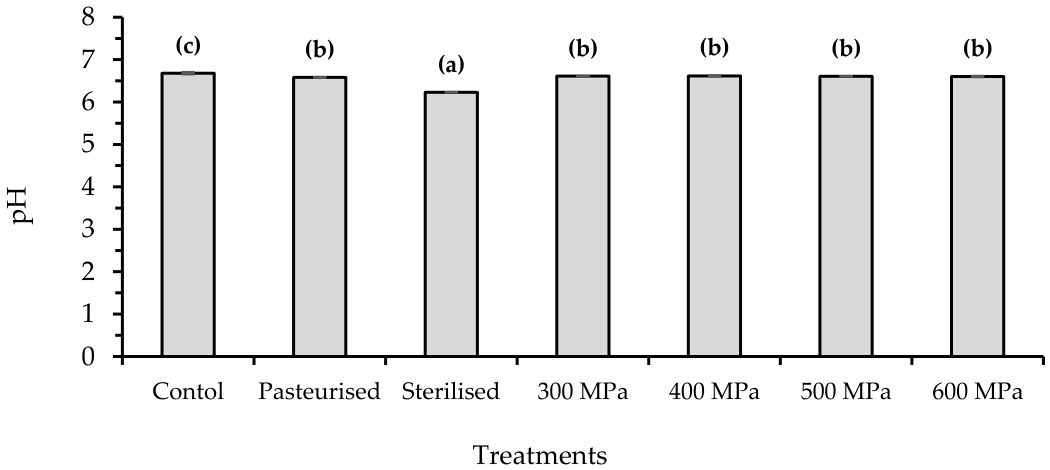
Differences in the pH values of the milk samples are presented in Figure 3. One-way ANOVA followed by Tukey’s post hoc test showed that both thermal and high-pressure treatments significantly affected the pH of raw milk (p < 0.05). However, all high-pressure-treated samples and the pasteurised milk sample were assigned to the same homogeneous group, indicating that their pH values did not differ significantly (p = 0.057). In these samples, pH decreased only slightly compared with the untreated raw milk, whereas sterilisation resulted in a more pronounced decrease of several tenths of a pH unit.
Figure 3.
pH values of untreated control, pasteurised, sterilised, and high-pressure-treated milk samples. Bars represent mean ± SD. Different lowercase letters (a–c) above the columns indicate significant differences among treatments according to Tukey’s post hoc test (p < 0.05).
3.3. Rheological Behaviour
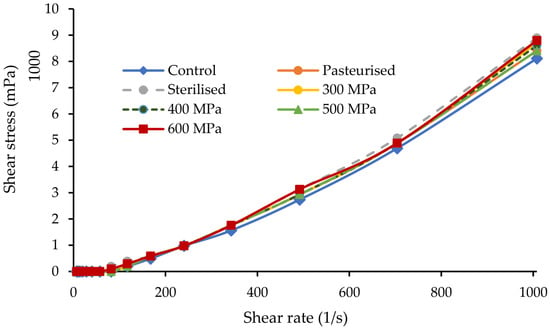
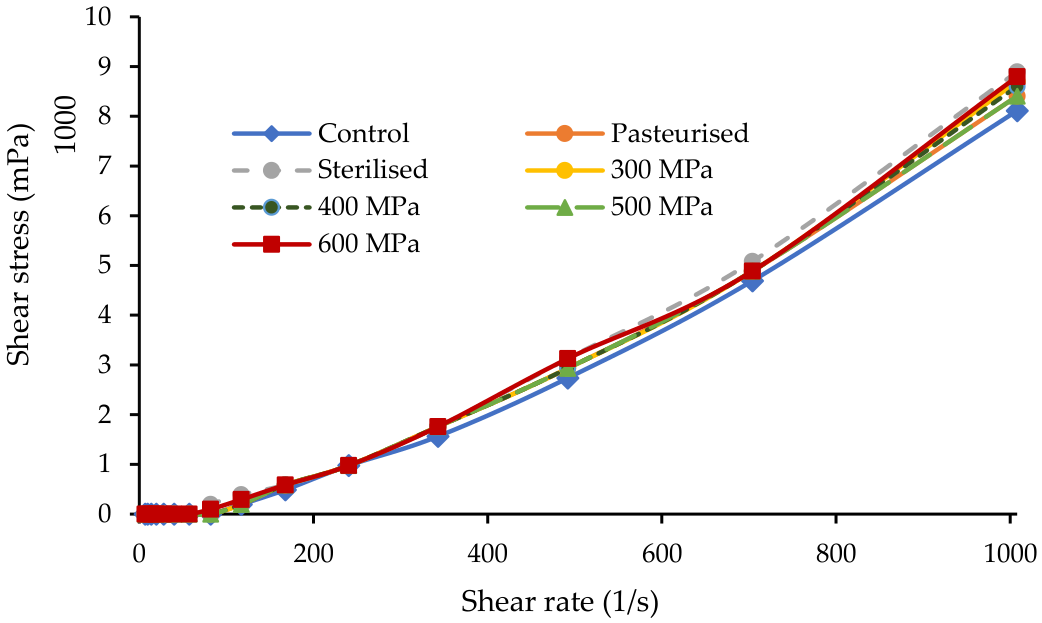
The rheological behaviour of untreated, thermally treated, and high-pressure-treated milk samples is presented in Figure 4. The shear stress values increased with increasing shear rate in all samples. Sterilised milk showed the highest shear stress values over most of the measured shear-rate range, whereas the high-pressure-treated samples remained closer to the untreated control and pasteurised milk.
Figure 4.
Shear stress as a function of shear rate for untreated control, thermally treated, and high-pressure-treated milk samples.
In the present study, the high-pressure-treated samples showed flow curves closer to those of the untreated control and pasteurised milk than to that of sterilised milk. This trend is broadly consistent with previous findings reporting that the viscosity of HHP-treated milk remained close to that of untreated milk [25]. However, because replicate-based power-law modelling was not performed in the present study, no conclusion is drawn regarding the flow behaviour index (n) or consistency coefficient (K).
3.4. SDS-Polyacrylamide Gel Electrophoresis Protein Profiles
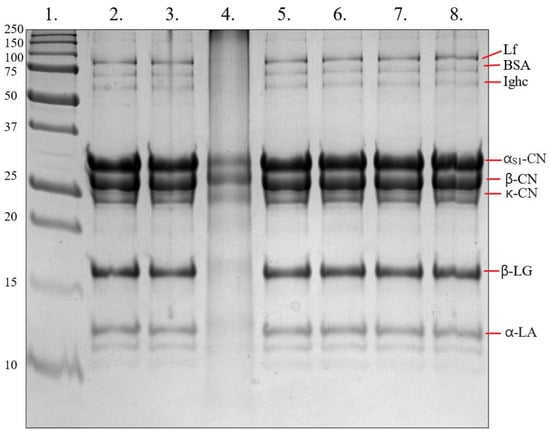
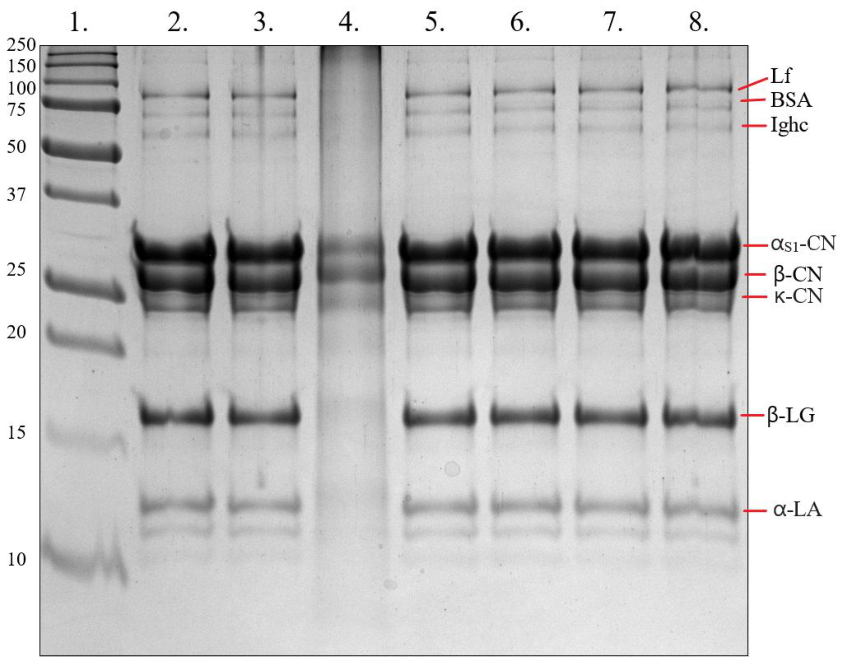
Following separation according to apparent molecular mass, protein bands were detected at positions characteristic of the major bovine milk proteins. The casein fractions (αs1-CN, β-CN, and κ-CN) were detected in the region of 23–29 kDa, β-lactoglobulin (β-LG) at approximately 16 kDa, α-lactalbumin (α-LA) variants at 11–12 kDa, lactoferrin (Lf) at approximately 87 kDa, bovine serum albumin (BSA) at approximately 68 kDa, and the immunoglobulin heavy chain (IgHC) at approximately 60 kDa [26,27].
Similarly, it was found that consistent no marked differences were observed between the SDS-PAGE profiles of raw and pasteurised milk (72 °C for 42 s) [27]. Densitometric analysis indicated an approximately 10% difference in relative band intensity between the raw and pasteurised milk samples. The electrophoretic profile of raw milk also closely resembled those of the samples treated at 300, 400, 500, and 600 MPa. The difference in relative band intensity between raw milk and the sample treated at 300 MPa was only 1%, while the differences remained below 8% at the higher pressure levels, including 600 MPa. Among the high-pressure-treated samples, the electrophoretic profile of milk treated at 600 MPa most closely resembled that of pasteurised milk. Lane 4 contained the sterilised milk sample (121 °C for 15 min), which exhibited clear signs of extensive heat-induced protein modification. The intensities of the casein bands decreased markedly, whereas the bands corresponding to whey proteins were no longer detectable under the applied analytical conditions. These changes suggest extensive heat-induced denaturation and aggregation, accompanied by altered protein solubility. The electrophoretic profiles of the untreated control, thermally treated, and high-pressure-treated samples are presented in Figure 5. Densitometric analysis showed that the intensity of the casein bands in the sterilised sample decreased by more than 40%. Nevertheless, like previous research, the caseins exhibited greater thermal stability than the whey proteins [28].
Figure 5.
SDS-PAGE protein profiles of untreated control, thermally treated, and high pressure-treated milk samples. Lane 1, molecular weight marker (250–10 kDa); lane 2, untreated raw milk (0 MPa); lane 3, pasteurised milk; lane 4, sterilised milk; lanes 5–8, milk treated at 300, 400, 500, and 600 MPa, respectively.
3.5. Native-Polyacrylamide Gel Electrophoresis Protein Profiles
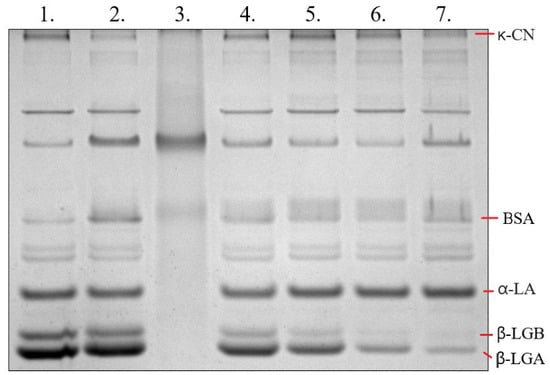
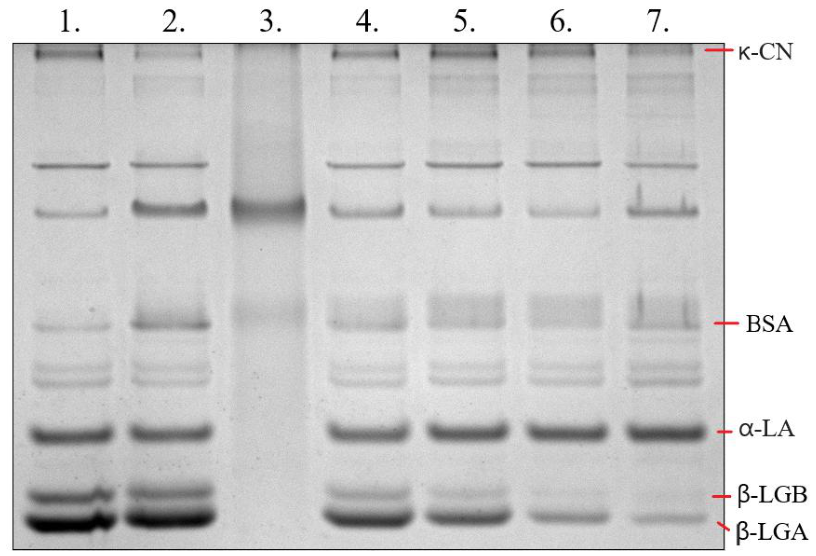
Native-PAGE revealed treatment dependent changes in the electrophoretic behaviour of the milk proteins (Figure 6). Pasteurisation reduced the intensity of the κ-casein-associated band by 54%, whereas a comparable reduction of 58% was observed only after treatment at the highest pressure level of 600 MPa. In contrast, pasteurisation caused no marked changes in the bands corresponding to α-lactalbumin and β-lactoglobulin.
Figure 6.
Native-PAGE protein profiles of untreated, thermally treated, and high-pressure-treated milk samples. Lane 1, untreated control (0 MPa); lane 2, pasteurised milk; lane 3, sterilised milk; lanes 4–7, milk treated at 300, 400, 500, and 600 MPa, respectively.
The sterilised sample exhibited extensive loss and smearing of the major protein bands, consistent with severe heat-induced protein denaturation, aggregation, and altered electrophoretic mobility. This interpretation is supported by an a previous research [29], where found that increasing heating temperature and duration promoted whey protein denaturation and association with caseins. Among the whey proteins, α-lactalbumin exhibited the greatest thermal stability, in agreement with the findings of Lin et al. [30]. In their study, 32% of α-lactalbumin remained in its native state after treatment at 100 °C for 10 min, whereas approximately 91% remained detectable in its native electrophoretic form in the present study following pasteurisation at 72 °C for 42 s. The higher proportion observed in the present study may be explained by the considerably milder time–temperature conditions applied during pasteurisation. The present findings are also consistent with previous observations identifying β-lactoglobulin as one of the least stable major whey proteins under processing conditions [31]. In the present study, the native band intensities of the β-lactoglobulin variants progressively decreased with increasing pressure, with the most pronounced changes observed at 500 and 600 MPa. The observed pressure-dependent changes are consistent with previous reports of increasing amounts of denatured whey proteins in skim milk treated at 250–650 MPa [32]. These findings indicate that β-lactoglobulin was less resistant to high-pressure treatment than α-lactalbumin, similar to the previous study [33]. The behaviour of β-lactoglobulin is particularly relevant because it accounts for approximately 50% of the whey protein fraction and is frequently used as an indicator of the extent of whey protein denaturation [34]. Furthermore, β-lactoglobulin is recognised as a major cow’s milk allergen. Although the pressure-induced loss of its native electrophoretic bands indicates substantial structural modification, these results alone do not demonstrate reduced allergenicity or protein inactivation. Specific immunological analyses would be required to determine whether the observed structural changes affected IgE binding or allergenic potential.
4. Discussion
The combined physicochemical and electrophoretic results demonstrated that the effects of thermal and high-pressure treatments on raw whole bovine milk depended strongly on treatment intensity. Sterilisation caused the most pronounced changes, whereas HHP induced comparatively moderate modifications within the scope of the measured parameters. The parallel use of SDS-PAGE and Native-PAGE further showed that some pressure-induced changes in native protein behaviour were not clearly reflected under denaturing electrophoretic conditions, highlighting the value of the combined analytical approach.
Sterilisation produced the greatest total colour difference (ΔE*), the most pronounced decrease in pH, and the highest shear stress values over most of the measured shear-rate range. The marked colour change may be associated with heat-induced protein modification and Maillard reactions [3]. High-pressure treatment caused comparatively moderate physicochemical changes. The pH of the pressure-treated samples decreased only slightly and did not differ significantly from that of pasteurised milk. This slight decrease may be related to pressure-induced changes in casein micelle structure and mineral equilibria, whereas the more pronounced pH decrease after sterilisation may reflect more extensive heat-induced protein modification and acid-forming reactions. Since these mechanisms were not directly measured, they should be interpreted as possible explanations. A limited effect of HPP on pH has also been reported in Murrah buffalo milk treated at 500 or 600 MPa for 3–5 min, although direct comparison with the present study should be made with caution because of differences in milk species, composition, and storage conditions [35]. Although the high-pressure-treated samples showed perceptible colour differences relative to untreated milk, these changes remained less pronounced than those induced by sterilisation. The higher shear stress observed in sterilised milk may be attributed to severe heat-induced protein denaturation and the formation of larger protein aggregates, which can increase resistance to flow [3].
SDS-PAGE profiles of raw (untreated control) and high-pressure-treated milk were almost similar, with differences in band intensity remaining limited even at 600 MPa. In contrast, the sterilised sample showed extensive loss of whey protein bands and a marked reduction in casein associated band intensity, consistent with aggregation and reduced protein solubility. Native-PAGE showed pressure-dependent changes that were not fully apparent under denaturing SDS-PAGE conditions. The native band intensities of β-lactoglobulin variants decreased at 500 and 600 MPa, whereas α-lactalbumin remained comparatively stable. This agrees with previous observations that α-lactalbumin exhibits greater resistance to moderate thermal and pressure treatments than β-lactoglobulin [30,31].
Within the scope of the parameters measured in this study, HHP caused less pronounced changes than sterilisation in colour, pH, rheological behaviour, and electrophoretic protein profiles. However, HHP should not be considered a universally applicable substitute for thermal pasteurisation, as its industrial implementation may be limited by high equipment and operating costs, as well as by the limited inactivation of bacterial spores under moderate-temperature conditions. The progressive loss of native β-lactoglobulin bands at higher pressure levels also indicates that HHP induces pressure-dependent protein restructuring. Since microbiological stability, shelf life, and sensory properties were not evaluated in the present study, further research should combine physicochemical and electrophoretic analyses with microbiological, storage, and sensory assessments.
Author Contributions
Conceptualization, B.C.; K.P.-H. and L.F.F.; methodology, B.C.; software, B.S.; validation, B.C., B.S. and K.P.-H.; formal analysis, B.C.; investigation, B.C.; resources, B.C.; data curation, B.S.; writing—original draft preparation, B.C.; writing—review and editing, B.C.; visualization, B.C.; supervision, K.P.-H.; project administration, I.D.; funding acquisition, L.F.F. and I.D. All authors have read and agreed to the published version of the manuscript.
Funding
This research received no external funding.
Institutional Review Board Statement
Not applicable.
Informed Consent Statement
Not applicable.
Data Availability Statement
The original contributions presented in the study are included in the article; further inquiries can be directed to the corresponding author.
Acknowledgments
During the preparation of this manuscript, the authors used [ChatGPT (OpenAI), GPT-5.5 Thinking version] for the purposes of [to review and improve English language clarity, grammar, sentence structure and readability of text that had already been written by the authors.] The authors have reviewed and edited the output and take full responsibility for the content of this publication.
Conflicts of Interest
The authors declare no conflicts of interest.
References
- Cunha, J.M.D.; Prestes, A.A.; Pimentel, T.C.; Prudencio, E.S. Current insights into thermal and non-thermal technologies used to mediate milk and dairy products processing. Processes 2025, 13, 3403. [Google Scholar] [CrossRef] [Scilit]
- McAuley, C.M.; Singh, T.K.; Haro-Maza, J.F.; Williams, R.; Buckow, R. Microbiological and physicochemical stability of raw, pasteurised or pulsed electric field-treated milk. Innov. Food Sci. Emerg. Technol. 2016, 38, 365–373. [Google Scholar] [CrossRef] [Scilit]
- Rabbani, A.; Ayyash, M.; D’Costa, C.D.C.; Chen, G.; Xu, Y.; Kamal-Eldin, A. Effect of heat pasteurization and sterilization on milk safety, composition, sensory properties, and nutritional quality. Foods 2025, 14, 1342. [Google Scholar] [CrossRef] [Scilit] [PubMed]
- SahityaRani, M. Milk treatment, homogenization, bactofugation. In Handbook of Milk Production, Quality and Nutrition; Rana, T., Ed.; Academic Press: Amsterdam, The Netherlands, 2025; pp. 473–481. [Google Scholar] [CrossRef] [Scilit]
- Wang, Y.; Xiao, R.; Liu, S.; Wang, P.; Zhu, Y.; Niu, T.; Chen, H. The impact of thermal treatment intensity on proteins, fatty acids, macro/micro-nutrients, flavor, and heating markers of milk: A comprehensive review. Int. J. Mol. Sci. 2024, 25, 8670. [Google Scholar] [CrossRef] [Scilit] [PubMed]
- Altuner, E.M.; Alpas, H.; Erdem, Y.K.; Bozoglu, F. Effect of high hydrostatic pressure on physicochemical and biochemical properties of milk. Eur. Food Res. Technol. 2006, 222, 392–396. [Google Scholar] [CrossRef] [Scilit]
- Patel, H.A.; Singh, H.; Anema, S.G.; Creamer, L.K. Effects of heat and high hydrostatic pressure treatments on disulfide bonding interchanges among the proteins in skim milk. J. Agric. Food Chem. 2006, 54, 3409–3420. [Google Scholar] [CrossRef] [Scilit] [PubMed]
- López-Fandiño, R. Functional improvement of milk whey proteins induced by high hydrostatic pressure. Crit. Rev. Food Sci. Nutr. 2006, 46, 351–363. [Google Scholar] [CrossRef] [Scilit] [PubMed]
- Vikranta, U.; Singh, G.P.; Hooda, A.; Rai, D.C.; Nagar, K. Emerging processing technologies in the dairy industry. In Trends in Animal-Based Foods; Nimmanapalli, R., Kumar Singh, M., Eds.; Springer Nature: Cham, Switzerland, 2025; pp. 27–44. [Google Scholar] [CrossRef] [Scilit]
- Saputra, A.; Gavahian, M.; Purnomo, E.H.; Saraswati, S.; Hasanah, U.; Boing Sitanggang, A. High-pressure processing as an emerging technology for enhancing dairy product safety and quality: A critical review of latest advances, sustainability impact, limitations, and prospects. Crit. Rev. Food Sci. Nutr. 2025, 65, 8341–8365. [Google Scholar] [CrossRef] [Scilit] [PubMed]
- Yang, J.; Powers, J.R. Effects of high pressure on food proteins. In High Pressure Processing of Food: Principles, Technology and Applications; Balasubramaniam, V.M., Barbosa-Cánovas, G.V., Lelieveld, H.L.M., Eds.; Springer: New York, NY, USA, 2016; pp. 353–389. [Google Scholar] [CrossRef] [Scilit]
- Datta, N.; Deeth, H.C. Heat treatment of milk: Non-thermal technologies: High pressure processing. In Encyclopedia of Dairy Sciences, 2nd ed.; Fuquay, J.W., Ed.; Academic Press: San Diego, CA, USA, 2011; pp. 732–737. [Google Scholar] [CrossRef] [Scilit]
- Sánchez, L.; Pérez, M.D.; Parrón, J.A. HPP in dairy products: Impact on quality and applications. In Present and Future of High Pressure Processing; Barba, F.J., Tonello-Samson, C., Puértolas, E., Lavilla, M., Eds.; Elsevier: Amsterdam, The Netherlands, 2020; pp. 245–272. [Google Scholar] [CrossRef] [Scilit]
- Patel, H.A.; Huppertz, T. Effects of high-pressure processing on structure and interactions of milk proteins. In Milk Proteins, 2nd ed.; Singh, H., Boland, M., Thompson, A., Eds.; Academic Press: San Diego, CA, USA, 2014; pp. 243–267. [Google Scholar] [CrossRef] [Scilit]
- Gharbi, N.; Marciniak, A.; Doyen, A. Factors affecting the modification of bovine milk proteins in high hydrostatic pressure processing: An updated review. Compr. Rev. Food Sci. Food Saf. 2022, 21, 4274–4293. [Google Scholar] [CrossRef] [Scilit] [PubMed]
- Yu, X.; Zhang, J.; Zhang, Y.; Dong, W. Effect of high hydrostatic pressure pretreatment-limited hydrolysis combination on the antigenicity and functional properties of whey protein isolates: A peptidomic analysis. Food Hydrocoll. 2026, 174, 112090. [Google Scholar] [CrossRef] [Scilit]
- An, N.; Yang, J.; Zhao, X.; Basak, P.; Zhang, Y.; Suo, H.; Song, J. Impact of high hydrostatic pressure treatment on physicochemical characteristics, structural characteristics, and functional characteristics of mare milk casein. Food Chem. 2025, 492, 145659. [Google Scholar] [CrossRef] [Scilit] [PubMed]
- Serna-Hernández, S.O.; Escobedo-Avellaneda, Z.; García-García, R.; Rostro-Alanis, M.d.J.; Welti-Chanes, J. High hydrostatic pressure induced changes in the physicochemical and functional properties of milk and dairy products: A review. Foods 2021, 10, 1867. [Google Scholar] [CrossRef] [Scilit] [PubMed]
- Chawla, R.; Patil, G.R.; Singh, A.K. High hydrostatic pressure technology in dairy processing: A review. J. Food Sci. Technol. 2011, 48, 260–268. [Google Scholar] [CrossRef] [Scilit] [PubMed]
- Salamon, B.; Tóth, A.; Palotás, P.; Südi, G.; Csehi, B.; Németh, C.; Friedrich, L. Effect of high hydrostatic pressure processing on organoleptic properties and shelf life of fish salad with mayonnaise. Acta Aliment. 2016, 45, 558–564. [Google Scholar] [CrossRef] [Scilit]
- Islam, M.N.; Azemi, B.M.N.M. Rheological properties of calcium treated hydroxypropyl rice starches. Starch/Stärke 1997, 49, 136–141. [Google Scholar] [CrossRef] [Scilit]
- Wall, J.R.; Hayes, M.; Scalise, D.; Stolarski, C.; Nebes, V.; Kiljanski, J.; Salvi, M.; Sato, M. Native gel electrophoresis and isoelectric focusing of a 64-kilodalton eye muscle protein shows that it is an important target for serum autoantibodies in patients with thyroid-associated ophthalmopathy and not expressed in other skeletal muscle. J. Clin. Endocrinol. Metab. 1995, 80, 1226–1232. [Google Scholar] [CrossRef] [Scilit] [PubMed]
- Needs, E.C.; Capellas, M.; Bland, A.P.; Manoj, P.; Macdougal, D.; Paul, G. Comparison of heat and pressure treatments of skim milk, fortified with whey protein concentrate, for set yogurt preparation: Effects on milk proteins and gel structure. J. Dairy Res. 2000, 67, 329–348. [Google Scholar] [CrossRef] [Scilit] [PubMed]
- Stratakos, A.C.; Inguglia, E.S.; Linton, M.; Tollerton, J.; Murphy, L.; Corcionivoschi, N.; Koidis, A.; Tiwari, B.K. Effect of high pressure processing on the safety, shelf life and quality of raw milk. Innov. Food Sci. Emerg. Technol. 2019, 52, 325–333. [Google Scholar] [CrossRef] [Scilit]
- Yu, T.; Zhang, X.; Feng, R.; Wang, C.; Wang, X.; Wang, Y. Comparison of the effects of high hydrostatic pressure and pasteurization on quality of milk during storage. Foods 2022, 11, 2837. [Google Scholar] [CrossRef] [Scilit] [PubMed]
- Crowley, S.V.; Dowling, A.P.; Caldeo, V.; Kelly, A.L.; O’Mahony, J.A. Impact of α-lactalbumin:β-lactoglobulin ratio on the heat stability of model infant milk formula protein systems. Food Chem. 2016, 194, 184–190. [Google Scholar] [CrossRef] [Scilit] [PubMed]
- Pesic, M.B.; Barac, M.B.; Stanojevic, S.P.; Ristic, N.M.; Macej, O.D.; Vrvic, M.M. Heat induced casein–whey protein interactions at natural pH of milk: A comparison between caprine and bovine milk. Small Rumin. Res. 2012, 108, 77–86. [Google Scholar] [CrossRef] [Scilit]
- Pásztor-Huszár, K. Protein Changes of Various Types of Milk as Affected by High Hydrostatic Pressure Processing. Ph.D. Thesis, Corvinus University of Budapest, Budapest, Hungary, 2008. [Google Scholar]
- Qian, F.; Sun, J.; Cao, D.; Tuo, Y.; Jiang, S.; Mu, G. Experimental and modelling study of the denaturation of milk protein by heat treatment. Korean J. Food Sci. Anim. Resour. 2017, 37, 44–51. [Google Scholar] [CrossRef] [Scilit] [PubMed]
- Lin, S.; Sun, J.; Cao, D.; Cao, J.; Jiang, W. Distinction of different heat-treated bovine milks by Native-PAGE fingerprinting of their whey proteins. Food Chem. 2010, 121, 803–808. [Google Scholar] [CrossRef] [Scilit]
- Pesic, M.; Barac, M.; Vrvic, M.; Ristic, N.; Macej, O.; Stanojevic, S. Qualitative and quantitative analysis of bovine milk adulteration in caprine and ovine milks using Native-PAGE. Food Chem. 2011, 125, 1443–1449. [Google Scholar] [CrossRef] [Scilit]
- Bravo, F.I.; Felipe, X.; López-Fandiño, R.; Molina, E. High-pressure treatment of milk in industrial- and pilot-scale equipment: Effect of the treatment conditions on the protein distribution in different milk fractions. Eur. Food Res. Technol. 2013, 236, 499–506. [Google Scholar] [CrossRef] [Scilit]
- Huppertz, T.; Fox, P.F.; Kelly, A.L. High pressure-induced denaturation of α-lactalbumin and β-lactoglobulin in bovine milk and whey: A possible mechanism. J. Dairy Res. 2004, 71, 489–495. [Google Scholar] [CrossRef] [Scilit] [PubMed]
- Jovanovic, S.; Barac, M.; Macej, O.; Vucic, T.; Lacnjevac, C. SDS-PAGE analysis of soluble proteins in reconstituted milk exposed to different heat treatments. Sensors 2007, 7, 371–383. [Google Scholar] [CrossRef] [Scilit]
- Yu, D.S.X.; Hui, C.K.; Ismail-Fitry, M.R.; Koirala, P.; Nirmal, N.; Nor-Khaizura, M.A.R. High-pressure processing and heat treatment of Murrah buffalo milk: Comparative study on microbial changes during refrigerated storage. Int. J. Food Microbiol. 2025, 426, 110926. [Google Scholar] [CrossRef] [Scilit] [PubMed]
Disclaimer/Publisher’s Note: The statements, opinions and data contained in all publications are solely those of the individual author(s) and contributor(s) and not of MDPI and/or the editor(s). MDPI and/or the editor(s) disclaim responsibility for any injury to people or property resulting from any ideas, methods, instructions or products referred to in the content. |
© 2026 by the authors. Licensee MDPI, Basel, Switzerland. This article is an open access article distributed under the terms and conditions of the Creative Commons Attribution (CC BY) license.