


Abstract
Accurate measurement of dynamic coal gangue size directly affects the grasping strategy of the coal gangue sorting robot, but there is still a lack of fast and effective measurement methods. To target this problem, a dynamic coal gangue size measurement method combining image coordinate-pixel calibration and Canny edge detection is proposed. Firstly, a dynamic coal gangue image acquisition system is built, and the actual size of the coal gangue is obtained by three-dimensional scanning reconstruction as a comparison benchmark. Then, through image coordinate measurement, pixel benchmark setting, and coordinate-actual size conversion model construction, combined with gray-scale conversion, Gaussian filtering, and Canny edge detection instead of traditional binarization processing, the accurate extraction of coal gangue image contour is realized. On this basis, non-maximum suppression, double threshold lag selection and morphological operation are introduced to optimize the edge detection effect, and the shadow removal technology is combined to further improve the measurement accuracy. Finally, dynamic measurement experiments are carried out under seven different working conditions to compare the measurement accuracy and stability before and after optimization. The results show that the average measurement accuracy of the optimized method is more than 98%, the measurement error is less than 1.2 mm, and the single frame processing time is about 6 ms, which meets the real-time sorting requirements. This research provides an effective technical scheme for the size measurement of dynamic irregular objects.
1. Introduction
Coal, as an important energy source and industrial raw material in China, is one of the main energy sources supporting the operation of China’s economy [1,2,3]. Intelligent coal sorting is the core link to improve resource utilization and realize green mining [4,5]. The accurate identification and efficient separation of coal gangue is the key problem of efficient resource utilization and environmental protection, which directly determines the sorting effect and economic benefits [6,7,8]. The traditional manual sorting method has the disadvantages of low efficiency, high cost, low precision, and slow speed [9,10]. However, the existing automatic sorting system still has insufficient ability to measure the size of coal and gangue quickly and accurately in the face of dynamic operating conditions, which seriously restricts the formulation and implementation efficiency of the picking strategy of the sorting robot [11]. Dimension calibration refers to the accurate measurement of the size of an object or system [12]. Coal gangue size calibration is the technical basis for automatic sorting of coal gangue. The combination of coal gangue sorting technology and coal gangue size calibration can improve the resource utilization efficiency and production efficiency of the coal industry [13]. Therefore, it is of great significance to realize the accurate calibration of dynamic coal gangue size to promote the intelligent development of coal sorting technology.
Many scholars have carried out research on coal gangue sorting and size calibration technology. In the aspect of traditional image processing methods, Zhao et al. [14] reconstructed the three-dimensional model of rock aggregate based on photogrammetry technology, and analyzed the influence of shape parameters on filling characteristics. Yang et al. [15] measured the size distribution of coal fragments by digital image processing technology; Mora et al. [16] developed a coarse aggregate shape parameter measurement method based on image processing. Song et al. [17] used the EDMS algorithm to achieve multi-angle 3D measurement of small workpieces.
In terms of detection methods based on physical properties, Ke et al. [18] focused on the calorific value and cementation characteristics of 0–1 mm coal gangue; Guo et al. [19] realized efficient identification by using the difference of dielectric properties between coal and gangue and combining with a support vector machine. Wang et al. [20] proposed an online flexible sorting model based on multi-information fusion, which improves the sorting accuracy by analyzing the motion trajectory. Alfarzaeai et al. [21] developed a coal gangue classification method based on volume information. These methods provide a variety of solutions for coal gangue identification, but there are still limitations in dynamic size measurement.
In recent years, deep learning technology has made significant progress in the field of coal gangue identification. Gao et al. [22] used U-Net network to achieve accurate segmentation of coal gangue images; the improved YOLO algorithm proposed by Liu et al. [23] realized the high-precision identification of coal gangue. Zhang et al. [24] constructed a coal gangue separation system based on deep learning and pneumatic separation. Li et al. [25] developed a coal gangue location recognition system based on image processing. Liu et al. [26] verified the effectiveness of the model in soil block identification and measurement by improving Mask R-CNN, and provided an effective method for accurately classifying the size of soil blocks. In addition, the adaptive image enhancement method proposed by Luo et al. [27] provides an effective means to improve the image quality of coal gangue. In the application of related technologies, Wen et al. [28] studied the mechanical properties and size effect of coal gangue concrete by establishing a numerical model of coal gangue concrete. The multi-feature underwater image enhancement method proposed by Zhou et al. [29] provides a new idea for image processing in complex environments. The SEM image quantitative analysis method developed by Kim et al. [30] also provides a technical reference for particle size measurement. Li et al. [31] proposed a multi-level image decomposition method based on latent low-rank representation and applied it to image fusion tasks. Kheradmandi et al. [32] reviewed the road crack detection technology based on image processing, highlighting the key role of image segmentation in automatic damage identification.
Based on the comprehensive analysis of the existing research, it is found that although the identification and separation technology of coal gangue has made great progress, there are still obvious deficiencies in the accurate measurement of the size under dynamic conditions. First, the existing methods pay more attention to the size calibration under static conditions, and lack the real-time capture ability of the size change under moving conditions. Secondly, most studies focus on identification and positioning, and do not fully consider the direct impact of size information on sorting strategy formulation. Third, the traditional image binarization method has limited edge extraction accuracy under complex working conditions, which affects the final measurement results.
Therefore, this paper studies the calibration of dynamic coal gangue size, and proposes an accurate measurement method of dynamic coal gangue size based on coordinate-pixel calibration. Firstly, the problem of scale calibration in dynamic scenes is solved by establishing an accurate conversion model between image coordinates and actual sizes. Secondly, Canny edge detection combined with morphological operation is used to replace the traditional binarization processing, which significantly improves the extraction accuracy of coal gangue contour under complex background. Finally, the applicability of the method is systematically verified under seven typical working conditions, which provides a reliable technical scheme for the size measurement of dynamic irregular objects.
The innovations presented in this paper are as follows:
- (1)
- An innovative coal gangue size calibration method based on coordinate pixel calibration method was proposed, and a mathematical model for image coordinate actual size correlation conversion was constructed. With the help of a 3D scanning reconstruction system, accurate measurement of actual coal gangue size was achieved.
- (2)
- An optimized extraction scheme of dynamic coal gangue image contour is proposed. The clear and complete extraction of contour is realized by Canny edge detection and morphological processing instead of traditional binarization, which ensures the accuracy and reliability of size measurement results.
- (3)
- The dynamic coal gangue size measurement experiment covering various conditions is designed. The measurement accuracy under seven different working conditions is more than 98%, and the error is less than 1.2 mm, which fully verifies the high accuracy and high stability of the method.
The technical approach adopted in this paper is outlined as follows: In Section 2, the image acquisition system of coal gangue is established, and the actual size of coal gangue is measured by three-dimensional reconstruction. In Section 3, a measurement method based on coordinate-pixel calibration is proposed, and the correlation mathematical model between image coordinates and actual size is established. In Section 4, targeting the shortcomings of the original method, a series of optimization strategies with Canny edge detection as the core is proposed, their effectiveness is verified by experiments, and the optimization scheme of human–computer interaction function is proposed. In Section 5, the dynamic coal gangue measurement experiments are carried out under various conditions, and the measurement accuracy and stability of the optimized method are comprehensively evaluated. The sixth part is the conclusion, which summarizes the content of the full text.
2. Construction of Coal Gangue Image Acquisition System and Experimental Data Set
2.1. Coal Gangue Image Data Acquisition System
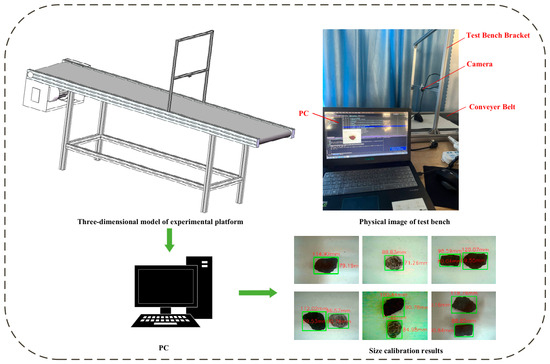
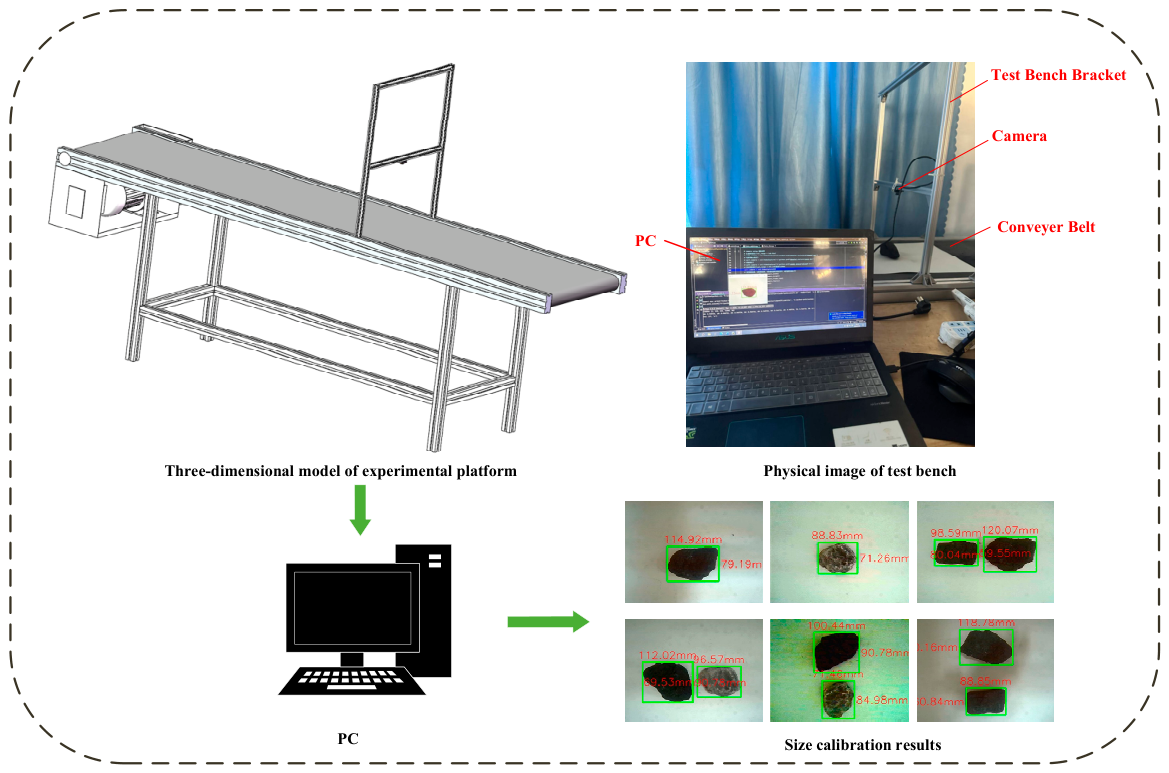
The coal gangue image acquisition system built in this study is shown in Figure 1. The acquisition device consists of a test bench, a camera, a conveyor belt, and a PC terminal. The image acquisition process of dynamic coal gangue is as follows: the coal gangue is placed on the conveyor belt, and then the system is started; the conveyor belt moves at a constant speed, and the camera captures the motion sequence image of the coal gangue on the conveyor belt at a fixed frame rate, and transmits it to the PC in real time for subsequent image processing and size measurement algorithms. Each experimental condition continuously collects 600 frames of images for measurement. When the target completely leaves the camera’s field of view, the single measurement cycle ends, and then the next set of tests is performed. The system effectively simulates the actual scene in industrial sorting, and provides a reliable experimental platform for the research of dynamic size measurement method.
Figure 1.
System for the acquisition and processing of coal gangue images.
2.2. The Actual Size Measurement Based on 3D Scanning
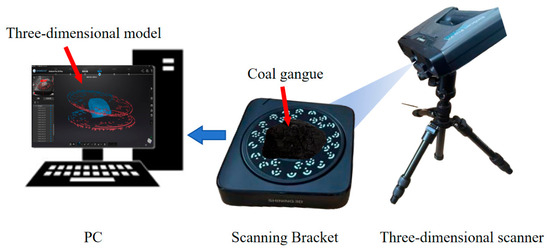
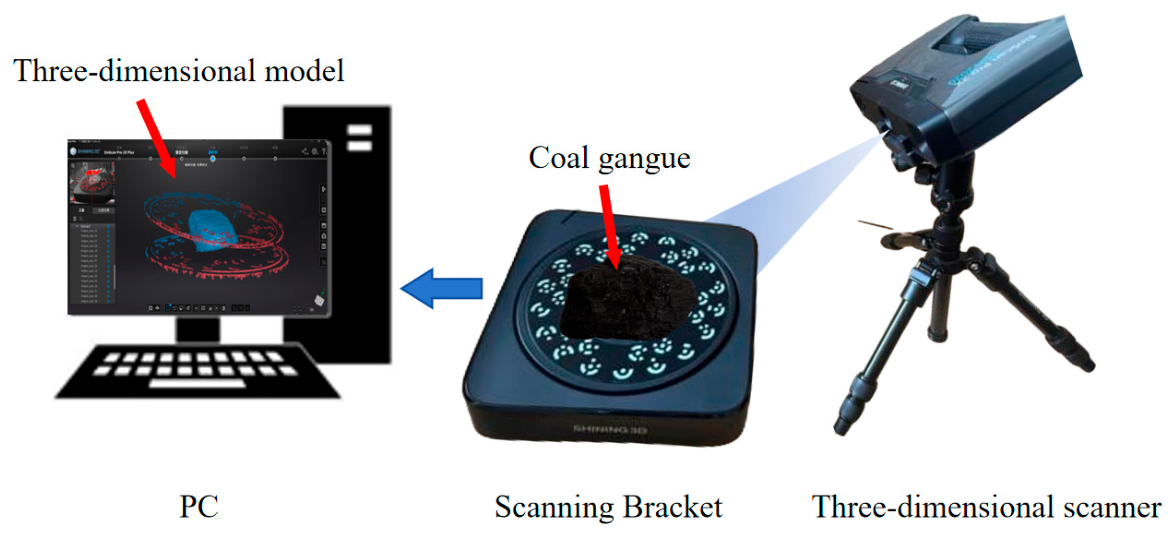
The purpose of this paper is to develop a precise calibration method for dynamic coal gangue particle size. In order to determine the accuracy of subsequent dynamic coal gangue particle size calibration, the actual size of coal gangue needs to be measured as a comparison benchmark. Therefore, this study builds a size measurement device for coal gangue particles, as shown in Figure 2. The device adopts Ein Scan Pro 2X multi-functional 3D scanning system, which is mainly composed of scanner turntable, scanner, and scanner bracket. The system uses three-dimensional reconstruction to restore the coal gangue image and measures the actual size in the reconstructed coal gangue image. The measurement accuracy of this device is 0.045 mm, which can achieve high-precision measurement and provide a reliable basis for dynamic calibration accuracy.
Figure 2.
Device for three-dimensional modeling.
In order to ensure that the collected coal gangue images have high contrast and clear edge details, this study specifically designed and selected the light source scheme. After a comprehensive comparison of different light source characteristics and lighting methods, the white LED ring light source was finally selected and combined with a 60° illumination scheme. In this scheme, white light can effectively enhance the discrimination between dark coal gangue and background; the LED light source has significant comprehensive advantages in brightness, stability, and life. The annular light at a specific angle can provide uniform illumination and effectively suppress shadows and reflections.
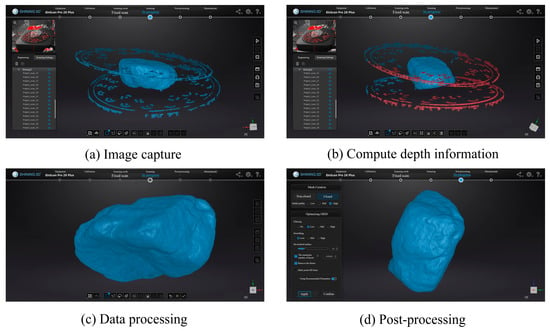
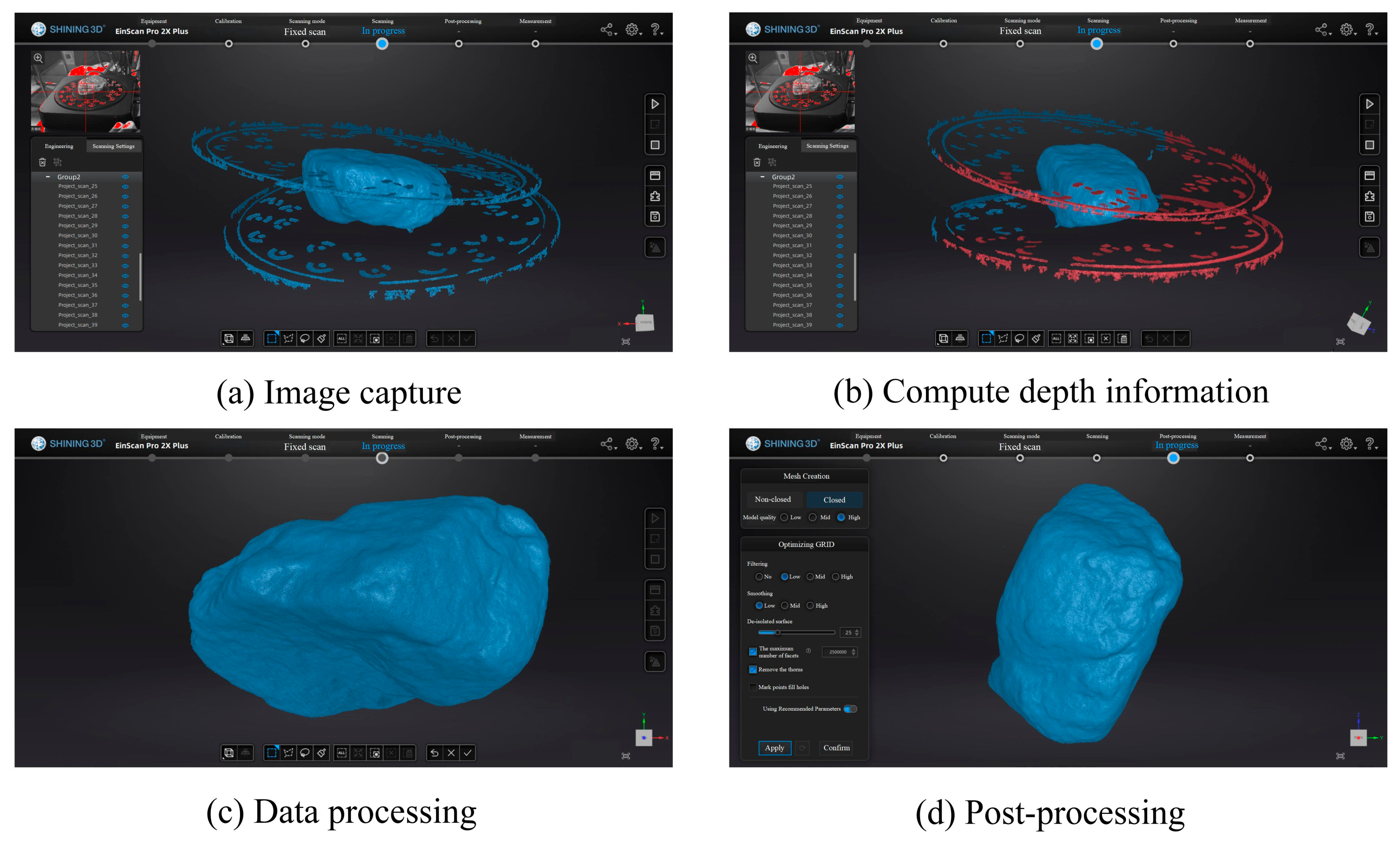
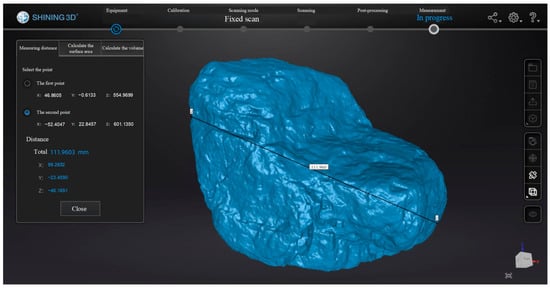
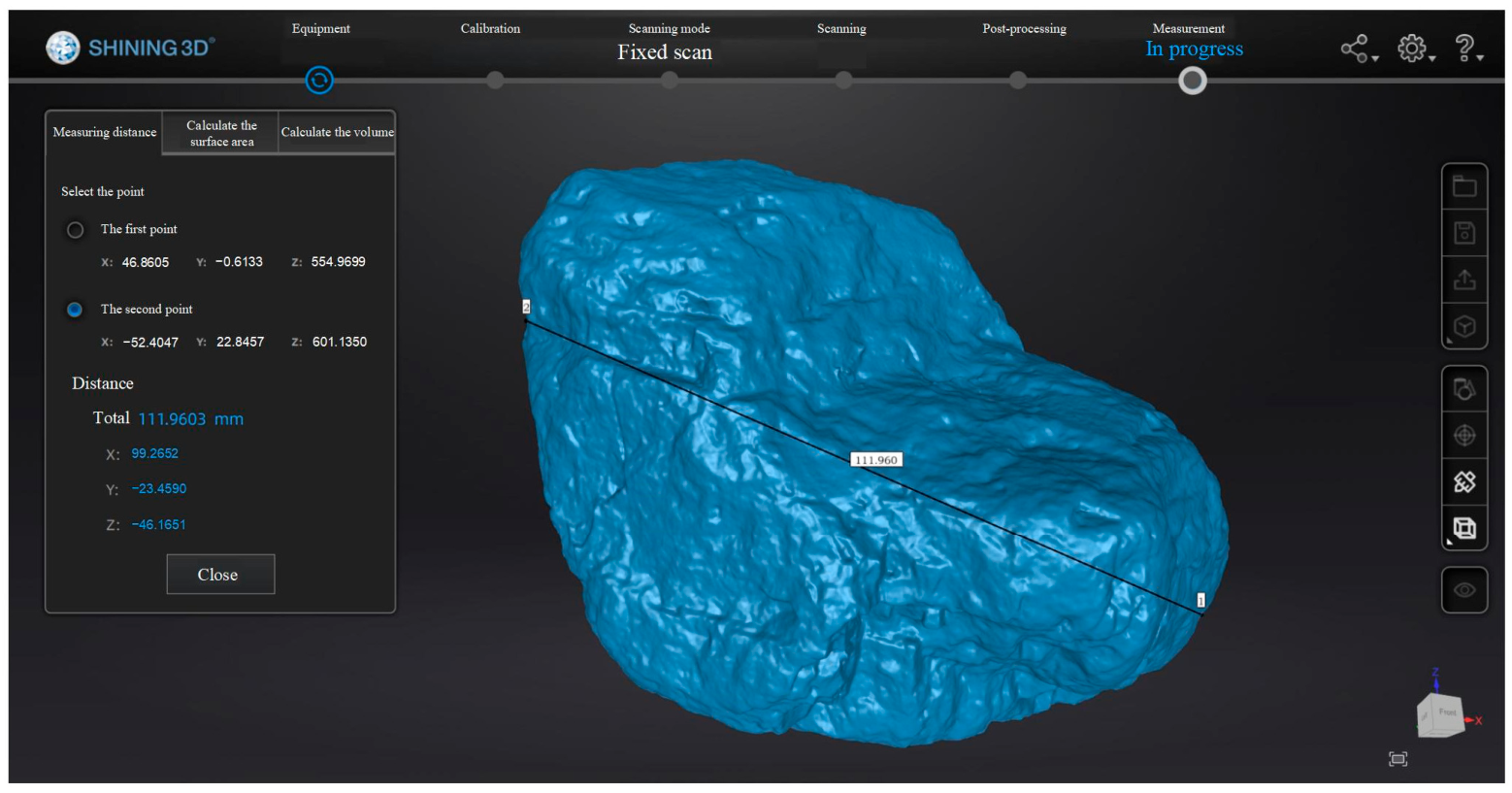
The process of three-dimensional reconstruction is shown in Figure 3. The coal gangue is projected by the device emitting structured light, and the projected pattern is captured and analyzed to obtain the depth of each point. By analyzing these deformed patterns and combining the known geometric relationship between the camera and the projector, the depth information of each point is calculated. Then the scanner integrates and processes the collected data, and further generates a high-quality three-dimensional model through post-processing. Finally, the length and width of the coal gangue are calculated by labeling, as shown in Figure 4.
Figure 3.
Three-dimensional reconstruction process.
Figure 4.
Coal gangue size measurement calibration.
3. Dynamic Coal Gangue Size Measurement and Calibration System Based on Coordinate-Pixel Calibration Method
In coal mining, particularly during coal gangue separation, accurate measurement of coal gangue particle size enables the fine separation of coal and gangue of different sizes during sorting. The fineness, efficiency, and accuracy of coal gangue sorting carry substantial importance for the improvement of coal mining benefits and the mitigation of environmental pollution [33,34,35]. Therefore, it is particularly crucial to achieve accurate size measurement of dynamic coal gangue. To target this problem, this paper proposed a coordinate-pixel calibration method to process the ore image. Following image preprocessing, the dynamic ore image on the conveyor belt was measured and calibrated, thereby achieving the measurement and calibration of ore size within the ore image.
3.1. The Principle of Coordinate-Pixel Calibration Method for Dimension Measurement
In this paper, an innovative coordinate-pixel calibration method is proposed. The core key is that each pixel point of each frame in the video image is regarded as a coordinate point, the number of pixels (i.e., pixel length) is unified and linked with the actual length, and the Euclidean distance formula is employed to compute the actual length, thereby enabling the size measurement and calibration of coal gangue to be achieved. The specific principles and steps are as follows.
Firstly, through the captured image, the width, height and frame rate of the image are obtained. The pixel coordinate system is established with the image center as the coordinate origin. The calculation formula of the origin coordinate (cx, cy) is shown in Formula (1):
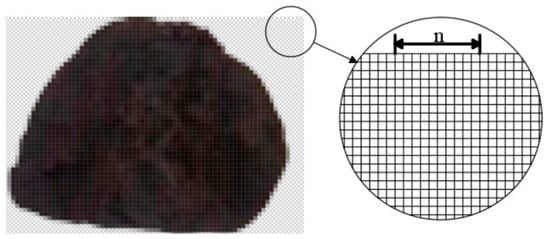
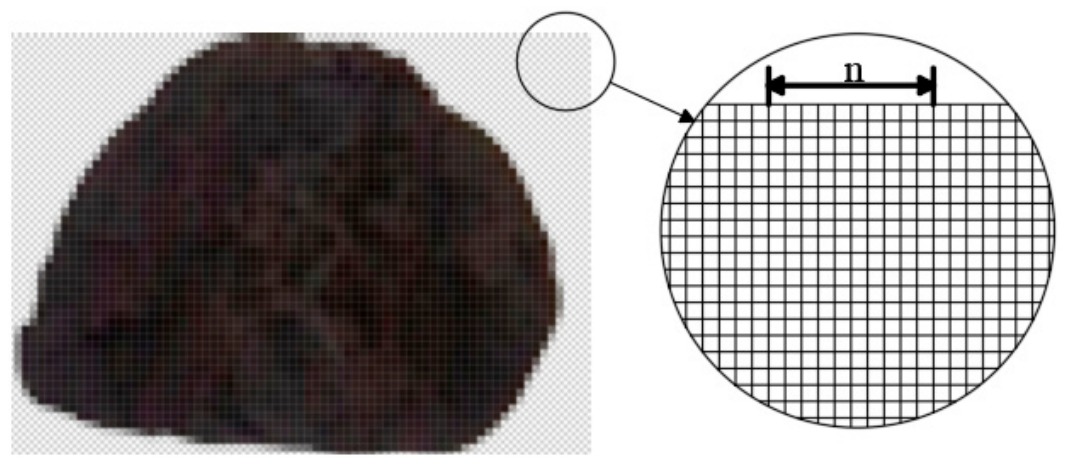
Before the measurement, in order to achieve stable size calculation, it is necessary to set the pixel reference for the dynamic coal gangue image in advance. As shown in Figure 5, the image is divided into several pixel blocks, and the pixel reference n is set to 10; that is, 10 pixels are used as a basic calculation unit, and subsequent measurements will be based on this calibration block.
Figure 5.
Pixel block coal gangue image and calibration.
After the pixel reference setting is completed, the calibration standard is determined. The calibration standard is set to specify the actual distance corresponding to the pixel length of the pixel reference, so as to ensure that the measured results have high accuracy. The calculation formula is shown in Formula (2). Va is the actual size of coal gangue, Vr is the set reference standard value, Vc is the pixel size measured under Vr, and Ks is the calibration standard. There is no need for repeated calibration in fixed equipment and measurement environments:
After calibration, the Euclidean metric is used to measure the size [36,37], and the formula is shown in Formula (3). The pixel distance in the video is calculated by the Euclidean distance and converted by the calibration standard Ks to output the actual size of the coal gangue.
3.2. Dynamic Coal Gangue Size Measurement Method Based on Gray-Gaussian-Binarization Joint Processing
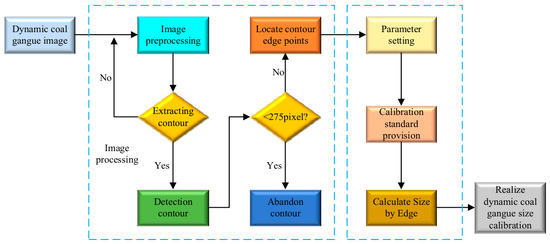
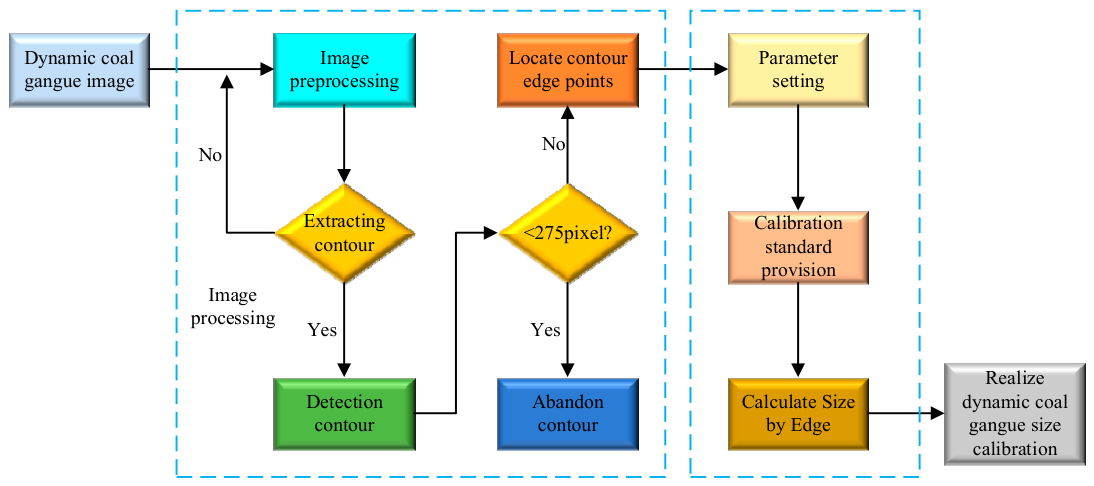
Based on the coordinate-pixel calibration method, the complete process of dynamic coal gangue size measurement is shown in Figure 6. The target contour is obtained by preprocessing the dynamic coal gangue image, and then the accurate measurement of the size is completed by calibration calculation.
Figure 6.
Dynamic coal gangue particle size detection operation model.
First, the input dynamic image is gray-scale processed, and the RGB image is converted into a gray-scale image, as shown in Figure 7, to prepare for the next image processing.
Figure 7.
Gray processing of coal gangue image.
After converting into a grayscale image, the image is subjected to Gaussian filtering. Gaussian filter is a linear smoothing filter widely used in image denoising. Gaussian filtering is the process of weighted average of the whole image. The value of each pixel is obtained by weighted average of its own and other pixel values in the neighborhood. The specific operation is to scan each pixel in the image with a template, and replace the value of the center pixel of the template with the weighted average gray value of the pixels in the neighborhood determined by the template. The Gaussian blur process of the image is the convolution of the image and the normal distribution. The Gaussian function is shown in Formula (4):
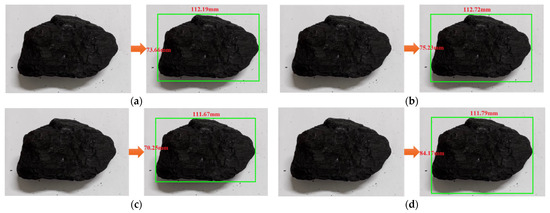
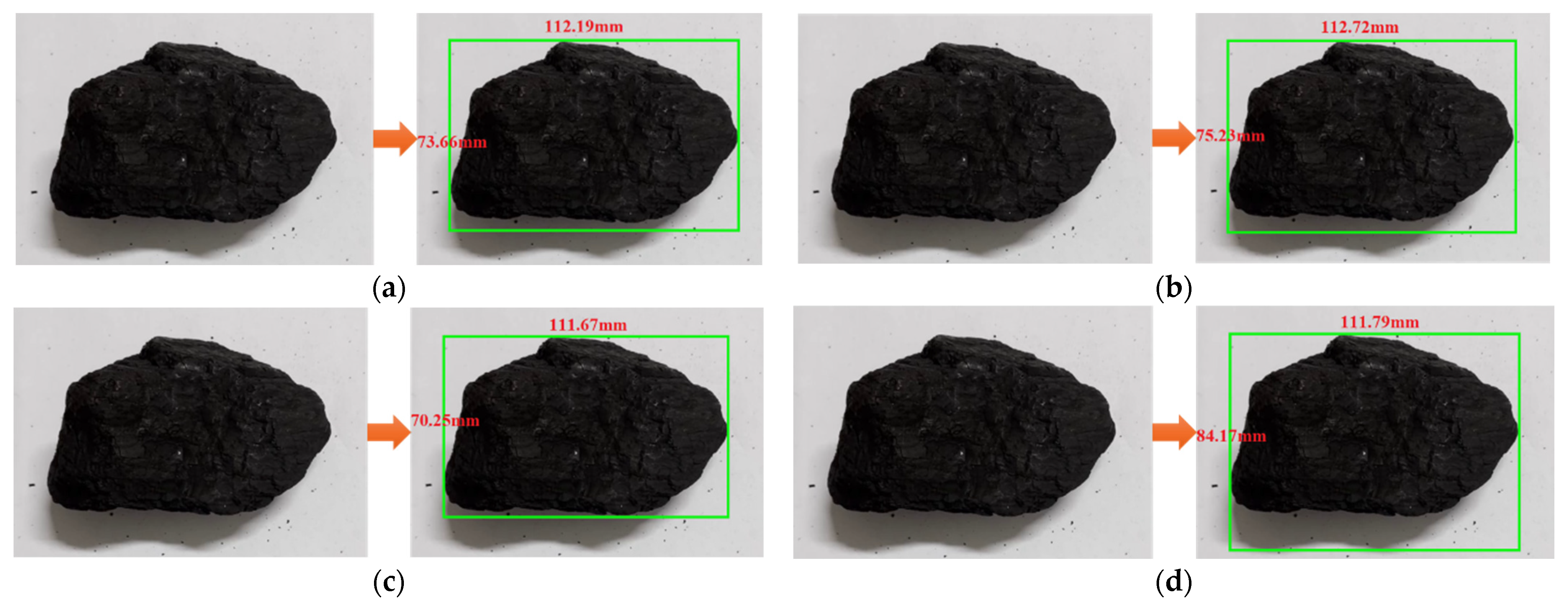
Gaussian fuzzy convolution has convolutions of different templates such as 3 × 3, 5 × 5, 7 × 7 and 9 × 9. The effects of various convolutions are shown in Figure 8, where the left image is a Gaussian fuzzy effect map, and the right image is the corresponding size calibration result. After comparison, the convolution templates of 3 × 3, 5 × 5 and 9 × 9 fail to detect the actual edge of coal gangue, while the convolution template of 7 × 7 can clearly extract the real edge of dynamic coal gangue image. Therefore, the convolution template of 7 × 7 is selected as the Gaussian fuzzy convolution kernel. After Gaussian blur processing, the denoised coal gangue image is obtained, and then the next step is processed.
Figure 8.
Gaussian blur and size calibration effect. (a) 3 × 3 conv; (b) 5 × 5 conv; (c) 7 × 7 conv; (d) 9 × 9 conv.
After the image is smoothed by Gaussian filtering, the image is binarized. The image binarization compares the gray value of the pixels in the image with the threshold by setting a threshold. The pixels larger than the threshold are set to white, and the pixels smaller than the threshold are set to black. Finally, the image is converted into only 0 and 1, that is, the binary image, as shown in Formula (5).
When the gray value is less than the threshold T, the pixel value is set to 0, which is a black pixel. When the gray value is greater than the threshold T, the pixel value is set to 1, which is a white pixel.
The image binarization processing used in this paper uses a global threshold processing. The operation process is to set a threshold, and use the threshold to divide the image data into two parts: a pixel group greater than the threshold and a pixel group less than the threshold. The binary threshold method is used for threshold processing, and the principle is shown in Formula (6).
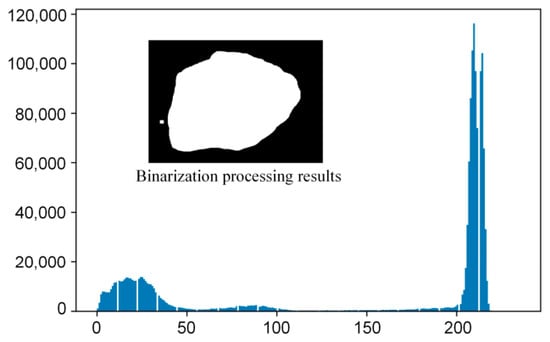
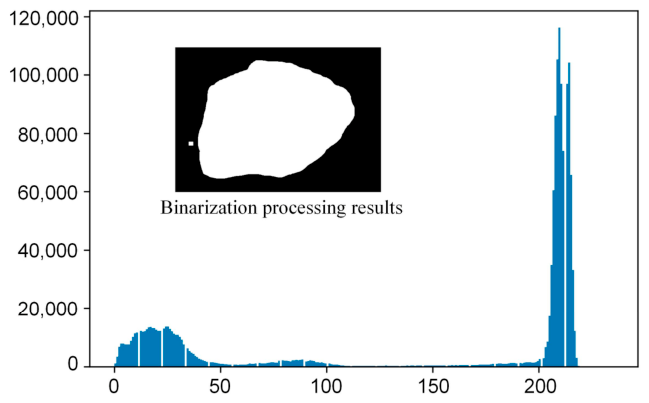
Take the maximum value for the part exceeding the threshold, otherwise take 0. However, in practice, the fixed threshold cannot be set manually, so Otsu’s binarization algorithm [38,39] is used to automatically find the threshold through the algorithm. This method has a good effect on the bimodal image, and the gray histogram of the coal gangue dynamic image to be tested is shown in Figure 9. It can be seen from the figure that the image to be tested is a bimodal image, so Otsu’s binarization algorithm can be used for threshold processing. The processed results are shown in Figure 9.
Figure 9.
Gray histogram and Binarization processing results of coal gangue image.
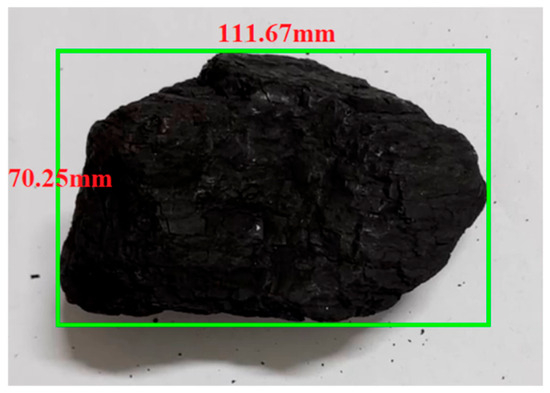
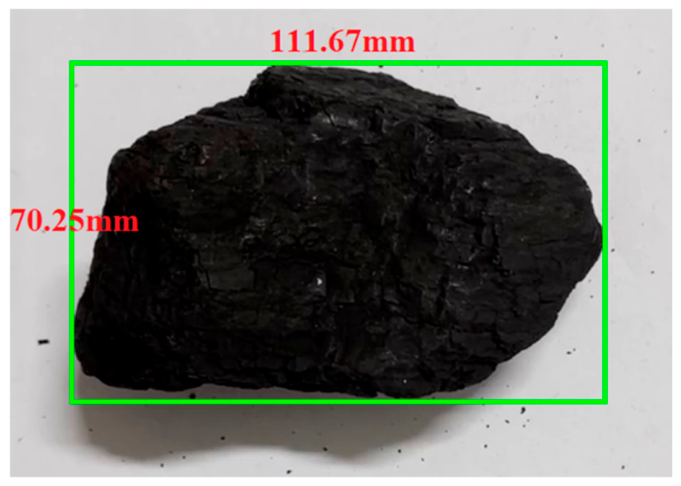
After contour screening, the size calibration parameters are set. According to Formula (2), Vr is 72, Va is 114.5 mm, and Vc is 42.83 when Vr is 72. It can be calculated that Ks should be 192.4819. Therefore, the calibration standard is obtained, and the subsequent process is performed after the standard setting is completed. By setting the standard and coordinate origin and combining the Euclidean metric, the coal gangue size can be measured and calibrated. The calibration results are shown in Figure 10.
Figure 10.
Size measurement and calibration.
3.3. Experimental Verification of the Measurement Accuracy of the Coordinate-Pixel Calibration Method
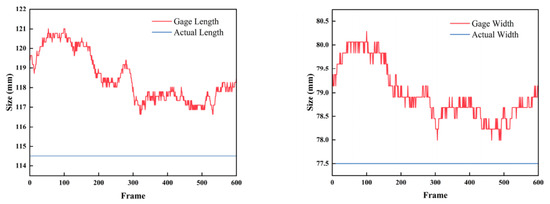
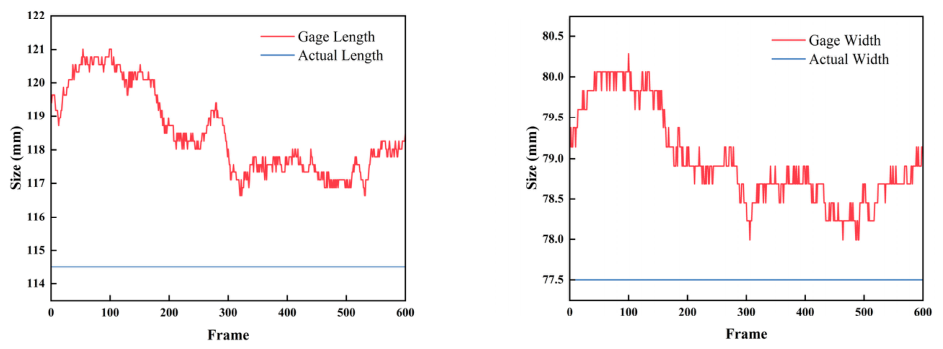
In order to verify the measurement accuracy of the coordinate-pixel calibration method, the accuracy of its size measurement in dynamic images was tested. By extracting the last 600 frames of images in the same video, the length and width data of coal gangue are measured and recorded frame by frame and compared with the real size. The results are shown in Figure 11.
Figure 11.
Length comparison and width comparison.
The figure shows the length and width size data of the coal gangue in the video obtained by the measurement method in this paper. The size measurement data changes at different time points during the measurement process are presented, and its dynamic characteristics are accurately captured. The figure also contains a reference standard of the actual size for comparison and calibration with the measurement results. The relationship between the measured data and the actual size is shown by the line chart. It can be seen from the diagram that the data measured by the method in this paper are higher than the actual value compared with the actual data, and then the accuracy test is carried out. The calculation accuracy formula is as shown in Formula (7):
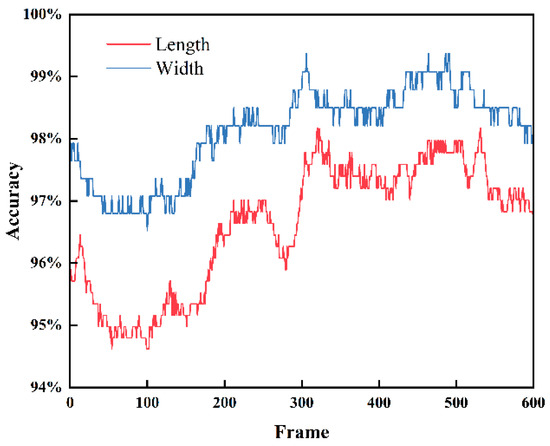
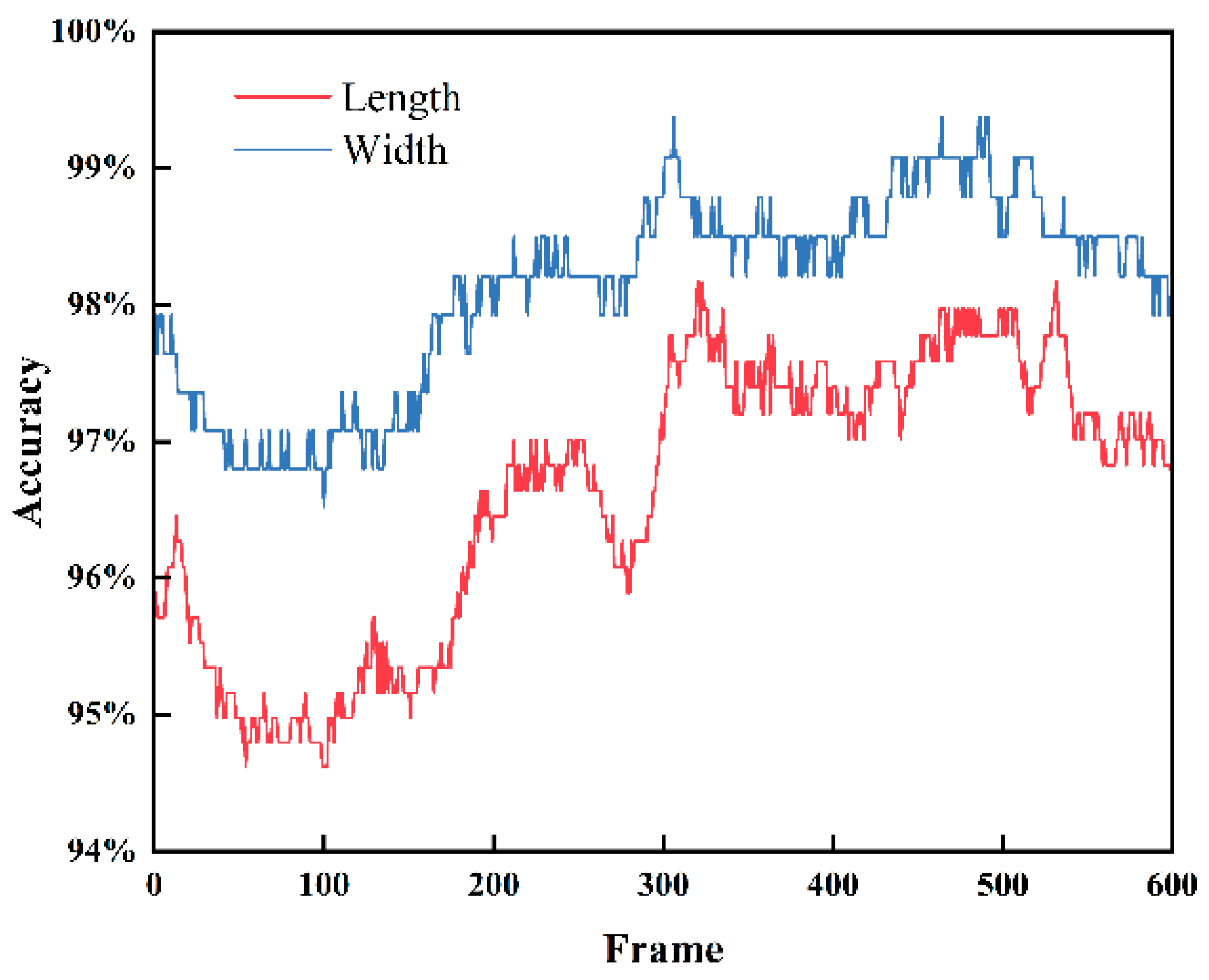
Among them, P is the measurement accuracy; Smin is the smaller between the measured value and the actual value; Smax is the larger between the measured value and the actual value. The accuracy measurement data is shown in Figure 12, and the average value of length and width and the average value of accuracy are calculated as shown in Table 1.
Figure 12.
Accuracy of length and width.
Table 1.
Length, width, and average accuracy.
The results show that the average accuracy of length and width in dynamic measurement is 96.62% and 98.12%, respectively, and the data fluctuation is small, showing good stability and reliability. However, the overall measured value is slightly higher than the actual value, there is a certain deviation, and there is still room for optimization in accuracy. Therefore, the measurement method will be optimized and improved in the future.
It should be pointed out that the method in this paper uses a monocular camera for measurement, and the calibration constant Ks is based on the assumption that all particles are located on the same plane (conveyor belt surface). When the particle height is different, the distance between the surface and the camera is different, which will produce perspective error. Under the experimental conditions of this paper, the measured coal gangue particle size range is 77.5~114.5 mm in length and 30~80 mm in width. The height difference is limited, and the perspective error is within the acceptable range. However, for the working conditions with large height difference, the error cannot be ignored. In the future, binocular vision or laser ranging will be introduced to compensate the measurement results by obtaining particle height information, so as to further improve the measurement accuracy.
4. Improvement Strategy of Dynamic Size Measurement Method of Coal Gangue
4.1. Improvement of Image Processing Method
After the measurement accuracy analysis of the coordinate-pixel calibration method size measurement experiment, the method still has room for optimization in measurement accuracy. After analysis, the accuracy of size measurement depends on the accurate detection of the edge of coal gangue. Therefore, the edge detection of coal gangue will be optimized in image processing, and Canny edge detection will be used instead of image binarization to process the coal gangue image. After reducing image noise by Gaussian fuzzy smoothing image, the Canny operator is used for edge detection [40,41]. After removing the noise by Gaussian filtering, the Sobel operator is used to calculate the first derivative of the image in the horizontal and vertical directions, and the gradient amplitude and direction are obtained to locate the edge region with the most dramatic gray change.
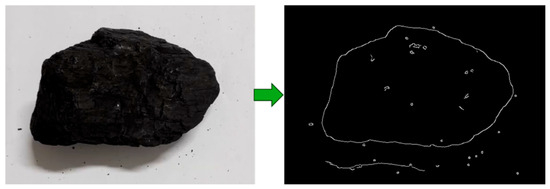
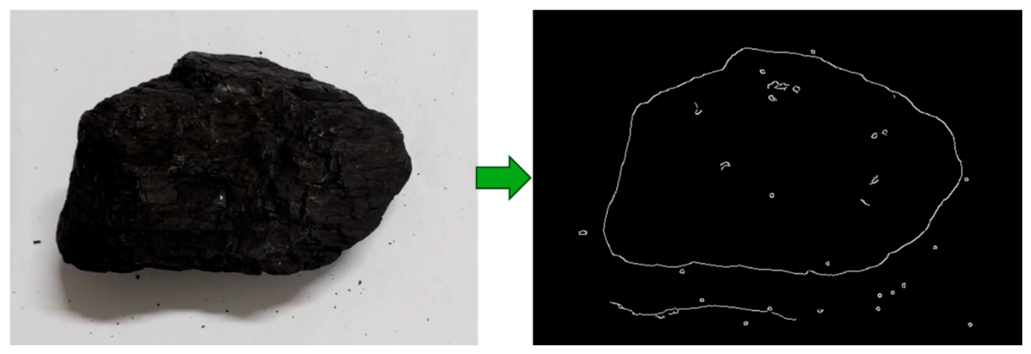
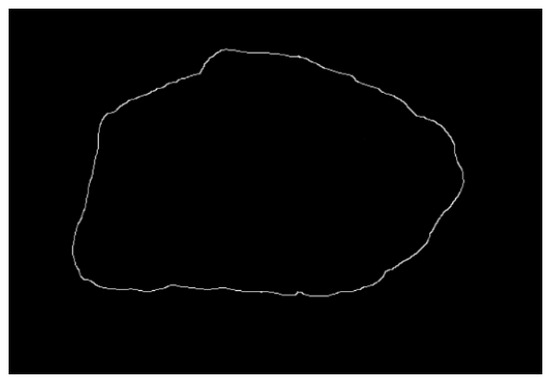
Then, by using the non-maximum suppression technique, only the maximum value of the gradient intensity on each pixel is retained and other values are deleted to refine the edge. Then the double threshold method is used to distinguish the edge and noise. The method proposed in this paper sets the lower threshold to 50 and the upper threshold to 100. The value refers to the general practice in the field of image processing. The ratio of 2:1 is in line with the recommended range of commonly used libraries such as OpenCV. It aims to effectively suppress noise while using the lag connection technology to retain the real weak edges and further process the candidate edges established by the double threshold method. The edge of coal gangue image detected by Canny edge detection is shown in Figure 13. It can be seen that there are still some noise points after edge detection, so further processing is needed.
Figure 13.
Edge detection.
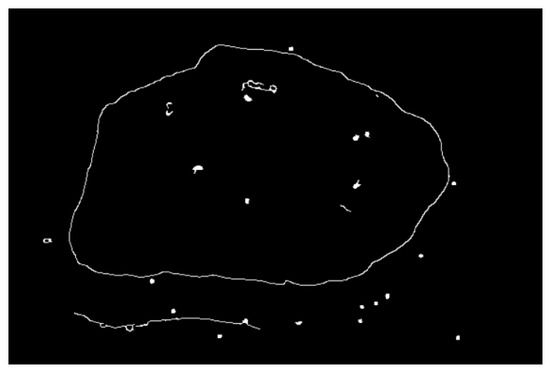
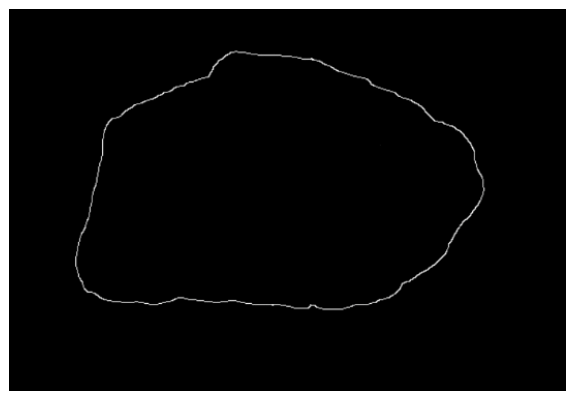
In order to eliminate the interference of residual holes on the measurement after edge detection, the image morphology operation is used to process the dynamic coal gangue image to fill the holes and smooth the contour. Through equal expansion and corrosion operations, the internal voids are filled and the edge contour is smoothed under the premise of maintaining the original contour size, which effectively improves the integrity and continuity of the coal gangue contour and lays a foundation for subsequent size measurement. The image effect of coal gangue obtained by morphological processing is shown in Figure 14.
Figure 14.
Morphological processing.
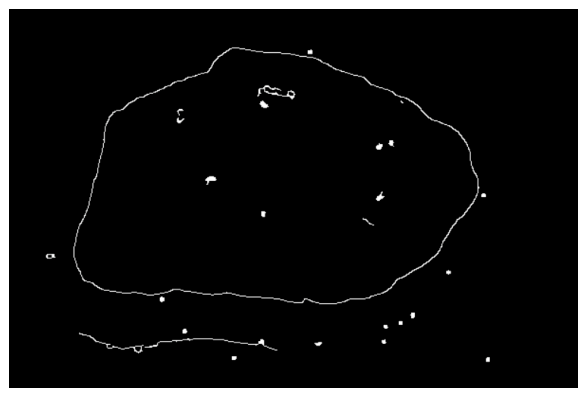
Contour traversal is performed on the processed image to extract continuous boundaries. After traversing, the contour is filtered and screened, and the screening threshold is set to 275 (275 means the number of arrays in the contour array list). All the non-coal gangue contour areas are screened out, and only the coal gangue parts that need to be detected and calculated are retained. The results after screening the contours are shown in Figure 15.
Figure 15.
Contour filtering results.
4.2. Function Optimization of Dynamic Coal Gangue Size Calibration System
When measuring the size of coal gangue, a series of human–computer interaction functions are designed to effectively process video or real-time data. When calibrating the size of the dynamic coal gangue image, it is proposed that the real-time measurement process can be obtained by controlling the key and allowing the video to be played and paused at any time. Through this interaction, the current key frames can be captured and saved in real time when needed. In addition, the calibration system also supports the switching between automatic and manual measurement modes to adjust the measurement process according to specific requirements.
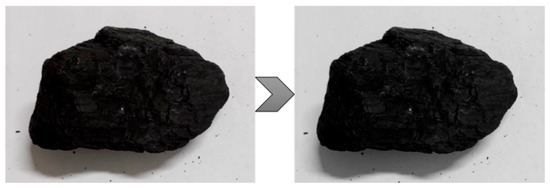
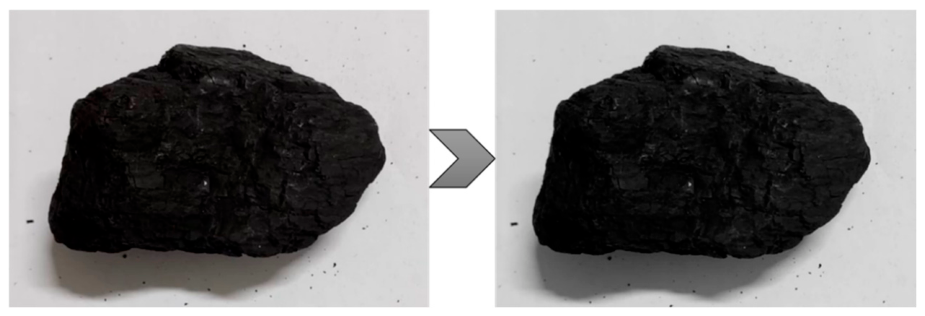
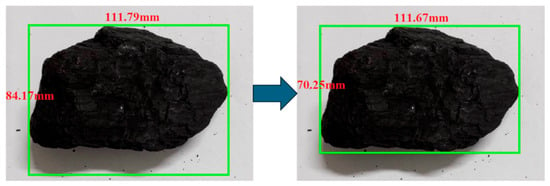
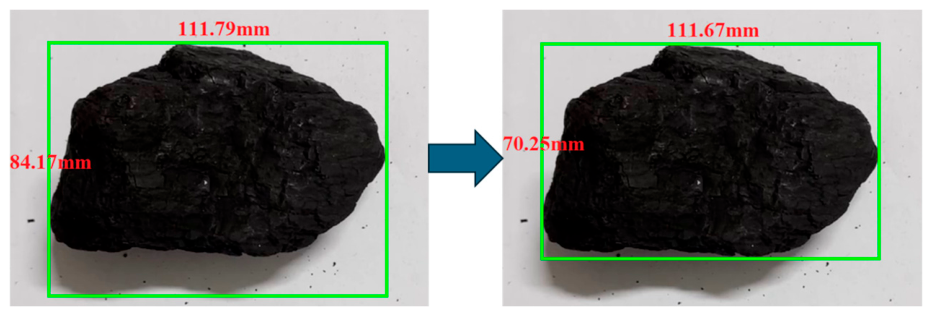
In order to further improve the accuracy of size measurement, especially in complex environments or light conditions, the system also introduces shadow removal technology. Through the image processing algorithm, that is, the Canny edge detection proposed in this paper replaces the binarization algorithm to identify and eliminate the influence of shadow on the size measurement results. The shadow removal results are shown in Figure 16 to ensure that the measurement data is more reliable and accurate.
Figure 16.
Comparison before and after shadow removal.
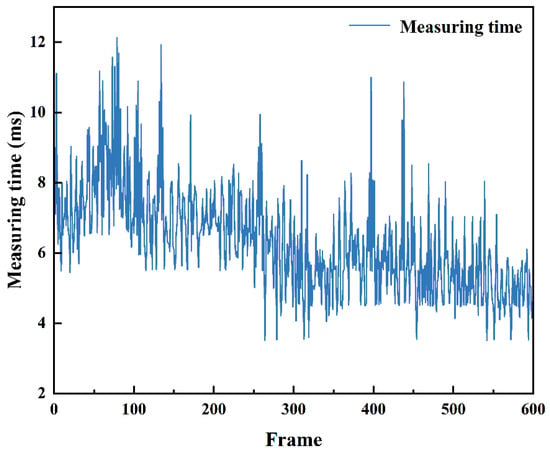
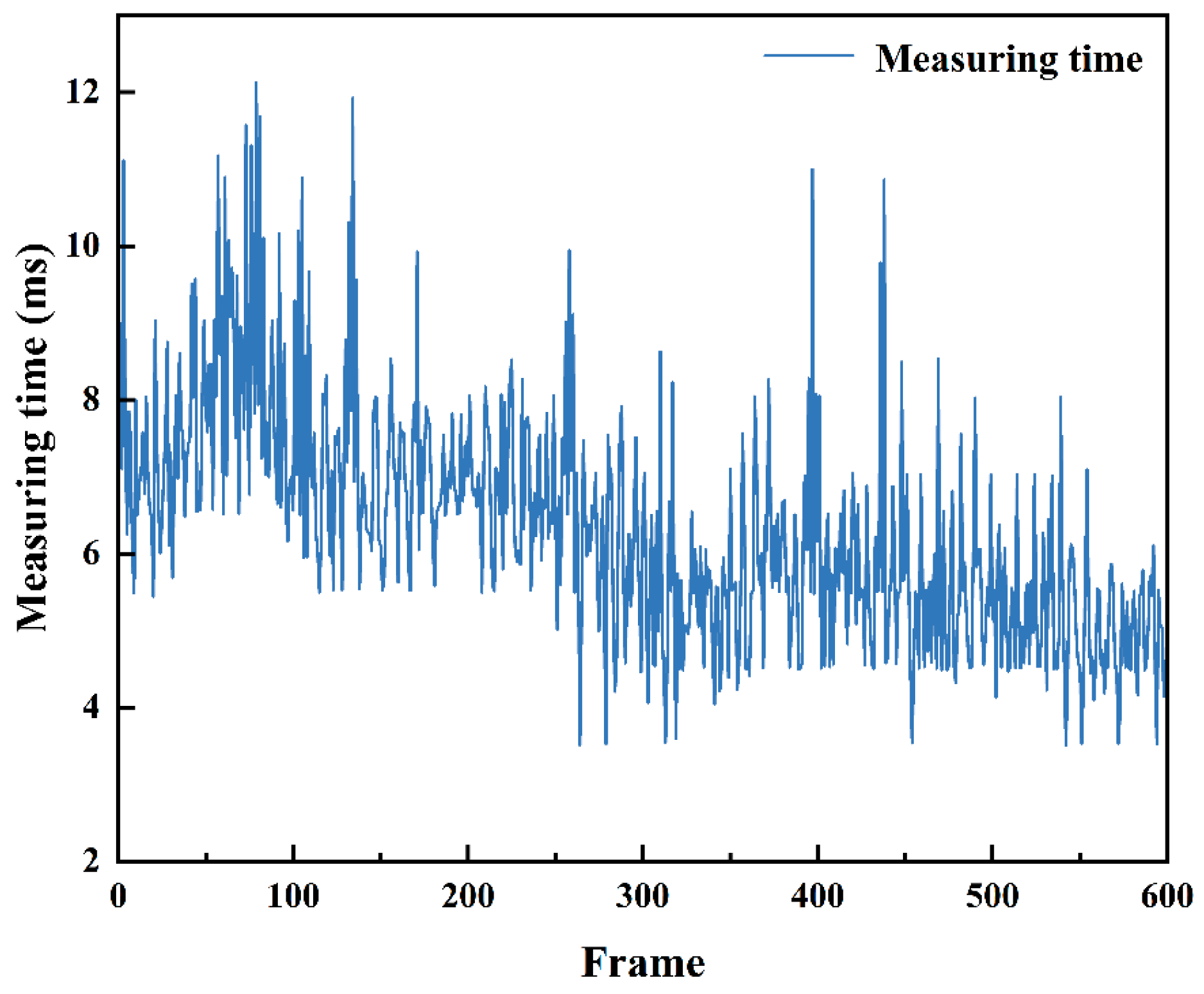
Figure 17 shows the time taken to measure the size of each frame during the measurement process. After calculation, the average time measured by this method is about 6 ms. Therefore, the method proposed in this paper shows significant computational efficiency and shows high efficiency and superiority in real-time applications.
Figure 17.
Measurement time.
4.3. Preliminary Verification of the Improvement Strategy
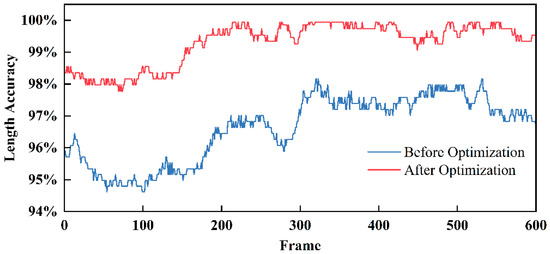
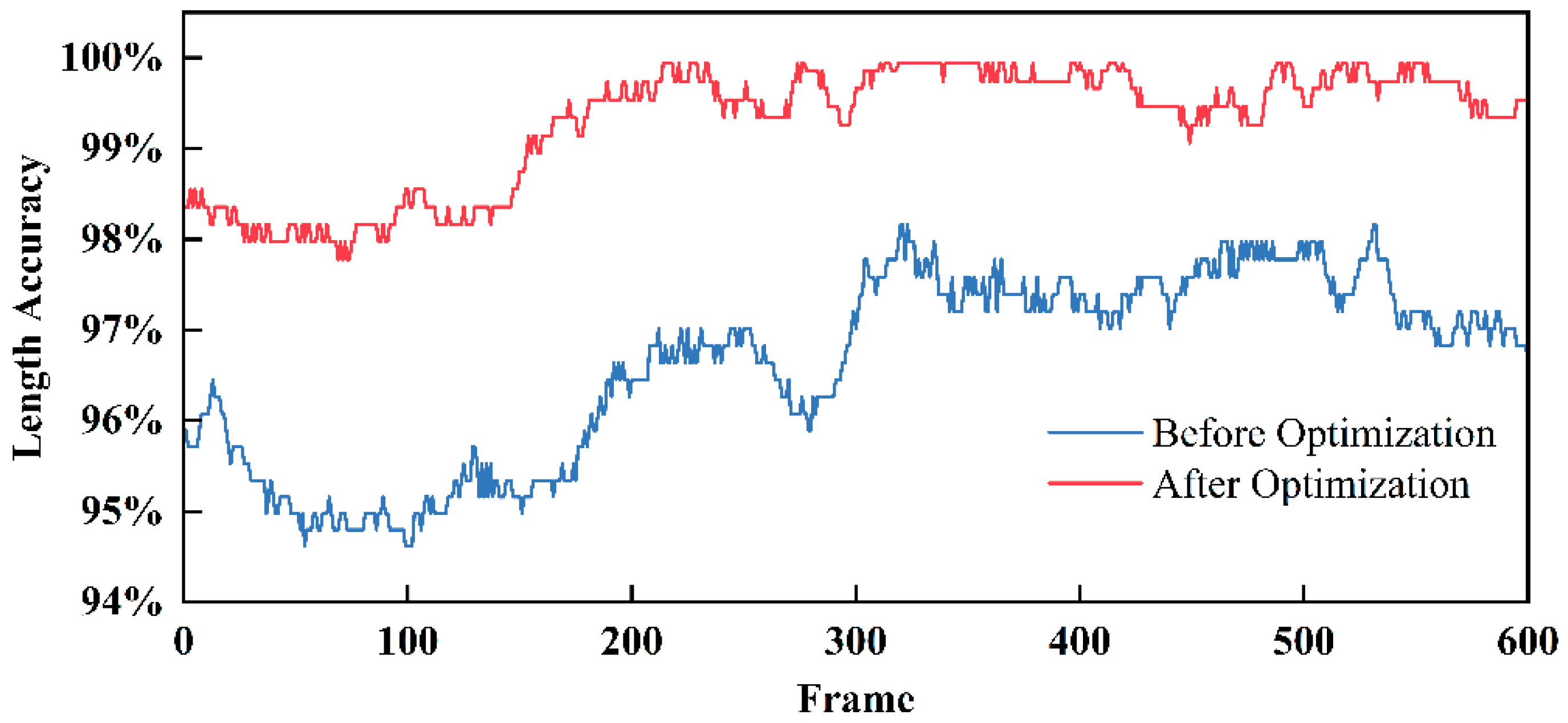
In order to quantitatively evaluate the effectiveness of the improved strategy proposed in this chapter, this section compares the performance of the method before and after optimization in the most representative ‘single coal’ scenario. As shown in Figure 18, by comparing the length accuracy of the method before and after optimization, it can be seen that the length measurement accuracy after optimization is increased by about 2% compared with that before optimization, and the accuracy of the results obtained after optimization is more stable from the trend of the broken line.
Figure 18.
Comparison of length accuracy before and after optimization.
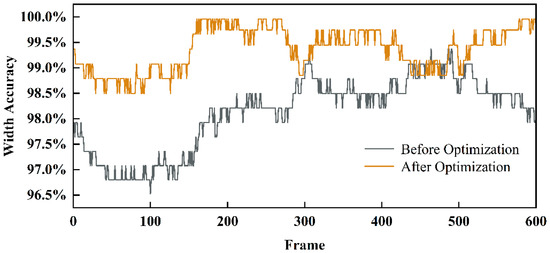
As shown in Figure 19, by comparing the width accuracy of the method before and after optimization, it can be seen that the width measurement accuracy after optimization has also been significantly improved: it is about 2% higher than that before optimization, and the stability is higher. The results obtained are more accurate, so the optimized method shows obvious improvement.
Figure 19.
Comparison of width accuracy before and after optimization.
In order to further verify the competitiveness of the proposed method, we qualitatively compare the proposed method with two classical image processing baseline methods under two typical working conditions of ‘single coal’ and ‘single gangue’. Yu et al. [42] used the improved multi-threshold Otsu algorithm to realize adaptive threshold segmentation, and combined it with Canny edge detection to complete the segmentation of coal gangue target and conveyor belt background. Zhang et al. [43] used the background difference method to detect and mark the coal and gangue in the video frame image of the belt conveyor. Compared with the above baseline methods based on traditional image processing, the Canny + morphological optimization method proposed in this paper performs better in terms of edge extraction integrity and contour continuity, and has obvious advantages in measurement accuracy and stability.
In the comparison with the deep learning method, the reference [11,22,23,24] uses U-Net, the improved YOLO algorithm, deep learning combined with a pneumatic separation system, and the lightweight YOLO algorithm based on ResNet18, respectively. The detection accuracy on their respective data sets is mostly between 92% and 96%. These methods usually rely on large-scale annotation data and high-performance GPUs, and the deployment cost is high in resource-constrained scenarios. The method in this paper is based on classical image processing technology, without training and GPU acceleration. The single frame processing time is about 6 ms, and it has better economy and real-time performance while maintaining more than 98% measurement accuracy. It should be noted that the above accuracy comparison is based on literature data. The data sets and experimental conditions used in each study are different, and the values are only for reference.
The above comparative experimental results in the ‘single coal’ scenario fully show that the improved dynamic coal gangue size measurement method has a significant improvement in accuracy and stability. The results verify the effectiveness of the optimization strategy proposed in this chapter, which lays a good foundation for the subsequent application under various complex working conditions.
5. Experimental Study on Dynamic Coal Gangue Size Measurement Based on Improved Dynamic Coal Gangue Size Calibration Method
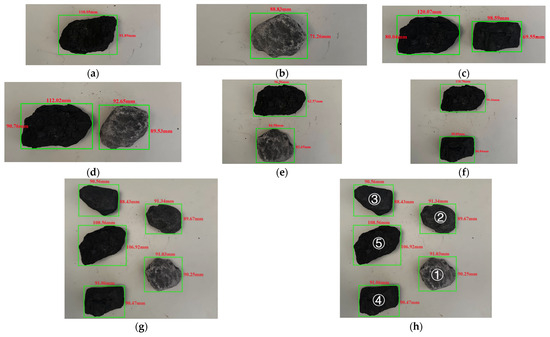
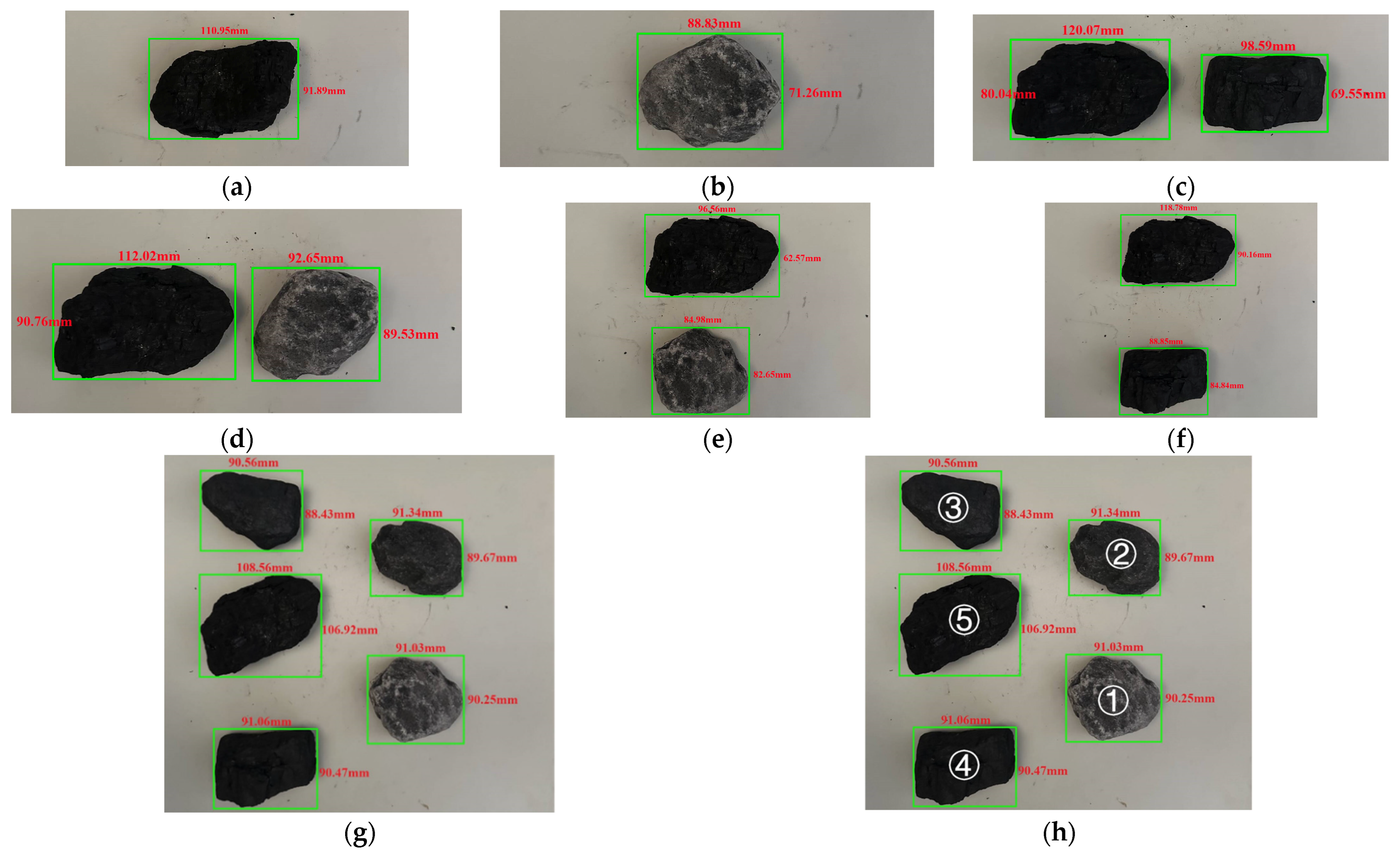
In order to systematically evaluate the performance of the improved dynamic coal gangue size calibration method proposed in this paper, the accuracy rate is used as the evaluation index, and the stability of the method is characterized by calculating the average value and average error of the accuracy rate. In this study, seven typical experimental conditions were designed, including single coal, single gangue, side-by-side coal, side-by-side coal and gangue, pre-post coal, pre-coal and post-gangue, and scattered situation. As shown in Table 2, each working condition contains multiple samples of two types of particles, coal, and gangue. By comparing and analyzing the measurement results of coal gangue size under different conditions, the measurement accuracy and stability of the method are comprehensively evaluated. The calibration of coal gangue size under various experimental conditions is shown in Figure 20.
Table 2.
Experimental conditions.
Figure 20.
Test results under various experimental conditions. (a) Single coal; (b) single gangue; (c) side-by-side coal; (d) side-by-side coal and gangue; (e) pre-coal and post-gangue; (f) pre-post coal; (g) scattered situation; (h) scattered situation labeling.
5.1. Stability and Error Analysis of Dimensional Measurement Under Different Experimental Conditions
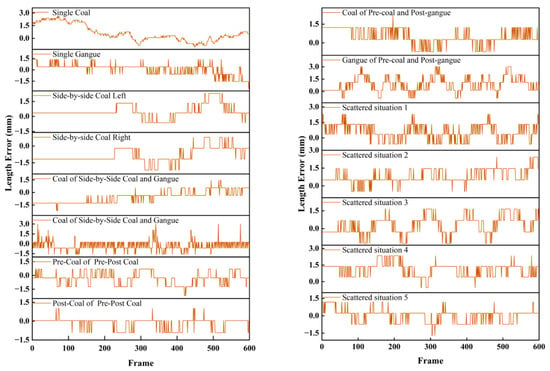
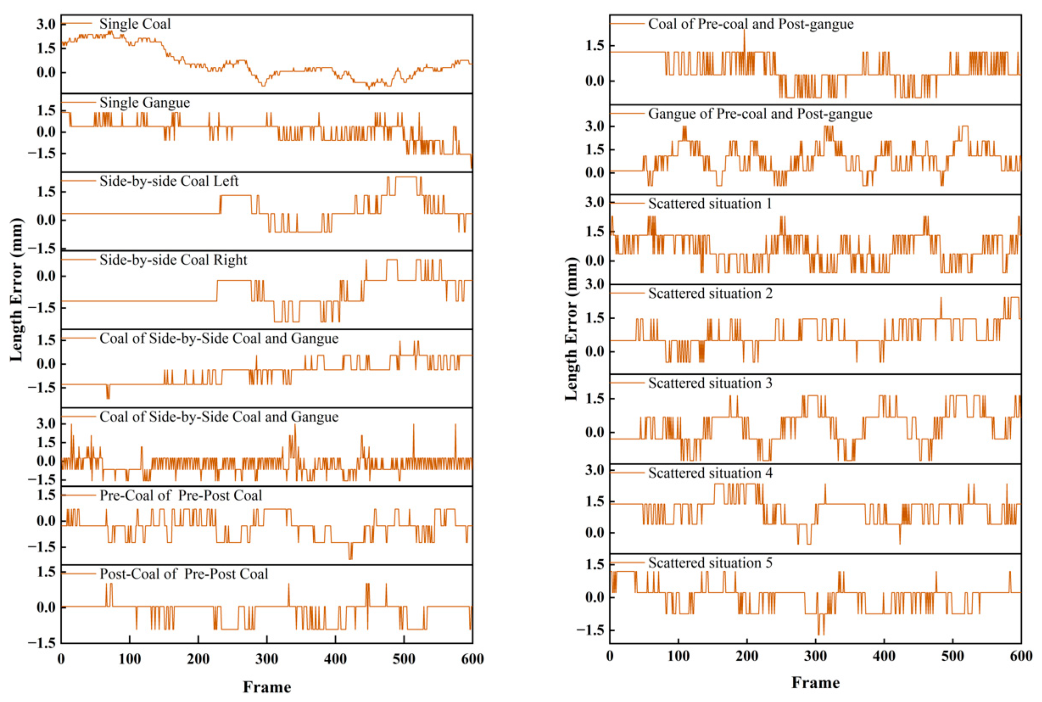
The purpose of this part of the experiment is to characterize and compare the stability of the length and width of coal gangue measured by the optimized method under different conditions that is, the difference in the calibration of each frame size and the stability of the measurement. Firstly, the length error under different experimental conditions is compared. The error between the measured length and the actual length under various conditions is shown in Figure 21, and the statistical results of length measurement errors under various experimental conditions are shown in Table 3.
Figure 21.
Length error under different experimental conditions.
Table 3.
Statistical results of length measurement errors under different experimental conditions (unit: mm).
According to the above diagram and the above table, the length error of coal and gangue measured by this method is about 1 mm, except for scattered situation 4, which is within 1 mm, showing significant stability and accuracy. Through the length error under various experimental conditions in Figure 21, it is observed that the measurement errors under various experimental conditions are kept in a very small range. In many experiments, the proposed method can stably generate dimensional measurement results with small errors.
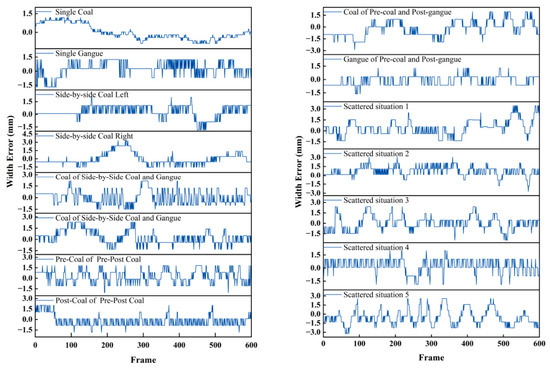
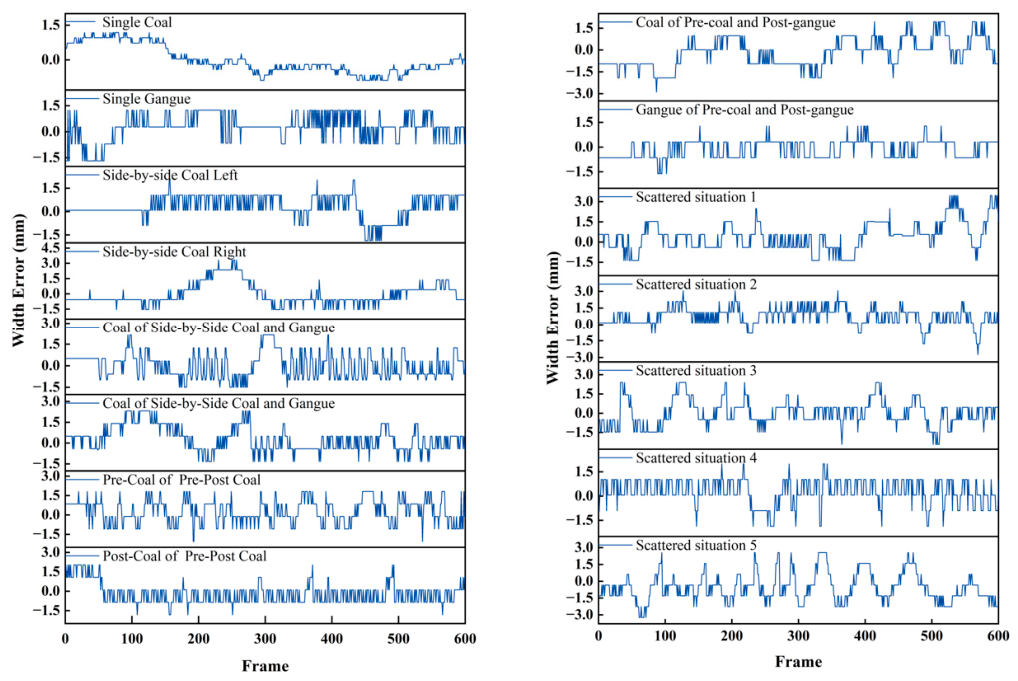
The second is the width error comparison under different experimental conditions. The error between the measured width and the actual width of various conditions is shown in Figure 22, and the statistical results of width measurement errors under various experimental conditions are shown in Table 4.
Figure 22.
Width error under different experimental conditions.
Table 4.
Statistical results of width measurement errors under different experimental conditions (unit: mm).
Through the above figure and table, it is known that the measurement is carried out under seven experimental conditions. The results show that only the average measurement width of pre-post coal and scattered situation 5 is above 1 mm, and the average measurement error of the width under most experimental conditions is below 1 mm. Specifically, in multiple width measurement calibrations, the proposed method can stably obtain close measurement results, indicating that the method can not only effectively reduce the measurement error, but also maintain high reliability and consistency under different experimental conditions.
In summary, in the entire data set, the measured size fluctuates around the actual size, but the amplitude is not large, and the measurement result is relatively stable. Therefore, this method can not only effectively reduce the measurement error, but also maintain its high stability under different experimental conditions.
5.2. Characterization of Calibration Accuracy of Length and Width Under Various Experimental Conditions
The purpose of this part of the experiment is to characterize the measurement accuracy of the length and width of coal gangue under different experimental conditions by using the optimized method. The stability and reliability of the method proposed in this paper under different conditions are evaluated by measuring the calibration and result analysis under each experimental condition.
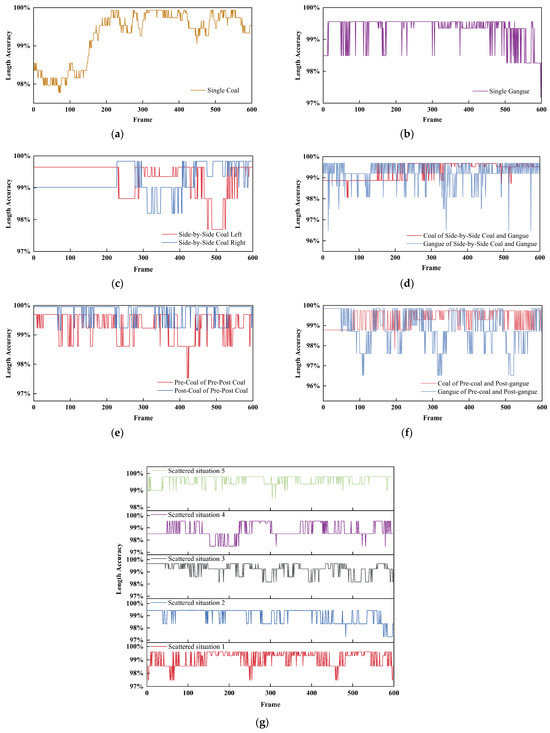
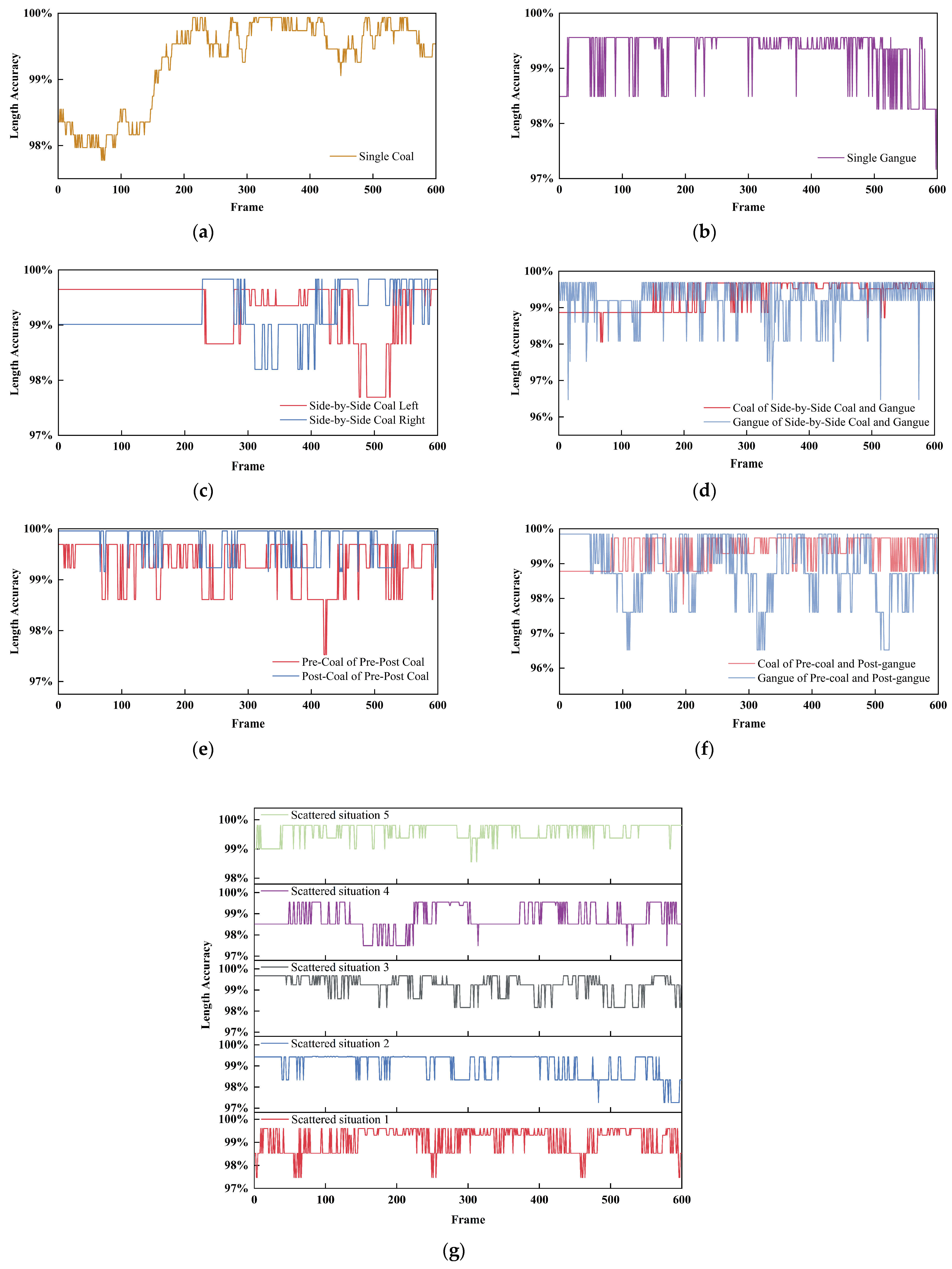
Figure 23 shows the characterization of length accuracy under various experimental conditions. It can be seen from the figure that the accuracy rate shows significant accuracy and stability under various conditions. It can be clearly observed from Figure 23 that, except for the two cases of the gangue of side-by-side coal and gangue and pre-coal and post-gangue, the other measurement accuracy rates reached more than 97%, and the accuracy rates of these two cases are also more than 96.5% in a small number of cases, with only a few cases fluctuating slightly.
Figure 23.
Length accuracy under various experimental conditions. (a) Single coal; (b) single gangue; (c) side-by-side coal; (d) side-by-side coal and gangue; (e) pre-post coal; (f) pre-coal and post-gangue; (g) scattered situation.
The average accuracy of the calibration length of the coal gangue size measurement under various experimental conditions is shown in Table 5. It can be seen from the table that the accuracy rate is above 99% except for the gangue of pre-coal and post-gangue and scattered situation 4, and the two cases are also above 98.5%. The results show that the proposed method has a high accuracy in the measurement of the length direction of the coal gangue.
Table 5.
The average accuracy of length under various experimental conditions.
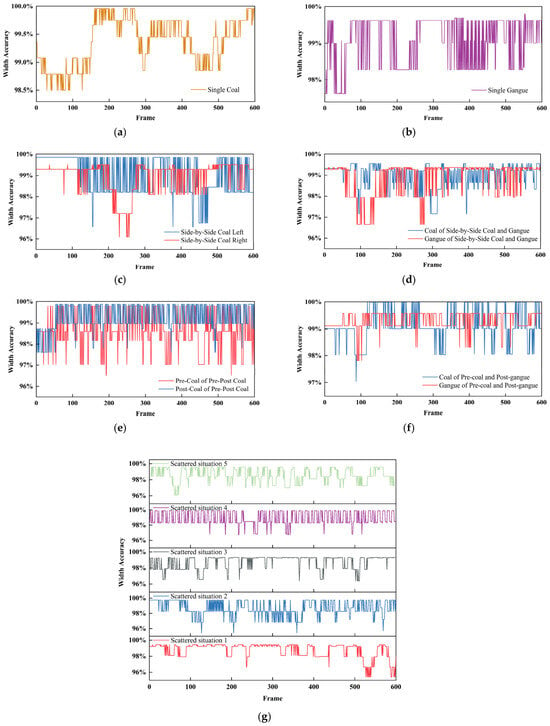
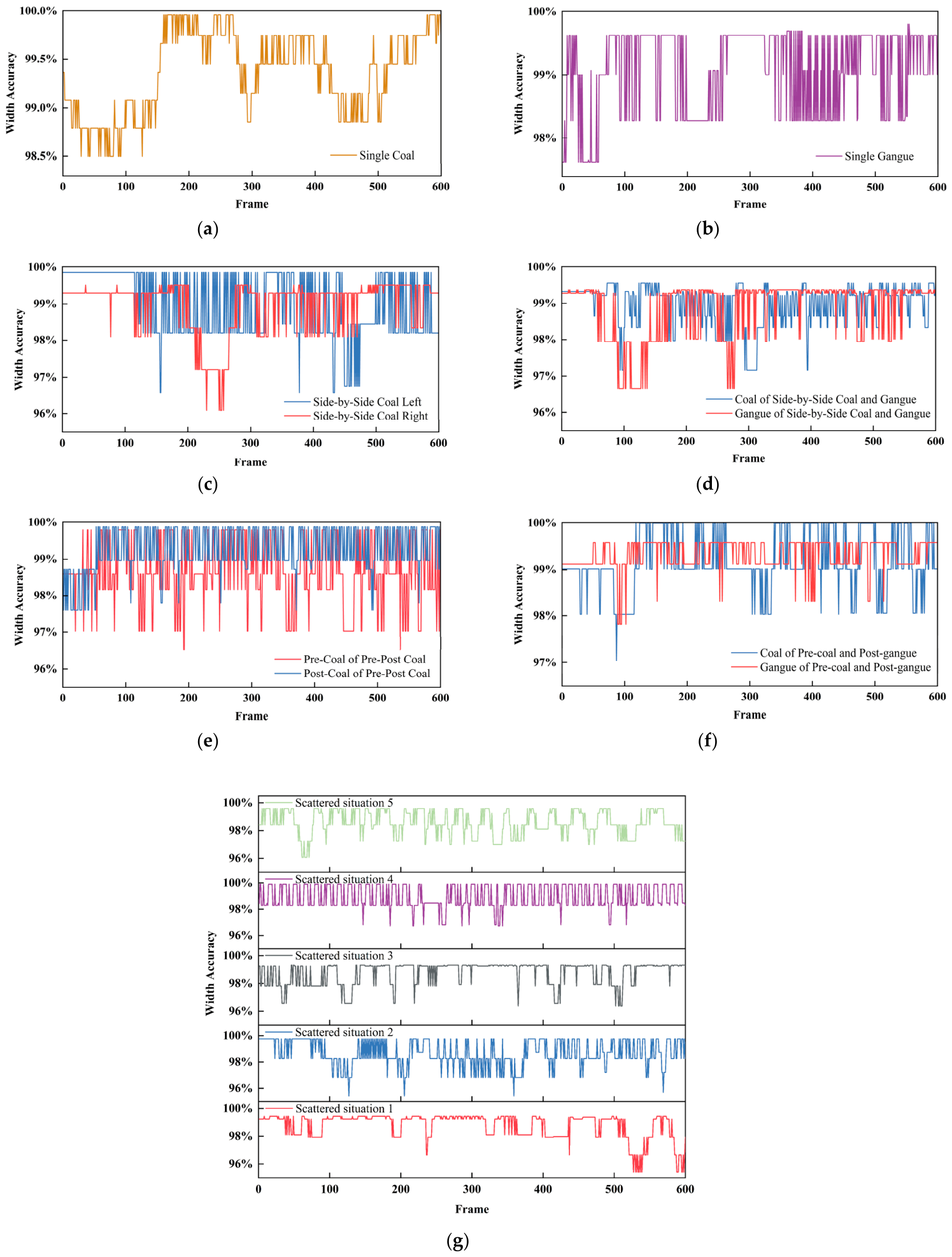
Figure 24 shows the characterization of width accuracy under various experimental conditions. It can be seen from the figure that when measuring the accuracy of coal gangue width, the stability of the overall situation fluctuates slightly compared with the accuracy of length, but it still remains at a high level. The accuracy is above 98%, only lower than the accuracy of length of 1–2%. The accuracy of single coal, single gangue and pre-coal and post-gangue is above 97%. These results not only verify the reliability of our method under diversified experimental conditions, but also highlight its potential in improving the accuracy of coal gangue size measurement.
Figure 24.
Width accuracy under various experimental conditions. (a) Single coal; (b) single gangue; (c) side-by-side coal; (d) side-by-side coal and gangue; (e) pre-post coal; (f) pre-coal and post-gangue; (g) scattered situation.
The average accuracy of the calibration width of coal gangue size measurement under various experimental conditions is shown in Table 6. It can be seen from the table that the accuracy of all experimental conditions is above 98.5%, showing the high accuracy of coal gangue measurement width.
Table 6.
The average accuracy of width under various experimental conditions.
In summary, the above coal gangue length and width accuracy measurement results show that the stability and accuracy of the measurement method in this paper are at a high level. The dynamic coal gangue size calibration method proposed in this paper not only has high precision, but also provides a reliable and stable solution for coal gangue size measurement.
5.3. Discussion
The dynamic coal gangue size measurement method proposed in this study performs well under experimental conditions, but its performance still faces challenges in practical industrial application environments. Firstly, under the extreme condition that the high-speed operation of the conveyor belt leads to serious motion blur of the image, the attenuation of the image gradient information will affect the accuracy of edge detection, which in turn restricts the reliability of the size measurement results. Secondly, the sharp change of illumination conditions may affect the image contrast. Although the ring light source optimization scheme is adopted in this study, it still needs to be further verified in complex industrial environments. In addition, when the coal gangue particles overlap seriously or block each other, the existing contour screening algorithm may not be able to achieve accurate separation of the target. Finally, the dust accumulation in the coal mine site will lead to a gradual decline in image quality, and a corresponding maintenance mechanism needs to be established.
Based on the above analysis, the future research work will focus on the following directions. First, promote the practical application of the measurement system in the industrial field, deploy it to the coal gangue sorting production line for testing, and improve the system according to the specific needs of different scenarios. Second, the human–computer interaction function of the measurement system is further improved, and a more intelligent parameter configuration scheme and operation interface are developed to improve the adaptability and ease of use of the system in different industrial scenarios. In addition, the image processing algorithm will be continuously optimized, and a solution combining advanced image processing technology with industrial field characteristics will be explored to comprehensively improve the measurement accuracy and stability of the system under complex working conditions. Targeting the problem of serious particle overlap, it is proposed to introduce an instance segmentation network (such as Mask R-CNN) to improve the separation ability in dense scenes. Targeting the problem of motion blur, the measurement accuracy variation law under different conveyor belt speeds will be tested by the system to determine the speed application range of the algorithm. For the inherent perspective error of monocular vision, binocular vision or laser ranging will be introduced for height compensation in the future. For the size characterization of inclined particles, the minimum circumscribed rotating rectangle (MinAreaRect) will be used instead of the current axis-aligned rectangular frame to obtain more accurate size measurement results.
6. Conclusions
Given the scarcity of research on dynamic coal gangue particle size measurement in coal gangue sorting, this study presents a precise dynamic coal gangue size measurement method based on image coordinate-pixel calibration. The coal gangue image acquisition system is established and the three-dimensional scanning reconstruction system is used to realize the accurate measurement of the actual coal gangue size. The optimized edge detection technology is used to optimize the method. The dynamic coal gangue size measurement experiments under seven different conditions are carried out, and the following conclusions are obtained:
- (1)
- An automatic coal gangue image acquisition and processing system has been developed, and the 3D reconstruction technology is used to accurately measure the actual coal gangue size, which provides data support for the measurement accuracy and analysis of the dynamic coal gangue size calibration method in the next step.
- (2)
- A precise dynamic measurement method for coal gangue size, based on image coordinate-pixel calibration, is put forward. Firstly, the measurement standards and parameters are set by developing a mathematical model for correlative conversion between coal gangue image coordinates and actual dimensions. Secondly, the dynamic coal gangue image processing is carried out by using the dynamic coal gangue image grayscale conversion-Gaussian filtering-binarization to obtain the proposed accurate size measurement method, and the size measurement accuracy is experimentally verified. The findings indicate that the mean measurement accuracy of dynamic coal gangue images under test reaches 96%, and the space still needs to be optimized.
- (3)
- To optimize the accuracy of the measurement method, in terms of image processing, the Canny edge detection algorithm is employed to replace image binarization to obtain a more accurate measurement size of coal gangue. A series of human–computer interaction functions of the dynamic coal gangue size calibration system are added for optimization, and the measurement time is evaluated. The results show that the average time of measuring one size by this method is 6 ms, which shows significant computational efficiency and high efficiency and superiority in real-time applications.
- (4)
- The dynamic coal gangue particle size measurement experiments under seven different experimental conditions, such as single coal, single gangue, and side-by-side coal and gangue, were carried out respectively, and a comparative analysis of the measurement methods before and after optimization was conducted based on the measurement results. The results demonstrate that the average error of coal gangue size measurement accuracy after optimization is between 0.265225 and 1.166946 mm. The measurement accuracy is above 98%. The average measurement accuracy rate is more than 2% higher than 96% before optimization. The optimized size measurement method has a small error, and the measurement accuracy and stability are significantly improved.
The research content enables precise measurement of the particle size of dynamically migrating coal gangue during coal gangue sorting, provide data support for the location information capture and grasping strategy formulation of coal gangue and the path planning control of the grasping robot, and provide accurate and efficient new methods for the accurate size measurement of irregular moving objects.
Author Contributions
Conceptualization, methodology, investigation, writing—review and editing, project administration, funding acquisition, Y.Y.; writing—original draft preparation, Y.Y., S.D. and S.C., W.Y. and D.W.; formal analysis, S.D., S.C., W.Y. and D.W.; Software, S.C., S.D., W.Y. and D.W.; data curation, W.Y. and D.W. All authors have read and agreed to the published version of the manuscript.
Funding
This work was supported by National Natural Science Foundation of China (Grant No. 52304143, 52574198), Shandong Province Higher Education Institutions Youth Innovation Team Development Program (Science and Technology Category) (Grant No. 2024KJH061), Young Talent of Lifting engineering for Science and Technology in Shandong (Grant No. SDAST2025QTA055), Jining City key research and development project (2024KJHZ010).
Institutional Review Board Statement
Not applicable.
Informed Consent Statement
Not applicable.
Data Availability Statement
Data will be made available on request.
Conflicts of Interest
Author Weili Yao was employed by China National Coal Group Corporation. Author Dandan Wang was employed by Beijing Tianma Intelligent Control Technology Co., Ltd. The remaining authors declare that the research was conducted in the absence of any commercial or financial relationships that could be construed as a potential conflict of interest.
References
- Wang, G.F.; Ren, S.H.; Pang, Y.H.; Qu, S.J.; Zheng, D.Z. The development effect of the coal industry in the 13th Five-Year Plan and the implementation path of the “dual carbon” goal. Coal Sci. Technol. 2021, 49, 1–8. [Google Scholar]
- Liu, F.; Cao, W.J.; Zhang, J.M.; Cao, G.M.; Guo, X.L. Progress of scientific and technological innovation in China’s coal industry and the development direction during the 14th Five-Year Plan period. J. China Coal Soc. 2021, 46, 1–15. [Google Scholar]
- Liang, W.G.; Guo, F.Q.; Yu, Y.J.; Zhang, Z.H.; Yan, J.C. Research progress of in-situ intelligent sorting and backfilling technology of coal gangue underground. Coal Sci. Technol. 2024, 52, 12–27. [Google Scholar] [CrossRef] [Scilit]
- Hu, Y.H.; Zhou, Y.J.; Pang, Y.H. Technical architecture of coal industry governance system platform based on new-generation information technology. Coal Sci. Technol. 2024, 52, 228–237. [Google Scholar]
- Li, S.Y.; Li, Y.N.; Wang, Z.J.; Hou, P.; Xue, G.H. Experimental platform of coal gangue sorting robot based on image detection. Ind. Mine Autom. 2023, 49, 107–113. [Google Scholar]
- Yin, J.; Zhu, J.; Zhu, H.; Pan, G.; Zhu, W.; Zeng, Q.; Shi, Q. Intelligent photoelectric identification of coal and gangue−A review. Measurement 2024, 233, 114723. [Google Scholar] [CrossRef] [Scilit]
- Hu, F.; Bian, K. Accurate identification strategy of coal and gangue using infrared imaging technology combined with convolutional neural network. IEEE Access 2022, 10, 8758–8766. [Google Scholar] [CrossRef] [Scilit]
- Zhou, G.; Zeng, Q.; Wan, L.; Wang, L.; Xuan, G.; Shao, Y. Identification of coal and gangue using visible-near infrared (Vis-NIR) hyperspectral imaging. Anal. Lett. 2025, 58, 714–723. [Google Scholar]
- Xu, Z.; Li, S.; Lin, P.; Li, Q. Non-destructive, fast and intelligent identification of coal and gangue via spatial-spectral fusion of hyperspectral images. Int. J. Rock Mech. Min. Sci. 2025, 194, 106187. [Google Scholar] [CrossRef] [Scilit]
- Yan, P.; Sun, Q.; Yin, N.; Hua, L.; Shang, S.; Zhang, C. Detection of coal and gangue based on improved YOLOv5.1 which embedded scSE module. Measurement 2022, 188, 110530. [Google Scholar] [CrossRef] [Scilit]
- Xue, G.; Li, S.; Hou, P.; Gao, S.; Tan, R. Research on lightweight Yolo coal gangue detection algorithm based on resnet18 backbone feature network. Internet Things 2023, 22, 100762. [Google Scholar] [CrossRef] [Scilit]
- Guan, R.J.; Qiu, C.J. Research progress of image size measurement technology. Mod. Manuf. Technol. Equip. 2023, 59, 62–64+71. [Google Scholar]
- Zhao, G.; Chang, F.; Chen, J.; Si, G. Research and prospect of underground intelligent coal gangue sorting technology: A review. Miner. Eng. 2024, 215, 108818. [Google Scholar] [CrossRef] [Scilit]
- Zhao, L.; Zhang, S.; Huang, D.; Wang, X.; Zhang, Y. 3D shape quantification and random packing simulation of rock aggregates using photogrammetry-based reconstruction and discrete element method. Constr. Build. Mater. 2020, 262, 119986. [Google Scholar] [CrossRef] [Scilit]
- Yang, X.; Ren, T.; Tan, L. Size distribution measurement of coal fragments using digital imaging processing. Measurement 2020, 160, 107867. [Google Scholar] [CrossRef] [Scilit]
- Mora, C.F.; Kwan, A.K.H. Sphericity, shape factor, and convexity measurement of coarse aggregate for concrete using digital image processing. Cem. Concr. Res. 2000, 30, 351–358. [Google Scholar] [CrossRef] [Scilit]
- Song, K.; Yi, H.; Zhang, L.; Jing, L.; Huang, J. Multi-angle 3D measurement of small workpieces using EDMS algorithm. Meas. Sci. Technol. 2023, 34, 105006. [Google Scholar] [CrossRef] [Scilit]
- Ke, G.; Jiang, H.; Li, Z. Study on the calorific value and cementitious properties of coal gangue with 0-1 mm particle size. Constr. Build. Mater. 2024, 414, 135061. [Google Scholar] [CrossRef] [Scilit]
- Guo, Y.; Wang, X.; Wang, S.; Hu, K.; Wang, W. Identification method of coal and coal gangue based on dielectric characteristics. IEEE Access 2021, 9, 9845–9854. [Google Scholar] [CrossRef] [Scilit]
- Wang, Z.; Xie, S.; Chen, G.; Chi, W.; Ding, Z.; Wang, P. An online flexible sorting model for coal and gangue based on multi-information fusion. IEEE Access 2021, 9, 90816–90827. [Google Scholar] [CrossRef] [Scilit]
- Alfarzaeai, M.S.; Hu, E.; Peng, W.; Qiang, N.; Alkainaeai, M.A. Coal gangue classification based on the feature extraction of the volume visual perception ExM-SVM. Energies 2023, 16, 2064. [Google Scholar] [CrossRef] [Scilit]
- Gao, R.; Sun, Z.; Li, W.; Pei, L.; Hu, Y.; Xiao, L. Automatic coal and gangue segmentation using u-net based fully convolutional networks. Energies 2020, 13, 829. [Google Scholar] [CrossRef] [Scilit]
- Liu, Q.; Li, J.; Li, Y.; Gao, M. Recognition methods for coal and coal gangue based on deep learning. IEEE Access 2021, 9, 77599–77610. [Google Scholar] [CrossRef] [Scilit]
- Zhang, K.; Wang, Z.; Zhang, Z.; Shi, Z.; Qi, Y.; Du, M.; Chen, Y.; Liu, T.; Chen, Y.; Yin, Z. Design and application of coal gangue sorting system based on deep learning. Sci. Rep. 2024, 14, 16508. [Google Scholar] [CrossRef] [Scilit] [PubMed]
- Li, M.; Duan, Y.; He, X.; Yang, M. Image positioning and identification method and system for coal and gangue sorting robot. Int. J. Coal Prep. Util. 2022, 42, 1759–1777. [Google Scholar] [CrossRef] [Scilit]
- Liu, L.; Bi, Q.; Liang, J.; Li, Z.; Wang, W.; Zheng, Q. Farmland soil block identification and distribution statistics based on deep learning. Agriculture 2022, 12, 2038. [Google Scholar] [CrossRef] [Scilit]
- Luo, Q.; Wang, S.; Guo, Y.; He, L.; Li, X. Adaptive image enhancement and particle size identification method based on coal and gangue. Meas. Sci. Technol. 2023, 34, 105403. [Google Scholar] [CrossRef] [Scilit]
- Wen, B.; Huang, D.; Zhang, L.; Song, Q.; Gao, G.; Huo, D. Study on mechanical properties and size effect of coal gangue concrete at mesoscale. Constr. Build. Mater. 2022, 360, 129551. [Google Scholar] [CrossRef] [Scilit]
- Zhou, J.; Sun, J.; Zhang, W.; Lin, Z. Multi-view underwater image enhancement method via embedded fusion mechanism. Eng. Appl. Artif. Intell. 2023, 121, 105946. [Google Scholar] [CrossRef] [Scilit]
- Kim, H.; Han, J.; Han, T. Machine vision-driven automatic recognition of particle size and morphology in SEM images. Nanoscale 2020, 12, 19461–19469. [Google Scholar] [CrossRef] [Scilit] [PubMed]
- Li, H.; Wu, X.J.; Kittler, J. MDLatLRR: A novel decomposition method for infrared and visible image fusion. IEEE Trans. Image Process. 2020, 29, 4733–4746. [Google Scholar] [CrossRef] [Scilit] [PubMed]
- Kheradmandi, N.; Mehranfar, V. A critical review and comparative study on image segmentation-based techniques for pavement crack detection. Constr. Build. Mater. 2022, 321, 126162. [Google Scholar] [CrossRef] [Scilit]
- Zhang, Y.; Ma, H.W.; Wang, P.; Cao, X.G.; Wei, X.R.; Zhou, W.J. Research progress and key technologies of intelligent coal gangue sorting robot. Ind. Mine Autom. 2022, 48, 42–48+56. [Google Scholar]
- Zhang, Y.H.; Pan, X.S.; Chen, X.J.; Huo, Z.L.; Ren, S.W.; Ji, L. Key technologies of intelligent gangue sorting robot. Ind. Mine Autom. 2022, 48, 69–76+111. [Google Scholar]
- Zhang, J.X.; Zhang, Q.; Ju, F.; Zhou, N.; Li, M.; Zhang, W.Q. Green mining technology system and engineering practice of “mining-dressing-backfilling + X” in coal mines. J. China Coal Soc. 2019, 44, 64–73. [Google Scholar]
- Toledo, F.J.; Galiano, V.; Blanes, J.M.; Herranz, V.; Batzelis, E. Photovoltaic single-diode model parametrization. An application to the calculus of the Euclidean distance to an I–V curve. Math. Comput. Simul. 2024, 225, 794–819. [Google Scholar] [CrossRef] [Scilit]
- Wu, X.; Han, J.; Wang, D.; Gao, P.; Cui, Q.; Chen, L.; Liang, Y.; Huang, H.; Lee, H.P.; Miao, C.; et al. Incorporating surprisingly popular algorithm and euclidean distance-based adaptive topology into PSO. Swarm Evol. Comput. 2023, 76, 101222. [Google Scholar] [CrossRef] [Scilit]
- Tu, T.N. An approach based on optimizing speed of the binary algorithm Otsu. J. Inf. Hiding Multim. Signal Process. 2023, 14, 113–123. [Google Scholar]
- Tan, J.; Tang, Y.; Liu, B.; Zhao, G.; Mu, Y.; Sun, M.; Wang, B. A self-adaptive thresholding approach for automatic water extraction using sentinel-1 SAR imagery based on Otsu algorithm and distance block. Remote Sens. 2023, 15, 2690. [Google Scholar] [CrossRef] [Scilit]
- Zhu, D.; Li, J.; Wang, F.; Gong, X.; Cong, W.; Wang, P.; Liu, Y. A method for extracting contours of building facade hollowing defects using polarization thermal images based on improved canny algorithm. Buildings 2023, 13, 2563. [Google Scholar] [CrossRef] [Scilit]
- Lu, Y.; Lin, D.; Zhai, Z.J.; Wang, Z. Application and improvement of Canny edge-detection algorithm for exterior wall hollowing detection using infrared thermal images. Energy Build. 2022, 274, 112421. [Google Scholar] [CrossRef] [Scilit]
- Yu, Z.S. Research on coal-gangue identification method based on R-value and improved multi-threshold segmentation. Coal Technol. 2022, 41, 130–134. [Google Scholar]
- Zhang, D.; Bai, Y.Y.; Zhang, S.R.; Zhang, T.J. Coal-gangue identification method based on video for belt conveyor. Coal Technol. 2022, 41, 212–214. [Google Scholar]

Disclaimer/Publisher’s Note: The statements, opinions and data contained in all publications are solely those of the individual author(s) and contributor(s) and not of MDPI and/or the editor(s). MDPI and/or the editor(s) disclaim responsibility for any injury to people or property resulting from any ideas, methods, instructions or products referred to in the content. |
© 2026 by the authors. Licensee MDPI, Basel, Switzerland. This article is an open access article distributed under the terms and conditions of the Creative Commons Attribution (CC BY) license.