


Abstract
Background: This study examines the correlation between extreme weather events and acute endodontic treatment-related emergency visits (AET-related EVs). Methods: A total of 11,541 AET-related EVs at the Medical University Graz from January 2016 to August 2022 were analyzed using a distributed lag non-linear model. Extreme weather was defined as conditions beyond the 5th or 95th percentiles, and relative (RR) and cumulative risks (cRR) were assessed over 14 days. Results: High temperatures (>21 °C) increased AET-related EVs (cRR 1.41 [1.20–1.65], p < 0.001), while cold spells reduced cRR (0.81 [0.68–0.96], p = 0.014). Prolonged humidity around 65% raised cRR to 1.38 (1.21–1.59, p < 0.001). Heavy precipitation elevated cRR (1.24 [1.04–1.46], p = 0.016). Lower wind speeds were linked to a reduced cRR of EVs within four days following a single weather event (minimum of 0.86 [0.75–0.99], p = 0.032), and within four, seven and 14 days after prolonged low wind speeds (minimum of 0.69 [0.58–0.83], p < 0.001). Three-day low atmospheric pressure increased RR after seven days (1.04 [1.01–1.08], p = 0.014), while a single event reduced cRR by one day (0.78 [0.63–0.95], p = 0.016). Conclusions: Extreme weather events significantly influence AET-related EV rates, with various conditions affecting risk differently. Potentially causative pathophysiological mechanisms need to be researched.
1. Introduction
Climate change is an increasingly debated topic that impacts not only ecological systems but also the field of medicine. Air pollution and increasingly frequent extreme meteorological phenomena such as heat waves, droughts, forest fires, and floods significantly affect the world [1]. Such phenomena precipitated 45 catastrophic events in 2019, resulting in an immediate loss of numerous lives [2]. In addition, it is critical to recognize that extreme meteorological events not only have immediate damaging effects but also possess the potential to exert a far-reaching, long-term impact on human health [3]. In this context, increased susceptibility to cardiovascular disease, pneumonia, transmission of infectious diseases, and otolaryngology disorders should be mentioned [4,5,6,7,8,9].
Regarding oral health, exacerbation of air pollution driven by climate change has been associated with reduced saliva production and a consequent rise in the risk of dental caries. Additionally, malnutrition due to droughts resulting from heat waves enhances the risk of gingivitis and ulcerative periodontal lesions. Furthermore, decreased ozone levels due to rising greenhouse gases increase exposure to harmful ultraviolet radiation, increasing the risk of lip cancer [10,11]. The potential link between alterations in weather patterns and the occurrence of odontogenic abscesses must be mentioned. While some authors failed to prove a direct correlation between weather phenomena and the occurrence of odontogenic abscesses [12,13,14], other researchers elucidated the influential factors substantiating this connection [15,16,17]. Finally, acute oral pain has been observed not to be directly correlated with absolute air pressure values but rather with deviations in air pressure levels [18].
Common causes of oral pain include acute apical periodontitis (AP), caries, abscesses, pericoronitis, periodontitis, residual root, and unexplained facial pain [18]. Dental trauma is a common complaint in the emergency department, which should be mentioned [19]. However, the two main reasons for emergency presentation are AP and deep caries [18].
AP is one of the most common inflammatory diseases in humans and is caused mainly by bacteria but also by archaea, viruses, or fungal infections of the root canals, followed by pulp necrosis [20]. The main reason for pulp necrosis is untreated dental caries [21]. Other reasons include trauma or a failed endodontic treatment [22]. Microorganisms are mainly found in the main root canal; however, especially in chronic infections, they can spread to other areas of the tooth, such as apical ramifications, lateral canals, isthmuses, and dentinal tubules. Therefore, in the case of persistent infections, timely treatment and customized disinfection are crucial [23]. Primary root canal treatments, in particular, have a high success rate of up to 95% in a four-year follow-up period [24].
To the best of our knowledge, there is a lack of data in the current literature related to the impact of extreme weather conditions on the number of acute endodontic treatment-related emergency visits (AET-related EVs). The current study aimed to examine both the immediate and delayed effects of extreme weather events on the prevalence of AET-related EVs at a tertiary hospital in Graz, Austria. A distributed-lag non-linear model (DLNM) was used. Short-term and long-term effects of various meteorological factors, including mean temperature, relative humidity, mean wind speed, precipitation, and atmospheric pressure, were assessed over a 14-day period.
2. Materials and Methods
2.1. Study Population and Meteorological Data
This study focuses on evaluating the immediate and delayed effects of extreme weather conditions on the frequency of AET-related EVs in Graz, Austria, during the period from 1 January 2016 to 31 August 2022. This study protocol was approved by the ethics committee of the Medical University of Graz (35–057 ex 22/23; IRB00002556). Written informed consent was waived due to the retrospective study design.
To evaluate AET-related EVs, data from the digital medical record system for all emergency department visits related to acute endodontic treatments within the specified time frame was extracted. These were identified using the treatment code from the Austrian dental fee catalog, representing emergency root canal treatments initiated but not completed in a single visit due to acute pulpal or periapical symptoms. This dataset included basic demographics (e.g., age, sex) as well as the respective visit’s date.
Meteorological data for Graz from 1 January 2016 to 31 August 2022 was obtained from the online platform “Open-Meteo”. All weather measurements were recorded at Graz, Austria (latitude: 47.07°; longitude: 15.45°). These coordinates were chosen to represent the entire region of Graz, with a catchment area of 127.6 km2 and a population of approximately 300,000.
2.2. Statistical Analysis
The assessment of immediate and delayed effects of extreme weather conditions on the frequency of AET-related EVs was conducted using a DLNM [25]. DLNMs have been previously employed to investigate the effects of meteorological events on morbidity and mortality [26,27,28].
Separate models were developed for each meteorological variable. The response variable was defined as the daily number of EVs related to an AET. The exposure-response and lag-response dimensions were modeled flexibly with natural cubic splines, allowing non-linear associations between daily weather conditions and subsequent AET-related emergency visits. A 14-day lag structure was selected to capture delayed associations while accounting for possible short-term displacement of emergency visits [29].
Temporal patterns unrelated to short-term weather variation were adjusted by modeling calendar time with natural cubic splines using seven degrees of freedom per year. Further indicator variables were introduced for weekdays to accommodate variations in demand during the week, including the increased demand on weekends. To account for the expected increase in EVs during public holidays, a holiday dummy variable was used. Because of the closing of dental practices during public holidays in Austria, the University Clinic of Dental Medicine and Oral Health is the primary provider of dental care, resulting in an increase in visitation rates. Due to the possibility of public holidays occurring on weekends, potentially diminishing their impact on the EVs, an interaction between the weekday indicator variable and the public holiday dummy variable was added.
Extreme weather events were characterized as the 1st, 5th, 95th, and 99th percentiles of each distinct meteorological parameter (i.e., p1, p5, p95, and p99), apart from precipitation, for which extreme weather events were defined using the 95th and 99th percentiles. Lag-specific relative risks (RR) of AET-related EVs were estimated by comparing extreme meteorological values with the median exposure level of the same variable. For the cumulative RR (cRR), the model summarized the total relative change in AET-related emergency visits across predefined lag intervals, using the median value of each meteorological variable as the reference condition. Effect estimates were reported for selected single lag days and cumulative lag windows, including 95% confidence intervals and corresponding p-values (RR: lag0, lag1, lag4, lag7, and lag14; cRR: lag0–1, lag0–4, lag0–7, and lag0–14). Next to single-day events, prolonged extreme weather conditions were examined by considering a three-day mean for specific weather variables. For sustained weather exposure, three-day exposure periods were generated, and the corresponding emergency visit counts were assigned to the final day of each period. Lag0 designates the final day within this three-day window.
All statistical analyses, model fitting, and data visualization were performed using R software (version 4.1.3, R Foundation for Statistical Computing, Austria). DLNMs were fitted using the “dlnm” package [30]. Data presentation includes RR or cRR along with their 95% confidence intervals (CIs).
3. Results
3.1. Study Population and Weather
Between 1 January 2016 and 31 August 2022, a total of 11,541 AET-related EVs were recorded at the University Clinic of Dentistry and Oral Health, Medical University Graz, Graz, Austria (n = 11,541). The patients’ characteristics of this cohort (n = 9079) are comprehensively presented in Table 1.
Table 1.
Detailed description of patients’ characteristics.
3.2. Temperature
The impact of mean temperature on AET-related EVs was investigated in this analysis. Low temperatures (p1 and p5) were associated with RR values ranging from 0.79 [0.50–1.23] at −8 °C the day after the event, to 1.12 [0.82–1.54] at −8 °C on the same day. Extremely high temperatures (p95 and p99) showed RRs ranging from 0.90 [0.68–1.18] on the same day at 23 °C to 1.23 [0.84–1.80] the day after the event at 23 °C. Neither extremely low temperatures of −8 °C and −3 °C (p1 and p5), nor extremely high temperatures of 21 °C and 23 °C (p95 and p99) exhibited a statistically significant change in the RR for AET-related EVs (p > 0.05, Supplementary Table S1). However, there were significant differences in the cRR within 14 days (lag 0–14) at high temperatures, with a cRR of 1.25 [1.00–1.56, p = 0.046] and 1.36 [1.01–1.84, p = 0.042] at 21 °C and 23 °C, respectively (as detailed in Supplementary Table S2).
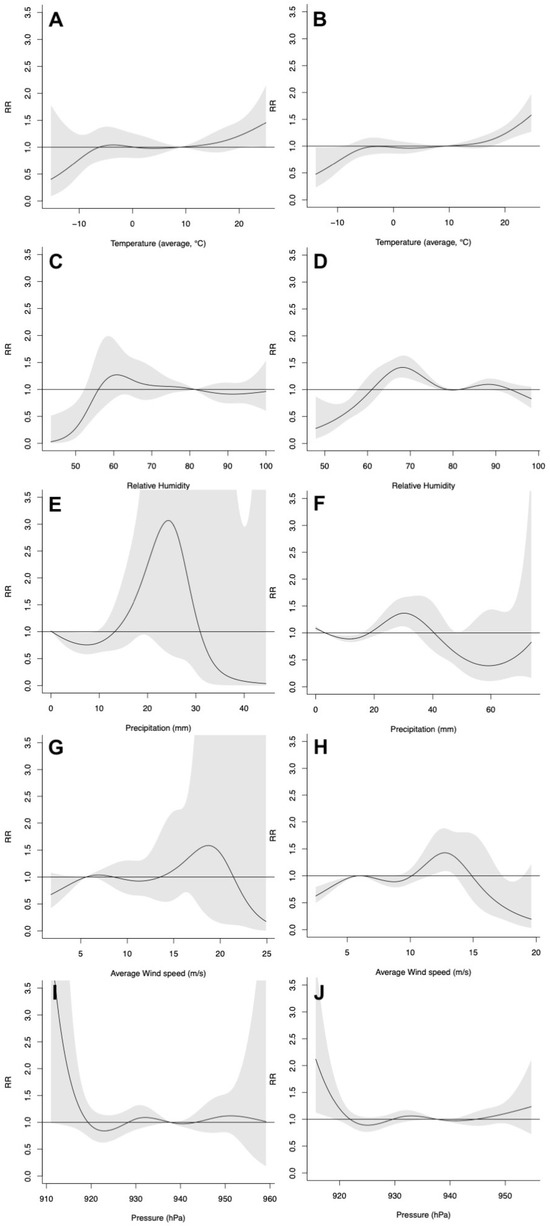
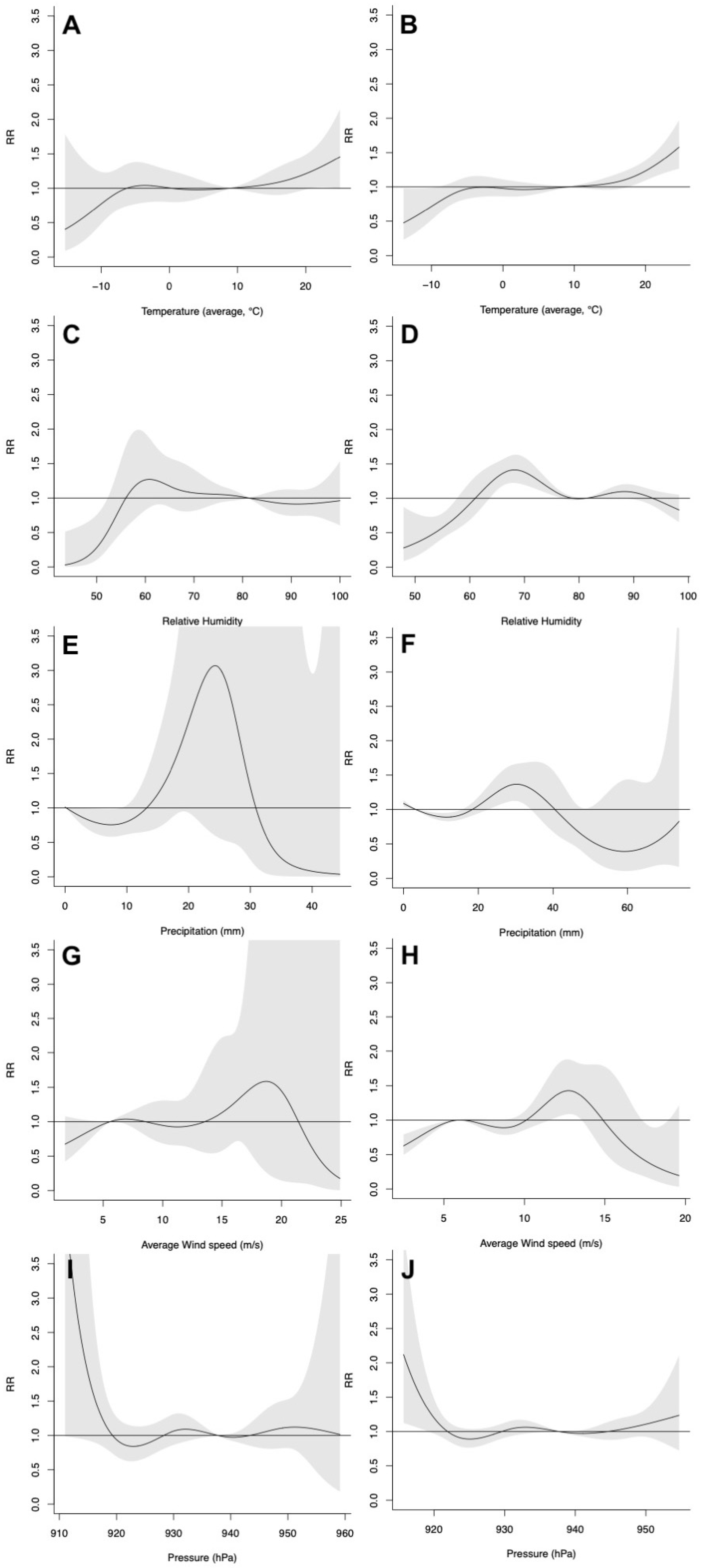
For prolonged periods of extreme temperatures lasting three days, a similar trend was observed. The RR after 14 days was significantly elevated to 1.08 [1.01–1.84, p = 0.020] after a heatwave at 23 °C over a three-day period (Supplementary Table S3). Concerning the cRR in the aftermath of an extended period of extreme weather conditions, a diminished cRR at −7 °C and −3 °C was observed across several lag periods (i.e., lag 0–4 at −7 °C 0.81 [0.68–0.96, p = 0.014], lag 0–7 at −7 °C 0.81 [0.69–0.94, p = 0.006], lag 0–4 at −3 °C 0.84 [0.73–0.96, p = 0.014]). Conversely, an increased cRR in response to prolonged high temperatures in various lag periods was noted (i.e., lag 0–7 at 21 °C 1.18 [1.04–1.34, p = 0.012], lag 0–14 at 21 °C 1.28 [1.13–1.44, p < 0.001], lag 0–7 at 23 °C 1.21 [0.05–1.40, p = 0.010], lag 0–14 at 23 °C 1.41 [1.20–1.65, p < 0.001]) (Figure 1, Supplementary Table S4).
Figure 1.
Cumulative RR (cRR) of acute endodontic treatment-related emergency visits after extreme weather events. cRR over 14 days after single temperature (A)/humidity (C)/precipitation (E)/wind speed (G)/pressure (I) event. cRR over 14 days after prolonged temperature (B)/humidity (D)/precipitation (F)/wind speed (H)/pressure (J) event (3 days).
In brief, the data highlights that high temperatures and prolonged heat waves (21 °C and above) increase the cumulative risk for AET-related EVs 0–14 days after the weather event. At low temperatures, prolonged cold spells reduce the cumulative risks four and seven days after the event.
3.3. Relative Humidity
Subsequently, the effects of extreme relative humidity conditions on occurrences of AET-related EVs were investigated. Under low humidity conditions of 56% (p1) and 64% (p5), no immediate or delayed significant effects were observed within a 14-day post-weather event timeframe. The RR remained relatively stable, ranging from 0.98 [0.92–1.06] by day seven to 1.13 [0.87–1.47] on the day after the event, at a humidity level of 56%. In the case of high relative humidity events, at 95% (p95) and 98% (p99), no significant change in RR, with values ranging from 0.94 [0.70–1.11] (lag 1, 95% humidity) to 1.02 [0.95–1.08] (lag 4, 98% humidity), was noted (Supplementary Table S1). Notably, these humidity conditions did not significantly impact the cumulative Relative Risk (cRR) for either low or high humidity events (Supplementary Table S2). Sustained low humidity conditions (67% humidity, p5) over a continuous span of three days yielded a modest yet statistically significant increase in RR to 1.14 [1.03–1.27; p = 0.012] observed on the last day of the relevant weather episode (Supplementary Table S3). Moreover, the same prolonged humidity level of 67% exhibited a substantial increase in cRR over all observed time periods (p < 0.001; Supplementary Table S4). In summary, the data collectively indicate that periods of humidity levels at around 67% have a statistically significant impact on the incidence of AET-related EVs in our department.
3.4. Precipitation
On the same day, the RR stood at 0.91 [0.83–1.01] for 11 mm (p95) and 0.90 [0.75–1.09] for 19 mm (p99). No significant impact on RR or cRR was observed on any lag-day during the 14-day observation period (Supplementary Tables S1 and S2). Prolonged heavy precipitation totaling 24 mm (p95) resulted in a slight increase in RR to 1.02 [1.00–1.05; p = 0.028] and 1.04 [1.01–1.08; p = 0.016] after seven and 14 days, respectively (Supplementary Table S3). Furthermore, within 14 days subsequent to the onset, the cumulative risk increased to 1.24 [1.04–1.46; p = 0.016] (Supplementary Table S4). This data suggests a progressive influence of prolonged heavy precipitation on AET-related EVs over a 14-day period, while no immediate effect was observed following single-day events.
3.5. Wind Speed
Low mean wind speeds of 2.5 m/s (p1) and 3.2 m/s (p5) exhibited a consistent range from 0.94 to 1.00 and 0.96 to 1.00, respectively, both on the same day and extending to day 14 (p > 0.05). At wind speeds of 11.7 m/s (p95) and 16.1 m/s (p99), the RR ranged from 0.92 to 1.05 and 0.98 to 1.11 throughout the 14-day observation period (p > 0.05, as outlined in Supplementary Table S1). However, the cRR displayed a statistically significant decrease within four days after the weather event (cRR lag 0–4: 0.88 [0.67–0.99] p = 0.016 at 2.5m/s and 0.86 [0.75–0.99] p = 0.016 at 3.2 m/s) (Supplementary Table S2). Extended periods of low wind speeds over three days indicated a noteworthy reduction in RR to 0.96 [0.92–1.00; p = 0.016] at 3.0 m/s (p1), specifically 14 days following the relevant weather event (Supplementary Table S3). Moreover, a statistically significant reduction in cRR was observed within four, seven, and 14 days, both at wind speeds of 3.0 m/s (p1) and 3.8 m/s (p5) (as indicated in Supplementary Table S4). Lower wind speeds were linked to a reduced cRR of EVs within four days following a single weather event, and within four, seven and 14 days after prolonged low wind speeds.
3.6. Atmospheric Pressure
Very low atmospheric pressure resulted in a same-day RR of 0.90 [0.73–1.10] to 0.99 [0.87–1.14] at 918 hPa (p1) and 924 hPa (p5), respectively. Very high atmospheric pressure showed a same-day RR of 1.03 [0.90–1.17] at 947 hPa (p95) and 1.09 [0.90–1.33] at 952 hPa (p99) (p > 0.05, Supplementary Table S1). A significant change in cRR at 918hPa (p1) was noticed at lag0–1 over the 14-day observation period with a cRR of 0.78 [0.63–0.95; p = 0.016] (Supplementary Table S2). Prolonged low atmospheric pressure of 920hPa (p1) over three days showed a significantly increased RR to 1.04 [1.01–1.08; p = 0.014] seven days after the weather event (Supplementary Table S3). Prolonged atmospheric pressure events did not significantly alter the cRR at any lag period over 14 days (Supplementary Table S4). In summary, prolonged low atmospheric pressure is associated with an increased RR seven days after the event, whereas a single occurrence of low atmospheric pressure reduces the cumulative risk by one day.
4. Discussion
Existing literature related to the influence of weather conditions on dental and maxillofacial issues primarily concentrates on immediate effects, particularly in relation to dental abscesses. However, these studies have shown heterogeneous results, preventing the establishment of a causative relationship between meteorological conditions and dental emergency visits [12,13,16,17]. This research seeks to close these gaps in knowledge and provide insights into the complex interplay between extreme weather events and AET-related EVs over 14 days. To comprehensively capture the complex and non-linear effects of weather on human physiology, the well-established DLNM was employed [25,30].
Atmospheric pressure has been the most extensively studied weather variable in the field of dentistry and maxillofacial surgery. The underlying effect, known as barodontalgia, is characterized by a toothache associated with changes in barometric pressure. The discomfort arises from issues such as leaky fillings or cavities that gradually adjust to pressure alterations. This is particularly noticeable during activities like scuba diving or when ascending from sea level to airplane altitudes [31,32]. Even minor fluctuations in barometric pressure may impact pain levels, prompting affected individuals to seek medical advice [15]. However, other conditions like depression and headaches have also been linked to changes in atmospheric pressure [33,34]. These can modulate the perception of pain in the head and neck region [35]. Kloss-Brandstatter et al. reported a higher prevalence of painful oral conditions during periods of atmospheric pressure changes [18]. Likely, Tarle et al. could demonstrate that pressure changes exceeding 12hPa can be seen as a predictive factor for odontogenic abscesses five days prior to hospitalization [17]. However, several studies could not detect any associations between barometric pressure changes and the occurrence of dental events [12,13,14,16]. Seemann et al. displayed a rise in odontogenic abscesses in periods of low barometric pressure [15]. This is consistent with the current study, where extended periods of low atmospheric pressure are linked to an elevated RR seven days following the event. In contrast, a singular instance of low atmospheric pressure diminishes the cumulative risk by a single day. Therefore, the influence of atmospheric pressure on oral diseases seems complex, with a delayed increase in AET-related EVs.
Several studies examined the impact of temperature on dental abscesses, but only Carl et al. could demonstrate statistical significance [12,13,14,15,16,17]. However, earlier studies relied on simple statistical approaches, such as t-tests, Spearman correlations, and chi-squared tests, to compare abscess rates between groups [14,36,37].
The sublingual pockets serve as a reliable and easily accessible site for temperature measurement, mirroring core temperature due to a robust blood supply [38]. However, numerous influencing factors, such as dietary intake, smoking, ambient temperature, convective air currents, and the presence of mucositis, significantly impact oral temperature [38,39]. Therefore, it is conceivable that extreme temperature events impact oral temperature and, consequently, pathological processes within the oral cavity. The investigation revealed that elevated temperatures and prolonged heatwaves escalate the cumulative risk of AET-related EVs within 0–14 days after the weather event. Conversely, extended cold spells reduce the cumulative risks within four to seven days after the event. However, one limitation of the current study is that external temperatures often do not reflect the temperatures to which people are exposed.
Single-day extreme humidity events had no impact on AET-related EVs, while prolonged humidity events, at around 67%, significantly increased the RR as well as all the cRR in all lag periods. In Austria’s climate, low humidity events usually occur in summer at high temperatures and, therefore, correlate with the increased EVs during extreme high temperatures. However, the relative humidity levels in the oral cavity are constantly around 100% [40]. Nevertheless, decreasing temperature and relative humidity create a less hospitable environment for microorganisms to grow [41].
In the case of precipitation, one day of heavy rain or snow events had no impact on AET-related EVs. In contrast, extended heavy precipitation increased the incidence of AET-related EVs over a 14-day period. Using a multilinear regression model, Ristow et al. found no correlation between precipitation and oral abscesses [12]. However, they did not assess possible lag periods. In Graz, hibernal precipitation is largely attributed to snow. However, the analysis of available weather data made no distinction between snowfall and rain. Consequently, the impact of precipitation in the form of rain may be underestimated in our study. Furthermore, the impact of precipitation could be influenced by behavioral patterns, as individuals may refrain from seeking medical advice in less urgent cases during precipitation. While this could not be statistically demonstrated as significant in this study, it is noteworthy that all same-day risk values were below 1.
Lastly, the effects of wind speed on dental issues have been sparsely investigated to date. This study’s data shows that extremely low wind speeds are significantly associated with reduced AET-related EVs. This phenomenon may arise due to the potential exacerbating effect of thermal or osmotic stimuli, such as exposure to cold wind [42].
Moreover, the observed gender distribution, which indicates a higher proportion of men seeking emergency endodontic treatment compared to women, is noteworthy. Numerous studies have observed that males tend to display an augmented inclination towards neglecting their oral health, practising inferior oral hygiene habits, and experiencing heightened occurrences of periodontal disease, oral cancer, and dental trauma. Additionally, men tend to visit the dentist less regularly than women. As a result, they are more likely to seek dental care only when acute problems arise, leading to a higher frequency of emergency visits [43,44]. Further, the study period included the COVID-19 pandemic, which may have influenced dental emergency visit patterns, patient behavior, and access to routine dental care.
The current study presents several limitations. The interpretation of these findings is limited by the retrospective design and by the fact that all data were obtained from a single tertiary dental care center. The data originate from a tertiary care center, introducing a selection bias towards patients lacking a regular dentist and those with severe cases. Additionally, it is important to acknowledge that this study assesses the overall risk for AET-related EVs across the entire population, precluding the interpretation of individual risk. Because meteorological exposure was assigned from one regional weather source, individual-level exposure may have differed from the recorded values depending on patients’ exact location and daily movement patterns. Furthermore, patient-related clinical factors, including smoking status, medication use, systemic health conditions, and standardized pain intensity scores, were not systematically documented in the retrospective dataset and therefore could not be included in the statistical analysis. As previously stated, another bias arises from the fact that meteorological weather conditions can differ significantly from the ambient weather conditions experienced by individuals. Lastly, the DLNM used is designed for time series data of single variables. Accordingly, the analysis focused on separate meteorological predictors and did not model combined or interactive weather patterns. Because multiple meteorological variables, percentiles, lag periods, and outcome measures were analyzed, the risk of type I error due to multiple testing must be acknowledged. This study was not designed to establish any causal link between the observed associations.
5. Conclusions
Extreme weather events are correlated with changes in the AET-related EVs rate in Graz, Austria. Although no causal relationship can be inferred from the retrospective observational design, the incorporation of external factors such as weather conditions could ensure optimized planning and resource utilization in emergency rooms and emergency scenarios and ultimately lead to better patient care. Still, these findings highlight the need for further investigation into the pathophysiological mechanisms driving these associations, emphasizing the impact of weather on health emergencies within a multicenter design, including different climates.
Supplementary Materials
The following supporting information can be downloaded at: https://www.mdpi.com/article/10.3390/app16136505/s1, Supplementary Table S1: Relative risk of acute endodontic treatment (AET)-related emergency visits (EV) after a single extreme meteorological event. p = percentiles of each distinct meteorological parameter. Supplementary Table S2. Cumulative relative risk (cRR) of acute endodontic treatment (AET)-related emergency visits (EV) after a single extreme meteorological event. p = percentiles of each distinct meteorological parameter. Supplementary Table S3. Relative risk of acute endodontic treatment (AET)-related emergency visits (EV) after prolonged extreme weather conditions over three days. p = percentiles of each distinct meteorological parameter. Supplementary Table S4. Cumulative relative risk (cRR) of acute endodontic treatment (AET)-related emergency visits (EV) after prolonged extreme weather conditions over three days. p = percentiles of each distinct meteorological parameter.
Author Contributions
Conceptualization, M.R., B.R. and D.T.L.; methodology, M.R., B.R. and D.T.L.; software, M.H. and F.F.B.; validation, M.R., B.R., J.G., M.H., M.P., N.J., F.F.B. and D.T.L.; formal analysis, M.R., B.R. and D.T.L.; investigation, M.R., J.G. and B.R.; resources, M.R., B.R., J.G., M.H., M.P., N.J., F.F.B. and D.T.L.; data curation, M.H. and F.F.B.; writing—original draft preparation, M.R.; writing—review and editing, M.R., B.R., J.G. and D.T.L.; visualization, J.G. and F.F.B.; supervision, M.P., N.J. and D.T.L.; project administration, M.R. and B.R.; funding acquisition, none. All authors have read and agreed to the published version of the manuscript.
Funding
This research received no external funding.
Institutional Review Board Statement
Ethical approval and consent to participate: Ethics Committee of the Medical University of Graz (35–057 ex 22/23; IRB00002556). Written informed consent was waived due to the retrospective study design (Ethics Committee of the Medical University of Graz).
Informed Consent Statement
Not applicable.
Data Availability Statement
Availability of data and materials: The datasets used and analyzed during the current study are available from the corresponding author on reasonable request.
Conflicts of Interest
The authors declare no conflicts of interest.
Abbreviations
| AET-related EVs | acute endodontic treatment-related emergency visits |
| RR | relative risk |
| cRR | cumulative risk |
| AP | apical periodontitis |
| DLNM | distributed-lag non-linear model |
| CIs | confidence intervals |
References
- Romanello, M.; Di Napoli, C.; Drummond, P.; Green, C.; Kennard, H.; Lampard, P.; Scamman, D.; Arnell, N.; Ayeb-Karlsson, S.; Ford, L.B.; et al. The 2022 report of the Lancet Countdown on health and climate change: Health at the mercy of fossil fuels. Lancet 2022, 400, 1619–1654. [Google Scholar] [CrossRef] [Scilit] [PubMed]
- Cred Crunch. Disaster Year Review 2019. Cred Crunch Newsl. 2019. Available online: https://www.preventionweb.net/publication/cred-crunch-issue-no-58-april-2020-disaster-year-review-2019 (accessed on 17 June 2026).
- Ebi, K.L.; Vanos, J.; Baldwin, J.W.; Bell, J.E.; Hondula, D.M.; Errett, N.A.; Hayes, K.; Reid, C.E.; Saha, S.; Spector, J.; et al. Extreme Weather and Climate Change: Population Health and Health System Implications. Annu. Rev. Public Health 2021, 42, 293–315. [Google Scholar] [CrossRef] [Scilit] [PubMed]
- Nieratschker, M.; Haas, M.; Lucic, M.; Pichler, F.; Brkic, F.F.; Parzefall, T.; Riss, D.; Liu, D.T. Fluctuations in emergency department visits related to acute otitis media are associated with extreme meteorological conditions. Front. Public Health 2023, 11, 1153111. [Google Scholar] [CrossRef] [Scilit] [PubMed]
- Haas, M.; Lucic, M.; Pichler, F.; Lein, A.; Brkic, F.F.; Riss, D.; Liu, D.T. Meteorological extremes and their impact on tinnitus-related emergency room visits: A time-series analysis. Eur. Arch. Otorhinolaryngol. 2023, 280, 3997–4007. [Google Scholar] [CrossRef] [Scilit] [PubMed]
- Haas, M.; Lucic, M.; Pichler, F.; Brkic, F.F.; Riss, D.; Mueller, C.A.; Liu, D.T. Extreme weather conditions influence the frequency of epistaxis-related emergency room visits. Rhinology 2023, 61, 144–152. [Google Scholar] [CrossRef] [Scilit] [PubMed]
- Lin, Y.K.; Zafirah, Y.; Ke, M.T.; Andhikaputra, G.; Wang, Y.C. The effects of extreme temperatures on emergency room visits-a population-based analysis by age, sex, and comorbidity. Int. J. Biometeorol. 2021, 65, 2087–2098. [Google Scholar] [CrossRef] [Scilit] [PubMed]
- Yoo, E.H.; Eum, Y.; Roberts, J.E.; Gao, Q.; Chen, K. Association between extreme temperatures and emergency room visits related to mental disorders: A multi-region time-series study in New York, USA. Sci. Total Environ. 2021, 792, 148246. [Google Scholar] [CrossRef] [Scilit] [PubMed]
- Davis, R.E.; Driskill, E.K.; Novicoff, W.M. The Association between Weather and Emergency Department Visitation for Diabetes in Roanoke, Virginia. Int. J. Biometeorol. 2022, 66, 1589–1597. [Google Scholar] [CrossRef] [Scilit] [PubMed]
- Hackley, D.M. Climate Change and Oral Health. Int. Dent. J. 2021, 71, 173–177. [Google Scholar] [CrossRef] [Scilit] [PubMed]
- Khanna, S. Climate Change & Oral Health: Current Challenges & Future Scope. Int. J. Environ. Sci. Dev. 2010, 1, 190–192. [Google Scholar] [CrossRef] [Scilit]
- Ristow, O.; Koerdt, S.; Stelzner, R.; Stelzner, M.; Johannes, C.; Ristow, M.; Hohlweg-Majert, B.; Pautke, C. A dental myth bites the dust--no observable relation between the incidence of dental abscess and the weather and lunar phase: An ecological study. BMC Oral Health 2015, 15, 21. [Google Scholar] [CrossRef] [Scilit] [PubMed]
- Spalthoff, S.; Jehn, P.; Treptow, K.; Zimmerer, R.; Korn, P.; Tavassol, F.; Gellrich, N.C.; Dittmann, J. Dependence of odontogenic abscess on meteorological parameters: Truth or myth? Clin. Oral Investig. 2020, 24, 3619–3622. [Google Scholar] [CrossRef] [Scilit] [PubMed]
- Meningaud, J.P.; Roudot-Thoraval, F.; Bertrand, J.C.; Guilbert, F. Do temperature and atmospheric pressure affect the incidence of serious odontogenic infection? Oral Surg. Oral Med. Oral Pathol. Oral Radiol. Endodontol. 1998, 85, 272–275. [Google Scholar] [CrossRef] [Scilit] [PubMed]
- Seemann, R.; Svabik, O.; Orlik, A.; Figl, M.; Fischer, M.B.; Schicho, K.; Wutzl, A.; Forster, J.; Jesch, P.; Perisanidis, C.; et al. The frequency of dental abscesses increases in periods of low barometric pressure. J. Cranio-Maxillofac. Surg. 2015, 43, 1843–1848. [Google Scholar] [CrossRef] [Scilit] [PubMed]
- Carl, F.; Doll, C.; Voss, J.O.; Neumann, K.; Koerdt, S.; Adolphs, N.; Nahles, S.; Heiland, M.; Raguse, J.D. Following in the footsteps of Hippocrates-interrelation between the incidence of odontogenic abscess and meteorological parameters. Clin. Oral Investig. 2019, 23, 3865–3870. [Google Scholar] [CrossRef] [Scilit] [PubMed]
- Tarle, M.; Zubović, A.; Kos, B.; Raguž, M.; Lukšić, I. Retrospective Longitudinal Study on Changes in Atmospheric Pressure as a Predisposing Factor for Odontogenic Abscess Formation. Dent. J. 2023, 11, 42. [Google Scholar] [CrossRef] [Scilit] [PubMed]
- Kloss-Brandstätter, A.; Hächl, O.; Leitgeb, P.C.; Buchner, A.; Coassin, S.; Rasse, M.; Kronenberg, F.; Kloss, F.R. Epidemiologic evidence of barometric pressure changes inducing increased reporting of oral pain. Eur. J. Pain 2011, 15, 880–884. [Google Scholar] [CrossRef] [Scilit] [PubMed]
- Hammel, J.M.; Fischel, J. Dental Emergencies. Emerg. Med. Clin. N. Am. 2019, 37, 81–93. [Google Scholar] [CrossRef] [Scilit] [PubMed]
- Tibúrcio-Machado, C.S.; Michelon, C.; Zanatta, F.B.; Gomes, M.S.; Marin, J.A.; Bier, C.A. The global prevalence of apical periodontitis: A systematic review and meta-analysis. Int. Endod. J. 2021, 54, 712–735. [Google Scholar] [CrossRef] [Scilit] [PubMed]
- Zero, D.T.; Zandona, A.F.; Vail, M.M.; Spolnik, K.J. Dental caries and pulpal disease. Dent. Clin. N. Am. 2011, 55, 29–46. [Google Scholar] [CrossRef] [Scilit] [PubMed]
- Bertossi, D.; Barone, A.; Iurlaro, A.; Marconcini, S.; De Santis, D.; Finotti, M.; Procacci, P. Odontogenic Orofacial Infections. J. Craniofac. Surg. 2017, 28, 197–202. [Google Scholar] [CrossRef] [Scilit] [PubMed]
- Siqueira, J.F., Jr.; Rôças, I.N. Present status and future directions: Microbiology of endodontic infections. Int. Endod. J. 2022, 55, 512–530. [Google Scholar] [CrossRef] [Scilit] [PubMed]
- Fransson, H.; Dawson, V. Tooth survival after endodontic treatment. Int. Endod. J. 2023, 56, 140–153. [Google Scholar] [CrossRef] [Scilit] [PubMed]
- Gasparrini, A.; Armstrong, B.; Kenward, M.G. Distributed lag non-linear models. Stat. Med. 2010, 29, 2224–2234. [Google Scholar] [CrossRef] [Scilit] [PubMed]
- Wang, Y.C.; Lin, Y.K. Association between temperature and emergency room visits for cardiorespiratory diseases, metabolic syndrome-related diseases, and accidents in metropolitan Taipei. PLoS ONE 2014, 9, e99599. [Google Scholar] [CrossRef] [Scilit] [PubMed]
- Goldberg, M.S.; Burnett, R.T.; Stieb, D.M.; Brophy, J.M.; Daskalopoulou, S.S.; Valois, M.F.; Brook, J.R. Associations between ambient air pollution and daily mortality among elderly persons in Montreal, Quebec. Sci. Total Environ. 2013, 463–464, 931–942. [Google Scholar] [CrossRef] [Scilit] [PubMed]
- Tian, H.; Xu, B.; Wang, X.; Wang, J.; Zhong, C. Study on the correlation between ambient environment-meteorological factors and the number of visits of acute otitis media, Lanzhou, China. J. Otol. 2020, 15, 86–94. [Google Scholar] [CrossRef] [Scilit] [PubMed]
- Zhou, H.; Geng, H.; Dong, C.; Bai, T. The short-term harvesting effects of ambient particulate matter on mortality in Taiyuan elderly residents: A time-series analysis with a generalized additive distributed lag model. Ecotoxicol. Environ. Saf. 2021, 207, 111235. [Google Scholar] [CrossRef] [Scilit] [PubMed]
- Gasparrini, A. Distributed Lag Linear and Non-Linear Models in R: The Package dlnm. J. Stat. Softw. 2011, 43, 1–20. [Google Scholar] [PubMed]
- Zadik, Y. Barodontalgia. J. Endod. 2009, 35, 481–485. [Google Scholar] [CrossRef] [Scilit] [PubMed]
- Zadik, Y. Barodontalgia: What have we learned in the past decade? Oral Surg. Oral Med. Oral Pathol. Oral Radiol. Endodontol. 2010, 109, e65–e69. [Google Scholar] [CrossRef] [Scilit] [PubMed]
- Mukamal, K.J.; Wellenius, G.A.; Suh, H.H.; Mittleman, M.A. Weather and air pollution as triggers of severe headaches. Neurology 2009, 72, 922–927. [Google Scholar] [CrossRef] [Scilit] [PubMed]
- Brazienė, A.; Venclovienė, J.; Vaičiulis, V.; Lukšienė, D.; Tamošiūnas, A.; Milvidaitė, I.; Radišauskas, R.; Bobak, M. Relationship between Depressive Symptoms and Weather Conditions. Int. J. Environ. Res. Public Health 2022, 19, 5069. [Google Scholar] [CrossRef] [Scilit] [PubMed]
- Fukuda, K.I. Diagnosis and treatment of abnormal dental pain. J. Dent. Anesth. Pain Med. 2016, 16, 1–8. [Google Scholar] [CrossRef] [Scilit] [PubMed]
- Keller, C.O.; Feifel, H.; Bucher, K.; Reineke, T.; Riediger, D. Correlation of odontogenic soft tissue infection and thermal effects with special reference to temperature sense. Statistical analysis of 2,111 patients. Mund Kiefer Gesichtschir. 1998, 2, 261–265. [Google Scholar] [CrossRef] [Scilit] [PubMed]
- Nissen, G.; Schmidseder, R. Effect of weather on odontogenic abscesses. Dtsch. Zahnarztl. Z. 1978, 33, 794–795. [Google Scholar] [PubMed]
- Erickson, R. Oral temperature differences in relation to thermometer and technique. Nurs. Res. 1980, 29, 157–164. [Google Scholar] [CrossRef] [Scilit] [PubMed]
- McGee, S. Chapter 18—Temperature. In Evidence-Based Physical Diagnosis, 4th ed.; McGee, S., Ed.; Elsevier: Philadelphia, PA, USA, 2018; pp. 135–144.e133. [Google Scholar]
- Borrell, A.; Gil, L.; Presenda, A.; Salvador, M.D.; Vleugels, J.; Moreno, R. Influence of relative humidity and low temperature hydrothermal degradation on fretting wear of Y-TZP dental ceramics. Wear 2019, 428–429, 1–9. [Google Scholar] [CrossRef] [Scilit]
- Qiu, Y.; Zhou, Y.; Chang, Y.; Liang, X.; Zhang, H.; Lin, X.; Qing, K.; Zhou, X.; Luo, Z. The Effects of Ventilation, Humidity, and Temperature on Bacterial Growth and Bacterial Genera Distribution. Int. J. Environ. Res. Public Health 2022, 19, 15345. [Google Scholar] [CrossRef] [Scilit] [PubMed]
- Timmerman, A.; Parashos, P. Management of dental pain in primary care. Aust. Prescr. 2020, 43, 39–44. [Google Scholar] [CrossRef] [Scilit] [PubMed]
- Lipsky, M.S.; Su, S.; Crespo, C.J.; Hung, M. Men and Oral Health: A Review of Sex and Gender Differences. Am. J. Men’s Health 2021, 15, 15579883211016361. [Google Scholar] [CrossRef] [Scilit] [PubMed]
- Su, S.; Lipsky, M.S.; Licari, F.W.; Hung, M. Comparing oral health behaviours of men and women in the United States. J. Dent. 2022, 122, 104157. [Google Scholar] [CrossRef] [Scilit] [PubMed]

Disclaimer/Publisher’s Note: The statements, opinions and data contained in all publications are solely those of the individual author(s) and contributor(s) and not of MDPI and/or the editor(s). MDPI and/or the editor(s) disclaim responsibility for any injury to people or property resulting from any ideas, methods, instructions or products referred to in the content. |
© 2026 by the authors. Licensee MDPI, Basel, Switzerland. This article is an open access article distributed under the terms and conditions of the Creative Commons Attribution (CC BY) license.